Alice Robinson, Anchor point (Review)

Alice Robinson, Anchor PointI love it when the book I’m reading picks up ideas explored in my previous book. Alice Robinson’s debut novel Anchor point is, in reality, far removed from Mark Henshaw’s The snow kimono (my review), but the first line of Henshaw’s book – “There are times in your life when something happens after which you are never the same” – could have been Robinson’s first line. Her focus is more personal than Henshaw’s audacious broad sweep, but the point is still made with punch.

Another aspect of this novel that popped out for me is its rural focus. Rural romance is becoming popular here, but not much of our literary fiction focuses on the rural – on farm life, specifically, I mean. In this regard, it reminded me a little of Jessica White’s Entitlement (my review), though they are different books in terms of what drives them.

Have I intrigued you? I hope so, but it would probably help if I now told you a bit about it, rather than the books it reminded me of! The novel starts with a small family on a farm – ten-year-old Laura, five-year-old Vik, their artist-potter mother Kath, and farmer father Bruce. It’s clear there are tensions between the parents, and early in the novel Kath disappears. Interestingly, White’s novel also has a disappearance. Anyhow, young Laura, in a state of anger and shock, makes, as the book’s promos say, “an impulsive decision that will haunt her for decades”. Nonetheless, she fills the gap left – she mothers Vik, takes on the domestic duties, and helps her father on the farm. Robinson conveys beautifully the impact of on her – her pride in helping out, her exhaustion and loneliness, and her realisation of what she is missing. Her childhood, like that of a character in Henshaw’s The snow kimono, was “wrenched” from her. Late in the novel Laura reflects on “what she had lost, what she had cost herself”.

The novel is told third person, in a linear structure. It is divided into parts identified by dates: 1984, 1997, 2008 and 2018. Such a span could suggest saga, but this is a quieter work. It has its dramas, but the tone is not dramatic, which conveys a sense that this is life. Life, in other words, comes with highs and lows, and you just have to get on with it. So we follow the family as Vik grows up and leaves home for university, and as Laura eventually leaves too, at the suggestion of her father. There is always, though, the pull of the farm for Laura – and she does return.

Besides the family drama and the resulting narrative arc to do with Kath’s disappearance, the book is also concerned with farming and the land. Bruce and Laura struggle against drought, bushfires and land degradation to keep the farm going. Climate change hangs over this novel. By 2018 Laura has given up the struggle to regenerate the farm: “the climate had long stopped being something she understood”. This little jump into the future is surely a message from the author, and gives the book a foot in the cli-fi genre.

The other important land issue for farmers – indigenous people and their relationship with the land – is also a thread, introduced early on via Laura’s school friend, the indigenous boy Joseph. This issue is not laboured but bubbles along underneath, coming to the surface in 2018 when Joseph reappears as a man asking for occasional access to the farm for his people. Laura is taken aback:

The land belonged to her and Vik. She thought how mixed up they all were. There was what they believed and what they did, the stories they told. So many truths contained in skin, concentric rings. Laura imagined herself a log, sawn open. How many layers.

She remembers Joseph’s help in the past, and recollects the canoe tree on the property. “‘Course'”, she says, “You can use the place any time you like”.

Like White, for whom this issue is more central, Robinson offers no longterm resolution, but it’s positive to see non-indigenous authors addressing it. (As an aside, I can’t help but think Robinson’s naming one of the farms in the area, the Jolley farm, is a little tribute to Elizabeth Jolley.)

Robinson introduces another contemporary concern, Alzheimer’s. It works well as a plot device, but she does push it a little far. Not unbelievably so, but enough to weigh the novel down a little with issues. On the other hand, it could also work as a metaphor for the way we “forget” what we’ve done and are doing to indigenous people, and to the land.

I enjoyed Robinson’s prose. Here for example is a description of time passing:

The months broke across the year in alternating tasks: clearing, fencing, cutting wood.

And here is a description of the house, when Laura returns after a time away:

The house looked long abandoned, falling into the dry earth. Paint worn away by weather. Verandah sagging. Foundations shifted like rheumatic joints, as though it hurt the wooden skeleton to stay still.

The language, as you can see, is generally spare – sentences tend to be short, and not a lot of time is wasted in long descriptions, just as Laura herself has little time for anything but work.

Overall Anchor point is a tight, well conceived novel. The title, meaning “a safe place”, can be read in multiple ways. Laura does find some “safety” or redemption, but it’s not a simple or easy one for her, and the land itself is far from safe. In the end, it’s all about choices, and, as Laura learns, our choices can create ripples that last long after they’re made. Best, really, to make good choices first off. I’m not sure we’ve learnt that lesson yet.

Lisa at ANZLitLovers also enjoyed the novel.

awwchallenge2015Alice Robinson
Anchor point
South Melbourne: Affirm Press, 2015
263pp.
ISBN: 9781922213617

(Review copy courtesy Affirm Press)

Kavita Nandan, Home after dark (Review)

NandanHomeUSPWhen Kavita Nandan offered me her novel to review I was happy to accept because its setting – Fiji, Australia and India – intrigued me. I’ve read several novels set in India, and by Indian writers, but none set in Fiji or by Fijiindian writers. Moreover, as Nandan wrote in her email, and as the back cover blurb says, the novel is “set against the backdrop of the first Fijian coup of 1987”. I certainly hadn’t read any literature about that!

Nandan is, as you have probably gathered, a Fijiindian Australian. She was born in India, grew up in Fiji, and migrated to Australia in her teens after the 1987 coups. She currently lectures in Literature and Creative Writing at Charles Darwin University. This is her first novel, and like many first novels it is told first person and has strong autobiographical elements.

The novel starts with a story about the Colonel’s involvement in saving the main character Kamini’s life from choking, and then jumps 18 years to the coup when that same Colonel places Kamini’s father, a politician in the Fijian parliament, under house arrest along with other Fijiindian ministers. The stage is set then for a story about the fine balance between love/loyalty and betrayal. There’s humour, as well as pain, in Nandan’s description of the coup:

Most of us only had a vague idea of what a coup was and even after it happened, the word sounded foreign in our mouths as we ignorantly clucked out the “p” like chickens on my cousin Ravi’s farm.

Nandan conveys the unreality of the coup (or coups), but it was not a happy situation and, as Wikipedia says, it resulted in a strong wave of migration from Fijiindians. Nandan (and her character) were part of that wave.

The narrative tos-and-fros a little – taking us to her childhood village life in Fiji and her grandmother’s home in India – but it is mostly chronological. In chapter 3, having set the scene with the coup, Nandan jumps the story forward to when Kamini is 35 years old and returning to Suva, with a husband, to work at the University as a lecturer. It becomes quickly clear that her relationship with her husband, Gavin, is fraught. Gavin suffers from depression and hasn’t worked since their marriage three years previously. This, it appears, is not a marriage of mutual support and respect, and most of Kamini’s family do not understand why she had married Gavin in the first place.

It’s an interesting story, though I wondered at times why Nandan had decided to write it as a novel. This is a critical decision, and one I’ve seen several authors discuss and change their minds about. Kate Grenville, famously, started her novel The secret river as a non-fiction work about her ancestor, but felt she had too many gaps in knowledge about the things she wanted to explore, so turned to fiction to explore them. Anna Funder, on the other hand, intended Stasiland to be fiction but, having done her research, felt the best way to honour the stories was to make her book non-fiction. Nandan’s book is strongest in her descriptions of life in India and Fiji, and less so in the story of the relationship between Kamini and Gavin, which I suspect is the main fictional component of the novel. Kamini is negative about Gavin most of the book, while continuing to want to make the marriage work. It didn’t quite gel emotionally for me, so the links Nandan tries to draw between the personal and the political felt tenuous.

Nandan does, however, have some evocative turns of phrase, such as this of the relationship between her Indian grandmother, Nani, and her aunt:

She had always craved better connection with her youngest daughter, but what passed through the gap was mostly cold air.

Or this, about the pull of the past:

I had run my fingernail along those ancient walls of memory and now I was being disturbed by strange echoes.

And she understands the paradox of immigration. Here’s her description of her great-grandfather leaving India on a boat for Fiji:

He felt his back alert and alive. His legs held their ground on a swaying ship. His entire body was seeking a new life.

The act of leaving his parents, his sisters, his brothers, his old grandmother and voyaging to a faraway place changed my grandfather forever. Building upon the memories of the old, he created the foundations of a new home and a new language. His single intent had been a courageous one. He was not to know that the new shore would give not only life but a new kind of death to his children.

Early in the novel, Nandan writes:

My father created a universe of hope through books and reading. But he was careful to remind us that life was always more important than anything read in books.

In Home after dark, the most powerful sections are those that seem to be drawn most closely from life, that is, those detailing the effect of multiple migrations on an extended family. It is in this theme of dislocation and loss, rather than in the story of a relationship, that Nandan’s heart is clearest, her hand surest. I’d like to see her develop it more.

awwchallenge2015Kavita Nandan
Home after dark
Suva: USP Press, 2014
185pp.
ISBN: 9789820109216

(Review copy supplied by the author)

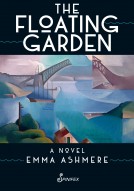
Emma Ashmere, The floating garden (Review)

Emma Ashmere, The floating gardenI had a little chuckle when, fairly early in Emma Ashmere’s novel, The floating garden, we discover that our main character, Ellis Gilbey, writes a gardening column under the name Scribbly Gum! Good name, I thought. If it hadn’t been for my school song inspiration, this would have been the name for me!

There’s another synchronicity for me, though, and it relates to the setting of this story. Last week I did a presentation on old Australian ads for an organisation I’m involved in. One of those ads was The charmed cup*. It was made in 1929, runs for around 8 minutes (can you believe it?), and is for Bushells tea. It also, coincidentally, contains footage of the Sydney Harbour Bridge mid-construction. It’s this construction which sets the scene for Ashmere’s story … so now, let’s get to it.

The floating garden is set in Sydney in 1926 when construction on the Sydney Harbour Bridge had started and houses in Milson’s Point on the north of the harbour were being  demolished with little or no compensation to the residents of those homes. One of those residents is middle-aged Ellis Gilbey, who has run a boarding house for over twenty years. At the novel’s opening the last of her boarders has left and she, with other residents in the street, is hoping against hope that some compensation will be offered. Meanwhile, in a well-to-do part of Sydney, south of the harbour, is 30-something Rennie Howarth, a young English artist who had “taken the outstretched arm of an Australian man she hardly knew and had sailed from everything cold, sad and stale”. Unfortunately that Australian man, Lloyd, who had brought her to a life of luxury, was also abusive.

Part 1 of the novel alternates the story of these two women, with more of the chapters devoted to Ellis. Whether these two women are connected, or are going to be connected, we don’t discover until Part 2 of this three-part novel. While we are wondering about this, Ashmere is busy drawing some parallels between the women – both have experienced brutal men in their lives, Ellis her father and then an employee in a house where she’d lived as a young woman, and of course Rennie her husband; both had toyed with theosophy; and both find themselves house hunting. Another parallel occurs within Ellis’s life when, destitute, she is taken in by an older woman, and then, when that doesn’t work out, destitute again, she is taken in by another older, but this time kinder, woman. These parallels are not laboured, but provide a subtle foundation to the story being told, and help hold it together.

Ashmere’s main focus is Ellis. In her story, we shift between past and present, while Rennie’s story is focused on her present. Ellis, we discover, had run away from her farm home, when she was a teen, after her mother died, and had found herself, rather by accident, in the home of theosophist, Minerva Stranks, aka Strankenstein, around the turn of the century. It was out of the frying pan and into the fire for Ellis, as Minerva is a cruel taskmaster and a charlatan, to boot. Ellis is sexually attracted to Minerva’s other protégé, the pretty Kitty Tate. Her belief that Kitty cares for her helps her survive her time in the house until … well, I won’t give this away, but by the novel’s opening, Ellis had been carrying guilt and regret for twenty-seven years.

We are not given the same depth of background for Rennie’s life before the present, but we learn that she’d had a couple of exhibitions in London before fleeing to Australia with Lloyd, and that she’d been a lively, fun woman before her marriage to a man who physically abused and emotionally manipulated her. In Australia her art changes from “polite English watercolours” to “bolder, flatter, earthier colours” that are all-round too confronting for Lloyd. She represents, as Ashmere explained in an interview on ABC’s Books and Arts Daily, the new modernist art movement, a movement which rejected tradition for something bolder. That’s certainly Rennie.

So, despite the parallels in their lives, Rennie works largely as a foil for Ellis, not only because of their class difference, but because she’s lively and risk-taking against Ellis’ more cautious approach to life, which is understandable given her greater age and particular experiences. If I have a frustration with the novel, it would be that Rennie’s story is not as developed as Ellis’s and that perhaps her main role is to be this foil or plot-device to move Ellis on rather than a character in her own right. This is more observation, though, than complaint, because overall the writing is evocative without being overdone, and the characters are engaging,

What I particularly enjoyed about the novel is that Ashmere does for the underprivileged of 1920s Sydney what Ruth Park did for the 1950s in Harp in the south. They are very different books in terms of their narratives and themes, but both exude warmth and sympathy for their motley crew of marginalised characters, and both are valuable for their social history. In The floating garden this includes evoking the about-to-be dispossessed Milson’s Point community, the charlatan fringe of theosophy, the colour of Paddy’s Markets, the energy of the artistic/bohemian community, and the opening up of land in the rural outskirts of Sydney, in Lane Cove.

The novel’s overall theme has to do with memories, guilt and grief, with the idea that you really can’t move on if you haven’t resolved your past. Late in the novel, as Ellis starts to understand the truth of what had happened all those years ago, Ashmere writes:

She’d grown used to her memories for all these years and now her grief – her guilt – had grown around them in the same way a tree’s trunk grew around a rock until both the rock and the tree risked mutual destruction if prised apart.

But sometimes, there can only be progress if they are prised apart – and prised apart they eventually are, of course.

The floating garden is a very enjoyable book. It deals with real issues honestly but gently, and it brings to life a past world in a way that enhances our understanding of the present.

awwchallenge2015Emma Ashmere
The floating garden
North Melbourne: Spinifex Press, 2015
243pp.
ISBN: 9781742199368

(Review copy supplied by Spinifex Press)

* Unfortunately, the ad is broken into three clips on this page. Clip 2 contains the Bridge footage.

Dymphna Cusack, Jungfrau (Review)

Dymphna Cusack, Jungfrau

Courtesy: Allen & Unwin

Are there some historical periods that particularly fascinate you? There are for me, and one of those is that between the two world wars. It was a complex time encompassing both economic hardship and great social change. A time when many of those Victorian era constraints were being lifted and women, in particular, were starting to enjoy an independence and freedom they hadn’t had before the First World War. Dymphna Cusack’s first novel, Jungfrau, is set in this period and deals with this very subject.

I have written about Cusack before, when I reviewed A window in the dark, her memoir about her time as a teacher. Because of its relevance to this novel, I’ll reiterate a couple of the points I made in that review. Cusack, I wrote, had a finely honed moral and social conscience, and was acutely aware of injustice. She was convinced of the “wickedness of our economic system”, and abhorred the power those with money had over others. She was consequently outspoken on social and economic justice issues, and was particularly critical of the treatment of “that much-maligned creature, the woman teacher”. A window in the dark was written forty years after Jungfrau, and is a memoir, but you can see the genesis of her values and ideas in this, her first novel.

Jungfrau is set in Sydney over a few months in the 1930s. It concerns three young women in their mid to late twenties: the rational, realistic and religious Eve, the emotional, dreamy and vulnerable Thea, and the modern, pragmatic, confident Marc. Eve and Thea have been good friends for several years. Marc is Thea’s friend, but Eve and the free-thinking Marc do not like or understand each other. At the novel’s opening, Eve and Thea are talking about Thea’s interest in a man twice her age, a married university professor. Eve cautions Thea about the risks, but Thea is ready “to take life—use it—now, instead of letting it use me”. Eve gently retorts that “If you leave yourself open to the world, it will rush in on you”.

Indeed, Eve, who has seen first hand in her maternity ward the results of poor, single women taking life, suggests that experiencing life “is much safer in books”. She says to Thea:

When you talk about getting in touch with reality and finding out what life is, all you really mean is following your instincts in spite of the consequence … Only, if you take your friend Marc’s prattling literally, I’d advise you to learn more about physiology than you know at this moment. You can’t safely combine what your modern friends rather euphemistically call ‘experience’ with a degree of ignorance that’s almost mid-Victorian. You’ll need to be practical if you’re going to be a realist. Marc’s evidently both.

The novel, as you’ve probably guessed by now if the title hadn’t given it away, explores what happens when Thea does not heed Eve’s advice and lets this relationship develop. I’d call this a coming-of-age novel but, having been written by Cusack, its themes are as much social as psychological. What did it mean for a woman at that time to have an affair with a married man, and what were her options with the – hmm – consequences?

The trouble is that while obstetrician Eve and social worker Marc are daily faced with the grim realities of life, teacher Thea evades them. Here’s Eve on her ward rounds,

All this rot about reality, this frenzied escape into abstractions, had curiously little to do with life as she knew it. … Here was reality. Tortured bodies, tired minds, birth and death. Nothing vague about this; no escaping from facts; no sheltering behind fancies.

Acerbic Marc has her own view on woman’s lot:

Women are cursed, all right. If you wither on the virgin stem you go all pathological; if you go off the deep end you get some foul disease; and if you marry and have dozens of young you die of exhaustion.

By contrast, here is Thea discussing the real Jungfrau with her professor:

“Yes,” he said almost inaudibly, “white, proud and untouched. But they’ve built a funicular almost to the top of it now, and the tourists swarm all over it like flies.”

“Poor thing! I don’t mind climbers and mountaineers; but it must hate the tourists soiling it—”

“That is usually the fate of the proud and the untouched,” he said, digging his stick in the turf, and she recoiled as though struck, her hands flung out in a gesture of defence.

Oh dear, we readers think – and so would Eve and Marc if they’d heard this conversation. Their lot, though, is to love Thea and to watch in dismay as she takes life to an edge that she is not fit to handle.

The critical thing about this book is that Cusack doesn’t judge these three women for their choices. We might find Marc a more sympathetic, more appealing personality, of the three, but Cusack is even-handed. She understands human psychology and empathises with women. Her ire is focused more on society’s expectations and rules than on any one woman’s decision or behaviour. I described this novel earlier in my review as a coming-of-age novel, but it could equally be called a novel of ideas. In it Cusack exposes “the reckless squandering of human possibilities”, of lives “anaesthetised by half-baked education, political platitudes and doles”. Economic inequities, abortion, women’s independence, and the meaning of freedom are her targets.

I read this book as part of my long-term plan to read classic Australian literature – and I enjoyed it immensely. While the social milieu is very different from now – thank heavens – the emotional truths transcend the particulars of time and place. The language did feel a little overblown at times. It has that DH Lawrence sort of emotional intensity that can sometimes be a little too melodramatic, or declamatory, for my 21st century ears. And yet, paradoxically, one of the novel’s real pleasures came from its descriptions of Sydney. Cusack catches the landscape – the plants, the light, the water – beautifully (but I’ll save sharing a couple of those for a Delicious Descriptions post).

I imagine this was a confronting novel at the time of publication, but I hope it got people thinking, as Cusack surely intended. Cusack, Katharine Susannah Prichard, Miles Franklin, Marjorie Barnard and Flora Eldershaw, to name the best known from that era, were fierce and intelligent writers. We are lucky to have them.

awwchallenge2015Dymphna Cusack
Jungfrau
Sydney: Allen & Unwin, 2012 (Orig. ed. 1936)
ISBN: 9781743431450 (ebook)

Note: I do need to have a little whinge. There were several errors/typos in my kindle edition, which is disappointing and did spoil the read a little.

Jane Rawson, A wrong turn at the Office of Unmade Lists (Review)

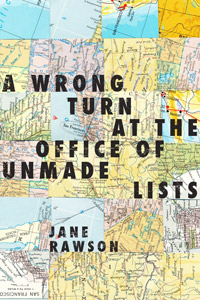
RawsonWrongTurnTransitThe weirdest thing happened when I put down Jane Rawson’s debut novel, A wrong turn at the Office of Unmade Lists: I started imagining things! This is weird because I’m not a particularly imagin­ative or fanciful person, so it must have been this book that did it. Let me explain …

First though, I need to say that I’ve been keen to read this book for some time. It started with the cover. I tend not to focus a lot on covers but some do grab me. This one, with its chequerboard of maps, is both eye-catching and intriguing. Then there’s the title. As a librarian/archivist, I’m drawn to organisation and lists but don’t mind a little anarchy every now and then. Is that what’s going on here, I wondered? And finally, there’s its MUBA award win last year. So it came down to a case of three strikes and you’re out – or, more accurately, in – and I bought the book. Well, what a read, because …

A wrong turn at the Office of Unmade Lists is a very unusual book. It traverses two places and times: Melbourne in 2030 and a sort-of imaginary San Francisco in 1997. It is, partly at least, a cli-fi* book. 2030 Melbourne is a bleak place – it’s very hot, clean water is harder to come by and more expensive than beer, soap is a luxury, and UN peacekeepers are in town. The rich survive as they do, but poverty is common, and many people live on the streets or in humpies. Bodies are regularly found in the streets. It’s a world you expect in dystopian novels, except that despite appearances, this novel is not completely dystopian.

Indeed, the novel has been described as a “genre-buster”. It is, for example, also a time-travel story, which brings me to the plot. Our protagonist is 33-year-old Caddy, who is living rough, having lost her husband and home in a heatwave-induced fire a couple of years before the novel opens. Like many in this devastated city, she survives on odd jobs – working in a bar, doing courier work, and selling her body. She has friends – an indigenous man and wheeler-dealer Ray, and bar-owner Peira. She also likes to write, and this is where San Francisco comes in because the story she is writing is set in 1997 San Francisco. It’s about two orphans-cum-childhood friends, 17-year-old Simon and 14-year old Sarah. They spend their time following a quest started by their parents in which they have to stand at least once in every 25-foot square of the USA, in order to see the whole country. With me?

At first this story of Caddy’s is told in italics within the main story, but in Part Two the narrative shifts and whole chapters are told in Sarah’s voice. Meanwhile, Caddy, with Ray who has bought some used and apparently magical maps, time-travels from Melbourne to San Francisco where they meet her creations.  Still with me? Hope so, because it gets tricksier. This “travel” involves passing through a sort of netherworld called The GAP, where we find the Office of Unmade Lists, and other sections including Tupperware Lids, Partially Used Pens, and Suspended Imaginums. Suspended Ims, as we in the know call it, is where the things that people imagine but “don’t come true” end up. I think that’s where my brief imaginings have gone!

This sounds more complex than it is – or, should I say, it’s conceptually complex but not hard to follow. Indeed it’s a hoot to read, because for all the grim, grittiness of this climate-damaged world, there’s warmth, love and humour – and a delightful sense of the absurd. I loved Rawson’s exploration of the two universes, the “real” and the “imagined”, and the way she has them meet. She messes with our minds! It made me think of Marion Halligan’s comment about her main character in Fog garden. Halligan writes: ‘She isn’t me. She’s a character in fiction. And like all such characters she makes her way through the real world which her author invents for her. She tells the truth as she sees it, but may not always be right.’ Halligan’s purpose is different, but the concerns, those to do with where imagination ends and reality begins, are similar.

That said, I’m not 100% sure of what Rawson’s purpose is, but I think she’s playing with her readers, with the idea of writing fiction, and with the meaning of fiction itself. Take, for example, her character Simon responding to Caddy telling him he’s her creation:

‘You come in here and tell us we’re imaginary, and now you’re saying you’re not even a very good writer! What do you mean? Like we’re all two-dimensional and shit, not fleshed out at all? Unrealistic? Is that what you’re saying? I don’t feel unrealistic. I feel pretty pissed off actually, which is kind of a realistic response to someone telling you you’re a shithouse imaginary character.’

Caddy looked at Ray like he might somehow get her out of this. He still had his head in his hands.

‘Sorry’, she said. ‘You’re heaps more complicated than what I imagined, if that helps.’

I love the sly, tongue-in-cheek allusion here to literary theory, to EM Forster’s notion of flat and round characters. This is just one of several references in the book to the things readers and critics talk about.

A wrong turn at the Office of Unmade Lists is a fun, absurd, clever book in which Rawson somehow marries her very real concerns about the future of our earth with a belief that human compassion and ingenuity will survive, and wraps it up in an exploration of the complex relationship of imagination to reality. Imagination, Rawson seems to be saying, is the real stuff of life.

So, my recommendation is: Don’t worry about the book making complete sense. Suspend your disbelief, enjoy the ride, and realise that here is a lively intelligence you don’t want to miss.

Lisa at ANZLitLovers also enjoyed the book.

awwchallenge2015

Jane Rawson
A wrong turn at the Office of Unmade Lists
Melbourne: Transit Lounge, 2013
318pp
ISBN: 9781921924439

* Jane Rawson was, and maybe still is, Editor of Energy & Environment at The Conversation

Charles Hall, Summer’s gone (Review)

Charles Hall, Summer's gone, Margaret River Press

Courtesy: Margaret River Press

When Western Australian writer Craig Silvey set his coming-of-age novel Jasper Jones in the 1960s I was a bit surprised, as Silvey himself did not grow up in that era. I’m not so surprised, though, about Charles Hall’s debut novel Summer’s gone as Hall did grow up in the 1960s. The novel is, from my reading of the brief author biography, somewhat autobiographical, as debut novels often are: both Hall and his main character played guitar in bands, hitch-hiked across Australia, worked in labouring jobs and ended up studying at university. This, though, doesn’t mean the story is Hall’s story. It simply tells us that Hall wrote of a milieu he knows – a wise thing to do!

Summer’s gone is a part-mystery, part-coming-of-age narrative, and is told first person by Nick. It focuses on his relationship with two sisters, Helen and Alison, and another young man, Mitch, with whom he’d formed a folk band in 1960s Perth. The novel starts, however, in Melbourne in 1967 with Nick finding 20-year-old Helen dead (or dying) on their kitchen floor. What happened to her, why it happened, and Nick’s feelings of guilt about it, form the novel’s plot. The theme, though, is something else, it’s about

the trouble with dwelling too much on the past – sometimes you remember other things as well, things you don’t necessarily want to think about.

Except, of course, we do often need to dwell on the past if we haven’t resolved it, we need to think, as Nick does, about the things we did, didn’t do, or might have done differently. We need, in fact, as Nick has come to realise, “to say goodbye to things. And perhaps even to understand.”

To tell his story, Nick slips between the 1960s, the mid 1970s, the 1980s, and sometime around the present from which he is looking back. Hall handles these time-shifts well: it’s not difficult to know where you are, and it effectively replicates the way we often approach the past, that is, in fits and starts as we put together what happened.

It’s an engaging story. Nick, the young version anyhow, is a rather naive and not well-educated – but not unintelligent – young man. He’s not wise in the ways of the world, but he’s decent, and prepared to give things a go. He has a poor relationship with his Perth-based mother, and his only real adult role model is his uncle Clem in Melbourne. The relationship between the four young people is nicely evoked, though because it’s a first person story, the other three characters are only developed as far as Nick understands them, and Nick is not always the most perceptive person. I found this a little frustrating – I wanted to know the other characters more – but I suppose it’s fair enough given the narrative voice chosen.

What gives this book its greatest interest is the social history. Many of the main stories of the period are worked into the narrative – abortion, and the horrors resulting from lack of legalisation; the Vietnam War, conscription, draft-dodging, and the physical and psychological damage experienced by soldiers. Nick also spends time in a hippie commune, and other news events like the Poseidon bubble and crash, the beginnings of women’s liberation, and the release of the Beatles’ Sgt Pepper’s Lonely Hearts Club Band album also get a mention. If you lived through this era, the novel provides an enjoyable wander down memory lane. It reminds us of the hopes and ideals of a generation which felt free to explore life and love, to rebel against the constraints of their elders, even though this freedom wasn’t always all it seemed to promise. I did feel, however, that Hall could have left the social history to this era. The references to Chernobyl and mesothelioma started to feel a little forced, and not really necessary to the plot, even though the mesothelioma issue is used to tighten the noose around one character just that little bit more.

Hall’s dialogue is realistic, and gives flavour to the era, and I did enjoy his descriptions of place – of Perth suburbs, and Melbourne, of travelling the Nullarbor and of country Victoria. These descriptions are kept to a minimum, but are just enough to breathe life into the scene.

Early in the novel, Hall refers to chaos theory and the butterfly effect, to the idea that “a minor detail has the power to change everything”. That’s probably true but I’m not sure it tells us anything we don’t already know! There are many minor details in our lives, and we could go mad worrying about which is the one that will (or did) change everything. Fortunately, I think Nick eventually agrees.

This is not a difficult novel, but it is warm, readable, and sings to us of summers past when the world seemed golden, but when in fact there was, as there always is, much more to it than that.

Lisa at ANZLitLovers enjoyed the book also for its evocation of the era.

Charles Hall
Summer’s gone
Witchcliffe: Margaret River Press, 2014
288pp.
ISBN: 9780987561541

(Review copy supplied by Margaret River Press)

Eimear McBride, A girl is a half-formed thing (Review)

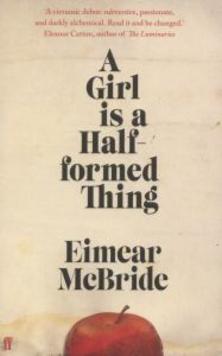
Eimear McBride, A girl is a half-formed thingI try very hard when writing reviews to avoid clichés and superlatives, like, say, “achingly beautiful” or “masterful”. But I think I’m going to use one for Eimear McBride’s multi-award-winning debut novel A girl is a half-formed thing when I describe it as “searing”. I can’t think of a more apposite word. Yet I fear it too has been over-used to the point of meaninglessness. So, let’s try something else …

Once again I’m coming late to the read, and once again this is partly because it was scheduled by my reading group. All I can say is, wow. I’m not sure I’d go so far as Eleanor Catton’s “read it and be changed” commendation on the front of my edition, but I do agree with her  “virtuosic” and “subversive”. It’s a gut-wrenching read.

The plot itself is simple enough. It’s the story of a family – a pious one-could-say-religiously-fanatical mother, a son who survived a serious brain tumour as a toddler, and the younger daughter. The tumour leaves the son somewhat brain-damaged and, of course, it returns. This tumour, the trauma of it, shapes their behaviour and defines their relationships. The story, which spans around 20 years, is told through the daughter and could, in one sense, be seen as coming-of-age. But. This. Tells. You. Nothing. Because …

This is not your typical first-person voice. Instead, we are in the head of the unnamed “girl”. We are there in her conscious unconsciousness (or, is it her semi-consciousness?) in which we hear what she’s experiencing in language that is – here’s another cliché – raw. By this I mean that the language is stripped of the mediation of a formalising narrator’s intellect. Instead it captures the immediate emotional truth of the girl’s experience as she grapples to make sense of her world. This is a book in which the style conveys the meaning as much as the words do.

How does McBride do this you are probably wondering (unless, of course, you’ve already read the book). Well, mostly by breaking, consistently, the rules of grammar and syntax. We are in the girl’s head, a place where, I believe McBride is saying, we rarely think in coherently formed sentences but in what I would call “impressions”. Take, for example, this description, on the first page, of the brother before his diagnosis:

I know. The thing wrong. It’s a. It is called. Nosebleeds, headaches. Where you can’t hold. Fall mugs and dinner plates she says clear up. Ah young he says give the child a break. Fall off swings. Can’t or. Grip well. Slipping in the muck. Bang your. Poor head wrapped up white and the blood come through. She feel the sick of that. Little boy head. Shush.

To orient you, “she” is Mammy, “he” is the father who disappears two pages later, and “you” are the little boy, the girl’s brother. Most of the novel is addressed to him (that is “you”). One of the challenges of reading this book, and it is a challenge to read, is its pronouns. Once you’ve got a handle on them, and once you realise that they are all from the perspective of the girl, you are half way there.

Anyhow, there is easier syntax than the above when life is relatively calm but, when our “girl” is distressed such as when the truth of her brother’s situation can no longer be avoided, it collapses almost completely:

I walk the street. City. Running through my mouth. Running in my teeth the. My eyes are. All the things. The said the done what there what’s all this? That stuff. I could do. My. I walk the street. Who’s him there having a look at me he. Look at my. Tits. Ssss. Fuck word. No don’t. Fuck that. No. Will. Not that. Not. That. But. If I want to then I can do.

This is not the most extreme example – I don’t want to spoil too much – but it should demonstrate what I mean by the language mirroring/enacting/even being her state of mind.

In addition to the idiosyncratic syntax, McBride draws on wide range of literary techniques to keep us focused on, grounded in the emotions of the here and now. The imagery is visceral, returning again and again to  “muck”, “dirt”, “blood”, and “puke”. She alters her rhythms to match the tone, not only through the syntax as evident in the examples above, but through allusions to and repetitions of prayers and hymns, lines from children’s games, literary works and sayings. She makes up new words (“I trup trup off behind her”), mangles existing words (“swoll” for “swollen”), and twists common expressions (“There’s a foul there’s a wind where’s the air”). McBride was inspired by Joyce she says, but her fresh, fearless, urgent language reminded me too at times of Gerard Manley Hopkins.

The novel is clearly set in Ireland and there are odd references to 1980s technology like Game Boys, but overall place and time are unspecified, and none of the characters are named. All this keeps the focus squarely on the emotional core of a family in pain, and the girl in particular. She is abused by her uncle at the age of thirteen and begins a strange love-hate, violent-tender, but sick, relationship with him. Sex becomes for her a weapon, a tool and a punishment. But the book is not about this, that is, it’s not yet another book about abuse. It is about the girl’s inability to handle her emotional pain, and her family’s inability to see her need, it’s about growing up unsupported. She is complicit in her own degradation because for her physical pain is better than the emotional. Like those who self-harm, she seeks out abuse again and again because

… what’s wrong here is me me me. Me the thing but I. Think I know. Is that the reason for what’s happened? Me? The thing. Wrong.

I know this all sounds unremittingly bleak and it largely is, but there are light touches – blackly comic scenes, surprising word plays, and chuckle-inducing descriptions (like her mother’s friends, “they polyester tight-packed womanhood aflower in pink and blue”).

A girl is a half-formed thing is hard to read style-wise and painful to read content-wise. But it is a book that, if you let it, reaches deep into your core and makes you understand the lives of others in a way that only the best literature can. I’m so very glad I read it.

John at Musings of a Literary Dilettante also liked it.

Eimear McBride
A girl is a half-formed thing
London: Faber and Faber, 2014
203pp.
ISBN: 9780571317165

Brooke Davis, Lost & found (Review)

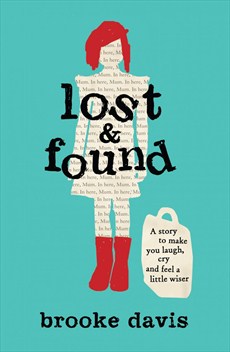
DavisLostFoundHachetteI must say that my antennae go up when I hear a book being touted as a publishing sensation even before it is published, as Brooke Davis’ recently published debut novel Lost & found, was. What does that mean? That it was the subject of a mega-dollar bidding war like, say, Hannah Kent’s Burial rites? Well, not necessarily, but Davis’ novel, according to hoopla.com, was “one of the hit titles at the 2014 London Book Fair and has since gone on to sell into 25 territories”. The question is, does it live up to this, hmm, hoop-la?

You’re all going to die (Millie)

I’ll start by saying that this “sensation” comes dressed as a light book and is, in fact, an easy and delightful read, but it also offers something more, content-wise and stylistically. For those of you who haven’t heard, the novel was inspired by Davis’s grief over the sudden death of her mother in a freak accident in 2006, and was written for her doctorate at Curtin University. It tells the story of three characters: seven-year-old Millie whose father has died and whose mother subsequently abandoned her in a department store; 87-year-old Karl whose wife has died and who has escaped the nursing home to which his son had abandoned him; and 82-year-old Agatha who hasn’t left her house since her husband died seven years ago, and who fills her day shouting insults at passersby. Three lost characters who come together, looking, though not initially consciously, to understand the old question: what is life about, or, more specifically, how do you live life when it is defined by loss, or even, as Agatha wonders, wouldn’t it be better to never care for anyone?

At the end of my edition is a short version of an article titled “Relearning the world” that Davis wrote about grief.  If you have experienced the terrible grief of sudden or before-its-time loss, you will relate to much of what she writes. She talks of the moment when the loss becomes real (a moment I vividly remember in my own life), and of “feeling outside of everything and looking in” (another sensation I remember). She talks of theories of grief, like Elizabeth Kubler-Ross’s, and how it makes sense because “we like order”. “Isn’t that”, she asks, “why we like narrative?”. But, she says, there’s been a backlash against the compartmentalisation of grief towards a recognition of “the disorder of grief”. Grief, she has learnt, is part of everything she says and does, all that she is. It is never resolved.

We’re just living, Derek (Karl)

This all sounds pretty heavy, albeit sensibly heavy. Davis’s book, however, is quite the opposite. The narrative line owes something to the picaresque novel, and the linear but choppy structure supports this form. The main body of the story concerns a rather wild and wacky journey the three characters take, some of it on the Indian Pacific train, to help Millie find her mother. As befitting the picaresque, they meet various colourful characters along the way, such as Stella the bus driver and Derek the train conductor. As the journey progresses, the adventures and mischief get sillier and sillier, and less and less “real”. But then, this isn’t a realistic novel. In fact, it is quite slapstick, which is not my favourite form of humour. However, Davis makes it work, pretty well anyhow, because we are invested in her characters by then. We want them to find what they are looking for – or something equally worthwhile.

Old is not a choice (Agatha)

Davis also makes it work because of the voice. Using third person, it’s fresh, and direct, and authentically captures the perspectives of a curious young child, a loving old man, and a grumpy old woman. It might be a “light” novel, but it’s not a prosaic or formulaic one. Each character is associated with various “things” or “recurring behaviours”. Just Millie writes “In here Mum” messages whenever she goes to a new place so her Mum can find her. Karl the Touch Typist, who had deeply loved his wife Evie, carries around Manny the store mannequin, with which he had helped Millie escape the authorities in a department store and which is mistaken for a sex doll by some of the people he meets. Agatha Pantha, a closed-off woman who had not been a kind wife, has her Age Book, in which she obsessively records her day in third person. Some of the character “associations” might, depending on your point of view, be a little overdone, just as the slapstick, depending on your tolerance, may be pushed a little too far. Overall though, I found Davis’ characterisation effective and engaging.

All this is supported by the narrative, which is moved along through delightful language, from the zippy dialogue to tight descriptions that nail with their acuity.

Here, for example, is Agatha trying to explain to Millie why at seven she can’t start a family:

You can’t get pregnant.
Why not?
You have to get your! Your! Agatha gulps. Your monthly womanly visitor!
Are they from the government?
Good God, no!
Where from then?
They’re not from anywhere!
Why are they called visitors, then?
That’s just what we say!
Who?
Agatha sighs loudly. Okay, I give up! Someone from the government comes to your house and makes you a woman!
Millie eyes the breastfeeding mum, and leans in close to Agatha. Will they bring me boobs too? she whispers. Because I’m not going to take them.

And here is Millie’s view on dates on gravestones:

The start date and the end date are always the important bits on the gravestones, written in big letters. The dash in between is always so small you can barely see it. Surely the dash should be big and bright and amazing, or not, depending on how you had lived. Surely the dash should show how this Dead Thing had lived.

Besides the loss-grief theme, Lost & found is about many things – loneliness, love, friendship and caring, and, above all, about taking risks because this is your life. It’s not a challenging novel, as it wears its heart on its sleeves, but it is lively, inventive and wise. It will be very interesting to see what Davis does next.

awwchallenge2014Brooke Davis
Lost & found
Sydney: Hachette Australia, 2014
280pp.
ISBN: 9780733632754

(Review copy courtesy Hachette Australia)

Roslyn Russell, Maria returns: Barbados to Mansfield Park (Review)

A week or so ago my local Jane Austen group had a guest speaker at our meeting, Roslyn Russell, the author of Maria returns: Barbados to Mansfield Park. Russell is a local historian who has written this historical novel based on Jane Austen’s novel, Mansfield Park. She is also a lapsed member of our group, so of course we had to ask her to come and talk to us about it. Most of this post draws from my report of her talk, which she titled Maria returns: Barbados to Mansfield Park: Fictionalising the legacy of slavery in Mansfield Park.

Regular readers probably know that I’m not a fan of fan-fiction or sequels of well-known works. In fact, I probably wouldn’t have read any if it hadn’t been for belonging to the Jane Austen Society of Australia. However, having read Deidre Shauna Lynch’s essay, “Sequels” in Jane Austen in context, edited by Janet Todd, I decided that I should relax my “rule”. Lynch convinced me that these books are an important part of our understanding of Austen as a literary and cultural icon. Consequently, I have now read PD James’ crime novel Death comes to Pemberley (my review) and Jo Baker’s Longbourn (my review). Roslyn Russell’s historical novel is my third. In it, she imagines that some ten years after being banished to the country, and upon the death of her companion Aunt Norris, Maria Bertram goes to Barbados and learns about slavery and the abolition movement.

There are, I’m gathering, many different reasons why writers want to write sequels or fan fiction works. For Russell, it was, as she writes in her author’s note, inspired by two passions: her love of Jane Austen and of Barbados. Barbados? How many Australians have been to, let alone developed a passion for, Barbados? Not many, I expect. It was her museum work, in fact, which took Russell to Barbados and there, its history – and particularly the history of its plantations and the practice of slavery – reminded her of Jane Austen’s Mansfield Park in which the leading family, the Bertrams, draw their prime income from their plantation in Antigua.

Jane Austen, Mansfield Park and Slavery

Russell commenced by telling us that although most of the characters in her novel are fictional, some are based on real people. Before discussing this further, however, she read the excerpt from Mansfield Park which contains the only reference to slavery:

“But I do talk to him more than I used. I am sure I do. Did not you hear me ask him about the slave–trade last night?”

“I did—and was in hopes the question would be followed up by others. It would have pleased your uncle to be inquired of farther.”

“And I longed to do it—but there was such a dead silence! And while my cousins were sitting by without speaking a word, or seeming at all interested in the subject, I did not like— I thought it would appear as if I wanted to set myself off at their expense, by shewing a curiosity and pleasure in his information which he must wish his own daughters to feel.” (MP)

She noted that this shows Maria and Julia’s lack of interest in the source of their family’s income. She then referred to cultural theorist Edward Said’s discussion of the novel and his statement that it is not appropriate “to expect Jane Austen to treat slavery with anything like the passion of an abolitionist or a newly liberated slave”. Said, she told us, did not apply 21st century attitudes to his assessment of Austen, but suggested that her work, as that of an author who belonged to a slave-owning society, should be analysed in context and in terms of what she does and doesn’t say rather than simply attacked as being complicit.

Ros then briefly outlined some of Austen’s known or probable connections with plantations:

  • the family’s close relationship with her father’s friend, the plantocrat James Langford Nibbs who was also Austen brother’s godfather. Nibbs apparently took his son out to his plantations in Antigua to settle down his unruly behaviour, which rather mirrors Sir Thomas’ taking Tom out to his plantation.
  • Austen’s aunt-by-marriage, Jane Leigh-Perrot, who was born in Barbados, though went to school in England.
  • Mrs Skeet who is mentioned in Austen’s letters. Skeet is a common name in Barbados, suggesting she had a connection to slavery*.
  • the Holder family of Ashe Park, also friends of the Austens. Holder, too, is a common name in the Caribbean.

The title Mansfield Park, itself, could also reflect Austen’s awareness of the slavery issue, as it may have been inspired by Lord Mansfield who was famous for adjudications which contributed significantly to the eventual abolition of the slave trade. (This is the Lord Mansfield who became guardian of his mulatto niece Dido, fictionalised in the recent film, Belle).

Barbados and Maria Returns

Russell then turned to her own book, first addressing the question of why she had set it in Barbados and not Antigua, where the Bertrams’ plantation was. Firstly, she has been to Barbados several times and knows its history. She couldn’t, she said, write about a place she didn’t know. Secondly, Barbados is also the location of a historical event she uses in her novel.

Mansfield Park was written 20 years before emancipation (i.e. the formal abolition of slavery) in 1834. Maria Returns is set about 15 years after MP, and so during the time when the abolition movement was becoming more vocal. Ros explained that the abolition of the slave trade in 1807 did not seriously affect the Caribbean plantations: they were “breeding” their own slaves and were essentially self-sufficient. However, the abolition of slavery represented a major threat to their livelihoods, and the plantation families were deeply concerned. By the 1820s the abolition movement was becoming active – mostly among Evangelical Anglicans, Methodists and Quakers.

Ros discussed the historical basis of her fiction. For example, at the dinner party in the English village where Maria first meets abolitionist John Simpson, he talks of a trial in Barbados in which slaves were apparently unjustly convicted of and executed for a murder. This trial did occur and is a reason Russell chose Barbados for her setting. The trial was witnessed by James Stephen** who, though he lived a little earlier than our fictional Simpson, is Russell’s model for her character.

Simpson also talks at this dinner about a slave rebellion, led by African-slave Bussa, that occurred in Barbados in 1816. Bussa was killed in the rebellion. Such slave rebellions resulted in plantation owners becoming harsher. Simpson makes it clear which side he is on. This is a wake up call for Maria who:

had not been aware of the strength of feeling in the wider community against the institution of slavery, from which her own family had benefitted so materially. (MR)

After Maria arrives in Bridgetown she meets or hears of other abolitionists, such as the historically real free coloured man, Sam Prescod (who, with Bussa, is now a national hero) and plantation owner Josiah Thompson. Thompson is fictional but, as a former owner who had downsized his estate and treated his slaves-now-servants well, he has historical antecedents. Men who behaved like he did faced hostility from other Barbadians – and so, in the novel, Thompson is a lonely man who is keen to host Maria and her friends at his home. His willingness to import a teacher from England to teach his slaves also has precedents. Maria realises again that she’d never wondered about her father’s plantations, but she begins now to wonder what her father might think about the people she’s meeting.

Ros then spoke about the treatment of slave women by their white owners, particularly in relation to sexual predation. This forms an important part of the story – but I won’t spoil it here. However, she again spoke of historical precedents – not that we really needed any for this one!  We weren’t, though, quite prepared for the example she gave us, one Thomas Thistlewood who kept a diary of his plantation life. Wikipedia confirms what Ros told us: his diary chronicled “3,852 acts of sexual intercourse and/or rape with 138 women, nearly all of whom were black slaves”.

Roslyn Russell, Maria Returns Ros illustrated her talk with some wonderful illustrations, including the painting used on the cover of her book, Agostino Brunias’ The Barbadoes Mulatto Girl. She also mentioned some of the sources she used in her research, like Andrea Stuart’s Sugar in the blood: A family’s story of slavery and empire.

So, the novel

I enjoyed the read. It is pretty much genre historical fiction rather than literary fiction, so not my usual fare. Russell doesn’t try to emulate Austen, and while her writing is clear, her dialogue can be a little too formal and uniform at times. She includes a lot of information about life at the time, information that Austen herself would not have needed to, and indeed did not, supply. But, of course, this is historical fiction, and modern audiences need background that Austen’s contemporaries didn’t.

Russell spins a credible story, both in terms of the plot she creates and how she develops the characters she draws from Mansfield Park. Maria does change significantly, but Russell convinces us that she could. However, this is historical, romantic fiction, not a fierce novel, so Russell’s more culpable characters, in particular Bertram father and son, are let off more lightly than they deserve. This perhaps mirrors the political reality: after emancipation, the Caribbean plantation owners received in total £20 million compensation, while the slaves received nothing.

What did Austen know and feel about slavery? We’re unlikely to ever know, but in Maria returns Russell has given us some insight into the darker side of life that Austen only hints at.

* Names that are common in slave areas are usually so because slaves tended to take on the surnames of their masters.

** Wikipedia tells that Stephen was great-grandfather of Virginia Woolf.

awwchallenge2014

Roslyn Russell
Maria returns: Barbados to Mansfield Park
Flynn: Bobby Graham Publishers, 2014
(Kindle ed.)

Tara June Winch, Swallow the air (Review for Indigenous Literature Week)

Tara June Winch

Tara June Winch (Courtesy: Friend of subject, via Wikipedia, using CC-BY-SA 3.0)

Tara June Winch’s Swallow the air is another book that has been languishing too long on my TBR pile, though not as long as Sara Dowse’s Schemetime. For Swallow the air, it was a case of third time lucky, because this was the third year I planned to read it for ANZLitLovers Indigenous Literature Week. Like the proverbial boomerang, it kept coming back, saying “pick me!” Finally, I did.

Winner of the 2004 David Unaipon Award for unpublished indigenous writers, Swallow the air made quite a splash when it was published in 2006, winning or being shortlisted for many of Australia’s major literary awards. (See Tara June Winch’s Wikipedia entry). I believe Winch is working on another novel, but it hasn’t appeared yet.

Now, though, to the book. The first thing to confront the reader is its form. It looks and even reads a little like a collection of short stories*, but it can be read as a novella. There is a narrative trajectory that takes us from the devastating death of narrator May Gibson’s mother, when May was around 9 years old, to when she’s around 15 years old and has made some sense of her self, her past, her people. May’s mother is Wiradjuri, her father English. At the novel’s opening, she is living in coastal Wollongong, which is not her mother’s country, in a single-parent household with her mother and her brother, Billy, who has a different and indigenous father. Absent fathers are, I should say, disproportionately common in indigenous families.

In fact, one of the impressive things about this debut novel is how subtly, but clearly, Winch weaves through it many of the issues facing indigenous people and communities. Poverty, loss of connection to country, the stolen generations, mining and land rights, alcoholism, drug addiction, racism, rape, child abuse by the church, imprisonment and the tent embassy are among the concerns she touches on during May’s journey. Listing them here makes it sound like a political “ideas” novel but, while Swallow the air is “political” in the way that most indigenous writing can’t help but be, its centre is a searching heart, for May has been cast adrift by the suicide of her mother. Life, which was tenuous anyhow, becomes impossible to hold together as her brother and aunt, both loving, struggle with their own pain.

This is where I become a little uncomfortable as a non-indigenous person making a generalisation about indigenous literature, but I’m going to do it anyhow, because I think I’m on firm ground. I’m talking about story-telling and what I understand to be its intrinsic role in indigenous culture. It imparts – or can do – a different flavour to the writing. Marie Munkara’s David Unaipon Award winning Every secret thing (my review) has some similarities in form to Swallow the air, and covers some similar thematic territory, but is very different in tone. Munkara’s novel also presents as a bunch of stories, with a uniting narrative thread. Swallow the air is more subtle, but nonetheless it’s the idea of stories that underpins the narrative.

What particularly impressed me about Winch’s writing is the way she manages tone and structures her story. She understands the Shakespearean imperative to offer some light after dark. For example, there’s a lovely little chapter/story called “Wantok” about family closeness which occurs after a story about a difficult work experience. In another situation, with just one word at the end of a story (“Mission”) – “Seemed [my emphasis] all so perfect, so right” – she prepares us for the opposite in the next (“Country”).

This flow – with shifts in tone that are sometimes subtle, sometimes dramatic, and with a narrative that is mostly linear but with the occasional flashback – kept me reading and engaged until the end. As did the writing itself. It’s deliciously poetic. Sometimes it is tight and spare, as in:

I do not cry, my eyes are hardened, like honey-comb, like toffee. Brittle, crumbling sugar. He puts his hand out toward me; we shake hands, a pact that I won’t be here digging up his past when he gets back.

And I’m not.

And in this description of life in the city: “Suits and handbags begin to fill the emptiness of the morning”. Other times it is gorgeously lyrical (a review buzz word, I know, but sometimes there’s no other word):

The river sleeps, nascent of limpid green, tree bones of spirit people, arms stretched out and screaming. And at their fingertips claws of blue bonnets, sulphur-crested cockatoos and the erratic dips and weaves of wild galahs, grapefruit pink and ghost grey splash the sky.

But back now to the story. As May makes her journey, we meet many characters – her brother, aunt, women like Joyce who care for her but also know when to push her on, men with whom she hitchhikes, to name a few. None of these characters are developed to any degree, but we learn what we need to know about them by how they relate to May. Most are kind, generous, nurturing. May’s journey, in other words, is not challenged so much by human barriers, but by emotional, social, political and historical ones. It is a generous thing that when she starts to understand her place, it’s an inclusive understanding, one that encompasses all of us who occupy this land:

And it all makes sense to me now. Issy’s drawing in the sand, boundaries between the land and the water, us, we come from the sky and the earth and we go back to the sky and the earth. This land is belonging, all of it for all of us.

However, while May comes to a better understanding of the land and her relationship to it, there is no easy resolution to the ongoing struggle of living in a place in which there is still “a big missing hole” created by the loss of connection to culture. It will take a long time to refill that hole, if indeed it can be done, but books like this will help communicate just what it means, and how it feels, to be so disconnected.

awwchallenge2014Tara June Winch
Swallow the air
St Lucia: UQP, 2006
198pp.
ISBN: 9780702235214

* One chapter/story, “Cloud busting” was published in Best Australian Stories 2005.