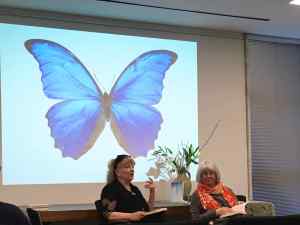
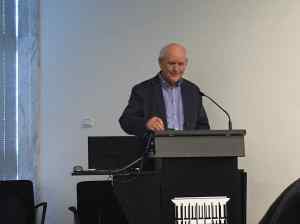
Canberra Writers Festival, 2017, Day 2, Pt 2: Two book launches

At last year’s festival, I attended a few excellent book launches, and so decided to do so again. Authors need all the support they can get after all.

Book launch: Ian Burnet: Where Australia collides with Asia

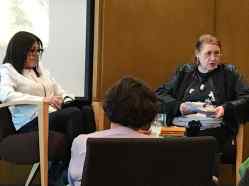
Burnet and Burdon

Burnet and Burdon

The first of today’s two launches was for a book with a very long title, by geologist Ian Burnet. It’s Where Australia collides with Asia: The epic voyages of Joseph Banks, Charles Darwin, Alfred Russel Wallace and the origin of the Origin of species. I haven’t heard of Burnet before, though he’s written a few books, and nor have I heard of the publisher, Rosenburg Publishing who produce “a small non-fiction list, concentrating mainly on history and natural history.”

So, that was interesting for a start. The book was launched by Sally Burdon of the Asia Bookroom here in Canberra.

I couldn’t possibly share all the information Burnet imparted to us about the four voyages he covers in the book. A lot of it is well-known, so well-known in fact that Burnet had been wanting to write about Alfred Russel Wallace, his hero, for a long time, but he couldn’t find an angle to make it worthwhile. The thing is that I didn’t know who this Wallace was.

The publisher’s website explains his importance. Wallace

realized that the Lombok Strait in Indonesia represents the biogeographical boundary between the fauna of Asia and those of Australasia. On the Asian side are elephants, tigers, primates and specific birds. On the Australasian side are marsupials such as the possum-like cuscus and the Aru wallaby, as well as birds specific to Australia such as white cockatoos, brush turkeys and the spectacular Birds of Paradise. It was tectonic plate movement that brought these disparate worlds together and it was Alfred Russel Wallace’s ‘Letter from Ternate’ that forced Charles Darwin to finally publish his landmark work On the Origin of Species.

This strait is apparently well-known in certain circles as The Wallace Line.

Burnet explained that the aha moment came when he was sailing in the strait and saw melaleucas, one of the unique species that supports Wallace and Darwin’s theory. He realised that this Australian connection was the story he could tell. (He found some other Australian connections, too, including Darwin’s contemplating his ideas about the origin of the species on the banks of Cox River, and the role of ornithologist John Gould in identifying adaptation in finches.)

An interesting point he made – one relevant to my write-up of the historical fiction session yesterday, even though this is non-fiction – is that it was the easiest book to research. Essentially all the critical documents he needed – letters, diaries etc by the main players – are digitised and available online. Way to go librarians and curators!

It was a lovely launch, and I learnt some things I hadn’t known before, which is always a plus.

Book launch: Stephanie Buckle: Habits of silence

I had identified this launch as one I wanted to attend, partly because the book is by a local author but even more because publisher Finlay Lloyd has sent me a copy of the book to review. Julian Davies, Finlay Lloyd publisher, introduced John Clanchy, whose gorgeous short story collection, Six, I’ve reviewed and who works with Finlay Lloyd as a manuscript assessor and editor.

Clanchy did a grand job of launching Buckle’s debut short story collection, Habits of silence. He explained that he met Buckle 10 years ago in a writers’ group, and talked about her achievements: some of the fourteen stories in this collection have been published before, have won prizes, and/or have been in editions of Best Australian stories. In other words, he said, she’s a writer with some cred (though he didn’t use that word.) She has worked at her craft, he said, even rewriting some prizewinning stories for this publication. (Interestingly, in a throwaway line, he mentioned that she has written a novel about the Canberra fires, From the ashes, but I don’t believe it’s been published as this is her debut book.)

Anyhow, Clanchy then discussed the book itself. He talked about the relevance of the low-light, empty urban streetscape on the cover, and said that it and the recurrence of words like “silence” and “wordless” provide a clue to the content. And this, he suggested, revolves around communication, about how it can break down, about the positive and negative impacts of silence. Silence, he said, can be positive, but with Buckle, things don’t stay the same, and smooth waters can turn turbulent.

Silence can be voluntary or involuntary. Two stories are about a stroke, which forces involuntary silence. He read an excerpt from one of these stroke stories. And then read from the second story in the book, “sex and money”, which is about voluntary silence, about silence being used aggressively by a wife who is not receiving the love and attention she desires. Both readings showed a gorgeous insight into human nature, and an ability to present it economically, as you’d expect in a short story.

Davies then returned to introduce Buckle. He reiterated her willingness to work on stories, suggesting this is partly a salute to being older, to the associated ability and willingness to produce stories of psychological subtlety. He then introduced Buckle to the podium.

Buckle said that the book was a long time coming, and that she never thought her first book would be a short story collection, given their general unpopularity. (Thank goodness for small publishers like Finlay Lloyd who take risks on unusual or less popular forms.) However, she loves short stories she said, particularly those of 2,500 to 3,000 words. You can’t hide in short story, and you can tease out a single idea. But, addressing the comment about her working on her stories, she said the hard thing is to know when to stop! I guess most writers – even bloggers – understand that!

She then read from two of her stories, from “us and them” which is set in a 1970s psychiatric hospital, and “the man on a path” which is about an older woman, widowed and lonely, going on holiday to a place she used to go with her husband. As she walks, all she sees are couples, until she sees a man alone walking towards her. The excerpt she read about what happens next was tantalising.

I so look forward to reading this book – but it will be a little while before it reaches the top of the pile.

Canberra Writers Festival 2017, Day 2, Pt 1: A conversation with Tony Jones

Choices, choices. Such a surfeit of riches across such dispersed venues made today a difficult one. In the end I had to make the tough decision to not see Jane Rawson, whose session was across the lake, though it broke my heart. My decision was made harder by the fact that as I was drafting this intro over my lunch break, a tweet came through promoting the event. Wah, but I’m trying to keep a cold at bay so being sensible about rushing around was the way to go.

But now, I’m going to have to try to emulate those historical fiction writers who need to leave out much of their research, otherwise I’ll be here all night – and I have things to do, books to read. Even so, I’m going to break this post into three parts.

Crime: Tony Jones with Krysia Kitch

Kitch and Jones

Kitch and Jones

Writers can’t always avoid controversy, particularly if they are political journalists, and so it was for Tony Jones who was attending the festival to discuss his new book, Twentieth man. Outside the venue was a small group of protesters holding a placard that said “Phony Tony, Propaganda through Plagiarism”. They believe the book is anti-Croatian, and that it plagiarises, writes Ina Vukic on her blog, “a Yugoslav era work of Propaganda titled Dvadeseti čovjek (the Twentieth Man) written by Đorđe Ličina”. I can’t comment on the propaganda aspect, because I haven’t read the book, but in his talk Jones mentioned that there has been speculation that there was a twelfth man in the Bugojno group which carried out an attack in Yugoslavia in 1972. So he decided to create a fictional twelfth man who survived the attack. And that’s all I’ll say about the protest, which Jones referred to a couple of times during the conversation.

Twentieth man is Jones fictional debut, and the first question turned on a favourite topic of mine, genre. Well it’s not that I love “genre” per se but I do enjoy discussions about definitions because they can help us tease out expectations. The question was, is this crime (as it was described for the Festival) or political thriller? Jones skirted answering this decisively by saying that it’s thrilling, it has crimes and it’s about politics! Fair enough. As the conversation progressed, I decided a third genre (or, perhaps, sub-genre) could be considered, historical crime! (Though again that raises the spectre from yesterday’s session about when is “history”.)

We’ll return to history later, but first something about the plot. It starts with the bombing of two Yugoslav Travel Agencies in Sydney in 1972 and ends with an assassination attempt on the Yugoslav prime minister. (Jones told us this so I don’t think it’s a spoiler!) Jones spent some time talking about the inspiration for the novel, at the same time giving us a refresher on fairly recent Australian political history.

Convenor Kitch from the National Portrait Gallery then referred to the Festival’s theme of Power, Politics, Passion and asked Jones what he thought about the power of the past over the present. Jones responded by referring to a quote often attributed to Mark Twain that:

“History doesn’t repeat itself but it often rhymes.”

He then talked more about the historical background to the novel, and about subsequent reporting and actions through the 1980s, 1990s and into the present, which prove that “history resonates again and again, it rhymes”.

Kitch mentioned how the shift of power between individuals is a major part of book. She said she loved his visceral descriptions of fear, and asked how he did it. Jones flippantly responded that he works at the ABC, but then, more seriously, said that he used his imagination … and that he could draw on some tricky situations he’d been in as a journalist.

This led to more conversation about the process of writing, such as his decision to mix “real” people with fictional ones. After all, he said, Tolstoy did it! He said he likes novels which deal with real history and fictional characters, and named James Ellroy’s novel on the Kennedy assassination, American tabloid, and Marlon James’ Booker prize-winning A brief history of seven killings exploring the assassination attempt on Bob Marley.

He also talked about researching and using documentary evidence to support his story, saying that the novel is fictional (of course) “but as close to real” as he could get. He’s not claiming it’s history but hopes it will encourage its readers to “reflect on the past”.

Kitch asked him about pacing – including the role of the moments of solitude for the characters – and also about his use of landscape to support his themes and characterisation.

Jones also mentioned the role of respected Australian publisher and editor Richard Walsh who offered to look over his manuscript. He told Jones there were two or more books there. So, folks, there will be a sequel!

There was so much more but this is getting long and I’ve covered the main issues I wanted to. There was discussion about the passion part of the Festival’s theme. First, Jones is clearly passionate about the topic. But, also, there’s a Romeo and Juliet style love story between the young Jewish journalist and the Croation hero/antihero.

Finally, Jones talked about the role of Canberra in the book, saying the city is “the star of this novel”. He thinks it provides a good picture of Canberra and its inhabitants at the time it is set. This was a blatant pitch to the locals as, he admitted, he’d been told to do!

There were some intelligent questions, but really, I must finish here, and will do so on Jones’ final words that Twentieth man is “a novel, largely a work of imagination but based on real events”.

Canberra Writers Festival 2017, Day 1: A panel and a conversation

It’s on again – the newly revamped Canberra Writers Festival, I mean. Due to a family commitment in Melbourne, from which I only returned at midday today, I didn’t get to some of the first day’s prime events. I missed, for example, a conversation with Graeme Simsion. I also missed a wonderful sounding panel titled Women in the Media, featuring Kathy Lette, Katherine Murphy, Virginia Haussegger.

The Festival’s theme – fitting for the nation’s capital – is Power, Politics, Passion, but my sessions today were more traditional writers festival fare.

Grasping the past: Tracy Chevalier, Amy Gottlieb and Rachel Seiffert in conversation with Gillian Polack

CWF, Polcak, Gottleib, Chevalier, Seiffert

From left: Polack, Gottleib, Chevalier, Seiffert

I chose this session because these writers interest me, as did the topic, historical fiction, which was one of the themes running through last year’s festival.

For those of you who don’t know the panelists, they were:

  • Gillian Polack (convenor): an historian and speculative fiction writer.
  • Amy Gottlieb: novelist and poet, whose debut novel, The beautiful possible, was published in February 2016.
  • Tracy Chevalier: novelist, most famous for The girl with the pearl earring but who has written 9 novels including Remarkable creatures which I’ve reviewed.
  • Rachel Seiffert: novelist, the daughter of an Australian-born father and German mother. She’s published three novels, of which the first, The dark room, was shortlisted for the Booker Prize.

What was excellent about this session is that it didn’t traverse the common issue of plausibility and authenticity. Instead, our jetlagged convenor wanted them to talk about how they transform their research into fiction. She was interested more in the process. It took a little while to get there but the discussion along the way was enjoyable anyhow!

A couple of issues were toyed with as the panelists grappled with the question. One of these related to the label itself. Gottleib, for example, said she didn’t see herself as an historical fiction novelist. It was the marketing people who labelled her book as such – because of its historical setting. Chevalier raised the issue of definition. When is a setting historical, she asked? Is her novel set in the mid 1970s historical? Seiffert agreed with Gottleib regarding the marketers applying the label, and suggested that historical fiction is seen as “more serious”. That intrigued my friend and me – and was immediately picked up by Chevalier who said that in England historical fiction tends to be seen as genre, and in opposition to serious literary fiction!

What came though strongly throughout the discussion is that these writers do not necessarily see themselves as historical fiction writers but simply as writers!

Meanwhile, Polack returned to her question regarding transforming historical research to fiction, by asking a more specific question regarding how they get their food research into their novels. This resulted in a detailed response from Chevalier who talked about her research process. She said that she can’t write about a period until she knows what people eat, how they eat, when they eat, what they sat on to eat, and so on. In other words, she needs to know what her characters would do on a day-to-day basis. And, here’s the challenge! She has to know this detail to create her period but she can’t tell it all in her novel. This is, as she clearly knows, one of the major criticisms levelled at historical fiction writers, i.e., that they can’t resist including their research, whether or not it’s not critical to the story.

Gottleib, though, starts with character. She knows the story – for example her character was going to leave Nazi Germany, travel to India, and then move to America. Once she knows this, she has to apply the scaffolding – to find out how he made this journey. This requires research. Seiffert, on the other hand, starts with the story first, being inspired, for example, by case studies and essays of people who resisted the Nazis.

Polack then asked the panel how they can do that thing that historians can’t, namely they can bring back erased people from past (such as women or servants), they can right wrongs or address flaws in past. How do they do this she asked?

Gottleib reiterated her interest in character, in their motivations, dreams, and longings. The history for her comes later. Chevalier referred to the book she made her name on – The girl with a pearl earring. She said she likes making things up, so she goes for the gaps – in the “real” story – and tries to fill them in. She likes to give voice to others, to their interior or emotional life. She is not about truth and facts, she said but about the emotional truth of the times. Seiffert referred to Kate Grenville’s The secret river and her feeling the need to write Searching for The secret river. It was as though she’d felt she’d “committed the sin of writing historical fiction” which is clearly something Seiffert felt she didn’t need to do.

Chevalier commented at this point that she has a huge respect for historians; she relies on them.

Polack then moved onto the thorny issue of avoiding cultural and historical bias when writing about a time different from their own. Chevalier said she was always on the look out for 21st century attitudes in her characters. She had to remember in Girl that a 17th century maid would have no feelings of social or economic empowerment.

Seiffert, who has written two books about the Third Reich, took this a bit further explaining that her character in A boy in winter doesn’t know the Holocaust is proceeding but the readers do. She had to fight that, showing that he had to make choices not knowing the full story, while the readers do know. You need, in other words, not to give characters foreknowledge.

Gottleib said that she handles this issue by having a narrator. She said that Latin-American fiction and Gabriel Garcia Marquez  got her into writing fiction, because she loved his multiple layering of stories. The narrator is her “out” of this mire.

This led Polack to raise the issue of their narratorial choices – past versus present tense, and 1st, 2nd or 3rd person. These are the most important things a writer must choose, said Chevalier. If they get it right, readers don’t notice. She started writing in first person, because she found it easier, but she said that the ability to handle third person is the sign of a more mature writer!

Seiffert said she wrote two historical novels using the present tense, because she wanted to situate reader in the time of the novel. The most interesting thing, she said, is that even when you don’t act there is a consequence.

Polack asked then about how fiction writers set up a conversation with history. Gottleib said her novel revealed a conversation, and that it turned out to be different to the one she thought she was having. Chevalier said that writing historical fiction can set up “an alchemy or magic that is hard to explain”.

Q&A

There were a couple of questions from the audience but I’ll just share the one concerning whether they have start with ideas they want to explore or whether the themes appear more serendipitously. Gottleib said that yes, hers is a novel of ideas but that she had to work to ensure the ideas didn’t overwhelm the characters. Seiffert said she has done this, as has Chevalier, but she said you have to avoid preaching.

Overall, this was an interesting discussion which explored historical fiction more from the practitioner’s end than from the reader’s response aspect, as I’ve often seen.

COMMENT: My friend and I did discuss the “cultural and historical bias” issue a little. We believe that there have always been iconoclastic thinkers. The challenge for the author, when creating these, is to know they are doing so and be able to justify it.

Authors and agents: Linda Tate and Valerie Parv

Linda Tate and Valerie Parv

From left: Linda Tate and Valerie Parv

I’m not a professional writer, and so don’t plan to employ an agent, but I chose this session – a conversation between author Valerie Parv and her agent Linda Tate – because I am interested in the business of writing, in how writers manage the bigger picture.

It was a very nicely presented session. Tate and Parv clearly know each other well and work well together, but beyond that, it was clear that they’d work-shopped their session so it flowed easily, and informatively without feeling artificial.

I’m not going to summarise it in depth, but will say that they focused on the role of an agent, arguing that the point is not how you publish – indie or traditional, through apps like Radish, or by repackaging older works, and so on  – but that you publish. Agents can help with the publishing aspect of writing. They can help with other business aspects too, such as managing the writer’s diary, ensuring s/he isn’t taken advantage of. They can also free up the writer’s time to do what writers do best – which is write.

One thing writers do need to do, though, they argued is to have a social media presence, and to have such a presence BEFORE they offer a manuscript for publication. Publishers want to know what the writer can offer, above the actual work, because it is these extras which can often sway a publisher. A writer needs a brand, needs to know what s/he wants to be known for, what his or her niche is.

They also warned about contracts, including the importance of IP. Their advice regarding contracts was always consider the worst case, and not to sign anything they can’t live with in the worst case.

This was all teased out with examples, but in the end this was the message – the writer writes, the manager handles the business. As was the point that, no matter how well agent and writer get on, it is a business relationship. The agent can only work for a writer if it’s commercially worthwhile for the agent (obviously!)

Oh, and they gave a lovely plug to the ACT Writers Centre which they described as one of the most pro-active in the country! Nice eh.

A worthwhile session – even for amateur me – although I did notice that there was no discussion of the payment aspect of the relationship.

The natural way of things: Conversation with Charlotte Wood

I have just returned from an inspiring evening in which we got to see Aussie author Charlotte Wood in conversation with Guardian Australia’s Katharine Murphy. It more than made up for our disappointment last year when Wood had to pull out of the Canberra Writers Festival due to illness. Tonight’s event was presented “in association with the Canberra Writers Festival” and had the support of the National Library of Australia where it was held.  

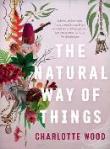
Charlotte Wood, The natural way of thingsAs the post title suggests, the evening was framed around Wood’s latest novel, The natural way of things (my review), which is partly why I was very keen to go because this is a provocative book that doesn’t leave you in a hurry. Wood started by describing the set-up, and explaining that the main plotline is like any prison novel. In other words, the question is: Will they escape or won’t they? I liked the simplicity of this!

Anger and the book’s genesis

Murphy asked her to talk a little about her comment, elsewhere, that anger had inspired the book. Wood explained that she didn’t realise how angry she was when she started writing the book. She talked about hearing a radio documentary about the Hay Institution whose inmates were described by the government as the “ten worst girls in the state”. The anger-inducing thing is that these girls had all been sexually assaulted in some way, and had been locked up for “being in moral danger”. They were locked up because they were in moral danger? You can see why Wood was angry – why any of us would be – on hearing that. Why were the victims locked up?

Wood then explained that her original story was historical, realist, in style, and it wasn’t working. Then, because when you are writing, “everything is about your book”, she started noticing contemporary stories – the army girl raped by a co-cadet, the woman employee sexually harassed by the David Jones CEO, etc – and decided to try a contemporary approach …

… but, while she was writing it, Julia Gillard became Australia’s first PM, and she saw a photo of Gillard, Quentin Bryce, and Anna Bligh together. They presented such a positive picture of female achievement that she thought her book was no longer needed. We all laughed at that! She then spoke of the hatred directed at Julia and her own distressed reaction to this. This is where her writing comes in: art helps you understand incomprehensible things, she said, you can give them shape.

Later, during the Q&A, she spoke more on the anger issue.  She’s uncomfortable with anger, she said – a little self-deprecatingly. She likes it when the book is described as “ferocious” or “fierce” rather than as “angry”. She talked about the importance of humour, of its being the essential companion to anger. (There is humour in the book, as I noted in my review). She quoted American thinker, Patricia Williams (she thought), who talks of the “gift of intelligent rage”. Wood saw this as anger/rage which encompasses positive energy.

That ending!

The discussion then turned to the ending, and its ambiguity. Murphy worried that Wood seemed to be suggesting that the answer is “separatism, opting out”. The ending is certainly the aspect that gave me some pause. It wasn’t that image that bothered many readers of the women pouncing on the designer handbags. No, for me, as for Murphy, it was the ambiguity. I like ambiguity, but here I was a little uncertain about what I was taking away.

Wood’s response was helpful. She said the book has different endings depending on who you are following, and that some readers come away feeling triumphant, while others feel demoralised. She said that for Yolanda, her only liberation was to “separate” herself, to go feral, to become an animal in fact, but that wasn’t Verla’s answer. This gave me a little structure for my thinking.

While she doesn’t like to talk in terms of messages, she agreed that part of it was that in order to be free you have to separate yourself to a degree from a culture that hates women. This can mean not reading women’s magazines that hurt/harm you, not laughing at sexist jokes, and so on.

She talked about another issue that intrigued me, and that’s to do with the men – the prison guards – ending up being trapped too. This is where the balance of power started to shift a little – and is the part of the novel she liked writing!

Nerdy stuff

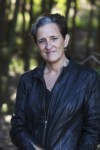
Charlotte Wood (Courtesy: Wendy McDougall)

Murphy then asked her “nerdy stuff”, that is, about her writing process. I won’t spend a lot of time on this (though nerdy me was interested too). I’ll just share a couple of comments. One was that although she now has five novels to her name, she is still always unsure when she sits down to write, but one thing experience has given her is that she is now “quicker at diagnosing problems”. She has also learnt more about the “craft” of writing, such as how to shape stories.

She described writing as hard – it’s hard making up stuff out of your head, she said. She knows when she’s got the momentum up – it’s when her current book is in her dreams, when she thinks about it as soon as she wakes up. She referred to her PhD on the cognitive aspects of creativity. She found some commonalities between writers, but knowing what these are doesn’t help you do it, she said! Encouraging eh?

Murphy asked whether she kept a notebook to jot down ideas she comes across, things she hears. She said she does this a bit, but wishes she did notebooks as well as Helen Garner. Mentioning the notebook excerpts in Garner’s latest book, Everywhere I look (my review), she said she admires “the precision of her [Garner’s] observations”.

Plausibility in fiction

Early in the conversation, Wood referred to some readers questioning plausibility in the book. I followed this up at question-time, as it was an issue in my reading group. I loved her answer because – as you regular readers here will see – it concurred with my views!

She said it depends, partly, on the sort of novel you’re writing. She wanted this novel to be strange and weird. Her usual benchmark is to ask what she herself would believe. Her question for readers is: “Are you going with it. If you start worrying about factual details, you risk missing out on what’s true.” Yes! So, in this book, in particular, she didn’t “care” much about plausibility. Her next book is more realist so the facts will matter more, but I got the sense that fundamentally she focuses more on what she is trying to do, to say, than on getting all the facts right.

There was more, but I’ll leave it here on my question – and conclude by saying that Wood came across as warm, natural (!), thoughtful, and openly sharing of herself. This made it a most enjoyable event – the hour went way too fast.

Canberra Writers Festival 2016: Recap

It’s a funny thing about writers festivals: there’s nothing really new to be said about reading and writing – surely we’ve said it all – and yet everything seems to feel new! Why is that? I guess it’s the stimulating environment that festivals create (the repartee that occurs between participants) and that there are always different ways of saying the same things (different spins, angles, perspectives). Whatever it is, I enjoy it and am glad we have our own festival again. (Most of my recent festival experience has been through ABC RN and podcasts!)

It’s all about the content …

For my own benefit, I want to tie up some threads that stood out to me:

  • Historical fiction: if you’ve read my Festival posts (listed at the end of this post), you’ll know that historical fiction was one of the threads that followed me (or I followed!) during the festival. It featured in a few sessions, but particularly in Waking the dead with Paul Daley, Sulari Gentill and Ros Russell. They all talked about the importance of plausibility and authenticity, but I particularly liked Gentill’s statement that historical fiction is about writing “plausible tales” about what might have happened, which gives insight into what did happen. This is what Kate Grenville was about in her controversial The secret river isn’t it? Some historical fiction, though, does focus on what did happen, but these are often told from a particular perspective. And here Gentill made another interesting point. She said her aim is not to present an absolute or rounded version of an historical person but an angle or perspective of that person that is true. This frees her to explore lesser-known sides of or possibilities regarding historical figures that may have been glossed over or ignored in the historical record. Finally, Gentill talked about giving voice to people whose stories are not always told (which made me think of recent Aussie books like Eleanor Limprecht’s Long bay and Emma Ashmere’s The floating garden.) I should add here that while I’m quoting Gentill, these ideas were more widespread – just stated differently.
  • Kim Mahood, Gia MetherellIndigenous authors and issues: the Festival did not have many indigenous authors present. Indeed the Festival was probably not high on diversity all up. My sense is that this is not an unusual situation with Australian literary festivals. Of course, I don’t know how hard our organisers tried in this area, but it’s something worth noting. The only indigenous authors I noticed were Bruce Pascoe (whose session I missed because it clashed with Omar Musa and Jennifer Rayner) and Stan Grant (who didn’t come in the end). However, indigenous issues – and awareness of the sensitivities surrounding “white” people writing on indigenous life – were evident. Kim Mahood’s session was particularly relevant because it directly confronted indigenous-non-indigenous relationships with each other and the land, but in other sessions, such as the book launches for Richard Begbie’s Cotter and Nicholas Hasluck’s The Bradshaw case, audience members asked about indigenous people’s reactions to “white” authors writing about them.  Unfortunately, in neither case was there time for in-depth discussion of the issue.
  • Politics: as I said in one of my posts, politics was a major theme of the festival. There were many sessions and events which focused specifically on this topic – the Hansard Monologues sessions, Leigh Sales and Annabel Crabbe, to name some. I didn’t attend these, though, so can’t comment. However, political issues and ideas underpinned two sessions I attended – Merlinda Bobis, and Jennifer Rayner and Omar Musa. While I love art for art’s sake (to be simplistic about it) and don’t think art has to have a message, I am drawn to writing that has a strong social justice purpose. Merlinda Bobis and Omar Musa are particularly inspiring in this regard. Bobis was passionate about changing our current political narrative from the politics of fear to the politics of caring. Loved it. And, if you know Musa, you’ll know that his passion is that of giving voice to minorities, to the disenfranchised. Both feel strongly that the arts can play a critical role in “saving” or changing us. Keeping a focus on politics – in diverse (!) ways – would be a logical thing for Canberra’s festival.

One of the joys of festivals is the opportunity to discover lesser-known or niche writers among the better known, and this festival did well here. There were the big overseas names like Yann Martel, AC Grayling, and Eimaar McBride, but there were also many wonderful Aussie writers – well-known and not so – to get to know a little better. For me, although I didn’t get to all I’d have liked, the mix was good. If I couldn’t attend one event, there was sure to be another that would be (and turned out to be) just as interesting.

… but the organisation is important too.

The festival had a lovely buzz about it, and from what I saw, it seemed that attendees were engaged and happy to be involved in such a well-organised event. I say well-organised because everything in my experience flowed smoothly, with problems (like my AWOL tickets) being handled pleasantly and without fuss.

There were a few issues though, and I’ll share them here because they might be helpful:

  • Advance notice/promotion: many people just did not know about the festival until quite late in the year, which suggests that marketing next time needs to be louder and reach deeper in the Canberra community. I “liked” the Facebook page, and subscribed in other ways, but found the information a little sporadic. I heard others say they didn’t know about it at all until very late.
  • Venues: the venues were great overall in terms of size and comfort – well, the ones I attended (NLA, NPG and Hotel Realm) anyhow – but I did find the widespread nature of the Festival (around the Parliamentary Triangle, Barton and over the lake) a little problematic. You could waste serious Festival time travelling between venues. Some of my session choices were made – and altered – due to this issue. It was a little disappointing, too, that Bookplate at the NLA closed up serving food so early. I think it was about 3.30pm or before on Saturday. With an all-day festival, it would be good to have more food available for longer, as food breaks don’t necessarily happen, depending on chosen sessions, at “normal” times. That said, Bookplate did a good job under pressure – in my experience.
  • Ticketing: I found the structure of the ticketing a little tricky to understand and navigate, particularly for the 5-event package which I opted for. (It was the best option by the time I booked). It wasn’t easy to work out what was available on the package and what had to be ordered separately. I worked out some – such as the Special Event morning tea – but other sessions that I thought were sold out were probably only available individually.

These are minor issues in the scheme of things, because overall it was a friendly, happy, content-rich festival. And it was encouraging to see so many of our cultural institutions and local organisations getting behind it.

So, thanks to the committee, the sponsors, and the volunteers (of course) for an enjoyable and stimulating weekend. And special thanks to Canberra’s literary grand dame, Marion Halligan. She was a real trojan in the number of sessions she took part in – and her input was so nicely relaxed and down-to-earth.

I look forward to doing it all again – in a more organised way – next year! August 25 to 27 is in my diary.

For my previous posts on the Festival you can check out the following links: Day 1, Day 2, and Day 3.

Canberra Writers Festival, Day 3: Three conversations and a disappointing miss

Oh no! Because, as I explained in my first post, I booked late, I missed some events that I would love to have attended, but I was thrilled that one of my “musts” was still available, Charlotte Wood (author of The natural way of things). However, I woke up in the morning, looked at the Festival website, and saw that the session had been cancelled “due to illness”. Another headline act I’d wanted to attend, Stan Grant, had been cancelled shortly before the Festival “due to unforeseen circumstances”. Disappointing for us, and of course for the hardworking organisers, but that’s festivals isn’t it! Fortunately, I had three other sessions booked for the day and, you know, the lesser-known lights are generally just as interesting as the “stars”. It’s just that they’re, well, lesser known. And, there is a silver lining: this will now be a shorter post – for me to write and you to read – than yesterday’s magnum opus.

Nick Earls and Marion Halligan: “Modern masculinity” (hosted by Dr Christopher Chapman)

Chapman, Halligan and EarlsNational Portrait Gallery curator, Dr Chapman, who is responsible for the Tough and Tender Exhibition, introduced authors Marion Halligan and Nick Earls, noting that both their recent books deal with boyhood and manhood. He quoted RW Connell on the hierarchy of modern masculinity and its basis in social and cultural expectations. “Alternative” males, Connell writes, are disenfranchised in the majority culture, even though the “majority” idea of masculinity doesn’t necessarily guide most men’s lives.

Halligan said she doesn’t think consciously of issues like this when writing but relies on her experience, which is of tender, kind, non-aggressive – though admittedly not always virtuous – men. The protagonist of Goodbye sweetheart who dies in the first pages – does that mean he’s the protagonist, Marion wondered aloud! – is not a good man.

Commenting on the fact that back in the 17th-18th centuries a common aspiration for men and boys was to be Robinson Crusoe – to be able to survive on their own in the wild – Earls noted that this scenario had no human contact. He writes his men at a time of challenge in their lives, at moments of reckoning, but these are often quiet moments, and involve connections with others, sometimes children. These men, like Halligan’s, have decent hearts, but make mistakes.

Halligan commented that she likes that Earls’ books are not miserable. They are not about dysfunctional families but can include moments of dysfunction. Earls confirmed this assessment, saying he wanted to write “real” families who connect with each other but for whom things sometimes go awry.

And so the discussion continued, moving fluidly, more like a conversation than a formal interview, though Chapman did inject some questions.

Halligan talked about changes in childhood between her generation and that of her grandchild, wondering about the impacts of these changes, while Earls spoke of some of the boys in his recent novella series, The wisdom tree. He talked of using an 11-12-year-old boy as a protagonist because this is the age of starting to push boundaries, of wanting to be successfully independent but also being a little fearful. He wanted the narrator of this story, NoHo, to be naive about what he was seeing. In another of the novellas, he puts a twenty-something rapper, his minder, and a 40-something rock journalist together, setting their different worldviews against each other.

Chapman asked Earls and Halligan what writers about men they liked. Earls, rather surprisingly, named Richard Ford, Raymond Carver, and Cormac McCarthy. He quickly qualified his nominations by saying he doesn’t “like” the men created by these writers but is fascinated by how they construct types of masculinity that he doesn’t relate to as a man, but that he believes and is interested in as a reader. Halligan, conversely, said she likes people who write characters like hers, writers liked William Trevor and John Banville who create muddled and not necessarily virtuous men. She does like Carver, though, for his sentences!

(I loved Halligan’s aside that she now reads on her iPad because if she buys more books she would have to move out of house! I hear you Marilyn!).

There was much more in a conversation that wove naturally between real life experiences and the writing of fiction, not surprising in authors who base their fiction in contemporary life. The audience Q&A continued this flavour. Some questions furthered the “literary” discussion, looking at whether the archetypal hero can encompass wider conceptions of masculine and feminine qualities and, more generally, at the challenge of constructing characters. Other questions moved into the personal. Earls discussed parenting. What do you keep and what reject from previous generations’ practices? And, of course, this topic couldn’t be discussed without some reference to the impact of feminism on the growing confidence in girls and increasing confusion about roles and expectations for boys.

A final point nicely made was that authors can create fluidity in gender roles, which must surely contribute to the wider conversation.

Kim Mahood  (with Gia Metherell)

Interviewer, and ex-Canberra Times literary editor, Gia Metherell commenced by telling us that the focus of her session with author and artist Kim Mahood would be her recently published memoir, Position doubtful. She started by quoting Susan Wyndham’s recent description of Mahood:

On the morning I meet the artist and writer Kim Mahood, she has driven her ute nonstop for 1000 kilometres on her way home to Canberra from the Tanami Desert in Western Australia, a journey she has made back and forth across the continent for more than 20 years with the compulsion of a migrating bird.

A small, lean figure with a dry sense of humour, unfazed by flat tyres and solitude, Mahood seems honed for no-frills survival. Cleaning out her vehicle after the long drive with her dog, Pirate, she found a wire used for digging out witchetty grubs, a tomahawk and remnants of cooked kangaroo tail. Yet her conversation and her creative work have the subtle eloquence of an urban intellectual.

OK, including quotes like this is going make this post longer than planned. Sorry folks, but this is such an apposite description. Although Kim Mahood spends part of her life in my region, I hadn’t really heard of her until I read her eye-opening piece, “Blow-ins on the cold desert wind”, in The invisible thread. She spent much of her childhood on a cattle station in the Tanami Desert. That station is now owned by indigenous people, but in adulthood Mahood returned to the area and now shares her time between there and here.

Much of the conversation focused on her experience of and relationship to land – as an artist and as a white person spending time in indigenous communities. It made for a very thoughtful development of ideas that are currently circulating contemporary Australian thought (and explored in such books as Bill Gamma’s The greatest estate on earth). Mahood thinks that landscapes enter us at a physiological level, particularly those landscapes we experience when young. She talked about different layers of knowing the land – traditional, pastoral, sacred/ritual.

And this of course brought us to that uncomfortable issue in contemporary Australia: how we non-indigenous people, who also call this country home, understand our own relationship to the land we “usurped” or “took up”. Mahood is living this challenge. She described not knowing how to respond when she returned to her old home; she felt stripped of her knowledge and identity (which, of course, is how indigenous people would have felt when the land was originally taken from them). How do white people make connections with land they love without disenfranchising indigenous people? You do it, she said, by putting yourself in their hands. It takes time, and you have to become “less precious about stuff”, like your car!  Anyhow, this issue and this solution are the central ideas of her book.

Kim Mahood, Gia MetherellHer book’s title captures this conundrum. “Position doubtful” has a literal meaning which describes places that cannot be definitively placed on maps, but it also works as a metaphor capturing her uncertainty. This reference to maps neatly segued us to mapping, Mahood’s art and indigenous art – and how these relate to understanding of land, of country. Mahood talked of a mapmaking project designed to help geologist Jim Bowler (he of Lake Mungo fame) research evidence about ancient climates in the area. The Tanami, she said, has no permanent water, but the entire landscape is marked by water. Occasional massive rainfalls can reactivate its “deep past” landscape.

Metherell asked whether indigenous art can work as maps. Mahood was measured in her response, but said that yes, orientations of places to each other are right, but that these paintings “embody” experience. They are complex “maps” that encompass stories, they are open, unfinished documents.

And here I’m going to make this post a little longer again by sharing part of the reading Mahood gave from her book. She’s describing doing a painting:

… the edge of the cliffs breaks against the sky like a wave. I score it with hard strokes of the brush, an emphatic horizontal line that differentiates my approach from the local aboriginal concentration on ground and surface. This seems important. Although my own perceptions have undergone all sorts of modifications, I know the horizon is more than a visual dimension. It is as much a symbol in its way as the concentric circles that indicate sites and routes, and it’s a symbol to which I can lay claim. The horizon is one of the perceptual fault lines that runs between white and Aboriginal ways of understanding country …

She discussed the intersection between local knowledge and scientific knowledge. For indigenous people, the people have to be healthy for the country to be healthy, whereas scientists look at “fixing” the environment. There is a very deep gap in ideas of causality. Maps, she believes, can bring the two ways of thinking together.

At some point Mahood said that she writes better than she talks. Hmm, I know exactly how she feels, except she was completely articulate and has no need for uncertainty on this front!

But, I think I’ll stop here. It was a deeply satisfying session. I hope that I’ve given you a flavour – and a sense of what you missed by not being there! Yes, I know, I probably missed some other wonderful session – but that’s the nature of festivals isn’t it? The point is to be satisfied with what you decide to go to – and I was.

I’ll just close with a brief reference to terminology. The Walmajarri people with whom she works call white people kartiya. She commented that we don’t in Australia have a single term to describe non-indigenous people the way they New Zealanders have, for example. She wishes we did, so we don’t have to be referred to as “non” (that is, “non-indigenous”).

Oh, and she described Position doubtful as a love story. I’m looking forward to reading it.

Jennifer Rayner and Omar Musa, Generation less (with Laura White)

My final session of the festival was probably also my most overtly political, as its focus was Jennifer Rayner’s book Generation less in which she explores her theory that her generation, the Millennials, (she was born in 1986) will be the first generation in 80 years to be worse off than its parents. When her parents were her age, she said, they had a house, stable jobs, and a superannuation scheme under way. We are facing a time of reducing opportunity for young people, she argued, and if we don’t do something about it, everyone will be worse off.

Departing from my more usual chronological reporting, I’m going to start with a comment I heard as I was leaving the theatre. The person, around my age, said to her companion, “I really just wanted to hear him talk because he’s such an interesting character”. Hmmm … if this was referring to Omar Musa versus Jennifer Rayner, which I presume it was, then was the hidden message here that she didn’t much engage with the rest of what she heard? Certainly, the two – also of a certain age – who were sitting behind me didn’t seem to, as they left partway after quite a bit of muttering between themselves. Of course, it may be that they had an important dinner engagement to get ready for. But enough of that, let me get back to my report …

Because, the point is that Rayner’s thesis can be confronting to us of the baby-boomer generation. It would be  easy to get defensive, except, as members of the audience pointed out, many of us have children in her generation and are seeing firsthand of what she speaks. Rayner admitted that she was expecting quite a backlash, but for this reason she has more often got understanding and a desire to do something.

Despite the dry-sounding nature of all this, it was in fact a lively and engaging session. Poet-rapper Omar Musa (also author of a novel, Here come the dogs) of course helped here. His intensely serious, but humorous, approach to what he does injected lightness, while also underpinning the importance of the concerns being discussed. He introduced himself by performing his hard-hitting poem, “My generation”.

His concerns are a little different to those of Rayner’s but they intersect. He is particularly interested in the disenfranchisement or disengagement of younger people, particularly of young “minority” men who don’t have the purpose of their immigrant parents. They feel disengaged from Canberra’s policy-makers.

Musa’s focus is people not usually written about, he said. Race, class, gender issues cause friction, he said, and create a combustible society. Feminism has a strong place, but for young men there is a “toxic masculinity”, and an inclination to see them as perpetrators. But they’re human beings too, he argued, and he wanted to humanise them in his novel.

So, the session shifted pretty easily between Rayner’s logical, evidence-based commentary, and Musa’s arts-based one. Rayner defined the issues confronting her generation as having three prongs: Work, Wealth and Well-being. In a nutshell, this means that (and she supported it with relevant data):

  • WORK: It is harder for young people to achieve stable jobs in the workforce, and wage inequality between ages is increasing
  • WEALTH: Her generation is “worth” less than her parents’ at the same age
  • WELLBEING: Her generation doesn’t have kids as early, doesn’t partner up as early, stay at home longer, all of which affects their emotional development and thus wellbeing.

Rayner said she grew up in the optimism of the Hawke era, while Musa talked of the disconnect between Keating who had a vision for the future, seeing the best Australia as ahead of us, and Howard who looked back to the halcyon days of the 1950s.

Rayner admitted that those young people who have gone to university are on a path –  a slower path than the past, but they have one. Her main concern is the other 60% for whom there are fewer entry-level jobs and who end up doing insecure often “cobbled together” work. It is particularly here that Rayner and Musa saw parallels between their books. Those currently worse off are young men who drop out of school early. They become “badly dispossessed” such as the housepainter in Musa’s novel. Musa was inspired by Christos Tsiolkas’ The slap, he said, except that Tsiolkas is about the middle class while his concerns the aspirational or working class in a changing cultural landscape.

(At some point here, Musa laughingly praised Rayner as being “so articulate”. She certainly knew her stuff, but Musa, though seeming to be briefly thrown on a couple of occasions, is no slouch – and was certainly not “put out”. They just had to work at times to find idea-connections in terms of their respective approaches!)

It wasn’t all negative though. Discussion also focused on solutions. These are mostly institutional and structural, said Rayner, because the problem has been caused by policies that have been put into place over years. Young people need to be part of the conversation, alongside business councils, seniors’ organisations and unions, for example.

She said that economic insecurity is at the base of the problem, and housing is the defining issue in terms of health and well-being. The 25-35-year-old group is struggling to buy their first homes, she said. Musa said don’t look at him. “I’m a poet, I’m not into economics”. We laughed!

Anyhow, Rayner said that her book is based on hard data, and she (aligned with the ALP, she disclosed), wants good evidence-based public policy. But, what can we do?  Rayner had some answers: vote for policies that will address the inequities, such as policies reforming negative-gearing and capital gains tax, policies that increase access to apprenticeships and those improving security for workers. There are also practical things, like not taking advantage of injurious policies. There are, in other words, moral choices we can make now – as well as when we cast our vote every three years. Later, she also referred to the increasing and successful, use of citizen juries – made up of a random group of people – to feed ideas into policy development, as another solution.

Musa’s solution was, as you’d expect, more personal. Listen to young people, he said, understand their stories in complex and nuanced ways, not by reverting to stereotypical views. Such listening demonstrates an openness to reconsidering our assumptions. He referred to Nigerian writer, Chimamanda Ngozie Adichie who refers to the danger of the single narrative. Poetry in Australia, he said, is now being taken up by other races – it’s no longer the domain of white middle class poets – and he hopes the thoughts and ideas of this generation of poets will start to feed into the public forum. The arts and storytelling will save us!” he argued with passion,

There was more, including a detailed discussion of Musa’s novel, his exploration of the “messiness of the clash between class and agendas”, and his wish to show tension, not resolve it.

Then, I guess, came a real point of difference between the two. Musa wants a more radical shift. He suggested that talking about house-buying is no longer relevant, that there are those who, considering issues like climate change, want a different life and world. Rayner agreed there has been some shift in what young people value, that they can be less consumerist, but she believes most still want what their parents wanted, and that they should have the option.

The session concluded with another performed poem by Musa. It was one of his more positive ones he said. It started, “Let me tell you about a father and son feud” and ended with

Trying to be a better me

Can’t say better than that.

… and here ended my festival. I plan a little recap post in a few days – if I can marshall my thoughts together. In the meantime, a huge thanks to the organisers, volunteers, supporters and sponsors. It was a wonderful event and I was thrilled to hear that it will be back next year. Put August 25-27 in your diaries now folks!

Canberra Writers Festival, Day 2: A morning tea, a launch and some conversations

Let’s get the guilt admission over first. I ditched the session I’d paid for this afternoon to attend three free events. I reckon I got my money’s worth. I did this for a couple of reasons. Firstly, I didn’t realise that the afternoon event – on adapting a book (Rosalie Hamm’s The dressmaker) to film – occupied the whole afternoon. I’ve read the book, seen the film, and had seen Rosalie Hamm at my morning (paid) event, so decided that would suffice in the face of other temptations. Secondly, that event was on the other side of the lake and, having found a parking spot with a little challenge in the NLA precinct, I didn’t feel like losing it. Finally, there were two events at the NLA that I really wanted to see, and I couldn’t do them all. Such is life!

Now, a couple of warnings. Today’s post will be longer than yesterday’s, as I attended more sessions. Ignore, skim, or read it all. Your choice. I won’t know. And, while I did my best to take good notes, I may have skewed the odd thing. It’s hard to listen, reflect and take notes in these thoughtful, vibrant sessions.

Morning Tea (at Hotel Realm) with Marion Halligan and Rosalie Ham, introduced by Karen Viggers

This was a lovely way to start the day. We got to sit down at tables, with food and drink (self-served from a buffet), and be entertained by three writers. They, however, I was sorry to see, had to stand!

Using the tried-and-true format, session chair Karen Viggers, herself an author, posed a number of questions to Halligan and Ham. There were those expected questions – like how did you come to be a writer, where do you get your ideas from, how do you go about writing – as well as some more specifically geared to Halligan and Ham. The answers were lively, sometimes humorous, and all worth hearing, but I’ll just share a selected few.

Both talked about how they see stories all around them, how everything they see has potential. And that, dear readers, is why they’re the writers and I’m the reader! Anyhow, Ham said that her novels start with an idea, with “whatever is up my nose”, and that she’s currently into questioning verities. The novel she is writing now questions accepted views about irrigation. If it doesn’t work, she said, she’ll return to family squabbles!

Concerning the process of writing, Halligan, unlike Ham who starts with a synopsis of her story, said she doesn’t know where her stories will go when she starts. She quoted author Rodney Hall who said that the way to take your reader on a journey is to go on one yourself. And anyhow, she said, plots, as her readers know, are not the essential thing – which is perfectly fine with me.

The conversation also turned to death, grief and loss which both have written about. Halligan talked about losing her husband in 1998, and how she saw everything through grief. People tell you time heals, she said, but grief is always there, tucked away in a little corner. (She’s right, it is.) She told how her novel The fog garden was her response to her husband’s death, but its sex scenes were too much for her publisher, Penguin. They weren’t for Allen & Unwin, so she’s been with them ever since! Her latest novel, Goodbye sweetheart, is all about death – about reactions to death, and secrets.

Both writers said more about grief, death and sex, but what was said in the room stays in the room. Instead, we’ll move on to Viggers follow-on question from Halligan’s comment re secrets. Why are secrets so good in novels, she asked. I loved Ham’s simple, to-the-point answer. It’s because, she said, they relate to power. (Yes, of course.) She has seen the way secrets work in life this way – in staff rooms, for example, and sports clubs, and country towns (in which she grew up)!

There was more conversation, but I’ll share just one other insight and that’s Halligan’s comment that she has to like her characters. If you don’t like them, she said, why should your readers? I’d love to have followed this up in terms of that common complaint from readers that they don’t like a book because they don’t like the characters. Did their authors like them I wonder? I suspect that what an author means by “like” and what some readers mean may be two different things? Anyhow, question time ran out – and so has my time on this event (engaging as it was). Let’s move on …

Waking the Dead: Paul Daley, Sulari Gentill, Ros Russell

Russell, Daley and GentillThis session was a very different kettle of fish. Chaired by NLA curator Robyn Holmes, its aim was to explore how authors use archival/historical materials in their writings. She, like Vigggers above, had come armed with a good set of questions – and the answers were considered, sometimes provocative, and more than I could perfectly capture.

For those who don’t know them, Paul Daley and Ros Russell are Canberra-based, Daley being a journalist and writer of fiction and non-fiction, and Russell an historian who has also written a novel. Sulari Gentill is a writer of historical crime fiction.

Holmes started by asking what “waking the dead”, that is, exploring archival materials, meant to them. Daley said it meant looking for voices that will drive the narrative, such as for his current project, a novel about the impact of 1930s-1940s anthropologists on black-white relations in Australia. Russell agreed, saying that for her latest history, High seas and high teas, she looked through diaries for voices to animate the story. She said that she often finds evidence that overturns some of her perceptions while confirming others.

Gentill, on the other hand, said she looks for holes in history, for the gaps where she can “make stuff up”. (The audience laughed.) Historical fiction, she said, is about writing “plausible tales” about what might have happened which gives insight into what did happen. (I like this.) It’s about playing in the shadows.

Holmes then asked about how collections determine the direction of their writing? Daley said, among other things, that every time he goes into an archive he comes back with five more book ideas! Russell talked of how archives can take you in directions you hadn’t expected when you started. A mundane diary, for example, can suddenly include a surprising story that you decide to feature.

The ever-humorous Gentill told us that her husband is a 1930s historian, which is the era she writes in. “I married my collection”, she announced! She doesn’t research in advance, but as she goes. She talked about the newspaper articles (found in Trove – yes!) that she includes in her novels’ chapter headings. Using them is her response to publishers telling her that she’d taken things too far. Those things were always things that had actually happened she said. But, you lose readers, she said, if they think you’ve gone too far – hence the newspaper “proof”.

Daley also referred to this issue of believability when he said that research can provide details like names and practices of the time, the sort of detail that gives authenticity. And later in the session, Russell also mentioned the importance of research to underpinning plausibility. It was critical for her historical fiction book, Maria returns, that she find a Barbados plantation owner who was also an abolitionist. She did!

Regarding the sorts of resources that can best bring stories to life, Russell mentioned unexpected places like government papers and reports. You have to cast your net widely, she said, to find the stories that illuminate. Daley said he loves photographic collections, and used his current research into 1930s/40s anthropologists as an example. He found a trophy-like photograph of American anthropologist Frank Setzler posed with human remains. This helped him write his composite character, because he felt he could see from the photo what the anthropologist was thinking.

Gentill said that she attracted primary resources, that historians send her materials that fit the period she writes in. She hasn’t experienced, she said, the oft-talked about historian-historical fiction writer divide. She also said that since, fundamentally, she writes about people, she relies on her own memory archive, her experiences and knowledge of people.

Gentill said that she makes up her protagonists, but often uses real people for her secondary characters. She always makes sure that she doesn’t say anything more heinous about the person than the historical record shows, but the rest she makes up. And here she said something beautifully clarifying: her aim is not to present an absolute or rounded version of an historical person but an angle or perspective of that person that is true. In other words, she presents that person, let’s say, Earle Page, from the perspective of her character, who may not like that person. It is not a complete picture of Page, but an aspect of Page as experienced by her character.

There was much more – writing about place, using oral histories, and the like – but I’ll close with two final topics. One concerns blurring the line between fiction and history. Gentill said that she is a fiction writer and that her whole purpose is to blur the line. The fiction writer’s job, she argued, is to give a bit of history by stealth – which is another issue I’d liked to have explored further. Daley said that his non-fiction writing is “true” and based on archival research, but in his fiction he can be more creative, such as messing with dates to make a story work. I’ve heard other writers say this. Seems fair enough to me, because I know I’m reading fiction, but will all readers who are getting their “history by stealth” make the distinction between historical “facts” that are played with (messed around) and the “truths” that are the writer’s real story?

And finally, there was a discussion about ethical responsibilities. Russell said that historians must not distort what they find, must be true to their sources, but that she always looks out for things that might say something different to the prevailing narrative. Somewhat similarly, Daley said that if something confronts his preconceptions he must address it. For example, in his current anthropological research, he was assuming he’d find a cruel man, but he found a kind one. This will affect his narrative.

Gentill said she looks for other perspectives to the prevailing ones, that she likes to find people who have been forgotten, but who are interesting. (I guess these are minorities, the “little” people, the women, and so on?) She sees this as doing a service to Australians.

All in all, it was a thoroughly engrossing session and I’m glad I decided to attend it.

Richard Begbie’s Cotter: A novel (launched by Tim Begbie and Jack Waterford)

I had not planned to attend this session, but given my decision to not go over the lake, I had an hour to fill between the two sessions I’d flagged, and so decided to attend this session launching an historical novel set in the Canberra area. I was glad I did, because I learnt something more about this region I call home.

Richard BegbieCotter: A novel tells of the local early nineteenth century settler family – after whom our lovely Cotter River is named – and their relationship with indigenous people of the region. Garrett Cotter, an Irishman from Cork, arrived in Australia in 1828, and became friendly with the local indigenous chief Honyong. He formed a good relationship with Honyong, but was also, of course, part of “the inexorable forces” which led eventually to the dispossession of Honyong and his people. Retired editor of The Canberra Times, Jack Waterford, who helped launch the book, described it as “a well-written book of our country, our neighbourhood and a good yarn”.

Richard Begbie told us that he had researched the book intensively with the descendants of both the indigenous people and the Cotters, and said there had recently been an event – not a launch – at which both groups had got together to renew a friendship that had been initiated 200 years ago.

He gave a brief reading from his novel of the moment when Cotter, working on the farm owned by the (also still local) Kenny family, first met Hongyong. It sounds like an engaging read written by someone who knows this area well.

In conversation: Melinda Bobis “Love, climate and the politics of care” (with Lucy Neave)

I should explain here that the Festival’s theme – fitting to our national capital setting – is Power, Politics, Passion. Consequently, there are several sessions involving political writers and journalists. Merlinda Bobis, however, is not one of them, but she is highly political, and politics underpinned much of this session, which was conducted thoughtfully by author Lucy Neave.
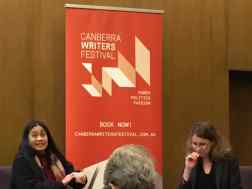
BobisFor those of you who don’t know her, Bobis, whose novel Fish-hair woman I’ve reviewed, is a Philippine-born trilingual poet, novelist, performer, scholar and retired academic. Leave explained that the session would  focus on two of her novels – Fish-hair woman (woo-hoo) and her latest one, Locust girl: a love song – and would explore how we tell stories and the politics of caring. Politics, you see! Like Waking the dead, this session was full-on, so will be hard to condense, but condense it I will – which means omitting a lot.

Bobis gave a couple of readings and included “performance elements” – singing and chanting – in the process. Lucky us. Neave asked why she performed, and her answer was a practical one. She arrived in Australia as a published poet, but could not get published here. She started performing her poems, and found that people listened. Then she started dancing. Her strategy, she said, suddenly became an art form!

I enjoyed the discussion of Fish-hair woman because while I felt I’d grasped its main meaning, I knew there were things I’d not fully comprehended. She talked about hair as a metaphor for memory, with memory here being mainly of trauma, grief and loss. She reminded us how grief and trauma can can turn hair white or even cause hair loss, but she inverts this in her novel and has Estrella’s hair keep on growing as the losses build.

Fish-hair woman is also a novel also about writing a novel and, because it contains both Philippine and Australian stories, it is about collaborative story-telling and grieving, and about not privileging one group, one grief, over another. Do we grieve for losses equally, she asked, referring to philosopher Judith Butler’s work on the politics of grievability, on differential grieving. Whose losses, whose stories do we validate? Is an Arab body mourned equally to a Western one? And here, you see, we were at politics again, the politics of mourning.

Bobis talked about our current political climate and the politics of fear. She argued that we need to encompass a new story, the politics of care. She referred to new indigenous MP Linda Burney’s statement that she’ll bring grace and kindness to parliament. Not a soft kindness, said Bobis, but kindness with spine!

She discussed how we define politics in terms of governance, or talk about it in terms of the personal being the political, but to her politics is feeling, thinking, doing. The central question of Fish-hair woman is, she said, how much can the heart accommodate. Can it accommodate even those we don’t love?

Locust girl continues and extends these concerns to how we care and love across borders. It’s about countering the politics of fear with the politics of love, extending the question of how much can the heart accommodate to how do you care for other. While Fish-hair woman has its hair metaphorhere it is the locust, which stands for extreme other, for fighting against demonising other.

Neave then led the discussion on to the environment. Bobis said that in Fish-hair woman, which is set during the 1987 Philippine government’s war against communist insurgents, she was worried about river. She said war is an environmental issue, it damages the planet. Locust girl is set in the desert, which represents climate change, the loss of water, a place where nothing grows, the drying of the human heart, and that there will be environmental refugees. (I hope I’ve got all this Locust girl stuff right, as I haven’t read it.)

She and Neave talked about projects they are working on, separately or together – in Spain, Philippines, Singapore – because writing is not enough. Bobis called it developing a creative arts practice in which storytelling becomes action.

Some interesting ideas came out of the Q&A at the end. I particularly liked her response to a question about her use of magical realism which is, she said, her favourite device. It’s part of her culture to believe that there is another world, but magical realism can also be seen as a post-colonial strategy, as a way of challenging the real, of challenging our established worldview.

Another question concerned how the imagination might relate to the politics of caring. Bobis said we need to imagine scenarios: “imagine this, and if this happens, what do you do”. We must give multiple imaginings to parliament she said, and if something has already happened, we must ask what can we imagine to address it.

She concluded by reading a love poem from her new poetry collection. Looking up from her paper, and looking directly but warmly at us, she read the last line: “there is hope for us”. What more can I say?

Canberra Writers Festival, Day 1: Two book launches

Well folks, finally we have another writers festival here in Canberra. From 1983 to 2001, we had something called the Word Festival (though its name varied a little over the time). Since then, to the best of my knowledge, we’ve only had the one-off Canberra Readers’ Festival (on which I posted) in 2012, so it was a thrill to hear many months ago that a Writers Festival was once again in the offing – and now it is here. I do hope there are plans for it to continue. If today’s buzz is evidence of success then I hope the organisers are feeling positive about future events.

However, here’s the thing. This year has been a topsy-turvy one for me, so I didn’t book a season ticket, and missed out on a couple of events that I would like to have attended, but that’s no biggie. I’ve booked some appealing events and look forward to those. Today, though, due to other commitments, I decided to just attend a couple of free afternoon events (so I missed, for example, Anne Summers). Oh well, I can’t do everything, and I know that whatever I choose to do I will enjoy. I’m easy that way!

Carmel Bird’s Family Skeleton (launched by Marion Halligan)

Carmel Bird and Marion Halligan
Bird, Halligan and butterfly, 2016

I’ve written about Carmel Bird and Marion Halligan before, when Bird launched Halligan’s Goodbye sweetheart. I realised then, and it was clear again today, that they are good friends. So when they launch each other’s books which they’ve done for each other a couple of times now, there’s no formality or stiffness, and they almost make it up as they go, making for a delightfully relaxed but nonetheless meaningful launch.

I won’t summarise the whole launch but just share a couple of points that struck me. First though, something about the book. It’s a black comedy – which, if you’ve read Bird, wouldn’t surprise you – and is largely narrated by a skeleton. It is about the O’Day family, and particularly about Margaret, the family’s widowed, wealthy matriarch. The epigraph, by Bird’s fictional character Carrillo Mean who provides all her epigraphs, goes like this: “The Storyteller knows what the Storyteller knows, and the Storyteller tells what the Storyteller tells”. But, said Halligan, does the Storyteller tell all that he knows? I think this is a book for me, so I’ve bought it.

And so the launch proceeded, with a couple of expressive readings by Bird, and engaging repartee between Bird and Halligan about Bird’s love of words and the naming of characters; her inspiration for the novel (which was seeing an Edwardian hearse on a country road in Victoria); and death, sex and butterflies, and whether the novel’s butterflies are a trope or a motif! I’m not a creative writing specialist, said Bird airily, passing off this issue! Fair enough. Leave that to the reviewers!

There was a lot more, but what I mainly wanted to share was Bird’s statement that she is always “looking for virtue” in her novels. That made us all sit up. Novels, she said, always explore evil, because evil is more interesting than goodness, but the end point of it all is always “where is the good, where is the hope?” An audience question had her clarify this a little further by saying this hope could for things like goodness, reason, happiness, beauty. I immediately thought of those grim, depressing books that many readers feel have none of this, like, for example, Charlotte Wood’s The natural way of things (my review)and the fact that in most of those books I do usually find a hint of hope. I can’t help thinking that most writers are like Bird, that is, that they want to end with some little bit of positivity, even when they also want us to remember the serious issue they are exploring.

Carmel Bird
Family skeleton
Crawley: UWA Publishing 2016

Nicholas Hasluck’s The Bradshaw case (launched by himself)

Nicholas Hasluck
Nicholas Hasluck, 2016

A completely different kettle of fish was the launch of Nicholas Hasluck’s The Bradshaw case, partly because he launched it himself and partly because it’s a very different sort of book – a fact-based courtroom drama about contemporary political issues regarding native title.

I haven’t read Hasluck before, though he’s won The Age Book of the Year and been shortlisted twice for the Miles Franklin Award. The packed room for his launch was evidence of his renown I’d say.

Again, I’m not going to going to summarise the whole session. He started by telling us he was launching a “device” called a book, in which thoughts and images could be conjured up in your mind from the pages you read. We all liked that, of course.

His book, he said, mixes fact and fiction. It explores, via a court case, some controversial issues about the origin of rock art in the Kimberley and how this plays out in terms of native title. He provided quite a lot of background about the rock art at the centre of this controversy – the Bradshaw images and the Wandjina images – a controversy I’ve come across in some of our outback Australia holidays. Hasluck was inspired to write his novel by the ambiguity surrounding this. But this is not what I want to share here.

What I was particularly interested in was some of his general comments regarding novels and history. Novels, he said, can both cast a light on what happened in the past and on what is said about the past now. They can explore (expose?) contested versions of the past.

Commenting on his use of fiction to tell this story, he said “give a man a mask and he will tell the truth”. I like that – as regular readers here who’ve read me on truth and fiction would expect. He also said that he chose fiction because he’s not an expert in the area and that many specialists have, and are, going the non-fiction path.

Discussing the question of how readers should approach the fact-fiction nexus of historical fiction, he said that the author-reader contract is that readers will assume everything they are told is true. (Note that he didn’t say “factual”). He hopes that people, once intrigued by something they’ve read in fiction, might then question what they’ve read and do their own research. This brought us back to the central controversy about the images, and what this means for indigenous people – and it resulted in his making a statement that, like Bird’s regarding looking for virtue, made me sit up. He said that the odd thing about Australian literature is that novels are not seen as part of current debates, unlike the USA, where works by Gore Vidal and Thomas Wolfe (Bonfire of the vanities), for example, do enter such debates. Australians, he said, see fiction as something quite separate. I’d love to know what others think about this claim – but for me, again, it made me think of Charlotte Wood’s The natural way of things and the contribution she clearly wanted to make to the misogyny debate.

The issue we didn’t really discuss, though it was touched on, concerns indigenous Austrlians’ reaction to this story being told this way by a non-indigenous writer. All Hasluck said on this point was that his book is about “cultural integrity”. It will be interesting to see.

Nicholas Hasluck
The Bradshaw case
North Melbourne: Arcadia, 2016

STOP PRESS: AS Patric’s debut novel Black rock white city has just been announced the winner of the Miles Franklin Literary Award. Congratulations to him! Another book for the TBR!