While researching my recent 1965 Monday Musings posts, I came across a new award to me – the Britannica Australia Awards (also known as the Encyclopaedia Britannica Australia Awards). Of course, I wanted to find out more about them. It was tricky. They have Wikipedia article, but The Canberra Times came good via Trove, and there is a paragraph about them in the Oxford companion to Australian literature, so I have enough to share with you.
The awards were sponsored by, obviously, the Encyclopaedia Britannica, to recognise, says the Oxford companion, “outstanding achievement in Australia” and “Australian-American links”. They were only offered from 1964 to 1973. From 1964 to 1967, they were made for the arts, education, literature, medicine and science; and from 1968 to 1973 for the arts, science and humanities. In this post I’m focusing on literature/the humanities. The award included money (initially £5,000), a medal and a citation.
1964: Judith Wright
The first literature winner was poet Judith Wright, who received it “for her wide-ranging and permanent contribution to Australian literature”. According to The Canberra Times, the citation said her work “was already part of Australia’s history. Both readers and other writers were richer in experience because of what she had done.”
Wright has been mentioned several times in this blog, with my main reference being in another Monday Musings post, on Capital Women Poets.
1965: Robert D. Fitzgerald and Professor A. D. Hope
The 1965 award was shared by two poets, AD Hope and Robert Fitzgerald. The Canberra Times reported that Hope “had been named on the occasion of the publication of his book of critical essays, The cave and the spring, and in recognition of his considerable achievement as poet, literary critic and teacher”. Chair of the literature committee, Clement Semmler, said that:
As a critic he is lively and controversial and he has earned the respect of his fellow teachers and intelligent readers, for his determined efforts to re-evaluate accepted literary convention.
Robert D Fitzgerald, the other recipient, was recognised for “his substantial contribution to Australian poetry over many years”.
1966: Julian Randolph Stow and Hal Porter
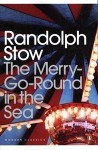 The 1966 award was also shared – and at last we have an author I’ve reviewed here, Randolph Stow. The Canberra Times reports this award, as follows:
Mr Hal Porter, novelist, short-story writer, playwright and poet, shared the literature award for his contributions to Australian writings, particularly his two most recent publications, The cats of Venice and The paper chase.
Randolph Stow’s award was made on the merits of his published works since 1956, including his latest novel, The merry-go-round in the sea (my review).
1967: Not awarded
You can’t have an award – even a short-lived one – without a controversy, it seems, and so it was that the Britannica Australia Awards had one. The Canberra Times‘ columnist Gang Gang reported that Professor Alec Hope, himself a recipient of the Britannica Award, said ‘that the decision to deprive author Christina Stead of the 1967 award because she was not an Australian author (though born here) was “absolutely bloody nonsense”.’
Hope, naming other Australian writers, like Henry Handel Richardson, who had made their homes outside Australia, said that
Christina Stead made her reputation as an Australian writer and although she left Australia 40 years ago (at the age of 26) she belonged to the world of English-speaking literature. Writers, he added, shouldn’t be subject to the test of whether they are ‘Canadian’ or ‘Australian’ enough to achieve recognition.
However, unknown-to-me journalist and writer Marien Dreyer disagreed:
“Chrisina [sic] Stead is undoubtedly a fine and prolific author by any standards — but she has lived for too long outside Australia to qualify. She left Australia for America in 1928 and since then our country has experienced two world wars, a world economic depression, and is greatly changed from the Australia she knew nearly 40 years ago”.
Like Stow, Stead has appeared here a few times, including my review of her novel For love alone.
1968: Douglas Stewart
I was introduced to Douglas Stewart, the poet, playwright and literary editor who won the 1968 award, at high school through his verse play about Scott’s tragic expedition to Antartica, The fire on the snow. I have also read his daughter’s biography/memoir Autobiography of my mother about his wife and her mother, the artist Margaret Coen. I didn’t find anything more than a brief announcement of this award in The Canberra Times. Stewart and Coen moved in circles which included several writers I’ve mentioned here, including Rosemary Dobson and David Campbell.
1969: Keith Hancock
1969’s winner, Keith Hancock, was an historian. According to The Canberra Times columnist Maurice Dunlevy, he said, on being advised of this award, “Well I had to wait a long time for Father Christmas to come to me”. Haha! Love that. He was 71.
If you are interested in Hancock, check out the article because Dunlevy gives a decent potted history of the man. On Hancock’s work as an historian, Dunlevy writes that
he sees his role as that of seeker, not seer. His job is not to answer questions but to know how to look for them. “Inquiry and narration – that is my craft”, he once wrote.
and that he wasn’t impressed by the modern “ordeal by thesis” type of history. Instead, said Dunlevy,
he emphasises that history is about life, “The man who chooses theory may write a valuable monograph on monopolistic competition . . . the man who chooses life will write history.”
I’d love to hear what contemporary historians think of his work now.
1970: CB Christesen
Clem Christesen, 1970’s winner, is best known as a literary editor. Not only did he found one of Australia’s most significant literary journals, Meanjin, in 1940, but he was its editor until 1974. He was influential in the careers of many of Australia’s mid-twentieth century writers, including the award’s first recipient for literature, Judith Wright. Again, I found nothing about his winning the award in my Trove search.
1971: Douglas Pike
As for Christesen, I don’t have a report on 1971’s winner, Douglas Pike, but I did found an obituary by Jacqueline Rees in 1974. Professor Pike was also an historian, but his greatest claim to fame was his work as a general editor of the Australian dictionary of biography, for which he received the Britannica award. The report said that he saw this award as “recognition not so much for his own work as for the project as a whole”. Nice.
1972: James McAuley
Poets seem to have won the lion’s share of this award – not a complaint, just an observation. James McAuley, the 1972 winner, was described by The Canberra Times as “Professor of English at the University of Tasmania and a prominent poet and literary spokesman”.
McAuley is quoted as saying at the presentation event
that Australia was second only to the US in the amount of talent it had among poets.
He was not enthusiastic about contemporary English poets. They have had very little to offer in recent years, he said. “Much the same could be said for the Russians”.
Ha! Perhaps the awards committees agreed, and this is why poets did so well!
1973: AD Trendall
The last award went to a new name for me, AD Trendall. Another Professor, he was Master of University House at the ANU, here in Canberra, from 1954 to 1969, but was resident Fellow at Melbourne’s La Trobe University at the time of winning the award.
The Canberra Times provides some brief information about him, saying that
He has written and published many works on archaeology, specialising in the Roman and Greek origin and has been a contributor to many overseas and Australian journals.
To conclude, it’s clear that this award had, as you might expect given its sponsorship, a scholarly tenor, which may explain why “literature” was broadened to “the humanities” (even though I’d argue that most writing in the humanities can be defined as literature.) Why it stopped, I don’t know. It might be there somewhere in Trove, but it didn’t pop up in first few pages retrieved by my various searches.
Another long post, I know, and probably only of interest to a few of you, but I did want to document these awards usefully.
 Whispering Gums