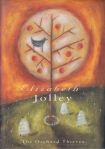
 Elizabeth Jolley’s twelfth novel, The orchard thieves, is a little different from most of the other Jolleys I’ve read. It’s a little less black, a little less about alienation, but it’s unmistakably Jolley in style and preoccupations.
By preoccupations, I mean her interest in family relationships and dynamics – and, related to that, her humane, but clear-eyed, understanding of human nature. The orchard thieves was written when Jolley was in her early seventies, and revolves around a grandmother contemplating the meaning of family and children. It feels very much like the meditations a woman of her age would be having – which is not to suggest that the story itself is autobiography. Still, I can see once again, why Helen Garner loves Jolley (and doesn’t love Thea Astley). Jolley and Garner both draw from their lives, albeit Garner more so, and both focus on life’s interior challenges. They also both do so in spare but loaded writing.
The orchard thieves, then, has a minimal plot, and no named characters. Told third person from the grandmother’s perspective, it concerns a family whose members are identified by their roles: the grandmother, the grandsons who belong to the youngest sister, the granddaughter who belongs to the middle sister, and the aunt (who also happens to be the eldest sister who lives with the grandmother). There is also the son-in-law (the youngest sister’s husband.) The novel (novella, really) is constructed in three parts, and the plot, such as it is, revolves around the return from London of the middle sister with her daughter.
So, what is it all about? It’s about the family at a point in time, from the grandmother’s point of view. It’s about parents and children, about love and worry, and about age and wisdom – not that the grandmother pontificates her wisdom or is even really sure that she has it. She worries about the aunt, her eldest unmarried daughter, fearing she’s lonely. She worries about the grandsons, their safety now and their future. And she worries about the middle sister’s health and happiness when she returns home – for how long? – clearly pregnant but saying nothing. It is this sister’s return that ripples the surface of the family’s finely balanced relationships.
Jolley prepares us for this “rippling” with an initially mysterious Preface, which commences
‘If you have the house,’ the middle sister said to the aunt, the eldest sister, ‘if you have the house you’ll have to pay us each one-third of the current market price. One-third each of the value of the place.’
We immediately think of course that someone has died, and then, as the book commences we realise that the owner of the house, the grandmother, has not died. We then wonder if she will die, but Jolley’s purpose is more subtle. This is not an inheritance-fight plot. Instead, the conversation tells something about the sisters’ characters. It also suggests underlying tensions, and introduces some ideas which, when they re-appear in their correct chronological sequence, become clear.
This is not a depressing book. The tensions are real, but the grandmother’s hard-won wisdom re-stabilises without offering pat solutions – and it’s all done in a quietly meditative, but by no means dry, tone. I found it absolutely delicious reading, with its Jolleyesque references to pear trees and birds, orchards and gardens, music and myths, sexuality and lesbianism; its sly humour; and, dare I say it, its relevance to my own musings. I haven’t reached my seventies yet, but am soon to join the world of grandmas and am certainly the mother of adult children. Jolley captures the concerns, the lessons learnt and still being learnt – about raising children, about relating to adult children, about being a grandmother, and above all about love – so economically but with sensitivity and insight.
Here’s a scene, early in the book:
Alone on the grey rug in the deeply shaded garden, the grandmother began to understand that it was not until she was a grandmother herself that she, because of her own love for her grandsons, realised how much she, as a small child, had been loved. And the pity was that it was too late to acknowledge this to anyone. It was no longer possible to offer, unsolicited, a kiss, a caress or a tender phrase backwards, as it were, over her shoulder. Recalling momentarily the pain of a telephone reprimand, well deserved she was sure, and only one of many, the grandmother came to a very real truth, which was that the great love which holds the mother to the child does not necessarily travel in the other direction, from the child to the mother. She understood also that she would not be the only person in the world to have discovered this.
Such spare writing. With the exception of the descriptions in the opening phrase – “grey” and “deeply shaded” – which set the melancholic, reflective tone, the language is direct and largely unadorned, and powerful as a result.
There are several references to myths and legends, which the grandmother believes “were attempts to explain happenings which were too painful and hard for human endurance.” Wanting to share these with the grandsons, she starts to tell them the story of Ceres/Demeter and her daughter Persephone/Proserpina, but it gets all too dark and boring for them, so they
simply slipped from the grandmother’s hands and disappeared with a slight rustling of dry leaves into the surrounding bushes.
You can just see it can’t you? Elsewhere, this gorgeous elegant language is subverted when the grandmother, walking with her grandsons, uses their language:
The grandmother hoped that the river paths unlike the roads and houses and the trolleys in the supermarket, were not crap. She hoped they were not crappy crap. She hoped that the aunt’s game and the secret paths, the rocks and the rock pools along the river beaches would remain uncrapped for as long as possible.
Oh, I could go on, sharing more and more. There’s so much more to say about, for example, the imagination and how it can lead you to worry and worry, about mothers’ regrets for things they could have done differently, about the time when children need to grow out of thieving orchards, about the reality that the
little rogues and thieves … would, during their lives, do something perfect and noble and wonderful and something absolutely appalling.
And appalling is pretty much how we could describe the middle sister’s behaviour when she arrives!
Helen Garner concludes her tribute to Jolley*, “To my dear Lift-rat” (which she wrote after Jolley had succumbed to dementia), with this:
But it was too late for me to say goodbye, or to thank her for the last sentence of The Orchard Thieves, where an old woman points out comfortingly to her daughter that the difference between a bad haircut and a good one is only a week.
Garner’s right. It’s somehow the perfect, grounding ending for a book which is about both the importance of “the unseen things, the real feelings and the deep needs” and the business of “push[ing] on with living.” It’s a timeless book.
Read for Lisa’s (ANZLitLovers) Elizabeth Jolley Week.
* You can read Garner’s essay on-line and in her collection Everywhere I look (my review).
 Elizabeth Jolley
The orchard thieves
Ringwood: Viking, 1995
134pp.
ISBN: 9780670865505




 Whispering Gums