Ariella Van Luyn, Treading air (Review)

Arielle Van Luyn, Treading air

It wasn’t until I reached the end of Ariella Van Luyn’s debut novel, Treading air, that I discovered it was loosely based on the life of a real person. I’m glad it happened that way. I like introductions, but I always read them last because I like to come to my reading as unencumbered as possible – and totally unencumbered I was with this one. Even the title gives nothing away.

So, I was pleasantly surprised to find the first page labelled “Brisbane 1945”, because I spent some of my formative years in Brisbane, albeit rather later than 1945. I was even more surprised, a couple of chapters in, to find a section labelled “Townsville 1922”, because my Mum was born in Townsville at the end of that decade, and I visited it a few times in my youth. There, see how I’ve sneakily given you the historical setting –  and implied the structure – without specifically saying so?

Now, let’s get to the story. As Van Luyn explains in her acknowledgements at the end of the novel, it concerns Elizabeth (Lizzie) O’Dea, aka Betty Knight/O’Brian/Stewart/Johnson, who was born in Brisbane around the turn of the 20th century*. She married Joe O’Dea and moved to Townsville in 1922 where Joe was promised a job. However, as Van Luyn tells it, Joe soon loses that job, and Lizzie, with few work skills, becomes a prostitute, which she sees as far more lucrative, and yes, less demeaning, than the domestic work her mother had done. From there, life becomes increasingly challenging … but, I’ll leave the plot here, because there are other things to discuss.

The novel opens in Brisbane’s lock hospital where Lizzie’s been sent by a magistrate. This opening set-up gives me a great opportunity to discuss how Van Luyn uses fiction and history to construct her character and story. Brisbane’s Courier Mail and the Townsville Daily Bulletin both report on a case at that time: Lizzie is accused of “attempting to steal £20” which brings about a “bond” (deferred) sentence on 8 May 1945. The Courier-Mail writes

“It is rather remarkable,” said Mr. Wilson, “that in this long list of stealing convictions she has never been given a chance to see if she could reform. “We will just try it for an experiment. …” Mr. Wilson ordered O’Dea to enter into a bond to come up for sentence if called upon within six months. “We will both thank you, sir,” said the woman as she left the dock.

Mr Wilson’s “experiment” idea resulted from O’Dea arguing that she wanted a chance to be there for her husband Joe’s imminent release from his 20-year prison sentence.

However, the “crime” Van Luyn uses in the opening of her novel is Lizzie’s stealing “tins of bully beef and some US army blankets”. This crime actually occurred in 1944 and the court case in October of that year resulted in a fine of £5. Here is Van Luyn’s story of the court case in her opening chapter:

At first, in the police court, surrounded by dark wood, she couldn’t make sense of what Mr Wilson was saying about Joe. In a wig that hung down his cheeks, he looked at her medical report and decided to be generous: only six weeks in the lock hospital to recover [because she’d been found to have “the clap”]. He said when Joe got out a few days after she had, they could start a new life together. “We’ll try it for an experiment,” Wilson said, and Lizzie wanted to stick her fingers in his eyeballs. She isn’t a bloody lab rat.

My marginalia here is: “feisty, independent”. So, I have two points to make. One is that Van Luyn shifts a crime of which Lizzie was accused to a different time because, presumably, it’s a more interesting time, narratively speaking. And the other is that, instead of having Lizzie thank Mr Wilson, Van Luyn has her responding (internally, anyhow) in a feisty manner to establish Lizzie as an independent woman, a survivor. For an historian, these “plays” with the facts would be unforgivable, but for Van Luyn, they enable her to engage the reader in the story and quickly establish the sort of person she believes, from her research, that Lizzie was. In other words, Van Luyn plays with the “facts” to create her “truth”. As she is writing fiction, I have no problem with that! Do you?

The other main point I want to make about this book draws from Sulari Gentill’s comments at the Canberra Writers Festival. She said she likes to find interesting but forgotten people. I understood this to mean working class people and minorities, that is, the “little” people, the women, and those disadvantaged by culture, race, and so on. This is certainly what Van Luyn does here. In addition to Lizzie, a working class woman, she also has Chinese and indigenous characters in Townsville. In this focus on the “forgotten people”, her book reminds me of others I’ve reviewed recently, including Eleanor Limprecht’s Long Bay (my review) about abortionist Rebecca Sinclair, and Emma Ashmere’s The floating garden (my review), which uses fictional people to tell the story of a real situation, the removal of marginalised people from their Milson’s point community to make way for the Sydney Harbour Bridge.

“Her life has twisted away from her”

Back to the story. It’s told third person, but from Lizzie’s perspective, and alternates between the 1920s and the mid 1940s, so we know at the beginning that Lizzie’s been “on the game” and is a survivor. Several dramas occur during the novel – including a murder, a shooting, an attempted suicide  – and all these can be found in court records of the time. Van Luyn doesn’t over-sensationalise these, any more than she does Lizzie’s life as a prostitute. She is, though, explicit in her descriptions, giving us a picture of a lusty, resourceful young woman who’s determined to survive. Life is tough going, however. Lizzie, like Townsville, is “unformed”, but Joe, she comes to realise, “can’t look after her” as she’d hoped, so “she has to look after herself”. Moreover, although prostitution is more lucrative than domestic work, she’s not very good at saving – not surprisingly, given her upbringing – so the gap between the dream of an independent future and the reality stays wide for much of the novel.

It’s to Van Luyn’s credit that she has managed to create out of a scrappy historical record a character who, petty criminal though she is, not only comes alive but engages us fully. This is not a sentimental story, but it nonetheless reminds us that not everyone gets a lucky start in life. There are Lizzies still amongst us today. This is the sort of historical fiction I enjoy.
awwchallenge2016

Ariella Van Luyn
Treading air
South Melbourne: Affirm Press, 2016
282pp.
ISBN: 9781925344011

(Review copy courtesy Affirm Press)

* Researching Trove, I found several court reports in which her age wanders around wildly, suggesting birthdates anywhere between 1893 to 1902.
Bianca Nogrady (ed), The best Australian science writing 2015

Bianca Nogrady, The best Australian science writing 2015It was one of the more science-minded members of my reading group who tentatively suggested we add The best Australian science writing 2015 anthology to this year’s schedule. I’m not sure why she was uncertain because we’ve shown ourselves to be pretty open readers. Our main question when someone suggests a book is “Will there be something to talk about?” I can’t imagine a book like this lacking in things to talk about. And so we scheduled it.

Five editions of this anthology have been published, each with a different editor, so I was tickled to find that our edition’s editor was Bianca Nogrady whose thoughtful book about death and dying, The end, I reviewed a couple of years ago.

Now, an anthology like this can be read in different ways. You can read it sequentially, as I did because I know editors put thought into ordering their content. Nogrady did a careful job here, not butting articles on similar topics up against each other, but ordering them in a way that built on our understanding. Alternatively, you can pick and choose depending on your interests, though the titles don’t always give away their contents. What are science writers doing getting creative with their titling! Or, in this case, you could meander through the anthology by following the links to “like” articles provided at the end of each article. Presumably your perambulations would get you through them all at the end! This approach might be a fun (and enlightening) way to read it, but I was on a deadline, so …

I started at the engaging Foreword by Adam Spencer, the Australian comedian and radio presenter with a special interest in science and maths, and read on. I was quickly engaged and read it almost like a page-turner. Truly! Of course, there was the odd article that didn’t really grab me, and some grabbed me so much that I’ll not forget them in a hurry, but overall it was an enjoyable, stimulating read.

In her Introduction, Nogrady analyses the content. She says that while the 2014 anthology featured several articles “on our changing climate and its repercussions, this year there were an overwhelming number of submissions about our vanishing biodiversity, and what could be or is being done about it”. She argues that this “suggests a shift away from the big picture catastrophe of climate change – in the face of which many of us feel utterly powerless – towards a more specific and manageable concern”. She also notes that there were “a number of articles exploring the rapidly evolving field of robotics and artificial intelligence” and observes that “despite being a relatively small nation, we have long held our own in the global science and technology arena”. This is certainly borne out by the articles in the anthology. I’d add a third thread – medical issues. We probably don’t need an explanation for this one. Who is not interested in health and medicine!

Entrants for the annual Bragg UNSW Prize for Science Writing, named for the father and son who were Australia’s first Nobel laureates, form the core of the anthology. The 2015 winner was Christine Kenneally’s “The past may not make you feel better”. Excerpted from her Stella prize-winning book The Invisible History of the Human Race, it explores, from multiple angles, DNA testing and genomic counselling, using Huntington’s chorea as its reference point. The runners-up were Idan Ben-Barak’s “Why aren’t we dead yet”, a wonderfully lucid and surprisingly entertaining description of pathogens and the immune system, and Trent Dalton’s “Beating the odds” about the driven Australian man who has developed an artificial heart.

There are several reasons why I enjoyed the read, and I’ll dot point them to keep it simple:

  • subject matter: although I’m not at all scientifically inclined, I recognise the significant role science (or STEM) plays in our lives – in health, the environment, our buildings and transport, for a start. These essays, selected for their ability to communicate scientific issues well, were just what I needed to bring me up to speed, particularly in those areas I’m pretty ignorant in, such as robotics. James Mitchell Crow’s  prize-shortlisted article “Robots on a roll”, for example, introduced me to “big” robots working on the Brisbane docks and in Pilbara mines.
  • radical ideas: some articles challenged current thinking or practices. These included Brodie Smith’s “Playing God” on the idea that we should use triaging to manage the problem of vanishing species and Michael Sleaze’s also prize-shortlisted article, “Aliens versus predators: the toxic toad invasion”, which argues that this invasion, while not a good thing, is not the disaster we’ve believed it to be.
  • esoteric topics: by this I mean articles on topics I would never have known about had I not read the anthology. Lauren Fuge’s “The women who fell through the cracks of the universe” delves into late 19th to early 20th century astronomy to tell us about “Pickering’s harem“, the mostly unsung women (or “human computers”) who contributed hugely to “the first Henry Draper Catalogue, a catalogue of more than 10 000 stars classified according to spectrum, published by Pickering in 1890”. Of course, I loved that this article was as much about history as about science!
  • style: the articles varied in style and tone. There was even a poem or two. There were some written in first person, giving a personal perspective. In “How I rescued my brain”, David Roland took us on his journey of diagnosis, treatment and eventual recovery from his stroke. And there were some written with a light, humorous touch. Ian Lunt’s “Field guide to the future”, for example, provides a delightful comparison between traditional printed field-guides (I particularly love wildflower ones) and the new digital ones.

But here’s the common problem with anthologies and collections – how to do the book justice without naming every contribution. I think I’ll just share a few quotes, to give you a flavour, starting with Slezak on the toads:

The toads are spreading further and faster than anyone expected, and they do have a devastating impact when they first arrive in a region. But most animals are adapting to their presence surprisingly quickly, and some even benefit.

‘If you’re a frog, the toad is your superhero,’ says Shine. ‘You’ve got its picture up on the wall. This guy is coming in, he looks like a frog and is killing everything that attacks frogs. If you’re a green tree frog, what more could you hope for in life?’

[…] ‘I’ve gone to thinking it’s a good-news story about the resilience of ecosystem. (from “”Aliens versus predators: the toxic toad invasion”)

Here is Ian Lunt on the fact that printed field guides must use words (not audio) to describe bird calls:

With a budget for paint – one illustration per species – but none for sound, cheerful ornithologists turned to onomatopoeia: ‘Pee-pee-pee-peeooo, Wee-willy-weet-weet, It-wooa-weet-sip, Zzzt zzzt zzzt. Cher-cher-cherry-cherry, Wah-i-wah-i-wah-oo, Twitchy tweedle, Kupa-ko-ko, Lik-lik-lik’. Less cheerful colleagues followed suit: ‘Chop-chop, Four o’clock, Wide-a-wake, Walk to work. Want a whip? It’s for teacher. Tweet-your-juice, Sweet pretty creature’. (All real calls, I assure you.) (from “Field guide to the future”)

And thirdly, here is Idan Ben-Barak on the human immune system:

And so, an immune system must correctly identify a diverse array of harmful creatures and react to each one in its own special way. Oh, and you know what would be very helpful? If it could remember the pathogens it’s encountered before and store this information on file, somehow, so that it could make short work of them the next time they pop in. And it needs to be prepared for new invaders it’s never encountered before, because life is like that. And it needs to be prepared for completely new invaders nobody has ever encountered before in the history of humankind, because pathogens evolve over time. And it needs to be economical, so the body can keep it operational. And it needs to be fairly unobtrusive, so the body can keep functioning normally. And it needs to do it all very quickly, every time, or the body will be overrun, because pathogens multiply like the devil. (from “Why aren’t we dead yet”)

Hopefully by now, I’ve convinced you that this is a great read – and if I haven’t, well, you’re probably a lost cause! Either way I’ll leave it here.

awwchallenge2016Bianca Nogrady (ed)
The best Australian science writing 2015
Sydney: NewSouth Publishing, 2015
ISBN: 9781742242231 (ebook)

Robyn Cadwallader, The anchoress (Review)

Robyn Cadwallader, The anchoressLet me start by saying that I’m not a big reader of historical fiction, and particularly not of non-Australian historical fiction, so to read a novel set in mediaeval times is quite a departure for me. However, I did want to read Robyn Cadwallader’s The anchoress for a number of reasons. Not only is Cadwallader an Australian writer living in the outskirts of my city, but we did meet a couple of years ago for a lovely lunch when she was in the throes of negotiating the publication of this book in three countries! And, besides this, the topic was so intriguing. I’m not a mediaevalist and had never heard of anchoresses and anchorholds before. It’s taken me sometime to get to it, but I finally have.

Now, one of the reasons I don’t jump to historical fiction is that I’ve tended to see it in terms of bodice-rippers and romances, and these don’t really interest me. But, The anchoress is not such a story. I don’t read back cover blurbs before I read books but towards the end of this book, as I was trying to guess where it might be going, I did look at the back, not because I wanted to know the end – because I didn’t – but because I was intrigued about how this book that was teasing me was marketed. The last sentence of the blurb is that the book is “both quietly heartbreaking and thrillingly unpredictable”. This reassured me that it wasn’t likely to go where a “genre” novel would probably go. Does that make sense?

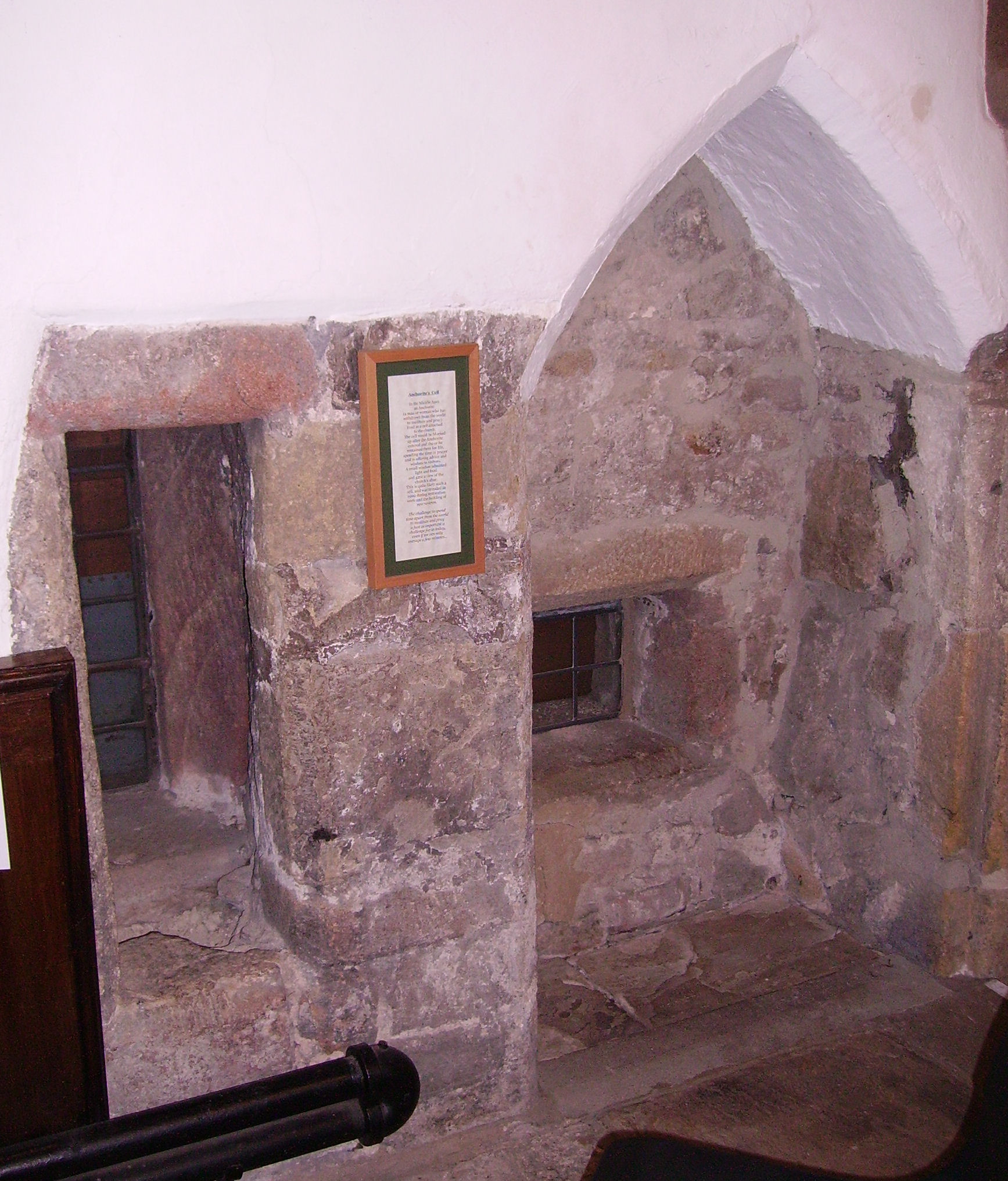
Anchorites' cell, Skipton

Anchorite’s cell, Holy Trinity Church, Skipton, UK (Courtesy: Immanuel Giel, Public domain, via Wikimedia Commons)

So, the plot. It tells the story of Sarah, a young 17-year-old girl who, after some traumatic experiences including the death of a loved sister in childbirth, asks to be enclosed as an anchoress. This means she agrees to spend the rest of her life in a small stone cell, essentially “dead to the world”, tended to by a maid through a window in the wall and visited by a priest who will provide guidance and take her confession. Her support is paid for by a patron, the local Lord. She is given a Rule book as her guide, and is expected to provide advice to village women. Sarah’s story is told first person but, interspersed with hers – in shorter third person chapters – is the story of young, inexperienced Father Ranaulf, her priest-advisor-confessor. And so the stage is set for – well, we don’t quite know what.

As the story progresses, all sorts of narrative possibilities present themselves. Will she stay (like Sister Agnes) or leave (like Sister Isabella)? How will her relationship with Father Ranaulf develop? And why did Sarah really decide on this rather extreme course for her life (because, of course, there is a reason)? These all have the potential for melodrama or cliche, but Cadwallader keeps it grounded. There is drama – a fire – but even it is downplayed in the service of Cadwallader’s bigger themes rather than generating page-turning excitement.

However, it’s not plot that draws me in my reading, but character, themes and language. And here the main characters are well-drawn. The story takes place over the period of a year or so. At the beginning Sarah is an idealistic young anchoress, keen to do it right. She takes seriously her decision with the uncompromising enthusiasm typical of a young person, and so is determined to be disciplined. She allows herself no pleasure, not even some tasty food donated by the villagers, despite advice that this level of self-denial is not expected, and moves into self-flagellation. Over the course of the novel she comes to a more realistic understanding of what being “holy” might mean, and of what she needs to survive her chosen role. Father Ranaulf is also young and inexperienced, which results, initially, in stiff, black-and-white responses to Sarah. Over time, he too comes to a more humane understanding of her and of his role as her advisor. I’m almost tempted to call it a mediaeval coming-of-age story as these two young people come to a maturer world view. Anyhow, it’s nicely and realistically done.

There are other characters of course – Sarah’s maids, villagers who visit Sarah, various priests, and Sarah’s patron and local Lord, the somewhat cliched Sir Thomas. These are less rounded but they enrich the picture Cadwallader paints of mediaeval life, and contribute to the story-line.

“Body without a body”

“True anchoresses”, Sarah reads in her Rule, “are like birds, for they leave the earth – that is, the love of all that is worldly – and … fly upwards towards heaven”. Birds are a recurring motif in the novel, starting with a symbolic bird, the jongleur whom Sarah calls Swallow. “An acrobat”, she says in the opening paragraph of the novel, “is not a bird, but it is the closest a person can come to being free in the air. The nearest to an angel’s gift of flying”. For Sarah, being enclosed was her way of emulating Swallow, of leaping into the air, of being a “body without a body”. She yearns to be free of her body, to leave the senses behind, but the more she tries to escape them, the more they make themselves known. Her challenge is to reconcile this dichotomy, this need to deny the senses while still very much having them, this being, theoretically, dead to the world, while very much alive.

Tied up with Sarah’s challenge is the wider story of mediaeval life and values. Cadwallader conveys life at the times, mostly through the people who visit Sarah. Life, we discover, if we didn’t already know it, is hard for women. We meet women who are abused and assaulted, and we realise that their rights are few in a society which sees women as “lustful and tempting”. Father Ranaulf tell Sarah that:

It is man who is mind and soul, woman who is body.

Wise Father Peter allows women some advance on this when he tells Father Ranaulf that holy women can develop manly souls and “almost become a man”! But it is Sarah who really confronts Renaulf, and forces him to a more empathetic understanding of her (and, by extension, of other women).

Life is also hard for the poor, as Cadwallader tells through the villagers’ lack of power in the face of the Lord’s control over the land they work. And life is a challenge too for church-men, who have to manage villagers and lords while earning money to survive. Father Ranaulf wants to make beautiful books but must “produce an income”, not to mention advise an intelligent young woman who won’t accept his platitudes and thoughtless “rules”!

So, The anchoress is an engaging story. It’s about a time long distant, thus satisfying our historical curiosity, and it’s about power in gender and class, that still resonates today. But, above all, it is about human beings, about how we read or misread each other, about how (or if) we rise to the hard challenges, and about whether or not we accept a duty of care to those who come into our lives. An enjoyable read.

awwchallenge2016Robyn Cadwallader
The anchoress
Sydney: Fourth Estate, 2015
314pp.
ISBN: 9780732299217

Helen Garner, Everywhere I look (Review)

Helen Garner, Everywhere I lookI was very sad to come to the end of Helen Garner’s latest essay collection, Everywhere I look. It was such a joy – such a joy – to read. Garner ranges across a wide variety of subjects from a kitchen table to Russell Crowe, from some of the darkest things humans do to each other to the beauty of ballet dancers in rehearsal, and she does it in a natural, warm voice that makes you almost feel as if she’s sitting across that kitchen table from you. While it would be cheeky of me to say that I now understand her, this collection provides wonderful insight into the way she thinks, how she goes about the business of living, why she writes the things she does. We come to know her as a human being who muddles through life, making mistakes, questioning herself, confronting challenges, rather than as the literary doyenne she in fact is. In other words, as she always does, she lays herself open.

I call these essays, but some are probably better described as articles or perhaps even columns, and there are a few which read more like collections of jottings or diary entries. Form isn’t the important thing here, it’s the content. The collection comprises 33 pieces, all but three of which have been previously published. Three date back to the 1990s. Many were published in Monthly, and some others in the Age and the Sydney Morning Herald. It’s not always obvious why they were originally written, but in this collection they have been loosely grouped into six broad thematic groupings, starting with “Part One: White paint and calico”, which is all about homes and things domestic, and ending with “Part Six: In the wings”, which I’d describe as comprising reflections about life and self. The cover, designed by the award-winning WH Chong, is just gorgeous, and I found myself looking at it several times as I read, opening it out to look at the whole front-and-back panorama.

But now, that common challenge of writing about a collection: what to discuss, what to leave out. I am going to leave out one thing, and that’s her discussion of writers and writing, because I want to save that for another post. Perhaps I’ll start with some “yes” moments, not that I have to always agree with writers to appreciate them, but affirmation can be nice. There’s her jotting in “When not writing a book” in which she expresses elation over the election of Obama. What an exciting time that was, even for us antipodeans. Her statement – “To think I’m alive when this happened” – is one many of us shared. I remember popping a bottle of bubbly with my patchwork group for the occasion.

There are delightful, often humorous, anecdotes about family life, especially about her grandchildren who now live next door to her, and there are little jewels of description, such as this perfect one of Christmas mornings:

The unnerving silence of Christmas morning. No sound of traffic. Sun lies fresh on everything. Birds sing with unnatural sharpness. The air is still.

And I did love her reference to a criticism of Muriel Spark in “Funk paradise”, another diary style piece:

Apparently her letters make no reference whatsoever to current events. So?

This accusation is also levelled at Jane Austen – for both her novels and letters – the implication being that to be valid you have to be political. I contest that. Austen and Spark write compassionately but incisively about human nature. Let others do politics if they will!

However, the section that grabbed me most was “Part Four: On darkness”. Here she explores the dark sides of human nature through five stories/cases about people who have done terrible things to others. This is subject-matter that many readers shy from, and those who do this tend to make those of us who don’t feel a bit ghoulish. Garner writes in this section about some well-known cases in Australia including the rape-murder of Jill Meagher (“The city at night”) and the murder of Luke Batty by his father (“The singular Rosie”). The fifth and last piece in this section is called “On darkness” and it’s about the Robert Farquharson trial which is the subject of her book, This house of grief (my review). In her opening paragraph she writes:

When the book came out I was struck by the number of interviewers whose opening question was ‘What made you interested in this case?’ It always sounded to me like a coded reproach: was there something weird or peculiar about me, that I would spend seven years thinking about a story like this.

She continues, describing how she would try to come up with “sophisticated explanations” for her curiosity, but eventually tired of being defensive. She outlines the complexity of the case – the ordinary people who behave in ways that even they can’t understand or explain – and asks why this is not worth exploring. She says:

People seem more prepared to contemplate a book about a story as dark as this if the writer comes galloping out with all moral guns blazing. A friend of mine told me that the woman who runs his local bookshop had declared she would, under no circumstances, read my book. Surprised, he asked why. ‘Because’, she replied. ‘I know that nowhere in the book does she say that Robert Farquharson is a monster.’

If he had been a monster, I wouldn’t have been interested in writing about him. The sorts of crimes that interest me are not the ones committed by psychopaths. I’m interested in apparently ordinary people who, under life’s unbearable pressure, burst through the very fine membrane that separates our daylight selves from the secret darkness that lives in every one of us.

This is why I like Garner. She’s generous, openly questioning, tender, but fierce too. And just in case you think she has no “moral guns”, read her piece in the last section, “The insults of age”, in which she describes her reaction to a young teenage girl whom she’d seen intimidating/disrespecting some Asian people. Garner writes:

… I saw the Asian woman look up in fear, and something in me went berserk.

In two strides I was behind the schoolgirl. I reached up, seized her ponytail at the roots and gave it a sharp downward yank. Her head snapped back. In a voice I didn’t recognise I snarled, ‘Give it a rest, darling.’ She twisted to look behind her. Her eyes were bulging, her mouth agape. I let go and she bolted away to join her friends …

This is why I like Garner!

There is so much in this book, lighter stuff too, but I’ll leave those delights for you to discover.

In “My dear lift-rat”, her delightful piece on Elizabeth Jolley, Garner says that she frequently wrote about Jolley’s books “in literary magazines, trying not to go over the top”, and that Jolley would write “formal” thank you letters. “I never knew”, Garner wrote, “whether she really liked them, or if she thought I had missed the point”. If Garner can feel that way about writing reviews (or critiques), then I don’t feel so badly about having the same worries! I sure hope, though, that I haven’t missed her points in this one.

awwchallenge2016Helen Garner
Everywhere I look
Melbourne: Text Publishing, 2016
227pp.
ISBN: 9781925355369

Larissa Behrendt, Under skin, in blood (Review)

ANZLitLovers ILW 2016In my last review – that for Ali Cobby Eckermann’s Ruby Moonlight – I shared the following lines:

Jack knows the remainder of the conversation
before it was spoke ya see any blacks roaming
best ya kill ’em disease spreading pests
(“Visitor”, from Ruby Moonlight)

Quite coincidentally, this point I was making, that it was not “the blacks” who brought disease, turned out to be the subject of my second choice for Lisa’s 2016 Indigenous Literature Week, Larissa Behrendt’s short story, “Under skin, in blood”. I chose it because I wanted to read at least something by Behrendt.

The story is told in first person by an older woman – called Nana Faye by Merindah, the granddaughter she’d raised – and is divided into three parts. The first and third parts are set in the present while the middle part flashes back to Faye’s past as she tells us why she no longer has her husband and son (Merindah’s father).

In the present, Faye (and Merindah) live in Faye’s grandmother’s country, Gadigal land, around Sydney. But Faye spent her married life, the place where Merindah was born, in Baryulgil on the land of the Bunjalung people. Faye’s flashback is inspired by a discussion she has with university student Merindah who is researching the Northern Territory’s Kahlin Compound, a place to which “half-caste children” (members of the Stolen Generations) were taken between 1911 and 1939. It had – and here you’ll start to understand my introductory paragraph – high rates of leprosy. Merindah is researching claims – claims which have indeed been made and researched – that children there were used as guinea pigs for leprosy drugs. Whether or not these claims are true – they may never be fully resolved due to lack of records – the case causes Faye to comment that the most lethal things white settlers brought to Australia were not guns and alcohol but “microbes” which were “flowing through their veins, floating in their blood, under that skin like bark from a ghost gum tree”. Leprosy, in other words, and malaria, small pox, syphilis, influenza. These killed more indigenous people in the first year of white settlement than bullets.

But these microbial-based diseases are not the main focus of Faye’s memories. It’s the mine in Baryulgil, the mine that opened in 1944 and which everyone thought made them lucky. Having lost their land to the pastoralists, but having decided to stay to be close to their country, the people suddenly found they had jobs – but, what were they mining? Asbestos! Faye tells of the tragic impact asbestos had on her husband Henry and son Jack:

… the mine we felt lucky to have, that gave us the benefits of work and kept the community together was slowly but surely killing us.

The scandal is that there was awareness of deleterious health effects of asbestos in the early 20th century, and certainly by the 1960s its relationship to mesothelioma was recognised. Australia’s best known asbestos mine, Wittenoom, was closed in 1966, ostensibly for economic, not safety reasons. It is telling though that Baryulgil was not closed until 1979. Faye says that the official enquiries that came later found

the mine was barely profitable and only continued to operate to prevent permanent unemployment among the Aboriginal workers in the area. Turned out this employment that was supposed to be doing the community a favour was actually a death sentence.

So, Wittenoom was closed more than a decade earlier because it wasn’t profitable, but different decision-making was used for Baryulgil. Now, normally, I’d approve of decision-making that took into account social values but this one is a bit suss.

This is, I have to say, a fairly didactic story. It could almost have been an essay, except that Behrendt has clearly thought, as she in fact says in her interview with Annette Marfording, that telling it as a story, showing the impacts of policy on human beings, would be the more effective way to go. So, while the story imparts a lot of factual information, Faye shares the devastating impact on her of losing her husband and son. She also tells how indigenous cultural practices work to their disadvantage in a white world. She says:

The hardest thing is to trust these people. These people who have the power of life or death over you, and use that power carelessly. These people we are mute to argue against. And our words never seem a match for what they wrote down, even though we have good memories and they make mistakes.

Now, that is probably the most important message in the story.

awwchallenge2016Larissa Behrendt
“Under skin, in blood”
in Overland (203), Winter 2011
Available online

Ali Cobby Eckermann, Ruby Moonlight (Review)

ANZLitLovers ILW 2016Ali Cobby Eckermann has been on my radar for a while, so when Lisa announced her 2016 Indigenous Literature Week, I decided Eckermann’s verse novel Ruby Moonlight would be my first choice. This novel won the poetry prize and the book of the year in the 2013 New South Wales Premier’s Literary Awards.

I enjoy verse novels but don’t read them often enough to build up a comprehensive understanding of the form. Eckermann’s Ruby Moonlight is the shortest and sparest of those I’ve reviewed on this blog, but its narrative is just as strong. It is set in colonial South Australia – the not-very-poetic subtitle being “a novel of the impact of colonisation in mid-north South Australia around 1880” –  and tells the story of Aboriginal teenage girl, Ruby Moonlight, whose family is massacred by white settlers. The novel reads like a classic three-act drama. It opens with the massacre and Ruby’s lonely wanderings, and then moves into a somewhat idyllic phase when Ruby meets the also lonely “colourless man”, Miner Jack. They become friends and lovers, giving each other the company and warmth they both so desire:

good friendships
blossom
slowly
(from “Friends”)

and

in the moonlight
solace is shared
in this forbidden friendship
( “Solace”)

But it can’t last, of course, not in that place and time, because neither the colonisers nor the Aboriginal lawmen will accept it: “it is the oasis of isolation/that tolerates this union”. Nothing else.

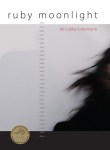
Ali Cobby Eckermann, Ruby MoonlightThe poetry, as you can see from my excerpts, is spare. There’s no punctuation, not even apostrophes, and no capitalisation except for proper names. Lines are generally short, and description is generally minimal. There’s a lovely but restrained used of repetition, and the rhythm is matter-of-fact, that is, it moves the story along with few flourishes (if that makes sense). The story is told through separately titled poems, each of which occupies its own page, though some only part of it. The titles are simple and to the point – “Ambush”, “Friends”, “Oasis”, “Hate”, “Cursed”, “Sunset”. You could almost track the trajectory of the story through its titles. This spareness, I think, enhances the emotional power. The poems say what they need to say without embellishment.

The excerpts above are from more narrative-focused poems, but there are also poems which provide context, describing the seasons as time passes, commenting on the landscape within which our characters operate, providing a sense of the country’s spirits watching, tending, ready to act. The novel opens on the poem “Nature” which sets the scene perfectly by conveying the opposing faces of nature – “sometimes/turning to/butterfly” or sometimes just to “dust” – which also subtly heralds the coming massacre. And, a few poems in, soon after the massacre, comes one describing nature’s nurturing of Ruby:

chirping red-browed finches lead to water
ringneck parrots place berries in her path
trust nature
(“Birds)

The words “trust nature” are repeated at the end of each couplet in this poem, providing a soothing mantra for Ruby.

Most of the poems are presented in couplets or triplets, but occasionally one uses a different structure, usually to mark a dramatic change. Early in the novel is the devastating, shaped-poem, “Ambush”, in which all lines but one comprise single words (“hack/hack/hack” it starts); and half-way through is another shaped-poem, “Tempo”, which marks both the passing of time and acts as a transition from a short time of idyll for Ruby and Jack to the appearance of others:

Jack knows the remainder of the conversation
before it was spoke ya see any blacks roaming
best ya kill ’em disease spreading pests
(“Visitor”, immediately after “Tempo”)

The irony of it! Who brought disease?

So, Ruby and Jack. One of the delights of the book is the sympathetic representation of these two characters. Bereft after the loss of her family, Ruby stumbles across Jack, a loner who scrapes a living out of fur-trapping. Both are outcasts in colonial Australia, Jack an Irishman, a hated “Mick” (“a music-less man stands aloof at the bar/scowling his hatred for the Micks”, from “Loose”) and of course Ruby, a lubra or black woman. These two cautiously find a “small trust … growing” (“Solace”) between them, but it is a “forbidden friendship”, forbidden from both cultures, so their times together are snatched carefully. Ruby is watched by members of another mob, people who are “slowed by fatigue” and “weary with worry” (“Signs”), and who know the dangers:

camp smoke whispers
tell story of the killings
(“Whispers)

Jack and Ruby become the target of the aforementioned “music-less man” – a man who’d lost his “music heart” after an act of barbarity – and his hired help, two brothers “with rotten teeth smirks” (“Scheme”). Hatred and greed fuel these men. And so the scene is set, but it doesn’t quite play out the way you expect, because Eckermann wants to focus more on our universal need for warmth, love and companionship, and also on survival.

The novel is imbued with indigenous presence, from the opening where Ruby’s family live in “Harmony” in their environment, through her meeting with the other mob, the Cloud people, “on their winter trek”, to the appearance of “Kuman”, her guardian spirit who guides her to safety.

Ruby Moonlight is a special read that adds another perspective and voice to colonial contact narratives, a voice that pays respect to indigenous law and traditions, addresses the politics of contact, but also recognises our personal and universal need for love and companionship. It’s a warm and generous book, but it doesn’t pull punches either. A good read.

awwchallenge2016Ali Cobby Eckermann
Ruby Moonlight
Broome: Magabala Books, 2012 (2015 reprint)
74pp.
ISBN: 9781921248511

Julie Proudfoot, The neighbour (Review)

Julie Proudfoot, The neighbourWhen Julie Proudfoot offered me her debut novel, The neighbour, for review I was more than happy to accept. After all, it had won Seizure magazine’s Viva La Novella Prize in 2014, and you all know how much I love a novella. I must say it’s a gorgeous looking book. I’m not one to judge books by their covers, but neither am I immune to a beautiful book, and The neighbour is that – from its rich, green and mysteriously intriguing cover to its crisp, clear internal design. It is such a pleasure to hold and read. No wonder I prefer print to electronic!

But of course, the most important thing is the content, and the book delivers here too. It’s an Ian McEwan style page-turner. By this I mean it starts with a dramatic event which sets in train actions and reactions as the characters struggle to come to grips with the event, with its impact on themselves and their relationships, and with the way it exposes secrets and past traumas. The event is the horrible but accidental death of a child due to a mistake made by a neighbour. The circle of characters is tight – Ryan, Angie, and the nearly-five Lily, who live next door to Luke, Laney, and their four-year-old son Sam. On the opening page, Luke acknowledges, internally, that a frisson of tension (“a nervous kind of energy”) exists between himself and Angie  – and then she asks him for a favour he does not want to do.

“His actions were wrong, but now he can right them”

The neighbour is a novel about psychological disintegration brought about by grief and guilt, and about the tension that ensues when one wants to forget, another wants to remember, while yet another wishes to atone. Grief, we see, is a personal, private thing, and particularly so when it is bound up in a secret that prevents its full expression. Luke has always been Mr Fix-it for Angie and Ryan, so of course he wants to keep on fixing. If he can just fix their house, the loose roof-tiles, for example, he can make amends. Actions, he tells Angie, are the only way he can “beat down” the guilt. But you can’t help or fix for others if you are falling apart yourself, and you certainly can’t if those others don’t want that help. This is something Luke has trouble recognising as his thinking becomes more and more disordered.

And Luke’s thinking becomes so disordered, in fact, that his behaviour moves into quite bizarre territory. His determination to fix things for Angie and Ryan, despite their refusal, edges him into stalker territory. But, stranger still, Lily’s death resurrects (I’ve chosen this word specifically but I’m not going to explain why!) memories of his older brother’s drowning when they were children. Luke’s response to these memories is, there’s no other word for it, sadistic, but we go with it because we know Luke is losing his hold on reality. He is not a sadist. He is a troubled man. We care about him – because Proudfoot makes sure we do.

She achieves this by telling most of the story through Luke’s perspective, though we also occasionally enter other perspectives, such as Angie’s, too. It’s in third person, but present tense, so we journey with Luke, and other characters, as they try to make sense of their situation. Here’s Luke after Ryan has vehemently rejected his attempt to fix their roof:

As he climbs back over the fence, he can feel Ryan watching him. It’s going to be tough. Ryan will fight it. He knows this, but they’ll thank him in the end. They don’t even know what they need right now. He’ll get them all back on track. Ryan and Angie need never be aware of it.

The language, as you can see, is clear and direct. Because we are in Luke’s head most of the time, description is kept to a minimum, but the writing is nonetheless evocative. Sentences are generally kept short, which keeps the story moving and develops tension. The short, choppy sentences also mimic the characters’ erratic, distressed mental states. Here is Angie through Luke’s eyes:

When she talks her face is in parts. Her eyes shine. Her mouth moves. Her cheeks square up when she speaks and droop when she stops. In doing what Ryan wants, she has become fractured and tense. The more Luke tries to help her, the worse she gets.

Then there’s the plotting. It’s delicious. As the novel progresses, we think we’ve guessed the back story, and we have, but not quite. As it builds to its conclusion, we think we know how it will end, and we are right, almost. The end, in fact, has a beautiful irony – and is perfect.

Despite its brevity, The neighbour tells a complex story of grief, guilt, culpability and responsibility. There are layers, here, as there often are in tragic accidents, but rather than labour them, Proudfoot trusts us to comprehend them while she gets on with the story. This is a powerful, thoughtful – and at times – shocking novel that gripped me from its opening sentence. I look forward to seeing what Proudfoot produces next.

Lisa (ANZLitLovers) read and enjoyed this when it first came out.

awwchallenge2016Julie Proudfoot
The neighbour
Sydney: Xoum Publishing, 2014
204pp.
ISBN: 9781922057983

(Review copy courtesy the author)

Dorothy Johnston, Through a camel’s eye (Review)

When should I give up saying that I don’t read crime? In the last seven years, I’ve posted nine reviews tagged crime fiction (of which one was a guest post). Perhaps just over one a year still qualifies as not reading crime? Then again, what’s the point of saying it, if every now and then I do read crime? I think there is a point – it advises that I’m not a crime fiction expert, so my posts need to be read from that point-of-view, and it also tells readers not to come here looking for posts on crime.

So now, with that off my chest, I’ll get to Dorothy Johnston’s crime novel, Through a camel’s eye. It’s the first novel in her new crime series, Sea-change mysteries. I decided to read it for two reasons. One is that I’ve read and posted on two other works by her and was interested to see how a Miles Franklin shortlisted author might approach crime fiction. The other is that she was going to be in town last weekend and we’d agreed to meet for a quick cuppa, so I thought this would be the time to read her latest book (though I didn’t finish it in time). I didn’t plan to quiz her about the book, but I did want to show some support for a hardworking author. As with most of the crime novels I’ve read while blogging, I wasn’t sorry about my decision to expand my horizons a little.

Dorothy Johnston, Through a camel's eyeBefore I write about the book, though, I do want to mention the cover. It features a soft-edged image of a camel, lighthouse, and boardwalk. It’s gentle, atmospheric and, woo-hoo, it doesn’t have an image of a tiny man or a woman’s back as has been popular in recent times. The murder victim is, however, a woman, which, given women do not comprise the majority of homicide victims, is another issue that crops up in commentaries. The point here, though, is that Johnston does not delight in gruesome detail. We gradually discover during the course of the novel how the murder took place but the details, the victim’s emotions, the appearance and/or treatment of the body are not focused on. This is because Johnston’s interest lies elsewhere.

And now, I should get to the story. It’s a police procedural set in a small coastal community in Victoria. The police station is run by a local, Constable Chris Blackie, who returned to the town when his mother was unwell and stayed on after she died. The novel starts, though, with Anthea, a young, recently graduated constable who has been sent to be Chris’ assistant. Her country-town placement has precipitated a break with her architect lover, and she’s pining. Actually, the novel doesn’t quite start with her, either – she’s just the first police officer we meet. The novel starts with one of the town’s “characters”, the recently mute Camilla Renfrew, watching a young woman, Julie, train a young camel. As Camilla walks away, she remembers that on a previous visit she’d heard a woman’s scream. And so there we have it, we think, the crime – and yes, one of the book’s two crimes is a murdered woman, but it’s not, in fact, the first crime we are confronted with. That honour goes to the aforementioned camel, Riza. He goes missing.

From these two crimes, Johnston spins an intriguing tale that keeps us wondering whether the crimes are connected or not – but you’ll have to read it yourself to answer that question. I want to talk instead about what I enjoyed most about the novel – characters and language.

… looking for drama

Most crime novels, I think, draw on archetypes. In this case, there’s the idea of a “sea-change” – particularly for Anthea – and the basic character set-up, the reserved, loner boss, and the fresh, unsettled, somewhat disengaged offsider. Anthea is “disappointed” to have been sent to Queenscliff, and thinks she has her boss pinned:

She would like to dismiss Chris Blackie as an old fuddy-duddy, or a closet-gay; but found she couldn’t, quite.

She’s attracted to “forceful men with definite ideas” but Chris is not that sort of man. He’s barely conscious of his “maleness”, and she doesn’t quite know how to respond to such a person. For his part, Chris would have been happy to run the station solo. Nonetheless, he’d been open to the idea of a woman, but

Anthea had come looking for drama. He’d seen it in her eyes the minute she walked in. Both the anticipation and the almost instantaneous disappointment …

He wasn’t to know of course that her first sight of him, bum-up tending the police station’s lavender and rose garden, hadn’t exactly inspired her.

So, we have an archetypal “misfit” situation – two people working together, neither of whom are completely comfortable in their skins. It is the development of these two characters and their relationship, rather than in solving the crime, that I enjoyed most in the novel. Anthea may have come “looking for drama” but Johnston develops her story quietly, tenderly, rather than dramatically. She achieves this by taking us into the heads of these two unsure people, showing us their thoughts, feelings and reactions.

Why are they unsure? Well, I’ve already described some of it, but there’s more – and this could be where those of you who don’t like coincidences may come a little unstuck, because there are several missing parents here. Anthea’s parents had died in an accident when she was three, while Chris’ father had drowned when he was ten. Camilla’s “cold, punitive” husband had died of a heart attack when her now adult son, Simon, was ten, something for which he seems to still blame her. And young Julie, the camel owner? Her parents had died in a car-crash when she was in her teens. Johnston doesn’t labour all this, but these losses provide background to the characters and help explain their lack of mooring. Coping with loss and resolving the past could also be seen as themes of the novel. Anthea, for example, needs to let go of her lover, while Chris needs to resolve the fears that are stunting him.

Besides these characters, there’s Johnston’s description of place and small town life. We meet the town’s denizens – farmers, teenagers, caravan park owners, retired solicitor. They are typical – they have to be for us to believe the town – but, overall, they work as individuals too. We see the pros and cons of small town living, the everyone-knows-everyone-else’s-business aspect alongside the looking-out-for-each-other part. Chris’ old cottage and Anthea’s flat, the paddocks and seascape, are all clearly, but succinctly, described, as are the characters. Here is a minor character:

His big frame relaxed as though someone pulled a peg that was holding complicated scaffolding in place.

And here is the physical environment, seen through the eyes of another minor character:

Camilla was fascinated by the thick white stalk of the lighthouse, appearing and disappearing through the fog. Behind her, the pier squatted as a vague horizontal line, a grey denser than the sky. Its verticals were lines of shadow legs, a giant centipede.

The crimes are solved, and Chris and Anthea progress in self-understanding, but enough openings are left for us to wonder where Johnston might take these characters next. Through a camel’s eye relies more on the little details of lived lives than on the big dramas to provide interest, which is exactly why I enjoyed it.

awwchallenge2016Dorothy Johnston
Through a camel’s eye
For Pity’s Sake Publishing, 2016
216pp.
ISBN: 9780994448521

Australian Women Writers 2016 Challenge completed

The time has come to write my annual completion post for my one challenge of the year, the Australian Women Writer’s Challenge. As in previous years, I signed up for the top-level, Franklin, which involves reading 10 books and reviewing at least 6. I’ve exceeded this, and I plan to continue to add to the challenge, as I’ve done in previous years, but half-way through the year seems a good time to write my completion post.

I have, so far this year, contributed 14 reviews to the challenge.

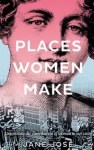
Jane Jose, Places women makeHere’s my list in alphabetical order, with the links on the titles being to my reviews:

This is quite different to last year’s completion post list which included one classic and one book by an indigenous author. I like to read classics, and I also like to read indigenous authors, but this year so far I’ve read neither. Instead, I seem to have read significantly more non-fiction, six out of 14 in fact. By the end of last year’s challenge, I’d read seven non-fiction out of 27 books in total. Looks like I’ll exceed that this year unless I stop reading Australian women’s non-fiction pretty well right now.

It’s also a little different because it includes two books by an author, the wonderful Elizabeth Harrower. Of course, it’s not that I don’t read multiple books by authors – but this usually happens over time. I tend not to find an author and immediately go hell-for-leather with that author – not because I don’t want to, but because I have books lined up, which brings me to …

… plans for the rest of the year. I know I’ll be reading at least one indigenous woman, Ali Cobby Eckermann, and I do have a couple of classics I really want to get to this year, but the review copies are piling up and there’s my reading group schedule, so I’m just going to see how it goes. The best laid plans, and all that!

Do you plan your reading in advance – and if so, do you keep to it – or do you just read what comes? 


Anna Rosner Blay, Sister, sister (Review)

BlaySisterHaleSome of the most vivid memories of my Sydney-based late teens and early twenties relate to spending time with Jewish people, business friends of my father. We went to parties in their homes, to weddings and bar mitzvahs. These were always happy, family-oriented occasions. I had crushes on the sons. I knew that most of these people had come to Australia after the war, had suffered during the war, many in concentration camps, but I knew little more than that. The war was back then and this was now. I have no idea what those sons knew or thought about their parents’ pasts. Anna Rosner Blay’s biography-cum-family-memoir, Sister, sister, has reminded me of those days and made me wonder, yet again, about the lives whose paths I so airily crossed.

Around that time, I also started reading “Holocaust literature”. I’ve read memoirs about surviving the war, including most recently Halina Rubin’s Journeys with my mother (my review), and novels about survival, such as Imre Kertèsz’s Fateless (my review), but Anna Rosner Blay’s Sister, sister adds new ground to my reading. Not only is it about two sisters, Polish Jews, who survived the war from the early restrictions, through ghetto, concentration camps, death marches and factories, to their eventual emigration to Australia, but it also exposes the longterm effects of Holocaust experiences, particularly on the next generation. It’s a moving book.

Three voices

Blay presents the story in three voices: those of her aunt Janka and mother Hela, and her own. Janka and Hela’s voices are clearly identified interview-style, while her voice is conveyed via italics without her name being appended. An interesting decision, but it works. Blay captured the sisters’ stories via tape-recorder and notebook, and then “transcribed and rearranged” them, primarily, I’m assuming, to get them into chronological order, given the stories came out in fits and starts, late in the sisters’ lives. Towards the end of the book Blay writes:

My mother’s accounts are often disjointed, abbreviated, shreds that veer away from the painful reality. But at other times they are laid out before me, complete and pulsating with life, precious jewels that I must handle very carefully.

She has, indeed, handled them (and her aunt’s) memories very carefully to produce a story that is horrifying, horrifying as a personal story, but also because it is clearly representative of a more universal experience of the millions of Jews who suffered under the Nazi regime, which just compounds the horror.

I’ll start with the universal. A survival story, Sister, sister describes the brutality, degradation and humiliation which the Germans visited upon the Jews during the war. You’ve heard the stories before, but, oh dear, to read yet again of the utter inhumanity is appalling. I couldn’t possibly quote the most brutal, so here’s a minor example. Both women ended up separately at Auschwitz. Both were stripped, shaved, sent into showers (that were – what a relief – real showers) – and then tossed random clothing and mismatched shoes. Hela received two left clogs causing blisters, while Janka’s pair comprised “one with a high heel and the other flat. I therefore walked with a limp.”

Surviving this war was, Janka tells, “a macabre game of chance”:

We hardly ever knew what would turn out to be good for us and what should be avoided, possibly by subterfuge. Sometimes being led to a train could mean being sent to a small camp with a factory, and easy work; other times it could mean being sent to death. Sometimes you could save your life just by lingering, which was dangerous in itself. There was no way of knowing how to survive …

And this brings me to the personal, because while the sisters’ experiences are universal, they are also deeply personal. One of the things that Blay does very well is capture Janka and Hela’s individual personalities. Janka tends to be more expansive, telling more stories in more detail. She is also “braver”. She lingers (drawing her sister or friends back) when she thinks to go forward means death; she lies about her skills when she thinks that will get her a better “job” and/or keep her with people she knows; she negotiates black market deals (to swap her mismatched shoes, for example); and so on. She identifies these, and other situations she survives, as “miracles”. The younger Hela – just 18 years old when the war ends – is, by her own admission, less brave, more fearful. She relies on her sister and later, a friend, to keep herself together when times get tough. She’s lucky to end up, towards the end of the war, as a Schindlerjuden, through her musician husband. But this is not to say she’s a wuss. She’s a hard worker, a skilled seamstress, and she survived. You had to be strong as well as lucky to survive. Janka, ten years Hela’s senior, says:

When we were girls Hela was like a flower that had opened too early, its fragile petals still crumpled and sheltered from the ways of the world. But she also had the strength to persist in harsh times, and to continue to flourish even in a storm.

Through directly presenting the sisters’ personal voices, Blay brings them alive as individuals in addition to representing them as survivors in general.

But, there’s a third prong to this story, the one that apparently forms the crux of Magda Szubanski’s recent memoir Reckoning. I’m talking the impact on the next generation. This is where Anna’s voice comes in. Again Blay handles this well, with Anna’s italicised reflections appearing intermittently in response to comments by one or other sister. Her voice is mostly gentle, without histrionics, but we are left in no doubt as to the longterm impact of the experience on the sisters and the way this has transmitted to the next generation. There are losses galore – losses of people and connections, for a start. Anna describes visiting a school friend who shows some of her “treasures” – a war medal, photos, some family jewellery. Anna writes:

She asks if I like the treasures; I nod, unable to speak. The tightness grows to a hollowness, an empty feeling that can’t be filled. The threads that link Linda to her past are strong, glowing. They are made manifest by the treasures before me, and I sense that it is not the objects themselves that have so taken my breath away. It is not their beauty or value that tugs at me, but the world of significant connections that surrounds them.

So, not only are there no grandparents, but there no objects to provide a link, a sense of history. Other losses are deeper, more psychological. Hela’s fear of hunger, of death, of fear itself, are also transmitted, sometimes subtly, sometimes not so, to her daughter:

My mother is always anxious at mealtimes. She coaxes me to eat more and checks how much I am putting in my mouth.

AND

I never trust strangers.

AND

My earliest nightmare is of a narrow cobblestoned lane. Fences on both sides crowd me in. As I walk along, alone, I realise I am being followed. An old man comes behind me with a sack, and grabs me …

Anna’s comments are not chronological, because they respond more organically to the sisters’ experiences, but together they convey how experiences – even when the telling of them has been withheld until late in life – carry through to the next generation. Anna’s stories, though, never overwhelm her aunt’s and mother’s because they are the main game. Anna sums it up best late in the book:

the enormity of the injustice and of the horror defies expression … [yet] … The power of the human spirit to survive, despite everything, is limitless.

Sister, sister was shortlisted for the Age Book of the Year Award and the New South Wales Premier’s Award in 1998. It’s not hard to see why.

Lisa (ANZLitLovers) also read and admired this book.

awwchallenge2016Anna Rosner Blay
Sister, sister
Alexandria: Hale & Iremonger, 1998
264pp.
ISBN: 9780868066479

(Review copy courtesy the author)