Biff Ward, In my mother’s hands (Review)

Biff Ward In my mother's hands

Courtesy Allen & Unwin

“Profoundly moving”, “a kind book”, and “harrowing” could be blurb words for Biff Ward’s memoir, In my mother’s hands, but they’re not. They are some of the words used by members of my reading group when we discussed the book this week with – lucky us – the author in attendance.

It’s quite coincidental that I happened to be reading this book right when Annabel Smith asked me to name my favourite memoir for her Friday Faves, which resulted in my follow-up post on memoirs this Monday. However, I’m glad it happened this way, because it’s given me an excuse to continue the discussion a little more. There’s so much to say about Ward’s book, but for this post I’m going to explore just two aspects: the reading experience, and its literary qualities.

On reading In my mother’s hands

So, let’s start with the story. Biff Ward is the daughter of one of Australia’s most influential historians of the mid-twentieth century, Russel Ward. At our meeting, she told us that people expected her to write his biography, but, she said, that was never her interest. Instead, she found herself writing about her mother. In doing this, though, she did in fact write about her father – but in a memoir, not a biography, because this book is about her experience of living in a family with an increasingly delusional, paranoid mother. What that experience was like – and how she eventually unravels the full story – makes compelling reading.

But, there’s more to reading this book than the story, strong as it is. There is how Ward tells it. She evokes the times beautifully – particularly the 1950s and 1960s – showing, in particular, the devastating result of the lack of understanding or awareness of mental illness. And she does this while inhabiting the child she was at the time, that is, she manages to tell those years from her child’s eye view, interspersing this voice with her experienced adult one. Take, for example, her description of when, as a teenager, she’s home when her mother is visited by “top girl” or “the queen bee of the university wives”. Ward believed this visit showed her mother was being talked about publicly, and she felt “shame and embarrassment” as “Top Girl bustled down the hall and out the front door”. That word “bustled” perfectly captures the idea of a “busybody”. Later, though, she sees it differently:

Now I can see that the network of women, connected through the university where their husbands worked, might have cared about my mother. Or might have wanted to care but were not sure how to go about it.

Also contributing to my reading enjoyment was how seamlessly Ward incorporated her research into the story to substantiate her feelings and ideas. She quotes from letters her father wrote to his parents and sister. (How wonderful that these were kept, says this librarian-archivist!) She talks of speaking to friends and family members later about their memories. She shares her research into official records. She refers to her father’s autobiography. And so on. None of this is tedious, but is woven naturally, logically, into the narrative.

Then there’s Ward’s honesty in confronting difficult truths, and her ability and willingness to reflect on her experiences and comprehend their meaning or implications. Here she is, for example, on her response to her father’s overwhelming (and surely unreasonable) request for her to look after her mother for a year:

I didn’t know that somewhere inside me was a plan. My motivation was buried way too deep for me to connect that first touch of an erect penis with the request Dad had made of me.

You can probably guess the outcome.

It would be easy to read this book with anger – to be angry particularly with Russel Ward for his failings – but that would, I think, miss the point. Ward is not angry – and indeed her father did a lot right too. Her tone is more one of sadness, than of anger. She appreciates the culture of the times and she knows that people are flawed. I loved this – the generosity with which she relates what was clearly a traumatic upbringing.

What makes a memoir literary?

This might sound like a snooty question, but literary non-fiction is a recognised genre, and memoirs are making literary award lists. So, what makes one memoir stand out over another in terms of literary qualities? Critic Barbara Lounsberry captures my perspective: “Verifiable subject matter and exhaustive research guarantee the nonfiction side of literary nonfiction; the narrative form and structure disclose the writer’s artistry; and finally, its polished language reveals that the goal all along has been literature.” (from Wikipedia)

So, narrative form, structure and “polished” language. While I wouldn’t call In my mother’s hands particularly innovative or challenging in terms of style and technique, I would call it skilled and polished. Ward’s use of her child’s voice interspersed with her more reflective adult one effectively draws the reader in. Her use of foreshadowing – such as “I missed seeing that I had been provided with a rehearsal of what was to come” and “It’s hard, looking back, to pick the precise moment when a turning point arrives, when your life is about to change” – picks up on a structural device common in fiction. (It also neatly demonstrates the memoirist’s ability to think back).

The jewel in the crown, though, is her language. Ward’s writing is generally direct and to the point, but she has a great eye for metaphor and produces some gorgeous images that can encompass multiple ideas. I loved this description of her mother’s increasing (often self-imposed) alienation within the family:

Even when there weren’t visitors, we hardly spoke to her. As her delusions grew, as she had almost no everyday conversation, we cut off from her, twig by twig. Our family tree grew its gnarled limbs around us and through us, in the imperceptible way trees do, so that we didn’t notice how weirdly shaped we all were.

This obviously distorts the traditional family tree motif but also, I think, subtly suggests the tree of (non) life?

And then there’s the title itself. In my mother’s hands references so many ideas – the fact that children are (rather defencelessly) in their parents’ hands; the idea that as a nurse her mother had had caring, nurturing hands; her mother’s grotesque habit of gouging and hurting her hands (invoking Lady Macbeth, and the mystery at the heart of the book); and her mother’s terrifying attempt to strangle Ward in her bed when she was 12 years old. Literal, symbolic, metaphoric. They’re all there in those four words.

The chapter titles are similarly evocative, usually brief and apt, such as Brittle, Knife, The Cobweb, Running. Language is, in fact, a significant issue in the book because in those awful days when mental illness was not understood, Ward, her father and younger brother had no language to explain to each other, let alone to outsiders, what they were experiencing. Sometimes Ward would lie, she said, because “when there are not adequate words, fiction will suffice”; other times they would use “shorthand” to obscure the reality.

I could write more about the language in this book, because I found it perfectly tuned to the story and to conveying the feelings within, but I’ll leave it here.

At the end of our meeting, I mentioned to Ward her longlisting for the Stella Prize. She smiled a little wryly, and said, in relation to missing out on the shortlist, that she felt in good company being “rejected with Helen Garner and Sonya Hartnett”! She sure is – and on the basis of this book, I’d say she well deserves being mentioned in the same breath as those writers.

awwchallenge2015Biff Ward
In my mother’s hands
Sydney: Allen & Unwin, 2014
268pp.
ISBN: 9781743319116
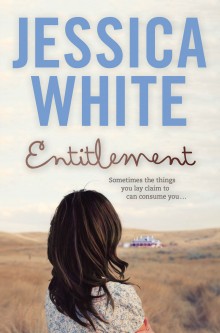
Jessica White, Entitlement (Review)

WhiteEntitlementVikingEntitlement is a powerful title for Australian author Jessica White’s second novel, but then White wanted to explore some powerful themes – though they are, unfortunately, somewhat belied by the rural romance/saga looking cover. The author bio at the front of the book tells us that White grew up on a property in northwest New South Wales and it becomes clear very early in the book that she knows whereof she speaks!

Of what does she speak, then, you are probably asking? Entitlement is set in contemporary times on a cattle property near a fictional place called Tumbin. The story starts with 29-year-old Cate McConville, now a practising GP, returning home because her parents wish to sell the property. She, with other family members, is a partner in the business, and all need to agree to the sale. But, Cate’s holding out – not because she loves farming and wants to return, but because her only sibling, her much-loved brother Eliot, had disappeared several years earlier and she wants him to have a home to return to. The farm – the land – also contains her memories of, and therefore her link to, him.

While the plot-line is established gradually, the first chapter sets the book’s tone and style. It tells us there’s tension between Cate and her parents; that memory is going to feature strongly in the telling; and that indigenous issues are likely to be part of the story. The book then progresses, introducing more and more characters over the next few chapters. Each chapter tends to be dedicated to one character, or a small group of characters, and usually involves flashbacks, as the character remembers something from, or reflects on, the past. White handles this well. There are many characters, but the present-flashback narrative style keeps them clear and in their place (if that makes sense). This style does risk becoming a little rigid, but White breaks it up every now and then with a chapter purely set in the present, or one that commences in the past.

Very early, as the characters are introduced, the themes start to become clear. The story is told within two main contexts – farming succession and indigenous connection to land. Over-riding all this is the notion of stolen and lost children. Local indigenous man, Mellor, has worked for a couple of decades for the McConvilles, as had his wife until she’d died of cancer. His extended family, particularly his two aunts, live with him on the edge of the property, and have experienced the stealing of their children. Cate’s father, Blake, is racist and dismissive of indigenous people and their rights, while her mother Leonora, by contrast, is on friendly relations with Mellor and his family.

Now, if you’ve been reading my blog for a while, you’ll have read some of my discussions of non-indigenous people writing about indigenous issues. It’s uneasy ground to walk on, but for White, with her farming background, the issues of stolen children and indigenous land rights are things she’s likely to have lived. I’m not surprised she wanted to explore it. Indeed, she wrote a comment on this blog nearly two years ago, saying that this novel:

raises the question of who, in contemporary Australia, is entitled to the land? I also tried to show, through the break up of a white family that was fighting over land, how Indigenous people have been affected by their dispossession. I don’t think it’s a question that can ever be answered, though I did aim for a (probably utopian) resolution at the end of the book.

She couldn’t do this, really, without creating indigenous characters and that means of course that she had to present (her understanding of) their attitudes. I think she’s handled this sensitively, but of course I’m non-indigenous. I did wonder if she’d stepped onto shakier ground when she drew comparisons between Cate’s mother’s loss with that of the stolen generation mothers. However, in her acknowledgements White thanks “Michael Aird and Sarah Martin for their conversations and resources on Indigenous culture and history”. She has not, it seems, walked this ground lightly. And she doesn’t leave it at country and stolen generation issues, but touches on other injustices, such as indigenous health and housing, and racist violence.

White is on safe ground when she discusses the land and farm from Cate’s point of view. I thoroughly enjoyed her descriptions of the landscape and farm life – little scenes of her father and uncle undertaking farm tasks, of Mellor tending to fences, or of Cate running through the land, for example. Here’s a description of an Australia Day picnic:

Flies and mosquitoes plucked at their skin. The scents of the bush were drawn out by the heat and bundled together like a sweet, loosely woven shawl. Kangaroos bounded away in alarm as they made their way up the hill. Crickets whirred, rising from the long grass, and cockatoos screeched.

Her characters, too, are real; they are imperfect, believable human beings. Cate’s inflexibility, her selfish unwillingness to understand the health issues forcing the need to sell, made me cross but the pain, the loss, driving her behaviour is believable. Her parents are presented as having a loving relationship, but not without its tensions and conflicts. And so on.

Entitlement is an engrossing and serious, though not a grim read. As White admits, she does try for a positive resolution, which could almost do the seriousness of the issues a disservice. However, the story is not completely neatly tidied up, presumably because she realised that her question – how do we handle conflicting relationships to this land so many of us call home – does not have a simple answer. It’s therefore important that both indigenous and non-indigenous writers put stories and ideas out there for us to think about. It can only help the discussion, don’t you think?

awwchallenge2015Jessica White
Entitlement
Melbourne: Viking, 2012
289pp.
ISBN: 9780670075935

(Signed copy won in a blog giveaway)

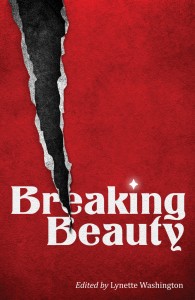
Lynette Washington (ed), Breaking beauty (Review)

Lynette Washington, Breaking Beauty

Courtesy: MidnightSun

As I’ve said before, I usually don’t read book introductions until the end. In the case of Breaking beauty, an anthology of short stories edited by Lynette Washington, it wouldn’t have mattered if I had read it first because Brian Castro’s intro gave nothing away while at the same time saying a lot. He starts by noting that the short story is making a come-back, “and wondering why it ever went away, perhaps because we were too imbued with the great whatever novel in the Borealis of canons or by the glossy fits of fashionable shades of grey”. Love the bite in that!

It’s a great introduction. It’s erudite, pithy, and often tongue-in-cheek. Castro says, reading my mind, “what good is an intro-duction if you haven’t been in-ducted, or even read the stories”. What indeed? And yet, his “intro-duction” manages to craftily incorporate the stories and their contexts, the ideas that drive them, without over-explaining or giving anything away. It is one of the most delicious introductions I’ve read in a very long time – unlike my introduction, so let’s move on!

Breaking beauty is a collection of stories by graduates of the University of Adelaide’s Creative Writing course. As Castro hints through a reference to Rousseau and as Washington states more directly, the stories explore the “complementary forces” and “dualities” encompassed by the idea of beauty, the notion that “there is no beauty without ugliness”. There are 28 stories, of which 22 are by women. They range in length from three or four pages to ten or so. Five of the stories have been published elsewhere, including Melanie Kinsman’s heart-rending “A paper woman” which was published in the Margaret River Press’s The trouble with flying (my review).

As you would expect, the stories look at beauty from all sorts of angles, physical, emotional, spiritual, even intellectual, but they rarely tell it straight. In Matthew Gabriel’s “To my son”, for example, an ugly father presents, to his apparently similarly ugly son, his solution for “neutralising physical appearance” which, he believes, will “not only rid the world of ugly’s plague but also its inextricable and toxic inverse”. Jo Lennan’s “A real looker” explores an extra-marital passion that resulted in a daughter who struggles to understand the adult world of passion, and a father transfers this passion to a boat called Marilyn. Sean Williams’ “The beholders” is a speculative fiction piece which cleverly twists the idea that beauty is in the eye of the beholder.

In other stories, beauty is more abstract . The second story, Corrie Hosking’s “A well strained fence”, is told first person by a young man for whom beauty is neatness and order. It’s a nicely sustained story that epitomises what a complicated notion or concept beauty is. It also neatly provides me with an opportunity to talk about voice. Just over half the stories are told first person, and two are told second person. One of these, Mary Lynn Mather’s mother-and-child story, “Whatever happened to the fairy-tale ending”, uses second person effectively to convey an emotion that is almost beyond bearing.

But of course voice is about more than which “person” is used; it’s about the persona used to tell the story, that is, about how the narrator of that story sounds to us. In short story collections – particularly anthologies – we usually find a great variety in voice (and, related to this, tone). Lynette Washington, in “Lia and Amos”, uses a matter-of-fact, reporter-like third person voice to tell a story with an unusual twist. The voice keeps us on our toes, divulging only what is going on in the moment, with no backstory or additional information, so that the end, when it comes, surprises and yet seems natural at the same time, because nothing has been sensationalised. By contrast, Rosemary Jackson’s narrator, Athina in “Athina and the sixty-nine calorie burn”, exudes the distressing (in this case), naive confidence of the young while the reader knows exactly what’s going on.

Several stories, including some already mentioned, tackle contemporary society’s (over-)emphasis on beauty. Others look at a broader notion of aesthetics from some interesting angles. Rebekah Clarkson uses an argument about aesthetics – a finial, in fact – in “A simple matter of aesthetics” to expose male arrogance, while in Katherine Arguile’s “Wabi-Sabi” a man’s commitment to aesthetics puts his family’s health, indeed survival, at risk. Meanwhile, Stefan Laszczuk’s narrator in “The window winder” finds beauty in a very gruesome place.

There’s no way, of course, that I can mention all twenty-eight stories. The ones I’ve mentioned here aren’t the only ones I enjoyed. There are moving – and often painful – stories about love, about sons and mothers, nieces and aunts, husbands and wives, mothers and children. There are stories about ageing, and the losses that usually attend, in one form or another. And there’s Lilian Rose’s cheeky story about a very unusual “Ladies Tea Party”.

Castro writes in his introduction of “the fleeting and the fleeing before one’s eyes, as a good short story is wont to do, not allowing its meaning to fully emerge because that would kill it, but letting it flit mothlike into memory”. This definition of good short stories could also define “true” beauty – as I’m sure the writers in this diverse and enjoyable collection would agree.

awwchallenge2015Lynette Washington (ed)
Breaking Beauty
Rundle Mall: MidnightSun Publishing, 2014
228pp
ISBN: 978192522700

(Review copy supplied by Midnight Sun)

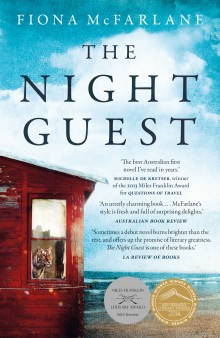
Fiona McFarlane, The night guest (Review)

McFarlaneNightGuestPenguinThose of you who followed the literary award season in Australia last year will have seen Fiona McFarlane’s debut novel The night guest pop up several times. The more it popped up, the more I wanted to read it – but also the more I thought it would be good to read with my reading group. So, I bought it, and held onto it until this year, as we did, in fact, schedule it for our end of February meeting.

The first thing to say about this book is that it’s an easy, quick read, a page-turner in fact. But, it is not a simple read. It’s a read that keeps you guessing right to the end, even though you are pretty sure you know what is going on. It’s about Ruth. She’s in her mid-seventies, and recently widowed. She lives in the family’s old holiday house to which she and her husband had retired a few years previously. And, she’s “reached the stage where her sons worried about her”.

Then, along comes Frida, from the government she says, to be Ruth’s carer, because Ruth, as we’d suspected, has dementia, albeit in early stages. She is, she feels, “still self-governing”. Apparently, both of McFarlane’s grandmothers had dementia which helps explain why McFarlane has been able to present Ruth’s state of mind so convincingly. I say “helps explain” because there’s clearly a perceptive and skilled writer at work here too. It’s one thing to experience family members with dementia, but it’s quite another to be able to present it with such authority and authenticity.

How does McFarlane do this? The most important decision a writer has to make I think – and I’ve certainly heard many say this – is the voice. For this book, McFarlane chose third person subjective, that is, it is told third person but almost completely from Ruth’s perspective. A good decision, because we can feel Ruth’s uncertainty as she slides between confidence and uncertainty, between independence and neediness, between reality and a strange world that doesn’t always make sense. Because it’s from her point of view – and not an omniscient author’s – we are kept on our toes, not always sure, as Ruth is not, of where she is on any of those spectrums at any given time. Sometimes it’s patently obvious, but other times it’s not so clear.

Ruth has a few guests during the course of the book – including Frida (of course) and a man called Richard Porter. But there is another one, a tiger! The tiger appears in the opening sentence of the novel:

Ruth woke at four in the morning and her blurry brain said, ‘Tiger’.

She was of course dreaming, except that now she’s awake, she starts to hear noises, “something large … rubbing” against her furniture, and “the panting of a large animal”. These noises are too big to be coming from her cats. The tiger is ongoing “character” in the novel. More on this anon.

The second guest to arrive is the aforementioned Frida. She appears out of the blue one day – “You don’t know me from Adam” she says – to start caring for Frida. The question though is, is she “out of the blue” or is it that Ruth didn’t remember that someone was coming. Questions like this recur throughout the novel, keeping us in a sort of readerly vertigo. One minute we believe we know, and the next we are uncertain again. By the half-way point, though, I suspect most readers are pretty confident of what’s really going on, but even then there are uncertainties about how it will actually play out. All this makes the book an engrossing challenge.

Then there’s the third guest, Richard Porter, who was her first, and unrequited love, when she was a young woman living in Fiji with her missionary parents. Ruth invites him for a visit, hoping that “things could still happen to her”.

It’s hard to know how to write more about the book though because this is one of those stories in which the plot and the meaning are intertwined. However, I can say that it’s broadly about ageing, grief, love and loss. It’s also about trust, honesty and the responsibilities we have for each other.

The tiger

The tiger, as I’ve already indicated, appears on the first page. He’s a complex figure, alluding partly, I’m sure, to Blake’s “The Tyger”. But, and here perhaps I’m drawing a longer bow, he also reminded me of the tiger (aka Richard Parker, which is very close to Richard Porter, but that might be a bridge too far!) in Yann Martel’s Life of Pi. Both tigers reflect a duality: they are both fearsome (and perhaps representative of evil, though I like to avoid that word), but both can also be seen positively. Blake’s tiger was made by the God who also made the lamb, and so by extension can be seen to encompass both forces. Martel’s tiger needs to be kept at bay, but his very presence also gives Pi the strength and focus he needs to survive.

So, too, in The night guest does the tiger play a complex role. He appears when Ruth is at her most uncertain, most fearful, most disoriented, disappearing when she’s calm. In that sense he represents the negative. But, there’s something grand, and perhaps even reassuring about him. In his first appearance, Ruth thinks:

A tiger! Ruth, thrilled by this possibility, forget to be frightened and had to counsel herself back into fear.

A little later, when she is feeling comfortable, the tiger is “safely herbivorous”. But, he comes back, and Ruth is irritated “because there was no point to him now that she had Frida and Richard; the tiger had prepared the way for them and was no longer needed”. I’m tempted to suggest that Frida and Richard could represent the tiger’s duality, but the book isn’t simplistically conceived, so I don’t want to take that line of thinking too far.

Towards the end, when the tiger is fighting for his existence,

Ruth felt for a moment on the verge of understanding exactly what the tiger was saying when he roared. He wasn’t concerned for his safety, but for his dignity …

I’ll leave the tiger there, but I think you can see how McFarlane uses him in the novel.

There are other images and symbols which run through the book, some of them biblical, like lilies (“she was safe behind her lilies”), which makes sense given Ruth’s missionary upbringing. And, of course, Ruth’s name itself is biblical. None of this is heavy-handed though, or suggests a slavish adherence to symbolism. It just adds to the depth with which we can contemplate this book – at least, I think so.

In the end, this is a book about people – and how we treat each other. Several people, besides those I’ve mentioned here, are involved in Ruth’s life, such as her sons and a young mother who’d found her husband as he was dying. The book asks us to consider how far do we – should we – take our duty of care? How do we decide when we should intervene in another’s life and when we should not. I did enjoy this book.

Lisa at ANZLitLovers didn’t enjoy it as much as I did. I agree that it doesn’t really work as a psychological thriller, which is how some of the blurbs on my edition describe it. But, as I was reading it, I wondered whether that’s what McFarlane intended … or just how it’s been promoted?

awwchallenge2015Fiona McFarlane
The night guest
Melbourne: Penguin Books, 2014 (orig. ed 2013)
275pp.
ISBN: 9780143571339

Ellen van Neerven, Heat and light (Review)

Ellen van Neerven, Heat and light, book cover

It’s silly I know, but I had a little thrill at the end of Ellen van Neerven’s Heat and light, because not only was the last story set in a place where I spent six of the formative years of my childhood – Sandgate on the northern edge of Brisbane – but one of the characters learnt to swim in the same pool there that I did, and her brother has a beagle, just as we did. Ah, childhood. Enough, though, of readerly nostalgia. Time to properly discuss the book.

Heat and light won the David Unaipon Award for Unpublished Indigenous Writer in 2013, and has been on my TBR for several months. I hadn’t prioritised it for reading, but its longlisting for the Stella Prize last week convinced me to squeeze it in before two works I had to complete by 21 and 24 February. I hope I won’t regret it. No, let me rephrase that: I know I won’t regret having read it, but I hope I don’t regret my decision to read it right now!

The first thing to say is that Heat and light isn’t a novel. It has, in fact, an intriguing form, something that’s not unusual with writers from an Indigenous background. Simplistically speaking, it comprises short stories organised into three sections titled Heat, Water and Light. However, each of these sections is quite different. Heat comprises interconnected short stories (5) about three generations of the Kresinger family, while Water is longform short fiction (54 pages in my edition) in the speculative fiction genre. Light, on the other hand, is more like a “traditional” collection of short stories (10). Together, the three sections, including the future-set Water, create a rich picture of contemporary indigenous life and concerns.

And here I confront again the challenge of being a non-Indigenous Australian reviewing a work by an Indigenous Australian featuring Indigenous people. It always makes me a little anxious: I fear sounding earnest or, worse, patronising; I fear making what’s different sound exotic; and, I fear missing the point. And yet I love reading Indigenous writers, because their perspective is different and because they (see, I’m generalising, aren’t I?) tend to be adventurous in their story-telling, often taking risks with voice, form, chronology, genre, and more. Van Neerven, as I’ve already implied, is such a writer.

The titles of the three sections – Heat, Water, Light – make me think of the elements. They are not quite the classical elements (fire, air, water, earth) but they convey, it seems to me, the essence of what’s needed for life. The focal character in Heat, though we don’t see a lot of her, is Pearl, the grandmother of the narrator of the first story which is titled, in fact, “Pearl”. Pearl is a bit of a free spirit – earthy, hot (in its sexual meaning, with “her siren eyes”), and likely to appear or disappear with the wind. Over the five stories in this section we learn about Pearl, her sister Marie, and the two succeeding generations. Van Neerven’s writing is confident, moving comfortably between first and third person narrators, all of whom are members of a complex extended family. Loyalties – to their indigenous background and to their blood relationships – are tested. As the narrator of “Pearl” says:

So much is in what we make of things. The stories we construct about our place in our families are essential to our lives.

And this is true, whether or not the stories so constructed are “true”. The implication is you need to know what you are doing. Colin, for example, finding himself, through his own actions, disconnected from his Indigenous heritage, wants to return, but

she told me if I was going to make my way home I’d better do it soon before the dust had covered my tracks.

The third section, Light, explores similar issues to those in Heat, but through ten separate stories, ranging from 2 pages to 30. The characters in both sections both move between city and country, but, while Heat is set in southeastern Queensland, the stories in Light are set in Sydney, Western Australia and Queensland. The protagonists tend to be young, and female. They also tend to be in formative stages of their lives, or at crossroads; they are sorting out their relationships, their sexuality, their identity. They confront racism and face conflict, but they also experience and give love. There’s humour, some of it wry, such as the young girl noticing that the tag on her pants states that “this colour will continue to fade”.

Water, the longform story that occupies the middle of the book, is very different. For a start, it’s set in the near future, the 2020s, when Australia is a republic with a female president. There’s a new flag and Jessica Mauboy’s song “Gotcha” is the national anthem. There’s also a social media ban! I reckon Van Neerven enjoyed imagining this. However, life isn’t perfect. Our narrator Kaden has a new job as a Cultural Liaison Officer and was initially pleased because she thought she’d be working with “other Aboriginal people” which would provide a “way of finding out about my culture and what I missed out on growing up”. But, she discovers she’ll be working with “plantpeople” who are sort of mutant plants with human features created during “islandising” experiments. Kaden’s job is to evacuate them in preparation for the Australia2 project.

I don’t want to give any more of it away, but you’ve probably guessed that it’s a story about how we treat other, about segregation, discrimination and dirty politics. It’s also about connection to country and about the importance of controlling one’s own art. Artist Hugh Ngo says:

I don’t make art for galleries. Or for money. I make art that speaks the truth.

This is a clever (and true!) book. The bookending sections Heat and Light present stories of Australian people going about their lives, and most of them happen to be indigenous. Their indigeneity is evident, and it affects the issues they confront, but there’s no specific advocacy. The middle section, on the other hand, is more overtly political. It picks up issues that appear in the shorter stories and provides a coherent, ideological context for the whole.

Heat and light is one of those really satisfying reads: it combines engaging writing with stories that make you feel you’ve got to the things that matter. So no, regardless of whether I meet my other deadlines, I’m not sorry I bumped this book up in my reading priorities.

awwchallenge2015

Ellen van Neerven
Heat and light
St Lucia: UQP, 2014
226pp.
ISBN: 9780702253218

Note: One of the stories in Light, “The Falls”, is available on-line at Kill Your Darlings

Tara Moss, The fictional woman (Review)

Courtesy: HarperCollins Australia

Courtesy: HarperCollins Australia

In terms of feminist argument, I’m not sure that Tara Moss told me anything I didn’t already know or believe in her first work of non-fiction, The fictional woman, but that didn’t stop me enjoying her take, her approach. Moss is an interesting woman. Her careers as a model and a crime writer meant she wasn’t really on my radar for the first twenty years of her working life, but that changed a couple of years ago when she began appearing on commentary shows I watch like Q&A (see an appearance here) and The Drum. I discovered that she’s a woman of wide interests and many talents. Here are some of them: UNICEF Ambassador for Child Survival, Goodwill Ambassador; UNICEF Australia Patron for Breastfeeding for the Baby Friendly Heath Initiative; Ambassador for the Royal Institute for Deaf and Blind Children; and a PhD candidate in the University of Sydney’s Department of Gender and Cultural Studies.

So the book. Her main thesis – born of her own experience – is that women’s lives and roles are subject to an inordinate number of fictions that contradict reality, and that this helps perpetuate ongoing inequalities for women in representation, status, value. The book starts more like a memoir, telling us how she became a model in her early teens (“The Model”), her experience of being measured by her body (“The Body”), how she survived some early experiences, including rape (“The Survivor”), and her transition to being a writer (“The Writer”). She then moves on to discuss wider topics such as “The ‘Real’ Woman”, “The Archetypal Woman”, “The Beautiful and the Damned”, and “The Crone”, though in these too, she often uses her personal experiences. To illustrate the fictions women live under, she tells of taking a polygraph test to prove that she, a “dumb” “blonde” “model”, could actually have written a successful novel.

Moss supports her discussion of the fictions she identifies with an impressive array of statistical and other evidence. The book is extensively foot-noted (or, is that end-noted), as you would expect from a PhD student. While the points she makes aren’t necessarily new to me, much of her evidence is – and that’s worrying because her evidence is recent confirming that things haven’t changed as much as I’d have hoped since I first started thinking and reading about feminism in the 1970s.

I won’t elaborate the multiplicity of fictions she explores, the way women are simplified into virgin, whore, witch, crone, for example, because we all know them. Even the male readers here know them, I’m sure. Rather, I’d like to talk about some ideas that I found particularly interesting.

One of these ideas relates to the issue of beauty, which comes up in several chapters, but my focus here is “The ‘Real’ Woman” in which she discusses the various campaigns for/promotions of “real beauty” which encourage women to show themselves au naturel. No, I don’t mean naked, but without makeup, and other enhancing products and processes. Having lived my life this way (little or no make-up, no hair-dyeing, no waxing, etc), I was feeling comfortable in this chapter, until I reached her suggestion that these “campaigns” can be “like a beauty pageant, only with different parameters”. In other words, once again, we are asked to “judge” women on the basis of their appearance. She writes:

I see some disturbing similarities between the kinds of appraisals of women’s appearance that we commonly view as misogynistic, and appraisals that present themselves as ‘pro-woman’.

I take her point. “Using images”, she argues, “to make the claim that you are freeing women from the prison of image is a tricky thing to pull off”. I found this chapter the most confronting because, unlike the others which tended to cover more familiar ground, this one forced me to think more deeply about the complexity of how we “see” women. It’s not surprising that she loves John Berger’s excellent work, The ways of seeing.

She explores some of the underlying structural causes, particularly the way our market-driven society supported by the media contort and distort “reality” through stereotyping, simplifying and then generalising. She argues that women’s visibility in the public sphere is dominated by/limited to those “images” needed to sell products. Advertising has become “so entangled with mainstream culture … so entangled with female identity in particular”, she argues, that we do not see the real diversity of women’s engagement in society.

For many people, “gender” and “feminism” are tricky concepts. Moss unpacks them both with excellent clarity. Her definition of feminism is exactly mine. Feminists want

equal opportunity, equal rights, equality for women. (Equality = same value or status. They want to be equal to, not the same as, men).

Yes! How often do we need to repeat this? “Equal” does not mean “same”. And just because you don’t agree with some feminists doesn’t mean you’re not a feminist if you believe in equality for women. Moss understands, though, women fearing to own the term. She tells of once being asked on ABC TV whether she was a feminist, and admitted she felt

an actual ripple of fear. Part of me was afraid of the vitriol I would be subjected to for publicly identifying with the very movement that had given me the right to vote, the right to own property, the right to work and earn my own pay.

How can that be?

And this brings me, in a way, to another theme that pops up through her book: the way women undermine each other. She discusses, for example the “mummy wars” in which working mums are pitted against stay-at-home mums, and breast-feeding mums are pitted against formula-feeding mums. And yet, she also debunks the fiction “that all women hate each other” or that “women are their own worst enemies”, not only by confirming that for many women, other women provide their greatest support, but by exploring how society, and particularly the media, “read” female behaviour and interaction to put this spin. She tells how a joking comment of hers was read as “a swipe at Miley Cyrus”. Again, the main point of her argument is the social construction that supports these “fictions” about women.

In her final chapter, she discusses what she sees as the wider problem which is that the world is not “a fair and balanced place”. We do not have equality – across gender, race or class. This is what we need to address, and she calls us all to action.

Occasionally I worried that Moss was drawing a long bow or skewing her argument a little by her own experience, but in fact I found her thesis and thinking to be clear and logical, intelligently-framed, and forceful without being judgemental. It’s a good read – and provides much for us to contemplate.

awwchallenge2015Tara Moss
The fictional woman
Sydney: HarperCollins Publishers, 2014
328pp.
ISBN: 9780732297893

(Signed copy received from my sister-in-law)

Pulse: First 2014 (Review)

Now here’s the thing. I’m a librarian by training, so I have certain expectations of how publications are titled, and Pulse, I must say, confused me. However, we librarians also know that publishers and writers don’t care about our rules; they just do what appeals to them! Fair enough. They’re the creators after all. Still, when I see a serial publication titled Pulse: First 2014, my immediate assumption is that the serial’s title is Pulse, and that I have in my hand the first edition for 2014. Not so, in this case. In fact, the serial – here, an annual – is titled First, and the title for the 2014 edition is Pulse! Got it? I have now!

So, what is First? It is “an anthology of creative works by students at the University of Canberra”. It has been published as First since 1995, but it commenced in 1993 under another title, Analectica. The editors of the 2014 edition therefore see Pulse as the anthology’s 21st volume, a “coming-of-age” edition. An impressive achievement I think. I’m not an expert on student-writing publications but 21 years in a world where projects come and go with some rapidity demonstrates a wonderful commitment by the university to its teaching of writing, design and editing.

The volume was put together by an editorial committee comprising students, some of whom feature in the volume. We are assured however that entries were all read blind. According to the university’s online news site, Monitor Online, there were 130 entries from which the final 26 stories and poems were chosen. Two prizes were given, though this is not noted in the volume: Best short story to Andrew Myers for “Neon Snow”, and best poem to Madonna Quixley for “The Archeological Dig”. The Monitor Online article also says that this was the first time all first year design students at the University submitted designs for the book’s cover. Sarah Watson won with her design which suggests “a sharp and energetic heartbeat”. It’s an attractive design, simple but strong, and I like the way a simplified version of the heartbeat (or pulse) carries through at the bottom of each page. Very stylish.

So, the content. I’m always interested in the order used in anthologies. In this collection, the first story, Alex Henderson’s imaginative “Easiest job in the world”, is futuristic, about a new way of creating energy using human power. There is a sinister mismatch between the protagonist’s unquestioning acceptance of his/her role and the reader’s suspicion that this acceptance is dangerously naive. It makes for a powerful start to the anthology. The last story is, fittingly, about death! Titled “Death’s apprentice”, and by Kaitlyn Wilson, it’s a reassuring, somewhat light-hearted, but by no means trivialising exploration of dying. In between is a diverse collection of works including poems, a graphic short story and a travel piece, as well as more short stories. Let’s talk about the poems, first.

Nine, if I’ve counted correctly, of the works are poems. I laughed at Cameron Steer’s “Nuts”, and smiled at the wry but wistful “Love song” in which an uncertain Katherine McKerrow writes to her potential lover, as yet unknown:

I’m not sure you should
look for me.
Try someone made with more
reality, brave enough to sing with the world

I loved Marjorie Morrissey’s short but evocative poem, “Canberra”, in which she captures the life and noise of the bird we love to hate, the Sulphur-crested cockatoo. If you like dogs, you’ll relate to the powerplay between master and dog in Owen Bullock’s “On the beach”, and if you like Murakami you’ll enjoy spotting his books in Gloria Sebestyn’s “Ode to Murakami”. Then, of course, there’s Madonna Quixley’s winning “The Archeological Dig” to which I can certainly relate. It starts:

Called ‘my side of the bedroom’,
it bears imprints of
geological and metaphorical
layers; not necessarily
related to years or epochs.
Books, almost categorised,
files, letters, pretty pieces of
paper that wrapped
gifts, now unclothed,
lie strewn throughout the sediment.
There are attempts at organisation
amongst the dust.

Against this, in the margin, I wrote “oh yes”!

This is an unusual anthology – at least in my experience – for the diversity of forms it contains, the most surprising of which is a graphic short story. It’s “The bringer” by architecture student Christopher Olalere. The art is sure, with a lovely use of colour. Like a few of the stories in the anthology, it has a speculative fiction element, this one to do with a “wishing star” that isn’t what it appears.

I wish, as I’ve said before, that I could comment on all of the pieces, but we’d be here forever, so I’ll just comment now on a few of the short stories. I liked, for example, Kieran Lindsay’s “Emily”, which is a cancer story with an unexpected ending. Ashley John’s “Not a toy” is about an arguing couple in which the apparently down-trodden husband gets his own back in a shocking way, while Rachel Vella’s “The noose” is a surprising story about a rather sour mother-son relationship. Claire Brunsdon effectively builds up tension in “Run”. I enjoyed Niki van Buuren’s “Only silence leads to salvation” about a future world in which music has been banned! Wah! No music? The story itself is a little predictable, perhaps, but I did laugh at the idea of a “Silence Revolution”. Andrew Myers’ “Neon snow” is a father-son story about a father’s concern for his gay son, and his promise to always be there. Nick Fuller’s entertaining “How not to write”, on the other hand, provides some wise advice about writing, despite its “philonoetic hebephrenia*”!

I wasn’t sure what to expect of a tertiary student anthology, but I enjoyed it. Not all the students are young. Some, from the bios, are clearly “mature-age”. Consequently, there’s a range of stories from those dealing with transition to adulthood to those exploring more mature relationships. I was intrigued by the overall tone. Although individual pieces vary and although much of the subject matter – like cancer, the environment, noxious relationships, good relationships under threat, and technology – is serious, there is, somehow, a light touch. Misery isn’t laboured, and yet there is no sense that life is easy either. Interesting too is the fact that several pieces either fall into the speculative fiction spectrum or involve eerie happenings or other-world beings. Does this signify a loosening of genre division, a willingness to break free of the purely rational – or it simply that this is a broad-brush anthology?

Whatever the case, Davis puts it well in her Introduction:

There’s magic, humour, hope, fear, colour, variety, simplicity and complexity in this Pulse: First 2014.

There’s talent and heart too. It will be interesting to see where these writers go next.

awwchallenge2015Pulse: First 2014
Managing editor: Irma Gold
Introduction: Brooke Davis
Faculty of Arts and Design, University of Canberra, 2014
85pp.
ISSN: 1838-5303

(Review copy courtesy University of Canberra)

* “Philonoetic : intellectual” AND “Hebephrenia : a condition of adolescent silliness” (according to Nick Fuller)

Julie Twohig, Full circle (Review)

When I review individual stories, I tend to choose ones that are available on-line. Is that fair, I wonder? It means the author receives no payment for the story I review, but it does mean readers can enjoy a story that they may not otherwise easily access and, I suppose, that the author receives some exposure. Does that make sense? Whatever! This is what I do!

So, to Julie Twohig. She came to my attention when she commented on one of my posts. As most of us do when people who have blogs themselves comment on our blogs, I checked out her blog. It turned out that Twohig is a short story writer, and has had some success, winning or being shortlisted for various awards/competitions, and being included in a few published anthologies. She’s a good example – I hope she doesn’t mind being held up as an example – of the hard work short story writers put into getting their stories known and published.

She provides the text for a few of her stories on her blog, but I chose to read “Full circle” because it is, she writes, her “first winning story and first short fiction to be published”. It won the Leader (Leader being a newspaper group) Darebin (being a community in Victoria) Short Story Competition and was also Commended by The Society of Women Writers Victoria Inc. I enjoyed the story. It’s not one of those tricky short stories that leaves you wondering at the end, but it’s a story from the heart about a middle-aged woman, Jean, returning to the Luang Prabang area of Laos, alone, thirty-two years after her previous visit with Peter, the man who was to become her husband. Peter isn’t with her because, we soon realise, he has died (not because of divorce). Early in the story Jean remembers him saying “I’ll rest when I’m dead”. The tone, here, is sad, nostalgic, not angry or bitter.

The story starts like a typical travel story. Our protagonist is on a bus in an unfamiliar environment, trying to work out how to navigate a different culture. It’s nicely done:

After freeing her backpack from an overhead rack Jean tries to dodge the spillage while scrambling past passengers packed tightly along the aisle. ‘Sorry, sorry … excuse me.’ She had thought it might be rude to thump her fist on the ceiling the way the locals do to make the driver stop. She wishes now she had.

All travellers are, I’m sure, familiar with this uncertainty about how to act. Anyhow, we are not sure what Jean is doing except that it is something she feels she must do – “this trip is for her. For Peter. Full circle”. Aha, there it is, the title, half way through the story.

I’d love to discuss what she is doing because it rang true to me – not that I have experienced exactly the same thing (my spouse is still alive), but I’ve experienced enough for it to have that lovely sense of “ah yes, this makes sense”. The story is well structured. There are a few flashbacks to give us a sense of where Jean is in her life, but only as is needed to convey who Jean is and why she might be doing this trip. The imagery isn’t particularly original, but it is effective, and not overdone, which suggests that Twohig has taken care to hone her story.

At the end of the story on her website, Twohig tells us that poor handling of the publication of the anthology resulted in a furore, which led to the competition not being repeated. Interestingly, the very same Leader newspaper group ran an article in February last year announcing the inaugural Mayor’s Writing Awards in Darebin, with two prizes – for Adult and Children’s short fiction. The winners of these prizes were announced in June on the Darebin Arts website. The winning and highly commended stories earned a cash prize and the “option to be published in n-SCRIBE issue 9″, the City of Darwin’s community arts magazine, which is published annually. It remains to be seen whether this competition will be run again in 2015. Full circle?

awwchallenge2015Julie Twohig
“Full circle” in Around the block: Our Darebin Community
Greensborough, Vic: Flat Chat Press, 2007
Available online at the author’s website

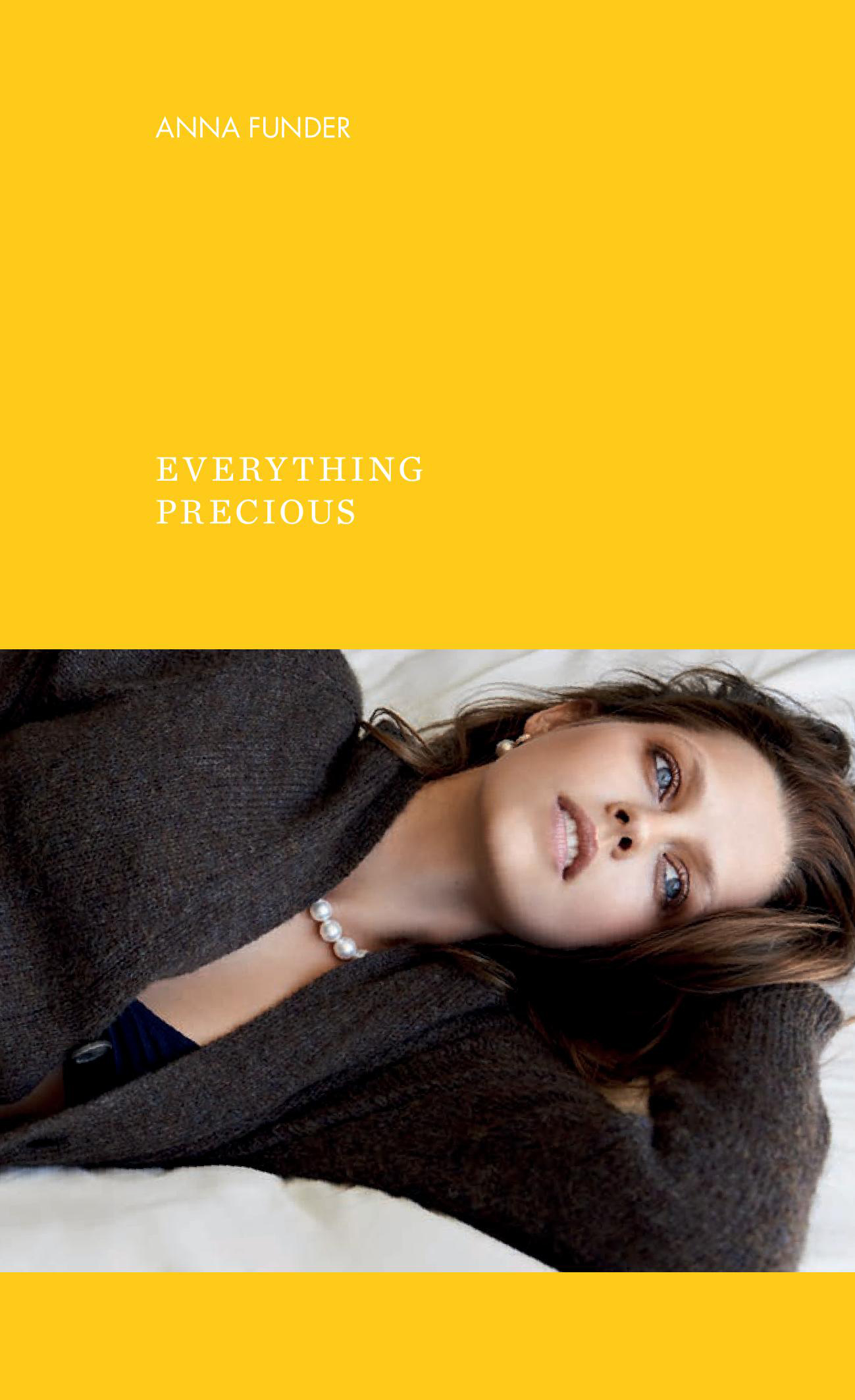
Anna Funder, Everything precious (Review)

Anna Funder, Everything preciousI must thank John aka Musings of a Literary Dilettante for introducing me to this intriguing little e-work by Miles Franklin award-winner, Anna Funder. When John read it, back in October, it was in daily instalments, but when I clicked the link in his post I was offered several e-book versions, including for the Kindle and iPad, or for an audiobook which I believe is read by Funder. It’s free.

So, what is it? Here’s the description at the start of the story:

This story is a unique collaboration between Paspaley, acclaimed author Anna Funder, photographer Derek Henderson and award-winning actress Teresa Palmer. It’s an original story of love, self and all things precious, featuring the most beautiful pearls in the world.

Paspaley, for those who don’t know, is an Australian-based company founded in the pearling industry of northwestern Australia. Although it has now diversified into other businesses, it is probably still best known for its pearling arm. As you might assume from the title of Funder’s story, “Everything precious”, it is the pearling arm that sponsored Funder. John wrote his post before he finished reading the story, and said he feared finding some product placement at the end. However, in a postscript added later, he advised there was no such thing. He’s right – in a sense – as there’s no reference to pearls or Paspaley in the text. But, in my e-book version, between chapters 4 and 5, there is a series of five photographs taken presumably by Derek Henderson and featuring, again presumably, actor Teresa Palmer. They are tasteful in that high-class-magazine way … no text, just beautiful images of a lovely woman wearing gorgeous pearls.

I researched a little more, and discovered that the story is part of a “multi-channel campaign” to launch Paspaley’s new Touchstone collection. The “campaign uses storytelling to engage a new, younger, more fashion conscious audience and make pearls relevant and appealing to them”. Intriguing eh! I wonder how successful it’s been?

What, besides presumably money, did it all mean for Anna Funder? Here’s what she says:

Working with Paspaley has been one of the most exciting writing experiences I’ve had. To have total creative freedom, a time limit and an audience turn out to be the perfect conditions for writing a short story. And the idea that a company, which makes things of great beauty and value from nature, values literature, which (on a good day) is also something of beauty and value that reflects the world around us, was inspiring. Writing this story has been a joy and a privilege, and was some of the most fun I’ve ever had writing.

Now, let’s talk about the story, which the promoter’s website I’ve linked to above describes as “a short story of desire, need, love and all that is precious”. The plot is pretty simple. It’s about Tess, who works in online legal publishing, and would be in her mid thirties. She has a husband, Dan, head of epidemiology in the State Health Department and a lovely SNAG if ever there was one, and three children, Charlotte who is 13, and the twins, Tom and Lorna, who are 6. She also has a father, Howard, a retired judge who is in Assisted Living because he has dementia. This is, then, an upper middle class, professional family. Tess and Dan have been together for 17 years and she’s feeling a little trapped and restless. A bit of a midlife crisis, in other words, or, as Funder writes in the story, Tess is:

at a hinge moment: between youth and age, between the life you thought you wanted and the one you feel might, now, suit you better.

So, Tess decides to consider that other life she might have had, but … well, I won’t give the ending away because it’s easy for you to access at Paspaley.

It’s interesting to look at this story in terms of the campaign because I’m presuming that although Funder had “total creative freedom” there must have been a brief – one that at the very least identified a target market, oops audience, for the story. This audience would, I’m sure, identify pretty easily with the character and set up, with the restlessness attended by guilt that she should be so restless. The brief must surely have identified a tone too. You wouldn’t sell pearls with a grim story – or did they assume Funder would have the nous to make the story appropriately positive? Regardless, the story would clearly suit what I assume was Paspaley’s target market – upwardly mobile or already there professional thirty-to-forty-something women who have the disposable income but who may see pearls as the province of their Baby Boomer mothers.

This all sounds pretty cynical, and to some degree it surely must be. I would describe the story as “chicklit” for the well-to-do married woman. It’s not challenging reading. The resolution is easy to comprehend and reassuring. However, it is written by Funder. This means that the writing is good, there’s intelligence at play (including an allusion to Chekhov!), and the insights into the pressures of early 21st century professional family life are authentic even if not explored in any depth.

awwchallenge2015Overall, then, it’s an enjoyable read and an interesting concept to ponder. I certainly wouldn’t criticise Funder for taking up the opportunity offered to her. Writers, like all of us, have to live – and if a company like Paspaley is prepared to pay, and offer “complete freedom”, why would you say no?

Anna Funder
Everything precious
Sydney: Paspaley, 2014
Smashwords Edition
Available: Gratis at Paspaley