Anna Krien, Us and them: On the importance of animals (Review)

Krien Us and them

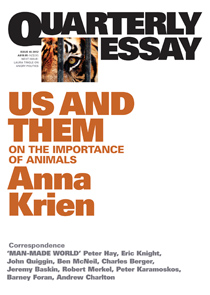
Quarterly essay cover (Courtesy: Black Inc)

I’ll admit it right up front, I am not a vegetarian or a vegan. I like to eat meat. I wear leather shoes. I like to think, though, that the source of these products has had a comfortable life and a quick, stress-free death. But I’m kidding myself, I know. And Anna Krien’s essay, Us and them, about the relationship between humans and animals, doesn’t reassure me.

In roughly 25,000 words, Krien, whose Into the woods I reviewed a couple of years ago, explores the complex relationship we humans have with our living, breathing co-inhabitants on this earth of ours. She exposes the underbelly of this relationship but resists simplistically declaiming the abuses and proclaiming that there is an easy solution. We all know there isn’t. As she says in the first section:

I’m not weighing up whether our treatment of animals is just, because it isn’t. That age-old debate is a farce – deep down we all know it.

The real question is, just how much of this injustice are we prepared to live with.

To try to answer this question she confronts the tension that exists in our relationship with “them” which is, as she puts it, the tension between seeing them as “beings” versus “objects”. She asks:

How to ensure that the butcher, the scientist, the farmer recognise that the creature in their care is a being, even as all the while they [and, I would say, by extension we] continue to use it as an object?

This is a well-structured essay. After an introductory section in which she sets the scene and poses her question, Krien explores the issues thematically, through the sorts of “encounters we have with animals”: Killing; Testing; Hunting,

These are, obviously, the encounters which are the most problematic. She spends little time on our positive and generally more mutually beneficial* encounters, such as in their roles as pets, guide dogs, and companion animals. That’s fair enough, given the serious questions she wanted to confront, but it’s a bit of a shame, nonetheless.

I like Krien’s writing. It’s well-researched, informative, and presents unpleasant facts with a light touch. She’s neither didactic nor conclusive but rather writes as one going on a journey with us. And she asks hard questions, such as these ones in the killing section:

  • Should Australia remain in the live animal trade and by so doing help other countries improve their animal welfare practices?
  • What does it say about our priorities when we have a World Society for the Protection of Animals but not one to protect women?
  • How do we explain the fact that more Australians empathised with the cows (being sent to Indonesia) than with people (such as those Indonesians for whom the cattle trade  means work and food, let alone the asylum-seekers plying the same seas as the cows)?

She explores the complexities of testing and here again disabused me of my head-in-the-sand hopes. I was surprised to read that the number of animals being used in research and teaching is increasing not decreasing. And again, the difficult questions. Is some testing acceptable, necessary even, and others not? And if so, on what basis do we decide? Why is there a disjunction between what scientists do in animal testing and believe is ethical, and what laypeople think?
Australian Women Writers Challenge 2012 Badge

Australian Women Writers Challenge (Design: Book'dout - Shelleyrae)

In her section on hunting, the focus is not so much on recreational hunting but on the hunting of animal pests – some native, such as dingoes, and some feral. She talks about apex predators, and the environmental impact of removing them. When the top predator goes, the ecological balance is severely disturbed. The loss of dingoes, for example, can be directly related to the extinction of small mammals. One solution to protecting farm animals that doesn’t involve killing dingoes is to use guardian animals like maremmas and alpacas. Hmm, methinks, introduced species aren’t always a good option – think camels, think cane toads – but so far so good it seems.

Late in the essay, Anna Krien writes that many scientists describe our current geological era as the Anthropocene, recognising the significant (negative) impact human activities are having on the earth. She follows this with biologist Edward O. Wilson‘s suggestion that what comes next will be “the Age of Loneliness” typified by “a planet with us and not much else”. I don’t want to think about what that would be like. There’s no easy answer to all this but, as Krien says, we must “acknowledge the questions” and continue the discussion. To do anything else is to deny that not only are animals are “important” in themselves but, to put it selfishly, they are important in multitudinous ways to us.

Anna Krien
“Us and them: On the importance of animals”
in Quarterly Essay, No. 45
Collingwood: Black Inc, March 2012
125pp.
ISBN: 9781863955607

(Review copy supplied by Black Inc.)

* Though I’m aware I’m making a human-centric assumption here!
Raising my consciousness: Thoughts of a reader on International Women’s Day

Australian Women Writers Challenge 2012 Badge

Australian Women Writers Challenge (Design: Book’dout – Shelleyrae)

I am not, and never have been, scared to use the “F” word – that is, I call myself a Feminist. My philosophy is a simple one: women are not the SAME as men, but women deserve EQUAL rights and respect as men. This is not to say that the interpretation and application of this philosophy is simple but it is to say that all our thinking on how we live, how we (as humans) should be treated and how we should treat others needs to start from this fundamental principle.

Books and reading have of course fed my thinking on this issue … and so today I’m listing a few books that have meant something to me. They are not, all anyhow, the usual suspects, but they are books that have remained in my consciousness years after I read them.

Germaine Greer‘s The female eunuch (1970)

I read this a year or so after it was published. It provided an underpinning to my thoughts from that point on. Greer’s analysis of how women are objectified fundamentally changed how I viewed myself and it informed how I have dressed and presented myself ever since. She politicised my decisionmaking and gave me permission to not spend time and money (that I could better spend elsewhere) on unnecessary grooming and uncomfortable, or demeaning, clothing. She said much more besides about women’s self-actualisation but it all stemmed for me from this basic premise …

Margaret Atwood‘s The handmaid’s tale (1985)*

Most of the books I’m going to list here are non-fiction but we litbloggers know the value of fiction in presenting and analysing human thought and behaviour, in showing us how we are and/or how we could be. Atwood’s The handmaid’s tale depicts with horrific clarity how we could be. It’s a dystopian novel, a cautionary tale; it describes with horrendous, gob-smacking clarity what could happen if we don’t remain vigilant about women’s right to equality. If you haven’t read it and you wonder whether Feminism’s for you, read this book before you make up your mind!

Diane Bell‘s Generations: Grandmothers, mothers and daughters (1987)

I recently read an article written in 1905 about Jane Austen, in which the author, William James Dawson, wrote:

It is often deplored that professional historians, who are capable enough of describing the pageantries of a court, the contests of politicans, the sumptuous lives of the rich, or even the miserable conditions of life among the disinherited and the criminal, appear incapable of producing any accurate picture of the average kind of life lived by those distinguished by neither great  wealth nor great poverty …

Lives, for example, lived by women. Dawson goes on to say that Jane Austen provides “a picture of England itself”. I love his recognition that fiction can provide us with social history … even though the rest of my list is non-fiction.

Anthropologist Diane Bell describes objects in women’s lives and how women pass them down from generation to generation. If I tell you that one of the chapters is titled “Darryl got the farm and mum got the pearls” you’ll get the picture. The book draws from interviews she conducted with several families of women. The women talk about pianos, sewing machines, textile crafts, jewellery, china, books, and so on, describing not only how they are passed down through the female line but also the memories these objects invoke – and what they tell us about women’s lives then and now. It’s a beautiful book, that I’d love to quote from if I had the time. I read it when it came out, and I think of it often.

Katie Holmes’ Spaces in her day: Australian women’s diaries, 1920s-1930s (1995)

Holmes is an historian and this book, like Bell’s, provides an insight into women’s lives – but through their diaries rather than through interviews. The book, also like Bell’s, is organised thematically but instead of by type of object hers is by women’s roles and life stages. The descriptions of women’s work (in the days before labour saving devices) are exhausting!

Start work 8 o’clock finish 11pm, feel awfully fed up, this life is much worse than the farm was even if I didnt have any clothes, here I do not have time to wear them, so it is worse, dont know what to do about it, but I am fed up. (Mabel Lincoln, 21 January 1930)

She also describes the way women were expected to give up their dreams to help others – to take over a family when a sister dies or becomes sick, for example. Unmarried women, in particular, were only “allowed” a life of their own for as long as someone else in the family didn’t need them. Another book I haven’t easily forgotten.

Helen Garner‘s The first stone (1995)

This is, probably, a strange book for me to include, mainly because Garner made me so MAD. Garner is a feminist but her response to the incident at Ormond College did not sit well with many feminists, me included. As I recollect, the incident involved the master of the College, the man in power that is, making untoward (read, unwanted) sexual advances to two students at a College party. When the students complained to the College hierarchy, they did nothing, so the two young women went to the police. Garner argued they should not have done that, that they should have simply, literally or metaphorically, “slapped” the man and got on with their lives, leaving him and his reputation secure. She felt their reaction was not mature and was taking the issue of harassment to unnecessary levels. But, for me, there were two significant issues that made me disagree vehemently with Garner. Firstly, the young women tried to complain within the College system and got nowhere. Had the College taken their complaint seriously, the situation could very well have been handled quietly and with a rationality that could have worked for all parties. But, the College didn’t. And secondly, this was a situation of power. It’s (depending on the situation) one thing to receive an unwanted advance at a party from a peer. Garner’s suggested response could very well be the appropriate one BUT, and I think it’s a big BUT, it’s quite another thing to receive such an advance from someone with real power over you. I’ve listed this book, though, because Garner is a great writer and so very honest about her views and feelings. We need more honesty like this, and more willingness to confront the issues and tease them out … and that, of course, is the other reason I’ve listed it. It got some issues teased out, albeit, for some, in an emotionally charged and hurtful way.

… and that, as they say, is that. I’d love to know what books have contributed to your thinking on women’s rights (or, indeed, on any issue of importance to you).

* Most of the books I’ve listed here are Australian but, given the topic is International Women’s Day and given the significance (to me) of Atwood, I had to include her here.

Gillian Mears, Foal’s bread (Review)

Gillian Mears' Foal's bread

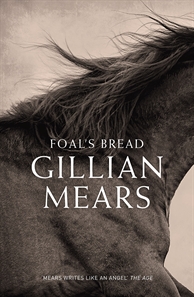
Foal's bread cover (Courtesy: Allen & Unwin)

Foal’s bread is Gillian Mears’ first novel in around 16 years, though she has published short stories in the interim. This is a shame because she is a beautiful writer, particularly when she writes about the place she knows best, the farms of the New South Wales north coast.

Foal’s bread is about the Nancarrow family. Most of it takes place between 1926 and around 1950, as it follows the fortunes of Noah (Noey/Noh), her husband Roley (Rowley), and the extended family with which they live. Their main business is dairying, but their passion is the sport of horse high jumping. At the beginning of the novel, Roley is an Australian high jump champion and Noey a young 14 year-old girl with promise. They meet, marry (early in the novel, so no spoilers here) and start working hard to achieve their dream of having their own high jumping team. Hope on, Hope ever, is their motto. That’s the broad plot; the story is far more complex.

This is an archetypal story of strong country people coping (or not) with “luckiness and unluckiness” in life. In its depiction of hardship, stoicism and the will to survive in rural families, it reminded me – in tone if not in story – of Geoff Page’s The scarringThe hardship may come from different quarters, but in both there is a sense of forces out of one’s control combining with things of the characters’ own making. That mix – of characters’ judgement or behaviour clashing with luck (usually bad) – tends to make for a good story, in the right hands. It’s a bit Shakespearean in a way, the clash of character with “the elements”.

Australian Women Writers Challenge 2012 Badge

Australian Women Writers Challenge (Design: Book'dout - Shelleyrae)

In Foal’s bread, the “bad luck” has many sources, some human and some natural, such as incest, lightning strikes, giving birth to a disabled child, war and drought. How the characters cope with the trials confronting them is the core of the novel. Unfortunately, more often than not, they don’t cope very well. Why? Mainly due to their very human failings. Noey and Roley, whose marriage commences with great love and big dreams, don’t know how to communicate when calamity hits. Noey’s mother-in-law, Minna, lets her jealousy (“of the happiness she’d never seen before”) get the better of her and prefers to increase the tension between her son and his wife rather than to ameliorate it.

By now you’ll be thinking this sounds like a miserable story, and in some ways it is. But it’s not all darkness. While the novel has an almost elegiac tone, its movement is towards light. It has a three-part structure. There’s a very short Preamble which sets a tone of harshness and brutality with its references to incest, bushfires, floods, and animal cruelty.”Watch out you don’t cry” we are warned. Then there is the bulk of the novel in which the story of Noey and Roley is played out. This is followed by a Coda, set some 50 years later, in which we learn that “the old voices remain … funny, flinty, relentless”. These voices are carried into the future by Lainey, the strong, resourceful daughter of Roley and Noey, “her mother’s daughter through and through”.

A strong story, but what gives this novel its real power is the writing. Mears mixes the rough, ungrammatical country-speak of the era with glorious, rhythmical language describing the magpies, butcherbirds, trees, creeks and hills of One Tree Farm. The “one tree” is a jacaranda, and it features throughout the novel. It could almost be, dare I say it, a character. Early in the novel, when all is full of hope, it quivers “to create the feeling of a big bosomed woman wanting to waltz”. Later, as things start to collapse, it loses its leaves, but at the end “the old tree lives on … like a huge purple cloud hiding the rooflines”.

And then, of course, there are the horses. Reading this book reminded me a little of reading Tim Winton’s Breath. Mears does for horse high-jumping what Winton did for surfing. She made me feel the joy and beauty of the jump, of pushing oneself to achieve just that little bit more in a risky sport, of having a dream that keeps you going, of doing “the impossible”. Mears, like Winton, knows her subject inside out, and you feel it in her writing.

I fear I haven’t done the book justice. I’ve not really described its complex plot. I’ve named only a few of its large cast of colourful characters. It’s an ambitious book with big themes and a big style. Not everyone loves it. Some find the dialogue tricky or some descriptions overdone; some think the ending is disappointing; some think it’s stereotypical in places. I think none of these things. I’d love to know what you – if you’ve read it – think!

Gillian Mears
Foal’s bread
Sydney: Allen & Unwin, 2011
370pp.
ISBN: 9781742376295

(Uncorrected proof copy received from Lisa of ANZLitLovers in a blog giveaway)

Dorothy Porter, On passion (Review)

Do you read “little” books? You know those small books that are carefully placed on bookstore sales counters where you are buying the book you really came for? I don’t often, but every now and then one catches my eye. Today’s review is of such a book from Melbourne University Press‘s Little books on big themes series. It’s by Dorothy Porter and is titled On passion. She finished it just before she died in December 2008. I think I could be justified in calling that poignant, don’t you?

Australian Women Writers Challenge 2012 Badge

Australian Women Writers Challenge (Design: Book’dout – Shelleyrae)

Dorothy Porter was (is, really) a well-regarded, successful Australian poet. I reviewed her last collection, The bee hut, a couple of years ago. It’s a wonderful collection full of the pains and joys of living. It is, you could say, a passionate book. One of the poems I quoted in that review is about the passion for writing, for finding the perfect way to express an idea:

and your pen slashes ahead
like a pain-hungry prince
hacking through
the bramble’s dragon teeth
to the heart’s most longed for
comatose, but ardently ready
princess.
(“Blackberries”)

So, writing, of course, was one of her passions but in this little essay Porter explores all sorts of meanings of the word (for her). She starts with her adolescent passions – her youthful religious faith which was replaced by her “dark gods, Janis Joplin, Jim Morrison and Jimi Hendrix” whose “daemonic songs” were her “new hymns”.

From here she explores the various ways passion has been part of her life … woven always with poetry, hers and others, and music:

Music has been my draught of intoxication since the very moment I first heard the Beatles in early 1964 […] I have been a Beatles pop/rock music maniac ever since, and have written virtually all my poems to rock riffs and rhythm – the catchier, the darker, the louder, the gutsier the better.

She talks in one section of Dionysus and moderation, strange bedfellows, eh? She argues that Euripides best understood the Dionysian, by exploring “how best to respect and live with it”. She admits, though, that “moderation was not something I embraced with Delphic calm, but something I gutlessly and gracelessly caved into” because, for example, she and drugs did not mix!

Nature too features, snakes in particular. “Real and living snakes are sacred to me” she says and then explores Minoan snake worship versus “the debased and diabolical serpent-demon of the Judaeo-Christian Garden of Eden”. She talks of the Rainbow Serpent in Australian Aboriginal Dreaming but admits that, when she actually confronts a King Brown snake in the desert, her worship did not stop her getting “the shock of my life”. She also refers to DH Lawrence‘s poem “Snake”, which I fell in love with in my teens. Lawrence describes the visit of the snake  as “a sacred event”. Porter says she always forgets the ending, how Lawrence’s fear gets the better of him so that he scares the snake away. She remembers only the vision of the wild thing being watched (and appreciated) by the poet.

There are other passions, but I’d like to conclude on the one dear to the heart of readers. She writes

I wonder if some of the most deeply passionate experiences of my life have happened between the covers of a book.

Not only do I love the idea that books have such an effect on us, but I also like her qualification: “some”, she says! Life is, after all, important too!

She describes Wuthering Heights as “the most scorching novel in the English language”; says that “there is, paradoxically, much more convincing grown up sex in Jane Austen than in Emily Brontë“. Oh, yes! She talks of Sappho’s love songs; admires one of my favourite poets, Gerard Manley Hopkins, for “pushing language as hard as it will go into ecstasy – and despair”; and describes Ginsberg as convincing her “of the power of language to shock”. She talks of love and desire, of wanting “to find and deliver scenarios, characters and poems that are magnetic with sexual energy” but asks, provocatively,

… how many readers have we lost because we have ignored the ancient silent cry: ravish me.

Near the end she wonders if reading had been the greatest passion of her life. She says – reminiscent of Francesca Rendle-Short and Michael Sala’s comments that writing/reading is dangerous – that

… at a more profound level I recognise that there is something very unsettling about a book.

Absolutely … but what say you about books, reading, passion?

Porter, Dorothy
On passion
Carlton: Melbourne University Press, 2010
(Series: Little books on big themes)
96pp.
ISBN: 9780522858358

Francesca Rendle-Short, Bite your tongue (Review)

Francesa Rendle-Short book cover Bite your tongue

Bite your tongue Bookcover (Courtesy: Spinifex Press)

How much do you think about the first sentence of your review? Like me, you probably try to find some anchor or point of interest to lead off from, but my problem with novelist-journalist Francesca Rendle-Short‘s fiction-cum-memoir, Bite your tongue, is that I have too many angles to choose from. Which one do I use? Do I go with the unusual form of this fiction-cum-memoir? Do I talk about my old friend synchronicity and how one of my first reviews in 2011 was a (semi)autobiographical novel about an Australian childhood, Barbara Hanrahan‘s The scent of eucalyptus? Or, do I talk about how I’m sure Spinifex Press had no idea how close to my heart this book would be when they offered it for review – how I (more or less) share a late 1950s/early 60s Brisbane childhood with Rendle-Short and how the very word “spinifex” is nostalgic for me due to my mid-1960s years in the mining town of Mount Isa? There, I’ve covered them all … so now I can get on with the review!

This is a mother-daughter story. How many of those have you read? I’ve certainly read a few in the last decade or so, including straight memoirs (such as Jill Ker Conway‘s The road from Coorain) and thinly veiled fictional pieces (such as Kate JenningsSnake). These books can be challenging for daughters to write, particularly when there is significant pain involved. Rendle-Short’s solution is to (mostly) tell from a “fictional” standpoint. She creates names for the family, including MotherJoy for the mother, Glory for herself, Gracie for her nearest and youngest sister, and Onward for her father. The last-name she devises for this family is Solider, which is an anagram of “soldier”. With the father being Onward, and the family being devoutly Christian, the hymn “Onward Christian Soldiers” must surely have inspired her naming. Rendle-Short writes, in the introduction, about how she chose to tell the story:

Some stories are hard to tell, they bite back. To write this one, I’ve had to come at it obliquely, give myself over to the writing with my face half-turned; give my story to someone else to tell. My chosen hero is a girl named Glory …

Australian Literature Month Platypus logo

Reading Matters’ Australian Literature Month

Why is this story so hard to tell? Well, Glory’s (Rendle-Short’s) mother was “a morals crusader, an ‘anti-smut’ campaigner. An activist. She was on a mission from God to save the children of Queensland” (from the Prologue). This mission involved banning “lewd” and “pornographic” books (of which 100 are listed at the back of the book in “Dr Joy’s Death List: Burn a Book a Day”). Clearly Rendle-Short (aka Glory), the fifth of six children (all girls in the book, five girls and a boy in reality), had a painful childhood. It’s not that she and her siblings weren’t loved – they clearly were – but it was a hard love, a love based too much on a narrow Christian ideology and too little, it seems, on the needs of children. One of the most painful scenes in the book is when Glory visits her mother in hospital after heart surgery and wants to kiss her but can’t bring herself to do so! Can’t kiss her old mother! That shows more than words ever could the pain in this relationship.

The book pretty well covers the story from Glory’s birth to MotherJoy’s death in her 80s, though it focuses primarily on Glory’s school years. There are 100 chapters in less than 250 pages. Most of these chapters are told third person, from Glory’s point of view. What makes this book particularly interesting form-wise, though, is that 14 chapters are written in first person, memoir-style. That is, Francesca speaks of herself and her mother, Angel, using their real names. In these scattered first person chapters, Francesca writes on her research, on how she pieced together her mother’s story through, for example, research at the National Library of Australia and the National Archives of Australia. She also occasionally comments on where the “fact” diverges from the “fiction” such as:

Unlike Glory, I wasn’t in Brisbane when my mother died, I was at home in Canberra where I was living at the time – because there was a scene. There was always a scene with Angel, especially where her children were concerned, the ‘jewels in her crown’, and on her deathbed it was no different. All six children had been at her bedside while she was dying …

And then, without describing exactly what happened, she tells us that, despite all of them having made the effort to get there, including from overseas, “seven days before she took her last breath, all six of us walked out on her. We had to do it …”.

Australian Women Writers Challenge 2012 Badge

Australian Women Writers Challenge (Design: Book’dout – Shelleyrae)

Now, if you are a reader who likes closure, who wants to know exactly what happened, you are not going to get it in this book, not specifically anyhow, but you will, if you read the clues, know what life was like in that family, at least what it was like for Glory/Francesca. You will know that she loved her mother, and wanted her mother’s approval, but that she had other attitudes and other feelings that were clearly not in accord with her mother’s. We are given enough “scenes” involving her mother (directly or indirectly) to tell us all we need to know. A particularly excruciating example is when Glory is cruelly bullied by her school “peers” (one can’t say  “mates” in the context) because of her mother’s views. (Where her father, an academic in pediatrics and a creationist, stood in all this is unclear. He’s there in the book, but we see little active parenting from him.)

Oh dear, I have so much to say on this book that I could easily turn this post into an essay, so I will finish here. I thoroughly enjoyed this book … on multiple levels. The writing is good, comprising many of the things that appeal to me – wordplay, lovely rhythm, effective imagery (such as the “tongue” motif). The story is easy to follow, despite changes in voice and chronology (as we flip backwards and forwards from childhood to MotherJoy/Angel’s old age). There are universals about love and forgiveness (real and wished for) between parents and children. And, there is love for books (in all their glory!):

Books show us how to love, really love body to body between the pages. Love perhaps where we’ve never loved before. That’s what Glory hopes.

Reading changes things …

… as, I suspect for Rendle-Short, does writing!

Francesa Rendle-Short
Bite your tongue
North Melbourne: Spinifex Press, 2011
246pp.
ISBN: 9781876756963

(Review copy supplied by Spinifex Press.)

Review to count towards the Australian Women Writers 2012 Reading and Reviewing Challenge.

Monday musings on Australian literature: Some Australian Literature online events for 2012

What better way to kick off Monday Musings in 2012 than by heralding some exciting Australian Literature initiatives from around the ‘net. Here they are, in no particular order:

Australian Women Writers Challenge 2012 Badge

Badge (Design: Book'dout - Shelleyrae)

Australian Women Writers Challenge 2012 by Elizabeth Lhuede. Her aim is to promote women writers across all fields and genres of writing. The challenge involves signing up to read books – in any genre – by Australian women writers. You can focus on one genre or many, you can choose a level that suits you. I don’t usually do challenges, but this one is a no-brainer for me since I always try to read a goodly quantity of Australian literature each year and I love to read books by women. Last year I reviewed at least 14 Australian women writers and, in addition, wrote several posts on specific women writers and women’s literature issues. My aim will be to achieve a Franklin-fantastic Dabbler, that is, I’ll read (and review) at least 10 books by Australian women writers in more than one genre.

Australian Literature badge, by Reading Matters

One of the Australian Literature Month badges (by Reading Matters)

Australian Literature Month by Kim of Reading Matters. She plans to read lots of Australian books during her cold northern January (she would leave Australia!) and encourages readers of her blog, to do the same. As an incentive she has created several gorgeous badges for bloggers to attach to their posts reviewing Aussie books. Since seeing a platypus in the wild is on my bucket list, I have chosen her platypus badge for this post.

Australian National Year of Reading 2012 by WeLove2Read. This project is “a collaborative project joining public libraries, government, community groups, media and commercial partners, and of course the public. As well as creating specific new campaigns for the National Year of Reading, we’ll be using our joint efforts to bring together and showcase the wonderful projects and organisations across Australia which already exist to promote reading and literacy”.  (From the website) Keep an eye on the website for activities and events as they occur during the year.

2012 Aussie Author Challenge by Booklover Book Reviews. The challenge is to “read and review books written by Australian Authors – physical books, ebooks and audiobooks, fiction and non-fiction” (from the blog). There are two challenge levels and, like most challenges, a badge to add to your site. (I added this challenge after the post was published, as the result of Tony‘s recommendation. Thanks Tony.)

And so …

As you start your 2012 reading, do consider including some Aussie Lit into the mix and please let the people above know when you do. They will appreciate knowing that their work has hit some paydirt.

If there are other initiatives that I haven’t listed here, please let me know in the comments below and I will update this list.