Monday musings on Australian literature: Louisa Atkinson, and indigenous Australians

Louisa Atkinson (1834-1872)

Louisa Atkinson (1834-1872) (Courtesy: Artist unknown, via Wikipedia)

Time for another Monday Musings highlighting an Australian literary pioneer, this time Louisa Atkinson. I came across Atkinson a few years ago when I was researching Australian women writers for Wikipedia. She’s one of those women who achieved much in her field but who, I believe, is little known. She was a journalist, novelist and naturalist. She was born in 1834, in the Southern Highlands of New South Wales, just a couple of hours’ drive from where I live.

There’s a good general biography of her online at the Australian Dictionary of Biography, but here is the gist:

  • She collected and painted plant specimens for well-known scientists of the time including Ferdinand von Mueller, and she is commemorated in the Atkinsonia genus as well as several plant species.
  • She was a rebel when it came to clothing. While, as is typical of her time, she was highly religious, she shocked the good women of her rural neighbourhood by wearing trousers for her naturalist ramblings and pony-riding.
  • She was a well-regarded botanical artist. Twentieth century Australian artist Margaret Preston described her drawings as having “unexpected elegance and extreme accuracy”.
  • She was the first Australian woman to have a long-running series of articles in a major newspaper. This was her natural history series, A Voice from the Country, which ran for 10 years from 1860.
  • AND she is credited as being the first Australian-born woman to publish a novel in Australia. It was titled Gertrude, the emigrant girl: A tale of colonial life (1857). This and her second novel, Cowanda: A veteran’s grant (1859), are available as etexts from the University of Sydney’s excellent SETIS project (to which I’ve linked the titles). Gertrude tells the story of a young immigrant girl hired to be a housekeeper in a country house by Mrs Doherty who, to give a sense of Atkinson’s style, is described in the first chapter as “a small woman, with a brown careworn countenance; the index of generous emotions, strong passions, and acute griefs, which had worn her straight features into sharp outlines, and given a restless keenness to her small dark eyes”.

I have only dipped into Atkinson’s novel, Gertrude, to get a sense of her writing so I won’t write any further on that. What is interesting to explore a little is her experience of indigenous Australians. Elizabeth Lawson in her book on Atkinson, The natural art of Louisa Atkinson, wrote that her father created a model farm, but

Oldbury’s promise was clouded by its exploitation of the convict system and by its dispossession of the local Gandangara people, a dispossession the family at least recognised. And just above the house on a natural terrace of the mountain rose a great Aboriginal grave-mound with carved funeral trees which Louisa was later to sketch. This mound and its increasing desolation stood in silent rebuke of Oldbury’s enterprise, of its new English place-names and all they signified.

Nonetheless, Lawson writes that Atkinson befriended, and retained life-long friendships with Aboriginal people both at Oldbury and in the Shoalhaven area where she spent some time. That she had sympathy for them is clear from one of her columns for A Voice from the Country (22 Sept 1863) in which she wrote:

These unhappy races have become rather a tradition, than a reality, already in many districts …

She describes their lives, their homes, their hunting with a naturalist’s, and sympathetic, eye:

On one occasion, when the remnants of three different friendly tribes had assembled for a grand corroboree or dance, I made plan of the encampment; each tribe was slightly apart trom the other, divided by a sort of street. Thus, the inviters (?) were clustered in the centre, having, I think, seventeen camps; the Picton tribe on the right hand, five camps, and the Shoalhaven on the left, comprising ten or eleven gunyahs, consecutively forming a village.

She also writes:

The men were severe to their wives, striking and even killing them – when under the influence of anger, but I believe these cases were far less frequent when they had not lost virtues and acquired vices from the so-called Christian people who invaded them.

Interesting, and sensitive, observation. She talks of the problem of drinking:

Intemperance is one of the vices so sadly prevalent among them, they know what its fatal results are, lament them, but have not courage to resist. How frequent is the paragraph in the country paper of an aborigine’s death from this cause, how many have sunk unrecorded. A great sin lies on us as a people, for much has been done to injure, and little to benefit the poor original possessors of our farms and runs.

And thus she confirms that thinking about indigenous Australians with a humane and clear-eye did not pop up suddenly in the mid to late 20th century!

Louisa Atkinson tragically died not long after (but not due to) the birth of her first child, when she was only 38. What a lot she achieved in a rather short life – and what an interesting person she would have been to know.
Anna Krien, Us and them: On the importance of animals (Review)

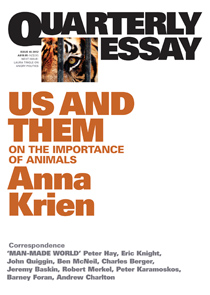
Krien Us and them

Quarterly essay cover (Courtesy: Black Inc)

I’ll admit it right up front, I am not a vegetarian or a vegan. I like to eat meat. I wear leather shoes. I like to think, though, that the source of these products has had a comfortable life and a quick, stress-free death. But I’m kidding myself, I know. And Anna Krien’s essay, Us and them, about the relationship between humans and animals, doesn’t reassure me.

In roughly 25,000 words, Krien, whose Into the woods I reviewed a couple of years ago, explores the complex relationship we humans have with our living, breathing co-inhabitants on this earth of ours. She exposes the underbelly of this relationship but resists simplistically declaiming the abuses and proclaiming that there is an easy solution. We all know there isn’t. As she says in the first section:

I’m not weighing up whether our treatment of animals is just, because it isn’t. That age-old debate is a farce – deep down we all know it.

The real question is, just how much of this injustice are we prepared to live with.

To try to answer this question she confronts the tension that exists in our relationship with “them” which is, as she puts it, the tension between seeing them as “beings” versus “objects”. She asks:

How to ensure that the butcher, the scientist, the farmer recognise that the creature in their care is a being, even as all the while they [and, I would say, by extension we] continue to use it as an object?

This is a well-structured essay. After an introductory section in which she sets the scene and poses her question, Krien explores the issues thematically, through the sorts of “encounters we have with animals”: Killing; Testing; Hunting,

These are, obviously, the encounters which are the most problematic. She spends little time on our positive and generally more mutually beneficial* encounters, such as in their roles as pets, guide dogs, and companion animals. That’s fair enough, given the serious questions she wanted to confront, but it’s a bit of a shame, nonetheless.

I like Krien’s writing. It’s well-researched, informative, and presents unpleasant facts with a light touch. She’s neither didactic nor conclusive but rather writes as one going on a journey with us. And she asks hard questions, such as these ones in the killing section:

  • Should Australia remain in the live animal trade and by so doing help other countries improve their animal welfare practices?
  • What does it say about our priorities when we have a World Society for the Protection of Animals but not one to protect women?
  • How do we explain the fact that more Australians empathised with the cows (being sent to Indonesia) than with people (such as those Indonesians for whom the cattle trade  means work and food, let alone the asylum-seekers plying the same seas as the cows)?

She explores the complexities of testing and here again disabused me of my head-in-the-sand hopes. I was surprised to read that the number of animals being used in research and teaching is increasing not decreasing. And again, the difficult questions. Is some testing acceptable, necessary even, and others not? And if so, on what basis do we decide? Why is there a disjunction between what scientists do in animal testing and believe is ethical, and what laypeople think?

Australian Women Writers Challenge 2012 Badge

Australian Women Writers Challenge (Design: Book'dout - Shelleyrae)

In her section on hunting, the focus is not so much on recreational hunting but on the hunting of animal pests – some native, such as dingoes, and some feral. She talks about apex predators, and the environmental impact of removing them. When the top predator goes, the ecological balance is severely disturbed. The loss of dingoes, for example, can be directly related to the extinction of small mammals. One solution to protecting farm animals that doesn’t involve killing dingoes is to use guardian animals like maremmas and alpacas. Hmm, methinks, introduced species aren’t always a good option – think camels, think cane toads – but so far so good it seems.

Late in the essay, Anna Krien writes that many scientists describe our current geological era as the Anthropocene, recognising the significant (negative) impact human activities are having on the earth. She follows this with biologist Edward O. Wilson‘s suggestion that what comes next will be “the Age of Loneliness” typified by “a planet with us and not much else”. I don’t want to think about what that would be like. There’s no easy answer to all this but, as Krien says, we must “acknowledge the questions” and continue the discussion. To do anything else is to deny that not only are animals are “important” in themselves but, to put it selfishly, they are important in multitudinous ways to us.

Anna Krien
“Us and them: On the importance of animals”
in Quarterly Essay, No. 45
Collingwood: Black Inc, March 2012
125pp.
ISBN: 9781863955607

(Review copy supplied by Black Inc.)

* Though I’m aware I’m making a human-centric assumption here!

Monday musings on Australian literature: Women writers and politics in the 1930s

I have written before about the fact that there’s been two periods in Australian literature when women writers seem to have flourished. One was around the 1920s to 1930s and the other around the 1970s to 1980s. Today I want to write a little about this first period because, from the perspective of 80 plus years later, it was an exciting period for women writers – that wasn’t sustained.

Australian academic Maryanne Dever says that “women represented a significant section of the writing community” in the interwar years and that this concentration “could be said to be one of the major distinguishing features of the then Australian literary landscape”.* Women were significant in the reviewing community, held office in major literary societies, judged literary competitions and edited anthologies. Many were also active politically. So, who were these women? I’m going to list just a few here.

Marjorie Barnard (1897-1987) and Flora Eldershaw (1897-1956)

Barnard and Eldershaw were major players in the Australian literary scene. They met at university and in 1929 won the Bulletin literary prize with their collaborative novel A house is built. Like all their collaborative works, they tackled in this book social issues, including gender stereotyping. Both held strong viewpoints regarding social justice and both were active in the Fellowship of Australian Writers, with Eldershaw becoming its first woman president in 1935. In their late thirties they shared a flat together and held what can best be described as “salons” at which a range of literary and political issues were explored with many of the intellectual luminaries of the time. Eldershaw was, not unusually for writers of the period, pro-Soviet. And she negotiated hard for writers to be supported, particularly in their old age.

Katharine Susannah Prichard (1883-1969)

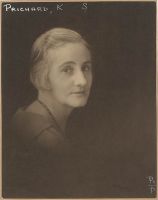
Katharine Susannah Prichard

Prichard, 1927/8 (Courtesy: State Library of NSW, via Wikimedia Commons)

Prichard, whose book The pioneers I’ve reviewed here, shared the 1929 Bulletin prize with M. Barnard Eldershaw, for her book Coonardoo (which I have also read, but many years ago). Coonardoo is one of the first Australian books to deal with a relationship between a white and an indigenous Australian. Prichard was a founding member of the Communist Party of Australia. Her novels documented people’s struggles, in work and relationships with each other. Her son, Ric Throssell, became an Australian diplomat and writer.

Miles Franklin (1879-1954)

Franklin’s career started long before the period I’m writing about here – My brilliant career was published in 1901 – but she was still active during this period and in fact won a prize in 1936 for her novel All that swagger**. I can’t resist sharing this excerpt which describes the hero, Danny, chopping down gum trees:

Guarding the illusive land were throngs of giants–the stateliest trees on the globe. Delacy was like an ant in the aisles of box trees and towering river gums, but he attacked them as an army, grunting with effort, sweat dripping from him. His slight form grew as wiry as steel; his hands were corneous and scarred with the work of felling and grubbing. (All that swagger, Ch. 3)

A contemporary reviewer described it as “probably the finest Australian novel ever written”. It deals with an Irish immigrant and his family’s history in Australia over 100 years, up to 1933. The Bulletin ‘s reviewer suggests that the hero, Danny, “seems certain to take a lasting place in Australian literary tradition.” The reviewer, I think, got that wrong, but Miles Franklin herself has achieved this through the eponymous prize she bequested. What is less well-known is that Franklin was politically active much of her life, and in fact spent around 9 years working for the National Women’s Trade Union League in Chicago from 1906 to 1915. On her return to Australia she worked hard to promote Australian literature, supporting, for example, the creation of fellowships for writers.

Other writers

Other politically active writers at the time included Jean Devanny, who was a Communist and who used her writing to promote her ideology; Eleanor Dark, who was active in the Labor left; and Nettie Palmer, who actively mentored younger writers like Marjorie Barnard and Flora Eldershaw and who, with her husband Vance, was anti-Fascist and a proponent of egalitarianism.

Literary histories about the period rarely mention any of these writers in isolation, which tells us something about the richness of the literary life of the time and of their collaborative approach to promoting not only Australian literature but also the values they thought should underpin Australian life. I never tire of reading about them, but I still have a way to go before I can feel well-read in their writings.

*From my research for Wikipedia. The citation is: Dever, Maryanne (1994) “Conventional women of ability: M. Barnard Eldershaw and the question of women’s cultural authority” in Dever, Maryanne (ed) Wildflowers and Witches: Women and Culture in Australia 1910-1945, St Lucia, University of Queensland Press, pp. 133–146

** Accessible online at Project Gutenberg Australia

DISCLAIMER: I have read works by most of these writers, but mostly long ago. I hope, in future months and years, to (re)read their works, and review them here.

Gillian Mears, Foal’s bread (Review)

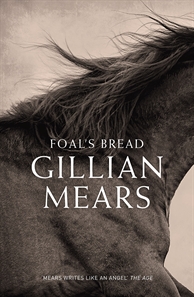
Gillian Mears' Foal's bread

Foal's bread cover (Courtesy: Allen & Unwin)

Foal’s bread is Gillian Mears’ first novel in around 16 years, though she has published short stories in the interim. This is a shame because she is a beautiful writer, particularly when she writes about the place she knows best, the farms of the New South Wales north coast.

Foal’s bread is about the Nancarrow family. Most of it takes place between 1926 and around 1950, as it follows the fortunes of Noah (Noey/Noh), her husband Roley (Rowley), and the extended family with which they live. Their main business is dairying, but their passion is the sport of horse high jumping. At the beginning of the novel, Roley is an Australian high jump champion and Noey a young 14 year-old girl with promise. They meet, marry (early in the novel, so no spoilers here) and start working hard to achieve their dream of having their own high jumping team. Hope on, Hope ever, is their motto. That’s the broad plot; the story is far more complex.

This is an archetypal story of strong country people coping (or not) with “luckiness and unluckiness” in life. In its depiction of hardship, stoicism and the will to survive in rural families, it reminded me – in tone if not in story – of Geoff Page’s The scarringThe hardship may come from different quarters, but in both there is a sense of forces out of one’s control combining with things of the characters’ own making. That mix – of characters’ judgement or behaviour clashing with luck (usually bad) – tends to make for a good story, in the right hands. It’s a bit Shakespearean in a way, the clash of character with “the elements”.

Australian Women Writers Challenge 2012 Badge

Australian Women Writers Challenge (Design: Book'dout - Shelleyrae)

In Foal’s bread, the “bad luck” has many sources, some human and some natural, such as incest, lightning strikes, giving birth to a disabled child, war and drought. How the characters cope with the trials confronting them is the core of the novel. Unfortunately, more often than not, they don’t cope very well. Why? Mainly due to their very human failings. Noey and Roley, whose marriage commences with great love and big dreams, don’t know how to communicate when calamity hits. Noey’s mother-in-law, Minna, lets her jealousy (“of the happiness she’d never seen before”) get the better of her and prefers to increase the tension between her son and his wife rather than to ameliorate it.

By now you’ll be thinking this sounds like a miserable story, and in some ways it is. But it’s not all darkness. While the novel has an almost elegiac tone, its movement is towards light. It has a three-part structure. There’s a very short Preamble which sets a tone of harshness and brutality with its references to incest, bushfires, floods, and animal cruelty.”Watch out you don’t cry” we are warned. Then there is the bulk of the novel in which the story of Noey and Roley is played out. This is followed by a Coda, set some 50 years later, in which we learn that “the old voices remain … funny, flinty, relentless”. These voices are carried into the future by Lainey, the strong, resourceful daughter of Roley and Noey, “her mother’s daughter through and through”.

A strong story, but what gives this novel its real power is the writing. Mears mixes the rough, ungrammatical country-speak of the era with glorious, rhythmical language describing the magpies, butcherbirds, trees, creeks and hills of One Tree Farm. The “one tree” is a jacaranda, and it features throughout the novel. It could almost be, dare I say it, a character. Early in the novel, when all is full of hope, it quivers “to create the feeling of a big bosomed woman wanting to waltz”. Later, as things start to collapse, it loses its leaves, but at the end “the old tree lives on … like a huge purple cloud hiding the rooflines”.

And then, of course, there are the horses. Reading this book reminded me a little of reading Tim Winton’s Breath. Mears does for horse high-jumping what Winton did for surfing. She made me feel the joy and beauty of the jump, of pushing oneself to achieve just that little bit more in a risky sport, of having a dream that keeps you going, of doing “the impossible”. Mears, like Winton, knows her subject inside out, and you feel it in her writing.

I fear I haven’t done the book justice. I’ve not really described its complex plot. I’ve named only a few of its large cast of colourful characters. It’s an ambitious book with big themes and a big style. Not everyone loves it. Some find the dialogue tricky or some descriptions overdone; some think the ending is disappointing; some think it’s stereotypical in places. I think none of these things. I’d love to know what you – if you’ve read it – think!

Gillian Mears
Foal’s bread
Sydney: Allen & Unwin, 2011
370pp.
ISBN: 9781742376295

(Uncorrected proof copy received from Lisa of ANZLitLovers in a blog giveaway)

Monday musings on Australian literature: Guest post from Tony of Tony’s Book World

As with most of my guest posters to date, I came across Tony (of Tony’s Book World) not long after I commenced blogging. He stood out like a beacon because he was a non-Aussie blogger who had read a significant amount of Australian literature, including Patrick White no less. If you check his blog, you will find that he even has a page listing his favourite Australian fiction. He (so far, anyhow) doesn’t have any other nationally focused pages. How could I not ask him to write a guest post here! Thanks Tony, it’s been great getting to know you through blogging. Not only have I enjoyed getting to know my own literature through other eyes but you’ve introduced me to some writers – like Dawn Powell – that I know will be up my alley.

Tony has chosen for his topic one of the grand dames of Australian literature …

Henry Handel Richardson and The Fortunes of Richard Mahony

English:

Henry Handel Richardson, 1945, by Coster (Presumed Public Domain, via Wikipedia)

It is terrific and I am grateful to Sue for having this opportunity to guest write in “Whispering Gums”. It took me long enough to figure out that a Whispering Gum is a tree, an Australian (eucalyptus?) tree.

I have never been to Australia. In fact I live about as far on Earth from Australia as you can get in Minneapolis, Minnesota, US, where most of our trees are either oaks or pine trees. Yet over the years I’ve developed a passion for Australian literature starting with Christina Stead and Patrick White (whom I consider probably the greatest novelist ever, just to give you an idea where I’m coming from). My appreciation of Australian literature has continued through the years with many writers including such recent writers as Tim Winton, M. J. Hyland, and Joan London.

Today I want to write about the “The Fortunes of Richard Mahony” trilogy by Henry Handel Richardson which I consider the high point of Australian literature along with Patrick White’s novels. Henry Handel Richardson was the male pseudonym of woman writer Ethel Florence Lindesay Richardson who lived from 1870 to 1946. I read this entire trilogy back in 1991 and 1992, and it was one of my most moving reading experiences.

Each of her (Henry Handel Richardson’s) novels is an effort to understand and to make us understand the complexities of a human situation, and this is in itself an invigorating and sometimes subversive exercise in following truth along unexpected paths. — Karen MacLeod, Henry Handel Richardson (1985)

Richardson later wrote that the character of Richard Mahony was based on her own physician father. What makes this trilogy so moving is the complexity and unsparing honesty that Richardson brings to the character of Richard Mahony. Just as perceptive parents know their own children, faults and all, better than anyone else in the world, children as they grow up observe their parents closely. Most children love their parents, but that does not mean they aren’t aware of their faults. From your own children, you can run but you can’t hide. Richardson gives the reader the full portrait of Richard Mahony entirely free of sentimentality. In fact Richardson said that so much had been written about the great successes among the Australian people, she wanted to give a picture of one of the many failures, and so we have this story of the slow decline of Richard Mahony.

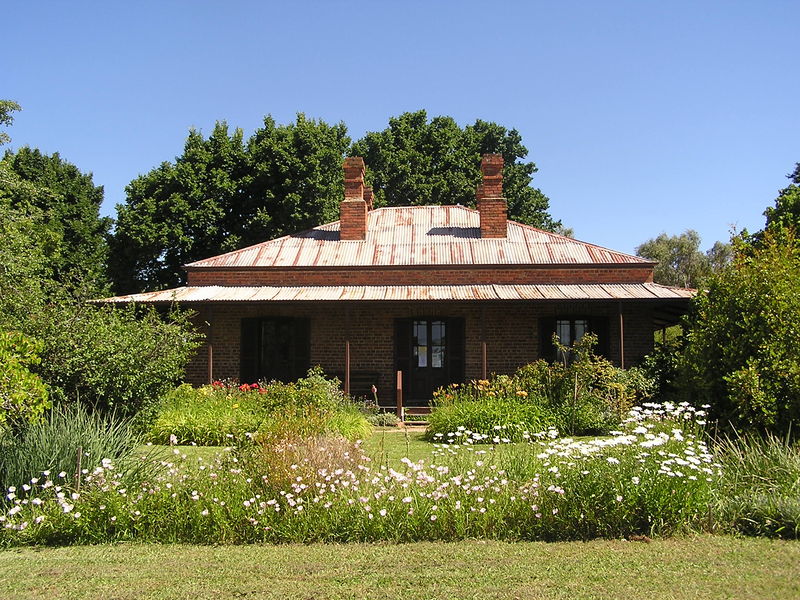
Lake View House, Chiltern

Lake View House, Chiltern, where Richardson lived when young (By Golden Wattle, via Wikipedia, using CC-BY-SA 2.5)

The first volume of the trilogy, “Australia Felix” begins at the goldfields near Melbourne in 1852. Richard is a young man just arrived from Dublin, Ireland and he is running the Diggers Emporium on the goldfields. He is more interested in reading philosophy than drinking and socializing, and most of his neighbors dislike him, thinking he is arrogant. He does meet fifteen year-old Polly whom he marries. Polly, later known as Mary, becomes a strong female figure in the trilogy. After losing his store due to accidentally selling spoiled flour, Richard takes up his original profession as a doctor

In the second volume, “The Way Home” Richard and Mary go back to the British Isles, this time to Glasgow, but soon Richard decides they can never be successful there and the couple returns to Australia and locate in the goldfields in Ballarat where he establishes a practice as a doctor. Here they finally have a daughter.

When the first two volumes of The Fortunes of Richard Mahony were originally published, there was little fanfare and few sales. All that changed when the third volume, “Ultima Thule”, was published in 1929. It was greeted with a chorus of praise from the critics, had good sales, and overnight Richardson became famous. Readers finally latched on to the tragedy of Richard Mahony and his family.

As the story in the trilogy continues, a strange thing happens. As I mentioned before, Richardson’s portrayal of Richard Mahony is honest and unsparing. Yet the reader is sympathetic and cares more about what happens to this man because of his faults and failures, not in spite of them. Richardson presents a total human being defects and all, and this complete blunt account gives the trilogy its power. Richardson applies these same forthright techniques to the wife Mary and the daughter.

Another distinctive feature of the trilogy is the style of the writing. Richardson’s writing has a visceral natural quality that puts you in to whatever scene she is depicting. I still remember some of the intense goldfield scenes vividly. There are similarities in her style to that of Patrick White, and I can’t help but think that White had read The Fortunes of Richard Mahony carefully sometime before writing his own novels.

One of Richardson’s literary heroes was Leo Tolstoy. “This is not a novel, it is a world”, wrote W. D. Howells of Tolstoy’s War and Peace, and the same line applies to The Fortunes of Richard Mahony. All of life is in these pages. As an unknown English critic said of The Fortunes of Richard Mahony, it is “one of the great inexorable books of the world’’.

The book Henry Handel Richardson – A Study by Nettie Palmer (1950) was very helpful to me in writing this article.

On the literary road: Omeo, Omeo, wherefore art thou Omeo?

The Omeo Plains near Benambra from Mount Blowhard

Omeo Plains (Released into Public Domain, by John O’Neill, via Wikipedia)

Ok, that’s a pretty weak beginning I know, but hands up if you’ve ever heard of Omeo in Victoria, Australia? I must say that I hadn’t until recently when I started planning our latest foray into Victoria. We decided to  travel to Melbourne via the Great Alpine Road, in Victoria’s High Country … and in that gorgeous region we found a very pretty little town called  Omeo.

And so, I checked my literary guide* and I discovered some interesting literary connections for the town. It was part of the big Gold Rush of the 1850s, and the area features in novels by Rolf Boldrewood and Henry Kingsley. I’m a bit embarrassed that I really hadn’t been aware of Kingsley until a year or so ago, but Omeo features in his best-known novel, The recollections of Geoffrey Hamlyn (1859), and in another of his novels The Hillyars and the Burtons (1865). This latter novel apparently incorporates a story inspired by the Omeo Disaster of 1854 in which a number of diggers rushed over the Great Dividing Range from Beechworth searching for gold. It was not successful, however, and some of the diggers did not survive their return trip.

Boldrewood is a better known writer, primarily for his novel, Robbery under arms. It is another novel of his, though, Nevermore (1892), that features this area, which he saw as wild and lawless. In this novel he recreates three real events that rather support his assessment – the murder of Cornelius Green, the Ned Kelly Gang cattle rustling, and the Tichborne Claimant affair. All of these had connections with Omeo. Cornelius Green was a gold-buyer who was hatchetted to death by two bushrangers in 1859. The Tichborne claimant, who made a fake claim on a fortune and a title in England, had worked around Omeo in the 1850s. It was a well-known case at the time in both England and Australia. And the Kellys, well, if you don’t know them, click the link to Wikipedia and all will be revealed!

By 1900 Omeo had become far more respectable and was recognised for the beauty that we saw on our visit. Poet Bill Wye wrote:

There’s a wild charm in the mountains that is not met elsewhere,
Free as the vagrant winds, and pure as snow
There are songs in fountains, bubbling in the hills up there,
That echo the name of ‘Omeo’…

Not great poetry perhaps, but you get the picture, as you do in the following which was included by one RH Croll in his 1928 book on bushwalking:

As I came over Livingstone
The day was like a flame,
But suddenly I saw below,
Far and far and far below,
The shining roofs of Omeo
And said its singing name.

Ah, Omeo, Omeo, methinks you deserve better poets than these!

*Peter Pierce (ed)
The Oxford Literary Guide to Australia
Oxford: Oxford University Press, 1983 (rev ed)
501pp.
ISBN: 0195536223

Dorothy Porter, On passion (Review)

Do you read “little” books? You know those small books that are carefully placed on bookstore sales counters where you are buying the book you really came for? I don’t often, but every now and then one catches my eye. Today’s review is of such a book from Melbourne University Press‘s Little books on big themes series. It’s by Dorothy Porter and is titled On passion. She finished it just before she died in December 2008. I think I could be justified in calling that poignant, don’t you?

Australian Women Writers Challenge 2012 Badge

Australian Women Writers Challenge (Design: Book’dout – Shelleyrae)

Dorothy Porter was (is, really) a well-regarded, successful Australian poet. I reviewed her last collection, The bee hut, a couple of years ago. It’s a wonderful collection full of the pains and joys of living. It is, you could say, a passionate book. One of the poems I quoted in that review is about the passion for writing, for finding the perfect way to express an idea:

and your pen slashes ahead
like a pain-hungry prince
hacking through
the bramble’s dragon teeth
to the heart’s most longed for
comatose, but ardently ready
princess.
(“Blackberries”)

So, writing, of course, was one of her passions but in this little essay Porter explores all sorts of meanings of the word (for her). She starts with her adolescent passions – her youthful religious faith which was replaced by her “dark gods, Janis Joplin, Jim Morrison and Jimi Hendrix” whose “daemonic songs” were her “new hymns”.

From here she explores the various ways passion has been part of her life … woven always with poetry, hers and others, and music:

Music has been my draught of intoxication since the very moment I first heard the Beatles in early 1964 […] I have been a Beatles pop/rock music maniac ever since, and have written virtually all my poems to rock riffs and rhythm – the catchier, the darker, the louder, the gutsier the better.

She talks in one section of Dionysus and moderation, strange bedfellows, eh? She argues that Euripides best understood the Dionysian, by exploring “how best to respect and live with it”. She admits, though, that “moderation was not something I embraced with Delphic calm, but something I gutlessly and gracelessly caved into” because, for example, she and drugs did not mix!

Nature too features, snakes in particular. “Real and living snakes are sacred to me” she says and then explores Minoan snake worship versus “the debased and diabolical serpent-demon of the Judaeo-Christian Garden of Eden”. She talks of the Rainbow Serpent in Australian Aboriginal Dreaming but admits that, when she actually confronts a King Brown snake in the desert, her worship did not stop her getting “the shock of my life”. She also refers to DH Lawrence‘s poem “Snake”, which I fell in love with in my teens. Lawrence describes the visit of the snake  as “a sacred event”. Porter says she always forgets the ending, how Lawrence’s fear gets the better of him so that he scares the snake away. She remembers only the vision of the wild thing being watched (and appreciated) by the poet.

There are other passions, but I’d like to conclude on the one dear to the heart of readers. She writes

I wonder if some of the most deeply passionate experiences of my life have happened between the covers of a book.

Not only do I love the idea that books have such an effect on us, but I also like her qualification: “some”, she says! Life is, after all, important too!

She describes Wuthering Heights as “the most scorching novel in the English language”; says that “there is, paradoxically, much more convincing grown up sex in Jane Austen than in Emily Brontë“. Oh, yes! She talks of Sappho’s love songs; admires one of my favourite poets, Gerard Manley Hopkins, for “pushing language as hard as it will go into ecstasy – and despair”; and describes Ginsberg as convincing her “of the power of language to shock”. She talks of love and desire, of wanting “to find and deliver scenarios, characters and poems that are magnetic with sexual energy” but asks, provocatively,

… how many readers have we lost because we have ignored the ancient silent cry: ravish me.

Near the end she wonders if reading had been the greatest passion of her life. She says – reminiscent of Francesca Rendle-Short and Michael Sala’s comments that writing/reading is dangerous – that

… at a more profound level I recognise that there is something very unsettling about a book.

Absolutely … but what say you about books, reading, passion?

Porter, Dorothy
On passion
Carlton: Melbourne University Press, 2010
(Series: Little books on big themes)
96pp.
ISBN: 9780522858358

Michael Sala, The last thread (Review)

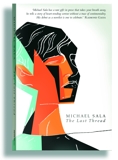
Michael Sala The last thread bookcover

The last thread (Courtesy: Affirm Press)

It’s clear why Affirm Press chose a comment by Raimond Gaita for the front cover of their latest publication, Michael Sala’s autobiographical novel, The last thread. Gaita, for readers here who don’t know, wrote an award-winning memoir, Romulus, My Father, about growing up as a migrant with mentally unstable parents. Sala’s story is different but both boys suffered emotional deprivations that they chronicle in their books … except, and this is a big one, Sala’s book is classified as “fiction”, and we must therefore read it as such. A bit, in fact, like Francesca Rendle-Short’s Bite your tongue!

So, what is his story? The novel is told from Michaelis’ (later Michael’s) point of view. It is divided in two parts: Bergen Op Zoom and Newcastle. It starts, then, in the Netherlands when Michael is around three or four years old, and his brother, Con (Constantinos) three years older. But it’s not quite this simple, as in the first part which is told third person we follow them from the Netherlands to Australia to the Netherlands and then back to Australia. The family’s unsettled state physically – they also move multiple times in Australia – works metaphorically too because there is little emotional stability in the boys’ lives. At the start of the novel, the mother has left the boys’ father, the Cypriot Phytos, and is living with the physically and emotionally abusive Dutchman, Dirk. (“There’s no problem”, Michael writes of this handyman stepfather, “that he can’t solve with his hands”.) By the end, when the boys have grown up, the mother has been married a couple more times. She is skilled, you would say, at choosing wrong men: “The men in my life take advantage of me”, she says.

What makes this somewhat age-old story compelling is the writing. It is told more or less chronologically but in little vignettes. The two parts are divided into chapters, but the chapters themselves are broken into smaller sections that provide an eye into scenes from Michael’s world. It’s a child’s eye, until near the end, so we readers must try to fill the gaps between what Michael describes and what we know could be the meaning behind what he’s seeing. Why, we must ask ourselves, would a young boy think this:

Michaelis can’t imagine anything more frightening than living forever.

And Michael’s eye, though a child’s one, is very observant. He particularly notices faces, watching them it seems for signs of warmth and connection, but

Each time light blazes from the screen, it washes across Con’s face and reveals it like something carved from stone.

and

She [mother] holds her belly and sighs, and there’s a look in her eyes as if she might burst into tears.

I could be mistaken but it felt to me that as we moved through the second part, Newcastle, which is told first person by the adult Michael, the chronology became more disjointed, mirroring I think Michael’s growing awareness of what lies behind the dislocations in his family, and of its impact on him.

As you’ve probably gathered by now, there are secrets in this family that contribute to the dysfunctional behaviour. These secrets are not mentioned on the backcover, so I won’t mention them either. Sala handles them well. He doesn’t labour them but rather lets them hover in a way that we know they are there but that doesn’t let them occupy centre-stage. We learn to live with them, the way the family has to. In the way of modern novels, there’s no dramatic denouement …

In talking of the writing, I’ve mainly discussed the narrative style but I should also mention the language. It is, in a word, gorgeous. Here are just two descriptions that convey Sala’s ability to capture the essence of things. First, being dumped by a wave:

There is such strength in the sea. He has forgotten it until now. It pulls at his limbs so that his feet touch nothing and only his desperate grip keeps him there. A sensation comes to him of being separate, of seeing it all from a great distance as if he cannot reach out and touch the world. Then the noise dies in his ears, the sky appears again above him.

And next, of his mother’s house:

The rooms and corridors of my mother’s house became like the arteries of a heart attack victim, all clogged up. Even the breeze had to bend in half to get through.

I’ve read quite a bit of autobiographical/biographical fiction, fiction-cum-memoirs, and memoirs in recent months, and some I’ve found a little wanting here and there. This, though, is hard to fault – if, that is, you like reading more for the interior than the exterior, for what’s going on inside rather than for what’s happening in the material world.

In the very last pages of the book, Michael’s mother says that “words and stories can be dangerous” (echoing Francesca Rendle-Short’s “to think, to write, is dangerous”). They can indeed, but sometimes that danger can have positive outcomes. I hope that, for Sala, the dangers of putting his story, his truths, on the page will be restorative. There’s no guarantee though that such bravery will have its just rewards … in life or in fiction.

Michael Sala
The last thread
Mulgrave: Affirm Press, 2012
238pp
ISBN: 9780987132680

(Review copy supplied by Affirm Press)

Monday musings on Australian literature: On the making of a classic

Having completed the book, I tried to get it published, but everyone to whom I offered it refused even to look at the manuscript on the ground that no Colonial could write anything worth reading. They gave no reason for this extraordinary opinion, but it was sufficient for them, and they laughed to scorn the idea that any good could come out of Nazareth – i.e. the Colonies. (Fergus Hume in the Preface to the 1898 revised edition of his The mystery of a hansom cab)

Rather coincidentally, I finished reading Fergus Hume’s The mystery of a hansom cab a few days after I wrote last week’s Monday Musings on nurturing Australian classics. The quote above doesn’t exactly relate to today’s topic on the creation of a classic but to the difficult business of getting published in the first place. However, it does lead nicely into today’s discussion, partly because a book must be published before it can hope to be a classic (duh!), but mainly because today’s topic was inspired by the new introduction to Sydney University Press’s 2010 edition of Hume’s novel.

In this introduction, Robert Dixon of Sydney University commences by stating that when people are asked to nominate the most popular Australian writers of the late nineteenth century they tend to name Marcus Clarke (The term of his natural life), Rolf Boldrewood (Robbery under arms), Banjo Paterson and Henry Lawson. They do not, in other words, mention Fergus Hume whose book achieved “impressive sales”. Nor do they mention writers like Ada Cambridge (whom I’ve featured in a past Monday musings). Why?

Dixon has some suggestions. One is commercial, that is availability. He quotes another academic in the field, Paul Eggert, as saying that a “consensus about the nineteenth-century classics emerged quite suddenly among reviewers around the Centenary year of 1888, which hardened into an orthodoxy” in early histories of literature. This resulted in Clarke’s, Boldrewood’s and Kinsley’s (The recollections of Geoffrey Hamlyn) novels becoming available cheaply and in quantity. But why these particular works? Well, Dixon says that there was a growing interest in the colonial past, an “emerging literary nationalism”, which

not only displaced a generation of female authors of domestic realism, such as Catherine Spence, Ada Cambridge and Catherine Martin, but also male writers of urban-based popular fiction, including Fergus Hume and Nat Gould.

He continues:

By the time the first critical evaluations of Australian literature came to be written in the early decades of the new century, Eggert notes, ‘the die had been cast’. The mystery of a hansom cab was urban, not pastoral, international rather than national in outlook, and ‘neither a detective story nor a turf tale* was going to compete seriously with the Kingsley-Clarke-Boldrewood trio’.

Interesting, eh? The logical outcome, of course, is that if a book is overlooked early in its life (due to “fashion” or the “fickle finger of fate”) it has a hard road back to serious recognition. But then, feminist studies over the last half century have already shown us how books (art, music, or whatever endeavour you care to mention) by women have regularly been overlooked by the creators of “the canon”.

It would be nice to think that “quality” (I’m not going to get into definitions of that now) will rise to the top but, while we probably agree in general that those books currently labelled “classics” are so, it’s pretty clear that there are many more works out there equally deserving of the label – if only we knew about them. That’s the real pity of it … so I’d like to thank all those publishers who, over recent years, have sussed out “quality” older works and re-introduced them to us. I hope they keep doing so.

All that said, it begs the question about today’s authors and books, doesn’t it? Will the swag of awards we have now be the arbiter of what become future classics? Or will best-selling status be the go? Will future publishers suss out the overlooked – and what will they be? Oh for a crystal ball.

Addendum to last week

In last week’s post I reported that Melbourne University did not teach one Australian literature course in 2011. Here is student Stephanie Guest’s take on the situation as she reported in the Australian Book Review (undated):

… at the University of Melbourne, there was only one subject on Australian literature, ‘The Australian Imaginary’. To my chagrin, the handbook reported that it was not available in 2011. There may be specialised branches of Australian literature taught in Croatia and Texas, but at Melbourne there was not even a general course on offer. The carelessness towards Australian literary studies was clear from the listing in the course curriculum of Murray Bail as ‘Murray Bird’.

The head of the English department told me that staff shortages, reduced funding for the Arts Faculty, and low student interest in the subject were responsible for the absence of Australian Literature in 2011.

* Nat Gould’s milieu

Fergus W. Hume, The mystery of a hansom cab (Review)

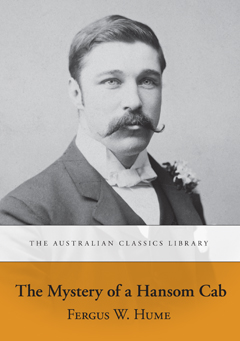
Hume Mystery of a Hansom Cab

The mystery of a hansom cab (Courtesy: Sydney University Press)

Sometimes you just have to break your reading “rules” don’t you? Two of mine are that I’m not much into detective fiction (despite having reviewed Peter Temple’s Truth here) and I don’t read self-published books – but then along came Fergus Hume‘s The mystery of a hansom cab. It’s a classic Australian crime novel – and it was “originally” self-published (says she cheekily)!

I’m not, you now know, an aficionado of crime fiction, so my assessment of this book may be the skewed one of a newbie not versed in the intricacies of crime writing. However, I must say that I found this a thoroughly enjoyable and engaging book, and would recommend it to crime and non-crime readers alike, for reasons that will soon become obvious. But first, the plot.

The story commences with a newspaper report of a murder that takes place in a hansom cab, and over the next few chapters we learn the name of the victim (a young man, Oliver Whyte, who was drunk at the time of his death) and that he was killed by a passenger who got into the cab, ostensibly to see him safely home. The detective on the case fairly quickly deduces that the murderer is a rival for the affections of a young society woman … and from here, as it always does, the plot thickens. The accused murderer declares his innocence, that he indeed has an alibi, but he will not divulge the information it would “curse” the life of his fiancée. The trial occurs and is resolved halfway through the novel. The rest explores … but wait, if I tell you this, I’ll give too much away, so I’ll stop here. The resolution, when it comes, is not a complete surprise but neither is it completely predictable. At least, not to non-aficionado me.

Australian Literature Month Platypus logo

Read for Reading Matters' Australian Literature Month

Now, why do I like it? To start with, it’s a well-told story, with nicely delineated characters. Then there’s the setting: it is primarily set in Melbourne, with a little excursion into the country, in the 1880s. This was a boom-time for what was known then as “Marvellous Melbourne” and Hume describes life in this well-to-do post-Gold Rush city with gorgeous clarity. Most of it concerns the middle classes – the professionals and self-made men – but we are also taken into the slums where prostitutes struggle to survive. Hume does not have the social justice goals of, say, William Lane (in The workingman’s paradise) but he doesn’t shy from describing some of the seamier aspects of the city:

Kilsip and the barrister kept for safety in the middle of the alley, so that no one could spring upon them unaware, and they could see sometimes on the one side, a man cowering back into the black shadows, or on the other, a woman with disordered hair and bare bosom, leaning out of a window trying to get a breath of fresh air … Kilsip, turning to the left, led the barrister down another and still narrower lane, the darkness and gloom of which made the lawyer shudder, as he wondered how human beings could live in such murky places.

Hume then describes the woman they had gone to meet, Mother Guttersnipe (how Dickensian is that?):

… a repulsive-looking old crone; and in truth, her ugliness was, in its very grotesqueness well worthy the pencil of a Doré.

This brings me to another aspect I enjoyed. It is chockablock with allusions to Shakespeare and the classics, and references to what the writer of the introduction describes as the “middle-brow, middle-class, international entertainment culture of North America and Europe”, such as the artist Doré, the composer Offenbach, and the writers Poe, Dickens and De Quincy. There’s also a cheeky reference to novelist Mrs Braddon – “Murdered in a cab … a romance in real life, which beats Mrs Braddon hollow” – containing a clue that readers of the time might have picked up.

There’s the 19th century style – third person omniscient, descriptive chapter titles, a touch (but not too much) of melodrama, light satire and humour, the use of little homilies (often to introduce chapters), and a (very) neatly tied up conclusion. This is not ponderous, heavy-handed 19th century writing, but good well-paced story-telling supported by lovely description and observations. Most of the light relief comes through minor characters, like the landlady Mrs Sampson and the young-man-about-town Felix Rolleston. Here is Mrs Sampson:

She was a small, dried-up little woman, with a wrinkled yellow-ish face. She seemed parched up and brittle. Whenever she moved she crackled, and one went in constant dread of seeing a wizen-looking limb break off short like the branch of some dead tree. When she spoke it was in a voice hard and shrill, not unlike the chirp of a cricket.

She is, for all this, a warm-hearted woman, but whenever she appears so do such words as “crackle’, “rustle”, and “chirp”. Beautifully vivid, but nicely controlled.

It is of course also 19th century in its worldview … and so has a patriarchal flavour. Our “plucky” heroine, Madge, buys “a dozen or more articles she did not want” writes the author. And in the resolution the men decide what they will and will not share with the women involved – “it would be useless to reveal” the truth to one female character as “such a relevation could bring her no pecuniary benefit”, and to another because “such a relation could do no good, and would only create a scandal”. The infantilisation of women, eh?

Fate also makes its appearance in the novel, from early on when the accused murderer’s life “hangs on a mere chance” to late in the novel when the author makes his position clear. He writes that men:

… created a new deity called Fate, and laid any misfortune which happened to them to her charge. Her worship is still very popular, especially among lazy and unlucky people, who never bestir themselves … After all, the true religion of fate has been preached by George Eliot when she says that our lives are the outcome of our actions. Set up any idol you please upon which to lay the blame of unhappy lives and baffled ambitions, but the true cause is to found in men themselves.

I’ve said it before, and I’m sure I’ll be saying it again: I could write on and on about this book. It has so much to explore and it would be fun to do so, but at this point I’ll simply recommend it to you and hope that you’ll find time to discover and enjoy it too. It was, in its time, a best-seller …

Fergus W. Hume
The mystery of a hansom cab
(The Australian Classics Library)
Sydney: Sydney University Press, 2010
(Orig. pub. 1886)
293pp.
ISBN: 9781920899561

(Review copy supplied by Sydney University Press)