Lesley Lebkowicz, The Petrov poems (Review)

Canberra poet Lesley Lebkowicz has made a couple of brief appearances in my blog: first in my post on The invisible thread anthology, and then when she won this year’s ACT Poetry Award. I was consequently more than happy to accept for review her latest book, The Petrov poems.

English: Evdokia Petrova at Mascot Airport, Sy...

Evdokia being escorted by two Russian diplomatic couriers to a plane at Mascot Airport, Sydney (Presumed Public Domain, from NAA, via Wikipedia)

It’s intriguing that nearly 60 years after the events, we are still interested in the Petrovs. In fact, I have written about them before, in my review of Andrew Croome’s historical novel, Document Z. Most Australians will know who they are, but for those global readers here who don’t, the Petrovs were a Russian couple who worked at the Soviet Embassy in Canberra in the early 1950s. Vladimir (Volodya), Third Secretary, and his wife Evdokia (Dusya) were both Soviet intelligence officers (or, to put it baldly, spies). They defected in 1954. The defection was particularly interesting because Vladimir defected first, and Evdokia two weeks later at the airport in Darwin after some dramatic scenes at Sydney’s Mascot airport.

At first glance, The Petrov poems looks like a collection of poems but in fact it is a verse novel, albeit one comprising many short individually-titled poems. These poems are organised into four “chapters”: Part 1, Volodya defects; Part 2, Dusya defects; Part 3, The Petrovs at Palm Beach; and Part 4, The Petrovs in Melbourne.

I must admit that I wondered, initially, why Lebkowicz had decided to write about the Petrovs, given that they have already been picked over in novels, non-fiction, theatre, and television. But, as soon as I started reading it, I could see why. Lebkowicz gets into the heart of these two characters, bringing them back to ordinary human beings who were caught up in something that was both of and not of their own making. It is a rather pathetic story. There are no heroes here – and yet, as happens with these sorts of things, it captured the world’s attention for a short time.

Now, before I comment specifically on this book, I’d like to quote another Canberra poet Paul Hetherington from an interview with Nigel Featherstone in the online literary journal Verity La:

One of the ways I recognise the poetic is when I find works in which language is condensed, ramifying, polysemous and unparaphraseable. Part of what I wish to do when writing poems is to make works that speak in such ways – but to do so without resorting to any kind of trickery or artificial obscurity.

While I wouldn’t use words like “ramifying” and “polysemous”, and while we can paraphrase the ideas to a degree, this is pretty much what Lebkowicz achieves in The Petrov poems. In just 80 pages or so she manages to not only tell the story of their lives but get to the nub of their hearts and psyches – as much, anyhow, as anyone can do for another person. We learn that Volodya is not succeeding at spying:

He wants to succeed but stumbles. Failure
follows him like iron torn from a roof and
rattled along the wind.
(from “Glass I”)

We learn that he loves Dusya (“Dusya is his place in the world”), but that he loves booze, his dog and prostitutes more. He seems weak, but he’s a man struggling. With Stalin’s death and the arrest of his boss, he fears reprisals when he returns to Moscow. Here he is at the moment of defecting (which he does, after disagreements on the subject, without telling Dusya):

Once again he’s going to be wrenched from the soil.
He remembers his father – struck by lightning, buried up to his neck
by foolish men, and dying in the freezing night.
Then chaos and not enough food. Uprooting a full-grown plant
is no easy thing: so many roots
are wound through the earth. He mutters the Russian words
for sadness and home and ruffles his Alsatian’s fur.
(from “Loss”)

Dusya, on the other hand, is a stronger character, but she has suffered severe losses in her life, including her first love and her daughter:

This is something Dusya does not allow herself to think: how her
life might have been if Romàn had not been arrested. […]
If she had gone on taking happiness for granted. Living with
Romàn had been like walking along a winter street and arriving
in a field of warm poppies. If Romàn had not been broken in a
labour camp. If Irina had not died –
(from Romàn I)

While she understands Volodya’s fear, she fears even more what might happen to her family if she defects. At Darwin airport she doesn’t want to make a decision: “If only/this government man would abduct her”. But of course he can’t.

We then watch them as their relationship falters, first during ASIO’s interrogation, and then the years of living together in Melbourne, officially in disguise but known nonetheless. (“The whole street knows they are Petrovs -/too many photos, too much publicity”).

While I’m not a Petrov expert, I’ve read enough to feel that Lebokowicz’s interpretation is authentic. She explores what happens when the political interferes with the personal; she recognises the pull of culture and the despair that losing one’s home can engender; and she sees that corruption is not confined to communism:

so when ASIO falsifies (No! Not falsifies
amends, adjusts, even corrects) the documents
he brought from the Embassy – of course he assents
(from “Bones”)
Australian Women Writers ChallengeThese are wonderful, readable poems. They are poetic but, to quote Paul Hetherington’s goal, without “trickery” and “artificial obscurity”. The imagery is strong but clear. I particularly liked the way Lebkowicz varies and plays with form. None of it is rhymed, but there are sonnets, couplets, poems with multi-line stanzas but closing on a single dramatic line, and others. There are poems with short lines or terse rhythms, indicating action or stress, and poems with long lines conveying thoughts and reflections. There is also a shape-poem, “Torment”, in which the zigzag shape mirrors Dusya’s distress (“Her life is a staircase that switches directions”).

Like any good historical fiction – if a verse novel can be called that – you don’t need to know the history to understand the story told here. And like any good historical fiction writer, Lebkowicz has produced something that enables us to reconsider an historical event from another perspective and to understand the humanity below the surface of the facts. An excellent and moving read.

Lesley Lebkowicz
The Petrov poems
Sydney: Pitt Street Poetry, 2013
95pp.
ISBN: 9781922080141

(Review copy supplied by Zeitgeist Media Group)
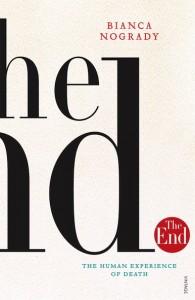
Bianca Nogrady, The end: The human experience of death (Review)

Bianca Nogrady, The end book coverHave you thought about your death? About how and where you want to die? These are the questions Australian science journalist Bianca Nogrady asks us to consider in her recent book, The end: the human experience of death. I’m not a morbid person, but when Nogrady contacted me to ask whether I’d consider reviewing her book, The end, it didn’t take me long to say yes. Like Nogrady I did witness, a couple of years ago, something I would call “a (pretty) good death”. That I felt it was so, intrigued me. I was therefore interested to read what Nogrady had to say.

And what she had to say was fascinating from beginning to end. In her introduction, she says:

This book could just as easily have been Everything you wanted to know about death but were afraid to ask. Death is fascinating, compelling, and it consists of much more than simply the end of a biological life-form. In seeking to understand death, we are seeking to understand life.

The rest of the book is structured logically according to the sorts of topics we are likely to ask about, starting with why we die, and then moving on to issues like defining death, where, when and how we die, spiritual and out-of-body experiences, and religion. Nogrady looks at these issues from all the likely points of view –  medical, sociological, psychological, philosophical, legal and ethical. She organises her information well, and the chapters (and subchapters) flow very naturally from each other.

So far, I have probably made it sound like a well-organised rather dry read – but that’s not how it is. Not only did Nogrady do a lot of secondary research (as the Notes at the end attest) but she also interviewed a lot of people. As a result, the formal information garnered from her research is supported by people’s stories, which also add colour and life to the facts. Many are of course sad – we are talking death after all – but this is not a sad book.

The most complicated section of the book is the second chapter on “Defining Death”. Nogrady takes us carefully through the different “definitions” – specifically, cardiac death and brain death (which, I learnt, can be further subdivided into “whole brain death” and “brain stem death”). She shows how the definition issue has been complicated by medical advances enabling us to keep the body alive and, of course, by the organ transplant process. Royal North Shore Hospital’s Intensive Care Specialist Dr Ray Raper suggests that death is:

a continuum; a graded box with one end as ‘being alive’ and the other end as ‘being dead’ … If you look at the domains of the transition between life and death, they’re spiritual, functional and structural and they’re biological, and the most important ones are the functional ones.

Death, in other words, is a process. If your fingernails are still growing when you are in the coffin, then, says Arizona State University Professor of Philosophy Joan McGregor, the questions needing answers relate to what are we preserving and why do we value it. I’ll leave this discussion here because there is no single solution – or not at present anyhow. This is murky ground indeed, but Nogrady manages to traverse it with clarity. I will probably have to read the book a few times though for the concepts to stick!

She also discusses euthanasia, teasing out misconceptions. She explains the differences between physician-assisted suicide, voluntary euthanasia and terminal sedation. She also explores the rise in palliative care as a profession, covering related issues like death doulas and volunteer workers in palliative care hospitals (or hospices). And of course she talks about near-death experiences, and those death-time phenomena that science can’t explain such as clocks stopping, machines behaving erratically, and deathbed visions.  The final chapter discusses faith and belief. Death is cultural, but, as she discovered, there is as much similarity as there are differences in end-of-life rituals.

It’s a funny thing to say, I suppose, but this is an enjoyable book. It’s neither superficial nor so detailed that you get bogged down. There is a lovely balance between expert opinions and anecdotes. I can imagine reading it again – or parts of it. It’s a shame, though, that there isn’t an index, which seems to be common in non-fiction books aimed at a general market. I guess it’s all about cost.

Australian Women Writers ChallengeIn her epilogue, Nogrady returns to her own experience, to how the death of her grandmother had caused her to want to better understand death. Writing the book, she says, made her think about “the value of planning, or at least thinking about how we want to die”. Death is, after all, a “one-way journey”. We do it alone, and it may well be, she argues, our best chance “find out who we are at the core”. One man who spent a long time thinking about his death, because he had a degenerative, terminal disease, was Australian public intellectual Donald Horne whose last book, written with his wife Myfanwy, was Dying: A memoir. He wrote:

My final drifting away, via a morphine dose, I would want to be among my memories, with Myfanwy whom I love holding my hand.

Think about your death, plan for it, is Nogrady’s final message to us. If you’re ready to take up her challenge, The end would be a good place to start.

Bianca Nogrady
The end: The human experience of death
North Sydney: Vintage Books, 2013
260pp
ISBN: 9781742752051

(Review copy supplied by the author)

Monday musings on Australian literature: Hazel Rowley Literary Fund

It seemed appropriate to talk about the Hazel Rowley Literary Fund this week given that several commenters on my review of Christina Stead‘s For love alone mentioned Rowley’s well-regarded biography of Christina Stead. Quite coincidentally – amazing how often such coincidences occur isn’t it – AustLit posted on their blog last week a piece titled The names behind our literary awards #1: Hazel Rowley. Today’s post was clearly meant to be.

For those of you who don’t know, Hazel Rowley was one of Australia’s most respected biographers. Christina Stead: A biography, published in 1993, was her first biography. It won the National Book Council’s “Banjo” Award for non-fiction. Her next biography published in 2001 was on the African-American writer, Richard Wright, whose book Native son is on my TBR, courtesy of my daughter. This was followed by Tête-à-tête: the lives and loves of Simone de Beauvoir & Jean-Paul Sartre in 2005, and the biography I have read and reviewedFranklin & Eleanor: an extraordinary marriage, in 2011. Unfortunately, this is where her work ends because Rowley, born in 1951, died in New York of a cerebral haemorrhage in 2011 as that last biography was coming out. What a tragedy – for her, her family, and us. I love the fact that she wasn’t afraid to tackle already well-covered subjects, like Sartre and de Beauvoir, and the Roosevelts. I’m not an expert on the Roosevelts but from my reading I think she did contribute an interesting perspective to the body of work about them.

Anyhow, soon after her death, her friends and family established the Hazel Rowley Literary Fund. It “aims to commemorate Hazel’s life and her writing legacy through activities that support biography and writing in general”. The main vehicle for this is the Hazel Rowley Literary Fellowship. It  is offered annually and provides up to $10,000  to a writer researching a biography, or “an aspect of cultural or social history compatible with Hazel’s interest areas”. The Fund states that “Preference will be given to projects that are about ‘risk-taking’ and expanding horizons, promote discussion of ideas, and make a significant contribution to public intellectual life”. That’s a big call – but an encouraging one too – particularly given the discussion in last week’s Monday Musings about “commercial imperatives” blocking “artistic ones”. More encouragement of “risk-taking” is what we want. Is it good enough though to rely on private funding to achieve this?

(With thanks to AustLit for the inspiration for this post)

Thoughts on Christina Stead’s writing in For love alone

I can’t resist writing another post on Christina Stead‘s For love alone, which I reviewed recently. Usually in my reviews I make some comments about the writing, but that review was getting so long that I decided to leave that discussion for another day.

I’m embarrassed to admit that For love alone is my first Stead. I’ve been wanting to get to her for the longest time, but somehow other books kept getting in the way. I’ll admit too that I was a bit nervous – as I’d heard over the years that she was difficult to read, or that her books were too miserable. Fortunately, I found neither of these to be the case with this novel. From the first chapter I was hooked. The book does have a little prologue which I enjoyed, but it was the first chapter that really got me in – and it got me in primarily because of its writing.

I love writing that plays with words and this is what I found in chapter one. Take for example this use of the word “bending” in an exchange between the heroine Teresa and her father (pp. 11-12):

“… I am in love again, with a young woman, a woman of thirty, a – ” His voice dropped. He came towards her, seized her arms and looked into her face without bending. “A wonderful, proud looking woman, pure in soul. “My whole life is wrapping itself around her, so I’m glad you brought it up for you will understand later on -”

She angrily shook her arms free. “Don’t touch me, I don’t like it.”

He sighed and turned his shoulder to her. “That is no way to treat men, men don’t like an unbending woman.”

“I am unbending.”

“You will be sorry for it.”

Then a few sentences down, her father says to her about flirtatious, coaxing behaviour in women:

“If, I say, you should ever be tempted to tricks like that, thinking to please some man, remember that they detest those tricks and see through them. They know they are traps, mean little chicane to bend them to women’s purpose.”

This is such a clever and telling exchange. It immediately tells us something about the father, the daughter and their relationship, about the likely themes of the novel (particularly given the title) and, though we don’t know it, it sets up future exchanges with Jonathan Crow who often talks of women trapping men.

A couple pages on is a another exchange in the family in which the idea of “honour” is played with and twisted. Stead, I sensed, was a writer I was going to like.

This, however, is not all that captured me in the first chapter. There were also several oxymorons (oxymora?) that added to the sense of slipperiness. Teresa’s room is described as “an inviting cell” and her brother, Lance, as “chaste and impure”. In the next chapter, a womanising dockhand is “agreeably sinister”.

It is language like this – ironic, satirical, biting – that keeps me reading, particularly in early stages of books where I’m not sure what is happening. I enjoy this sort of language because it challenges our preconceptions and can set a strong tone. (I do like a strong tone.) Mostly, though, such language tells me that the novel in question is likely to be multi-layered and that I’d better be ready to look beneath the surface.

Stead also writes beautiful, evocative descriptions. Christina Houen, commenting on my review of the book, referred to Stead’s description of Sydney. Stead herself grew up on Sydney Harbour. Here is the description Christina referred to. It occurs as Teresa is returning home after the wedding that opens the book:

It was high tide at nine-thirty that night in February and even after ten o’clock the black tide was glassy, too full for lapping in the gullies. Up on the cliffs, Teresa could see the ocean flooding the reefs outside, choking the headlands and swimming to the landing platforms of jetties in the bays. It was long after ten when Teresa got to the highest point of the seaward cliffs and turning there, dropped down to the pine-grown bay by narrow paths and tree-grown boulders, trailing her long skirt, holding her hat by a ribbon. From every moon-red shadow came the voices of men and women; and in every bush and in the clumps of pine, upon unseen wooden seats and behind rocks, in the grass and even on open ledges, men and women groaned and gave shuddering cries as if they were being beaten. She passed slowly, timidly, but fascinated by the strange battlefield, the bodies stretched out, contorted, with sounds of the dying under the fierce high moon. She did not know what the sounds were, but she knew children would be conceived this night, and some time later women would marry hurriedly, if they could, like one of her cousins who had slept the night with a man in one of these very grottoes; and perhaps one or two would jump into the sea. There were often bodies fished up around here, that had leapt when the heart still beat, from these high ledges into waters washed around these rocks by the moon. (Beginning of Ch. 5)

I won’t even try to unpack all this, but I’m sure you can see how intense and dense it is. It’s ambiguous about love and sex – and this ambiguity underlies the whole book, right through to – and beyond – its resolution.

Oh, and then there’s her facility with dialogue, her imagery, her literary and classical allusions – but again this post is starting to get long. Maybe another day!

Christina Stead, For love alone (Review)

In a recent communication with local author Nigel Featherstone about reviewing, he reminded me of Peter Rose’s advice for new reviewers for the ABR. One of the points Rose makes is:

with major books, ones that have been reviewed extensively in the newspapers, submit reviews that add to our understanding of the book, not just repetitious codas to or echoes of earlier reviews.

This stands also, I think, for classics, for books that have become part of the “canon”. Stead’s For love alone is such a book. My problem then is how to say something about this book that isn’t same-old, same-old. I could be lucky here though, because while Christina Stead is part of the Australian literary canon she’s probably not as well read or as well-known as she should be.

To gain some idea of her reputation amongst the literati, just look at these comments … Patrick White described this book as ‘A remarkable book. I feel elated to know it is there’. Now that is really something isn’t it? Helen Garner has said ‘I could die of envy of her hard eye’, David Malouf wrote that ‘Christina Stead has the scope, the imagination, the objectivity of the greatest novelists’, while American critic Clifton Fadiman called her ‘the most extraordinary woman novelist produced by the English-speaking race since Virginia Woolf‘. He has qualified his praise with ‘woman’, but nonetheless, you see what I mean. What can I add to a discussion of a writer of this ilk?

Enough introduction. Those of you who don’t know the novel are probably wondering by now what it’s about. The title sounds a bit melodramatic, and the basic plot-line could suggest it, but in fact the book is low on drama. You don’t read Stead for page-turning excitement. The novel is set in Sydney and London, from 1933 to 1937. It concerns Teresa Hawkins, the 19-year-old daughter of an unloving, self-involved father. Neither she nor her three siblings are happy at home but seem tied to it, mostly for economic reasons. The novel opens with Teresa and her sister Kitty attending the wedding of their cousin Malfi, setting the scene for Teresa’s quest for love – for a real love, though, not for “some schoolfellow gone into long trousers”. Unfortunately, while she is an intelligent and resourceful young girl, she is also naive. She sets her sights on her Latin teacher, the 23-year-old Jonathan Crow*. Consider the name, and you might gain some insight into his nature!

“She believed firmly in the power of the will to alter things and force things to an end”

It’s hard when reading the novel not to think of Thomas Hardy’s Tess of the d’Urbervilles (surely it’s relevant that Teresa is also called Tessa?) and, even more, of Edith Wharton‘s heroines. However, while society’s rules and conventions underpin the plot, Stead is more interested in her characters’, particularly Teresa’s, psychology. What does Teresa mean by love, what is its impact on her, and how far will she go for it? Very far, we soon discover. She denies herself sustenance almost to the point of death, not once but twice, in the novel. Why?

Well, let’s look at Teresa/Tessa. Early in the novel, she’s idealistic. She will not, she says, compromise her life. “I’ll never give in” (p. 33) she says to her aunts, and a little later says to her cousin, “I’d work my fingers to the bone to keep my lover” (p. 127). As she becomes immersed in her love for Jonathan Crow, she enacts these vows: “I am killing myself for a man” (p. 314), she realises. “Love is hard” (p. 357). And yet, she continues for many more chapters, to believe in her idea of love (in which women can’t expect happiness) and in Jonathan. This, to her, is how love is. It’s an intriguing portrait of a woman who is strong and intelligent, and yet unable to let go of something that is patently going nowhere. When the inimical Crow describes her as “a true example of masochism and also a perfect example of mythomania”, it’s hard not to agree.

Teresa, then, is not a simple character. Her commitment to Jonathan is complicated: when opportunities arise for greater intimacy, she in fact pulls back. It’s significant that several times through the novel she mentions Ulysses:

she could sail the seas like any free soul, from Ulysses to the latest skipper of a sixteen-footer rounding the world.

Eventually, though, she discovers “true love … the love without crime and sorrow” but, as ABR editor Peter Rose also says “never give away the denouement”, I will leave it here. I’ll simply say that the ending is satisfyingly open and true to Teresa’s character.

“The world was hers and she had no doubt of the future”

The novel is, essentially, a bildungsroman. It’s Teresa’s coming of age, intellectually, psychologically and physically. Her youthful confidence takes quite a battering as she confronts the realities – presented by society and by Jonathan. She realises that society’s rules are counter-human:

Why the false lore of society? To prevent happiness. If human beings really expected happiness, they would put up with no tyrannies and no baseness; each would fight for his right for happiness. (p. 532)

This is not a social history. Despite the descriptions of poverty, the analysis of societal marriage conventions, the discussions about money and power, Stead is not writing a Dickensian novel. Rather, it’s about Teresa’s struggle to know herself as a mature loving women, something that is stunted for some time by her relationship with the slippery Jonathan: “In one speech he would be sardonic and naive, cruel and gay, tender and cold” (p. 380) And yet, Teresa cares for this man, and forgives, and forgives, and forgives again his erratic, careless, misogynistic treatment of her. In fact, she appears to be so in his thrall that her employer James Quick begins to wonder whether she is as intelligent as he’d believed:

What can she be, to tolerate such a contemptible, calculating worm […] this intellectual scarecrow (p. 477, 480).

However, she is, of course, intelligent and in true bildungsroman-style does experience “true” love. But this is Stead and it’s not simple. At one point her new love tells her:

he will send her to university – make a woman of her, make a brilliant woman of her … He would take her to Paris, and elsewhere, no-one who knew her now, would know her then; he would make her over entirely.

Oh dear …

Australian Women Writers Challenge

This is a delicious book – rich in ideas, gorgeous in writing, passionate in conception, and complex in psychology. The more I delve into it, the more I want to say. Perhaps, I will another day.

Postscript: By coincidence, I finished For love alone just as the ABC’s Australian Story broadcast the strange story of revered Australian writer Elizabeth Jolley, her librarian husband and his daughter by his first marriage, Susan Swingler, whom he left in England without telling her the truth. The first thing that crossed my mind as the story – I have Swingler’s book, unread, on my shelves – unfolded was “the things people do for love”. Jolley’s novels, like this one of Stead’s, are emotionally intense and explore some of the darker sides of familial and romantic relationships.

Christina Stead
For love alone
Carlton, The Miegunyah Press, 2011 (orig. pub 1945)
575pp.
ISBN: 9780522853704

* The novel is autobiographical, but by no means autobiography. Here is an article on Keith Duncan who inspired Jonathan Crow.

Murray Bail, Portrait of electricity (Review)

A couple of weeks ago I quoted Murray Bail on compser-house-museums from his latest novel, The voyage. But this isn’t the first time Bail has expressed his attitudes towards turning the home of a famous person into a museum. It was the topic of a short story, “Portrait of electricity” which, as far as I can tell was first published in 1975. And this story, I gather, was probably the inspiration for his novel Homesickness (1980) (though I haven’t yet read that).

I was tickled by the quote because in our recent overseas trip we’d visited the house where Beethoven was born and where Liszt spent the last twenty years of his life, not to mention the residences of writers Goethe and Schiller. We enjoyed visiting these places, because each was well presented providing us with insight into the lives of their erstwhile residents. We probably would have got that from a straight museum, of course, but a museum (usually) needs a building and if it is to be a dedicated museum, why not in a building connected to the subject? The question is, what do you put in that building and how do you present it? The temptation with using a building in which the person lived is to imbue it with an additional layer of “meaning” which can result in what Bail satirises – and that is excessive (defining this is a judgement call of course) reverence, the turning of the space into a shrine.

This is where “Portrait of electricity” comes in. That the story is satirical is pretty obvious from the opening sentences:

There were three guides. One did all the talking, the others nodded in agreement.

Three guides – with only one talking? What were the rest there for? To increase the sense of import?

The visitors/tourists are given special shoes (as we were given in Weimar’s Anna Amalia Bibliotek) but

inside, it was a museum like any other. The rooms strangely impersonal, exhibits arranged in cabinets against the wall, special objects located towards the centre.

It’s hard to imagine how Bail could fashion an 18-page story out of this premise but he does, and it engages. Sometimes you squirm, but other times, fortunately, you are able to adopt Bail’s satirical stance and see how ridiculous such museums can be when taken to extremes – and, being the good satirist Bail is, he takes the fascination for all things belonging to the revered person to rather grotesque extremes. But it would spoil the story to give away here just how far he goes.

The story also satirises the people who visit such museums, including little digs at different nationalities, at gender behaviour, and different tourist types (the sceptical, the smart alec, the unimpressed, the tired, and so on). People take photographs of the chair with its flattened contour “caused by his body weight”, “women put on the expression they use when choosing wallpaper”, and all follow the guides feeling as though they are drawing “closer to him, acquiring greater knowledge”. Meanwhile, the guide conjures up the man’s life in the house, reminding them that “his body travelled through what you see before you”. No object is too small to have meaning. When one visitor asks “Is that worth preserving?” (“that” being a fingernail), there is only one possible answer, “It’s part of him”.

Bail knows his museological stuff, because he also satirising sacred principles such as that of maintaining objects in “original state”. The question behind the satire is whether there should be limits to the collection and presentation of a person’s effects. This is a serious question, one faced by archivists and museum curators every day. Bail’s story is an effective reminder that common-sense should play a role in this decision-making.

I will leave it here. The items the guide draws their attention to become more and more peculiar if not downright absurd, the reliability of the guide’s analysis of the man and the import of the evidence becomes increasingly shaky, while the visitors feel (or hope perhaps) they are drawing towards “important, intimate knowledge”. Can we ever really know a person – famous or otherwise – through a bunch of objects they owned or used? This story is a great read, whether you work in museums or visit them. It may not change your mind about visiting such museums if, like me, you enjoy them, but it will make you think about them next time you do. And in our celebrity-focused, materialist culture that would be a healthy thing.

Murray Bail
“Portrait of electricity”
Published in:
Marion Halligan and Roseanne Fitzgibbon (eds), The gift of story: Three decades of UQP short stories (1998)
and in
Murray Bail, Contemporary portraits and other stories (1975) (and various other Bail collections)

Murray Bail, The voyage (Review)

Murray Bail, The voyage, book cover

Courtesy: Text Publishing

It took me a while to read Murray Bail‘s latest novel The voyage. I started it before we went overseas but didn’t quite finish it, and decided not to carry it with me. So, 8 weeks later, I picked it up and found it surprisingly easy to continue. I say surprising because it is a rather astonishing novel – in style, structure, and also, I think, theme. Like other works of Bail’s, particularly Eucalyptus, it manages to feel old and new at the same time, which is rather the point, since it shifts back and forth between the Old World (Europe) and the New (Australia), between high society Vienna and a cargo ship returning to Australia with piano inventor Delage and escapee from the Old World, Elisabeth von Schalla, on board.

It’s a short book, just 200 pages, but it’s by no means simple. Short books, I’ve found, often demand the most of their readers. Anyhow, Bail, you may remember, gave the opening keynote address at the National Library of Australia’s Writing the Australian Landscape conference. It was a provocative talk, but I won’t reiterate what I’ve said before. Instead I want to refer to his plea for writers to take stylistic and intellectual risks. This is what Bail has done here.  There’s a Patrick White-like intensity, but the style is all Bail.

First though, as usual, a few words about the plot. The story concerns 46-year-old piano-inventor Frank Delage coming to Europe – specifically Vienna – to sell his new Delage piano. It’s a cheeky thing to do, this, but he gives it a go with a certain naiveté perhaps that comes with being from the New World. He meets the Schalla family, first the mother Amelia von Schalla and then the husband, Konrad, and their 36-year-old daughter Elisabeth. There are two main plot tensions – will he sell his piano, and what will happen between him and the two “landlocked women”. The piano plot is resolved clearly (though not necessarily neatly) while the relationship plot is not so clean, even though early in the novel we know that Elisabeth is on the boat with him going to Australia.

Now to the risky business. This is a novel with no chapters, and it mostly comprises long paragraphs that last several pages. These are somewhat unusual, though not particularly risky. The chronology alternates between Delage’s time in Vienna and his voyage home on the ship, with occasional flashbacks to Australia. This sort of narrative structure isn’t unusual these days either. But, what is unusual, what is risky, is how he alternates his chronology. It is done organically, fluidly, mid-paragraph and even – sometimes – mid-sentence. For example, the following sentence starts in the present, on the ship, with the subject being two of the passengers, and then shifts back to Amalia in Vienna. The next sentence returns to the ship, but now with Elisabeth:

Now the sisters faced the sun, closing their eyes, allowing the warmth to soften their thoughts, the older, forsaken one undoing the top buttons of her blouse to extend the tan, after first rubbing cream into her feet and throat, the buttons on Amalia’s, pleated, high-collar blouse he found to be imitation buttons, decoration only, on her back well-hidden by the Italian pleating, which gave the impression of vertical stripes was a tiny zipper of unexpected elegance. For Elisabeth, it was too hot on the small deck, she went back to the cabin, favouring an Austrian complexion over acquiring a tan … (p. 142)

Bail, it seems, loves the comma! It looks tricky to read: if you try to analyse a sentence or paragraph, it defeats you, the syntax is odd. And yet, it flows seamlessly from place to place, character to character, idea to idea. It is artful, carefully composed, but reads naturally, surprisingly so.

The important question, however, is how does this style relate to the theme? And here I’d like to return to Bail’s address. He spoke of Australians not being sure of who we are. We have a thin layer of history, he said, by contrast with the Old World and its long, albeit often grim history. “What is bad for a country can be good for art”, he proposed. Oh dear, I’m not sure we want to generate a few revolutions or civil wars for ourselves just to give artists something to chew on! He also said that “I hadn’t quite realised my novels are centred around journeys … My people are instinctively hot-footing it out of here, turning away from the apparent barrenness.” Bail senses a continuing discomfort about the New World’s “place”, which is articulated by Delage: “It goes without saying that they [the Viennese] would stick their noses up in the air at an intruder, a concert grand made in a hopeless backward place, Australia”.

And so, in The voyage, we have a dialogue between Old and New, which is mirrored in the style. Bail sees a tension between respecting the old and encouraging or supporting the new, between certainty and uncertainty, between world-weariness and naivete. I was initially surprised. Surely we have resolved our identity crisis; surely Old World-New World discussions are old hat. But he has a point. The Old World does, whether it’s justified or not, seem sure of itself in a way that we aren’t – “the old buildings, industrial, older than anything in Sydney or at least different, carved stonework above the windows and doors, left him feeling out of place”. It’s natural to feel out-of-place in a different culture, but there’s something else going on here too – and it’s regarding the fact that we Australians often feel lesser, and apologise even, for the fact that we, as exemplified by our buildings, are new. You hear it all the time – the awe and admiration – from Australians travelling overseas. And yet, our land is older, and indigenous Australian culture is probably the oldest continuous culture in the world. No wonder indigenous writers like Jeanine Leane get a little fired up!

Anyhow, Bail explores this tension through Delage’s attempts to sell his New World piano to the Old World, and his triangular relationship with the von Schalla mother and daughter. What happens to his piano – who buys it, how it is used – provides a biting comment on both New World and Old World pretensions. How the relationships develop is more nuanced and less resolved, leaving the way open for growth and change. Because, of course, the novel is not simply about Old World meets New World. It is about New in a much broader sense. It’s about “being open to the new”, in all fields of endeavour, whether this be piano manufacture, writing, the arts in general, or even the self. Indeed, at the book’s conclusion, Delage, who had earlier felt “without edges”,  senses that he has “become a slightly different person”.

For all this seriousness, though, The voyage is a quietly funny, satirical book. Bail delights in skewering self-importance and pomposity in critics, avant-garde artists, architects, and business men, to name a few of his targets. Women generally fare better. Viennese Amalia says she enjoys “the discomfort of the unexpected” and Elisabeth demonstrates that she does by joining Delage on his cargo ship.

I’ve laboured over this review as you can probably tell. I’ve rambled, and may not have made much sense. It’s a slippery novel that can be tackled from many angles and it doesn’t resolve all its tensions. This is good. I enjoyed the novel, but I suggest you ignore my review and read the book yourself. I’d love to know what you think.

Lisa (ANZLitLovers) has also reviewed the book, and enjoyed its inventiveness.

Murray Bail
The voyage
Melbourne: Text Publishing, 2012
200pp
ISBN: 978192192261

Dorothy Johnston, Eight pieces on prostitution (Review)

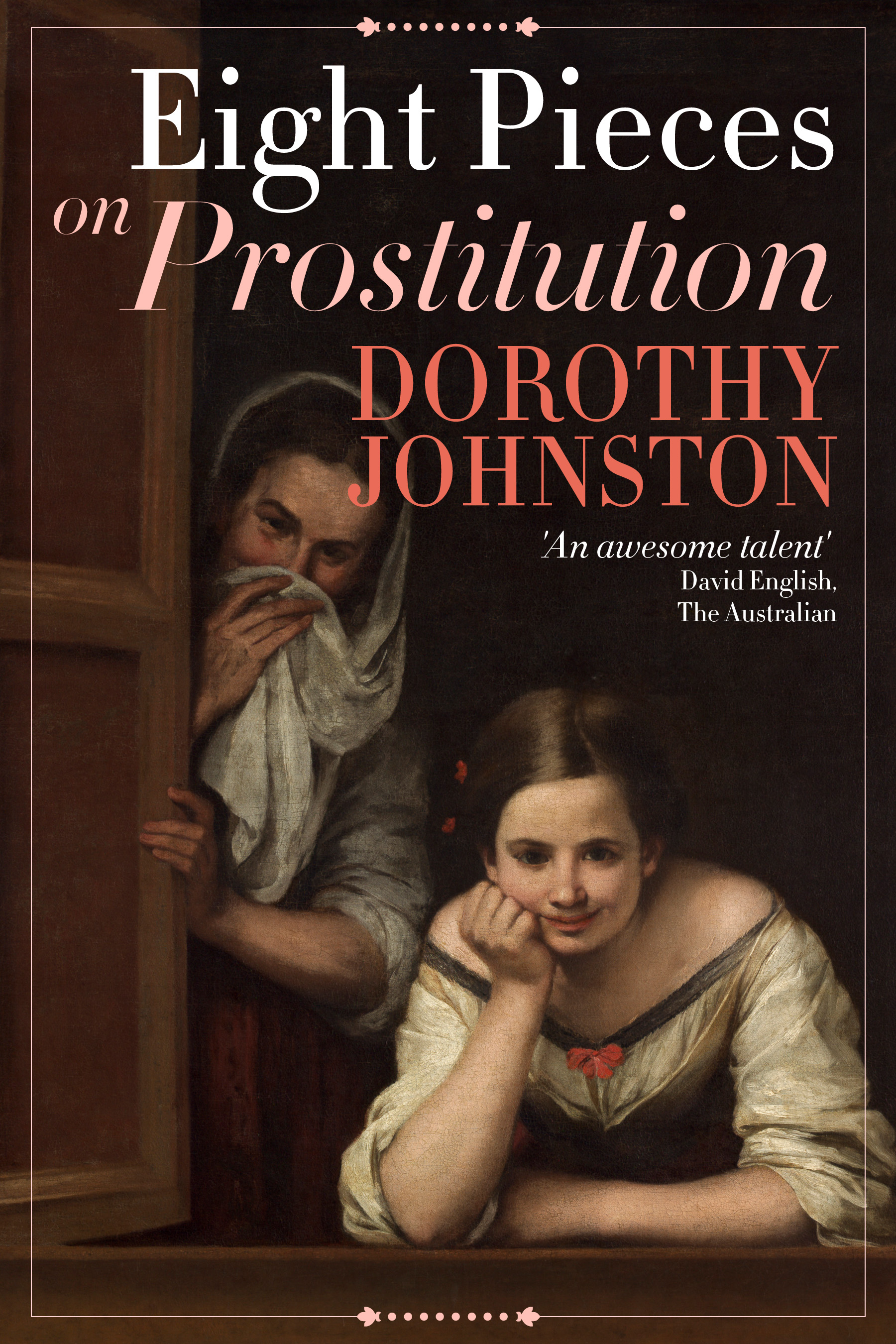
Dorothy Johnston, Eight pieces on prostitution book cover

Lifted, with approval I hope, from Johnston’s website

A few months ago I wrote a Monday Musings on the Australian Society of Authors’ digital publishing initiative, Authors Unlimited e_Book portal. At the time I decided to try it out and bought Dorothy Johnston‘s collection of short stories, Eight pieces on prostitution.

The collection comprises 7 short stories and a long story or novella. One of the stories, ‘Mrs B’, I read earlier this year in Meanjin‘s Canberra edition. Some of the other stories have been published before too: ‘The Man Who Liked To Come With The News’ (The State of the Art, 1983), ‘Commuting’ (Island, issue 52, Spring 1992, and elsewhere), and ‘The Studio’ (Southerly, Winter 1996).

The first thing I should say about this collection is that it is not salacious reading. That is, it’s not erotica. Johnston’s interest is the lives, the experience, of prostitutes as people. Who are they? Why are they doing what they are doing? How do they negotiate their relationships, professional and personal? How do they live the life they’ve chosen and are they happy?

Johnston’s prostitutes are neither glamorous nor tarty, and most work for themselves or in small establishments. They are not the prostitutes of popular imagination. That is, they tend not to work in fancy parlours under control of a madam nor in that sleazy underworld borderland managed by pimps. They are, instead, either ordinary employees or small businesswomen. Some are career prostitutes, others are university students or single mothers who need to support themselves, while still others, like Eve in ‘The Studio’, are a little more mysterious:

She lives in a small flat. She chose the national capital because she imagined it to be a city where she could fade into the background, where she could hide.
Johnston’s characters are often wistful or even a little sad, but they are never pathetic. They are intelligent, and Johnston respects not judges them. They are not powerless, either, though sometimes the power they have is limited to their domain and can be tenuous. They can be a little lost, or perhaps just at a cross-roads in their lives. Maria in ‘The Cod-piece and the Diary Entry’ is uncertain about the world and her place in it. She thinks, when she moves and loses a client:
Looking back, she could not shake the feeling that she’s been on the point of understanding something important while in Harry’s company, that understanding had been no more than a breath away.
Sandy in ‘Names’ admires university student Gail’s strength and resilience:

She never let herself fall into a chair like I did when she came back from a client, slumping my stomach and letting the smile drop off my face.

There is a continuity between these characters and the three women in her novel The house at number 10 which I reviewed earlier this year. Like Elizabeth Jolley, Johnston is not afraid to re-use or develop characters across her oeuvre. I rather like that.

The pieces are set in places known to Johnston – Canberra and Melbourne. We get a clear sense of those cities, but even more we are let into the rooms the prostitutes inhabit – the ones they work in, the ones they relax in between clients. We learn about the things that are part of their daily routine. Sophie, for example, in ‘Commuting’, finds that when she steps outside work
petrol fumes are a relief after hours of perfumed towels and bubble bath.
The final piece is the novella ‘Where the Ladders Start’. The title comes from Yeats’ poem, ‘The Circus Animals’ Desertion’:
I must lie down where all the ladders start
In the foul rag-and-bone shop of the heart.

It concerns a three-woman brothel established by Sue, who’d been dreaming for years of a “better system”. It’s “a co-operative … Tough that word, but they’d risen to its challenges”. Now though, the dream is being severely tested as they cope with the death of a client, on the first page, from erotic asphyxiation, “the choking game”.  The story explores the “one for all, all for one” ideal. Are there limits to trust, and how far should you take loyalty, particularly when it starts to be to your own detriment? Johnston sets the story at the beginning of the new millennium adding an ironic overlay to the situation confronting the women. What sort of millennium are they setting up for themselves by their response to the death?

As in all her stories, Johnston’s view of human nature here is warm but realistic, clear-eyed. She pits the “never let a chance go by” attitude against the desire to protect, care and trust, and then tests that against the need for self-preservation.

Johnston’s language is a delight to read. She’s precise but expressive, using imagery with a light touch:

The freedom to ask each other questions danced and shimmied in the air.

She can be quietly ironic:

Laura went on sitting in the kitchen like a Buddha, or more accurately a simpleton, a girl who’d left her mind someplace and forgotten to go back for it.

Is Laura simple or not is the question we ponder through most of the story.

In dealing with a mysterious death, “Where the Ladders Start” introduces us to that other string on Johnston’s writing bow, the crime novel. It’s a clever story, well-plotted, nicely maintaining a tension between mystery and clarity. Like most of the stories, there’s no simple resolution. Life, Johnston shows, is a messy business.

You’ve probably gathered by now that I thoroughly enjoyed this collection. While there is a commonality between the women, giving the collection a lovely coherence, there is also difference. Each character is unique, each story engaging. If there’s an overall theme, it is one of survival, or perhaps more accurately, resilience. Her women get on with life. They make decisions, some good, some bad, some we are not sure about, but, and here’s the important thing, they don’t stand still. Do read it. At $9.95, I reckon this is a steal.

Dorothy Johnston
Eight pieces on prostitution
Australian Society of Authors, 2013
202pp.
Availability: Online download for $9.95 from the ASA site

Romy Ash, The basin (Review)

Romy Ash has made quite a splash with her debut novel, Floundering. It was shortlisted for the Stella Prize and the Miles Franklin Literary Award, among others. I  haven’t read it yet, but I have read a couple of her short stories that have appeared in the Griffth Review, one of which is “The basin”.

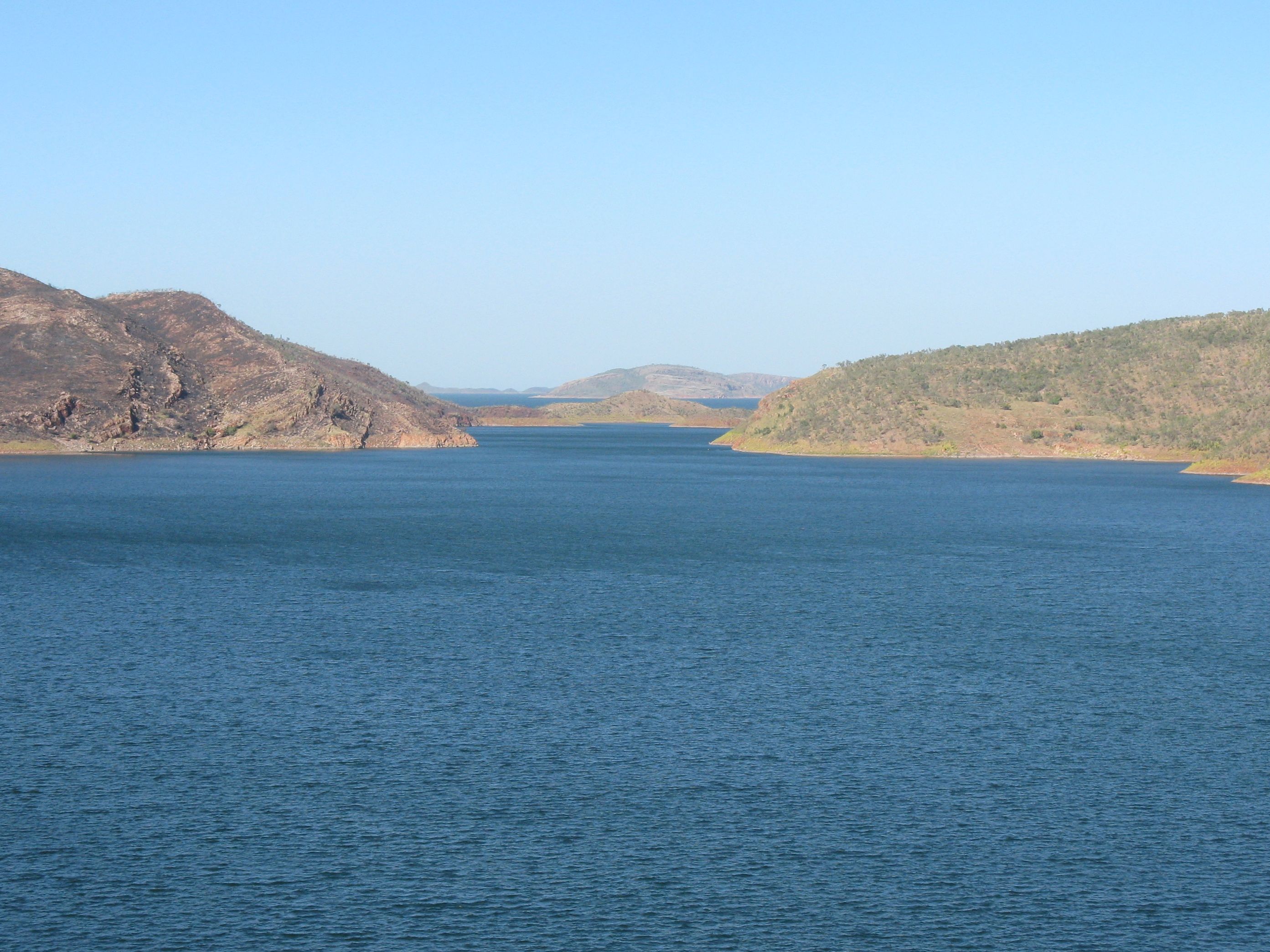
Lake Argyle

A tiny section of Lake Argyle

For those who don’t know, the Griffith Review is published quarterly, with each issue focusing on a particular theme. The issue “The basin” appears in is titled “What is Australia” which is rather apposite given my Monday Musings post this week on Writing the Australian landscape. Ash doesn’t identify the “place” in which the story is set, beyond telling us that there’s a dam which is described in a pamphlet as “the biggest inland body of water in Australia”. Well, that gives it away. It is clearly inspired by Lake Argyle in the Kimberley region of northern Australia. The lake – an artificial one created by damming the Ord River – is huge. I’ve never seen a lake (in Australia anyhow) quite like it.

Ash’s story is about Jess who has come to the region with her husband, Max, and their daughter, Frankie. Jess is not happy, something that is physically represented by her increasing weight: “every bit of her wobbled”, “Sitting there Jess felt fatter”, “her thighs rubbed together”, and so on. “You were skinny, before”, an old farmer tells her.

Max, however, is happy. “We’ve never done so well”, he tells her. But all is not well in this man-made Eden (there are sly references to “apples”) and not all men are happy. It’s not normal for this “dry country” to have so much water. A farmer tells them:

The most beautiful country you’ve ever seen, gone. Them gums, they’re drowned under there. Ever heard a gum drown?  They creak. All the animals. It’s not like fire – them animals can’t sense it coming – they was drowned, sure enough. The surface of the water was just insects. Snakes curled and died. They washed up at the sides. It didn’t look like it does now. It was putrid.

Putrid perhaps, but natural is the implication. I have written about the drowning of this landscape before in my post on Mary Durack’s poem “Lament for a drowned country”. The Duracks’ own homestead was drowned to create Lake Argyle.

Australian Women Writers ChallengeAsh uses feminising imagery to tell her story – with many references to the colour “pink” (galahs, inside of mouths, sunrise, hams) and to the “basin” of the title. Water, often a literary device associated with life, is a complex image in Ash’s story. People are told not to swim in the dam because it’s the town water. Jess and Frankie do, but then Jess will only drink bottled water, refusing to drink the town water. Understandably! A different sort of water features in the story’s resolution.

Although Ash doesn’t explore it, she reminds us of indigenous people’s association with the land when she says that “after the flooding the town had been renamed Burrngburrng-nga, an Indigenous name. Every time she heard someone say it they pronounced it differently and quietly, unsure.” Google tells me that it means “The water boiled” in the Wagiman language (from Katherine in the Northern Territory).

This is a story about the costs – personal and environmental – of mankind’s belief in its ability to control nature. It’s about values, and whether making money is enough to sustain happiness. It’s about the unhappiness that can result when people are dislocated from their roots – either because they move or because their place has been changed beyond recognition. Place – it has such a complex relationship with our physical, emotional and/or spiritual well-being, doesn’t it?

It’s not a particularly dramatic story, but it is a quietly effective one that I can see fitting nicely into a volume intended to encourage us to think about “What is Australia”.

Romy Ash
“The basin”
Published in the Griffith Review, Edition 36, Winter 2012
Available: Online at the Griffith Review

Michelle de Kretser, Questions of travel (Review)

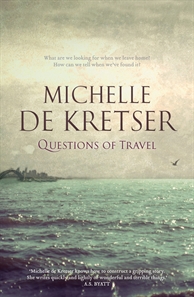
Hardback cover (Courtesy: Allen & Unwin)

Hardback cover (Courtesy: Allen & Unwin)

Every now and then a book comes along that is so sweeping in its conception, that it almost defies review. Such a book is this year’s Miles Franklin Award winner, Questions of travel by Michelle de Kretser. Consequently, I’m going to focus on one aspect that particularly spoke to me – and that is her exploration of place and its meaning/s in contemporary society.

“Soon everyone will be a tourist”

As the title suggests, the novel is about travel – but travel in its widest sense. In fact, without being too corny, it is, really, about the journey of life. As our heroine Laura, thinking about her married lover Paul, ponders:

Perhaps she was an item on the checklist: the wild oats of Europe, the career back home, marriage, mortgage, fatherhood, adultery, the mandatory stopping places on the Ordinary Aussie Grand Tour, with renos*, divorce and a coronary to follow.

That made me splutter in my coffee …

First, though, a brief overview of the plot. The story is told chronologically, alternating between the Australian Laura and Sri Lankan Ravi. Both were born in the 1960s, and the novel chronicles their lives until 2004 when they’d be around 40. Laura, under-appreciated by her family (cruelly described by her father as “the runt of the bunch”) and aimless, travels the world before returning to Sydney in her mid-30s, still rather directionless, but now an experienced freelance travel-writer. Ravi grows up in Sri Lanka, marries and has a son, but a shocking event results in his coming to Australia in 2000 as an asylum-seeker, the same year that Laura returns. You might think at this point that you know where the novel is heading, but you’ll be getting no spoilers from me!

And so we have two significant types of traveller – the tourist (with some business travel thrown in) and the refugee/emigrant. De Kretser explores these comprehensively, and with, I must say, thrilling insight. Thrilling is an unusual word in this context, I suppose, but I can’t think of a better one to describe my reaction to the way de Kretser, point-by-point, unpicks the world of travel, skewering all sorts of assumptions, expectations and pretensions as she goes. I almost got to the point of cancelling my next overseas trip! After all, as Laura discovers, “to be a tourist was always too arrive too late”. How many times have you been told that x place was better in the 80s, only to remember that in the 80s you were told it was better in the 60s!

“Geography is destiny”

So Ravi is told by his teacher Brother Ignatius. This, for all the serious and satirical exploration of travel and tourism, is what the book means most to me. Brother Ignatius tells his students that “History is only a byproduct of geography”. While we could all have fun exploring a chicken-and-the-egg argument, I’d find it hard to deny its fundamental truth.

Laura spends most of the book travelling, or thinking and writing about travel. She’s the quintessential modern person, believing:

What was the modern age if not movement, travel, change?

Living in England she sees the long-standing connections people have to their place, while

Her own people struck Laura, by comparison, as a vigorous, shallow-rooted plant still adapting itself to alien soil.

She returns to Australia, following the death of the gay man she’d loved, hoping for meaning, connection. Geography, place, home had asserted itself … as it usually does. But life doesn’t prove to be much easier. Struggling to find her place, she finds once again that “noone was asking her to stay”.

Meanwhile, Ravi struggles to adjust to his circumstances. Grieving for what he’s lost, he (with his “eyes that had peered into hell”) goes through the motions of living and working. People such as his landlady and her family, and his work colleagues, are kind – enough – but de Kretser shows how skin-deep, how superficial, our practice of diversity and, worse, our humanity is. We do not easily accept people from “other” places. “Otherness”, de Kretser proves, “is readily opaque”. Australians, for example, ask Ravi which detention centre he’d been in because, of course, as an asylum-seeker that’s where he’d been! And, if he hadn’t, was he a “real” refugee. (One of the book’s many other themes, in fact, is “authenticity”.) Ravi, it has to be said, doesn’t help himself. He doesn’t share his history (should he have to?) and, fearing obligations, he resists any help that isn’t essential.

“Place had come undone”

While Laura and Ravi struggle with where they are, they also confront the fact that by the late twentieth century place isn’t only physical. Ravi had discovered, back in Sri Lanka, the world of “disembodied travel”, though his wife Malini had proclaimed “Bodies are always local”. This imagery, seemingly light at the time, carries a heavy weight. Later, finding settling into his new geographical location difficult, Ravi starts to find escape and even solace in virtual places, including visiting people’s homes via real estate sites. De Kretser doesn’t miss any opportunity to explore the ways we “travel” and it never feels forced. It all fits, emulating the way travel fits into our lives.

For Laura, the virtual intrudes mostly through work where she is a commissioning editor for Ramsays, a travel guide company. As the 21st century takes hold, the e-zone division of her company starts to increase in importance. Some of the novel’s best satire is found in the portrayal of corporate culture at Ramsays. It’s laugh-out-loud, sometimes excruciatingly so.

“Time was a magician, it always had something improbable up its sleeve …”

While the novel’s subject matter is travel, in all its guises and in what it says about how we relate to place and each other, the overriding theme is that literal and existential question, What Am I Doing Here? It tackles the big issues that confront us all every day – Time, Truth, Memory, Death and, of course, the most fraught of all, Other People.

Towards the end of the novel, Laura realises that:

… the moment that mattered on each journey resisted explanation … because it addressed only the individual heart.

We could say the same about a great book … and so I apologise for my paltry attempt here to explain de Kretser’s witty, warm and powerful novel. If you have any interest in contemporary literature and its take on modern living, this is the book for you.

For an equally positive perspective, check out Lisa’s (ANZLitLovers) excellent review.

Michelle de Kretser
Questions of travel
Sydney: Allen & Unwin, 2012
517pp
ISBN: 9781743317334

* Aussies commonly abbreviate words with “o” or “ie” endings. “Renos” therefore refers to “renovations”.