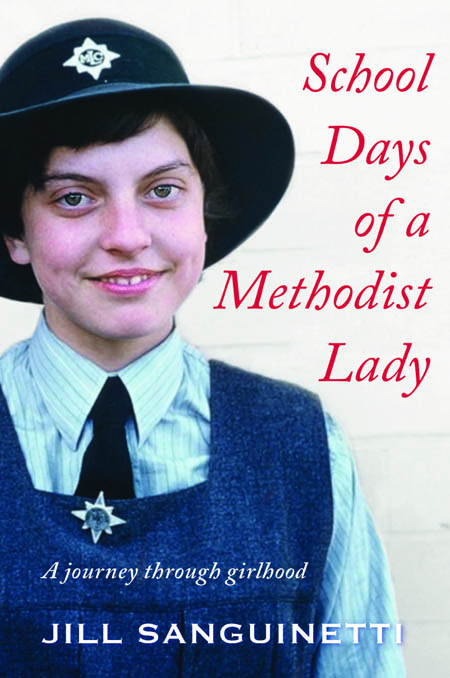
 When I read a memoir, particularly one by an unknown person like Jill Sanguinetti’s School days of a Methodist lady, my first question is why was this memoir written? Sally Morgan’s My place, for example, explores how she discovered her indigenous origins and why her family had kept this hidden, while Frank McCourt’s Angela’s ashes chronicles the extreme poverty of his childhood. Not surprisingly, many memoirs, like these two, examine the writer’s childhood – that formative time in our lives – and Jill Sanguinetti’s is no exception.
So, why did Sanguinetti write her memoir? In her opening letter to the reader she says she’s written it for the MLC community, for young people “struggling to grow through life’s complexities”, and for herself to air “a dark and musty corner of my soul”. This breadth is a bit of a shame because it means the memoir doesn’t have a core purpose that propels it along like, say, Morgan’s and McCourt’s. Nonetheless, I did enjoy the book, mainly because of its subject, Sanguinetti’s school days. The main focus is her four years as a boarder at Melbourne’s prestigious MLC (Methodist Ladies College), but it starts with her childhood in the small country town of Kyabram in northern Victoria.
Now, I wasn’t a boarder and I didn’t attend a prestigious private school, but I am a baby-boomer, as is Sanguinetti. This means that, although I went to government schools in two Queensland towns and then Sydney, and although I’m a later baby-boomer, we shared a similar world, and I enjoyed wandering down memory lane with her. I remember the freer childhood of a 1960s country town, and singing hymns with my sister after church. I remember the Billy Graham Crusades (though unlike Sanguinetti, I didn’t attend one). Elvis was well established by the time I was a teen, so my rock ‘n roll memories are of the Beatles, Credence Clearwater Revival and the Stones, but our ways of enjoying them through our radios was similar. And I remember the formality of schools in those post-war decades. Sanguinetti tells all this with a simple, straightforward clarity.
What helped keep my interest, too, was the memoir’s structure. While it is roughly chronological, starting with the family’s move to Kyabram in 1951 when she was 6, and ending with her leaving MLC in 1961, most of the chapters in between are thematic allowing her to explore these aspects of her life in more depth. And so there’s a chapter on church (“My family at church”), and one on friendships (“The gift of girlfriends”), a chapter on school discipline (“Discipline and resistance”), and another on boys (“The embarrassing problem of boys”). And so on. I particularly enjoyed her chapter on four inspirational teachers (“Matriculation: Four Great Teachers”). Don’t we all have them? This departing from a formal chronological structure, yet still moving the time on, enables the book to function as a meaningful social history of the time within the broader narrative.
I started my post with “my first question”, but I do have others about memoir-writing, a major one being how writers manage to remember so much. My memory of my childhood is woeful, patchy at best. I appreciate that when you get down to it memories come, but still … Well, Sanguinetti covers this issue both directly and indirectly in her book – within the main text and in her Acknowledgements. Her own memory is of course critical, but she was lucky that her parents kept the letters she (and her sister) wrote home while at boarding school. How useful for a childhood memoir, methinks, to have gone to boarding school! There is a trap in this, though, because your memory can be swayed by what you wrote in your letters. Indeed, Sanguinetti quotes, from one of her letters, an experience from her schooldays, and then writes:
I have no recollection of the dormitory prayer circle and doubt that it lasted long.
What significance, then, should we grant this experience in her memoir? How often, I wonder, does this happen in memoirs without our knowing? The significance depends a bit on the intention of the memoir. If it is intended to be a social history of a place or time, or a nostalgia piece, then it’s probably just as significant as events more clearly remembered, but if the memoir’s focus is the experiences that formed the writer, does something not remembered carry equal weight as one consciously remembered? (Hmm … let’s not answer that lest we become mired in psychological theory!) I should add here that Sanguinetti had other sources – written and oral – for her work. Some are mentioned in her Acknowledgements, and others in her useful, well worth reading, Chapter Notes.
Now, let’s return to my original question: why did Sanguinetti write this memoir? Throughout the book she hints at or foreshadows something darker, and we gradually realise it is depression of some sort. Around the middle of the book (“Angst”), she says that “I believe today that it was the sustained stress that harmed me in the long term, rather than separation from home or the privations of boarding”. This chapter ends with:
I was up and down like a yo-yo, revelling in the buzz and stimulation of school life one moment, and languishing in anxiety, regulation and grey ordinariness the next. I knew that other girls whose marks were not brilliant did not tackle their work with the same intensity as I did, nor did they get in a muddle, or be all up and down as I was. And why was I blighted with ever-stiffening fingers and crazy handwriting. What was it about me?
While she suggests misery, and mentions that her sister “too, started to show signs of depression”, she doesn’t develop this or make us “feel” her pain, which makes it easy for us to dismiss it as “typical” adolescent ups and downs. However, from a reference, in the post-school concluding chapters, to a breakdown, it was clearly more than that. For her, she says, the memoir “would free myself from that particular set of ghosts” left from her MLC experience, but for us it is a well-written, analytical, and yes, interesting story about Australian school and society in the 1950s to early 1960s.
Thinking about all this, I was reminded of Carolyn Heilbrun’s Writing a woman’s life in which she worries that in autobiographies “nostalgia, particularly for childhood, is likely to be a mask for anger”. This is not a nostalgia piece, though – it’s too real in her evocation of boarding-school hunger, cold and lack of freedom to be that – but it does feel as though she throttled back. Indeed, she says as much through her choice of epigraph:
Perhaps the only point about autobiography is to remember a world which, by the time of writing, has changed so much as almost to vanish, and to record the succession of changes … How to look back, not in anger, but in reflection, is a problem I had to solve. For the small, enclosed world I began in had its concealments and anguishes as well as joys. (Judith Wright)
Sanguinetti, I realise, headed me off at the pass, before she began. She’s done what she intended – and done it well. Still, a little anger mightn’t have gone astray.
 Jill Sanguinetti
School days of a Methodist lady: A journey through girlhood
Melbourne: Wild Dingo Press, 2014
239pp.
ISBN: 9780980757095
(Review copy courtesy Wild Dingo Press)




 Whispering Gums