Delicious descriptions from Elizabeth Harrower’s country

Elizabeth Harrower, A few days in the country and other stories

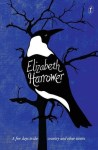
The hardback cover

In my recent review of Elizabeth Harrower’s short story collection, A few days in the country, and other stories, I included a few excerpts from the stories, but they primarily were chosen to reflect the themes and content. In this post, I want to focus on her use of language, through just a small number of examples as, of course, I don’t want to steal the thunder from the book itself.

Because Harrower’s focus is the psyche and human relationships, her “country” is as much the mind and heart as setting or place. Consequently, my selections here will cover this wider concept of country, but I’ll start with a physical description. It takes place off Scotland Island in Sydney’s beautiful Pittwater, in “The beautiful climate”. The family, Hector Shaw and his wife and daughter, are fishing, at Hector’s command of course. Here is the scene:

Low hills densely covered with thin gums and scrub sloped down on all sides to the rocky shore. They formed silent walls of a dark subdued green, without shine. Occasional painted roofs showed through. Small boats puttered past and disappeared.

I don’t think I need to tell you how our women are feeling, do I?

Here is a description of Alice and her favoured brothers, in “Alice”:

Meanwhile, the boys swam in attention and praise, and at an early age had had so much that they never needed it again, could afford to discard that particular life buoy and plunge out with a glossy confidence in their qualities. Alice never even learned to dog-paddle. Who would notice if she sank? The deep end was too risky for a girl whose brilliant dark-red curls could be so easily overlooked.

I love the sustained metaphor here.

In “English lesson”, protagonist Laura is devastated by a letter (from a man) responding to a letter of hers (which her friends told her she should write). We are not told the content of these letters, just the impact on Laura:

But could shock have the effect of bringing about a permanent physical change? Could she doubt it? Everything about her, physical and metaphysical, had sunk, shrunk. She was shorter, pruned, slightly murdered.

Can we doubt the impact?

And finally, here is Dan from “The cost of things”, unhappy in his marriage, but returning to his wife after a long business trip away during which he has had an affair:

He felt like someone who has had the top of his head blown off, but is still, astonishingly, alive, and must learn to cope with the light, the light, and all it illuminated.

If these don’t appeal to you, then maybe Harrower isn’t the writer for you, but if they do, I say, hop to it … and find one of her books.

Elizabeth Harrower, A few days in the country, and other stories (Review)

HarrowerCountryTextThere’s something about Elizabeth Harrower. I’ve just read her Stella Prize shortlisted short story collection A few days in the country, and other stories – and wow! Really, just wow! If you’re a regular reader here, you’ve probably noticed that I’m not one to effuse excessively about books, anymore than I’m one to pan them. I’m careful about what I choose to read, so most of what I read I enjoy. There are, after all, a lot of good and inspiring writers around. But Harrower – the more I read her, the more I see why Patrick White and Christina Stead liked her. She really is something. Her shrewd intelligence, sharp wit, and ability to penetrate the hearts of her characters in just a few words is breathtaking.

Enough though of the superlatives. They are easy to say, but can I prove they are just? I’ll give it a go. As I was reading – and enjoying – Tegan Bennett Daylight’s collection Six bedrooms (my review) I was thinking, yet again, about the current preference for writing in first person. I certainly don’t reject this narrative voice, because I do enjoy the intimacy of it, but I sometimes wonder whether it has become a little de rigueur, perhaps reflecting today’s me-focus? I don’t mean, in saying this, to criticise contemporary writers, because the self is part of the zeitgeist – and to capture that you have to use its modes. However, there’s also something to be said for standing back a little, and this is what a third person voice can do. It is, in fact, what Jane Austen is admired for – her clear-eyed ability to analytically, but wittily, comment on her society, to skewer its pretensions, entrapments and hypocrisies. Harrower exerts the same clear eye, though her focus is more the psyche to Jane Austen’s society.

Now to the collection, itself. The first thing to say is that this is a collection of twelve stories, ten of which have been published before, some as far back as the 1960s and others as recent as last year. Some have been multiply published in anthologies, and some have been reworked. Oh, and eleven are told in third person, with just one in first! There is a subtle underlying structure to the collection, with the first four being about young people – starting with ten-year-old Janet in the opening story, “The fun of the fair”, then moving on to teenagers and young women – followed by the later stories which feature married couples or single adults facing the lives they have made for themselves. The last shocking story, the titular “A few days in the county”, could only be at the end.

There is, I’d say, an overall theme to the collection, and it is best expressed by Clelia in the penultimate story, “It is Margaret”. Her mother, Margaret, has just died and Clelia is dealing with her step-father, a very controlling man reminiscent of Felix in The watch tower (my review) and Hector Shaw in this collection (“The beautiful climate”). Clelia thinks:

Here it was again–the mystery that pursued her through life in one form, in another, returning and returning, presenting itself relentlessly for her solution: how should human beings treat each other?

This is one of those chilling stories about the power people, men usually, can exert over others, and the way women, more often than not, submit to that power, as Margaret did. But Margaret – the title allluding to one of my all-time favourite poems, Gerard Manley Hopkins’ “Spring and fall” – has died, and “there was no further harm Theo could do”. We hope.

This theme, the way people treat each other, is at the heart of every story, and culminates in the final one, “A few days in the country”. What an unnamed someone did to the protagonist Sophie is not made explicit, only hinted at, but the consequences are devastating for her. An undivulged act having a dramatic impact on the protagonist is also explored in the tenth story, “English lesson”, nicely setting us up for this last story and again suggesting a careful hand in ordering the stories.

The consistent world view regarding power and manipulation in the way human beings treat each other is offset by variety in setting, character, story and tone. I was intrigued, for example, by two that read almost like little fables, “Alice”* and “The cornucopia”. Both are written third person, but with an added layer of distance. That is, they are written from a neutral position (“third person objective”), rather than by a narrator who takes us into the heads of the characters, interpreting their feelings and attitudes (“third person limited” or “subjective”). Regardless of how you describe the technique, however, the change in tone adds variety to the reading experience and forces us to look at humanity from a different, cooler, standpoint.

So, “Alice” then. She is a little girl unappreciated by a mother who prefers her sons:

Luckily for the mother, she also had two sons, younger than the girl–golden, milky boys not made entirely of wood and flames like their mother, nor of guileless life like their sister, but a mixture of both, and somehow not quite enough of either. They were extremely pretty children just the same. Like Alice, the brothers had remarkable hair and eyes, but their great triumph over her was that they were boys. She began to perceive that this, more than curls or thoughtful ways, was what pleased. The question was: could one terribly good girl ever, in her mother’s eyes, equal one boy? And the answer was no. (“Alice”)

The story goes on to chronicle Alice’s life, her struggle to be recognised and accepted in a family, then a world, where boys didn’t have to try, “they were welcome when they arrived.” Alice marries, but still wants her mother’s love. However

If Alice had a fault, dangerous to her survival, it was that she was inordinately reluctant to learn from experience. She would not. Because the lesson would be so sad.

Clelia in “It is Margaret”, by contrast, did learn lessons from her step-father, and you can see why Alice resists learning hers:

She would have known much less about good and evil without his lessons, but she had paid a good deal for them.

Lessons are another ongoing theme in the book.

You have probably realised by now that what I most love about this book is its writing. It just takes my breath away. Besides the variety already mentioned, there’s her language – the economy of her imagery, her tight pointed syntax. She can do irony. There’s not a lot that’s beautiful, for example, in “The beautiful climate”, and in “The cost of things” the real costs are more than monetary. And, yes, she can be funny – albeit mostly with biting wit – like:

The man had a lot to put up with, too, with the world not appreciating him as it should. (“Alice”)

and

Holding glasses, standing in strategic formation, the men were fascinated. Though the sum of money involved was trivial, it was, nevertheless, money, and the whole story began to symbolise some problem, to involve principles … By the instant, they grew harder. (“The cornucopia”)

It might sound from these that Harrower is only critical of men, but Julia in “The cornucopia”, with her Grades I, II and III friends will put you right on that!

You know how some writers just speak to you? Well, for me, it is writers like Jane Austen, Elizabeth Jolley, Thea Astley and now Elizabeth Harrower, writers whose sharp intellect and sly wit get to the nub of human experience and make me laugh and gasp in the one breath. Now, though, I’m stuck. I want to tell you about every story in this book, but I can’t. I’d bore you, and I need to move on. However, I hope I’ve encouraged you to try Harrower, if you haven’t already. Meanwhile, I can feel a Delicious Descriptions coming on!

awwchallenge2016Elizabeth Harrower
A few days in the country and other stories
Melbourne: Text Publishing, 2015
205pp.
ISBN: 9781925240566

* “Alice” was published in The New Yorker last year, and you can read it online. If you do, tell me if it does or doesn’t whet your appetite for more.

Tegan Bennett Daylight, Six bedrooms (Review)

Tegan Bennett Daylight, Six bedroomsI have just read Tegan Bennett Daylight’s collection of short stories, Six bedrooms, in my quest to read at least some of the Stella Prize shortlist before the announcement of the winner on the 19th of this month. I haven’t read Daylight before – she has written three novels, among other things – so I was glad for the added incentive to read her now. It helped, of course, that Brother Gums and family gave me the book for my birthday!

So, Six bedrooms. It’s a collection of 10 short stories, seven of which have been published previously in literary journals and anthologies. Eight are written in first person, and the other two in third. While the stories are all complete within themselves, as you’d expect, one character, Tasha, appears in four of them, the first, fourth, seventh and tenth. Evenly spaced out in other words, providing a nice sense of continuity and a sort of narrative framework for the whole. That, briefly, is the form of the book, but let’s get now to the content.

Most of the stories could be described as coming-of-age stories, as most of the protagonists are in their teens or early twenties. If you define coming-of-age broadly – that is, as a time of growth, transition and establishing identity – almost all the stories could be described as that. In the last story, “Together alone”, for example, Tasha is 36 years old, but while she’s certainly more “together” than her first appearance at 15 years old, she still has unresolved issues in her life, mainly to do with a missing brother and an ex-husband. This brings me to the epigraph. It’s by Tim Winton, and says “… the past is in us, not behind us. Things are never over.” A truism, you might say, but in this world where “closure” seems to be the thing, it’s worth remembering.

Although only the four Tasha stories are linked by character, there are several themes that recur in the book, besides the coming-of-age one. One is closely related to coming-of-age – the idea of the misfit. How many of us felt we were misfits, had that excruciating sense of feeling out of step with everyone else, only to discover later that those who looked so together felt the same! Tasha, in her first appearance in the book’s opening story “Like a virgin”, goes to a party with her friend Judy. She’s 15 years old, and feels ashamed because they showed everyone else how unable they were to deal with a party. Jane, the younger of two sisters in “Trouble”, feels lonely and awkward, a poor copy of her sister, and despises herself. And so on. Rose in “J’aime Rose”, though, has a different take. She calls herself a misfit, then soon after argues that she isn’t because she “didn’t have the courage”. For her a misfit is one who stands out through, say, “triple-pierced ears” or “a radical devotion to a singer or a style”. A rose by any other name I’d say! Anyhow, misfit or not, Rose, like many of the book’s protagonists, is lonely and unconfident, which leads her, like those other protagonists, to behave selfishly or even spitefully at times. The thing is that it’s all so believable! Unfortunately.

Other recurrent themes or motifs include missing people (parents, in particular, but also siblings, who disappear or die) which can exacerbate outsiderness, lack of sexual confidence, and friendships that survive or don’t under the weight of adolescent self-obsession and inexperience. Tasha and Judy remain friends through the jealousies and little lies to the last story when they are in the thirties, while Sarah and Fern in “Other animals” can’t survive a terrible difference in experience that Sarah doesn’t understand until way later. Daylight captures beautifully here the naive narrator who describes what she sees without having the maturity to understand the shadows beneath.

I enjoyed all the stories, but some stood out more than others. The Tasha stories for example. Daylight doesn’t broadcast the continuity, but provides hints – the name of the friend, the alcoholic but loving mother, the brother – that clue you in to the fact these stories are about the same person.

I also particularly enjoyed the title story, “Six bedrooms”, one of the non-previously-published stories in the book. The six bedrooms refer to a share-house. After all, you couldn’t really have a book about adolescents and young adults without one share-house story! The narrator here is 19-year-old Claire. Daylight builds the story with tight, effective narrative control. The residents of five bedrooms are introduced in the first couple of pages leaving us to wonder about the sixth. We learn about him four pages in. And Claire tells us that she has a friend in the house, with whom she’d moved from a previous house, but it’s clear the friendship is not strong. That too is left hanging, unexplained, until later in the story when we realise there are other perspectives besides Claire’s. Gradually, the relationships and their tensions are developed as Claire tries to find her own way and place. She befriends William, the resident of the sixth bedroom, but it never quite goes the way she’d like:

William sat on the one single chair. I smiled at him but it was as though the smile missed him, went over his head.

AND

I waited for him to touch me. I left my hand lying beside him so he could pick it up, but his hands were busy. He was itchy, and he needed to smoke …

AND

I invented a persona for myself: I was a girlfriend. Almost.

The problem is that she, like other narrators in the book, is naive, and there are things about William that she, in her naiveté, missed completely. Her pain of feeling stupid and alone is palpable.

Ultimately, Six bedrooms is about youth’s painful lessons. Its power lies in the way it captures the small (and not so small) excruciating moments in our lives when we know things aren’t right, but we don’t know how to right them. There are no dramatic resolutions or big light bulb moments, but there are glimmers of a forward momentum in many of the characters’ lives, such as Tasha realising in “Together alone” that “I might have been harder to live with than I thought”. Mostly, though, it’s about accepting that “awkwardness and trouble are part of being alive’’ (“Trouble”), that things are, indeed, never quite over. Another good Stella shortlist choice.

awwchallenge2016Tegan Bennett Daylight
Six bedrooms
North Sydney: Vintage Books, 2015
215pp.
ISBN: 9780857989130

Delicious descriptions from Elizabeth Harrower’s Circles

Elizabeth Harrower, In certain circlesIn my recent review of Elizabeth Harrower’s In certain circles, I focused on the book’s form and overall themes, and warned that I’d produce a Delicious Descriptions to share some of her writing. So, here it is, organised by headings to keep it simple …

Gender

I didn’t focus on gender in my review, but this is Harrower, and it is one of her ongoing concerns. It was in The watch tower, where the powerlessness of neglected young women put them in danger’s way, psychological and physical, and it’s here, in this novel, where women’s choices are constrained by expectations and conventions.

I’ll just share one scene. It occurs when Zoe responds to Lily who doesn’t believe Zoe understands how some women put children first. Zoe feels she understands only too well:

‘What I do understand is that at any point in a woman’s life she may come across something like a cement pyramid in the middle of the road. Another person. People. She’s capable of sitting there, convinced that it would be impossible to forsake her position, till it becomes a private Thermopylae. This sort of block was probably designed for the survival of our species, but the cost’s high. What makes men superior is that they don’t – on the whole – stop functioning forever because of another person. They lack this built-in handicap, and are they lucky!’

Zoe is finally seeing the light – though where she sees this “built-in handicap” originating is not clear! She admits elsewhere that she’s been complicit in her dismantlement, that she’d “agreed to be devalued”, but she’s also aware that there are other drivers. It’s part of the complexity of this novel that nothing, including gender, is black-and-white.

Emotional states

Harrower captures her characters’ emotional states with breathtaking economy. Since they’re short I’ll give you a few examples.

Zoe, soon after meeting Stephen:

He despised her. An invisible hand dragged a steel rake across her body.

My, that’s visceral isn’t it?

Here is Anna during a conversation with Russell. By this time their unstated feelings for each other are starting to affect their ability to relate naturally:

Speaking in a tone of enormous objectivity, looking straight ahead, Anna felt her skeleton waver secretly, as though it were seaweed pressed about by movements of deepest seas, invisible on the glittering surface.

You feel the effort it takes her, here, to keep strong. I also love this description of Anna after the crisis:

Anna was stared at. As though by choice, she left her face undefended, and her trustfulness was felt by others as a gift of purest generosity, as a sort of honour.

By contrast, here is her brother Stephen around the same time, finally confronting the waste of his and Zoe’s relationship:

Like someone kidnapped and dragged across a frontier into a place where the language and laws were wholly unknown, he glanced about with a mix of desperation and bafflement.

Place

While the interior is Harrower’s focus, she can write exteriors beautifully, usually to reflect, or contrast, her characters’ emotions.

Anna, widowed not so long ago and wiser in affairs of the heart, talks to Zoe about time being short. Zoe, in the early rosy years of her marriage, doesn’t understand her, thinking:

This was the wrong moment for pensive utterances–a gorgeous, glowing evening with the beach down there suddenly deserted and the sand turning cool and white, and the calm harbour a bay of light, and the trees beatified by the late sunlight.

Blissful – and yet methinks the “cool and white” could also intimate the chill around the corner?

And here are Zoe and Stephen, after fifteen years of marriage:

They went along the beach and swam in Russell’s pool before anyone was awake. The sun rose swiftly and built a shifting honeycomb of light on the green floor of the pool. The early morning had a glassy fragility, and Zoe felt the link between herself and Stephen to have that same extreme fragility and transparency; a breath could shatter it. Stephen churned through the water. She shivered and pulled on her towelling coat, prudently absent from past and future.

I mean, really, that last sentence. It’s a kicker isn’t it?

This was not an easy post to write, not because it was hard to find good examples to share but because it was hard to choose from so many delicious descriptions. All I can say is that I hope those I’ve chosen are good enough to inspire you to read this book, if you haven’t already.

Elizabeth Harrower, In certain circles (Review)

Elizabeth Harrower, In certain circlesThere’s an interesting story behind Elizabeth Harrower’s last novel, In certain circles. It was all set for publication in 1971, following her very successful The watch tower (my review), when Harrower pulled it. Why? I wondered about this as I read it, and I have some ideas, but more on that anon. First, the story.

In certain circles chronicles the lives from youth until their forties of five people – well-to-do brother and sister Russell and Zoe Howard, orphans from an impoverished background Stephen and Anna Quayle, and Lily the teenage sweetheart and then wife of Russell. Part way through the novel, Stephen and Zoe also marry, as does Anna outside the circle. The story starts and ends with Zoe, but the perspective shifts a little along the way between the various characters. It’s a story of idealism and wasted opportunities, of the decisions we make (or don’t make) and their unintended consequences. It’s also about the way the past can drive those decisions. The setting is Sydney, not long after World War 2, though it’s never made explicit. Harrower is not interested in time and place, just people – who they are, why they do what they do, and how it impacts their deepest selves.

Commentators discussing Harrower invariably tell us that Australian literary luminaries Patrick White and Christina Stead praised her writing. You can see why – she writes with their intensity, probing deeply into the psyches of her characters to explore motive, feeling and behaviour. I’d also liken her to the recently deceased Anita Brookner, who, coincidentally, was born the same year as Harrower, 1928, and who also intensely explored the psyches of her characters.

The thing about Harrower’s writing here, though, is that while character is her focus, a strong sense of form underpins her style. The novel is, for example, presented in three clearly delineated parts, which facilitates time-jumps without the need for extensive explanation and gives it the narrative arc of a classic three-act drama.

So, Part 1 is set just after the war. Zoe is a bright, “fearless”, world-at-her-feet young seventeen-year-old, who often doesn’t mean what she says and is not known for her “social conscience”. She is, clearly, ready for a fall. A perfect Act 1 set up in other words. Big brother Russell, on the other hand, has been touched by experience, including being a prisoner-of-war, and has a more realistic perspective of the world. He sees disadvantage and he wants to right it. The opening scene is a tennis party at the Howards, to which Russell has invited the orphans and at which his fiancée Lily is also present. Our five characters are thus properly introduced to us and each other.

Part 2 starts eight years later, when Zoe is 25 years old and has just returned, upon her mother’s death, from a blossoming career in film and photography in Europe. The course of her life changes at this point, and she marries Stephen who is now in business with her brother Russell. She finds herself deeply in love with this man who, when she was 17, had both attracted and repelled her with his judgement of and opposition to her. In this part, the characters have settled into some sort of stable routine, but we readers see the cracks even if the characters themselves don’t. Take Zoe, our main character, for example:

Excessively, even for someone in love, Zoe had found a chameleon-like capacity for fitting herself to Stephen’s moods.

Hmm, we think … and this too:

From riding the crest of a wave, from taming tigers, she had turned into this new thing–a suppliant, but a suppliant with a purpose: all to be well with Stephen.

The conversations between them are chilling – because Zoe submits and submits her self to his views and ideas.

Meanwhile, Lily, for whom family is all (“it was not only a sort of pity Lily felt for anyone unrelated to her, but an involuntary antagonism”) and who has given up her career for her children, is becoming frustrated with Russell’s focus on a wider humanity. And Anna, now widowed, realises where her love truly lies – Russell.

Then comes Part 3, as it inevitably must. Zoe is nearly 40, and not happy. (We could have told her!) After 15 years of self-denial and subsuming her self to Stephen, she is a changed woman, to her detriment, and she knows it. That fall we assumed at the beginning has finally come – and not just for Zoe. The denouement is dramatic, rapid and effective in shaking up the characters’ complacencies and self-destructive compromises, just as you’d rightly expect in a narrative of this sort.

Besides this three-part structure, Harrower also employs form in her character handling. The novel starts with two sets of siblings and one outsider, Lily, but by the middle of part 2, they have re-formed into two couples and a different outsider, Anna. This rearranging of pairs-and-outsider creates parallels and counterpoints that keep the story tight and focused, exposing tensions and differences.

“wasted years”

But form, of course, is used for a purpose, which is to explore themes important to Harrower. In certain circles is not as claustrophobic or as chilling as The watch tower, but they have similar concerns, such as loneliness and a feeling of entrapment. These play out differently in In certain circles, where the focus is on wasted talents, through lack of opportunities, and wasted lives, through difficult pasts or poor decisions, but the result is the same – loneliness, desolation, and entrapment, conscious or otherwise.

Early in the novel, when she’s still 17, Zoe escapes a room of older people, “away from miserable white faces and wasted years”. Ironically, this is exactly how Zoe finds herself twenty odd years later, because Stephen has, “without the least desire to deflate or wound”, dissolved the last of her “ideas and ambitions”, leaving her trapped, demoralised, “detesting the person she had become”.

Zoe is not the only one. The other characters too find themselves having wasted at least some aspect of their lives, some because they can’t let go of (or are damaged by) the past, others because they honour decisions and commitments they’ve made.

There are many roads by which these characters come to the wasteland in their lives, and Harrower presents them with an acuity that is also generous. She doesn’t judge. Even when, at the beginning, Zoe is arrogant and self-involved, Harrower encourages us to like her because she’s lively and good-hearted rather than malicious. Stephen would be even easier for us to dislike, but his pain, his genuine love for his sister, and his obliviousness to “the damage he had done”, enable us to understand rather than hate him.

And now, here I am, way past when I should have finished this post, but having barely touched on the writing – and I should discuss it, because it is delicious. Harrower nails feelings, attitudes and motives with a pithiness that takes your breath away. Watch out for a Delicious Descriptions post!

So, returning to my opening para, why might Harrower have pulled her novel? I understand that she submitted it, pulled it and re-worked it, then submitted it again, and pulled it permanently. I can see why she may have done this: the drama that precipitates the resolution is a little far-fetched though she explains it well enough to make it work; Russell is comparatively shadowy even among the less developed characters; and occasionally the perspective feels a little clumsy or laboured, as if she hasn’t fully resolved how to bring all her personages into the frame as she desires. But, are these serious enough for the book not to have been published? I don’t think so. Neither did Text, and neither, we have to presume, did that original publisher. It is literature’s gain that this book has finally seen the light of day.

Lisa at ANZLitLovers also enjoyed the book.

awwchallenge2016Elizabeth Harrower
In certain circles
Melbourne: Text Publishing, 2014
250pp.
ISBN: 9781922182968
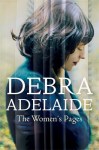
Debra Adelaide, The women’s pages (Review)

Debra Adelaide, The women's pagesWhen I started reading Debra Adelaide’s latest novel The women’s pages I thought, “Oh yes, here’s another interesting story about women’s lives, how their options are limited, etc etc. I’ll enjoy this but I wonder why it was longlisted for the Stella?” And then, a few chapters in, I started to realise that behind this “interesting story about women’s lives” was a fine and witty intelligence that was playing games with me, that was exploring ideas about creativity and writing, that was looking at how life imitates art (or is it vice versa), as well as at the lives of women! Needless to say, by the end I was fully engaged, enjoying every word while I eagerly turned this woman’s pages.

The embarrassing thing is that I haven’t read Adelaide before – well, that is, I haven’t read her fiction before. I have read some of her non-fiction. Her Australian women writers: A bibliographic guide was groundbreaking and is still highly valuable, and the book of critical essays which she edited, A bright and fiery troop: Australian women writers of the nineteenth century, is a significant work. She also edited and introduced Dymphna Cusack’s A window in the dark which I’ve reviewed here.

But her fiction? I’ve been remiss, but no more, because The women’s pages sure has me intrigued. It starts off straightforwardly enough with protagonist Ellis being asked to a 10th wedding anniversary barbecue. Adelaide sets the scene perfectly. It’s the 1960s and Ellis is a young domestically-competent mother who’s not happy in her marriage. She can’t imagine still being married to her (albeit perfectly decent) husband for another 8 years. So far so good – I’m interested. Then, chapter 2 introduces us to “not yet forty” Dove from current times. She is grieving for her mother and, we discover, is writing the story about Ellis. From here, the chapters alternate Ellis and Dove’s story until around halfway through the book where they start to intrude a little on each other, where in the same chapter we find Dove musing on where Ellis’s story is going or on how Ellis is exerting “maddening autonomy” on her story! What is going on, we start to wonder?

So, as well as being a story – and an authentic story at that – about women’s lives, The women’s pages is also a metafiction about the art and process of writing fiction. Here, for example, is Dove with a sort of writer’s block:

But Dove had run out of ideas. When the baby was born, she had a fair idea, but exactly where, and how, resisted her imagination. Doubtless because she had no experience in this respect, she could not bring herself to visualise a pregnancy and the birth of a baby. She knew this was nonsense, if she were to call herself a writer of fiction, and that she needed to do something about this, even if it simply meant googling the subject.

Write what you know, or else research! I enjoy these sorts of mind-games played by authors; I don’t mind being reminded of the author’s hand.

However, while the metafiction thread is an important part of the novel, there are other threads or themes. Motherhood is a major one. Childbirth and childrearing feature, but the overriding idea is that of missing mothers, the silences about them, the gaps they leave. Ellis’s mother had left her when she was a baby, and Dove was adopted (by a loving mother, but …).  A related thread is the new word to Ellis’s world, “feminism”. There are illegal abortions and adoptions, alongside women striving to develop careers. Ellis gets a job in the magazine industry. By the mid-1970s change is afoot. She senses “the whole country shifting around … with these tall god-like creatures [the Whitlams] in charge”, but she’s not fooled into believing “there was really such a thing as equality”. When she’s offered a promotion, her male boss tells her he expects “absolute commitment”, that is, there must be no “running off to get married, or taking time out to look after children”. Adelaide knows the decades of which she speaks, and her evocation of them is spot on.

Then there’s Adelaide’s exploration of imagination and invention, particularly in the metafiction thread. And this is where another important aspect of this novel comes into view – Emily Brontë’s Wuthering Heights. Brontë’s novel is introduced at the beginning of chapter 2, with Dove blaming it for her decision to write her novel about Ellis (whose name references Emily’s pseudonym Ellis Bell). The “gaps and shadowy images and half truths” in Wuthering Heights “had infected her [Dove’s] imagination” and out of it Ellis’ story emerged. For most of The women’s pages, Brontë’s novel acts as a sort of simmering undercurrent, surfacing every now and then, not always overtly, to impose an added layer on the narrative. But at the end, as Ellis’s complicated family background is finally revealed, it comes to the fore. We even have a Catherine, an Edgar and a Nell, but the parallels aren’t laboured.

Dove writes, around halfway through the novel, that

she had not meant to write the story of women, but that was how it had appeared, that was the only story in her head. The more she delved into the lives of her characters the more it was about missing or silent women and the more it seemed it was her job to find them and open their mouths and lay them across the pages. Ellis had stepped out of a longer story, one in which women were always grasping for some sense of authenticity, and in which mothers in particular were absent. Wuthering Heights had almost no mothers and certainly none whom you could say were good to any degree. They were all dead or dying, or simply blank spaces, unnamed and unacknowledged, as if their progeny – Heathcliff, Catherine, Hindley, Edgar, Nelly – had been produced by magic, or had just sprung up out of the earth …

I said in my opening paragraph that Adelaide’s writing is “witty”. I didn’t mean by this “funny”, though it is wryly amusing at times. No, I meant “knowing”, “astute”, “clever”. Adelaide’s development of Ellis and Dove’s story is beautifully controlled. The women’s pages could, in fact, be read as an expert’s guide on how to write a novel. More interesting to me, though, is the light it throws on the intense emotional investment novelists can make in their work, on the sometimes complex nexus between character and author:

What, Dove wondered, had she done? Or had she done it? Maybe it had happened exactly like this and she was merely recording the facts.

See what I mean? I imagine Adelaide had fun writing about Dove writing about Ellis.

This is a delicious read that engages both the mind and the heart, and has an ending that brings you up with a start. Yes, I can see why it was longlisted for the Stella.

awwchallenge2016Debra Adelaide
The women’s pages
Sydney: Picador, 2015
295pp
ISBN: 9781743535981

(Review copy courtesy Pan Macmillan Australia)

Delicious descriptions: Fiona Wright on writing and hunger

Fiona Wright, Small acts of disappearanceIn my recent review of Fiona Wright’s Small acts of disappearance, I focused on her analysis and her experience of anorexia, but, as I mentioned in the review, she was, already, a published writer. An award-winning poet for a start: her poetry collection, Knuckled, won the Dame Mary Gilmore Award for a first collection. Her poetry and essays have been published in several literary journals. Consequently, it’s not surprising that writing makes an appearance in Small acts …

In her essay, “In Hospital”, she writes:

I know now that the impulse I have to starve comes from exactly the same place as my impulse to write: hunger, like writing, is a mediator. It stand between me and the world, between my self and the things that might cause it harm. Hunger is addictive, and it is intensely sensual, pulling the body between extremes of hyper-alertness and a foggy trance-like dream state. And like writing, it lets me stand clear, separate and intact; it lets me stand on the outside. I spent years determined to stay on the outside.

Is this a common experience of writers, that it separates them from the world, I mean? I guess so, in a way, because writers tend to be observers – and it is hard to observe and be part of something at the same time, isn’t it?

In “In Miniatures”, she discusses how the enjoyment of miniatures involves narrowing one’s focus and attending to detail. However, “detail-oriented thinking” is psychologically related to hunger because the malnourished brain becomes intensely focused: the world shrinks, and becomes small enough to handle, to not be a threat. The trouble is, she writes:

detail has for so long been the stuff and substance of my poetry, my craft: the accrual of small, odd things, contradictory things, the things that undercut or illuminate the social world. It has always been detail that I’ve thought makes the worlds we write specific, poignant and, in essence, poetic. And it’s hard to contemplate that my writing, the thing I feel has kept me sane, may very well have been based on nothing more than cognitive pathology.

Hmmm … That “nothing more” is perhaps her being harsh on herself. I suspect that even if “detail-oriented thinking” is part of the anorexic pathology, Wright’s writing comes from a bigger part of herself too. But her fear that in losing hunger she may also lose her writing is palpable.

And then, in “In Group” she writes at length about John Berryman’s Recovery/Delusions, two books in one – his unfinished novel, Recovery, and a collection of poems, Delusions. Recovery is an autobiographical novel about an alcoholic man in a psychiatric hospital. Wright writes at length about Berryman’s character’s experience of group therapy and her own, and in so doing also discusses writing, its impulses and sources. I won’t share any more of this: it’s better that you read her book, rather than my ramblings on it!

Instead, I’ll conclude on one little point. Recovery is unfinished because John Berryman committed suicide while writing it. Wright comments:

the novel simply stops, in a suspension … Part of me thinks this is exactly as it should be: an unintentional but radical inconclusiveness, a denial of the three-act structure that biography is often made to fit …

Novel, biography, the same thing in the context of narrative, I suppose. Anyhow, this reminded me once again of EM Forster’s wish (in Aspects of the novel) for novels to be able to end when the novelist gets “muddled or bored”. Instead, he says, “most novels do fail here – there is this disastrous standstill while logic takes over the command from flesh and blood.”

Wright concludes her essay with her own intriguing idea about “logical and fixed conclusions” versus “the unfixed and uncontainable”, but I’m leaving it here. If you’re interested, you know what to do.

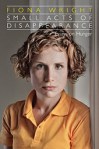
Fiona Wright, Small acts of disappearance (Review)

Fiona Wright, Small acts of disappearanceIt would be a rare person these days, from Western cultures anyhow, who didn’t have some brush with an eating disorder, whether through a friend, a family member, or personal experience. And yet it is one of our most misunderstood afflictions, which is where Fiona Wright’s Small acts of disappearance: Essays on hunger comes in. Wright, born in 1983, is a published poet. However, in her mid twenties, in her first hospital day program for her seriously low weight, she had to admit to herself that she was, indeed, one of “those women”, one of those women, that is, whom she’d always thought were “vain and selfish, shallow and somehow stupid”.

Now, many of you know that I am interested in form. Well, Small acts of disappearance is interesting in this regard. On the surface, it is what it says it is, a collection of essays, but it is also, in effect, a memoir of Wright’s experience of one of medicine’s most mystifying conditions, anorexia nervosa. There are ten essays, the title of each commencing with “in” as “In Colombo”, “In Hospital” and “In Hindsight”. This word “in” has a literal meaning, but its repetition also accentuates that she really is “in” something that she cannot, must not, distance herself from. While there is a loose sort of chronological drive to the essays, the first one, “In Colombo”, does not start at the beginning, not that there is, in these things, a clear beginning. She goes to Colombo as a newly graduated journalist in her early twenties, around three years after what she defines as the formal onset of her condition, but years before she commences any dedicated sort of treatment. It is in Colombo, however, when she thinks “things changed” and her “illness grew more complicated”, and so it is from here that she launches her set of essays exploring this “illness”.

There is, then, an idiosyncratic sort of chronology or narrative arc, which provides a structure for what is essentially a set of thematic essays. Linking them are some recurring threads, in addition to the condition itself of course. One of these relates to the paradoxical and perverse nature of the condition, and another to language. I’m going to be perverse and start with the second of these, language. Wright, being a writer, loves language, so as well as writing the book in her own gloriously clear and evocative language, she also shares the “new” language she learns. There’s the language of treatment (“In Increments”), for example, which she describes as “a jargon, that language that speaks only to the initiated, that carries with it its own definition of inclusion”, and the language of group therapy and recovery (“In Group”). She considers the implications of the language, of how it normalises the way the initiates communicate. Group language and behaviours, she explains, mean sufferers can identify each other, like it or not, outside treatment.

In my opening paragraph I suggested that anorexia nervosa is a misunderstood condition. Wright herself had believed that “those women” were vain and stupid. However, through years of treatment she comes to realise that the very opposite is true, that anorectics (her label) tend to be people (men and women) “who think too much and feel too keenly, who give too much to other people”. She says of the women she met in treatment that they were “some of the bravest but also most vulnerable that I had ever met”. The awful thing, the challenge for treatment, is the condition’s perverse and paradoxical nature. No matter which way you look at it, there’s likely to be a contradiction. Sufferers “fear death” and yet let their bodies destroy themselves; their desire for control often triggers the illness, but the illness, the hunger, wrests control from them and takes over; they want anonymity while their emaciated bodies draw attention to themselves; the pain of hunger numbs other pain; and, so on. Hunger, she writes, is addictive, heightening the senses, creating a feeling of “hyper-alertness”. It “feels so good” that “even now” on the road to recovery, she can miss it. Wright’s analysis of the psychology and pathology of eating disorders is clear and authentic.

While much of the book chronicles her personal experiences, Wright supports her impressions/findings with knowledge gleaned from reading and research. This gives the book a gravitas not usually found in the “sick-lit” (sub-)genre, to which this book may or may not belong, depending on the breadth of your definition. She describes the Minnesota Hunger Experiment, which was conducted during World War 2 on conscientious objectors to ascertain the physiological and psychological impacts of extended periods of starvation or malnutrition. She analyses fictional characters who exhibit disordered eating in novels by Christina Stead (For love alone), Tim Winton (Cloudstreet) and Carmel Bird (The Bluebird Cafe).

She also devotes an essay (“In miniature”) to miniatures, which themselves have a contradictory nature. They unsettle our perception, she writes, while also attracting us. So, she interrogates her love of miniatures from childhood, teasing out of this a pathology that desires to be small and that likes clear boundaries. She writes:

To be miniature, then, is to occupy space differently, and especially, pointedly, to have a different occupation of public space. We disturb it with our discrepancy, even as our smallness means that we occupy less of it. I think sometimes that the drive to hunger, the drive towards smallness, is about precisely this: we feel so uncertain, so anxious about our rightful place in the world, that we try to take up as little of it as possible. It is a drive to disappear that can only ever succeed in making us more prominent, more visible, because it makes us as different and offensive on the outside as we so often feel we are at heart.

And then, scarily, she describes how the crafting of miniatures takes “real skill, exceptional care, and time”. Oh dear. Hunger, she says, “narrows the world so minutely and completely” that it brings the world “back under our command”. But, “it is a false and contradictory kind of command … We possess the world, perhaps, but in the process we are dispossessed of our own selves.” It is a long way back, and as she makes clear in her book, she hasn’t yet quite worked out how to live “a full-sized life”.

I’ll close, logically, with her last essay “In Hindsight” which, in another structure, could have been the opening essay because in it she looks back, back, back to origins. In hindsight, she sees aspects of her childhood and adolescence that contained hints of what was to come. All along she’s told us that her disorder had a particular physical trigger when she was 19 years old, but here, in the last essay, she writes:

I’ve resisted telling this other story, I think, because I don’t want to hear it myself.

And then she exposes all those early signs, with such heart-breaking, self-exposing honesty. I’m not surprised Small acts of disappearance has made it to the Stella Prize shortlist. Wright offers us a clear-eyed, analytical but moving insider’s view of a devastating and still mystifying condition. It’s a gift of a book.

awwchallenge2016Fiona Wright
Small acts of disappearance: Essays on hunger
Artarmon: Giramondo, 2015
193pp.
ISBN: 9781922146939

Monday musings on Australian literature: Spotlight on David Malouf

Courtesy: Annette Marfording

Courtesy: Annette Marfording

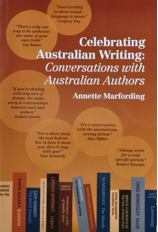
A couple of weeks ago I published the first of a number of posts which I’m planning to write using Annette Marfording’s Celebrating Australian Writing: Conversations with Australian Authors as starting point. That post was on the first interview in the book, Robert Dessaix. I decided that my second post would be on one of my favourite Aussie writers – you could call him one of our grand men of letters – David Malouf. And then last week I heard that Malouf had won the 2016 Australia Council Award for Lifetime Achievement in Literature – for his 55 years (55 years!) in literature. A most apposite coincidence!

The impressive thing about Malouf is that he has written in multiple forms – novels, short stories, poetry, essays, memoir and even libretti – and he has been critically acclaimed in all. Most of his work that I’ve read, I read before I started blogging, though I did review his latest novel, Ransom, here. It was published in 2009. Since then he has primarily published poetry, essays and short stories.

I haven’t read all of Malouf’s novels, but I’ve read a good number, starting with his first autobiographical novel, Johnno. It’s set in Brisbane where he grew up (and where my Mum spent her youth after moving there when she was 5, and where I spent 6 years of my childhood!), though his youth – incorporating World War II – is well before mine. To say that I enjoyed the book would be an understatement.

However, my favourite two of his are Fly away Peter (which I often buy for or recommend to people asking about Australian literature) and The conversations at Curlow Creek. This latter, for some reason, gets less press than most of his other novels. I’ve also read An imaginary lifeRemembering Babylon and, of course, Ransom. In other words, I’ve read his first three novels and his last three (to date), but not the three in the middle!

Now Marfording’s interview. She starts by asking him about awards, of which he has won many. I liked his response that

it’s more important to be on the shortlist in some ways because who then comes out of the shortlist as the winner is a bit of a lottery.

Of course, the money attached to prizes is very useful – it often means the ability to keep on writing – but in terms of what awards mean, Malouf makes an important point.

She then talks about translation, because Malouf’s books have been well-received overseas and many have been translated into multiple languages. Malouf’s response gets to the heart, really, of my concern about reading books in translation:

And really, what the translator is doing is not just carrying the book over from one language to another, but recreating that book in another language.

Re-creating, yes. Still, it’s better than his books not being available to others at all.

She asks him about Patrick White. I found his answers again spot on in terms of my understanding of White’s place in our literary culture. He says that White achieved two things that have paved the way for writers after him. One is that White showed that “an Australian life could be of significance” and not just in Australia but more generally. The other is that

he made it possible for you to write a novel in which the major interest was the interior, not really on action, but on what was going on in people’s heads.

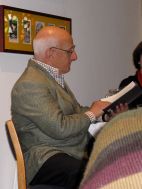
David Malouf reading Ransom

Malouf reading Ransom, National Library of Australia, August 2009

And this is exactly how much of Malouf’s fiction reads. The conversations … for example is about the conversations that occur between a military officer and an arrested bushranger who is to be executed in the morning. It’s about the connections made between the captor’s reflections on his own life and the condemned man’s concerns about death, God and forgiveness. It is such a quiet, mesmerising and deeply humane book.

Marfording and Malouf talk about Ransom, his latest book at the time of the interview, and his writing style and practice. They also talk about his main themes. Marfording suggests that “being an outsider – a foreigner or someone in exile” is one, and that family is another. Malouf says that

family is the first little society, a little mirror of society … but family is also reflective of the larger society we live in, and then families are – as far as I have observed – the greatest repository of secrets, and secrets are always what writers are interested in.

Secrets. Yes, I can see what he means.

A theme that I see in his work relates to travel and transition – again, like outsiders and secrets, not unusual for a writer! He starts his essay “The traveller’s tale” (originally published in 1992) with “One of the first stories we tell is the story about leaving home”, and argues that:

The story moves us so deeply because it touches our lives at the two extremes of our experience, the moment when we leave our mother’s body and the moment when we must leave our own, but it speaks as well for the daily business of going out into the world – to hunt or on a war party or simply to see what is there – and then the return to the homeland or hearth.

Our two men – the policeman and the bushranger – in The conversations … travelled to Australia from Ireland, then find themselves, in the 1820s, at a critical point in both their lives. Priam travels with Somax to Achilles’ camp in Ransom on an inspired errand. The characters in Fly away Peter go overseas to take part in World War 1, and one doesn’t return. In Remembering Babylon, a young British cabin boy lands in the far north of Australia and is taken in by Aboriginal people, and doesn’t return to the European world until 16 years later. In Malouf’s very first novel Johnno, the narrator returns home to bury his father, and in the process remembers, and reconsiders, his youth and his childhood friend Johnno. And so on … Malouf himself has lived overseas for large “chunks” of his life. He is clearly very familiar with what it means to move to-and-fro between “home” and new places – physically, spiritually and psychologically.

Whenever I think of Malouf, I feel a sense of well-being, because I know I can trust that whatever he says or writes will be considered, humane, and well-worth giving time to.

Annette Marfording
Celebrating Australian Writing: Conversations with Australian Authors
Self published, 2015
273pp.
ISBN: 9781329142473

Note: All profits from the sale go to the Indigenous Literacy Foundation. You can purchase the book from its distributor, lulu.com.


Monday musings on Australian literature: Some Australian screenwriters

Funny things sure do happen sometimes. I decided on the weekend that, with my comment about screenwriters in my post on Hail, Caesar and with the Oscars being screened today, Monday (downunder time), that I would devote this post to screenwriters. Then, I turned on the TV to look at the Oscars, and guess what? They changed the usual order of announcements and put the screenwriters first! A tribute to Trumbo perhaps? Whatever, the coincidence made me smile.

Now, I have written about screenwriters before in a post on Australia’s AWGIE awards, but in that post I focused on a few authors who had also written for screen or theatre. This time I’m going to focus on those for whom screenwriting is a major part of what they do. There are a lot of them, so all I can do is choose a few to represent the many. I’m not going to analyse their work – that would take too much time – but just introduce them, and identify some of their works because they are often just not known as the person behind these works. Here goes:

  • Stuart Beattie would be the least known to me of the writers I’m listing, even though he’s the most prolific. He writes, it seems, in genres I tend not to watch, like thrillers and adventure. However, he was a co-writer on Baz Luhrmann’s controversial film Australia, and he adapted John Marsden’s bestselling young adult novel Tomorrow, When the War Began to a film of the same name.
  • Andrew Bovell writes for theatre, movies and television, sometimes adapting his own work from one form to another, such as the films Lantana and Blessed which he adapted from his plays, Speaking in Tongues and Who’s afraid of the Working Class, respectively. Non-Australian moviegoers might know him for his adaptation of John Le Carré’s A Most Wanted Man.
  • Laura Jones is the daughter of Australian writer Jessica Anderson (whose The commandant and One of the wattle birds I’ve reviewed here.) Jones started her career with television teleplays for Australia’s public broadcaster, the ABC. Her first screenplay, an original, was Hightide made by Gillian Armstrong, and her next was Angel at my table, made by Jane Campion and adapted from Janet Frame’s memoir. She has gone on to write many adapted screenplays, including Portrait of a Lady, Angela’s Ashes and Possession. Some great films there …
  • Jan Sardi has been nominated for an Oscar so, given today is Oscars day, I had to include him! The film was Shine. Sardi also adapted Nicholas Spark’s The Notebook and Li Cunxin’s Mao’s Last Dancer. He is apparently currently working on adaptations of Kate Grenville’s The Secret River and Tracy Chevalier’s Remarkable Creatures (my review). He is also the current President of the Australian Writers Guild (AWG).
  • Eleanor Witcombe is the oldest of my group and is not, as far as I can see, still working. She was born in 1923, and is had to be in my list because she adapted two significant Australian women writers, Henry Handel Richardson’s The Getting of Wisdom and Miles Franklin’s My Brilliant Career. Witcombe wrote for theatre and television, including the television miniseries adaptations of two more classic Australian women’s books, Ethel Turner’s Seven Little Australians and Ruth Park’s The Harp in the South.

Many of Australia’s successful directors have also written for some of their films, such as Gillian Armstrong, Jane Campion, Baz Luhrmann, George Miller, Rachel Perkins, and Peter Weir. Such creativity. I’m in awe.

Now, just in case you are interested in writing for film yourself, I came across in my research a document by ScreenAustralia, published just last year, titled I’ve got a great idea for a film. You can read it online. It mainly lists resources, both Australian and overseas, for all aspects of script development.

Do you tend to be aware of screenwriters, and do you have any favourites?