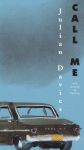
Julian Davies, Call me (#BookReview)

Book coverI wasn’t sure what I was in for when I started reading Call me, the latest offering from that tricksy duo, novelist Julian Davies and illustrator Phil Day. But, it soon became clear that what was before me was a coming-of-age story. What, I wondered, was Davies doing writing such a novel? Then I remembered that this was the author who gave us, most recently, Crow mellow (my review), so I decided to relax and go with the flow. Sensible me, because this is a sophisticated take on the genre, geared to an adult audience.

The story starts in the first person voice of a young woman called Caddie, who is in bed with a young man called Pip. They are both in their last year of school, and the story spans the last couple of months of that year, through their eyes. However, the tricksiness starts here, because Caddie’s voice is first person, while Pip’s is third person subjective. Why? An author doesn’t make these decisions lightly, so I usually want to know why. It’s particularly interesting here because this is a male author choosing to write his female character in first person, and the male in third person. I’ll come back to this because right now you are probably wanting to know more about the actual story than these technicalities!

“This is Australia” (Pip’s friend, Stu)

So, the story. Caddie and Pip have been in a relationship for around a year at the start of the novel, but it’s geographically challenged because Caddie lives in the city (in Canberra, in fact) while Pip lives in the country, an hour or so’s drive away. Davies knows whereof he speaks because he too lives about an hour’s drive from Canberra. Caddie’s parents see themselves, according to Pip, as “high middle class”. They both run businesses, her father’s being an investment business called Capital Capital, and her mother’s an art gallery called Sense and Sensibility (because, as she apparently told Pip, “she was lapping up Jane Austen while her friends were still  playing with their dolls”). They keep “upgrading” their homes, and they fight a lot. Pip’s parents, on the other hand, describe themselves as “feral middle class”. Sydney escapees, they live in the not-quite-finished house they built themselves; they take a loving but laissez-faire approach to parenting; and they get on well. All this introduces the city-versus-country theme that recurs in Davies’ works, including Crow Mellow and his Meanjin piece about building his own home (my review). It’s pretty clear where Davies’ preference lies!

The majority of the novel takes place over 15 days, and chronicles, in lovely nuanced detail, the tensions that develop in Pip and Caddie’s relationship due to Pip’s decision to leave school only weeks before the end. Their thoughts and feelings are told alternately in chronologically named chapters, like “Day One” and “Day Eight (Still Later)”. Although Caddie is critical of her parents, in the way that teenagers often are, she’s following the traditional path of working hard at school and planning to go to university. She is totally into mobile phones and social media. Pip is a more independent thinker. He’s not interested in social media, and only has a phone because Caddie gave it to him. And yet, in a neat paradox, Caddie records her thoughts in a diary, while Pip records his into his phone! This is pure Davies, by which I mean nothing is simple or straightforward.

So, we have the city-versus-country theme, plus a subtle questioning of modern technology, including our reliance on it and its potential for misuse. A third theme relates to education. Pip’s decision to leave school stems from his refusal to live by external expectations that don’t feel authentic to him. He hates the “petty rules” and, as Caddie explains it, “the kind of society we live in that the education system feeds”. He has no alternative plans but feels incapable of “passively endorsing” a system he doesn’t believe in.

“What kind of person am I?” (Caddie)

Accompanying these more sociological themes are personal, psychic ones. Both Caddie and Pip are deeply concerned with their identity, specifically with what it is to be “a person”. Caddie, living in her “sheltered” house and uncomfortably aware of the material benefits provided by her parents, wonders not only “what kind of person” she is, but, more broadly, “what does it mean to be a person.” This question of personhood is frequently burdensome to her. Pip, however, has a different take, recognising that “he is only one person”. One of the challenges they face is negotiating their own and each other’s personhoods. Late in the novel, when their relationship is floundering, Pip wonders “did the new, distant Caddie undermine and diminish his sense of her as the person he thought he knew?” Meanwhile, Caddie “wonders who Pip is that he can hold this view.”

Call me, then, is essentially a book of ideas that questions, in a lightly satirical way, aspects of modern Australian society, but it’s not boringly didactic, partly because the ideas are explored though some engaging characters. These include two we met in Crow Mellow, making this book a sort of “companion piece”. The characters are the wise Phil Day, a teacher who, cheekily, happens to share a name with the book’s illustrator, and the ridiculously named cynic, Dick Scrogum (aka Scrotes). Scrogum’s opinionated banter and Day’s quiet conversations encourage Pip to dig a little deeper into the reasons for his decision.

These characters, however, are only part of why the book doesn’t become mired in earnestness. Another reason is that, surprisingly, as the book progresses, it becomes apparent that there’s more to it than just Caddie and Pip’s relationship; there is in fact quite a plot developing. Who are the mysterious callers on Pip’s phone and what do they want? Should we be worried about them? And what about the gun that Pip has? It is pretty much de rigueur that once a gun is mentioned in a narrative it’s going to be used, but will it? Is this book not what it looks, but, really, some sort of crime-mystery-thriller? You’ll need to read it to find out.

And now, I’ll return to that question I posed at the beginning about voice. Both first person and third person subjective voices offer easy engagement with characters but can only offer limited perspectives. Telling the story through two such voices widens the perspective, by letting us see Caddie and Pip through each other’s eyes as well as their own. In other words, we get a little touch of omniscience alongside close engagement. But, why is one voice first person and the other third? I’m not sure really, but maybe it’s something to do with the fact that Pip is the main protagonist, and that Caddie, as the “I”, represents both herself and the reader (who is, perhaps, likely to be more like her – female, sincere, somewhat conservative, but also open-minded and keen to explore). By being more directly in her head, we are encouraged to question, as she does, certain assumptions and values. I suspect too that there may be something autobiographical about this novel. Is Pip like Davies’ younger self? And does putting Pip at one step remove provide him with a little space to interrogate the boy he was? Certainly Caddie seems to question who Pip is more than vice versa. I’m probably wrong about this, but at least I’ve given it a shot!

As I say all too often, there is so much to say about this book. I haven’t even touched on the gorgeous landscape descriptions of a region I love. Nor on the clever segues, nor Phil Day’s whimsical illustrations, nor the humour, nor, indeed, what a beautiful book is it to look at, hold and read. However, I’ve written enough for now.

Call me, then, is not only an engrossing story about the psychic growing-up of its protagonists, but one that also offers provocative commentary on both humanity in general and modern society in particular. Them’s big boots, but Davies pulls it off, resulting in a book that’s both intelligent and fun to read.

Julian Davies
Call me
Illustrated by Phil Day
Braidwood: Finlay Lloyd Publishers, 2018
363pp
ISBN: 9780994516541

(Review copy courtesy Finlay Lloyd Publishers)
Monday musings on Australian literature: Spotlight on Robert Drewe

Courtesy: Annette Marfording

Courtesy: Annette Marfording

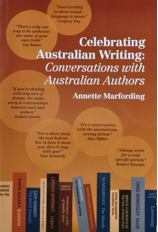
In 2016, I wrote five Spotlight posts inspired by Annette Marfording’s Celebrating Australian writing: Conversations with Australian authors, and decided that was probably enough mining of her work for my blog. However, with over two years having passed since then, I wondered if it might be okay to do another. I emailed Annette, and she kindly agreed. But, who to choose from the 21 authors in her book? Well, of course, you know from the post title who I chose, so the next question is, why him?

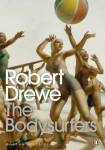
The answer lies in an email correspondence I’ve had with Carmel Bird over the last week in response to my last Monday Musings posts on pianos. Carmel emailed me privately to mention an anthology she edited, Red hot notes, which includes many pieces about the piano. How embarrassing! I actually have that book. Anyhow, that got us talking about short stories and short story writers, including Robert Drewe whose The bodysurfers I have. Carmel exhorted me to read (or, to be precise, finish reading) it. I will, because what I’ve read so far I’ve loved. (Meanwhile, I plan a future post on short stories more generally, inspired by our discussion.)

Robert Drewe, The bodysurfersBut now, after that rather long introduction, on to Robert Drewe. Marfording’s interview took place in August 2009, at which time Drewe had published six novels, three short story collections, two non-fiction books and two plays. Since then he has written another novel and short story collection, both of which I have given as gifts in recent years, plus four more works of non-fiction. He has won two Walkley Awards, a Commonwealth Writer’s Prize, and several other awards. Wikipedia says that his novel The drowner made Australian literary history by becoming the first novel to win the Premier’s Literary Prize in every state”.  And yet, I have not reviewed him for my blog, though I did post on his Seymour Biography Lecture in 2015.

Given the multiple forms he has written in, Marfording started by asking him his preferred form. He said that he likes them all “at different times – sort of equally” but that at the time of the interview he was particularly enjoying short stories, a form he came to after writing a couple of novels. Now, that’s interesting because many people suggest short stories are a training ground for novels, an idea I don’t much like as I see short stories as a form in their own right. Anyhow, Drewe commented that he was “finding the short story more interesting and more contemporary and of the moment.”

Marfording then turned to his origins as a fiction writer, after his early work as a journalist. He talked about always wanting to be a writer, and what his career as a journalist gave him:

It taught me how to write simple declarative sentences, it took me out of a normal Australian middle-class background and showed me how the other half live, it showed me how courts work and crime and how people at the struggling end of the spectrum live. It was really a fascinating background for a writer.

The discussion then moved on to Drewe’s novels and short stories, and how they reflect or comment on contemporary Australian society, including, specifically, such issues as refugees, the environment, and Indigenous Australians. Drewe makes an interesting comment about using the novel versus short story form:

I’m interested in ideas which I try to get across in a novel, but I’m interested in more succinct, shorter forms like relationships and so forth, and conflicts between people are easier to deal with in a short story …

Not surprisingly, this led to a discussion about his treatment of relationships, before returning to the short story, and what he sees as the essence of a short story. For Drewe,

… a good short story makes you look at something about your own life or experience through the prism of what you’re reading. So a sense of identification or recognition is what matters, really.

I’d have to think about whether all “good” short stories need to do this, but certainly I’d agree that many or most do.

Marfording then discussed his writing process, which is something that interests most readers (or, at least, those who read or listen to interviews with authors), and also a little about film adaptations, given his Ned Kelly novel, Our Sunshine, was adapted for a film which starred Heath Ledger. But, I’m leaving those to move on to their discussion about his work as an editor of short story anthologies.

How, Marfording asked, does he choose short stories for his anthologies. Drewe said that he advertises in all the literary columns in “newspapers and so forth”, and, he said, “the stories arrive in their thousands.” He also reads published stories in literary magazines. He said that half the content will be pre-published stories like these, but the rest will be new – “that’s where the fun is for the editor, discovering new people.” I reckon that’s where the fun is for the people he has discovered as well. Imagine being selected by Robert Drewe!

He commented that some anthologies include “slabs of novels … which goes against the whole point of short story collections.” I have certainly seen that. It’s seems fine if it’s a story that the author later develops into a novel, but to excerpt a novel feels a bit suss to me. However, I don’t want to be absolutist about this because there are always exceptions, n’est-ce pas?

Then, of course, there’s that other question we readers all love, his favourite writers. Drewe’s include Gabriel Garcia Marquez, Raymond Carver, Alice Munro, Helen Garner, and Peter Temple. You can see a few short form writers in there can’t you?

Another behind-the-scenes question concerned judging literary awards. It’s not so hard, he said, to choose shortlists, but choosing the winner is something else:

I generally tend to go for the imaginative ones, the ones that strike me as being less like another story than I’ve read before. The more original, the better, really.

A good rule-of-thumb, methinks, though a risky one. It can result in the selection of books that many readers won’t like, and the work may not stand the test of time. But, if award-winners don’t push boundaries, where are we? We need brave judges.

I did say I’d pass by discussing his writing process, but I’ll conclude with a selection of first lines from The bodysurfers which exemplify his comment that “you owe it to the reader to engross them”:

“My father wasn’t in his element in party hats”. (“The manageress and the mirage”)

“It was possibly lucky my mother didn’t marry her first fiancé because he ended up in Fremantle prison”. (“The silver medallist”)

“The murders took the gloss off it.” (“The bodysurfers”)

Would these lines make you want to read on?

Previous Spotlight posts:

Annette Marfording
Celebrating Australian writing: Conversations with Australian authors
Self published, 2015
273pp.
ISBN: 9781329142473

Note: All profits from the sale go to the Indigenous Literacy Foundation. To find out where you can purchase this book, please check Marfording’s website.

Karen Viggers, The orchardist’s daughter (#BookReview)

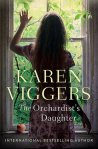
Karen Viggers, The orchardist's daughterThe orchardist’s daughter is local author Karen Viggers’ fourth novel, but the first that I’ve read. She has, however, appeared on my blog before, being the person who conversed with Sofie Laguna about her novel, The choke. It was one of the most entertaining conversations I’ve ever attended.

Now, if you haven’t read or heard of Karen Viggers before, there are some facts worth knowing about her. Firstly, she’s a vet with special training in native wildlife health – and this background informs most if not all of her novels, I believe. It certainly informs The orchardist’s daughter. Another significant fact is that she’s a best-selling author in France! How wonderful that a novelist who writes strongly Australia-centric books does so well in France! Her previous novel, The lightkeeper’s wife, was, in fact, awarded the Les Petits Mots de Libraires literary prize.

So, an interesting author, and The orchardist’s daughter is an interesting, enjoyable book. It is set in a small logging town in Tasmania, and has quite a formal structure, starting with a Prologue, followed by four parts – Seeds, Germination, Growth, Understorey – and ending with an Epilogue. It is told third person through the perspective of three characters – Miki, the titular orchardist’s daughter who is 17 years old for most of the novel; Leon, a Park Ranger, who is 25 years old at the novel’s start; and Max, a 10-year-old boy who is Leon’s neighbour. Miki and Leon are relative newcomers to the town, Miki arriving with her older brother Kurt to run the town’s takeaway shop after they lose their home, farm and parents in a fire, and Leon moving from his Ranger job on Bruny Island to the mainland. All three are outsiders and serve to illuminate the tensions existing in the town.

Around these characters is a community comprising mainly logging families, Max’s being one of them. However, there are others who round out the town a little, including policeman Fergus and his sons, Geraldine who runs the information centre, and vet Kate. The narrative develops around a couple of situations. One is a mystery surrounding Miki’s brother Kurt. What does he do by himself in the forest when he insists that Miki wait in the ute, and what does he do during his weekly solo trips to Hobart (during which he locks Miki inside their shop/home)? The other concerns logging, and the dangerous unrest that develops when a temporary ban is placed on logging around a certain ancient tree. Jobs are at risk, the loggers believe, and the butt of their anger is of course Parkie Leon. From these two situations, Viggers builds tension slowly but inexorably, with the Kurt-and-Miki story becoming the prime focus, of course, given the book’s title.

So, there is a strong plot to the novel, but this plot, while driving us on to read, is there to serve some issues that Viggers wants to explore. These concern logging and the environment, bullying and domestic violence, not to mention more personal ones like freedom. These are big issues, and not only is Viggers clearly passionate about them, but her writing about them feels authentic. The characters may be a little less complex than, say, those in Lucashenko’s Too much lip, but they are believable. Logger and vicious bully Mooney is offset against Robbo, who is equally single-minded about logging but seeks more peaceful, law-abiding means of protest. Similarly, Max’s father Shane, another logger who is violent, is offset against colleague Tobey who has a tender, caring relationship with his wife. All of this is observed by Miki from her shop-counter – and she makes her own little attempts to lighten the lives of the bullied and the ostracised, by sneaking treats into their take-away bags. Through this little subversive action, we sense Miki’s inner strength and resourcefulness, something she takes to another level when she works out ways of escaping her “prison” while Kurt is away.

Freedom is one of the novel’s underlying drivers. Miki’s imprisonment is literal, but imprisonment takes many forms – the wives who are abused but feel incapable of escaping, and young Max who is bullied to behave in ways antithetical to his nature. Some of these are resolved, but Viggers recognises that there’s no magic wand for domestic abuse. The first step is moving from passive awareness (or acceptance, even) to taking action, and this starts to happen in the novel.

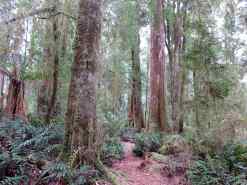
In the Tarkine, NW Tasmania

The book really stands out, however, in its writing about nature. A Booktopia interview with Viggers tells us that she grew up in the Dandenongs and has been to Antarctica. She has also spent time in Tasmania (and immersed herself in Tasmanian-set books, including two I’ve read, Anna Krien’s Into the woods, and Louis Nowra’s Into that forest). All of this has given her a sure feel for the wilderness, so much so that it’s difficult to choose an excerpt to share, but here’s one:

Miki loved the trees and the birds, but what she loved most couldn’t be seen. The way she felt in the forest. The scent of the bush after the rain. The sound of bark crackling. Branches squeaking. The feeling of patience and agelessness, growth and renewal. The aura of trees. The sense of connectedness. Of everything having its place. She could stay here all day, breathing with the tree, drawing its life into her lungs.

These forest descriptions move into Tasmanian Gothic realms during the climactic chase. The experience is both “terrifying and surreal” for our character who crawls and runs through, burrows and squats in the forest, “slipping from the thicket and weaving though the trees, ducking under tree ferns, past the tipped-up end of a fallen tree whose buttressed roots made a wall he could hide behind.” It’s muddy and dangerous with sword grass that scratches you and bark mounds that can trip you up. Viggers knows this landscape – and how to make it terrifying.

In the end, The orchardist’s daughter is about community and compromise, and about the courage to break free. It straddles the boundary between commercial and literary fiction. It is accessible, it has a strong plot and easy-to-engage-with characters, and it is hopeful (not that literary fiction can’t be!!) But, it is also gritty in subject matter and doesn’t offer neat solutions to the important environmental and social issues it raises. I like that in my reading!

Theresa (Theresa Smith writes) also loved the novel.

AWW Challenge 2019 BadgeKaren Viggers
The orchardist’s daughter
Crows Nest: Allen & Unwin, 2019
389pp.
ISBN: 9781760630584

Review copy courtesy the author, Karen Viggers.

Melissa Lucashenko, Too much lip (#BookReview)

Melissa Lucashenko, Too Much LipMelissa Lucashenko’s title for her latest novel Too much lip conveys a lot about what she is trying to do here. Superficially, the title refers to protagonist Kerry’s refusal (or inability) “to swallow her opinions”, but there are layers to the title which reflect the layers in the novel. Kerry is female and indigenous, and she is lippy, which gets her into trouble, sometimes rightly because she’s not always sensible and measured in her responses, but sometimes there’s a political layer. Sometimes she has something relevant to say but because she’s a woman, or because she’s indigenous, or because, “truesgod”, she’s a woman and indigenous, her “lippiness” is ignored or put down. I’d venture to say – and I don’t think this is a long bow – that this political layer extends to imply that all indigenous people can be seen by white Australians as having “too much lip”. It is this clever, wicked multilayering in Too much lip that makes it such an engrossing and confronting book to read.

Essentially, Too much lip is a contemporary story about an indigenous family living in the small fictional country town of Durrongo in Bundjalung country, in northeast New South Wales. The family struggles to keep it together – and, as the book progresses, we come to see why. And it’s no surprise: colonial dispossession, the massacres, the stolen children policies, not to mention the ongoing racism, result in poverty and dysfunction, in unemployment, drug-taking, violence and withdrawal from wider society. Lucashenko does not shy from exposing violence and conflict within the novel’s indigenous community but she also makes clear that the cause can be found in long-standing, intergenerational traumas experienced by the community – as individuals and as a group.

Now this might all sound very earnest, but it’s not. This is a ripping read with a strong plot about vibrant, beautifully differentiated characters. After a somewhat mysterious opening chapter whose import is not clear until well into the novel, we meet protagonist Kerry, the 34-year-old daughter of Pretty Mary. She’s coming home, riding into town on her stolen Harley, no less. It’s to be a quick trip. She wants to say goodbye to her dying grandfather and then get out of there. It’s clear there’s not much love lost between Kerry and her remaining family in town. However, she is at a bit of a personal crossroads. She’s fleeing a botched armed robbery which resulted in the imprisonment of her partner Allie, who has broken their relationship. Kerry is grieving this. When she and her family catch wind of plans to develop Granny Ava’s island, a sacred place for their people, she decides to stay a bit longer and fight the fight.

So, this becomes, also, a story about land and connection to country versus greedy developers and corrupt politicians who, in this small town, combine in the form of one man, Mayor Jim Buckley. There’s enough thrills and action in the novel, not to mention a romance, to keep lovers of exciting plots engaged, but there’s also enough about characters and their relationships, to keep us more character-oriented readers interested.

This is a confronting novel for non-indigenous Australian readers – but it’s a confrontation we need. It shows (not, didactically tells) what colonial settler societies have done to indigenous inhabitants and how this reverberates through the generations. My back cover blurb calls the novel “gritty and darkly hilarious” – and that’s a perfect description of its tone. Lucashenko privileges us to sit in on an indigenous family’s life. We get to see the world from their perspective, their pain, their frustrations, but also the jokes they make about white people’s ignorance.

Kerry had managed, on the surface anyhow, to rise above the racism she experienced at high school, but

her indifference – part pretence, part real – meant the insults quickly found their targets elsewhere, in the small handful of other Goories who usually decided to fight back, and who were quickly expelled for expecting a bit of common decency in their lives.

Disgusting, isn’t it? Examples of racism abound in the book, but there are also times where Lucashenko’s Goories critique white culture. One of these occurs when policemen, Jim Buckley’s henchmen, turn up at Pretty Mary’s home. The family retaliates by suggesting, at one point in the confrontation, that white people need a refresher on their old ways, and more:

‘How to invade other people’s countries and murder em, and call it civilisation …’ Ken couldn’t remember when he’d enjoyed himself this much.

‘Child stealing 101,’ Black Superman nodded enthusiastically. ‘Interventions for fun and profit.’

‘Globalised capitalism for the one per cent,’ Zippo called out.

Eventually they force the police to retreat, and feel a great sense of victory. They rework the story, savour and analyse it, embellish it, agreeing that “Glenrowan had nothing on Durrongo”. Haha! It’s a wonderfully written scene that makes us whitefellas squirm.

It’s not all hilarious though. The dysfunction is serious. There’s heavy drinking and violence. Brother Ken is irrational, violent, and neglectful of his adolescent son Donny, who is struggling to find his way. Kerry sees this, but is struggling with her own demons, including living in a gendered world where her word counts for little. Even her mother, Pretty Mary, is more likely to turn to Ken than to her daughter. It’s tough. There is hope though, and it comes mainly in the form of two characters – Ken and Kerry’s younger, successful city-dwelling brother, Black Superman, and Uncle Richard.

Uncle Richard, in particular, embodies both strength and wisdom. He’s not a push-over, but he exerts leadership when it’s needed. He says to the incendiary Ken:

‘Yeah, okay. We need to fight. But first I think you’d better come to Men’s Camp this weekend. Get yer head clear, neph. Manage your anger so you use it, not it using you.’

It takes some talking, but he eventually prevails. A little later, Uncle Richard brokers a reconciliation amongst the family, encouraging past hurts to be put into context rather than poison their futures:

‘History’s made us all hard … We had to grow hard just to survive, had to get  as hard as that ol’ rock sitting there. But the hardness that saved us, it’s gonna kill us if it goes on much longer. People ain’t rocks …’

Pervading all this is a strong sense of indigenous culture. Connection to the land is palpable, as is its power to revive the family. Birds, particularly crows, play a subtle role. There’s the “king plate” with a power “too dangerous” to leave lying around. There are references to totems, including tongue-in-cheek jokes that suggest indigenous people are serious but not humourless about their culture. And then there’s the Doctor, a shark which swims around Granny Ava’s island, waiting for a blood debt to be paid.

There are some books you read that you just really want to write about. Too much lip is one such book. I so looked forward to writing this post, but I was challenged at the same time. How to do justice to Melissa Lucashenko’s achievement? By wrapping a rich contribution to truth-telling inside an entertaining story guaranteed to keep you turning the page, she has pulled off something impressive. I really hope I’ve been up to the task. Perhaps you’d better read the book – if you haven’t already – to judge for yourself!

Lisa at ANZLitLovers was also impressed by the book.

AWW Challenge 2019 BadgeMelissa Lucashenko
Too much lip
St Lucia: UQP, 2018
318pp.
ISBN: 9780702259968

(Review copy courtesy UQP)

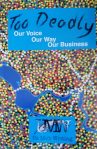
Us Mob Writing, Too deadly (#BookReview)

Us Mob Writing, Too DeadlyToo deadly is an anthology of writings by the Canberra-based writing group Us Mob Writing. Comprising Australian First Nations writers, this group was formed in the late 1990s and is, apparently, one of our capital’s longest running writers’ groups. I saw advertising for the book’s launch back in late 2017, but was unable to attend. I was consequently thrilled to be offered a copy to review some months later. Finally, it worked its way to the top of the pile and I have read it. Things happen slowly here at the Gums!

The book comprises works by 11 women writers. It is introduced by Jeanine Leane whose novel Purple threads I reviewed a few years ago. She describes the content as including “prose and narrative poetry; flash fiction, fiction and creative non-fiction; and life writing.

It was interesting to read this just after reading Anita Heiss’s anthology, Growing up Aboriginal in Australia (my review). Heiss’s book, obviously, is all life-writing, while this anthology is more varied in form and subject matter, but, as in Heiss’s book, many of the works are overtly political, not surprisingly, but all writers speak of connection to culture, in some way.

Now, how to do this? I don’t usually discuss every writer in an anthology because doing so, without writing a tome, risks being superficial, but I’m going to try here and see if I can find a fair balance. You be the judge.

Wulli Wulli writer Lisa Fuller: eight pieces, mostly poetry. They deal with her writing practice, her sources of inspiration, and her sense of self. My heart went out to her struggles to accept that she is “good enough” in poems like “Who me?” and “Never enough” (“I will kill myself through/ should-i-n-g and my 20/20 judging”), but I also loved her sense of humour and word plays. “Waking” made me laugh, with the “only clock in the place/ disguised as a phone” as did her wry references to her “Master pieces” in “Electronic inclusions”, which describes her preference for “paper and pen” over keyboard. She also writes of nature and the inspiration it provides, including:

the mist envelops
its cool embrace
blocking everything
making the everyday
more mysterious
(“Surrounds”)

Juru-Kija poet Michelle Bedford: six poems, most of which directly address culture – her connection with it, and/or loss of it. In “Kindred Spirit-so many stories untold”, the refrain at the end of each verse is “so many stories untold”, while “Straight up and back with a certain native pride” tells of a hunting party and how engaging in cultural practice brings contentment and pride. Coming from the beautiful Kimberleys, she has some poems evoking her love of that landscape: “Colour me fine” is a love-letter to the Kimberley that I could relate to. Other poems are more overtly political. “Standing alone with others” and “I promise you … she is worthy” reminded me somewhat of Oodgeroo Noonuccal’s work.

Wiradjuri poet Yullara Reed: one poem, “Catch me if you can”. Told in the voice of a bird, her allegorical poem confronts its reader with the realities of indigenous life, particularly regarding the stolen generations, as the bird watches out for catchers. There’s a cheeky freshness to this poem which makes its message so much starker.

Erubian writer Chella Goodwin, from the Torres Strait: two poems and one prose piece. “Morning dreaming” is a gorgeous poem about yearning for a simpler life. Her irregular use of rhyme here is particularly effective. Many of us can relate to these lines, “microsoft word/ part of the city herd”, and to

divorcing the city
with its traffic and hustle
for straight roads to the horizon
where the kookaburras hustle

Bundjalung writer Samia Goudie: six pieces, mostly poems. They mourn a loss of culture, but also express defiance (particularly “White lie”) and sorrow (“Dirt child”). Her prose piece, “Coming home”, is a short story about a stolen generation daughter meeting her mother for the first time. The insensitivity of the church official, where the meeting is effected, is breathtaking. He wants a photo for, he says:

“… the church newsletter, the story, our story; it is such a great story. The congregation will love it.”

Whose story?

Yuin writer Brenda Gifford: one memoir piece about her life on the road, for ten years, with the mixed indigenous and non-indegnous band, Mixed Relations. Much of the story would be familiar to any band, I guess, except that this one has the added issue of race to deal with. She talks of confronting racism in Moree, and of the opposite in Brewarrina, where the local mob showed them the fish traps (now made famous by Bruce Pascoe in Dark emu.) She also writes of touring North America, and sharing experiences with First Nations Americans (not to mention trying their wonderful fried cornbread!)

Wiradjuri author Kerry Reed-Gilbert (grandmother of Yullara above) has ten pieces, and is the best-known, most published of the group. Reed-Gilbert also appears in Growing up Aboriginal in Australia, with a strong small town story. Some of her poems talk of dark history, such as blood loss and massacres in “The place in the paddock”, while others ask for Australians to work together, as in “Reflections” and “I know you”. Many of her pieces, as do those of others, talk of the wisdom of older people (uncles, grandfathers, grandmothers) and, further back, of the Old or Ancient Ones from whom the laws come.

Ngemba/Barkindji writer Barrina South: four pieces. Her poem “Ghost Gum” describes the ageing and regeneration of a tree, but surely also works as a metaphor for indigenous history – the losses (“pooled blood appears on the surface caused by previous contusions”) and the hope for the future (“She reaches up and gently sways/ Dancing in time with the stars…”) “Baaka” is more overtly political, but also uses nature, the river in this case, to oppose long connection with culture (and the “old people”) against loss (and “they [who] fence rivers”).

Wiradjuri poet Marissa McDowell: three pieces. “By the campfire” is a lovely hymn to indigenous creation spirit Biamie, “the maker of all things”, while “Me” is a plea to be respected “before all is lost/at what human cost”.

Kamilaroi writer Joyce Graham: eight pieces, starting with three haiku which lead into more powerful, pull-no-punches poems. “Proud Uncle” references, I believe, the story of the two indigenous men Jimmy Clements and John Noble who walked miles to attend the opening of Canberra’s provisional parliament house in 1927. It confronts us with our lack of interest (“ignored by white/ present not caring/ not curious/ Dismissive/ ignorant of your importance”). It’s a story most Canberrans didn’t know until recently. Certainly I didn’t – “ignorant”! “Life’s landscape” uses strong language, too, to make its point, describing “the white dust storm” and its aftermath.

Torres Strait Islander writer Samantha Faulkner: twelve pieces, including five prose pieces. Faulkner’s pieces, like many others, explore the history of indigenous experience in Australia. “The Old Man” also reflects on the Jimmy Clements and John Noble story, describing the two men as “compelled to be there”. “Tribute to Mabo” is another straightforward narrative poem about an indigenous hero. “One Day at Walpa (Walpa Gorge, Kata Tjuta/the Olgas” made me laugh at its depiction of tourists visiting this beautiful peaceful, place. And “It’s a small town world” succinctly conveys opposing images of small towns – narrow on one hand, and big-hearted on the other. Faulkner’s is, generally, a lighter touch than some in the book, but no less effective for that.

There are, then, recurring themes in the anthology, as you’d expect – to do with loss and disconnection caused by colonisation and white laws – but while some are angry (and understandably so), many are generous and hopeful, looking to a better future. Motifs recur too. There’s the wisdom of older people and of the Old Ones, and, of course, nature, particularly trees and birds, appears in many pieces.

Too deadly is a challenging book to read with its varied styles and tones, but it is well worth the effort because this very variety provides a breadth of insight that is not easily come by. I’ll close with some lines from McDowell’s “Me”, because, in many ways, it conveys the heart of the book (but apologies for not getting the lines’ layout right):

Images are plastered all over our screens
Scaring the weaker
And empowering the meaner
Open your door and open your mind
move a bit closer
I could be your friend
not an enemy
Who’s portrayed as the end.

AWW Challenge 2019 BadgeUs Mob Writing
(Eds. Kerry Reed-Gilbert, Samantha Faulkner, Barrina South)
Too deadly: Our voice, our way, our business
Us Mob Writing, 2017
172pp.
ISBN: 9780992559823

(Review copy courtesy Sarah St Vincent Welch and Us Mob Writing)

Festival Muse 2019: Alice Pung in conversation with Sam Vincent

Muse Festival

Festival Muse, a literary festival run by one of our favourite places in town, Muse, now seems to be a fixture on the Canberra Day long weekend calendar. For the last two years Mr Gums and I have attended the Opening event, which this year was titled Moments of Wonder. As Opening Night was also International Women’s Day, the event was dedicated to women: it featured Sarah Avery, Aunty Matilda House, Kate Legge, Alice Pung and Annika Smethurst talking about their moments of wonder. Unfortunately, due to illness in my family, we had to cancel our attendance this year, but social media tells me it was excellent as usual.

However, I did fit in a one-hour Saturday afternoon session – and was accompanied by Daughter Gums, who was in town.

Alice Pung in conversation with Sam Vincent

Alice Pung will be known to most Australians. Based in Melbourne, she has written several books, including  two memoirs, Unpolished gem (read before blogging) and Her Father’s Daughter (my review), a young adult novel Laurinda, and Close to home, a collection of essays which inspired this conversation. She has also edited an anthology titled Growing up Asian in Australia, and she writes for Monthly magazine. Pung was in conversation with Canberra-based writer, Sam Vincent, whose 2015 book Blood and guts: Despatches from the whale wars was short and longlisted for various awards.

Sam Vincent and Alice Pung

The back cover blurb for Close to home describes it as covering “topics such as migration, family, art, belonging and identity.”  However, given migration is the major theme running through Pung’s work, the conversation focused on this and the migrant experience in Australia. What was both interesting and chastening was that her family’s experiences were (are?) so very like those of indigenous Australians that are shared in Growing up Aboriginal in Australiaexcept that indigenous Australians get called different names and aren’t told to “go back to where you came from”! It’s particularly chastening because of the generosity with which so many migrants and indigenous Australians respond to the racism they live with on a daily basis. Pung talked about the racist comments yelled at them in the 1980s – the “go back to where you came from” variety – but commented that at the time Australia was going through a recession so the anger was understandable.

Pung talked quite a bit about her family, but much of that is covered in her two memoirs, so I won’t repeat them here. Vincent asked her about the difference between the subjects of her writing and her readers. Pung agreed that yes, her mother’s generation, the subjects of her stories, is not very literate. Consequently, the people she writes about rarely read what she says, and the people who read her tend to be middle-class white-haired white Australians. Guilty as charged! She doesn’t mind, though – as long as people are reading her books!

Alice Pung

Pung talked a little about the traditional narrative arc of the migrant success story – and her desire not to write that. She talked about how when you sit people down to interview them their voice changes into this narrative of success, but she wants their own voices.

What I found particularly interesting was her discussion of racism and class. There’s the obvious racism – the name-calling, the “go back where you came from” shouts, and so on – but there’s also the softer, more patronising racism from people who believe themselves not racist. Questions from university-educated people, she said, such as “your mother has been here for 20 years, why doesn’t she speak English?”, indicate a lack of understanding of migration.

Continuing this theme, she understands, for example, people who follow Pauline Hanson while saying to her, “Youse are the good ones”. People she said are kind individually despite the confronting stickers on their cars. She understands “working class racists” because own parents are working class.

She talked about how “class” underpins racism. As a young qualified lawyer, she was getting nowhere in her interviews for law jobs because she was not dressed the way a middle-class white Australian professional would dress. She appreciated honesty from her friends she said, such as the one who explained her dress issue to her. As soon as she changed her dress she started getting interview call-backs, even though the content of her interview responses hadn’t changed. She realised then how class works.

She referred, during the conversation, to a number of migrant and/or refugee writers including Christos Tsiolkas, Benjamin Law and Anh Do. She quoted Tsiolkas who has said that the middle class can write what they like – be as liberal as they like – but refugees will always be placed in working class communities!

Pung has a broad, historical understanding of racism. Since white settlement of Australia, she said, some group has always been ostracised – the Irish, then Greeks and Italians, then Asians, and so on. (Such racism, she argued, is not confined to Australia.) She also teased out the oft-criticised racism found in migrant communities themselves. Her parents, for example, suffered significantly under the Pol Pot regime before they came to Australia. What settled, established migrants fear, she suggested, is not so much “other” but civic unrest. She also noted that migrants from unstable countries trust democracy and, in doing so, trust and believe Australian newspapers. A newspaper like the Herald-Sun, which the educated middle-class might reject, is perfect for many migrants because it uses simple sentences. Racism, she said, is nuanced – and has less to do with colour than with class.

Vincent also asked her about her voice, her use of vernacular, in her books. She talked about wanting to use the language used by people like her parents, a less formal language. You can talk like Kevin Rudd, she said cheekily, and have only 30% of what you say be understood, or you can talk simply to be fully understood. She appreciated her first editor who left usages in like “youse”. She also talked about her parents’ humour, and their wonderful use of metaphors despite their basic English. She admitted that she was fortunate to have been perpetually embarrassed by her parents! She said she had to write her first books carefully because she “didn’t want to tell a success story, but an Aussie battler story”.

Regarding her intentions for her writing, she strongly rejected having a didactic aim – no one wants a message, she said. However, she hoped her books did inform and educate. She reiterated this during the Q&A when she was asked what she would say to Pauline Hanson if she ever met her face-to-face. She said that she doesn’t believe you can change someone by saying something to them in a one-off situation like that, but that books might change people.

She agreed with Vincent’s suggestion that there’s a dearth of working class voices in Australian literature.

Q & A

There was a Q & A, but I’ve incorporated the main points into the discussion above. However, Daughter Gums’ final question went down a different path. The question was inspired by the work Pung does with school students, and concerned whether school students ask different questions to those asked by adults. Yes, said Pung, they don’t have the filter that adults have, so can ask bald questions like “how much money do you earn?” Pung gave us her answer, explaining the numerical and thus economic difference between an Australian best-seller (10,000 books sold) and an American one (10,000 sold per week!)

She shared some entertaining and enlightening anecdotes throughout the conversation and Q&A, but I reckon we should all read her book(s) to enjoy those!

I must say that I found thirty-something Pung articulate, warm, and grounded. She makes serious points, and tells difficult stories at times, but with a grace that’s inspiring. A big thanks to Muse for including her in this year’s event.

Alice Pung Close to home
Festival Muse
Saturday 9 March, 2.30-3.30pm

Michelle Arrow in conversation with Frank Bongiorno

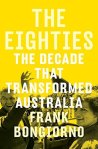
A few days ago, Mr Gums and I attended another ANU/The Canberra Times Meet the Author event, this one featuring Australian historian Michelle Arrow in conversation with Australian historian Frank Bongiorno. It was an especially interesting pairing because Arrow’s book, which she is currently touring, is titled The seventies: The personal, the political and the making of modern Australia, while Frank Bongiorno wrote, just 4 years ago, The eighties: The decade that transformed Australia. So, it was a case of the Seventies facing off against the Eighties! Fortunately no blood was shed…

The conversation was introduced, as usual, by MC Colin Steele, who does a marvellous job of organising and mc-ing these events. In his intro, he told us that one of the main threads in Arrow’s book is the now well-known idea that the personal is political. This theme also ran through the conversation.

The Seventies was a big decade for me. It’s the decade in which I graduated, established my professional career, and married. It’s also the decade in which I read Germaine Greer’s The female eunuch, and when the great reformer, Gough Whitlam, came to power – and showed what a government with vision and heart could do. I must say that it is rather disconcerting to think that an era in which we were fully adult is now the subject of serious history! Such is life!

Now, the conversation …

The conversation

Michelle Arrow, The SeventiesBongiorno commenced by asking Arrow how she defined her decade. Before I share her answer, I should explain that Arrow later told us that, while Bongiorno had taken a comprehensive look at the Eighties, she had narrowed her decade’s focus to gender and sexuality. This affected how she defined the decade. So, her answer was that she took the formation of the Homosexual Law Reform Society in the ACT in 1969 as her start, and the Women Against Rape in War protests (which also originated in Canberra) of the early 1980s as her end. She noted that soon after these protests, the ANZAC narrative began to dominate our national mythology.

Bongiorno asked Arrow to describe the discourse characterising the Seventies. Arrow talked about its being a time of rapid social and economic change and, consequently, of some disarray. Feminism and Gay Rights were big issues.

The conversation then turned to the theme mentioned by Colin Steele that the personal is the political. The main example of this, Arrow explained, is feminism. Women began to realise that their personal experiences and concerns (economic and social, for example) were structurally and politically based. Formal and informal consciousness-raising groups began exploring the underlying issues. This theme also played out in the gay and lesbian rights movement: being gay was also seen as having a political component. She mentioned here the work of the early-1970s-formed group, CAMP (Campaign Against Moral Persecution).

After this rather long introduction, we got to the core of Arrow’s book, the Royal Commission on Human Relationships. This Commission grew out of the Whitlam government’s failed attempt to reform abortion law. It was reading the fascinating personal submissions to this Commission that inspired Arrow’s book. While the Dismissal and Fraser’s election resulted in funding cuts to the Commission, bringing the Report forward and affecting the end result, the submissions themselves remain valuable.

Bongiorno noted that this Commission initiated a new role and purpose for these sorts of enquiries. Arrow agreed, explaining that it legitimated people’s stories and played a therapeutic role, both of which we still see today. (The recent Royal Commission into Institutional Responses to Child Sexual Abuse is a good example)

Another issue discussed was that of violence – and its appearance in the submissions. Violence also reflects “the personal is the political” theme. Corporal punishment for children, violence against women and girls, and gay bashing were all issues that played out politically. Bongiorno referred to Pierre Trudeau’s famous statement that “there’s no place for the state in the bedrooms of the nation”. Arrow explored the paradoxical nature of this argument: homosexual people sought freedom and privacy for the expression of their sexuality, while women were seeking protection for theirs!

There was of course a discussion about the Pill and its role. I was interested, given contemporary politics, in Arrow’s comment that the liberation of the 1960s, afforded by developments like the Pill, transformed in the 1970s to concerns with identity.

Bongiorno, though, pushed on to ask about the relationship between women’s liberation and the sexual revolution. Arrow talked about researching 1970s popular culture. She read magazines like Cleo and Forum, and suggested that Cleo had a more feminist aspect underpinning its exploration of sexuality and bodily knowledge, than did Forum. She commented that “letters to the editor” were particularly informative. She shared her shock on reading a response to a letter about father-daughter incest that said it was caused by wives not satisfying their husbands. How far we have (hopefully) come!

She also looked at movies – such as Alvin Purple and Petersen – for their evocation of sex, class and gender.

The conversation concluded by discussing Whitlam, the Seventies, and whether it matters. Arrow argued that there was a particular convergence in Australia of the height of the women’s liberation movement and the election of the Whitlam government. This resulted in things like Elizabeth Reid becoming the first women’s adviser to a leader anywhere in the world, to a big government commitment to International Women’s year, to attempts to reform abortion law (still an issue today), and the Royal Commission on Human Relationships. Fraser, coming into power at the end of 1975, had to face this new infrastructure. She traces in her book what happened to women’s issues as time passed – for example, to Women’s Refuge funding made by Whitlam in 1975.

Q & A

The Q&A, though brief, demonstrated the audience’s knowledge of the Seventies! Topics included:

  •  No-fault divorce laws (the Family Law Act of 1975): Arrow agreed this was crucial social change, and it is covered in the book
  • Multiculturalism: This is mentioned in the book, but given her focus, it’s mostly in relation to migrant and indigenous women in the women’s movement, and how the movement accommodated difference.
  • Indigenous issues (Tent Embassy, Land rights, etc): Again, because of her focus, her coverage mostly relates to women. She noted that because of Indigenous people’s specific concerns, Indigenous women did not particularly feel part of the women’s movement.
  • Education: Arrow agreed that Whitlam’s opening up access to tertiary education was transformative, and that it was particularly so for middle-class women (rather than for its main intention, working class people.) This led to the rise of women’s studies in universities, and to women (as teachers) then taking their learning out to schools – proving, again, that “the personal is political”.
  • Backlash against feminism: Arrow noted PM Malcolm Fraser’s (1975-1983) “more fractious” relationship with the women’s movement, and the rise of anti-feminist groups. However, the women’s movement, she said, “opened up spaces for protest”.

Another questioner cheekily asked which decade – the 70s or 80s – was most influential, to which the replies were mutually respectful!

The final question I’ll share concerned whether “the personal is political” theme played out in other parts of the world. Arrow responded “yes, mostly in women’s movements”, but that in Australia the convergence of Whitlam with women’s movement gave it a particular flavour. She noted the significance of the Royal Commission on Human Relationships being not just about work but private life as well, and that this influenced the flavour of action in Australia.

Vote of thanks

Frank Bongiorno, The eightiesSociologist/social commentator Hugh Mackay gave an inspired vote of thanks. With a cheeky glint, he compared the subtitle of Arrow’s 70s book – “the making of modern Australia” – with that of Bongiorno’s 80s book – “the decade that transformed Australia”.

He discussed the major “revolutions” Arrow explores – women’s and gay rights. He noted that histories like Arrow’s show how rocky these were, and how far we have come. It is because of these revolutions, he suggested, that we now better understand Gender and Equality. He then talked a bit about gender and its place today – and why young women seem to feel that it, as a concept, is less relevant to the inclusive, gender-blind, world we want. However, he said, those wanting to eschew the “feminist” tag might want to read Arrow’s book to see just how rocky and difficult it’s been to get where we are today.

It was a lively and engaged encounter, and one which I’ve got even more out of by writing up!

ANU/The Canberra Times Meet the Author
MC: Colin Steele
Australian National University
7 March 2019

Anita Heiss (ed.), Growing up Aboriginal in Australia (#BookReview)

Anita Heiss, Growing up Aboriginal in Australia

As many others have said, including my reading group, Anita Heiss’s anthology, Growing up Aboriginal in Australia, should be required reading for all Australians. At the very least, it should be in every Australian secondary and tertiary educational institution. Why? Because it contributes to the truth-telling that is critical to real reconciliation between Indigenous and non-Indigenous Australians. Truth-telling comes in many forms. There are formal processes, as through truth-telling commissions, but there are also the informal processes that we can all engage in while we wait for the government to fiddle-diddle around deciding whether it can front up and do the right thing.

Essentially, truth-telling means all Australians acknowledging and accepting “the shared and often difficult truths of our past, so that we can move forward together”. These truths include the original colonial invasion of the country, the massacres, the Stolen Generations, and the ongoing racism that results in continued inequities and significant gaps in almost every health, educational and occupational measure you can think of. Informal truth-telling encompasses all the things we do to inform ourselves and each other of these truths. Heiss’ anthology, Growing up Aboriginal in Australia, which contains 50 stories by indigenous Australians on their experience of growing up indigenous in this so-called lucky country of ours, contributes to this informal truth-telling. Taken as a whole, the book provides a salutary lesson, for all Australians who care to listen, on the experience of being indigenous in Australia. Taken individually, each story has the potential to break your heart. If you think I’m laying it on a bit thick, then you haven’t read the book!

“a stranger in my own land”

The above line from William Russell’s story, “A story from my life”, brought me up short because it replicates a line I read in Atkinson’s book The last wild west (my review). Atkinson describes his Indigenous friend and co-worker Sno as being “an alien in his own homeland”. There is strength in this replication between books, just as there is strength in the repetition of experiences within Heiss’s book, and the strength is this, that every repetition reinforces the truth of the historical (and continuing) injustice faced by Indigenous Australians. The stronger, the more inescapable the truth becomes, the harder it must surely be to ignore.

So, what are the repeated experiences in Growing up Aboriginal in Australia? Well, there are recurring references to the Stolen Generations, to being questioned about identity (“are you really Aboriginal?”, “you look too white to be Aboriginal”), to feeling disconnected from culture, to being called racist names, to being humiliated in myriad ways too numerous to list, and to being physically attacked. These are the experiences that we’ve all heard of, but Heiss’ contributors enable us to feel them. And that’s important. I’ll share just a few quotes from a few stories:

Thankyou for your acknowledging every 26 January with such grace and humility. Thankyou for your encouragement – and advice to me – to let the past be in the past, to simply ‘get over it’ on the day my people’s land was invaded and dispossessed. (Dom Bemrose’s biting “Dear Australia”)

My father cut to the chase. ‘Olly, you can’t go telling people we’re Aboriginal … It isn’t safe’. (Katie Bryan, “Easter, 1969”)

I would paint and draw and sculpt about being Aboriginal. I would see people twitch uncomfortably and sometimes even let their ignorant thoughts out: ‘But you don’t look it’, ‘From how far back’, ‘Do you get lots of handouts?’ (Shannon Foster, “White bread dreaming”)

In Year 2 I was lined up with Aboriginal classmates to be checked for nits and, as I stood there with fingers being raked through my hair, I felt angry and embarrassed as my non-Indigenous classmates watched. I realised that … for some reason it was only supposed to be us Aboriginal kids that had nits. (Jared Thomas, “Daredevil days”)

None of us kids are allowed to go anywhere outside after dark by ourselves. We can’t ever go to the toilet at night: we gotta go in twos, and Mummy stands at the door and watches. She has a big bundi* ready in case there’s trouble … Terror is outside the door, and we can’t do anything about it. (Kerry Reed-Gilbert, “The little town on the railway track”)

It was hard selecting these quotes – not because they were hard to find but because there were so many options that it was hard to decide which ones. That’s the shame of it. And these stories come from all ages – from teenagers to those in their 70s or 80s –  and from all parts of Australia, from, as Heiss writes in her Introduction, “coastal and desert regions, cities and remote communities.” They come from “Nukuna to Noongar, Wiradjuri to Western Arrernte, Ku Ku Kalinji to Kunibídji, Gunditjamara to Gumbayanggirr and many places in between.”

The contributors include many well-known people – writers like Tony Birch and Tara June Winch, sportspeople like Patrick Johnson and Adam Goodes, performers like Deborah Cheetham and Miranda Tapsell –  but there are also lesser-known but no less significant people, many of whom are actively working for their people and communities.

Despite the devastating picture being painted, the book is not all grim. There are also positive repetitions in the book. They include deep connection to country, the importance and support of family, and particularly, the strength of mums. There’s humour in some stories: you can’t help but laugh, while you are also grimacing, at Miranda Tapsell’s story of her friends expecting her to turn up to a party as Scary Spice, but opting for Baby Spice instead (Miranda Tapsell, “Nobody puts Baby Spice in a corner”).

“two divided worlds”

One of the early stories is particularly sad because its 29-year-old author, Alice Eather, took her life before the book was published. In her person, in her story, in her life, she represents the challenge Indigenous people face in Australia today. Her story “Yúya Karrabúrra” starts with a poem. At the end of the poem she writes:

This poem is about identity, and it was a really hard thing to write in the beginning because identity is such a big issue. It’s a large thing to cover. The poem is about the struggle of being in between black and white.

Now Alice, like many in the book, had an Indigenous parent and a non-Indigenous one, but the struggle she names here is faced by every person in the book, regardless of their family backgrounds, because every one of them must contend with white society and culture, and it’s clearly darned hard.

I’m going to close on this idea of identity, because identity is the well-spring from which everything else comes. The stories are organised alphabetically by author, which I’m sure was an active decision made to not direct the conversation. Coincidentally, though, the last story – Tamika Worrell’s “The Aboriginal equation” – provides the perfect conclusion. It constitutes a strong, unambiguous statement of identity. She says:

I will not sit quietly while my identity is questioned. It doesn’t matter how many times you say you didn’t mean to be offensive, that doesn’t dictate whether or not I’m offended.

Then concludes with a hope that she

will live to see a future that is less ignorant, less racist and at least somewhat decolonised. Until then, I’ll continue to be an angry Koori woman, educating those who don’t understand and those who choose not to.

She’s not asking for the moon here is she? The least we can do is choose to understand – and we can start by reading books like this.

Lisa (ANZLitLovers) has also posted on this book, and there are several reviews for the Australian Women Writers Challenge.

* “bundi” is a Wiradjuri hitting stick I believe.

AWW Challenge 2019 Badge

Anita Heiss (ed.)
Growing up Aboriginal in Australia
Carlton: Black Inc, 2018
311pp.
ISBN: 9781863959810

Neil H Atkinson, The last wild west (#BookReview)

In one of those strange synchronicities, I attended an event, a few hours after finishing Neil H Atkinson’s The last wild west, that gave me the perfect opening for my post. This event was the launch of the VR film, Carriberrie, at the National Film and Sound Archive. Speaking at the launch, indigenous woman and participant in the production, Delta Kay, referred to being approached by the non-indigenous filmmaker Dominic Allen about making the film. Most non-indigenous people, she said, come to their community and “want, want, want” but Allen was offering to “give”, in a spirit of true reconciliation. This spirit of “giving” to indigenous people was as far from Atkinson’s experience as you could get.

Neil H Atkinson, The last wild westAtkinson’s memoir –The last wild west: A saga of Northern Territory cattle stations, racial violence, wild horses and the supernatural: A true story – chronicles the time, 1977-1980, he spent working at a Northern Territory cattle station. He went there in a state of disillusionment and despair, having been refused shared custody of his children after his divorce. His aim was to transform himself, to become a man the judge would see as stable and reliable, to become, in other words, a person “like other people, who were trusted and respected”. He did transform himself, but not quite in the way he’d expected. He had felt that in the Northern Territory he could work hard and prove himself a man. In no way did he think that he would become involved in brutal racial conflict and that the “manhood” he sought would encompass a new understanding of humanity.

I’ve read novels about white brutality towards indigenous people in Australia – such as Thea Astley’s A kindness cup – and I’ve read histories and other nonfiction books, like Chloe Hooper’s The tall man, which tell this story. However, I haven’t read a memoir this charged on the subject. The physical and psychological brutality conveyed here is truly confronting – and what makes it worse is that, much as we’d prefer it be otherwise, it’s not surprising or unbelievable.

But, why write it now? Atkinson’s experience happened 40 years ago, and progress has surely been made (as suggested by projects like Carriberrie.) Atkinson answers this in his Introduction:

I wanted to hold up a mirror; otherwise it is too easy for people to say: “That was then, and  our society isn’t like that anymore.” I wanted to ask if things had changed as much as people thought they had.

This is a question for each reader to consider. I would certainly hope that the sort of brutality described in this book is no more, but I really can’t be sure. However, I do know – we all know – that we still have a long way to go before true equality is achieved. For that reason – because we all know about slippery slopes – Atkinson’s book is relevant, and worth reading.

“an alien in his own homeland”

And now, I’d better give you some sense of what Atkinson’s experience was. Self-described as timid and insecure, Atkinson, with no cattle station experience, decides that the Northern Territory is the place to remake himself. Serendipitously, while en route, he meets two truckies who give him the names of a pub, of a man who visits that pub and of the station he works for. They advise him not to admit his lack of experience but to “wing it”. They also tell him that “blacks are treated worse ‘n shit”, that they “should get more credit and be paid more”, and, most critically, that “there’s a hell’va lot of bad blood between whites and blacks right now.” This was post-Wave Hill, a landmark for indigenous land rights that heralded a time of change in the outback. White owners and bosses felt threatened, and, while the tide might have been changing, indigenous people were still deemed inferior and had little or no power.

Atkinson’s story is one of being caught between these two worlds. While he starts off having little regard for indigenous people and their rights, early describing himself as having “little sympathy for the blacks”, he is a sensitive person. He soon experiences the brutal machismo of the men in charge – to greenhorn men like himself, to the indigenous workers and their families, and to the cattle. Indeed, his descriptions of the treatment of the cattle by the station workers and managers conveys such barbarity that you are prepared for anything.

To write this memoir, Atkinson draws from the diaries he kept at the time, in which he recorded experiences “as they occurred, the same day or shortly after, and using as far as practical, people’s own words”. The result is that the dialogue and descriptions feel fresh and authentic. He is a good story-teller, telling his story chronologically, and building up slowly to the event which – well, I won’t spoil it. He shares this journey with an almost ego-less honesty, admitting that, even two-thirds of the way through his time in the Territory, even after seeing much brutality, he was still thinking “It was an Aboriginal problem, not mine.” His intellect, his historical understanding, in other words, lagged behind his humanity. Emotionally, he started aligning himself increasingly with the indigenous workers, but he continued to do his darndest to avoid becoming involved in the conflict, to avoid even recognising that the indigenous people’s struggles for voice, dignity, and land, was an “Australian” problem not just an “Aboriginal” one. This attitude is, to a degree, understandable, given the power and control wielded by the white station foreman and his henchmen.

Atkinson’s writing is highly evocative. Initially, I found it almost over-blown – too many adjectives I was thinking. But, as I got into the story, I became mesmerised by his voice, by his way of imbuing feeling into what he was seeing and experiencing. This is not the spare writing of modern writers – but it feels right for Atkinson. Certainly, it conveys an inner response to the situation he found himself in:

Dawn knocked with such blinding clarity, its beams should have scarred the door and windows with clutching fingers of blazing red and yellow, as if I should just hurry over and embrace the new day because of its arrogant promise of purity and renewal.

[and, on Sno, his indigenous co-worker]

I then watched him walk away, a black man with a black shadow cast over the baked red earth of a past filled with pain.

Now, I’ve discussed here many times that issue concerning white people telling black stories. This is not, ostensibly, a problem here, because this is Atkinson’s memoir of his experience. It involves sharing his understanding of indigenous people’s culture, particularly of their attitude to place (“country” is not used here – was not used, I think, so much back in the 1970s) and of their spirituality. Mostly, he quotes their words to him, or his interpretation of their words. It can be a fine line.

As I often say in my posts, there is so much more to this book, so many issues and ideas that I haven’t touched upon, but I’m going to close with two ideas Atkinson discusses in the book, ideas which get to the nub of why this book is worth reading. One concerns his understanding of the history wars:

Such wars are as much about morality as about facts, because we choose the way we frame the national drama: either to regard the dispossession of the people as an injustice that needs addressing, or not. There is no neutral body of facts to which to appeal to answer the basic question. We all have to answer for ourselves. Every Australian has to exercise historical judgement. (p. 149)

And the other, in a sense, frames this:

Most ignorance is ignorance you choose. We don’t know because we don’t want to know. Our will decides how and upon what subjects we use our intelligence, direct our interest. Those who don’t detect any meaning in the Aboriginal world generally do so because, for one reason or another, it suits their opinion that the black world should be meaningless, so it is. (p. 194)

I don’t usually like to use book review clichés, but The last wild west is, I must say, provocative in the best meaning of the word.

Neil H. Atkinson
The last wild west: A saga of Northern Territory cattle stations, racial violence, wild horses and the supernatural: A true story
Melbourne: Hybrid Publishers
288pp.
ISBN: 9781925272918

(Review copy courtesy Hybrid Publishers)

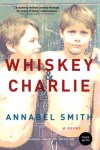
Annabel Smith, Whiskey and Charlie (#BookReview)

Annabel Smith, Whiskey and CharlieSome explanations first. Western Australian author Annabel Smith’s novel Whiskey & Charlie was first published in Australia back in 2012 as Whisky Charlie Foxtrot, which immediately brings to mind the two-way alphabet (or, as I knew it, the alphabet used by the police on The Bill for communication. The things you learn via TV!) However, as happens, the book was, excitingly and successfully, published in America in 2014, and its title was changed to the less evocative Whiskey & Charlie. What I read – heard, actually – was the audiobook that I won in a Readers’ Pack draw last year. Mr Gums and I listened to it on our recent road trip to Melbourne. It passed the time beautifully.

But, another thing, before I talk about that. I’m not a huge fan of audiobooks as I explained earlier in this blog. I really like to see the text; I don’t like to miss visual clues; and I rarely like readers acting out the voices. All these were challenges with Whiskey & Charlie, particularly the last one. The reader, Gildart Jackson, is English. He did the English accents well, but, oh dear, his Australian accent sounded disconcertingly American. I assume this audio, with its American title, was made for an American audience, but, regardless … I prefer reading!

So now the book itself which, really, is what this is all about isn’t it? It tells the story of two identical twins, Whiskey (born William) and Charlie. It is all told, however, through Charlie’s eyes, as the novel starts after Whiskey has had a freak accident and is lying in hospital in a coma. They are 32 years old, and the trouble is that they have been estranged for some time. Charlie has no idea what music, for example, Whiskey would want played at his funeral should he not awaken. He’s distressed. A procastinator who avoids confrontations, he’d always believed there’d be time to sort it all out. The novel progresses from this point, with the family taking turns waiting by Whiskey’s bedside, while Charlie remembers the past and how they’d got to the point they’re at. As he does so, he gradually comes to some realisations about himself and their relationship that enable him to – finally – mature, to see that it hadn’t all been as one-sided as he’d rather smugly assumed. This could be seen in fact as a coming-of-age novel. Perhaps all novels are, in a way; perhaps none of us stop coming of age until we, well, stop?

Anyhow, what makes this book particularly intriguing, besides the thoroughly engrossing story of an ordinary family with all its ups and downs – emigration from England to Australia, parental divorce, and so on – is its structure. And this is where the two-way alphabet comes in. We learn early on that when they were 9 years old, the then close twins been given a walkie-talkie set, and, to help with communication, they learnt this alphabet. William was disappointed that Charlie’s name was in the alphabet, while his was not. Charlie dubs him Whiskey, which becomes his name from then on. Smith structures the narrative around the alphabet, with each chapter titled according to the words – Alpha, Bravo, Charlie, Delta and so on right through to Zulu – and with each of these words linking to some part of its chapter’s content.

This – and the fact that the flashbacks aren’t completely chronological – gives the novel a somewhat episodic structure, but it doesn’t feel forced. Instead, the story is revealed in the backwards-forwards sort of way, for example, that we gradually get to know new friends while the friendship itself is moving forward. (A not uncommon structure. What makes this one a bit different is being organised by the alphabet.)

I’m not going to write my usual sort of review, mainly because having listened to it, I don’t have the same sort of notes, or the same easy access to check details or find quotes. So, I’ll just make a few comments. It’s quite a page-turner, with the main plot, as you’d expect, turning on whether Whiskey will come out of his coma, and if he does what state will he be in. The secondary plot relates to Charlie’s mental state, and his understanding of himself and his relationship with his brother (not to mention with his long-suffering, angelically patient partner, Juliet). He has always felt inferior – the one who came second, the one who didn’t get the girls or the fancy jobs – but he also felt in the right when it came to their estrangement. However, were things really how he saw them? This is something he has to work out for himself. For this reason, the third person limited voice is a good choice for the novel. It enables us to feel with Charlie, while also providing that little bit of distance which enables us to see that Charlie’s perspective may be just a little skewed.

One of the lovely things about Smith’s plotting is that there’s no melodrama, or over-blown emotionalism here. Sure, drama occurs, and there are some surprises, but it’s all within the realm of possibility. There’s some lovely humour too, particularly in the stories of the boys growing up. One particularly funny section has Charlie describing the “bases” in petting with a girl. There were times, though, when I felt Charlie was too angry, too irrational, particularly towards the end when it seemed he was on the road to growth, but that’s minor and didn’t affect his overall trajectory.

Binding all this together is the description of Whiskey’s medical condition. Smith obviously did quite a bit of research – or already knew – just how extended comas play out. While I knew some of it, there were details that I didn’t, and that I found fascinating. Smith also covers such issues as grief and end-of-life decisions.

Finally, I like the title. At first I wondered why Whiskey’s name was first when Charlie was telling the story, particularly given Charlie also comes first in the alphabet. But, of course, it’s polite to put the other person first, and it also reflects Charlie’s sense of who was first in their relationship.

Whiskey & Charlie (or Whisky Charlie Foxtrot) has been out for a few years now, but it’s still worth reading if you come across it in a library or bookshop. Or, have you read it already? If you have, let me know what you thought.

Lisa (ANZLitLovers) also liked and reviewed this – but way back when it came out!

AWW Challenge 2019 BadgeAnnabel Smith
Whiskey & Charlie (Audio)
(Read by Gildart Jackson)
Blackstone Audio, 2015 (Orig. pub. 2012)
10H30M on 9CDs (Unabridged)
ISBN: 9781504608268