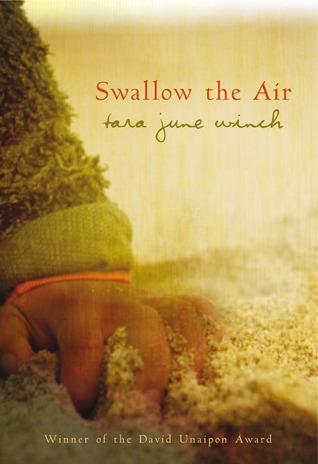
Novel-in-stories, Tara June Winch’s Swallow the air

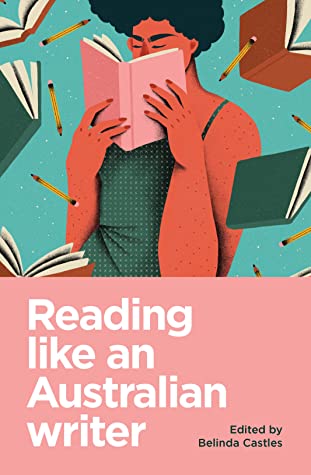
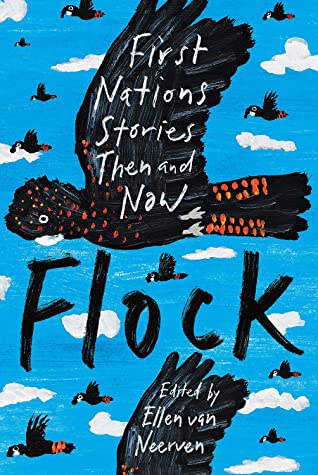
This is my third post inspired by Reading like an Australian writer, and it involves two First Nations writers, Ellen van Neerven on Tara June Winch’s award-winning debut novel Swallow the air. I chose van Neerven’s essay for my next post, because, coincidentally, I’d just read Winch’s story “Cloud busting” in Flock, an anthology, edited by van Neerven. Are you keeping up? “Cloud busting” is one of the stories in Swallow the air.

Form? What form?

Tara June Winch, Swallow the air

In my review of Swallow the air, I wrote:

The first thing to confront the reader is its form. It looks and even reads a little like a collection of short stories*, but it can be read as a novella. There is a narrative trajectory that takes us from the devastating death of narrator May Gibson’s mother, when May was around 9 years old, to when she’s around 15 years old and has made some sense of her self, her past, her people. May’s mother is Wiradjuri, her father English.

The asterisk pointed to a note at the end of my post, which stated that one story from the novel, the aforementioned “Cloud busting”, had been published separately in Best Australian stories 2006. And, in her essay, van Neerven says that she had used “Cloud busting” with students. Sounds like it could become one of Australia’s popular anthologised stories. This would be a good thing because, also in her essay, van Neerven comments on having had no introduction to “Indigenous-authored books” when she was at school (which, for 31-year-old van Neerven, was not that long ago.) Short stories are an excellent form for introducing school students to great stories and writing, and it would be a good thing to see more diverse stories added to current anthology favourites.

“Cloud busting” is a beautiful story, by the way, because it makes a point about deep loss but also conveys the warmth, trust and generosity that can exist between people.

Anyhow, back to form. Just as I wrote in my post on Swallow the air, van Neerven also comments on the book’s form, noting that “writing relational novels-in-stories” is a “very First Nations practice”. She cites Jeanine Leane’s Purple threads (my review) and Gayle Kennedy’s Me, Antman and Fleabag, as other examples. Marie Munkara’s Every secret thing (my review) fits in here somewhere too, I’d say. I hadn’t really thought about this as being particularly First Nations, as we all know novels from various writers that generate arguments about whether they are novels or short story collections. However, in my experience – and I am generalising a bit – First Nations people can be great story-tellers so it wouldn’t surprise me to find the form of “novel-in-stories” being more common among First Nations writers.

Further discussing this book, in which protagonist May goes on a journey back to Country to find her Wiradjuri origins, van Neerven makes another interesting observation, which is that May’s journey “plays into the reader’s romanticised expectations that a return to Country will bring the story a happy resolution”. But, of course, it’s not that simple. Country has often been too damaged by “past policies and institutionalisations”, as van Neerven puts it, for this to happen, but, she says, May does come to understand something important, which is that Country “lives within her” and her family “allowing her to feel strong in her identity without the shame of not living or growing up on Country”. Of course, it’s not up to me to pronounce on the validity of this way of seeing, but it makes good sense to me.

Anyhow, I’ll leave it, on these two interesting-to-me points, as I don’t want to steal the life from Castle’s book. These essays are all so different, as you’d expect, but this just makes them more worthwhile. You just never know what approach a writer is going to take when talking about another writer, but you do know that it will probably be insightful.

Ellen van Neerven
“Kinship in fiction and the genre blur of Swallow the air as novel in stories”
in Belinda Castles (ed), Reading like an Australian writer
Sydney: NewSouth, 2021
pp. 7-12
ISBN: 9781742236704

Tara June Winch
“Cloud busting”
in Ellen van Neerven (ed), Flock: First Nations stories then and now
St. Lucia: UQP, 2021
ISBN: 9780702264603 (Kindle)

Sarah Krasnostein, The believer (#BookReview)

One of the reasons I love reading fiction is to be introduced to lives and cultures I know nothing about. This is less so in nonfiction, but Sarah Krasnostein’s latest book, The believer, fits the brief. In it she explores questions concerning what people believe and why through six different people (or groups of people), all of which were foreign to me.

The six “beliefs” are eclectic, but can be divided into three categories : personal lives (a death doula and a woman who had been incarcerated for over 30 years for murdering her violent husband); religious lives (through a Creation Museum and some Mennonite families); and the unexplainable (paranormal seekers/ghostbusters and ufologists). These six “cases” all come from either the USA or Australia.

Different readers will be drawn to different ideas in the book, but in my reading group, the most popular were the two personal stories – death doula Annie, and ex-prisoner Lynn. Lynn’s story of abuse at her husband’s hands first and then the justice system’s was heart-rending. Yet Lynn had come to understand that she’d made choices, and had gone on to use her life to make things better for others. Inspiring.

The book has a disjointed three-part structure, with one of each of the three categories explored in “Below”, the remaining three in “Above”, and then some reappearing in the final “Coda: Here” section. Within these sections, the stories are told over several alternating chapters, so no one story is told in one go. One of the questions my reading group discussed was whether this structure helped or hindered our reading. We didn’t resolve this, though the overall consensus seemed to be that the alternating did keep us interested. There was probably method to the placement of the stories, but it wasn’t always clear to us, which might be more to do with the time of year and our concentration levels.

Lightbulb moments

What we did all agree on, however, was that the book had some great lightbulb moments – and for many of us, it’s the lightbulb moments that make a book special or memorable.

One refrain that ran through the book was that life isn’t easy or simple. Mennonite Becky says that “life isn’t just a bed of roses”, and ex-prisoner Lynn understands that “pain is a part of life”. Ufologist Jaimie has a more positive spin, seeing that life “is not just going to work and dying”. There are mysteries out there to explore.

However, for me, the most significant moment occurred in “Before”, in a Paranormal/Vlad chapter. It concerned the need for certainty. Krasnostein references German neurologist, Klaus Conrad, who coined the term apophenia, which essentially means that we look for meaning and coherence, and will go so far as to perceive them in unrelated events and ideas. We will, writes Krasnostein, “choose certainty over accuracy”. “We are compulsive converters of fact into meaning”.

I hope I’m not oversimplifying, but Krasnostein then cites a Science article which talks about the human desire to “combat uncertainty and maintain control” and the importance of this to psychological wellbeing and physical health. You can probably see the lightbulb here: it explained, to me, why some people have found the pandemic harder to handle than others, and why some people can become susceptible to conspiracies. People who feel out of control will look for patterns and answers. For me, living with questions is interesting – and in fact real, because I’m not sure there always are answers – but I feel I better understand now, those who do not feel this way, those who demand certainty, such as “promise there will be no more lockdowns”. I better understand why people might turn to conspiracies when authority doesn’t (indeed, sometimes can’t) provide consistent answers.

Other lightbulb moments were less applicable to my life, but were interesting nonetheless. An example was the Mennonites fear of higher education. It “contains an unacceptable risk of assimilation”, potentially causing tertiary educated members to leave the community (the Mennonite kingdom) and be assimilated into wider society. Higher education threatens their understanding of the world, their faith in the Bible as explaining the world. Krasnostein writes of one Mennonite man who had moved to New York in a mission “to make a difference in people’s lives”:

Anthony’s conflict comes from the fact that the certainties he received instead of education are poor tools for daily living.

There’s that idea of certainties again. Anthony tells Krasnostein that “Theology always scares me because it takes the things that seem simple and makes them complex”. This too returns us to the idea of certainties. Anthony sees life simply. In the Mennonites’ belief in a “loving presence”, they see (create?) “a perfect pattern embroidered into the fabric of reality”. Patterns, again.

What added to the book’s interest was that Sarah Krasnostein was, herself, searching to understand “belief”. She admits to occasionally envying Anthony and his co-believers’ “refusal to accept the absence of evidence as the evidence of absence”. She says at one point, “If I could only ask the right questions I could understand”.

This has not been one of my typical review posts, partly because this is a different sort of book, but mostly because I finished it nearly two weeks ago and am not in the brainspace for doing my usual thing. Forgive me. However, you should be grateful, because this book is jam-packed with stories – some tragic, some poignant, some inspiring and some, I have to admit, infuriating (I’m looking particularly at you Creation Museum) – and it would have been tempting to share too many of them. They weren’t, of course, all equally interesting. And occasionally, they got a bit bogged down in detail to the point that I risked losing the thread. That’s the challenge Krasnostein faced in meeting so many people and wanting to explore all their thoughts and ideas. Overall, it works. Her lyrical prose, and warm, open heart play a big role in that.

Talking about UFO sightings, ufologist Ben tells Krasnostein that “we need to find all these little stories. They build up into a big matrix of stories” which, for him, might locate the “truth” of the events. However, this is also exactly what Krasnostein did in this book and, in doing so, she found, as she writes at the end,

six different stories, six different notes in the human song of longing for the unattainable.

My reading group was a little disappointed that in the Coda, Krasnostein didn’t give us a clear summation of the sort you often find in nonfiction works. In fact, though, I think Krasnostein did find something very real, a belief that could help us accept each other’s wildly different shores a little more: it’s that we are “united in the emotions that drive us into the beliefs that divide us”. That is quite profound, and worth spending some time absorbing.

Challenge logo

Sarah Krasnostein
The believer: Encounters with love, death and faith
Melbourne: Text Publishing, 2021
351pp.
ISBN: 9781922330208

Omar Musa’s Killernova book launch, with Irma Gold

Local performance poet-novelist-artist Omar Musa’s latest book, Killernova, had two launches in Canberra this weekend, one with Polly Hemming and the other with Irma Gold. Being Gold fans, Mr Gums and I booked her session, and it was both engaging and illuminating, but I have it on good authority that Polly Hemming’s session, though different, was also well worth attending.

Omar Musa has three poetry collections, a Miles Franklin Award longlisted novel (Here come the dogs), and a play to his name. He has also released solo hip hop records. And now, he has turned his hand to woodcuts and woodcut printing. He is, you’d have to say, multi-talented – and it comes, I think, not only from a curiosity about the world, but a desire to find his place, to engage with it, and to explore ways of expressing the things that he feels strongly about.

Not surprisingly, then, this was not your usual “in conversation” launch. It started with Musa performing some of his poetry, and a song. There’s nothing better, really, than hearing a poet read or perform their own writing, and Musa is a polished performer. So there was that. Then there was a display of his woodcuts, most of which appear in his book, and home-made sambal for sale, along with the book, not to mention the conversation with Irma Gold.

The performance

It was such a treat to have Musa perform some poems. I’ve heard him before, and love his heart and his ability to convey it so expressively through words and voice. His poetry is personal but also political, carefully crafted yet fresh too. Here’s what he performed:

l am a homeland: Musa, who has Malaysian and Australian heritage, started with this poem that explores home and belonging, when you don’t have one place, and got some audience participation going, asking us to breathe in its meditation-inspired refrain, “inhale”, “exhale”:

Inhale – I am singular
Exhale – I appear in many places

UnAustralia: Musa explained that he is often criticised as being UnAustralian because he (dares to) criticise Australia. This poem is his answer to that, and perfectly examplifies his satirical way with words:

Come watch the parade!
In UnAustralia
Land of the fair-skinned.
Fairy Bread.
Fair Go.

Rose gold lover: this one was a song – part ballad, part rap, and beautiful for that. (You can hear it performed with Sarah Corry on LYRNOW)

Hello brother: Musa dedicated this poem to Haji-Daoud Nabi, who, with the words “Hello, brother”, warmly welcomed to Christchurch’s Al Noor mosque, the shooter who went on to kill him and 50 other people.

Flannel flowers: Musa introduced us to a rare pink flannel flower that grows in the Blue Mountains. It flowers only when “specific conditions … are met … fire and smoke, followed by rainfall”, making it bitter-sweet – and an opportunity to contemplate both the environment and our mortality.

The conversation

So, I’ve introduced Musa, and Irma Gold needs no introduction, as she has appeared many times on this blog, including for her debut novel, The breaking (my review). Click on my tag for her to see how active she is. Irma is also a professional editor, and co-produces the podcast Secrets from the Green Room.

Musa and Gold, National Portrait Gallery, 27 November 2021.

Gold commenced by introducing Musa as a multi-talented artist, poet, rapper. She also praised, as an editor, the book being launched, Killernova. It’s a collection of diverse poems and woodcuts, and yet flows seamlessly, she said.

It was a thoroughly enjoyable conversation that, with Gold’s warm and thoughtful questioning, covered a lot of relevant ground.

The woodcuts

Given woodcuts feature strongly in the book, and are a “new” art for Musa, Irma started with how he got into woodcutting. He explained how he’d been in a dark place – had started to hate what he was supposed to love, writing and performing – so was visiting his father in Borneo, when he came across Aerick LostControl running a woodcut workshop, and joined in.

He spoke of the leopard which appears – often playfully – in his woodcuts (including one on top of Canberra’s iconic bustop.) So much of his writing, he said, focused on the ugliness of humanity, on racism, depression, so he wanted to do something beautiful. His first woodcut depicted the local small leopard (Sunda clouded leopard, I think). Although he felt it was “childish”, his teacher saw talent – what a surprise! – and a new form of expression for Musa was born.

Gold also asked him about the practice of “stamping the spirit into the works”. This is, Musa said, the traditional Southeast Asian way of printing woodcuts, and is still used, I think he said, by Indonesian protest poster-makers.

Musa then talked about taking the craft of writing so seriously it can lead to paralysis. Language is so imprecise you can just keep going, tweaking, tweaking the words. In woodcutting, if you make a mistake, you have to move on, as what is done is done. To make art, you have to take risk. He’d been taking himself too seriously, he felt, so wanted (needed, too, I felt he was saying) to be playful.

At the end of the conversation, but I’m popping it in here, Gold asked about how woodcarving deepened his connection with heritage. Musa said that he “would like to say it felt like homecoming but it felt more like tourism”. Some of this tension is conveyed, he said, in the first poem he performed, “I am a homeland”. It explores how we can inhabit different identities. A box limits you, he said. He prefers fluid identities.

The writing process

Gold asked whether, given he’s a performance poet, he reads aloud when he is writing? Musa said he writes in a “trancelike state” then “sculpts” his work. “Write in passion, edit in cold blood” is his practice. He also shared the philosophy of his favourite poet, Elizabeth Bishop – write with “spontaneity, accuracy, mystery”.

On whether he ever edited a poem further after performing, I think he said yes! (Given I sometimes post-edit my blog posts – because I can – I say, why not?)

Art and creativity

Gold referred to the poem, “Poetry”, because she related to its ideas. In it, he plays with the traditional recommendation to “write what you know”, shifting it, first, to “write what you know about what you don’t know”, then rephrasing it to “write what you don’t know about what you know”, before finally getting to the crux – and I like this – “write a question”.

The best art, he said, makes us ask questions about the world around us, but he likes to start with a question about self, with something that tests one’s preconceptions. Art, he believes, does not have to provide answers, just ask questions. Yes.

Gold then asked him about the role of alcohol and drugs in creativity, something Musa has spoken about. Killernova, he responded, is partly about undercutting mythologies in the art scene. One is the singular genius writer or artist. It’s b***s***, he said. All artists are products of their environment, so, this book includes collaborative poems. Another concerns the “addict musician, drunk poet” which he had bought into, but this book was “written when clean”.

The environment

Gold noted that concern with desecration of the environment runs through book, and asked Musa about the role he saw for art. Art, Musa believes, both holds a mirror up to world as it is and as it can be.

There is a Utopia in Killernova, Leopard Beach. Are Utopias dangerous, childish ideas that distract us OR could they project the world as it could be? he asked. Good question. He described a successful turtle sanctuary in Borneo, which was the result of someone’s dream. Through art, we can reimagine the world, and make us feel less alone.

Can art change people’s minds?

Musa responded that Werner Herzog said no, but he thinks it can, through asking questions. However, this needs to go hand-in-hand with collective action.

The end

Musa gave us one more performance to end with. It was a collaborative poem (“after” Inua Elliams) about pandemic, F***/Batman. Loved it, with its wordplay on masks (“we could finally drop our masks”) and references to toilet paper, Zoom, jigsaws; its exploration of the positives, negatives, and potential contained in the pandemic; and the idea that we “grew madder yet clearer headed”. What will we do with this, though, is the question. A provocative end to a great launch.

Omar Musa’s Killernova book launch with Irma Gold
National Portrait Gallery
Saturday 27 November 2021, 3-4pm

Helen Meany, Every day is Gertie Day (#BookReview)

Helen Meany’s Every day is Gertie Day is the third Viva La Novella winner that I’ve read and posted about on my blog, the other two being Julie Proudfoot’s The neighbour (my review) and Mirandi Riwoe’s The fish girl (my review). All are memorable reads, and do this award proud – and no, I am not being paid to say this.

Announcing Meany’s win, Books and Publishing quoted the prize organisers who said that “at the intersections of art, politics, identity and representation, this darkly funny novella shows us a world that is weird, disturbing and all too familiar”. Previous Viva La Novella winner, Jane Rawson, calls it “a fresh, funny and delightfully weird take on authenticity and the people who manufacture it”.

Both use the word “weird”, but if you don’t normally do “weird” please don’t let that put you off because this novella is just weird enough to jolt us into thinking about its ideas, but it’s not that far-fetched – unfortunately.

Every day is Gertie Day concerns a new small house museum in Sydney commemorating a reclusive woman called Gertrude Thrift who had died and not been found until well decomposed. She had been the subject of a series of paintings by an artist called Hettie P. Clarke. This series, formally called the Girl with Greyhound series, is popularly known as the Elf Ears paintings because Gertie is depicted in them with pointy elf-like ears. This isn’t particularly weird, but what is weird is that there are people who have adopted Gertie as their inspiration, their role-model and have had their ears modified to emulate those in the paintings. The problem is that there is no evidence in the museum that Gertie herself had such ears.

The story is told in the first person voice of Nina, a guide (or Public Education and Engagement Officer) at the Museum. That this book was going to interrogate contemporary cultural and political trends and tensions is clear early on. As a retired librarian-archivist invested in the heritage sector, I was hooked when Nina notes that

getting people through the door of any museum anywhere was enough of a challenge, and the professional consensus, though no one would publicly admit it, was that it didn’t matter how you achieved it.

Nina continues that if anyone voiced “any sort of distaste, or ethical concerns, or accusing State Heritage of cashing in on a tragedy” they were to say that the museum endeavoured “to be as respectful as possible”. Thus the stage is set for conflict between the Gerties (mainly the Truthers but also the Regular Gerties), the museum staff, and State Heritage over the authenticity – the truth – of their displays. What follows is a story about a tussle for the “truth” in which the actual “truth” seems less important than what people want to believe and why, and what State Heritage and the Government think is best to do and say about it.

While Nina’s voice is the prime one, we are also given excerpts from the artist Hettie’s diaries, which may, or may not, be the “truth”, and, as the conflict escalates, we see some transcripts of social media commentary from various Gerties and their opponents. It is all so real, and delicious to read in the wake of contemporary controversies about “truth” and our tendency, desire even, to make it suit our own purposes and world-views. Nina is as reliable a narrator as we could hope for in this environment, but she has her own needs and perspectives. Mainly, she wants a quiet life and a job to support her family.

There is an element of dystopia in all this. A parallel story concerns Nina’s husband Benj, his recyc-u-pay job and the plight of the unemployed Trolley People (Trollos). These Trollos earn a living sorting through other people’s rubbish to feed into recycling machines that may be poisoning the air. Has Benj been affected? Who is caring about the Trollos, while the Gertie business garners all the attention?

And then there’s the State Museum, where Nina had previously worked. It had closed because of the “controversial Hall of Extinction”. The truth, it appears, was unpalatable. People had stopped coming because no one wanted to be reminded of all the lost species that could now only be seen “stuffed and mounted or on large video screens”:

Dwelling on the past was no way to move forward, it only made people unnecessarily depressed and angry. At least they were the government’s main arguments for defunding the museum.

There are many angles from which to explore this book – cult, identity, and politics; who controls the narrative and what can get lost in the melee; not to mention, art, and its creation and meaning. How ever you look at it, in Every day is Gertie Day, Meany has astutely tapped into the zeitgeist in a way that extends where we are now just a little bit into “weird”, but not beyond our ability to accept its – hm – truth or, worse, its inevitability. Have we got to the point where people are simply “allowed to believe what they want” or, where authority is so distrusted that all we have is belief (with or without evidence)? The ending is perfect.

Read for Novellas in November, and AusReading Month.

Challenge logo

Helen Meany
Every day is Gertie Day
Lidcombe: Brio Books, 2021
213pp.
ISBN: 9781922267627

S-S-S Snake, Kate Jennings’ Snake, that is

I thoroughly enjoyed Tegan Bennett Daylight’s essay on Helen Garner’s Cosmo cosmolino (1992) in Reading like an Australian writer. Consequently, I plan, over time, to read and share other essays in this book – at least those discussing books I’ve reviewed here. As it happens, there is an essay by Debra Adelaide on Kate Jennings’ Snake (my review), and it’s the perfect next cab off the rank. Not only have I already posted this year on Erik Jensen’s longer essay on the book in the Writers on writers series, but Snake is a novella, so I’m using this post as a contribution to Cathy’s (746books) Novellas in November. I hope that’s not too cheeky.

I’ll start, though, by introducing Debra Adelaide. A novelist with a few books under her belt, including The women’s pages which I’ve reviewed, she first became known to me through her work on early Australian women writers, her Bibliography of Australian women’s literature, 1795-1990 (1991) and A bright and fiery troop: Australian women writers of the nineteenth century (1988). Like many writers, she also teaches creative writing, and Snake is one of the texts she regularly sets.

So Snake – for those who don’t know – draws from Jennings’ life, and tells the story of a lively, imaginative woman, Irene, who marries a decent but boring man, Rex. It cannot work, and the consequences are dire.

Jensen’s and Adelaide’s essays are very different. This is partly because Jensen’s, being in the Writers on writers series, focuses on the writer, whilst Adelaide’s in Reading like an Australian writer focuses on the reading and writing. Not surprisingly, the approach Adelaide takes is closer to mine – except that her writerly perspective is more astute, centred and expository.

The elastic novella

Early in her essay, Adelaide specifically address its form as a novella, saying that Snake demonstrates “how wonderfully elastic the novella can be”. In Snake‘s case, it is “so elastic that it can almost be prose poetry”. It is also “audaciously” abbreviated. She’s right – this is one spare novel.

Adelaide identifies three main reasons that she sets this text for her students – “its poetic brevity, its ‘experimental’ form, and its intriguing, sometimes maddening, allusions to and quotes from numerous literary and cultural references”.

It is, she says, the perfect set text, because it can be easily read in one night and remembered, but,

Brevity does not mean simplicity: its complex themes ripple out and take their time before finally landing on the muddy shores of our imagination.

This is what makes Snake such a good and memorable read.

The three s’s

Adelaide divides her essay into three main sections, those three s’s in the title: Structure; Serpents; and Scenes, sex and Serena McGarry.

I love discussions of structure, because structure can so often help inform the meaning. When a short novel like Snake has a complex structure, it is worth taking note. Adelaide talks about her own method of writing and wonders about Jennings’ approach. She doesn’t know how Jennings works, but she does say that this novel

opened up my eyes to the possibilities of writing a novel that was straightforward yet clever in structure, that was stripped back to its narrative bones, and yet at the same time managed to be multilayered, dense, poetic and unforgettable.

She discusses the novel’s four-part structure, and explains how, although the book is primarily about the mother Irene, it manages to convey the POVs of all four characters, thus “deftly” delivering a portrait of the whole family. Simultaneoulsy, with its use of second person at the beginning and end, “it offers a powerful sense of everyperson”. I love this analysis. I also enjoyed her further discussion of second person, which accords with some of my assumptions about this voice. One of the points she makes is how second person makes (can make) the reader complicit, which is one of the reasons Madeleine Dickie used it in Red can origami (my post).

Adelaide also briefly discusses an issue that fascinates her, as it does me – “the unlikable character in fiction”. Irene is “remote, ruthless and selfish”, and yet, despite Snake‘s “staccato delivery and disparate parts”, Jennings manages to maintain the focus on Irene “without alienating us from her”.

However, the section I most enjoyed is Adelaide’s discussion of Serpents. She references DH Lawrence’s poem “Snake”, which Jennings quotes from in the novella, and Henry Lawson’s short story “The drover’s wife”. She also references Jensen’s discussion of snakes, because, of course, he discussed them too. The point is that snakes are both metaphorical (the cause of the original fall of humankind, and so on) and actual (a real threat to vulnerable children, dogs and women.)

And so, the heart of Jennings’ Snake lies in, says Adelaide, “the universal fear of the serpent, that potent post-lapsarian symbol of all evil and danger”. All associations with snakes race through our minds, she says, as we read this novel. This is one of the ways a spare novel can lay down meaning on top of meaning.

In the third section, Adelaide discusses Jennings’ “scrupulous clarity”, using a few examples from the novel. One is the murder-suicide of Serena McGarry and her husband. Adelaide explores how much, in less than 100 words, Jennings conveys about Serena, and its implications for Irene. Adelaide makes the point that these “marvellously condensed” scenes “contain entire longer stories within them”. She sometimes uses them as springboards for students to develop their own stories. I would add that this sort of writing can make a book a great reading group book because it encourages readers to think about characters – who they are, why they are who they are, and why the writer has written them this way. Endless discussion can ensue!

Adelaide concludes by saying that Snake is “a novel that replays re-readings well out of proportion to its size”. I second that.

Debra Adelaide
“Structure, serpents and Serena McGarry: Kate Jennings’ Snake
in Belinda Castles (ed), Reading like an Australian writer
Sydney: NewSouth, 2021
pp. 219-232
ISBN: 9781742236704

Alf Taylor, God, the devil and me (#BookReview)

It was a complete coincidence that, as I was writing last week’s Monday Musings post on diversity and memoir, I was also reading a First Nations memoir, but such is the reading life, eh? The memoir, Alf Taylor’s God, the devil and me, is, however, both very much a memoir but also its own thing, which I’ll explain as we continue.

For those who, like me, hadn’t heard of Alf Taylor, here is a brief bio. He grew up in the Benedictine-run New Norcia Mission, Western Australia, escaping when he was fifteen years old. He then worked around Perth and Geraldton as a seasonal farm worker, before joining the Australian Army. Eventually, he “found his voice as a writer and poet”, and has had three collections of poetry and short stories published, including one also published in Spanish. He has given readings at festivals and events in Australia, England, France, India and Spain. The memoir’s Foreword describes him as the leading “Elder Nyoongar writer in Western Australia, as Kim Scott [who has appeared on my blog] is the leading younger writer”.

God, the devil and me is typical memoir in that it focuses on a particular aspect of Taylor’s life, his time at New Norcia from around 7 years old to his escape as a 15-year-old. We are talking the 1950s and 60s, which is horrifying to this 50s-60s child! As he tells it, he asked his parents, on a visit to the mission, if he could stay because his brother was there. So the die was cast, but very soon he realised it had not been a good request. Although his father and brothers, and his father’s mother had all gone “through New Norcia Mission”, and had become “good Catholic[s]”, for him it was a terrible experience. His story is one of unremitting brutality – including regular use of straps and sticks to keep the children in line, a diet that consisted primarily of “sheep’s head broth”, and inappropriate clothing – and utter rejection of the children’s Indigenous language and culture.

But, God, the devil and me, is also quite different from your usual memoir. For a start, and most significantly, it’s not told chronologically. Instead, it constantly shifts around, telling various stories ranging over his time at New Norcia. On the surface, the book looks like a bunch of, often quite short, anecdotes but, these stories are connected, not so much chronologically, as thematically, with one occasion or story usually leading organically to another. The end result is an impressionistic – if Dickensian – picture of life at New Norcia, rather than a coherent life story.

Many themes run through the memoir, the brutality, the sadness and loneliness, and alcohol, to which he is introduced through helping the priests with the altar wine. He doesn’t shy from intimating his own later problems with alcohol and he makes clear that many of his Mission friends had died early due to it. Another major thread of course is religion, and his introduction to God and the Devil, who, he is told by the priests, will always be with him. Early in the memoir, alcohol and God are intrinsically linked in his mind:

‘Taylorrr, you’rrre neverrrr going to make it in life. When you get out of herrrre, you arrrre going to get a flagon, find a shady tree and drrrink yourrrrself to death. All of you.’

Being so young, I clasped my hands in prayer and whispered, ‘Yes, Brother, I am going to do all those things when I grow up.’ I agreed with Brother Augustine because I thought that God was passing those words to the brother, who in turn, spat them at me.

Here we see one iteration of the memoir’s underlying idea, the confusion in the young Alf’s mind about religion – what it meant, who God was, how Jesus fit in, not to mention the role of the Brothers in it all. Near the end of the memoir is a surreal scene in which the sleeping Alf leaves his body and ascends to Heaven where he meets (good) Judas and (drunk) Peter. In this scene, Alf finds/creates/discerns a more charitable Christianity than he has experienced at the Mission (which, he sees as being worse than Hell could ever be).

“turn sorrow into laughter”

Alf Taylor is clearly a storyteller. He convincingly embodies his young self when writing about his childhood. The memoir is fundamentally political, but you don’t hear words like “invasion” or “dispossession”. What you hear is a mish-mash of history as young Alf understood it. White Australians are generally referred to as Captain Cook’s Australians and the government, Captain Cook Government. He describes a visit to the Mission of the “Native Affairs men and women”. When asked who founded Australia,

of course, at the top of our lungs, we all shouted in unison ‘Captain James Cook’ with such pride that even old Jimmie Cook himself would’ve risen from the grave and saluted us little Native children.

Similar, usually self-deprecating, humour recurs throughout. Taylor is one of those writers who can use humour to inject a sting in the tail. Here is another moment. Injured by a rock, he is taken to hospital in Perth, where:

I was in for the shock of my life – there were little Captain Cooks lying everywhere; there seemed to be a million of them, and not one little blackfella around.

And, what’s more, he notices that “the gawking Watjella kids all looked the same”!

However, Taylor’s experience isn’t all bad. There are bright moments. Footy is one, but best is when they can get out into the bush. It is in these moments that young Alf is happiest:

running free through the bush, watching the birds fluttering through the leaves or sitting by a stream watching a babbling brook hiss its foam at you was magic … to me, the bush was Heaven. Only Watjellas went to Heaven; we Nyoongahs, when we died came back as a bird or an animal, even as a newly formed brook to quench the thirst of other weary Nyoongah kids … I mean, to me, the bush was everything, my mother, my father; to me, in the bush, I could do no wrong; the fire of Hell did not exist.

He recognises his Ancestors as being the source of his true spirituality – and yet, there is always the overlay of “God, the devil and me”. How DID that fit in with everything else?

Early in the memoir, Taylor shares that the “best thing” he got from New Norcia was learning to read and write. These, he said, were “my weapons” and he devoted much time to them. He also talks about the love of books, and “sneaking off to the library” when others were playing: “a book was like magnetism to me and the pencil was my friend”.

I will leave it here. With its strong content and seemingly disjointed structure, God, the devil and me is not an easy read, but it pays persistence with gold, because this voice, while different from other First Nations voices, complements them and adds depth to the truths we are hearing.

Contribution for Brona’s AusReadingMonth2021.

Alf Taylor
God, the devil and me
Broome: Magabala Book, 2021
289pp.
ISBN: 9781925936391

Review copy courtesy Magabala Books

Consider Helen Garner’s Cosmo cosmolino

Helen Garner, Cosmo cosmolino

Commenting on my post on Helen Garner’s One day I’ll remember this, Bill (The Australian Legend) wrote that he’d hoped I’d mention Cosmo cosmolino (1992). It’s one of the novels Garner was writing during the period covered by these diaries, and Bill had struggled with it. I don’t blame him because, while I loved reading the novel, my own review written early in this blog is less than wonderful. Cosmo is a very different novel and I didn’t grapple at all well with its tricky themes.

Bill has, in fact, written twice about Cosmo cosmolino, his second drawing from Tegan Bennett Daylight’s essay in Reading like an Australian writer (edited by Belinda Castles). I have now read that essay too, so I am going to write a second post on Cosmo – too!

There are two main issues that are tricky with this novel, its form and its content. I’ll start with form, which derives from the fact that the book comprises three pieces/stories: “Recording angel”, “A vigil” and “Cosmo cosmolino”.

But, is it a novel?

I am forgiving (or, wishy-washy, if you prefer) when it comes to questions like this. I think form is and should be a loose thing, and that it should have room to move. Even Bill, who sometimes has strong views on things, said that “If an author, as Garner has done here, declares a collection of pieces to be a novel, then that is how I will read it. But these pieces don’t speak to each other at all. If this is a novel, then as far as I am concerned, it is a failed novel”.

So, Bill was happy, more or less, to accept it as a novel. I was certainly happy to do so because the first two pieces – “Recording angel” and “A vigil” – introduce two of the three main characters in the last story. They also introduce some of the ideas that she further develops, though I didn’t fully grasp them in my review. More on that later in this post. The point is that for me the pieces did speak to each other, albeit oddly, because, for example, the first piece is told first person in Janet’s voice, while the third is told third person with Janet as the protagonist.

Bennett Daylight discusses the form in her essay. She starts by suggesting that she would have broken down the last piece into smaller stories, and

seen the book as a whole as telling the central story through a kaleidoscope of scenes, points of view, small (and large) narratives. I’m thinking particularly of Alice Munro’s early short story collections … in which Munro builds a long narrative about her protagonists like you might a model train, adding stories like carriages until the narrative winds into the distance. The result, to my mind, can be more satisfying than the novel whose every scene is roped to a single central idea.

She then quotes Robert Dessaix who, while praising Garner as “one of our most gifted” writers, said that none of her fictional works were novels. They are “fine works of art and innovative explorations of literary approaches to nonfiction, every one of them an outstanding example of stylish reportage”. He then gets to one of the nubs, the pedestal on which novels are put. Garner writes in her diaries that she needs to free herself “from the hierarchy with the novel on top”. She needs “to devise a form that is flexible and open enough”, wants to “blow out realism while at the same time sinking deeply into what is most real”.

She also writes of “pointless struggles to work my stuff into the shape of a novel, and my determination to write only what it’s personally urgent for me to write” (p. 181). The two urges, it seems, fight each other. She says more but this gives you the gist. I love her engagement with form, though in one sense, it shouldn’t really matter – should it?

Meanwhile, Bennett Daylight is convinced that Cosmo cosmolino is a novel because “what makes a novel a novel is metaphor”, meaning that in a novel it’s “as though life looked in the mirror and saw, not just its reflection, but something behind it”.

“My strange experience”

What is this something? It’s certainly deeper than I was prepared to go in my review, because, to be honest, I was uncertain – and here is why. Bennett Daylight quotes an interview Garner had about the book with, in Garner’s words, “that hard-nosed leftie rationalist Craig McGregor”. In this interview, she was stupid enough “to blurt out my strange experience with the shadowy presence”. Afterwards, she panicked and asked him not to include that part, and while he reassured her he’d hardly mentioned it, this “mysterious visitor” is the backbone of his piece. The responses weren’t positive – “Garner’s got religion, etc”. It taught her, she told Bennett Daylight,

that in Australia you can’t write about experiences of ‘the numinous’ without opening yourself to sneering and cynical laughter. Back then, anyway.

This is the challenge I had with the book. What was the spiritual aspect about? I’ll flip to Bernadette Brennan’s book on Helen Garner, A writing life (my review). She says that the three interlinked stories all concern transformation, and are connected through recurring characters and the presence in each of various forms of angels:

The book’s structure mirrors that of a Christian pilgrimage: “Recording angel” confronts the physicality of a suffering body, “A vigil” enters the underworld to witness death head on, and “Cosmo Cosmolino” offers a sense of possible redemption, perhaps even resurrection. The structure can also be read as a meditation on the past, the present and the future.

Garner writes in her diaries that her main experience of religion is the Holy Spirit:

I don’t understand ‘God’ or even ‘Jesus’, but the Holy Spirit [the “shadowy presence”] has stood behind me on many different days, even though for a long time I was too frightened to acknowledge it or ‘call out to it’. It has visited me and comforted me and become part of me. (p. 160/161)

Bennett Daylight concludes her essay by talking about “the metaphor of belief” that underpins this novel:

Religion or belief is the attempt to impose order where there is none – and surely fiction is the same thing. In fact, from where I’m standing it’s exactly the same thing. I don’t believe in a god or gods, but I do believe in the power of fiction, the power of narrative, the power of metaphor to restore order. A great novel unsettles, then settles – it causes disorder, and then order. Order is restored in Cosmo cosmolino; the metaphor that effects this restoration is a metaphor of belief.

Let’s discuss this definition of “a great novel” another time, but it works here.

As for Garner, what does she say in the diaries? There’s quite a lot, but I’ll just choose these:

I want to write things that push down deeper roots into the archetypal. Things whose separate parts have multiple conections with their own structure. (p.140)

I got to the end of Cosmo. Where is this stuff coming from? The weird state I’m in. I have to apply my intellect but at the same time keep my instincts wide open. I need to hover between these levels. (p. 206)

and

I’m scared that with Cosmo I’ll come a cropper. (p. 217)

It would be 16 years before she wrote another novel.

For me, Cosmo cosmolino, now read so long ago, remains memorable. Janet and “Recording angel”, in particular, are still vivid. I’d willingly read it again.

Tegan Bennett Daylight
“A big sunny shack: Cosmo cosmolino by Helen Garner”
in Belinda Castles (ed), Reading like an Australian writer
Sydney: NewSouth, 2021
pp. 26-41
ISBN: 9781742236704

Sofie Laguna, Infinite splendours (#BookReview)

Those of you who know the subject matter of Sofie Laguna’s latest novel, Infinite splendours, will not be surprised to hear that it drew a mixed reaction from my reading group, particularly coming on the heels of recent reads like Nardi Simpson’s Song of the crocodile (my review) and Douglas Stuart’s Shuggie Bain (my review). However, if we all agreed on one thing, it was that Laguna’s writing is splendid.

Some of you though, particularly non-Australians, will not know what it’s about, so let’s get that out of the way first. The back cover blurb starts this way:

Lawrence Loman is a bright, caring, curious boy with a gift for painting. He lives at home with his mother and younger brother, and the future is laid out before him, full of promise. But when he is ten, an experience of betrayal takes it all away, and Lawrence is left to deal with the devastating aftermath.

It’s not a spoiler to say that this betrayal involves sexual abuse.

Infinite splendours, like Laguna’s previous book, The choke (my review), is set in the rural past. In this case, we are in the Grampians, west of Melbourne, and the novel starts in 1953 when Lawrence is 10. As with The choke, my question is, why set the story in the past? And my answer – though I don’t know Laguna’s – is the same: it’s set at a time when awareness of abuse and the resultant trauma were essentially non-existent. This enables Laguna to explore her theme unencumbered.

The novel is told chronologically in three parts. The first ends with the abuse, and the second takes Lawrence through to another crisis in his late twenties, with the third picking him up, a couple of decades later, in 1994. By this time, Lawrence is living alone in the isolated family home. The novel is told first person, so we spend the whole time in Lawrence’s head, seeing only his perspective. It’s intense and introspective, but not unleavened. There are moments of calm and beauty.

One part engaged, another observing. Two selves. (p. 411)

Still, it’s a tough story, as we watch this lovely, sensitive boy, whom we’ve come to love, decline. He stutters. He gives up his interests, including the art in which he’d shown such talent, and he keeps to himself. His body is a source of mental and physical anguish. From the moment of the abuse, he’s a divided person:

I felt myself dividing; there were two selves to choose from. One inside, one outside. (p. 152/153)

There are moments when he may have been helped. Soon after the abuse, his younger brother Paul asks “what did he do to you Lawrence” – but Lawrence won’t confide. At the beginning of part 2, the family’s kind neighbour, Mrs Barry, tells his mother that he reminds her of the “men back from the war”, but of course PTSD was not properly recognised nor treated back then.

After his mother dies when he is 26 years old, his brother leaves home, and a crisis occurs at his workplace. At this point, Lawrence’s self-isolation is complete. He does, however, have points of solace. His beloved mountain Wallis, a fictional mountain in the Grampians which features in the story from the beginning, provides moments of peace, hope and transcendence; a bunker on the property, in which he hides in a game of hide-and-seek at the novel’s opening, is a place he goes to for safety; and his art, to which he returns after leaving his job, provides occupation and self-expression:

This was the world for me; there was Wallis above and the bunker below, and here was I, between them with my tray of colours. (p. 267)

Lawrence also has an art book, Letters from the masters, that his uncle had given him during his “grooming”. This book becomes his “bible” – for art and life – and he returns to it again and again. He studies the paintings, and he ponders the artists’ words. Indeed, the novel’s title comes from Master Millet who wrote “I see far more in the countryside than charm, I see infinite splendours”. And so does Lawrence, particularly in his beloved Wallis. It is while standing on Wallis, before the events unfold, that he has his first intimations of “something else, greater, that was infinite–the earth’s invisible self. Wallis whispered, See this“.

It is in this context that Lawrence’s art becomes his life’s work. He describes one of his landscapes as “like a living thing … a soul contained within an object”, and sees his paintings as his family. He is as settled as he can be. But, change is inevitable, and the time comes when Mrs Barry’s long-empty house across the yard is occupied again. It discombobulates Lawrence:

I painted into the sun, layers of yellow into yellow. Immersion in light. Sun across my knees, sun in the sky, sun on my canvas. Could I not keep going, contained forever within this one emerging world of light? Must I inhabit another?

It seemed I must … Everything changes.

The new occupants are a single-parent family like his own had been, this one, though, with a mother, teen daughter, and, yes, a 10-year-old boy. The tension builds as we readers watch and desperately hope that Lawrence will not repeat history, that he will get his two selves back in sync in the best way.

I said at the beginning that my reading group praised Laguna’s writing. Her descriptions of the landscape are exquisite and her delineation of character, even minor ones, is so very good. Her warmth and empathy are palpable. I also love her ability to change pace and rhythm to evoke different emotions. However, several of us did feel it became repetitive. Further, although I was fully engaged in Lawrence’s story, and was never going to give up on him or the book, there were times that I felt overwhelmed with the multitude of motifs. As well as those I’ve mentioned, like Wallis and the bunker, there’s Robinson Crusoe, Madame Butterfly, a strawman/scarecrow, birds and the bird clock, rocking and a rocking chair, colours, and more. While none of these were gratuitous, they did sometimes become distracting, as I tried to identify whether they were adding anything critical to what I already knew and felt.

As I read this novel, with a frequent sense of foreboding, I was buoyed by my memory of Laguna’s statement that hope is important. Without giving anything away, let’s just say that, here, the hope felt a bit thin, albeit there is a real transcendence in the ending. For that I was truly grateful.

As for my reading group? Well, there’s been a request for books with a lighter touch next year, which is fine by me, as long as they have meat too!

Challenge logo

Sofie Laguna
Infinite splendours
Sydney: Allen & Unwin, 2020
435pp.
ISBN: 9781760876272

Winner of the 2021 Colin Roderick Award

Helen Garner, One day I’ll remember this: Diaries, Volume 2, 1987-1995 (#BookReview)

Helen Garner, One day I'll remember this, book cover

I loved volume 1 of Helen Garner’s diaries, Yellow notebook (my review), last year, and equally enjoyed this second volume, One day I’ll remember this. As with my first volume post, I plan to focus on a couple of threads that particularly interested me.

First though, it’s worth situating these diaries in terms of Garner’s biography. The nine years encompass the writing of her screenplay The last days of chez nous (my review), her novel Cosmo cosmolino (my review), and her non-fiction work, The first stone (read before blogging). This time also covers the beginnings of her relationship with novelist Murray Bail (“V”) and the early years of their marriage. The trajectory of this fraught relationship gave the volume a strong narrative arc, though the volume concludes not on this relationship but her hysterectomy. Read into that what you will.

Like Yellow notebook, volume 2 offers much for Garner fans. It covers similar ground to the first: observations from life around her, snippets of conversations, occasional news items (like the fall of the Berlin Wall), thoughts about other writers, and of course reflections on her own writing. We watch the tortuous development of her relationship with Bail, and the ups and downs of some close friendships. Music and religion feature again. And, there’s a search for home, for a place of her own.

“the little scenes” and “she never invents anything” (1987)

In her preface to The last days of chez nous and Two friends, Garner characterised her writing as “the same old need to shape life’s mess into a seizable story.” Those who know Garner’s writing will know that she was, on the publication of her debut novel Monkey grip (1977), criticised for not writing fiction but just publishing her diaries. This issue of what sort of writer she is, and what sort of writer she wants to be, continues to occupy her in this volume. “My work is very minor”, she worries in 1990. She is not helped by Bail who clearly thinks that her subject matter is not worthy of her writing skills:

I asked V what he ‘really thought’ of my work. He said he thought it was very good but that I should get beyond the subject matter that limited me, ‘those households, what are they called? That you always write about?’ (1992)

So it seems did Z (who, I think, is David Malouf):

V reports Z’s ‘outburst’ against ‘women’s writing’ with its ‘domestic nuances’ which he dislikes and it not interested in. V tries to get me to pick up my upper lip but without success since he doesn’t hide the fact that he agrees with Z. (1989)

It’s not surprising that among the writers whom Garner admires is Canadian Nobel Prize for Literature Winner, Alice Munro, about whom Garner writes, immediately before the above outburst:

Alice Munro is deceptively naturalistic. All that present tense, detail of clothes, household matters, then two or three pages in there’s a gear change and everything gets deeper, more wildly resonant. She doesn’t answer the questions she makes you ask. She wants you to walk away anxious. (1989)

Bail and Malouf, like many, misread Garner if they think her writing is about unimportant stuff. Garner is interested in the sorts of things she admires in writers like Jolley and John McGahern, for example. She says of McGahern that “he goes in very deep, broaching a vast reservoir of sadness, passivity, hopelessness and despair” (1993). She is not at all interested in domesticity for domesticity’s sake but in understanding the darkness in human beings, and “what people do to each other”.

As well as content, Garner talks again about the process of writing, of the frustration when it feels “false and stiff”, “ugly, clumsy”, or exhibits “anxious perfectness”, and of the exhilaration when it all goes right:

Hours passed in big bursts and I ended up with seven pages of stuff I could never have foreseen or invented … This must be how it’s done–take your foot off the brake, unpurse the lips and see where it takes you. (1990)

These volumes offer wonderful insights into the insecurities, challenges, despair and triumphs of being a writer – and for Garner, specifically, of the struggle to find “her” mode:

I need to free myself from the hierarchy with the novel on top. I need to devise a from that is flexible and open enough to contain all my details, all my small things. If only I could blow out realism while at the same time sinking deeply into what is most real. (1989)

By the end of this volume Garner has moved from “those households” into The first stone – and from there, as we know, she took on narrative non-fiction, and produced books on her own terms in her own form. In these, she finally found a way to not only explore the “darkness” and the things “people do to each other”, but to do it with an openness that is not always pretty but that I admire immensely.

“This is what life is. It’s not for saying no” (1987)

So writes Garner about her newly developing relationship with “V”. This relationship provides the diary’s backbone. It drives, mostly, where she lives, who she sees, and how and where she works. As they move from place to place – in his Sydney and her Melbourne – Virginia Woolf’s A room of one’s own comes frequently to mind, because, wherever they are, he gets to work at home while she must find somewhere else. Even when she tries to put her foot down, she ultimately backs off and, yes, finds somewhere else. This, in many ways, epitomises their relationship – he confident in the rightness of his working where he wishes, and she uncertain about whether to compromise (again), he sure that he is “blameless”, and she, self-deprecatingly, wondering if she’s “a monster”. It’s a typical man-woman story in so many ways, and for women readers the gender issues are both illuminating and infuriating.

However, it’s not all bad. There are moments of generosity and tenderness, even of fun. There are conversations about books and reading, convivial times with friends, and trips away. But, it also seems clear from the beginning that they are the proverbial chalk and cheese. Garner is emotional – “hypersensitive, says friend R – and sociable. She loves nature, music and dancing. V, on the other hand, is reserved, austere, elitist, really. He is furious when someone criticises art that he believes (knows!) is good, while Garner is interested in the discussion.

It made for painful reading at times, but fortunately, there was always this sense, this thing she says early in the volume:

Nothing can touch me. The power of work. Art and the huge, quiet power it brings. (1987)

Amen to that, eh?

Challenge logo

Helen Garner
One day I’ll remember this: Diaries, Volume 2, 1997-1995
Melbourne: Text Publishing, 2020
297pp.
ISBN: 9781922330277

(Review copy courtesy Text Publishing)

Chrystopher J. Spicer: Cyclone country: The language of place and disaster in Australian literature (#BookReview)

I love thinking about place in literature, so I was intrigued when Chrystopher Spicer, cultural historian and adjunct senior research fellow at North Queensland’s James Cook University, offered me his book Cyclone country: The language of place and disaster in Australian literature for review. Unfortunately, I’ve taken a while to get to it.

Place can be a contentious issue for readers, and I’ve become embroiled in many discussions over the years on the topic. However, this is not going to be one of those, not because I have nothing more to say, but because Spicer’s book looks at place from a different angle. His focus is, obviously, cyclones, and was inspired by the fact that he lives in northern Queensland, a tropical region known for its often highly destructive cyclones. Despite this, people stay. How do they incorporate their experience into their sense of place, and, more significantly, into their understanding of who they are personally and as a community? Cyclones bring chaos and destruction, but, paradoxically, they are also part of the fabric of place they destroy.

It is in this context that cyclones (and similar “nature catastrophes”) can be catalysts for literature. It specifically was for Susan Hawthorne’s eco-poetry collection Earth’s breath. Spicer wanted to explore whether such literature provides “a means by which individuals and societies can cope with and integrate these events into their lives, culture and place” and how weather catastrophes like cyclones “speak of our relationships with place and the people in it”. Concluding his introduction, he identifies his objectives as

to explore how we integrate a violent, chaotic, and destructive weather feature into our culture through the use of storytelling and structure. At the same time, I hope to convey a sense of the connectivity and commonality of people search for meaning amid the meaninglessness of chaos and catastrophe.

“in with through” (Hawthorne)

Spicer explores all this through eight chapters. The first two and the last are devoted to general discussion about cyclones, cyclones and place, and cyclones in literature. In these chapters in particular, Spicer draws on academics, critics, and other writers to provide a theoretical underpinning to his argument. The fundamental point is that stories shape the places in which we live and that in the same process people and place are mapped by those stories. He adopts the word “terroir”, traditionally used to describe wine regions, arguing that it encompasses both the tangible habitat and the spiritual sense that is imbued in that habitat from living within it. Weather, he argues, is inseparable from the physical and experiential aspects of the landscape. As poet Susan Hawthorne writes:

I am in with through the cyclone
which is inside with through me

The book’s other five chapters explore his ideas through specific works set in or around Queensland and its cyclonic environment: Vance Palmer’s Cyclone (Lisa’s review), Thea Astley’s A boatload of home folk (with references to other works including The multiple effects of rainshadow which I’ve reviewed), Patrick White’s The eye of the storm (Lisa’s review), Susan Hawthorne’s Earth’s breath, and Alexis Wright’s Carpentaria (my post).

Storms and cyclones have, of course, featured in literature as long as people have been telling stories, and Spicer provides many examples. Their “propensity to be intense life-changing personal experiences” naturally leads to their use in literature, often as metaphor for “epiphany and revelatory apocalypse”. I’m sure all of us have examples from our reading. For me, Shakespeare stands out.

Alexis Wright, Carpentaria

The five authors Spicer explores use cyclones in different ways, but there are recurring ideas. Epiphany, revelation, with a corresponding opportunity to change or start afresh, underpin the stories. Serpents and similar monsters feature frequently, whether it’s Palmer’s Leviathan, or Hawthorne’s ouroboros, or Wright’s Rainbow Serpent. I’m simplifying here but, essentially, their role varies from being the monster that embodies and explains the chaos to something that is more organically part of the process of chaos and renewal. Somewhat related to this, but separate too, is a cyclical view of nature and thus life. This idea is particularly developed by Hawthorne and Wright, in whose works the apocalyptic event contains the cycle of beginning and end, of life and death and life again.

For White, the image or metaphor is a little different again, but also related, with his using the spiral and the mandala or circle. For his protagonist, it’s in the “eye” of the storm, or the “still point” of the spiralling word, that revelation is found, and epiphany achieved. Astley, too, suggests Spicer, sees us as all being “part of a swirling, spiralling, cyclonic universe”. However, instead of going into the eye, her characters try to escape the cyclone, something which Astley herself said, “is not possible”. The main Astley book that Spicer explores, A boatload of home folk, has been criticised as awful, unlikeable, but Spicer disagrees, arguing that, ultimately, Astley, like the other writers, “uses the elemental cyclone as a trope of apocalypse that is both an instrument of destruction and a catalyst of revelation.” It is what the cyclone draws out of the despair in the novel’s characters that is significant.

In the end, there are two main ideas I took from this book. One is that cyclone literature helps us to understand the event, to incorporate the resultant chaos into our lives, and thus, to “integrate nature catastrophes” into our sense of place, or terroir. While Spicer’s focus is cyclones, he also mentions “nature catastrophes”. Consequently, I’d argue that his argument holds for places which frequently experience other such catastrophes, like bushfires, tornadoes, earthquakes, and recurring long droughts. People who live in places frequented by such catastrophic events, and who choose to remain in those places, must surely “integrate” the experience in some way into their identity as a person of that place, and into their understanding of how to live in that place. Spicer’s discussion of Susan Hawthorne’s Earth’s breath addresses this idea in depth.

The other idea relates more generally to how writers use cyclones/storms to explores broader ideas. In a way, this extends beyond Spicer’s specific goals regarding place. Whether or not writers are inspired by actual cyclonic events or purely imagined ones, in real or imagined places, they can and do use cyclones to explore spiritual and/or psychological upheavals in their characters’ lives. Spicer’s selections are all Queensland-related, so place is quintessential to the stories, but his analysis shows that cyclones in literature also transcend place to encompass something more universally human.

In the final section of his book, “The Cyclone as Universal Trope”, Spicer writes that –

Such events and the stories of them can challenge previous human experience, thereby providing opportunity to move forward and rebuild, opportunity for the emergence of the new.

– with “the new” embodying both the tangible and the intangible aspects of our lives.

Spicer’s book is well-researched and thorough in its analysis, and is supported by an excellent bibliography and index. I found it fascinating. It’s not for everyone. However, it makes an excellent contribution to our understanding of the tropes of Australian literature, including reminding us that it’s not all about “the bush”.

Lisa also reviewed this book.

Chrystopher J. Spicer
Cyclone country: The language of place and disaster in Australian literature
Jefferson, NC: McFarland, 2020
202pp.
ISBN: 9781476681566

Review copy courtesy of the author