Last week’s Monday Musings focused on a plebiscite conducted in 1927 on Australian and New Zealand authors and poets. It was conducted in August as a lead up to September’s Australasian Authors’ Week. I found several articles about this week. Some were primarily descriptive, but a few took the opportunity to comment on the state of Australian literature.
I particularly enjoyed reading the unnamed writer in The Catholic Press. S/he starts:
We hardly know whether the Australian* Authors’ Week, proclaimed by the Booksellers’ Association, to begin to-morrow, is intended as a tribute to the merits of Australian writers, or as a demonstration of remorse, or as merely a gesture, like the Shopkeepers’ ‘Country Week,’ to indicate the stuff that is to be avoided for the other 51 weeks of the year.
Hmmm … this writer continues that it’s not a very original idea, but may divert “the minds of book readers from the notion that Ethel M. Dell, Zane Grey and H.G. Wells are the pillars of the present day literature in the English language and its American offshoot”. I wonder if that “American offshoot” comment is a dig at the language or reflects a prevailing view of the period that they are separate? I’ve never heard of Ethel M. Dell but the Zane Grey comment makes sense. However, I was surprised by H.G. Wells. Maybe his star has risen in the years since 1927?
A young culture
The writer argues against the view that “Australian literature has been an unconscionably long time developing”. S/he suggests that Australia was still a very young country (in terms of white settlement, as we moderns would qualify), at just 14o years old – and that it did not have a significant population for the first half of that period, that is, not until the gold rush of the 1850s. S/he argues that there was little or no American literature for its first 300 years. Hmm … I guess this depends a bit on your definition of “literature”. Later in the article, s/he says that most people narrow the term to “poetry and fiction”, but clearly believes it can encompass more, including history and essays. There was, in any event, political and religious writing in America from its early days but, according to Wikipedia, the first American novels didn’t appear until the late 18th to early 19th centuries.
In Australia, the earliest writings were journals of the early Governors; verses by Judge Barron Field; “the superficial historical work of W.C. Wentworth, an Australian native”; and “dry-as-dust chronicles” by historians. Australia’s bookstalls now, s/he writes, “are flooded with the cheap trash of England and America, which are neither literary nor instructive”.
Literarily … Australian
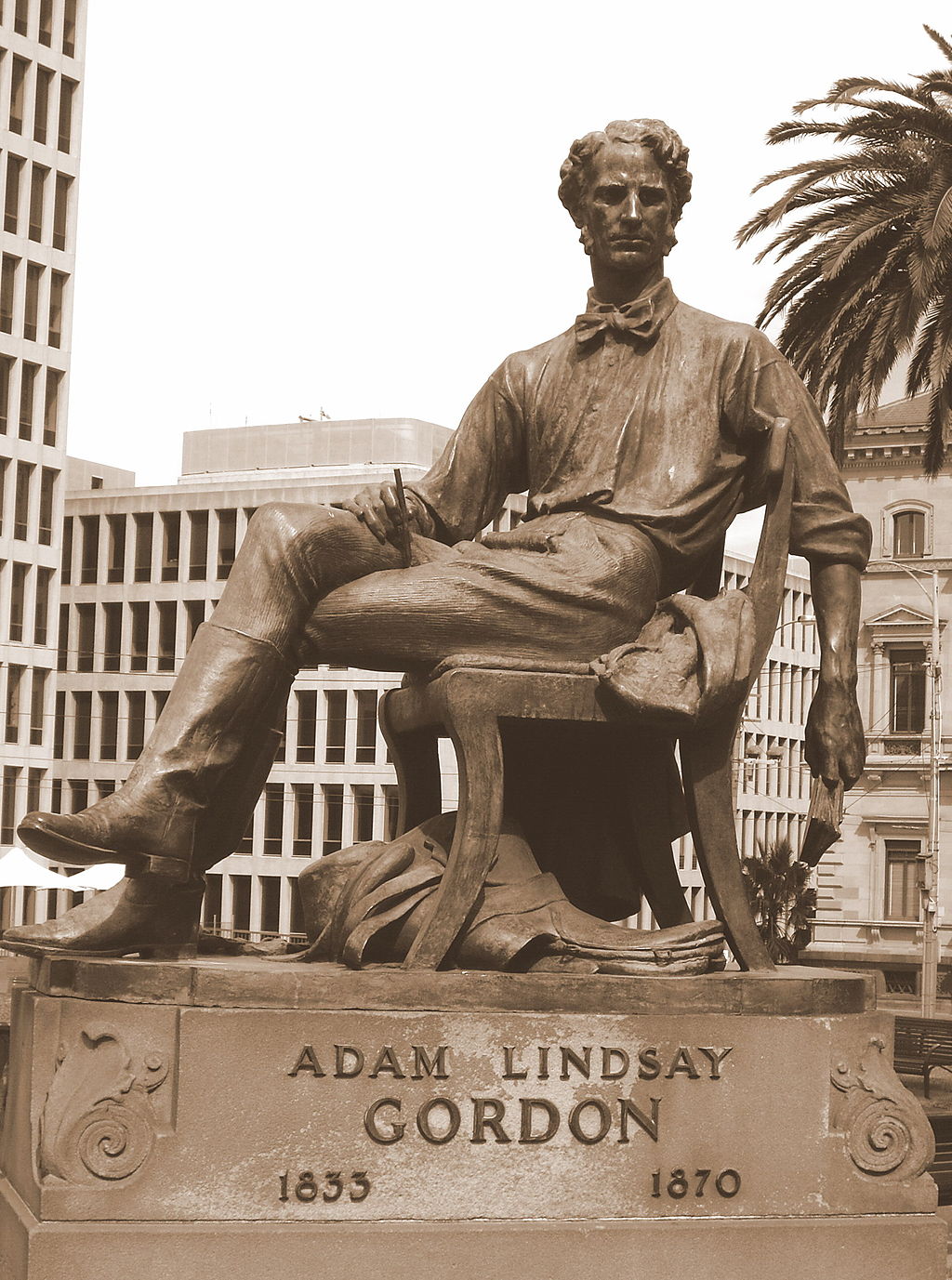
Adam Lindsay Gordon monument (Courtesy VirtualSteve, using CC-BY-SA 3.0, via Wikipedia)
The writer then discusses the plebiscite. S/he states that “it would be too much to expect that such a vote could be considered critical”. “Subconsciously, many honest voters would follow the crowd”, s/he suggests. Very likely, I’d say, given that members of the sponsoring Society had provided their selections in the newspaper at the start of the plebiscite! The writer is not particularly keen on the poet who “won” the plebiscite, Adam Lindsay Gordon, and who, s/he says “had an affection for the ‘gee gees'”. S/he also doesn’t approve of the leader of the prose section, Marcus Clarke, with “his inartistic stuff”, but doesn’t explain this further. Another writer on the week, in The Australasian, reports that Percival Serle**, addressing the Australian Literature Society, said that “the worship of Gordon had done a very great harm to Australian literature”, and that English lecturer F. Sinclaire was similarly critical of Gordon, calling him “pernicious as an influence socially and artistically, besides being in no sense Australian”.
Back now, though, to our Catholic Press writer who argues that “much of Australian literature prior to the so-called ‘Bulletin‘ school has little distinctive character”. S/he suggests that writers like Gordon, Clarke, Rosa Praed, Guy Boothby “may have laid plots in Australia, but failed to get the atmosphere”. I wish s/he’d elaborated a bit more on this, because s/he goes on to name writers s/he sees as “Australian” without defining what s/he means.
Who are they? Well, they include poets Roderic Quinn, Charles Harpur (who wrote “the first genuine Australian verse”), and Henry Kendall. S/he does have a little dig at Kendall’s style – quoting his “notes that unto other lyres belong” – but argues that he is “Australian in sentiment”. Other writers – poets and novelists – s/he names include Rolf Boldrewood, “Banjo” Paterson, Mary Gilmore, Ethel Turner, CJ Dennis, Bernard O’Dowd, Dorothea Mackellar. (F. Sinclaire also names O’Dowd, but adds Furnley Morris***, whom I don’t know at all, and J. Shaw Nielson). As an aside, I can report that all the poets mentioned here – including the maligned Gordon – appear in 100 Australian poems you need to know, published in 2009. It’s not the arbiter of quality, but is a fair indication of the longevity of these writers’ reputations.
S/he then argues that on Henry Lawson’s death, it was argued that “he was the last of the school which began with Gordon”, but s/he believes that “he was the first of the new school, the Hawthorne of Australian literature”. Does s/he mean Nathaniel Hawthorne? I haven’t heard that before.
Overall, s/he is positive about the state of Australian literature. The list, s/he says, “is not unworthy of the first century in a nation, which even now holds less (sic) people than the single cities of London, New York or Paris”. S/he concludes:
If young writers seek characters and episodes in the life around them and avoid imitating the style, decadence and false sentiment of the ‘best sellers’, Lawson, Quinn and Kendall will have worthy successors in a field that still has room for exploration.
The point of all this for me is that while assessments might vary in the particular, most if not all of the writers mentioned in the articles are still known today – some very well, others in more specialist arenas. It reassures me that Australian literature is deepening, as well as broadening.
* Some called it Australasian, some Australian, and others Australian and New Zealand …. Authors’ Week!
** Serle could conceivably be the Catholic Press writer, but I didn’t find any evidence for this.
*** Furnley Maurice, I believe.
 Whispering Gums