My reading group was only talking about Andrew McGahan (1966-2019) this week. We knew he was terminally ill, but little did we know that his end was so near. How very sad, then, to hear today that he died just yesterday, at only 52 years of age.
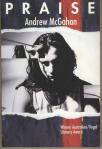 Now, I know that Lisa (ANZLitLovers) has written a tribute but I do want to write one too, because he’s an author who made an impression on me. After all, he introduced me to a genre that would not be my natural calling – grunge lit (or, perhaps more “formally” known as dirty realism!) I enjoyed it. Well, I appreciated his books anyhow. I read both Praise (1992) and 1988 (1995), back in the mid-1990s, which was long before blogging. I wrote to my Californian friend in 1995 – my letters to her are a useful resource sometimes – that I found 1988 “interesting reading” even if I found the 21-year-old protagonist “frustrating in his inability to take hold of his life”. Frustrating perhaps, but the vivid sense of hopelessness and helplessness that McGahan conveyed in these books has stayed with me, which says something about his writing. (It helped too that the protagonist’s girlfriend in Praise suffered from eczema. There’s something validating, as many of you know, in reading about a character whose challenges are yours!)
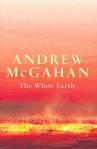 Anyhow, I went on to read his very different novel, The white earth (2004), a rather ambitious multi-generation book about indigenous and non-indigenous Australian love of land/country. It was inspired by the 1992 native title legislation and the conflicting attitudes towards it. It was controversial in some quarters. I liked it. In my letter to my Californian friend, I did say it was a little “clumsy” and used some fairly conventional images and symbolism, but again, over time, it’s a book whose “message”, whose heart really, has stayed with me, while other books I read back then haven’t.
I haven’t read any other of McGahan’s novels. though he wrote three more, Last drinks (2000), Underground (2007) and Wonders of a godless world (2009). According to Wikipedia, he also wrote young adult novels, a play and the screenplay for the film of Praise. The reason he came up at my reading group earlier this week was because one of our members – a recently retired rep for McGahan’s publisher Allen & Unwin – was reading Last drinks. It’s about police corruption in Queensland, and she was wondering if Trent Dalton’s Boy swallows universe was going to visit similar ground. It doesn’t – but she did tell us that McGahan was taking his diagnosis philosophically and was continuing to work on his new novel. It will be published later this year.
The wonderful thing about McGahan was his versatility, having tried his hand at several genres and forms. He didn’t do a bad job at them either, as the following awards for literary, crime, science fiction and children’s fiction reveal:
- Praise: the Australian/Vogel Award (for an unpublished manuscript by a writer under 35 years of age); the Commonwealth Writers Prize for First Novel (Southeast Asia and South Pacific Region)
- Praise (screenplay): AFI Award for Best Adapted Screenplay; the Queensland Premier’s Award for Best Drama Script.
- Last drinks: Ned Kelly Award for Crime Writing for Best First Novel. (That must mean best first crime novel?)
- The white earth: Miles Franklin Award; Commonwealth Writers Prize Southeast Asia and South Pacific Region; Age Book of the Year; Courier Mail Book of the Year.
- Wonders of a godless world: Aurealis Award for Best Science Fiction Novel.
- The coming of the whirlpool: CBCA (Children’s Book Council of Australia) Book of the Year.
For a lovely insight into who McGahan was, albeit from 2004 when The white earth came out, check out this article with him in The Age. The Guardian Australia’s announcement of his death and tribute is also worth reading.
I am very sorry to hear that he has died, and pass my sympathy to his family, friends and colleagues. Fifty-two is just too young to die. He may not have been, for me, the “perfect” writer, but he made a lasting impression on me, so much so that those three books I’ve read frequently come to mind. In the end, what writer could ask for more? (Except for some more years, perhaps!)
 Whispering Gums