 Today I attended several sessions of the first Yarra Valley Literary Festival, which the organisers turned around and converted to an online event with the arrival in our lives of COVID-19. I plan to write up a couple more sessions over the next week, when time permits, but you can also check Lisa’s blog for her posts.
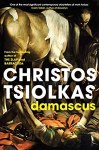
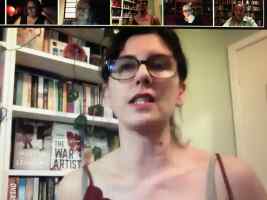
I was looking forward to this session, because Damascus is my current read. I also wanted to see interviewer Angela Savage (whom I’ve reviewed here, and who comments here every now and then) because she is such an engaged writer, herself, as well as a supporter of writers.
Now, I must say that although I’ve really liked the two Tsiolkas novels I’ve read, I was not really looking forward to reading Damascus. Biblical times are not something I gravitate to, and I had heard that the novel contains quite a bit of violence. However, although Damascus does indeed start with something violent – the stoning of an adulterous woman – I was engaged immediately. The violence was neither gratuitous nor laboured, and Tsiolkas’ writing just got me in (again). I’ve read about a third of the novel and the subject matter, the origins of Christianity, is keeping me interested, because I’ve started to realise why it is worth reading. Tsiolkas is focusing particularly on Christianity’s commitment to equality or egalitarianism. Given the way organised Christianity seems to have lost much of its way in our times, it seems a good time to consider its founding values.
So, the conversation, but with the proviso that I did miss bits due to much of it being broken up by connection/transmission problems somewhere.
I’ll start by saying it was a lovely conversation, held between two people who obviously know each other well. That’s one of the lovely things about these writers festivals – you get to see the camaraderie that exists between some writers, and discover some of the ways they support each other. In this case, it came out that Savage had read some of Tsiolkas’ drafts and had had discussed them with him. She praised him for the time he takes with his work, for the way he honours his art.
The first questions explored some of the novel’s background. Tsiolkas said he’d spent five to six years on Damascus, and was terrified when it came out because it is quite different from anything he’s done before. However, he’s fortunate, he said, to have a supportive publisher in Jane Palfreyman, albeit she too was nervous about this one!
While he doesn’t call himself a Christian now, he did grow up with Christianity. He was interested in how much of what we know about Christianity has come through the interpretation of Saul/Paul, and he talked about his interest in Paul, from his adolescent understandings of being rejected by an admonishing Paul to his more mature comprehension when he returned to Paul after a personal crisis. That Paul, he realised, had suffered too. He said that (Biblical) Paul’s aim was to teach people how to live while “waiting for the kingdom” or eternity (which he thought was going to happen any day now.) For Tsiolkas, this has translated to “am I really leading the life that will enrich me?”
From here Savage asked him about his characterisation of Paul.
Tsiolkas talked about his research. Saul/Paul was a Jew who left his faith to follow a strange scandalous religion. Tsiolkas talked about exploring the differences and similarities between Paul’s world and ours, and the challenge of finding his own way to Paul. He knew he wasn’t writing a hagiography, because the reality is that we are human. What is remarkable about the Christian story, he said, and what the Greeks and Romans could not understand, is the fact that through Jesus the sacred becomes human. However, the book also wasn’t going to be “a kicking in the guts”. It also wasn’t intended to be heretical or blasphemous (though some might see it that way!)
He needed to give Paul a battle, and so we have in the book sins like lust, greed, vanity, pride.
This brought us to the question a novelist begins with. For Damascus it was what was it in the Christian belief system that changed the world?
Savage then asked him about the novel’s structure. She loves, she said, how he structures his novels – and if you know me as a reader, you will know that structure is something that fascinates me. I have read enough of the novel to notice its non-chronological, four-points-of-view structure – which Savage called a “roving point of view” – so I was keen to hear his answer.
Tsiolkas said that structure is important to him as a novelist. It provides him with a blueprint which stops him getting lost. Voice and structure are the first things he thinks about. He was lucky with Paul’s voice, because of Paul’s letters. The three other voices are:
- Lydia, representing the history of female participation in the church, something that was later wiped away. (Lydia, from a dye-making family, appears in the book of Acts as the first woman Paul brings to the new religion.) Tsiolkas talked about how he had wanted the female voice to be a slave, given Christianity was largely reviled because it accepted slaves, but he couldn’t find the voice and had no models from his research to draw on. He emphasised what a radical moment this acceptance of slaves was, and, as I have already noticed in my reading, he said that the novel’s refrain, “the first shall be last, the last shall be first”, makes this point. Anyhow, he struggled until suddenly Lydia came to him in the early hours one morning, and he just started writing her. I love stories like that.
- Thomas, representing the doubter that he wanted in the novel because he, too, is a doubter. He chose Thomas from gospel of John, because, like Thomas, he doesn’t believe Christ was resurrected. Tsiolkas believes there is no eternal kingdom, that working out how to live a good life has to be worked out here and now. This idea offers another direction in which the church could have gone.
- Timothy was Paul’s companion in the Bible. His father was pagan Greek and his mother Jewish, so he embodies “between world-ness”.
Savage, noting that it’s not a blasphemous book because it has such a respect for the values, asked about its reception. Tsiolkas said the way people have engaged and have wanted to have a conversation about it has been heartening. He’s been “blown away” by people’s generosity in responding to it.
There was a Q&A but I’m going to end on Tsiolkas’ wonderful answer to the question about his personal faith, because it’s an answer that is more broadly applicable I think. He said that the only answer is to hold doubt and faith together. If you know me, you’ll know that this sort of almost paradoxical answer suits me to a T.
From Yarra Valley Writers Festival 2020 (Online)
9 May 2020, 9:30 AM – 7:30 PM
Livestreamed
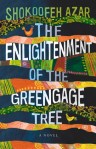 I bought Shokoofeh Azar’s novel The enlightenment of the greengage tree when it was longlisted for the 2018 Stella Prize, for which it was also shortlisted. However, it was its shortlisting this year for the International Booker Prize that prompted me to finally take it off the TBR pile.
 Shokoofeh Azar
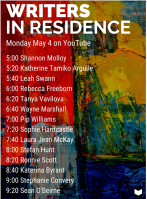 With information coming from every which way, I’m not sure how I heard about the
 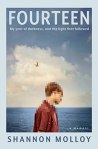 Molloy’s book, simply titled Fourteen, was published in March. It is an autobiographical coming-of-age memoir about being a gay teen. It is set in Yeppoon, in regional Queensland, in 2000. Molloy admitted that his story is harrowing, but believes it also has a strong message of hope. He wants kids “to know there is an end in sight”.
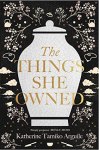 Arguile’s debut novel, The things she owned, was published in late April. Describing herself as “from all over the place”, Arguile, was introduced by Orton as a Japanese-British-Australian artist and journalist. She explained the title of her book. The things are objects which the protagonist, Erika, inherited from her mother, Michiko. Erika is half-Japanese like Arguile, and the novel draws from her own experience. However, as she stressed, The things she owned is a novel, and Michiko is nothing like her own mother.
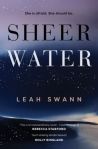 Swann’s novel Sheerwater, which was published in March, is garnering a lot of reviews for the Australian Women Writers Challenge. (I’ve
  The dictionary of lost words, published in late March, is Pip Williams’ debut novel, though she has written other books. She was one of the reasons I was keen to register for this event as I gave this book to my mother for Easter. She, a retired lexicographer, loved it.
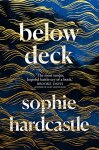 Artist and writer Hardcastle’s novel Below deck, was published in March and is her first novel for adults. It is divided into four parts, with the last being set in Antarctica. Hardcastle had had, she said, an artist’s residency in Antarctica. She wanted to write a work that explored “climate change and our relationship with the natural world.” She thought that a story of the body being violated could work as a metaphor for the environment being violated. The rest of the conversation, however, didn’t really discuss this aspect further.
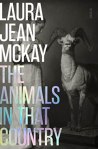 McKay’s novel, Animals in that country, was published in late March. It’s another I had bought as an Easter gift, because, not only did it seem appropriate for the times, given it involves a flu pandemic, but it sounded innovative and feminist. Right up Daughter Gums alley! The novel does have talking animals, including a dingo called Sue! McKay had spent time in a Northern Territory wildlife park as part of a writer-in-residence program, and got to know some dingos here. Sue was apparently inspired by an actual dingo.
 It is not the richest award – though $8000 this year for the winner and $1000 for each runner-up is not bad either – but it carries a good deal of kudos. It has also done well over its 24 years in
  If you look at the Wikipedia link in the paragraph above, you’ll see that the number of awards made each year varies. In 1997, ten awards were made, but most commonly it seems that around three to four are announced.
 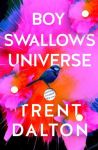 While SMH’s Best Young Australian Novelists is one of the best known emerging writers awards, there are others. Many, like this one, are age-related, such as The Australian Vogel Literary Award which was won this year by Katherine Kruimink, A treacherous country. But not all are. The
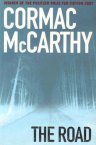 Now to May’s starting book, the 2007 Pulitzer Prize winning novel by America’s Cormac McCarthy – The road. If you haven’t read it, let me tell you that it’s a mesmerising, post-apocalyptic dystopian novel. I loved it, partly because its writing is so spare (see
 Another, very different road trip underpins Australian writer Eve Langley’s The pea-pickers (
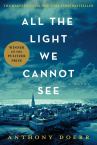 While road trips aren’t the backbone of my next book, American writer Anthony Doerr’s Pulitzer prize-winning novel All the light we cannot see (
 Staying in war-time but moving to a different sort of road, I am taking us to the Thai-Burma railroad as told by Australian writer Richard Flanagan in his Booker Prize-winning novel, The narrow road to the deep north (
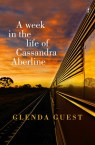 Having mentioned railroads, I’ll stay with them and link to Australian writer Glenda Guest’s A week in the life of Cassandra Aberline (
 Choosing my final book proved a challenge: I had many to choose from, many I wanted to highlight. In the end I decided to stay in Australia, and go a bit lighthearted. The book is English writer Louis de Berniere’s Western Australia-set Red dog (


 So, back in 1927 the Advocate took on this issue of supporting local writers. The article refers to the plebiscite, and says of the winning prose writer, Marcus Clarke:
 The Advocate also suggests Bernard Cronin, describing him as “amongst the leaders of Australian fiction”, and naming two of his popular works, Red Dawson and Salvage. I have devoted
 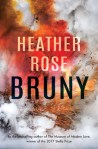 If The yield (
 Heather Rose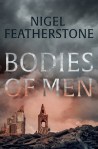
 The
The  Underneath this is the current Book of the Month, with a link to more information suited to reading groups, complete with discussion questions and “if you like this book…” suggestions. Check out
  Whispering Gums