Yarra Valley Writers Festival 2020 (Online): New Release Sundays: Ramona Koval

Four weeks ago I posted on another session from the Yarra Valley Writers Festival’s New Release Sundays, the one with Robert Dessaix talking about his book about growing older, The time of our lives. In that post, I mentioned that Dessaix had presented a couple of radio programs on ABC RN, including Books and writing. Well, coincidentally, this weekend’s program features Ramona Koval who presented, for five years, a successor to that program, The Book Show (which I also loved.) Her new release is the intriguingly titled A letter to Layla: Travels to our deep past and near future.

Layla is her granddaughter, and the book, as the session’s promo says, explores the following questions: How might the origins of our species inform the way we think about our planet? At a point of unparalleled crisis, can human ingenuity save us from ourselves? Sounds like a huge task to cover in 300 pages. Unfortunately, I had a little technical problem resulting in my getting two soundtracks, one with a 10 second delay, so I missed much of the first 15 minutes!

The conversation

Convenor – and journalist – Fiona Gruber started by asking the obvious question, who is Layla, which of course I’ve answered above. As far as I could gather via the garbled soundtrack I was listening to (until I got it sorted), this grand-daughter, together with her own realisation of, for example, climate change, got science-trained Koval thinking about what’s going to happen in the world. She noted her interactions with Layla – which I believe thread through the book – saying that “interaction” was elemental to the things she wanted to think and talk about.

Unfortunately, at this point, I was trying to work out what was going on with my system, so I missed much of the early conversation, which dealt with primates. By the time I had it sorted, we were nearly done with them – but I did get a few things!

Such as, that Koval likes to start at the beginning, but in this case she couldn’t start with unicellular organisms, hence the primates, hominids and hominins!

She talked about going to Georgia to see the homo erectus skulls at Dmanisi. She went there rather than Africa, the accepted “the cradle of civilisation”, because Africa is less safe, she said, and no-one would pay a ransom for her! Hmm … Anyhow, she told a very entertaining story about her Georgian tour, which I won’t repeat here, except to share that at the end of a long day, she was surprised that the scientist, whose name I didn’t capture, wanted to talk about the soul rather than the famous skulls!

She commented at this point that everyone she met gave her something different about being human than she’d expected. Anyhow, Gruber asked about the soul and what evidence there is for its existence. In art, she asked? Or ritual?

“we just measure”

Koval said she’s not religious, nor an ideologue, being more interested in where evidence takes her. She talked about being taken 700 metres deep into France’s Niaux cave. This would have been dangerous, she said, in the days without modern torches etc, so why? Her scientist didn’t want to answer. “We just measure”, he said, because they can’t know why. However, when asked, modern hunter-gatherers suggest that when people do things like this it’s because they wanted to go into “another world”.

This led to quite a discussion about scientists. Gruber suggested that this French scientist’s comment suggested a lack of imagination in scientists. She noted that there is consensus that cave paintings are spiritual, but that Koval found little consensus among her scientists. Koval responded that she didn’t see scientists as unimaginative – meaning, I think, that they have different imaginations. She also doesn’t think a lack of consensus is a problem. These disagreements, she suggested, are just “steps on the way to understanding”. One of my strong takeaways from this session was that Koval is curious and open-minded.

Koval talked about disagreements between scientists, citing one anthropologist Bernard Wood has had with other researchers, particularly in terms of process. The details are not my point here, though. After some discussion about this, Koval shared that Wood had told her that if he had his time over he wouldn’t do science at all because it’s all changing too quickly, and it’s hard to keep up. (This made me laugh because Mr Gums sometimes said the same about his career in electronic communications!) The interesting thing is what he said he would study – how humans make decisions. Koval liked this, saying this is the critical thing.

Gruber then raised race which led to the next most interesting point for me: University of New England’s Iain Davidson’s point that the original colonisation of what is now Australia is the first evidence of modern human thought. Such ability was probably evident before, but this act – the planning, etc, it involved – is the “first” evidence of such thought.

How interesting! I guess those of you who read in this area knew this, but I didn’t. Koval noted that these ideas are fraught with conversations about race and eugenics – but it is important to confront all ideas and continue being curious.

At this point, with around 10 minutes to go, Gruber turned to the second – and future-focused – part of the book. I won’t spend much time here, but Koval talked about cryogenicists and their perspective that nature is not our friend, that ageing is a disease to be cured. Some of these people are disdainful of our humanness, she said. However, many people are working on life-extension.

There was also some talk about computers, robots, AI, and whether they can ever replace us – and about computers and consciousness, and the idea of “singularity“. I’ll leave this here, except to report that Koval said that we are still in charge of things. No-one has, yet, made a computer capable of doing the complexity of what humans can do. Cooperation, for example, is fundamental to human endeavour and achievement, which is something computers can’t do (now anyhow, I suppose, is the caveat.)

Concluding discussion

Towards the end, Gruber asked more about the book itself. Did Koval aways plan it to be in the two parts. Koval replied that she was interested in all the ways people are thinking. She did her research, and the book, including the Layla parts, essentially self-assembled.

On whether the book changed her, an initially stumped Koval said that it made her admire humans’ need to understand, and desire to connect. It also made her think her next book should be about just ONE thing!

Gruber concluded by describing the book as one full of rabbit holes, good questions, and encounters with interesting people. I get the sense, from the review excerpts on Text Publishing’s website, that we only touched the edges of this wide-ranging book. I can’t imagine how you could achieve more in an hour’s conversation. I certainly found it an engaging conversation.

I thank the Yarra Valley Writers Festival for offering this session free of charge. This was the Festival’s first year, I believe. I’m impressed with what they have achieved and offered. I wish them well – for their sakes and mine – in 2021 and beyond.

From Yarra Valley Writers Festival 2020 (Online): New Release Sundays
29 November 2020, 4:00 – 5:00 PM
Livestreamed

Anna Goldsworthy, Melting moments (#BookReview)

Book cover

Melting moments is Australian writer and concert pianist Anna Goldsworthy’s debut novel, following her highly successful memoir of a decade ago, Piano lessons (my review).

Melting moments – for those not familiar with this Antipodean classic – are little shortbread-based biscuits (cookies) sandwiched together with buttercream. In titling her book by these little treats, with the added intimation of moments that melt our heart, Goldsworthy flags the tone and subject matter of her book. The tone is going to be gentle, and the subject matter domestic. The question is: does this make for an interesting book, or just a sweet one?

Overall, I’d say interesting. As a member of my reading group suggested, there is another connotation of the title, that of moments that melt away, of moments that don’t last. So, Goldsworthy’s Melting moments captures the life of a woman from the so-called “greatest generation”. Born between 1901 and 1927 (so my mother just misses it), they went though the Great Depression and World War 2. Sociologist Glen Elder suggests they came out of these experiences “with an ability to know how to survive and make do and solve problems”. This could describe Goldsworthy’s protagonist, Ruby, who marries Arthur, after a short courtship, on the eve of his heading off to the War. She might as well have the “war widow pension” he says, an idea that was, I think, behind a few marriages at the time. This social history aspect is one of the reasons for reading this book which takes us through the decades of marriage, children, empty nest, ageing parents, retirement village life, leaving us when Ruby reaches her early eighties.

This, I know, makes it sound like one of those big family sagas, but in fact it’s not, on two counts. First, it’s short, at just 230 pages, and second, it has no big dramas – just the little trials and tribulations of life.

“misplaced life”

However, this doesn’t mean the book is boring. Ruby lived in the pre-feminist world when women had few rights but many gender-prescribed responsibilities – stay-at-home, cook and house-keep, bring up the children, and keep the husband happy. Like many of her generation, she doesn’t rock boats, but knuckles down to it (using her consciously developed “resourcefulness” to help her along the way). But, she’s not blind to what all this means and, sometimes, she feels

the emptiness rush in at her, as if she were living on a road from nowhere to nowhere …

Or, occasionally wonders

whether life should be something more than a series of daily tasks, successfully dispatched.

Indeed, later in the novel, she considers a path not taken – one involving throwing it all in for the exciting man. But that way led to “briars … social condemnation; impecuniousness; the heartbreak of children”, and, anyhow, the man had removed himself. Nonetheless, she sometimes feels

as if she had missed a summons. As if she had somehow missed her life.

This situation, of course, is not unique to her generation, but it is true that making such a break in her era would have been more difficult. And, anyhow, Arthur, as Ruby recognises herself, was not a bad husband – just a “stolid” one – and their marriage was “more or less” successful.

The novel is written third person, but its focus is Ruby, meaning that the other characters are not significantly fleshed out. Most are nonetheless more than just simple stereotypes. The “stolid” but kind Arthur, for example, is more willing to accept daughter Eva’s grasping the freedom of the 1960s and 1970s than Ruby. And Eva, though frustrated with her mother’s conservatism and inability to understand the changing world, is a loving daughter who finds a balance between living her life her way and loving and supporting her mother.

Ruby’s parents have some individualised flesh on their bones too, but Arthur’s mother, Granny Jenkins who lives with them much of their married life, is rather more the stereotypical unsupportive, demanding mother-in-law. However, Ruby just gets on with that too – as most women did – organising things as much as she can to minimise the imposition .

Now, early in this post, I mentioned that this book, despite its chronological sweep, is not a saga. This begs the question of how Goldsworthy tells the story of such a long life in such few words. She does it by using an episodic structure, skilfully paced so that you always know where you are in Ruby’s life. The gaps are obvious, of course, but it’s also clear that we are getting the critical “moments” in Ruby’s life.

The end effect of all this is a quietly observed book, one unsatisfying for some, and perfectly satisfying for others, as my reading group discovered. Some of us wanted the gaps filled in. Why was Arthur released early from active service, for example. Others of us accepted that the focus was Ruby and what she thought and cared about. When the opportunity finally comes when Arthur might share his war story, she turns away and makes a cup of tea! “What’s done is done”, she says.

There is some humour in the book, and I did smile many times, but, while it felt like an Austen-ish story, it doesn’t have the sharpness of her wit. I must say that in a nicely observed story like this, I did miss that bit of bite.

Melting moments, then, did not exactly wow me, but neither did I find it trivial. Without being consciously political, it works as a reminder of those women who didn’t always identify what it was that caused their feelings of “emptiness”, but who just got on with it, and somehow managed at the same time to bring up the Evas who went on to grab the opportunities available. Goldsworthy has paid credit to them, in a warm-hearted and enjoyable book.

Challenge logo

Anna Goldsworthy
Melting moments
Carlton: Black Inc, 2020
230pp.
ISBN: 9781863959988

Monday musings on Australian literature: “Returning novels”

Book cover

In his review of Tara June Winch’s The yield (my review), Jonathan Shaw (Me fail? I fly!) writes that “Ellen van Neerven, in a review in the Australian Book Review, describes The Yield as a ‘returning novel’”. I loved this way of framing the novel, so I checked the review.

Van Neerven, who has featured several times on this blog, goes on to say that:

In contemporary Aboriginal fiction, a common theme is ‘returning’ – returning to Country, family, language, and culture, all of them intertwined.

Melissa Lucashenko, Too Much Lip

She’s right, I think. Melissa Lucashenko’s Too much lip (my review) is another example, with Kerry returning to her family, like Winch’s August, due to the death of her grandfather. In both novels, the returning protagonist finds herself embroiled in the family’s challenges and starts to reconnect in a meaningful way with the family she’d intentionally escaped. This sort of “returning” also happens in Indigenous Australian non-fiction, like Marie Munkara’s memoir Of ashes and rivers that run to the sea (my review) in which Munkara, who had been fostered by a white family, returns to the Tiwi Islands to understand her Indigenous family and roots.

However, and I hope this is not inappropriately appropriating van Neerven’s idea, “returning novels” are not limited to Indigenous Australian literature. After all, returning stories – think Homer’s Odyssey or the Bible’s prodigal son – are not new. Van Neerven’s point, though, is that “returning” in Indigenous culture has very specific drivers, impacts and outcomes.

Anyhow, now inspired by this idea, I thought I’d take the opportunity to look at some other Australian returning novels. What are returning stories about? The Odyssey was as much about the journey as about the return, while of course the prodigal son story is all about the return.

The novels I’m thinking about tend to be more about the return than the journey, though not exclusively so. They include returns from war, returns home after long times away, and returns after (or for) a major situation or event (like a death). Like Indigenous Australian stories, these can have their different trajectories.

Post-war

Post-war returning novels are a very specific subset. In these novels, the return is usually attended by the issue of resettling – physically and emotionally – and, in many cases, by the returnee suffering from some level of war trauma. War trauma is often the driver for these novels.

Josephine Rowe’s A loving faithful animal (my review) and Rodney Hall’s A stolen season (my review) are recent war-return stories.

Josephine Rowe, A loving faithful animal

Rowe’s novel explores the devastating impact on a family of the husband/father’s ongoing trauma (PTSD) following his Vietnam War experience. In Hall’s novel, on the other hand, the husband has returned from the war in Iraq so severely physically damaged that he can only live by means of a “Contraption” that is activated and controlled by his brain.

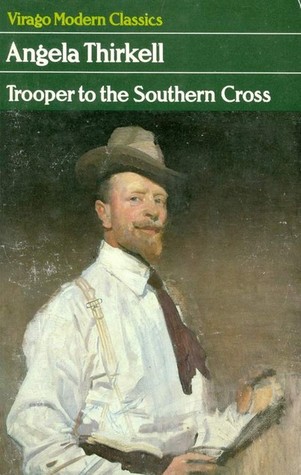
Slightly different examples are Angela Thirkell’s Trooper to the Southern Cross (my review) which chronicles the trip home of an Australian soldier with his English wife, after World War 1, and Geoff Page’s verse novel, The scarring (my review), telling the story of a couple from the 1910s to the 1980s, from their youth and courtship through to old age. Thirkell’s novel is mostly about the journey, but there is much here about the cultural issues that the Australian husband and English bride will face in returning to the husband’s home. Page’s novel may look like a family saga, but it’s what happens after the husband’s return from World War 2 that drives the novel.

After a long time away

Novels about older people returning after a long time away are, of course, different. They tend to be contemplative, and are often (though not always) about the returning person resolving the issues that they were escaping in the first place.

In Jessica Anderson’s Tirra lirra by the river, which I read long before blogging, Nora, who, as a young woman, had escaped the narrow confines of her life in Brisbane, returns at the age of 70, to rediscover and reassess the life she had left.

Glenda Guest, A week in the life of Cassandra Aberline

Glenda Guest’s A week in the life of Cassandra Aberline (my review) is about a woman who left home somewhat suddenly, 45 years before the novel opens, for a reason that’s not clear but is clearly unresolved. Now, 60 and with an early Alzheimer’s diagnosis, she wants to be sure she was right to leave, and if not, she wants to “make amends”.

A different sort of return occurs in Eleanor Limprecht’s The passengers (my review). Here, Australian war-bride Sarah is returning to Australia (with grand-daughter Hannah) from the USA where she’d gone with American soldier husband. This “returning” trip provides the opportunity for her to contemplate her choices and decisions.

Other returns

There are all sorts of “returns” though, besides the big two described above!

John Clanchy, Sisters

In John Clanchy’s Sisters (my review), sister Sarah calls her other two sisters, all of them in their 60s, to spend a month together at the family home, for an undisclosed reason. Not surprisingly, it is about resolving something that happened in the past, a common driver for “returning novels”.

David Malouf’s Remembering Babylon, another that I read long before blogging. It’s about a white man in 1840s Australia who returns to “white” culture, having spent 16 years with the Aboriginal people who took him in after he survived a shipwreck. He, and the people he “returns” to, are challenged by his readjustment. Bill has reviewed it, and touches on the issue about white writers writing about Indigenous people.

“Returning novels” then are highly varied. Most deal with the past in some way, but for Indigenous people the overriding issues are cultural and political (as well as personal), while in non-Indigenous Australian stories, the driving issues tend to be personal. This is, though, a broad generalisation.

Anyhow, these are just a few examples of the “returning novels” I’ve read. There are many more … I’d love to hear about some you’ve read.

Jane Austen, Juvenilia, Volume the first (#Review)

Book coverJane Austen’s Juvenilia, which range over three manuscript notebooks, contain twenty-seven items, which, says Austen scholar Brian Southam, she put together “as a record of her work and for the convenience of reading aloud to the family and friends.”

While only four of the pieces are specifically dated, Austen scholars have worked out an order of writing. Most of those in “volume the first” date from 1787 to 1790 (from when Austen was 11/12 to 14/15.) The few pieces which she added at the end of this first volume come from 1793.

Why read the Juvenilia?

There are many reasons for reading an author’s juvenilia, which Juvenilia Press defines as “early writings by children and adolescents up to around 20 years of age”. They probably vary depending on the author and reader in question, but, for me, the reasons for reading Austen’s Juvenilia include for

  • insight into her development as a satirist;
  • insight into her understanding of the “depths of human perversity” (RF Brissenden);
  • insight into her understanding of the machinations of society, such as the nexus between marriage and money, and the place of women;
  • insight into her linguistic skill and wordplay;
  • insight into her writing development, including toying with forms like memoir, epistolary novels, adventures, plays, poems;
  • fun, because, depending on your sense of humour, they are a hoot.

If you love Austen, one of the reasons you love her is for her wit. In her Juvenilia, we see the origins of what later became a sophisticated (and arch) use of wit. In her Juvenilia, though, the humour is more variously described as nonsense, absurd, burlesque, farce, melodrama, parody, satire, comic, and so on. The humour is broad and realism absent, but oh, such fun.

For some recent thoughtful discussions of the Juvenilia, check out:

Meanwhile, I’m going to share, somewhat randomly, some of the things I enjoy!

Themes

Like many, I’m interested in the “proto-feminist” ideas in Jane Austen’s novels, and love that they are already apparent in the Juvenilia. Volume 1 is replete with heroines who are active, have agency, go on adventures, and drink with the best of them! Things may not always work out for them, but you can’t say they don’t give it a red hot go!

Take, for example, the resourceful Eliza (“Henry and Eliza”), whose “happy Junketings”, despite various misbehaviours, end up well in the end. Or Cassandra (“The beautiful Cassandra”), who runs off with a bonnet (rather than a man), gets into various scrapes, but returns home feeling she’s had a “day well spent”. (She reminded me, stupidly I suppose, of Pat Hutchins’ Rosie, in the picture book, Rosie’s walk. In fact, my Jane Austen group felt that “The beautiful Cassandra” would make a fine picture book”)

There are exceptions, though, like Mary in “The three sisters – a more sombre, and longer, work pointing to the adult Austen. Mary, the eldest of three sisters, receives “an offer of marriage” from a man she does not like. The problem is that he will marry one of her sisters if she doesn’t! She wants the “triumph” of marriage, but not the man. Mary’s superficial self-centredness reminded me of Sense and sensibility’s Mary Musgrove and, as one in my group said, of Pride and prejudice’s Lydia.

This brings me to a major theme found in the Juvenilia, that ongoing one in Austen’s novels, which I call “the marriage project”. It encompasses her understanding of the social and, particularly, economic factors affecting people’s marriage choices, and her support for marriages based on mutual affection and respect. Several of the stories are about marriage, and while the stories are frequently absurd, there is no doubt about the ideas lying behind them.

We also see in the stories, examples of hypocrisy, vanity, gullibility, deception, pomposity and greed – all of which appear, more subtly, in the novels. We see commentary on the times, suggesting Austen was a keen observer of what was going on around her. There are reference to the education of young women “in the Paths of Virtue” (by a Governess who elopes with the Butler!) (“Jack and Alice”); to large families which we know Austen saw as problematic, particularly for the poor child-bearing women; and to the preference for male children.

Something we don’t find so much in the Juvenilia are the delightful aphorisms that pepper Austen’s adult novels. The Juvenilia are, generally, too over-the-top to contain these more measured pronouncements. But, I did find a couple. In “Edgar and Emma”, there’s a couple who “were indeed very sensible people & tho’ (as in this instance) like many other Sensible people, they sometimes did a foolish thing …” The later Austen would have worked this up into something more general, but you get the gist.

And, in “The three sisters”, is:

he hates dancing & … what he hates himself he has no idea of any other person’s liking …

So wise so young! (And reminiscent of “One half of the world cannot understand the pleasures of the other.” Emma)

Style

The best fun though comes from the writing itself. It can be so absurd, so exaggerated, that you can’t help but feel what fun the young Austen had writing them, and how much laughter there must  have been when they were read in the family circle.

In the play, “The visit”, there is a dinner party for 8 people but, wah!, there are only 6 chairs:

Miss F: Pray be seated. [They sit] Bless me! there ought to be 8 Chairs & there are but 6. However, if your Ladyship will but take Sir Arthur in your lap, & Sophy my Brother in hers, I believe we shall do pretty well.

Lady H: With pleasure

The absurdity here is two-fold – not only do we have guests being asked to sit in each other’s laps, but men are asked to sit in women’s laps. How subversive the young Jane was!

Much of the fun, in these pieces, is situational, like the lap-sitting above, but these is also much evidence of Austen’s linguistic ability, her love of words and language. There are silly place names, like Crankhumdunberry (“Frederic and Elfrida”) and Pammydiddle (“Jack and Alice”). There’s alliteration, like Rebecca being “surrounded by Patches, Powder, Pomatum & Paint” (“Frederic and Elfrida”). There’s wordplay, like “variety of variegated flowers” (“Frederic and Elfrida”).

Exaggeration is a favourite technique in the Juvenilia, and is fundamental to much of the humour. We have a marriage not being supported in “Frederic and Elfrida”

on account of the tender years of the young couple, Rebecca being but 36 & Captain Roger little more than 63. To remedy this, it was agree that they should wait a little until they were a good deal older.

They waited 7 days! (And, note the inversion of the two ages.)

We have a young woman’s leg being caught in a steel trap (“Jack and Alice”). It is set by Lady Williams “with great skill which was the more wonderful on account of having never performed such a one before.” Even more miraculous is that the young lady “then arose from the ground” and found herself able to “walk with the greatest ease”.

We have another young woman, who, unrequited in love, retires to her room and “continued in tears for the remainder of her Life” (“Edgar and Emma”).

Austen also uses puns and irony. In “Henry and Eliza”, a ridiculous story is accepted as a “rational and convincing account”. And, of course, there’s melodrama with suicidal drownings, shootings and poisonings – all very un-Austen-like.

The overall effect is one of exuberance, of a precocious and confident young writer, enjoying and exploring her talent.

But … what to make of it all …

What conclusions though can we draw? Are these often silly tales pure nonsense – which White suggests is antithetical to moral imperative – or do they point to the development of Austen as the moral commentator that many of us see? The truth probably lies somewhere in the middle. In the Juvenilia – in the first volume anyhow – I’d argue that both are at play. Many of the stories could very well be seen as pure nonsense, written in great fun by a young woman working out what and how she could write. But others, like “The three sisters”, undeniably point to the Austen we know. Let’s see what I find when we do the second and third volumes next year.

Meanwhile. I’ll leave you with Devoney Looser’s assessment which accords perfectly with mine:

the juvenilia shows that Austen was a child-writer of great, raucous, gender-role-defying fun, an irreverent observer of life’s ridiculous conventions and fiction’s silly habits.

Jane Austen
“Juvenilia. Volume the first” (ed. R.W. Chapman & Brian Southam)
in The Oxford illustrated Jane Austen. Vol VI, Minor works
London: Oxford University Press, 1969 (revision)
pp. 1-75
ISBN: 19 254706 2

Barbara Jefferis Award 2020 Winner Announced


In early October, the shortlist for the biennial Barbara Jefferis Award, worth $50,000, was announced. This award, for those of you who don’t remember it, has very specific criteria:

“the best novel written by an Australian author that depicts women and girls in a positive way or otherwise empowers the status of women and girls in society”.

Libby Angel, The trapeze actThe eagle-eyed amongst you will realise that it is not the sex of the writer that’s relevant here (nor, in fact, the genre). This award is for books about women and girls – and so can be written by anyone of any sex – but it must also present them in a positive or empowering way. I wrote a Monday Musings post about this “positive or empowering” requirement two years ago. That year, the winner was Libby Angel’s The trapeze act, a book I hadn’t read then, hadn’t heard much about even, and still, I’m afraid, haven’t read.

This year’s shortlist of five books comprises four by women writers and one by a man AND, notably, three of the five are by Indigenous Australian writers.

Unbelievably for me, given my usual track record, I’ve read four of the five. I wish I’d read Treloar too because I know it’s been much enjoyed by bloggers, and it is set in a part of the USA that I have visited.

Judges Robyn Sheahan-Bright, Jeremy Fisher and Barbara Horgan, as reported by Books + Publishing, said of 2020’s submissions:

We were very much struck by the empathy with which the experiences of older women were depicted as powerful role models for those younger than them in so many titles—women who were survivors of both personal and family challenges and cataclysmic social, economic or environmental events.

… and the winner is

Of course, the one I haven’t read, Lucy Treloar’s Wolfe Island!

You can watch the announcement here, which includes an introduction by author Bri Lee, comments on each book by judge Robyn Sheahan-Bright, comments on their books by the short-listed authors, the winner’s announcement by Barbara Jefferis’ son Michael Little, and a gracious and strong response from the winner Lucy Treloar. In her words, she repeats the message I’ve shared here before which is that prizes like this (plus all arts funding) enable writers to buy time to write.

Congratulations to Lucy Treloar – and to all the shortlisted authors. I must read this book.

Monday musings on Australian literature: Political biography

With the US election going, going … but not quite gone it seems … and with a new biography of President-elect Joe Biden, Joe Biden: The life, the run, and what matters now by Evan Osnos, hitting the bookstands, I thought it might be apposite to consider the political biography in Australia. By “political biography”, I mean, not those multitudinous memoirs that seem to come out with mind-numbing regularity soon after a major leader leaves the stage, nor the more formal autobiographies, but those extensively researched, analytical, and hopefully objective presentations of politicians’ lives written not by themselves.

Researching this topic, I found a 2006 monograph documenting a workshop on political biography and administrative histories held at the ANU in May 2005. (This workshop, incidentally, included autobiographies and memoirs.) In the final chapter, it says of an informally generated list of “favourite” political biographies that:

all of them tell us about how we are governed, explain the thinking of past leaders, and contribute to political science by illustrating how personalities affect our political structures and policy. … all have contributed to a greater understanding of how politics works.

However, in the monograph’s preface, the writers recognise that political biography is a tricky beast, often being written by those who have sympathy for their chosen subject and who, therefore, tend to write favourable books. But, they argue,

biographies (and autobiographies) have much to offer the student of politics. Political biography is an alternative narrative of events — a personalised view stressing the familiar and the specific. It contributes the views of political actors — sometimes in a contemporary context, sometimes with the benefit of hindsight. It can reinforce existing accounts of events or produce new accounts. It can add new perspectives and insights to existing accounts. It provides a medium through which the personal ‘take’ on politics is able to be ‘written in’ to conventional accounts. Crucially, political biographies are often the most accessible and widely read form of political writing, attracting readerships beyond the purely scholarly interest or the political junkie market.

One of the most famous and authoritative political biographies of recent times is American Robert Caro’s five-volume The years of Lyndon Johnson, of which four have so far been published. Caro is now 85, which begs the obvious question, but you can read about his progress at the Wikipedia link I’ve provided.

Selected Australian political biographies

Book cover

Below is a very select, and somewhat randomly chosen, list of recent-ish Australian political biographies. They are listed chronologically by date of publication, although to follow tradition I should perhaps have listed them alphabetically by biographical subject, or, even more interestingly, chronologically by birthdate of subject! Not surprisingly, these are all about prime ministers.

  • Blanche d’Alpuget’s Robert J Hawke: A biography (1982). One of the rare political biographies I’ve read (because my biographical interest tends towards literary subjects), this biography was published the year before Hawke became Prime Minister. It won the NSW Premier’s Douglas Stewart Prize for Non-fiction in 1983. D’Alpuget, who married Hawke in 1995, wrote a “complete biography” of Hawke, which was published in 2019, the year he died.
  • Allan Martin’s 2-volume Robert Menzies: A life (1993, 1999). I had to include this one, given Menzies was, in his time, and still remains, Australia’s longest-serving prime-minister.
  • Jenny Hocking’s 2-volume Gough Whitlam: The biography (2008, 2012). These volumes are just two of many biographies written about Whitlam, and just two of the several books written about him by Hocking. Hocking came to public notice recently for her successful court case to have the embargo lifted on secret correspondence [now dubbed the “palace letters”] between the then Governor-general, Sir John Kerr, and the Queen concerning the controversial dismissal of  Whitlam’s government.
  • Judith Brett’s The enigmatic Mr Deakin (2018). Deakin was Australia’s second prime minister, so Brett’s biography is certainly one of those able to “benefit from hindsight”. This book won the National Biography Award in 2018, with the judges calling it among “the very best political biographies written in Australia”.
  • Patrick Mullins’ Tiberius with a telephone: The life and stories of William McMahon (2019). Having studied political biographies, Mullins wanted to write one, and McMahon – funnily enough – was there for the taking. So Mullins told the audience at last year’s Canberra Writers Festival. Good decision, because Mullins won two big awards with this – the National Biography Award and the NSW Premier’s Douglas Stewart Prize for Non-fiction. The NSW Premier’s Award judges commented that this was “an impressive work of political biography, an achievement all the greater for its unpromising, though fascinatingly complex, subject”. Poor Billy! 
Book cover er

And here I’m going to sneak in one I have reviewed here. The subjects are not Australian, but the biographer is. The book is Hazel Rowley’s Franklin and Eleanor: An extraordinary marriage (2011) (my review).

A matter of definition

But here’s the interesting thing. While Franklin and Eleanor is about two consummate politicians, Rowley’s focus was their marriage. This made me think about who writes political biographies – in Australia anyhow. They tend not to be our “professional” biographers – people like Rowley, Brenda Niall and now, I’d say, Gabrielle Carey – but historians, like Judith Brett, Jenny Hocking and Allan Martin. Is the driver for writing political biographies a little different?

Journalists – like Blanche d’Alpuget, David Marr, Chris Masters – also tend to write biographies with a political bent, though sometimes their subjects are not politicians. Would we call Masters’ biography Jonestown: The power and myth of Alan Jones a political biography? Would we call David Marr’s books, Barwick on Australia’s longest-serving Chief Justice of Australia’s High Court, and The Prince about Cardinal George Pell, political biographies? Not technically, perhaps, but politics surely inspired and drove these books. Your thoughts?

And now the obvious question: Do you read political biographies? And, if so, would you care to share some favourites (or, even, not-so-favourites)?

John Kinsella, Displaced: A rural life (#BookReview)

John Kinsella, Displaced

I haven’t talked about reading synchronicities for some time, but when I started reading John Kinsella’s memoir, Displaced, I couldn’t help but think of the book I had just finished, Gay Lynch’s historical novel Unsettled (my review). Both have one word titles which play with opposites; in both cases, those opposites refer to physical meanings and more abstract, intellectual, social and/or emotional ones; and, in both, these meanings draw significantly from the colonial act of settling Australia and displacing its original inhabitants. I enjoy such wordplay that forces us to consider multiple, and sometimes conflicting meanings because it encourages a deeper engagement with the ideas being explored.

Notwithstanding this, reading Displaced was a labour of love, because it is a demanding, and often confronting read. However, I wanted to know about this man who is one of Australia’s leading contemporary poets, so I persevered. My assessment? If you are interested in how one might live life as ethically as possible with regard to justice and the exploitation – of First Nations people and the environment – that is encompassed in the long tail of colonialism, Kinsella’s book is a good place to start.

This leads me, as I’m wont to do, to a consideration of form or genre. Displaced is characterised in promotions as a memoir, but I see it more as a manifesto with memoir elements. Events in Kinsella’s life underpin the book, including his stints in Ohio, Schull and Cambridge, but they are not the focus. Instead, they are used to explicate and exemplify his ethical beliefs and, more, to explore the paradoxes we all live with. These paradoxes provide the book’s main thread. They are expressed in such terms as “belonging and unbelonging”, finding a meaning for “home” that recognises Indigenous “dispossession” and doesn’t encompass the exploitative ideas of “ownership”, and feeling “displaced” while very definitely being in a place. He characterises this as “the ethics of presence”. It’s difficult to get your head around while also being very simple really. In other words, the idea is simple, but the living of it, not so!

Two-thirds through the book, Kinsella talks about conducting peace readings, and says that:

A poet has a job to do – art in itself is meaningless if it does not jolt us into self and collective action.

He then describes a sculpture in the British Museum comprising bits of AK-47s welded together. “The artwork,” he says, “jolts one out of apathy, if not out of complicity”.

For Kinsella then, art is not just for art’s sake. And so, here, this work of art, his “memoir”, has a very specific goal, to raise our consciousness regarding the lives we are living and how colonialism, and the accompanying capitalism, continue to damage both colonisers and colonised. He calls himself an “anarchist”, but not one who subscribes to chaos and disorder. His anarchism, he says, has

the social angle, it has the respect for individual difference. I do not attempt to tell people what to believe, but I do attempt to draw attention to the damage being done.

So now, let me return to my opening comment regarding the title and its multiple meanings. Early in the book, Kinsella talks about growing up in the Western Australian wheatbelt, and about the paradoxical, hypocritical love of nature and place he espoused. “Something didn’t add up”, he says, between the way he “felt about the world” and the way he “acted in it”, his actions drawing from “outdoorsmen activities and the attendant crisis of masculinity.” The things he did – farming, hunting, and so on – were counter to the things he loved. The book chronicles his realisation that

I was part of a colonial invasion force, and I belonged nowhere. What could I do about it? I wandered, displaced as an addict [literally as well as spiritually], and as someone trying to undo my own identity.

Learning a new way of being (“unbecoming what I was, becoming what I might be”) became his lifelong project, one he shares with his wife, the poet Tracy Ryan, and their son Tim. Kinsella puts this thinking into his work – in his writing (as mentioned above) and in his role as Professor of Literature and Environment at Curtin University. He speaks in the book of trying to create a new way of writing about place, “a system for working through the contradictions of presence, of time and space and catastrophe and catastrophising, of the failure of modernity and the consequences of colonial modes and modalities of presence”. That’s a mouthful, but it explains his wish to find a way of expressing how colonialism has negatively infiltrated our lives physically, spiritually and linguistically.

To explain his beliefs, he wanders between childhood, youth and adulthood, amongst relationships with other writers and thinkers, and between his current home, Jam Tree Gully back in the Wheatbelt, and those places he’s lived in overseas. Because – I think – of this to-and-fro structure, there is a lot of repetition of ideas and experiences, and these repetitions did become a little tedious at times. I get it John, I get it, I felt like saying a few times as I read. The other challenge for Kinsella was to not preach or virtue signal. He does come close, at times, but he makes clear that he understands the nuances – how does someone like him, for example, deal with feral cats or weed pests? “There’s plenty of mea culpa in my life”, he says.

In the end, this earnest, frank book is full of heart and commitment. One of the things I’ve taken away from it is a heightened awareness of how “colonialism” has infiltrated our language. Take, for example, an interpretive sign we recently saw on a bushwalk that described a tree trunk as providing “high rise living”. Or, a Wiradjuri country rural town’s proud sign promoting its “170 years of heritage”. Just 170 years? On its website, the Blayney Shire speaks more on this (colonial) heritage, and then mentions its natural environment and Aboriginal heritage. “Aboriginal relics and artefacts”, it explains, “are primarily protected under the provisions of the National Parks and Wildlife Act, 1974. Listed heritage in the Shire is mainly European in nature”. This sort of demarcation in thinking about heritage needs to change.

We can’t turn back the clock, which Indigenous Australians accept, I believe. However, they want and warrant the respect due any human being, recognition of their sovereignty and of their dispossession, and for us to listen to their wisdom and knowledge.

Kinsella, who believes that “poems can stop bulldozers”, includes many in this book. They make good reading. But I’ll end here on a positive note from halfway through the book:

The land is constantly being rewritten. We don’t have to be stuck with the damage. It can be undone.

John Kinsella
Displaced: A rural life
Melbourne: Transit Lounge, 2020
329pp.
ISBN: 9781925760477

Review copy courtesy Transit Lounge, via Scott Eathorne of Quikmark Media

Living under COVID-19 (4)

It’s some months since I wrote a “living under COVID-19” post, as things have been pretty much pottering along here in the Australian Capital Territory, but I’ve decided it’s time to do an update (for posterity if for no other reason.)

COVID-normal

There’s been much talk about living under COVID-normal, though what that means is, I suspect, a movable feast depending on where your jurisdiction is at.

Lamsheds Restaurant, Yarralumla
Spaced tables, Lamsheds, Yarralumla

Here in the ACT, where we’ve had fewer than 10 cases since May (and only one since mid-July), COVID-normal means, primarily:

  • sanitising, everywhere
  • cleaning, particularly in cafes and restaurants after each client
  • checking-in, via QR-code apps, QR-code websites using phone cameras, or good old pencil and paper. Privacy? What privacy!
  • social distancing: public venues – shops, restaurants, etc – are currently restricted to one person per four square metres of “usable indoor space” and one person per two square metres of outdoor space rule, but larger gatherings in larger spaces are allowed (thought still with some upper limits).
  • no masks, except by personal choice or for certain health workers

We have no limits on household visits, so my reading group has been meeting in person (woo hoo) for some months. Cinemas have been open since July with strict social distancing, which the cinemas have been handling very well through allocated seating with enforced separation, and spaced scheduling creating quiet foyers.

I can visit my father in Aged Care, as long as I meet certain requirements. Visits have some limitations, but the constraints, though a little irritating, are minor. We certainly can’t complain, and our older people feel safe.

Online eventing – book launches, musical events

As I’ve written in previous posts – and something you all know – the main plus out of this pandemic has been the ability to attend remote events that we wouldn’t otherwise have been able to attend. I haven’t got to as many as I’d like because the timing frequently conflicts with other commitments. (How does that happen?) Anyhow, events I’ve “attended” since my last COVID-19 post are (in case you are interested):

Book cover

More consolation than plus – though we’ll take it – are the streamed live performances. We’ve not attended many of these, once again due to timing and commitments, but we have enjoyed some Discover Musica Viva Concerts with accordionist James Crabb and cellist Julian Smiles, and then classical guitarist Karin Schaupp. These were short concerts, but delightful with the performers introducing their pieces. I always enjoy hearing musicians talk about the pieces they play. I was devastated to have missed my beloved Griffyn Ensemble’s event (though we paid for it).

Spring has sprung – big

As if the universe knew we needed it – as if! – we have had a beautiful spring down under with enough blossoms (and flowering weeds) to cheer the saddest heart (I hope).

Need I say more? (From our garden, except the tulips, which are from Moss Vale)

Helen Garner’s lockdown diaries

Book cover

You all know how much I love Helen Garner, and how much I enjoyed the publications of volume 1 of her diaries in 2018 (my review), so I was excited to see her “lockdown diaries” in The Monthly, October xx, 2020. One of the things I enjoyed about reading this piece, besides the writing, was that I could track the trajectory from COVID-19’s earlier days in Australia to around August/September. Garner, for those who don’t know, lives in Melbourne, so her diaries include the only significant second wave lockdown we’ve had here in Australia.

We’re supposed to observe physical distancing. Everyone is to have an area of 4 square metres. “These are not suggestions,” says the chief medical officer. “These are civic duties.” The phrase “civic duty” thrills me.

I love the idea that ‘the phrase “civic duty”‘ thrills her!

Stage 3 lockdown. People over 70 are ordered to stay home for three months. A stab of stir-craziness, then, again, the stoical feeling.

This immediately brought to mind Julia Baird’s Phosphorescence (my review), and her discussion of stoicism, using the extreme example of Jim Stockdale (a POW in “Hanoi Hilton” for over 7 years).

Cadavers encased in white plastic are trolleyed out of New York hospitals and trucked in refrigerated vans to mass graves. Are they old people? Rash people who kept going to clubs? People with delivery jobs or “co-morbidities”? Who are the unlucky ones? Why are they dead, and we’re not? Is there a reason? Will we ever understand what’s happening to us?

Good questions, Ms Garner!

The old professor calls. He talks for a good 20 minutes, he can’t stop, he is flustered, agitated, distressed, veering among the wrecked shards of his mind. His sentences have no content but they are so perfectly jointed and polished that they make me dizzy with admiration. When at last he begins to peter out (…) I produce from behind my back the syringe of praise and give him a huge shot: “Your English is admirable and beautiful. Your syntax is faultless.” He becomes relaxed and sunny, like someone who’s had a hit of Valium: “I am a man. I am vain. You have entered my soul.”

This pure Garner – the interaction (with her old German neighbour, recently moved to aged care), the tone, the language. I love her description of producing from behind her back “the syringe of praise” to “give him a huge shot”.

Numbers of new cases rise and rise. Hotspots here and there. The big flats shut down. Quarantine hotels. A new lockdown, from midnight. People are refusing to be tested. How can people refuse? The world I’ve spent my life in is coming to an end. I keep myself half turned away, my eyes narrowed. On some deep level I’m terrified.

Do you feel as Helen does? And, overall, how are you faring?

Monday musings on Australian literature: “You don’t walk away until the work is done”

Book cover

This is a different type of Monday Musings, but its relevance will become apparent, I promise you! It’s inspired by Julia Baird’s Phosphorescence which I read a couple of weeks ago. In my review, I mentioned that one of the book’s four main sections is devoted to failure and imperfection, but I didn’t share much about this section, which is titled “We are all wiggly”.

Its opening chapter, after her usual intro, is called “The activist’s attic”. In it she tells of 9 boxes of papers she’s carried around with her for decades. They relate to her “spectacularly unsuccessful endeavour”, when a young woman, to win ordination for women in Sydney’s Anglican church. It’s a failure that has hung heavily on her, and that brought her to ask, in this book, “how to think of these years of effort?”

She shares the stories of other activists, like William Wilberforce who fought against the slave trade for forty-six years, and Nelson Mandela “who spent much of his life, including twenty-seven years in prison, fighting apartheid … “

And then she talks about climate change:

… think of all the scientists who have been warning of the dangers of extreme climate change since the 1960s, and of all the criticism of their work and the dismissal of anything resembling agitation and or activism as the lunatic alarmism of the left. The public burying – or attempts to discredit – the crucial findings of thousands of our finest climate scholars will prove to be one of the greatest (if not the greatest) acts of political and intellectual corruptions of our age.

But then comes the paragraph that is the focus of this post, because this week is NAIDOC Week, and in her book – in this Activist chapter – Baird also writes about Indigenous Australians’ long fight for recognition:

And what of the Indigenous people of Australia seeking constitutional recognition, truth-telling and a voice to parliament, those people who have been mistreated, stymied, rejected, ignored and discriminated against and who continue to ask non-indigenous Australians to walk with them in a makarrata, a Yolngu word meaning peace-making, a coming together after a struggle? The grace of this approach after more than two hundred years of suffering racism, along with their patience, strength and resilience, is astonishing.

The lesson is: you don’t walk away until the work is done.

I should explain here that NAIDOC Week is usually held in July, but it was deferred this year to protect, wrote the Committee, “our elders and those in our communities with chronic health issues from the disastrous impacts of COVID19. I post most years for this Week, and did write two posts back in July, anyhow, to align with Lisa’s ANZLitLovers’ Indigenous Literature Week. But, I wanted to also honour this year’s actual week, so decided to let Baird be my inspiration.

Finally, this year’s theme is “Always was, always will be”, which recognises that “First Nations people have occupied and cared for this continent for over 65,000 years”. It also asks

all Australians to celebrate that we have the oldest continuing cultures on the planet and to recognise that our sovereignty was never ceded. 

C’mon, Aussies … let’s get this thing done!

Six degrees of separation, FROM The bingo palace TO …

Two months into spring here down under, and we are enjoying a wetter spring than usual. I don’t love rain, but my has it resulted in lovely spring blossoms, and we do need our dams to be filled – which they are! Now though, onto today’s business, this month’s Six Degrees of Separation meme.  As always, if you don’t know this meme and how it works, please check out meme host Kate’s blog – booksaremyfavouriteandbest.

And the first rule, of course, is that Kate sets our starting book, and this month, as she did a year or so ago, she told us to start this month’s chain with last linked book from our last Six Degrees post, which, woo-hoo, means another starting book I’ve read!

Book cover

So, the book I ended last month’s chain with was Louise Erdrich’s The bingo palace (my review), which is inspired by the fact that gambling is a major source of income for many Native American communities, a way in which they can support themselves (albeit also comes with problems).

Min Jin Lee, Pachinko

Another community for which gambling can operate as a survival mechanism are the Koreans in Japan who run most of the Pachinko parlours in that country. This story is covered in Min Jin Lee’s originally named Pachinko (my review).

Richard Lloyd Parry’s The people who eat darkness (my review) is a non-fiction true crime work which explores the problematic position of Koreans in Japan, one which can have, as here, dire consequences.

Keeping with the Korean theme but moving over to South Korea itself, my next link is to a book I read for the now-defunct 2011 Man Asian Literary Prize, Kyung-Sook Shin’s Please look after mom [or mother, if you read the non-American edition] (my review).
Yan Lianke's Dream of Ding Village

For my next link, I’m moving from setting and subject (though am staying in Asia), to another book I read for the 2011 Man Asian Literary Prize shadow jury, Yan Lianke’s Dream of Ding Village (my review).

Courtney Collins, The burial

Finally, we land in Australia, with Courtney Collins‘ historical novel The burial (my review), which was inspired inspired by the life of Jessie Hickman, an Australian woman bushranger. That, however, is not the link – obviously. The link is that both novels have dead child narrators, though Collins’ is a very young baby.

John Lang, The forgers wife

For my final link, I’m sticking with “wild” Australia, but this time with a book written at the time it is set, John Lang’s The forger’s wife (my review). It deals with the rough and tumble of life in the colony, and of course, that includes bushrangers!

As frequently happens with my Six degrees posts, four of my six links are books by women. However, we have travelled a bit this time – from America to Japan to South Korea and thence China, before finally landing in Australia. The authors have been diverse too, though the two books set in Japan were not by Japanese writers! Go figure, as they say!

Now, the usual: Have you read The bingo palace? And, regardless, what would you link to?