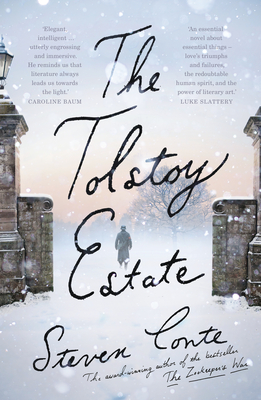
Steven Conte burst on the scene in 2008 when he won the inaugural Prime Minister’s Literary Award with his 2007-published debut novel, The zookeeper’s war. I always intended to read it but somehow it never happened. Jump to 2020, and Conte’s second novel, The Tolstoy Estate, was published. That’s a big gap, but what he’s produced is a well-researched, carefully-crafted, thoroughly absorbing novel.
What intrigues me more than this gap, however, is that both his novels are set during World War 2, and both deal with Germany in the war. The zookeeper’s war is about how the Berlin Zoo’s owner and his Australian wife managed to keep it going through the war. I wonder what it is about war and Germany that attracts Conte? Or, is it just coincidence?
So many paths to follow
The Tolstoy Estate’s plot is not complicated. Most of the story takes place over the six week period – November-December 1941 – during which a German army medical unit established and ran a hospital in Yasnaya Polyana, Tolstoy’s estate, near Tula, south of Moscow. Arriving at the estate, the Germans, including doctor Paul Bauer, meet the site’s curator, Katerina Trubetzkaya, who is, not surprisingly, hostile. A relationship develops between Paul and Katerina, against a backdrop of deteriorating conditions both on the war-front and in the unit, as its commanding officer Metz’s behaviour becomes increasingly erratic.
Sounds straightforward enough? Yes, but as one of my reading group members said, the novel has so many paths to follow, so many ideas to think about, that it’s impossible to follow them all. I agree, so, here, I will focus on just a couple of them.
I’ll start, however, with a few comments about the style and structure. The novel is primarily told in third person through the perspective of Paul, so our understanding of what happens, our assessment of the characters and their relationships, come through his thoughts and feelings. Fortunately, he is quickly established as a humane, considered person, so we can trust him, as much as we can trust anyone.
SORT OF SPOILER (though not the ending)
Half-way through the novel we jump to 1967, and a letter from Katerina to Paul. This introduces a second chronology which covers nearly a decade from then. Most of it, until the last chapter, is conveyed though a few letters between the two, interspersed with the main wartime narrative.
Why does Conte do this? This is the question I always ask when an author plays with their narrative structure like this. My usual thought is that the author wants to de-emphasise the plot to encourage us to think about something else, but then the question is, what? I suspect that this is partly the case here, and I’ll talk about the “what” soon. Regardless of the “what”, however, the impact of revealing that Katerina and Paul have survived the war, is to slow us down. It encourages us to focus on the development of their relationship against the backdrop of this cruel war, rather than rushing to turn the pages to see what happens next.
As for the paths, the “whats”, there are many. The Tolstoy Estate is about war of course. The history part of this novel is true, in that Tolstoy’s estate was indeed occupied by the Germans for a military hospital, so there is that. And, there’s the exploration, through our two protagonists, of two unappealing regimes, Nazism and Stalinism. I could write more about the nuances of that, but I won’t. Then, there’s its evocation of how humans behave during war, of how some will and some won’t behave with humanity across the enemy divide. We see this in many war novels, so I won’t dwell on that, either, except to say that I liked Conte’s appreciation of the continuum of humanity’s behaviour from the worst to the best. One of the questions on Steven Conte’s website concerns whether we can forgive what we come to understand. I’ll leave that one with you too!
Love is an excellent motivator (Katerina)
Now, though, I want to turn to two paths that particularly interested me – love and literature. Let’s do love first. The Tolstoy Estate is a love story. Both our protagonists have lost their spouses, meaning both are currently free but have experienced love before. However, they are also, of course, technically, enemies, belonging to opposing regimes, both of which can be brutal to those who cross the line. This tests their love.
Love is not one-dimensional, as Conte knows, so he sets their love against other sorts of love, including master-race proponent Metz’s dutiful but ultimately sexless marriage because of the “physiological costs imposed by sexual congress”; the Soviet Government’s conservative, sexist attitude to romantic relationships, evidenced in its reaction to Katerina’s novel; a German officer’s homosexuality that brings about his demise; the bawdy conversations and behaviour of many soldiers. There’s also Bauer’s brief but pointed reference to the soldiers he treats:
“Loves or is loved“, he thought constantly as he amputated, concerned less about the truth of the incantation than its usefulness to keeping him alert.
War and love, by definition, make strange bed-fellows. War heightens emotions of all sorts, and forces those who love to think seriously about it, as Paul and Katerina do. Paul’s bawdy but romantic colleague Molineux says that Paul and Katerina’s bond “transcends race, it transcends law”, and yet both Paul and Katerina are aware that the practicalities of love can spoil even a strong bond – which provides the perfect link to the literature path …
Writers document, great men do (Metz)
Contemplating the value and practice of literature underpins the novel, with Tolstoy’s War and peace, of course, providing the pivot. It links to the love path, because Paul and Katerina frequently consider Tolstoy’s evocation of love in the novel. In a letter to Katerina, Paul writes that War and peace reminded him
that love doesn’t always conquer but that, arguably, it’s better that way – that thwarted love is stronger, more enduring than the domesticated kind.
But, beyond love in Tolstoy, Conte’s characters also think about the value of literature. Again, here is Paul in a letter to Katerina, telling her that War and peace had restored his faith in
doing good in the world; because if, as Tolstoy argued, we are all specks in a vast world-historical drama, including those who think they’re in charge, it follows that everyone’s actions are potentially significant, that the humblest person can influence events as much as any general, emperor of tsar.
This counteracts Metz’s argument to Katerina early in the novel that
with his rifle our humblest “Landser” shapes the world in a way your Tolstoy never did.
The old “pen is mightier than the sword” discussion I suppose, but oh so engagingly told!
There are also discussions about the craft of writing – some of which reflect wryly on Conte’s interest, such as Katerina’s research focus being narratology.
But I will end with Katerina’s concern about the fading of the novel in the later 20th century:
Everything fades, I suppose, certainly everything made by human hands, and yet I can’t help feeling bereft to witness this diminution of the novel, which for all its inadequacies has trained us to see the world from others’ points of view. To borrow a Stalinist idiom, the novel is a machine, a noisy, violent thing whose product, oddly enough, is often human understanding, perhaps even a kind of love.
Love … and the novel. A good place to end my post on this compelling and intelligent novel.
Lisa (ANZLitLovers) also loved this novel.
Steven Conte
The Tolstoy Estate
Sydney: Fourth Estate, 2020
410pp.
ISBN: 9781460758823



 Whispering Gums