Monday musings on Australian literature: on 20/40, a new publishing prize

We all like to see a new literary or publishing prize. That is, most of us do, because I do appreciate that prizes in the arts are problematic, and that some do not, for perfectly valid reasons, like them. However, for most, the positives outweigh the negatives. These positives include – in different combinations – kudos, money, time, publication.

Carmel Bird, Fair game

Last week, I received a press release about a new prize being offered by one of our wonderful local-ish, independent, and non-profit, publishers, Finlay Lloyd. I have reviewed many Finlay Lloyd publications over the years, and I also reported on their 10-year anniversary back in 2016. Their output is small in quantity but the quality, both in content and in the physical product itself, is high. Their design aesthetic is carefully considered and I love handling, as well as reading, the results. Like many small publishers, they are not afraid to publish the books and forms others eschew. Take their FL Smalls, for example. These are tiny books – smaller than a traditional novella, even – written by emerging and established (like Carmel Bird) writers. Finlay Lloyd also publishes short story collections, illustrated novels, and nonfiction on difficult subjects, like their Backlash: Australia’s conflict of values over live exports (my review).

Given this background, it’s to be expected that if they came up with a prize it would be a bit left-field, and it is. Called the 20/40 Publishing Prize, it aims to “encourage and support writing of the highest quality”, but writing that meets certain criteria. Here is how they describe it:

In an environment where writers find it increasingly difficult to find an audience, Finlay Lloyd is branching out to offer a publishing opportunity for fiction and non-fiction prose works between 20,000 and 40,000 words through the 20/40 Publishing Prize.

Finlay Lloyd’s publisher and commissioning editor, Julian Davies, is quoted in the Press Release as saying:

‘We’re incredibly excited to be able to encourage writers to submit pieces of this length, a scope which has proven itself through time to be particularly engaging and rewarding for writers and their readers.

‘It’s long enough to allow the rich development of a concept but tight enough to encourage focus and succinctness.

‘Each year we plan to select two winning authors, closely supporting them through the editorial process with care and enthusiasm, and publishing their entries in line with Finlay Lloyd’s innovative design standards.’

This length is, of course, novella length – but Finlay Lloyd has not used the term “novella” because this term refers to short prose fiction, while the prize encompasses fiction and nonfiction. They say on their website that “all genres of prose writing are welcome, including hybrid forms”. 20/40 is, I should clarify, an unpublished manuscript competition with publication being the prize.

The press release goes on to explain that Finlay Lloyd is “dedicated to identifying and encouraging good writing free from external pressures such as reputation and the undue influence of market forces”. Consequently, the judging panel will read the submissions “blind”, and will focus on “creative inventiveness and quality”.

Their hope is that 20/40 will “offer an incentive for writers to get down to work and hone their expressive skills”. They believe that readers are “hungry for writing of quality that is published with care and flare as well-designed and engaging paper artefacts”. See what I mean? The content AND the object are both important to them. I know many readers, myself included, who are so hungry.

Anyhow, submissions can be made between 1 January and 10 February, 2023. They will announce the shortlist in October and publish the winning books – one fiction, one nonfiction, I think – in November. The prize is being overseen by their “expert advisory board”:

Book cover
  • Dr Christine Balint, whose novella, Water music, I’ve reviewed
  • John Clanchy, novelist and short story writer whom I’ve reviewed a few times here
  • Donna Ward, writer, publisher, and editor
  • Dr Meredith McKinney, academic, translator – including of Mori Ôgai’s The Wild Goose on my TBR – and daughter of Judith Wright
  • Emeritus Professor Kevin Brophy, whose recent short story collection is on my TBR

I must say that I’m tickled about the timing of this announcement, given its relevance to Novellas in November.

Elisa Shua Dusapin, Winter in Sokcho (#BookReview)

French Korean writer Elisa Shua Dusapin’s award-winning debut novella, Winter in Sokcho, was published when she was just 22 years old. As the title conveys, it is set in Sokcho, a tourist town in the Republic of Korea near the border between the two Koreas. In fact, when the Korean peninsula was divided into two countries following World War II, Sokcho was on the Northern side, but became part of the South after the 1953 Korean War armistice 1953. I suspect Sokcho was chosen as the setting partly for its “divided” history, this being in-between, neither one thing or the other,

But, more on that later. The novel’s unnamed first person narrator is a 24-year-old French Korean woman who works in a struggling guesthouse. She seems to do everything – reception, cooking, cleaning – but with little enthusiasm. The novel opens with the arrival of an unexpected guest, the 40-something French graphic novelist, Yan Kerrand. The two are drawn to each other in some way, but, at least from Kerrand’s point-of-view, it doesn’t seem to be romantically driven. For our protagonist, the situation is a little more complex. She has a boyfriend – Jun-Oh – but it’s not a satisfactory relationship from her perspective. However, her fish-market worker mother is expecting an engagement any day. The situation is ripe for something different to happen in her life, but will it – and what, anyhow, does she want? She seems betwixt and between.

Winter in Sokcho has many of the features I like in a novella, starting with spare expressive prose, a tightly contained storyline, and a confined setting. There’s also a small cast of characters, with little or no digression into backstories. All we have is what’s happening now.

And, what is happening now is that the stranger’s appearance has affected our narrator. In the second paragraph, while registering him as a guest, she says

I felt compelled for the first time since I’d started at the guest house, to make excuses for myself. I wasn’t responsible for the run-down state of the place. I’d only been working there a month.

We then move to her visiting her mother, and another thread begins to appear, that of body image. We’ve already been told that one of the guesthouse guests is “seeking refuge from the city while she recovered from plastic surgery to her face”, and now we are introduced to our narrator’s mother’s concern about her appearance. She’s too thin, her mother says. Our narrator rejects this, but soon after, in a photograph her boyfriend has taken of her, she sees “a wasteland of ribs and shoulder blades receding into the distance … her bones sticking out” and is “surprised at how much”. When she’s with her mother, she binges on the food her mother makes, only to feel “sick” and later repelled by her “misshapen body”. There is a tension between this single mother and her daughter that pervades the novel. We sense that our narrator would like to leave Sokcho. Indeed, there’s a reference early on to the “literary world” suggesting she has aspirations in that area, but she feels she cannot leave her mother. Betwixt and between.

Throughout the novella, there’s an atmosphere of things being out of kilter or not quite right. Early on, the narrator describes Sokcho’s beach:

I loved this coastline, scarred as it was by the line of electrified barbed wire fencing along the shore.

This is not your typically loveable beach view, but she herself bears a physical scar on her thigh to which she often refers. It’s unexplained but there are hints later of self-harming. Meanwhile, later in the book, Kerrand tells her that he prefers the beaches of Normandy to those in southern France, because they are

Colder, emptier. With their own scars from the war.

And so the novella progresses, in this clipped spare prose, with a sort of wary dance going on between the narrator and Kerrand. He’s there for inspiration for the last book in his series about “a globe-trotting archaeologist … A lone figure. With a striking resemblance to the author.” She is intrigued by him. She offers to show him some local sights – the border region, with its checkpoint “No Laughing” rule, and the nearby national park, with its snowy mountains and waterfalls. She watches him, surreptitiously, as he draws by night, but always the drawings are destroyed by morning, because they are imperfect.

What does Kerrand see in her, what is he looking for? This being a first person narrative, we see it all through her eyes. She is as reliable a narrator as she can be, but like any first person narrator her viewpoint is limited by her perspective.

Winter in Sokcho does not have a simple resolution, but I’ll return to that idea of Sokcho being chosen as the setting. Its divided history mirrors our narrator who is also divided – in her French Korean heritage and her torn sense of self. Further, Sokcho is described as “always waiting”, as it seems also is our narrator, though for what, even she doesn’t really know.

How much is this a personal story and how much political? Two-thirds through, as she and Kerrand discuss their scarred beaches, she tells him (and just look at this writing):

Our beaches are still waiting for the end of the war that’s been going on for so long people have stopped believing it’s real. They build hotels, put up neon signs, but it’s all fake, we’re on a knife edge, it could all give way any moment. We’re living in limbo. In winter that never ends.

There can be no neat ending to such a story, but without spoiling anything, I’ll share something she sees in Kerrand’s final drawing:

A place, but not a place. A place taking shape in a moment of conception and then dissolving. A threshold, a passage …

Does this suggest hope, albeit tenuous – for both the narrator and her Korea? I’m reading it that way. As for the closing lines … they are glorious.

Read for Novellas in November, Week 2: Novellas in Translation.

Elisa Shua Dusapin
Winter in Sokcho
Translated from the French by Aneesa Abbas-Higgins
Melbourne: Scribe, 2021 (Orig. pub. 2016)
154pp.
ISBN: 9781922585011

(Review copy courtesy Scribe)

Nonfiction November 2022: Book pairings

Week 2 of Nonfiction November and hanging in. This meme/blog event/reading month/challenge (what do we call it?) is hosted by several bloggers, with Week 2: (November 7-11) – Book Pairing, being hosted by Rennie (of What’s Nonfiction). The challenge is to pair a nonfiction book with something else – a fiction title, another nonfiction work, or even a podcast, film, documentary, TV show, etc. There just has to be some link in terms of subject matter or topic. I really enjoy this week of the challenge, because it’s such fun to do and is also fun to see what other bloggers come up with.

The no-brainer

Since much of my nonfiction involves literary topics – literary biographies or memoirs, for example – this pairing challenge is really very easy. Take, for example, Carmel Bird’s bibliomoir Telltale (my review). There are so pairing possibilities, because in it she discusses books she’s read and written. So, for this year’s no-brainer – I did one last year too – I will pair her bibliomemoir with… Hmm, with what? Because here’s the challenge: she mentions so many books. However, if I limit it to those I’ve reviewed, which is my preference, that narrows the field. And, if I narrow it even more to those books by her that I’ve reviewed, I’m getting to something quite manageable.

Book cover

So, after a little consideration, the one I’ve chosen for my pairing is her Field of poppies (my review), because, as I wrote in my post, it has many of the hallmarks of her writing, including “all manner of allusions and digressions, underpinned by a clearly-focused intelligence”. This, of course, we also find in Telltale. Unfortunately, though, I am away from home, so I don ‘t have my copy of Telltale with me to share some of Bird’s comments about this novel. However, I do remember her discussing mining, and how she had referenced it in her work, including in Field of poppies.

This year I have also read several literary essays, and each of these could be paired with their source novel or story, such as Ellen van Neerven’s essay (my post) on Tara June Winch’s Swallow the air (my review).

But, rather than list all those, I’d like, as I also did last year, to give myself something that’s more of a pairing challenge, so here is …

Another pairing

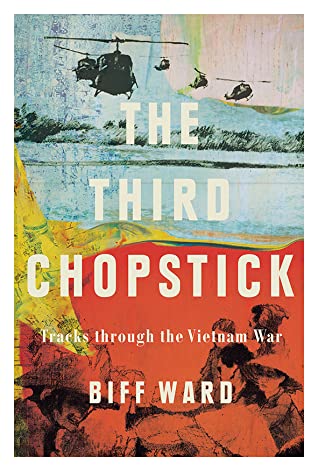
My most recent nonfiction read was Biff Ward’s part memoir, part social history, The third chopstick: Tracks through the Vietnam War (my review). This book covers both her experience as an antiwar protestor and her later decision to meet and understand the men who went to war – the Vietnam Vets. In those meetings, she comes face-to-face with the traumas (the PTSD) many of them suffered on their return and, with their permission, she shares some of this experience with us.

Josephine Rowe, A loving faithful animal

Not a lot of fiction, comparatively speaking anyhow, has been written about this War, as I discussed in my recent Monday Musings – and I’ve read only a little of that. However, I have read a little, and one of those is Josephine Rowe’s A loving, faithful animal (my review), which deals very specifically with PTSD from this war and its intergenerational impact. It’s a strong, and unforgettable novel and worthy of pairing with Biff Ward’s book.

For those of you doing Nonfiction November, I’ll see your pairings I’m sure, but, if you’re not, I’d love to see what you would pair – if you’d like to play along.

Monday musings on Australian literature: Classic Australian novellas

Novellas in November logo

I have written on and reviewed novellas almost since this blog started, because I love the form. Last year, for Novellas in November (run by Cathy of 746 Books and Rebecca of Bookish Beck), I wrote a Monday Musings on Supporting Novellas (here in Australia). This year, I thought I’d address the meme’s first week’s theme, which is Classic Novellas. I am also going to dedicate this post to Brona’s AusReadingMonth, because I know she loves a good novella too!

I love Bookish Beck’s introduction to novellas, in which she quotes American author Joe Hill‘s description of novellas as being “all killer, no filler”. This beautifully captures why I love great novellas – they cut to the chase. This is not to say that longer books can’t also cut to the chase. Of course they can, but novellas often get a bad press because, you know, they are over before you’ve started, they don’t offer value for money in terms of how much you pay per page, etc etc. None of these anti-novella reasons cut it with me, though, because for me writing is all about the punch (broadly speaking) – and you can get that in a short story, a novella, or a full-length novel.

Wikipedia’s article on the novella provides a useful introduction to the form. Do read it if you are interested, but I thought I’d share just one quote from it, because it expands on Hill. The quote comes from Robert Silverberg‘s introduction to the novella anthology, Sailing to Byzantium. He writes that the novella

is one of the richest and most rewarding of literary forms…it allows for more extended development of theme and character than does the short story, without making the elaborate structural demands of the full-length book. Thus it provides an intense, detailed exploration of its subject, providing to some degree both the concentrated focus of the short story and the broad scope of the novel.

I have discussed the definition of novellas before, and you can read more in Wikipedia, so am not going to go there again, except very broadly. Definitions, after all, are the darnedest things, and here, for this post, I’m confronted with two – “classic” and “novella”. Regular readers here will know that I do like discussing definitions but, perhaps contrarily, I’m also happy for them to be loose. That is, I like definitions to offer a framework for the topic under consideration, but I don’t like them to lock us down. So …

For the purposes of this post I’m going to use meme-leader Cathy’s definitions. Classic, then, means published up to and including 1980 (or thereabouts), and novella means up to 150 pages and no more than 200! (Officially, novellas are defined by number of words but how can readers know that, so pages, for all their variation in size, is it!)

Selected Australian classic novellas

The first novella I can remember reading was in fact a classic Australian one, Frank Dalby Davison’s Man-shy, in my first year of high school. It had quite an interesting history, as Wikipedia describes. Originally self-published through the Australian Authors Publishing Company, it was soon picked by Angus and Robertson after winning the 1931 ALS Gold Medal, before then being successfully published in America as The red heifer. In a post on 1930s Australian literature, I shared that a columnist/critic had written that Davison’s The red heifer “has already been accepted in America, probably to a greater extent than in Australia”. 

Over the decades since then I have read many more … including most of those in the list below (though several were before I started blogging).

  • Jessica Anderson, Tirra lirra by the river (1978) (Lisa’s post)
  • Thea Astley, A kindness cup (1974) (Lisa’s review)
  • Frank Dalby Davison, Man-shy (1931)
  • Helen Garner, The children’s Bach (1984) (my review)
  • Bill Green, Small town rising (1981) (Lisa’s review)
  • Barbara Hanrahan, The scent of eucalyptus (1973) (my review)
  • Elizabeth Jolley, The newspaper of Claremont Street (1981)
  • Louise Mack, The world is round (1896) (my review)
  • David Malouf, Fly away Peter (1982) (Lisa’s review)
  • Gerald Murnane, The plains (1982) (my review)
  • Vance Palmer, Cyclone (1947) (Lisa’s review)
  • Patrick White, The cockatoos: Shorter novels and stories (1974) (Bill’s review)

I’ve included Helen Garner’s novella, although it is pushing the definition envelope a bit, because, when researching its Wikipedia article many years ago, I discovered that Australian academic and critic, Don Anderson, had argued that

There are four perfect short novels in the English language. They are, in chronological order, Ford Madox Ford’s The Good Soldier, Scott Fitzgerald’s The Great Gatsby, Hemingway’s The Sun Also Rises and Garner’s The Children’s Bach.

That is some accolade.

Aus Reading Month logo

This is a small selection, based mostly on those I know and have read. I’d love to hear of your favourite classic novellas – and, if you are Australian, I am particularly interested in classic Australian ones that I haven’t included here.

Written for Novellas in November 2022 and AusReadingMonth.

Six degrees of separation, FROM The naked chef TO …

Oh my, oh my, I’m becoming one of those people who complains about the weather – but really, we’ve had so much rain in our neck of the woods. It’s proving difficult to get our washing dry, to carry out some necessary house maintenance, and so on. The problem is, though, that I feel embarrassed about complaining, given we have brought so much of this upon ourselves. So, that recognised, I think I’d best just move on … to why we are here, our Six Degrees meme. As always, if you don’t know how it works, please check meme host Kate’s blog – booksaremyfavouriteandbest.

The first rule is that Kate sets our starting book, and in November it is another book I haven’t read, Jamie Oliver’s The naked chef. I don’t have it, but I am forever grateful to Jamie Oliver for teaching Son Gums to cook, through his books and cooking app. Oliver is a wonder. I was impressed with the app.

Ouyang Yu, Diary of a Naked Official

So, where to from here? I have in fact posted on a couple of cook books, but I’m not going there. Instead, I’m linking on the word “naked” in the title, and going to Ouyang Yu’s Diary of a naked official (my review). My reason is that this enabled me to link to a book that I haven’t – until now – managed to include in this meme. Ouyang-Yu is a Chinese-born Australian-based writer who has a significant body of work.

Linda Jaivin, Found in translation Book cover

Besides writing novels in English, Ouyang Yu translates English (Australian) books into Chinese. My next link is to Linda Jaivin, who not only wrote a Quarterly Essay on translation, Found in translation: In praise of a plural world (my review), but who also does Chinese-English translation, but in the reverse direction to Yu.

Book Cover

I have reviewed a handful of Quarterly Essays for this blog, another being Sebastian Smee’s Net loss: The inner life in the digital age (my review). I read this particular issue for my reading group, as the result of a little confusion. We weren’t sure whether we were to read this Quarterly Essay or …

Penguin collection, translated by Garnett, book cover

Anton Chekhov’s short story, “The lady with the little dog” (my review). Several of us, myself included, read both. The point was that Smee references Chekhov’s story in his essay, because Chekhov’s Gurov discusses his inner and outer lives. In case you are interested, Gurov argues that the inner life is where “everything that was essential, of interest and of value to him, everything that made the kernel of his life, was hidden from other people”, and Smee is concerned that in our digital age the “notion of an elusive but somehow sustaining inner self is eroding”.

Chekhov’s short story has been translated multiple times, and is much anthologised. Another frequently anthologised short story is Shirley Jackson’s “The lottery” (my review). Indeed, I wrote in my post that it is “one of the most famous short stories in the history of American literature”.

Christos Tsiolkas, The slap

In that post on Jackson’s short story, I also quoted Jackson as saying her story was a “graphic dramatisation of … pointless violence and general inhumanity”, which brings us to my final link, Christos Tsiolkas’ The slap (my review), because I argue that one of its themes is the pervasiveness of violence in western middle-class society.

This month, we’ve spread our wings wide, visiting England, China, the USA, Russia and Australia. For a rare change, my authors are four males to two females. What came over me! I can’t think of any real way of linking Tsiolkas back to Oliver except to say, perhaps, that both are cool dudes with something to say?

Now, the usual: Have you read The naked chef? And, regardless, what would you link to?

Nonfiction November 2022: Your year in nonfiction

My participation in Nonfiction November is usually a bit catch-as-catch-can – that is, I often don’t manage to complete every week’s topic – but I do like to start off as though I might, so here I am.

Nonfiction November, as most of you know, is hosted by several bloggers. This year, Week 1 – Your Year in Nonfiction, is hosted by Katie at Doing Dewey, with the same questions posed for us to consider as last year.

I’m not sure why, but for this nonfiction-November year (that is, from last December to now), I’ve read about 25% more nonfiction than I read in each of the previous few years that I’ve participated. 45% of this reading has been life-writing, 45% essays, and the rest has been “other” non-fiction.

What was your favorite nonfiction read of the year?

Favourites are always hard to identify, because I tend to get something out of most of what I read. However, if pushed, I’d say Carmel Bird’s Telltale (my review), because bibliomemoirs are always going to appeal to me, and when such a book is written by a favourite writer as Carmel Bird is, then it’s a no-brainer. I loved so much about this book, as my review and follow-up post make obvious.

Honourable mentions are many, but let me just name three, Gabrielle Carey’s Only happiness here (my review), because I am a fan of its subject, Elizabeth von Arnim; Mark McKenna’s Return to Uluru (my review) because it increased my knowledge of Australia’s history and relationship with our First Nations people; and Jess Hill’s See what you made me do (my review) about domestic abuse, with particular exploration of coercive control, because I learnt a lot about something I thought I already knew quite a bit about.

Do you have a particular topic you’ve been attracted to more this year?

Last year, I wrote in answer to this question that when it comes to nonfiction, my main interests are literary biographies, nature writing, and works about social justice/social history. Nothing has changed in terms of my preferences, but I should add something I didn’t say last time, which is that in terms of nonfiction forms, I do like essays, and there are always a few in my reading diet.

This year, the greatest proportion of my nonfiction has related to literature in some way. Besides the books by Carmel Bird and Gabrielle Carey mentioned above, I have read several fascinating essays from the anthology edited by Belinda Castles, Reading like an Australian writer. One of my posts from that book was about Emily McGuire’s essay on epiphany in an Elizabeth Harrower short story. It has proved very popular on my blog this year. I’m not sure why but I wonder whether the word “epiphany” has attracted search engine hits?

What nonfiction book have you recommended the most?

Again, as I wrote last year, this is hard, because with nonfiction, even more than fiction, what you recommend depends greatly on people’s interests. I have, though, recommended all those books I named under my favourite nonfiction book of the year.

I have also talked much about my most recent read – which is also, really, a “favourite” contender – Biff Ward’s The third chopstick (my post). Given it is about a time my peers and I lived through when we were young, and given it is written with such humanity and heart, it’s natural that I expect to be talking about and recommending it often in the months to come.

What are you hoping to get out of participating in Nonfiction November?  

What I am not specifically looking for is more recommendations – not because I am not interested but because I have too many books to read already without adding to the pile (physical and virtual). However, what I always get out of participating in blog events like this is book talk on topics that particularly interest me and, sometimes, meeting new bloggers whose interests are similar to mine (albeit, as with my book piles, I don’t really need more bloggers to follow. I hope that doesn’t sound unkind, but I think many of you understand the quandary! We love the book talk, but it also takes away from the book reading!)

Besides this, I’m always interested discussing wider issues regarding nonfiction and nonfiction reading: Why do we read nonfiction? What do we look for? What makes a good nonfiction read?

This year, with us all having come through a pretty tough few years, there’s the question about whether trying times see us seeking more nonfiction that might help us understand what we are going through or less because we want to escape into an imaginative world. What do you think?

Monday musings on Australian literature: Vietnam War fiction

Having just posted on Biff Ward’s The third chopstick, and with the 50th anniversary of Gough Whitlam’s election (which set in train our final withdrawal from the war) being imminent, I felt now seemed an appropriate time to devote a Monday MusingsAustralian fiction about the war.

Ward’s book is nonfiction, but here I want to focus on fiction because of the special role the creative or imaginative arts play in reflecting who we are. Academic Geoffrey Davis makes the point that

there is an important distinction to be drawn between writing by former active combatants, which often appeared in the immediate post-war period and was largely inspired by personal experience of the war, and fiction by non-combatants, published considerably later. Each new generation must form an image of the wars that have shaped its times and must assess the way in which those wars have impacted on their own society.

Yes!

Viet Thanh Nguyen, The sympathizer

The most recent Vietnam (American) War novel I’ve read is Viet Thanh Nguyen’s Pulitzer Prize-winning The sympathiser (my review), which satirically confronts the mess of this war through the experience of Vietnamese refugees in the USA, but I have also read a handful of Australian novels about the war.

“All wars are fought twice, the first time on the battlefield, the second time in memory”
(Viet Thanh Nguyen, Nothing ever dies: Vietnam and the memory of war, cited by Davis)

A select list

Here is a select list of novels and short story collections, with a brief note on their focus or angle:

Charles Hall, Summer's gone, Margaret River Press
  • Alison Booth, A distant land: on war-reporting and corruption
  • Charles Hall’s Summer’s gone (2014) (my review): includes conscription and draft-dodging
  • Myfany Jones’ The rainy season (2009) (Lisa’s review): on war trauma and its effect on the family
  • Adib Khan’s Homecoming (2003): on a Vietnam vet’s postwar trauma
  • Nam Le’s The boat (2008): includes short stories about Vietnamese refugees
  • Gabrielle Lord’s The sharp end (1998): on traumatic psychological effects of the war on soldiers
  • Doug McEachern’s Stardust and Golden (2018) (Lisa’s review): on conscription
  • William Nagle’s The odd angry shot (1975): a war-time story based on the author’s experiences
  • Hoa Pham’s Lady of the realm (2017) (my review): set in Vietnam itself, pre, during and post war
  • Hoa Pham’s The other shore (2014) (Lisa’s review): on the impact in Vietnam itself
  • John Rowe’s Count your dead (1968): realities of war, and American policy, drawn from author’s time there
  • Jospephine Rowe’s A loving, faithful animal (2016) (my review): on PTSD and intergenerational trauma
  • Evie Wyld’s After the fire, a still small voice (2009) (Kim’s review): on war trauma in a Vietnam War conscript and his war-veteran father

I have called this a select list, which might imply that I’ve curated a special selection but in fact, I didn’t find many books beyond those I already knew, so this list includes most of those I found. Why are there so few?

This is a question author Alison Booth also raised in a post she wrote on “Australian Fiction and the Vietnam War”. She commences:

The Vietnam War is sometimes termed a forgotten war. Neglected by Australian literature until relatively recently, it seems it was the war that most of us wanted to forget. The last and most prolonged proxy battle of the Cold War, it saw Australians become increasingly divided. Should the country be at war at all, or had it been manipulated into involvement by its political leaders? Did people have the right to take to the streets and protest about the war? And just how far was the security intelligence organization prepared to go to silence the protesters? 

These issues offer endless possibilities for writers of fiction and yet they have been little used. 

When she looked for lists of fiction, what she found (as did I) was mostly written by American males. She finds this lack “puzzling” because so much of what happened then has relevance to now. For example, 50 years after that war, we are still confronting “those trade-offs between surveillance and security on the one hand, and personal liberty on the other”; we are still involved in unwinnable wars; and protests still generate conflict. She concludes by wondering whether it will take more time “before novelists find the Vietnam War period appealing” and “before publishers do as well”. Or, maybe it’s that “too many people remember that period with distaste” and we need to wait until the next generation is interested in historical fiction featuring the Vietnam War. I have no answers, but, like Booth, I do find it curious.

However, Davis observes that some of Australia’s non-Vietnam war literature might, in fact, be a response, to it. One critic, he writes, has suggested that the authors of some of our First World War novels, such as McDonald’s 1915 (1979) and Malouf’s Fly away Peter (1982), “may have chosen the divided, angry and anguished climate of that time as their setting as a means of dealing indirectly with Australia’s part in the Vietnam War, where similar social schisms greeted Australian involvement”. An interesting explanation, though these could also have been a reaction to the increasing interest in “celebrating” war? Further, Davis says that the same source has suggested that “the Vietnam War is the hidden subject” of some novels set in Southeast Asia, like Christopher Koch’s The year of living dangerously (1978) and Blanche d’Alpuget’s Turtle Beach (1981). Another interesting point.

Finally, Davis suggests early in his paper, and reiterates it at the end, that the anti-war novel has a long tradition in Australian literature, and that “this has been influential in shaping the attitudes of subsequent generations of Australians to their country’s history”.

What say you?

Sources

Frederic Manning, The middle parts of fortune, Ch. 1 (#Review, #1929 Club)

I had identified two novels for my 1929 read, M. Barnard Eldershaw’s A house is built and another. With Lisa also considering A house is built, I decided to go for the other. I started it, and am loving it, but I won’t finish it in time, so I thought I’d check my Australian anthologies for a 1929 offering, and found one. In the Macquarie PEN anthology of Australian literature is the first chapter of a book I’d been unaware of until I wrote my 1929 Monday Musings post this week. The book is The middle parts of fortune: Somme and Ancre, 1916, by Frederic Manning.

It particularly caught my attention because the title sounds more like a nonfiction book. So, I checked it. Yes, it is fiction, I clarified, and has an interesting history. I’ll start, though, with the author…

Frederic Manning (1882-1935) was born in Sydney. An apparently sickly child, he was educated at home, and when a teenager he formed a close friendship with Rev. Arthur Galton, who was secretary to the Governor of New South Wales. When Galton returned to England in 1898, Manning went with him, but returned to Australia in 1900. However, he returned to England in 1903 – when he was 21 – and there he remained. He produced all his writing from there, but the Australian Dictionary of Biography (linked on his name) claims him as Australian.

That’s all very well – for us to say now – but at the time of his death, according to Nicole Moore who wrote his entry in the Anthology, he was “largely unknown in Australia”. And yet, she continues, “his novel, The middle parts of fortune: Somme and Ancre, 1916 (1929) is cited around the world as one of the most significant and memorable novels of the First World War”. Indeed, she writes, it is “often grouped” with Ernest Hemingway’s Farewell to arms and Erich Remarque’s All quiet on the western front.

Manning served in the war from October 1915, first as Private (no. 19022) and later as a second lieutenant, though apparently the officer’s life did not suit him. He drank, and resigned his commission in February 1918. Wikipedia explains explains that, with increasing demand through the 1920s for writing about the war, and his having published some poems and a biography, he was encouraged to write a novel about his wartime experiences – and so The middle parts of fortune was born.

The story does not end here, however. The first edition was published privately and anonymously, under subscription, says Moore. Soon after, in 1930, an expurgated edition was published under the title Her privates we, with the author now identified as Private 19022. This version, Moore says, “removed the soldiers’ expletives that strongly punctuate the text”. Acceptable, apparently, for the private edition, but not for the public one! Wikipedia says that Manning was first credited as the author, posthumously in 1943, but the original text wasn’t widely published until 1977.

Wikipedia identifies the book’s admirers as including Ernest Hemingway, Arnold Bennett, Ezra Pound, and T. E. Lawrence. Lawrence is quoted as saying of The Middle Parts of Fortune that “your book be famous for as long as the war is cared for – and perhaps longer, for there is more than soldiering in it. You have been exactly fair to everyone, of all ranks: and all your people are alive”, while Ernest Hemingway called it “the finest and noblest novel to come out of World War I”. How could I have not known it?

Now, the book … Wikipedia says that each chapter begins with a quote from Shakespeare – answering a question I had, because Chapter 1 so starts. The source of the quote, however, is not cited, but a quick internet search revealed it to come from Act III, Scene 2 of Henry IV Part 2:

By my troth, I care not; a man can die but once;
we owe God a death. … and let it go which way it will,
he that dies this year is quit for the next.

It basically says that we can only die once, and that we’ll all die one day – so, we may as well accept our fate? A soldier’s creed?

Before I say briefly discuss the first chapter, I’ll add that Nicole Moore says that the protagonist’s nationality is not “made explicit” which is “in keeping with the novel’s deflation of military hierarchies and nationalism”. She goes on to say that it explores “the effect of war on reason and selfhood” and is thus “an existentialist study of the extremes of human experience”.

I’ve read several novels, over the years, about World War 1, including – to share another Australian one – David Malouf’s Fly away Peter. It too powerfully evokes the terrible impact of that war.

So, Manning’s Chapter 1 introduces us to a soldier stumbling back to the trenches after some action during which many men had been lost. Soon, he – named Bourne, we learn – is joined by a couple of Scottish soldiers – not from his battalion – and then an officer from his. The rest of the excerpt chronicles his moving through a “battered trench” to join his compatriots in their dugout, before setting off again to meet their captain and retire to their tents in the ironically, but truthfully, named “Happy Valley”.

The tone is one of desperate resignation. Faces are blank (despite “living eyes moving restlessly” in them); no energy is wasted in unnecessary talk; and whiskey is a necessary support after “the shock and violence of the attack, the perilous instant”. The description of their progress from the dugout to the camp above ground beautifully exemplifies the writing:

they saw nothing except the sides of the trench, whitish with chalk in places, and the steel helmet and lifting swaying shoulders of the man in front, or the frantic uplifted arms of the shattered trees, and the sky with clouds broken in places, through which opened the inaccessible peace of the stars.

The “frantic uplifted arms of the shattered trees” and the “inaccessible peace of the stars” conveys it all – and this is only Chapter1.

If you would like to know more about this novel, you can check Lisa’s blog, as she knew of this book and reviewed it back in 2015!

Read for the 1929 reading week run by Karen (Kaggsy’s Bookish Rambling) and Simon (Stuck in a Book).

Frederic Manning
The middle parts of fortune: Somme and Ancre, 1916 (1929)
in Macquarie PEN anthology of Australian literature (ed. Nicholas Jose)
Crows Nest: Allen & Unwin, 2009
pp. 365-369
ISBN: 9781741754407

Biff Ward, The third chopstick: Tracks through the Vietnam War (#BookReview)

Biff Ward’s The third chopstick was my reading group’s October selection. It’s the second book by Ward that we’ve done, the first being her memoir, In my mother’s hands (my review), about growing up with her academic father, the historian Russel Ward, and her mentally ill mother, at a time when mental illness was shameful and to be hidden. It was a moving book that engendered an engaged and wide-ranging discussion. Biff Ward, in fact, attended that meeting.

The third chopstick is another personal book, but one that’s not so easy to classify. I would describe it as hybrid memoir-creative nonfiction. Memoir, because it’s about her experience as an anti-Vietnam war protester who later chose to meet Vietnam veterans and listen to their stories. And creative nonfiction, because, although nonfiction, it uses some of the devices of fiction to engage its readers. These include hinging her story around one particular vet, Ray, whom she describes as her “muse”, her “archetypal veteran”, her conduit, perhaps, to “the missing piece”. His story, combined with his powerful presence, gives the book its compelling, narrative drive.

The implication of what I’m saying here is that while The third chopstick is historical it is not an academic history. Although Ward did the historian thing, and conducted recorded interviews with vets, she does not attempt to present an “authoritative” analysis of protesters or of vets, but a thoughtful, personal quest. It has no footnotes, although there is a selected reading list at the end, and there’s no index. This is not to say, however, that it doesn’t add to our understanding of history, because it certainly does.

The book has a logical, and more or less chronological, structure, though there is criss-crossing of timelines where appropriate. It has three main parts – Protest, Veterans, Vietnam – which are bookended by a Prologue and Epilogue. In Protest, Ward describes her life as a protester, and introduces us to her ongoing interest in Vietnam long after the war ended. In Veterans, she introduces us to the veterans she met and interviewed, shares their stories and experiences, and reflects on these. Finally, in Vietnam, she discusses post-war Vietnam, including how Vietnamese people have processed, and live with, what happened. She has visited the country many times – as a sole tourist, on war-themed tours, and as a tour leader herself. On some of those visits, she either accompanied or met vets. Through these postwar connections, she starts to bring together her central questions concerning how we Australians got caught up in this, and what it did to us – as a nation, as individuals – though, of course, there are no simple answers.

“a scrambled snarl”

A bit over halfway through the book, while interviewing Nick, an SAS veteran of the war, Ward confronts the issue of “killing”. Nick’s story causes her to think about that and, thence, her stance as a pacifist. She realises she’d never really grappled with it. She had, she writes, a ‘”natural” antipathy to killing, a generalised kind of pacifism which yearns for peace’ but she also believed that, if needed, she would strive as hard as she could to defend “me and mine”. Her pacifism was “a scrambled snarl of thoughts and feelings”. She doesn’t explore this further, as it’s not the subject of the book, but …

… I liked this expression because what her book does is explore just what “a scrambled snarl” war is, whichever way you look at it. I particularly liked her various reflections on war. She makes the point early on that it is well known that war takes years to recover from. Vet Graham tells her that medieval knights “used to go into a monastery after being on a crusade”. He himself had, after leaving the army, been ill; he’d been in hospital and at a health farm, before spending “thirteen years, mostly alone, making music, keeping quiet”. By the time Ward met him, he was working with the Federation for Vietnam veterans.

Throughout the book, then, Ward reflects on war in general, but I’ll just share a couple that captured my attention, both resulting from her reading of Ray’s journal, where he expresses the trauma he experienced. It leads Ward to suggest “that the truth of all war is only these depthless oceans of grief”. A few pages later, she discusses “moral injury”, which “refers to an injury to the soul, to morality, to what can happen when a soldier has to do something against his own sense of what is right and wrong.” The injury done to Ray is immense.

Ward may not have intended this, but her book also functions, at least a little, as a cautionary tale, because she shows how easy it is to believe you are doing the right thing when you protest for a humane cause, and be oblivious to the potential for unintended consequences. The anti-Vietnam War protesters’ beef was with the government and its policies, but the result, as we all know now, was that the soldiers who went to Vietnam were vilified – not so much by the core protesters but by others who took their ideas on without understanding the politics. Ward shares some of the facts and myths about how it played out.

Ward also discusses those other two big fall-outs from this particular war – Agent Orange and its ongoing impact on the health of both soldiers and Vietnamese people, and PTSD, which she describes as the Vietnam vets’ gift to the world.

What makes this book a particularly good read, besides all this subject matter, is the language, which mixes journalistic-style reportage with more evocative writing. There’s too much to share, but here’s one describing her experience of transcribing Ray’s journal:

As I transferred his words from the page to pixels on my screen, they sometimes spiralled off and pranced about the room like leering pixies.

(This sometimes necessitated her needing to take a break!)

Here’s an appropriate point to explain the title, because it came from Ray, as she explains in Chapter 2. While in a restaurant, he places two chopsticks in parallel lines, about two centimetres apart, across a bowl, and names the space between the two as “normal life … where people get born and grow up …” etc. Then, he takes another chopstick (“the third chopstick”), places it parallel to the others, the same distance apart, and says

The veteran lives here, alongside but separate, see? He can see this life, he pointed back to the first space. He can see what other people are doing, but he can’t join in. He doesn’t know the rules anymore. It might look like like garbage to him. It’s got no connection to what’s happening inside him, see?

The secret, Ray continues, is for the veteran to be able to handle both “his own stuff” and join in. There’s a little more to it but that’s the gist.

    Lest you be thinking so, The third chopstick is not just relevant to those who lived through the Vietnam War era. As I read this book, I couldn’t help thinking about a war that is happening right now. Near the end, Ward writes:

    So even today, for the People of the Bag*, the mountains and the rivers, the land and the water and their interconnectedness are concepts integral to the way Vietnamese conceive of themselves. And, I chucke to myself, those men in Washington and Canberra thought they could somehow beat them, that the People of the Bag would eventually give up? Really?

    Given its origins in a leftie anti-Vietnam war protester who went on to engage openly and genuinely with soldiers involved in that very war, The third chopstick is quite an astonishing book. For anyone interested in the complex experience of war, it makes excellent reading. All eleven who attended my reading group agreed.

    * The Vietnamese, from their Creation Myth

    Biff Ward
    The third chopstick: Tracks through the Vietnam War
    Penrith: IndieMosh, 2022
    313pp.
    ISBN: 9781922812025

    Monday musings on Australian literature: 1929 in fiction

    As many of you know by now, Karen (Kaggsy’s Bookish Rambling) and Simon (Stuck in a Book) run “reading weeks” in which they nominate a year from which “everyone reads, enjoys, posts and shares wonderful books and discoveries from the year in question”. The current year is 1929, and it runs from today, 24 October to 30 October. For the third time now, I have decided to devote a Monday Musings to the week (my previous two being 1936 and 1954).

    1929 is a meaningful year for me, because that was the year my dear mum was born. It was, however, meaningful more universally too, given, as most of you will know, the Wall Street Crash came late in the year and ushered in the Great Depression. But, of course, this happened at end of 1929, so won’t be reflected in the books published that year.

    My research located books published across all forms, but my focus is fiction, so here is a selection of 1929-published novels:

    • Arthur H. Adams, Lola of the chocolate and A man’s life
    • Martin Boyd, Dearest idol
    • Bernard Cronin, Toad
    • John Bead Dalley, Max Flambard
    • Jean Devanny, Riven
    • M. Barnard Eldershaw, A house is built (John Boland’s review)
    • Arthur Gask, The lonely house
    • Mary Gaunt, The lawless frontier
    • William Hay, Strabane of the Mulberry Hills: the story of a Tasmanian lake in 1841
    • Fred Howard, Return ticket
    • Jack McLaren, A diver went down
    • Frederic Manning, The middle parts of fortune: Somme and Ancre, 1916 (Lisa’s review)
    • Myra Morris, Enchantment
    • Katharine Susannah Prichard, Coonardoo (Posts by Lisa and me)
    • Effie Sandery, Sunset Hill
    • Henry Handel Richardson, Ultima Thule (Brona’s review)
    • Alice Grant Rosman, Visitors to Hugo
    • James Tucker (as Giacomo di Rosenberg), Ralph Rashleigh (Bill’s review)
    • Arthur W. Upfield, The Barrakee mystery
    • Arthur Wright, Gaming for gold
    Book cover

    By the late 1920s, there was quite a flowering in women’s writing, which continued through the 1930s. This is reflected in the above list, which includes Jean Devanny, Marjorie Barnard and Flora Eldershaw (writing collaboratively as M. Barnard Eldershaw), Mary Gaunt, Katharine Susannah Prichard and the already-established Henry Handel Richardson. Effie Sandery (Elizabeth Powell), Myra Morris and Alice Grant Rosman also appear in the list, but are new to me.

    There were very few literary awards at the time, but two that were established in 1928, made awards in 1929: the ALS Gold Medal went to Henry Handel Richardson’s Ultima Thule and The Bulletin’s (unpublished) Novel Competition was won by Vance Palmer’s The passage.

    Writers born this year included poet Peter Porter, and novelists Kenneth Cook, Catherine Gaskin, Ray Mathew, and Glen Tomasetti (though she was better known as a singer-songwriter and activist). Deaths included Barbara Baynton, who continues to be the subject of some of my most popular posts.

    The state of the art

    Of course, I checked Trove to see what newspapers of the time were saying about Australian literature, and fiction in particular.

    One of the things that shone through the newspaper articles I read was great enthusiasm to support and promote Australian literature. The papers reported on the meetings of many organisations, including the Australian Literature Society (which originated the ALS Gold Medal), the Queensland Authors’ and Artists’ Association, the Henry Lawson Literary Society of Sydney, and The Royal Australian Historical Society. The papers noted the issues they raised, and what guest speakers discussed. These included:

    • holdings of Australian literature in school, university and public libraries. There was clearly concern about either lack of good holdings and/or lack of promotion of those holdings. Brisbane’s The Telegraph (8 February), for example, reported that the University of Queensland had approved the purchase of books by Australian authors for the University library from the proceeds of Authors’ Week. Further south, Tasmania’s Mercury (6 December) reported that the Australian Natives’ Association* had decided to write to the Launceston Public Library committee, asking them to set aside a section of their library for “works of all descriptions by Australian authors” and to so identify them.
    • support for Australian literature. A couple of papers reported that organisations had expressed appreciation for the support given to Australian literature by newspapers. Melbourne’s Argus (19 March) quoted a speaker at the Australian Literature Society saying that “the best newspapers of the Commonwealth were making a definite attempt to create a literary tradition, and the standard of professional writing was high, despite the fact that writers appeared to be paid in inverse ratio to their qualities” [my emph]. The Sydney Morning Herald (11 June) repeated similar praise from the Henry Lawson Literary Society which said that “opportunities for Australian writers had been greatly extended by the interest displayed by Australian newspapers and journals prominent among which were the Sydney Morning Herald and the Bulletin. On the other hand, Melbourne’s The Age (16 March) wrote of Australian Literature Society’s point that “more is required of the public than a passive loyalty”, while the above quoted Argus wrote of the public’s “indifference”.
    • lectures on Australian literature. Papers also reported on various lectures given on Australian literature. The Australian Worker (28 August) promoted a series of three to be given by author, editor and critic A.G. Stephens. It was organised by the University Extension Board “in response to numerous requests for lectures on literary subjects”. His topics were Australian Poetry, Australian Humor, and Australian Literature.

    This is just a small taste of the sorts of discussions of Australian literature that occurred throughout the year. The final recurring issue I want to share concerned the quality of Australian literature – to date.

    Book cover

    Journalist Firmin McKinnon had strong views about Australian literature, and I have reported on him before. Then, 1934, he was still speaking about what he was arguing in 1929, which was how “behind” Australian literature was compared with the settler societies like Canada and South Africa. Brisbane’s The Telegraph (6 August) reported on a lecture he gave, in which he pronounced that:

    Australian novelists have failed in the main because they have no definite attitude towards life that is worth writing about, because many of the characters are unreal, and because they have failed to interpret the great soul of the real Australia.

    He did, however, praise two novels from my list above. One was John Dalley’s Max Flambard, which he described as

    the best novel yet produced of Sydney and suburban life, failing only because he had given his novel a tinge of satire which detracts from a true interpretation, and depicts snobbery as the dominating feature of suburban life.

    Oh dear, we can’t be satirical about Australia? But, he saves his best praise for the one he sees as “the greatest Australian novel”:

    “A House is Built,” by Miss Eldershaw and Miss Barnard. … while it may be too long and too particularised for the average reader, it was a story of the reconstruction of the past, covering the history of Sydney for half a century.

    Overall, though, he argues that Australian literature to date was lacking a “definite constructive outlook towards life”. McKinnon was firmly of the opinion, as The Queenslander (6 June) reported on an earlier address, that

    some writers unfortunately wallowed in the realism of misery, forgetting that misery was not a dominant feature of Australian life, but light-hearted optimism and courage.

    Australian writers “must”, he told the meeting, “tell a story true to Australian life”. I think I’ll leave you with that little thought!

    Additional sources:

    * Natives, here, meaning “white” Australian-born, not First Nations people, an appropriation issue that was commented on by later historians.

    Meanwhile, do you plan to take part in the 1929 Club?