Shirley Hazzard, The picnic (#Review, #1962 Club)

As I have done for most “year” reading weeks*, I decided for 1962 to read a short story by an Australian author. I read two, in fact, and may post on the second one later.

Today’s story, though, is Shirley Hazzard’s “The picnic” which I found in an anthology edited by Carmel Bird, The Penguin century of Australian stories. It was my mother’s book, which Daughter (or Granddaughter to her) Gums gave her for Christmas 2006. I’m glad she kept it when she downsized. Shirley Hazzard is a writer I’ve loved. I have read three of her books, including the novels, Transit of Venus and The great fire, but all of this was long before blogging. I have mentioned her on the blog many times for different reasons, but an early one was in my Monday Musings on expat novelists back in 2010.

Who was Shirley Hazzard?

Hazzard (1931-2016) is difficult to pin down, and can hardly be called Australian given she left Australia in 1947 when she 16, returned here briefly, but left here for good when she was 20. Wikipedia calls her an Australian-born American novelist. As I wrote in my expat post, Hazzard didn’t like to be thought of in terms of nationality. However, she did set some of her writing in Australia, and did win the Miles Franklin Award in 2004 with her novel The great fire, against some stiff competition.

According to Wikipedia, she wrote her first short story, “Woollahra Road”, in 1960, while she was living in Italy, and it was published by The New Yorker magazine the following year. This means, of course, that “The picnic”, first published in 1962, comes from early in her writing career. Her first book, Cliffs of fall, was published in 1963. It was a collection of previously published stories, including this one. Her first novel, The evening of the holiday, was published in 1966, and her second, The bay of noon, was published in 1970, but it was her third novel, The transit of Venus, published in 1980, that established her.

She is known for the quality, particularly the clarity, of her prose, which, it has been suggested, was partly due to her love of poetry

“The picnic”

It didn’t take long for me to discover that “The picnic” is the second story of a linked pair, which were both published in The New Yorker in 1962. Together they tell of an affair between the married Clem and a younger woman, Nettie, his wife May’s cousin. The first story, “A place in the country”, concerns the end of the affair, while in “The picnic” the ex-lovers meet again, eight years later. They are left alone by May, probably deliberately thinks Clem, while she plays with their youngest son down the hillside.

This is a character-driven slice-of-life story in which not a lot happens in terms of action but which offers much insight into human nature – and into that grandest passion of all, love.

In 2020, The Guardian ran a review of Shirley Hazzard’s Collected stories, edited by Hazzard biographer Brigitta Olubas. Reviewer Stephanie Merritt writes that “Hazzard’s recurring themes here – enlarged upon in her novels – are love, self-knowledge and disappointment”. From my memory of Transit of Venus in particular, this rings true. And, it is certainly played out in “The picnic”.

So, love, albeit a failed love, is presumably played out in the first story, but in this story it is still present in its complicated messiness. The two ex-lovers look at each other uncomfortably. Self-knowledge is part of it, but it’s not easily achieved for Clem for whom self-deception has also powerful sway. There’s resignation about love – “an indignity, a reducing thing” which he sees can be a “form of insanity” – and about marriage, which involves “a sort of perseverance, and persistent understanding”. There’s also a male arrogance. He didn’t, he realises, “know much about her [Nettie’s] life these past few years – which alone showed there couldn’t be much to learn”. By the end of his reverie, he comes to some self-understanding, despite earlier denials, about his true feelings and about the decision he’d made. Whether the reader agrees or not, he feels he has “grown”.

Nettie’s reveries tread a roughly similar path. There’s not a lot of regret to start with. She sees he is nearly fifty, and with “a fretful, touchy air”. She sees his self-deceptions, and his caution, and yet her feelings, like his, are conflicted. For her, too, love is a complicated thing:

… one couldn’t cope with love. (In her experience, at any rate, it always got out of hand).

What I haven’t conveyed here, because you have to read it all to see and enjoy it, is the delicious way Hazzard conveys their internal to-ing and fro-ing, through irony and other contradictions. They say nothing to each other, but in their thoughts and observations, while they rationalise what happened and why it was right, they reveal their true feelings. Love and disappointment or disillusion live side by side, never quite resolved.

The story is told third person but from shifting perspectives. First Clem, followed by Nettie, reflect on their situation at some length. Then, in a surprise switch, the short last paragraph moves to May, whose feelings neither of them had seriously considered in all their internal ponderings. But Hazzard makes sure we see them. This technique reminded me of Kevin Brophy’s very different short story “Hillside” which does a similarly powerful switch of perspective in the last paragraph. In both cases, concluding with the perspective of someone who is both outsider but very much affected by the situation just nails it.

Not only did I enjoy this story, but I’m very glad to finally have Hazzard reviewed on my blog.

* Read for the 1962 reading week run by Karen (Kaggsy’s Bookish Rambling) and Simon (Stuck in a Book). This week’s Monday Musings was devoted to the year.

Shirley Hazzard
“The picnic” (orig. pub. The New Yorker, 16 June 1962)
in Carmel Bird (ed.), The Penguin century of Australian short stories
Camberwell: Penguin Books, 2006 (first ed. 2000)
pp. 178-185

Monday musings on Australian literature: 1962 in fiction

Once again it’s Karen’s (Kaggsy’s Bookish Rambling) and Simon’s (Stuck in a Book) “Year Club” week. This time the year is 1962, and it runs from today, 16th to 22nd October. As has become my practice, I am devoting my Monday Musings to the week.

The 1960s was an exciting decade for those of us who lived it. Change was in the air, and we truly thought we were making a fairer society. (Little did we know.) Wikipedia describes it thus:

Known as the “countercultural decade” in the United States and other Western countries, the Sixties is noted for its counterculture. There was a revolution in social norms, including clothing, music (such as the Altamont Free Concert), drugs, dress, sexuality, formalities, civil rights, precepts of military duty, and schooling.

I was in primary school in 1962, and my life was simple and stable. It wasn’t until the mid to late 60s that I became caught up in the excitement in the air. This is not only because I was a bit older, I think, but because the momentum was still building in the early part of the decade. However, there were hints of change in my 1962 research. But, let’s start with the books …

I found books published across all forms, but given my focus is fiction and I want to keep things a bit tight here, I’m just sharing a selection of 1962-published novels:

  • James Aldridge, A captive in the land
  • Thea Astley, The well dressed explorer (Lisa’s review)
  • Elizabeth Backhouse, Death of a clown
  • Martin Boyd, When blackbirds sing (Lisa’s review)
  • Patricia Carlon, Danger in the dark
  • Gavin Casey, Amid the plenty
  • Nancy Cato, But still the stream
  • Jon Cleary, The country of marriage
  • Robert S. Close, She’s my lovely
  • Frank Clune and P.R. Stephenson, The pirates of the brig Cyprus
  • Kenneth Cook, Chain of darkness
  • Dymphna Cusack, Picnic races
  • David Forrest (pseud. for David Denholm), The hollow woodheap
  • Catherine Gaskin, I know my love (Brona’s review)
  • Stuart Gore, Down the golden mile
  • Helen Heney, The leaping blaze
  • George Johnston, The far road
  • Elizabeth Kata, Someone will conquer them
  • Eric Lambert, Ballarat
  • Joan Lindsay, Time without clocks (Brona’s review)
  • David Martin, The young wife
  • John Naish, The cruel field
  • John O’Grady, Gone fishin’
  • Nancy Phelan, The river and the brook
  • Criena Rohan (pseud. for Deirdre Cash), The delinquent
  • Donald Stuart, Yaralie
  • Geoff Taylor, Dreamboat
  • Ron Tullipan, March into morning
  • George Turner, The cupboard under the stairs (Lisa’s review)
  • Arthur Upfield, The will of the tribe

Children’s literature was going strongly at the time, with books published by authors still remembered as writers of our children’s classics, such as Nan Chauncy, Ruth Park, Ivan Southall, P.L. Travers, and Patricia Wrightson.

There were very few literary awards at the time. The ALS Gold Medal went to Vincent Buckley’s Masters in Israel, and for the first time since I started taking part in the Year Club, the Miles Franklin Award was in existence. It was shared by the Thea Astley and George Turner novels listed above. There was also, though Wikipedia doesn’t list it, the ACTU Dame Mary Gilmore Award, but I plan a special post on it, so watch this space.

Writers born this year are mostly still around though I haven’t reviewed many: Matthew Condon, Alison Croggon (my post on her memoir), Luke Davies, and Craig Sherborne. Deaths included the novelist Jean Devanny and poet Mary Gilmore. The librarian Nita Kibble (for whom the Nita B Kibble Awards – now seemingly in abeyance – were named) died this year, as did the critic HM Green.

The state of the art

Of course, I checked Trove to see what newspapers were saying about Australian literature, and fiction in particular, and will just share two threads I found.

First Nations Australians

With the devastating loss of The Voice referendum here last weekend, I would like to start with some First Nations (or Aboriginal) Australians that came up in my Trove travels, which mainly involved references to writers including Aboriginal characters in their books. One was Helen Heney (1907-1990) whose father was the first Australian-born editor of the Sydney Morning Herald. Heney wrote several novels – plus social commentary, translation and a biography – but the one published in 1962 was The leaping blaze. It is set in a station in western New South Wales, which is now in the hands of the latest generation, the “spinster” Evangeline Wade. The Canberra Times’ reviewer (January 5, 1963) explains that Evangeline has been frustrated through her life, and now wants power over others. Part of her plan is to create an “aboriginal station on her property as. an experiment”, but this plan, says our reviewer, is “motivated more by a desire to gain further power than it is to further native welfare”. Unfortunately, our reviewer continues, the novel lacks a clear focus, which 

is a pity because Miss Heney is essentially a writer of ideas. She is not just telling a story. / She is obviously out to give her views on a number of sociological problems but the canvas is too large for anything more than a casual sketching of them.

The other novel I want to share is Yaralie by Donald Stuart (1913- 1982) which tells “the story of the daughter of a white father and a half-caste mother, and the people among whom they live”. The Nepean Times’ reviewer (October 11) writes:

Told with a good deal of warmth, the story is set in a native settlement in north-west Australia during the depression and deals with the ever-present problem concerning the treatment of the aborigines in a white Australia.

Donald Stuart is new to me, but seems worth following up. His work is sure to be dated now we have First Nations people telling their own stories, but he’s part of a tradition. Wikipedia says

Stuart attempts to view the world from the Aboriginal point of view, making him one of the few Australian writers, along with anthropologists such as T.G.H. StrehlowCharles Pearcy MountfordRonald Berndt and Catherine Berndt, to even attempt to come close to a personal knowledge of Aboriginal people.

Realist literature and The Australasian Book Society

The main thread I found through Trove, however, concerned communist writers and realist literature. This emphasis might be partly due to the fact that Trove’s content in this period is somewhat skewed as the Australian Communist Party’s newspaper, Tribune, has been digitised, because, like The Canberra Times, they have given permission despite still being under copyright. 

However, before I searched Trove, I had already noticed the significant number of authors in the list who were Communists – often members of the Communist  Party of Australia (CPA) – or Communist-sympathisers, so the slant may be real to some degree! Anyhow, what these writers tended to write were realist (or social realist) novels, the preferred genre for Communist writers. 

It was clear from several articles that these social realist writers felt under-appreciated at home. The Tribune regularly reported on the success of Australian social realist writers overseas. On January 17, the Tribune wrote that CPA-member Dorothy Hewett’s realist 1959 novel, Bobbin Up, about women in a spinning factory, was “becoming a novel of world repute” with translations being published, or to be published, in the German Democratic Republic, Rumania, Hungary and, very likely, the Netherlands. 

And on February 7, under the heading “Success despite critics”, the Tribune advised that another book by an Australian Communist author was garnering interest overseas ‘despite class-prejudiced criticisms by Australian daily press “experts”.’ Progressive authors like Katharine Prichard, Frank Hardy, Dorothy Hewett, and Mona Brand were being published overseas, it said, and now they’d heard Judah Waten’s Shares in murder, “a murder story that is different because of its social exposure content” was to be serialised in New Berlin Illustrated, and published in book form in Germany, Czechoslovakia, and, they expected, the Soviet Union.  

It is this very Judah Waten who, in another article, is scathing about Australia’s literary darlings of the time. On March 28, again in the Tribune, he wrote:

In Australia today the writers who are acclaimed in the daily press, win awards and prizes are those distinguished for the obscurity of their prose, their irrational characters, their dream symbolism, parallels to ancient myths, feudal attitudes and pornography.

Who are these writers? Patrick White? Hal Porter? Thea Astley too perhaps?

I also noticed that many of the books praised in the Tribune were published by the Australasian Book Society, so I went hunting, and found a seminar was held about it in 2021.  The seminar promo described the Society as

a mid-twentieth-century, book-club style, cooperative publisher with a subscription model that promised four books a year to members and distribution through unions, industry associations, education organisations and the communities of the organised left in Australia, including the communist party. It sought to find readers who did not read literature and to develop writers who did not yet write it.

Fascinating. In 1962, this Society celebrated its 10th anniversary … but, like the Dame Mary Gilmore Prize, I think it deserves its own post.

Meanwhile, just to show that not all my research ended up at the Tribune, I’ll close with a review from The Canberra Times of Ron Tullipan’s novel March into morning, which was published by the Australasian Book Society in 1962, and won the Dame Mary Gilmore prize. It tells the story of a man “who started life as a ward of the State and was hired out to a slave-driving cocky, whose only interest in him was how to exploit him”. Writing on September 29, reviewer G.C.P. says it

may sound like one of those hopeless novels whose authors are only concerned to spit into Authority’s eye and point out wickedness in high places. / Fortunately, it is not, and reads more like an honest piece of reporting.

G.C.P. assesses its strengths and weaknesses, and concludes that “it is not great literature, [but] it is a very readable book”. Judah Waten would probably see this as damning it with faint praise! 

Sources

  • 1962 in Australian Literature (Wikipedia
  • Joy Hooton and Harry Heseltine, Annals of Australian literature, 2nd ed. OUP, 1992 (with Bill’s help)

Previous Monday Musings for the “years”: 1929, 1936, 1954 and 1940.

Do you plan to take part in the 1962 Club – and if so how?

Kevin Brophy, The lion in love (#BookReview)

This year has been, for me, the year of the short story, partly because short stories have fitted in with the sort of year I’ve had, but also because short stories – individually, in anthologies, and in collections – have been coming my way in great number. This is fine, because I love a good short story. Fortunately, this latest collection, The lion in love by Kevin Brophy, contains good short stories.

The lion in love is Brophy’s second collection, but I’ve not read him before. He worked in many jobs, but his last job was teaching creative writing at the University of Melbourne, where he is now an Emeritus Professor. According to the university’s page for him, he has twenty books of poetry, fiction and essays to his name. Finlay Lloyd’s page lists some of his awards and other accolades, and adds that “as a writer he has chronicled urban Melbourne, especially the street life of his heartland, Brunswick”. This focus is evident in The lion in love, but not exclusively so, as several stories are set in other places. The opening story, “The lesson”, for example, is set in England, while “Apartment with balcony” is mostly set in Amsterdam, and the tight little “Experience” is set in Spain, to name some. I loved those set in Melbourne and Victoria – because these are places I’m getting to know – but the inclusion of these more exotic settings gave the book a richness I wasn’t expecting.

What also gives this book its richness is the variety in voice, tone and form present in the collection. Some stories are first person, and some third; some are realistic, while others, like “The googly” and the titular “The lion in love”, are more fable-like; some are dark, some a little melancholy, and some contain humour while others offer little slices of a time in a life. They range in length from the single-page “A child’s tale” to the 16-page “Apartment with balcony”. Despite the variety, however, every story feels carefully observed.

What, then, are they observing? Good question! The answer, to put it simply, is human beings – old ones, young ones, male ones, female ones, the seekers and questioners, the sad, the curious, the certain, the uncertain, and so on. Take for example, “Apartment with balcony”, in which the unnamed third person narrator tells the story of his youthful friendship – from school days to young adulthood – with rich boy, Herman. It starts in Melbourne, but mostly takes place in Amsterdam where they have been given the opportunity to apartment-sit. The apparently “ugly” Herman is sure of himself, while our narrator is far less so, with his thoughts frequently turning to death – but he is willing to watch and learn. The boys are interested in girls, and Herman talks about them a lot:

He was a dreamer, I guess. I admired that, because it meant he might one day dream about more serious things, more ambitious things, once we got the talking-about-girls thing out of the way. And he would be okay, we both knew that, because he was from a wealthy-enough family of well-educated parents, uncles, aunts and cousins. When he was ready for it, the right girl would hook up with him, we both knew that without having to say it.  Whether I would find a girl eventually was a more difficult question.

There’s a familiar sensible-poor-boy-accompanies-more-reckless-rich-boy trope here, and the ending won’t greatly surprise, but there’s much to enjoy and think about in the telling.

Now, though, let’s go back to the beginning, to “The lesson”, an English-set realist story about a young boy living with his recently separated mother. Like “Apartment with balcony”, this is a coming-of-age story. Our third person narrator is on the cusp. He’s interested in girls, and experiences his first kiss, but more significantly, he’s trying to work out who he is and how life works. Insecure, uncertain, but imaginative, he peppers his mother with “what if” questions, but she’s too mired in her own grief to engage.

This story perfectly exemplifies the subtle way Brophy conveys meaning. It starts with our protagonist in a tumble-down church cemetery where “tombstones lean at all sorts of angles”, but it is spring with jonquils and bluebells growing “any-which-way”. Already a contrast is established between dark chaos and a more lively one. The opening paragraph ends at the church gate, where the sombre meets the mundane, with one sign “listing the names of local men who died in the First World War” and another “asking people to take away their rubbish when they leave”. Such is the stuff of life where big things jostle against the everyday. Without spoiling anything, the story ends with the boy holding “an ice cream in one hand and a grey sea stone in the other hand, a stone, not much smaller than his boy’s heart”.

Closing the collection is the more surreal titular story, “The lion in love”, whose first person narrator is an older, experienced woman. It’s set in a Melbourne street – in Brunswick, presumably, given the referenced proximity to the zoo – during the pandemic. As people’s hair grows longer and wilder during Melbourne’s long lockdown, our protagonist’s neighbour across the road looks increasingly like a lion, and starts to behave like one, at least in the eyes of our narrator whose imagination runs amok. In a very different way, this story, which traverses that fine line between the wild and the civilised, also jostles the everyday with bigger questions about “love and pain”.

In between these two are fifteen other stories. In many, the characters aren’t named, creating a detached tone that encourages us to observe and think, rather than be emotionally led through identifying with characters. It works well, particularly in the stories that are more fairy-tale or fable-like, such as “The googly” which is about the middle of three brothers. It riffs, surely, on the traditional “three bears” story, but in this case the “middle” one is not necessarily “just right”, though neither is he the opposite. He is just another being working his way through life’s ups and downs:

He knew now that the difference between fiction and living is that in living there are no shapely endings, there can only be endurance.

“Hillside” is one of the shorter stories, and tells of an ageing couple who visit their son’s grave. The third person perspective subtly shifts between the husband, wife, and an omniscient narrator, as the couple contemplate life, death, grief and ageing:

They bend over their son, close together, their heads so close they might be looking down over a bassinet. She says something. He nods because whatever it is she is saying he knows he would agree with her. He notices some clay has splashed across the lettering on the plaque in one corner, so he takes out his handkerchief and bends down to wipe it. This cleaning is something he can do even if he cannot weep or pray or say words his heart should be composing.

Look at that spare precision. Soon after, the husband and wife topple over, and must wait for a cemetery worker to help them up. The next day the wife tells their daughter what had happened. Upon that, in the last sentence, the perspective suddenly shifts to the daughter’s, and we see a whole other element to this story.

The lion in love is full of characters who engage us with their quiet sincerity. Whether they know it or not, they offer us wisdoms that are worth heeding, because they are like us. I’m going to leave you with a couple of my favourite takeaways. The first comes from “The lesson” and refers to the arrival of the Vikings on the English coast. Our young narrator considers their impact:

Those mad pagan Vikings taught the men of Beeston how to make the boats that would make them famous, so you can’t know, can you, whether what you see coming out of the water in front of you is a dog of doom or an angel of salvation?

No, you can’t – but you can always be open to possibility. The other is from one of the few stories with named characters, “But if she did”. This is another observer story, and is a little reminiscent of “Apartment with balcony” except it traverses a longer period of time and thus of life. Our observer, watching his rich friend struggle with grief, notes that

There are no true endings, only pauses for one thing to stop and another thing to start.

I, however, need to end this post. I’m not sure I’ve done this collection justice, but I hope I’ve conveyed enough of its subtle beauty and quiet truths to encourage you to give it a try.

Lisa reviewed this in a far more timely fashion than I, but I offer this, now, to Brona for her 2023 AusReading Month.

Kevin Brophy
The lion in love
Braidwood: Finlay Lloyd, 2022
173pp.
ISBN: 9780994516572

(Review copy courtesy Finlay Lloyd)

Melissa Lucashenko in conversation with Alex Sloan

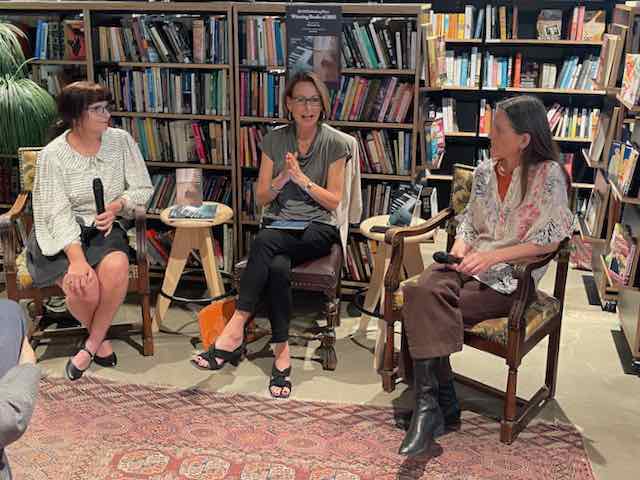
I can’t believe it’s been a year since I attended an ANU/The Canberra Times Meet the Author event, but this year has been packed. Finally, though, we were free on at the right time – and the event happened to be one of high interest for me, Melissa Lucashenko being interviewed about her latest book, Edenglassie. The interviewer was popular ex-radio journalist and well-known Canberra booklover, Alex Sloan.

I have posted on Lucashenko several times before, including on her Miles Franklin award winning novel, Too much lip. I don’t always hang around for book signings these days – do authors really like doing them? – but we thought we’d see how long the line was. It wasn’t too long, so I decided to hang around. When it got to my turn I told her that I loved that she could write with humour about serious things. It’s a skill. Quick as a flash, she signed my book “For Sue / Keep laughing/ Melissa Lucashenko”. It was worth lining up for.

The conversation

The event started as always with MC Colin Steele, acknowledging country and introducing the speakers. He explained that the title of Lucashenko’s latest book Edenglassie, comes from the name, combining Edinburgh and Glasgow, that was nearly given to Brisbane in early colonial times. He summarised the book as being about the “impact of loss of country” but also being a “novel of strength and love”.

Before getting into the conversation, Alex Sloan referred to the elders at Uluru and their request of us, the Voice, that we are now voting on in this weekend’s referendum – and asked us all “to do the right thing”. Problem is she was probably preaching to the converted.

I’m going to use first names, mostly, in the rest of the report where the alternative would feel too formal.

Alex started the conversation by referring to a review in The Guardian which described the novel in terms of its “flair, humour, generosity” and as being a novel about ongoing resistance. She then asked Melissa to share the origins of her novel.

Melissa commenced with “hello friends” and said she’d like to “extend good feelings to anyone touched by events in the Middle East”. There’s nothing much else she can say, she said, but “war crimes are never ok”.

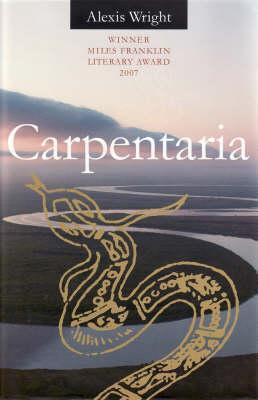
She then introduced her novel, describing it as a historical novel, with a contemporary thread to add some humour. She said it had grown out of the memoir she’d read of the Queensland “pioneer” Tom Petrie. She told an amusing story about being in London at the same time as Alexis Wright, then working on Carpentaria (my post), and as Peter Carey, who had won the Booker Prize with True history of the Kelly Gang. We are talking around 2001, I guess. Apparently, after they’d had a brief moment with Carey, Wright, who liked Carey’s book, also said that the problem was that Australians “write too many historical novels”.

Melissa took this to heart, and so her first three novels were contemporary novels. But, on catching up with Alexis Wright several years later, she reminded Wright of her comment. Wright looked at her, and clarified that she meant “white people write too many historical novels, not us”. Lucashenko went back to her historical novel interest!

Alex then moved the discussion on to place, noting the epigraph from Jean Rhys’ Wide Sargasso Sea. It comes from when the now locked-up Antoinette is told she is in England, and responds “I don’t believe it…and I will never believe it”. Lucashenko explained its application to her novel, to the fact that Australia is “aways Aboriginal land”. All her books are about place she said.

Alex asked about the novel’s first line, which describes Granny Eddie “falling, falling, falling”. Lucashenko said that besides Granny’s literal fall, it also alludes to an old woman “falling, falling, falling” in a Thea Astley* novel, and to the biblical fall.

Next, Alex turned to the novel’s love theme. Lucashenko said it has two love stories, one in each time period. Blackfellas are human too, she said, and deserve “love, joy and peace” like anyone else. I hate that she feels she has to say this. What sort of world do we live in? Anyhow, Alex described the historical lover Mulanyin as “hot, move over Mr Darcy”, she said. She asked Melissa to do a reading, which she did, from Chapter 8, when the historical section lovers meet. “Love at first sight,” said Alex.

The conversation moved from Mulanyin and his love interest Nita to the modern storyline and the character of Winona, who, Lucashenko said, is around 27 or 28, and “likes to tell it straight”. Alex asked her why she interlinked this modern story with the historical one, and the answer was clear and to the point. She wanted to counteract the trope of the dying race. It has been slowly changing since Mabo, but is still evident. Because of it, she never kills off her Aboriginal characters. She also wanted to balance feisty characters still here in 2024, who are talking back, with her historical figures.

From here, Alex asked Melissa about Edenglassie being a work of fiction. Lucashenko responded that although it was a work of fiction, she’d done a lot of research. She’d agonised on getting facts right, because she had Keith Windschuttle on one shoulder and Andrew Bolt on the other (an image that tickled Alex.) She knew her novel would be attacked because she was telling the story from a non-conservative position. Her historian friend reassured her, though, that “it’s all fiction” – a position I don’t disagree with. Melissa also shared Barry Lopez’s point that everything in life is “story and compassion”.

At this point we returned to the title. Lucashenko elaborated on Colin Steele’s intro, saying it had come from the Scottish Chief Justice Forbes who had established a property in NSW called Edenglassie, and had liked it so much that he tried to later give this name to Brisbane. It’s a great find for a writer. Lucashenko loved it with its “Eden” and “lassie” (for a feminist like her) references. 

In terms of the novel’s perspective, she said that at the time the historical part of the novel is set, the Aboriginal people, who were in the majority at that point, felt the whites would go away. This brought us back to discussing Mulanyin, whom Lucashenko described as brave, and a fisherman. She did another wonderful reading from early in the book, when he is taught some lessons by his elders, but taught in the way First Nations culture does it, which, as Lucashenko describes it, is “you go work it out”. In this case, the lesson involved honouring old ones and not being destructive out of greed. 

Lucashenko also explained that her idea for the novel had its origins in the fact that next year will be the bicentenary of white Queensland. She wanted to provide an Aboriginal perspective on the story but it developed into something more complex, that included love, and also encompassed the idea of “what could have been”. 

She talked quite a bit about Tom Petrie who had established a pastoral station with the permission of the local Aboriginal headman – in a location that was strategically chosen by that headman. The central question of the novel concerns “what was going through these people’s minds”. Things could have been different then, she said, and could still be now. There’s the paradoxical idea of British pluck and courage versus the facts involving murder, mayhem, theft. The conversation teased out several complex ideas about colonisation – attitudes to law, and to beliefs, for example. Lucashenko talked about pastoral workers being branded, and how that can be seen in two ways – it marks a person as a slave, but it can also work as protection (as in “don’t shoot me, I belong to Petrie”.)

Her story explores how colonisation could have been done differently. In Petrie’s case, for example, it was still colonisation, but the way he did it saved Aboriginal lives and partly at least protected their culture. I’m intrigued. Without having read it yet, I can see why she felt the need to prepare herself for attacks. (She’s been attacked before for her “non-conservative”, confronting exploration of difficult subjects.)

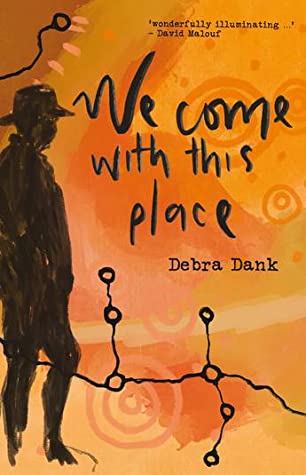
Alex talked about the section in the book where Mulanyin asks for permission to marry Nita. She felt it explained things about Aboriginal practices and beliefs that she had not known (which is how Debra Dank’s We come with this place impacted me, so I look forward to continuing that journey here.) Lucashenko then talked about the novel’s modern thread, about Winona confronting the wanna-be (my term) Aboriginal, and her upfront message to him. About this, Lucashenko said that “being harsh is not blackfella law” but there is also a “right way”.

Q & A

On what she learnt about herself through writing each novel: That she has stamina for writing, though not for much else. So, the lesson is, “Do what you are good at”! 

On not providing a glossary for words in language: Meaning can be understood with a little work; knowledge is best earned not given. (Love this.) 

On the novel taking four years: She has been writing this novel her own life, but serious research for it started in 2019, just before the fires, floods and pestilence!

On how Brisbane is affected by its history: All Australia is affected by colonisation, but in Brisbane’s case it was a brutal penal settlement, giving meaning to that phrase, “Another day in the colony”, which still has meaning today. Melissa talked about the question “Are you a monkey or an ape” experienced by an Aboriginal woman prisoner in Logan in 2014.

Vote of thanks

Lucy Neave (whose novel Believe in me I’ve reviewed), gave a sincere vote of thanks, which included thanking Melissa for the special readings from her book (there were three.) She described Edenglassie as a generous book, that’s “compelling, accessible, and meticulously researched”. It encompasses diverse values, she said, and shows what enormous value we can get “if we listen”. 

I would add thanks to Lucashenko for her gracious handling of occasional clumsiness from her questioners, because we whitefellas can be hamfisted at times.

* First Chris Flynn (Here be Leviathans) and now Lucashenko admit to the influence of Thea Astley. Love it

ANU/The Canberra Times Meet the Author
MC: Colin Steele
Australian National University
12 October 2023

Monday musings on Australian literature: Shortlist for the inaugural 20/40 Prize

Last November, I announced the creation of the new 20/40 Publishing Prize by the wonderful (and local-ish to me), independent, non-profit publisher, Finlay Lloyd. Now, eleven months later, the awarding of the inaugural prize is imminent, with the shortlist being announced last Friday and the winners to be announced on 28 October.

But, just to recap, 20/40 is a manuscript award, with the prize being publication. It is not limited to debut or young or women or any other subgroup of writers, as some manuscript awards are. However, it does have some criteria, in addition to looking for “writing of the highest quality”. The submissions can be fiction or non-fiction, must be prose (but “all genres … including hybrid forms” are welcome), and must be between 20,000 and 40,000 words (hence the award’s name, the 20/40 Prize). They aim to choose two winners, each year. In the communication I received last week about the shortlist, Finlay Lloyd publisher and commissioning editor, Julian Davies, says:

Our passion for creating this opportunity for writers and bringing their work to the reading public will continue next year and, we hope, for many more.

That’s great to hear … and we can do our bit to help by buying and reading the winning published novels.

And now, the Shortlist

You can read a brief description of the six works at the announcement link above, so here I will provide some brief author information that I have found online.

  • Roger AverillSlippage: freelance researcher, editor and writer, with four books published by Transit Lounge – Exile: The lives and hope of Werner Pelz (Lisa’s review), the memoir Boy he cry: An island odyssey, and two novels, Keeping faith and Relatively famous (Lisa’s review).
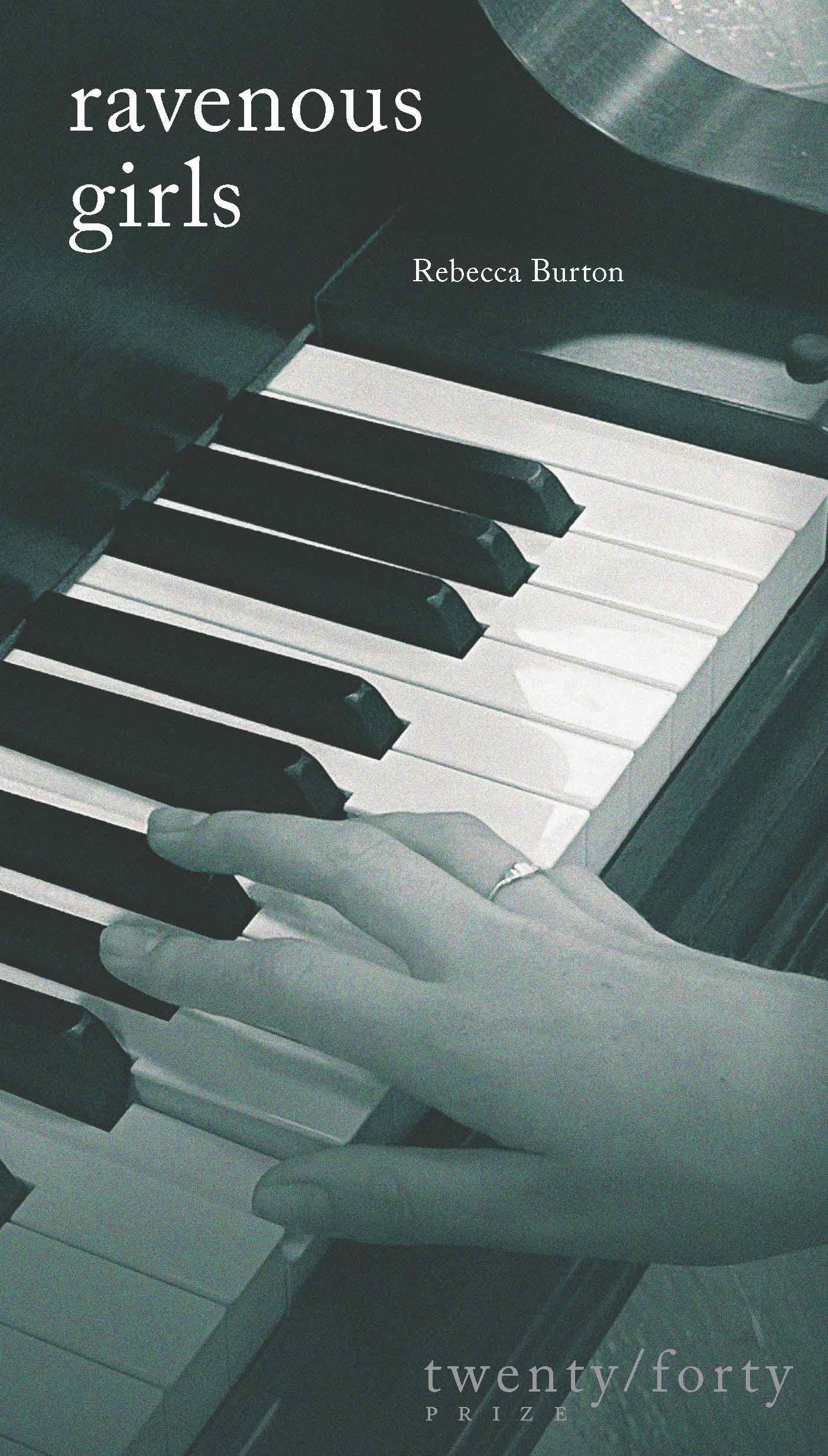
  • Rebecca BurtonRavenous girls: editor, and author of two young adult novels, Leaving Jetty Road and Beyond Evie, both published by HarperCollins Australia.
  • Rachel FlynnNew moon rising: author of children’s picture books and novels, including the I hate Friday series, published by Penguin.
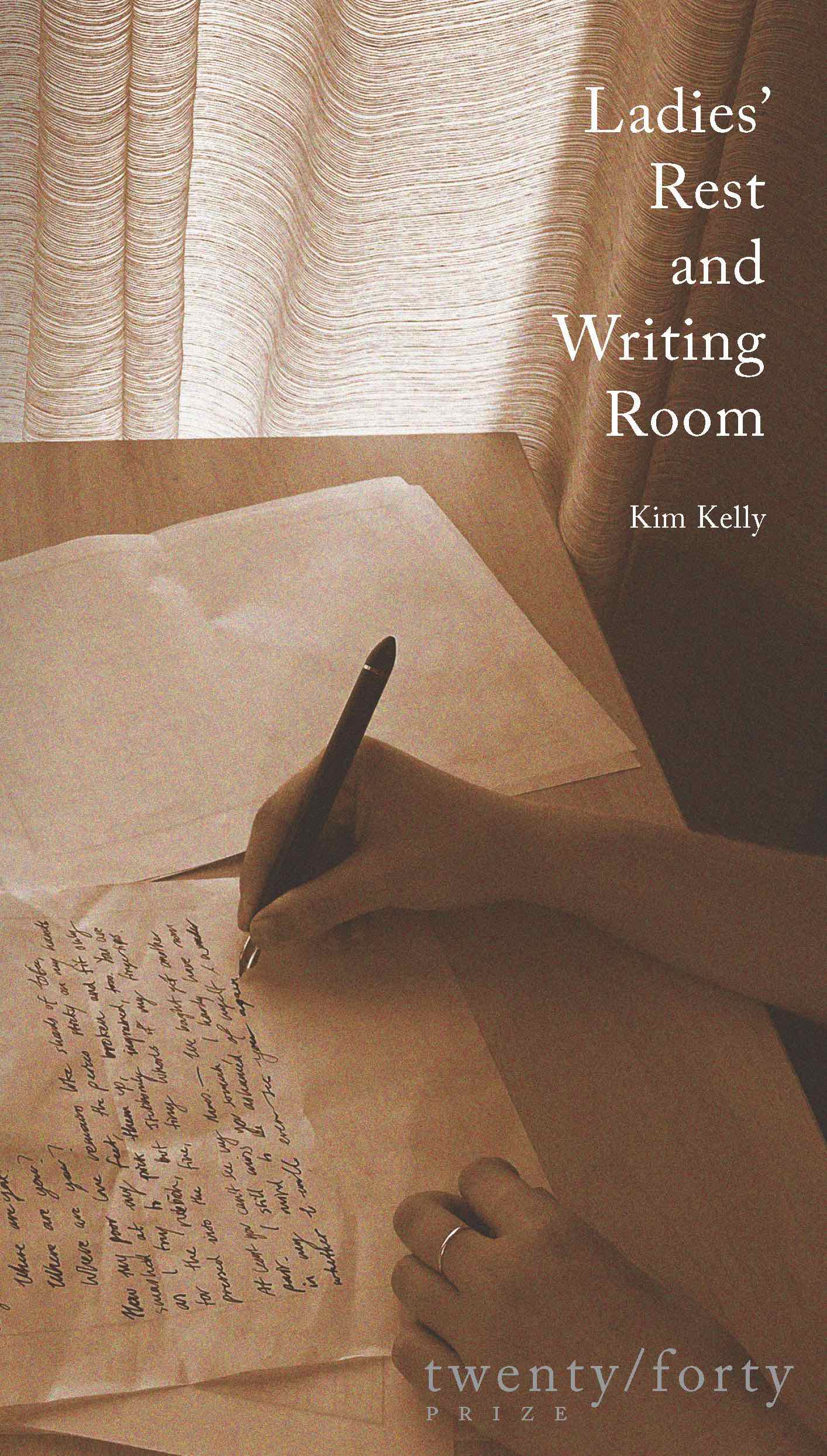
  • Kim KellyLadies’ Rest and Writing Room: author of 12 , mostly historical fiction, novels, most if not all published by Brio Books.
  • Jane Skelton, Breathing water: writer of poetry, short fiction and novels, published by Flying River Press, Rochford Press, Spineless Wonders and others.
  • Olivia De ZilvaHold on tight: writer and poet.

Julian Davies explains on the shortlist page that the works were judged blind.

The judging panel for the inaugural prize comprised Katia Ariel (author and editor), Christina Balint (whose novella, Water music, I’ve reviewed), John Clanchy (novelist and short story writer whom I’ve reviewed a few times), Julian Davies (the publisher and also an author whom I’ve also reviewed a few times), and Stefanie Markidis (writer and researcher).

When I first announced this prize last November, I noted its relevance to Novellas in November. So, I am thrilled about the timing of this announcement, because you can pre-order the two winning novellas at the Finlay Lloyd site, for a special discounted price of $43.20 (instead of $24 each). A bargain. And, if you’ve never read a Finlay Lloyd book before, you won’t be disappointed I’m sure in the artefacts themselves, as publishing good writing in beautiful packaging is what they do. Pre-ordered books will be shipped on announcement day, October 28, giving you time to read one or both by the end of November! I plan to.

Six degrees of separation, FROM I capture the castle TO …

Daylight savings started in my jurisdiction last week, and I am so happy. I love the longer end of days in summer, and not being woken so early in the morning. I am not so looking forward though to what this forecasted hot, dry summer might bring, but let us be hopeful… meanwhile let’s get to Six Degrees. If you don’t know how this meme works, please check host Kate’s blog – booksaremyfavouriteandbest.

The first rule is that Kate sets our starting book. In October it’s finally a book I have read, but long before blogging, Dodie Smith’s work of historical fiction, I capture the castle. I loved it when I read it as a teenager – who didn’t, really – but I’m going to share the Goodreads description: “Through six turbulent months of 1934, 17-year-old Cassandra Mortmain keeps a journal, filling three notebooks with sharply funny yet poignant entries about her home, a ruined Suffolk castle, and her eccentric and penniless family”. So, a lively coming-of-age story set in a castle.

For my first link I am, as last month, going obvious, again in deference to commenter MR, who wants logical links. (But it won’t last MR!) So, the link is another work with castle in the title, Jane Austen’s work of juvenilia, Lesley Castle (my review). Written when Austen was 16, it’s a comic novella that starts with letters sent by Margaret Lesley, from her Lesley Castle abode, complaining about her brother’s adulterous wife and her roué father running amok in London. It gets sillier from there!

Eleanor Dark's Juvenilia

My next link is on the juvenilia angle, and it’s to Eleanor Dark’s Juvenilia (my review) which was published by Juvenilia Press as part of their inspired program which uses juvenilia to teach the skills of “editing, annotating, designing and illustrating” a scholarly publication, thereby killing two birds with one stone (to use a cliché). I have reviewed several of their books, and have a few more to go – and they are still publishing.

Keeping to obvious links, my next one is on author’s first name. I have reviewed books by a few Eleanors but I want to leave Australia, so it’s to New Zealand author, Eleanor Catton’s The luminaries (my review) that I’m taking you next.

Hilary Mantel, Bring up the bodies

Catton’s novel is a work of historical fiction that won the Booker Prize in 2013. Another work of historical fiction won the Booker Prize the year before in 2012, Hilary Mantel’s Bring up the bodies (my review), so that is my next link. As I recollect, some naysayers didn’t like the emphasis on historical fiction in the shortlist when the first book in Mantel’s Cromwell trilogy, Wolf Hall, won in 2009, but clearly the judges took little notice of them!

As I’ve implied already, Bring up the bodies is the second book in Mantel’s Cromwell trilogy. My next link is another second book in an historical fiction trilogy, Pat Barker’s The women of Troy (my review). Just as an aside, the third book in Barker’s historical fiction Regeneration trilogy, The ghost road, also won the Booker, back in 1995.

BOok cover

And now, you know, to be a bit tricksy, my next link is to Peter Carey’s Amnesia (my review). Why, do you ask? Well, Pat Barker was born on 8 May 1943, and Peter Carey was born the day before, on 7 May 1943. Both have had stellar literary careers. But, one of the reasons I thought to end with this book is because I wrote in my review that I believed Carey wanted us to “maintain the rage”, to remain aware and vigilant of what is happening, and of whose fingers are in which pie. This is still relevant as politics becomes increasingly polarised and mired in misinformation. I’m not a conspiracist, but that doesn’t mean it’s not sensible to think about who is arguing what, and why, as well as about the argument itself.

We’ve rambled quite a bit this month across time and place, but hmmm, I have been rather one-sided in author gender this post, with just one male author bringing up the rear!

FINALLY: A little shout-out on Love Your Bookshop Day to my new (because I’ve moved) neighbourhood independent bookshop, The Book Cow. Not only is it friendly and helpful but it actively supports writers, especially our local ones. And not far down the road from there is the lovely Muse which I’ve written about several times here before and which also regularly runs literary events involving local and other authors.

Now, the usual: Have you read I capture the castle? And, regardless, what would you link to?

Susan Glaspell, A jury of her peers (#Review)

One of my retirement activities is to co-ordinate a little band of volunteer indexers at the National Film and Sound Archive. Not only do we do useful work for the Archive, but we get to socialise a little with our peers, meaning we talk about what we are watching, listening to, and reading. Recently, one of the team sent me a short story to read. He “raved” about it, he wrote in the accompanying email. Well, I have now read it and I’m mighty impressed too. It’s by an American writer and appeared in one of the those annual best short stories volumes, this one for 1917.

Susan Glaspell

The author of the story, as you will have worked out from the post title, is Susan Glaspell (1876-1948). I had never heard of her, but fortunately she has a decent-sized Wikipedia page which you can read, but I’ll give a brief summary here. She was a playwright, novelist, journalist and actress. Indeed, she and her husband founded America’s first modern theatre company, the Provincetown Players. Wikipedia then says, and I’ll quote because why try to paraphrase it:

First known for her short stories (fifty were published), Glaspell also wrote nine novels, fifteen plays, and a biography. Often set in her native Midwest, these semi-autobiographical tales typically explore contemporary social issues, such as gender, ethics, and dissent, while featuring deep, sympathetic characters who make principled stands. Her 1930 play Alison’s House earned her the Pulitzer Prize for Drama.

Wikipedia has much more to say but essentially, like many women writers, her star faded, partly Wikipedia says, because her “strong and independent female protagonists were less popular in the post-war era, which stressed female domesticity”. However, from the 1970s on – we all know about this revival don’t we – she started to regain traction. Now, she is recognised as a “pioneering feminist writer and America’s first important modern female playwright”.

All this might clue you in to why I so enjoyed her story.

“A jury of her peers”

Kindle ed.

“A jury of her peers” is quite a long short story, but it engrosses from the beginning because of how Glaspell slowly unfolds the story, incisively developing, as she goes, a number of ideas that still speak to us today. We readers work out fairly quickly what has likely gone on, but our fascination lies in how the two women protagonists come to their understanding of the matter, how they try to resist what they have intuitively guessed, and what they decide to do about it. Overlaying this are the assumptions made about them (and about women in general) by the men involved, which adds a social dimension to the moral one. It’s a wonderfully complex story. It’s no accident that the main action takes place in that women’s domain, the humble kitchen.

The story, according to Wikipedia again, was loosely based on the 1900 murder of a man called John Hossack which Glaspell covered while working as a journalist. She originally wrote it in 1916 as a one-act play, Trifles, for the Provincetown Players, before turning it into a short story. Later, it was adapted for an episode of that 1950s TV series, Alfred Hitchcock Presents, and into a 30-minute film by Sally Heckel in 1980.

The plot is simple. A farmer, John Wright, has been murdered, and his wife, the diminutively named Minnie, taken into custody, the day before the story’s action takes place. The story opens with Sheriff Peters and the county attorney Mr Henderson picking up the Wrights’ neighbour, farmer Mr Hale, who had called in the death the day before. Their aim is to visit the scene to look for evidence that might explain what had happened, that might provide a motive. In the buggy is the sheriff’s wife Mrs Peters who is coming along to collect some clothes for Minnie. At the last minute, Mrs Hale is asked to join them, at the request of Mrs Peters who appears to need some support in her sad task.

So, this band of five arrive at the Wrights’ “lonesome-looking place” and, while the men go in search of their evidence, the women remain in the kitchen-living area to get those items Minnie had asked for. As they do, they start to notice things around them – providing insight into Minnie’s life and state of mind – and slowly they piece together an understanding of what had happened. These two women don’t know each other well, so they are cautious with each other, sometimes moving “closer together” in solidarity, particularly when the men appear at intervals and invariably belittle women’s skills and knowledge, but other times drawing apart, uncertainly feeling each other out as they simultaneously feel out their own thoughts and feelings.

The practical farmer’s wife Mrs Hale increasingly senses what sort of life Minnie had led, and feels guilty, criminal even, about never having visited her, but she is uncertain about how the timid-seeming, law-abiding Sheriff’s wife is reacting. However, every now and then she catches in Mrs Peters “a look of seeing into things, of seeing through a thing to something else”. Eventually, they connect, “in a steady burning look in which there was no evasion, no flinching”.

It is so beautifully done, with barely a wasted word or description, with every interaction carrying weight, with perfect use of metaphor (involving birds, cages, and knots) and irony. It reminded me, just a little, of Pat Barker’s The women of Troy (my review), another story in which men underestimate women, to their detriment (though they may not always know it). And so, in this story, a number of issues are explored, including morality and natural justice versus the law; gender and men’s superior, condescending dismissal of women’s skills and knowledge; neighbourliness and guilt; and female solidarity.

“A jury of her peers” is a subversive crime story, one that wowed me, for its subject matter, particularly given the time it was written, and for its sure, unflinching writing. I’m impressed that it was chosen for an annual best anthology by a man – but perhaps that’s me being condescending now. Whatever! I would love to read more Glaspell.

Susan Glaspell
“A jury of her peers” (orig. pub. in Every Week, 5 March 1917)
in Edward J. O’Brien (ed.), The best short stories of 1917 and The yearbook of the American short story
Boston: Small, Maynard and Company, 2014
pp. 256-282
Available online at Hathitrust

Monday musings on Australian literature: Spineless Wonders

For a small, specialist, independent publisher, Spineless Wonders has appeared on my blog more times than you might expect, sometimes in passing, sometimes as the publisher of an author I’ve reviewed, and a few times in posts on publishing and publishers. All that, I’ve decided, has earned them their own post.

The first – and main – time I mentioned Spineless Wonders specifically was back in 2013 in a Monday Musings on Specialist Presses, in which they were one of five presses I chose to introduce. I said then that I thought they’d been established around 2011 – and I added an aside that I wished all organisations would include at least some history on their websites. Well, they have now confirmed on their About page that they were indeed founded in 2011 by Bronwyn Mehan.

Who is Bronwyn Mehan?

Like other keen Aussie litbloggers, I know the names of several publishing company CEOs (or directors or managers, or whatever they are called), particularly at the small presses, but Bronwyn Mehan is not one of them. So, I went searching, and didn’t find much, but there was something on SPN, the website for the Small Press Network. Her entry there is not extensive, but it tells us a few things. It says, not surprisingly, that she “looks for innovative ways to connect Australian authors with new audiences, collaborating with artists and organisations engaged in multi-media and performing arts”. “New” audiences is so important to those of us who believe in the value of the arts, isn’t it?

Anyhow, it also said that in 2018, she spent a month in New York as part of a Publishing Fellowship researching trends in multi-platform publishing. She has also been a peer assessor for the Australia Council Literature Board and in 2021 she took part in the Australia Council’s (now Creative Australia) Future Form program. As far as I can tell it’s a “leadership program” intended to help small to medium arts organisations “transform and innovate their core business model”. And that’s about it, except that I did read elsewhere that she also writes – short and long fiction, and poetry.

What is Spineless Wonders doing?

At the time of my 2013 post, they described themselves as being “devoted to short, quality fiction produced by Australian writers … [to] brief fiction in all its forms – short story, novella, sudden fiction and prose poetry”. And, as I explained, their name referred to the fact that they delivered their publications “to readers via  smart phones and laptops”, but they did (and do) also in print and audio forms. Since, then, however they have expanded further, to, in their words, “a short story production company working collaboratively with authors and artists across many disciplines to get short fiction out into the world – everywhere”.

What does this mean? These initiatives, from their About page, give you an idea:

  • Performed Fiction: Since 2014, they have produced something they call Little Fictions (originally known as Spineless Wonders Presents… a short evening of tall stories). They describe this as a “unique literary event” involving short stories being read by actors to a live audience. Inspired perhaps by poetry readings? In 2017, the City of Sydney invited them to produce a series of these for their Late Night Library program. Ongoing funding from this has apparently enabled them to create something they call Off the Page, which is a multi-media platform for performed short fiction. Sounds wonderful to me.
  • Storybombing: In 2016, they formed an interdisciplinary artists’ collective called #Storybombing, which aims “to find innovative ways to activate public spaces with short Australian fiction curated and produced” by themselves. Examples of the initiatives include stories spraypainted onto pavements, installed in retro pushbutton phones, or projected onto buildings. They say you can find examples on their #storybombing tab, but I see there’s nothing there since 2020 so maybe this is a victim of COVID.
  • Microflix: In 2018, they established the Microflix Awards and Festival, which aimed “to encourage more Australian filmmakers to use work by Australian authors, to reward excellence and creativity in film adaptations and to champion the importance of the writer, and the original text, in the filmmaking process”. Sounds great as short stories make perfect starting points for film. Just look, for example, at how many short stories by Somerset Maugham have been adapted to film. However, around 2021, this initiative ended, but they note on their website that they had partnered with SF3 to continue to encourage collaboration between writers and filmmakers.

What these initiatives tell me is that Spineless Wonders is an innovative company with a clear goal to support short (including micro and flash) fiction. It’s also clear that this is not easy, but that the company is active, flexible, and willing to pivot where they can to achieve their goal. The goal is clearly the thing.

If you look on their home page, you will see in their side-bar other activities and initiatives, like their Es-Press imprint, their work In Translation, and their Audio Lounge. It’s inspired and ambitious, though looking at the dates when things have happened, I suspect these things happen somewhat in fits and starts, but they are clearly exploring every angle they can to get creators works to readers, listeners, and viewers.

You will also see a link to Opportunities and Awards. These include a current call for “startling stories set in Sydney’s past” for Imaginative Recreation – Sydney. There are talks and masterclasses to help creators “invent stories drawn from the archives”, and submissions are due by midnight 17 December 2023. This is where you will also find the Carmel Bird Digital Literary Award, but it seems to be in abeyance at the moment. It was funded by the Copyright Agency. They did run again this year, though, their Slinkies Competition for writers under 30. This results in an anthology, and Slinkies 2023 can be pre-ordered now.

Meanwhile, though, Spineless Wonders continues to publish short stories, of which I’ve reviewed a few – two collections by Carmel Bird (The dead aviatrix and, most recently, Love letter to Lola) and the anthology The great unknown edited by Angela Meyer.

And, their YouTube channel has some current content, which provides another opportunity to get to know them.

My point overall, though, is that here is a publishing company working in a challenging form – short fiction – in a way that is inventive and always looking for new ways of reaching people. And, twelve years after being founded, they are still here.

Carmel Bird, Love letter to Lola (#BookReview)

In her prose piece, “Ocean of story” (my post), Christina Stead wrote that

It is only when the short story is written to a rigid plan, or done as an imitation, that it dies. It dies when it is pinned down, but not elsewhere. It is the million drops of water that are the looking-glasses of all our lives.

The stories in Carmel Bird’s latest collection, Love letter to Lola, could never be accused of being written to a rigid plan – and if you know Carmel Bird, you would never expect them to. What I so enjoy about Bird is the subversive way she plays with form and tone, while never losing sight of the things she wants to say – but more on that later. Love letter to Lola contains eighteen short stories, the majority of which have been published elsewhere, but mostly in niche or themed journals and collections. However, “The tale of the last unicorn” appeared in The dead aviatrix (my review), as did the titular “Love letter to Lola”, except that here Spixi’s letter earns response.

This new collection is divided into two main sections – Animals, comprising twelve stories, and Human and Angels, the other six. These are followed by a Reflection in which Bird discusses the inspirations for the stories, and much more besides, including, if you read it carefully, her thoughts on stories, writing and fiction. Ignore it at your peril! She tells us, in this last piece, that while the collection has “no primary overall topic … there is a fairly consistent kind of slant on life in general, and a distinct recurrence of themes, motifs, and propositions”. That there is, and in big picture terms, it involves “peering at life and death from different angles, in varying moods”, with a particular interest in “the wild and weird things humans do to undermine the safety of the planet”.

“inklings and threads” (“Two thirds of the truth”)

So, let’s start with the first section, Animals. The twelve stores are told in the voices of different animals, reminding me a little of Chris Flynn‘s Here be leviathans (my review). The animals, their locations and habitats, and their eras vary, but the subject matter all relates in some way to death, and, in several cases to a very particular type of death – extinction. Consequently, we have stories from, or about, a Spix’s macaw (“Love letter to Lola”), a passenger pigeon (“Resurrecting Martha”); a dodo (“The comeback or a pond of dreams”); and a thylacine (“Fertile and faithful”). In these stories, Bird plays with, among other things, plans by the “scientificators” to clone and return animals to existence, but in each one there is a different spin, drawn from the facts. Overall, there is a valid incredulity about the whole business, but the way Bird writes it through her various creatures is gloriously entertaining. Just read Dodo’s story to see what I mean.

“Fertile and faithful” is a good example of Bird’s playing with form and voice. It a distinct biblical look and tone to it, but the bite and wordplay are ever-present. She writes of plans by “delirious and magical scientists” to “grow a shiny new version of the great stripy animal within the being of a tiny little browny grey Sminthopsis, known as a dunnart”:

CHAPTER 3

8. And in the almost fullness of time the scientists became gods.

At the other end of the spectrum – hmm, is it the other end? – are the pathogenic creatures capable of playing havoc with the human race, like mosquitoes (“It’s a mosquito thing”), flies (“Surveillance”) and rats (“Completing the 1080 project”), not to mention that most reviled of creepy-crawlies, the cockroach (“The affair at the Ritz”). Then, there is the sad story of a spider, “Margaret Orb-Weaver, The Interview, 19 September 1922”, inspired by the small green spider seen crawling across a white card on Queen Elizabeth II’s coffin. This story takes the form of an interview with Margaret just before she descends into the vault on the coffin. In her brief moment of fame, Margaret manages to pass on a few truths. In this and other stories, like “The cockatoo’s question”, Bird, whose imagination runs rife while simultaneously being grounded in reality, reminds us of our contemporary ills, like the spectre of fake news, or our faith in money.

The second section, Humans and Angels, picks up more of Bird’s fascinations, fascinations that won’t be new if you’ve read other work by her, and particularly if you’ve read her bibliomemoir Telltale (my review). Through her love of fantasy and magic, and of weaving fact through her imagination, she further explores and shares her thoughts about the weird and disturbing things that humans do – and with the same sophisticated wit that we experience in Animals.

I loved “Yes my darling daughter” with its cheeky, pointed playing with the idea of wolves and sharks, and the dangers confronting young women. The chatty tone, as in so many of the stories, belies the message, but if you miss it, the “helpful quotations” at the end should see you straight.

Our last speaker is Beau, the Recording Angel (“Recording Angel”) who leads us on a merry dance (or, danse macabre, perhaps) through the island of Nevermind, referencing, presumably, humans’ general apathy. As he does so, he tells various stories including those of two young historical figures, “Walter’n’Matilda”, who suffer tragic deaths but find true love in Nevermind. If, as our angel instructs, you put their two names together quickly, you might catch a hint of a popular Australian song – and thereby catch some of the workings of Carmel Bird’s mind.

The delight of reading Carmel Bird is also the challenge. The delight comes from the playful way she digresses, the way she can allude to, or reference, anything from a children’s picture book to a Greek philosopher to the latest work of scientists, or even to her own characters and works. The challenge is how many of these we pick up because Bird‘s mind is not our mind and her reading is not our reading. But it doesn’t really matter because we are sure to pick up enough of the inklings and threads woven throughout to recognise the things Bird would like us to think about – seriously but with hope in our hearts too.

But again, if you are struggling, there are the four epigraphs which provide the perfect guide to how to approach her stories and what we should expect as we read them. Pure gold.

If you haven’t realised by now, I love reading Carmel Bird. Her “endless search for meaning”, as she describes it, is wrapped in the sort of darkly entertaining writing that I can’t resist. It is the sort of writing I can happily read again and again – with the same expectation that I read Jane Austen. That is, both writers can make me laugh and squirm at the same time, which for me is just right.

(Review copy courtesy the author, but copies are available from Spineless Wonders. Yes, Carmel Bird herself sent me this book, but that is not why I loved it. It made me do that all by itself.)

Carmel Bird
Love letter to Lola
Strawberry Hills: Spineless Wonders, 2023
223pp.
ISBN: 9781925052961

Monday musings on Australian literature: Introducing Uninnocent landscapes

You heard it here first – or, first(ish) anyhow, as the webpage is up and orders are already coming in for a new, beautiful book, Uninnocent landscapes: Following George Augustus Robinson’s Big River Mission. Yes, I admit it isn’t out yet so I haven’t actually seen it, but I know it is beautiful because I’ve seen some of the content over the years, and I’ve seen the cover on the website. It looks stunning.

Of course, I’m biased because the creator is my brother, Ian Terry. However, it goes without saying that I wouldn’t be writing this if I didn’t feel his project was worthwhile.

So, the project … Ian introduces his motivation on the publisher’s website:

Without invasion, colonisation and the near destruction of lutruwita’s First People, without Robinson’s ‘Friendly Mission’, I would not have had the opportunity to feel so much at home on this island. This is a reality that, as much as we might try to ignore it, non-Indigenous Tasmanians cannot escape. How do we come to terms with our privilege and its Janus face, the violent and continuing dispossession of palawa/pakana?

Now, Ian’s last job before retirement was a senior curator of history at the Tasmanian Museum and Art Gallery, during which time, among other things, he mounted exhibitions on First Nations history. He has, for nearly three decades, been an active and contributing member of THRA, the Tasmanian Historical Research Association. History was his undergraduate major, and in the early 1990s he complemented these studies with a Graduate Diploma in Cultural Heritage Management, after which he began working as a freelance history consultant – in lutruwita/Tasmania. History, you could say, is in his blood – and was not going to stop flowing after he retired. Enter the project …

But first, I need to add that in addition to his love of history, Ian has been a photographer since early adulthood. Way back in the the fall of 1983, he joined Mr Gums and me on a road trip through New England and Eastern Canada. We all took photos, but Ian was the one who would climb the hill behind the gorgeous white-spired church, or run across the bridge to the other side of a pretty river, to get the best shot. That interest has never waned and he has honed his skills to the point that he is now achieving recognition in photographic competitions.

This project, which involved his following the steps of George Augustus Robinson’s 1831 Big River Mission (brief description), combines these two passions. It has required historical research to identify Robinson’s movements and actions. It also called on Ian’s negotiating skills when, for example, he needed to enter private property to take the desired photos. It used his well-developed bush skills when he needed to explore more difficult landscapes. And, it depended on his photographic skills because photographs form the core of the book.

Of course, Ian’s tracing of Robinson’s path was not aimless. As the above-linked publisher’s website says, he had various questions in his head as he worked through his project, questions like

What memories do the landscapes of lutruwita/Tasmania hold? What stories are embedded in the rocks, the trees and grasses, the waters of rivers and lagoons? What could the landscape tell us about invasion, colonisation and the destruction of First People’s life and culture? What could it tell us about our own lives here on this island?

Uninnocent landscapes, the book, comprises a selection of Ian’s photographs documenting the landscape in a way that also expresses his ideas about it. It also contains an introduction by Tasmanian art historian, curator, essayist and commentator on identity and place Greg Lehman (a descendant of the Trawulwuy people of north-east Tasmania), and four essays, one by him and three he commissioned from:

  • Rebecca Digney (manager, Aboriginal Land Council of Tasmania)
  • Roderic O’Connor (woolgrower and Connorville custodian)
  • Nunami Sculthorpe-Green (activist/artist and proud palawa and Warlpiri woman)  

I can’t wait to see and read it – and, isn’t it a great title?

Ian with our mother, 2017

But wait, there’s more … there is also Uninnocent landscapes, the exhibition. It will feature large-scale archival prints from the book, and will be held in the Sidespace Gallery at Salamanca Arts Centre in nipaluna/Hobart from 2–14 November 2023. I will be there at the opening.

Uninnocent landscapes is published and distributed by OUTSIDE THE BOX / Earth Arts Rights under their imprint An Artist’s Own Book, and will be available from early November. It costs $65, and all proceeds will go to the Aboriginal Land Council of Tasmania’s Giving Land Back fund. You can preorder here.

To fully disclose: Ian did not pay (or even ask) for this announcement, but he is accommodating me (I hope) on my trip to lutruwita to attend the exhibition opening!