Australia’s first Arbor Day

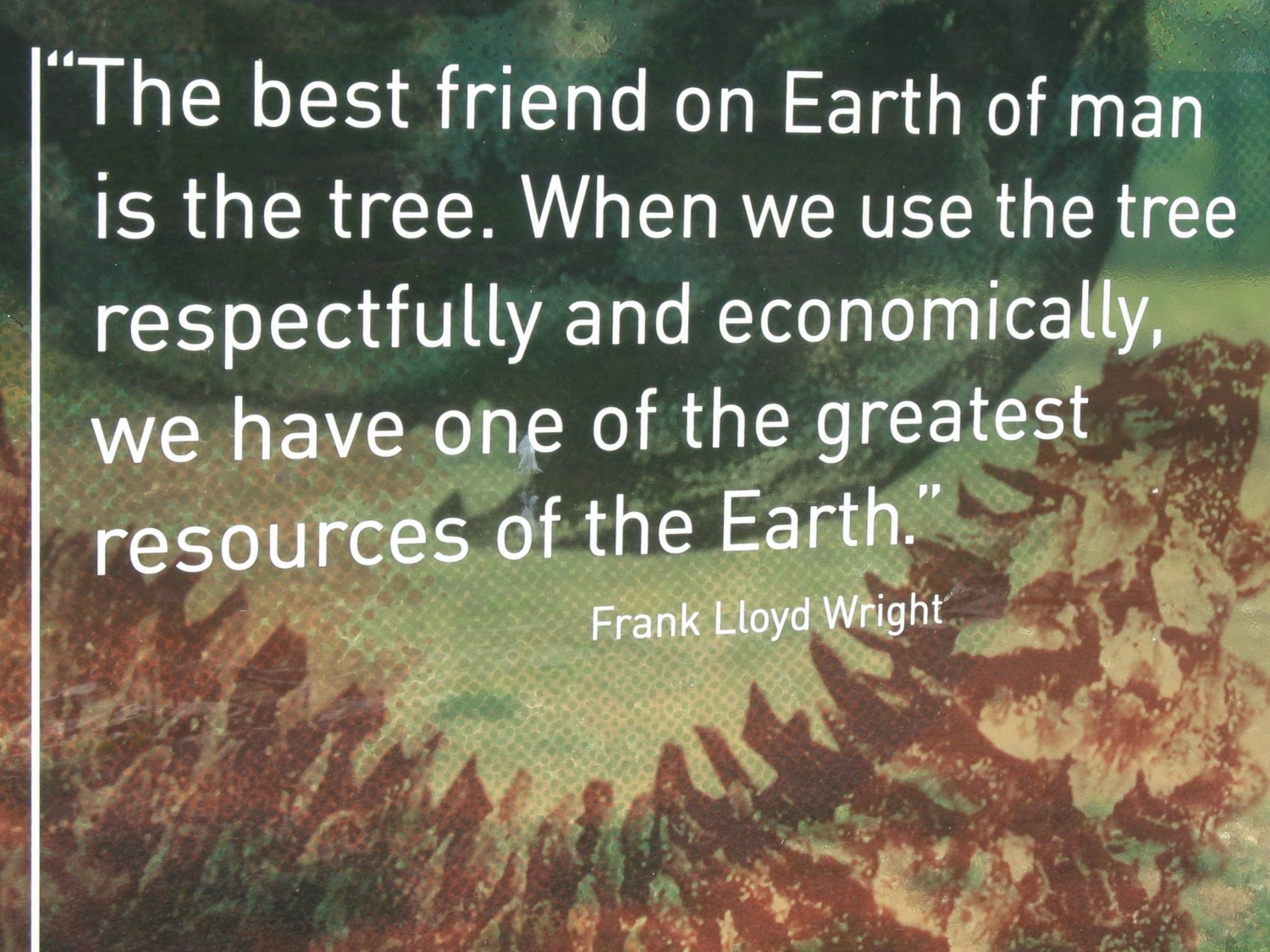
Frank Lloyd Wright tree quote
At the National Arboretum, Canberra

Do you ever wonder what a few generations hence will think about the way we do things? About how we put on our festivals and celebrations? Whether they will think how silly we look – and, I don’t mean “silly” in the ways we may have intended but “silly” in the sense of “cute” because, well, we just weren’t sophisticated like they are? I often do, and it came to mind again when I read last week about Australia’s first Arbor Day.

This post is a little out of the ordinary for me. It’s not (really) about a literary work and neither is it about a cultural event I’ve attended, but it is inspired by the Library of America story “About trees” that I reviewed last week. As I read that story, I was reminded of celebrating Arbor Day when I was young. So I did some research in the National Library of Australia’s Trove and discovered an article titled “Our first Arbor Day” in the South Australian Register of 20 June, 1889. What a little treasure it turned out to be!

First though, a brief history. While J Sterling Morton instigated Arbor Day in the USA, in Nebraska, in 1872, the first Arbor Day actually occurred, according to Wikipedia, in Spain in 1805 in a little village called Villanueva de la Sierra. It was the brainchild of a local priest who believed in “the importance of trees for health, hygiene, decoration, nature, environment and customs” (Naturalist Miguel Herrero Uceda). It came to Australia in 1889, though I was entertained to read in Prime Facts, published by the NSW Department of Primary Industry, that Australia’s first Arbor Day occurred 1890. Not so! That may have been the first in the east of the continent, but our first one did take place a year earlier.

The author of “Our first Arbor Day” tells us a bunch of interesting things about trees – about liberty trees and memorial trees in France and the USA, about the tree of knowledge and tree worship, and about the Town Clerk of London who created an avenue of trees in memory of the criminals “at whose executions he had assisted”! Our author continues that no encouragement to plant trees is needed in South Australia as:

The forestry influence is happily strong upon us in South Australia, and we are inclined to regard the man or boy [this is the nineteenth century I suppose!] who plants a tree in the light of a benefactor of the human race.

Good to hear! What’s interesting though is the type of trees named:

It would be a good thing to have the waste places of the colony covered with planes, or oaks, or pines, or whatever trees are best adapted to the condition of the case.

Hmm … it seems as though native trees weren’t considered as being “best adapted” for the place! Who said we were anglo-centric?

Our writer, like J. Sterling Morton, also recognises the relationship between trees and climate, stating that “the presence of trees tends to modify the climate”. S/he therefore approves of Arbor Day, and particularly of involving children, as it will “inculcate in them a conviction of the importance of the science of forestry.”

And this brings me back to the beginning of this post and, in fact, to the beginning of the article I’m discussing, because the article opens with a description of the tree planting ceremony in Adelaide. It went like this:

The Adelaide children start with a great flourish of trumpets from Victoria-square. Each school will be preceded by its band. The singers go before, the planters – who are to be decorated with rosettes – follow after. When the procession arrives on the ground the elect children, who are to plant trees, will be separated from their less favoured brethren. The schools will be divided into ‘squads’ — the planting squad and the non-planting squad. The planting squad is to be arranged with due care — one child to each hole. It may be hoped that a certain amount of fitness will be observed, and that every square hole will command the attendance of a square child. When the word is given, the trees will be planted, a great celebration will be over, and the children of the schools will have received a lesson on the value of arboriculture.

Can’t you just see it? The band, the singers and all those rosette-wearing, favoured, square children next to their square holes? The pride is palpable – just as we are proud today of our public events and ceremonies. Will we look as earnest and quaint to our descendants, do you think? Probably!
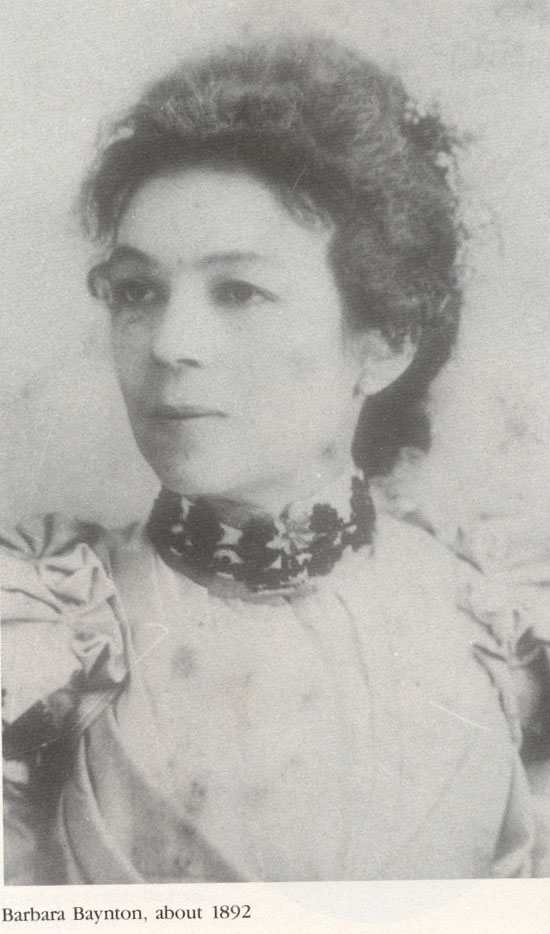
 

Monday musings on Australian literature: Barbara Baynton

Barbara Baynton 1892

Baynton 1892 (Presumed Public Domain, via Wikipedia)

It’s a while since I’ve devoted a Monday Musings to an individual author – my last being, I think, Jessica Anderson back in February 2012 – and so I thought it was high time for another one, if only to mix the series up a bit! My choice for today is – well, you know who it is from the post’s title – Barbara Baynton. She is a worthy subject for several reasons. Let me count the ways. Firstly, she does not, outside of academia at least, receive the attention she deserves. Yes, she can be a little challenging to read, particularly in her use of the vernacular, but she was quite a pioneer in the subjects she discussed and in bucking some of the male traditions of her time regarding writing about the bush. Secondly, she was an interesting person worth knowing a little about. And thirdly, I recently finished reviewing the short stories in her collection, Bush studies. Baynton only published two books: Bush studies in 1902, and a novel, Human toll, in 1907. She did write stories, poems and articles after this, but there were no more books.

Rags to riches girl

So, who was this Barbara Baynton? It appears that she was pretty good at covering her tracks – at least earlier in her life. In a 1980 review of Barbara Baynton (Portable Australian Authors series), author Marian Eldridge wrote that the editors had cleared up the mystery surrounding her origins. This mystery was further clarified in a biography written in 1989 by her great grand-daughter, Australian actress, Penne Hackforth-Jones. Baynton was born in the Hunter region of New South Wales in 1857, and was married three times. She divorced her first husband, with whom she had three children, after he repeatedly left her isolated when he was “a-droving and a-drinking” (Ralph Elliott reviewing Hackforth-Jones’ book). In fact, he ran off with her niece. At this point, Baynton moved to Sydney where she, aged 33, married the 70-year-old wealthy doctor Thomas Baynton, who had employed her as a housekeeper. It was during this time of material comfort that Baynton started to write about the harsh life of the bush. After Thomas Baynton died in 1904, she moved to London with her daughter and it was here, wrote Hackforth-Jones, that “she rubbed out bits of her past she didn’t like and substituted the ones she did”, creating for herself quite an ancestry. During the war, she was generous to Australian soldiers, apparently lodging, overall, some 8,000 during their leave. On a visit to Australia in 1920, she spoke of the pain experienced by Australian mothers whose sons were sent to other side of the world:

Those mothers had not the wonderful hours when their sons were on leave. Their boys were strangers in London, and I know no lonelier place on this earth than London for the uninitiated. It is the Gethsemane of loneliness.

Many years later, in 1921, she married Lord Headley. Elliott writes that Headley was “a Muslim convert, engineer, sportsman” who “needed money for his decaying Irish estate.” Baynton, on the other hand, “coveted the coronet”. This marriage did not last long and ended in divorce. She returned to Australia, one last time, in 1928, and died in 1929.

Subtle like Proust, grim like Gorky!

Researching this post, I came across some interesting contemporary (or near-contemporary) assessments of her work. One, by Australian poet, essayist, critic and literary mentor, Nettie Palmer, appeared in the Brisbane Courier of 15 June 1929, a couple of weeks after her death. Palmer analyses Baynton’s writing, quoting a passage, and arguing that:

Baynton shows that there is no end to subtleties of human and even sub-human intercourse. The implications of that passage … make a scene as subtle as something in Proust.

Proust, eh? I’m afraid I don’t know Proust well enough to comment on that, but it’s an interesting comparison. Baynton is determined, she says, “to record the varied strands in our human nature” even though “her actual figures are usually derelicts in some forgotten corner of a bush that she shows as without comeliness”. She then writes that Scottish writer RB Cunninghame Graham likened her to contemporary Russian writers like Maxim Gorky (1868-1936) who was determined, according to Wikipedia, to “write the bitter truth”. That certainly sounds right! Take, for example, this contemporary review of Human Toll:

As a study in character of the morbid kind recent fiction has nothing to show equal in impressiveness to this picture of the beautiful, strenuous, high-wrought Ursula.

That was in 1907. In 1931, another unidentified writer is somewhat critical of Baynton’s grim realism, comparing her and Price Warung (see my review of his collection, Tales of the early days) with Henry Lawson and EG Dyson. Baynton and Warung, this writer says, “have not their breadth of vision, although they have a compensatory intensity to some extent”. Hmm … that “to some extent” rather reduces what little compliment there is in this statement, doesn’t it? This writer continues that:

“The Bulletin” encouraged the presentation of the raw and ruddy in bush sketches as an antidote to the sentimental. Yet it is no truer art to exclude the gentle and gracious side of life in the name of realism than to obliterate the harsh and repellant in the name of the romantic. Barbara Baynton is a grim realist, and her “Bush Studies” are powerful but unpleasant.

Who said, one could ask, that art must be pleasant? For this 1931 writer, Baynton’s story “Squeaker’s mate” (my review) is “more gruesome than Gorky”, and “The chosen vessel” (my review) “raises the question of art and the horrible”. Baynton, s/he says, paints “the backblocks in the colours of hell”. S/he would much prefer Henry Lawson’s more “human” stories. But, Lawson could be sentimental, as Marian Eldridge argues. You could never accuse Baynton of that!

But wait there’s more …

I can’t leave this brief introduction to Baynton, without mentioning something rather surprising – her anti-suffrage stance, which was mentioned in a couple of the articles I read. Indeed, one specifically commented that she would stand on a tub in Hyde Park to argue her case! So, I delved a little deeper, and found a recent article by Lucas Smith at sheilas.org.au. He tells us that she was one of the first women to divorce in the colony after laws were passed allowing women to file. And she was able to inherit Baynton’s estate in her own name because inheritance laws had recently changed. She was an independent woman. And, her stories demonstrate the awful powerlessness of women. So, why anti-suffrage? Well, Eldridge found the following statement by her in the Sydney Morning Herald in 1911:

It may sound disloyal to my sex, yet, it is a common truth; show me a woman in power, and I will show you a despot. Indeed, in my anti-suffrage canvass in London, my surest and most successful weapon was to just ask shopgirls, “Would you rather have a woman over you than a man?”

Oh dear … so simplistic, and unfortunately there is still an element of this attitude today. Anyhow, Smith concludes his article with a good question – and I’ll end my post with him:

She benefited from women’s rights struggles at every stage of her life – her divorce and her inheritance were the result of collective struggle – yet she seemingly never recognised this fact. Bush Studies portrays the fear and helplessness of early women settlers in a male-dominated colonial Australia better than any other book, yet Baynton was opposed to female suffrage, arguably the single-most important achievement of the modern women’s movement. Where is the line between the personal and the political drawn? This is the question Baynton’s story forces us to think about.

It sure does …

J. Sterling Morton, About trees (Review)

One of the first Library of America stories I wrote about here was John Muir’s “A wind-storm in the forests“, so when I saw one titled “About trees” pop up recently, I had to read it. By recently, I mean April – as the Library of America published it to coincide with Arbor Day in the US which occurs at the end of April. J. Sterling Morton is credited as the originator of “this tree-planting festival” – in 1872.

JS Morton, ca 1890s (Presumed Public Domain, via Wikipedia)

JS Morton, ca 1890s (Presumed Public Domain, via Wikipedia)

According to Wikipedia, J. Sterling Morton (1832-1902) was a Nebraska pioneer, newspaper editor and Secretary of Agriculture for President Cleveland. According to LOA’s notes, Morton and his wife moved in the mid-1850s “to a bare, windswept 160-acre homestead in newly incorporated Nebraska City”. This is when, LOA says, his “mania for tree-planting” began. I don’t know much about Nebraska – and what I do know has come from Willa Cather’s novel My Ántonia (my review), which was published in 1918 but set around the 1880s. The landscape Cather describes in that novel rings true to LOA’s description of Morton’s Nebraska. Anyhow, like other successful pioneers, Morton gradually expanded his original small house into something much larger – in his case, a replica of the White House, no less! His estate is now the Arbor Lodge State Historical Park and Arboretum.

Now to the article, “About trees”. It is, LOA tells us, the prefatory chapter in a pamphlet titled Arbor Day Leaves that was compiled in 1893 by the chief of the US Forestry Division, Nathaniel Hillyer Egelston. It was intended as “a complete programme for Arbor Day observance, including readings, recitations, music and general information”. Some pamphlet, eh?

Morton starts by praising trees as:

the perfection in strength, beauty and usefulness of vegetable life. It stands majestic through the sun and storm of centuries. Resting in summer beneath its cooling shade, or sheltering besides its massive trunk from the chilling blast of winter, we are prone to forget the little seed whence it came. Trees are no respecter of persons. They grow as luxuriantly besides the cabin of the pioneer as against the palace of the millionaire.

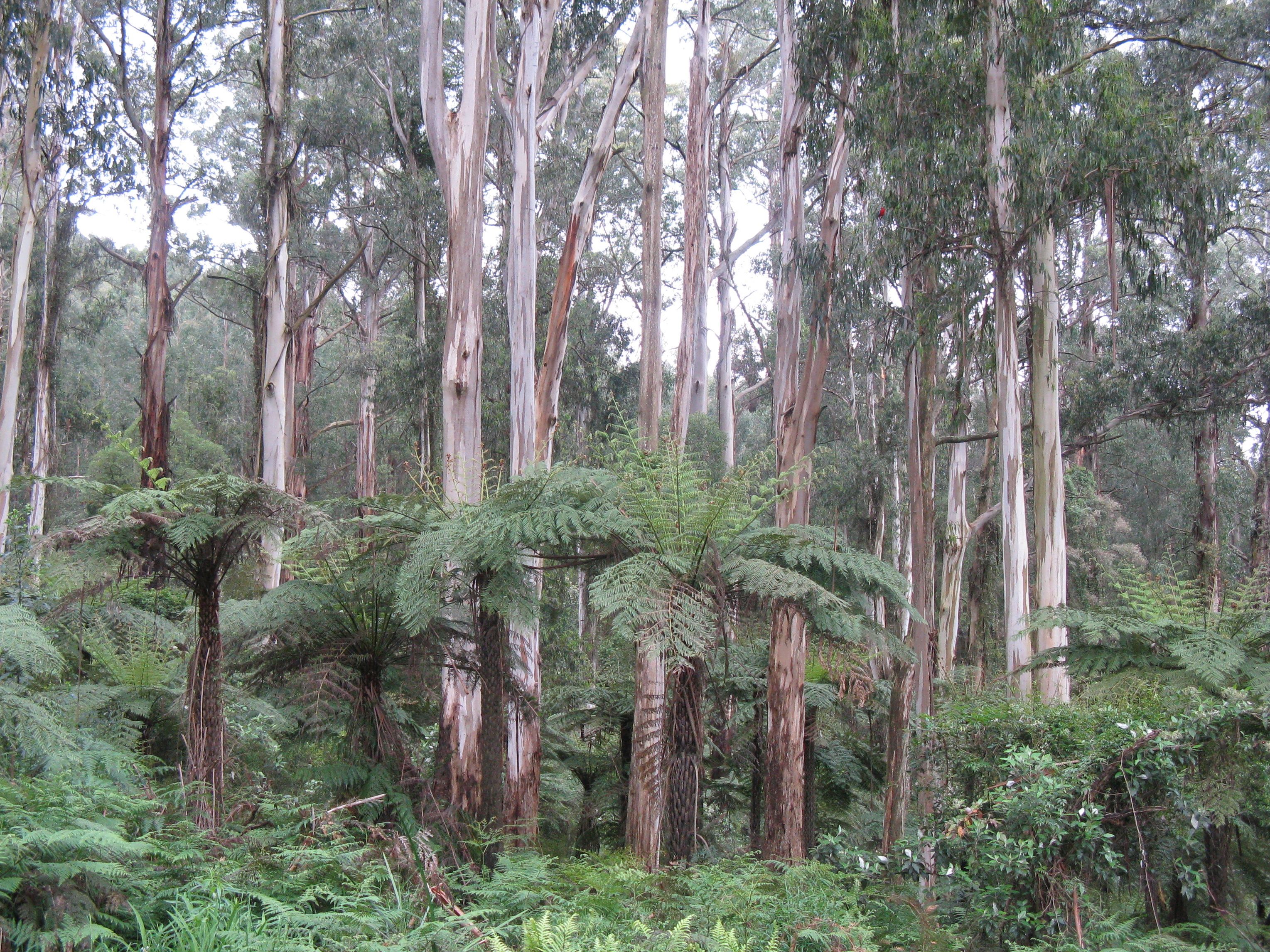
Sherbrooke Forest and Eucalyptus regnans

Sherbrooke Forest (Vic) and Eucalyptus regnans

He says trees are “living materials organised in the laboratory of Nature’s mysteries out of rain, sunlight, dews and earth”, and are the result of a deft metamorphosis. He explains this metamorphosis by telling us more specifically how an oak grows from a planted acorn, and how the earth, through the roots, provides food such as phosphates while:

foliage and twig and trunk are busy in catching sunbeams, air, and thunderstorms, to imprison in the annual increment of solid wood. There is no light coming from your wood, corncob, or coal fire which some vegetable Prometheus did not, in its days of growth, steal from the sun and secrete in the mysteries of a vegetable organism.

I love the John Muir-like romantic prose here! Animal and tree life are, he says, interdependent. Trees are “essential to man’s health and life”. Without vegetable life and growth, animal life would be exterminated:

When the last tree shall have been destroyed there will be no man left to mourn the improvidence and thoughtlessness of the forest-destroying race to which he belonged.

It’s worrying that over a century later, we have Australian Prime Minister Tony Abbott stating that “We have quite enough national parks. We have quite enough locked up forests already. In fact, in an important respect, we have too much locked up forest.” (For one academic’s assessment of the issue, check out forest ecologist Rod Keenan’s* article,  “Abbott’s half right: our national parks are good but not perfect”, at The Conversation.)

Morton argues that “in all civilisations man has cut down and consumed, but rarely restored or replanted, the forests”. In some parts of the world, this has changed, due largely to initiatives like Arbor Day, Earth Hour, not to mention the creation of national parks and reserves. Of course, replanting with (obviously) new trees does change the ecological balance and no matter how carefully managed it is, it is based on knowledge that we know is imperfect. Better then, as much as possible, to preserve forests and let them renew naturally – or so it seems to me!

Anyhow, Morton concludes by reaffirming the importance of planting trees “to avert treelessness, to improve the climatic conditions, for the love of the beautiful and useful combined”.

Arbor Day is, he says

the only anniversary in which humanity looks future ward instead of past ward, in which there is a consensus of thought for those who are to come after us, instead of reflections concerning those who have gone before us. It is a practical anniversary. It is a beautiful anniversary.

When Arbor Day Leaves was published in 1893, forty-four of the USA’s then forty-eight states observed Arbor Day (and by 1920s all states were practising it). What a great legacy.

Later this week, I will post on Australia’s first Arbor Day … watch this space.

J. Sterling Morton
“About trees”
First published: in Arbor Day Leaves (ed. N.H. Egelston), 1893
Available: Online at the Library of America

* I’m no expert, and Rod Keenan is not the darling of all environmentalists, but he offers a reasoned perspective.

On Howard Goldenberg writing about indigenous matters

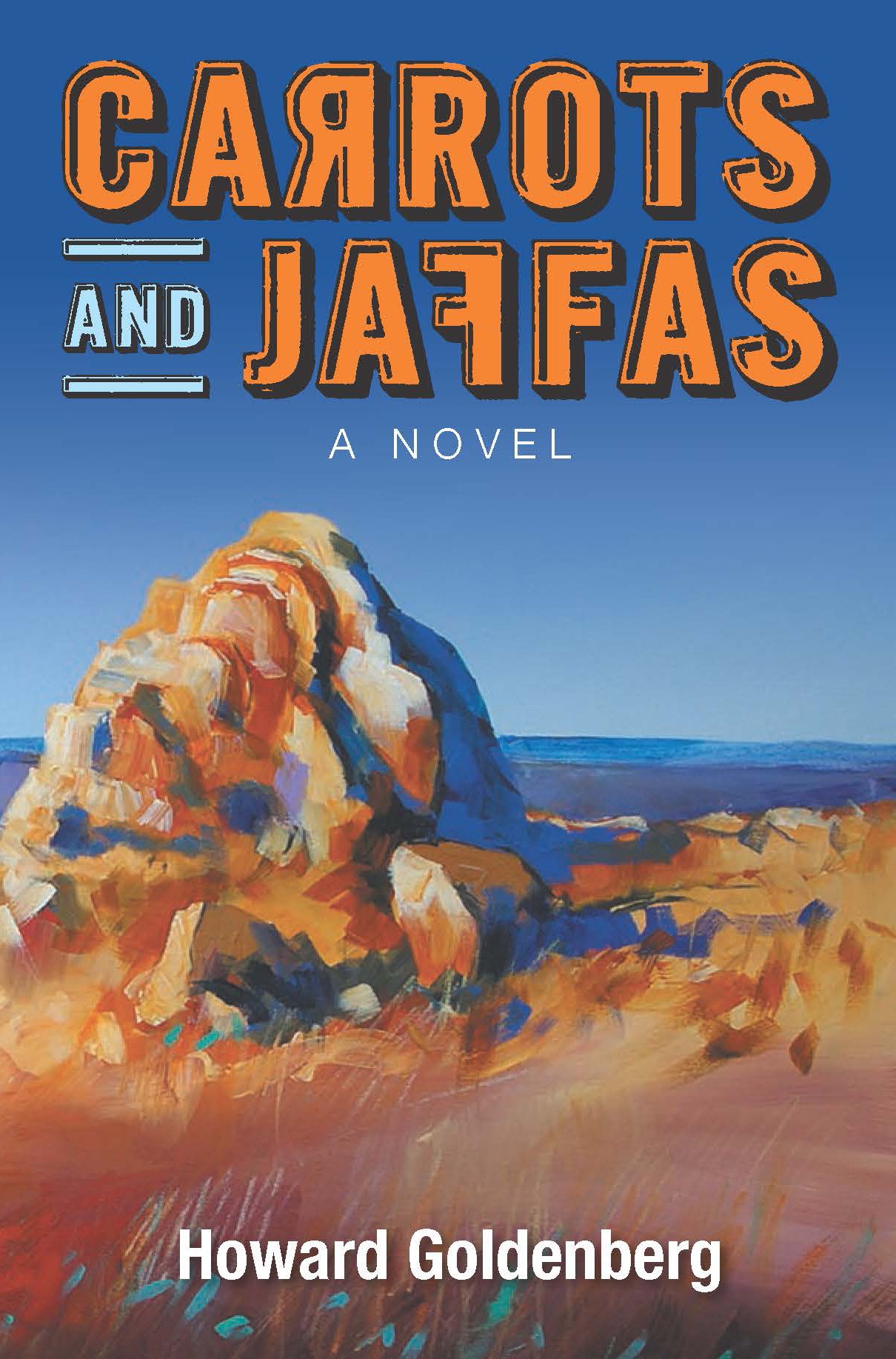
Howard Goldenberg, Carrots and Jaffas

Courtesy: Hybrid Publishing

It’s funny how reviews go, at least how mine go anyhow. They sometimes head me off in a direction quite different to the one I started and I feel powerless* to change it. That happened with my recent review of Howard Goldenberg’s novel, Carrots and Jaffas. I started by mentioning the issue of white writers writing on black subjects but ended up focusing on the main issue in the novel that grabbed me – suffering and loss. But this is where it’s great to be a blogger: I can just write another post. I am my own boss after all! Consequently, in this post I plan to return to that opening point and discuss how Goldenberg writes about indigenous issues. I’m a bit anxious about it, however, as here I am, a white blogger writing about a white writer writing about black subjects. How far removed is that? You must read, therefore, what I say from that point of view – a non-expert who thinks the issue needs to be kept on the table.

Goldenberg has tried a tricky thing. He has taken the issue of the stolen generations and spread it out in a few directions. He’s taken the universal issue of traumatic, sudden loss (of children, siblings, parents), which is what I focused on in my review, and used it to provide readers with an entrée into the very particular loss experienced by those affected by the stolen generations policy. He has revolved his plot around the abduction of a white child to provide a parallel with the large-scale abduction of indigenous children. And he has placed the abducted child in an indigenous setting, enabling him to explore different responses to land or country, which is what I want to discuss here.

Three of the book’s characters are significant to this aspect of the novel. Goldenberg takes pains early in the novel to individuate the twins, describing Jaffas as interested in music, dance, beauty, as an “infant aesthete”, while Carrots is active, “exuberantly physical”. It is Jaffas who is abducted, the one more likely to be responsive to what Goldenberg has planned for him! Then there’s the indigenous woman, Greta. Goldenberg introduces us to her before she meets Jaffas, establishing her as a nurturing woman. She has brought a very sick baby, her great-niece, to see Doc, our third character. He observes her with the baby, noticing that she “crooned soft words in language, words to hold her safe”. As for Doc, we meet him just before we meet Greta. He too has suffered a loss, when his loved young sister was taken overseas by his father as the result of divorce. He’s been researching bowel infections for decades and has now gone bush to help prevent Aboriginal babies dying from diseases like dysentery.

Through these three characters, Goldenberg explores different ways of relating to our land, specifically in this case, the rock country of the Flinders Ranges:

The doctor set out early. The sun blessed its morning favourites – western peaks, taller treetops, selected folds of hill. Here and there, narrow beams probed gaps in the ranges and dowered the lower slopes with gold.
Greta shows Jaffas how to make fire, and catch goannas. She teaches him about her Dreaming by telling stories that were passed down to her:
Warraiti, you call him emu, you know? Very strong spirit. Warraiti, he the Law Man. He protect the Law. Plenty mob – blackfella mob, whitefella mob – eat warraiti, but not me. Never me. Warraiti, he my dreaming, my father …

Doc tells Jaffas that he is in the Flinders “to learn the stories of this country”. His perspective is broad. There is, he says, only one story, which is: “Where do we come from? What are we? Where are we going?” And so, over the two months that Jaffas spends with Greta and Doc, he learns their stories. Greta tells him about her country, about how to live in it and how to relate to it, while Doc tells him his stories. He talks of fossils, telling Jaffas that “it’s a story of ‘Where do we come from?'” He tells him about the geology – about the hills that are older than time – and about the first people, the Adnyamathanha, who lived off the land for thousands of years. And he tells him that the new people, the settlers, have stories too. At times, it verges on the didactic, but then Doc is “teaching” Jaffas, and Goldenberg’s hand is light, so it works.

Jaffas, for his part, absorbs what he is told, and wants to share what he has learnt. He “needs Carrots to understand the important things”. He wants Carrots to hear Greta’s stories, and the Doc’s “many stories that are one great story”.

So, what is Goldenberg doing here? Well, he is writing a story about stories – about sharing stories with each other, about respecting each other’s stories, and, most importantly, about the role stories can play in healing the division between indigenous and non-indigenous cultures in Australia.

Carrots and Jaffas has several themes, but is, essentially, a modern story of abduction that conveys truths about the stolen generations, and about the wrongs, in general, done to indigenous people. It’s not, however, admonitory in tone. Instead, Goldenberg offers a prescription for healing. To do this, he has presumed to “speak” through an indigenous character (not to mention through white children, an immigrant woman and white men). I believe he has done it with respect and on the basis of personal knowledge. I found it honest and effective. I look forward to hearing what others say.

* Of course I have the power, but often I like the way I’m going while mourning the way I’ve left!

Monday musings on Australian literature: Specialist literary festivals

Are you a reader of crime or science fiction or fantasy? Or, perhaps of poetry? A few weeks ago I wrote a post on regional literary festivals in Australia. I focused then on festivals for general and/or literary fiction. But, if you have specialist reading inclinations, there are also likely to be festivals for you. And so today I thought I’d post a selection – just to whet your appetite.

While I was researching that last post, I came across a couple of websites: literary festivals.com.au, which lists Australian festivals, andVampires in the Sunburnt Country, which publishes a literary festival calendar for Australia. They are worth checking out if you want to know whether a festival is coming to a town near you – or, better still, your own town.

As last time, I’ll list a randomly selected few – representing a variety of specialty and location – in the order of their establishment, starting with the oldest.

  • Australian National Science Fiction Convention. Established in 1952, and run each year in different cities by different groups. This year’s festival will be held in Melbourne and run by a group called Continuum.  Arthur C Clarke was a guest at the fourth convention held in 1955.
  • Romance Writers of Australia Conference. Running now for 23 years, this is a big affair. It’s a 4-day event and will be held in Sydney this year, but moves around a bit I believe. It is, really, more conference for practitioners than festival for readers, but with “350 published and aspiring romance writers, editors, agents and other industry professionals” attending, I figured it’s worth mentioning. Romance is, clearly, serious business. And, anyhow, the conference will include a Literacy High Tea, which they describe as a networking event “for librarians, booksellers, authors and readers” that will also be a fundraiser the Australian Literacy and Numeracy Foundation.
  • StoryArts Festival Ipswich. Established in 1995, and originally called the Ipswich Festival of Children’s Literature. It takes place biennially and is organised primarily by the Ipswich Teacher-Librarian Network (in Queensland). Good for them. Their aim is broad: “to increase an awareness of the value of the arts in relation to writing and illustration and help build and maintain increased audiences for children’s literature. We plan to inspire young people to buy and read more books and gain an appreciation of the processes involved in writing and illustrating. We also aim to enthuse teachers and parents about the value of stories and encourage them to promote literature to young people.”
  • Perth Poetry Festival. Established in 2005 as the WA Spring Poetry Festival, and now run by WA Poets Inc. It is one of many poetry festivals held around Australia, including some dedicated to bush poetry and other poetry forms, which suggests that poetry is alive and well(ish) even if poets can’t make a living from their art!
  • Jane Austen Festival Australia. Established in 2008 in Canberra, this is a 4-day Regency Festival which explores the world of Jane Austen. It includes a wide variety of activities and events including dancing, archery, historical costume making, a Jane Austen book club and lectures on literary and historical subjects. The 2014 conference included a half-day symposium on Mansfield Park.
  • Reality Bites. Established in 2008, and run by the Sunshine Hinterland Writers’ Centre (in Queensland). (It may alternate with another festival titled Reality Writes, but the website doesn’t yet have its “About” page functional). It describes itself as “Australia’s premier literary nonfiction festival” and takes place on the last weekend in October each year. It sounds right up my alley but is rather far away.
  • Death in July Festival. Established in 2014 – yes, this is its first year. In my last post I only selected festivals that had some longevity behind them but, Ballarat Writers Inc, which is organising this festival with Sisters in Crime, tweeted me about it. I reckon that deserves a guernsey. It celebrates women’s crime writing and will be held in Ballarat, Victoria, in July. Guests at this first festival will include Angela Savage whose The dying beach I reviewed earlier this year.

As you can see, most of these are pretty recent – though there are some longstanding ones. I haven’t included any play/theatre festivals but there are several of those too. It does seem that literary festivals of all sorts are popular at present – not only in cities but also in regional towns, which clearly hope that festivals will be part of their survival in our economically tough world.

Have you attended any speciality literary festivals? If so, what specialty has taken your fancy!


Howard Goldenberg, Carrots and Jaffas (Review)

Howard Goldenberg, Carrots and Jaffas

Courtesy: Hybrid Publishers

Howard Goldenberg, we are told in “About the Author” at the back of his debut novel Carrots and Jaffas, is the sole practitioner of a literary genre – the rhyming medical referral letter! Wouldn’t I love to see some of those! Anyhow, you’ve probably guessed now that Goldenberg is a doctor, and you’d be right. But he’s a doctor with some very specific experience. Earlier this year I wrote about white writers writing on indigenous subjects. It resulted in quite a discussion. While the overall opinion was that there should be no taboos in subject matter for writers, we agreed that such writing is most effective when done from a standpoint of knowledge (and, it goes without saying, sensitivity). Howard Goldenberg, whose novel Carrots and Jaffas I’ve just completed, has such knowledge*, as he has and still does practise for part of his time in outback Aboriginal communities. Beats me how he could also find time to write a novel, but like all passionate writers, he has!

I hadn’t heard of Howard Goldenberg before, but apparently he was featured in one of the sessions at this year’s inaugural Melbourne Jewish Writers festival, about which (the festival, not Goldenberg) Lisa (ANZLitLovers) and Jenny (Seraglio) have posted on their blogs. Goldenberg writes on his blog of his session with Martin Flanagan. He says that Flanagan “led a conversation about the book, about my choice to turn from serious non-fiction to the novel, about stolen children – the ultimate wound, about twinness, about the problems and pitfalls of the whitefella writing about blackfellas.” Oh, wouldn’t I have loved to have been there!

This novel, Carrots and Jaffas, is pretty ambitious. It covers a lot of ground, asking us to make the right connections between different experiences of suffering and loss. It uses parallel stories and a frequently shifting narrative perspective to do this. It has the odd awkward moment – a coincidence pushed a little far, an irony that doesn’t quite ring true, an earnestness that gets in the way – but these are minor in a story that totally got me in from the first page. Goldenberg has written two works of non-fiction – a memoir about his father, My father’s compass, and a book of stories about his experiences as a doctor in outback Aboriginal communities, Raft. These non-fiction works have clearly honed his narrative skills.

The main action of the novel occurs around 2004, with the setting split between suburban Melbourne and the Flinders Ranges in South Australia, in Adnyamathanha country. The plot starts with the abduction of 9 year-old Jaffas, one of identical twins, by an ex-drug addict, ex-con, who plans to deliver him to an old indigenous woman, Greta, who had two sons stolen from her in the 1960s. Clean now, but with a brain damaged by PCP, he (Jimmy aka Wilbur) sees himself as Golem or the Redeemer. He is going to right a wrong. He planned to take the two boys but it goes wrong and he ends up with just Jaffas, leaving behind a distraught Carrots. The story then flashes back to the story of how Carrots and Jaffas came to be, to the meeting and subsequent marriage of their parents, Bernard, an IT specialist who had lost his father when young, and Luisa, an immigrant from Buenes Aires who, we gradually learn, had suffered significant trauma and loss in her youth. Later, we meet Doc who works in the Flinders Ranges, but who has experienced a loss of his own, a sibling through divorce.

From here the story alternates between Carrots at home, and Jaffas in the outback in a neighbouring state. As Carrots starts to fall apart, Jaffas, who was threatened with the death of his twin if he tells, is introduced to indigenous culture. He is not happy, is biding his time for an opportunity to go home, but in the meantime, over a period of a couple of months, he starts to hear different stories about life – indigenous ones from Greta and scientific ones from Doc – and learns another way of living. I will leave the story at this point … except to say that there is drama alongside reflection. It’s quite a page turner, in its quiet way!

There is humour here, despite the serious subject matter. I particularly loved the chapter on the kindergarten fancy dress parade. It brought back such memories. Even in this lighthearted scene, though, there’s seriousness. One child is particularly diminutive, and Goldenberg writes:

No one in his class considered him abnormal. But already behind him, forever past, were the years of parity with his classmates. This would be his last year of unselfconsciousness, the last year before he entered the big school, where bigger kids would be free with unkind comparisons. Luisa gazed at him, concerned; she realised the child did not suffer from dwarfism – not yet.

Oh, the power of labels!

The characters are engaging, each clearly individualised – from Luisa’s bible-learnt English and understandable fearfulness to Greta’s confident, nurturing nature, from Bernard’s practical approach to life to the Doc’s passionate if somewhat eccentric one.

There are many losses explored in this novel – parents “lose” children, and children their parents, siblings lose siblings – and they are mostly needless, human-induced. Goldenberg examines what happens to the soul, the spirit, when it experiences such pain. Not everyone responds in the same way – some start to disintegrate, some go into problem-solving mode, others respond with increased generosity of spirit – but all suffer.

Carrots writes letters that he clearly can’t send to the abducted Jaffas. In one of them he writes “I am not me without you”. They are of course twins, but most people, Goldenberg shows, are irrevocably changed when they experience loss. For all this, the novel is redemptive. I’d love to know how indigenous people respond to the novel but, for me, it’s a novel written with love from the heart. I enjoyed it.

Howard Goldenberg
Carrots and Jaffas
Melbourne: Hybrid Publishers, 2014
242pp.
ISBN: 9781925000122

(Review copy courtesy Hybrid Publishers)

* Read, for example, his powerful, heartfelt blog post on the current Budget recommendations regarding co-payment for medical treatment.

Barbara Baynton, Bush church (Review)

awwchallenge2014“Bush church” is my sixth and last* story from Barbara Baynton’s Bush studies, and it presented a rather pleasant change in tone from most of the others in the book. I’m sorry in a way that I read these stories quite out-of-order. “Bush church” is the fifth story in the collection, appearing after “Billy Skywonkie” and before the very grim “The chosen vessel”. It would work well in this position I think.

Like “Billy Skywonkie”, “Bush Church” contains a lot of dialogue in the vernacular of that particular place and time, making it somewhat of a challenge to read. However, I didn’t find it off-puttingly so. This may be because I’ve developed a bit of an ear for it (and you do have to use your ear when reading it) or perhaps because there is less dialogue. The story concerns a motley group of graziers and selectors gathered together at a grazier’s property to attend a church service delivered by a travelling parson. It becomes clear early on that attending a church service is a very rare occurrence in this neck of the woods. There are couples not married, children not christened, and people, indeed, who have never been to a church service.

It is, in many ways, a comic piece. But, here’s where I should take back that word “pleasant” in my first sentence because, while it doesn’t have the violence that several of the other stories have, the comedy is bitter. Baynton’s people here, as in her other stories, are not the noble sufferers we meet in Henry Lawson’s “The drover’s wife” or those two stories by Mary Grant Bruce that I recently reviewed. They are, with few exceptions, jealous, self-centred and/or mean-spirited.

The story, divided into two parts, starts with the parson on a horse en route to the grazier’s property. It’s not a good horse. The story opens:

The hospitality of the bush never extends to the loan of a good horse to an inexperienced rider.

The implication, of course, is that the bush is hospitable. You know, country hospitality and all that! However, as the story progresses we see little if any evidence of bush hospitality. Early in the story, our unnamed parson, is joined by “flash” Ned, who is desperate for a smoke, but gets none from the non-smoking parson, nor from “hairy Paddy Woods of eighteen withering summers” whom they meet along the way.

Perhaps because of this or just because he’s who he is, Ned decides, mischievously, that the parson is there as an Inspector, and spreads this news to all and sundry, so that they start hunting for:

land receipts, marriage lines, letters from Government Departments, registered cattle brands, sheep ear-marks, and every other equipment that protects the poor cockey from a spiteful and revengeful Government, whose sole aim was “ter ketch ’em winkin'” and then forfeit the selection. All of these documents Ned inspected upside down or otherwise, and pronounced with unlegal directness that “a squint et them ‘ud fix ‘im if thet’s wot ‘e’s smellin’ after”. He told them to bring them next day. Those of the men who had swapped horses with passing drovers, without the exchange of receipts, were busy all afternoon trumping up witnesses.

No wonder Ned, who, we also discover, is a wife-beater, “was no favourite” among his neighbours!

This is where the first part ends. The second part comprises the church service which takes place on the grazier’s verandah. The attendees, we are told, are “ten adults and eighteen children”. Baynton provides us with colourful descriptions of these people as they arrive, and then the service starts:

For a few minutes the adults listened and watched intently, but the gentle voice of the parson, and his nervous manner, soon convinced them that they had nothing to fear from him. Ned had been “poking’ borak” at them again; they added it to the long score they owed him.

Not surprisingly, with a couple of exceptions, they all gradually lose interest. The adults bicker, while the children find the food the hostess had prepared for a post-service lunch for the parson, herself and her husband. Her hospitality was not extending any further, but she’s one-upped by the children and one of the mothers! When the service is over, she has a problem to solve!

This is not a story with a strong plot, but is, rather, a slice of life, presented with a good deal of humour peppered with bite and irony. Susan Sheridan, in her introduction to my edition, suggests that Baynton’s writing belongs to the naturalist tradition of writers like Zola and Gorky. Naturalism, she says, is a style that “was crafted to express the view that the uncontrollable forces of the natural world had their equivalents in human nature, and that the values of civilisation were a mere crust over an underlying struggle to death among various life forms”. In this style, she suggests, violence and cruelty are expressed in a detached way. That doesn’t mean, I think, that we readers react in a detached way. Rather, the detached tone adds to our feeling of horror.

Barbara Baynton, I’ve decided, was a very interesting woman. I plan to do a Monday Musing on her soon to share a little more about who she was.

Barbara Baynton
“Bush church” in Bush studies
Sydney University Press, 2009
ISBN: 9781820898953
Available online: in Bush studies at Project Gutenberg.

*For my previous reviews of stories in this book, click the appropriate title: A dreamerScrammy ‘and, Squeaker’s mate, The chosen vessel, and Billy Skywonkie.

Monday musings on Australian literature: ABR’s first laureate

While I was gallivanting in the northern hemisphere in April, ABR (the Australian Book Review) announced its first ever laureate. I missed it at the time, but heard of it soon after my return, and am now sharing it with you. For most Aussie readers, though, it’s probably a bit old hat!

ABR’s concept of a laureate is somewhat different to, say, Britain’s poet laureate who is called upon to produce poetry for special occasions. ABR’s idea, says editor Peter Rose, is “to highlight the work of our greatest writers”. However, the laureate will have one job, and that is to nominate (and possibly mentor) a “laureate’s fellow”, a younger writer who will receive $5000 to support “a work of poetry, fiction, memoir or criticism” that will be published in ABR.

So, who is ABR’s first laureate? Rose said that deciding the first laureate was easy – David Malouf. With David Malouf turning 80 this year, it seemed obvious, he said, to mark his many achievements. Makes good sense to me, particularly given the breadth and depth of those achievements. But, I’ve already written about Malouf turning 80, so won’t repeat what I said then.

However, to commemorate Malouf’s laureateship (is that a word?), ABC Radio’s Mark Colvin conducted a brief interview with Malouf for PM  Colvin asked him a few well-targeted questions concerning the development of Australian literature. Malouf was his usual thoughtful, measured self – and made his usual sense. He talked of the change in Australian literature from the 1980s to now, suggesting that in the 1980s and 90s, defining our identity, our Australian-ness “was a big thing … I think writers themselves had a more self-conscious notion of their Australian-ness and what the particular subject matter of Australia might be. I think that moment has more or less passed”. In response to Colvin’s question regarding why that might be, he said:

I think the question of Australian identity has become much more open and flexible and more complex. I think younger writers don’t necessarily think of themselves as being Australian writers; they really want to be global writers or international writers. But you know, like all writers, the thing that they are aware of is that you’re a writer for yourself. It’s something very, very personal.

And I think we’ve reached the kind of sophistication when we think about Australian-ness to understand, which I think is absolutely true, that for anybody who is writing and has grown up in Australia with Australian language and Australian education and Australian interests, your Australian-ness is something you can pretty well take for granted. You don’t have to work on it.

I think he he’s right – and it is probably part of the natural maturation of a nation. It’s perhaps a bit like moving from adolescence to adulthood in that we are becoming comfortable in our own skins. This is not to say that we won’t continue to write about some of the issues that define us, issues like our indigenous/colonial/settler history, or our physical distance from much of the world (which might be mitigated somewhat by technology but not completely – the kilometres are still there). But it does suggest that we are less likely to fuss about who we are, to feel that we have to explain or justify ourselves. Books like Malouf’s own Ransom (my review) is a perfect example – an Australian writing about classical Greeks (as he did earlier about ancient Romans in An imaginary life).

If Malouf is right and we do, and can, take our Australian-ness for granted, what does this mean for our interpretation of the Miles Franklin Award’s stipulation that the winner must be about “Australian Life in any of its phases”? How do we interpret that in 21st century Australia? In other words, what does an “indigenous literature” (Franklin’s words) look like in a mature nation?

Anyhow, the other main question Colvin asked him concerned the difficulty of being a writer today and the future of the novel. Malouf said that, while there may be some questions regarding the impact of new formats like reading on a screen,

my belief would be that there will always be readers because I think reading is for some people something they can’t do without. It’s a bread and butter matter, it’s an addiction. And I think those people will go on reading. I think they’ve always been a fairly small number; I think they’ve always been pretty much the same number.

So I’m optimistic really about the survival of the novel and the survival of the reader.

His final point – and it’s a writer’s point – was that “the question really would be about what happens to publishing rather than what happens to writing.” Once a writer, always a writer, obviously!


Dinah Fried, Fictitious dishes (Review)

Dinah Fried, Fictitious dishes

Courtesy: HarperCollins Australia

Regular readers here know that I recently spent a few weeks in North America – mostly in Toronto, bookended by a few days in Southern California. We spent our last day with a friend I “met” many years ago through online reading groups. We actually met Trudy for the first time in 2008, so this was our second meeting. She is a fun, generous person, and upon our arrival at her pretty cottage, she proceeded to shower us with gifts targeting our interests and activities. One of these was Dinah Fried’s Fictitious dishes which she chose because of our “sophisticated palate and enthusiastic approach to dining” – as well as, of course, my love of reading. I’m not so sure about the sophisticated bit, but we do love our food!

Dinah Fried’s book, subtitled “an album of literature’s most memorable meals”, is one of those delightful little books for readers to get their teeth into. (Ha!) As you read it you think, of course, about your favourite meals and foods in books. (You know what I’ll be asking you at the end of this post, then, don’t you?). In her introduction, Fried mentions some of her favourites, starting with one of my own, Heidi (by Johanna Spyri). Fried mentions the golden cheesy toast that Heidi’s grandfather serves her in their home in the mountains, but I also remember the white bread rolls that so astonished Heidi when she lived in the town with Clara. Who doesn’t like cheese on toast and perfect bread rolls!

The book contains an eclectic and sometimes surprising collection of “fictitious dishes” in both adult and children’s books that range from European classics like Kafka’s Metamorphosis to modern American Pulitzer prize winners like Cormac McCarthy’s The road. This latter, involving a can of pears, reminded me of the cans of peaches* in Adam Johnson’s The orphan master’s son (my review). In other words, the book can send you off on little journeys of your own! There are 50 or so dishes, and each is presented as a two-page spread. On the left is the title of the book, the quote, and some tidbits of information inspired by the book and/or the food items chosen. On the right is Fried’s photo of the food, lovingly prepared and carefully laid out. In her introduction, she talks briefly about food preparation and the work involved in sourcing just the right props. It is good fun looking at the photos and thinking about her design choices. She is, after all, a designer, a graduate from the Rhode Island School of Design. As with any book of this ilk, some designs worked better for me than others, but I enjoyed looking at them all.

Most intriguing to me, though, were the little pieces of information. They include:

  • the history of various food items, like freeze-dried potatoes, for Beverly Cleary’s Beezus and Ramona;
  • notes about the books, such as prizes won or an interesting point about their publication; and
  • comments on the authors, such as their inspiration for the work or their relationship to the food.

There’s no real pattern to these. Some books have four or five points, and others only two, but they are fun to read. She does provide a list of references at the back, along with a list of the books chosen and the editions she used for the quotes. I do have one bone to pick with her (oh dear!), and that’s regarding her comment on, you’ve probably guessed it, Jane Austen! Food appears quite frequently in Austen’s novels, and particularly in Emma, which features a hypochondriacal father keen to ensure everyone eats as plainly and boringly as he does. It also features a picnic, a strawberry gathering party (from which Fried takes her quote), and balls and dinners. My quibble relates to Fried’s comment that “Despite proposals, Austen never married, setting her apart from many of her novels’ characters, who are husband hunters”. To describe Austen’s heroines so baldly as “husband hunters” badly misses Austen’s point. Her heroines were prepared not to marry (as Austen didn’t) if they couldn’t marry for love. Austen knew the importance of money to women’s security, but her heroines also wanted to love and respect the man they married.

But now, to the fun bit. One of my favourite bookish references to food comes from Virginia Woolf’s A room of one’s own. I’m sure you know to what I refer! However, as Fried’s book is devoted to fiction, I’ll share one of my favourite fictitious dishes (one that wasn’t included by Fried). It comes from Gene Stratton Porter’s A girl of the Limberlost and refers to a brown leather lunchbox:

It did open, and inside was a space for sandwiches, a little porcelain box for cold meat or fried chicken, another for salad, a glass with a lid which screwed on, held by a ring in a corner, for custard or jelly, a flask for tea or milk, a beautiful little knife , fork and spoon fastened in holders, and a place for a napkin.

Not only did I adore the idea of this gorgeous little box, but the love and generosity behind it in the story speaks to the most important thing about food in our lives – the making of and sharing it with those we love. Now, over to you … what are your favourite fictitious dishes?

Dinah Fried
Fictitious dishes: An album of literature’s most memorable meals
New York: Harper Design, 2014
126pp.
9780062279835

* They play an important role in the lives of the main characters, but to explain it would be to spoil!

Adam Johnson, The orphan master’s son (Review)

Adam Johnson 2006

Adam Johnson 2006 (Courtesy: Roms69, using CC-BY-SA 3.0, via Wikipedia)

Given my current reading preferences, I probably wouldn’t have read Adam Johnson’s Pulitzer prize-winning novel, The orphan master’s son, if it hadn’t been for my reading group, but I’m rather glad I did. It’s a confronting novel, not only because of its brutal content, but also because it is an outsider’s critique. I always feel more comfortable if criticism comes from within, free of external agendas. However, criticism from within is scarcely possible in a totalitarian regime, so I admire Johnson for taking it on.

Now that’s off my chest, let’s get to the book. Most of you probably already know what it is about. It is set in the Democratic People’s Republic of Korea during the reign of Kim Jong-il (who died in 2011) and explores the lives of citizens living under his repressive, authoritarian rule. The novel is divided into two parts: The Biography of Jun Do, and The Confessions of Commander Ga. The first part is told in third person voice, in a linear chronology. The second part, however, is more complex. As well as continuing the third person narrative, there is a first person strand by a new character, an unnamed interpreter, and an “official” strand told via loudspeakers. While each has a linear chronology, they are told at different rates resulting in the overall chronological sequence being somewhat jagged. This structure reinforces one of the main themes of the novel which has to do with stories, lies and truths, and shifting identities.

The structure is one of my reasons for liking the book. I like it when authors use technical aspects of their work, like the structure, to reinforce their intention. It adds challenge to the reading, making me think about what the author is doing and why. It also, in this case, helped distract my mind from much of the brutality of the content. In the interview with his editor David Ebershoff at the back of my edition, Johnson said that he had “to tone down much of the real darkness of North Korea”. Wow, is all I can say to that.

Anyhow, I’ve written three paragraphs without saying anything about the story or plot. The first thing to say is that Jun Do (a play on John Doe, neatly suggesting hidden or uncertain identities) and Commander Ga are the same person. In the first part, Jun Do, the titular orphan master’s son, takes part in many “adventures” on behalf of the state, including working as a tunnel soldier, kidnapping Japanese, gathering radio information on a fishing boat, and representing North Korea on a delegation to Texas after which, because they fail their assignment, he is sent to Prison 33, a prison mine. In this first part, Jun Do learns the art of survival and, importantly, the importance of stories to that survival. In the second part, Jun Do has survived the prison, killed the hated Commander Ga, and emerged, with the state’s sanction, to take his place, including moving in with Ga’s wife, the beautiful actress, Sun Moon.

It is in this part that Do/Ga’s life comes together and then starts to “unravel”, though not without his complicity and not without doing some damage of his own. The novel is beautifully plotted so that seemingly random or bizarre occurrences – such as Jun Do hearing radio signals from the “girl rower”, his chest being tattooed by a boat captain with an image of Sun Moon, and his being given a DVD of the film Casablanca – all find their place in the latter part of the novel.

“there is nothing between the citizen and the state” (interrogator)

But now I want to get back to stories. In the first part, the fishing boat crew concoct an improbable story involving Jun Do to explain the disappearance of the Second Mate, who has defected, and thereby protect themselves from retribution. In Texas, when Jun Do expresses uncertainty about repeating this story, the delegation leader, Dr Song, tells him:

Where we are from … stories are factual. If a farmer is declared a music virtuoso by the state, everyone had better start calling him maestro. And secretly he’s be wise to start practising the piano. For us the story is more important than the person. If a man and his story are in conflict, it is the man who must change.

This is what Jun Do does throughout the novel. He changes to suit the role he finds himself in. He has to, to survive. In the second part of the novel, we are presented two versions of his story – the third person narrated one which we take as the “truth”, and the propaganda one broadcast over loudspeakers to all the “citizens” of Pyongyang.

Alongside these two narratives is that of our first person narrator, the interrogator, who works in Division 42, the department which extracts information from enemies of the state. A self-styled biographer, he eschews the thuggish techniques of the “rival interrogation team”, the Pubyok, although his apparently benign story collecting methods conclude with a brutal pain (electric shock) machine which aims to create

a rift in the identity— the person who makes it to the far shore will have little resemblance to the professor who now begins the crossing. In a few weeks, he will be a contributing member of a rural farm collective […]. There’s no way around it: to get a new life, you’ve got to trade in your old one.

He is, in a strange way, a voice of conscience, as he starts to question what it’s all about. Indeed, at one point he asks his father “Is it just about survival? Is that all there is?”. This question recurs near the end when Do/Ga, our interrogator’s last case, imagines a life that “would no longer be about survival and endurance”.

In most of my reading, multiple viewpoints are used to convey the idea that there are different ways of seeing things. It’s usually pretty benign, even if some of the individual perspectives are not. But in this novel, there is something sinister going on, so sinister that if you are caught out in the wrong perspective you will very likely find yourself at a prison farm (or worse). You need to make sure, in other words, that your identity matches the one the regime has for you. And this brings me to the scariest thing about the society Johnson depicts – the precariousness, or uncertainty or, even, the randomness of existence. To survive, you must believe what you are told or, as Jun Do learnt early in his life, do what you are told.

“no beginning, an unrelenting middle, and ended over and over” (Do/Ga)

I’ve said nothing, though, about the experience of reading this book. It may sound silly, given what I’ve written above, but this novel takes you on a wild ride. Besides the inevitable brutality, it has tender moments, some very funny ones, and is more than a little absurd. It asks us to accept, and believe in, Jun Do as our guide. It’s a dystopian novel with a touch of romance, adventure and mystery/thriller.

The success of a book like this rests on its authenticity, on whether we believe the truths that lie beneath the fabrication. Unfortunately, I do.

Adam Johnson
The orphan master’s son
London: Black Swan, 2013
575pp.
ISBN: 9780552778251