Like the recent Canberra Writers Festival author talk we attended with Helen Garner, last night’s event featuring Irish-born writer Colum McCann was a full-house. I have been wanting to read McCann for some time, but I hadn’t realised just how big a following he has.
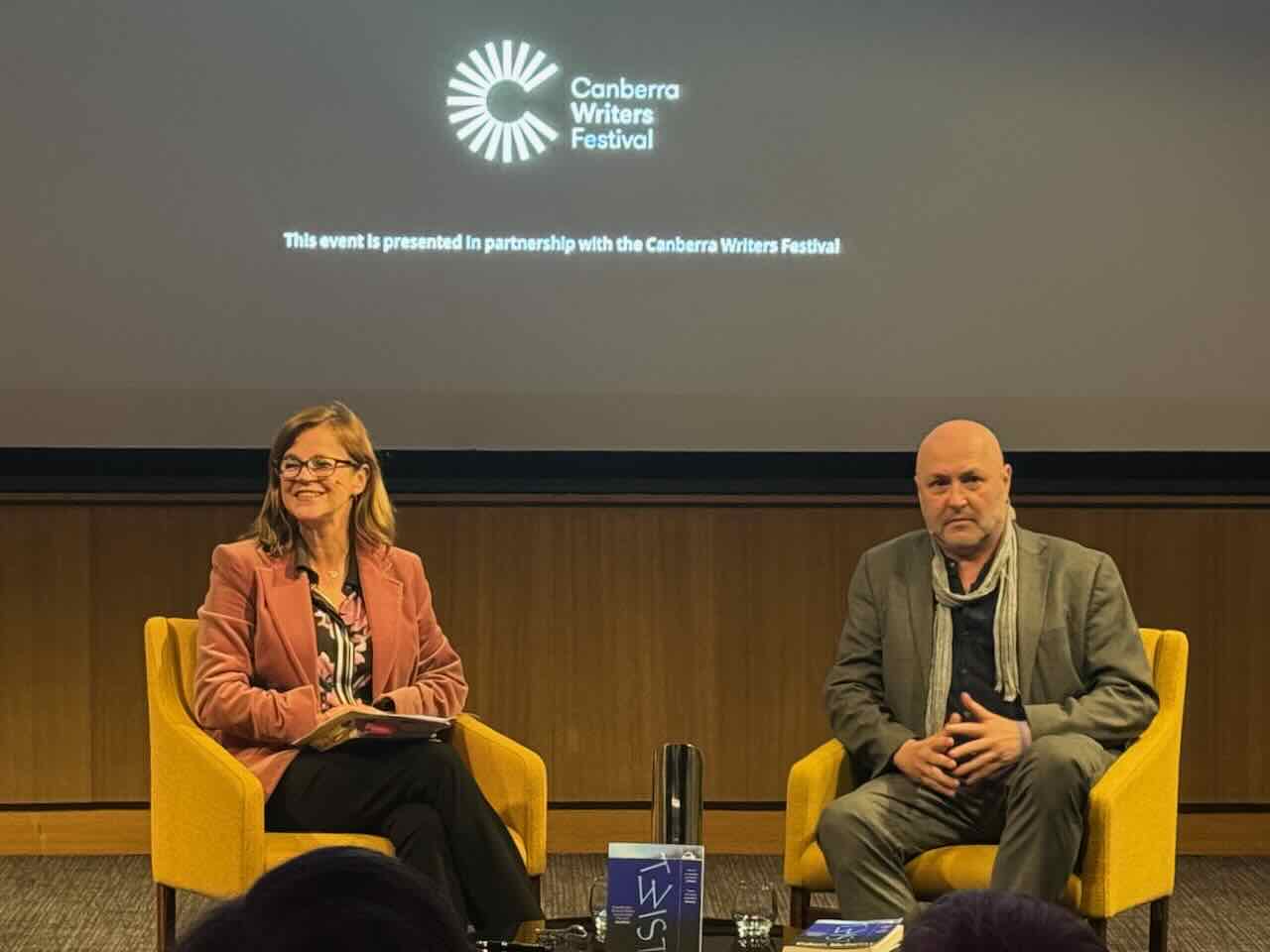
The evening opened with a welcome and acknowledgement of country from Marie-Louise Ayres, Director-General of the National Library, who then introduced the participants:
- Colum McCann: multi-award winning author of eight novels, three short story collections, and two works of non-fiction, and President and co-founder of the non-profit global story exchange organisation, Narrative 4.
- Nicole Abadee: writer, editor, podcaster, literary awards judge, and facilitator at writers’ festivals and other literary events.
The conversation
This was a conversation which went to the heart of how I perceive the world (if that doesn’t sound too grandiose), a way that is both optimistic but realistic, that simultaneously encompasses opposing truths. It also interested Mr Gums whose professional training was in telecommunications engineering. Interested? Then read on …
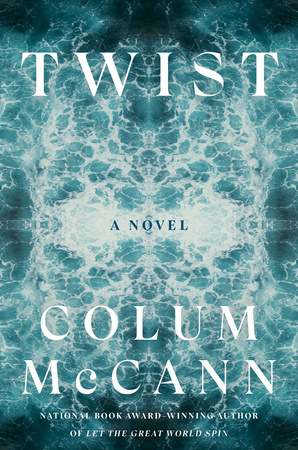
Nicole started by fleshing out Marie-Louise’s introduction of Colum. Yes, he was born in Dublin, but he has lived in New York City for over 20 years. She named two of his books that particularly interested her – Let the great world spin, which draws from Philippe Petit’s 1974 tightrope walk across the Twin Towers, and Apeirogon, which was inspired by the real-life friendship between Israeli Rami Elhanan, whose daughter was killed in a Hamas suicide bomb attack, and Palestinian Bassam Aramin, whose daughter was shot by an Israeli border guard. (This reminded me of Izzeldin Abuelaish’s memoir I shall not hate.) She described his newest novel, Twist, as “enigmatic and urgent”.
On storytelling
Nicole then added one more bit to Colum’s biography, the fact that in 1986, when he was 21, he cycled across the US from east to west, which is where, he has said, he learnt to listen. I have to add here that only a few years earlier, in 1982, my brother rode his bike across the US, but from west to east. Anyhow, Nicole used this additional piece of biography to lead into her first question: was this where he first learnt the value of storytelling?
Maybe, replied Colum, but it could have been at school, when he was 8. He praised teachers (and librarians) for being, with their promotion of books and reading, at the “frontline of democracy”. Also, his father was a journalist who encouraged writing and writers, including women writers like Edna O’Brien. (He told some delightful stories about his dad.)
But yes, the cycle ride was part of it. People would give him their story, and expect him to pass those stories on. This point led to a discussion of Narrative 4, and its Story Exchange Program, which he describes as “an act of radical empathy”. Its foundational concept is
“To step into the shoes of others in order to be able to step back into our own“.
It involves pairing two very different people, who share their own stories with each other, and then retell the other’s story as if it were their own. When kids do this, they are initially terrified of each other, but soon discover how similar they are, and “the barriers come tumbling down”. He asked the audience to try it then and there, and the buzz in the theatre was exhilarating.
On what Twist is about
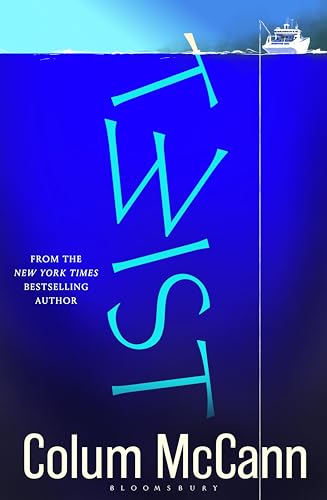
The plot centres on the repair and sabotage of underwater cables. His inspiration was a story he read during COVID about the Léon Thévenin, a cable repair ship going out to fix Africa’s broken internet. A ship, he thought, isn’t the internet out there in the air? This inspired him to learn how the internet works. Everything we know is in those submarine cables/tubes but they are going to places we don’t know. He saw this story as a metaphor for, among other things, the idea that everything is both connected and disconnected.
These cables/tubes, which are owned by Google, Meta, Apple, etc, can be seen as digital colonialism. The tubes carry the data as light, which is both magical and biblical but also terrifying. More paradox.
From the reality perspective, these tubes are very easily damaged, and security (obvious to anyone’s eye) is “unbelievably slack”. It has, in fact, been suggested that the next major war will start under water. (Mr Gums whispered to me that China has announced that it has a cable-cutting ship.) Colum talked a little more about the very real risks and dangers involved here. We are talking about government – hospitals, education, and so on – about our lives which are tied to information and disinformation. This can be hard to write about, but he found it easy to write about in a novel. He used the tone of The Great Gatsby, and also referenced Heart of darkness. Twist has many illusions and allusions!
Colum then read p. 49 at Nicole’s request … a beautiful, rhythmic passage that sets the scene.
On Twist’s characters
Nicole suggested that the characters are also broken and need to be repaired. (All part of the metaphor.) Colum clarified straight off that his protagonist, Andrew Fennell, is not he. Fennell is a journalist in his mid-40s, and a failed novelist who thinks this story will be easy and may solve “his own ruptured cable”. He meets the boat’s Chief of Mission, John Conway (an allusion to Conrad, and with initials that carry other allusions!) They are all men, and are all at sea – literally and figuratively.
Somehow, Colum managed, throughout the conversation, to slip almost seamlessly between light and dark, without dragging us down. He believes we live “in fairly shattered times”, but admits we could point to many “end-times”: the pandemic (which is when he wrote this 2019-set novel), 9/11 (he was living in New York at the time), post WW2 and the fear of nuclear war, and more. BUT he sees now as different because it’s all moving so quickly we can’t easily repair it. He identified climate and global migration as two big issues.
However, he’s an optimist, so he believes repair is possible. He pointed to what Greta Thunberg achieved by standing up. She has done magical things, but it’s not enough. We need more voices like hers.
On The Great Gatsby parallels
Nicole was keen to explore the parallels with The Great Gatsby, but although that novel frames this one, Colum didn’t want to focus on that. He sees Heart of darkness as the more obvious literary parallel. The tubes, he says, follow old colonial routes, and suggest corporate or digital colonialism.
He then talked about writers and readers. The big secret about writers is that “we don’t know what we are doing”. Books are never completed until they are in the hands of readers who tell back what a book is about. As for whether his book contains truths, truth, he said, is the music in the background.
Returning to the overall connection-disconnection metaphor, he said we have never been more connected yet so alone. This is particularly acute for young people. The machine is not the problem, but our relationship to the machine. And here came the paradoxes again. Technology is also good. How do we hold these contradictory ideas. He alluded to Dickens – it’s the best of times and the worst of times (and can be “incredibly crushing”). How do we support our young people? Through education, books, parents.
These are big problems, but not insurmountable. This is where storytelling comes in, as used at Narrative 4. We are in real danger of losing books but we still have stories.
On writing and politics, as activism, as disruption
Colum recognises that writing doesn’t have to be political, but for him it is. It’s about disrupting conventional thinking. When asked what he wanted to disrupt with this book, he responded, “I don’t know”, and added that this was a “good answer”. He wished more people would say they don’t know.
This led to the idea of the “ethical imagination”, which includes being conscious about intruding on others’ stories. Cultural appropriation is completely valid, but you enter another’s story or domain “with head bowed” and come out again to do justice to the story. There’s cultural appropriation and cultural celebration: two opposing truths. How do we live with the messiness between two endpoints, which in themselves are absolutes and problematic. He was saying, as I understand it, that life/truth/ethics lie in managing the messiness between the endpoints. This thinking – this way of understanding our lives – greatly appeals to me.
Q & A
On Nabokov’s statement that “imagination is the purest form of insubordination”:
Colum liked this idea. Messy is where decency is, but America is not recognising the messiness. “Multitudinous is good”, but currently in the USA there’s denial that you can be (embrace) multitudes. Art needs to say life is complicated.
On whether fact and truth are the same thing: Colum illustrated this with a story about Apocalypse now, that he references in the novel. He described a scene from the film and behind-the-scenes of that scene. It demonstrated “two clear realities”. The filmed scene (the fictional reality, or invented scene) is what we all see and remember, while the real events that happened on set has got lost in the haze. This was a more sophisticated answer than I would have given. I like its refusal to be simple. He added that “facts are mercenary things”, things that are “used”, and don’t necessarily get to the truths.
Conclusion
Andra Putnis, the new Artistic Director of the Canberra Writers Festival, closed the session.
A big thanks to local author Karen Viggers for passing on her ticket to me when she realised she would be out of town – in Bhutan, in fact! I am so glad I attended this conversation.
Author Talk: Twist with Colum McCann
With Nicole Abadee
National Library of Australia, in partnership with the Canberra Writers Festival
Friday 9 May 2025




 Whispering Gums