In her introduction to Learning to dance: Elizabeth Jolley, her life and work, a book that was intended to comprise only non-fiction to create a sort of autobiography, literary agent Carolyn Lurie wrote that Jolley would sometimes “draw so directly on her life” for her stories “that it seemed illuminating to include a small selection of her fiction.” From what I know of Jolley, this seems like a sensible decision.
For example, in “Poppy seed and sesame rings”, the first person narrator says:
I often heard Mother crying in the night. When I called out my father always explained in a soft voice, ‘She is homesick, that is all.’ So I always knew what was the matter.
Compare this with the opening piece in another compilation, Central mischief: Elizabeth Jolley on writing, her past and her self, which contains only non-fiction. The piece is titled “What sins to me unknown dipped me in ink”, and in it Jolley writes that “because of her marriage, my mother was an exile. I remember that her homesickness lasted throughout her life.”
 However, before I discuss the story itself, a little about its background. Jolley, born in 1923, started writing novels and short stories very early in her life. Although her first book wasn’t published until 1976, she’d written her first novel around 1939, and had had short stories published by the 1960s. As far as I can tell from a list of her papers at the University of Western Australia, the story “Poppy seed and sesame rings” was written around 1965, and was initially titled “Pumpernickl, poppy seed and sesame rings”. So, it was an early story, and has been published at least three times, twice in anthologies and once in a collection of her stories, and has also been broadcast on radio:
- Frictions: an anthology of fiction by women, edited by Anna Gibbs, Alison Tilson (1982) (contains three Jolley stories)
- The Oxford book of Australian stories, edited by Michael Wilding (1994)
- Fellow passengers: collected stories: Elizabeth Jolley, 1923-2007 (1997)
- Read on BBC Radio 4, by Kerrie Fox, 26 Oct 1997
I wonder how many of Jolley’s other stories have had such exposure?
And now, the story. As I said above, it’s clearly autobiographically based, but of course that doesn’t mean that what happens in the story happened in real life. It simply means that the story’s broad outline and main themes draw from Jolley’s experience of being the daughter of an Austrian immigrant mother. In the story, the family, comprising her father, mother, aunt and grandmother, has migrated to the “New Country” from an unidentified Germanic country. In reality, Jolley was born in Birmingham to an English father and an Austrian immigrant mother.
The main theme of the book is the immigrant experience, and particularly the mother’s homesickness. Initially, the mother tries to make it work. She is generous with their shop’s customers in a desire “to be accepted”, and she feels supported by the company of her sister and mother. However, gradually things deteriorate. The sister and mother die; her daughter (our first-person narrator) leaves home for nurse training; she continues to miss her favourite foods like “poppy seed bread and sesame rings”; and the shop struggles to make a living so her help is not needed. Her life becomes a lonely one, spent largely “in the dingy room at the back.” She becomes more set in her old ways and attitudes while the daughter, finding her own way in the world, feels less and less inclined to visit. It’s a common story in migrant families.
There are other things in this story, though, besides these ideas of exile and loneliness, that give it the Jolley imprint. The story starts with the sudden death of the narrator’s aunt while the two are visiting an Art Gallery and Museum. The daughter describes her aunt’s death on the steps of the museum:
I tried to pull her from the step but she only sighed and, making no attempt to get up, she simply leaned forward and died. I ran straight home leaving her there with the pigeons and the coming darkness.
‘Tante Bertl wanted to walk,’ I told them so they did not expect her for a time.
This sort of shocking moral failure – plainly stated, and often never discovered – is not uncommon in Jolley, and reflects her acknowledgement of our darker natures. It’s part of the surprise of her work – and so at odds with her appearance! Such a sweet-looking, unassuming little old lady in a cardigan, she was!
There’s also a hint of lesbian attraction. The daughter brings a friend, Marion, home to cheer up her mother, a “friend” she “hardly knew” and “had chosen … because she looked healthy and very clean and the nearest one to speak to in the hospital administration department.” The visit goes badly, due to the mother’s refusal to be welcoming to the visitor. Afterwards, the daughter finds herself thinking about Marion:
Upstairs I sat at my table and tried to read and write and study but I kept writing Marion’s name everywhere.
I thought about her. I kept thinking about her without being able to do anything about it.
These thoughts cause her to digress from her nursing study to write from her heart “about quiet lakes and deep pools which have no reflection and no memory”, to express the “unknown store-house of feelings” she had found within herself. There’s a double whammy here, it seems – a discovery of attraction and also, perhaps, of the power of writing. No wonder this early story has had several outings.
Read for Lisa’s (ANZLitLovers) Elizabeth Jolley Week.
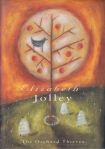
 Elizabeth Jolley
“Poppy seed and sesame rings”
in The Oxford book of Australia short stories (ed. Michael Wilding)
Melbourne: Oxford University Press, 1994
pp. 177-183
ISBN: 9780195536102








 Whispering Gums