Sarah Waters, The little stranger

The little stranger, by Sarah Waters

The little stranger (Book cover courtesy: Virago Press)

I’m not quite sure I know where to start with this one –  the ghost story that isn’t. Or is it? The little stranger is my second Sarah Waters’ novel. I found The night watch riveting, and I did see and enjoy (but not read) her very Dickensian Fingersmith.

Like The night watch, The little stranger was shortlisted for The Man Booker Prize. It’s an easy read, and rather a page-turner, but by the end I have to say that I felt a little unsure about what I’d read. In one of those interesting bits of reading synchronicity, I recently read Helen Simonson’s Major Pettigrew’s last stand. It is very different to this one, and is set a few decades later, but they both deal with the loss of “old families” and the breaking up of their estates. Waters, though, is the far superior writer.

So, what is the plot of The little stranger? Its first person narrator, Dr Faraday, was born to the working class but, through family sacrifice, has pulled himself up into the professional middle class. After a brief flashback to a childhood memory of Hundreds Hall, where his mother had worked as a housemaid, he proceeds to chronicle the relationship he develops with the Hall’s family when he is in his late 30s and practising in the nearby town as a GP. The family comprises the mother, Mrs Ayres, and her adult children, Caroline and Roderick. The book is set soon after World War 2, and the story he tells occurs over the period of about a year, but is told from the vantage point of some three years later.

Waters is best in her vivid description of the house, its inhabitants and its increasing dilapidation. I’m tempted to read the house as a metaphor for the society it represents – for the days of elegance and upstairs-downstairs that are now on the way out.  And, extending this idea, “the little stranger” (or “dark germ”) that seems hell-bent on bringing about the house’s destruction could then be seen as a metaphor for the rapid modernisation that was occurring in post-war England and that was pushing the old families to the brink of economic and, thereby, social ruin. After all, servant Mrs Bazeley reassures the young servant girl Betty that “it” is not interested in them.

To support this way of looking at the novel, here is Dr Faraday early-ish in the novel:

But Hundreds Hall had been made and maintained, I thought, by the very people they were laughing at now. After two hundred years, those people had begun to withdraw their labour, their belief in the house; and the house was collapsing, like a pyramid of cards. Meanwhile, here the family sat, still playing gaily at gentry life, with chipped stucco on their walls, and their Turkish carpets worn to the weave…

And here is Dr Seeley (to whom he later goes for advice):

The Ayreses’ problem … is that they can’t or won’t adapt … Class-wise they’ve had their chips. Nerve-wise, perhaps they’ve run their course.

Quotes like these support a social change interpretation. And yet, perhaps it is more psychological? Dr Seeley suggests that part of one’s psychology, one’s dream-self , can break loose and become some sort of “psychic force”:

The subliminal mind has many dark, unhappy corners, after all. Imagine something loosening itself from one of those corners. Let’s call it a – a germ. And let’s say conditions prove right for that germ to develop – to grow … What would this little stranger grow into? A sort of shadow-self, perhaps a Caliban, a Mr Hyde. A creature motivated by all the nasty impulses and hungers the conscious mind had hoped to keep hidden away: things like envy, and malice and frustration…

Somewhat supporting this interpretation is Caroline’s report of her mother as saying:

the house knows all our weaknesses, and is testing them one by one.

And so what do you think? Psychological/psychic or social? Or perhaps bit of both? That is, the arrogant upper class family out of touch and unable to adapt (social) releasing all its weaknesses (psychic). I’m not sure that Waters makes the case clearly enough – partly I think due to the ambiguity posed by the narrator.

Her characterisation is in fact coherent and convincing, except for the narrator. How are we to read him? Is he genuine – does he really care for the family? Does he genuinely care for the house and its history? Or, is he a social climber who wants his way into the house any way he can. I must say I couldn’t fully work him out. Is he reliable? The tone is quite reminiscent of that in Ishiguro’s wonderful Remains of the day. Like Ishiguro’s butler, Dr Faraday tells the story from some time after the events, and he peppers his account with such words as “recall”, “I think I noticed”, “must have”, words that suggest that all may not be as he sees it. And in some ways it isn’t, but there is no intriguing twist, neither is there a traditional resolution. As I read I wondered whether he was stringing me along, whether he was the cause of the malevolence. He did after all chip away a decorative acorn from the house on his youthful visit:

I was  like a man, I suppose, wanting a lock of hair from the head of a girl he had suddenly and blindingly become enamoured of.

If he was the malevolence, there is no evidence to suggest it is anything other than unconscious. And further, if he was, it certainly makes the whole class divide story more complex – and, more interesting.

Regardless, though, of how the end comes about, of “who” (one? many? none?) is responsible, it is pretty clear that the winners – if there can be such things in the messy game of life – are the old underclass. Hundreds was, in Dr Seeley’s view, “defeated by history, destroyed by its own failure to keep pace with a rapidly changing world”. It is not surprising, I suppose, that by the end the narrator is both “baffled and longing”.  Social change never has been easy!

Sarah Waters
The little stranger
London: Virago, 2009
450pp.
ISBN: 9781844086023
Willa Cather, The sentimentality of William Tavener

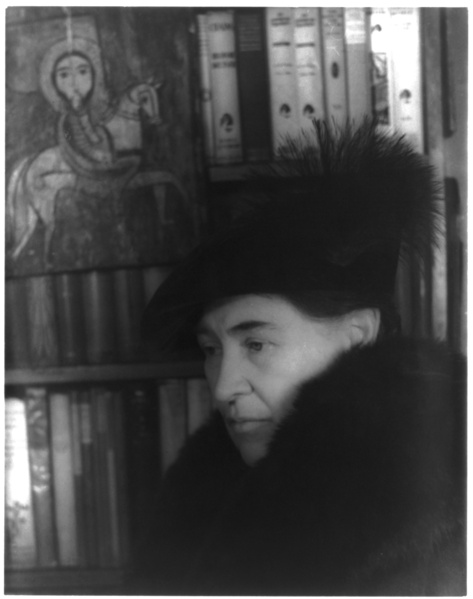
Willa Cather

Willa Cather, 1936 (Photo: Carl Van Vechten; Public domain, via Wikipedia)

Last week’s Library of America story was Willa Cather’s “The sentimentality of William Tavener” (1900). I can’t resist blogging about this one because it’s by the wonderful Willa, to whom I was introduced when I first lived in the US in the early 1980s. I have read only three of her novels (My Antonia, The professor’s house, and Death comes for the archbishop) but loved her from the beginning: for her robust, somewhat terse and yet not unsubtle style, and for writing so evocatively about the nation I was living in and keen to learn about.

The Library of America’s introduction says that this story is one of her earliest pieces and that it “combines recollections from her childhood years in Virginia, where she was born, with the atmosphere of her family’s later home in Nebraska”. It also introduces us, the Library continues, to “the strong-willed pioneers who would be so prevalent in her later, more famous fiction”.

“The sentimentality of William Tavener” might be an early piece but it demonstrates well her ability to tightly evoke character and mood. Its plot is flimsy: it takes place in one evening and concerns Hester Tavener’s plan to get her husband to allow their sons go to the circus. He, it appears, is hard and demanding of the boys; she, their ally in obtaining some of the pleasures of life (“No debtor ever haggled with his usurer more doggedly that did Hester with her husband on behalf of her sons”). In less than 6 pages, Cather provides a powerful picture of this couple – of their individual (equally strong in their own ways) personalities and the somewhat distant relationship between them. In the first paragraph is this:

The only reason her husband did not consult her about his business was that she did not wait to be consulted.

And yet, he, the William of the title, is not a pushover – but he does things his way:

Silence, indeed, was William’s gravity and strength.

On the night of the story though, he breaks his silence and the astonishing effect, the ending teases us, is that it just may augur a new balance of power in the family. We see the possibility of this coming as the evening wears on and the barrier between the couple starts to break down through the sharing of memories, but it is heralded by a sudden change in style from concrete, matter-of-fact almost staccato reportage to a descriptive interlude:

The little locust trees that grew by the fence were white with blossoms. Their heavy odor floated in to her on the night wind and recalled a night long ago, when the first whip-poor-Will of the Spring was heard …

There is irony in the title: William is not presented as a sentimental man and yet, we find, a little sentimentality can work wonders.

The story introduces us to the Willa Cather to come – to her direct, matter-of-fact style; to her strong characters who often survive by the force of their own will in a world that is hard (or they perceive as hard); to her exploration of relationships and the challenges of maintaining them (particularly in the long haul); and to her evocative, careful use of landscape and nature. If you enjoy this story, and have not read any other Cather … then do move on to her novels.

POSTSCRIPT: For an excellent analysis of Willa Cather’s writing, see AS Byatt’s article in The Guardian. It takes a writer to know a writer!

Ruth Park, Swords and crowns and rings

Note to self: never again “read” an audiobook over a long period, such as, say, 5 months! This is how I read Ruth Park‘s engrossing 1977 Miles Franklin award-winning novel, Swords and crowns and rings. It was not hard to keep up with the plot as it’s pretty straightforward – and powerful. It is hard, though, over such a time to keep up with and remember all the nuances in her writing and expression and the way they affect character development and thematic strands. For a thoughtful review of the book by someone who read it more sensibly, please see my friend Lisa’s, of ANZLitLovers, here.

I am not an experienced “reader” of audiobooks and I have to say that I found what seemed to me to be the over-dramatisation of the story rather trying in the first few CDs. I gradually got used to it, however, and by the end I was happy with Rubinstein’s reading, but it did take me a while to settle into it.

New-Zealand born Ruth Park is a wonderful chronicler of Australian life. Her novel, The harp in the south, set in working class Sydney in the 1940s is, to my mind at least, an Australian classic – but it is just one of her extensive and well-regarded body of work. Her autobiographies are also well-worth reading, not only for the light they throw on her life and on that of her husband, author D’Arcy Niland, but also on that of the Australian literary establishment of the mid-twentieth century.

Anyhow, back to the novel. Swords and crowns and rings tells the story of two young people born in an Australian country town before World War 1 – pretty Cushie Moy (born to a comfortable family with the stereotypical socially ambitious mother who has married down) and the dwarf, Jackie Hanna (whose background is well and truly working class). Not surprisingly, Cushie’s parents frown on the friendship which develops between the two. This is not an innovative story but, rather, good historical fiction with evocative writing and sensitive character development. Consequently, as you would expect, the two are separated just as they realise their love for each other and the book then chronicles their respective lives – Cushie with various relations in Sydney and Jackie in a number of country locations before he too reaches Sydney. Much of the book takes place during the early 1930s Depression. Park gorgeously evokes the hardships – physical, economic and emotional – experienced by people like Jackie and his step-dad “the Nun” as they struggle to support themselves. All this is underpinned by Park’s thorough knowledge of the social and political history of the time: we learn about labour organisations and the rise of socialism, of that irascible politician “Big Fella” Jack Lang, and of the building of the Sydney Harbour Bridge.

The resolution is predictable – it is, after all, a book of its genre – but it is not over-sentimentalised and is not achieved before the characters, Jackie in particular, have matured to the point that we can trust that he not only deserves what will come but that he will continue to work and mature for the betterment of himself and those he loves. It is truly a powerful book about human nature, as well as about the place and time in which it is set.

Ruth Park
Swords and crowns and rings (Audio CD)
Read by Deidre Rubenstein
Bolinda Audio, 2007
18 hours on 15 compact discs
ISBN: 9781741636628

Helen Simonson, Major Pettigrew’s last stand

If you like warm-hearted novels with a positive ending you may like this. If you like such novels with a touch of social commentary you will probably like this. If you like books like The Guernsey Literary and Potato Peel Pie Society and Miss Garnet’s angel, then this is definitely for you. But if you like a little more meat in your sandwich, a little more fodder for the brain, then you may like to look elsewhere for your next read.

Major Pettigrew’s last stand concerns one widowed Major Pettigrew and the little, very English village in which he lives. He meets Mrs Ali, the English-born-of-Pakistani background owner of the local shop, and the result is a story of racism, classism and materialism as these two find they have much in common but are confronted by bigotry and cultural expectations (from both sides) that set to derail them. I won’t go into details. There are some interesting characters including the Lord of the manor, some businessmen and a self-centred ambitious son, but most are a little too stereotyped for serious analysis. Some valid contemporary issues regarding English village life are raised, particularly regarding the increasing cultural diversity in the population, and the aristocracy and its role in villages, but the plot becomes a little melodramatic and predictable for my preference.

There are however some nice observations in the book:

…as I get older, I find myself insisting on my right to be philosophically sloppy. It’s so hard to maintain that rigour of youth, isn’t it?

I have no patience with all this analysing of writers’ politics … let them analyse the prose.

Good point. I often – as I’m sure many of us do – wonder how much we should take into consideration the politics of the creator. Is it OK to like TS Eliot? Should we listen to Wagner?

Life does often get in the way of one’s reading…

Ain’t that the truth?

Simonson is British born but wrote this in the USA where she now resides. There are quite a few “digs” at America. The Major, with whom we are supposed to sympathise, if not identify, is critical of American “self-absorption” though he discovers that his potential American daughter-in-law has more substance than he thought. The book, does, in fact  explore the way we stereotype each other in ways that can prevent “true” relationship developing. As the Major recognises at one point, he

knew he was a fool. Yet at that moment, he could not find a way to be a different man.

The novel has some genuinely funny scenes and is lightly satirical in that way that the English tend to do well… And so, while it is not my preferred type of reading, it is nicely written and will provide good reading for those who want a bit of grit without the grimness that often accompanies stories of racial conflict and politics. I know a few people to whom I will happily recommend it.

Helen Simonson
Major Pettigrew’s last stand
New York: Random House, 2010
361pp
ISBN: 9781400068937

(Unpublished proof copy, lent)

Edith Maude Eaton, Mrs Spring Fragrance

This week’s Library of America short story offering is “Mrs Spring Fragrance” by Chinese American author Edith Maude Eaton (1865-1914) who wrote under the pen name of Sui Sin Far. She had an American father and a Chinese mother and, according to the notes which accompany the story, was apparently the first person of Chinese descent to write in the US about Chinese-American life.

“Mrs Spring Fragrance” was published in a collection in 1912. Its concerns are not new to us, reading it nearly a century later and familiar with literature about the challenges of living cross-culturally, but at the time it was apparently rather exotic. The subject of the story is marriage, and the conflict between traditional Chinese arranged marriage and westernised marriage in which young people choose their marriage partner. The main characters are a happily married Chinese couple who live in America, the Spring Fragrances. Their marriage was arranged but as we are told early in the story, both are quite “Americanised”. Mrs Spring Fragrance, we learn, is sympathetic to the plight of their young neighbour who has been promised in marriage but who wants to marry her chosen love.

The plot turns on that old conceit of eavesdropping – of things heard out of context which threaten to derail the “real” situation. (Interestingly, there is a book published by Cambridge University Press titled Eavesdropping in the novel from Austen to Proust, which explores the concept of eavesdropping in nineteenth century English and French novels.) Anyhow, back to the Spring Fragrances. In this story, the eavesdropping is complicated by cultural confusion and the result is … Well, I’m not going to give it away as you can read it yourself using the link above.

I will say, though, that what is eavesdropped is Tennyson’s statement:

‘Tis better to have loved and lost,
Than never to have loved at all.

Surely, says Mr Spring Fragrance, expressing a Chinese perspective despite his “Americanisation”:

Is it not better to have what you do not love than to love what you do not have?

It is a straightforward story, but told nicely and with a light touch. She shows how difficult it is to truly “change” cultures: through such comments as those above and Mrs Spring Fragrance’s unconscious error when she refers to the “loved and lost” poem as the “beautiful American poem written by a noble American named Tennyson”! You have to laugh – but not cruelly, as these are appealing characters, earnest in their desire to do the right thing.

This is not a must-read story, unless you are interested in the history of Chinese-American literature, but it is an enjoyable one nonetheless.

Jessica Anderson, The commandant

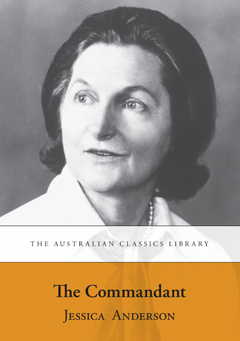
Jessica Anderson, The commandant Book cover

Cover image for The commandant (Courtesy: Sydney University Press)

When I first read about Sydney University Press’s Australian Classics Library, the book I really wanted to read waThe commandant by Jessica Anderson. It’s her only historical novel, but its subject matter doesn’t stray much from what she told Jennifer Ellison in an interview many years ago, “I was very much, and always have been, preoccupied with people who are strangers in their society” and “I am interested in families… They are interesting – you know, the tangle” (Rooms of their own). This is a clever and thoughtful novel by yet another much overlooked Australian woman writer.

[WARNING: SPOILERS, if you don’t know the history on which this is based]

The plot is pretty simple. It is set in Queensland’s penal settlement of Moreton Bay in 1830. It draws from the real story of the commandant there, Patrick Logan, who was noted for his harsh methods and who was murdered while out on an expedition. In the novel, Logan’s family is joined by his wife’s young sister (“the stranger”), Frances, who, on her way up to the settlement via Sydney, has been introduced to “radical” ideas critical of Logan’s regime. The scene is therefore set for potential conflict either between Patrick and Frances, or within Frances herself, or both.  In the end, it is a bit of both as Patrick finds his practices questioned and Frances confronts the realities of living in a penal settlement.

Except for Frances’s boat trip up to Moreton Bay with some of the settlement’s residents, the novel is set entirely in Moreton Bay. The characters include Logan’s household (family and servants), his wife Letty’s two women friends, officers of the settlement including two medical officers and the man sent to replace Logan, and of course some prisoners. There are also some characters in Sydney – Frances’ would-be beau and the sisters of a newspaper editor jailed for his criticism of the regime and against whom Logan is bringing libel action. The characters are well-drawn, with the significant ones nicely complex. You get a good feel for life in the settlement.

I would love to write about many of the characters as there are some wonderfully meaty ones, but I’ll just focus on Frances, the only character, really, who changes during the course of the novel. At the beginning, she “was seventeen; she was not stupid, but was often absurd”. She is also sympathetic to the idea of reform, which she says she developed through seeing servant life and poverty first-hand in Ireland and which puts her at odds with many in the settlement. She has a lovely ability to question herself, to see her failings, and it is this which enables her to learn from her several painful experiences. By the end, she is wiser in the ways of the world and has learnt to live with “incurable knowledge”, but has not lost her commitment to the cause of humanity.

Much of the story is told in dialogue – in fact, it wouldn’t be hard to turn it into a play/screenplay. Anderson handles this dialogue well, nicely differentiating the characters, from Letty’s lisp to officer Collison’s uneducated speech patterns. Letty’s lisp is an ironic touch – it lulls us into thinking she is one of those superficial flirtatious women but we soon discover that she is more complex than just a pretty little wife. Characters are nuanced by their reactions to each other  as well as by what they say, rather than by a lot of specific authorial comment, though there is that too.

There is also description, including some particularly beautiful ones of the bush during the search expedition for Logan, such as:

…a few clumps of trees, their rough bark the colour of iron, and their foliage a dun green, stood with the junction of trunk and root shrouded (my emphasis) by tall pale grass; and although at his left the river marked out a fissure of brighter greens, none among them were the sappy (again my emphasis) greens of England and Ireland or the dense fleshy greens of the coast … Among and behind this scrub stood big trees with foliage in similar colours, and with trunks of grey, or silvery grey, or of mauve shading to grey or rust, or of the beautiful colour of pink clay. It was as if everything here inclined not to the sun’s bright spectrum, but to those of the mineral earth and the ghostly daytime moon.

This is not an entirely benign landscape she is decribing – but neither does it hang heavily on her tale: her main focus after all is people. Here is an evocative description of Letty:

She fragmented the worry with her laugh, and waved it away with her hands, but it always seemed to reassemble, out there in the air, and float back to resettle on her.

One of the things that intrigued me most about the novel as I was reading it was the narrative form. It is a pretty straight chronology, but with many small flashbacks that help illuminate the characters. Most interesting though are a couple of slight but meaningful foreshadowings which, before the novel’s end, give us a sense of the sisters’ futures. This makes us realise that the novel is not really about them…it is about humanity, about how we treat each other – and, about that special word, mercy. You will have to read it for yourselves to know what I mean.

Jessica Anderson
The commandant
Sydney: Sydney University Press, 2009
326pp.
ISBN: 9781920898946

(Review copy supplied by the Sydney University Press)

Jennifer Forest, Jane Austen’s sewing box

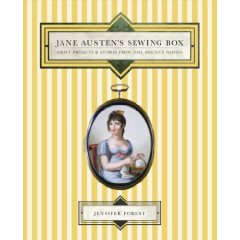
…and so the current Jane Austen juggernaut rolls on. The latest that has come to my attention is Canberra writer Jennifer Forest’s book Jane Austen’s sewing box. Must admit that I was a little sceptical when I first heard of it, but I saw it, bought it, and was pretty impressed. It’s a nicely produced book and represents a genuine attempt to look at the “crafts” of Jane Austen’s time – as well as being a “how to” book.

Jane Austen Sewing Box, by Jennifer Forest, Book cover

Cover from http://www.jennifer-forest.com/sewing-box.php, using Fair Dealing (I think)

The first thing to note, said the author when she attended my Jane Austen group’s monthly meeting last weekend, is that these are not all simply “crafts”. Many are, in fact, women’s work. Women made clothes, including men’s shirts and cravats, bags and purses, bonnets and so on. There was, in fact, a clear divide between “decorative” work and “useful” work and most women, including Jane Austen herself, did both. In fact, Penny Gay, writing in Cambridge University Press’s Jane Austen in context wrote:

Most houses had several sitting-rooms, in one of which the ladies of the household would gather after breakfast to ‘work’. By this is meant needlework, an accomplishment which was both useful and artistic, and which was considered a necessity for women of all social classes. Jane Austen herself was a fine needlewoman… If visitors called, it was often considered more genteel to continue with one’s ‘fancywork’ rather than ‘plain’ shirt-making or mending.

Forest also talked a little about how Jane Austen uses knowledge and skill in this work as part of her characterisation. In Mansfield Park, for instance, the work of the Bertram sisters is deemed not good enough for display in the public rooms (“a faded footstool of Julia’s work, too ill-done for display in the drawing room”) of the house – a clear indication that these girls are not to be admired. On the contrary, Henry Tilney in Northanger Abbey shows himself to be a solid young man and a loving brother by his knowledge of muslin. He could even be seen, many of us think, as the fore-runner of the SNAG (aka Sensitive New Age Guy)!

Forest introduced her talk with the quote that set her thinking about crafts in Jane Austen. It comes from the famous Netherfield scene in Pride and Prejudice in which Elizabeth Bennet, Mr Darcy, and Caroline and Charles Bingley discuss women’s accomplishments. The aways generous Charles Bingley believes all women are accomplished:

Yes, all of them I think. They all paint tables, cover screens and net purses.

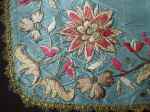
CrewelWiki

Crewel embroidery (from Wikipedia using Creative Commons CC-BY-SA)

Forest went on to describe these three “accomplishments” and more, such as crewel work, tambour work, and knotting. She also brought along a “show and tell” of the objects she had made in the course of writing the book. There is nothing like seeing and touching a hand-made bonnet or a netted purse to understand just how these women spent so much of their time. I am so glad I was born in the time of labour-saving devices!

This might not be a book for everyone. It is not academic but is nicely researched; and it is gorgeously produced with lovely period illustrations. I do have a quibble though – one that is, to me, quite serious – and that is its index. Why have a Table of Contents listing for “Muff and Tippett” and then have an Index listing for the same. If you want to find out what a Tippett is, you will not find it under T. Try M instead. How silly is that? Overall, the index is idiosyncratic and needs to at least double its existing size to be truly useful. That said, even if, like me, you are unlikely to make the 18  items described, take a look. Its readable discussion of “the accomplishments” of the period nicely illuminates the context of the novels – and this can only enhance our enjoyment of them.

Jennifer Forest
Jane Austen’s sewing box: Craft projects and stories from Jane Austen’s novels
Miller’s Point: Murdoch Books, 2009
224pp.
ISBN: 9781741963748

Tessa Hadley, Friendly fire

TessaHadleyMacmillan

Tessa Hadley (Courtesy: Macmillan Books, via their “noncommercial” terms of use)

“Friendly fire”, a short story by the English writer Tessa Hadley, is a simple story of two middle-aged women cleaners in an industrial warehouse, Pam who owns the cleaning business and her friend Shelley who is helping her out for the day. The story focuses on Shelley and nothing much really happens – it’s more about what goes through Shelley’s mind as she cleans the factory floor and its toilets.

The first thing that strikes about the story is the language: the stars are “like flecks of broken glass” and “she let the cold creep into her as if she were made of stone”. Very quickly we get the sense that Shelley is not the happiest person on the planet. Hadley also uses double negatives – “they didn’t make a bad team” and “it wasn’t that she wasn’t proud” – further conveying Shelley’s less than joyous feelings about life.

So, what happens? Shelley and Pam go to the warehouse, clean (one upstairs and one downstairs) and then leave for home. While she is cleaning, Shelley thinks about her son Anthony who is a soldier in Aghanistan, and we realise that it is her fear for his safety that occupies her mind day and night, that colours her emotions. The title of the story comes from her worry that her son might have been involved in a friendly-fire incident. Her husband tells her: “Why d’you have to make up trouble … as if there wasn’t enough already?” In between, she thinks about the ups and downs of her marriage, her daughter’s teen pregnancy, her menopausal loss of libido. Life certainly seems rather circumscribed these days for Shelley. Even her husband’s playful phone messages – about funny place names like the Fishmonger called “A Plaice to Go” – fail to lighten her spirits. Perhaps she’d like to be in a different place?

At the end of the day, they return to the car and “the sky was a blue so pale that it was almost no colour”. Muted like her sense of her life! So, what is it about? Primarily, it is about the worries of a mother for her son engaged in an arena of war. It’s not dramatic, but it’s a nicely observed story that conveys the wider implications of our engagement in war, and how women – the mothers – bear much of that.

Favourite writers: 3, Thea Astley

I love its densely woven grammar, its ingrained humour, its uncompromising politics, and its undimmed outrage at human folly, stupidity and greed (Kerryn Goldsworthy on Thea Astley’s writing)

and

Great story, great characters … Stylistically, however, this book is like a very handsome, strong and fit woman with too much makeup on … This kind of writing drives me berserk” (Helen Garner, on Astley’s “An item from the late news”)

Despite winning four Miles Franklin awards along with several other major Australian literary awards, Thea Astley (1925-2004) has to be one of Australia’s most underappreciated writers. The two quotes above, from two significant Australian literati, give us a clue why. She was uncompromising and gutsy in her subject matter and she took risks with her style. This made her a pretty controversial writer. It also makes her great for discussion by reading groups (if they’re prepared to give her a try!)

Before I continue, though, I need to be honest. Her career spanned over 40 years and some 15 or so novels, as well as countless short stories, essays and articles, but I have only read about half of the novels and a few short stories. I’ve read enough though, from her mid career A kindness cup (1974) to her last novel Drylands (1999) to know that I like her and want to read more.

Take Drylands, for example. It covers a lot of the things important to Astley. Two major ones are words and their importance/their power, and people’s cruelty to each other. Subsumed in this latter one are some recurrent issues for her – gender, race, and other power imbalances. She has several targets in this book: she’s not too fussed on computers, television, or our sports-mad society; she’s also critical about how women are treated, not to mention indigenous people and ‘oddballs’. She’s a writer with a strong social conscience – and, for example, tackled race issues head on in books like the ironically titled A kindness cup (1974) and the gorgeously titled The multiple effects of rainshadow (1996).

But it’s not her subject matter that loses her fans so much as her writing. It can be dense…though it can have a sly humour too. She once said in an interview with Candida Baker that “I can’t resist using imagistic language. I like it. I really don’t do it to annoy reviewers”! It’s how she thinks. Here, for example, are some lines describing a town and its “barbaric” Christmas from the first page of the novel, An item from the late news (1982), referred to by Helen Garner in my opening quotes:

…the beer-gut belchings and the rattle of schooner glasses that always discover the Christmas crib and soothe the infant with whack yoicks seem to me to have a muckworm style. All towns. Not just this one. Because this one is smaller, a mere speck on the world’s glassy eye, the grossness is horribly apparent.

Time usually diminishes the memory; but for me it has done nothing but magnify that swollen moment of history when Wafer had the wax on his wings melted from flying too close, not to the sun, but to the local grandees.

Astley, as you can see, is rather critical of small town Australia…and small towns are the common settings for her books. I’m not sure why I, an optimist, like her jaded view of the world. Perhaps being an optimist enables me to take on board her concerns – concerns that are hard to argue against – without being ground down by them?  Anyhow, in 2002 she won a much-deserved, I think, special award at the NSW Premier’s Literary Awards for being ‘a trailblazer’.

I hope, if you haven’t read her before, that this has whetted your appetite. I’ll say no more but end with a favourite line, with which I identify, from Drylands :

… she had never been harried by the glamour of any possessions but books.

(Note: You may notice that some of the content of this blog is also on Wikipedia. Please don’t accuse me of plagiarism: what I’ve used here is material I put there!)

Marion on Marion (Halligan)

A few days ago I posted a review of Marion Halligan’s latest book, Valley of Grace, and mentioned that Halligan had attended my bookgroup meeting at which we discussed the book. I didn’t, however, share in that post all of the things that Halligan told us – and I won’t in this post either. Some things are just not meant to be shared! Nonetheless, there are things we asked her that are of general interest to readers interested in writers and writing, and these I will share…

As readers often ask writers, we asked her about her writing process. She started off by saying that she never says she has writer’s block. This doesn’t mean she doesn’t get stumped at times but that when she does she just moves on to other writing she has on the go. Valley of Grace was, she said, written essentially over 20 years. She made notes for it back in 1989 when she was living in that apartment in Paris that overlooked the Val de Grâce church. And then, when she got a little stuck in her novel The point, which was published in 2004, she took out the notes she’d made back then and worked them up into a short story. Sometime later, she realised that it was more than a short story and voilà, we now have the book (though it took perhaps a little more than voilà for her to get from short story to book!).

Hand and pen, from Clker.Com

Hand and pen, from Clker.Com

Now, here’s the interesting bit: Halligan writes by hand! She says that the slowness of the eye-hand-paper process makes you think harder and results, for her anyhow, in fewer drafts. Essentially, she writes the story out by hand and then reads it over crossing out and adding in, etc. She then reads it again – often reversing the changes she’d made! It is only then that she types it into her computer, and the sense we got was that at this point it’s pretty much ready to go. We didn’t – silly us – ask her much about the publisher’s editors.

We talked a bit about the use of imagery, including metaphors. She says that much of this is unconscious, that if you are an experienced writer and you get into your story’s mode, the imagery seems to just come (such as the use of light, yellow etc in Valley of Grace). She talked specifically about the challenge of using metaphor and how writers often don’t think them through. Her example of a poorly thought through metaphor was  one writer’s description of a person’s bottom during lovemaking as “white dunes of sand”! The mind boggles rather. Anyhow, this brought to my mind a statement she makes in one of her more self-conscious books, The fog garden:

That is the trouble with metaphor, it may take you to places you don’t want to go.

She had more to say on writing, such as to beware of using too many adjective and adverbs, and that for her books are not about answers but about questions. In Valley of Grace the over-riding question, really, is about the soul, about what makes us human. Now, it’s hard to get a bigger question than that!

We also talked a little about reading and what we like. Halligan is not keen on issue(ideas)-based fiction: she doesn’t think it’s interesting. This is an issue I have referred to briefly in a couple of my reviews, specifically in This earth of mankind and The workingman’s paradise.

Finally, we couldn’t let her go without asking her about her literary influences. Not surprisingly, given that she’s been writing for a long time now, she couldn’t really say, but she did name some of her favourite writers. These included Margaret Drabble, William Trevor, and John Banville. Interesting, eh, that they are all Irish or English! Clearly, I really must read that William Trevor languishing my TBR pile!

Anyhow, you can probably tell from all this that Halligan was generous with her ideas and her time. It was a real treat having her there…