Monday musings on Australian literature: Miles Franklin Award shortlist and the woman question

Miles Franklin

Miles Franklin ca 1940s (Presumed Public Domain, via Wikipedia)

Things have been looking up lately on the women writers front. Last year two women – Anna Funder (All that I am) and Gillian Mears (Foal’s bread) – made an almost clean sweep of our major literary awards. This year women writers are again faring well, with the Miles Franklin shortlist comprising all women. The shortlist, announced last week, is:

Three of these – Floundering, Beloved and The mountain – are debut novels, though Drusilla Modjeska has published several books, some of which play with the boundary between fact and fiction.

I’m not writing this post to gloat. After all, I love many contemporary Aussie male writers including those I’ve reviewed here, such as David Malouf, Tim Winton, Murray Bail, Gerald Murnane, Peter Carey, Richard Flanagan, and less well-known ones like Alan Gould, Andrew Croome and Nigel Featherstone. However, there have been some very lean years for women, including a couple of recent years (2009 and 2011) in which no women writers were shortlisted for the Miles Franklin. These, together with VIDA’s evidence regarding inequities in women being published and reviewed, and women being used as reviewers, were the prime impetus for the establishment of the Australian Women Writers Challenge (AWW). Last year’s stellar year for women and now this year’s Miles Franklin shortlist might suggest that the job is done – but I don’t think so. History has shown that gains made by women are often not sustained …

… and, anyhow, the AWW is not about ignoring men. It is simply about recognising and, in doing so, promoting women. Most of the women involved in the challenge also read male (or, should I say, men) writers. I sure do, as you can see if you scan my Author Index.

Last year, Rebecca Giggs wrote an article in Overland about the “woman” issue. She was commenting on a question put to Anna Krien (I’ve reviewed Into the forest and Us and them) regarding why Australia’s best non-fiction is currently being written by women. Giggs pondered:

During this past summer – a time when women’s writing has been the subject of renewed attention – I have found myself wondering why a direct answer to that question is so hard. It would be exceptionally unusual, one imagines, for an emerging male author to be asked why so many of our best books are currently being written by men. And yet it would also be wrong to say that the query, asked of a female writer, is unforeseeable. As regressive and problematic as the question seems, it remains relevant because of the prevalence of its assumptions in publishing and readership communities. To foreclose on Attwood’s right to ask about the specific role of women in nonfiction is to abandon the opportunity to learn from our stumbling answers.

This is the point – to keep the conversation going, to better understand if there are any underlying issues preventing longterm equal treatment and recognition. Reading Giggs again, I was reminded of the recent discussions regarding Wikipedia’s removing women from their American novelists category to the American women novelists category. The impetus for the new category was valid: people do want to identify and locate women writers, just as people want to locate a country’s indigenous authors or LGBT authors or some other specific group. The problem was the “removing” of women novelists from the main list, thereby marginalising them while at the same time highlighting them. Wikipedia, being the collaborative venture that it is, is reviewing its policy to ensure that its categories work practically, equitably and philosophically.

It’s vexing, really, that the question is still vexed …

Dorothy Johnston, The house at number 10 (Review)

Johnston, House at Number 10 bookcover

Courtesy: Wakefield Press

Dorothy Johnston‘s The house at number 10 has one of the cheekiest opening sentences I’ve read for a long time … but I’m not going to tell you what it is. If you are interested you’ll have to find out for yourselves – and tell me if you agree.

I decided to read this novel for a couple of reasons. Firstly, I’d known of Dorothy Johnston since the 1980s but have only read some short stories (specifically, those in the recent Canberra-focused anthologies, The invisible thread and Meanjin’s Canberra Issue.) Secondly, I chose this particular novel because it is set in Canberra and this Centenary year I’m focusing a little, though not exclusively, on books set in Canberra or by Canberra writers.

Dorothy Johnston was a founding member of the Seven Writers, a group of women writers in Canberra who met for many years to share and critique each other’s writing. They have become the stuff of legend, at least to Canberra readers. Johnston has written several novels including four crime novels set in Canberra. She has also been shortlisted for the Miles Franklin award – twice. But The house at number 10 is not one of her crime novels, nor one of the shortlisted novels. It is, though, a good read … and it’s time I got to it!

The novel is set in the early 1990s, on the cusp of the legalisation of the sex industry in Canberra. Its protagonist, late-twenties-something Sophie, has been left by her husband, Andrew, not for another women but for “a floating, open-ended freedom”, for “a raft of girls”. They are sharing the care of their four-year-old, rather self-possessed daughter, Tamsin, and Sophie, now living in the garden flat at the back of the old widow Mrs B’s home, needs to support herself. So she applies for a job in a small, newly established and rather shabby brothel in the suburb of Kingston, at 10 Andover Street. Hence the novel’s title. The novel explores Sophie’s various relationships – with Elise and Kirsten who work in the brothel, with Marshall the brothel owner and Elise’s partner, with her landlady, with her old friend (and architect) Ann, with a couple of her clients, and of course with her estranged husband and her daughter.

There is a little bit of the “oh what tangled webs we weave” about this novel as Sophie strives to keep her two lives separate – but Johnston is not so much interested in mysteries and intrigues here as in how we navigate complicated relationships and cope with betrayal. It’s a surprising set-up but it works, because she keeps the story grounded in the relationships and not in its potential for salaciousness.

And the relationships are what keep you reading, as Johnston slowly draws the various characters into Sophie’s new life. Ann designs a renovation for the brothel, Mrs B takes over fixing up its garden. Characters look out for each other – Kirsten deflects Marshall who is keen to try out this new “girl”, while Sophie looks out for Kirsten through a long illness; Ann and Mrs B accept Sophie’s choice, supporting her while also offering advice. Not all is rosy though. Elise is suspicious and prickly, and Ann has a little fling with Andrew, albeit with Sophie’s not-overly-happy knowledge.

Underpinning all this is a tension stemming from Sophie’s grief and anger at her abandonment. She doesn’t rant, and she holds it together in front of her daughter, but her feelings are made clear when she meets her first client:

She handed him a condom and he rolled it expertly. Now, she thought, now, as grief at her failed marriage made barriers transparent, each one constructed of material so thin she could burst through it at will. Anger welled up, and resentment and self-pity. Blame struck out and swam through the lamplight towards this stranger who wore Andrew’s hair.

It’s a dangerous game she’s playing, particularly when she takes on Jack, who is into bondage, something the brothel has not offered before. For Sophie, though, it provides an opportunity to enact revenge on Andrew, displaced though it is to Jack. She knows he’s not Andrew, but she can imagine so – and this works for a while. However, you can’t of course maintain a secret or divided life forever. Eventually the crunch comes, and Sophie risks losing what matters to her most …

Besides her sensitive characterisation, Johnston also does place well. Canberra is rightly depicted as a place in which ordinary people live and go about their business, but she also captures its particular beauty – the “flat, clean” sun which has a “greedy kind of clarity”, and the light and colours of the changing seasons that are so marked in Canberra. The house at number 10 has a character of its own – shabby, but somehow warm with its worn out armchair and cosy kitchen. Not quite what you’d expect for a brothel – though how would I know – and yet it feels true. And there’s Sophie’s garden flat with its comforting garden:

There was the dark green garden, watered to the gills, and the sense it always gave her of luxury, repleteness, a deep satisfaction with its own existence.

Johnston uses imagery lightly but effectively. Sophie’s divided life is represented by her living on one side of the lake and working on the other. We often drive with her over the lake, making the transition clear. As the novel builds to its climax, the colour “red” and words like “fire” and blood” start to appear, suggesting anger, violence (real or imagined), and revenge. Contrasted with this are references to water, primarily via the lake and a Cupid fountain bought for the brothel’s garden, implying something more female, perhaps calming but also a little mysterious. And then, throughout, there’s gardening and its association with nurture and growth, with vision and imagination.

So what really is it about? Revenge is the motive for the plot, but it is not really the theme. Rather, it’s about facing life bravely and taking risks even if you “draw blood”, about friendship and the things you do for your friends, and about love in all its guises. A quiet book, despite its subject matter, and well worth the read.

AusLitMonth2013Dorothy Johnston
The house at number 10
Kent Town: Wakefield Press, 2005
257pp.
ISBN: 9781862546837

Read for Australian Women Writers’ Challenge and Reading Matters’ Australian Literature Month.

Courtney Collins, The burial (Review)

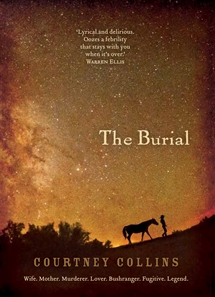
Book cover (Courtesy: Allen & Unwin)

Book cover (Courtesy: Allen & Unwin)

I became aware of Courtney Collins’ The burial when it was longlisted for the Stella Prize. It has since been shortlisted for the Stella, shortlisted for the new writing award in the NSW Premier’s Literary Awards, and longlisted for the Dobbie Literary Award for new writing. It had previously been shortlisted for the 2009 Australian/Vogel Award for Unpublished Manuscripts. This is one impressive debut. While I’m attracted to several of the books longlisted for the Stella, I particularly wanted to read this one because of its subject matter; it is inspired by the life of Jessie Hickman, an Australian woman bushranger. I hadn’t heard of her before and thought this would be an interesting introduction. I wasn’t wrong. The burial is no ordinary historical fiction.

The bulk of the novel takes place in 1921 when 27-year-old Jessie, having had a gutful of her abusive, horse rustling husband Fitz, takes off, having first … well, let’s just say, done to him what she’d been wanting to do for a long time. In other words, she’s on the run. Now Jessie is no saint. She’s already been in prison for rustling, but she didn’t deserve the treatment she got at the hands of Fitz. The novel chronicles Jessie’s escape, and the story of the two men looking for her, Jack Brown, her lover and co-horse rustler for Fitz, and Sergeant Barlow, who has a story of his own. Escape is, we discover, Jessie’s speciality. It’s not for nothing that the book starts with a story of Houdini, or that Jessie’s horse is named for him.

As I read, I was reminded of two American writers – Toni Morrison and her powerful, gut-wrenching novel Beloved, and Cormac McCarthy and his western novels – for pretty obvious reasons. The burial is narrated by Jessie’s prematurely born daughter whom she kills and buries at the start of the novel, reminiscent of Sethe’s daughter Beloved, despite their different behaviours. And the elemental, evocative language along with the themes – human against human, human against nature, in a forbidding and lawless environment – immediately bring Cormac McCarthy to mind.

What is particularly impressive about this debut is Collins’ handling of the narrative voice and structure. The baby’s voice is generous and wise, not maudlin or pathetic. She cares about this mother of hers, and is a bit like a guardian spirit, albeit one without any power. Somehow, despite what Jessie did to her, she humanises Jessie and encourages us to feel sympathy rather than horror. Collins is light-handed in her use of this trope. As the novel progresses, it feels like a third person story, which it is, really, because it is not about the narrator but is her story of her mother. Every now and then, though, we are reminded of our narrator when she says “my mother”.  As for the structure, the narrative alternates, loosely rather than rigorously, between Jessie’s story and that of Brown and Barlow. It’s basically chronological but there are flashbacks to fill us in on Jessie’s origins as we follow her escape.

Back now to the story. Early in the novel, Jessie is released from jail to be an apprentice horse-breaker and domestic help to Fitz, and pretty soon we are told all we need to know:

Her hope was that her employer was a good man. But he was not.

I love the way Collins’ language flows – from lyrical description to the plain and straight.

Fortunately, Jessie, while fearful of this man who beats her, is also spunky and “found freedom in the ways she defied him”. There is a bit of the picaresque in the novel, as we follow Jessie’s escape and the various people she meets, but it has none of the lightness of that form. A better description is probably gothic. It’s a tough world Jessie finds herself in – one that is particularly cruel to women and children. She spends time, for example, with an old couple. The woman wants her because “All of these years in this miserable place I have prayed for the company of someone other than you and here she is. I am taking her”. The man’s response?  “She’s of no value”!

The brightest spot in the novel occurs when Jessie meets a gang of young rustlers led by the 16-year-old Joe in a spirit of mutual support and cooperation. She joins them and helps them in a well-planned heist in which they manage to steal 100 cattle, sell them at saleyards and return to the hills before the owner notices the loss. It is remote country, after all. However, the theft is discovered and a bounty is put on Jessie’s head – for the cattle they believe she’s stolen and for the rumoured murder of Fitz. And so the final hunt begins involving a bunch of men who are after the bounty, and Brown and Barlow who hope to get to her first.

For a while the gang stays hidden but, eventually, some of the hunters get close:

That’s the sound of desperate men, said Joe. I know this type of man, said Bill. He has no god. And he is all the more dangerous to us because, worse than that, he has no law in him or myth to live by.

Jessie, at her insistence, heads off alone, setting up the climax which is not totally unpredictable – after all, one can’t stay on the run forever – but which contains its surprises.

This is a novel about a hard world in which

A man can rape or kill and expect no consequence except his own consequence. You mean conscience? Consequence is what I said and what I mean to say!

But it is also about love and forgiveness, magic and myth, resilience and resourcefulness … I’ll not forget it quickly.

Courtney Collins
The burial
Sydney: Allen & Unwin, 2012
ISBN: 9781743311875 (Kindle ed.)

Read for Australian Women Writers’ Challenge and Reading Matters’ Australian Literature Month.

Monday musings on Australian literature: AWW Challenge 2013 First Quarter Progress Report

Regular readers here know that while I generally do not do challenges I am taking part in the Australian Women Writers’ Challenge – because it’s what I like to read anyhow. The challenge, which began last year, was so successful that the initiator Elizabeth Lhuede, decided to continue it this year – and called on other bloggers to help. I am one of those bloggers and have responsibility for overseeing the Literary (fiction and non-fiction) area. We have now completed the first quarter of 2013 – how can that be, by the way (!) – and I thought it might be interesting to produce a bit of a report card.

Australian Women Writers ChallengeBefore I continue, I need to explain that the “Literary” category isn’t easy to define. The Challenge’s policy is that reviewers allocate the category/ies to the books they review, though the AWW Blog Team does do the occasional editing or tweaking where there are glaring errors. Given that proviso, on with my quarterly report – and I’ll start by providing some perspective. In 2012 some 1526 reviews were logged for the challenge. So far, in the first quarter of 2013, 614 reviews have been logged. Clearly, the challenge is gaining momentum, which is really exciting. These reviews cover the whole gamut of women’s writing – all genres, non-fiction, poetry, short stories, and even some self-published works.

Kate Grenville - Cambridge - January 2012

Kate Grenville, Cambridge, January 2012 (Photo credit: Chris Boland, via Wikipedia)

In the “literary” area, which for the purposes of my survey here includes “Classics”, 112 reviews (or more) were logged in the first quarter, representing over 20% of the reviews posted. These reviews cover 71 authors, which means of course that several authors have been reviewed multiple times. The most frequently reviewed authors are:

  • Kate Forsyth whom I must admit I don’t know: Six reviews for her novel The wild girl
  • Karen Foxlee whose Anatomy of wings I read before I started blogging: Six reviews, including five for her current novel The midnight dress
  • Miles Franklin, of course: Five reviews ranging across her work, including one for her diaries
  • Kate Grenville whose The lieutenant I reviewed last year: Three reviews
  • Lisa Jacobson whose The sunlit zone has been shortlisted for the inaugural Stella Prize: Three reviews for The sunlit zone.
  • Dorothy Porter, whose The bee hut I’ve reviewed: Three reviews for two of her works
  • Madeleine St John, the subject of Helen Trinca’s biography which I’ve just reviewed: Three reviews for The women in black
  • ML Stedman whose debut novel The light between oceans is winning or being shortlisted for many awards: Four reviews for The light between oceans
  • Amy Witting, a late bloomer: Three reviews ranging across her work

Besides these, there are also reviews for well-known writers like Helen Garner, Anna Funder and Ruth Park and for writers not known to me. There are reviews for poetry, including verse novels by Lisa Jacobson and Dorothy Porter, and poetry collections by Amy Witting and Suzanne Edgar. There are of course gaps, but overall it’s encouraging to see such a diverse range of Aussie women writers brought together in one place. It can only be good for them, and for Australian literature in general, to be so clearly identified.

While the challenge is about reviewing women writers, this does not mean the reviewers have to be women. It’s encouraging to see several men actively contributing to the challenge. Some men are clearly not averse to reading books written by women!

If you are interested in the challenge and would like to take part – it’s never too late – or would like to check out some of the reviews, click here for the challenge site and have a look around. I’d be surprised if you didn’t find something to interest you. And, if you see any major discrepancies in categorisation, please let us know.

Are you taking part in the Challenge? And if so, is it changing what you read?

Helen Trinca, Madeleine: A life of Madeleine St John (Review)

Trinca, Madeleine
Madeleine (Courtesy: Text Publishing)

I wanted to read Helen Trinca’s biography Madeleine for several reasons. First, of course, being a reader, I’m interested in biographies and autobiographies of writers. Secondly, Madeleine St John belongs to that group of Australians, half a generation or so older than I am, that has made quite a mark on the literary and arts world. Her friends and acquaintances included Sydney University peers Clive James, Bruce Beresford, Robert Hughes, Richard Walsh, most of whom lived ex-pat lives like she did. Thirdly, her father Edward St John, was a controversial conservative politician (and then barrister) who fought injustice and whom Justice Michael Kirby described as “a contradictory, restless, reforming spirit”. And finally, I was hoping to find out more about what happened to Bruce Beresford’s plan to film her first novel, The women in black. Trinca covers all these bases and more in her biography.

Madeleine was – as Trinca ably, but fairly it seems, demonstrates – a complicated and difficult woman. She could be called a tragic figure if we define that as a person brought down by a flaw in their character or make-up. Trinca’s Madeleine, though, would probably not agree with that assessment. As far as she was concerned, her troubled life was solely caused by her father, “the ghastly Ted”. More on that anon. First I’d like to quote from a letter Madeleine wrote as she was trying to write her first novel:

I somehow feel (not for quite the first time) that life is beyond my capacities … meanwhile am trying to write some fiction, which is abominably difficult & and therefore terrific – but horrifying.

This quote says a lot about St John – about how hard she found life, and about the heightened way she lived it.

Madeleine was born in 1941 to Edward St John (Ted) and his lively, sophisticated wife Sylvette. Sylvette did not, for several reasons carefully explored by Trinca, adjust well to the life of wife and mother. She became an alcoholic and mentally unstable, to the point that Ted, apparently in order to protect his two daughters, placed them in boarding school in 1953. They didn’t understand, and were miserable. The next year their mother took her life, a fact which was not made clear to the girls at the time and which Madeleine never accepted. Ted remarried the next year a women ten years his junior, 27-year-old Val Winslow. Madeleine never accepted this either and at the age of 18 was told to leave home. While she saw and communicated with her family, on and off, for the rest of her life she never reconciled with them and believed to the end that they were the architects of all that was wrong with her life. We will never know the truth of course, and many records have been destroyed. However, while mistakes were made, partly due to individual personalities and family dynamics and partly as a consequence of the childrearing practices and patriarchal attitudes of the time, Ted and Val, Trinca argues, did their best to support Madeleine but she never gave them an inch, never saw things from any other perspective but her own. Tragic, really, however you define it …

… and making her, I think, a tricky subject to write about. Madeleine was, and there is documentation from a variety of sources to support this, a controlling and emotionally erratic friend who would, as one said, “just destroy everything, destroy a relationship”. She was, as we’d say now, high maintenance, and wanted, needed, to call the shots. And yet, people stuck with her, because she was witty, intelligent company, and also because people saw her need. Trinca handles this minefield with a clear, even-handed but sensitive eye, enabling us to feel Madeleine’s pain while being frustrated at her inability to lift herself out of it.

St John moved to London in the 1960s, leaving, more or less by mutual agreement, her first and only husband behind in the USA, and eventually took out English citizenship. She was horrified when, on being shortlisted for the Booker Prize in 1997 for her novel The essence of the thing, she was hailed as an Australian writer. She didn’t want to be aligned with the place, but she was the first Australian woman to be shortlisted for the Booker, so no wonder she was hailed that way.

Trinca’s biography is a traditional, chronologically told one. It’s tight, with little superfluous detail but enough examples to provide a good picture of Madeleine and her life. I particularly enjoyed the chapters covering the writing and publication of her novels. The book is very well documented, using clear but unobtrusive numbers linked to extensive notes at the end. In her acknowledgements, Trinca details what records she had available and where the gaps are. In addition to the oral history St John recorded (covering the first couple of decades of her life), Trinca had access to letters by and to Madeleine (though many were destroyed) and other documentation such as wills, and obituaries written by those who knew her. Trinca also interviewed many of the significant people in her life. I was intrigued to discover names familiar to me in other contexts, such as filmmaker Martha Ansara. The older we get, it seems, the more we discover our paths have crossed in interesting ways with others.

If you need any proof that Madeleine is worth reading, Clive James’ statement made in 2006, the year she died of emphysema, may convince you:

Sometimes, when I’m reading one of the marvelous little novels of Madeleine St John, part of whose genius was for avoiding publicity, I think the only lasting fame for any of the rest of us will reside in the fact that we once knew her. (quoted by Trinca from his memoir North Face of Soho)

A slight exaggeration perhaps, given who the “us” are, but James clearly believed that this complex late bloomer who produced four novels in six years deserved more recognition than she was getting. Thanks to Text Publishing, all four of her novels are back in print and we have this thorough and highly readable biography. All we need now is to see The women in black in film!

Helen Trinca
Madeleine: A life of Madeleine St John
Melbourne: Text Publishing, 2013
280pp
ISBN: 9781921922848

(Review copy supplied by Text Publishing)

The Stella Prize shortlist, 2013

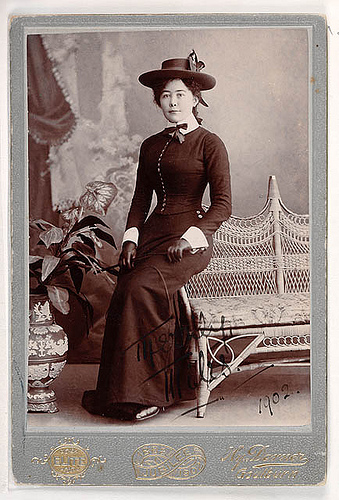
Miles Franklin, 1902

Miles Franklin, 1902, by H.Y. Dorner (Presumed Public Domain)

Woo hoo … The Stella Prize shortlist has been announced.

I posted the longlist a few weeks ago before, but just to recap, the Stella Prize is a new award on the Australian literary scene. It is named for Miles Franklin and is “for the best work of literature (fiction and non-fiction) published in 2012 (for this inaugural one) by an Australian woman”. The prize of $50,000 will go to one author.

I like the look of the shortlist. It includes authors I’ve read and enjoyed before (de Kretser, Kennedy and Tiffany) and the authors I picked out as particularly interesting (to me, anyhow) from the shortlist:

  • Courtney Collins, The burial (Allen & Unwin): a debut historical crime novel which reimagines the life of  Australia’s ‘lady bushranger’, Jessie Hickman. I’m not a crime reader, but this one intrigues me.
  • Michelle de Kretser, Questions of travel (Allen & Unwin): the fourth novel by this award-winning writer.
  • Lisa Jacobson, The sunlit zone (Five Islands Press): a verse novel which has been reviewed several times already for the Australian Women Writers Challenge. (See my roundup over there. The reviews I read while writing that round-up have increased my interest in this book).
  • Cate Kennedy, Like a house on fire (Scribe): a collection of short stories by one of Australia’s best short story writers.
  • Margo Lanagan, Sea hearts (Allen & Unwin): a fantasy or speculative-fiction novel about selkies and the like that I believe also appeals to non-genre readers. Lanagan has a reputation for lovely prose, so I’d be interested to check her out some time.
  • Carrie Tiffany, Mateship with birds (Picador): the second novel by the author of the truly splendiferous Everyman’s rules for scientific living.

It’s all fiction, but there’s “genre” writing here, as well as traditional “literary” fiction, poetry and short stories. It’s rather sad that only one can win but let’s hope the longlisting and shortlisting will raise the profile of these authors – and others along with them – because that is the prime goal of the award. (For the winner, though, the prize purse of $50K will be an important outcome!)

And, it looks like the Australian independent publisher Allen & Unwin has scooped the pool with three of the six shortlisted books! Congratulations to them.

The first winner of the Stella Prize will be awarded in Melbourne on the evening of Tuesday 16 April. I’ll keep you informed.

PS Is it the 2013 prize for books published in 2012, or is it the 2012 prize awarded in 2013?

Anita Heiss, Paris dreaming (Review)

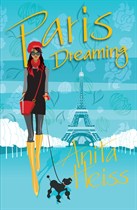
Anita Heiss Paris Dreaming

Paris Dreaming (used by permission of The Random House Group Ltd)

Late last year I wrote a post about the inaugural Canberra Readers’ Festival. One of the speakers was indigenous Australian author, academic and activist, Anita Heiss. I wrote then that I bought one of her books. It was her fourth (I think) chick lit novel, Paris dreaming. This might surprise regular readers here, as chick lit is not really my sort of thing, however …

There are reasons why I was happy to read this book. First was that my reading group chose it as part of our focus on books featuring Canberra for our city’s centenary year. Yes, I know, it’s called Paris dreaming, but the heroine starts in Canberra and Canberra is mentioned (not always positively I must say) throughout the book. The other reason is the more significant one, though, and that is Heiss’s reason for writing the book. I said in the first paragraph that she is an activist and her chick lit books, surprising though it may sound, are part of her activism. In fact, I think pretty much everything Heiss does has an activist element. In her address at the Canberra Readers’ Festival she described herself, an educated indigenous Australian, as in the top 1% of the bottom 2.5% of Australia. She feels, she said, a responsibility to put her people on the “Australian identity radar”.

Does this book do it, and if so how? Well, one of her points is that 30% or more of indigenous Australians are urban and this book, as its genre suggests, is about young urban indigenous women. Anita Heiss manages I think (though I’m not the target demographic so can’t be sure) to present characters that both young indigenous and non-indigenous women can relate to. Our heroine Libby and her friends are upwardly mobile young professionals. They care about their work; they love fashion, drink and food (this is chick lit remember!); and they wonder how to marry (ha!) their career goals and romance.

Indigenous design vase, on hall table, Governm...

Indigenous art vase, Government House, Canberra

So what’s the plot (besides the obvious chick lit formula which this book certainly follows)? At the start of the novel  30-year-old Libby, manager of the education program at the National Aboriginal Gallery, is on a man-fast. She’s been bitten one too many times and has sworn off men, much to the dismay of her tiddas (her “sisters”). She is, though, keen to develop her career and wants a new challenge – all part of the chick lit formula – and so pitches a proposal to her boss that she mount an exhibition of indigenous Australian art at the Musee du Quai Branly in Paris. Of course, her boss approves and off she goes to Paris where, following the formula, she falls for hunky, sexy Mr Wrong while Mr Right watches on, spurned (and spurned and spurned). But, of course, I don’t need to tell you how it comes out in the end do I? This is not subversive chick lit because that would not serve Heiss’s purpose …

Did I enjoy it? Yes, but not so much as a piece of literature because my reading interests lie elsewhere, but as a work written by a savvy writer with a political purpose. This purpose is not simply to show that young, urban, professional indigenous Australians exist but, as she also said in her address, to create the sort of world she’d like to live in, a world where indigenous Australians are an accepted and respected part of Australian society, not problems and not invisible. She is therefore unashamed about promoting indigenous Australian creators. She names many of them – artists, writers, filmmakers – and discusses some of their work, educating her readers as she goes. Most of the people, works and places she mentions are real but there’s an aspirational element too. The National Aboriginal Gallery does not exist but she presents it as a significant player in the Canberra cultural institution scene. Good for her!

I’ll probably not read another of Heiss’s choc lit (as she, tongue in cheek, calls it) books, but I’m glad to have read this one – and I’ll certainly look out for works by her in other genres (including her memoir Am I black enough for you?). Heiss is a woman to watch.

Anita Heiss
Paris dreaming
Sydney: Bantam, 2011
313pp.
ISBN: 9781741668933

Thea Astley, The monstrous accent on youth (Review)

I was going to start this post with that well-known quote by Sophocles – or was it Plato – complaining about the young people of today, but a little bit of research turned up the fact that that quote is somewhat spurious. It was probably inspired by Plato’s Republic in which he presents a dialogue with Sophocles about the ideal education, advocating a “stricter system” to ensure young people “grow up into well-conducted and virtuous citizens”. It was not a tirade on “the youth of today”. That permutation was the work of variously identified twentieth century writers/speakers.

So, instead, I’ll dive straight into Thea Astley‘s essay, “The monstrous accent on youth”. It was written in 1968 and reproduced in last year’s Meanjin anthology which contains a selection of essays organised by decade, starting with the 1940s. I plan to dip into the anthology over the year as there are essays by writers like Patrick White and David Malouf, poems by Judith Wright, and so on. A treasure for dipping into.

I was, I suppose, surprised by the Thea Astley essay, though in retrospect I probably shouldn’t have been. She was never one to go lightly and she sure doesn’t here in criticising the youth of the 1960s. She talks of discussing moral dilemmas in a “middle-class girls’ high school” and being horrified by her students’ callous responses to her questions about conscription during the Vietnam War:

Girls, like female spiders, want to have their men and eat them, too. I was appalled by the selfishness of their reactions and wondered if this were merely a by-product of thinking in a Liberal Party voting area.

She suggests that the generation of the 1960s were frank and (by implication “progressive”) about sex and drugs but had a “hard conservative core”. She then talks of discussions at Macquarie University and says attitudes were more liberal there, “particularly noticeable in the nuns”. (I went to Macquarie University in the 1970s and had many nuns and seminarians in my tutorials. She’s right. They were usually thoughtful tutorial participants.) But, she’s discouraged by the narrowness of the reading. Her students hadn’t read, she said, “Compton Burnett, Cheever, Edmund Wilson, Nabokov, Gordimer …”. Hmm, must say that, with the exception of Nabokov, I hadn’t read those writers then either – in fact, I didn’t even hear of Gordimer until the 1980s – and yet I called myself a reader.

She ponders the reading issue, wondering if that generation spent more time drinking than reading, and worries that “their livers are in more danger than their morals”! I found this fascinating given the current concerns about drinking and the young …

Anyhow, I started to be concerned that the essay was simply going to be a rant against the young and, while it is that to a degree, her main concern is more to do with social change, I think. She writes:

The permissiveness of our generation to the younger has created the monstrous over-rated importance of youth. Oldies – pregnant, sick, reeling – can tremble vertical upon trains and buses while thick-thighed youngsters cling to their seats.

“Thick-thighed”. That sounds like Astley. But, back to the argument. Here in this paragraph near the end of the essay is her main point: “life is so easy for the young and, because of this, so difficult”. She is, in other words, not completely critical of the young. She sees their behaviour in a wider social context, as something that’s partly of her generation’s own making. Perhaps she would have approved of Plato’s “stricter system”?

Thea Astley
“The monstrous accent on youth” (1968)
in Meanjin Anthology
Melbourne University, 2012
(Kindle ed.)

Monday musings on Australian literature: Capital male poets

Today’s Monday Musings is the second in a series of posts I plan to write this year about Canberra writers to commemorate our centenary. The first post covered Canberra’s women poets. Like that post, all the poets mentioned below appear in The invisible thread, Canberra’s centenary anthology that I’ve mentioned before.

AD Hope (1907-2000)

The American poet Ezra Pound apparently once said “I haven’t known anyone worth a damn who wasn’t irascible”. Well, we have, I believe, a few Aussie poets who would live up to that description, and AD Hope, one of Australia’s most significant poets, would be one of them. He is famous, for example, for describing Patrick White’s novel The tree of man as “illiterate verbal sludge”, which, not surprisingly, offended Patrick White who was, I must admit, also known for being irascible. All this, of course, has little to do with Hope’s poetry except that, like White, he was highly critical of Australia. Reviewers have variously described his poetry as “sardonic”, satiric” and “sharp-edged”. One of my favourite poems of his, “Country Places“, makes fun of Australian place names and was included in Jamie Grant’s 100 Australian poems you need to know. Being of a certain age, I also like the following lines from “Spaetlese” in his collection A late picking:

Old men should be adventurous. On the whole
I think that’s what old age is really for:
Tolstoy at Astapavo finds his soul;
Ulysses hefts his oar.

But, the poem in The invisible thread, “Meditation on a bone“, is a different thing altogether. Inspired by an inscribed bone from about AD1050, it is about passion, rage and age, ending with:

… When I am dung
What bone shall speak for me?

David Campbell (1915-1979)

Canberra is a small city, and was even more so a few decades ago. Consequently, poets like AD Hope, David Campbell and Rosemary Dobson knew each other pretty well. In fact, I mentioned David Campbell in my Capital Women Poets post because he and Dobson were good friends and, among other things, translated Russian poetry together. Like Hope, who was born in a country town about 100kms south of Canberra, Campbell was born in an even smaller country town a similar distance by road due east of here. But, unlike the highly academic Hope, Campbell was a war hero, a skilled sportsman, and a keen fisherman, among other things. His humorous poem, “The Australian Dream”, which gently mocks Australia’s fascination with royalty around the time of the 1954 Royal Tour, is included in Grant’s abovementioned anthology.

The poem included in The invisible thread, “Mothers and daughters“, is short and sharp but complex too. Its subject is mothers and daughters, but its themes are youth and age, competition between women, anxiety about sexuality, and there’s a little revenge sting in the tail because the first line of this taut 8-line poem introduces the male gaze as well:

The cruel girls we loved

The poem makes me both smile and grimace at once!

Geoff Page (b. 1940)

Geoff Page is particularly special to me – not that he would know it – because he taught my son English at Narrabundah College and he was also the first author to attend my reading group’s discussion of his work. We did two of his verse novels, The scarring (my review) and Freehold, and Geoff was wonderfully generous in sharing his thoughts with us. The scarring is one of the most shattering works I’ve read in a long time. Geoff is, in fact, well-known in Canberra, in certain circles at least, because he has, for many many years, supported Australian poetry and jazz through his monthly Poetry at the Gods and Jazz at the Gods events, of which I have attended a few over the years. He also holds a popular Dead Poet’s dinner every winter and is a regular reviewer of poetry for ABC Radio National.

Page is also represented in the Jamie Grant anthology by one of his best-known poems, “Smalltown Memorials“, about the plethora of World War 1 war memorials in country towns. His poem in The invisible thread is “My Mother’s God“, a rather wry but affectionate look at the beliefs of his protestant mother’s generation:


His second book, my mother says,
is often now too well received;

the first is where the centre is,
tooth for claw and eye for tooth
whoever tried the other cheek

Well, Christ maybe,
but that’s another story

Oh, and he too was born in a country town, Grafton, some long distance north of Canberra.

Alan Gould (b.1949)

Alan Gould is another poet I’ve reviewed here – but for him it was his novel, The lakewoman – and he also agreed to attend my reading group’s discussion of that book. I haven’t, I must say, read much of his poetry – and, unlike the first three poets, he was born in a city. London, to be exact! His poem in Jamie Grant’s book – yes, he’s there too – is called “Pliers“.

The roof tilers“, Gould’s poem in The invisible thread, immediately brought to mind a delightful short film that I fell in love with, oh over 30 years ago now, called The Log Driver’s Waltz. Made by the National Film Board of Canada in 1979, and sung by the gorgeous Kate and Anna McGarrigle, it delighted me with its whimsy but also because it’s an ode to the grace (and courage) that can be found in the working man. Of course, I had to check You Tube and there it was. Have a look …

Thanks Alan Gould for a beautiful poem and for letting me wander down memory lane!

Both are slender; one is already high.
You watch as he steps on his wire legs,
from batten to batten, pauses, steps,

like a grazing antelope…

Omar Musa (b. 1984)

My last poet – unlike the previous four – is younger than I and, while he hasn’t attended my reading group, I have seen him perform live. He is a poet and rapper from Queanbeyan – sometimes unkindly called “struggle town” – which is the New South Wales town that borders Canberra. Our cities are, as a result, bound closely together, even if sometimes those binds fray a little. Musa is, for an oldie like me, exciting and refreshing. He performs at poetry slams (and can be found on You Tube) and his subject matter often deals with social justice issues to do with multiculturalism, youth opportunity, and similar. His poem in The invisible thread is, of the poems I’ve quoted here, the most grounded in our region. It’s called simply, “Queanbeyan”, and describes his love-hate relationship with a city that contains some of the worst of urban life – “alcos”, “used syringes”, bullies, and people playing pokies – but that’s also “a place where you can still see the stars”. I plan to keep an eye on Omar Musa in coming years.

Who are your favourite male poets?

Note: if a poem is hyperlinked, it is to a copy of that poem on the web.

Valeria Luiselli, Faces in the crowd (Review)

Mexican writer Valeria Luiselli’s Faces in the crowd was, as regular readers here might remember, one of my two Bah Humbook virtual gifts from Stu of Winston’s Dad. I ordered it on Christmas Day for my Kindle – after all, it was a Christmas present – and have now read it. Wow, what a read, but how to write about it?

Perhaps I’ll start by quoting something near the end of the novel:

There are people who are capable of recounting their lives as a sequence of events that lead to a destiny. If you give them a pen they write you a horribly boring novel in which each line is there for an ultimate reason: everything links up, there are no loose ends.

This is not such a novel. Things don’t link up, there are loose ends, and it’s both chronological and not. It is in fact a metafictional work. It has the old story-within-a story-within-a-story structure, the self-consciousness about fiction versus reality, all of which could be a bit old hat, except it isn’t. The first person narrator is a somewhat frustrated novelist in Mexico City. She has two children – the boy and the baby – and a husband. To make her novel, an autobiographical one, interesting, she has her husband leave her. (Wish fulfilment? we wonder.) Reading over her shoulder, he says:

Why have you banished me from the novel? What? You wrote that I’d gone to Philadelphia. Why? So something happens.

This fictional husband sometimes takes up the story, telling of his life in Philadelphia and of missing his children. Our narrator reminds us that “it’s only a novel, none of it exists” and says she is writing “A horizontal novel, told vertically”, and then “A vertical novel told horizontally”, and still later “Or a horizontal novel, told vertically. A horizontal vertigo”. Word play, you see! I can imagine the fun the translator had with this – and from what I can tell, she seems to have made a good fist of it because there’s a lot of humour here, humour that is linguistic, verbal, and that requires you to keep your wits about you.

Meanwhile, interspersed with telling the story of her current life in Mexico City and the “fictional” life of her husband in Philadelphia, she tells of her past when she worked in New York City “as a reader and translator in a small publishing house dedicated to rescuing ‘foreign gems'”. There are a few “digs” at Americans in the book and one follows this statement, when she continues, “Noone bought them, though, because in such an insular culture translation is viewed with suspicion!” I can see why Stu, with his love of translated literature, related to this work! This story, the one about her time in NYC, is full of unusual but colourful characters flitting into and out of each other’s lives, houses and beds, all told through little, sometimes interconnecting, vignettes which mostly serve to illustrate the contrariness of existence.

There’s Moby, for example, who “forged and sold rare books that he himself produced on a homemade printing press”. “My husband reads some of this”, our narrator writes, “and asks who Moby is. Nobody I say. Moby is a character.” Is he? Your guess is as good as mine. Suffice it to say that Luiselli plays these games with us from beginning to end, all the while challenging us to consider what is fiction, what is real. Is any of it real, she seems to be asking? She writes, “Writing this is coarse. But reality is even more so.” There are ghosts, blindness, and shadows; people and objects suddenly slip from being substantial to being insubstantial. And gradually our narrator, herself, seems to merge with the obscure Mexican poet, Gilberto Owen, about whom she is writing, while running into (or does she?) other poetic luminaries like Federico Garcia Lorca, William Carlos Williams and Ezra Pound.

There’s a fantastical element to the story, but it’s not the same as Gabriel Garcia Marquez‘s magical realism. It’s more slippery, if that makes any sense at all. While Gabriel Garcia Marquez expects us to comprehend “the magical” as part of it all, Luiselli seems to be saying the opposite, suggesting that perhaps “nothing is”.

This all might sound rather depressing, but it’s not. It is in fact a fun read. And while the novel is, I think, about the challenge of living an artistic life in which the things of the real world threaten to overwhelm the imagination, the final word is positive – albeit ironically so. You’ll have to read it yourself though to find out what that is.

Valeria Luiselli
Faces in the crowd
Translated by Christina MacSweeney
London: Granta Books, 2012
ISBN: 9781847085580 (Kindle ed.)