Jo Baker, Longbourn (Review)

Jo Baker, Longbourn

Used by permission of The Random House Group Ltd

“Never say never” is one of my favourite mottos, though I must admit there are some things I never will do, such as climb Mt Everest, say, or even write a novel. However, when it comes to reading choices, there are certain types of books that are not my preference, such as crime and Jane Austen sequels, but as regular readers will have seen over the years I can be persuaded. And so, I was persuaded to read Jo Baker’s Longbourn: Pride and prejudice, the servants’ story, a Pride and prejudice spin-off, for my local Jane Austen group’s monthly meeting. I can’t say I loved the book, but it did interest me.

So, what’s it about? As the title suggests, it concerns the “downstairs” staff, the servants, at Longbourn, the residence of the Bennet family of Pride and prejudice. These servants appear, either directly or by indirect mentions, in Austen’s novel, but of course we know nothing about their lives. Baker rectifies that in her story by exploring who they are, how they got there, and what their aims and ambitions are. There’s Mr and Mrs Hill (butler and housekeeper/cook), Sarah and Polly (housemaids) and, for a short time, James the footman. The “heroine”, if a poor orphan housemaid with bleeding, chill-blained, “pruney” hands can be called that, is housemaid Sarah. The plot, particularly concerning James and his relationship to Longbourn, is a little melodramatic and the romantic resolution a little predictable for my tastes but it is probably traditional historical fiction fare. The book is well-written, the characters realistic and engaging, and the plot well-paced. I’m no expert in the genre but it is, I’d say, a perfectly fine example.

Baker nicely handles the relationship with the “parent” novel. The downstairs staff are privy, of course, to what happens to the Bennets, so we see many of the scenes, such as Mr Collins’ proposal to Elizabeth and Lydia’s “elopement” with Wickham, through their eyes. They have their own views on the characters and their own reactions to the events. Baker’s imagination of these is completely believable. Mrs Hill, for example, is sympathetic to Mrs Bennet, understanding that much of her behaviour stems from Mr Bennet’s lack of love and respect for her. She is also very aware of the precariousness of the servants’ situation. What will happen when Mr Bennet dies and the estate falls into Mr Collins’ hands? Will there be enough work for them all as the young misses marry and leave Longbourn?

All this was interesting enough, and the story wasn’t so melodramatic that I was turned off, but what mostly captured my attention was Baker’s evocation of the life of servants in Regency/Georgian times. They work hard, and over long hours, sometimes from 4.30am to 11pm. Baker describes in some detail their duties such as laundering and the hand-ruining scrubbing needed to remove stains, the emptying of chamber pots, and the making of soap and other products such as dubbin. Their needs and feelings are rarely considered. Even “kind” employers’ like the Bennets tend to be oblivious of their servants’ lives, just as the thoughtful Anne Elliot in Persuasion doesn’t notice her sick friend Mrs Smith’s nurse. Their living quarters are cramped, in uncomfortable parts of houses, with housemaids often sharing a bed. Through James, the footman, we learn about the awful lives of young men who “take the King’s shilling” and end up fighting in harsh conditions, treated like fodder and at the mercy of corrupt superiors. James realises:

I had handed my freedom right over. I signed it clean away. I sold myself.

In addition to these rather era-specific aspects of the book were references to behaviours that are more universal to relationships involving disempowered people. One relates to naming. There are two such situations in Longbourn. There’s housemaid Polly whose real name is Mary, but

It’s only ‘cos she’s the Miss and I imnt, that she got to be called Mary, and I had to  be changed to Polly, even though my christened name is Mary too.

This practice, we know, wasn’t limited to English servants. It happened regularly, for example, with indigenous people, as Kim Scott tells us regarding the naming of Bobby in That deadman dance (my review), and Eleanor Catton regarding her Maori character in The luminaries (my review). Then there’s Bingley’s footman, the mulatto Ptolemy Bingley. When Sarah questions his last name, he says:

If you’re off his estate, that’s your name, that’s how it works.

The other issue that struck me was the way servants watch their masters/employers. I’ve already noted that the employers often didn’t notice their servants, but the servants sure noticed them – and more than was simply required for the work they were employed to do. Servants needed to watch because their lives were closely attached to the fortunes of their masters. Similarly, I’ve read that indigenous Australians watch and know non-indigenous Australians way better than we know them. As indigenous activist Lee says in Margaret Merrilees’ The first week (my review):

You think we can’t see you? You think we haven’t been watching you for two hundred years? We’ve had to find out everything there is to know about you.

These sorts of insights are, for me, one of the prime values of reading historical fiction – the lessons learned about how we’ve been and behaved, and the historical continuities between people and times. It’s for these reasons, in particular, that I’m not sorry I devoted some precious reading hours to reading Longbourn.

Jo Baker
Longbourn: Pride and prejudice, the servants’ story
London: Doubleday, 2013
365pp.
Design: Clare Ward
ISBN: 9780857522023

Sue Milliken, Selective memory: A life in film (Review)

Sue Milliken, Selective memory

(Courtesy: Hybrid Publishers)

Funny how things go sometimes. I may not have read Sue Milliken’s memoir, Selective memory, had the publisher, Hybrid Publishers, not noticed my rather particular interest in film via my recent review of Margaret Rose Stringer’s And then like my dreams. I’m glad they did because this book took me down memory lane …

Sue Milliken is a name well-known to me through my career as a librarian-archivist working with film and television. Her career as a film producer started in the same decade, 1970s, that my career started (albeit mine towards the end of the decade). Consequently, I enjoyed her memoir. She writes in her author’s note at the beginning that she had intermittently kept a diary, that

as the dramas around me escalated, I found myself given to recording the day’s events. They form the basis for this work.

She acknowledges that other participants “may have widely varying memories and opinions of the same events”. This is obvious, really, but probably a wise point to make when writing about an industry high in emotion and ego. Never hurts to cover yourself! And Milliken, while I suspect she has been quite circumspect in places, is rather honest in this book. She’s not afraid to let her feelings be known about certain people, such as the former wife of Barry Humphries, Diane Milstead. Diane and I, she writes, “quickly grew to loathe each other”. Admittedly, they were working on a disastrous film, Les Patterson Saves the World. How, she asks, “do you tell the funniest man in Australia that he’s not funny?” They tried, she says, and some changes were made, but “the train had left the station and we were along for the ride”. There are many such moments in the book. One that made me laugh relates to her decision to not let on to a large group of her peers that her current production, Total Recall, was going belly-up:

Anything was preferable to telling 200 industry schadenfreudeists at the conference, here are the sets but the movie has just been cancelled.

Australian director Bruce Beresford, who has made three films with Milliken, writes in the introduction that this is “a forthright and witty account”. He’s right about that.

Milliken tells her story pretty much chronologically, and focuses primarily on her work, with occasional references to her personal life. I must say that, being a typical voyeuristic reader, I’m usually interested in people’s lives, but the snippets included here sometimes felt like items from the cutting room floor. That is, they seemed to be just popped in, perhaps because that’s how they appeared in her diaries, or perhaps because they showed that she did have a life too! I enjoyed it all, but in terms of coherence, I’m not sure these little asides were necessary. What was necessary, though, was her insider’s insight into some of the most important decades in Australia’s film history.

Her main role in the industry has been as a producer; she has produced many major Australian feature films, including The Fringe-dwellersBlack Robe, Sirens, Paradise Road. However, Milliken has also worked as a film guarantor and a film censor, and held significant positions in the industry such as Chair of the Australian Film Commission, a board member of ScreenWest, and president of the Screen Producers’ Association of Australia. As you can imagine there’s a lot of politics behind these organisations, and she has many times been at the centre of them. She chronicles it all clearly but lightly, not bogging us down in excessive detail, but getting the salient points across.

But now, I’m going to go subjective, and pick out a few points in the book that have particular interest for me. The first relates to the film, The Fringe Dwellers (1987). Adapted from a novel by Nene Gare, it’s about an indigenous Australian family living on the fringe of an Australian country town. It was a moving and confronting movie, but of course it was made by white Australians from a book by a white Australian. Having recently discussed this contentious issue in a post, I was not surprised to read that there was criticism “from young Aboriginal activists who disapproved of white filmmakers telling a story about Aboriginal people, and of the story itself which was written by a white writer”. Milliken agrees that they had a point, though she also notes the positive aspects of the process – work for indigenous Australians, and increased understanding of indigenous issues for her, the cast and crew (and, hopefully, for the audiences). In 2008, Milliken was made an Officer of the Order of Australia (AO) for, among other things, support and encouragement of indigenous filmmakers. This is not to ignore the problem, but it indicates goodwill and intentions on Milliken’s part.

Another relates to Paradise Road (1997), the film of which she’s the most proud. I smiled when she discussed the casting. Its ensemble cast includes many significant actors such as Glenn Close and Frances McDormand. I happened at the time to know a good friend of the director, Bruce Beresford, and this friend and I were chuffed that Beresford (who, I believe, was also chuffed) had managed to get Jennifer Ehle for the cast. Ehle was, of course, the gorgeous Lizzie Bennet in the famous Colin Firth Pride and Prejudice (1995). It’s always bothered me that Ehle has never got the recognition she deserved for that role, all because of the fawning, which I totally understand mind you, over Firth. Anyhow, what amused me was that while my colleague and I were thrilled about Ehle, Milliken was fighting to get another, still largely unknown, actor for the film – Cate Blanchett! It was, I gather, her first feature film.

The third film I want to mention is one that hasn’t been made, The Women in Black, from the book by Madeleine St John (my review). As I’ve mentioned before, Bruce Beresford was very taken with the book and wanted to make the movie. It was Milliken he approached. She agreed that it would “make a charming film” and writes “we set about acquiring the rights”. At the completion of Paradise Road, it became the film she most wanted to do but financing “proved elusive”. It is apparently still proving to be so!

Milliken’s memory may be selective, and she may not have told every story worth telling, but this is a good read, not just for those interested in Australian film history but for anyone interested how films are made, particularly from a producer’s point of view. 

awwchallenge2014Sue Milliken
Selective memory: A life in film
Melbourne: Hybrid Publishers
267pp.
ISBN: 9781921665875

(Review copy supplied by Hybrid Publishers)

Monday musings on Australian literature: Capital women novelists

Hmmm … it’s taken me a while to get back to my so-called series on Canberra’s writers. Over a year ago I wrote posts on Capital women and Capital men poets, and fully intended to write about the fiction writers last year too, but somehow the year got away from me. However, today is Canberra Day, the day we celebrate the “birth” of Canberra, and so it seemed like a time to get back to my series. As I did with the poets, I’ll start with the women, some of whom you’re sure to recognise from other posts.

Canberra Seven or Seven Writers

I have written before about this group of seven women. On one occasion, my post on Canberra’s Centenary, Dorothy Johnston wrote in the comments:

I don’t know whether you all had young families when you began your reading group in 1988, but half of us had small children, when 7 Writers started in the early 1980s. I remember Margaret Barbalet bringing her twin boys, and I quite often took my daughter – it was that, or not go to the meeting. I also remember that we held a small celebration when the combined number of our published books finally outstripped our total of children and grand-children!

Lovely story eh? The seven were, in alphabetical order: Margaret Barbalet, Sara Dowse, Suzanne Edgar, Marian Eldridge, Marion Halligan, Dorothy Horsfield, Dorothy Johnston. I have reviewed some here – Suzanne Edgar’s collection of poetry The love procession, Marion Halligan’s Valley of grace, and Dorothy Johnston’s The house at number 10 and Eight pieces on prostitution. Long before blogging, I read several others by Halligan and Sara Dowse’s West block. I still, to my embarrassment, have a book by Margaret Barbalet in my pile! Several of these authors are excerpted in Irma Gold’s anthology, The invisible thread.

A Canberra setting isn’t the criterion for this series of posts, but of course I’m interested in works that are set here. Many of these writers did set at least some of their books here, such as Sara Dowse in her novel West block: The hidden world of Canberra’s mandarins. In addition to being a novelist and artist, Sara Dowse was a high profile bureaucrat. Indeed, she was head of the Whitlam Labor government’s women’s affairs section, a position she held for around 3 years until she resigned in 1977. West block, set in the mid 1970s, draws from her experience as that public servant. My reading group, Canberrans all, loved reading about something so close to our understanding, but, looking at it now I feel rather depressed. Here is the character Cassie, fearing the impact of Labor losing the coming election:

She would have liked to thrash it out with someone. State it baldly. Look here, she might say. Women, blacks, migrants, kids, old people, the unemployed. We’re the ones who need a public sector. Not the bastards who take it for their own, then disavow it …

Oh dear … she could have written that last year, and it wouldn’t have been out of place!

Blanche d’Alpuget

I’ve only read one book by d’Alpuget, and that’s her biography of one of our most colourful prime ministers, Bob Hawke (to whom she is now married). However, she is also a novelist, with her books including Monkeys in the dark, Turtle Beach (which was adapted for a movie), and Winter in Jerusalem. She wrote her first novel, Monkeys in the dark, in Canberra, when she had a young baby. Turtle Beach, which won The Age Book of the Year in 1981, is set in Canberra and Malaysia, and explores the plight of Vietnamese boat people in Malaysian refugee camps. I’ve always meant to read this book and it seems like now – Australians will know why – would be a good time.

Francesa Rendle-Short book cover Bite your tongue

Bite your tongue Bookcover (Courtesy: Spinifex Press)

Francesca Rendle-Short

Born in Queensland and now living in Melbourne, Rendle-Short lived in Canberra for a couple of decades. She has written, among other things, novels, short stories and the fictional memoir, Bite your tongue, which I reviewed a year or so ago. Her novel, Imago, which I haven’t read, is set in Canberra in the 1960s. Blogger Dani reviewed it last year in her blog Dinner at Caph’s, and included a couple of lovely descriptions of Canberra from the book. Lisa (ANZLitLovers) also reviewed it recently. She includes a lovely description of English Molly revelling in Canberra’s summer heat. This book sounds like it might be an interesting companion to Frank Moorhouse’s Cold light (my review) which covers the same time period but looks at life in Canberra from a very different perspective to Rendle-Short’s two suburban wives.

Kaaron Warren

Warren is an author I hadn’t really heard of before reviews of her books started appearing in the Australian Women Writers Challenge, and even then I didn’t realise her Canberra connections until Irma Gold’s The invisible thread anthology. Warren has, in fact, lived in Canberra for over 20 years. However, her genre is science fiction, which is not something I seek out. I did, nonetheless, enjoy her contribution to the anthology, an excerpt from her short story, “The glass woman”. She is a multi-award winning author in her field, so if you are into science fiction and horror, and haven’t discovered her, she is clearly worth checking out.

Irma Gold

I’d like to end this post on Gold. She has not had a novel published yet though I believe she has written one and is now on the publisher trail. However, she has published a collection of short stories, Two steps forward (which I reviewed a couple of years ago and which was shortlisted for the MUBA award). It’s an excellent collection that demonstrates a sure grasp of form. I particularly liked the way she mixes up voice and point of view. There are mothers, teenagers, children, old men, and they all – this is fiction after all – confront challenges, the sorts of real challenges anyone can face, such as a miscarriage, or seeing a terminally ill friend, or working in a detention centre. I can’t wait to see what her novel is about!

As with all my regional literature posts, this contains an idiosyncratic selection and is by no means comprehensive. Some have written about Canberra, while others haven’t necessarily made Canberra their focus. They are all, though, interesting writers well worth following up when you have the inclination.

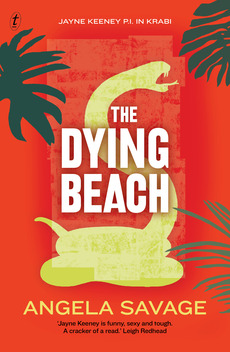
Angela Savage, The dying beach (Review)

Angela Savage, The dying beach

Courtesy: Text Publishing

When I received Angela Savage’s novel The dying beach out of the blue last year as a review copy, I didn’t put it high in my list of reading priorities. I had – and still have – a pile of books waiting patiently, and I rarely (never say never) read crime novels. However, two things changed my mind. One is that Christos Tsiolkas dedicated Barracuda to Savage, and the other is that this year, for the first time, I will visit Thailand, which is the novel’s setting. So, I read it!

The dying beach is apparently Savage’s third Jayne Keeney novel. Jayne is a Private Investigator, an expat Australian living in Bangkok. Like many female PIs, she’s gutsy, hard-living, resourceful, somewhat of an outsider, and rather inclined to bristle if her independence is questioned. (Perhaps this latter is not confined to female PIs, but can be said of many women working for a living in a male dominated environment.) In this, her third outing, she’s holidaying in Krabi with her new (I believe) business and romantic partner, Rajiv, an expat Indian. They are a bit of an odd couple, but we all know about opposites attracting:

Jayne had never imagined she could find love with a man five years her junior, whose background was so different from her own. But Rajiv gave her a whole new way of viewing the world. As if he’d walked into her life and drawn back the curtain, revealing a window she hadn’t even known was there.

I love that image of “revealing a window she hadn’t even known was there”. Savage’s writing is pretty direct, keeping a good pace appropriate to its genre, but that doesn’t mean that it lacks lovely descriptions and turns of phrase. Indeed, the language is one of the delights of the book. Without disturbing her pacing, Savage regularly surprises with telling descriptions. This, for example, gives you a perfect picture of Jayne in full flight:

She was like an appliance without an off switch that kept accelerating under pressure until it threatened to short circuit.

The novel opens with a sort of prologue in which Sigrid, who doesn’t play an ongoing role in the novel, finds a body floating in the water at Princess Beach. Sigrid is surprised to discover that it’s the tour guide Pla whom she’d spoken to only that week. She notices some bruises around the neck suggesting Pla “did not die gently”. The novel proper then starts at Chapter 1 with Rajiv and Jayne in bed. It’s here (in the chapter not the bed!) that Savage provides us with the necessary background to their relationship, to where it stands at this point, and implies tensions that may play out in the future – as indeed they do. There is, in other words, a love story to this crime novel. At the end of this chapter they front up to the counter at Barracuda (surely a little homage to Christos Tsiolkas) Tours planning to book a tour with the “exceptional guide” they’d had a couple of days previously – the unlucky Pla, of course. And so the scene is set for their holiday to become another job, albeit unpaid, something that bothers the practical Rajiv but not our justice-seeking heroine.

I’m not going to write a lot more about the story, because it’s the sort of book people read for plot and surprises, and I don’t want to give them away. I will say though that it offers lovely insights into Thai character and culture. It is also unashamedly political with its plot revolving around the conflict between economic development and environmental degradation. The title itself refers to the fact that mass shrimp-farming results in the destruction of mangrove forests which in turn causes the beaches to “die”.

Savage also presents a critique of Australia, when she has Jayne contemplate why she is living in Thailand:

Truth was Jayne had long felt an outsider among her peers. Since her final year of high school, in fact, when she spent six tantalising months on a student exchange in France. When she returned home, her passion for the outside world met with a lack of interest, if not downright hostility – as though it was disloyal to find anywhere as attractive as Australia. […] For all that Australians like to boast about the national larrikin spirit, in reality only irreverence was tolerated. Unconventionality was not.

It’s a little didactic, but ouch! There is, unfortunately, some truth in this.

The final point I’d like to make relates to its narrative style. Having read several complex novels recently, that is, books with shifting points of view and intricate chronologies, I rather enjoyed reading something more straightforward. I say this, however, comparatively speaking, because The dying beach does not have a simple, linear chronology. Not only are there a few flashback chapters interspersed strategically through the book, but occasionally the narrative focus shifts from Jayne and her cohort to a couple of characters who appear to be implicated in at least some of the murders. The voice is essentially third person omniscient, though sometimes we seem to shift inside a character’s head. Savage does it well, and I enjoyed the change after the intensity of my recent reads.

The dying beach is a compelling page-turner that also makes some points about cultural difference and tolerance, the challenge of tourism, and the complexity of environmental management in developing countries. It achieves this without, to the best of my admittedly limited knowledge, deviating dramatically from the conventions of its genre. And that is a good thing, because the result is the sort of novel that could appeal to a cross-over audience. The challenge, though, is how to get readers, like me for example, to cross over.

awwchallenge2014Angela Savage
The dying beach
Melbourne: Text Publishing, 2013
339pp.
Cover design: WH Chong
ISBN: 9781921922497

(Review copy supplied by Text Publishing)

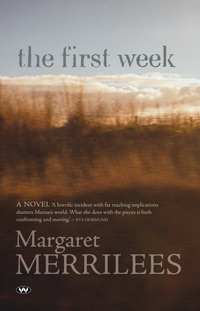
Margaret Merrilees, The first week (Review)

Margaret Merrilees, The first week

Courtesy: Wakefield Press

Having discussed in this week’s Monday Musings Margaret Merrilees’ essay on white authors writing about indigenous Australians, I’m now getting to my promised review of her debut novel, The first week, in which she does just this. It also, according to Wakefield Press’s media release, won the Adelaide Festival’s Unpublished Manuscript Award in 2012. I can see why it did.

The plot is simple. It chronicles the first week in the life of Marian, after she hears shocking news about something her adult son Charlie has done, news that would chill the heart of any parent. Marian is a middle-aged, widowed countrywoman who jointly manages a farm with her oldest son, Brian. She holds the conservative views that would be typical of her demographic. The setting is south-west Western Australia, the Noongar country of Australian author Kim Scott whose That deadman dance (my review) tells of early contact in that very region, but Marian understands little of that. She’s about to learn though, because, standing at a fence that she used to clamber through, she realises

… it was different now. There was a claim on it. This fence, a fence she’s ignored for years, had taken on new meaning. Where she stood was her land. The other side was theirs. Someone’s. Those Noongars from town.

What would they do with it? Any more clearing would be a disaster. The salt was already bad down there.

This comes early on day one, Monday, before she hears the news about Charlie, but already Merrilees has introduced us to Marian, the land she works and her attitudes. She clearly has little respect for “those Noongars from town” and yet she knows the land has been damaged. Merrilees also describes other aspects of Margaret’s life that will help inform our understanding of the week to come – guns, the family’s dynamics including her relationship with her troubled late husband, a dependence on a more savvy friend. It’s all lightly, naturally done through a well controlled third person voice.

By day two, Tuesday, Marian is in Perth, where the first order of the day is to attend Charlie’s arraignment in court. Here she meets Charlie’s housemates and is invited to their home to talk about what has happened – and there she meets Charlie’s neighbour and friend, the indigenous woman, Lee. In addition to the reference to “those Noongars” on Monday, Merrilees leads us up to this meeting with other suggestions of Marian’s prejudiced attitudes to “other” (to Asians and Aboriginal Australians). Needless to say, her meeting with the educated, political Lee does not go well.

This is where Merrilees confronts the issue she addresses in her essay, because for Marian to develop she needs to hear from indigenous characters. Marian meets Lee cold, that is, she doesn’t know Lee is indigenous: “No one had mentioned that. They wouldn’t think it mattered, probably. But it did.” Lee tells her about the Reserve in her region, about the treatment of indigenous people there and in the town. Marian doesn’t want to know – or believe – what she hears. She uses those patronising words “you people” and leaves in rancour. However, she is a woman still in shock and, knowing that all this has something to do with Charlie’s actions, her better self starts to realise that “she had to know whatever there was to know”. She reads Lee’s paper, attends Lee’s talk, and converses again with Lee. Lee is presented as fair but determined. She doesn’t go easy because Marian’s in pain, and when Marian admits that Lee has made her think, and that she’s ready to learn, Lee tells her:

Then you owe me … I won’t forget. Salvation doesn’t come cheap.

To my white Australian mind, Merrilees handles her indigenous characters well. They ring true to what my experience and reading tell me, but, as Merrilees also says in her essay, “it is not for a white writer or critic to decide what is appropriate.” I would love to know what indigenous readers think.

And this segues nicely to what I most enjoyed about the book – its humanity and lack of judgement. Merrilees lets her characters be themselves, warts and all. Lee, for example, is rather fierce but open to discussion and sad about the direction Charlie took. Marian is conservative, in great pain and feeling a failure as a mother, but is open to change. I particularly liked the way Merrilees captured the physicality of Marian’s pain – she can’t eat, or sleep, or remember her son’s phone number, her chest tightens, her heart races. From my own experience of an awful shock, I related to the point where she really has to face her changed circumstance:

Getting out of the car and leaving it behind suddenly seemed difficult. Her last tie with home and normal.

If my review has seemed a little vague about detail, that’s partly because the book is too. There’s a lot we aren’t told about what exactly happened, about why Charlie did what he did, but that’s because he is not the book’s main subject. Early in my reading, I was reminded of Lionel Shriver’s We need to talk about Kevin. This, though, is a different book. Yes, both books are about a mother and a terrible act by a son, but Merilees’ compass is broader. It’s both personal and political. And so, on the personal level, Marian realises that she can – she will – survive. But it’s the political lesson that is dearest, I think, to Merrilees’ heart, and it is simply this, “that she, Marian, was ready to listen” to Lee’s story, to listen to it “wherever and in whatever way” suits Lee. The first week is a compelling read with, dare I say it, an important message. I hope it gets out there.

Lisa (ANZLitLovers) also recommends this debut.

awwchallenge2014Margaret Merrilees
The first week
Kent Town: Wakefield Press, 2013
225pp.
ISBN: 9781743052471

(Review copy supplied by Wakefield Press)

Stella Prize 2014 longlist

I’m not going to write a long post on the Stella Prize longlist because Paula Grunseit has written a good rundown of the books on the Australian Women Writers’ challenge website. Do check it out if you are interested to know more about the books (which I’ll list below).

The Stella Prize, regular readers here will know, is a new Australian literary prize for women writers, this being only its second year. One prize is awarded for a book that can be fiction (literary or genre, novel or short stories, poetry or prose) or non-fiction.

This year’s longlist was announced yesterday. It includes three books I’ve read and reviewed. (An improvement for me on last year when I’d read none at the time of longlisting, though by the end of the year I had read a few!) As last year, it’s a diverse collection, which includes debut novels, novels by indigenous authors, a short story collection, memoirs, a biography, and social analysis non-fiction (I have no idea what else to call books like Night games and The misogyny factor).

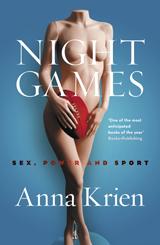
Anna Krien, Night Games

Courtesy: Black Inc

Anyhow, here is the list, in alphabetical order by author:

  • Letter to George Clooney, by Debra Adelaide (Picador): fiction, short story collection
  • Moving among strangers, by Gabrielle Carey (UQP): non-fiction, memoir
  • Burial rites, by Hannah Kent (Picador): fiction, debut novel
  • Night games, by Anna Krien (Black Inc): non-fiction, see my review
  • Mullumbimby, by Melissa Lucashenko (UQP): fiction, novel
  • The night guest, by Fiona McFarlane (Penguin): fiction, debut novel
  • Boy, lost, by Kristina Olsson (UQP): non-fiction, memoir
  • The misogyny factor, by Anne Summers (New South): non-fiction
  • Madeleine, by Helen Trinca (Text): non-fiction, biography, see my review
  • The swan book, by Alexis Wright (Giramondo): fiction, novel
  • The forgotten rebels of Eureka, by Clare Wright (Text): non-fiction, history
  • All the birds, singing, by Evie Wyld (Random House): fiction, novel, see my review

Three books published by UQP (University of Queensland Press)! Good for them.

For those of you who are interested, this year’s judges are:

  • Kerryn Goldsworthy, critic and writer (chair, and on last year’s panel)
  • Annabel Crabb (journalist and broadcaster)
  • Brenda Walker (author and academic)
  • Fiona Stager (bookseller, and on last year’s panel)
  • Tony Birch (writer and lecturer )

The winner will be announced on March 20.

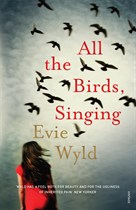
Evie Wyld, All the birds, singing (Review)

Evie Wyld, All the birds, singing

Courtesy: Random House Australia

Quite by coincidence, I read Evie Wyld’s second novel All the birds, singing straight after Eleanor Catton’s The luminaries. I was intrigued by some similarities – both have a mystery at their core, and both use a complex narrative structure – but enjoyed their differences. Wyld’s book is tightly focused on one main character while Catton’s sprawls (albeit in a very controlled way) across a large cast. Paradoxically, Wyld’s 230-page book spans a couple of decades while Catton’s 830-page one barely more than a year. And yet both convey, through their structures, an idea of circularity, of the close relationship between beginnings and endings. But, enough prologue. On with All the birds singing.

The book opens powerfully:

Another sheep, mangled and bled out, her innards not yet crusting and the vapours rising from her like a steamed pudding. Crows, their beaks shining, strutting and rasping, and when I waved my stick they flew to the trees and watched, flaring our their wings, singing, if you could call it that. I shoved my boot in Dog’s face to stop him from taking a string of her away with him as a souvenir, and he kept close by my side as I wheeled the carcass out of the field and down into the woolshed.

And so we are introduced to Jake and the things that dominate her life – Dog, sheep and birds. Soon, we learn there’s another thing – fear. But fear of what, or whom, we don’t know. From this opening, Wyld tells her story in alternating chapters: the odd ones, set in England, move forward, and the even ones, in Australia, move back to what started it all. It’s an effective structure that explores the ongoing impact on Jake of whatever it was that happened. We see what’s happening now, and we slowly see how she has got to this point.

Jake, at the start of the novel, is in her 30s. She’s a loner, capably running a sheep farm on a remote British island. Her nearest neighbour, Don, keeps a bit of a fatherly eye on her, and tries to encourage her to engage with the local community, to go to the pub for example, but Jake is not interested. As we move back in time we learn snippets about various significant people in her life – a lover while she was a shearer, a controlling man whom she’d initially seen as her rescuer, a female friend and co-worker. We also learn that she’s estranged from her Australian family, and we discover that she has scars on her back, but how they were caused are part of the mystery.

Wyld’s writing is marvellous. The imagery is strong but not heavy-handed because it blends into the story. The rhythm changes to suit the mood. The plot contains parallels that you gradually realise are pointing the way. There’s humour and irony. I love the fact that our Jake, on the run from whatever it is, smokes “Holiday” brand cigarettes.

There’s a bleakness to the novel, but it’s not unremitting. Jake, always the outsider, is tough and resourceful. She sleeps with a hammer under her pillow, but she has a soft side that is revealed mostly through her tenderness towards her animals. She talks to Dog, and losing a sheep always brings “a dull thudding ache”. The imagery is focused. Black, shadows, and fire in various permutations recur throughout the novel. They provide possible clues to what started it all; they contribute to the menace she feels now; and they help create an unsettling tone for the reader. We are never quite sure whether the shadow she sees out there, watching, following her, is real or a figment of her imagination. Jake is not an unreliable narrator, but we see through her eyes, and her eyes are influenced by her very real fears. She is “damaged goods”, though not in the sense meant by the paying customer (if you know what I mean!) offended by her scarred back.

And of course, there are the birds. They’re omnipresent. Sometimes they reflect her mood (“the birds sing and everything feels brand new”); sometimes they break tension; sometimes they suggest death. There are specific birds – butcher birds, night jars, galahs, merlins, currawongs and crows – and there are birds in general. The imagery references the real and metaphorical, from the crows hovering over the dead ewe in the opening paragraph to the birds near the end that attend the defining event:

[…] and the birds scream, they scream at me, Chip, chjjj, cheek, Jaay and jaay-jaay notes, Tool-ool, twiddle-dee, chi-chuwee, what-cheer … Wheet, wheet, wheet, wheet […]

awwchallenge2014It’s deafening. But it’s the silence and the dead birds afterwards that impresses the full horror on us:

The trees don’t want me there … There’s not a single bird to make a sound.

All the birds, singing is about how the past cannot “be left alone”. “We’ve all got pasts”, the shearers’ boss tells Jake early in the novel, but for some people the past must be dealt with before they can move on. The novel is also about redemption. It’s not the first novel about the subject, and neither will it be the last, but it is a finely told version that catches you in its grips and makes you feel you are reading it for the first time.

John at Musings of a Literary Dilettante loved the book too. Thanks to my brother and family for a wonderful Christmas gift!

Evie Wyld
All the birds, singing
North Sydney: Vintage Books, 2013
232pp
ISBN: 9781742757308

Eleanor Catton, The luminaries (Review)

Courtesy: Allen & Unwin

Courtesy: Allen & Unwin

Now here’s the thing … I don’t make a practice of reading mysteries. I really don’t care about who dunnit. When Mr Gums and I watch television crime shows, I rarely concentrate enough to work out the plot intricacies, but I do watch the characters. I’m always interested in the detectives and their relationships. I want to know who they are and what makes them tick. And so, I must say that I got a little tired of the plot machinations in Eleanor Catton’s Booker prize-winning novel, The luminaries. I didn’t really want to expend effort to keep track of the complexities of whose gold went where, who told whom what, and so on. But, I did find the book an interesting read, nonetheless.

Why? Well, first and foremost because of the characters. In the first half of the novel, as the characters were being introduced, I was impressed by Catton’s understanding of human nature.  Her characters, most of them anyhow, are nuanced – if that’s not too clichéd a term. Here for example is Thomas Balfour:

When a restless spirit is commissioned, under influence, to solve a riddle for another man, his energies are, at first, readily and faithfully applied. But Thomas Balfour’s energies tended to span a very short duration, if the project to which he was assigned was not a project of his own devising. His imagination gave way to impatience, and his optimism to an extravagant breed of neglect. He seized an idea only to discard it immediately, if only for the reason that it was no longer novel to him; he started in all directions at once. This was not at all the mark of a fickle temper, but rather, of a temper that is accustomed to enthusiasm of the most genuine and curious sort, and so will accept no form of counterfeit – but it was nevertheless, something of an impediment to progress.

This made me laugh. Not all descriptions did of course, but most are insightful of humanity.

There is also humour in the book – some funny scenes, and wry asides. Since we’re on Thomas Balfour, let’s stay with him. Here he is meeting the chaplain Cowell Devlin:

‘Good morning’, returned the reverend man, and from his accent Balfour knew at once that he was Irish; he relaxed, and allowed himself to be rude.

Thomas, as you might have guessed, is English – and this of course tells us more about him than about Devlin.

Perhaps at this point I should mention the plot, though as a Booker Prize Winner, its basic premise is probably known to most of you. The novel is set in the New Zealand goldfields, Hokitika mainly, over 1865 to 1866. The plot concerns the death of one man, the disappearance of another, an apparent suicide attempt, and the provenance of a gold fortune. There are 20 main characters – 12 described as stellar, representing the 12 astrological star signs; 7 described as planetary, representing, of course, the planets; and one, the dead man, described as terra firma. It’s a lot to keep in your head but Catton does provide a character chart at the front to help.

There is a lot to enjoy while reading this book, in addition to the characterisation and humour. The plot is intricate and fun to unravel if you enjoy mysteries. The goldfields setting is realistic, with its businessmen, publicans, politicians, prospectors, whores, opium dealers and tricksters, not to mention the salting and the duffers. The writing is sure. I enjoyed her use of imagery. Grey and yellow feature throughout as do references to spirits (ethereal, emotional, and alcoholic), ghosts, apparitions, phantoms, fog and mist. These all helped convey a sense of murkiness, and of things shifting before our eyes.

The main themes are to do with truth, lies and fraud, with love, loyalty and betrayal. It’s quite a cynical world that our characters find themselves in. As the not-yet dead man, Crosbie Wells, says to the whore, Anna Wetherell:

There’s no charity in a gold town. If it looks like charity, look again.

There is, of course, but it’s rare – and, as Wells advises, you have to be darned careful about who you trust, because, human nature being what it is, where there’s gold, there’s always greed.

The big challenge of this novel is its structure. I’ve already mentioned the structure of the characters. The astrological theme is carried through into the structure of the narrative. The book is divided into 12 parts which, I learnt at my reading group, are meant to align with the lunar cycle, each part being exactly half the length of the previous part. This didn’t feel artificial, because the increasingly shorter parts provided a rhythm to the unravelling of the plot. The other point to make about the structure is that the novel commences on 27 January 1866, 13 days after 14 January when the critical plot events take place. The novel then moves forward, through the trial and its aftermath, to 27 April 1866 (Part 4). In this part, we also jump back, in alternating chapters, to 27 April 1865, when the major players in the plot start, shall we say, “orbiting” each other, if not downright colliding. The novel then progresses forward again, ending on 14 January 1866, not quite back at the beginning, but on the day that precipitates the narrative.

There is, then, a certain circularity to it all, but what does it mean? Does this structure do anything for we readers? I’m not sure. There are intricate astrological charts at the beginning of each part showing where the 12 characters are positioned, astronomically speaking, on that date. I don’t have the astrological knowledge to know whether these charts added meaning or not. The circularity does, however, suggest another potential theme – which is, as chaplain Devlin says, that:

Some things are never done.

Devlin says something else too, which is reinforced by the way the narrative progresses via the stories of the various players:

never underestimate how extraordinarily difficult it is to understand a situation from another person’s point of view.

So, in the end, where did it all leave me? Wondering, in fact, whether it was just a little too clever for itself or, maybe, too clever for me. Either way, I did enjoy the read, and was impressed by the skill with which Catton executed her tale and the insight she has into human nature. Beyond that, I think it’s best if you decide for yourselves.

Lisa (ANZLitLovers) wasn’t enamoured, nor was the Resident Judge, but John (Musings of a Literary Dilettante) liked it very much.

Eleanor Catton
The luminaries
London: Granta, 2013
832pp.
ISBN: 9781847088765

Harriet Ann Jacobs, The lover (Review)

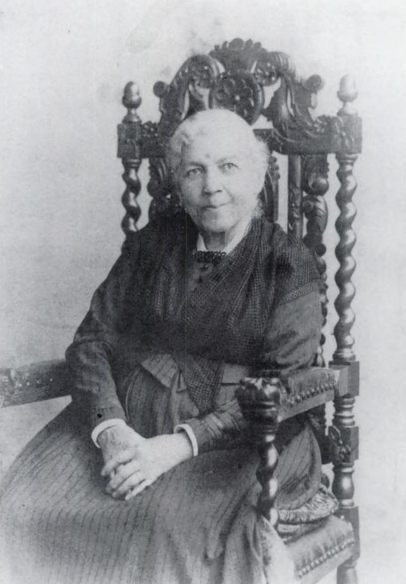
It’s a while since I read a story from the Library of America‘s (LOA) Story of the Week program, but when I saw Harriet Ann Jacobs’ story “The lover” appear in its list of Top 10 stories from 2013 I felt it was time to rectify my tardiness – particularly with the movie, 12 Years a Slave, about to be released here. This story is, in fact, a chapter from her memoir Incidents in the life of a slave girl.

Harriet Ann Jacobs, 1894 (Presumed Public Domain, via Wikipedia)

Harriet Ann Jacobs, 1894 (Presumed Public Domain, via Wikipedia)

Last year was the bicentenary of Jacobs’ birth. Her mother died when she was 6 years old, making her an orphan-slave. Her first masters, LOA says, taught her to read and write, but that mistress died when Jacobs was 12, and she was left in the will to a 3-year-old! That brought her into “a household that introduced her to the true barbarities of slavery”. Jacobs eventually escaped to the north in 1842, when she was nearly 30 years old. Her memoir was published in 1861 by best-selling author of the time Lydia Marie Child, under the pseudonym, Linda Brent. According to LOA, the book and its author enjoyed some minor celebrity in the north at the time, but disappeared pretty quickly, probably due to its being “overwhelmed by the war and later by emancipation”.

LOA goes on to say that it was then “largely forgotten”. Most academics, they say, believed it had been written by Child, suggesting that it may have been “loosely based on Jacobs’s life but ‘too melodramatic’ … to be an actual slave narrative”. However, in 1971, historian Jean Fagan Yellin uncovered the truth of its authorship. She eventually published a biography of Jacobs in 2005, Harriet Jacobs: A life.

The chapter published by LOA as “The lover” gives us a sense of Jacobs’ feisty, resilient nature. It starts with:

Why does the slave ever love? Why allow the tendrils of the heart to twine around an object which may at any moment be wrenched away by the hand of violence? When separations come by the hand of death, the pious soul can bow in resignation, and say, “Not my will, but thine be done, O Lord?” But when the ruthless hand of man strikes the blow, regardless of the misery he causes, it is hard to be submissive. I did not reason thus when I was a young girl. Youth will be youth. I loved, and I indulged the hope that the dark clouds around me would turn out a bright thing. I forgot that in the land of my birth the shadows are too dense for light to penetrate.

I love the way this paragraph confirms that the young-in-love are the same at any time, in any place. Hopeful. Optimistic. How universal. But, how not universal was the situation Jacobs found herself in! She goes on to tell how she’d fallen in love with “a young colored carpenter; a free-born man” in her neighbourhood. She loved him “with all the ardor of a young girl’s first love”. He proposed to her and wanted to buy her from her masters.

Knowing her masters, Jacobs held out little hope for his success, but writes of how “this love-dream had been my support through many trials”. So, she enlisted a sympathetic white woman to plead her case. How nice to read that there were sympathetic white people. Of course the white woman had little to lose other than perhaps the respect and friendship of her peers. I won’t tell you the rest of the story. It’s short and is more powerful in her own words. You can read it at the link below.

A decade or so after her escape (a story in itself) to the North, and over some period of time, Jacobs wrote her book. Then, in the 1860s, she began a career as an activist newspaper journalist. She also worked as a relief worker amongst refugee slaves in Alexandria (Virginia). It was tough work – not only because of the work itself, but because Alexandria, on the border between North and South, had a largely secessionist population. The terrible conditions described by Scott Korb, associate editor of The Harriet Jacob Papers, in his articles “Harriet Jacobs’s First Assignment” and “Harriet Jacobs’s War” reminded me of Geraldine Brooks’ scenes of the Washington DC area in her novel March:

All I could notice was the blight of this place: the pigs wandering the street and dead horses bloating by the roadside … Washington is flooded by the ragged remnants of slavery, contraband cast up here to eke out what existence they may. I felt a pang for the little bootblacks, crying our for trade and going without …

So, I checked. Brooks did, it seems, draw from Jacobs’ book to create her slave character. Now I feel I should read Jacobs’ whole book.

Harriet Ann Jacobs
“The lover”
First published: As Chapter VII of her book, Incidents in the Life of a Slave Girl, 1861.
Available: Online at the Library of America

Margaret Rose Stringer, And then like my dreams (Review)

Margaret Rose Stringer, And then like my dreams

Courtesy: Fremantle Press

I was, I have to admit, predisposed to like Margaret Rose Stringer’s memoir, And then like my dreams, before I opened the cover. Fortunately, I wasn’t disappointed, but not, as it turned out, for the reason I expected. Here’s why. Margaret Rose Stringer once worked as a continuity girl in the Australian film industry and she was married to stillsman (film stills photographer), Chic (Charles) Stringer. I spent many years of my career working with film stills, and I loved it. I was therefore looking forward to hearing an insider’s story. However, the book didn’t really spend a lot of time on industry talk, but Stringer is such an engaging writer that I didn’t care because, by the time I realised it, I was fully invested in her story about the love of her life.

“The love of her life”. This could suggest something rather schmaltzy but while Stringer is totally one-eyed about CS, as she calls her late husband, this is not a schmaltzy book, not really, not despite frequent adulatory proclamations of love. Part love-story, part grief-memoir, the book works because of Stringer herself – her honesty and her writing style. I don’t make a practice of reading about grief. However, over the years I have read Isabel Allende’s Paula (1994), Joan Didion’s The year of magical thinking (2005), and Marion Halligan’s autobiographical novel, The fog garden (2001), and haven’t regretted any of them. Of course, Didion, Allende and Halligan were all established writers when they wrote about their grief, whereas Stringer was not.

But, she could have been, because this book has a fresh, lively style despite its subject matter. In fact, I did say it was only part grief-memoir: while we are told in the first chapter – one-page long and simply titled “All of it” – that she met Chic Stringer when she was 31 years old and that he died 31 years later, much of the book is about these 31 years, of which only the last couple encompassed his dying. Theirs was, it seems, the perfect love story. Stringer briefly describes her childhood, particularly her difficult relationship with her mother, then her undirected, rather wild and unsettled early adulthood in which she was dogged by anxiety, panic attacks and clinical depression. She discovered late in her much-loved father’s life that he too suffered but apparently, while he recognised that Stringer, the fourth of five daughters, was similarly afflicted, he did not have the wisdom or knowledge to effectively help her. Chic, though, did – through love, patience and tolerance. Stringer visualises their relationship as a “truth tree” with the trunk comprising the fundamental fact that:

Chic really, really wanted and needed to look after me; and I really, really wanted and needed him to do it.

My feminist self was a little taken aback by this, but it became clear that Stringer is not, as this might suggest, submissive so much as in need of love and nurturing, which Chic provides. In fact she says:

The point is that I didn’t simply go along with  everything Chic wanted, because I loved him. Nono! – I retained my behavioural traits, because they were mine and they comprised me, even if they were less than totally attractive and desirable as traits go. After all, it was me he loved – not some paragon ….

She could, she said, be stroppy and unreasonable, and he could be bossy, but they made it work. I did feel she was a little too self-deprecating, too willing to put herself down at times, but she’s so thoroughly genuine that these niggles subsided.

Most of the book is about their life together: their work, particularly in the film industry and then the video production business they established when long-sightedness forced Chic out of his career; their various homes, including the one Chic built on Dangar Island in the Hawkesbury River; and their European travels, with some lovely stories about their passion for Placido Domingo. She refers us to their site European Travels with a Spouse for further information on their trips because, as she was reminded by her advisers, she was not writing a travel diary! Chic’s dying and her subsequent grief occupies only a small proportion of the whole.

What makes this memoir especially engaging is the style. Firstly, there’s her friendly, open voice. And then there are the quirky features, one of which is the use of script form to convey key scenes. Most of the book is written in first person, as you would expect, but these script scenes are written in third person. They relieve the intensity of the book and are, in fact, a little whimsical even when the point she wants to convey is serious. It’s the reverse what of Francesca Rendle-Short did in her fictional memoir Bite your tongue which she wrote primarily in the third person, using another name for herself, but occasionally inserted some first person commentary. For her, writing in third person enabled a distancing from the emotional intensity of a story she found “hard to tell”, whereas Stringer often uses these third person scenes to make an emotional point. Or, sometimes, just to tell a funny story. Stringer also uses footnotes entertainingly; she openly discusses the advice she received about memoir writing; and she tells her story through mostly short chapters with inspired titles like “Crust (Daily)”,  “Joy”, and  the ironic “Silver Tongue” in which she discusses Chic’s dislike of her “coarse utterance”.

Stringer is, of course, particularly moving when describing her grief, from her initial denial, through the last months of caring for a terminally ill partner, to feelings of “utter confusion” and madness afterwards. Joan Didion also wrote in her memoir of the mad – aka magical – thinking that attends grief. Stringer, in her inimitable style, is more direct and writes of her “mad-soup” brain.

Late in the book, Stringer says that part of her reason for writing was “to travel all the roads and pathways and sidealleys leading to and from grief”. She has achieved that, and more, because what she has written is a sad yet humorous, and ultimately wise book about the most meaningful thing in our lives – love.

awwchallenge2014Margaret Rose Stringer
And then like my dreams: A memoir
Fremantle: Fremantle Press, 2013
323pp.
ISBN: 9781922089021

(Review copy supplied by Fremantle Press)