Fiona McFarlane, The night guest (Review)

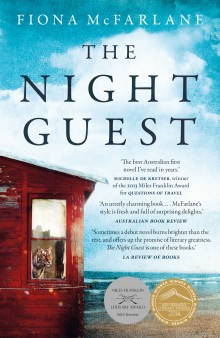
McFarlaneNightGuestPenguinThose of you who followed the literary award season in Australia last year will have seen Fiona McFarlane’s debut novel The night guest pop up several times. The more it popped up, the more I wanted to read it – but also the more I thought it would be good to read with my reading group. So, I bought it, and held onto it until this year, as we did, in fact, schedule it for our end of February meeting.

The first thing to say about this book is that it’s an easy, quick read, a page-turner in fact. But, it is not a simple read. It’s a read that keeps you guessing right to the end, even though you are pretty sure you know what is going on. It’s about Ruth. She’s in her mid-seventies, and recently widowed. She lives in the family’s old holiday house to which she and her husband had retired a few years previously. And, she’s “reached the stage where her sons worried about her”.

Then, along comes Frida, from the government she says, to be Ruth’s carer, because Ruth, as we’d suspected, has dementia, albeit in early stages. She is, she feels, “still self-governing”. Apparently, both of McFarlane’s grandmothers had dementia which helps explain why McFarlane has been able to present Ruth’s state of mind so convincingly. I say “helps explain” because there’s clearly a perceptive and skilled writer at work here too. It’s one thing to experience family members with dementia, but it’s quite another to be able to present it with such authority and authenticity.

How does McFarlane do this? The most important decision a writer has to make I think – and I’ve certainly heard many say this – is the voice. For this book, McFarlane chose third person subjective, that is, it is told third person but almost completely from Ruth’s perspective. A good decision, because we can feel Ruth’s uncertainty as she slides between confidence and uncertainty, between independence and neediness, between reality and a strange world that doesn’t always make sense. Because it’s from her point of view – and not an omniscient author’s – we are kept on our toes, not always sure, as Ruth is not, of where she is on any of those spectrums at any given time. Sometimes it’s patently obvious, but other times it’s not so clear.

Ruth has a few guests during the course of the book – including Frida (of course) and a man called Richard Porter. But there is another one, a tiger! The tiger appears in the opening sentence of the novel:

Ruth woke at four in the morning and her blurry brain said, ‘Tiger’.

She was of course dreaming, except that now she’s awake, she starts to hear noises, “something large … rubbing” against her furniture, and “the panting of a large animal”. These noises are too big to be coming from her cats. The tiger is ongoing “character” in the novel. More on this anon.

The second guest to arrive is the aforementioned Frida. She appears out of the blue one day – “You don’t know me from Adam” she says – to start caring for Frida. The question though is, is she “out of the blue” or is it that Ruth didn’t remember that someone was coming. Questions like this recur throughout the novel, keeping us in a sort of readerly vertigo. One minute we believe we know, and the next we are uncertain again. By the half-way point, though, I suspect most readers are pretty confident of what’s really going on, but even then there are uncertainties about how it will actually play out. All this makes the book an engrossing challenge.

Then there’s the third guest, Richard Porter, who was her first, and unrequited love, when she was a young woman living in Fiji with her missionary parents. Ruth invites him for a visit, hoping that “things could still happen to her”.

It’s hard to know how to write more about the book though because this is one of those stories in which the plot and the meaning are intertwined. However, I can say that it’s broadly about ageing, grief, love and loss. It’s also about trust, honesty and the responsibilities we have for each other.

The tiger

The tiger, as I’ve already indicated, appears on the first page. He’s a complex figure, alluding partly, I’m sure, to Blake’s “The Tyger”. But, and here perhaps I’m drawing a longer bow, he also reminded me of the tiger (aka Richard Parker, which is very close to Richard Porter, but that might be a bridge too far!) in Yann Martel’s Life of Pi. Both tigers reflect a duality: they are both fearsome (and perhaps representative of evil, though I like to avoid that word), but both can also be seen positively. Blake’s tiger was made by the God who also made the lamb, and so by extension can be seen to encompass both forces. Martel’s tiger needs to be kept at bay, but his very presence also gives Pi the strength and focus he needs to survive.

So, too, in The night guest does the tiger play a complex role. He appears when Ruth is at her most uncertain, most fearful, most disoriented, disappearing when she’s calm. In that sense he represents the negative. But, there’s something grand, and perhaps even reassuring about him. In his first appearance, Ruth thinks:

A tiger! Ruth, thrilled by this possibility, forget to be frightened and had to counsel herself back into fear.

A little later, when she is feeling comfortable, the tiger is “safely herbivorous”. But, he comes back, and Ruth is irritated “because there was no point to him now that she had Frida and Richard; the tiger had prepared the way for them and was no longer needed”. I’m tempted to suggest that Frida and Richard could represent the tiger’s duality, but the book isn’t simplistically conceived, so I don’t want to take that line of thinking too far.

Towards the end, when the tiger is fighting for his existence,

Ruth felt for a moment on the verge of understanding exactly what the tiger was saying when he roared. He wasn’t concerned for his safety, but for his dignity …

I’ll leave the tiger there, but I think you can see how McFarlane uses him in the novel.

There are other images and symbols which run through the book, some of them biblical, like lilies (“she was safe behind her lilies”), which makes sense given Ruth’s missionary upbringing. And, of course, Ruth’s name itself is biblical. None of this is heavy-handed though, or suggests a slavish adherence to symbolism. It just adds to the depth with which we can contemplate this book – at least, I think so.

In the end, this is a book about people – and how we treat each other. Several people, besides those I’ve mentioned here, are involved in Ruth’s life, such as her sons and a young mother who’d found her husband as he was dying. The book asks us to consider how far do we – should we – take our duty of care? How do we decide when we should intervene in another’s life and when we should not. I did enjoy this book.

Lisa at ANZLitLovers didn’t enjoy it as much as I did. I agree that it doesn’t really work as a psychological thriller, which is how some of the blurbs on my edition describe it. But, as I was reading it, I wondered whether that’s what McFarlane intended … or just how it’s been promoted?

awwchallenge2015Fiona McFarlane
The night guest
Melbourne: Penguin Books, 2014 (orig. ed 2013)
275pp.
ISBN: 9780143571339
Ellen van Neerven, Heat and light (Review)

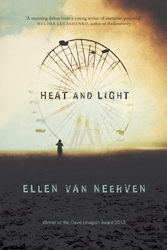
Ellen van Neerven, Heat and light, book cover

It’s silly I know, but I had a little thrill at the end of Ellen van Neerven’s Heat and light, because not only was the last story set in a place where I spent six of the formative years of my childhood – Sandgate on the northern edge of Brisbane – but one of the characters learnt to swim in the same pool there that I did, and her brother has a beagle, just as we did. Ah, childhood. Enough, though, of readerly nostalgia. Time to properly discuss the book.

Heat and light won the David Unaipon Award for Unpublished Indigenous Writer in 2013, and has been on my TBR for several months. I hadn’t prioritised it for reading, but its longlisting for the Stella Prize last week convinced me to squeeze it in before two works I had to complete by 21 and 24 February. I hope I won’t regret it. No, let me rephrase that: I know I won’t regret having read it, but I hope I don’t regret my decision to read it right now!

The first thing to say is that Heat and light isn’t a novel. It has, in fact, an intriguing form, something that’s not unusual with writers from an Indigenous background. Simplistically speaking, it comprises short stories organised into three sections titled Heat, Water and Light. However, each of these sections is quite different. Heat comprises interconnected short stories (5) about three generations of the Kresinger family, while Water is longform short fiction (54 pages in my edition) in the speculative fiction genre. Light, on the other hand, is more like a “traditional” collection of short stories (10). Together, the three sections, including the future-set Water, create a rich picture of contemporary indigenous life and concerns.

And here I confront again the challenge of being a non-Indigenous Australian reviewing a work by an Indigenous Australian featuring Indigenous people. It always makes me a little anxious: I fear sounding earnest or, worse, patronising; I fear making what’s different sound exotic; and, I fear missing the point. And yet I love reading Indigenous writers, because their perspective is different and because they (see, I’m generalising, aren’t I?) tend to be adventurous in their story-telling, often taking risks with voice, form, chronology, genre, and more. Van Neerven, as I’ve already implied, is such a writer.

The titles of the three sections – Heat, Water, Light – make me think of the elements. They are not quite the classical elements (fire, air, water, earth) but they convey, it seems to me, the essence of what’s needed for life. The focal character in Heat, though we don’t see a lot of her, is Pearl, the grandmother of the narrator of the first story which is titled, in fact, “Pearl”. Pearl is a bit of a free spirit – earthy, hot (in its sexual meaning, with “her siren eyes”), and likely to appear or disappear with the wind. Over the five stories in this section we learn about Pearl, her sister Marie, and the two succeeding generations. Van Neerven’s writing is confident, moving comfortably between first and third person narrators, all of whom are members of a complex extended family. Loyalties – to their indigenous background and to their blood relationships – are tested. As the narrator of “Pearl” says:

So much is in what we make of things. The stories we construct about our place in our families are essential to our lives.

And this is true, whether or not the stories so constructed are “true”. The implication is you need to know what you are doing. Colin, for example, finding himself, through his own actions, disconnected from his Indigenous heritage, wants to return, but

she told me if I was going to make my way home I’d better do it soon before the dust had covered my tracks.

The third section, Light, explores similar issues to those in Heat, but through ten separate stories, ranging from 2 pages to 30. The characters in both sections both move between city and country, but, while Heat is set in southeastern Queensland, the stories in Light are set in Sydney, Western Australia and Queensland. The protagonists tend to be young, and female. They also tend to be in formative stages of their lives, or at crossroads; they are sorting out their relationships, their sexuality, their identity. They confront racism and face conflict, but they also experience and give love. There’s humour, some of it wry, such as the young girl noticing that the tag on her pants states that “this colour will continue to fade”.

Water, the longform story that occupies the middle of the book, is very different. For a start, it’s set in the near future, the 2020s, when Australia is a republic with a female president. There’s a new flag and Jessica Mauboy’s song “Gotcha” is the national anthem. There’s also a social media ban! I reckon Van Neerven enjoyed imagining this. However, life isn’t perfect. Our narrator Kaden has a new job as a Cultural Liaison Officer and was initially pleased because she thought she’d be working with “other Aboriginal people” which would provide a “way of finding out about my culture and what I missed out on growing up”. But, she discovers she’ll be working with “plantpeople” who are sort of mutant plants with human features created during “islandising” experiments. Kaden’s job is to evacuate them in preparation for the Australia2 project.

I don’t want to give any more of it away, but you’ve probably guessed that it’s a story about how we treat other, about segregation, discrimination and dirty politics. It’s also about connection to country and about the importance of controlling one’s own art. Artist Hugh Ngo says:

I don’t make art for galleries. Or for money. I make art that speaks the truth.

This is a clever (and true!) book. The bookending sections Heat and Light present stories of Australian people going about their lives, and most of them happen to be indigenous. Their indigeneity is evident, and it affects the issues they confront, but there’s no specific advocacy. The middle section, on the other hand, is more overtly political. It picks up issues that appear in the shorter stories and provides a coherent, ideological context for the whole.

Heat and light is one of those really satisfying reads: it combines engaging writing with stories that make you feel you’ve got to the things that matter. So no, regardless of whether I meet my other deadlines, I’m not sorry I bumped this book up in my reading priorities.

awwchallenge2015

Ellen van Neerven
Heat and light
St Lucia: UQP, 2014
226pp.
ISBN: 9780702253218

Note: One of the stories in Light, “The Falls”, is available on-line at Kill Your Darlings

Tara Moss, The fictional woman (Review)

Courtesy: HarperCollins Australia

Courtesy: HarperCollins Australia

In terms of feminist argument, I’m not sure that Tara Moss told me anything I didn’t already know or believe in her first work of non-fiction, The fictional woman, but that didn’t stop me enjoying her take, her approach. Moss is an interesting woman. Her careers as a model and a crime writer meant she wasn’t really on my radar for the first twenty years of her working life, but that changed a couple of years ago when she began appearing on commentary shows I watch like Q&A (see an appearance here) and The Drum. I discovered that she’s a woman of wide interests and many talents. Here are some of them: UNICEF Ambassador for Child Survival, Goodwill Ambassador; UNICEF Australia Patron for Breastfeeding for the Baby Friendly Heath Initiative; Ambassador for the Royal Institute for Deaf and Blind Children; and a PhD candidate in the University of Sydney’s Department of Gender and Cultural Studies.

So the book. Her main thesis – born of her own experience – is that women’s lives and roles are subject to an inordinate number of fictions that contradict reality, and that this helps perpetuate ongoing inequalities for women in representation, status, value. The book starts more like a memoir, telling us how she became a model in her early teens (“The Model”), her experience of being measured by her body (“The Body”), how she survived some early experiences, including rape (“The Survivor”), and her transition to being a writer (“The Writer”). She then moves on to discuss wider topics such as “The ‘Real’ Woman”, “The Archetypal Woman”, “The Beautiful and the Damned”, and “The Crone”, though in these too, she often uses her personal experiences. To illustrate the fictions women live under, she tells of taking a polygraph test to prove that she, a “dumb” “blonde” “model”, could actually have written a successful novel.

Moss supports her discussion of the fictions she identifies with an impressive array of statistical and other evidence. The book is extensively foot-noted (or, is that end-noted), as you would expect from a PhD student. While the points she makes aren’t necessarily new to me, much of her evidence is – and that’s worrying because her evidence is recent confirming that things haven’t changed as much as I’d have hoped since I first started thinking and reading about feminism in the 1970s.

I won’t elaborate the multiplicity of fictions she explores, the way women are simplified into virgin, whore, witch, crone, for example, because we all know them. Even the male readers here know them, I’m sure. Rather, I’d like to talk about some ideas that I found particularly interesting.

One of these ideas relates to the issue of beauty, which comes up in several chapters, but my focus here is “The ‘Real’ Woman” in which she discusses the various campaigns for/promotions of “real beauty” which encourage women to show themselves au naturel. No, I don’t mean naked, but without makeup, and other enhancing products and processes. Having lived my life this way (little or no make-up, no hair-dyeing, no waxing, etc), I was feeling comfortable in this chapter, until I reached her suggestion that these “campaigns” can be “like a beauty pageant, only with different parameters”. In other words, once again, we are asked to “judge” women on the basis of their appearance. She writes:

I see some disturbing similarities between the kinds of appraisals of women’s appearance that we commonly view as misogynistic, and appraisals that present themselves as ‘pro-woman’.

I take her point. “Using images”, she argues, “to make the claim that you are freeing women from the prison of image is a tricky thing to pull off”. I found this chapter the most confronting because, unlike the others which tended to cover more familiar ground, this one forced me to think more deeply about the complexity of how we “see” women. It’s not surprising that she loves John Berger’s excellent work, The ways of seeing.

She explores some of the underlying structural causes, particularly the way our market-driven society supported by the media contort and distort “reality” through stereotyping, simplifying and then generalising. She argues that women’s visibility in the public sphere is dominated by/limited to those “images” needed to sell products. Advertising has become “so entangled with mainstream culture … so entangled with female identity in particular”, she argues, that we do not see the real diversity of women’s engagement in society.

For many people, “gender” and “feminism” are tricky concepts. Moss unpacks them both with excellent clarity. Her definition of feminism is exactly mine. Feminists want

equal opportunity, equal rights, equality for women. (Equality = same value or status. They want to be equal to, not the same as, men).

Yes! How often do we need to repeat this? “Equal” does not mean “same”. And just because you don’t agree with some feminists doesn’t mean you’re not a feminist if you believe in equality for women. Moss understands, though, women fearing to own the term. She tells of once being asked on ABC TV whether she was a feminist, and admitted she felt

an actual ripple of fear. Part of me was afraid of the vitriol I would be subjected to for publicly identifying with the very movement that had given me the right to vote, the right to own property, the right to work and earn my own pay.

How can that be?

And this brings me, in a way, to another theme that pops up through her book: the way women undermine each other. She discusses, for example the “mummy wars” in which working mums are pitted against stay-at-home mums, and breast-feeding mums are pitted against formula-feeding mums. And yet, she also debunks the fiction “that all women hate each other” or that “women are their own worst enemies”, not only by confirming that for many women, other women provide their greatest support, but by exploring how society, and particularly the media, “read” female behaviour and interaction to put this spin. She tells how a joking comment of hers was read as “a swipe at Miley Cyrus”. Again, the main point of her argument is the social construction that supports these “fictions” about women.

In her final chapter, she discusses what she sees as the wider problem which is that the world is not “a fair and balanced place”. We do not have equality – across gender, race or class. This is what we need to address, and she calls us all to action.

Occasionally I worried that Moss was drawing a long bow or skewing her argument a little by her own experience, but in fact I found her thesis and thinking to be clear and logical, intelligently-framed, and forceful without being judgemental. It’s a good read – and provides much for us to contemplate.

awwchallenge2015Tara Moss
The fictional woman
Sydney: HarperCollins Publishers, 2014
328pp.
ISBN: 9780732297893

(Signed copy received from my sister-in-law)

Favourite quotes: from Thea Astley’s Coda

I’ve decided to start a new, occasional series – a bit like The Conversation does! I have two reasons for this. One is that I’m reading pretty slowly at the moment, partly because my current read is a big one, and partly because life is busy. The other is that during my current decluttering project I’ve come across a lot of old reading notes, and they contain such treasures that I want to share them (not to mention document them so I can toss out my notes!) Who better to start with than Thea Astley?

Coda, published in 1994, was her third last novel (a novella, in fact). You know how readers love to remember favourite first lines? Well, Coda’s first line is one of mine. It starts

I’m losing my nouns, she admitted.

This immediately tells us the main subject matter of the novel – aging – and hints at the speaker’s attitude. Kathleen, our speaker and protagonist, is getting old, and when her house is reclaimed by the government for a right-of-way, her children (daughter mainly) move her into a retirement community. This is a satire, so you won’t be surprised to discover that the name of this village is Passing Downs. Kathleen, needless to say, is not happy. She’s not ready to be, as she says, “corpsed”, but she’s a wily, acerbic old woman, a self-styled “feral-grandmother” who’s pretty clear-eyed about the way life goes, about the

… four ages of women: bimbo, breeder, babysitter, burden.

In a Sydney Morning Herald article written, as it turned out, the year before she died, Astley is described as one of Australia’s “prose-poets”, who were “led” by Patrick White. You can see it in this line can’t you? The confident alliteration that ensures the words are almost spat out as befits their meaning.

I’m not going to write a review here. It’s too long since I read it, but this is one of those books that has left a lasting impression on me. It’s wicked, funny, bitter and, yes, poignant, too, because it deals with a situation for which there are no simple answers (except, of course, compassion, which is lacking here). I will though share a few more quotes to show the way Astley uses language. You’d be hard-pressed to find a cliche in an Astley book.

Here is a description of, as I recollect (my notes aren’t clear here), her husband’s island dream going sour:

The island had become for him a bright stamp whose colours had run.

Then there’s Kathleen describing her income, her

Public service pension that drizzled brief fortnightly puddles of support into her bank account like a rusty tap.

And here she is, looking for words:

She was scrabbling and rooting about for words in that old handbag of her years.

I love how these images draw on the familiar – and yet they have a freshness that grabs me, and makes me smile, every time I read them.

For a recent review of this novel, check out Lisa’s at ANZLitLovers.

Julie Twohig, Full circle (Review)

When I review individual stories, I tend to choose ones that are available on-line. Is that fair, I wonder? It means the author receives no payment for the story I review, but it does mean readers can enjoy a story that they may not otherwise easily access and, I suppose, that the author receives some exposure. Does that make sense? Whatever! This is what I do!

So, to Julie Twohig. She came to my attention when she commented on one of my posts. As most of us do when people who have blogs themselves comment on our blogs, I checked out her blog. It turned out that Twohig is a short story writer, and has had some success, winning or being shortlisted for various awards/competitions, and being included in a few published anthologies. She’s a good example – I hope she doesn’t mind being held up as an example – of the hard work short story writers put into getting their stories known and published.

She provides the text for a few of her stories on her blog, but I chose to read “Full circle” because it is, she writes, her “first winning story and first short fiction to be published”. It won the Leader (Leader being a newspaper group) Darebin (being a community in Victoria) Short Story Competition and was also Commended by The Society of Women Writers Victoria Inc. I enjoyed the story. It’s not one of those tricky short stories that leaves you wondering at the end, but it’s a story from the heart about a middle-aged woman, Jean, returning to the Luang Prabang area of Laos, alone, thirty-two years after her previous visit with Peter, the man who was to become her husband. Peter isn’t with her because, we soon realise, he has died (not because of divorce). Early in the story Jean remembers him saying “I’ll rest when I’m dead”. The tone, here, is sad, nostalgic, not angry or bitter.

The story starts like a typical travel story. Our protagonist is on a bus in an unfamiliar environment, trying to work out how to navigate a different culture. It’s nicely done:

After freeing her backpack from an overhead rack Jean tries to dodge the spillage while scrambling past passengers packed tightly along the aisle. ‘Sorry, sorry … excuse me.’ She had thought it might be rude to thump her fist on the ceiling the way the locals do to make the driver stop. She wishes now she had.

All travellers are, I’m sure, familiar with this uncertainty about how to act. Anyhow, we are not sure what Jean is doing except that it is something she feels she must do – “this trip is for her. For Peter. Full circle”. Aha, there it is, the title, half way through the story.

I’d love to discuss what she is doing because it rang true to me – not that I have experienced exactly the same thing (my spouse is still alive), but I’ve experienced enough for it to have that lovely sense of “ah yes, this makes sense”. The story is well structured. There are a few flashbacks to give us a sense of where Jean is in her life, but only as is needed to convey who Jean is and why she might be doing this trip. The imagery isn’t particularly original, but it is effective, and not overdone, which suggests that Twohig has taken care to hone her story.

At the end of the story on her website, Twohig tells us that poor handling of the publication of the anthology resulted in a furore, which led to the competition not being repeated. Interestingly, the very same Leader newspaper group ran an article in February last year announcing the inaugural Mayor’s Writing Awards in Darebin, with two prizes – for Adult and Children’s short fiction. The winners of these prizes were announced in June on the Darebin Arts website. The winning and highly commended stories earned a cash prize and the “option to be published in n-SCRIBE issue 9″, the City of Darwin’s community arts magazine, which is published annually. It remains to be seen whether this competition will be run again in 2015. Full circle?

awwchallenge2015Julie Twohig
“Full circle” in Around the block: Our Darebin Community
Greensborough, Vic: Flat Chat Press, 2007
Available online at the author’s website

Anna Funder, Everything precious (Review)

Anna Funder, Everything preciousI must thank John aka Musings of a Literary Dilettante for introducing me to this intriguing little e-work by Miles Franklin award-winner, Anna Funder. When John read it, back in October, it was in daily instalments, but when I clicked the link in his post I was offered several e-book versions, including for the Kindle and iPad, or for an audiobook which I believe is read by Funder. It’s free.

So, what is it? Here’s the description at the start of the story:

This story is a unique collaboration between Paspaley, acclaimed author Anna Funder, photographer Derek Henderson and award-winning actress Teresa Palmer. It’s an original story of love, self and all things precious, featuring the most beautiful pearls in the world.

Paspaley, for those who don’t know, is an Australian-based company founded in the pearling industry of northwestern Australia. Although it has now diversified into other businesses, it is probably still best known for its pearling arm. As you might assume from the title of Funder’s story, “Everything precious”, it is the pearling arm that sponsored Funder. John wrote his post before he finished reading the story, and said he feared finding some product placement at the end. However, in a postscript added later, he advised there was no such thing. He’s right – in a sense – as there’s no reference to pearls or Paspaley in the text. But, in my e-book version, between chapters 4 and 5, there is a series of five photographs taken presumably by Derek Henderson and featuring, again presumably, actor Teresa Palmer. They are tasteful in that high-class-magazine way … no text, just beautiful images of a lovely woman wearing gorgeous pearls.

I researched a little more, and discovered that the story is part of a “multi-channel campaign” to launch Paspaley’s new Touchstone collection. The “campaign uses storytelling to engage a new, younger, more fashion conscious audience and make pearls relevant and appealing to them”. Intriguing eh! I wonder how successful it’s been?

What, besides presumably money, did it all mean for Anna Funder? Here’s what she says:

Working with Paspaley has been one of the most exciting writing experiences I’ve had. To have total creative freedom, a time limit and an audience turn out to be the perfect conditions for writing a short story. And the idea that a company, which makes things of great beauty and value from nature, values literature, which (on a good day) is also something of beauty and value that reflects the world around us, was inspiring. Writing this story has been a joy and a privilege, and was some of the most fun I’ve ever had writing.

Now, let’s talk about the story, which the promoter’s website I’ve linked to above describes as “a short story of desire, need, love and all that is precious”. The plot is pretty simple. It’s about Tess, who works in online legal publishing, and would be in her mid thirties. She has a husband, Dan, head of epidemiology in the State Health Department and a lovely SNAG if ever there was one, and three children, Charlotte who is 13, and the twins, Tom and Lorna, who are 6. She also has a father, Howard, a retired judge who is in Assisted Living because he has dementia. This is, then, an upper middle class, professional family. Tess and Dan have been together for 17 years and she’s feeling a little trapped and restless. A bit of a midlife crisis, in other words, or, as Funder writes in the story, Tess is:

at a hinge moment: between youth and age, between the life you thought you wanted and the one you feel might, now, suit you better.

So, Tess decides to consider that other life she might have had, but … well, I won’t give the ending away because it’s easy for you to access at Paspaley.

It’s interesting to look at this story in terms of the campaign because I’m presuming that although Funder had “total creative freedom” there must have been a brief – one that at the very least identified a target market, oops audience, for the story. This audience would, I’m sure, identify pretty easily with the character and set up, with the restlessness attended by guilt that she should be so restless. The brief must surely have identified a tone too. You wouldn’t sell pearls with a grim story – or did they assume Funder would have the nous to make the story appropriately positive? Regardless, the story would clearly suit what I assume was Paspaley’s target market – upwardly mobile or already there professional thirty-to-forty-something women who have the disposable income but who may see pearls as the province of their Baby Boomer mothers.

This all sounds pretty cynical, and to some degree it surely must be. I would describe the story as “chicklit” for the well-to-do married woman. It’s not challenging reading. The resolution is easy to comprehend and reassuring. However, it is written by Funder. This means that the writing is good, there’s intelligence at play (including an allusion to Chekhov!), and the insights into the pressures of early 21st century professional family life are authentic even if not explored in any depth.

awwchallenge2015Overall, then, it’s an enjoyable read and an interesting concept to ponder. I certainly wouldn’t criticise Funder for taking up the opportunity offered to her. Writers, like all of us, have to live – and if a company like Paspaley is prepared to pay, and offer “complete freedom”, why would you say no?

Anna Funder
Everything precious
Sydney: Paspaley, 2014
Smashwords Edition
Available: Gratis at Paspaley

Annie Parker, Passages in the life of a slave woman (Review)

I have, this year, reviewed a couple of Library of America‘s (LOA) stories about slavery in the USA, one being Harriet Ann Jacobs’ “The lover”, and the other William Wells Brown’s, Madison Washington. I’ve always been interested in slavery in the US, so when Annie Parker’s “Passages in the life of a slave woman” appeared in my inbox, I of course wanted to read it – and discovered yet another intriguing story.

When I say I discovered “another intriguing story”, I don’t just mean Parker’s story but the story of Parker herself. Let me explain. Parker’s story, “Passages in the life of a slave woman”, was published, according to LOA’s always illuminating notes, in Autographs for freedom. This was an annual anthology of antislavery literature published as a fundraising venture by the Rochester Ladies Antislavery Society. (Only two were apparently produced). The anthologies included “original works by such dignitaries as Ralph Waldo Emerson, Harriet Beecher Stowe, Theodore Parker, William Wells Brown, Catherine M. Sedgwick, William H. Seward, and Horace Greeley”, as well as Frederick Douglass’ novella, The heroic slave, about Madison Washington. They also included two pieces by Annie Parker – a poem, Story telling”, and the story I’m discussing here. But, here’s the thing – no-one, says LOA, apparently knows who this Annie Parker is (or was).

So, like any good blogger, I did an internet search – just a little one – and found a guest post on the blog of the IAHI, aka, the IUPUI (Indiana University-Purdue University Indianapolis) Arts and Humanities Institute. The guest post, published in September 2014, is titled “In Search of Annie Parker by Professor Jack Kaufman-McKivigan”. Kaufman-McKivigan’s post concerns a symposium that was coming up in October at which experts were “to examine the historical and literary significance of Douglass’s novella, The Heroic Slave.” In preparation for this event, staff members were engaging, he said, in some “literary detective work” – and one of these projects was trying to identify Annie Parker.

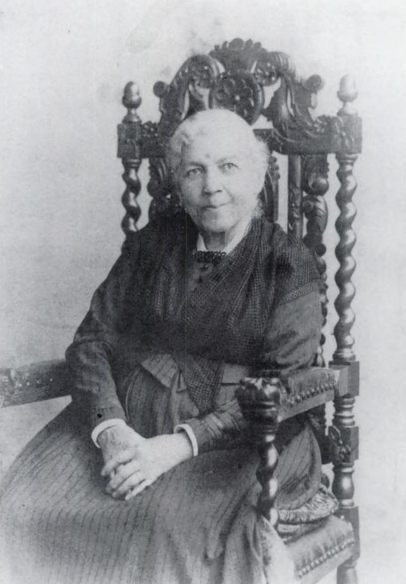
Harriet Ann Jacobs, 1894 (Presumed Public Domain, via Wikipedia)

Harriet Ann Jacobs, 1894 (Presumed Public Domain, via Wikipedia)

Kaufman-McKivigan writes in the post that in recent decades her story “has been anthologized several times as one of the earliest works of fiction by an African-American author”. That’s interesting in itself, because it means they (whoever “they” are) have assumed she was an African-American contributor. It could be so, and the story could be autobiographical, but I also wondered, given the lack of information about her, whether “Annie Parker” was a pseudonym. Anyhow, our professor says they found a couple more articles by an Annie Parker in a temperance journal from Geneva, New York, but then the trail went “cold, very cold”. Genealogical research, he says, turned up “a few possible ‘Annie Parkers’ in the upstate New York region” but none had “any known connection to the antislavery movement and all were white”. He then posits that Annie Parker may not have been a runaway slave as others have speculated, but might have been “a pen-name”. The question then is whose? One possible idea is the above-mentioned Harriet Jacobs. There are some valid reasons for making this connection, as he explains in the post – so do read it at the link above if you are interested. Why Jacobs might have wanted to use a pseudonym is a question the literary detectives are now working on. All very interesting – and one of the reasons I do enjoy these LOA offerings.

Now, though, the story – which is told first person in the voice of a slave, after the opening paragraph is told third person. I was, I must say, quite flummoxed by this. The paragraph has some odd punctuation, in that there are opening quotation marks but no closing ones. LOA’s notes suggest this is to indicate that the rest of the story is composed entirely of her narrative. Fair enough, though I don’t quite understand why Parker needed to start with the third person, except that it does make for an easy way of telling us who the narrator is.

The story is told by the slave, Phillis, sister of another slave, Elsie, who had died giving birth to her second child. Both Elsie’s children – the first, a son, and the newborn, a girl – were fathered by “the young master”. The son, who looks too much like his father is sold off before the young master brings a wife home, thus preventing any awkward questions being asked. Meanwhile, Phillis cares for the daughter, Zilpha, as she grows up to young womanhood. I won’t give away the story here but simply tell you that LOA introduces it as a “tale, charged with incest and gothic intrigue”. You can read it at the link, below. It’s only 6 pages.

This is not a story about beatings and cruel physical treatment. Indeed the new mistress:

proved a kind and gentle mistress. All the slaves loved her, as well they might, for she did everything in her power to make them comfortable and happy.

But, we never forget that slaves are powerless – and, as we know only too well, when anything happens that threatens an owner’s happiness or security, little thought, even on the kindest plantations, is given to the “feelings” of the slaves. They are possessions and can be moved around at will. Their emotional or psychological needs, let alone their physical safety, are not relevant. And so, in this story, as certain truths come to light, the owner takes actions to protect his security and happiness. The irony is that he, like his mistress, is generally (perhaps “superficially” is the better word) kind and fair, but there are limits – and it is the impact of those limits that we are left with, confirming once again what a destructive institution slavery was, indeed is.

Annie Parker
“Passages in the life of a slave woman”
First published: In Autobiography for freedom, 1853.
Available: Online at the Library of America

Thea Astley, Drylands (Review, of sorts)

I read Thea Astley’s Drylands many, many years ago now, so what I’m going to share here – inspired by my post earlier this year on confronting Australian novels – are the notes I made when I read it. They are not particularly well-formed, because I wasn’t planning a review at the time, though I must admit that I did spend some time skimming it as I tried to massage my notes into some shape. Too hard not to! It’s her last novel, and it earned Astley her fourth Miles Franklin Award (shared with Kim Scott’s Benang).

Drylands is subtitled “a book for the world’s last reader”. It’s one of those tricky books that looks like a collection of short stories but is, albeit perhaps loosely defined, a novel. Its structure comprises sections titled “Meanwhile” by the so-called writer of the stories, Janet, alternated with stories about inhabitants of, or visitors to, a dying town called Drylands:

a God-forgotten tree-stump of a town halfway to nowhere whose population (two hundred and seventy-four) was tucked for leisure either in the bar of the Legless Lizard or in front of television screens, videos, Internet adult movies or PlayStation games for the kiddies.

[…]

No one was reading anymore.

It’s a town “being outmanoeuvred by the weather. As simple as that. Drought. Dying stock.”

The main subject of these stories are three men (Franzi Massig, farmer Jim Randler and the indigenous Benny Shoforth) and three women (Evie the writing teacher, Lannie Cunneen, and Joss the publican’s wife). This is all quite neat, except that we are thrown somewhat by the fact that the “Janet” character may be a conceit dreamed up by Evie, who says she will “write a story … about a woman in an upstairs room above a main street in a country town, writing a story about a woman writing a story”. Since Janet is an inhabitant of Drylands while Evie is not, it makes sense that this might be Evie’s work, not Janet’s, making Evie both character and observer*. Another spanner in the narrative-voice-works is that two of the stories – those of Franzi Massig and Joss – are told first person. I might be reading too much into it, but I wonder if Astley is using this uncertainty to mirror the disorder she sees in society, if that makes sense.

Drylands explores many of the issues important to Astley. The two overriding ones are words and their importance/power, and the impoverishment of the spirit (often related to our inhumanity). Subsumed in the latter are some of Astley’s recurrent issues – gender and race, dispossession and power imbalances. She rails against the shallowness and small-mindedness that lead to poor treatment of “other” (indigenous people, women, less educated people, the ageing, etc), to “the powerlessness”, as Benny calls it, “of poverty and colour”. Here is a husband coming to drag his wife out of her writing class to get him his lunch:

He was hurling words at his shrinking wife like clods or bricks and she was not dodging but receiving them like a willing saint, enduring abuse like a terrible balm.

I wonder what Astley would have written about our treatment of asylum-seekers had she still been around, but unfortunately she died in 2004.

Thea Astley is, as you’ve probably gathered, an unsettling writer – and one with some very strong viewpoints. Besides being unimpressed by how women, indigenous people, and ‘oddballs’ (or outsiders) are treated, she’s also not too fussed about computers, television, and our sports-mad society. For these reasons I’m inclined to agree with Kerryn Goldsworthy that there’s a dystopian element to her vision. I didn’t pick it at first because I tend to see dystopian novels as being speculative or fable or allegorical, as being, in other words, about what “might be” rather than what “is”. The handmaid’s tale is a dystopian novel that is not specifically set in the future but neither is it set in a recognisable “real” world. Lord of the flies and Animal farm are dystopian views of the world that are not set in the future but, arguably, neither do they present a realistic community/society/place. Drylands, though, is recognisably our world, but a pretty grim version of it, which suggests dystopia. It’s probably worth noting here that Drylands was published in 1999, that is, at the end of the millennium.

Regardless of formal definition, though, Drylands, like dystopian novels, is pervaded by a sense of hopelessness. There are likable people – many – but life isn’t easy or happy for them. There are, however, some positive or redemptive hints, particularly for Clem and Joss. Janet, the linking character, on the other hand, can only glimmer the fact that there might be something out there:

There was something out there, but she doubted she would ever discover. The idiocy of her wasted years made her laugh even more.

There were no endings no endings no

awwchallenge2014The writing in Drylands, though sometimes colourful, is sparer, more restrained than we are used to from Astley – and just right for a bitter tale about lack of literacy, loss of reading skills, and the implications thereof. Janet’s mother tells her that “being unable to read is being crippled for life”. Janet, writing her story, worries whether she’s getting her narrative right, but decides it’s “better for readers to frolic with their own assumptions from the words spoken, the deeds done” – which is, perhaps, the ultimate irony if everyone has lost the ability to read! If you only ever read one Astley, you couldn’t go wrong with this one.

Thea Astley
Drylands
Ringwood: Viking, 1999
294pp
ISBN: 9780670884704

* There is a scene in “Stranger in town”, where Evie briefly meets the eyes of the woman (whom we know is Janet) living above the newsagency.

Helen Garner, This house of grief: The story of a murder trial (Review)

Helen Garner, This house of grief book cover

Courtesy: Text Publishing

Well you might ask why you would want to read a book about the trial of a man accused of murdering his three sons by driving his car into a dam and escaping the car himself? Indeed, Helen Garner was asked why she would want to attend such a trial – and write about it. But Helen Garner is made of strong stuff, having previously written The first stone about the sexual harassment of two girls at Melbourne University’s Ormond College and Joe Cinque’s consolation about the trial of a woman accused of murdering her boyfriend via a drug overdose. I’ve read and appreciated both these books, along with novels and short stories by Garner, and so was keen to read this, her latest.

For those of you who don’t know the story, here’s Wikipedia’s summary of what happened:

… as Farquharson was returning his children to their mother after a Father’s Day access visit, his white 1989 VN Commodore vehicle veered across the Princes Highway between Winchelsea and Geelong, crashed through a fence and came to rest in a farm dam where it filled with water and submerged. His three children, Jai (10), Tyler (7) and Bailey (2), were unable to free themselves and drowned. Farquharson managed to escape and alerted another driver who took him to nearby Winchelsea. Police divers recovered the boys’ bodies about 2 am the next day. They were still inside the vehicle and unrestrained by seatbelts.

Farquharson claimed that he did not intend to kill his children, that he had blacked out during a coughing fit (a condition known as cough syncope). However, he was tried and found guilty, tried again after winning an appeal and found guilty again, and was then refused leave to appeal to the High Court of Australia.

Garner sat through both trials, the first one lasting around 7 weeks, and the second one 11 weeks, and managed to condense it all into 300 pages of lucid prose. One of the reasons I was keen to read the book was to see what approach she’d take. In The first stone and Joe Cinque’s consolation, Garner’s opinion is pretty clear from the beginning – and I didn’t fully agree with her (for very different reasons in each of the books). However, in This house of grief, Garner is more measured. She doesn’t want to believe that Farquharson is guilty – “longed to be persuaded” otherwise – but is gradually swayed by the evidence to believe it must be so. She doesn’t engage emotionally with the participants in the intense way she did in Joe Cinque’s consolation, but she is emotional. How could you not be in such a case? There are two reasons I like Garner – her tight, evocative prose, and her fearless honesty. And so, in this book, she tracks her own response as she listens to the evidence – from her disbelief that a father could do such a thing, and her sentimental desire to believe Farquharson, to her horrified admission that any doubt about it is “no more substantial than a cigarette paper shivering in the wind”.

So, let’s get back to the original question. Why read such a story? There are a few reasons, but I’ll discuss my two main ones. The first is to gain insight into, and understanding of, human behaviour. Why do people do what they do? It’s so easy to judge people out-of-hand, but even horrific events have nuances, and I want to understand those. Not to excuse, because it’s impossible to excuse taking the lives of those in one’s care, but to be able to empathise in some way. Isn’t this what literature is about?

Garner achieves this by not demonising Farquharson. As she watches him in court, and listens to the evidence – professional, personal, expert – she presents a picture of a man who was “emotionally immature, bereft of intellectual equipment and concepts, lacking in sustaining friendships outside his family”. At the end of the first trial, the judge speaks kindly to Farquharson, and Garner writes:

Farquharson nodded to him, courteous and present. For the first time I saw him as he might have been in ordinary life, at work, at school. It touched me. Again I felt shocked, as if this response were somehow illegitimate.

(Interestingly, Garner did not accord such recognition to Anu Singh in Joe Cinque’s consolation. Yes, different case, very different people, but the principle still stands I think.) A little earlier in the trial, Garner quotes “a tough American prosecutor” who’d said to her:

‘If I were appearing for him, I’d try to make his family see that loving him doesn’t have to mean they believe he’s innocent’.

But, how tough that would be, eh?

My second reason is to understand the workings of courts and justice. I have never (yet anyhow) been called for jury duty. Oh my, oh my, after reading this, I’m even more desperate that I never am. Although it’s pretty obvious that the right verdict was achieved in this case, the process was not reassuring. Garner’s reporting of evidence and cross-examination reads very like those court dramas you see in film and television. There’s drama, police mistakes, twisting of the truth, character assassinations, conflicting expert opinions – and, in this case, a lot of complicated and sometimes obfuscatory technical evidence about cars and tire tracks and steering inputs, about arcs and gradients. And it goes on for weeks.

Garner keeps it interesting by focusing on the people and their reactions, reporting some dialogue, and summarising the critical (which, she makes clear, is not always the most relevant) points of evidence. Her descriptions of the defence and prosecution team are drawn with a novelist’s eye for character. Sometimes Morrissey, the defence barrister, is “as jumpy as a student undergoing an oral exam”, while at other times he’s “less flustered … more in control of the content and tone of his discourse”. His “waxen” appearance at the second trial is quite different from the beginning of the first when he’s presented as a hearty “spontaneous, likeable man” whose “stocks were high”.

She also pays a lot of attention to the jury. Of course we cannot know what they thought or discussed but Garner watches them, noting when their attention flags and when it picks up, when emotions get the better of them. She writes, for example, of one witness that “the jury liked him … he was one of the witnesses they instinctively trusted”. During her report on the second trial, she quotes American writer, Janet Malcolm who wrote that “jurors sit there presumably weighing evidence but in actuality they are studying character”.

Partway through the book, Garner comments that the question “Did he do it?” is the “least interesting question anyone could ask.” Later, between the first and second trial, she quotes a grandmother from another murky situation in which a father was suspected of killing his children via a house fire. The grandmother asks:

‘What’s worse? — living with suspicions and various possibilities and never knowing the truth, or living with the truth of something too horrible to contemplate.’

Books like Garner’s enable us – nay, force us – to contemplate such questions. They show us that trials are less about retribution, perhaps even less about justice, but more about the truth. What we are to do with the truths we so glean is another question – but that question, Garner suggests, is our “legitimate concern”, and I agree.

awwchallenge2014Helen Garner
This house of grief: The story of a murder trial
Melbourne: Text Publishing, 2014
300pp.
ISBN: 9781922079206

(Review copy courtesy Text Publishing)

Delicious descriptions: Eimear McBride is not all grim

Reactions to Eimear McBride’s A girl is a half-formed thing, which I reviewed recently, vary greatly. It is, overall, a bleak read and its style is idiosyncratic, which makes it a double whammy. So, for example, it has been called “brutal” (by Sunday Times Ireland) and a “joyous thing” (by Michael Cathcart, RN’s Books and Arts Daily). Both of these make sense to me – the story is “brutal” but the writing is “a joyous thing”, because it’s alive, it wakes you up, it compels you on.

In 2013, as you may have already heard, it was the inaugural winner of the Goldsmiths Prize, which was “established to celebrate the qualities of creative daring associated with the University and to reward fiction that breaks the mould or opens up new possibilities for the novel form. Accordingly, the annual prize of £10,000 will be awarded to a book that is deemed genuinely novel and which embodies the spirit of invention that characterises the genre at its best”.

Like most “brutal” works of art, though, A girl is a half-formed thing does have light or chuckle-inducing moments. I wanted to share one with you. Reviewers, I’ve noticed, have tended to choose a scene from the grandfather’s wake to illustrate this so I thought I’d choose something different, a description of Mammy being visited by her church friends early in the novel. Here goes:

Some most are women. In a blue moon a man. I like to eye. Sitting in the corner jugging as I can for all they say is interesting. Dress undressing no-neck cindy. Not stopping or I get look at little lugs there listening in. Oh taking it all in that one. Doesn’t miss a thing. Spelling I know but too iquick to understand r.u.n.o.f.f with the s.a.c.r.i.s.t.a.n and they are living in s.i.n down in such and such a place. There’s stink girl’s mother and her sister with women’s troubles so peculiar all pointed down and asked and how’s ahem? Ah she’ll not sit down for years. Apparently the smell of it is something wicked but god knows it’s not her fault. Their brother’s second wife — ach the first died leaving five behind. Tell me where’s the sense? They’re wild as wild. As bold as brats. The P.P’s housekeeper — God rest her late husband. A lovely man. She gave him a hard life but sure. Mrs one whose husband ran the AIB. Uppity up in herself — behind palms in the scullery they whisper adding a splash to warm the pot. Great red hat she wears to mass. So we have a look at her and where’s the humility in that? Ah each to their own, they say. Then your woman who bought a knitting machine. A hundred and twenty pounds now where did she … Her little boy. Downs. God love him. She does school jumpers so she can get him toys that are ed-u-cat-ional nod nod. That’s right for God helps those who help themselves. The politician’s wife they’d normally spite but God help us her heart is broke. He’s running about with this one and that one. She can’t look down on them. Her vows were sacred and he’ll not get her in mortal sin. Her heart may be pierced with a thousand spears but she’ll offer it as a penance that’s a bit proud don’t you think? And the one whose husband’s a desperate drunk. Like his father before him you know the type, vicious. That’d kill you in it by mistake. Her blue eyes. Her black eyes. Is he on the bottle? they say and pray for sometimes giving up and the forgiveness of his sins.

Go with it – and it’s perfect, a funny, biting rendition of women’s gossip. Stop to unpack the “sentences” – and you’re lost.