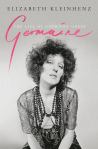
Elizabeth Kleinhenz in conversation with Chris Wallace – about Germaine Greer

Elizabeth Kleinhenz, Germaine Greer

It made for a busy night, given that the last Tuesday of the month is also my reading group night, but I had to go to this ANU Meet the Author event, because it involved Canberra academic/journalist (not to mention Germaine Greer biographer) Chris Wallace conversing with Elizabeth Kleinhenz, whose biography, Germaine: The life of Germaine Greer, has just been published.

MC Colin Steele commenced proceedings by introducing the participants, then noting that Germaine Greer’s archives had been bought a few years ago by the University of Melbourne for $3m! Not cheap, eh, but it is a significant collection about, as the back cover artwork says, “arguably one of the most significant and influential Australian women of her time.” Hmm, there are a lot of qualifications here – “arguably”, “one of the most”, “Australian”, “women” and “her time”. Whoever said this was not going out on a limb!

Anyhow, it was an excellent conversation – not just because it was about this fascinating woman, Germaine (b. 1939) but also because Chris Wallace led the conversation in a logically, but not rigidly, structured way and Elizabeth Kleinhenz was open and articulate in her responses. I’m glad I made the effort to attend.

First things first

To get things going, Wallace asked some general questions about the book itself. Its cover pic, for example. Kleinhenz responded that it was the publisher’s choice, though she was involved, I gather, in the discussion. They wanted a picture that would be attention-grabbing. And so it is.
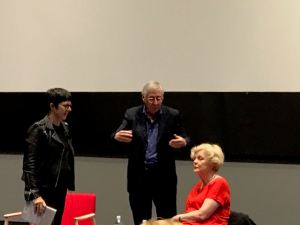
Wallace, Steele and Kleinhenz,
Wallace, Steele and Kleinhenz, 2018, before the session

Wallace then asked about that back cover quote that I’ve already mentioned. It led to Kleinhenz talking about why she’d chosen Greer as her subject. She spoke about all the negative reactions she’d received on telling people that she was writing about Greer – comments like “that silly old bat”. But, Kleinhenz felt that Greer had made some significant contributions to women’s lives and that she’s an excellent scholar: she wanted to “set the record straight”.

She also said that Greer, despite her obvious impact on women’s lives, doesn’t like women (like me, for example) telling her that she’d changed their lives. “I didn’t change your life,” she apparently says, “you did.” Well yes, technically she’s right, but, without enlightenment from Greer, many of us may not have made the leaps we needed – or may have made them much more slowly – so I think our belief stands, whether or not Greer accepts it!

Anyhow, then, before getting into the nuts and bolts of the biography, Wallace asked Kleinhenz to say a little about her first biography on Kathleen Fitzpatrick, who is, apparently, another misunderstood woman. I won’t go into details, but Kleinhenz said she had always wondered why Kleinhenz, when offered a Professorship, had declined, saying she wasn’t good enough. She found the answer, she said, when researching Greer: it’s that women of Greer and Fitzpatrick’s generation were not brought up to be equal. Greer, said Kleinhenz, saw that women had to change themselves in order to move forward.

Wallace asked Kleinhenz how it was that we had moved from Fitzpatrick to Greer. Kleinhenz, born in the 1940s, related her own experience as a young women who, although she had a good job as a teacher, “just” wanted a house and family. However, when she got there she found it wasn’t enough. She realised, as Greer argues in The female eunuch, women could/should not blame men – doing so, in fact, cedes power to men – but must change ourselves. So, she did – she went back to work.

Early, mid and late Germaine

We then got into the guts of the conversation. With Greer now 80, how, asked Wallace, do we assess her? Kleinhenz felt that Wallace had got it right in her biography, Germaine Greer: Untamed shrew, recognising that Greer writes from where she’s at at the time. In that, said Kleinhenz, she is consistent!

However, later in her career, she said, it seems that Greer “went funny”. She is known to suffer depression. Maybe she wasn’t well. Her book, The boy (2003), about the beauty of young boys’ bodies, comes from, Kleinhenz feels, an unfortunate period in her life. But some years later, she bought the rainforest – which was in fact funded, I understand, from that sale of her archives. Kleinhenz suggested that this period marks her “return”.

Wallace, though, seemed not so sure, and asked Kleinhenz about Greer’s book On rape. Wallace is appalled by it, while Kleinhenz admitted to a “softer” response, one that she has also found amongst other women of her age. She admitted that Greer takes a very narrow definition of rape, but felt that Greer says some sensible things about the legal system, for example, and about the role of violence in rape.

Research and writing

The discussion then turned to biography writing. Wallace asked whether readers are surprised that people are, in fact, rounded, that is, not all good or all bad. Kleinhenz said that she tried not to be soft on Greer in her book, but she did find Greer an interesting woman. Greer has, in fact, a lot of friends – the implication being that she must have some good things going for her despite all her critics.

Wallace noted that Greer is charismatic, and wondered whether it’s been a problem that she has been too uncritically treated, here, rather than getting “energetic” Australian feedback. Kleinhenz agreed somewhat with this. There was some discussion, for example, about Greer’s taking a cultural relativist view towards female genital mutilation, rather than opposing it categorically. Kleinhenz suggested that Greer has been criticised in Australia – but “of the silly old bat” variety rather than more “critical” criticism, that is, serious analytical discussion of her ideas. Kleinhenz also said that it’s hard to dislike someone who makes you laugh. I understand that!

Wallace then moved onto a subject dear to my heart – the issue of the archives. Were they rich, she asked. Did they change Kleinhenz’s view? Kleinhenz, laughing, started by comparing Kathleen Fitzpatrick’s ordered 8-box collection with Germaine’s nearly 500 boxes that were not organised chronologically. She discussed her process – the role Wallace had played in her getting “more organised”, and how she handled the closing of the Greer archives for 12 months partway through her research. This turned out to be useful, because during this time she went to secondary sources and conducted interviews, so that when the archives opened again, she had a framework.

She shared some of the treasures, some of the things that stood out – such as letters from Clive James, Helen Garner, and a French girl who told a very personal story and to whom Greer wrote a personally revealing reply.

During the Q&A at the end, the issue of Greer keeping copies of the letters she wrote came up. Why did she – do some – people keep not only the letters they receive but copies of those they write? There’s no single answer of course. However, Kleinhenz did say that she believes Greer knows her “commercial” value. The words “no fee, no work” appear at the bottom of many of her letters. Wallace interjected here commenting that writers’ incomes are “lumpy”, so it’s quite likely that potential financial value drove her decision to keep her papers – and, Greer knew she was big. (However, it could also simply that she’s a hoarder, or, a historian who likes to keep her records? I can understand that.)

Kleinhenz also said that she suspects that Greer had probably removed some family-related material from the archives before she sold them. Also, there was not much “childhood stuff” in the archives, but the audio material is wonderful. Greer apparently records her thoughts, for example, as she goes for walks with her dogs.

Q & A

I’ve included some of the Q&A discussions above, because it seemed logical, but other issues were discussed, including:

  • Why did she choose Greer? Kleinhenz said she grew up with Greer. Greer is only three years older than she, but also lived in the same area of Melbourne, and they both went to Catholic schools. However, the main reason is that she felt Greer deserved it: she wanted, she reiterated, “to put record straight”.
  • What difference do her archives make to assessment of her? Kleinhenz answered that while they don’t contain much in terms of signficant new facts, they add a depth of understanding. Those letters she mentioned above, and other letters like those with John Atwood, whom she appeared to love at one stage in her life, helped here.
  • What impact did the birth control pill have? Kleinhenz said that Greer was highly aware of the pill and felt that women needed to think through the changes the pill brought, and how they would manage those changes, what they would do with them. This came out in the excellent notes she made for writing The female eunuch.

Kleinhenz added at this point, that Greer had felt a freak as a young person – she felt too tall, too noisy.

Closing the session

In closing the session, Colin Steele referred to the small Trailblazers book – accompanying Australia Post’s Australian Legends series – in which Greer says she’s not a tour operator, but wants to encourage people to think for themselves. This, in fact, perfectly sums up my attitude to Greer. She’s a bit (hmm, just a bit?!) of an iconoclast. I don’t always like – or perhaps, fully comprehend – what she says, but I love that she’s around saying it. She can always make me think – and sometimes, she makes me laugh!

I’d love to say more about Greer and some of the ideas generated by this conversation, but will, perhaps save them until I’ve read the biography.

Podcast: click this link to see if you think I’ve captured the conversation accurately enough!

ANU/The Canberra Times Meet the Author
MC: Colin Steele
Australian National University
30 October 2018
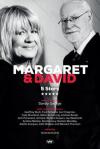
Amanda Duthie (ed.), Margaret & David: 5 stars (#BookReview)

Amanda Duthie, Margaret and DavidMargaret and David, the subjects of this delightful, eponymously named collection of reminiscences and essays, do not need last names here in Australia. They are just “margaretanddavid”. But, since we have an international readership here, I should formally introduce them. Margaret and David are Margaret Pomeranz and David Stratton, Australia’s best-known and best-loved film critics who retired from their television movie show in 2014 after 28 years on air! There were to us as Siskel and Ebert were to Americans. Their influence was immense.

This book, Margaret & David: 5 stars, is essentially a tribute book produced on the occasion of their being awarded the 2017 Don Dunstan Award, an award established in 2003 to commemorate the late South Australian Premier, Don Dunstan, who was a major champion of the arts, including film. The book contains mostly short reflections, but also an extended essay, on Margaret and David’s contribution to Australia’s film industry and culture, and, in fact, to world film culture. The pieces are written by a wide variety of industry people, from producers like Jan Chapman, through actors like Geoffrey Rush, and directors like Cate Shortland and Gillian Armstrong, to film business people, journalists, film festival directors, and even, Margaret’s son, Josh. It’s a delightful read – but a provocative one at times too.

Of course, I enjoyed the insights into Margaret and David’s personas and working relationship – and won’t go into these. If you’re looking for gossip you won’t get it here because Margaret and David were professionals, and were, and are, we are told, good friends. Sure, they disagreed, sometimes vociferously – we all remember Margaret’s “Oh, David!” exclamations – but these arguments always teased out ideas about film. Gillian Armstrong says, “they formed a lively, fiery, passionate, laughter-filled relationship.” If, on the other hand, you’re looking for insights into the history of the Australian film industry, you will get some here. This is not an academic work, but many of the reflections on these two can’t help but comment on the Australian industry and on film culture more broadly, from the mid 1980s when they started on television to the mid 2010s when they finished. Their contribution – and impact – was not only qualitative but, in some respects, quantifiable.

This all interested me, but what I want to focus on in the rest of this post is what the book offered me regarding …

The practice of criticism

… because, fundamentally, criticism is criticism, whether you are discussing film or books, drama or ballet. I enjoyed some of the commentary on this.

Director Gillian Armstrong, while teasing (and forgiving) David about his poor review of her Oscar and Lucinda film, describes perfectly the art of the critic, when she says

It is important to have serious discussions that actually discuss the craft of the director. They shared a real appreciation of the vision behind the camera angles, the lighting, editing, music and casting. But most importantly, their reviewing was about the very heart of those films, the content and ethics.

Leaving aside the terms “review” and “criticism” which tend to be used somewhat interchangeably in the book, I think this statement contains the guts of what criticism or, shall we say, serious reviewing is about: marrying analysis of technique with exploration of content (and ethics). Journalist Sandy George, in her extended essay, puts in this way:

They actively engage in talking about the narrative, the history of the production, what the filmmaker was trying to achieve, and how the film affected them; they don’t engage in reductive talk such as “this is good”, “this is bad”, “see this”, “don’t see that”.

There’s one memorable review they did which several writers commented on: their review of the violent R-rated movie Romper Stomper. Margaret gave it 4.5 stars and David refused to rate it. This review is now famous – and part of this is for the way their discussion was conducted. It was respectful, and considered. You can see the review here.

Other practical issues are teased out – such as reviewing works you don’t like, and reviewing works by friends. On the former, Sandy George quotes David Stratton on writing reviews for “the extremely influential” Variety:

‘I never gave a glowing review to something that didn’t deserve it … but knowing how important a Variety review is, I sometimes went out of my way not to review a film.’

A valid decision I think, though purists would probably say that you should review such films regardless.

George also quotes Margaret about reviewing works by friends. They tried, she said, “not to be friends with filmmakers, but it’s impossible”. She also says:

“I’ve always been kind to Australian films because I’m such a wimp … “

Indeed, one person said that because of this, a good review from David carried more weight!

George goes on to report one distributor’s comment that

one way the pair went above and beyond for Australian films was how carefully they chose their words when one fell short.

Notwithstanding my above comment about not reviewing at times, I also like this approach. Honest reviews are important, but there are ways of being honest. The arts are tough enough, without demoralising those working hard within it, don’t you think?

Anyhow, I enjoyed this book. It’s a quick read but not a frivolous one. I’ll close with a comment made by current SA Premier, Jay Weatherill:

Their love of cinema is real, undiminished and contagious, and they have helped me and countless other Australians to understand the critical role can play in telling our nation’s stories and presenting our values.

AWW Badge 2018Amanda Duthie (ed.)
Margaret & David: 5 stars
Mile End: Wakefield Press, 2017
133pp.
ISBN: 9781743055137

(Review copy courtesy Wakefield Press)

Nadia Wheatley, Her mother’s daughter: A memoir (#BookReview)

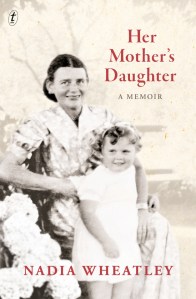
Nadia Wheatley, Her mother's daughterIn Her mother’s daughter: A memoir, Australian writer Nadia Wheatley has written the sort of hybrid biography-memoir that I’ve reviewed a few times in this blog. All of them, as I mentioned in my recent Meet the Author post, have been mother-daughter stories, Susan Varga’s Heddy and me, Anna Rosner Blay’s Sister, sister, and Halina Rubin’s Journeys with my mother. It’s this hybrid form that I’d particularly like to explore in this post.

And the hybrid I’m talking about is one where the biography is of the subject (mothers, in these cases) and the memoir is of the writer (the daughters.) This is the more common form of hybrid biography-memoir, though my research did turn up others, such as Room to dream by Kristine McKenna and David Lynch in which McKenna’s biographical chapters on Lynch are followed by Lynch’s responses to those.

The biographer’s question

There are, of course, many memoirs by people who, in order to tell their own story, need to figure out their relationships with others, particularly their parents. However, these books remain primarily about the writer. Hybrid biography-memoirs, on the other hand, tend to be as much, if not more, about the other person as the writer. The end result might be the writer understanding themselves more, but the focus tends to be the other. This was clearly Wheatley’s intention. Indeed she told us that her biographer’s question was “Why would a nice person like Neen marry an awful person like my father?”

So, her book’s main focus, then is her mother. Nina (Neen) Wheatley, nee Watkin, was born in northern New South Wales in 1906, and died in Sydney in 1958. She lost her own mother when she was five years old. She and her siblings were separated when her father remarried, with Nina and her younger sister Boo staying with their father and his new wife. It became clear that the family expected Nina to be the parents’ carer in their old age. However, Nina managed to train as a nurse, and go overseas during the war as an enlisted nurse with the 6th AGH (Australian General Hospital), where she worked in Greece and Palestine. She returned to Europe after the war to work with UNRRA and then IRO, caring for Displaced Persons. It was during this time that she met the man – English doctor, John Wheatley – she ended up marrying. It was a bad decision: he was a womaniser, possessive and controlling, and, according to Wheatley, sadistic. Indeed, it’s very likely that, had he – and the medical fraternity more broadly – taken women’s health seriously, Nina would not have died when she did. After her mother’s death when Wheatley was 9 years old, she, an only child, lived with a local family known to her (and chosen by her mother before her death.) This was, for Wheatley, a problematic situation – but this part of the story occupies just the last 20 or so pages of the book, and, while it’s important to the overall memoir, I do want to move onto other points.

So, back to the form. Unlike Wheatley, those other three biographers-cum-memoirsts, Varga, Blay and Rubin, were able, as adults, to question their mothers. They could bring an adult’s eye to their mothers, and ask the sorts of questions an adult might ask. They all tape-recorded their mothers. Wheatley’s mother, however, died when Wheatley was nine, so concocting her mother’s story was a very different challenge. Fortunately – and how prescient of her – she realised that her memories wouldn’t last so, at 10 years old, she started writing down her memories of the happy times she spent with her mother and also the stories her mother had told her about her life. At times I wondered how she could possibly have remembered as much detail as she does. However, given Wheatley was clearly a writer from the start and given what she experienced was so powerful, it wasn’t hard to trust her authenticity. It’s these stories and  memories, together with letters, journals and interviews with family members and friends, and official records, that provide the facts for her mother’s biography.

Step one, then, is the research, but next comes how to marshall it all into a narrative. Varga and Rubin, like Wheatley, take us on a journey of discovery. As Wheatley said during the conversation with Halligan, she wanted to take the reader on the quest with her. She wanted to share the detective story of her unravelling her mother’s story, and not just present the evidence. Varga and Rubin do something similar, but they tell their story first person, sharing when their mother is reticent, when they, as daughters, are challenged, and so on. Varga makes it clear to her mother – and us – that this means “it won’t be her life story, not properly” but would be “filtered” through her “reactions and thoughts”, her “second generation eyes.”

Blay, however, is more formal, presenting her mother Hela and aunt Janka’s stories in their words as transcribed from her interviews with them. She intersperses these with her own perspective in italics. The three voices are thus distinct.

Wheatley, though, uses a different approach again. She tells her mother’s story third person, but, intermittently, will suddenly switch to first person to present her own role in the research or the story, removing us from Nina’s chronology to her own time-frame. Chapter 9, which relates her mother’s life immediately postwar, is a good example. The first 10 pages read like a standard biography, describing what Nina was doing, quoting from letters and journals to support the information, then, suddenly, after a reference to Nina’s father’s death, she flashes to nine years after Nina’s own death (and over twenty years after the time we’ve been in.) Nadia is dining with her Auntie Boo, and casually asks if she knows where Nina’s wedding ring is. Her aunt bursts into tears, saying:

‘Daddy’s will was so unfair! To leave everything to Neen! Not just Glenorie, but everything in it!’ As my aunt moved on in her attack, it turned out that I too was guilty as charged: ‘All those things that Nina and you had in that house at Strathfield, you had no right to them.’

Now, Nina’s father had left “other real estate to his other children” but leaving the family home to Nina rankled so much, writes Nadia, that “some of her siblings would never get over it.” After a page on all this, we are returned to Nina’s life, and the third person voice.

This approach ensures that as well as travelling the journey with Nadia, we also see the impact on her, and her sense of guilt, as she is growing up. There are many insertions like this, including one later in the book when Nadia remembers a time with her father when she was three years old. With this approach, Nina’s story is told chronologically, but Nadia’s is disjointed until after Nadia is born when her story is gradually folded in to the main narrative. It’s a tricky approach, but Wheatley, an experienced novelist and biographer, makes it work, resulting in something that provides both a coherent biography of her mother, and the impact on her. It doesn’t necessarily work if you are expecting a detailed memoir of Wheatley’s life, but that wasn’t Wheatley’s goal.

Defining moments

Interesting as all this is, however, the main joy in reading Her mother’s daughter lies in its social history of the first half of the twentieth century. Wheatley’s story of her mother’s experience as an active participant in World War 2 is vivid, and makes a significant contribution to a less covered aspect of that war. Her story of her mother’s life in Sydney during 1950s is significant too – but terribly so.

Nina’s War “story” was fascinating. Her reports of her early experience are cheerful, full of a sense of adventure and camaraderie, but that soon changes as her real war experience starts. She sees the impact of bombing on civilians in Greece, and she nurses casualties of the Syrian campaigns including El Alamein. She already cared about social justice before going to war, but her desire to help others firmed afterwards. Her experience of forced repatriations, of seeing “Poles packed like cattle in trucks” during her work with UNRRA, was “a defining moment” writes Wheatley. Nina wrote in her journal that “This experience will have an intense influence on all my life.”

Wheatley’s description of her mother’s work with Displaced Persons is inspiring, showing Nina to be a resourceful and empathetic woman who managed to create harmony in extremely difficult circumstances. However, her marriage to Dr Wheatley saw this confident, warm woman brought undone. Her husband’s cruel, self-centred behaviour soon soured all Nina’s hopes of a happy marriage of equals. Nadia writes that he either “provoked arguments” with her mother, or set up “elaborate games in which I was the pawn he used to take the queen.” That – and his womanising – were bad enough but, when in 1956 Nina started feeling unwell, the situation became dire because Nina fell prey to a male-dominated medical system, actively supported by her doctor husband. The belief that the ills women of Nina’s now middle-age felt were all “in the mind” resulted in her eventual destruction. It’s devastating for Nina (of course) and for Nadia from whom so much, before and after, was kept secret – but, for anyone who knows or lived through the 50s, it’s only too believable.

Unfortunately, as it turns out, not all the defining moments of Nina’s life were positive ones.

Now, once again, I’ve outstayed my welcome, so I’ll conclude by saying that Her mother’s daughter is a great read for two reasons. Firstly, it provides a thoughtful, authentic – sometimes exciting, sometimes disturbing – social history of the times. And secondly, with Wheatley’s ability to write engaging narratives, it makes for engrossing, moving, provocative reading. I do recommend it.

AWW Badge 2018Nadia Wheatley
Her mother’s daughter: A memoir
Melbourne: Text Publishing, 2018
322pp.
ISBN: 9781925603491

Dymphna Clark Lecture: Clare Wright and You daughters of freedom

According to the University of Melbourne website, the Dymphna Clark Lecture “is delivered annually by a lecturer who exemplifies the deep commitment Dymphna Clark showed to Australia’s intellectual and cultural life.” Strangely, I can’t find a description of the lecture series on the Manning Clark House site which, I believe, is behind the lecture series. I can, however, find a list of the Manning Clark Lectures up to and including 2019 on their About Us page. Poor form I think, particularly given it was Dymphna, I understand, “who bequeathed the family home to the intellectual and cultural community with the wish that it be used to support artists and public intellectuals and provide a safe haven for the entire community.”

On Facebook I discovered that Drusilla Modjeska gave the 2016 lecture; on the above-linked University of Melbourne site that Anna Funder gave 2013’s; and on Virginia Haussegger’s site that David Headon was 2009. Drilling down to page 3 of my Google search, I found at honestyhistory that Bill Gammage was it for 2014 and on safecom that Eva Sallis was 2007. But, why can’t I easily find a list of all the Dymphna Clark lectures, as I can of the Manning Clark lectures? We could take exception to this, seeing it as, once again, sexism in action, but I’m inclined to think the reason is more mundane, and that it’s a sin of omission, not of commission. So, I now respectfully suggest that they create a new page for the two lecture series and maintain a list, with relevant links, of both series, because they are serious lectures. Clare Wright’s 2018 talk, for example, was being recorded for ABC RN’s Big Ideas program. But now, having made my point, I’ll move on to the lecture.

You daughters of freedom

Technological troubles

It was held in a lecture theatre at the ANU. Unfortunately, despite many people trying for over half an hour to get the technology working, the lecture went ahead without Wright’s accompanying slideshow. A real shame but, luckily, Wright is an excellent, engaging speaker, and easily kept our attention for the 50 minutes or so that she spoke. The lecture was, of course, inspired by Wright’s latest book, You daughters of freedom, the second in her Democracy Trilogy, she told us. Manning Clark House’s promotion for the lecture said the book:

brings to life a time when Australian democracy was the envy of the world—and the standard bearer for progress in a shining new century. For the ten years from 1902, when Australia’s feminist activists won the vote for white women, the world looked to this trailblazing young democracy for inspiration.

This epic new history tells the story of that victory—and of Australia’s role in the subsequent international struggle—through the eyes of five remarkable players: the redoubtable Vida Goldstein, the flamboyant Nellie Martel, indomitable Dora Montefiore, daring Muriel Matters, and the artist Dora Meeson Coates, who painted the controversial Australian banner carried in the British feminist activist marches of 1908 and 1911.   

I’ve started reading the book, and while I’ve only read some 40 of its 500 or so pages, I’m finding it wonderfully readable.

Anyhow, now, really, the lecture! Wright was briefly introduced by Sebastian Clark, President of the Manning Clark House and son of Dymphna and Manning Clark, and then we were off. She started by describing that famous restaurant scene in When Harry met Sally – you all know the one – which concludes with the woman at the next table saying to the server, “I’ll have what she’s having.” Wright teased out some meanings and implications of that scene in terms of women’s freedom, the #metoo movement, and, of course, her lecture’s subject, the granting of the vote to women in Australia in 1902.

“In the noonday glare”

Clare Wright, You daughters of freedomWhen Wright stated that this legislation made Australian women the most franchised women in the world, there were mutterings in the audience about, for example, New Zealand – and was followed up in the Q&A. But, I had already read Wright’s Author’s Note that opens her book, where she explains her claim. Australia was the first nation to give (white) adult women full suffrage – meaning not only could they vote on equal par with men (that is, without property qualifications, and with the same age and residency requirements) but they could also sit in parliament. New Zealand granted women the vote in 1893, but New Zealand was not a nation until 1947, and women could not sit in parliament until 1919. Finland was, in fact, the next nation to grant full suffrage to women – in 1906. I loved that she refers in this Note to something that we’d discovered on our US travels back in the 1990s, which was that women were granted the vote in Wyoming in 1869! But, Wyoming is a state, not a nation. Similarly the colony of South Australia enacted universal suffrage in 1895, including allowing women to stand for the colonial parliament, but again, it was not a nation. It was the fact that a nation had granted suffrage that apparently became a beacon for the world. Of course, proclaiming “firsts” is always risky, but Wright’s definition seems perfectly valid to me in terms of her book’s thesis.

Wright explained in her lecture that this same Act disenfranchised indigenous people. Some parliamentarians did apparently demur on this point, but those who demurred gave way to ensure that at least women got the rights. Consequently, race not gender became the dividing line. As Wright said, “white” Australia was very much the game from Federation, and, while later, some women started fighting for their “black sisters”, their first priority, after gaining suffrage for themselves, was to go to England to support the mother country’s sisters. Such were the times. Later in her lecture, Wright said that it may not be pleasing to know this about our “heroines” but it’s historically accurate!

I should confess at this point, that I’m not reporting on this lecture exactly in the order that Wright gave it but in an order suiting my main takings from it.

Anyhow, back to the granting of suffrage. Wright quoted American-born Australian suffragist Jessie Ackermann who said that this act of the new Australian nation put it/us “in the noonday glare.” Suffrage was, she said, the biggest news in the early years of the twentieth century and was simply known as “the Cause”. Australia’s actions made it/us a test site for universal suffrage and the other socially progressive laws Australia enacted in those days. Could it work? Everyone was watching – particularly of course men who feared loss of power. As Wright said near the end of the lecture:

Power never concedes anything without a fight.

Wright briefly introduced the five main women she features in her book, Vida Goldstein, Nellie Martel, Dora Montefiore, Muriel Matters, and Dora Meeson Coates, and characterised their approach to activism by giving them a canine archetype! Goldstein, the “born activist”, she described as a kelpie, for example, while Meeson Coates is a “reluctant activist” and a Weimaraner! (As past owners of Weimaraner, Mr Gums and I chuckled here.) Again, near the end of the lecture, Wright explained that she did this canine breakdown to show that these women were not all one type, and that difference is critical to the movement’s internal gatekeeping.

Wright also spoke about the challenge she faced in making suffrage, citizenship and federation exciting, particularly at this time when democracy is under attack. She quoted the recently reported Lowy Institute poll showing the surprising level of ambivalence in Australia about democracy. It’s hard to imagine in this environment, she said, that democracy and all that it involves was the hottest topic on the planet in the late 19th century. Why did Aussie women travel to England to fight for the rights for others?

Well, they were different times, of course, as Wright made clear. The turn of the century was a time of optimism. In Australia it was a trinity – new year, new nation, new century. People believed the past was being left behind; they had new Utopian visions. Women’s suffrage encapsulated all this – the ideas of rebellion, emancipation, restructuring society. Suffrage was seen as the key to unlocking repression. If women could vote, and if women could sit in parliament, women’s needs might be better cared for. As Jessie Ackermann said, the freest girls were in Australia.

The women’s suffrage banner

As she does in her book’s Introduction, Wright walked us through (our current) Parliament House to a narrow corridor past the Members’ Hall where, if you get there, you find a large banner. It was created by that Weimaraner Dora Meeson Coates in 1908 and was carried in the 1911 suffragette-organised Women’s Coronation Procession. Wright took us through its iconography/symbolism, through the implications of its depiction of Mother Britannia with Daughter Minerva. It shows, she said, the daughter Australia speaking to the mother England, the banner headline reading “Trust the Women Mother As I Have Done.” This was, she said, “allegorical effrontery.” Why had she not known about this banner, she wondered, given she calls herself a feminist historian?

Now, I could go on, but I’ve probably lost half of you by now and will soon lose the rest, so I’m going to try to become even briefer. Wright explained that one-third of her book is about how Australian women won the vote, and two-thirds about how Australian women inspired the world, In this context, she told a wonderful story about Bulldog Dora Montefiore, another Aussie woman who went to England, and her “Siege of Hammersmith”, a 6-weeks long passive resistance protest again paying taxes without representation. (She was, says Wright, seen by a young Indian man, Mahatma Gandhi!) A wonderful story. It was part of something called the Women’s Tax Resistance League. Wright also described the passive resistance campaigns against the 1911 Census: Women argued that if they don’t count, they shouldn’t be counted.

The irony of history

And so, Australian women were leaders in the suffrage movement and yet, today, British suffragettes are icons of rebellion and bravado but our Australian activists are relegated to the footnotes of academic history. BUT, she argued, Dora Meeson Coates’ banner challenges the view that this history of women’s activism is niche. The big picture is, she said, that Federation and Feminism went hand-in-glove: the banner is about colonialism, about old and new, the enfranchised and disenfranchised, about men in Australia who championed women’s suffrage and those in England who didn’t, and more …

Why then are women not sufficiently accounted for in Australian history? Because, she said, of the First World War. Federation’s optimism, she argues, was soon overshadowed by the War, which, as we all know now, precipitated a “new narrative.” So, whilst before the War, our role in the world was being seen in terms of our achievements in terms of democratic idealism, suddenly it was being seen in military terms. It was our bravery, our contribution to the war effort, that now defined us as a nation – and the rest, as they say, is history! (Particularly given, I’d add, that, as Jane Austen said one hundred years ago, “Men have had every advantage of us in telling their own story … the pen has been in their hands.”) From Wright’s point of view, the War represented not the birth of a nation, but the death of the nation we were becoming. Something to think about, eh?

Clare WrightThere was still more, but even I’m running out of puff now. Wright concluded by talking about the importance of stories. The stories we choose to tell are the ones that define who (we think) we are. Why, for example, she asked, is there no statue in Melbourne memorialising that significant suffragist and social reformer, Vida Goldstein? Why, too, is Prime Minister Fisher remembered more for his statements about war (about our defending the mother country “to the last man, and the last shilling”) but not his argument about “true democracy” requiring the inclusion of “women as well as men in the electorate of the country”?

Wright said she’s wary of “learning lessons” from history, preferring to think about legacies. The legacy of the suffragists is that resistance, that grass-roots movements, can create real and lasting change. Her mantra, she said, is Dora Montefiore’s exhortion: #trustthewomen. And with that, her true colours, already advertised in the borrowed suffragette scarf she was wearing, were shown!

An intelligent Q&A lasting nearly half an hour followed, but eventually we had to finish. It was a wonderful lecture. I love that not only is Wright such an accessible, engaging historian, but that she linked the past to the present, because that is the main reason I like to read history. The past is interesting, but its true value lies in how it can enlighten the present.

And now, if you made it to the end – I thank and salute you!

Dymphna Clark Lecture
RN Robertson Theatre, ANU
17 October 2018

Sue Williams, Live and let fry (#BookReview)

Sue Williams, Live and let fryWell, 2018 is clearly “the year of the Mallee” here at Whispering Gums, with Sue Williams’ Rusty Bore Mystery, Live and let fry, being my third Mallee-set book so far this year. The others are Jenny Ackland’s Little gods (my review) and Charlie Archbold’s Mallee boys (my review). By the time I visit the Mallee – next year I hope – I should know it well, though I might stay away from Rusty Bore. Fortunately, that won’t be hard as Rusty Bore is fictional. I say fortunately, because who wants to visit a place known for murders? It would be like choosing to visit Midsomer!

Seriously though, on with the book, starting with the fact that it’s the third in the Rusty Bore Mystery series. I haven’t read the first two, but I’d say this one stands alone well. There’s enough recap for the new reader to quickly pick up the main characters and their relationship with the protagonist, Cass Tuplin, who’s an unlicensed private investigator as well as the owner-operator of the Rusty Bore Takeaway. I’m not a big reader of crime fiction, but I do watch a bit on TV, and I can say that Cass fits the mould of many TV detectives – private or not, licensed or not – in that she has a messy personal life. She’s clearly had a fling with Vern, the owner of the town’s only other shop, but is now with Leo, who’s doing good works in Bolivia but is staying away significantly longer than he’d told her he would. Cass also has two sons – Dean, a not-very-successful policeman in Mildura (a real place), and the-not-very-sensible Brad who’s waiting his court case for “disseminating false information to the market.” There’s affection between mother and sons, but it’s not without tensions – either because Dean is fussing over his mother’s safety, not to mention her unlicensed detecting, or because Cass is too focused on this detecting to listen to Brad well enough to hear what’s happening in his life.

None of this need be taken too seriously, though. As the back cover blurb says, Williams is “Australia’s answer to New Jersey’s Janet Evanovich.” I haven’t, I admit, read Evanovich – shock! horror! – but Daughter Gums has, so I know enough to realise that her crime novels are bright, breezy affairs. And so, certainly, is Live and let fry.

Now, what to say? This is rural crime, and it starts with the disappearance of the aforesaid Vern’s new lady friend, Joanne, from the neighbouring town of Sheep Dip. (There’s nothing subtle in the town names here – Rusty Bore, Sheep Dip, Muddy Soak, Hustle.) Cass, like any self-respecting unlicensed private detective, is reluctant to become involved but, of course, you know she will – and she does. Pretty soon, a murder occurs – not Joanne’s though – and the plot rapidly thickens as we move into the murky world of developers and environmental protection. This has our intrepid Cass driving backwards and forwards across the Mallee in her “little Corolla”, getting into more and more serious scrapes, worrying her sons, irritating the police, and not always making the right calls – as you’d expect.

All this gives Williams the opportunity to provide us with a picture of the Mallee and its inhabitants, which she does in language somewhat different from that we’ve seen in those other Mallee books I’ve read. Here is the Mallee, for example:

As I got closer to Mildura the eucalypt-and-orange desolation gave way to irrigation green, the dark green of orange groves, the brighter, flamboyant green of grapevines, the camouflage khaki of olive trees. I drink it in – green’s not a colour we get that much of in Rusty Bore.

And here is one of its inhabitants:

Nola’s eighty-two and usually quite mentally robust, with opinions carefully cryo-preserved since 1953.

The writing is peppered with gentle, affectionate mocking like this, along with broad satire of various contemporary issues and preoccupations, such as “coffee condescension” from city-siders, and Cass’s own “artisanal” food. We’re also told that

Leo’s import-export business in Muddy Soak folded after the African knick-knack trade fell victim to the decluttering trend.

And there are digs at politics and politicians, such as:

I stood at the desk and waited. A TV flickering behind Taylah showed a surging crowd of middle-aged people in suits. Mostly men, looked like politicians. Another leadership spill? A new Royal Commission? There’d been a lot of debate lately about whether air exists. “If you can’t see it, can’t smell it, it can’t be there.” The slogan of one of the newer political parties.

It’s not subtle, but then Williams’ goal is less social or political commentary than maintaining a light breezy tone and conveying character.

Now, though, back to Cass. Does she get her man (or, not to be sexist, woman)? Well, this is what I’d call “cheery crime”, so yes, one way or another, she does. In other words, without spoiling anything, it all comes out right(ish) in the end and Cass lives to fight (or not, as she chooses) another day. I’m not sure I’ll read another Rusty Bore mystery as I feel I’ve got its measure now, but for those who love light-hearted crime, particularly with an Australian flavour, then Rusty Bore could be just the ticket.

AWW Badge 2018Sue Williams
Live and let fry
Melbourne: Text Publishing, 2018
295pp.
ISBN: 9781925603514

(Review copy courtesy Text Publishing)

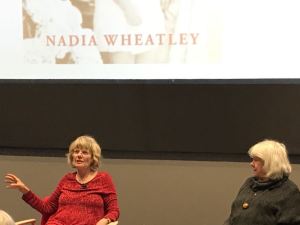
Nadia Wheatley in conversation with Marion Halligan

Nadia Wheatley, Marion Halligan,

Nadia Wheatley and Marion Halligan, ANU Meet the Author

Nadia Wheatley is, I fear, not as well-known in Australia’s literary firmament as she should be because her credentials are excellent. Not only is there My place (1987) – a wonderful multi-award-winning children’s book about the history of place – but her biography of Charmian Clift, The life and myth of Charmian Clift, has been described by critic Peter Craven as “one of the greatest Australian biographies.” She has appeared here in a Monday Musings list of books recommended by indigenous writers (even though she is not indigenous) for her book, with Ken Searle, The Papunya School book of country and history. And these are just a few of her literary credentials.

All this is to say that when I saw that she was to be a “Meet the author” subject this week at the ANU – on a free night for me, no less – I didn’t hesitate to book. It didn’t hurt, too, that her Conversation partner was to be Marion Halligan (who has appeared here several times, in various guises.)

Now, I don’t want to discuss in detail her latest book – Her mother’s daughter: A memoir – which was the reason for this event, because I have almost finished it and will discuss it in my soon-to-come post, so I’ll just share, briefly, some of the main points from the conversation.

“Caught between an independent woman and a controlling man”

The book’s title suggests that the book is Wheatley’s memoir of her life with her mother (Nina, familiarly called Neen.) However, this is only part of the story. The book is, in fact, like a few I’ve read recently, a sort of hybrid biography-memoir, because it is as much a biography of her mother, who died in 1958 when Nadia was 9, as it is a memoir. Three others I’ve discussed here in recent years are Susan Varga’s Heddy and me, Anna Rosner Blay’s Sister, sister, and Halina Rubin’s Journeys with my mother. Interestingly, the mothers in all of these books experienced World War 2 in some way, though Wheatley’s mother differs from the other three European-born women in that she was an Australian who went over to work in the war.

Marion Halligan commenced the conversation by commenting that the book was a difficult read, and that it must also have been difficult to write. Wheatley agreed, commenting that people under-estimate children’s ability to suffer, but also their ability to survive…

… and both suffer and survive, Wheatley did. She was caught, she said, “between an independent woman and a controlling man”, but that was only the half of it. She wasn’t helped by a family which – only partly because it was the 1950s – did not feel the need to tell Wheatley what had really happened to her mother, resulting in the young Nadia hoping (if not totally believing), for some years, that one day her mother would return. She was abandoned by her father, whom she described as “a strange, sadistic person.” The family dynamics are complex, and I’ll discuss some of them a little more in my post on the book.

I will say, however, that the underlying biographer’s question for Nadia in writing the book was:

Why would a nice person like Neen marry an awful person like my father?

Because, awful he was … though not, it seems, to Neen in the early years of their relationship when they were working for/with refugees and displaced persons in post-war Europe!

What lifts this book above what could so easily have been a misery memoir is that it also works as social history of an era – of life in Australia in the first half of the twentieth century, and of the work Australian nurses did during and after the Second World War. The pictures Wheatley draws of the joys (yes) and challenges of the War for Nina are vivid, and ring true. Nina was a truly independent woman, despite the demands home and family exerted on unmarried “girls” at the time. The pictures Wheatley then draws of Nina post-marriage are, consequently, even more devastating – because of the gap between what could (should) have been and what was. Nina’s dire situation was compounded by the confluence of a controlling, sadistic husband and a time, the 1950s, when women had little agency in the face of such a situation. Even so, Nina did her best …

At one point during the conversation, Wheatley made the interesting – and obvious, if you know their stories – point that there are some parallels between her and her mother’s stories. Both were motherless from a young age, and both became involved in social justice action. There was discussion in fact about how her mother’s work with refugees is relevant to today’s refugee situation. Nina worked for the short-lived UNRRA and was involved in the early definition of just what a refugee is and in the practice of placing them.

Telling the story

Nadia Wheatley, Her mother's daughterIn the Q&A, I asked Wheatley about the structure she chose to use in the book, about the fact that while is it generally chronological, she inserts herself into this chronology at times when she herself wouldn’t have been alive. For example, she describes the young Nadia asking her mother about a photo in an album. This enables us to see Nadia’s interest in her mother’s story, her reaction to her mother’s story, and her mother’s later reaction to the events in her life, at least in terms of how she wants to present them to Nadia. From the reader’s point of view, it makes reading this book far more engaging.

Wheatley answered that felt she needed to be in there “on the quest”, and referred us to AJA Simon’s biography A quest for Corvo: An experiment in biography, as one of her inspirations. She wanted the book to be her journey of discovery – “to have the detective story of her unravelling her mother’s story” – rather than just be a presentation of the evidence. Again, I will talk more about this in my post, but Wheatley did share some of the stories about how she went about this unravelling. I like this approach to non-fiction, not only because it’s usually engaging, but because it can strengthen the authority or integrity of the work.

There was more to the conversation – but some of it, as I’ve already said, will come out in my post, and some of it is best left for you to read yourselves in the book. I mustn’t give it all away!

Vote of thanks

To conclude, MC Colin Steele introduced The Canberra Times’ past – and, distressingly, to date, last – literary editor, Gia Metherell, to give the vote of thanks. In doing so, she said that Wheatley’s book shows why childhood biographies can be so potent. She quoted the late Australian critic Geraldine Pascall* (I think) who said that Australian writers write more often and more potently about their childhood than anyone else, besides English and French writers. What an interesting thought on which to end a thoroughly engaging conversation.

* Gia Metherell clarifies this in the comments below saying that it wasn’t Geraldine Pascall to whom she was referring but English academic Roy Pascal. However, on checking later, she realised she had misremembered and it was Richard Coe, in “Portrait of the Artist as a Young Australian: Childhood, Literature and Myth”, Southerly, 41, no. 2, 1981. Thanks Gia.

ANU/The Canberra Times Meet the Author
MC: Colin Steele
Australian National University
8 October 2018

HC Gildfind, The worry front (#BookReview)

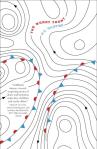
HC Gildfind, The worry frontThe first thing to note about HC Gildfind’s short story collection, The worry front, is its striking, inspired cover. Designed by Susan Miller, it features a weather map which captures the central motif of the title story, but it also suggests the unsettled lives which characterise the book. Gildfind, however, writing a post on the publisher’s blog ascribes another meaning too, noting the link between maps and stories. She says that both “guide us: they locate us in the present by showing us where we have been and where we might go in the future.” Both can also represent the abstract and concrete domains in which we live and operate – and where they might intersect.

But now, the book. It contains ten short stories and a novella, titled “Quarry”. All but one of the stories have been published before – in respected literary journals like Meanjin, Griffith Review, Westerly and Southerly. “Quarry” in fact appeared in the Griffith Review’s novella edition back in 2015. Gildfind then is an accomplished writer, and yet I hadn’t been aware of her. I am now, though, and I’m impressed.

I wasn’t completely sure that I would be, however, when I started the collection. “Ferryman” is a grim, gritty story about an angry man. I wasn’t sure that I was ready for such anger, albeit understandable in the circumstances – but the writing, particularly the rhythm and poetry of it, appealed, so I kept on reading. I’m glad I did, because the next story, the title story – “The worry front” – got me in completely. While the first story is told third person through a man’s eyes, this one is first person in the voice of an eighty-year-old woman. Like “Ferryman”, it’s a powerful story – but this time about a widowed woman who, all her life, has been dogged by “the worry front” but who, when confronted with the realisation that she has cancer, takes matters into her own hand with a breathtakingly original plan. It’s one of those stories where, at the start, you think, “is what I think is happening, what is really happening?” Well yes, it is.

And so the stories continue – varied in gender and voice, but often about something a little out of the ordinary or from a slightly offbeat point of view. The third story, “Gently, gently” is, for example, told second person. It’s a woman speaking about herself, but the second person voice engages us intimately in her life and feelings, drawing us in. It’s about a couple and the three hens they acquire. A chook goes missing – and the couple’s reactions highlight the tension in their relationship. Violence ensues. Like other stories in the book, it treads familiar ground but then turns a corner that forces us to see it from different angles. The relationship dynamic is not as simple as it might have first seemed. The next story, “Eat. Shit. Die” is told in two alternating voices – Leo’s in first person, and Nina’s in second. Both are lonely, and both have – hmm – gut troubles. Nina can’t stop eating, and Leo is having trouble with his s******g, but these are, as you might expect, also symptomatic of something else.

The birds and other animals, and food and eating, that appear in these two stories, recur in many of the book’s stories. Sometimes they reflect emotional states and other times they provide conduits for resolution. In the novella, “Quarry”, a stray black dog kickstarts our damaged protagonist Luke’s return from his agonising loneliness.

These recurring motifs underpin, as you’d expect, recurring themes. One is the interrogation, sometimes explicit, sometimes not, of what is normal. And another is that universal human one of longing for meaningful connection. Some characters eschew it because it hasn’t proven positive (“The wished for”), some are resigned to not having it because they feel unloved or unlovable (“Quarry”), and some actively seek ways of achieving it (“Solomon Jeremy Rupert Jones”). In most cases, this meaningful connection means a relationship with someone of the opposite sex, which, not surprisingly, raises the spectre of gender differences – which issue does run through many of the stories. There’s violence, direct or indirect, in several – but there’s nuance here rather than reliance on standard tropes or simple explanations.

Margaret River Press has produced Book Club Notes for the book. I’m not usually interested in such notes, because they don’t usually address my reading interests, but these are good. There are thoughtful questions for each story, ones that ask for the meaning or significance of events, symbols, actions, and/or characters, rather than the more simple “what would you do” sort of question that you often see.

There are also some general questions for the overall collection. One of these is: “Do you think it is important to ‘like’ a character when reading fiction?” This is a good question because it confronts this problematic issue head on. The worry front does not have many immediately likeable characters – but most characters ring true, and that’s the critical thing for me. We may not, for example, decide to do what the woman in “The worry front” does, but her feelings of dismay, and her resignation to and acceptance of things she can’t change, are true.

Another general question asks “which stories – or characters – provoked the strongest thoughts and feelings in you?” What a good question! I love that it doesn’t ask which one/s you like the best. For me, three stories in particular stand out – “Ferryman” because its anger was so viscerally shocking, “The worry front” because its protagonist’s plan is so surprising while her feelings are so comprehensible, and “The quarry” because Luke’s predicament engaged my heart from the start.

Not all stories grabbed me equally, but there are other memorable ones, including “What there is”. I related to its narrator’s searching for “the body-jolt of recognition” in books. Ironically, a significant jolt that she receives comes from another character, not a book:

You can never change the past. But you can always change how you feel about it.

However, it did come from a book, for me!

It’s hard to do a collection like this justice, but I liked it. I liked its surprising situations. I liked having my expectations unsettled. I also liked its design, and its careful order. It starts and ends with angry men, both of whose anger is caused by the actions of others, by, as Luke sees it, “f*****g men and f*****g women f*****g everything up for everyone forever” (“The quarry”). While it’s uncertain whether our first man will recover, Gildfind does leave us with a sense of hope at the end. I like that too.

AWW Badge 2018HC Gildfind
The worry front
Margaret River Press, 2018
288pp.
ISBN: 9780648027577

(Review copy courtesy Margaret River Press)

Robyn Cadwallader, Book of colours (#BookReview)

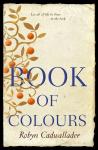
Robyn Cadwallader, The book of coloursWhat makes historical fiction worth reading for me is the exploration of universal ”truths”. Fortunately, Robyn Cadwallader’s second novel, Book of colours, does this, albeit I wish that some of the universals – gender inequity, class (meaning social and economic inequity), and fear of foreigners – were no longer universal! The book explores other more general universals, too, such as love, friendship, loyalty, courage, suspicion, fear. However, historical fiction needs something more of course. It needs to authentically evoke an historical time and place, preferably through engaging characters. Cadwallader does this too.

Book of colours is set in mediaeval England, specifically between 1320 and 1322, and concerns an illuminated book of hours. The narrative is structured into two main chronological threads – the story of the book’s creation and the people creating it, from late 1320 to 1322, and that of the noblewoman who commissioned it, Lady Mathilda Fitzjohn, after she has it in her hands, from May to September 1322. She lives in Hertfordshire, while the limners’ atelier is located in London, so we also see city and country life during this period. As the limner Gemma writes:

…let all of life be there in the book, from high to low, animal and monster, story and joke, devotion and dance … (from The art of illumination)

Now, I particularly like it when historical fiction writers provide some historical context to their story, preferably in an afterword, along with some references or sources. This Cadwallader does, with a four-page Author’s Note and two-plus pages of Further Reading. She explains the historical background, including that the period she chose encompasses the Great Famine and the Dispenser War, and she discusses where the facts are less well documented. The meaning of those bawdy or confronting marginal images in books of hours, for example, is little understood. Also, says Cadwallader, no women limners are listed in this period, but there is evidence that women did, in fact, undertake illumination. These notes support the novel’s political, socioeconomic and sociocultural context.

The story is told third person through three main perspectives: Mathilda’s and those of two of the atelier workers, journeyman-near-master Will Asshe and master-in-work-if-not-in-name Gemma Dancaster. The atelier is owned by Gemma and her husband John – well, actually, given the times, it is “owned” by her husband, but he inherited it from her father. Prefacing the atelier-based chapters are sections from the book The art of illumination which Gemma secretly writes for her apprentice son Nick.

“both beauty and chaos”

Towards the end of the novel, the widowed Mathilda – her rebel Marcher husband having been killed while fighting the Dispensers – realises that life is not “ordered” as she had thought but is, like the “delicate, bawdy and capering creatures” in her book, “both beauty and chaos.” It is this “beauty and chaos” that Cadwallader captures through her vivid characters. The atelier thread starts with the arrival in London of Will, a limner who is escaping something that happened in Cambridge where he had lived and done his training. As the story progresses we discover, of course, what that was, but all I’ll say here is that he’d been associating with a student named Simon who had filled his head with ideas about equality. These ideas make Will angry about “the rich and their ambitions” and resentful about “the marks of privilege” requested for the book of hours. He’s a bit fiery, our Will, and gets himself into several scrapes, all the while watched over by an animated gargoyle who represents, I’d say, Will’s conscience.

Meanwhile, Gemma, the would-be master limner, is frustrated about the inequalities she faces as a woman – particularly a woman having to cover for her husband who is, we soon discover, no longer able to draw and paint. Gemma, too, is aware of economic inequities. Southflete, the stationer and middleman who handles the commission, tells them that

the calendar pages must be beautiful scenes of life on the demesne, you understand … Chubby infants, well-fed peasants, colour, beauty …

Gemma is not impressed:

Beautiful. How, in a village farmer’s wife, would January be beautiful? Snow if the weather was kind, ice if it was not. And this past year, colder than ever. Frost that rarely lifted, and then only to snow or rain. London had clenched its teeth, frozen to the marrow, too cold to move. At least the cramped lanes and houses blocked some of the wind; what it was like in the country, she couldn’t bear to think.

She, like Will, makes her assumptions about their patron Mathilda’s life and values, but as is often the case, assumptions aren’t always completely right – and these too Cadwallader teases out as the book progresses.

There are other characters – including Gemma’s gentle husband, their quietly wise apprentice Benedict, and their son and beginning apprentice Nick. These, plus other residents of London’s book trade area, Paternoster Row, flesh out the story, adding depth to the narrative and to the history of this fledgling industry struggling to establish itself as a guild.

So, there’s beauty and chaos in life, but it is through their drawings that the limners convey their feelings and ideas. As the world changes around them – for reasons I can’t fully divulge – the limners draw and paint their reflections and reactions, their messages even, into the book. Both Gemma and Will remind Mathilda of who she is and of her responsibilities to herself and others, responsibilities that become more nuanced and more personal than their original simplistic view of the world at the start of the novel. The interplay between the artists’ ideas as they paint and Mathilda’s reflections as she considers their paintings is one of the joys of the book. It is as much through these, dare I say, “virtual communications” as anything, that our three main characters grow in understanding. It is through them, for example, that Gemma shares her feelings – feelings Mathilda doesn’t recognise as coming from any sermon she knows – about women’s need to stand strong in the face of men’s power.

Book of colours, in other words, is a delicious read, imbued with the life of a long-ago time but filled with people whose emotions, hopes and frustrations are very much our own. Latish in the novel, Mathilda realises that Will’s friend “Simon’s simple borders of right and wrong won’t hold. They leave no space to breathe.” This is the book’s message: to grow and change we need to expand beyond simple conceptions of right and wrong. We need to let each other breathe and be. Only then can true selves, true relationships and, hopefully, a true understanding of equity develop.

Note: Lisa (ANZLitLovers) loved this book, and Angharad Lodwick (one of last year’s Litbloggers) was also impressed. I also reported, back in April, on a Conversation with Robyn Cadwallader about this book.

AWW Badge 2018Robyn Cadwallader
Book of colours
Sydney: Fourth Estate, 2018
360pp.
ISBN: 9781460752210

(Review copy courtesy HarperCollins)

Jenny Ackland, Little gods (#BookReview)

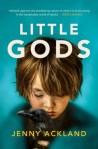
Jenny Ackland, Little godsThe universe is telling me something. Jenny Ackland’s Little gods is the second novel I’ve read in a few months that is set in the Mallee region of northwestern Victoria, the other being Charlie Archbold’s Mallee boys (my review). Interestingly, both are coming-of-age novels, both involve farms, and both have a death at the centre. However, this is where the similarity ends, because Ackland’s protagonist, Olive, is female – and younger than Archbold’s – and Ackland’s death is a mystery to Olive, whereas in Archbold’s novel it’s the mother’s death which precipitates the narrative.

There’s another difference too, and it’s that Mallee boys slots into YA fiction*, albeit also a good read for adults, whereas Ackland’s book, while seen primarily through Olive’s point of view, is adult fiction. This is because although it’s about Olive’s journey, the main focus is on the way children see adults and the way adults completely miss what is going on in children’s minds, on the decisions adults make about what to tell children and how children respond to what they sense isn’t being told.

So, the story. Set in the 1980s, it’s about Olive and her extended family in which two of the sisters, Audra and Rue, had married two brothers, Bruce and William, with a third sister and brother on each side left over. Thistle, the oldest (and left-over sister), lives with Rue and William and their three children, Sebastian, Archie and Mandy, on the sisters’ family farm. Audra and Bruce, with Olive, live close by in town. The action is split between the farm, which Olive’s family visits regularly, and Olive’s home in the neighbouring town.

The novel starts with a little un-named “prologue” which tells us that the book is about the year Olive turned 12, when she was “trapped in the savage act of growing up”. It’s about a time when, uncertain about what was going on, she reached back into her memory, only to find that memory can be deceptive. It all could have ended up far worse than it did. (We know it didn’t because here she is at the beginning, alive, apparently well, but contemplative!)

She is fierce

Anyhow, from this point, the novel proper starts with Olive knowing that the local community thinks her family – the whole family, I mean – “odd”, which entrenches her sense of outsiderness but also fires her sense of agency. The novel starts slowly, with the plot not picking up until we are well in. Before that, Olivia’s character and the family’s complicated relationships, particularly between the sisters, are carefully developed. Olive, we soon learn, is independent and, outwardly at least, sure of herself. She’s “fierce”, as the epigraph from Shakespeare warns us, and bosses her best friend, Peter, and her cousins around. But she is needy too. And for this there is Grace, a wild raven who provides her with the affection that she doesn’t get from her stylish but withdrawn mother. For all her faults, we like her.

And so, here’s Olive, on the cusp of adulthood, wanting to understand the world. She knows which adults in her life will nurture her, mainly Rue, and which are likely to answer her questions, and that’s mostly Thistle. However, Thistle has her own issues and sees life through a particular prism which is not always useful to Olive. It all starts to unravel when Olive finds pictures of her parents and Thistle all holding a baby which is not her. Through insistent questioning, she discovers that the baby had been her sister and had drowned. But, with no more details forthcoming, she decides the baby had been murdered and that she knows who is responsible. She determines on revenge, but needs help. Meanwhile, Thistle is working through her own lost baby problem … You could see this novel as a modern take on the Aussie “lost child” motif.

At times, as the narrative plays out, we are called on to suspend disbelief, but never quite beyond the point of no return. Some shocking things happen but others are diverted, so that by the end Olive has found some answers and also learnt some valuable lessons.

There are several joys in reading this book, one of which is the writing. Ackland’s descriptions of the Mallee, though brief, are evocative:

Sunday morning and the sun rose on the bleached Mallee landscape and lit the distressed greens and greys.

Even lovelier are the ways she captures people, their thoughts and relationships, particularly Olive’s of course:

Olive crept back to the bathroom. It was a startling thing to know that Cleg could be tender with Thistle the sister he seemed to like the least. Standing in front of the mirror it was as if there was an opening inside her mind. A plant, a tall one, with a green stem that was thick all the way around. At the top of it, a tightly bunched bloom, an enormous head of closed, wrapped petals. She didn’t know the colour of the flower yet but it was bright as if illuminated by special lights, and inside the heard of the flower was a quavering, shimmering sensation of coming movement and understanding.

Perfect.

Water also features throughout the novel, which is appropriate given the drowning, but it is also presented as a positive thing. For Olive, water provides respite. At the pool, “her body feels real in the water”, and, submerging herself in the dam she stays “under just to be in that cool distant place for a while longer.” The novel, in fact, opens and closes with references to Olive jumping off the high board – an effective image for the gutsy way she approached life, though the suggestion in the prologue is that having grown up she “was no longer a girl bombing off the high board.”

So, the book is about the challenges of growing up. Olive, the child, sees the world simplistically. People are “little gods” who “have power to do things, like make baddies pay”. She is shocked when lawyer Cleg sees it a little differently, is not so categorical about “bad people”. Ackland explores the clash between child and adult world views by teasing out responses to a family tragedy. As the secret comes out, as the truth is told, some family wounds heal and some lessons are learnt – but at what cost? I thoroughly enjoyed this book.

Oh, and as for what the universe is telling me … it’s that I need to make good my plan of some years’ standing to visit the Mallee!

Lisa (ANZLitLovers) also enjoyed this book.

AWW Badge 2018Jenny Ackland
Little gods
Sydney: Allen & Unwin, 2018
345pp.
ISBN: 9781760297114

(Review copy courtesy Allen & Unwin)

* Mallee boys has just been commended as an Honour Book in the Children’s Book Council of Australia Book of the Year for Older Readers Award

Monday musings on Australian literature: Women science fiction writers

This year’s National Science Week finished yesterday, 19 August, but I figured no-one would mind if I wrote a Science-Week-dedicated post a day late. In past years I’ve written Science Week posts on novels about scientists (2015), science-based non-fiction (2015), and science writing (2016). I didn’t write a post last year. So, what to do this one? I’ve decided, given my Australian Women Writers Challenge involvement that I’d share some of Australia’s popular women science fiction writers. This is not, I admit right now, my area of expertise. but I’ll give it a go.

My first challenge is, as you might expect, definition of the genre. Wikipedia lists, in chronological order, over 30 definitions, starting with someone called Hugo Gernsback in 1926. I don’t want to get embroiled in this, and I want, for my purposes here, to take a rather narrow definition. Here are two, in Wikipedia, from well-known science-fiction writers:

  • Isaac Asimov (1990) “‘[H]ard science fiction’ [is] stories that feature authentic scientific knowledge and depend upon it for plot development and plot resolution.”
  • Arthur C. Clarke (2000) “Science fiction is something that could happen—but you usually wouldn’t want it to. Fantasy is something that couldn’t happen—though you often only wish that it could.”

So, I’m going to focus on women writers who, I believe, write (more or less) within these definitions. I’ll be on thin ground I know, but will welcome debate!

I decided that a good source for me to separate out science fiction from other forms of speculative fiction would be Australia’s Aurealis Awards which offers prizes in specific categories, one being “Science Fiction” (but even there, some of the books overlap into other sub-genres, like dystopian fiction, which I want to leave aside here.) Indeed, the more I looked into “my” topic, the harder I found it to locate relevant authors. It seems, as AWW Challenge Speculative Fiction expert Tsana Dolchiva said in a post for the challenge, “Australia hasn’t been the most fertile ground for science fiction — for whatever reason, the planets didn’t quite align for it the way they did for fantasy.” I wonder why this is? Any ideas? Anyhow, I don’t feel so bad now about the paucity of my knowledge.

Marianne de Pierres, Dark spaceSo, here goes with a few names – all Australian women of course:

  • Cally Black: New Zealand-born, Melbourne-based Black is a new writer in the YA science fiction arena. Her debut novel, In the dark spaces, won the Aurealis Award for Best Young Adult Novel. It is a sci-fi thriller about a 14-year-old orphan who is taken in by her aunt who happens to be a cook on a space freighter.
  • Amanda Bridgeman: The Western Australian-based Bridgeman has, so far, written the Aurora space opera series, and an apocalyptic novel, The time of stripes. The Aurora series comprises 6 books set in and around a spaceship named “Aurora”. The third in the series, Aurora: Meridian, was nominated for an Aurealis Award.
  • Marianne de Pierres: Tsana writes that you “can’t talk about science fiction in Australia without mentioning Marianne de Pierres” which makes sense to me because even I have heard of her! De Pierres writes across a wide range of speculative fiction genres, including in this more “pure” science fiction area that I’m focusing on here. An example is her space opera series, the Sentients of Orion. Its four books – Dark space, Chaos space, Mirror space and Transformation space – were all shortlisted for Aurealis Awards, with the last one winning Best Science Fiction Novel in 2010. The novels are set on an “arid mining planet” called Araldis. She lives in Brisbane, and writes crime under a different name, Marianne Delacourt.
  • Anna Hackett: Hackett is, her website says, a USA Today bestselling author, but she grew up in Western Australia and describes her childhood as “running around in the sunny weather, chasing my brother and turning my mother’s outdoor furniture into spaceships.” She writes action romance, some of which take us into space, such as her Galactic Gladiators series.
  • Amie Kaufman & Jay Kristoff, IlluminaeAmie Kaufman: Tsana describes Kaufman as “one of the most notable Australian authors writing science fiction today”. She is, her website says, “a New York Times and internationally bestselling author of science fiction and fantasy for young (and not so young) adults.” She seems to mostly write collaboratively. Her debut novel, These broken stars, was co-authored with US writer Meagan Spooner, as is her latest book published this year, Unearthed. It’s novel is about an alien culture that has advanced technology which may be able to undo environmental damage. She has also collaborated with Australian writer Jay Kristoff, such as on their YA series, the Illuminae Files. The first in the series, Illuminae, is set in 2575 and “two rival megacorporations are at war over a planet that’s little more than an ice-covered speck at the edge of the universe.”

So, that’s five, and, until today, I’d only heard of one of them. So many genres, so many authors. I tried to see if I could identify any consistent themes running through these books, but I don’t think there are – not, at least, the way there are in the dystopian sub-genre. It does, though, seem that more writing is happening in the YA area than specifically for adults, which is interesting.

But now, have you read these authors – or, if not, who are your favourite sci-fi authors?

(PS I might explore other speculative fiction genres in future National Science Week posts.)