Miscellaneous writers on travel

You may have noticed that I didn’t manage a Monday Musings last week. Mr Gums and I have just arrived home from our 7-weeks sojourn overseas – so normal service will resume soon, both here and in my reading of your blogs!

Today, though, I thought I’d share a small, eclectic collection of quotes about travellers and travelling that I’ve come across recently. All of them reflect, in some way, our experiences over the last 7 weeks.

Murray Bail in The voyage (2012)

The other passengers went off in different directions, their alertness to novel sights gave the impression they had more energy than the locals, an optical illusion, most likely.
Lafcadio Hearn in Glimpses of unfamiliar Japan (1894)
I climb and climb and climb, halting perforce betimes, to ease the violent aching of my quadriceps muscles …
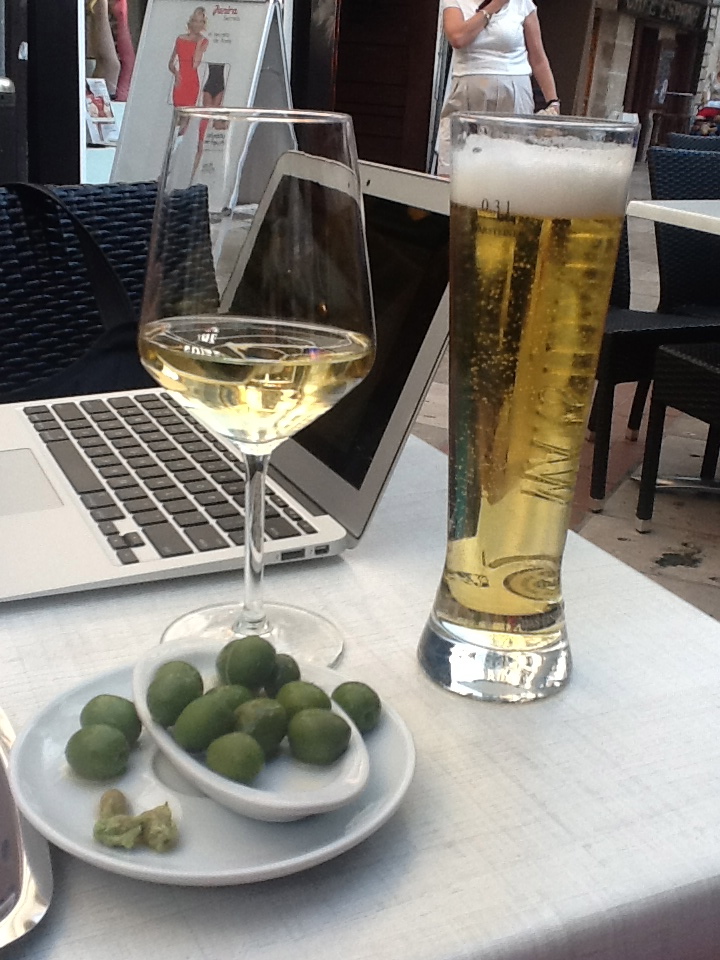
Wine, beer and laptop

The modern traveller (Burgos, Spain)

Washington Irving in Tales of the Alhambra (1832)

… but above all we laid in an ample stock of good humor, and a genuine disposition to be pleased, determining to travel in true contrabandista style, taking things as we found them, rough or smooth, and mingling with all classes and conditions in a kind of vagabond companionship.

Jack Kerouac in On the road (1957)

Our battered suitcases were piled on the sidewalk again; we had longer ways to go. But no matter, the road is life.

Do these speak to you? And do you have any favourite travel quotes?

A note re advertising

I gather that while I’ve been away WordPress has been adding random advertisements to my blog (which they host for free) for cost recovery reasons. As I don’t monetise this blog in any way, I’ve decided for the moment not to pay to be ad-free. However, if the ads become irritating, please let me know and I will reconsider.

Monday musings on Australian literature: Qantas flight-length book deal

Some of you have probably sussed that Whispering Gums is not at her usual desk – and you’d be right. I’ve been travelling since mid-August, mostly in Europe, and will be back home in early October. I had hoped to read some books and write reviews while on the road, but somehow the reviews haven’t happened. One review is nearly ready though!

However, here’s something interesting I read just before I left Australia in AustLit news. It was about a Qantas initiative involving commissioning, from Hachette, a series of paperback books “timed to be read during 10 of Qantas’s main flying routes”. The series is called “A Story for Every Journey” and, AustLit reports, will be offered to Qantas’ platinum Frequent Flyers.

The books will cover popular fiction and non-fiction genres  –  the ones we often call “airport books”. The book lengths are based on average reading speeds, taking into consideration time for napping and eating – or so I read in an article at goodereader.com. It quoted Mr Nobay, spokesperson for Hachette’s partner Droga5, as saying that

According to our literary friends at Hachette, the average reader consumes between 200 and 300 words per minute, which equates to about a page per minute.

This spokesperson also said that

for the longer flights, we accommodated some napping time and meals … After a few hours with a fine Qantas in-flight meal with Australian Shiraz, most people need a break from reading.

(Don’t you love the marketing?!)

AustLit said that one of the ten books – sounds like the initial plan is for ten – will be Kimberley Freeman’s Wildflower Hill which “has been suggested as the perfect read for travellers on the Sydney to Dubai route”. What a shame I didn’t have it when I flew that route a few weeks ago! I’ve never heard of Kimberley Freeman, which is apparently the nom de plume of Brisbane writer and academic Dr Kim Wilkins. Other authors include popular actor and author William McInnes, popular non-fiction writer Peter FitzSimmons and novelist Lian Hearn.

Anyhow, as goodereader comments

If this concept in reading takes off (pun intended) and if lawmakers insist on holding to strict regulations on the use of mobile devices during air travel, there is potential for a surge in not only print-reading, but also a shift towards more books being written with an intentional audience already in mind.

On my first reading of the initiative, I thought it was about commissioning books to be written for the purpose, but it sounds like it’s about identifying existing books that suit the criteria and re-packaging them for a new market. It may, of course, lead to books being written specifically for the market, as goodereader wonders.

I’m not sure I need to have books specially targeted to a set reading period, but I love the creative thinking behind this initiative. What do you think? Have you heard of anything similar?

Michelle de Kretser on the benefits – hmm – of travel

I could write posts and posts sharing gems from Michelle de Kretser’s Questions of travel, and who knows, maybe I will. Right now, though, I’ll just share one of the many commenting on how travel has infiltrated the way we live:

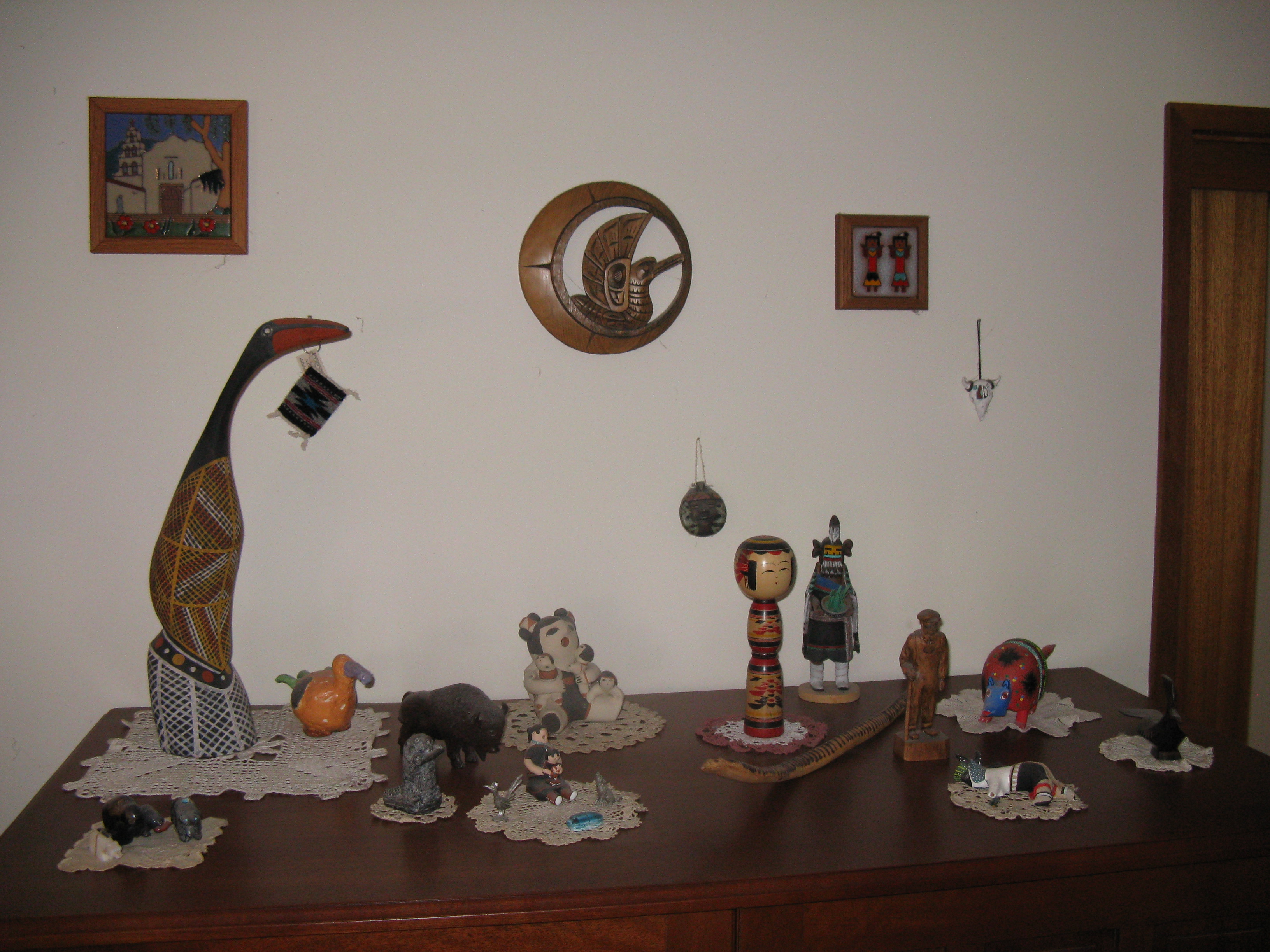
Laura Fraser belonged to an age and a place where an amazing thing was taken for granted: for the first time in history, ordinary people could raid the past and the planet to decorate their homes. Her eye was accustomed to ecumenical style, to African masks hanging beside industrial signage, to a witty postmodern aesthetic that refused to distinguish between designer and detritus, kitsch and cool.

Travel souvenirs

Tiwi meets Hopi meets Japan meets Navajo meets Quebec meets … hmm, guilty as charged

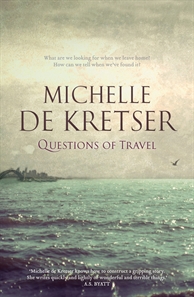
Michelle de Kretser, Questions of travel (Review)

Hardback cover (Courtesy: Allen & Unwin)

Hardback cover (Courtesy: Allen & Unwin)

Every now and then a book comes along that is so sweeping in its conception, that it almost defies review. Such a book is this year’s Miles Franklin Award winner, Questions of travel by Michelle de Kretser. Consequently, I’m going to focus on one aspect that particularly spoke to me – and that is her exploration of place and its meaning/s in contemporary society.

“Soon everyone will be a tourist”

As the title suggests, the novel is about travel – but travel in its widest sense. In fact, without being too corny, it is, really, about the journey of life. As our heroine Laura, thinking about her married lover Paul, ponders:

Perhaps she was an item on the checklist: the wild oats of Europe, the career back home, marriage, mortgage, fatherhood, adultery, the mandatory stopping places on the Ordinary Aussie Grand Tour, with renos*, divorce and a coronary to follow.

That made me splutter in my coffee …

First, though, a brief overview of the plot. The story is told chronologically, alternating between the Australian Laura and Sri Lankan Ravi. Both were born in the 1960s, and the novel chronicles their lives until 2004 when they’d be around 40. Laura, under-appreciated by her family (cruelly described by her father as “the runt of the bunch”) and aimless, travels the world before returning to Sydney in her mid-30s, still rather directionless, but now an experienced freelance travel-writer. Ravi grows up in Sri Lanka, marries and has a son, but a shocking event results in his coming to Australia in 2000 as an asylum-seeker, the same year that Laura returns. You might think at this point that you know where the novel is heading, but you’ll be getting no spoilers from me!

And so we have two significant types of traveller – the tourist (with some business travel thrown in) and the refugee/emigrant. De Kretser explores these comprehensively, and with, I must say, thrilling insight. Thrilling is an unusual word in this context, I suppose, but I can’t think of a better one to describe my reaction to the way de Kretser, point-by-point, unpicks the world of travel, skewering all sorts of assumptions, expectations and pretensions as she goes. I almost got to the point of cancelling my next overseas trip! After all, as Laura discovers, “to be a tourist was always too arrive too late”. How many times have you been told that x place was better in the 80s, only to remember that in the 80s you were told it was better in the 60s!

“Geography is destiny”

So Ravi is told by his teacher Brother Ignatius. This, for all the serious and satirical exploration of travel and tourism, is what the book means most to me. Brother Ignatius tells his students that “History is only a byproduct of geography”. While we could all have fun exploring a chicken-and-the-egg argument, I’d find it hard to deny its fundamental truth.

Laura spends most of the book travelling, or thinking and writing about travel. She’s the quintessential modern person, believing:

What was the modern age if not movement, travel, change?

Living in England she sees the long-standing connections people have to their place, while

Her own people struck Laura, by comparison, as a vigorous, shallow-rooted plant still adapting itself to alien soil.

She returns to Australia, following the death of the gay man she’d loved, hoping for meaning, connection. Geography, place, home had asserted itself … as it usually does. But life doesn’t prove to be much easier. Struggling to find her place, she finds once again that “noone was asking her to stay”.

Meanwhile, Ravi struggles to adjust to his circumstances. Grieving for what he’s lost, he (with his “eyes that had peered into hell”) goes through the motions of living and working. People such as his landlady and her family, and his work colleagues, are kind – enough – but de Kretser shows how skin-deep, how superficial, our practice of diversity and, worse, our humanity is. We do not easily accept people from “other” places. “Otherness”, de Kretser proves, “is readily opaque”. Australians, for example, ask Ravi which detention centre he’d been in because, of course, as an asylum-seeker that’s where he’d been! And, if he hadn’t, was he a “real” refugee. (One of the book’s many other themes, in fact, is “authenticity”.) Ravi, it has to be said, doesn’t help himself. He doesn’t share his history (should he have to?) and, fearing obligations, he resists any help that isn’t essential.

“Place had come undone”

While Laura and Ravi struggle with where they are, they also confront the fact that by the late twentieth century place isn’t only physical. Ravi had discovered, back in Sri Lanka, the world of “disembodied travel”, though his wife Malini had proclaimed “Bodies are always local”. This imagery, seemingly light at the time, carries a heavy weight. Later, finding settling into his new geographical location difficult, Ravi starts to find escape and even solace in virtual places, including visiting people’s homes via real estate sites. De Kretser doesn’t miss any opportunity to explore the ways we “travel” and it never feels forced. It all fits, emulating the way travel fits into our lives.

For Laura, the virtual intrudes mostly through work where she is a commissioning editor for Ramsays, a travel guide company. As the 21st century takes hold, the e-zone division of her company starts to increase in importance. Some of the novel’s best satire is found in the portrayal of corporate culture at Ramsays. It’s laugh-out-loud, sometimes excruciatingly so.

“Time was a magician, it always had something improbable up its sleeve …”

While the novel’s subject matter is travel, in all its guises and in what it says about how we relate to place and each other, the overriding theme is that literal and existential question, What Am I Doing Here? It tackles the big issues that confront us all every day – Time, Truth, Memory, Death and, of course, the most fraught of all, Other People.

Towards the end of the novel, Laura realises that:

… the moment that mattered on each journey resisted explanation … because it addressed only the individual heart.

We could say the same about a great book … and so I apologise for my paltry attempt here to explain de Kretser’s witty, warm and powerful novel. If you have any interest in contemporary literature and its take on modern living, this is the book for you.

For an equally positive perspective, check out Lisa’s (ANZLitLovers) excellent review.

Michelle de Kretser
Questions of travel
Sydney: Allen & Unwin, 2012
517pp
ISBN: 9781743317334

* Aussies commonly abbreviate words with “o” or “ie” endings. “Renos” therefore refers to “renovations”.
On the literary road: Gundagai Redux

20130509-154945.jpgGundagai, a small country town only two hours drive from my home, was the first place featured in my first literary road post back in 2009. I didn’t on that occasion write about its early history.

The Gundagai area was home to the Wiradjuri people, and was settled by white people in the late 1820s. It was officially gazetted in 1840 despite repeated warnings by the Wiradjuri about the risk of large floods to this part of the Murrumbidgee River floodplain.

According to the Poet’s Recall Motel, Gundagai’s first streets were named for poets: Shakespeare Tce, Milton St, Pope St, Johnson St, Maturin St, Landon St., Hemans St, Sheridan St, Otway St, Byron St, Homer St, Virgil St, and Ovid St. However, believe it or not, the Wiradjuri knew their country and in 1852 a huge flood destroyed the town. Over one third of the 250 inhabitants and a number of travellers died, and 71 buildings were destroyed. The old mill is the only building still standing from the original town. As for the poets, when the town was rebuilt, on higher ground, the poet street names, according to the Motel’s notes, were not reused. However, looking at a modern street map of Gundagai, I did spy Sheridan, Homer, Byron Streets, plus a reference to Ovid Lane and the other poets. Presumably these have been returned to the town in more recent times.

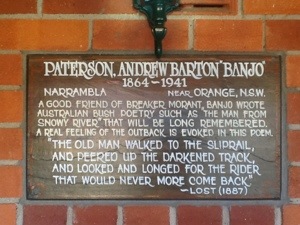
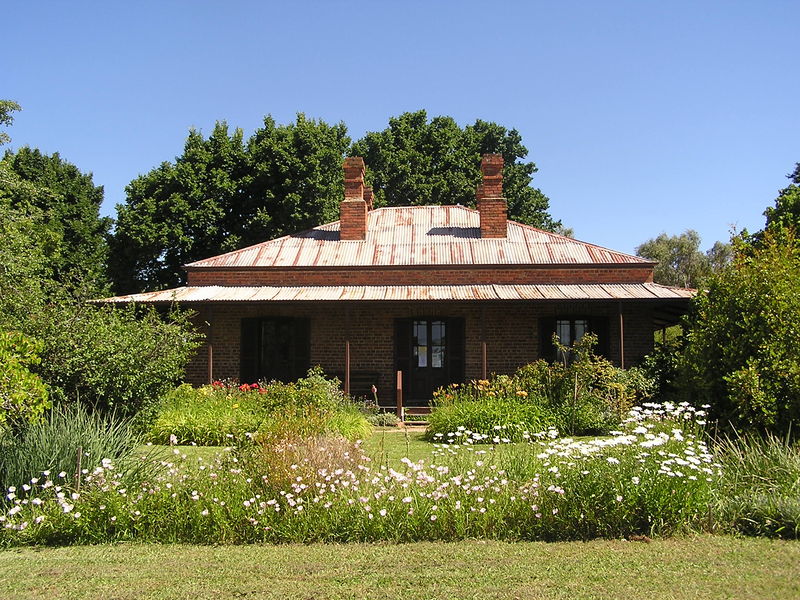
Anyhow, this is where the Poet’s Recall Motel comes in. The owner – I’m not sure when – decided to revive Gundagai’s poetic history. Each motel room is named for a poet – the original 13 and then some. I was rather delighted to find that our room was Banjo Paterson, and the two rooms next to us were Henry Lawson and Breaker Morant. Fine room-mates for Whispering Gums! In addition, the historic bar in the motel’s restaurant is decorated with painted portraits – on local slate – of the original 13 poets.

Once again I’ve learnt that country towns can be surprising places … I don’t imagine I would ever have heard of Felicia Hemans, who was published in the early nineteenth century by John Murray, Jane Austen’s publisher, if I hadn’t stayed at the Poet’s Recall Motel.

Monday musings on Australian literature: What’s in a street name?

Street names may be an unusual topic for a post on literature, but I think it could be argued that names of things are part of our wider literary culture. It can certainly be argued so for my city because street names here are serious business. None of your 5th Avenues and 61st Streets for us! I know, I know, New York’s a great place, and very easy to navigate compared to Canberra with its reputation for going round in circles, but we have our reasons …

I was inspired to write this post because this past weekend Prince Charles and the Duchess of Cornwall were in town as part of their Diamond Jubilee Tour downunder. One of their duties was to take part in the renaming of Parkes Place to Queen Elizabeth Terrace. This has special meaning for me because the address of my first library employer was Parkes Place, which was named for Henry Parkes, the “father” of our Federation. Queen Elizabeth now joins Queen Victoria, King Edward, and King George in being commemorated by a street in what we call our Parliamentary Triangle. I’m pleased to say that poor old Henry is not being completely brushed aside: the little roads that circle Old Parliament House will now be called Parkes Place.

Enough about my inspiration though, and back to the main point, which is that in 1928 the Canberra National Memorials Committee of the Australian Parliament presented a “Report in Regard to the Naming of Canberra’s Streets and Suburbs” which laid down principles for Canberra’s official nomenclature. Early in the document comes this:

… the commission divided the Canberra City District into 23 divisions. It devolved upon the National Memorials Committee to find names for these divisions, which will eventually become the suburbs of the capital. It was felt by the Committee that patriotic and national sentiment would be best met if the names of those men who have contributed most to Australia’s existence as a unified nation, be used in the most important places, that is, for the names of the divisions or suburbs of Canberra.

The patriotism of a nation is often expressed by memorials to its benefactors, so it is deserving and right that the names of those great statesmen who laboured in the cause of the federation of the Commonwealth should be perpetuated as place names to be used in the mother-tongue by all Australians for all time.

A map of inner Canberra showing the Parliament...

Inner Canberra early suburb names. (Photo credit: Martyman, using CC-BY-SA 3.0, via Wikipedia)

Now isn’t that a great piece of bureaucratic literature! I particularly love the reference to “mother-tongue” after the preceding references to “men” and “statesmen”. It then lists the names of these men, and explains that “a suffix has been added, similar to some of the Anglo-Saxon names of towns in Great Britain, where the name is thought not to be very euphonious”. So, while Braddon gave rise to the suburb of Braddon, and Barton Barton, Lyne became Lyneham and Fysh Fyshwick. Ingenius eh?

The Report then goes on to note that other suburbs would be based on names connected with Canberra’s early days and its pioneers, and that “the use of aboriginal names has not been overlooked.” They stated that much knowledge of indigenous naming in the Canberra region had been lost but those known would be retained, and so they are – with most rolling off the tongue beautifully (euphoniously, even), like Narrabundah, Yarralumla, Pialligo, Jerrabomberra, Mugga, and Canberra itself.

All this is probably pretty common in cities elsewhere but the committee went on to set down principles for the naming of streets:

The Committee has adopted the idea of grouping together various classes of names in separate areas. Sections of the City have therefore been set apart for Governors, Explorers, Navigators, Scientists and others, Foresters and others, Pioneers and others, Founders of the Constitution, and euphonious Aboriginal words.

I wonder whether the names of the scientists, foresters, “and others” had to be “euphonious”?

I won’t go on with more of the report, but I will say that this plan has continued to the present. One of our newest suburbs, still in the making, is Wright – named for the poet Judith Wright. Yes, we do now have a handful of suburbs named for women, including the writers Miles Franklin, Dame Mary Gilmore and Henry Handel Richardson. Moreover, some of our street names, says ACTPLA, our current planning authority, are named for “quiet achievers”. Things do change in the corridors of government – eventually. As for the theme for Wright’s streets, it’s a somewhat diverse one, “Environment, Poets and Butterflies”. Maybe there’s a connection there; Wright was a poet and a conservationist so perhaps the latter covers the “environment” and the “butterflies”!

I like that fact that such thought has been put into Canberra’s urban (or is it suburban) nomenclature, and I’m glad that while the spirit of the early planners has remained our nomenclature has broadened to encompass women, quiet achievers, the arts and increasing usage of indigenous names. The end result is, for we capital residents, a fascinating literature of suburb and street names. Do you have such literature where you live?

On the literary road: Omeo, Omeo, wherefore art thou Omeo?

The Omeo Plains near Benambra from Mount Blowhard

Omeo Plains (Released into Public Domain, by John O’Neill, via Wikipedia)

Ok, that’s a pretty weak beginning I know, but hands up if you’ve ever heard of Omeo in Victoria, Australia? I must say that I hadn’t until recently when I started planning our latest foray into Victoria. We decided to  travel to Melbourne via the Great Alpine Road, in Victoria’s High Country … and in that gorgeous region we found a very pretty little town called  Omeo.

And so, I checked my literary guide* and I discovered some interesting literary connections for the town. It was part of the big Gold Rush of the 1850s, and the area features in novels by Rolf Boldrewood and Henry Kingsley. I’m a bit embarrassed that I really hadn’t been aware of Kingsley until a year or so ago, but Omeo features in his best-known novel, The recollections of Geoffrey Hamlyn (1859), and in another of his novels The Hillyars and the Burtons (1865). This latter novel apparently incorporates a story inspired by the Omeo Disaster of 1854 in which a number of diggers rushed over the Great Dividing Range from Beechworth searching for gold. It was not successful, however, and some of the diggers did not survive their return trip.

Boldrewood is a better known writer, primarily for his novel, Robbery under arms. It is another novel of his, though, Nevermore (1892), that features this area, which he saw as wild and lawless. In this novel he recreates three real events that rather support his assessment – the murder of Cornelius Green, the Ned Kelly Gang cattle rustling, and the Tichborne Claimant affair. All of these had connections with Omeo. Cornelius Green was a gold-buyer who was hatchetted to death by two bushrangers in 1859. The Tichborne claimant, who made a fake claim on a fortune and a title in England, had worked around Omeo in the 1850s. It was a well-known case at the time in both England and Australia. And the Kellys, well, if you don’t know them, click the link to Wikipedia and all will be revealed!

By 1900 Omeo had become far more respectable and was recognised for the beauty that we saw on our visit. Poet Bill Wye wrote:

There’s a wild charm in the mountains that is not met elsewhere,
Free as the vagrant winds, and pure as snow
There are songs in fountains, bubbling in the hills up there,
That echo the name of ‘Omeo’…

Not great poetry perhaps, but you get the picture, as you do in the following which was included by one RH Croll in his 1928 book on bushwalking:

As I came over Livingstone
The day was like a flame,
But suddenly I saw below,
Far and far and far below,
The shining roofs of Omeo
And said its singing name.

Ah, Omeo, Omeo, methinks you deserve better poets than these!

*Peter Pierce (ed)
The Oxford Literary Guide to Australia
Oxford: Oxford University Press, 1983 (rev ed)
501pp.
ISBN: 0195536223

Delicious descriptions from Downunder: Isabella Bird on Nikkō in Japan

Woodwork on temple in Nikko, Japan

Carved birds and animals at Toshō-gū Shrine, Nikkō, Japan

This is one of those Delicious Descriptions that is from Downunder but is not of Downunder, if you know what I mean. It’s actually of Japan – as you observant readers will already know given the title of this post – and it comes from Isabella Bird‘s Unbeaten tracks in Japan to which I referred in my first Japan trip post in May.

One of Bird’s first stops after leaving Tokyo was Nikkō, now designated as a UNESCO World Heritage Site for its astonishing complex of shrines and temples. It was, it appears, no less astonishing in the late 19th century than it was for us when we visited it in 2006. Bird spends quite a few pages describing it, but I thought I’d share this one for now:

The shrines are the most wonderful work of their kind in Japan. In their stately setting of cryptomeria, few of which are less than 20 feet in girth at 3 feet from the ground, they take one prisoner by their beauty, in defiance of all rules of western art, and compel one to acknowledge the beauty of forms and combinations of colour hitherto unknown, and that lacquered wood is capable of lending itself to the expression of a very high idea in art. Gold has been used in profusion, and black, dull red, and white, with a breadth and lavishness quite unique. The bronze fret-work alone is a study, and the wood-carving needs weeks of earnest work for the mastery of its ideas and details. One screen or railing only has sixty panels, each 4 feet long, carved with marvellous boldness and depth in open work, representing peacocks, pheasants, storks, lotuses, peonies, bamboos, and foliage. The fidelity to form and colour in the birds, and the reproduction of the glory in motion, could not be excelled. (Letter VIII)

It is, as Bird says, simply marvellous, full of wonderful details that you can spend hours wandering around. However, during Bird’s stay:

there were two shocks of earthquake; all the golden wind-bells which fringe the roofs rang softly, and a number of priests ran into the temple and beat various kinds of drums for the space of half an hour.

Nikkō apparently means “sunny splendour”, and it sure is that – but how vulnerable it is.

Monday musings on Australian literature: What value writers’ homes?

DKS, in a recent comment on this blog, and Lisa of ANZLitlovers, in a post last week, have brought to my attention the threat to Christina Stead‘s home, Boongarre, in Watsons Bay, Sydney. As a lover of the “literary road”, I’m concerned and so decided to explore it a little more.

The facts, as I understand them, are there is a draft heritage listing on the house, but there is also a development application currently before the Woollahra Council to add “modern extensions and excavate the historic garden” (Street Corner Staff, 6 June 2011). The house was a major inspiration for Stead’s novel, The man who loved children. The Watsons Bay Association has set up a petition to save the home. Their arguments are that the house:

  • will (do they know this?) be a heritage item “within months”;
  • represents 70 years of history of Christina, and her conservationist father and step-mother, David and Thistle Stead; and
  • is one of a “dwindling number of important historic houses in Watsons Bay”.

The Association provides strong supporting evidence for these arguments (which you can read via the link I privoded). They also say that the cause is being supported by such contemporary writers as Jonathan Franzen (who wrote an introduction for a recent edition of The man who loved children), Alex Miller and Nikki Gemmell.

Lake View House, Chiltern

Lake View House, Chiltern, in which Henry Handel Richardson lived (Courtesy Golden Wattle, via Wikipedia, using CC-BY-SA 2.5)

There are those, however, who aren’t so quick to leap to the defence of the house. Over at The Australian newspaper’s A pair of ragged claws litblog, the issue was discussed earlier this month by Stephen Romei and his commenters. Stephen posed this:

I’m leaning towards saying it doesn’t bother me, that Schwarzer spent $10 million to buy the place, which is a house not a museum, so he should be able to do some renovations if he wants, that swimming pools are great when you have kids, and that he’s not, as far as I know, also proposing to burn the last copy of The Man Who Loved Children.

But I’d like to hear other opinions on the matter. The fact that Alex Miller, for one, does care, is more than enough to give me pause. So, apparently, does Jonathan Franzen, who is Stead’s literary champion in the United States.

Romei goes on to suggest that seeing a writer’s house, say Hemingway’s, is interesting in a “touristy” way but that he wouldn’t care if it weren’t there the way he would if Hemingway’s books no longer existed. Several commenters agreed with him: it’s the books that matter, they said; and there must be other ways to remember and promote interest in Christina Stead. But, argued others, there is value in keeping and celebrating writers’ houses. My favourite arguments are:

  • When a home and/or museum is done well, it can provide wonderful insights into the writer’s life and serve as a repository for archives and artefacts, as well as a focus for dissemination of the writer’s work and a resource for scholarship. (Nathanael O’Reilly); and
  • Maintaining a house for prosperity is more than a gesture. It is an important anchor point for a culture which says “this is us, this is valuable.. see why”.  It speaks volumes to those coming on, even if they don’t visit.  A writer’s home may seem inconsequential, say compared with Monticello (tell me if that experience doesn’t impact, and last!*), and upkeep payments may seem misplaced or prohibitive, but little by little these things infuse society and enrich us here, and by overseas acknowledgement through visitation, in ways immeasurable.  We really do need to understand these values and to move away from the transigent [sic] “she’ll be right” approach to our “culture” and begin taking a more hands-on approach. (Lobster)

Wow! I didn’t need convincing, but Lobster has nailed it on the head as far as I’m concerned. What about you?

(* It sure does!)

Whispering Gums on Deformed Pines

Black Pine overhanging pond, Korakuen, Okayama

Black Pine over hanging pond, Korakuen, Okayama

I am slowly but surely working my way through Isabella Bird‘s Unbeaten tracks in Japan. While we were still in Japan, and enjoying its wonderful gardens, I came across the following passage from early in Bird’s travels:

After running cheerily for several miles my men bowled me into a tea-house, where they ate and smoked while I sat in the garden, which consisted of baked mud, smooth stepping-stones, a little pond with some goldfish, a deformed pine, and a stone lantern. (From Unbeaten tracks in Japan, 1880, Letter VI)

Hmm, I thought, was the pine really “deformed” or is this a case of Bird’s anglocentric eyes missing the beauty of Japanese pines? Because for me, besides of course the overall design, the three things I love about Japanese gardens are the stones, the lanterns and the pines. I cannot resist photographing these “objects”, particularly if I see them in combination. The stones, though, are stones, albeit beautifully chosen and carefully placed. And the lanterns – usually made of stone – come in a range of sizes and forms but are recognisably lanterns. The pines, however, are something else. They come in two main varieties – Red and Black. They are often supported by poles tied to the tree with rope, and their trunks may be protected by a bamboo “coat”. And, they are very particularly pruned, to shapes that I suppose could be described as “deformed” if you didn’t realise there was a plan and a purpose.

Korakuen scene, Okayama

Lantern, stones, pine and water at Korakuen, Okayama

Water, stones and pines are the critical elements of Japanese gardens. And each has its meaning. For now though I’ll just focus on the pine. Pines, we were told by our Korakuen guide, represent longevity. My research for this post confirmed this but added that they also express happiness. I suppose happiness goes with long life? (At least it would be nice to think so!). I also discovered that Japanese red and black pines represent in and yo, “the soft, tranquil female forces and the firm, active male forces in the universe” (From the UCLA Hannah Garden Center). I would have expected from this that red and black pines would usually be found (more or less) together in Japanese gardens, but while we certainly saw both types of pines I wasn’t aware of their being in any obvious relationship with each other or even of regularly being in the same garden. Perhaps I’m reading this symbolism a little too literally. I will do some more research on this one … but, if any of you readers out there are experts in Japanese pines I’d love to know more.

Alex Kerr, in his award-winning book Lost Japan, has some critical things to say about modern Japanese gardens, but as I haven’t finished that book  (either) I will reserve comments for now. Meanwhile, though, I hope you have enjoyed this admittedly little foray away from gums into the world of the Japanese pine!