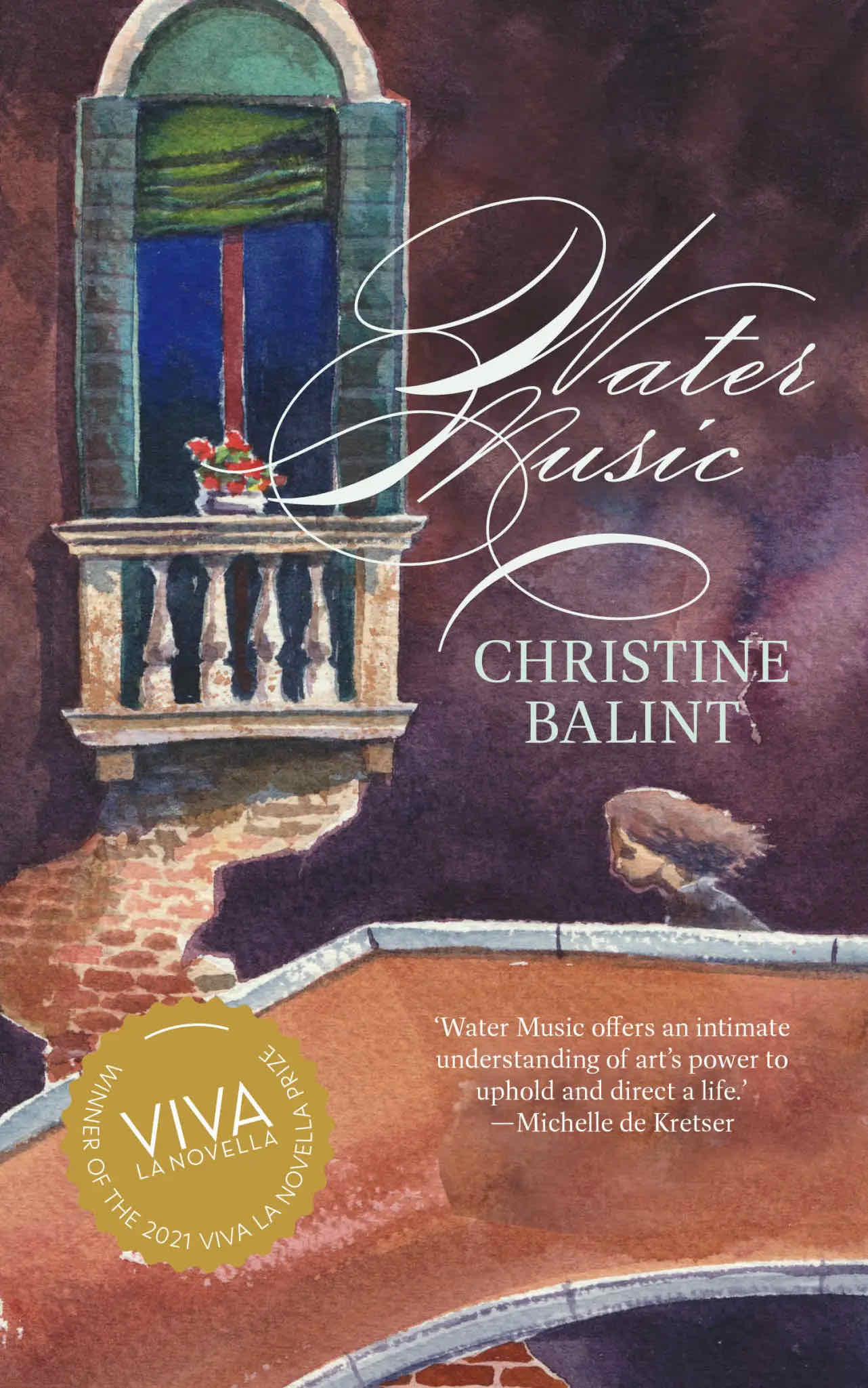
Christine Balint, Water music (#BookReview)

Christine Balint’s Water music was a joint winner of the 2021 Viva La Novella Prize with Helen Meany’s Every day is Gertie Day (my review), but they are very different books. Meany’s is contemporary, perhaps even near-future, and tackles some up-to-the-minute issues regarding fact, truth and authenticity, while Balint’s is historical fiction, a coming-of-age story, albeit a very specific one.

Set in 18th century Venice, Water music tells the story of a young orphan, Lucietta, who is raised by a fisherman’s family until she’s 16 years old when she leaves to live in Derelitti Convent, one of Venice’s many musical orphanages for girls. This interested me, because when my children were young we loved listening to an audiocassette telling the story of Vivaldi teaching in a Venetian orphanage for girls, but I’d never researched it further.

Balint explains her inspiration in the Acknowledgements and on her website. The book, she says, draws on “the unique history of the musical orphanages” in Venice, which existed from around 1400 to 1797, and were run by and for women. They took in girls of any class or background, if they passed an audition, and provided them with an opportunity to pursue a professional career when this “was rarely possible elsewhere in the world”. In particular, they gave impoverished girls an opportunity “to earn an income and establish a career or save for a dowry—enabling them to forge a fruitful life”.

The obvious question is, how could impoverished girls learn enough music to pass the audition? There must have been a way, but in our Lucietta’s case, she was born illegitimately and placed in a “foundling home”. From here she was given to a wet-nurse, the woman who became her mother, but her “real” father had left instructions and money for her musical education. This sets her on the course that leads her to auditioning for and being accepted at Derelitti.

From the beginning, it’s clear that Lucietta, who has learnt the violin, is musically talented and that her parents have been conscientious about fulfilling these instructions. Her mother, Lucietta tells us, “believed that if she followed these instructions, my musical and marital future would be assured”. Notwithstanding this, the question the novella poses is, what is her future to be? A few options are available to, or possible for, Lucietta, ranging from the future her mother doesn’t want for her, being a fisherman’s wife, to one dreamed of by the orphanage girls of being married to a nobleman from the “Golden Book“.

The story is told first person by Lucietta, so we see it all through her eyes. She’s a sensitive, intelligent young woman who has loved her fishing family, which includes a brother Lionello, so it’s not surprising that she is initially disconcerted when she leaves her family to live in the convent. However, this seems to be a kind place were the nuns and music teachers are supportive and the other girls are friendly. There’s not a lot of drama here, which is counter to your typical historical fiction. Instead, we travel along with Lucietta as she absorbs the influences, ideas and life around her, as she grows and changes, and as she meets, under the eyes of her mentors Maestra Francesca and the Convent’s priora, her suitor and potential husband, Don Leonardi.

Lucietta has decisions to make … and the good thing is that she is supported in those decisions without pressure. Well, there is a little pressure, including from one of her Convent friends, the sweet but one-armed and therefore in those times unmarriageable Regina. She had been sent to the Convent by her father who didn’t want to waste money on her. This is a world, after all, where “a girl is only as worthwhile as her marriage prospects”. Through Regina, Lucietta sees all the

Unwanted, unmarriageable girls through centuries. Here in this vast echoing building. Creating sublime music, their souls lost to time. Their music remaining.

There is a little political barb here regarding all those women who created and produced in the past – but anonymously. These convent girls may have had more opportunities than many, but they were not individually remembered. Some may see it as anachronistic when Lucietta sees value in “restoring the music, in finding the music, trying to recover their stories”, but then again, why wouldn’t someone back then have thought of doing this?

Balint’s writing is lovely. She brings the settings Lucietta experiences – her fishing home and then her convent one – to life, and creates in Lucietta an engaging, believable character.

Water music didn’t excite me quite so much as Helen Meany’s book did, perhaps because it’s a gentle book that explores a familiar story, albeit in a different and thoroughly interesting historical setting. However, because of that setting, because of its feminist underpinning, and because the writing is sure, I’d recommend it to anyone interested in a good – and not bleak – story.

Theresa also enjoyed this book.

Christine Balint
Water music
Lidcombe, NSW: Brio Books, 2021
119pp.
ISBN: 9781922267610
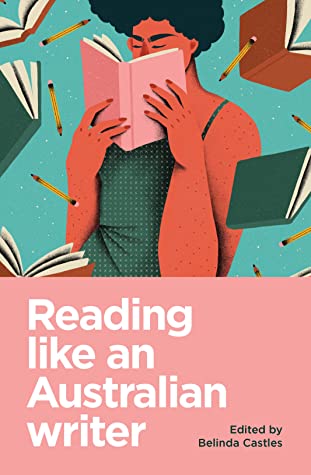
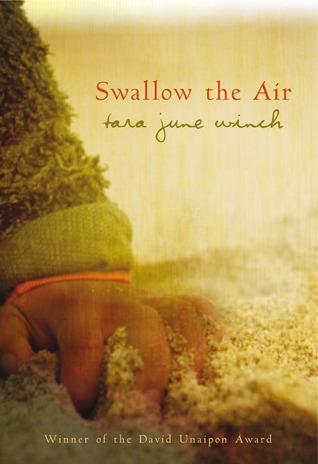
Novel-in-stories, Tara June Winch’s Swallow the air

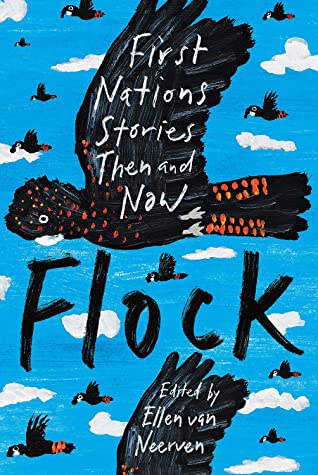
This is my third post inspired by Reading like an Australian writer, and it involves two First Nations writers, Ellen van Neerven on Tara June Winch’s award-winning debut novel Swallow the air. I chose van Neerven’s essay for my next post, because, coincidentally, I’d just read Winch’s story “Cloud busting” in Flock, an anthology, edited by van Neerven. Are you keeping up? “Cloud busting” is one of the stories in Swallow the air.

Form? What form?

Tara June Winch, Swallow the air

In my review of Swallow the air, I wrote:

The first thing to confront the reader is its form. It looks and even reads a little like a collection of short stories*, but it can be read as a novella. There is a narrative trajectory that takes us from the devastating death of narrator May Gibson’s mother, when May was around 9 years old, to when she’s around 15 years old and has made some sense of her self, her past, her people. May’s mother is Wiradjuri, her father English.

The asterisk pointed to a note at the end of my post, which stated that one story from the novel, the aforementioned “Cloud busting”, had been published separately in Best Australian stories 2006. And, in her essay, van Neerven says that she had used “Cloud busting” with students. Sounds like it could become one of Australia’s popular anthologised stories. This would be a good thing because, also in her essay, van Neerven comments on having had no introduction to “Indigenous-authored books” when she was at school (which, for 31-year-old van Neerven, was not that long ago.) Short stories are an excellent form for introducing school students to great stories and writing, and it would be a good thing to see more diverse stories added to current anthology favourites.

“Cloud busting” is a beautiful story, by the way, because it makes a point about deep loss but also conveys the warmth, trust and generosity that can exist between people.

Anyhow, back to form. Just as I wrote in my post on Swallow the air, van Neerven also comments on the book’s form, noting that “writing relational novels-in-stories” is a “very First Nations practice”. She cites Jeanine Leane’s Purple threads (my review) and Gayle Kennedy’s Me, Antman and Fleabag, as other examples. Marie Munkara’s Every secret thing (my review) fits in here somewhere too, I’d say. I hadn’t really thought about this as being particularly First Nations, as we all know novels from various writers that generate arguments about whether they are novels or short story collections. However, in my experience – and I am generalising a bit – First Nations people can be great story-tellers so it wouldn’t surprise me to find the form of “novel-in-stories” being more common among First Nations writers.

Further discussing this book, in which protagonist May goes on a journey back to Country to find her Wiradjuri origins, van Neerven makes another interesting observation, which is that May’s journey “plays into the reader’s romanticised expectations that a return to Country will bring the story a happy resolution”. But, of course, it’s not that simple. Country has often been too damaged by “past policies and institutionalisations”, as van Neerven puts it, for this to happen, but, she says, May does come to understand something important, which is that Country “lives within her” and her family “allowing her to feel strong in her identity without the shame of not living or growing up on Country”. Of course, it’s not up to me to pronounce on the validity of this way of seeing, but it makes good sense to me.

Anyhow, I’ll leave it, on these two interesting-to-me points, as I don’t want to steal the life from Castle’s book. These essays are all so different, as you’d expect, but this just makes them more worthwhile. You just never know what approach a writer is going to take when talking about another writer, but you do know that it will probably be insightful.

Ellen van Neerven
“Kinship in fiction and the genre blur of Swallow the air as novel in stories”
in Belinda Castles (ed), Reading like an Australian writer
Sydney: NewSouth, 2021
pp. 7-12
ISBN: 9781742236704

Tara June Winch
“Cloud busting”
in Ellen van Neerven (ed), Flock: First Nations stories then and now
St. Lucia: UQP, 2021
ISBN: 9780702264603 (Kindle)

Helen Meany, Every day is Gertie Day (#BookReview)

Helen Meany’s Every day is Gertie Day is the third Viva La Novella winner that I’ve read and posted about on my blog, the other two being Julie Proudfoot’s The neighbour (my review) and Mirandi Riwoe’s The fish girl (my review). All are memorable reads, and do this award proud – and no, I am not being paid to say this.

Announcing Meany’s win, Books and Publishing quoted the prize organisers who said that “at the intersections of art, politics, identity and representation, this darkly funny novella shows us a world that is weird, disturbing and all too familiar”. Previous Viva La Novella winner, Jane Rawson, calls it “a fresh, funny and delightfully weird take on authenticity and the people who manufacture it”.

Both use the word “weird”, but if you don’t normally do “weird” please don’t let that put you off because this novella is just weird enough to jolt us into thinking about its ideas, but it’s not that far-fetched – unfortunately.

Every day is Gertie Day concerns a new small house museum in Sydney commemorating a reclusive woman called Gertrude Thrift who had died and not been found until well decomposed. She had been the subject of a series of paintings by an artist called Hettie P. Clarke. This series, formally called the Girl with Greyhound series, is popularly known as the Elf Ears paintings because Gertie is depicted in them with pointy elf-like ears. This isn’t particularly weird, but what is weird is that there are people who have adopted Gertie as their inspiration, their role-model and have had their ears modified to emulate those in the paintings. The problem is that there is no evidence in the museum that Gertie herself had such ears.

The story is told in the first person voice of Nina, a guide (or Public Education and Engagement Officer) at the Museum. That this book was going to interrogate contemporary cultural and political trends and tensions is clear early on. As a retired librarian-archivist invested in the heritage sector, I was hooked when Nina notes that

getting people through the door of any museum anywhere was enough of a challenge, and the professional consensus, though no one would publicly admit it, was that it didn’t matter how you achieved it.

Nina continues that if anyone voiced “any sort of distaste, or ethical concerns, or accusing State Heritage of cashing in on a tragedy” they were to say that the museum endeavoured “to be as respectful as possible”. Thus the stage is set for conflict between the Gerties (mainly the Truthers but also the Regular Gerties), the museum staff, and State Heritage over the authenticity – the truth – of their displays. What follows is a story about a tussle for the “truth” in which the actual “truth” seems less important than what people want to believe and why, and what State Heritage and the Government think is best to do and say about it.

While Nina’s voice is the prime one, we are also given excerpts from the artist Hettie’s diaries, which may, or may not, be the “truth”, and, as the conflict escalates, we see some transcripts of social media commentary from various Gerties and their opponents. It is all so real, and delicious to read in the wake of contemporary controversies about “truth” and our tendency, desire even, to make it suit our own purposes and world-views. Nina is as reliable a narrator as we could hope for in this environment, but she has her own needs and perspectives. Mainly, she wants a quiet life and a job to support her family.

There is an element of dystopia in all this. A parallel story concerns Nina’s husband Benj, his recyc-u-pay job and the plight of the unemployed Trolley People (Trollos). These Trollos earn a living sorting through other people’s rubbish to feed into recycling machines that may be poisoning the air. Has Benj been affected? Who is caring about the Trollos, while the Gertie business garners all the attention?

And then there’s the State Museum, where Nina had previously worked. It had closed because of the “controversial Hall of Extinction”. The truth, it appears, was unpalatable. People had stopped coming because no one wanted to be reminded of all the lost species that could now only be seen “stuffed and mounted or on large video screens”:

Dwelling on the past was no way to move forward, it only made people unnecessarily depressed and angry. At least they were the government’s main arguments for defunding the museum.

There are many angles from which to explore this book – cult, identity, and politics; who controls the narrative and what can get lost in the melee; not to mention, art, and its creation and meaning. How ever you look at it, in Every day is Gertie Day, Meany has astutely tapped into the zeitgeist in a way that extends where we are now just a little bit into “weird”, but not beyond our ability to accept its – hm – truth or, worse, its inevitability. Have we got to the point where people are simply “allowed to believe what they want” or, where authority is so distrusted that all we have is belief (with or without evidence)? The ending is perfect.

Read for Novellas in November, and AusReading Month.

Challenge logo

Helen Meany
Every day is Gertie Day
Lidcombe: Brio Books, 2021
213pp.
ISBN: 9781922267627

S-S-S Snake, Kate Jennings’ Snake, that is

I thoroughly enjoyed Tegan Bennett Daylight’s essay on Helen Garner’s Cosmo cosmolino (1992) in Reading like an Australian writer. Consequently, I plan, over time, to read and share other essays in this book – at least those discussing books I’ve reviewed here. As it happens, there is an essay by Debra Adelaide on Kate Jennings’ Snake (my review), and it’s the perfect next cab off the rank. Not only have I already posted this year on Erik Jensen’s longer essay on the book in the Writers on writers series, but Snake is a novella, so I’m using this post as a contribution to Cathy’s (746books) Novellas in November. I hope that’s not too cheeky.

I’ll start, though, by introducing Debra Adelaide. A novelist with a few books under her belt, including The women’s pages which I’ve reviewed, she first became known to me through her work on early Australian women writers, her Bibliography of Australian women’s literature, 1795-1990 (1991) and A bright and fiery troop: Australian women writers of the nineteenth century (1988). Like many writers, she also teaches creative writing, and Snake is one of the texts she regularly sets.

So Snake – for those who don’t know – draws from Jennings’ life, and tells the story of a lively, imaginative woman, Irene, who marries a decent but boring man, Rex. It cannot work, and the consequences are dire.

Jensen’s and Adelaide’s essays are very different. This is partly because Jensen’s, being in the Writers on writers series, focuses on the writer, whilst Adelaide’s in Reading like an Australian writer focuses on the reading and writing. Not surprisingly, the approach Adelaide takes is closer to mine – except that her writerly perspective is more astute, centred and expository.

The elastic novella

Early in her essay, Adelaide specifically address its form as a novella, saying that Snake demonstrates “how wonderfully elastic the novella can be”. In Snake‘s case, it is “so elastic that it can almost be prose poetry”. It is also “audaciously” abbreviated. She’s right – this is one spare novel.

Adelaide identifies three main reasons that she sets this text for her students – “its poetic brevity, its ‘experimental’ form, and its intriguing, sometimes maddening, allusions to and quotes from numerous literary and cultural references”.

It is, she says, the perfect set text, because it can be easily read in one night and remembered, but,

Brevity does not mean simplicity: its complex themes ripple out and take their time before finally landing on the muddy shores of our imagination.

This is what makes Snake such a good and memorable read.

The three s’s

Adelaide divides her essay into three main sections, those three s’s in the title: Structure; Serpents; and Scenes, sex and Serena McGarry.

I love discussions of structure, because structure can so often help inform the meaning. When a short novel like Snake has a complex structure, it is worth taking note. Adelaide talks about her own method of writing and wonders about Jennings’ approach. She doesn’t know how Jennings works, but she does say that this novel

opened up my eyes to the possibilities of writing a novel that was straightforward yet clever in structure, that was stripped back to its narrative bones, and yet at the same time managed to be multilayered, dense, poetic and unforgettable.

She discusses the novel’s four-part structure, and explains how, although the book is primarily about the mother Irene, it manages to convey the POVs of all four characters, thus “deftly” delivering a portrait of the whole family. Simultaneoulsy, with its use of second person at the beginning and end, “it offers a powerful sense of everyperson”. I love this analysis. I also enjoyed her further discussion of second person, which accords with some of my assumptions about this voice. One of the points she makes is how second person makes (can make) the reader complicit, which is one of the reasons Madeleine Dickie used it in Red can origami (my post).

Adelaide also briefly discusses an issue that fascinates her, as it does me – “the unlikable character in fiction”. Irene is “remote, ruthless and selfish”, and yet, despite Snake‘s “staccato delivery and disparate parts”, Jennings manages to maintain the focus on Irene “without alienating us from her”.

However, the section I most enjoyed is Adelaide’s discussion of Serpents. She references DH Lawrence’s poem “Snake”, which Jennings quotes from in the novella, and Henry Lawson’s short story “The drover’s wife”. She also references Jensen’s discussion of snakes, because, of course, he discussed them too. The point is that snakes are both metaphorical (the cause of the original fall of humankind, and so on) and actual (a real threat to vulnerable children, dogs and women.)

And so, the heart of Jennings’ Snake lies in, says Adelaide, “the universal fear of the serpent, that potent post-lapsarian symbol of all evil and danger”. All associations with snakes race through our minds, she says, as we read this novel. This is one of the ways a spare novel can lay down meaning on top of meaning.

In the third section, Adelaide discusses Jennings’ “scrupulous clarity”, using a few examples from the novel. One is the murder-suicide of Serena McGarry and her husband. Adelaide explores how much, in less than 100 words, Jennings conveys about Serena, and its implications for Irene. Adelaide makes the point that these “marvellously condensed” scenes “contain entire longer stories within them”. She sometimes uses them as springboards for students to develop their own stories. I would add that this sort of writing can make a book a great reading group book because it encourages readers to think about characters – who they are, why they are who they are, and why the writer has written them this way. Endless discussion can ensue!

Adelaide concludes by saying that Snake is “a novel that replays re-readings well out of proportion to its size”. I second that.

Debra Adelaide
“Structure, serpents and Serena McGarry: Kate Jennings’ Snake
in Belinda Castles (ed), Reading like an Australian writer
Sydney: NewSouth, 2021
pp. 219-232
ISBN: 9781742236704

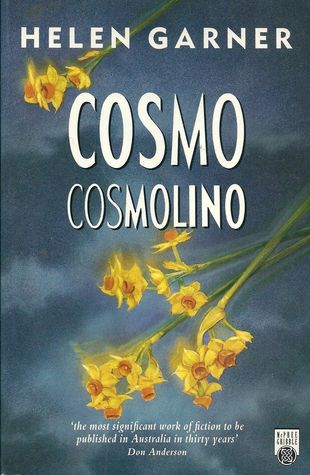
Consider Helen Garner’s Cosmo cosmolino

Helen Garner, Cosmo cosmolino

Commenting on my post on Helen Garner’s One day I’ll remember this, Bill (The Australian Legend) wrote that he’d hoped I’d mention Cosmo cosmolino (1992). It’s one of the novels Garner was writing during the period covered by these diaries, and Bill had struggled with it. I don’t blame him because, while I loved reading the novel, my own review written early in this blog is less than wonderful. Cosmo is a very different novel and I didn’t grapple at all well with its tricky themes.

Bill has, in fact, written twice about Cosmo cosmolino, his second drawing from Tegan Bennett Daylight’s essay in Reading like an Australian writer (edited by Belinda Castles). I have now read that essay too, so I am going to write a second post on Cosmo – too!

There are two main issues that are tricky with this novel, its form and its content. I’ll start with form, which derives from the fact that the book comprises three pieces/stories: “Recording angel”, “A vigil” and “Cosmo cosmolino”.

But, is it a novel?

I am forgiving (or, wishy-washy, if you prefer) when it comes to questions like this. I think form is and should be a loose thing, and that it should have room to move. Even Bill, who sometimes has strong views on things, said that “If an author, as Garner has done here, declares a collection of pieces to be a novel, then that is how I will read it. But these pieces don’t speak to each other at all. If this is a novel, then as far as I am concerned, it is a failed novel”.

So, Bill was happy, more or less, to accept it as a novel. I was certainly happy to do so because the first two pieces – “Recording angel” and “A vigil” – introduce two of the three main characters in the last story. They also introduce some of the ideas that she further develops, though I didn’t fully grasp them in my review. More on that later in this post. The point is that for me the pieces did speak to each other, albeit oddly, because, for example, the first piece is told first person in Janet’s voice, while the third is told third person with Janet as the protagonist.

Bennett Daylight discusses the form in her essay. She starts by suggesting that she would have broken down the last piece into smaller stories, and

seen the book as a whole as telling the central story through a kaleidoscope of scenes, points of view, small (and large) narratives. I’m thinking particularly of Alice Munro’s early short story collections … in which Munro builds a long narrative about her protagonists like you might a model train, adding stories like carriages until the narrative winds into the distance. The result, to my mind, can be more satisfying than the novel whose every scene is roped to a single central idea.

She then quotes Robert Dessaix who, while praising Garner as “one of our most gifted” writers, said that none of her fictional works were novels. They are “fine works of art and innovative explorations of literary approaches to nonfiction, every one of them an outstanding example of stylish reportage”. He then gets to one of the nubs, the pedestal on which novels are put. Garner writes in her diaries that she needs to free herself “from the hierarchy with the novel on top”. She needs “to devise a form that is flexible and open enough”, wants to “blow out realism while at the same time sinking deeply into what is most real”.

She also writes of “pointless struggles to work my stuff into the shape of a novel, and my determination to write only what it’s personally urgent for me to write” (p. 181). The two urges, it seems, fight each other. She says more but this gives you the gist. I love her engagement with form, though in one sense, it shouldn’t really matter – should it?

Meanwhile, Bennett Daylight is convinced that Cosmo cosmolino is a novel because “what makes a novel a novel is metaphor”, meaning that in a novel it’s “as though life looked in the mirror and saw, not just its reflection, but something behind it”.

“My strange experience”

What is this something? It’s certainly deeper than I was prepared to go in my review, because, to be honest, I was uncertain – and here is why. Bennett Daylight quotes an interview Garner had about the book with, in Garner’s words, “that hard-nosed leftie rationalist Craig McGregor”. In this interview, she was stupid enough “to blurt out my strange experience with the shadowy presence”. Afterwards, she panicked and asked him not to include that part, and while he reassured her he’d hardly mentioned it, this “mysterious visitor” is the backbone of his piece. The responses weren’t positive – “Garner’s got religion, etc”. It taught her, she told Bennett Daylight,

that in Australia you can’t write about experiences of ‘the numinous’ without opening yourself to sneering and cynical laughter. Back then, anyway.

This is the challenge I had with the book. What was the spiritual aspect about? I’ll flip to Bernadette Brennan’s book on Helen Garner, A writing life (my review). She says that the three interlinked stories all concern transformation, and are connected through recurring characters and the presence in each of various forms of angels:

The book’s structure mirrors that of a Christian pilgrimage: “Recording angel” confronts the physicality of a suffering body, “A vigil” enters the underworld to witness death head on, and “Cosmo Cosmolino” offers a sense of possible redemption, perhaps even resurrection. The structure can also be read as a meditation on the past, the present and the future.

Garner writes in her diaries that her main experience of religion is the Holy Spirit:

I don’t understand ‘God’ or even ‘Jesus’, but the Holy Spirit [the “shadowy presence”] has stood behind me on many different days, even though for a long time I was too frightened to acknowledge it or ‘call out to it’. It has visited me and comforted me and become part of me. (p. 160/161)

Bennett Daylight concludes her essay by talking about “the metaphor of belief” that underpins this novel:

Religion or belief is the attempt to impose order where there is none – and surely fiction is the same thing. In fact, from where I’m standing it’s exactly the same thing. I don’t believe in a god or gods, but I do believe in the power of fiction, the power of narrative, the power of metaphor to restore order. A great novel unsettles, then settles – it causes disorder, and then order. Order is restored in Cosmo cosmolino; the metaphor that effects this restoration is a metaphor of belief.

Let’s discuss this definition of “a great novel” another time, but it works here.

As for Garner, what does she say in the diaries? There’s quite a lot, but I’ll just choose these:

I want to write things that push down deeper roots into the archetypal. Things whose separate parts have multiple conections with their own structure. (p.140)

I got to the end of Cosmo. Where is this stuff coming from? The weird state I’m in. I have to apply my intellect but at the same time keep my instincts wide open. I need to hover between these levels. (p. 206)

and

I’m scared that with Cosmo I’ll come a cropper. (p. 217)

It would be 16 years before she wrote another novel.

For me, Cosmo cosmolino, now read so long ago, remains memorable. Janet and “Recording angel”, in particular, are still vivid. I’d willingly read it again.

Tegan Bennett Daylight
“A big sunny shack: Cosmo cosmolino by Helen Garner”
in Belinda Castles (ed), Reading like an Australian writer
Sydney: NewSouth, 2021
pp. 26-41
ISBN: 9781742236704

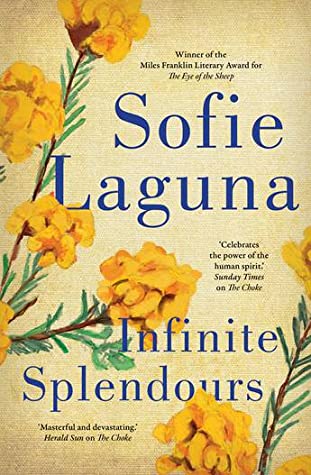
Sofie Laguna, Infinite splendours (#BookReview)

Those of you who know the subject matter of Sofie Laguna’s latest novel, Infinite splendours, will not be surprised to hear that it drew a mixed reaction from my reading group, particularly coming on the heels of recent reads like Nardi Simpson’s Song of the crocodile (my review) and Douglas Stuart’s Shuggie Bain (my review). However, if we all agreed on one thing, it was that Laguna’s writing is splendid.

Some of you though, particularly non-Australians, will not know what it’s about, so let’s get that out of the way first. The back cover blurb starts this way:

Lawrence Loman is a bright, caring, curious boy with a gift for painting. He lives at home with his mother and younger brother, and the future is laid out before him, full of promise. But when he is ten, an experience of betrayal takes it all away, and Lawrence is left to deal with the devastating aftermath.

It’s not a spoiler to say that this betrayal involves sexual abuse.

Infinite splendours, like Laguna’s previous book, The choke (my review), is set in the rural past. In this case, we are in the Grampians, west of Melbourne, and the novel starts in 1953 when Lawrence is 10. As with The choke, my question is, why set the story in the past? And my answer – though I don’t know Laguna’s – is the same: it’s set at a time when awareness of abuse and the resultant trauma were essentially non-existent. This enables Laguna to explore her theme unencumbered.

The novel is told chronologically in three parts. The first ends with the abuse, and the second takes Lawrence through to another crisis in his late twenties, with the third picking him up, a couple of decades later, in 1994. By this time, Lawrence is living alone in the isolated family home. The novel is told first person, so we spend the whole time in Lawrence’s head, seeing only his perspective. It’s intense and introspective, but not unleavened. There are moments of calm and beauty.

One part engaged, another observing. Two selves. (p. 411)

Still, it’s a tough story, as we watch this lovely, sensitive boy, whom we’ve come to love, decline. He stutters. He gives up his interests, including the art in which he’d shown such talent, and he keeps to himself. His body is a source of mental and physical anguish. From the moment of the abuse, he’s a divided person:

I felt myself dividing; there were two selves to choose from. One inside, one outside. (p. 152/153)

There are moments when he may have been helped. Soon after the abuse, his younger brother Paul asks “what did he do to you Lawrence” – but Lawrence won’t confide. At the beginning of part 2, the family’s kind neighbour, Mrs Barry, tells his mother that he reminds her of the “men back from the war”, but of course PTSD was not properly recognised nor treated back then.

After his mother dies when he is 26 years old, his brother leaves home, and a crisis occurs at his workplace. At this point, Lawrence’s self-isolation is complete. He does, however, have points of solace. His beloved mountain Wallis, a fictional mountain in the Grampians which features in the story from the beginning, provides moments of peace, hope and transcendence; a bunker on the property, in which he hides in a game of hide-and-seek at the novel’s opening, is a place he goes to for safety; and his art, to which he returns after leaving his job, provides occupation and self-expression:

This was the world for me; there was Wallis above and the bunker below, and here was I, between them with my tray of colours. (p. 267)

Lawrence also has an art book, Letters from the masters, that his uncle had given him during his “grooming”. This book becomes his “bible” – for art and life – and he returns to it again and again. He studies the paintings, and he ponders the artists’ words. Indeed, the novel’s title comes from Master Millet who wrote “I see far more in the countryside than charm, I see infinite splendours”. And so does Lawrence, particularly in his beloved Wallis. It is while standing on Wallis, before the events unfold, that he has his first intimations of “something else, greater, that was infinite–the earth’s invisible self. Wallis whispered, See this“.

It is in this context that Lawrence’s art becomes his life’s work. He describes one of his landscapes as “like a living thing … a soul contained within an object”, and sees his paintings as his family. He is as settled as he can be. But, change is inevitable, and the time comes when Mrs Barry’s long-empty house across the yard is occupied again. It discombobulates Lawrence:

I painted into the sun, layers of yellow into yellow. Immersion in light. Sun across my knees, sun in the sky, sun on my canvas. Could I not keep going, contained forever within this one emerging world of light? Must I inhabit another?

It seemed I must … Everything changes.

The new occupants are a single-parent family like his own had been, this one, though, with a mother, teen daughter, and, yes, a 10-year-old boy. The tension builds as we readers watch and desperately hope that Lawrence will not repeat history, that he will get his two selves back in sync in the best way.

I said at the beginning that my reading group praised Laguna’s writing. Her descriptions of the landscape are exquisite and her delineation of character, even minor ones, is so very good. Her warmth and empathy are palpable. I also love her ability to change pace and rhythm to evoke different emotions. However, several of us did feel it became repetitive. Further, although I was fully engaged in Lawrence’s story, and was never going to give up on him or the book, there were times that I felt overwhelmed with the multitude of motifs. As well as those I’ve mentioned, like Wallis and the bunker, there’s Robinson Crusoe, Madame Butterfly, a strawman/scarecrow, birds and the bird clock, rocking and a rocking chair, colours, and more. While none of these were gratuitous, they did sometimes become distracting, as I tried to identify whether they were adding anything critical to what I already knew and felt.

As I read this novel, with a frequent sense of foreboding, I was buoyed by my memory of Laguna’s statement that hope is important. Without giving anything away, let’s just say that, here, the hope felt a bit thin, albeit there is a real transcendence in the ending. For that I was truly grateful.

As for my reading group? Well, there’s been a request for books with a lighter touch next year, which is fine by me, as long as they have meat too!

Challenge logo

Sofie Laguna
Infinite splendours
Sydney: Allen & Unwin, 2020
435pp.
ISBN: 9781760876272

Winner of the 2021 Colin Roderick Award

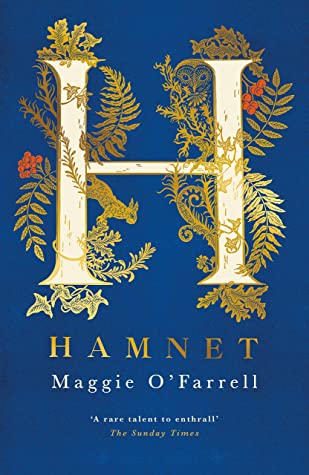
Maggie O’Farrell, Hamnet (#BookReview)

Book cover

Not unusually, I’m late to this book that was all the talk in 2020 – and, I may not have read it at all if it hadn’t been for my reading group. I’m talking, as you will have guessed from the post title, of Maggie O’Farrell’s Hamnet.

As most of you will know, Hamnet’s plot draws from the life of Shakespeare (never named in the novel) and Anne Hathaway, and the death of their son Hamnet at the age of 11. There was an older sister, Susanna, and Hamnet’s twin sister, Judith. O’Farrell explains her interest in her Author’s Note:

Lastly, it is not known why Hamnet Shakespeare died: his burial is listed but not the cause of his death. The Black Death or ‘pestilence’, as it would have been known in the late sixteenth century, is not mentioned once by Shakespeare, in any of his plays or poetry. I have always wondered about this absence and its possible significance; this novel is the result of my idle speculation.

Because this book has been well-covered already online, I’m going to take a slightly different tack with this post, and focus on a couple of questions.

“She herself might tell a different story”

With all books, but particularly with historical fiction, one of my questions is, why did the author choose to write their story. O’Farrell partly answers it in her Author’s note. However, there is also, surely, a feminist reading, because, although the novel is titled Hamnet, it is primarily about his mother Agnes (as Anne is named in Shakespeare’s will). Early in the novel, O’Farrell writes “This is the story, the myth of Agnes’s childhood. She herself might tell a different story”.

The thing is, we don’t know a lot about Agnes Hathaway which makes her ripe for historical fiction. What we do know is that women’s stories were – and too often still are – rarely told, but that that doesn’t mean their lives were unimportant. It means that importance hasn’t been placed on them. Whoever Agnes really was, O’Farrell has created a wonderful, eccentric character, who is perceptive, warm, independently-minded, a little flawed but engaged in the life of her family and community. She is fun to read about.

Besides telling a story about her, though, O’Farrell also presents, through her, a story about grief, and this, for me, was one of the strongest aspects of the novel. Agnes’ thoughts about burying her son, her astonishment that people can complain about their children, her utter discombobulation were so real:

Agnes is not the person she used to be. She is utterly changed. She can recall being someone who felt sure of life and what it would hold for her …

This person is now lost to her for ever. She is someone adrift in her life, who doesn’t recognise it. She is unmoored, at a loss. … Small things undo her. Nothing is certain any more.

So real …

Hamlet?

Warning: Spoiler of sorts

Given the novel is titled for Hamnet, rather than for its main protagonist, Agnes, it’s worth considering why, and this leads us to the play Hamlet. The novel ends with Agnes attending a performance of her husband’s play, which confirms the significance of this play to the novel. The epigraph to the novel’s second part is a quote from Hamlet (V:ii): “Thou livest;/ . . . draw thy breath in pain,/ To tell my story”. But, Hamlet could scarcely be seen to be Hamnet’s story, though I did have a little laugh at the point in the novel where Hamnet chooses to die:

They cannot both live: he sees this and she sees this. There is not enough life, enough air, enough blood for both of them. Perhaps there never was. And if either of them is to live, it must be her. He wills it. He grips the sheet, tight, in both hands. He, Hamnet, decrees it. It shall be.

Eleven-year-old Hamnet seems, here, to be far more decisive than his namesake who is known for his prevarication. This, however, is not what we are expected to take away from the novel I’m sure!

So, what else? Well, there’s the grief theme, which Hamlet can be seen to “resolve” in the novel. Agnes, devastated after her son’s death, can’t understand her husband returning to work – and writing comedies:

His company are having a great success with a new comedy. They took it to the Palace and the word was that the Queen was much diverted by it.

There is a silence. Judith looks from her mother, to her sister, to the letter. 

A comedy? her mother asks.

She is even more devastated though to learn that her husband has gone on to write a play using their son’s name – Hamnet and Hamlet being interchangeable – so she goes to London to confront him. What happens is something else. Initially, she feels eviscerated:

How could he thieve this name, then strip and flense it of all it embodies, discarding the very life it once contained? 

But then, as she sees the ghost father and living son, she starts to see something else:

He has, Agnes sees, done what any father would wish to do, to exchange his child’s suffering for his own, to take his place, to offer himself up in his child’s stead so that the boy might live.

My reading group discussed the question of the play a little, though we didn’t come to any particular conclusion, which I rather like. However, we did talk about how Shakespeare wrote his darkest, strongest plays, including the four great tragedies, after Hamnet’s death, which suggests that his son’s death had a big impact on him. A member also raised the play’s existential nature, seeing it exploring the fragility of life – “to be or not to be” – and how you go on in the face of bleakness.

Now, I could go on and talk about the style (language, use of present tense, symbolism), the decision not to name Shakespeare, and the dual storyline structure, as I normally would, but I’m sure they’ve been discussed elsewhere, so I’m leaving it this time. There were aspects of the novel that I question, but the truth is that I fell for Agnes and her story.

So, I’m going to leave you with two quotes, one from the husband, one from the wife.

It is so tenuous, so fragile, the life of the playhouses. He often thinks that, more than anything, it is like the embroidery on his father’s gloves: only the beautiful shows, only the smallest part, while underneath is a cross-hatching of labour and skill and frustration and sweat. 

Gardens don’t stand still: they are always in flux. 

These relate to their spheres of activity, but they also say something about life, don’t you think?

Maggie O’Farrell
Hamnet
London: Tinder Press, 2020
310pp.
eISBN: 9781472223814

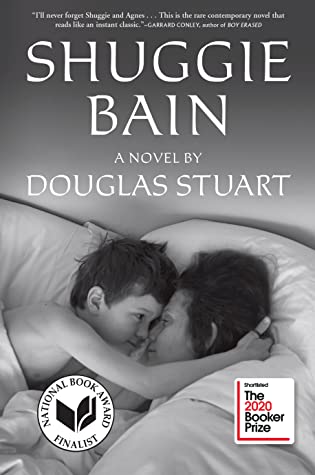
Douglas Stuart, Shuggie Bain (#BookReview)

How to write about a book that has made such a big splash that it has already been extensively reviewed. What more can one say? This is what I’m facing with Douglas Stuart’s debut and Booker Prize-winning novel, Shuggie Bain.

I haven’t, in fact, read much about it, because I prefer to come to books fresh, but I have heard an interview with Stuart, and I can imagine what has been written about his book. I have also discussed it with my reading group. All I can do is just launch in, and write what I would normally write, but I fear it won’t add anything fresh to the discussion. It will, however, record, for me, my thoughts and feelings.

The story

For those of you who haven’t yet read Shuggie Bain, it tells the story of its eponymous protagonist growing up in public housing in 1980s industrial Glasgow. This was the time of Thatcher, a time when mines, shipyards, railyards closed, resulting in significant unemployment and the usual fallout when men can’t work and women and children end up on welfare:

Whole housing estates of young men who were promised the working trades of their fathers had no future now. Men were losing their very masculinity.

This is important, but it is also just the backdrop for the personal story of Shuggie and his mother Agnes. There are other characters, but these two are the book’s core.

The story starts in 1992 with Shuggie, nearly 16, living on his own in a boarding house in Southside Glasgow. He is clearly pitied by the people around him, so the question for us is why is he there alone, how did he get there? We then go back to 1981, where we meet Shuggie’s family, thirty-nine-year-old Agnes, her second husband Shug, and Shuggie’s two older siblings, Catherine and Leek, who were born to Agnes’ first husband. It is not a happy situation. They are all living in a flat with Agnes’ parents, Wullie and Lizzie, and Agnes feels a failure.

When Shug does take his family away, it’s a cruel action, and Agnes and her three children soon find themselves alone, living on welfare payments in the desolate Pithead – a housing scheme which had “the plainest, unhappiest-looking homes Agnes had ever seen”. She knew Shug was “a selfish animal”, but she wasn’t expecting this. From here, their lives are a struggle, though Agnes – now drinking heavily – tries her darnedest to maintain appearances amongst women who reject her and her airs.

The characters

Agnes’ airs! Stuart has an impressive ability to create vivid, real characters. Even the villains of the piece – like Shug – are recognisable as people beyond the “type”, in his case a macho, violent, womaniser, they represent. This is no mean feat. However, it’s Agnes, Shuggie and, to a degree, Leek, who are our focus.

Agnes is a woman with aspirations. She’s resourceful, when sober, and wants more than the life she’s been dealt. But, she is unable to find a way out, largely because, for women of her time and place, it seems that a man is the answer. Her first husband Brendan tries to buy her happiness, but he’s boring. Then the flashy Shug comes along. For all his failings, and they abound, he too tries to buy her happiness, but tires of all her “wanting”.

Unfortunately, one of the things Agnes wants is “to take a good drink”. Her drinking, which was already evident when they lived at her “mammy’s”, becomes a serious problem at Pithead. Life, for her children, becomes insufferable. Catherine skedaddles into an early marriage as soon as she can, while the sensitive, artistic Leek withdraws into himself, leaving the young Shuggie to be the main watcher over his mother. And this is where this novel’s credentials as autofiction come into play, because the evocation of the child-addict parent relationship reads so authentically. We can’t help admiring Agnes’ gallus, while also despairing for her and her children.

So, it’s a heartbreaking story. Not only does Shuggie struggle with his addicted mother – loving her, caring for her in ways that a child should never have to – but he must cope with his own outsiderness that he doesn’t understand. From a very young age his way of talking, dressing and walking, not to mention his disinterest in typical boy things, are ridiculed. He’s called names, beaten up, ostracised, and he doesn’t know why. At 10 years old, aware he’s “no right”, he asks his mother, “What’s wrong with me, Mammy?” If she knows, she doesn’t tell him, but a few years later, he realises that Leek, who had tried to teach him to toughen up, had known all along.

Leek is the support act, figuratively and literally, to Shuggie and his mother. He quietly provides support in the background, even after he eventually leaves home. He’s resentful of the impact on his own ambitions to become an artist, but he sticks around, taking labouring work, because he is needed. In many ways, he’s the hero of the novel, and my heart went out to him as much as to Shuggie. This, I think, says it all:

he looked like a half-shut penknife, a thing that should be sharp and useful, that was instead closed and waiting and rusting.

The writing

It also gives you a flavour of the book’s expressive writing. One of the first things you might notice is that Stuart loves a simile. The book is full of them, but they are so good, like

“The auld man’s face crumpled like a dropped towel.”

and

“The unwelcome presence of a man was like a school bell.”

and so many of Agnes, such this when Shug leaves her

“Agnes, sparkling and fluffy, was lying like a party dress that had been dropped on the floor”.

The book is also well structured, opening in 1992, which immediately tells us that whatever happens Shuggie is going to survive, and ending back in 1992, this time on a note of hope, albeit a tentative one.

Stuart uses vernacular extensively, resulting in much unfamiliar-to-me vocabulary – boak, hauch, gallus, to name a few – but they are understandable from the context, and essential to setting the scene. The novel is not at all hard to read. Indeed it’s beautiful – and easier to understand than some spoken Scottish can be!

Moreover, for all its bleakness, the novel has a good smattering of humour. Here’s Shuggie defending his mother, drunk and over-dressed, marching into the hospital to see her dying father,

Shuggie heard the nurse say to a male attendant that she thought for sure Agnes was a working girl.

“She is not,” said Shuggie, quite proudly. “My mother has never worked a day in her life. She’s far too good-looking for that.” 

What it all means

The novel is, as I’ve said, autobiographical, but that doesn’t mean that Stuart simply sat down and wrote his life. Shuggie Bain reads as a considered piece of fiction that has some things to tell – about dashed dreams, the powerlessness of women in a male-dominated world, poverty, addiction and outsiderness. It’s both political and personal about what happens to lives when the ground beneath is taken away. And yet, for all that, it’s also about love – child-to-mother, brother-to-brother, friend-to-friend – that survives in places you barely expect it to. No-one in my reading group was sorry we scheduled it.

Douglas Stuart
Shuggie Bain
London: Picador, 2020 (2021 eBook)
355pp.
ISBN: 9781529019308

Sara Dowse, West Block (#BookReview)

The decision to republish, last year, Sara Dowse’s pioneering 1983 novel, West Block, was prescient. Think about this. In last weekend’s The Saturday Paper (14 August 2021), journalist Karen Middleton wrote about an issue involving the Department of Prime Minister and Cabinet. In her article, she shares some comments made about this Department by law professor Anne Twomey. Twomey, Middleton writes, called

the department “disorganised, shambolic and disrespectful of the legal process”.

“In days gone by, the department was full of extremely competent people – the traditional mandarins,” she says. “Look what’s coming out of it now.”

Now, this is the Department Sara Dowse worked in during the 1970s. It was housed in a wonderful old Canberra building called West Block, and it’s this building, and Dowse’s work there, which inspired her eponymous novel. I read it back in the 1980s, and loved it, but have always wanted to read it again. How would it stack up – as a novel, and as a document about Canberra and the public service – decades later? Having now reread it, I think it stacks up very well, and clearly so did For Pity Sake Publishing.

This new edition is prefaced by an Author’s Note, in which Dowse provides a background to the novel, including her career trajectory which inspired it. Dowse headed up the Whitlam government’s new Women’s Affairs Section, from 1974 to 1977. Dowse resigned partly in protest at the section’s removal from the Department by the Fraser Government, but partly also because what she really wanted to do was write.

But, what to write about? She was American-born, living in Australia at a time when Australian women’s writing was flowering – with Australian stories. Although she’d been in Australia since 1958, it was her experience working in West Block, that gave her such a story:

The building itself galvanised me. The minute I walked into it, I wanted to write its story, but now that I was in a position to, I was up against the prejudice against Canberra, most particularly, Canberra’s public service.

As a Canberran and a public servant myself – albeit a librarian/archivist rather than a bureaucrat – I know whereof she speaks.

‘Nuff said, so I’ll return to my opening description of the novel as “pioneering”. Some of you may have wondered about that call. First, few novels had been set, to then anyhow, in Canberra. There’d been some, like M. Barnard Eldershaw’s Plaque with laurel, but not many. That has changed, since, due partly in fact to Canberra’s group of Seven Writers, of which Dowse was a member. Second, not many novels had been written about the workings of the public service, particularly Australia’s. And finally, Dowse’s writing, particularly the structure she used for her novel, was innovative. Dowse said in the book’s zoom launch I attended last year, that one of her inspirations was John Dos Passos, and how he can tell a big story through overlapping individual stories.

All this makes West Block an excellent and meaningful read, not just for Canberrans, but for Australians and readers of thoughtful novels anywhere.

Servants of a nation (Harland)

With that long preamble, let’s now get to the book. Set in 1977, it tells the intersecting stories of five public servants: conservative, “sober-faced” bureaucrat George Harland; passionate, progressive Henry Beeker; socially conscious, dedicated but lonely Catherine Duffy; young, up and coming economist Jonathan Roe; and the femocrat, Women’s Equality Branch head, Cassie Armstrong, whose story bookends the novel, making her its main and unifying character. While each character’s story occupies a separate chapter, giving each centre stage in turn, they do occasionally appear in each other’s stories, and they all work in West Block to Departmental head, Deasey.

Through these characters we see the workings of government, and here, as a plus, we also gain insight into the issues of the time which, besides women’s affairs, included Australia’s uranium policy and Vietnam. Dowse uses these big issues to show what happens behind the scenes – trips overseas to negotiate with other governments, the IDCs (interdepartmental committees) and argy-bargying between departments as public servants try to find compromise between their various political masters, relationships between politicians and bureaucrats. Underpinning these is the daily life of public servants as they navigate the ethics of public service and their career ambitions alongside their jobs. We see tensions between different perspectives and approaches – the sober conservatives like Harland versus the crusading progressives like Beeker – of service. Dowse gives both their due.

This sounds dry, but it’s not because Dowse infuses her story with humanity. Her characters are not just public servants, but human beings with lives, and feelings. At the launch I attended, interviewer Seminara said she loved the characters for their commitment to public interest and because they are “admirable as characters, flawed as people.” Harland struggles to understand his daughter who has left her husband and children; Catherine confronts the ethics of personal relationships that intrude into work life; and Jonathan reacts poorly to his girlfriend’s unplanned pregnancy, for example.

Cassie, the main character, is not Dowse but is clearly inspired by her. The angst is palpable as she and her staff struggle to get their voices heard and women’s agenda on the table. There is a telling scene with Deasey that says it all. She presents him with her Branch’s thorough report into women’s needs cross-government. He’s not impressed:

‘Seriously now. We’ve had enough of your fingers poking in every pie. Causes no end of trouble. I can’t allow it, do you hear? It’s no way to run a department. So, be a reasonable girl. Pick out one, two, maybe three things to concentrate on.’ He stopped for breath. ‘Discrimination legislation, for instance.

“Girl” eh! Would he have said to Harland, “be a sensible boy”? I reckon not.

There are two more crucial characters in this novel, Canberra and West Block. They breathe life into and enrich the read immensely, but this is getting long, so watch for a Delicious Descriptions in a couple of days

While West Block’s style and structure is not as unusual as it was in the 1980s, it will likely still challenge those who like straightforward chronological narratives with deeply interacting characters. For me, though, there is a overarching narrative arc concerning Cassie’s devastated realisation that she is not going to effect the change for women she’d envisaged – and I enjoyed every beautifully-delineated character.

Ultimately, West Block pays tribute to the public servants who understand that their role is to be “servants of a nation” not of their political masters. This is the role of the public service, no matter how much its political masters would like to make it otherwise. Unfortunately, this fundamental principle has been increasingly tarnished over recent decades, which makes re-publication of this novel, now, all the more relevant and, dare I say, necessary.

Challenge logo

Sara Dowse
West Block
Book designer: Barbie Robinson
For Pity Sake Publishing, 2020 (New Edition, Orig. ed. 1983)
348pp.
ISBN: 9780648565789

Review copy courtesy For Pity Sake Publishing and the author

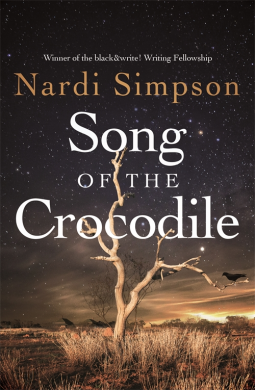
Nardi Simpson, Song of the crocodile (#BookReview)

Nardi Simpson’s Song of the crocodile is a tight multi-generational saga set in the fictional town of Darnmoor over the last decades of the twentieth century. It tells the story of the people of the Campgrounds, who are ostracised, exploited and abused by the white townspeople. Between the Campgrounds and the town proper, with its ironically named Grace and Hope Streets, is the tip, which was created by knocking down “strangely scratched gums” on the old bora grounds. The road to the tip, and on to the Campgrounds, is Old Black Road. The stage is set …

“trespassers on their own country”

The story is told in three parts which span three generations of the Billymil family – Celie, her daughter Mili, and Mili’s eldest son Paddy. Celie’s part starts, however, with her mother, Margaret. Margaret not only runs the town hospital’s laundry, but also undertakes the major load of nursing the hospital’s First Nations patients. They are housed on “the back verandah” and are mostly ignored by the hospital’s medical staff. In this way, very early in the novel, we get the picture loud and clear about how the town’s Indigenous people are treated. The racism, the omniscient narrator tells us, is “hidden yet glaring. It’s the Darnmoor way”.

But there is a parallel story going on here, too, that of the spirits and ancestors, the “knowledge keepers”, who reside among the stars. They “wait for their loved ones to arrive” but they also introduce an important idea underlying this story – the “connectedness” of “all living or once lived things”. This connection is symbolised in the novel by threads and ropes that join sky and earth through birds and trees to the roots underground. I loved that Simpson shared this, that she trusted her readers to respect a worldview that’s foreign to many of us.

Intrinsic to this connectedness, of course, is the land. Some of the book’s most lyrical writing comes from descriptions of the country – rivers, trees, birds – in which it is set. This country is the freshwater plains of northwest New South Wales, the traditional lands of Simpson’s Yuwaalaraay heritage. In her novel its main feature is the Mangamanga River, “known by some as the wide-bodied, liquid boss of the plains.” It is to this river that Mili and/or members of her family go to refresh their spirits, but the men of Darnmoor want to control it, and protect themselves, by building a levee between the town and the Campgrounds.

Essentially, then, Song of the crocodile is the story of people who are made to feel “trespassers in their own land”. But, it’s also the story of strong, resilient women who forge a community on the Campgrounds. With guts and confidence, Celie turns her mother’s laundry skills into a business called the Blue Shed, providing work for herself and the other women. These women are a joy to read about, but they and their families are barely tolerated by the town, which ensures they know their place. When Mili’s bright young friend Trilpa wins a mathematics prize she is disqualified on trumped-up grounds, and when Mili, herself, applies for permission – permission, would you believe – to continue school past the age of 15, she too is brought down, by Mayor Mick Murphy, in the worst way.

“threads of broken lore”

Needless to say, it’s a difficult story. Too many people, people we’ve come to love, “pass” too young. As the oppression of those left behind builds, creating “hopelessness and grief”, the beast – Garriya, our titular crocodile – starts to stir. Regular hints of his rumbling imbue the novel with a sense of foreboding.

The crocodile is apparently a creator being in Yuwaalaraay country, but his evocation in this novel, as Garriya, is unleashed by the evil that has been visited upon the Campground people, evil that has broken the country’s lore. We feel him coming, and Mili’s alienated son Paddy is the conduit. Desperate to counteract this, spirit songman Jakybird wants to reconnect the “threads of broken lore”. He prepares his spirit “choir” for one last, powerful song, Garriya’s cycle. The climax is shocking, but the ending is cheekily open.

All this sounds grim, but I didn’t find it hopeless. There is delightful warmth and humour in the interactions between the Campground women, and there is humour and hope in the spirit world. Through these, Simpson gives us a complex story of oppression and survival. For all the misery suffered by the Billymils and their community, there is hope in their resilience, in their ongoing connection to country, and in their determination to keep passing on culture. Early in the novel, laundry worker Joyce addresses the parcels for delivery, using drawings that convey “a belonging, a knowledge, a truth of the place on which they walked and worked”:

In most cases the recipients failed to notice the mark, tearing the paper off and crushing it into a ball. It didn’t matter that eventually it was taken to the tip and returned to the earth. What mattered were the boys on the bikes that delivered them, that read the symbols then read the land. The drawings and the washing restored old journeys, countrymen walking on places they knew.

Simpson also, as First Nations writers are increasingly doing, uses Yuwaalaraay language throughout. She doesn’t directly translate it and there is no glossary. This bothered some of my reading group, while others of us felt the meaning was always clear – or clear enough. Here, for example, is Margaret in Chapter 1:

“Yaama. Dhii ngaya gaagilanha. Who wants a cuppa?” Margaret pushed open the door to the hospital’s back verandah, its hingers squealing as she entered. “How are we all today?”

Song of the crocodile was my reading group’s July book, and it resulted in one of our liveliest discussions this year, as we defended our diverse responses to its ideas, style, characters and tone.

For me it was an absorbing read. It is uncompromising in its portrayal of the insidious racism that First Nations Australians confront and the devastating impact of that on the spirit, but it also shows resilience in the face of that, and it affirms that culture is strong. That has to be a positive thing?

For Lisa’s and other blog reviews, check her ILW Fiction Reading List.

Challenge logo

Nardi Simpson
Song of the crocodile
Sydney: Hachette Australia, 2020
401pp.
ISBN: 9780733643743