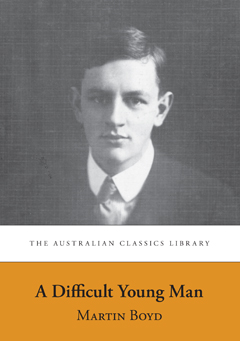
Martin Boyd, A difficult young man

Martin Boyd's A difficult young man
Difficult but handsome (Courtesy: Sydney University Press)

I’m not sure what I was expecting, but I certainly wasn’t expecting the delightful sly wit I found in Martin Boyd’s A difficult young man, which, I understand, is the second book in the “Langton Quartet”. This novel though can clearly stand on its own – otherwise, why would Sydney University Press publish it alone as part of its Australian Classics Library? Is it the best written of the four? The most readable? The one most commonly studied (which goes back to the original question anyhow)? Or was it simple a case of eeny-meeny-miny-moe? (Even “eeny meeny miny moe” has a Wikipedia article – how great is that?) Whatever  the reason, my appetite has been whetted, and the first book, A cardboard crown, will now be promoted in my TBR pile.

Anyhow, back to the serious stuff. I know it was written in a completely different place and oh, nearly a sesquicentenary later, but there’s more than a whisper of Jane Austen about Boyd’s book. Superficially, this book and Austen’s works are very different: this is not a romance – but then neither is that Jane Austen’s focus either; its main characters are male rather than female; it has an autobiographical thread which none of Austen’s novels do; and it uses first person rather than Austen’s omniscient third person narrator. The similarities are, rather, in language (their wit and irony) and form (both write what can be described as social satire). I may be the first person to have put these two authors in the same sentence, but, well, that’s the fun of being a blogger: you can say it as you see it! And what I see is that both writers make me chuckle with their observations on human nature.

So what is the plot? The story is narrated by Guy Langton (a veiled Martin), who is the fourth son of Steven and Laura Langton. He focuses on the late adolescence-early adulthood of the eldest living son, Dominic (inspired by – but not – Merric), the “difficult young man” of the title, who, as the story progresses, manages to fail in, or otherwise mess up, pretty well everything he does. Through the course of the book the family moves from Australia (Melbourne and environs) to the family seat in England and back to Australia again. The book chronicles a number of domestic crises, at the root of which is usually Dominic who somehow undermines “the various attempts to fit him into some place in the world”.  In many ways though, the book is just as much about Guy who, through the process of narration, works to find a balance between “the unaltered impression” of “my childish mind” and “the glaze of adult knowledge”. This is a clever book which reads like, but is not, an autobiography.

It’s an engaging story – not so much for its rather episodic plot as for its array of wonderful and mostly eccentric characters, from the social-climbing arriviste Aunt Baba (who thinks anyone who does “a kindness from which they received no benefit” is silly) to the gentle, wise but somewhat ingenuous father, Steven. My favourite aspect of the book though is its style. I usually enjoy self-conscious narrators, and Guy is definitely that. He regularly addresses the reader directly, reminding us that he can use “the mask of a character in the story” and advising us of which “glaze” he is applying at the time. In this way he lets us know which parts might be more suspect than others in terms of the “facts”, which he recognises as being different from the “truth”:

..but the reader must take certain wild statements as intended for fun, though they contain an element of truth too subtle to be confined within the limits of accurate definition. One can make exact statements of fact, but not of truth, which is why the scientist is forever inferior to the artist.

And this brings us to another concern of the novel – the importance of the imagination. In many ways the book is a hymn to the creative life, a statement of the Boyds’ belief that a life lived without imagination is probably a life not worth living. It also makes a plea for humane values, for peace not war, for gentle not brutal discipline of children, for education that is not conformist. The book is set in the years leading up to World War 1 and the point is made that life before the war – the “secure civilisation” – was to change irrevocably after.

In addition to irony, Boyd uses a wide range of literary techniques rather effectively, such as foreshadowing (which teases us while at the same time directing our understanding), analogies, contradiction, and allusions (particularly to art and literature). All of these imbue the book with a reflectiveness that undermines a focus on plot.

There are so many strands to this novel – its style, diverse subject matter, and characterisation – that would be fun to explore, but that would leave nothing for the rest of you to talk about, so I will finish with a statement made by the narrator towards the end of the novel:

This is really what I am seeking for throughout this novel, the Memlinc in the cellar, the beautiful portrait of the human face, lost in the dissolution of our family and our religion.

I am doubtless romanticising the Bynghams [maternal ancestors], but there is an element of truth in what I write, which is all I ever claim. Also everyone romanticises what interests him.

As he does so often in the novel, he says one thing here and then undermines it immediately after. But it works, and it works because life is messy and contradictory and yet out of this mess and contradiction comes a vision of something that is real and enduring – and that is the transcendence of family, and the importance of imagination.

Martin Boyd
A difficult young man
Sydney: Sydney University Press, 2009 (orig. pub. 1955)
223pp.
ISBN: 9781920898960

(Review copy supplied by Sydney University Press. This is the last of 12 books that my friend Lisa (aka ANZLitLovers) and I received to review. We believe more will be published in this series: if these 12 are anything to go by we are in for a real treat – and the cause of Australian literature can only profit from that.)

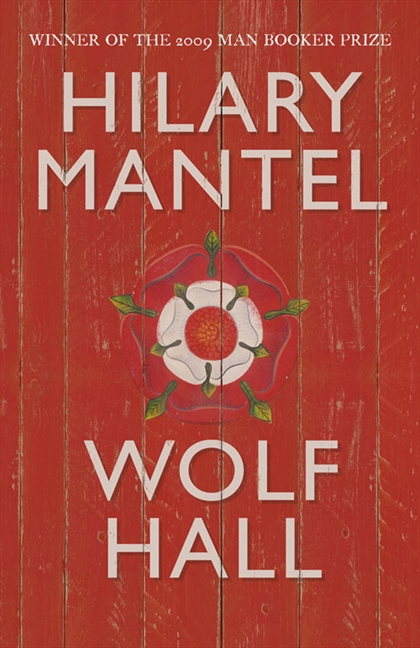
Hilary Mantel, Wolf Hall

An interesting question to ponder when thinking about Hilary Mantel’s Wolf Hall is the significance of the title. While the place Wolf Hall, the family seat of the Seymour family, does get a few mentions it does not really function as a location. Wolves, however, are one of the subtle motifs running through the novel. As its protagonist remembers late in the book:

…homo homini lupus, man is wolf to man.

Hilary Mantel, Wolf Hall

Cover image (Courtesy HarperCollins Publishers)

And, after reading the novel, it would be hard to refute this notion! Wolf Hall is set in England between 1500 and 1535, with most of the action taking place between 1527 and 1535. It deals primarily with the lead up to and first years of Henry VIII’s marriage to Anne Boleyn, but as seen through the eyes of Thomas Cromwell. Its plot centres on the machinations involved in dissolving Henry’s marriage to Katherine (Catherine) of Aragon, who had failed to produce a male heir, so he could legally marry Anne Boleyn; its real subject matter, though, is far wider than that. Its time period – the early years of the English Reformation – and its plot mean that it deals with the major issues of the time, including England’s separation from Rome, the translation of the Bible into English and the relaxing of rules regarding access to the Bible, the Act of Supremacy, and succession to the throne. Running through this are the jostlings for power, the skullduggery, and the betrayals (and suprising acts of loyalty) that are the hallmarks of the Tudor Court. Man was indeed wolf to man then (and I sometimes wonder how much has changed?).

This is an exquisite – though large! – novel. It won the 2009 Booker Prize: I can’t compare it with the others because I haven’t read them, but I did enjoy this immensely. In my recent review of The enchantress of Florence – and what fascinating synchronicity to read these two in sequence – I said that the one word I would use to describe it was “paradoxical”. The word I would use for Wolf Hall is “subtle”. It is subtle in so many ways – in its narrative style, its humour, its irony, its symbolism, its descriptions, its juxtapositions. Nothing here is heavy-handed or overdone.

But first, its narrative style. I was forewarned about Mantel’s use of “he” in this novel and perhaps this helped, because I rarely found it difficult or confusing. In fact, I rather liked the style. It’s a bit like a first-person novel told in third person – third person subjective (limited) point of view, I guess – and so the use of “he” reminds us that it is HIS perspective we are getting. Everything we know we know through him, through his thoughts and through his interactions with others. I found this approach intriguing – it gave immediacy and distance at the same time. And this brings me to the man himself.

Thomas Cromwell, for those who don’t know their English history, rose from very humble beginnings to being Henry’s trusted chief minister. He did this by dint of his character and the timely beneficial patronage of Cardinal Wolsey. He became street-smart in his youth but he also educated himself in the culture (literature and art) of the times. He could speak Latin, Italian and French. He was an accountant and lawyer.  He knew about trade. He was no slouch in the kitchen either. He was, indeed, a jack-of-all-trades. Here is a description early in the book (1527):

Thomas Cromwell is now a little over forty years old. He is a man of strong build, not tall. Various expressions are available to his face, and one is readable: an expression of stifled amusement … It is said he knows by heart the entire New Testamant in Latin … He is at home in courtroom or waterfront, bishop’s palace or inn yard. He can draft a contract, train a falcom, draw a map, stop a street fight, furnish a house and fix a jury…

A man, that is, not to be trifled with – and yet he is a man who develops a large and loving household full of loyal children, relatives and “wards”. Some of the loveliest sections of the book are set in his home, Austin Friars. He is also loyal – sticking by Wolsey, for example, in his decline – and firm, hard even, but not cruel.

However, I don’t want this review to be as long as the book and so shall move on. I loved Mantel’s descriptions – they are always short but highly evocative. Here is the Duke of Norfolk:

The duke is now approaching sixty years old but concedes nothing to the calendar. Flint-faced and keen-eyed, he is lean as a gnawed bone and cold as an axe-head;  his joints seem knitted together of supple chain links, and indeed he rattles a little as he moves, for his clothes conceal relics…

And here is another telling description (after charges against Wolsey have been written):

It is a wan morning, low unbroken cloud; the light filtering sparely through the glass, is the colour of tarnished pewter. How brightly coloured the king is, like the king in a new pack of cards: how small his flat blue eye.

Delicious aren’t they?

The novel ends at an intriguing point – but I won’t give that away here except to say that it does not conclude with the end of Cromwell’s life. That, we believe, is the subject of a sequel.

I would love to keep writing about the characters, the language, the way Mantel puts it all together – such as the way she drops hints then explores them later – but that could become boring. Better for you to read the book (if you haven’t already). Instead, I will end with what is probably the book’s overarching theme – that of “how the world works”, and that is through machinations behind the scenes:

The fate of peoples is made like this, two men in small rooms. Forget the coronations, the conclaves of cardinals, the pomp and processions. This is how the world changes: a counter pushed across a table, a pen stroke that alters the force of a phrase, a woman’s sigh as she passes and leaves on the air a trail of orange flower or rosewater…

It was ever thus, eh?

Hilary Mantel
Wolf Hall
London: Fourth Estate, 2009
653pp.
ISBN: 9870007292417

POSTSCRIPT: Steven, at A Momentary Taste of Being, posted a link to this fascinating article by Hilary Mantel on Thomas Cromwell. It is well worth a read.

Salman Rushdie, The enchantress of Florence

The enchantress of Florence by Salman Rushdie

Cover image, used by permission of The Random House Group Ltd

Where to begin? Salman Rushdie’s latest novel, The enchantress of Florence is one of those books-writ-large: its canvas is broad, its structure a little complex and it has a large character set. In other words, you need your wits about you as you read this one.

This is only my third Rushdie. Like most keen readers I read and enjoyed Midnight’s children, with its inspired exploration of the partition of India. I also loved his cross-over children’s book Haroun and the sea of stories. It is a true laugh-out-loud book. In fact, as I started this book I had a flashback to Haroun, not so much because of the subject matter but the light rather satirical if not downright comedic tone. It is very funny at times, particularly in the beginning.
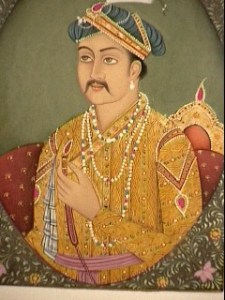
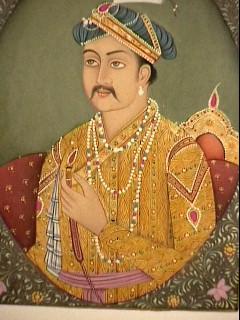
Akbar the Great

Akbar the Great (Courtesy: Wikipedia, Presumed public domain)

The novel is set in the 16th century and revolves around the visit of a young Italian, the so-called “Mogor dell’Amore” (Mughul of Love), to the Mughal emperor Akbar‘s court and his claim that he is a long lost relative of Akbar, born of an exiled Indian princess (Qara Köz) and a Florentine. The story moves between continents, with “Mogor’s” story about his origins in Medici Florence being told alongside that of Akbar’s court. The book is populated with a large number of historical figures – and at the end of it is an 8-page (my edition) bibliography of books and web-sites Rushdie used to research his story. They include social, political and cultural histories as well as fictional works such as Italo Calvino’s Italian folktales. One could wonder, at times, whether it’s a little over-researched, but perhaps that would be churlish.

The next question to ask is, What sort of novel is it? Is it historical fiction? Well yes. Is it a picaresque novel? Yes, a bit. Is it a romance? That too, a bit. Is it a comedy? Certainly. Is it a fable? Could be! What it is, under all this of course, is postmodern.

If I had to use one word to describe this book it would probably be paradoxical. On the second page of the story, the bullock cart driver who brings the stranger (our “Mogor”) to town, describes his passenger in these terms:

If he had a fault, it was that of ostentation, of seeking to be not only himself but a performance of himself as well, and, the driver thought, everyone around here is a little bit that way too, so maybe this man is not so foreign to us after all.

And thus the scene is set for a rather rollicking tale about people who either aren’t all – or don’t seem all – quite real, who play games with each other, who are perhaps more alike (“not so foreign”) than they are different, and who manipulate, fight, love and hate each other as they struggle to find (or understand or establish) their place in the world. In fact, at the end of the first chapter the sort of paradoxical story we are embarking on is made clear:

The visionary, revelatory dream-poetry of the quotidian had not yet been crushed by blinkered prosy fact.

In other words, as you read this book, keep your wits about you! And that is, I admit, what I found a little hard to do as stories, people, and ideas were thrown at me…and then taken back and thrown at me a different way. As I read books I tend to jot notes on the blank page/s you usually find at the end. My notes on this one are all over the place: Love, Power, Names and their mutability, Truth, Religion and Faith, Imagination and Reality, Stories, Nature of men and women, East versus West, and so on. The question now is, Do any of these tie together or form a coherent thought upon which to hang the book? I think there is, and it is to do with ideas surrounding imagination and reality. In Chapter 3, for example, we learn of Akbar’s love for Jodha, the woman he has conjured up for himself:

She was an imaginary wife, dreamed up by Akbar in the way that lonely children dream up imaginary friends…and the emperor was of the opinion that it was the real queens who were the phantoms and the nonexistent beloved who was real.

Their love is called “the love story of the age”, and the chapter talks about the border between “what was fanciful and what was real”. Love, and its power, is one of the driving forces of the novel, and, without giving anything away, the ending more or less unites the two ideas: the power of love, and the conjunction of imagination and reality.

But, truth be told, I’m having trouble writing about this book…and I think this is because, for me at least, it started off with a flourish but got bogged down, particularly when we moved from India to Florence. That said, it picked up again near the end. Here is Akbar in the last chapter:

Again, at once, he was mired in contradictions. He did not wish to be divine but he believed in the justice of his power, his absolute power, and, given that belief, this strange idea of the goodness of disobedience that had somehow slipped into his head was nothing less than seditious. He had power over men’s lives by right of conquest … But what, then … of this stranger idea. That discord, difference, disobedience, disagreement, irreverence, iconoclasm, impudence, even insolence might be the wellsprings of good. These thoughts were not fit for a king.

The word I used earlier in this review to describe this book was paradoxical and this is because almost every “truth” presented within its pages is met by an equal but opposite “truth”. And perhaps that is the biggest truth of all!

Salman Rushdie
The enchantress of Florence
London: Vintage, 2009
355pp.
ISBN: 9780099421924
Andrew Croome, Document Z

Truth, according to the dictionary, can mean several things including:

  • the state of being the case, fact or actuality; and
  • a transcendent or spiritual reality.

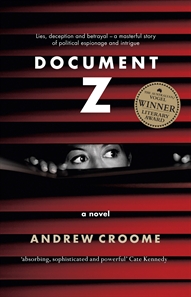
Document Z bookcover

Document Z cover image (Courtesy: Allen & Unwin)

Truth in all its variety and slipperiness is, I think, the fundamental theme of Andrew Croome’s Document Z which won the 2008 The Australian/Vogel Literary Award. This book, which chronicles the famous-in-Australia Petrov Affair about the defection of Vladimir (familiarly, Volodya) and Evdokia Petrov in 1954, began as a PhD Creative Writing thesis. Who needs a PhD in Creative Writing, though, when you have a publication offer instead?

At the end of the novel is a reference to an oral history that was conducted with Evdokia by the National Library:

This historian’s questions give her the space to betray Volodya, to admit his faults, to commit herself finally, to the truth. She doesn’t. The record is no all-important thing, and what exactly would be the point?

What indeed? After all, duplicity is what the book is about. Vladimir and Evdokia are MVD agents at the Soviet Embassy. This is their secret role, in addition to their formal embassy roles, and it puts them in conflict with the ambassador since, in effect, they work for two masters, the ambassador and the MVD headquarters in Moscow. Not an easy position to be in, particularly in a regime that thrived on suspicion.

Croome nicely structures the book, commencing with the dramatic attempt on 19 April 1954 by the Soviet authorities to return Evdokia to Russia. The book’s narrative form is multiple third person subjective, and this opening scene is viewed through Evdokia’s eyes: “Evdokia knew this crowd was for her. They were hunting her…”. She was wrong though. The crowd was with her and were “hunting” those who seemed to be taking her away. This opening chapter ends with the words, “Everything he had betrayed”. The scene is set to tell their story, and the book flips back to 1951 and their arrival in Canberra. From this point on the story is told through several eyes, particularly Evdokia’s, Vladimir/Volodya’s (who, Moscow thought, “could be well and truly trusted [my stress]”) and Dr Bialoguski’s (the man who worked for ASIO and who, through cultivating Petrov’s friendship, engineered the defection).

I enjoyed the book – partly because it was set in familiar territory, which is a bit of a rarity for we Canberrans, and partly because I was interested in the Petrov Affair. Croome seems, to the best of my knowledge, to have captured the era well. I loved the description of the Soviet Embassy wives going shopping…and he nicely evokes the polarisation of views between East and West/Communism and Capitalism that characterised the Cold War period. However, the book was a little unsatisfying too. I think it’s because Croome focusses a little too much on plot machinations for me – and yet the plot is not dramatic enough to support this. He does try to get “into” the characters but, for all his sound characterisation of the Petrovs, they are, at the end, pretty much as shadowy in terms of their “true” natures/desires/motivations as they were at the beginning. In the end, there’s not much drama in either the political or the personal story. It feels, almost, as though they were victims of circumstance – and perhaps they largely were.

And what were these circumstances? Well, they were largely the duplicitous – and fear-ridden – situation they lived and worked in. I had to laugh, early in the book, at the description of the embassy’s secret (MVD) section: “Somewhere, the roof leaked“. The book has many little ironies and paradoxes mostly playing on notions of secrets, lies, deception and betrayals, playing, that is, on a world in which truth is treated with rather careless abandon. By the end of the book we are, I think, no nearer the truth. We perhaps know some of the “facts” (albeit this is fiction!), but we do not “really” know the “spiritual reality” of these two people whose marriage seemed weak and who apparently lived a pretty sad life in exile.

I’d certainly recommend the book … it’s well written, and is a genuinely interesting portrayal of the case. But if you are looking for insights into the affair, I’m not sure you’ll find them here.

Andrew Croome
Document Z
Crow’s Nest: Allen & Unwin, 2008
350pp.
ISBN: 9781741757439

Arnold Zable, Sea of many returns

He leaps through centuries, tears apart myths, and reassembles them in his own way.

Sea of Many Returns cover

Cover image courtesy Text Publishing

These words that are said of one of the characters in Arnold Zable’s Sea of many returns could just as easily be said of Zable himself – not only of this book, but of his earlier ones such as Cafe Sheherazade. Zable loves telling stories, stories that weave between each other in an attempt to understand the impact of dislocation and exile on the human psyche – well, on his characters’ psyches but it is not hard to universalise this.

Sea of many returns is, essentially, a dual point-of-view novel:

  • the first person narrator, Xanthe, who was born in Melbourne to an Ithacan father and who tells her story; and
  • the third person story of Mentor, her paternal (also Ithacan) grandfather whose journals she is translating.

The story roams, backwards and forwards, from 1895 to present time as Xanthe and Mentor tell of the lives of their family members in Greece and Australia…about all their leavings and returnings, for work or adventure, or more terribly for war or, simply, to find a better life:

The stories I have heard, and am yet to hear, are echoes of one refrain: Is there somewhere on earth where I can find peace and prosper? Once the question is posed, the agony begins, the eternal dilemma: to stay or leave? To retreat behind fortifications, or cast our fate to the winds? (Xanthe, p. 203)

Underpinning this dilemma is the yearning for Ithaca – which translates, really, to the yearning for place, for home. Towards the end of the novel Mentor discusses the notion of “nostalgia” or “the pain of longing for the return”. Put this together with “the Ithacan phobia, the fear that I may never return” and the result is a melancholic – but not depressing – tone, since it is mostly accompanied by, if not always strength of mind, a resilience of spirit.

Not surprisingly, it’s the men who travel, at least in the earlier times of the book. As Xanthe’s aunt says, resignedly, “Let your men roam distant lands. Let them do what they must. What choice do we have? Bend your back to the mountain. Sow and reap”. And so, while Xanthe talks to some of the women in her Greek family, it is the men whose stories she seeks as she tries to understand her father, the angry Manoli, and her grandfather, Mentor. However, the book’s final section, titled “Epilogue: The resident tiller of the soil”, focuses on 90-something year old Irini who, quite paradoxically Xanthe realises, has not left Ithaca since her arrival there 90 years before and yet “is both voyager and teller, Odysseus and Homer”. This is perhaps a little elliptical but it has a certain resonance nonetheless! And Andreas does mutter in the previous section, “To know one place is to know all places”.

While the novel takes on a mythic overtone, it is “history” which provides its backbone and puts flesh on its characters: there are, for example, the way-too-many wars (to which many men go and from which some return), the 1916 anti-Greek riots in Kalgoorlie, the 1953 earthquakes in Ithaca, and the building in Melbourne of Cafe Australia and the Capitol by the Chicago architects, Walter Burley and Marion Mahoney Griffin. This last one seems a bit odd in terms of the overall thrust of the book but is interesting to one who lives in the city they planned!

I have only touched on a little of what this novel contains – there are the references to the Homeric quest and the story of Odysseus, there is the drunk but wise Niko, there is the beauty of the language in its rhythms and descriptions, and there is music – but if I go on, I might, like its storytellers, never stop. As Andreas says to Xanthe near the end

I have told you one version of the story and tomorrow I may tell it with a different slant. Each word I utter is true and false at the same time …

Paradoxical? Yes! But that is the essence of this lyrical and mesmerising but also rather mystifying – or, is that mythifying – book!

Arnold Zable
Sea of many returns
Melbourne: Text Publishing, 2008
307pp.
ISBN: 9781921351532

Jessica Anderson, The commandant

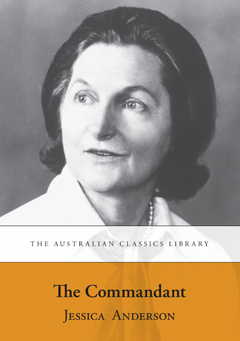
Jessica Anderson, The commandant Book cover

Cover image for The commandant (Courtesy: Sydney University Press)

When I first read about Sydney University Press’s Australian Classics Library, the book I really wanted to read waThe commandant by Jessica Anderson. It’s her only historical novel, but its subject matter doesn’t stray much from what she told Jennifer Ellison in an interview many years ago, “I was very much, and always have been, preoccupied with people who are strangers in their society” and “I am interested in families… They are interesting – you know, the tangle” (Rooms of their own). This is a clever and thoughtful novel by yet another much overlooked Australian woman writer.

[WARNING: SPOILERS, if you don’t know the history on which this is based]

The plot is pretty simple. It is set in Queensland’s penal settlement of Moreton Bay in 1830. It draws from the real story of the commandant there, Patrick Logan, who was noted for his harsh methods and who was murdered while out on an expedition. In the novel, Logan’s family is joined by his wife’s young sister (“the stranger”), Frances, who, on her way up to the settlement via Sydney, has been introduced to “radical” ideas critical of Logan’s regime. The scene is therefore set for potential conflict either between Patrick and Frances, or within Frances herself, or both.  In the end, it is a bit of both as Patrick finds his practices questioned and Frances confronts the realities of living in a penal settlement.

Except for Frances’s boat trip up to Moreton Bay with some of the settlement’s residents, the novel is set entirely in Moreton Bay. The characters include Logan’s household (family and servants), his wife Letty’s two women friends, officers of the settlement including two medical officers and the man sent to replace Logan, and of course some prisoners. There are also some characters in Sydney – Frances’ would-be beau and the sisters of a newspaper editor jailed for his criticism of the regime and against whom Logan is bringing libel action. The characters are well-drawn, with the significant ones nicely complex. You get a good feel for life in the settlement.

I would love to write about many of the characters as there are some wonderfully meaty ones, but I’ll just focus on Frances, the only character, really, who changes during the course of the novel. At the beginning, she “was seventeen; she was not stupid, but was often absurd”. She is also sympathetic to the idea of reform, which she says she developed through seeing servant life and poverty first-hand in Ireland and which puts her at odds with many in the settlement. She has a lovely ability to question herself, to see her failings, and it is this which enables her to learn from her several painful experiences. By the end, she is wiser in the ways of the world and has learnt to live with “incurable knowledge”, but has not lost her commitment to the cause of humanity.

Much of the story is told in dialogue – in fact, it wouldn’t be hard to turn it into a play/screenplay. Anderson handles this dialogue well, nicely differentiating the characters, from Letty’s lisp to officer Collison’s uneducated speech patterns. Letty’s lisp is an ironic touch – it lulls us into thinking she is one of those superficial flirtatious women but we soon discover that she is more complex than just a pretty little wife. Characters are nuanced by their reactions to each other  as well as by what they say, rather than by a lot of specific authorial comment, though there is that too.

There is also description, including some particularly beautiful ones of the bush during the search expedition for Logan, such as:

…a few clumps of trees, their rough bark the colour of iron, and their foliage a dun green, stood with the junction of trunk and root shrouded (my emphasis) by tall pale grass; and although at his left the river marked out a fissure of brighter greens, none among them were the sappy (again my emphasis) greens of England and Ireland or the dense fleshy greens of the coast … Among and behind this scrub stood big trees with foliage in similar colours, and with trunks of grey, or silvery grey, or of mauve shading to grey or rust, or of the beautiful colour of pink clay. It was as if everything here inclined not to the sun’s bright spectrum, but to those of the mineral earth and the ghostly daytime moon.

This is not an entirely benign landscape she is decribing – but neither does it hang heavily on her tale: her main focus after all is people. Here is an evocative description of Letty:

She fragmented the worry with her laugh, and waved it away with her hands, but it always seemed to reassemble, out there in the air, and float back to resettle on her.

One of the things that intrigued me most about the novel as I was reading it was the narrative form. It is a pretty straight chronology, but with many small flashbacks that help illuminate the characters. Most interesting though are a couple of slight but meaningful foreshadowings which, before the novel’s end, give us a sense of the sisters’ futures. This makes us realise that the novel is not really about them…it is about humanity, about how we treat each other – and, about that special word, mercy. You will have to read it for yourselves to know what I mean.

Jessica Anderson
The commandant
Sydney: Sydney University Press, 2009
326pp.
ISBN: 9781920898946

(Review copy supplied by the Sydney University Press)

Markus Zusak, The book thief

In one moment, there was great kindness and great cruelty, and I saw it as the perfect story of our humans are. (Zusak on the Random House website)

Zusak could hardly have chosen, for The book thief, a better setting to explore the best and worst of humanity than Germany during the Holocaust. The book reminds me a little of Ursula Hegi’s Stones from the river which also deals with a small German town during the war and the hiding of Jews, though Hegi’s book has a much wider canvas, covering a few decades.

The novel, which is narrated by Death, tells the story of a young girl Liesel (the book thief) who is left with a foster family in a small German town in the lead up to and during World War II. Liesel is treated well by her foster parents, Hans and Rosa Hubermann, and makes friends with people in the neighbourhood including Rudy Steiner, a boy her own age. Not long into the novel, the Hubermann household is also joined by Max, a 24 year old Jewish man whom they hide. From here we follow the family and the neighbourhood as they live through the war. The characters – and there are many of them – are well drawn.

It’s a clever, memorable book. The use of Death as a narrator and its structure, which seems both old world (the chapter titles ‘featuring….’) and post-modern (the inclusion of the illustrated stories, the little bold-type assertions like ‘A small threat from Viktor Chemmel to Rudy Steiner’, ‘He survived like this’), give it a fresh tone which impel the reader on. This tone has a veneer of whimsy while at the same time being deadly serious.

There is a bit of foreshadowing but it’s handled well. It tells us our narrator is omnipotent and warns us that bad things are going to happen (and we know they will anyhow). I don’t usually mind foreshadowing – and agree with Death who says:

Of course, I’m being rude. I’m spoiling the ending, not only of the entire book, but of this particular piece of it. I have given you two events in advance, because I don’t have much interest in building mystery. Mystery bores me. It chores me.

The star of the book for me is its language. It’s superficially simplistic but is really quite sophisticated. There are some wonderful images – ‘pimples were gathered in peer groups on his face’; ‘they were going to Dachau to concentrate’; ‘rumour of sunshine’; ‘the sky began to charcoal towards light’ – but these are not overdone.

Zusak effectively handles the fact that the characters are German and would be speaking German through the occasional use of German words and phrases. And he lightly translates most of this German for us,  such as ‘”Keine Ahnung’, Rudy said, clinging to the ladder. He had no idea.'” Again, there isn’t too much of this but just enough.

The repetition of the curses – “Saumensch”, “Saukerl”, “Jesus Mary and Joseph” – give it a light touch, as do things like the “Keine Ahnung … He had no idea” above and the gruesome humour of “they were going to Dachau to concentrate”. Again, none of this is overdone. Not too funny, but definite touches of humour. There are those who say you can’t “do” humour and the Holocaust, but I don’t agree: this book is a perfect example of why I don’t.

There is also poetry to the language – with this poetry coming as much through the rhythm, as through imagery:

In the morning he would return to the basement.
A voiceless human.
The Jewish rat, back to his hole.

[and]

She didn’t need an answer.
Everything was good.
But it was awful, too.

[and]

Why him?
Why Hans Huberman and not Alex Steiner.
He had a point.

[and]

Their drivers were Hitlers, and Hubermanns, and Maxes, killers, Dillers and Steiners.

And then there is the frequency of ‘3s’. For example:

  • The Hubermanns lived at 33 Himmel Street (and 33 was the age Jesus Christ was when he died – relevant?);
  • the common curse was ‘Jesus, Mary and Joseph’;
  • a lot of the rhythms (such as the examples above) come in threes.
  • it is third time unlucky for Hans Hubermann
  • “The Word Shaker” written by Max story starts with “three important details about his life”.

The threes just keep coming. Three is a pretty magical number: the trinity; mind, body and spirit; past, present and future. The concept of “three” is found in most religions and represents, at its simplest, unity.

The novel seems to have two main themes. One is the power of words – to help and to hinder. I loved this, describing Leisel’s surviving the bombing: “the words WHO had saved her life”. The personification of words here, at the end of the novel, is really effective. Words sustain her through most of the book, but there was a point when she nearly gave up on them, as when she tears up a book in the mayor’s house after having seen Max in the Dachau march:

Soon there was nothing but scraps of words littered between her legs and all around her. The words. Why did they have to exist? Without them, there wouldn’t be any of this. Without words, the Führer was nothing. There would be no limping prisoners, no need for consolation or worldly tricks to make us feel better.

What good were the words.

BUT the other theme is the one that ends the book: what it means to be human. Death says:

I wanted to explain that I am constantly overestimating and underestimating the human race – that rarely do I ever estimate it. I wanted to ask her how the same thing could be so ugly and so glorious, its words so damning and brilliant … tell her the only truth I truly know … I am haunted by humans.

In other words, Zusak, in this book, encapsulates humanity – its best and its worst – and does it through using ordinary people living in/coping with extraordinary times. His message is simply that humans are capable of wondrous things and of heinous things. No astonishing truth really – we all know it – but he shows how closely these can co-exist and how fine the line often is.

Markus Zusak
The book thief
Sydney: Picador, 2005
584pp.
ISBN:033036426X

Murray Bail, The pages

The pages, Paperback cover (Image: Courtesy Text Publishing)

The pages, Paperback cover (Image: Courtesy Text Publishing)

It’s not surprising that someone who calls herself Whispering Gums loved Murray Bail’s previous novel, Eucalyptus, and so it was with some enthusiasm that I picked up his latest novel, The pages, a few days ago. My edition, unlike the one imaged here, is the hard cover one and, funnily enough, it looks like the bark of a tree (like, say, a eucalyptus!). That makes sense I suppose since trees are the source of paper.

It is, I have to say, a bit of an odd book – but I did like reading it nonetheless. Plot-wise, it’s pretty flimsy. Middle-aged Erica, a philosopher, goes outback with her friend, the psychologist Sophie, to stay with brother and sister graziers, Roger and Lindsey, in order to examine their late brother Wesley’s “philosophy”.  This gives the novel two narrative strands – the women’s experiences as they stay with Roger and Lindsey interspersed with the told-in-flashback story of Wesley and how he came to write his philosophy. Both strands are told in third person until near the end when, as Erica starts to read some of Wesley’s writings (his “pages”), his strand switches to first person.

Occasionally inserted between these strands are funny little digressions on topics such as hospitality in relation to philosophers and psychoanalysts (Ch. 8), and psychoanalysts, philosophers and their chairs (Ch. 23). Juxtaposition may partially throw light on these but I’m not sure it does fully. Bail seems to want to say something about psychoanalysis (which Bail says is typified by the “endless sentence”) versus philosophy (“the long sentence”) but I’m not sure exactly what it is. He seems more negative about psychoanalysis, but philosophy is also found wanting.

I like the characterisation. Bail’s characters are very comprehensible as people and as types: the socially awkward but dependable Erica, the self-centred flirtatious Sophie, and the practical no-frills Lindsey, for example, are recognisable but interesting too. I also like the language, the description of the setting in particular is evocative but not overdone:

Through the window she saw a tall pale-grey eucalypt surrounded by a darker cluster of pines, elms, cedars. It pronounced a solid leave-it-or-take-it way of being. The simple strength of the tree: stand it alongside the lack of statement, on her part. For a moment – before looking away – Erica saw herself as resolute only in a few minor things.

There is humour in it too, mostly of the ironic or sly type. The solicitor, for example, is described as having “pursed lips from the many years of putting words in parentheses”. And, as you can see from that, there’s play on words, about words, and with words (and language): the sandstone “weathered and worn smooth by the never-ending revision of ideas” and the ambition of philosophers to “build a word-model of the world, an explanation, parallel to the real world.”

The book is rather elliptical (in both its literal and literary meanings). Wesley goes from country to Australian city to foreign cities and back to the country in search of a philosophy, a new way of understanding the world. During these journeys we are tantalised with “glimpses of clarity”  as he tries to comprehend what might comprise his philosophy while at the same time he is confronting (seeking?) something way more human – love. In these later moments he wonders whether  “the ambition to supply the answer to everything is a form of madness” and suggests that “philosophers have been unsatisfactory in the examination of emotions”. Meanwhile, Erica moves from the city to the country (a physical and metaphysical “interior”) to, she hopes, find a new philosophy in Wesley’s “pages” but what she actually finds, in the country, is love. Somewhat akin to Wesley’s questionings she comes to wonder “what possible dent could philosophy make on the fact of existence?” Contrasts and contradictions underpin the book.

Earlier, around the middle of the book, it is said of Wesley that he “was finding a gap existed between the clarity of his chosen subject, and the softer unavoidable intrusions of everyday life”. It seems to me that, by the end, he has not closed that gap OR, rather, he finds that true philosophy lies IN the gap. The final line of the novel is that “we are philosophers; we cannot help being”. I love the wordplay on the last word: “being” as in “existing”, and “being” as in “being philosophers”.

Somewhat similarly, Erica says near the end of the novel:

One of philosophy’s functions has always been to shine light into the dimly lit, the imprecise, the hopeful.

What we find reflected in Bail’s The pages, then, is “a glimmer of clarity” that, for we readers as for the characters, comes and goes with the “light”. And, isn’t that pretty much how it is in life?

Murray Bail
The pages
Melbourne: Text Publishing, 2008
199 pp.
ISBN: 9781921351464

Note: I’ve read a small number of reviews since reading this book, seeking a more complete understanding. These reviews are more erudite than mine and most are longer so delve a little more deeply, but none, really, offer me a better understanding. The one I like the best, because it most closely reflects my understanding of and reaction to the book, is by Hermione Lee.

Jonathan Safran Foer, Everything is illuminated

Jonathan Safran Foer (Photo by Elena Torre, from flickr.com, under Creative Commons CC BY-SA 2.0)

Jonathan Safran Foer (Photo by Elena Torre, from flickr.com, under Creative Commons CC BY-SA 2.0)

He invented stories so fantastic she had to believe.

It’s hard to know where to start writing about Jonathan Safran Foer’s Everything is illuminated, so I’ll just start with a brief description of the plot. It concerns a search in the Ukraine by “the hero” (aka Jonathan Safran Foer) for the woman (Augustine?) who, he believes, saved his grandfather from the Nazis during World War 2. He is escorted on this trip by a translator Alex, a driver (Alex’s grandfather, also Alex), and their “seeing-eye bitch” dog, the absurdly named Sammy Davis, Junior, Junior. This narrative is conveyed to us through three streams:

  • Alex’s (the translator, not the driver) story of the search for Augustine and Trachimbrod;
  • Jonathan Safran Foer’s (“the hero” and searcher) novel-in-progress about the history of his family in Trachimbrod (from 1791 to 1942); and
  • Alex’s (translator, again) letters to Foer about their search and his novel.

So far, so good, but if you have read my introductory post on the book you will know that this is a postmodern book and therefore a bit “tricksy”! And the first bit of “tricksiness” is that overlaying these narratives is the fact that Jonathan and Alex comment on each other’s writing, though we only hear this from Alex who comments in his letters on Jonathan’s work as well as responding to Jonathan’s comments on his work. Alex, then, is the main character in the book – if, that is, it can be said to have a main character. Certainly, Alex is the one whose character develops through the novel – from a rather callow youth who is full of bravado to a thoughtful young man (or “premium person”) ready to take on serious responsibilities.

At first, it is pretty funny – which, if you knew when you started that its subject is the Holocaust, could discomfort a little. I believe though that humour can deal effectively with the dark side, so I didn’t find it disconcerting – and, anyhow, the humour decreases as the book wears on. As Alex writes early in the novel:

I am able to understand now that it was the same laugh … the laugh that had the same darkness as Grandfather’s laugh and the hero’s laugh.

Humour and the multiple strand structure (combined with a convoluted but comprehensible chronology) are just two elements of this novel’s style. There are many others – too many really to cover in a short(ish) review – but fortunately I did refer to several of them in my introductory post. However, one I didn’t mention is Foer’s (the author this time!) use of different linguistic styles to represent the different characters and their strands, and to convey Alex’s growth towards maturity. It is with some disappointment, really, that we see his malaproprisms and other word-misuse (“I wore my peerless new jeans to oppress the hero”) disappear! There is also the magical realism in “the hero’s” story of Trachimbrod: the stories he tells about this shtetl stretch our credulity, but no more perhaps than does the cruelty of the Holocaust which is the point to which the narrative leads us. As the woman (Augustine? Lista? Does it matter?) who shows them what’s left of Trachimbrod says:

It is not a thing you can imagine. It only is. After that, there can be no imagining.

The book covers a lot of ground, including memory, history, place, names and identity, but two ideas that run throughout and that caught my attention are love and truth. “The hero’s” novel-within-the-novel speaks much about love, while Alex’s story of their search explores the notion of truth (though this distinction is not completely rigid). Why this is is not hard to understand when you know their (and their family’s) respective roles in the story: Alex would like to see through the “facts” to the “truth” (for some sort of absolution) while “the hero” would, it seems, like to believe that love can transcend all (to glean something from the wholesale destruction).

You can see the progression in Alex’s thinking in the following:

I also invented things that I thought might appease you, funny things and sad things. (p. 54)

This is a nice story. It’s true, I’m not making it up. (p. 158)

We are being very nomadic with the truth, yes? Do you think that this is acceptable when we are writing about things that occurred? (p. 179)

I would never command you to write a story that is as it occurred, but I would command you to make your story faithful. (p. 240)

Meanwhile, “the hero” is writing of love: Brod (his great-great-great-great-great or, “very-great”, grandmother) and her love-match with the Kolker in early 19th century Trachimbrod; the time when all the people of Trachimbrod thought they had a novel in them with all these novels being “about love”; his grandfather’s love for the gypsy girl between 1934 and 1941 (the gypsy and the Jew!). One of the most poignant lines of the novel describes love messages made out of war-time newspaper headlines:

…each note a collage of love that could never be, and war that could.

Love – what people do and don’t do for it – is, really, the heart of the book.

It’s a full-on novel, and suffers somewhat from that new-writer problem of trying to do too much: you almost wonder what is left for his second novel. That said, it’s a rollicking read despite the seriousness of its subject – and provides plenty of challenges for the grey matter. I was taken by this little mind-twister about Brod:

She repeats things until they are true, or until she can’t tell whether they are true or not. She has become an expert at confusing what is with what was with what should be with what could be.

This conveys the essential problem of writing about the Holocaust: the sheer horror of it is almost beyond comprehension.

Early in the novel Alex asks “the hero”:

Are you being a humorous writer here or an informed one?

I see no reason why you can’t be both – and Foer, in this novel, has pretty well pulled it off.

Marion Halligan, Valley of grace

Valley of Grace book cover (Courtesy: Allen & Unwin)

Valley of Grace book cover (Courtesy: Allen & Unwin)

Delicious but sly are the first words that come to mind when I think about Marion Halligan’s latest novel, Valley of Grace. Take this for example:

You know, people think flowers are pretty. Sentimental. Frivolous even. But the fact is, everything begins in the garden. Humans. Society. Civilisation. Evil. Things bud, bloom, weather, age, die. There is as much decay as there is burgeoning. Gardens offer emblems of our passage through the world.

Sly because you know she is alluding to the Garden of Eden here but, without the snakes, apples or trees, the garden symbolism is wider, more encompassing than the simple biblical Fall of Man. Delicious because the language flows so beautifully – and it’s typical of the sure writing that’s found throughout the book. The style is relaxed and flowing, even when it is staccato (if that makes sense). It feels conversational, and yet it is not colloquial. And, it contains Halligan’s hallmarks – wonderful descriptions of food and wine, of home and gardens.

The novel is set in contemporary Paris and chronicles a few years in the life of Fanny and her family and friends. At the beginning of the novel she is 25, single, and working with the gay Luc in his antiquarian bookshop, but very soon she marries builder and restorer of old buildings, Gérard, who is 38. There’s no mystery about this – you can see it coming and it comes. What doesn’t come after that is a baby.

There are no big dramas in this book so if that’s what you like, this is not for you. It is however the book for me, because while I can enjoy a book with drama, that’s not what I read books for. I read them for the very things that I got out of this book: astute observation of humans and how we think and behave, combined with writing that delights, inspires and grabs. Valley of Grace explores all the sorts of things that make up human experience – love and friendship, betrayals, secrets, appearance versus reality, and more besides – but most of all it is about babies and children. The having of them, the not having of them, the healthy and the damaged, the child and the god-child, and the wild child are all covered in this neat little book.

And, in fact, as Halligan told us at our bookgroup meeting tonight (to which we’d invited her and she’d wonderfully accepted), children were a major inspiration for the book. She lived in Paris in 1989 and, from her apartment window, could see the church, Val de Grâce, which was built by Anne of Austria as her part of a bargain with God to give her a child (Louis XIV, no less). This story fed into Haligan’s thinking about fertility (the presence of it and the absence of it) and about how in the past women came to “a bad end” if they didn’t have a baby or had a baby at the wrong time. She said that in the 1960s we thought this would all change but in fact it hasn’t quite turned out that way because women are having babies later and the result is more problems (such as infertility, increased miscarriages, “damaged” babies). This book is, then, her meditation on children – who they are, what they mean to us. And the following will show you just what Halligan thinks they mean:

Taking an angry or maybe anguished baby and changing it from a stiff protesting awkward bundle into a relaxed kitten-like creature seems to Fanny as important a thing as anybody could ever do.

The novel is told in third person but from different perspectives in different chapters – with some wonderful set-pieces, such as the story of Sabine and her arrogant philosopher husband Jean-Marie to whom she delivers “the pavilion girls”. Halligan said that telling the story this way replicates the way life goes – we are the heroes of our own stories, but bit-players in those of others. This makes sense – and certainly works well in the book.

There is a luminous quality to the book, conveyed largely through imagery to do with light and colour (mainly yellows). Mostly it is comforting, but sometimes it is not. Here is Fanny in the Val de Grâce:

She looks up at the immensity of the pale grey stone. Even with all the decoration, the cherubs, the frescos, the marble and gilt columns, it has a bareness, a coldness. It’s the colour of concrete, There’s no stained glass. The light is silvery; when the sun shines, lemony. There is no comfort in it, as there is in her house.

And then in her apartment:

She looks at the graceful space of the apartment. At the light, greenish gold today with summer sun and the fresh leaves on the chestnut trees, their milky white flowers buzzing with bees.

It’s a short book – just under 250 pages – and a rather gentle one. It’s sometimes a little sad, but other times it has a wry humour.  It’s well researched, but the research hangs lightly on it. Its ending is one of the most inspired I’ve read for a long time – but you’ll have to read it yourself to see if you agree.

I have read a few Halligans over the years – Lovers knots, The golden dress, The fog garden and The point – and have enjoyed them all. I’ll close this post with a favourite line from The fog garden because I think it describes this book to a T:

Read a wise book and lay its balm on your soul.