Elliot Perlman, The street sweeper (Review)

Elliot Perlman‘s latest novel, The street sweeper, is a complex book with a pretty simple message. It’s complex because of its multiple interconnecting storylines that move back and forth between World War II, the American Civil Rights era, and contemporary times. It has multiple themes, about which I’ll write further, but the underlying message is simply this: history is important. Related to this is the idea that all things are connected. Let me explain …

The original characters in the novel, those from whom the connections flow, are two lawyers, the Jewish Jake Zignelik and African-American William McCay. Both were active in civil rights in the 1960s. However, as the novel starts, Jake has been dead for some time, and William is in his 80s. The baton, in a way, has been passed to their sons, Charlie and Adam who are historians at Columbia University. It is around 2008, and both men have lost their way somewhat. Charlie is a successful academic, so successful that his administrative duties are not only tearing him away from his main love, research, but also from the important relationships in his life, those with his father, wife and teenage daughter. Adam’s problem is different. His career has stalled. He hasn’t published anything for so long that he will not get tenure – and Charlie, who has been his mentor, but who has let that relationship slide too, can’t help. Adam, believing it’s the honourable thing to do, breaks up with his long-standing girlfriend, Diana, on the basis that he’s unable to be the husband and father that he believes she wants.

None of these characters, though, is the street sweeper of the title, because there is another significant character, the one who opens the novel. This is Lamont Williams, an African-American who has just started work as a janitor at a cancer hospital in a pilot program for ex-convicts. He, like Adam, is close to 40 years old. Lamont, we soon learn, is a good man to whom bad things happen, just like the hero in Perlman’s first novel, Three dollars. He is, in fact, innocent of the crime that put him in jail but his colour and poverty meant he didn’t have a chance – just like the Jews in war-time Europe.

The novel focus primarily on these two men – Adam and Lamont – as they struggle to get their lives on track. Lamont’s story sees him getting to know hospital patient and Holocaust survivor Henryk Mandelbrot who tells Lamont over a period of nearly 6 months of his experience under Nazism, particularly in Auschwitz. Mandelbrot wants his story known, and insists that Lamont learns and remembers it. Meanwhile, Adam, initially reluctantly, looks into a research project suggested by Charlie’s father William, one that sees him also learning about the horrors of the Holocaust. As the novel progresses, and more characters – from the past and present – are introduced, the connections and links between people multiply, rather like a Dickensian novel. There is, though, a point to these connections. Early in the novel, Perlman writes that

you never know the connections between things, people, places, ideas. But there are connections.

And these connections, whether we know it or not, can direct the trajectory of our lives – as they do for the characters in The street sweeper. There is also a central ideological connection in the book, and this is that there are “parallels between the situation of blacks in the United States and the Jews in Germany”.

A major theme of the novel – one of Perlman’s pet themes in fact – is that of moral responsibility, of what makes a “good” person. As so often happens, those who have the least but, paradoxically, the most to lose, are quickest to take the moral path. Early in the novel, and four days into his 6 months probation, Lamont is accosted by Mandelbrot who asks a favour. This favour is something Lamont is not supposed to do – it’s not his job – but, seeing the old man’s distress, he risks losing his job to do the right, the moral, thing. Late in the novel, a professional woman who has nothing to lose but a bit of her time is asked to do a moral thing. She experiences a jolt when, after a passage of time, she realises that she’d been prevaricating about an issue of justice. Not all characters though come to this realisation regarding their moral duty.

I said in my opening paragraph that the underlying message of the novel is that history matters. This is conveyed throughout the book by discussions about history and the role of historians, by showing historians going about their business, by reference to the “long causal chain” and to the importance of remembering, and most of all, by the refrain, “tell everyone what happened here”. You won’t be surprised to know that I loved the fact that Perlman explicitly and implicitly explores the theory and practice of history here, but it deserves a post of its own so watch this space … I’ll simply say now that Perlman explains in his author’s note which characters are based on “real” historical figures, and he provides an extensive list of the sources he used.

The question I always ask when reading historical fiction is why has the author decided to tell this story from the past? In Perlman’s case the answers are obvious. First it’s the one made explicitly in the novel, and that is to “tell everyone what happened here”. Then there’s the more implicit one to do with why we need to know what happened, and that is to ensure that the horrors visited upon the Jews in the Holocaust and the African-Americans in the US don’t happen again. And finally it’s to remind us of our basic moral responsibility which is, as William says to his son, to “Do what’s right here, Charlie”.

I could pick some holes in the novel. It’s big and a little baggy around the edges. It can verge on didacticism at times. And, to make the necessary connections, Perlman relies a lot on coincidence, which could seem contrived if you haven’t bought into the story. But, here’s the thing. I have read many good, even excellent, books this year. However, The street sweeper, like Rohinton Mistry‘s A fine balance and Margaret Atwood‘s The handmaid’s tale, is one that will stay with me long after I’ve forgotten the name of the characters, long, even, after I’ve forgotten how the plot falls out. And that, for me, is the best sort of read.

Lisa of ANZLitLovers also liked this novel.

Elliot Perlman
The street sweeper
Kindle edition
Random House, 2011
ASIN: B005LV7O4S

Sefi Atta, A bit of difference (Review)

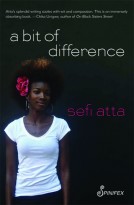
Sefi Atta, A bit of difference

Book cover (Courtesy: Spinifex Press)

Nigerian writer Sefi Atta was once an accountant. Interesting switch that, accountant to writer, but Atta seems to have made it with great success. Her first novel, Everything good will come, won the Wole Soyinka Prize for Literature in Africa, and received an Honourable Mention in the Aidoo-Snyder Book Prize. Her short story collection, News from home, won the Noma Award for Publishing. I don’t usually itemise awards but it seemed appropriate to do so for a writer who is probably little known to most of my readers. It provides some context to her standing.

However, I mentioned her previous profession for another reason. The main character in her most recent novel, A bit of difference, is a Nigerian accountant. I’m not sure how autobiographical the novel is but Atta clearly understands something about the world of accountants!

The novel is set in the early-mid 2000s, just post the war in Iraq, and takes place over a few months in the life of its protagonist, Deola (pronounced, we are told in the first chapter, “day-ola”). Aged 39, Deola is the director of internal audit for an international charitable foundation. Her role is to audit organisations that receive its grants. The novel starts with her travelling to the Atlanta, USA, office and sets the tone for her dissatisfaction regarding where she is in her life, that is, an unmarried, childless Nigerian expat living in London.

Deola and I have little in common, but I have lived the expat life twice, once in my early 30s and again in my late 30s-early 40s and I understood her desire to be with people who have a “shared history”. The trouble of course is that having gone to boarding school and then worked in England for many years, her “shared history” is a little muddy. However, she starts to feel it’s back in Nigeria, despite her own misgivings and those of her English and Nigerian friends in London.

This is not a book with a page-turning plot. It simply follows several months in the life of an unsettled woman who’s trying to make a decision. It’s told 3rd person, but from Deola’s point of view, and is chronological, with flashbacks to explain to us how she’s got to where she is. Despite the potential, given its setting, it’s not a grim novel. There’s humour – in some funny scenes, entertaining dialogue, effective use of irony. And there’s a wide cast of well-diffferentiated and rather colourful but very real characters – from the thirty-something sister in Nigeria who still likes hip-hop to the not-yet successful Coetzee-enthusiast Nigerian novelist friend in London.

What is most interesting in the novel is its multiple, intertwining themes: the often lonely life of the middle-class expat, race relations in England, African identity and politics, and the way even the enlightened or educated people in both cultures don’t always meet eye-to-eye. I was reminded, as I was reading the book, of Anita Heiss’s talk at the Readers Festival I attended last month. She said she wanted to write novels about young, professional, urban indigenous women to show that their concerns are much the same as their anglo-Australian contemporaries, with the added issue of racial identity and politics to contend with.

And so, as I believe Heiss’s “chicklit” novels do, Atta’s novel explores those universal concerns of belonging and identity, but set against a particular environment where ethnic distrust and/or racial and class hierarchies threaten the self, both at home and in the “adopted country”. Deola feels somewhat of an outsider. In England, she feels her views or experience are not respected by her employing organisation and she is conscious always of being black in a white country. Back home in Nigeria, she’s aware of corruption, and of the way Nigerians rank and distrust each other on a whole range of grounds. England may be characterised by “phony egalitarianism” but Nigeria doesn’t seem much better. Through a character like Deola, Atta can tease out the misunderstandings – or arrogance even – of western organisations trying to “do good” for developing countries while also showing the lack of cohesion in those very countries receiving the help. Fortunately for Deola, at least on a personal level, help might be on the way in the form a man she meets on a business trip to Lagos. But, like most modern novels, nothing is quite as simple as it seems …

Two motifs run through the novel – the fear of HIV/AIDS and the threat of “armed robbers”. These are the “bogies” of contemporary Africa, and serve as a constant reminder that for all the universalities, this novel is also particularised to Africa. A bit of difference is an interesting and satisfying book primarily for this very reason, for, that is, the fact that it so beautifully integrates an engaging personal story with one having a wider political resonance.

Sefi Atta
A bit of difference
North Melbourne: Spinifex Press, 2012
219pp.
ISBN: 9781876756994

(Review copy supplied by Spinifex Press)

Zane Lovitt, The midnight promise (Review)

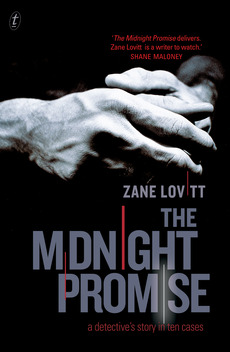
Zane Lovitt, Midnight Promise

Book cover (Courtesy: Text Publishing)

Zane Lovitt’s debut book, The midnight promise, is one of those books for which I can’t decide how to start my review. I could go with the point, previously made in this blog, that I’m not a reader of crime and so cannot speak with authority on the subject. Or, I could write about the fact that one of the chapters in the book, “Leaving Fountainhead”, won the SD Harvey Short Story Award in Australia’s top crime awards, the Ned Kelly awards*. I could start with how Melbourne-based Lovitt joins the growing number of lawyers who write fiction. Or, I could start with the topic that interests me most, its form.

Because, if you haven’t noticed, I didn’t use the word “novel” once in my opening paragraph. There’s a good reason for this: The midnight promise is, if I can draw from the main media through which I consume crime, more like a detective series than a movie. I could have described it as a book of short stories, but that would be misleading. The ten chapters or stories all feature the one detective or “Private Inquiry Agent”, John Dorn, and they are told chronologically. Moreover, even though the book comprises ten separate cases, rather than one main case as would be expected in a novel, there is an overarching, albeit not immediately obvious, plot, defined by “the midnight promise”.

This form may, in fact, be one of the reasons I liked it. Each story is complete in itself while also forming part of a greater whole if you keep reading. The form is also, however, responsible for my only real criticism, which is that, almost without exception, the stories are structurally the same. They follow a present-flashback-present-flashback (and so on) structure. In a “true” book of short stories, I like things to be mixed up a bit; I like to see variety in style, in voice, structure, tone, language. That’s not the case here – but neither, I suppose, would it be the case in a television detective series, so perhaps my criticism isn’t valid. Still, a couple of times, I felt myself saying “here we go again …”.

John Dorn is not, I think, a particularly original character, for the genre. Like many crime protagonists, he’s somewhat of an outsider, a loner with a broken engagement behind him. He’s also a man of some principle which is why his is pretty much a hand-to-mouth existence. In the early stories his fee ranges from $400 a day to $250 a day to nothing depending on whether he wants (or believes in) the job or not. The higher the charge the less he wants it! For this reason we like Dorn, and want things to work out for him, but somehow, more often than not, he manages to shoot himself in the foot.

Being a private eye, his cases are varied, from marital spying to finding missing people to protection (of the innocent or the guilty). But the theme is consistent. It’s “the shitty things people do to each other” or, as he puts it more colourfully when describing roadkill in the final story:

We drive over two foxes, parallel, like one of them couldn’t bear to live without the other. Though what’s more likely is one fox was eating a dead fox and got hit by a car because he didn’t see it coming because he was distracted because the other fox was so delicious.

Not a grammatically beautiful sentence but appropriate and effective in the context. In fact, I liked Lovitt’s writing. The voice is first person, and the writing is generally direct and spare with the occasional well-placed image which works partly due to its rarity. Like this, for example:

I’ve heard rumours about his shady GST schemes, but everything I know about tax offences wouldn’t rouse a chihuahua from its beauty sleep.

The dialogue is realistic. There is humour – mostly in Dorn’s sardonic view of the world – which varies the tone. There is irony, as in the name of the character, Comedy, who is anything but funny, and in the story “Grandma’s House” whose title belies the horrors within.

And this brings me back to the form, to the fact that while each story is complete there is a trajectory in the book, heralded by the occasional bit of foreshadowing. We know something is going to happen that will change Dorn’s life, and probably for the worse. The crisis occurs in the seventh story, “The Crybaby Technique” – and it’s ironic because he was, in this particular case, only a bit player. Things change gear from here, leading to the final crisis in the tenth story which is significantly titled “Troy”. It’s a gripping read with a beautifully controlled out-of-control last page. You’ll have to read it to see what I mean.

So, would I recommend this book? Yes, to non-crime readers, like me, who look for character and good writing, and to crime readers who, I’m presuming, like intriguing cases with a detective who keeps you guessing. If I were a crime reader, I’d be saying I hope this isn’t the last we see of John Dorn, or of Zane Lovitt. In fact, I’ll say it anyhow …

Zane Lovitt
The midnight promise
Melbourne: Text Publishing, 2012
283pp.
ISBN: 978192192230

(Review copy supplied by Text Publishing)

*In 2010. It also appeared in Scribe’s New Australian Stories 2, that same year.

Nancy Cato, All the rivers run, Book 1 (Review)

It’s been a long time since I reviewed an audiobook or, more accurately, reviewed a book via its audiobook version. As I’ve said before, I don’t listen often to audiobooks, but last month Mr Gums and I did a long drive and so decided to listen to Nancy Cato‘s All the rivers run. I referred to this novel a few Monday Musings ago, because it was one of Australia’s early, successful adaptations for television.

Enough introduction though, time to talk about the book. Our audiobook contained the first book* of Philadelphia (Delie) Gordon’s saga. It starts her story when, in 1890 at the age of 13 she is orphaned in a shipwreck off the coast of Victoria. She is taken in by her dour aunt and more welcoming uncle who lead a spartan prospecting life at Kiandra in the Australian Alps. When her uncle Charles strikes it rich – that is he finds a large nugget of gold – the family (with her cousin, Adam, who is three years older than she) move to a sheep farm on the Murray River not far from Echuca. This first book, which is pretty much a coming-of-age story, finishes when Deli (as she prefers to be called) leaves home at the age of 17, after a tragedy has struck the family.

This is not really the sort of book I would normally read, though it is the sort of book I’d listen to on audiobook. Why so? Well, at the risk of being called a literary snob, I tend not to read sagas (whether they be historical fiction, fantasy or whatever). This is because their focus tends to be plot rather than style, structure, theme and, even perhaps, character development, though I know aficionados will argue with me and they will probably be right (to a degree!). Anyhow, there’s nothing wrong with that, it’s just not what I prefer to read. However, such stories are perfect for listening to in the car. Literature requiring intense concentration is not a safe bet when you are driving (or even when you are navigating). Horses for courses, as they say.

Cato’s book, like good historical fiction, captures the social history of the era well, particularly the tail end of the gold rush, the 1890s depression, life along the Murray River for the pastoralists and paddle steamers, the challenges faced by women in a male dominated society. She also touches on the dispossession of the indigenous people, showing the women working as “house-girls” for the pastoralists and their all too often descent into prostitution, often as the result of being used by and bearing the children of their white male bosses. Cato was, apparently, an active campaigner for indigenous land rights as well as for conservation.

I enjoyed Cato’s vivid descriptions of the landscape. The plot is a little predictable and the characters are somewhat stereotypical – the welcoming, easy-going farmer, the tough wife, the handsome son champing at the parental bit – but not so much that they don’t engage. Delie in this first book, for example, is a believable young girl, orphaned and taken in essentially by strangers and then experiencing her first love. She’s bright but not brash, independent but not without uncertainties.

I enjoyed one little description in particular. At a moment when things are going wrong for Deli, Cato writes that “a pair of kookaburras laughed sardonically”. I liked this description because only recently I’d been thinking about the first white settlers in Australia and what they made of the birds here, many of whom can sound pretty raucous. I wondered, in particular, what they thought when they first heard a kookaburra’s “laugh” as we describe it. Sardonic, is a very good description of it!

Overall then, it’s an enjoyable read, if you enjoy historical sagas, are interested in life in country Australia in the 1890s – and particularly if you have a long drive ahead of you! You could do way worse …

Nancy Cato
All the rivers run: A river not yet tamed (Audio CD)
Read by Kate Hosking
Bolinda Classics
6 hrs 15 mins on 5 discs
ISBN: 9781742336732

* Note: As far as I understand it, the three books in the trilogy were originally separately published as: All the rivers run (1958); Time, flow softly (1959); and But still the stream (1962). Recent editions, however, combine the three novels into one volume titled All the rivers run. I am not sure where the title A river not yet tamed comes from, but it looks like it might be Bolinda’s title for the first part of their recording of the trilogy.

Karen Jennings, Finding Soutbek (Review)

Jennings Finding Soutbek
Finding Soutbek (Courtesy: Holland Park Press)

I don’t, as a rule, accept review copies of books by non-Australian authors, but when New Holland Press offered me Finding Soutbek by South African writer, Karen Jennings, I was intrigued. Intrigued because of connections in our countries’ respective histories, and because I’ve read several books set in South Africa (by, for example, JM Coetzee, Doris Lessing and Nadine Gordimer). This is Jennings’ first novel, but she has written and published poetry and short stories, winning both the Maskew Miller Longman Award in 2009 and the Commonwealth Short Story Competition‘s Africa Region prize in 2010.

I enjoyed Finding Soutbek. It’s an ambitious, layered novel that switches between the 17th century and the present in a small, remote community in South Africa, the fictitious Soutbek in an area called Namaqualand. The town comprises two groups of people, the upper-towners and the lower-towners. In a neat reversal of expectations, the upper-towners are the poor, the under-class, who at the novel’s opening, have just been hit by a fire for the second time in a reasonably short period. The novel tells the story of what happens in the town after this fire, interspersed with chapters from The History of Soutbek, written by the Mayor and a local Professor, about the community’s founding in the 17th century. This history presents the town as having utopian origins, based on “communal living, sharing and acceptance”.

The novel’s main characters are this Mayor and his wife Anna, the destitute teenage girl Sara who appears in the town at the beginning of the novel and is reluctantly taken in by the Mayor, and Willem who lives in the upper town but who also happens to be the Mayor’s nephew. Jennings explores the relationships between these (and other) characters as the Mayor, the town’s first coloured mayor in fact, struggles to achieve his personal goals in a climate that seems to stall him at every step. The potential benefits of The History are undermined by the post-fire chaos in the upper town. There is a dark side to this mayor, to the way he treats others in his quest for personal wealth and power. Anna sees this and recoils from it, and finds herself increasingly isolated until Sara’s arrival. Willem, attracted to Sara, joins these two in a companionship that sees them jointly reading The History.

The themes are pretty universal – power and oppression, the rich controlling the poor, social inequality – but there is also something that seems particularly South African. That is, the book reminded me of works I’ve read by Nadine Gordimer and Doris Lessing. I’m thinking particularly of Gordimer’s short story Six feet of the country and Lessing’s novella The grass is singing, which, like Finding Soutbek, describe marital tensions deriving from a life characterised by the exercise of power by one group over another. This sort of conflict is evident too in JM Coetzee’s Disgrace, though his occurs between father and daughter, rather than husband and wife. These works are more complex and hard-hitting than Jennings’ novel, but they all seem to reflect a pre- and post-Apartheid South African literary aesthetic.

What interested me most about the book though was The History which purports to be based on the previously unknown journals written by the leader of a previously unknown unofficial expedition in 1662. A few chapters into the history, we learn a little more of the Mayor’s co-author, the Professor. We learn he has fallen into disrepute because his previous histories had been pro-Apartheid, had in fact argued that Apartheid should have been “carried further”. Moreover, we are told,

he felt no remorse for his actions. He believed that what he had done was fair and just … He had moulded the past into a suitable present, giving people historical proof of what they already believed.

So, a little way into The History we readers are forewarned. It may not do to be taken in. Willem is intrigued, “attracted by the utopia it described … [and] … its answers for a better life”. But, the oldest man in the village makes him wonder and so he starts to read other histories. Late in the novel he says

History says that for centuries humans have been trying to rule other humans, taking the land and everything else for themselves. That’s all the history you need to know. There’s nothing else.

You might guess from this that the utopian vision presented in The History may not be quite as it looks – and you’d be right but I won’t give too much away of how it all plays out. I’ll simply say that I like the fact that Jennings has tackled the writing of history, and how easily it can be made to serve a purpose. As we in Australia know, “history”, whether knowingly fabricated or not, can completely miss the point. And this can have devastating consequences.

While I enjoyed the book, I had some reservations. The History chapters are longer than they need be for the point they are making and this slows the book down somewhat. And the characters are kept a little at a distance. This is partly due to the almost mythic tone and partly to the shifting point of view. It’s the sort of tone I like, but it fights a little here with the very real story going on, and the shifting point of view makes it hard for us to fully engage with the characters. We don’t get to know them quite well enough to fully empathise with them, and this lessens somewhat the book’s emotional impact.

Finding Soutbek is, nonetheless, a good read. The plot is logically developed, the writing is good and the subject matter is relevant. Jennings writes in her Acknowledgements:

At all times I have been careful to remember that though this is a piece of fiction, it is a tale nonetheless which represents a sore reality, and I have tried my utmost to relate it in a sympathetic and sensitive manner.

She has done exactly that and, despite my reservations, I’m glad I read it.

Karen Jennings
Finding Soutbek
London: Holland Park Press, 2009
273pp.
ISBN: 9781907320200

(Review copy supplied by Holland Park Press)

Toni Jordan, Nine days (Review)

Jordan's Nine Days

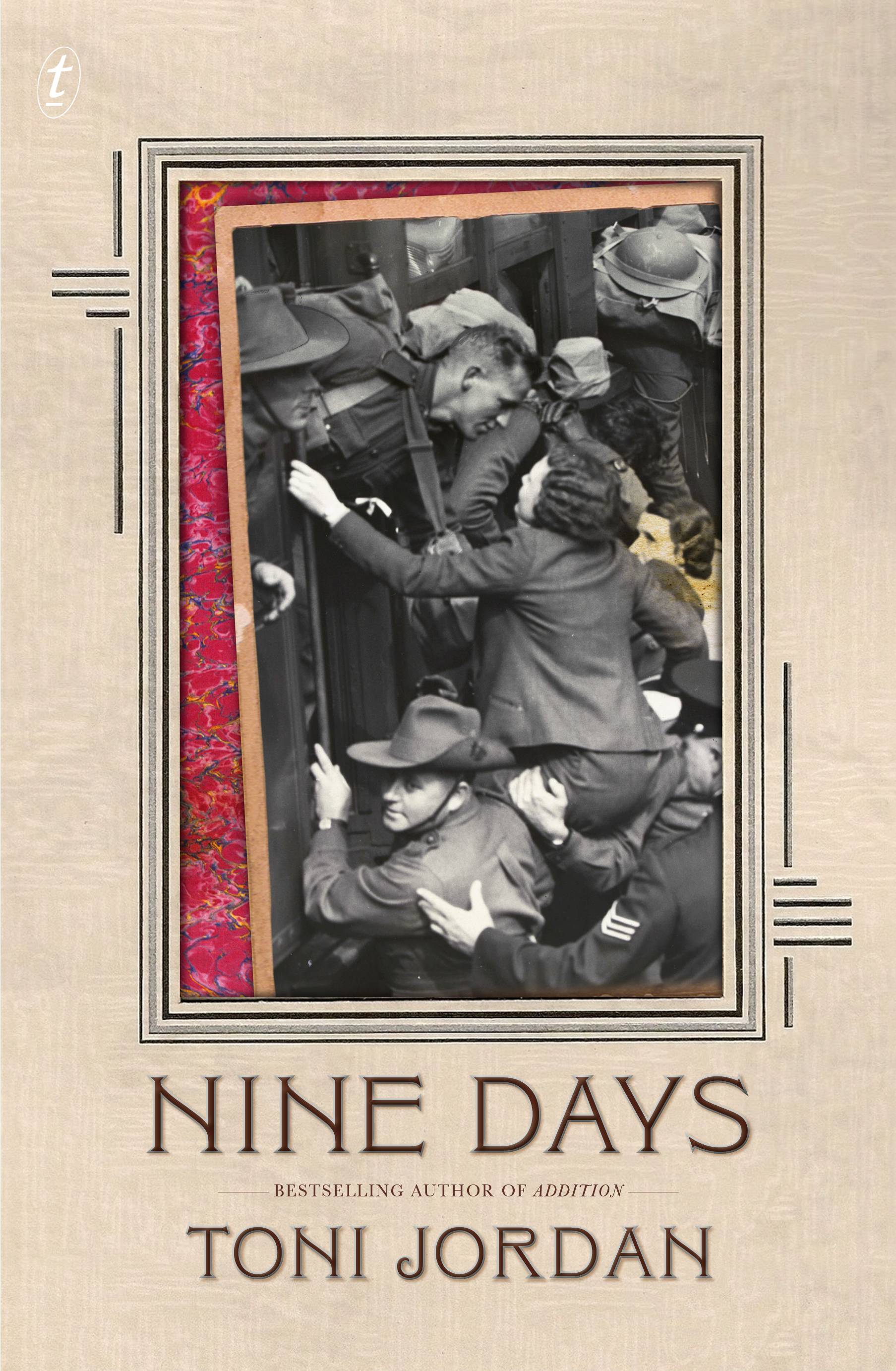
Book cover (Courtesy: Text Publishing)

Toni Jordan’s latest novel, Nine days, is somewhat of a departure from her first two novels which are more in the chicklit vein, albeit chicklit with a difference. The thing is, I don’t generally read chicklit, but I did enjoy Addition and Fall girl, so I was more than willing to read Jordan’s next offering. I was not disappointed.

Nine days was, according to the Author’s note, inspired by a photograph from the State Library of Victoria’s Argus collection. The photograph forms the cover of the book’s first edition: it depicts an unidentified soldier leaning out of a train window to kiss an also unidentified young woman. Jordan has woven around this photo a multi-generational story that spans six decades or so from the eve of world war 2 to the present. The title refers to the nine days upon which the book’s nine chapters are built – with an added complexity. This is a multiple point of view novel like, say, Christos TsiolkasThe slap and Elliot Perlman‘s Seven types of ambiguity, but while those two novels progressed their narratives in a linear chronology via the changing voices, Jordan’s chronology jumps around in a seemingly chaotic manner. However, there is method to it, because careful reading reveals thematic or structural connections, even if not chronological ones, between each chapter.

That’s the basic structure, but the real interest of course is in what the novel’s about. How, though, to describe the plot of such a novel succinctly? The best way is to simply say that the novel tells the story of three generations of one family, which is, by the way, an impressive thing to attempt in 250 pages. There is a central mystery – for the reader and for the family though they aren’t necessarily aware of it – to do with the two figures in the photograph. Each chapter is named simply for the character in whose first person voice it is told. The first is Kip, a nearly 15-year-old boy in 1939, who has just had to leave school and go to work because of the recent death of his father. Other chapters are told by his twin brother Francis/Frank (who gets to stay at school), his mother Jean, and his much loved big sister Connie. Interspersed with their stories are those told by Kip’s wife, Jack who lives next door, Kip’s twin daughters, and even his grandson. For each person something happens – some choice must be, or is, made – in the particular day they describe, which impacts their life’s direction.

It’s an ambitious structure, but Jordan succeeds, for a few reasons. A big one is her ability to create strong, believable characters who are likable despite their faults. It helps that the first character, Kip, is particularly engaging. He’s easy-going and generous-hearted, but is also endowed with a good dose of wits and common-sense. He plays an important role in the denouement. His daughters, the overweight, rather uptight Stanzi, and the hippy-alternative-eco-warrior Charlotte, are clearly differentiated and provide a touch of humour with their (mostly) good-natured sibling bickering and point-scoring. Most contemporary female readers will see bits of themselves or people they know in these two. And, while I’m speaking of women, I can’t resist quoting Kip’s young, restless sixteen-year old grandson Alec:

I’ve wasted my whole entire existence up to now. I’ve done absolutely nothing with it. I’ve just been counting down the months of my life. Sixteen years, totally useless. I live with three women. A big night at my place is when the ABC runs a Jane Austen marathon. God I hate that Bennet chick. Marry him already, and spare us the drama.

Another reason the book works is that Jordan manages place and time well. Counterbalancing the seemingly erratic chronology is the fact that place is kept simple. The whole novel occurs pretty much in one suburb in working class Melbourne. This helps keep we readers grounded, as do two little motifs – a “lucky” shilling and a purple pendant – which appear on and off throughout the novel. I was initially concerned, after the first couple of chapters, that the shilling was going to be a little heavy-handed or mechanistic – particularly given the shilling graphic commencing each chapter – but it’s not. Like the pendant, it appears in some, but not other, chapters, and in so doing helps keep us focused without irritating us.

In other words, the book is handled very well technically. But, that’s not what makes a book, in the end, is it? What makes a book good is its heart – and the heart of this book is warm but real. Its particular subjects are war, abortion, religious and class difference, social conscience and social mobility, but it is also a universal tale about how love (marital, romantic, sibling, parental, and so on) forms the glue that keeps us going. This might sound corny, but that’s not how it comes across. The novel has its share of grittiness; and relationships have their tensions, conveying the message that love (whether marital, sibling or parental) is not a simple endpoint but something to be worked at.

This may not be the book for readers who like long family sagas they can lose themselves in, but for those like me who enjoy works which tease and leave ties undone, much like life really, Nine days has plenty to offer.

Toni Jordan
Nine days
Melbourne: Text Publishing, 2012
245pp.
ISBN: 9781921922831

(Review copy supplied by Text Publishing)

Alexander McCall Smith, The Saturday big tent wedding party (Review)

I have a number of tenets – if that’s not too grand a word for it – according to which I read. These include that I don’t read series books and I don’t read crime. However, the best rules are made to be broken, aren’t they? And so, I break mine for our family holiday tradition which is to read the latest book in The No. 1 Ladies’ Detective Agency series. We are now behind though. We should have read The Saturday big tent wedding party (the 12th of now 13 books in the series) last September. But that annual family holiday as well as our February holiday this year were cancelled due to health reasons. We finally got away in August … I have now read the book and am about to pass it on to the next eager reader.

So, what to say? If you know the series you’ll know what it is about and may have read this one already. If you don’t know the series, then I’d say if you are looking for something warm and charming, with a touch of humour, to fill in a quiet time you could do worse than spend a few hours with Precious Ramotswe and her family and friends. Or, if you prefer to spend your reading time on different fare, watching the miniseries on DVD could be just the thing. It was an enjoyable adaptation.

I said that I don’t read crime. However, these are probably not books leapt on by aficionados of that genre. There is always a crime to investigate of course … but while the crimes in these books have, on occasion, involved violence or real danger for the victims, their resolution never depends on violence, guns, car chases and the like. Rather, Precious (and her assistant, Mma Makutsi) use common-sense, psychology, simple observation and forthrightness to determine the perpetrator. Police, courts and jails are rarely if ever invoked.  The denouement, instead, usually entails natural justice and/or negotiated restitution. If only life could be managed this way …

Which brings me to McCall Smith and his philosophy. These books espouse a life based on moral and ethical behaviour, on forgiveness and humility, and on understanding where the other is coming from. It might seem (and is) a little cutesy at times, but the heart is real and the lessons seriously intended. In resolving the crime in this 12th book, Precious Ramotswe thinks:

There would be no further attacks – that was clear, and the damage had been set right by the one not responsible for it. All that was lacking was the punishment of the one responsible. But punishment often did not do what we wanted it to do …

And the one responsible … well, that would be giving it away. Suffice it to say that it’s not as simple as it might have looked at the beginning.

The rest of the book – like its predecessors – continues the story of Precious and her family. The apprentices are growing up (at last), a wedding finally occurs, the tiny white van is not totally lost – and Mrs Potokwani continues in her well-meaning but organising way.

And now onto the next holiday read …

Alexander McCall Smith
The Saturday big tent wedding party
London: Little, Brown, 2011
248pp.
ISBN:  9781408702598

Jane Austen, Love and freindship (Review)

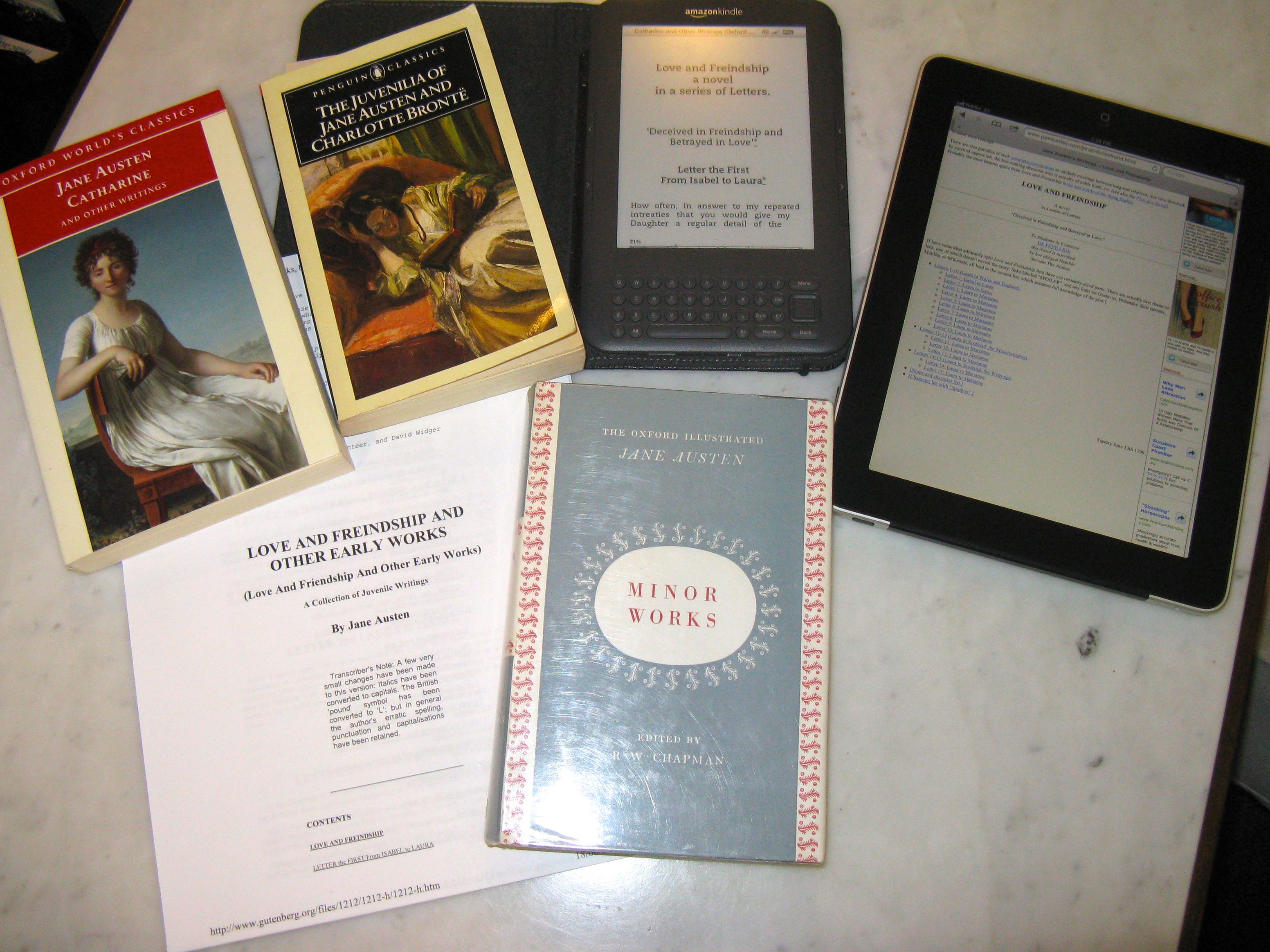
Love and Freindship editions

Love and Freindship editions

If you are a Jane Austen fan, you don’t just read her six novels. You read her letters, her unfinished works and her juvenilia. And you read them more than once. So it is that I have just – for my local Jane Austen group – reread Love and freindship (sic), the short epistolary novel she wrote in her 15th year. It is a fun – and illuminating – read. It’s the illuminating part that I plan to focus on here.

But first, a little about the plot. It commences with a letter in which Isabella asks her friend Laura to tell her daughter “the Misfortunes and Adventures” of her Life. “You are this day 55”, she says, and surely now safe “from the determined Perseverance of disagreeable Lovers and the cruel Persecutions of obstinate Fathers”. Laura, while rejecting that she is too old for such “unmerited” misfortunes, agrees to tell her story  to Isabella’s daughter Marianne as a “useful lesson”. What follows is a melodramatic story of sudden friendships, quick-not-always legal marriages, and wild coincidences, accompanied by much fainting and “running mad”.

This doesn’t sound much like the writer described by Charlotte Bronte as “sensible and suitable” does it? And, in fact, this wildly improbable, effusive story isn’t much like her. Or is it? This is the point I’d like to explore a little in my post, because there are many seeds here of the writer Austen was becoming – of the things that were to concern her and of the style she was developing.

The thing that concerned her most was to make fun of silly or ridiculous people and ideas. The most obvious of these in Love and freindship was the late eighteenth century’s cult of sensibility, which involved the favouring of sensibility over sense, the fostering of an overactive imagination (as evidenced by the popularity of Gothic novels). But what is exaggerated and parodied in Love and freindship become more considered subjects in her first novels, Northanger Abbey and Sense and sensibility.

There are, for example, obvious similarities between Laura, here, Catherine Morland in Northanger Abbey and Marianne in Sense and sensibility, but Laura’s complete refusal to recognise that sense has any place in her life is modified in Catherine and Marianne who learn through experience that their imagination and sensibilities, if left uncurbed, can get them into trouble. (Intriguingly the recipient of Laura’s letters is a Marianne. A little Austen in-joke perhaps?). Pride and Prejudice’s Lydia could perhaps be seen as Laura’s true heir: Lydia is not described in quite the same terms as Laura, but she certainly pays no credence to anything remotely sensible.

Now I’m going to be lazy and simply illustrate Austen’s changed approach with some comparative examples. Here is Laura on an older man, her husband’s father:

for what could be expected from a Man who possessed not the smallest atom of Sensibility, who scarcely knew the meaning of Simpathy, and who actually snored.

And here is Marianne, in love with the dashing Willoughby, on Colonel Brandon:

He was silent and grave. His appearance, however, was not unpleasing, in spite of his being in the opinion of Marianne and Margaret an absolute old bachelor, for he was on the wrong side of five-and-thirty; but though his face was not handsome his countenance was sensible, and his address was particularly gentlemanlike.

While Laura ends her tale with:

I took up my Residence in a romantic Village in the Highlands of Scotland where I have ever since continued, and where I can, uninterrupted by unmeaning Visits, indulge in a melancholy solitude my unceasing Lamentations for the Death of my Father, my Mother, my Husband, and my Freind.

Catherine learns her lesson and

… was completely awakened. Henry’s address, short as it had been, had more thoroughly opened her eyes to the extravagance of her late fancies than all their several disappointments had done. Most grievously was she humbled. … The absurdity of her curiosity and her fears — could they ever be forgotten? She hated herself more than she could express.

Exaggeration and parody are the tools used in Love and friendship, while the adult Austen used the more sophisticated, though no less funny, tools of wit and irony to achieve her satire.  And again, I’ll demonstrate with comparative examples. In Love and freindship she satirises novel-reading with broad humour:

“Where, Edward in the name of wonder (said he) did you pick up this unmeaning gibberish? You have been studying Novels I suspect.”

But in Northanger Abbey, the plot itself demonstrates the foolishness of reading novels unwisely, while a respected character conveys Jane’s truth:

The person, be it gentleman or lady, who has not pleasure in a good novel, must be intolerably stupid.

Love and friendship is unsubtle, and is clearly the work of a youthful writer, but it is a hoot to read and we are lucky to have it (and her other juvenilia) to show us an author in the making.

Note: Love and friendship (1790) is available in many formats and manifestations. My first copy was in RW Chapman’s edition of her Minor works, but this time I read it on my Kindle using a bought version, the Oxford World Classics edition titled Catharine and Other Writings. However, you can read (or obtain) it online at Project Gutenberg.

Jeanine Leane, Purple threads (Review for Indigenous Literature Week)

What I especially like about Jeanine Leane’s book, Purple threads, is how well she draws the universal out of the particular. That she does this is not unusual in itself. After all, this is what our favourite books tend to do. The interesting thing about Purple threads, though, is that the particular is an Indigenous one. Even as I write this post my mind is flicking back-and-forth between thinking about the Indigenous Australian themes in the book and the more universal ones about family and relationships. More on that anon. First, I want to say a little about the book’s form, because ….

I’m not sure whether to call Purple threads a novel or a book of connected short stories, except I don’t think it matters much. What is significant is that the stories revolve around a mostly female-only Indigenous Australian family living on a small piece of land in the Gundagai area of New South Wales in the 1950s to 1960s. The main characters run through the whole book, and the stories are told pretty much chronologically. There could even be a plot line or two, but they are not strong and are not what drive us to read on. This form had an eerie familiarity as I was reading and I realised it was because it reminded me of another David Unaipon Award winning book I have reviewed here, Marie Munkara’s Every secret thing. Is this a coincidence – after all, there are similar books by non-Indigenous writers – or should I go out on a limb and wonder whether this form reflects an Indigenous Australian way of story-telling? In addition to this similarity in form, these two books share a particular style of humour. Munkara’s is probably more belly-laugh, and is definitely more gut-wrenching, but both have a self-deprecating element, a willingness and ability to laugh at themselves, to see the absurd. It’s a form of humour we also see in Alexis Wright‘s Carpentaria. Okay, enough of that, back to the book itself.

The stories are told first person by Sunny (Sunshine) who lives with her sister Star, and her grandmother, Nan, and aunts, Boo (Beulah) and Bubby (Lily). Her mother, father, grandfather, more aunts and uncles, and others in the community, also appear in the book, but these five named characters are the focus. They are well differentiated. Nan is the down-to-earth matriarch of the group who doesn’t know how to read but “sure as hell know[s] how ta think”. Boo is independent and feisty, the one who takes action when action is needed. She loves the ancient Romans, particularly Empress Livia “who knew how to work behind the scenes”. Bubby, on the other hand, is the gentle, romantic one, who loves Emily Bronte and Wuthering Heights. The stories chronicle the first two decades of Sunny’s life in this female-dominated household. There are anecdotes about walks with Aunty Boo, about spoilt Petal (Sunny and Star’s mother), and about interactions with neighbours, teachers and others in the community. Most of the stories are light, albeit with a good degree of bite, but some are dark, such as the story of the young white neighbour, Milli, who is regularly beaten by her husband. This story, in fact, forms a minor plot line in part of the book.

The universal themes are about the way families comprise different and sometimes conflicting personalities and yet manage to love and support each other to ensure their joint survival. The particularity, though, has to do with being Indigenous, with being lesser, in a rural community. Leane handles this cleverly, using, for example, the Christian symbol of “the black sheep” throughout the book to tease out the ironies and complexities packed into this idea when it is played out in a sheep-farming community. The symbol is explicitly introduced to us in “God’s flock” where Sunny talks about going to church and being taught the story of “the black sheep”:

‘ … But Jesus, if we pray to him [the priest says], will find all the lost sheep and return them to the fold, even the black sheep that no one  else wants or loves.’

At least this bit made sense to us. Apart from Jesus, we didn’t know any other sheep farmer who loved black sheep. Most hated them, in fact. That’s why every year my Aunties always ended up with a few black lambs to raise ….

Leane shows how Nan and the Aunties navigate life in a world where “black was not the ideal colour” and in which “women livin’ by themselves are always easy targets”. They navigate it with dignity, often by pretending to go along with white society’s ways while staying true to their own values, which involve respecting and caring for other people and creatures and for their little bit of land.

Purple threads, apparently drawn from Leane’s life, provides an engaging but uncompromising insight into a life most Australians know little about. I hope I’m not being too pompous when I say that we need more books like this, and they need to be read by more people, if we non-Indigenous Australians are to have a chance of truly comprehending the experience of being Indigenous in our nation.

Read for ANZLitLovers Indigenous Literature Week, for which Lisa has also reviewed it.

Jeanine Leane
Purple threads
St Lucia: University of Queensland Press, 2011
157pp
ISBN: 9780702238956

(Review copy supplied by University of Queensland Press via ANZLitLovers blog giveaway. Thanks Lisa. Thanks UQP)

* I have assumed copyright permission for this cover on the basis that the book was provided by UQP

Elizabeth Harrower, The watch tower (Review)

Elizabeth Harrower The watch tower
Cover for The watch tower (Courtesy: Text Publishing)

Elizabeth Harrower’s fourth and final novel, The watch tower, is a rather harrowing (couldn’t resist that) read. It is also an astonishing read, and I wonder why it has had such little recognition over the decades or so since its publication in 1966. Thanks to Text Classics, though, it now has a second chance. It deserves it. In fact, I’d say it is one of the best books I’ve read this year (to date, of course!)

What makes it so is the writing. It has a Patrick White-like intensity – and I can see her influence in writers like Joan London and Shirley Hazzard*. But first, a little about the content. It is set in Sydney and spans roughly the mid-1930s to around 1950. The plot is slim. It concerns two sisters, Laura and Clare, who are abandoned twice – first, albeit inadvertently, by their father (through his death when Laura is about 16 years old, and Clare, 9) and then a few years later by their selfish unloving mother who decides to return to her family in England, without them. What happens to them from this point is Harrower’s subject and it all centres on the ironically named Felix, Laura’s first and only boss, who comes to the rescue, or so it seems, when mother leaves the scene.

Laura had been a girl of dreams with the ability to achieve them. She aspired to be a doctor, but when tragedy strikes and she is taken from school, she’s not overly concerned. She “had read books” and in all but those with “circumstances ridiculously removed from hers, everything ended happily for young heroines.” And yet she also

had a sensation of having mislaid a vital pleasure that she could not remember, or a piece of herself.

Clare is younger and is less affected by having to leave boarding school, but life with their mother is no picnic. She expects her daughters to “take over”, to, in effect, run the house as well as go to school, for Clare, and business college then work for Laura. And so Laura’s life of servitude to one master or another begins, while Clare takes on the role of helper and watcher. Laura gets on with the job, generously and to her detriment, particularly when the misogynistic power-hungry Felix enters the scene. Clare sees what is going on, and expects more of life, but soon realises she

had really nowhere to go. Caught, not safe, cold – There were no reliable people.

From these premises, Harrower builds a story of psychological and physical entrapment in which both girls become caught in Felix’s malevolent net. Laura, ever the Pollyanna who believes noone would be consciously mean or vicious, becomes complicit in the destruction of her self while Clare, physically caught, maintains a vision of something better and does her darnedest to get Laura to see it too.

Harrower develops all this with a slow drip-drip, through language that is tightly pared to the essentials, through a simple but not even chronology that moves in fits and starts, and through a narrative voice characterised by subtle shifts in point of view. The focus is inwards  – on a small number of characters and their relationships with each other that rarely lets outsiders in. The result is a claustrophobic tone – and a slow build up of tension and suspense. Take this description, for example, of the women upon hearing Felix, drunk, coming down the path:

Breaking their poses like trees snapping branches, the women urgently regarded each other, cleared away all signs of work in an instant, examined their souls for defects, in a sense crossed themselves, and waited.

Acts of violence do occur, but are reported in retrospect. This seems to lessen our focus on the specific event and emphasises instead the response of the two young women. Will they decide to leave this time?

Late in the novel a fourth person, 19 year-old Dutch migrant, Bernard, is thrown into the mix, creating the catalyst for the denouement. For Laura, he provides a diversion for “poor Felix” and hopefully another chance for him to show a decent side. For Clare, he shows her that for all her suffering she can still be a useful person. For Felix, he of the “cold smile” and “deaf look”, well that would be telling… And as for Bernard himself, the question is whether he will survive his Felix experience intact.

And this brings me to my final point. While she doesn’t expressly say it, and in addition to her study of power and control, Harrower seems to be exploring ideas about the soul (a person’s essence) and character. Where does one end and the other begin? How do they act upon each other, and is change possible? This is a book I won’t quickly forget.

POST-SCRIPT, 2025: I wrote here about “power and control”, because the term “coercive control” by which it would now be known, was not in public parlance.

Elizabeth Harrower
The watch tower
(with a new introduction by Joan London)
Melbourne: Text Publishing, 2012
335pp.
ISBN: 9781921922428

(Review copy supplied by Text Publishing)

* Hazzard is only 3 years younger than Harrower but her first novel was published, I believe, in 1966, the year this, Harrower’s last, was published.