Hannah Kent, Burial rites (Review)

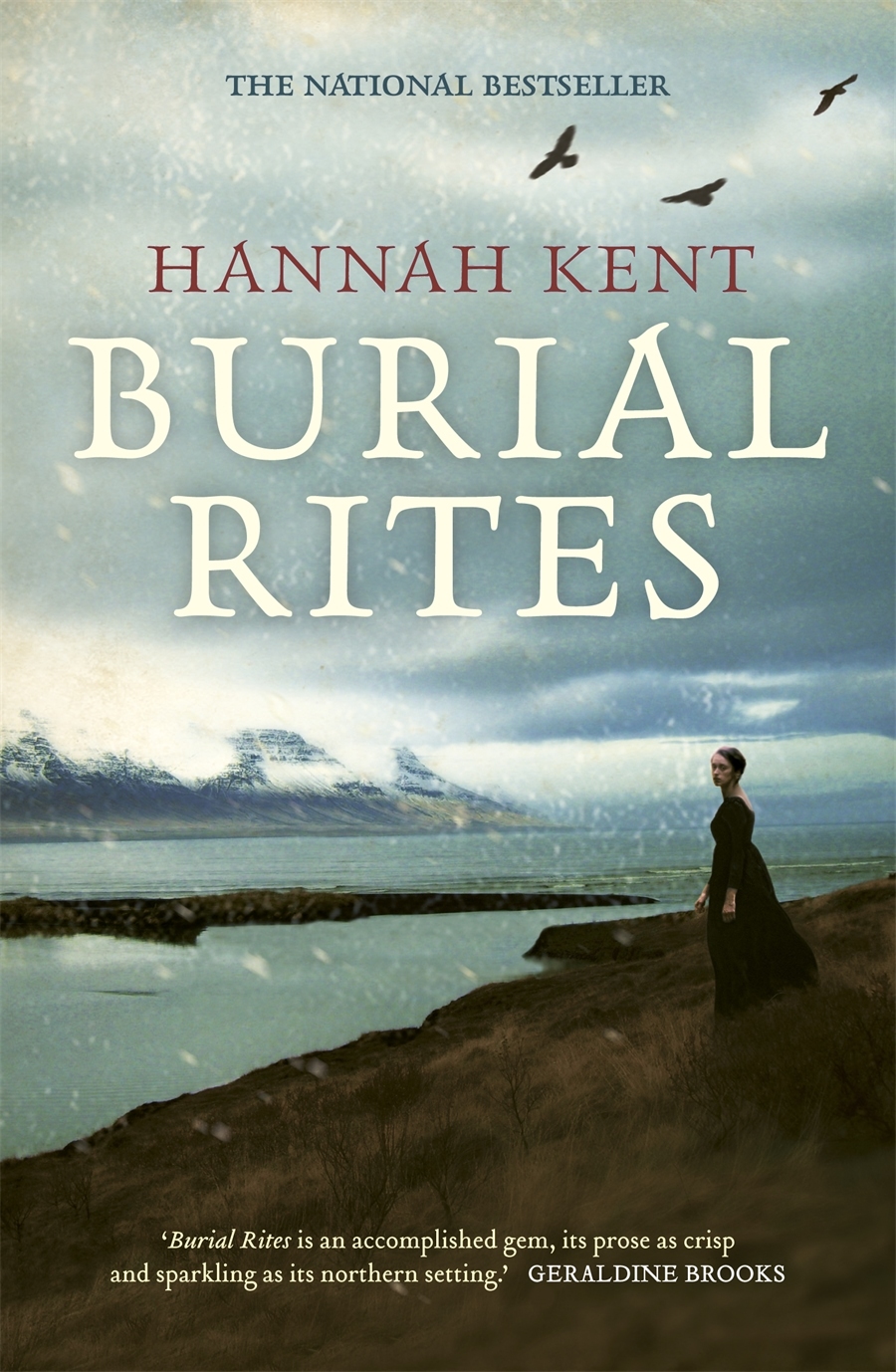
Hannah Kent, Burial Rites bookcover

Courtesy: Picador

“We’ll remember you” says Margrét to Agnes on the day of her execution. We sure will, if Hannah Kent’s debut novel Burial rites has anything to say about it. Kent’s book is the second novel set in Iceland I’ve read, the first being Icelandic writer Halldor Laxness’s unforgettable Independent people. Although Laxness’s novel is set a century after Burial rites, it prepared me for Kent’s novel – for the difficult landscape, the hard lives, and the unforgiving natures that such an environment can engender. Yes, that’s a generalisation I know. You can find unforgiving natures anywhere, but oh, they work so well in harsh environments. Just think, for example, of My Antonia (my review).

But now, what to say about a book that hit the book stands running? I wanted to read it last year, but I also wanted to read it with my reading group, which is why I have only now read it. Reading a book so late can make it difficult to add anything meaningful to the conversation. Fortunately though, while I couldn’t avoid the early buzz, I haven’t read the myriad reviews out there, enabling me to come to it reasonably freshly. So, here goes …

Remember your place, Agnes

It’s a compelling read. Icelanders may know the basic story, but we don’t. It concerns Agnes Magnúsdóttir – great sounding name, eh? – who, in 1830, was the last person to be executed in Iceland. She and two others, Fridrik Sigurdsson and Sigrídur Gudmundsdóttir, were convicted of murdering Natan Ketilsson, a complicated and probably cruel man, and his friend Pétur. Fridrik was also executed, while Sigrídur’s sentence was commuted to life imprisonment. Apparently, executions were normally carried out in Denmark but District Commissioner Björn Blöndal wanted to make an example of Agnes. As it would take some time to organise the executions and as Iceland had no real prison facilities, Agnes and Fridrik, were, literally, farmed out to live with public officials who were also farmers. Most of the novel takes place on the farm, Kornsà, to which Agnes was sent. The main characters, there, are the farmer’s dying wife Margrèt, her two daughters Steina and Lauga, and her husband Jón. Making regular visits is Assistant Reverend Tóti, chosen by Agnes to be her religious adviser. As the novel progresses, we also meet the victim and Agnes’s co-murderers.

Kent creates a believable world in which the people at Kornsà are initially resentful and fearful, but gradually, more gradual for some than others, come to recognise Agnes’ humanity and to believe that her sentence “isn’t right”. Similarly, the anxious but conscientious Tóti grows through his relationship as Agnes’ mentor. We learn about Agnes’ childhood, in which she is early deserted by her mother and then loses a loving foster-mother through death in childbirth. And we learn about her struggles to support herself as a woman. She thought she’d found her place with Natan, who seemed to offer her love while also offering her a job, but he soon reminds her of “her place”! Kent’s Agnes lives most of her life alone, lonely, and unsupported, which was probably not uncommon for women of her class at that time. This is, I’m sure, one of the themes Kent wants to explore in her novel.

You could argue that, overall, Kent’s women are fleshed out more than her men, but this is Agnes’ story and we know, I think, what we need to know about the men. There is a feminist reading to the book, but it is also more broadly sociological, to do with poverty and disempowerment. That women are more likely than men to find themselves in these positions is part of the problem.

This is what I told the reverend

Kent doesn’t use a simple, direct narrative to tell her story. (What novelist does in this post-postmodern world of ours!) For a start, she opens each chapter with one or more translated archival documents. This regular interruption of the main narrative could irritate readers by breaking emotional engagement with the story, but I found it enhanced the novel, particularly considering Kent’s intentions. One of these intentions, as she explained in an interview at last year’s World Book Expo, relates to the fact that she sees the novel as “speculative biography” not “historical fiction”. She describes, in this and other interviews, her methodology which was to use facts wherever they were available. Where the facts weren’t available, she says, she did broader contextual research about Iceland to imagine what was most likely to have occurred. She felt “free to invent” only in the outright gaps. She describes this approach as “research-driven creative-practice”. It’s logical, given all this, that she would use archival documents to support her “story”.

The other main narrative technique Kent uses is to switch voices from first person for Agnes, to third person for everyone else. This also makes sense given that Kent’s prime motivation was to give Agnes a voice, to “find her ambiguity, her humanity” and lift her out of the prevailing, more caricatured image. Again, I think it works, mostly. Agnes’ voice is distinctive, strong, and wavers, as you would expect, from confidence and hope to anxiety and fear. However, there were times when the switch back to third person seemed unnecessary. Mostly the third person sections focus on other characters, even when they are interacting with Agnes, but on a couple of occasions the shift occurs in the middle of Agnes’ story. One minute she is telling her story – “This is what I told the reverend” – and next minute the reverend asks “What happened then” and her story continues in the third person with her words in quotation marks. This was a little disconcerting, though it didn’t spoil the story significantly.

A magic stone

While the main point of the novel is Agnes’ story, Kent, in the process, paints a rich picture of Icelandic society, of the farmers, healers, neighbours, poets, gossips, maids and so on. Religion is clearly important, but for some characters, omens and superstition are equally if not more powerful. Natan is depicted as highly susceptible to bad omens, and for Agnes the ever-present ravens – “their black feathers poisonous against the snow” – reflect her sense of aloneness, and bode ill. By contrast, stones suggest good luck:

The stone Mamma gave me before she left. It will bring you good luck, Agnes. It is a magic stone.

It is, therefore, telling when she spits out a stone from her mouth on the day of her execution.

This brings me to Kent’s writing. It’s strong, evocative and often visceral. She uses motifs, like the ravens and stones, to reinforce her ideas. (It’s probably not coincidental, either, that the novel has thirteen chapters!). She is though, a first-time novelist, and at times the writing becomes a little heavy-handed, like this, for example:

Sometimes, after talking to the Reverend, my mouth aches. My tongue feels so tired; it slumps in my mouth like a dead bird, all damp feathers, in between the stones of my teeth.

But who’s complaining? Burial rites is a magical read that gets you in from the first page and doesn’t let you go until you get out your hanky at the end. Consider yourself warned.

awwchallenge2014Hannah Kent
Burial rites
Sydney: Picador, 2013
Design: Sandy Cull
338pp
ISBN: 9781742612829

Jo Baker, Longbourn (Review)

Jo Baker, Longbourn

Used by permission of The Random House Group Ltd

“Never say never” is one of my favourite mottos, though I must admit there are some things I never will do, such as climb Mt Everest, say, or even write a novel. However, when it comes to reading choices, there are certain types of books that are not my preference, such as crime and Jane Austen sequels, but as regular readers will have seen over the years I can be persuaded. And so, I was persuaded to read Jo Baker’s Longbourn: Pride and prejudice, the servants’ story, a Pride and prejudice spin-off, for my local Jane Austen group’s monthly meeting. I can’t say I loved the book, but it did interest me.

So, what’s it about? As the title suggests, it concerns the “downstairs” staff, the servants, at Longbourn, the residence of the Bennet family of Pride and prejudice. These servants appear, either directly or by indirect mentions, in Austen’s novel, but of course we know nothing about their lives. Baker rectifies that in her story by exploring who they are, how they got there, and what their aims and ambitions are. There’s Mr and Mrs Hill (butler and housekeeper/cook), Sarah and Polly (housemaids) and, for a short time, James the footman. The “heroine”, if a poor orphan housemaid with bleeding, chill-blained, “pruney” hands can be called that, is housemaid Sarah. The plot, particularly concerning James and his relationship to Longbourn, is a little melodramatic and the romantic resolution a little predictable for my tastes but it is probably traditional historical fiction fare. The book is well-written, the characters realistic and engaging, and the plot well-paced. I’m no expert in the genre but it is, I’d say, a perfectly fine example.

Baker nicely handles the relationship with the “parent” novel. The downstairs staff are privy, of course, to what happens to the Bennets, so we see many of the scenes, such as Mr Collins’ proposal to Elizabeth and Lydia’s “elopement” with Wickham, through their eyes. They have their own views on the characters and their own reactions to the events. Baker’s imagination of these is completely believable. Mrs Hill, for example, is sympathetic to Mrs Bennet, understanding that much of her behaviour stems from Mr Bennet’s lack of love and respect for her. She is also very aware of the precariousness of the servants’ situation. What will happen when Mr Bennet dies and the estate falls into Mr Collins’ hands? Will there be enough work for them all as the young misses marry and leave Longbourn?

All this was interesting enough, and the story wasn’t so melodramatic that I was turned off, but what mostly captured my attention was Baker’s evocation of the life of servants in Regency/Georgian times. They work hard, and over long hours, sometimes from 4.30am to 11pm. Baker describes in some detail their duties such as laundering and the hand-ruining scrubbing needed to remove stains, the emptying of chamber pots, and the making of soap and other products such as dubbin. Their needs and feelings are rarely considered. Even “kind” employers’ like the Bennets tend to be oblivious of their servants’ lives, just as the thoughtful Anne Elliot in Persuasion doesn’t notice her sick friend Mrs Smith’s nurse. Their living quarters are cramped, in uncomfortable parts of houses, with housemaids often sharing a bed. Through James, the footman, we learn about the awful lives of young men who “take the King’s shilling” and end up fighting in harsh conditions, treated like fodder and at the mercy of corrupt superiors. James realises:

I had handed my freedom right over. I signed it clean away. I sold myself.

In addition to these rather era-specific aspects of the book were references to behaviours that are more universal to relationships involving disempowered people. One relates to naming. There are two such situations in Longbourn. There’s housemaid Polly whose real name is Mary, but

It’s only ‘cos she’s the Miss and I imnt, that she got to be called Mary, and I had to  be changed to Polly, even though my christened name is Mary too.

This practice, we know, wasn’t limited to English servants. It happened regularly, for example, with indigenous people, as Kim Scott tells us regarding the naming of Bobby in That deadman dance (my review), and Eleanor Catton regarding her Maori character in The luminaries (my review). Then there’s Bingley’s footman, the mulatto Ptolemy Bingley. When Sarah questions his last name, he says:

If you’re off his estate, that’s your name, that’s how it works.

The other issue that struck me was the way servants watch their masters/employers. I’ve already noted that the employers often didn’t notice their servants, but the servants sure noticed them – and more than was simply required for the work they were employed to do. Servants needed to watch because their lives were closely attached to the fortunes of their masters. Similarly, I’ve read that indigenous Australians watch and know non-indigenous Australians way better than we know them. As indigenous activist Lee says in Margaret Merrilees’ The first week (my review):

You think we can’t see you? You think we haven’t been watching you for two hundred years? We’ve had to find out everything there is to know about you.

These sorts of insights are, for me, one of the prime values of reading historical fiction – the lessons learned about how we’ve been and behaved, and the historical continuities between people and times. It’s for these reasons, in particular, that I’m not sorry I devoted some precious reading hours to reading Longbourn.

Jo Baker
Longbourn: Pride and prejudice, the servants’ story
London: Doubleday, 2013
365pp.
Design: Clare Ward
ISBN: 9780857522023

Angela Savage, The dying beach (Review)

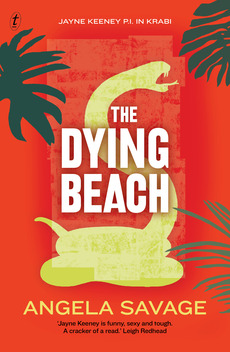
Angela Savage, The dying beach

Courtesy: Text Publishing

When I received Angela Savage’s novel The dying beach out of the blue last year as a review copy, I didn’t put it high in my list of reading priorities. I had – and still have – a pile of books waiting patiently, and I rarely (never say never) read crime novels. However, two things changed my mind. One is that Christos Tsiolkas dedicated Barracuda to Savage, and the other is that this year, for the first time, I will visit Thailand, which is the novel’s setting. So, I read it!

The dying beach is apparently Savage’s third Jayne Keeney novel. Jayne is a Private Investigator, an expat Australian living in Bangkok. Like many female PIs, she’s gutsy, hard-living, resourceful, somewhat of an outsider, and rather inclined to bristle if her independence is questioned. (Perhaps this latter is not confined to female PIs, but can be said of many women working for a living in a male dominated environment.) In this, her third outing, she’s holidaying in Krabi with her new (I believe) business and romantic partner, Rajiv, an expat Indian. They are a bit of an odd couple, but we all know about opposites attracting:

Jayne had never imagined she could find love with a man five years her junior, whose background was so different from her own. But Rajiv gave her a whole new way of viewing the world. As if he’d walked into her life and drawn back the curtain, revealing a window she hadn’t even known was there.

I love that image of “revealing a window she hadn’t even known was there”. Savage’s writing is pretty direct, keeping a good pace appropriate to its genre, but that doesn’t mean that it lacks lovely descriptions and turns of phrase. Indeed, the language is one of the delights of the book. Without disturbing her pacing, Savage regularly surprises with telling descriptions. This, for example, gives you a perfect picture of Jayne in full flight:

She was like an appliance without an off switch that kept accelerating under pressure until it threatened to short circuit.

The novel opens with a sort of prologue in which Sigrid, who doesn’t play an ongoing role in the novel, finds a body floating in the water at Princess Beach. Sigrid is surprised to discover that it’s the tour guide Pla whom she’d spoken to only that week. She notices some bruises around the neck suggesting Pla “did not die gently”. The novel proper then starts at Chapter 1 with Rajiv and Jayne in bed. It’s here (in the chapter not the bed!) that Savage provides us with the necessary background to their relationship, to where it stands at this point, and implies tensions that may play out in the future – as indeed they do. There is, in other words, a love story to this crime novel. At the end of this chapter they front up to the counter at Barracuda (surely a little homage to Christos Tsiolkas) Tours planning to book a tour with the “exceptional guide” they’d had a couple of days previously – the unlucky Pla, of course. And so the scene is set for their holiday to become another job, albeit unpaid, something that bothers the practical Rajiv but not our justice-seeking heroine.

I’m not going to write a lot more about the story, because it’s the sort of book people read for plot and surprises, and I don’t want to give them away. I will say though that it offers lovely insights into Thai character and culture. It is also unashamedly political with its plot revolving around the conflict between economic development and environmental degradation. The title itself refers to the fact that mass shrimp-farming results in the destruction of mangrove forests which in turn causes the beaches to “die”.

Savage also presents a critique of Australia, when she has Jayne contemplate why she is living in Thailand:

Truth was Jayne had long felt an outsider among her peers. Since her final year of high school, in fact, when she spent six tantalising months on a student exchange in France. When she returned home, her passion for the outside world met with a lack of interest, if not downright hostility – as though it was disloyal to find anywhere as attractive as Australia. […] For all that Australians like to boast about the national larrikin spirit, in reality only irreverence was tolerated. Unconventionality was not.

It’s a little didactic, but ouch! There is, unfortunately, some truth in this.

The final point I’d like to make relates to its narrative style. Having read several complex novels recently, that is, books with shifting points of view and intricate chronologies, I rather enjoyed reading something more straightforward. I say this, however, comparatively speaking, because The dying beach does not have a simple, linear chronology. Not only are there a few flashback chapters interspersed strategically through the book, but occasionally the narrative focus shifts from Jayne and her cohort to a couple of characters who appear to be implicated in at least some of the murders. The voice is essentially third person omniscient, though sometimes we seem to shift inside a character’s head. Savage does it well, and I enjoyed the change after the intensity of my recent reads.

The dying beach is a compelling page-turner that also makes some points about cultural difference and tolerance, the challenge of tourism, and the complexity of environmental management in developing countries. It achieves this without, to the best of my admittedly limited knowledge, deviating dramatically from the conventions of its genre. And that is a good thing, because the result is the sort of novel that could appeal to a cross-over audience. The challenge, though, is how to get readers, like me for example, to cross over.

awwchallenge2014Angela Savage
The dying beach
Melbourne: Text Publishing, 2013
339pp.
Cover design: WH Chong
ISBN: 9781921922497

(Review copy supplied by Text Publishing)

Christos Tsiolkas, Barracuda (Review)

Christos Tsiolkas, Barracuda

Courtesy: Allen & Unwin

The best way I can describe Christos Tsiolkas’ latest novel Barracuda is to liken it to what Tsiolkas would define as a “good man”, tough on the outside, but tender within. I don’t know how Tsiolkas does it, but he manages to reach into your heart while at the same time confronting you to your core.

On the surface, Barracuda is about success and failure, specifically in sport. The plot concerns Danny Kelly aka Psycho Kelly aka Barracuda who is a talented swimmer. He receives a scholarship to attend one of Melbourne’s elite private schools and be coached on the swim team. Danny, with his Scottish truck-driving father and Greek hair-dresser mother, is not the normal demographic for the school and feels an outsider from the start, but he knows – or believes, at least – that he can be “the strongest, the fastest, the best”. However, things don’t go according to plan and Danny, who had poured his all into a single vision for his future, is devastated. The novel explores how a young man copes with such a major blow to his self-image, what happens when his expectations for his future are destroyed. Tsiolkas examines the social, political and economic environment in which Danny lives and the role they play in what happens to him, but he also delves deeply into the psyche, because what happens to Danny can only be partly explained by external forces. In the end we are, as Danny comes to realise, responsible for ourselves and our actions.

Contemporary writers annoyed him

Barracuda is quite a page-turner, but it bears slow reading, because it is a carefully constructed novel and some of its joys come from considering what Tsiolkas is doing. There is an amusing moment in the book when Danny, now in jail, becomes an enthusiastic book reader – primarily of 19th century novels. When the librarian asks:

‘Why are you always buried in those old farts?’ Danny would accept the teasing good-naturedly for he knew it was apt. Contemporary writers annoyed him, he found their worlds insular, their style too self-conscious and ironic.

I say amusing because there’s a self-consciousness in Tsiolkas’ style and I can only assume that he is having a little dig at himself. The novel’s structure reminded me somewhat of Evie Wyld’s All the birds, singing (my review) because both start at a point in time and then, in alternating chapters (sections), radiate forwards and backwards from that point. Tsiolkas, though, follows this structure a little less rigorously than Wyld, and he combines it with a change in person. In the first half of the novel, the sections moving backward are told in third person (limited) through the eyes of Danny, while the sections moving forward are told in first person through the eyes of Dan. This effectively enables the growing, maturing Dan to disassociate himself somewhat from his old self, although the dissociation – or perhaps the reintegration – of the two selves have a long way to go when the book opens. In the second part of the novel the point-of-view is reversed with the third person used for the older Dan, and first person for the younger, perhaps suggesting some progress towards the realignment of the selves? I need to think about this a bit more! Not only does this book warrant slow-reading, but rereading wouldn’t hurt either.

He couldn’t bridge the in-between

A significant issue for Dan is managing the two worlds he finds himself in:

It’s like two worlds were part of different jigsaw puzzles. At first, he’d tried to fit the pieces together but he just couldn’t do it, it was impossible. So he kept them separate: some pieces belonged to this side of the river, to the wide tree-lined boulevards and avenues of Toorak and Armadale, and some belonged to the flat uniform suburbs in which he lived.

When the two worlds conflict, Danny feels split open, cracked apart. “No one could ever put him back together”. And so, he starts to occupy what he calls “the in-between” but that leaves him silent, and alone. This dissection of worlds, of  “class”, and of anglo-Australia versus immigrant Australia, is an ongoing concern for Tsiolkas. We came across it in his previous novel, The slap (my review) and we see it again here. Tsiolkas is not the only writer exploring this territory, but he’s one of the gutsiest because he’s not afraid to present the ugliness nor does he ignore the greys, the murky areas where “truth” is sometimes hard to find (though he doesn’t use the word “truth”).

While Danny is the main conduit for teasing out the tensions in society between two worlds, other characters also reflect it. There’s Danny’s childhood friend, Demet, whose working class migrant background is challenged when she goes to university, and his school friend Luke, a nerdy ostracised boy at the elite school who, with his Vietnamese mother and Greek father, is also “half and half”. These characters manage to traverse their worlds more easily than Danny, but Tsiolkas shows that it isn’t easy.

His father was a good man

Barracuda is about a lot of things. It’s not an exaggeration to say that Tsiolkas taps into the zeitgeist of contemporary suburban Australia. But I might explore that in another post, because this post is getting long and I do want to end on the theme that struck me the most, that of defining “a good man”.

Throughout the novel, Danny meets many men – his father, grandfather and coach, in particular, when he’s a boy, and his lover Clyde, old schoolmate Luke and brain-damaged cousin Dennis when he’s an adult. As an adolescent, and somewhat typically, Danny loves his grandfather, rejects his father, and dotes (until he “fails”) on his Coach. Adult Dan is more circumspect about men, but sees good qualities in Clyde and Luke, while still rejecting his father. None of these men, though, seem able to break through his destructive self-absorption. However, late in the novel, living a self-imposed lonely life, albeit one now committed to helping others, Dan has an epiphany. In a confrontation with his father, he suddenly realises:

His father was a good man. It struck him with a force of revelation, exultation, light flooding through him. His father was a good man. His father was the hero of his own life.

At this moment, he realises he wants to be a good man. He also starts to get a glimmer of what a good man is, and it has nothing to do with being the strongest, fastest and best.

I have more to say about this book, and so will do a follow-up post rather than write a longer essay here. Meanwhile, I know there are readers of this blog who do not like Tsiolkas. He is, I agree, a confronting writer. His characters are not aways easy to like, and he doesn’t shy away from their grubbiest (that is, unkind, violent, sexual) thoughts, but for me he has some valid concerns to share and I want to hear them.

Christos Tsiolkas
Barracuda
Sydney: Allen & Unwin, 2013
515pp.
ISBN: 9781743317310

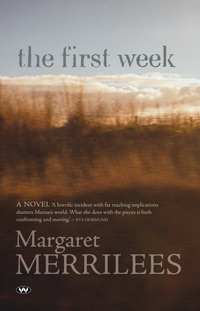
Margaret Merrilees, The first week (Review)

Margaret Merrilees, The first week

Courtesy: Wakefield Press

Having discussed in this week’s Monday Musings Margaret Merrilees’ essay on white authors writing about indigenous Australians, I’m now getting to my promised review of her debut novel, The first week, in which she does just this. It also, according to Wakefield Press’s media release, won the Adelaide Festival’s Unpublished Manuscript Award in 2012. I can see why it did.

The plot is simple. It chronicles the first week in the life of Marian, after she hears shocking news about something her adult son Charlie has done, news that would chill the heart of any parent. Marian is a middle-aged, widowed countrywoman who jointly manages a farm with her oldest son, Brian. She holds the conservative views that would be typical of her demographic. The setting is south-west Western Australia, the Noongar country of Australian author Kim Scott whose That deadman dance (my review) tells of early contact in that very region, but Marian understands little of that. She’s about to learn though, because, standing at a fence that she used to clamber through, she realises

… it was different now. There was a claim on it. This fence, a fence she’s ignored for years, had taken on new meaning. Where she stood was her land. The other side was theirs. Someone’s. Those Noongars from town.

What would they do with it? Any more clearing would be a disaster. The salt was already bad down there.

This comes early on day one, Monday, before she hears the news about Charlie, but already Merrilees has introduced us to Marian, the land she works and her attitudes. She clearly has little respect for “those Noongars from town” and yet she knows the land has been damaged. Merrilees also describes other aspects of Margaret’s life that will help inform our understanding of the week to come – guns, the family’s dynamics including her relationship with her troubled late husband, a dependence on a more savvy friend. It’s all lightly, naturally done through a well controlled third person voice.

By day two, Tuesday, Marian is in Perth, where the first order of the day is to attend Charlie’s arraignment in court. Here she meets Charlie’s housemates and is invited to their home to talk about what has happened – and there she meets Charlie’s neighbour and friend, the indigenous woman, Lee. In addition to the reference to “those Noongars” on Monday, Merrilees leads us up to this meeting with other suggestions of Marian’s prejudiced attitudes to “other” (to Asians and Aboriginal Australians). Needless to say, her meeting with the educated, political Lee does not go well.

This is where Merrilees confronts the issue she addresses in her essay, because for Marian to develop she needs to hear from indigenous characters. Marian meets Lee cold, that is, she doesn’t know Lee is indigenous: “No one had mentioned that. They wouldn’t think it mattered, probably. But it did.” Lee tells her about the Reserve in her region, about the treatment of indigenous people there and in the town. Marian doesn’t want to know – or believe – what she hears. She uses those patronising words “you people” and leaves in rancour. However, she is a woman still in shock and, knowing that all this has something to do with Charlie’s actions, her better self starts to realise that “she had to know whatever there was to know”. She reads Lee’s paper, attends Lee’s talk, and converses again with Lee. Lee is presented as fair but determined. She doesn’t go easy because Marian’s in pain, and when Marian admits that Lee has made her think, and that she’s ready to learn, Lee tells her:

Then you owe me … I won’t forget. Salvation doesn’t come cheap.

To my white Australian mind, Merrilees handles her indigenous characters well. They ring true to what my experience and reading tell me, but, as Merrilees also says in her essay, “it is not for a white writer or critic to decide what is appropriate.” I would love to know what indigenous readers think.

And this segues nicely to what I most enjoyed about the book – its humanity and lack of judgement. Merrilees lets her characters be themselves, warts and all. Lee, for example, is rather fierce but open to discussion and sad about the direction Charlie took. Marian is conservative, in great pain and feeling a failure as a mother, but is open to change. I particularly liked the way Merrilees captured the physicality of Marian’s pain – she can’t eat, or sleep, or remember her son’s phone number, her chest tightens, her heart races. From my own experience of an awful shock, I related to the point where she really has to face her changed circumstance:

Getting out of the car and leaving it behind suddenly seemed difficult. Her last tie with home and normal.

If my review has seemed a little vague about detail, that’s partly because the book is too. There’s a lot we aren’t told about what exactly happened, about why Charlie did what he did, but that’s because he is not the book’s main subject. Early in my reading, I was reminded of Lionel Shriver’s We need to talk about Kevin. This, though, is a different book. Yes, both books are about a mother and a terrible act by a son, but Merilees’ compass is broader. It’s both personal and political. And so, on the personal level, Marian realises that she can – she will – survive. But it’s the political lesson that is dearest, I think, to Merrilees’ heart, and it is simply this, “that she, Marian, was ready to listen” to Lee’s story, to listen to it “wherever and in whatever way” suits Lee. The first week is a compelling read with, dare I say it, an important message. I hope it gets out there.

Lisa (ANZLitLovers) also recommends this debut.

awwchallenge2014Margaret Merrilees
The first week
Kent Town: Wakefield Press, 2013
225pp.
ISBN: 9781743052471

(Review copy supplied by Wakefield Press)

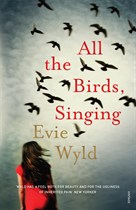
Evie Wyld, All the birds, singing (Review)

Evie Wyld, All the birds, singing

Courtesy: Random House Australia

Quite by coincidence, I read Evie Wyld’s second novel All the birds, singing straight after Eleanor Catton’s The luminaries. I was intrigued by some similarities – both have a mystery at their core, and both use a complex narrative structure – but enjoyed their differences. Wyld’s book is tightly focused on one main character while Catton’s sprawls (albeit in a very controlled way) across a large cast. Paradoxically, Wyld’s 230-page book spans a couple of decades while Catton’s 830-page one barely more than a year. And yet both convey, through their structures, an idea of circularity, of the close relationship between beginnings and endings. But, enough prologue. On with All the birds singing.

The book opens powerfully:

Another sheep, mangled and bled out, her innards not yet crusting and the vapours rising from her like a steamed pudding. Crows, their beaks shining, strutting and rasping, and when I waved my stick they flew to the trees and watched, flaring our their wings, singing, if you could call it that. I shoved my boot in Dog’s face to stop him from taking a string of her away with him as a souvenir, and he kept close by my side as I wheeled the carcass out of the field and down into the woolshed.

And so we are introduced to Jake and the things that dominate her life – Dog, sheep and birds. Soon, we learn there’s another thing – fear. But fear of what, or whom, we don’t know. From this opening, Wyld tells her story in alternating chapters: the odd ones, set in England, move forward, and the even ones, in Australia, move back to what started it all. It’s an effective structure that explores the ongoing impact on Jake of whatever it was that happened. We see what’s happening now, and we slowly see how she has got to this point.

Jake, at the start of the novel, is in her 30s. She’s a loner, capably running a sheep farm on a remote British island. Her nearest neighbour, Don, keeps a bit of a fatherly eye on her, and tries to encourage her to engage with the local community, to go to the pub for example, but Jake is not interested. As we move back in time we learn snippets about various significant people in her life – a lover while she was a shearer, a controlling man whom she’d initially seen as her rescuer, a female friend and co-worker. We also learn that she’s estranged from her Australian family, and we discover that she has scars on her back, but how they were caused are part of the mystery.

Wyld’s writing is marvellous. The imagery is strong but not heavy-handed because it blends into the story. The rhythm changes to suit the mood. The plot contains parallels that you gradually realise are pointing the way. There’s humour and irony. I love the fact that our Jake, on the run from whatever it is, smokes “Holiday” brand cigarettes.

There’s a bleakness to the novel, but it’s not unremitting. Jake, always the outsider, is tough and resourceful. She sleeps with a hammer under her pillow, but she has a soft side that is revealed mostly through her tenderness towards her animals. She talks to Dog, and losing a sheep always brings “a dull thudding ache”. The imagery is focused. Black, shadows, and fire in various permutations recur throughout the novel. They provide possible clues to what started it all; they contribute to the menace she feels now; and they help create an unsettling tone for the reader. We are never quite sure whether the shadow she sees out there, watching, following her, is real or a figment of her imagination. Jake is not an unreliable narrator, but we see through her eyes, and her eyes are influenced by her very real fears. She is “damaged goods”, though not in the sense meant by the paying customer (if you know what I mean!) offended by her scarred back.

And of course, there are the birds. They’re omnipresent. Sometimes they reflect her mood (“the birds sing and everything feels brand new”); sometimes they break tension; sometimes they suggest death. There are specific birds – butcher birds, night jars, galahs, merlins, currawongs and crows – and there are birds in general. The imagery references the real and metaphorical, from the crows hovering over the dead ewe in the opening paragraph to the birds near the end that attend the defining event:

[…] and the birds scream, they scream at me, Chip, chjjj, cheek, Jaay and jaay-jaay notes, Tool-ool, twiddle-dee, chi-chuwee, what-cheer … Wheet, wheet, wheet, wheet […]

awwchallenge2014It’s deafening. But it’s the silence and the dead birds afterwards that impresses the full horror on us:

The trees don’t want me there … There’s not a single bird to make a sound.

All the birds, singing is about how the past cannot “be left alone”. “We’ve all got pasts”, the shearers’ boss tells Jake early in the novel, but for some people the past must be dealt with before they can move on. The novel is also about redemption. It’s not the first novel about the subject, and neither will it be the last, but it is a finely told version that catches you in its grips and makes you feel you are reading it for the first time.

John at Musings of a Literary Dilettante loved the book too. Thanks to my brother and family for a wonderful Christmas gift!

Evie Wyld
All the birds, singing
North Sydney: Vintage Books, 2013
232pp
ISBN: 9781742757308

Eleanor Catton, The luminaries (Review)

Courtesy: Allen & Unwin

Courtesy: Allen & Unwin

Now here’s the thing … I don’t make a practice of reading mysteries. I really don’t care about who dunnit. When Mr Gums and I watch television crime shows, I rarely concentrate enough to work out the plot intricacies, but I do watch the characters. I’m always interested in the detectives and their relationships. I want to know who they are and what makes them tick. And so, I must say that I got a little tired of the plot machinations in Eleanor Catton’s Booker prize-winning novel, The luminaries. I didn’t really want to expend effort to keep track of the complexities of whose gold went where, who told whom what, and so on. But, I did find the book an interesting read, nonetheless.

Why? Well, first and foremost because of the characters. In the first half of the novel, as the characters were being introduced, I was impressed by Catton’s understanding of human nature.  Her characters, most of them anyhow, are nuanced – if that’s not too clichéd a term. Here for example is Thomas Balfour:

When a restless spirit is commissioned, under influence, to solve a riddle for another man, his energies are, at first, readily and faithfully applied. But Thomas Balfour’s energies tended to span a very short duration, if the project to which he was assigned was not a project of his own devising. His imagination gave way to impatience, and his optimism to an extravagant breed of neglect. He seized an idea only to discard it immediately, if only for the reason that it was no longer novel to him; he started in all directions at once. This was not at all the mark of a fickle temper, but rather, of a temper that is accustomed to enthusiasm of the most genuine and curious sort, and so will accept no form of counterfeit – but it was nevertheless, something of an impediment to progress.

This made me laugh. Not all descriptions did of course, but most are insightful of humanity.

There is also humour in the book – some funny scenes, and wry asides. Since we’re on Thomas Balfour, let’s stay with him. Here he is meeting the chaplain Cowell Devlin:

‘Good morning’, returned the reverend man, and from his accent Balfour knew at once that he was Irish; he relaxed, and allowed himself to be rude.

Thomas, as you might have guessed, is English – and this of course tells us more about him than about Devlin.

Perhaps at this point I should mention the plot, though as a Booker Prize Winner, its basic premise is probably known to most of you. The novel is set in the New Zealand goldfields, Hokitika mainly, over 1865 to 1866. The plot concerns the death of one man, the disappearance of another, an apparent suicide attempt, and the provenance of a gold fortune. There are 20 main characters – 12 described as stellar, representing the 12 astrological star signs; 7 described as planetary, representing, of course, the planets; and one, the dead man, described as terra firma. It’s a lot to keep in your head but Catton does provide a character chart at the front to help.

There is a lot to enjoy while reading this book, in addition to the characterisation and humour. The plot is intricate and fun to unravel if you enjoy mysteries. The goldfields setting is realistic, with its businessmen, publicans, politicians, prospectors, whores, opium dealers and tricksters, not to mention the salting and the duffers. The writing is sure. I enjoyed her use of imagery. Grey and yellow feature throughout as do references to spirits (ethereal, emotional, and alcoholic), ghosts, apparitions, phantoms, fog and mist. These all helped convey a sense of murkiness, and of things shifting before our eyes.

The main themes are to do with truth, lies and fraud, with love, loyalty and betrayal. It’s quite a cynical world that our characters find themselves in. As the not-yet dead man, Crosbie Wells, says to the whore, Anna Wetherell:

There’s no charity in a gold town. If it looks like charity, look again.

There is, of course, but it’s rare – and, as Wells advises, you have to be darned careful about who you trust, because, human nature being what it is, where there’s gold, there’s always greed.

The big challenge of this novel is its structure. I’ve already mentioned the structure of the characters. The astrological theme is carried through into the structure of the narrative. The book is divided into 12 parts which, I learnt at my reading group, are meant to align with the lunar cycle, each part being exactly half the length of the previous part. This didn’t feel artificial, because the increasingly shorter parts provided a rhythm to the unravelling of the plot. The other point to make about the structure is that the novel commences on 27 January 1866, 13 days after 14 January when the critical plot events take place. The novel then moves forward, through the trial and its aftermath, to 27 April 1866 (Part 4). In this part, we also jump back, in alternating chapters, to 27 April 1865, when the major players in the plot start, shall we say, “orbiting” each other, if not downright colliding. The novel then progresses forward again, ending on 14 January 1866, not quite back at the beginning, but on the day that precipitates the narrative.

There is, then, a certain circularity to it all, but what does it mean? Does this structure do anything for we readers? I’m not sure. There are intricate astrological charts at the beginning of each part showing where the 12 characters are positioned, astronomically speaking, on that date. I don’t have the astrological knowledge to know whether these charts added meaning or not. The circularity does, however, suggest another potential theme – which is, as chaplain Devlin says, that:

Some things are never done.

Devlin says something else too, which is reinforced by the way the narrative progresses via the stories of the various players:

never underestimate how extraordinarily difficult it is to understand a situation from another person’s point of view.

So, in the end, where did it all leave me? Wondering, in fact, whether it was just a little too clever for itself or, maybe, too clever for me. Either way, I did enjoy the read, and was impressed by the skill with which Catton executed her tale and the insight she has into human nature. Beyond that, I think it’s best if you decide for yourselves.

Lisa (ANZLitLovers) wasn’t enamoured, nor was the Resident Judge, but John (Musings of a Literary Dilettante) liked it very much.

Eleanor Catton
The luminaries
London: Granta, 2013
832pp.
ISBN: 9781847088765

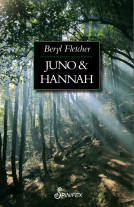
Beryl Fletcher, Juno and Hannah (Review)

Beryl Fletcher, Juno and Hannah

Courtesy: Spinifex Press

I’ve been pretty remiss in my blog regarding New Zealand literature. I have read and enjoyed several New Zealand novelists, such as Keri Hulme, Janet Frame and Fiona Kidman, but the only New Zealand writer I’ve reviewed here to date has been Lloyd Jones. And so I was both intrigued and pleased when Spinifex Press sent me Juno and Hannah by New Zealand writer, Beryl Fletcher.

I’m embarrassed to say that I hadn’t heard of Fletcher, but she has some form! Her first novel, The Word Burners, won the 1992 Commonwealth Writers’ Prize Best First Book for the Asia/Pacific region. Juno and Hannah is her fifth novel. She has also written a memoir and some short stories. The fact that four of her five novels have been published by Spinifex Press would suggest a feminist agenda but, while Juno and Hannah certainly has an element of women being challenged by patriarchal authority, it is not a preachy or proselytising book, any more than are the other Spinifex Press books I’ve reviewed. Rather, like them, its focus is women’s experience of the world.

Hmm … that’s a long introduction. Time to get to this particular world. Juno and Hannah is set in 1920s New Zealand. The eponymous sisters are living in a religious commune, and are without parents. Despite the fact that Juno’s name appears first in the title, Hannah is the older. Two things happen in the opening pages of the book which cause Hannah to “run away” with Juno. The first is that she is punished with a month’s isolation for saving a strange man from drowning by breathing life into him – and thereby arousing fears of witchcraft, of communing with the spirits. It’s a clearly unjust punishment from (the significantly named) Abraham, who claims to adhere to “the sacred principles of Christian justice”. The second thing is her hearing that the community plans “to get rid of” 14-years-old Juno, probably to an orphanage in town. Juno, you see, requires special care as she is not quite normal – and the so-called Christian community “can’t carry a non-productive member”. This sets up what is essentially a Gothic adventure tale in which Hannah, with the help of a strange assortment of others, searches for a secure home for Juno and herself.

The novel (novella, really) is a page turner. There are good guys and bad guys (including eugenicists who have their sights on the “mentally defective” Juno), but sometimes we can’t always be sure who are the good guys. Hannah, a resilient and loyal young women but one who experienced abandonment at an early age, finds it hard to trust anyone, including those who offer help. In this mix are Hannah’s mother, her father and his mistress, the man she’d saved, and his sister. There are all sorts of Gothic archetypes here – cottages in the wood, horses pushed to their limits, storms, secrets, a sanatorium. While the story is told third person, we see much of it through Hannah’s inexperienced eyes, so when she is unsettled, so are we. And rightly so, because the world is an uncertain place.

Fletcher’s style is plain, direct, and yet also poetic. It comprises mostly short sentences, which keep the plot moving but which are interspersed every now and then with more Gothic descriptions. These are particularly effective because they are not overdone:

When the southerly blew itself out, fog crept up from the river and devoured all before it. Not one leaf moved, not one bird sang. One by one the trees melted away. The fog brought a terrible silence outside her prison that emulated the social death within.

And:

Something had changed. The hut was withdrawing into itself; the fire had gone out, empty tins had been dropped onto the clay floor. She touched the glass chimney of the paraffin lamp. It was cold.

I enjoyed reading this book, but am having trouble writing about it. I think this is because the themes are carried primarily through the plot. By this I mean, they are conveyed by who does what with whom, who appears and disappears, who chases whom, and who helps whom. I don’t really want to explain too much for fear of giving the story away. Briefly, though, the main themes are resilience and trust. As a young vulnerable woman responsible for an even more vulnerable sister, Hannah needs to be resilient to survive the world she finds herself in. She also needs to trust, but she must temper this with wariness because the world is not a safe place. Another theme is the responsibility to protect weaker members of our society, as Hannah does for Juno, but as was not done for her when she was “abandoned” in the religious community. In fact, “abandonment” is another theme. And finally is the theme of nurturing. Clearly, Hannah nurtures her sister, but the theme is also conveyed through the act of bread-baking, which occurs throughout the novel. Hannah is good at it, so is her mother Eleanor. Providing bread to others in need is one of the final, reassuring images of the novel.

Juno and Hannah is a compelling read. There were times when the plot seemed to be slipping from my grasp. Loose ends perhaps, or maybe just part of the uncertain world Fletcher was creating.  It was never enough, however, to stop my being invested in Hannah and her trials. There’s something about Fletcher’s direct narrative style evoking an almost other-worldly setting that drew me in. I didn’t want to put it down.

awwchallenge2014Beryl Fletcher
Juno and Hannah
North Melbourne: Spinifex Press, 2013
174pp.
ISBN:9781742198750

(Review copy supplied by Spinifex Press)

NOTE: I have included this review in the Australian Women Writers Challenge because Fletcher’s primary publisher is Spinifex Press (and because someone before me has also included her!). I hope Fletcher and any New Zealand readers here aren’t offended!

Diego Marani, The last of the Vostyachs (Review)

Italian writer Diego Marani‘s The last of the Vostyachs was originally published in 2002, but the English translation was not published until 10 years later in 2012. How lucky we are that it was, because this book is unlikely to have been written by an English-language writer. Its focus on the relationship between language, culture and place and on darker issues like ethnic nationalism comes from a different – and particularly European – sensibility. We speakers of the world’s dominant language can, I think, be a bit oblivious to the linguistic issues faced by speakers of other languages, particularly in Europe where multiple languages live cheek by jowl. The challenge of communication is an important issue for Marani who works in Brussels for the European Union. His roles have included interpreter, translator, and policy adviser on multilingualism. Marani knows as well as anyone that language is both a cultural and political issue – and this is what he explores in this, his second novel.

However, The last of the Vostyachs is no dry tome explicating the role and value of language. Instead it is a surprising and often funny novel that weaves myth and saga, melodrama and irony through the warp of a crime thriller. It incorporates a number of literary traditions and archetypes: the wild (innocent) man set loose in the city, the spurned wife, the spirit guide, the corrupt obsessive, and the remote cottage in the woods where dastardly things happen. On the night the crimes (murders, in fact) take place, nature runs amok. Zoo animals roam the city and the temperature drops to its coldest in fifty years.

The plot centres on Ivan, who is the last of the Vostyachs, an ancient Siberian shamanic tribe. He is the only one who can speak the language, though at the novel’s opening he had not spoken it (or anything else) for twenty years, not since, as a young boy in the gulag, he’d seen his father killed. When the gulag is suddenly freed, he returns to the Byrranga Mountains but all he finds are wolves. He believes them to be his people who, to flee the soldiers, had hidden deep in caves and turned into wolves. He cannot bring them back to human form but they shadow and protect him.

Every single language is necessary to keep the universe alive

Into this mix appears the plain, ethical, Russian linguist Olga who is excited to find a speaker of a language thought to have been extinct and who sees in this language an exciting connection between Europeans and the native Americans. Her old colleague, the womanising, unethical, Finnish linguist Jarmo Aurtova is not so pleased with this threat to his theory of Finnish as the “Latin of the Baltic”, as, in effect, the master language of Europe. Jarmo sounds scarily like Hitler in his desire to prove the supremacy of a pure Finnish language:

In ancient times we were the civilised ones and they were the barbarians. We were the masters, they were the slaves. Not for nothing is the word aryan so similar to the Finnic orja, which means slave.

and

But now ‘someone’ was trying to throw Finland into the dustbin of history, together with the other conquered peoples who have no future. Aurtova was not having that …

Jarmo cares not if a language or two disappears and dies in the service of his theory. He believes that the fewer the languages the more “we’re moving towards the truth, towards the pure language”, while for Olga “with each one that dies, a little truth dies with it”. Marani, the creator of the flexible inclusive language Europanto, is on Olga’s side, on the side of plurality. She says

The true meaning of things is hidden from us; it lies beyond the bounds of any one language, and everyone tries to arrive at it with their own imperfect words. But no language can do this on its own. Every single language is necessary to keep the universe alive.

Cherish ignorance

The last of the Vostyachs is a ripping yarn that takes us from the tundra to Helsinki, through city streets, down country roads, across ice and onto the sea, as the various characters pursue their passions. But it’s the irony that conveys its main messages – and much of this irony revolves around our arch-villain and misogynst, Jarmo. His guilt as a murderer is revealed through a clue that is gorgeously ironic. In his final speech to the linguistic congress he, an academic for heaven’s sake, exhorts people to “cherish ignorance”, to not learn other people’s languages but “force” them to learn yours. And, most ironic of all, not only is the Vostyach language not destroyed, but by the end of the book, without giving too much away, “it could truly be said to be alive and flourishing” – albeit in a rather odd place.

Partway through the novel, Olga says to Jarmo of Finns that “to communicate with the rest of the world you have to learn another one, you have to venture out among words which are not your own, which you have borrowed from others”. In The last of the Vostyachs, Marani has ventured out and written something wild and rather risky. In doing so, he has produced a novel that’s not only fun to read but also gives the mind much to think about.

Lisa at ANZLitLovers read and enjoyed this book earlier this year.

Diego Marani
The last of the Vostyachs
(Trans. by Judith Landry)
Melbourne: Text Publishing, 2012
176pp.
ISBN: 978192196885 (Kindle ed.)

Lesley Lebkowicz, The Petrov poems (Review)

Canberra poet Lesley Lebkowicz has made a couple of brief appearances in my blog: first in my post on The invisible thread anthology, and then when she won this year’s ACT Poetry Award. I was consequently more than happy to accept for review her latest book, The Petrov poems.

English: Evdokia Petrova at Mascot Airport, Sy...

Evdokia being escorted by two Russian diplomatic couriers to a plane at Mascot Airport, Sydney (Presumed Public Domain, from NAA, via Wikipedia)

It’s intriguing that nearly 60 years after the events, we are still interested in the Petrovs. In fact, I have written about them before, in my review of Andrew Croome’s historical novel, Document Z. Most Australians will know who they are, but for those global readers here who don’t, the Petrovs were a Russian couple who worked at the Soviet Embassy in Canberra in the early 1950s. Vladimir (Volodya), Third Secretary, and his wife Evdokia (Dusya) were both Soviet intelligence officers (or, to put it baldly, spies). They defected in 1954. The defection was particularly interesting because Vladimir defected first, and Evdokia two weeks later at the airport in Darwin after some dramatic scenes at Sydney’s Mascot airport.

At first glance, The Petrov poems looks like a collection of poems but in fact it is a verse novel, albeit one comprising many short individually-titled poems. These poems are organised into four “chapters”: Part 1, Volodya defects; Part 2, Dusya defects; Part 3, The Petrovs at Palm Beach; and Part 4, The Petrovs in Melbourne.

I must admit that I wondered, initially, why Lebkowicz had decided to write about the Petrovs, given that they have already been picked over in novels, non-fiction, theatre, and television. But, as soon as I started reading it, I could see why. Lebkowicz gets into the heart of these two characters, bringing them back to ordinary human beings who were caught up in something that was both of and not of their own making. It is a rather pathetic story. There are no heroes here – and yet, as happens with these sorts of things, it captured the world’s attention for a short time.

Now, before I comment specifically on this book, I’d like to quote another Canberra poet Paul Hetherington from an interview with Nigel Featherstone in the online literary journal Verity La:

One of the ways I recognise the poetic is when I find works in which language is condensed, ramifying, polysemous and unparaphraseable. Part of what I wish to do when writing poems is to make works that speak in such ways – but to do so without resorting to any kind of trickery or artificial obscurity.

While I wouldn’t use words like “ramifying” and “polysemous”, and while we can paraphrase the ideas to a degree, this is pretty much what Lebkowicz achieves in The Petrov poems. In just 80 pages or so she manages to not only tell the story of their lives but get to the nub of their hearts and psyches – as much, anyhow, as anyone can do for another person. We learn that Volodya is not succeeding at spying:

He wants to succeed but stumbles. Failure
follows him like iron torn from a roof and
rattled along the wind.
(from “Glass I”)

We learn that he loves Dusya (“Dusya is his place in the world”), but that he loves booze, his dog and prostitutes more. He seems weak, but he’s a man struggling. With Stalin’s death and the arrest of his boss, he fears reprisals when he returns to Moscow. Here he is at the moment of defecting (which he does, after disagreements on the subject, without telling Dusya):

Once again he’s going to be wrenched from the soil.
He remembers his father – struck by lightning, buried up to his neck
by foolish men, and dying in the freezing night.
Then chaos and not enough food. Uprooting a full-grown plant
is no easy thing: so many roots
are wound through the earth. He mutters the Russian words
for sadness and home and ruffles his Alsatian’s fur.
(from “Loss”)

Dusya, on the other hand, is a stronger character, but she has suffered severe losses in her life, including her first love and her daughter:

This is something Dusya does not allow herself to think: how her
life might have been if Romàn had not been arrested. […]
If she had gone on taking happiness for granted. Living with
Romàn had been like walking along a winter street and arriving
in a field of warm poppies. If Romàn had not been broken in a
labour camp. If Irina had not died –
(from Romàn I)

While she understands Volodya’s fear, she fears even more what might happen to her family if she defects. At Darwin airport she doesn’t want to make a decision: “If only/this government man would abduct her”. But of course he can’t.

We then watch them as their relationship falters, first during ASIO’s interrogation, and then the years of living together in Melbourne, officially in disguise but known nonetheless. (“The whole street knows they are Petrovs -/too many photos, too much publicity”).

While I’m not a Petrov expert, I’ve read enough to feel that Lebokowicz’s interpretation is authentic. She explores what happens when the political interferes with the personal; she recognises the pull of culture and the despair that losing one’s home can engender; and she sees that corruption is not confined to communism:

so when ASIO falsifies (No! Not falsifies
amends, adjusts, even corrects) the documents
he brought from the Embassy – of course he assents
(from “Bones”)

Australian Women Writers ChallengeThese are wonderful, readable poems. They are poetic but, to quote Paul Hetherington’s goal, without “trickery” and “artificial obscurity”. The imagery is strong but clear. I particularly liked the way Lebkowicz varies and plays with form. None of it is rhymed, but there are sonnets, couplets, poems with multi-line stanzas but closing on a single dramatic line, and others. There are poems with short lines or terse rhythms, indicating action or stress, and poems with long lines conveying thoughts and reflections. There is also a shape-poem, “Torment”, in which the zigzag shape mirrors Dusya’s distress (“Her life is a staircase that switches directions”).

Like any good historical fiction – if a verse novel can be called that – you don’t need to know the history to understand the story told here. And like any good historical fiction writer, Lebkowicz has produced something that enables us to reconsider an historical event from another perspective and to understand the humanity below the surface of the facts. An excellent and moving read.

Lesley Lebkowicz
The Petrov poems
Sydney: Pitt Street Poetry, 2013
95pp.
ISBN: 9781922080141

(Review copy supplied by Zeitgeist Media Group)