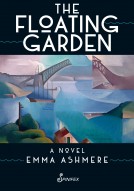
Emma Ashmere, The floating garden (Review)

Emma Ashmere, The floating gardenI had a little chuckle when, fairly early in Emma Ashmere’s novel, The floating garden, we discover that our main character, Ellis Gilbey, writes a gardening column under the name Scribbly Gum! Good name, I thought. If it hadn’t been for my school song inspiration, this would have been the name for me!

There’s another synchronicity for me, though, and it relates to the setting of this story. Last week I did a presentation on old Australian ads for an organisation I’m involved in. One of those ads was The charmed cup*. It was made in 1929, runs for around 8 minutes (can you believe it?), and is for Bushells tea. It also, coincidentally, contains footage of the Sydney Harbour Bridge mid-construction. It’s this construction which sets the scene for Ashmere’s story … so now, let’s get to it.

The floating garden is set in Sydney in 1926 when construction on the Sydney Harbour Bridge had started and houses in Milson’s Point on the north of the harbour were being  demolished with little or no compensation to the residents of those homes. One of those residents is middle-aged Ellis Gilbey, who has run a boarding house for over twenty years. At the novel’s opening the last of her boarders has left and she, with other residents in the street, is hoping against hope that some compensation will be offered. Meanwhile, in a well-to-do part of Sydney, south of the harbour, is 30-something Rennie Howarth, a young English artist who had “taken the outstretched arm of an Australian man she hardly knew and had sailed from everything cold, sad and stale”. Unfortunately that Australian man, Lloyd, who had brought her to a life of luxury, was also abusive.

Part 1 of the novel alternates the story of these two women, with more of the chapters devoted to Ellis. Whether these two women are connected, or are going to be connected, we don’t discover until Part 2 of this three-part novel. While we are wondering about this, Ashmere is busy drawing some parallels between the women – both have experienced brutal men in their lives, Ellis her father and then an employee in a house where she’d lived as a young woman, and of course Rennie her husband; both had toyed with theosophy; and both find themselves house hunting. Another parallel occurs within Ellis’s life when, destitute, she is taken in by an older woman, and then, when that doesn’t work out, destitute again, she is taken in by another older, but this time kinder, woman. These parallels are not laboured, but provide a subtle foundation to the story being told, and help hold it together.

Ashmere’s main focus is Ellis. In her story, we shift between past and present, while Rennie’s story is focused on her present. Ellis, we discover, had run away from her farm home, when she was a teen, after her mother died, and had found herself, rather by accident, in the home of theosophist, Minerva Stranks, aka Strankenstein, around the turn of the century. It was out of the frying pan and into the fire for Ellis, as Minerva is a cruel taskmaster and a charlatan, to boot. Ellis is sexually attracted to Minerva’s other protégé, the pretty Kitty Tate. Her belief that Kitty cares for her helps her survive her time in the house until … well, I won’t give this away, but by the novel’s opening, Ellis had been carrying guilt and regret for twenty-seven years.

We are not given the same depth of background for Rennie’s life before the present, but we learn that she’d had a couple of exhibitions in London before fleeing to Australia with Lloyd, and that she’d been a lively, fun woman before her marriage to a man who physically abused and emotionally manipulated her. In Australia her art changes from “polite English watercolours” to “bolder, flatter, earthier colours” that are all-round too confronting for Lloyd. She represents, as Ashmere explained in an interview on ABC’s Books and Arts Daily, the new modernist art movement, a movement which rejected tradition for something bolder. That’s certainly Rennie.

So, despite the parallels in their lives, Rennie works largely as a foil for Ellis, not only because of their class difference, but because she’s lively and risk-taking against Ellis’ more cautious approach to life, which is understandable given her greater age and particular experiences. If I have a frustration with the novel, it would be that Rennie’s story is not as developed as Ellis’s and that perhaps her main role is to be this foil or plot-device to move Ellis on rather than a character in her own right. This is more observation, though, than complaint, because overall the writing is evocative without being overdone, and the characters are engaging,

What I particularly enjoyed about the novel is that Ashmere does for the underprivileged of 1920s Sydney what Ruth Park did for the 1950s in Harp in the south. They are very different books in terms of their narratives and themes, but both exude warmth and sympathy for their motley crew of marginalised characters, and both are valuable for their social history. In The floating garden this includes evoking the about-to-be dispossessed Milson’s Point community, the charlatan fringe of theosophy, the colour of Paddy’s Markets, the energy of the artistic/bohemian community, and the opening up of land in the rural outskirts of Sydney, in Lane Cove.

The novel’s overall theme has to do with memories, guilt and grief, with the idea that you really can’t move on if you haven’t resolved your past. Late in the novel, as Ellis starts to understand the truth of what had happened all those years ago, Ashmere writes:

She’d grown used to her memories for all these years and now her grief – her guilt – had grown around them in the same way a tree’s trunk grew around a rock until both the rock and the tree risked mutual destruction if prised apart.

But sometimes, there can only be progress if they are prised apart – and prised apart they eventually are, of course.

The floating garden is a very enjoyable book. It deals with real issues honestly but gently, and it brings to life a past world in a way that enhances our understanding of the present.

awwchallenge2015Emma Ashmere
The floating garden
North Melbourne: Spinifex Press, 2015
243pp.
ISBN: 9781742199368

(Review copy supplied by Spinifex Press)

* Unfortunately, the ad is broken into three clips on this page. Clip 2 contains the Bridge footage.

Peter Carey, Amnesia (Review)

CareyAmnesiaHamishSomewhere sometime ago I read that serious reviewers should read the book they are reviewing at least twice. I think this is good advice, but I admit that with so many books I want to read I rarely follow it. Peter Carey’s latest novel Amnesia is one that well warrants rereading. It assaults you with ideas and action that aren’t easily assimilated on the first read. However, time marches on, so to write this review I am going (or, to be honest, I’m choosing) to rely on the notes I took, supported by a quick flick through. Please read my review in this light!

Amnesia is a satire, and satires can be pretty tricky to read. They’re slippery. They can be funny, but not necessarily. They tend to be about ideas or issues, so their characters are created to serve that end and may not be fully developed or particularly sympathetic. This can make satires tricky to engage with, particularly if you’re the sort of reader who loves to engage with characters. Amnesia presents the reader with some of these challenges. It’s a romp, a thriller, a drama – but in the end it’s all about activism, cyber security and journalism, about politics and the relationship between Australia and the United States of America. I enjoyed it, though the pace was so cracking at times I found it hard to keep up.

The novel starts with a worm, the Angel Worm, which infects the computer control systems of Australian prisons, releasing their locks. Because Australian prison security was designed by American corporations, the worm also infected nearly 5,000 American prisons. Prisoners of all sorts, including asylum seekers, were freed. The U.S. is not amused. As the story breaks, our protagonist, Australia’s self-described “sole remaining left-wing journalist” Felix Moore, is being tried in court for defamation. He’s “grateful for a story big enough to push me off the front pages”. Unfortunately, in the sort of irony typical of satire, he soon finds himself out of the frying pan and into the fire, because, of course, the parents of one of the Worm’s creators are old university friends, Sando Quinn and his wife Celine.

So here’s the set up. Felix is destitute. His book is to be pulped, and his wife has kicked him out. To his rescue comes another old university friend, Woody Townes, who pays him a lot of money to write a book about worm-creator Gaby. Felix soon learns though that this book is not going to be his book expressing the truth as he discovers it, but a book that says … well, let’s just say that here the adventure, romp, thriller, drama, whatever you want to call it, begins.

What then is being satirised? Let’s start with the four main characters, Felix, Sando, Celine and Woody. They met as students at Monash University and became friends. They were radicals and activists who believed they could change the world. They organised marches and protests, they voted in Whitlam and the Labour Government, and they were affronted and angry by Whitlam’s dismissal in 1975. But, who are they now? One of Carey’s targets is this: what happens when radicals grow up? Woody turns capitalist property developer with hints of something worse; Sando is a politician who tries to keep the faith but discovers the compromises he has (or wants) to make; actor Celine sees herself as Bohemian but becomes seduced by the “finer” things in life and doesn’t want to mix with the working class; and journalist Felix sees himself as the tell-it-all saviour but recognises that in the process he has “become an awful creature”.  It’s not a pretty picture.

Underlying this is a thread exploring Australia’s relationship with the USA. There’s the Battle of Brisbane (a two-day fight and riot between American soldiers and locals during World War 2), discussion of US involvement in Whitlam’s dismissal, and, fictionally, fears of what might happen if the US extradited Gaby. (Julian Assange anyone?) Early in the novel, Felix agrees that Woody has a point regarding the extradition risk:

Everything we knew from life suggested that America would do what it liked and Australia would behave like the client state it always was.

Carey also satirises journalism, particularly the sort that prides itself on exposés in search of the truth. Felix becomes the pawn in a game to produce a story that suits the person who gains control of him – by whatever method they can, by money, say, or by abduction. Woody suggests at one stage that Felix make things up to put Gaby in a positive light, but Felix, who believes there’s “no such thing as objective journalism” argues that this doesn’t equate with making things up! Through the course of the book Felix moves (or, more correctly, is moved through mysterious mechanisms) from a classy high-rise in Melbourne, to a remote primitive shack on the Hawkesbury River, and thence to a motel room in the Blue Mountains. All the while he doggedly listens to tapes of mother, Celine, and daughter, Gaby, talking, talking, talking.

Their story of life in Melbourne, from when Gaby was born, significantly on 11 November 1975, is great reading. Melbourne-born Carey knows the city and captures its life, rhythms, and diversity beautifully. The writing is gorgeously descriptive at times, and often funny, but can also be biting.

I think, too, that there’s an element of Carey sending himself up. I’m not suggesting, despite some obvious similarities between character Felix and creator Carey, that Amnesia is intended in any way to be autobiographical. But, in several of the references to writers and writing, I detect digs at some of the criticisms that have been levelled against him. How about, for example, Felix’s comment at the end that:

For the crime of expressing pleasure that my book would be available to future generations, I was judged not only immoral but vain and preening …

Oh Peter, I thought!

To conclude, though, what is all this satire for? Well, the title says it. There’s a reason Gaby was born on the day of the dismissal, and that she becomes the next generation of activists (or hacktivists) – and the reason is that Carey does not want us to forget. He wants us to “maintain the rage”*, to remain aware and vigilant of what is happening, and of whose fingers are in which pie. It’s not subtle, but then what satire is, and it perhaps tries to pack too much in, but it is both an entertaining and a provocative read. I’d be more than happy to read it again.

Peter Carey
Amnesia
Hamish Hamilton, 2014
367pp.
ISBN: 9781926428604

* I drafted my review and then trawled the net, and what did I find but an interview with Carey in The Australian that says just this. I didn’t steal it, promise!

Jane Austen, Emma Vol 3 (continuing thoughts)

I’ve now finished my re-read of Emma, and found that the theme of friendship, which I discussed in my Volumes 1 and 2 posts, did continue to play out in the last volume. In those previous posts, I suggested that Austen was presenting friendship as having both personal and social value, and I gave examples of different acts of friendship, some generous, others more questionable if not down-right self-serving.

Now, having finished the novel, I’d like to identify the different sorts of friendships which Austen presents to her readers:

  • neighbourly/kind friendship
  • “general” friendship
  • self-serving friendship
  • “true” friendship

Since I touched on some of these in previous posts, I will just expand a little more here. Neighbourly or kind friendship encompasses giving mostly practical support to others. In Emma this includes, for example, providing transport or food to poorer women in the neighbourhood. Many characters offer this sort of friendship, including, even, the unpopular Mrs Elton.

General friendship, on the other hand, is the sort of hail-fellow-well-met tolerance/acceptance of other people, with little regard to substance. Mr Weston is a perfect example of this. He’s “straight-forward, open-hearted”. He doesn’t discriminate against people on the basis of, say, class, but neither does he discern between sincerity and superficiality. And he’s inclined to gossip rather than hold his counsel. Here’s Emma on Mr Weston at the Crown where he is hosting a dance. He’d invited her to arrive early to pronounce on whether everything is in order, but she finds that he had similarly invited many other “friends”:

Emma perceived that her taste was not the only taste on which Mr. Weston depended, and felt, that to be the favourite and intimate of a man who had so many intimates and confidants, was not the very first distinction in the scale of vanity. She liked his open manners, but a little less of open-heartedness would have made him a higher character.—General benevolence, but not general friendship, made a man what he ought to be.—She could fancy such a man.

Such a man is, of course, Mr Knightley. Emma is, admittedly, a bit of a snob and likes to be recognised for her “place” in Highbury, but nonetheless, Mr Weston is presented to us as someone who “takes things as he finds them, and makes enjoyment of them somehow or other” rather than one who can be relied upon, for example, to make good judgement about character. He’s an appealing character, but not the ideal man.

Self-serving (or self-aggrandising) friendship is epitomised by the execrable Mrs Elton whose protestations of friendship, particularly towards Jane Fairfax, belie her real motivations, which are to look good and to spite Emma. She chooses her friendships on the basis of what they do for her.

And then there’s “true” friendship, the sort of friendship which is not swayed by superficial concerns, which is not scared to speak the truth, and which quietly works for the benefit of others without looking for praise or recognition. This is the sort of friendship offered by Mr Knightley, who tells Emma when he feels she’s behaved rudely or improperly, who consistently judges people correctly, and who is prepared to make sacrifices for the benefit of others.

There are readers who find the relationship between 21-year-old Emma and 38-year-old Mr Knightley a little paternalistic, if not creepy, but I’d argue these were different times with different expectations and mores. Emma is not a push-over and it’s clear that Austen sees their relationship as one built on love and “true” friendship. The last lines of the novel are:

The wedding was very much like other weddings, where the parties have no taste for finery or parade; and Mrs. Elton, from the particulars detailed by her husband, thought it all extremely shabby, and very inferior to her own. “Very little white satin, very few lace veils; a most pitiful business! Selina* would stare when she heard of it.” But, in spite of these deficiencies, the wishes, the hopes, the confidence, the predictions of the small band of true friends who witnessed the ceremony, were fully answered in the perfect happiness of the union.

Before I leave this topic of friendship, I want to mention a somewhat related topic – that of civil falsehoods. Austen introduces the term through Frank Churchill who, on being encouraged by Emma to go hear Jane Fairfax play the pianoforte, expresses an inability to pretend to like it if the instrument’s tone is poor. He says “I am the wretchedest being in the world at a civil falsehood”. The irony, of course, is that he is being false to Emma. Emma, though, blithely unaware, tells him that “I am persuaded that you can be as insincere, as your neighbours, when it is necessary”.

Emma, more than any of Austen’s novels, deals with a whole community. Austen teases out the idea that communities survive on the basis of “civil falsehoods”, that these falsehoods are at times “necessary”. On another occasion, when Mr Weston invites Mrs Elton to the Box Hill picnic, stating that “she is a good-natured woman”, a disappointed

Emma denied none of it aloud, and agreed to none of it in private.

Emma, in other words, does the polite thing and holds her tongue. But Austen knows there are costs, and that there is a place for “civil falsehoods” and a place for honesty. Falsehoods, even civil ones, Austen argues need to be handled with care. By the end of the novel, it’s clear that she, like Emma, would always prefer “openness” to concealment. I wonder if this is why she, known for her sharp tongue, felt Emma would be a heroine that only she would like!

Re-reading

Noticing this friendship theme is just one of the delights I’ve had in this re-reading of Emma. Each time I read it, I notice more – both in terms of Austen’s concerns and her technique.

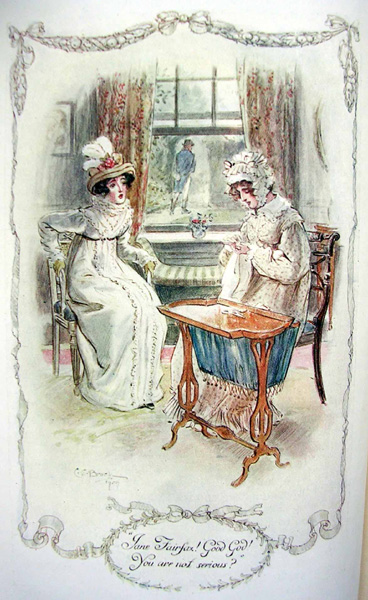
Illustration, Emma and Mrs Weston

“Jane Fairfax. Good God! You are not serious!” (Illus, by CE Brock)

One feature that interested me this read is the way she shows characters’ real love interests by whom they are watching (out for). It’s subtle and can be missed on early reads but it’s there. For example, while everyone thinks Frank Churchill is interested in Emma, Frank is watching out for Jane Fairfax. When Jane arrives at the Crown with her aunt, Miss Bates, it looks as though it’s Miss Bates whom Frank tends – “Miss Bates must not be forgotten” he says to his father as he rushes out to make sure they don’t get wet. But Miss Bates, in her chatter, lets drop his real interest:

My dear Jane, are you sure you did not wet your feet? It was but a drop or two, but I am so afraid: but Mr. Frank Churchill was so extremely—and there was a mat to step upon. I shall never forget his extreme politeness.

Similarly, when Emma and Harriet discuss a past occasion when they were with Mr Knightley and Mr Elton, Emma remembers where Mr Knightley had been standing, while Harriet only remembers Mr Elton:

“Stop; Mr. Knightley was standing just here, was not he? I have an idea he was standing just here.”

“Ah! I do not know. I cannot recollect. It is very odd, but I cannot recollect. Mr. Elton was sitting here, I remember, much about where I am now.”

Absolutely delicious. By the time this occurs, Harriet is over Mr Elton, and Emma is still unaware of her love for Mr Knightley, all of which adds to our delight in reading this scene.

Another technique which struck me was how often characters mis-read clues, how often they assume the wrong reason for an occurrence. Near the end, Mr Knightley holds Emma’s hand and is “on the point of carrying it to his lips—when, from some fancy or other, he suddenly let it go”. Emma doesn’t read this as love but as a sign of “perfect amity”. And when Frank, on his return to Highbury, visits Emma but doesn’t stay long, she assumes “it implied a dread of her returning power, and a discreet resolution of not trusting himself with her long”. However, the real truth, we realise on subsequent readings if not our first, is that he wants to visit Jane.

I could, in fact write three times this and more, on Emma, but I’d rather not. I’d much prefer it if these little tidbits encouraged you to read it (again!). At 200 years old, and despite its dated snobbery, this is a book that still has much to offer about human nature – and about skilful writing. I’m sure to read it again.

* Selina is Mrs Elton’s sister whom she sees as the arbiter of all things impressive.

Dymphna Cusack, Jungfrau (Review)

Dymphna Cusack, Jungfrau

Courtesy: Allen & Unwin

Are there some historical periods that particularly fascinate you? There are for me, and one of those is that between the two world wars. It was a complex time encompassing both economic hardship and great social change. A time when many of those Victorian era constraints were being lifted and women, in particular, were starting to enjoy an independence and freedom they hadn’t had before the First World War. Dymphna Cusack’s first novel, Jungfrau, is set in this period and deals with this very subject.

I have written about Cusack before, when I reviewed A window in the dark, her memoir about her time as a teacher. Because of its relevance to this novel, I’ll reiterate a couple of the points I made in that review. Cusack, I wrote, had a finely honed moral and social conscience, and was acutely aware of injustice. She was convinced of the “wickedness of our economic system”, and abhorred the power those with money had over others. She was consequently outspoken on social and economic justice issues, and was particularly critical of the treatment of “that much-maligned creature, the woman teacher”. A window in the dark was written forty years after Jungfrau, and is a memoir, but you can see the genesis of her values and ideas in this, her first novel.

Jungfrau is set in Sydney over a few months in the 1930s. It concerns three young women in their mid to late twenties: the rational, realistic and religious Eve, the emotional, dreamy and vulnerable Thea, and the modern, pragmatic, confident Marc. Eve and Thea have been good friends for several years. Marc is Thea’s friend, but Eve and the free-thinking Marc do not like or understand each other. At the novel’s opening, Eve and Thea are talking about Thea’s interest in a man twice her age, a married university professor. Eve cautions Thea about the risks, but Thea is ready “to take life—use it—now, instead of letting it use me”. Eve gently retorts that “If you leave yourself open to the world, it will rush in on you”.

Indeed, Eve, who has seen first hand in her maternity ward the results of poor, single women taking life, suggests that experiencing life “is much safer in books”. She says to Thea:

When you talk about getting in touch with reality and finding out what life is, all you really mean is following your instincts in spite of the consequence … Only, if you take your friend Marc’s prattling literally, I’d advise you to learn more about physiology than you know at this moment. You can’t safely combine what your modern friends rather euphemistically call ‘experience’ with a degree of ignorance that’s almost mid-Victorian. You’ll need to be practical if you’re going to be a realist. Marc’s evidently both.

The novel, as you’ve probably guessed by now if the title hadn’t given it away, explores what happens when Thea does not heed Eve’s advice and lets this relationship develop. I’d call this a coming-of-age novel but, having been written by Cusack, its themes are as much social as psychological. What did it mean for a woman at that time to have an affair with a married man, and what were her options with the – hmm – consequences?

The trouble is that while obstetrician Eve and social worker Marc are daily faced with the grim realities of life, teacher Thea evades them. Here’s Eve on her ward rounds,

All this rot about reality, this frenzied escape into abstractions, had curiously little to do with life as she knew it. … Here was reality. Tortured bodies, tired minds, birth and death. Nothing vague about this; no escaping from facts; no sheltering behind fancies.

Acerbic Marc has her own view on woman’s lot:

Women are cursed, all right. If you wither on the virgin stem you go all pathological; if you go off the deep end you get some foul disease; and if you marry and have dozens of young you die of exhaustion.

By contrast, here is Thea discussing the real Jungfrau with her professor:

“Yes,” he said almost inaudibly, “white, proud and untouched. But they’ve built a funicular almost to the top of it now, and the tourists swarm all over it like flies.”

“Poor thing! I don’t mind climbers and mountaineers; but it must hate the tourists soiling it—”

“That is usually the fate of the proud and the untouched,” he said, digging his stick in the turf, and she recoiled as though struck, her hands flung out in a gesture of defence.

Oh dear, we readers think – and so would Eve and Marc if they’d heard this conversation. Their lot, though, is to love Thea and to watch in dismay as she takes life to an edge that she is not fit to handle.

The critical thing about this book is that Cusack doesn’t judge these three women for their choices. We might find Marc a more sympathetic, more appealing personality, of the three, but Cusack is even-handed. She understands human psychology and empathises with women. Her ire is focused more on society’s expectations and rules than on any one woman’s decision or behaviour. I described this novel earlier in my review as a coming-of-age novel, but it could equally be called a novel of ideas. In it Cusack exposes “the reckless squandering of human possibilities”, of lives “anaesthetised by half-baked education, political platitudes and doles”. Economic inequities, abortion, women’s independence, and the meaning of freedom are her targets.

I read this book as part of my long-term plan to read classic Australian literature – and I enjoyed it immensely. While the social milieu is very different from now – thank heavens – the emotional truths transcend the particulars of time and place. The language did feel a little overblown at times. It has that DH Lawrence sort of emotional intensity that can sometimes be a little too melodramatic, or declamatory, for my 21st century ears. And yet, paradoxically, one of the novel’s real pleasures came from its descriptions of Sydney. Cusack catches the landscape – the plants, the light, the water – beautifully (but I’ll save sharing a couple of those for a Delicious Descriptions post).

I imagine this was a confronting novel at the time of publication, but I hope it got people thinking, as Cusack surely intended. Cusack, Katharine Susannah Prichard, Miles Franklin, Marjorie Barnard and Flora Eldershaw, to name the best known from that era, were fierce and intelligent writers. We are lucky to have them.

awwchallenge2015Dymphna Cusack
Jungfrau
Sydney: Allen & Unwin, 2012 (Orig. ed. 1936)
ISBN: 9781743431450 (ebook)

Note: I do need to have a little whinge. There were several errors/typos in my kindle edition, which is disappointing and did spoil the read a little.

Aminatta Forna, The hired man (Review)

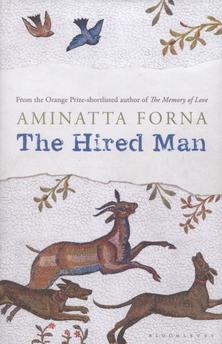
Aminatta Forna, The hired manEarly in Aminatta Forna’s The hired man, the narrator Duro is told by his old, ex-best friend Krešimir, “People have moved on, Duro. Maybe you should too”. At this point we are not sure exactly what they have moved on from but we guess it might have something to do with war – and as the story progresses we discover we are right.

The hired man is Forna’s third novel, but my first to read. All of them, together with her memoir The devil that danced on water, deal with the prelude and aftermath of war. In The hired man it’s the Croatian War of Independence which occurred in the early 1990s. Forna, though, never names the war, and while there is some description of war-time action, she doesn’t provide any real historic details about who, what or where.

The novel is set in the fictional town of Gost, and commences in 2007 with Duro, our first person narrator, telling us that “at the time of writing I am forty-six years old”. Later we realise he is writing for a future reader, after he dies. He writes

… I have to tell this story and I must tell it to somebody, so it may as well be you, come to sort through my belongings.

The trapdoor is opened …

So, what is the story he has to tell – and why is he suddenly compelled to tell it now? Well, towards the end of the novel he says this:

Laura arrived in Gost and opened a trapdoor. Beneath the trapdoor was an infinite tunnel and that tunnel led to the past.

You don’t know who Laura is, though, do you, so it’s time I introduced the plot. The novel spans Duro’s life from his childhood to his mid-forties. He tells of his family, and his boyhood friends, particularly the aforementioned Krešimir and his younger sister Anka, with whom Duro fell in love. He tells how his relationship with Krešimir crumbled as Krešimir’s true, cruel, nature became apparent, and why he left Gost for a few years, returning just before the war started. And he tells us about the “chaos” that ensued during the war, “when men turned to hunting each other”. I don’t want to give too much away here, but let’s just say that by the time the war starts his relationship with Anka had moved, necessarily, from that of lover to good friend.

We jump then sixteen years to 2007 – when Duro is living alone and friendless – though the novel is not told in this linear way. It’s told more organically as the changes resulting from the opening of the “trapdoor” stimulate memories and bring the past back to Duro. This trapdoor is opened because Krešimir sells the “blue” house, the home he’d shared with Anka and their parents, to Laura and her husband who plan to renovate it, sell it, and move on. Duro, we discover, is a handyman, and he becomes Laura’s “hired man” for this renovation, and in the process becomes the family’s friend.

There is an underlying theme here of the British moving into Europe, oblivious of history and inherent dangers:

The way the English saw it, the past was always better. But in this country our love of the past is a great deal less, unless it is a very distant past indeed, the kind nobody alive can remember, a past transformed into a song or a poem. We tolerate the present, but what we love is the future, which is about as far away from the past as it is possible to be.

These English do not understand, for example, that the “fields that used to be ploughed … are now full of wild flowers because nobody dares to walk in them in case they put their foot on a mine and are blown to pieces.”

“I imagine myself with the body of a bird, a raven. Outstretched wings and neck, rigid beak and shining eye, I swoop over the ravine and hover over the town.”

So, here is Duro, standing “guard over the past” like a predatory bird. And here is Laura, reminding him of Anka who, though we don’t know why, is no longer in Gost. And here is “the chill of unfinished business”. The stage is set … but here I’ll leave the plot.

What is beautiful about this novel is that, despite its depiction of brutality and betrayal, and despite a sense of menace, it is restrained – and it’s restrained because Forna’s focus is not violence and revenge, though there are elements of these in the novel. Her interest is how people live with each other after war, and particularly after Civil War when traitors, collaborators, opportunists and victims, depending  on your point of view of course, must all live together. The novel made me think of Olivera Simić’s Surviving peace which I reviewed last year. It’s a memoir, and Simić does not still live in her Serbian home, but she makes very clear that surviving a war, particularly ethnically-driven civil war, is just the beginning.

What is also beautiful about this novel is Forna’s writing – her use of imagery, symbolism, irony and parallels to convey her meaning. Birds and colours have multiple connotations, some positive, natural, others menacing. The “ravine” on the edge of town bears witness to beauty and horror. Hunting suggests violence and predation, but is also a source of sustenance and defence. The title, itself, “the hired man”, has both benign and malignant meaning …

As does the idea of masculinity, “with its undercurrent of aggression”. For Duro, it encompasses loyalty, protectiveness, and reliability alongside strength and control, while for men like Krešimir and Fabjan, the town bully, it means power and competitiveness, and is attended by a sense of menace.

Nothing, in other words, is simple in Forna’s world, and the language conveys this subtly but emphatically.

‘Well this is one of the most beautiful places I’ve ever been. You don’t notice it any more, but you don’t know how lucky you are.’

Laura, new to the town, is oblivious to the irony of her utterance, and so are we as the novel starts – but, we soon learn differently. It is not a pretty town but by the end some rapprochement, uneasy though it still may be, has been achieved. This is a moving but realistic book about just how difficult it is to survive peace.

Aminatta Forna
The hired man
London: Bloomsbury Publishing, 2013
ISBN (Kindle ed): 9781408818770

Jane Rawson, A wrong turn at the Office of Unmade Lists (Review)

RawsonWrongTurnTransitThe weirdest thing happened when I put down Jane Rawson’s debut novel, A wrong turn at the Office of Unmade Lists: I started imagining things! This is weird because I’m not a particularly imagin­ative or fanciful person, so it must have been this book that did it. Let me explain …

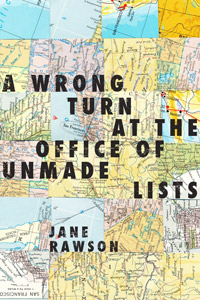
First though, I need to say that I’ve been keen to read this book for some time. It started with the cover. I tend not to focus a lot on covers but some do grab me. This one, with its chequerboard of maps, is both eye-catching and intriguing. Then there’s the title. As a librarian/archivist, I’m drawn to organisation and lists but don’t mind a little anarchy every now and then. Is that what’s going on here, I wondered? And finally, there’s its MUBA award win last year. So it came down to a case of three strikes and you’re out – or, more accurately, in – and I bought the book. Well, what a read, because …

A wrong turn at the Office of Unmade Lists is a very unusual book. It traverses two places and times: Melbourne in 2030 and a sort-of imaginary San Francisco in 1997. It is, partly at least, a cli-fi* book. 2030 Melbourne is a bleak place – it’s very hot, clean water is harder to come by and more expensive than beer, soap is a luxury, and UN peacekeepers are in town. The rich survive as they do, but poverty is common, and many people live on the streets or in humpies. Bodies are regularly found in the streets. It’s a world you expect in dystopian novels, except that despite appearances, this novel is not completely dystopian.

Indeed, the novel has been described as a “genre-buster”. It is, for example, also a time-travel story, which brings me to the plot. Our protagonist is 33-year-old Caddy, who is living rough, having lost her husband and home in a heatwave-induced fire a couple of years before the novel opens. Like many in this devastated city, she survives on odd jobs – working in a bar, doing courier work, and selling her body. She has friends – an indigenous man and wheeler-dealer Ray, and bar-owner Peira. She also likes to write, and this is where San Francisco comes in because the story she is writing is set in 1997 San Francisco. It’s about two orphans-cum-childhood friends, 17-year-old Simon and 14-year old Sarah. They spend their time following a quest started by their parents in which they have to stand at least once in every 25-foot square of the USA, in order to see the whole country. With me?

At first this story of Caddy’s is told in italics within the main story, but in Part Two the narrative shifts and whole chapters are told in Sarah’s voice. Meanwhile, Caddy, with Ray who has bought some used and apparently magical maps, time-travels from Melbourne to San Francisco where they meet her creations.  Still with me? Hope so, because it gets tricksier. This “travel” involves passing through a sort of netherworld called The GAP, where we find the Office of Unmade Lists, and other sections including Tupperware Lids, Partially Used Pens, and Suspended Imaginums. Suspended Ims, as we in the know call it, is where the things that people imagine but “don’t come true” end up. I think that’s where my brief imaginings have gone!

This sounds more complex than it is – or, should I say, it’s conceptually complex but not hard to follow. Indeed it’s a hoot to read, because for all the grim, grittiness of this climate-damaged world, there’s warmth, love and humour – and a delightful sense of the absurd. I loved Rawson’s exploration of the two universes, the “real” and the “imagined”, and the way she has them meet. She messes with our minds! It made me think of Marion Halligan’s comment about her main character in Fog garden. Halligan writes: ‘She isn’t me. She’s a character in fiction. And like all such characters she makes her way through the real world which her author invents for her. She tells the truth as she sees it, but may not always be right.’ Halligan’s purpose is different, but the concerns, those to do with where imagination ends and reality begins, are similar.

That said, I’m not 100% sure of what Rawson’s purpose is, but I think she’s playing with her readers, with the idea of writing fiction, and with the meaning of fiction itself. Take, for example, her character Simon responding to Caddy telling him he’s her creation:

‘You come in here and tell us we’re imaginary, and now you’re saying you’re not even a very good writer! What do you mean? Like we’re all two-dimensional and shit, not fleshed out at all? Unrealistic? Is that what you’re saying? I don’t feel unrealistic. I feel pretty pissed off actually, which is kind of a realistic response to someone telling you you’re a shithouse imaginary character.’

Caddy looked at Ray like he might somehow get her out of this. He still had his head in his hands.

‘Sorry’, she said. ‘You’re heaps more complicated than what I imagined, if that helps.’

I love the sly, tongue-in-cheek allusion here to literary theory, to EM Forster’s notion of flat and round characters. This is just one of several references in the book to the things readers and critics talk about.

A wrong turn at the Office of Unmade Lists is a fun, absurd, clever book in which Rawson somehow marries her very real concerns about the future of our earth with a belief that human compassion and ingenuity will survive, and wraps it up in an exploration of the complex relationship of imagination to reality. Imagination, Rawson seems to be saying, is the real stuff of life.

So, my recommendation is: Don’t worry about the book making complete sense. Suspend your disbelief, enjoy the ride, and realise that here is a lively intelligence you don’t want to miss.

Lisa at ANZLitLovers also enjoyed the book.

awwchallenge2015

Jane Rawson
A wrong turn at the Office of Unmade Lists
Melbourne: Transit Lounge, 2013
318pp
ISBN: 9781921924439

* Jane Rawson was, and maybe still is, Editor of Energy & Environment at The Conversation

Charles Hall, Summer’s gone (Review)

Charles Hall, Summer's gone, Margaret River Press

Courtesy: Margaret River Press

When Western Australian writer Craig Silvey set his coming-of-age novel Jasper Jones in the 1960s I was a bit surprised, as Silvey himself did not grow up in that era. I’m not so surprised, though, about Charles Hall’s debut novel Summer’s gone as Hall did grow up in the 1960s. The novel is, from my reading of the brief author biography, somewhat autobiographical, as debut novels often are: both Hall and his main character played guitar in bands, hitch-hiked across Australia, worked in labouring jobs and ended up studying at university. This, though, doesn’t mean the story is Hall’s story. It simply tells us that Hall wrote of a milieu he knows – a wise thing to do!

Summer’s gone is a part-mystery, part-coming-of-age narrative, and is told first person by Nick. It focuses on his relationship with two sisters, Helen and Alison, and another young man, Mitch, with whom he’d formed a folk band in 1960s Perth. The novel starts, however, in Melbourne in 1967 with Nick finding 20-year-old Helen dead (or dying) on their kitchen floor. What happened to her, why it happened, and Nick’s feelings of guilt about it, form the novel’s plot. The theme, though, is something else, it’s about

the trouble with dwelling too much on the past – sometimes you remember other things as well, things you don’t necessarily want to think about.

Except, of course, we do often need to dwell on the past if we haven’t resolved it, we need to think, as Nick does, about the things we did, didn’t do, or might have done differently. We need, in fact, as Nick has come to realise, “to say goodbye to things. And perhaps even to understand.”

To tell his story, Nick slips between the 1960s, the mid 1970s, the 1980s, and sometime around the present from which he is looking back. Hall handles these time-shifts well: it’s not difficult to know where you are, and it effectively replicates the way we often approach the past, that is, in fits and starts as we put together what happened.

It’s an engaging story. Nick, the young version anyhow, is a rather naive and not well-educated – but not unintelligent – young man. He’s not wise in the ways of the world, but he’s decent, and prepared to give things a go. He has a poor relationship with his Perth-based mother, and his only real adult role model is his uncle Clem in Melbourne. The relationship between the four young people is nicely evoked, though because it’s a first person story, the other three characters are only developed as far as Nick understands them, and Nick is not always the most perceptive person. I found this a little frustrating – I wanted to know the other characters more – but I suppose it’s fair enough given the narrative voice chosen.

What gives this book its greatest interest is the social history. Many of the main stories of the period are worked into the narrative – abortion, and the horrors resulting from lack of legalisation; the Vietnam War, conscription, draft-dodging, and the physical and psychological damage experienced by soldiers. Nick also spends time in a hippie commune, and other news events like the Poseidon bubble and crash, the beginnings of women’s liberation, and the release of the Beatles’ Sgt Pepper’s Lonely Hearts Club Band album also get a mention. If you lived through this era, the novel provides an enjoyable wander down memory lane. It reminds us of the hopes and ideals of a generation which felt free to explore life and love, to rebel against the constraints of their elders, even though this freedom wasn’t always all it seemed to promise. I did feel, however, that Hall could have left the social history to this era. The references to Chernobyl and mesothelioma started to feel a little forced, and not really necessary to the plot, even though the mesothelioma issue is used to tighten the noose around one character just that little bit more.

Hall’s dialogue is realistic, and gives flavour to the era, and I did enjoy his descriptions of place – of Perth suburbs, and Melbourne, of travelling the Nullarbor and of country Victoria. These descriptions are kept to a minimum, but are just enough to breathe life into the scene.

Early in the novel, Hall refers to chaos theory and the butterfly effect, to the idea that “a minor detail has the power to change everything”. That’s probably true but I’m not sure it tells us anything we don’t already know! There are many minor details in our lives, and we could go mad worrying about which is the one that will (or did) change everything. Fortunately, I think Nick eventually agrees.

This is not a difficult novel, but it is warm, readable, and sings to us of summers past when the world seemed golden, but when in fact there was, as there always is, much more to it than that.

Lisa at ANZLitLovers enjoyed the book also for its evocation of the era.

Charles Hall
Summer’s gone
Witchcliffe: Margaret River Press, 2014
288pp.
ISBN: 9780987561541

(Review copy supplied by Margaret River Press)

Jane Austen, Emma Vol 2 (continuing thoughts)

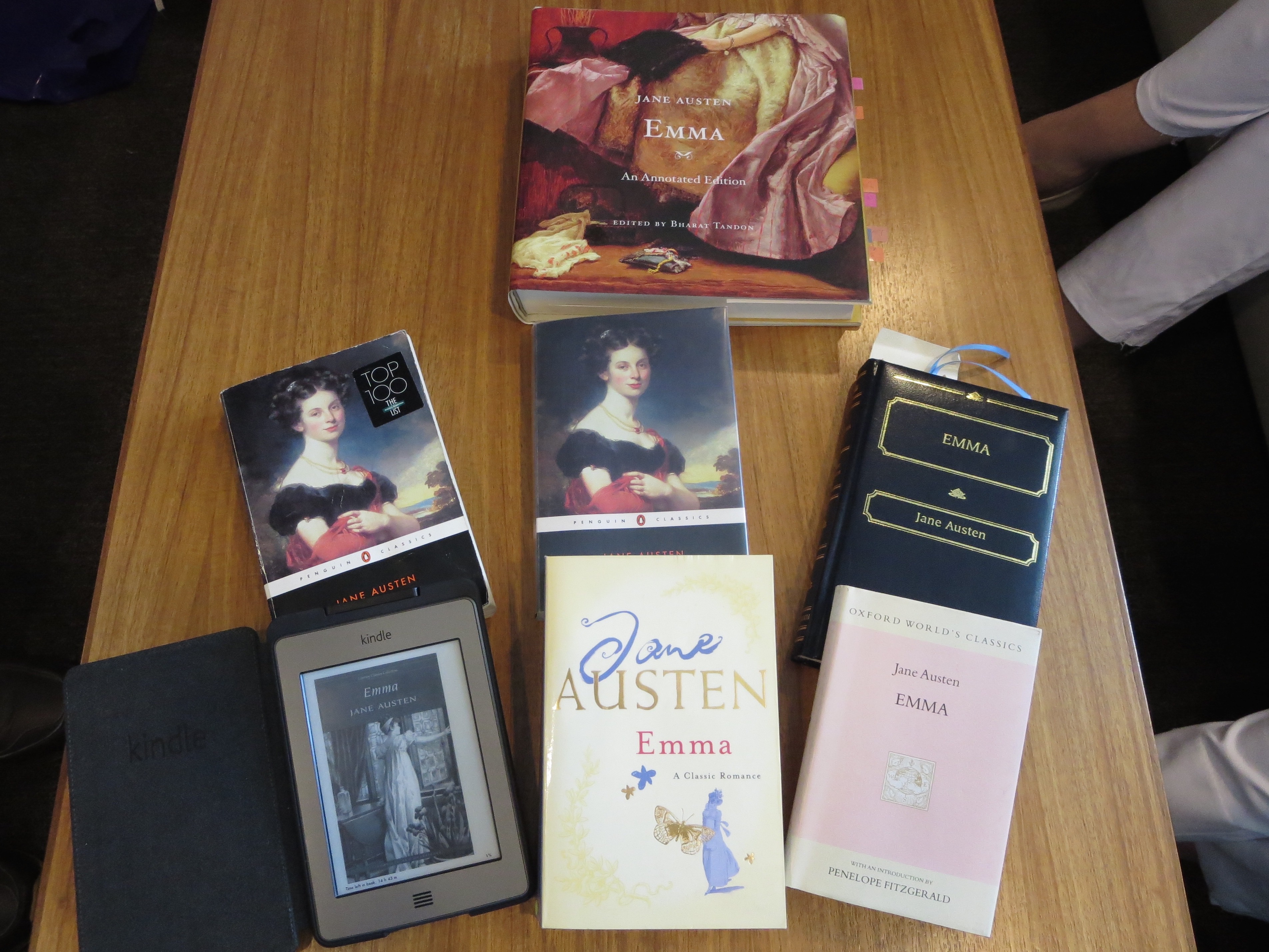
EmmaCoversThe friendship plot – that theme I discussed in my post on Volume 1 of Emma – thickens in Volume 2. Several “new” friendships are presented, as Austen continues to deepen our understanding of what constitutes community via the little village of Highbury. For Jane Austen, I think we are going to realise, friendship is both a deeply personal thing as well as something that underpins society.

In Volume 2, three people are introduced to Highbury – Jane Fairfax and Frank Churchill, about whom we’d heard heard in Volume 1, and Mrs Elton, the new bride of Highbury’s minister, Mr Elton. Through them, and the previously introduced characters, we are introduced to several facets of “friendship”. Positive examples include:

  • Colonel Campbell’s generous act of friendship to Jane Fairfax’s late father by taking Jane into his household and educating her along with his daughter;
  • Mr Knightley’s neighbourly style of friendship in providing food from his estate to the Bates and transport for them to a wintry evening dinner-dance;
  • Emma’s similarly neighbourly friendship in providing food to the Bates;
  • Miss Campbell’s open-hearted, trusting acceptance of her fiancé’s preference for her friend Jane Fairfax’s piano playing over her own; and even
  • Mr Woodhouse’s entertaining some of the older women in the town.

More questionable ones include:

  • Mrs Elton’s profusions of friendship to Jane Fairfax but in fact interfering with Jane’s wishes; and
  • Emma’s inability to befriend Jane Fairfax.

In Volume 1, Austen explored the role (and value) of friends in providing advice and emotional support to each other, what we could call perhaps the more “personal” side of friendship. In Volume 2, there is I think a slight shift of emphasis to more practical, or societal, aspects such as the provision of material comforts and company. Through all these manifestations of “friendship”, Austen seems to be building a rich picture of human relationships, of what we need from, and can do for, each other.

There is also in this volume a discussion of what Emma doesn’t like in a friendship: it’s the “coldness and reserve” that she sees in Jane Fairfax, with whom everyone, including Mr Knightley, expected and still expects her to be intimate. She says of not looking to Jane for friendship:

But I must be more in want of a friend, or an agreeable companion, than I have yet been, to take the trouble of conquering any body’s reserve to procure one.

An additional impediment to Emma’s willingness to befriend Jane Fairfax is fact that Jane is lauded for skills in areas in which Emma is less accomplished (through, it seems, lack of application!) Interestingly, late in the volume, Mr Knightley, responding to suggestions that he might be thinking of marrying Jane Fairfax, says he is not interested:

She is reserved; more reserved, I think, than she used to be: and I love an open temper.

It will be interesting to see whether the issue of love and its relationship to friendship is teased out in Volume 3.

Jane Austen – protofeminist?

Just how “feminist” you see Jane Austen depends somewhat on your definition of feminism, but for me she demonstrates a clear recognition of the (economic) inequalities that affect women’s lives and of the (societal) factors that hold them back. She demonstrates this in Emma by presenting a heroine who is independently wealthy and who therefore has no economic need to marry. Emma recognises this and says early in the novel, in volume 1 in fact, that she won’t marry:

“I have none of the usual inducements of women to marry …  without love, I am sure I should be a fool to change such a situation as mine. Fortune I do not want; employment I do not want; consequence I do not want: I believe few married women are half as much mistress of their husband’s house as I am of Hartfield; and never, never could I expect to be so truly beloved and important; so always first and always right in any man’s eyes as I am in my father’s.”

Part of the trajectory in Emma is for her to learn that there are other reasons to marry besides those of money and consequence. By contrast, her foil/double, Jane Fairfax has no independent wealth. The most likely course of life for her is to be a governess, but it’s not a cheery thought:

“I did not mean, I was not thinking of the slave-trade,” replied Jane; “governess-trade, I assure you, was all that I had in view; widely different certainly as to the guilt of those who carry it on; but as to the greater misery of the victims, I do not know where it lies…”

For Jane Fairfax, a good marriage would save her from what she sees as a pretty devastating fate.

Contrasting these two quite different situations is Mrs Elton. In Austen, as in most authors, you need to be aware of who is speaking when assessing what they say. Mrs Elton is a figure of ridicule in Emma, rather like Mr Collins in Pride and prejudice. She’s the upstart who “has a horror of upstarts”. Her idea of standing up for women involves counteracting Mr Weston’s statement that “delicate ladies have very extraordinary constitutions”. She says:

I always take the part of my own sex; I do indeed. I give you notice, you will find me a formidable antagonist on that point. I always stand up for women; and I assure you, if you knew how Selina feels with respect to sleeping at an inn, you would not wonder at Mrs. Churchill’s making incredible exertions to avoid it. Selina says it is quite horror to her; and I believe I have caught a little of her nicety. She always travels with her own sheets; an excellent precaution.

The satire here is multi-layered, but includes ridiculing Mrs Elton’s notion of standing up for women by asserting their focus on niceties!

More …

There’s a lot more I could discuss about this volume, such as its perfect plotting in which very little happens, or is said, that doesn’t move the plot forward, but that does it in such sly ways that we are barely aware it’s happening. However, I think I’ve made the main points here that particularly caught my attention during this re-read … so, onto volume 3 in April.

Jessica White, Entitlement (Review)

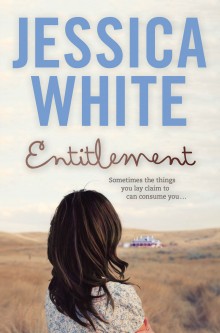
WhiteEntitlementVikingEntitlement is a powerful title for Australian author Jessica White’s second novel, but then White wanted to explore some powerful themes – though they are, unfortunately, somewhat belied by the rural romance/saga looking cover. The author bio at the front of the book tells us that White grew up on a property in northwest New South Wales and it becomes clear very early in the book that she knows whereof she speaks!

Of what does she speak, then, you are probably asking? Entitlement is set in contemporary times on a cattle property near a fictional place called Tumbin. The story starts with 29-year-old Cate McConville, now a practising GP, returning home because her parents wish to sell the property. She, with other family members, is a partner in the business, and all need to agree to the sale. But, Cate’s holding out – not because she loves farming and wants to return, but because her only sibling, her much-loved brother Eliot, had disappeared several years earlier and she wants him to have a home to return to. The farm – the land – also contains her memories of, and therefore her link to, him.

While the plot-line is established gradually, the first chapter sets the book’s tone and style. It tells us there’s tension between Cate and her parents; that memory is going to feature strongly in the telling; and that indigenous issues are likely to be part of the story. The book then progresses, introducing more and more characters over the next few chapters. Each chapter tends to be dedicated to one character, or a small group of characters, and usually involves flashbacks, as the character remembers something from, or reflects on, the past. White handles this well. There are many characters, but the present-flashback narrative style keeps them clear and in their place (if that makes sense). This style does risk becoming a little rigid, but White breaks it up every now and then with a chapter purely set in the present, or one that commences in the past.

Very early, as the characters are introduced, the themes start to become clear. The story is told within two main contexts – farming succession and indigenous connection to land. Over-riding all this is the notion of stolen and lost children. Local indigenous man, Mellor, has worked for a couple of decades for the McConvilles, as had his wife until she’d died of cancer. His extended family, particularly his two aunts, live with him on the edge of the property, and have experienced the stealing of their children. Cate’s father, Blake, is racist and dismissive of indigenous people and their rights, while her mother Leonora, by contrast, is on friendly relations with Mellor and his family.

Now, if you’ve been reading my blog for a while, you’ll have read some of my discussions of non-indigenous people writing about indigenous issues. It’s uneasy ground to walk on, but for White, with her farming background, the issues of stolen children and indigenous land rights are things she’s likely to have lived. I’m not surprised she wanted to explore it. Indeed, she wrote a comment on this blog nearly two years ago, saying that this novel:

raises the question of who, in contemporary Australia, is entitled to the land? I also tried to show, through the break up of a white family that was fighting over land, how Indigenous people have been affected by their dispossession. I don’t think it’s a question that can ever be answered, though I did aim for a (probably utopian) resolution at the end of the book.

She couldn’t do this, really, without creating indigenous characters and that means of course that she had to present (her understanding of) their attitudes. I think she’s handled this sensitively, but of course I’m non-indigenous. I did wonder if she’d stepped onto shakier ground when she drew comparisons between Cate’s mother’s loss with that of the stolen generation mothers. However, in her acknowledgements White thanks “Michael Aird and Sarah Martin for their conversations and resources on Indigenous culture and history”. She has not, it seems, walked this ground lightly. And she doesn’t leave it at country and stolen generation issues, but touches on other injustices, such as indigenous health and housing, and racist violence.

White is on safe ground when she discusses the land and farm from Cate’s point of view. I thoroughly enjoyed her descriptions of the landscape and farm life – little scenes of her father and uncle undertaking farm tasks, of Mellor tending to fences, or of Cate running through the land, for example. Here’s a description of an Australia Day picnic:

Flies and mosquitoes plucked at their skin. The scents of the bush were drawn out by the heat and bundled together like a sweet, loosely woven shawl. Kangaroos bounded away in alarm as they made their way up the hill. Crickets whirred, rising from the long grass, and cockatoos screeched.

Her characters, too, are real; they are imperfect, believable human beings. Cate’s inflexibility, her selfish unwillingness to understand the health issues forcing the need to sell, made me cross but the pain, the loss, driving her behaviour is believable. Her parents are presented as having a loving relationship, but not without its tensions and conflicts. And so on.

Entitlement is an engrossing and serious, though not a grim read. As White admits, she does try for a positive resolution, which could almost do the seriousness of the issues a disservice. However, the story is not completely neatly tidied up, presumably because she realised that her question – how do we handle conflicting relationships to this land so many of us call home – does not have a simple answer. It’s therefore important that both indigenous and non-indigenous writers put stories and ideas out there for us to think about. It can only help the discussion, don’t you think?

awwchallenge2015Jessica White
Entitlement
Melbourne: Viking, 2012
289pp.
ISBN: 9780670075935

(Signed copy won in a blog giveaway)

Jane Austen, Emma Vol 1 (Review, or perhaps just thoughts)

EmmaCovers

Every now and then my local Jane Austen group does a slow read of one of Austen’s novels. With 2015 being the 200th anniversary of the publication of Emma, we decided it was the logical choice for our next slow read. I love this activity because what happens when I re-read an Austen novel – particularly when I take part in a slow read – is that I “see” something new in the novel, something new to me that is, because it’s hard to think that anyone could come up with something totally new about Austen.

So, last time I re-read Emma, the thing that stood out for me was how beautifully plotted it is. There isn’t a word or action that doesn’t imply or lead to something telling, even if we don’t know it at the time. This read, with the plotting firmly in my brain, I’m finding that the aspect is flying a little under the radar. Instead, I’m noticing how often the word “friend” or notion of “friendship” is appearing. The novel, in fact, starts with Emma losing her ex-governess-then-companion Miss Taylor to marriage. They’ll remain friends but … so Emma, alone in a big house with her fussy, demanding, albeit gentle father, develops a friendship with Harriet, “the natural daughter of Somebody … [who] had no visible friends but what had been acquired at Highbury”.

This, though, is not the only friendship involving Emma to appear in Volume 1. Mr John Knightley, Emma’s brother-in-law, advises Emma “as a friend” that Mr Elton’s attentions are more than friendly, but Emma believes that she and Mr Elton “are very good friends, and nothing more”. Emma and her long-standing friend and neighbour, Mr Knightley, decide to “be friends again” after one of their quarrels. Meanwhile, we, like Mr Knightley, wonder whether Emma’s friendship is helpful to Harriet or not.

In the third paragraph of the novel, Austen suggests what she sees friendship to entail:

Sixteen years had Miss Taylor been in Mr. Woodhouse’s family, less as a governess than as a friend, very fond of both daughters, but particularly of Emma.  Between them it was more the intimacy of sisters.  Even before Miss Taylor had ceased to hold the nominal office of governess, the mildness of her temper had hardly allowed her to impose any restraint; and the shadow of authority being now long passed away, they had been living together as friend and friend, very mutually attached, and Emma doing just what she liked; esteeming Miss Taylor’s judgment, but directed chiefly by her own.

I’m talking about the words “and Emma doing just what she liked”. Miss Taylor/Mrs Weston, as Mr Knightley says to her later, had been a good companion to Emma but had also been better at submitting her will to Emma than in giving Emma the “complete education” he thinks she needed. Mr Knightley’s view of friendship encompasses providing honest, wise advice. He’s therefore severely angry with Emma when she encourages Harriet not to accept Robert Martin’s proposal:

 You have been no friend to Harriet Smith, Emma.

There are other friendships in the novel that don’t directly involve Emma, some with and between neighbours, and some within families. Her father, Mr Woodhouse, may be “no companion” for Emma, but we learn in Chapter 3 that he “liked very much to have his friends come and see him”. One of those visiting friends is Miss Bates who feels fortunate to be “surrounded with blessings in such an excellent mother and so many good neighbours and friends”. And one of these “good neighbours and friends” is Mr Knightley who supplies the low-income Bates’ women with apples and other produce from his estate. Emma’s friend Harriet, herself, has friends who invite her to visit, the Martin family who manage a farm on Mr Knightley’s estate. See what’s happening? An intricate set-up of all sorts of friendships. Austen must be on about something.

Emma more than any of Austen’s six novels paints a fairly in-depth picture of a diverse community. There are the Westons, Mrs and Miss Bates, and their niece Jane Fairfax, Mr Knightley and his estate, Mr Elton the minister and his wife, Mrs Goddard and other members of her school, the new-money Coles, and various other members of the community who appear briefly, including the poor and gypsies. This is a more complete “Country Village” than we find in the other novels, even though her focus here is still her favourite, that is, “3 or 4 families” (Letter to her niece, Anna, 9 September 1814). It’s not surprising, then, that with such a wide and diverse group that friendship would feature more significantly. I look forward to watching and thinking about how she develops this concept over the next two volumes. Watch this space …