You know you are hooked

…on blogging when you start writing your blog in your head while you are out and about enjoying something. This is what happened to me last night (and it’s not the first time) when I was at a Kate Ceberano concert (sorry Kate – but I did pull myself up quickly and start concentrating again). The concert was her Kate Ceberano – 25 Live Tour which celebrates her 25 years in show business. The support act was Carl Riseley, a rather gorgeous and confident “big band swing-style” singer and trumpeter from Queensland.

Anyhow, a little aside. One of the delights of being retired in Australia is that you get to listen to ABC Radio National programs on all sorts of topics. And so, just last week, I heard an interview on Bush Telegraph with Jim Haynes, the author of a book titled The ultimate guide to country music in Australia. There is a relevance I promise to this digression from an article on jazz-soul-pop-musical theatre singer Kate, and it is this: Haynes suggested that missing on the current country music scene in Australia are good interpreters of song. He said the tendency today is to want to be a singer-songwriter but that interpreting the songs of others is also an important part of the scene.

Kate and her band (including brother Phil at right) (Mobile phone image, August 2009)

Kate and her band (including brother Phil at right) (Mobile phone image, August 2009)

This brings us to Kate. Of course, interpretation is a more intrinsic part of the jazz scene but Kate’s concert included a delightful mix of interpreted and original songs, with the interpreted songs being every bit as engaging as the originals. Carl Riseley warmed us up nicely with an entertaining mix of mostly swing style music, interspersed with the odd bit of trumpet and finishing somewhat surprisingly (unless you follow Riseley I gather) with his version of Boz Scaggs‘ “Lido Shuffle”. And then Kate came on and sang for around 2 hours. She comes across as warm, confident and irrepressible. Her voice is powerful but also has a rich mellowness, and she sang a wide repertoire  including a song she wrote for her mother and her somewhat raunchy also self-penned hit single “Pash”, songs from her Jesus Christ Superstar days, her gorgeous version of “The First Time Ever I Saw Your Face” and much more besides.

Oh, and curvaceous Kate looked wonderful in the sparkly long black dress she started in, the white diva gown she changed into, and the tight little black number that she wore to end the concert. 25 years on and Kate is still going strong. It’s hard to think that she won’t still be in another 25 years.  It was a truly joyous night.

Musica Viva concert: Steven Isserlis & Dénes Várjon

Cello (Photo by Jamilsoni, used under Creative Commons Attribution Noncommercial No-derivative Works 2.0)

Cello (Photo by Jamilsoni, used under Creative Commons Attribution Noncommercial No-derivative Works 2.0)

I haven’t written about all the Musica Viva concerts I’ve attended this year because I don’t really have any music review skills. However, I can’t resist writing a little about this one. This is the third time we’ve seen the cellist Steven Isserlis, each time accompanied by a different pianist, and we’ve never been disappointed. He is one of those expressive performers who actively communicates with the audience through his playing.

Tonight’s program was all Schumann – played by two Schumaniacs (as Isserlis described themselves when introducing their encore – another piece by Schumann!). This despite the fact that Schumann, while apparently liking the cello having played it as a child, wrote little for it. Only one of the six programmed pieces was written for cello; the rest were written for instruments as varied as violin, oboe, clarinet and piano. Whatever they were originally written for, the arrangements for cello and piano that we heard tonight were delightful and could, to my ears anyhow, have always been intended that way. The program was:

  • Fantasiestücke, op 73
  • Märchenbilder, op 113 (arranged Alfredo Piatti)
  • Violin Sonata no 3 in A minor (1853) (arranged Steven Isserlis)
  • Three Romances, op 94
  • Adagio and Allegro, op 70
  • Fünf Stücke im Volkston, op 102 (the one originally for cello and piano)

Schumann is a Romantic composer, and his pieces clearly reflect that period – they are variously sweet, melancholic, dramatic, humorous even, but never discordant or jarring.  The playing was lovely. That said, some of my companions felt that the piano often overwhelmed the cello. Others of us, though, almost forgot the piano (gorgeous as it was) existed, so focused were we on Steven. He is hard not to focus on with his somewhat wild curly locks and animated playing. He is also unflappable: just as he finished a movement of one piece a baby in the audience squawked. Isserlis pulled a humorous face and commented that while a couple of notes might have been out of tune, it wasn’t that bad, and then muttered something about “critics”! What a charmer!

I guess my only criticism, if you could call it that, is that the program was all Schumann. Schumann is lovely and the program had some colour to it, but I would probably have enjoyed a little wider variety – a little discordance perhaps to counterpoint all the lyricism. This is but a petty point to make about a lovely evening’s music played by delightful performers. And who could be more delightful than a performer whose voicemail apparently goes like this:

Please leave me a nice uplifting message to make my day, make my life worthwhile. (Musica Viva Concert Program)

What more can I say!

PS If you are interested, here is a YouTube of Isserlis and Várjon playing Schumann’s Arbendlied Op 85 No 12, which was the encore at our concert.

What I didn’t know about flamenco

Until tonight, if you’d asked me what flamenco was I probably would have said a Spanish dance accompanied by percussion and I might have said there’s flamenco music too. After all, I have heard flamenco guitar! Tonight, though, we attended a performance by  Soledad Barrio and Noche Flamenca, and I learnt more about flamenco in two hours than I’d learnt in my somewhat longer lifetime.

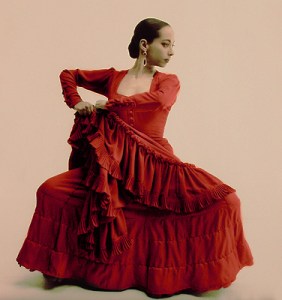
Noche Flamenca was formed in 1993 by Martin Santangelo and his dancer wife Soledad Barrio. The performance we saw comprised two guitarists, two singers and three dancers (all male except for Soledad Barrio). The show commenced with the company on stage tapping out percussive rhythms on a table as if they were at a bar (cantina) and ended with the company doing another hand percussive piece, but this time without table. In between was a sequence of dance and singing items all performed on a stark, minimal stage and pretty well all accompanied by one or two guitars. The only props were chairs, and the lighting was simple but dramatic. I am no dance and music critic and so will not attempt an analysis of what we saw but I will say that it was a beautiful show. It wasn’t what we, naively now I realise, expected: we expected red dresses and castanets, along with stamping feet. We got the stamping feet but there wasn’t a castanet in sight. The whole show was presented as if it were a highly stylised cantina: performers appeared from the group to “show off” a dance or song and controlled but seemingly natural chat could be heard occasionally in the background. The dancing was splendid. I was particularly taken with some travelling moves by Soledad in which, if I hadn’t actually heard the feet tapping, I would have believed she was floating above the surface. Eat your heart out Michael Jackson!

Flamenco Dancer, photo by Gilles Larrain (via Wikipedia)

Flamenco Dancer, photo by Gilles Larrain (via Wikipedia)

So, what did I learn? I learnt that flamenco covers dance, music and song, and that a major feature is its complex syncopation against a strict rhythmic structure (called the compás). My most interesting discovery, though, was that while it is now defined as the music and dance of the Andalusian region of Spain, its origins are wider. During the performance, I was surprised by the singing in particular as it had, to my admittedly untrained ears, a Middle Eastern sound. A quick search of the Internet after we got home told me why – flamenco’s roots are Arabic (Moorish) and European gypsy. How nice to discover that my untrained ears are slowly being trained!

Oh, and I also learnt – rightly or wrongly – that flamenco is a very male thing, that male posturing and bravado are very much part of the tradition. At least that’s how it appeared to me as presented by this company of six men and one woman.

I came away a much wiser person. I also came away wishing I could swish and swirl my skirt the way Soledad did. First though I have to get the skirt!

My mate the AktiMate

I’m late into mp3 players, mainly because I’m not all that keen on walking around with earbuds stuck in my ears. I like to engage with the world – particularly when I walk – rather than cut myself off. After all, isn’t it nice to have some pockets of peace in our otherwise wonderfully connected world? Slowly, though, I started to realise there were other benefits to having an iPod. The car. What a boon it is to be able to plug a player into the car and have immediate access to a large music library (not to mention podcasts and audiobooks) without having to carry around a bunch of CDs. And then there’s home. CDs are on the way out, electronic music is in, and I have in fact been downloading music from iTunes for a while now. BUT, among the plethora of iPod dock options out there, which one to get?

This is where Mr Gums, dare I call him that?, came to the rescue as he always does when it comes to things technological. There are limits, I’m afraid, to my feminism. So, what did I want:

  • a neat system that would not take up a lot of space and would be easy to use;
  • a basic system (as I don’t at this stage need much in the way of fancy functionality);
  • decent sound for a biggish space; and also, hopefully,
  • the ability to plug in my internet radio so I can better listen to great stations like Folk Alley.
AktiMateMini Speaker (1 of 2), with iPod and Internet Radio

AktiMate Mini Speaker (1 of 2), with iPod and Internet Radio

And what, after a search of shops and the internet, did he find to meet these criteria? The AktiMate Mini – two neat little speakers with an iPod dock on one of them, and a remote control. That’s it. It has good sound, particularly for my uncomplicated ears though the experts also review it well, is easy to use, and takes up little space. Looks good too, though I have to admit that, at first, the little iPod did look a bit silly perched on top, but I soon got used to that. And, they do only come in black and white, so you can’t coordinate with all those glorious iPod Nano colours! But that’s probably just as well – lime green chromate speakers might have been a bit of overkill.

In the end, it was all so easy … why did I take so long?

Musica Viva concert: Katia Skanavi

I have been attending classical (to use the popular definition of the term) concerts since the mid- 1970s, but I am not musically trained and so cannot comment with any expertise on technique, interpretation,  etc. However, I do know what I like – and one of the things I like is a concert that mixes old composers/pieces with new. It is satisfying to hear music you know or, if you don’t know the actual music, at least a familiar style. But, it is also great to be challenged by new compositions from contemporary composers.

Musica Viva’s recent subscription concerts – we returned to subscribing about 8 years ago after a bit of a hiatus – achieve an appealing balance in this regard. Under the artistic directorship of Australian composer Carl Vine, we have seen (and heard) a wide range of performers from the tried and true, like the Jerusalem and Tokyo Quartets, to the unusual (for the chamber music scene anyhow) like TaikOz and The Song Company. And, each year, there is a featured composer – a contemporary Australian. In recent years we have had Matthew Hindson, Richard Mills, Ross Edwards, Peter Sculthorpe and, this year, Carl Vine himself. This means that pretty well every concert in the series will include at least one piece by that composer. A painless – indeed usually a joyful – way of being introduced to contemporary repertoire.

And this brings me to last night’s inspiring concert by the young (well, born in 1971) Russian pianist, Katia Skanavi. We rarely have solo piano concerts at Musica Viva, so we were expecting a real treat, and were not disappointed. The program included Schubert, Carl Vine and two pieces by Chopin. It was beautiful – to watch and to listen to. I won’t describe the concert in detail. True music reviewers will do that much better than I, but I will say that Carl Vine’s Piano Sonata No. 3 (2007) was a delight. It comprises 4 movements played without the usual breaks between them. It was both lyrical and dramatic. This may sound silly but I particularly loved the left hand which played some gorgeous quiet lyrical parts and then joined the right in strong dramatic sections. In fact, Katia confirmed once again what a physical thing playing the piano is – her soft notes were barely there but you could hear them all; her loud notes were clear and strong. She seemed to me to combine technical excellence with great expression. After playing for around 80 minutes – with an intermission – she played an encore.  Unlike many performers today who tell us what their encore is, she just sat down and played. I think it might have been another Chopin but I’m probably wrong. I will have to wait for the reviews to find out.

Meanwhile, if you want to hear and see her, albeit much younger, self try this YouTube recording.

Addendum: There was finally a review of the concert BUT, bum, the reviewer did not identify the encore. I bet he didn’t know it either! Anyhow, he agreed that the concert was great. He wrote that “Her playing is deceptively simple. Everything seemed effortless, with even the most complex and technically demanding passages played with a delightful rhythmic definition and precise  phrasing and articulation.” (Graham McDonald, “Simply Splendid Skanavi”, Times2, The Canberra Times, 26 May 2009)

Addendum 2: Here is a lovely review from a Melbourne Blogger of the Melbourne concert. They had two encores, and one was Chopin. I reckon ours was too! Anyhow, now I wish we’d clapped more…