I spent Anzac with the Griffyns

While other Aussies were attending dawn services, or watching almost 24/7 ANZAC broadcasts on the box, this ANZAC Day, Mr Gums and I chose to remember it by going to the Griffyn Ensemble’s The Dirty Red Digger concert, which was devised by their musical director Michael Sollis. Even more audacious than usual, Sollis managed to create a thoughtful show that married the story of the Glebe Rugby League football team (the Dirty Reds) with that of the ANZACS in World War 1, framed by interviews with young rugby league footballers today. He – and his “team” of engaged and talented performers – had the audience glued to its seats.

In a program that ran for a little over 2 hours, with a short break for half-time (!), Sollis spun a story about men and war and sport, about loss and class war and conscription. The performance integrated music and song, much of it composed (and all of it arranged) by Sollis himself, with archival and documentary film footage. The amount of work involved in putting all this together, the research, the writing, the interviewing, not to mention the composing and arranging – well, let’s just say we are in awe. It certainly conveyed Sollis’ passion for the subject matter – music, history, politics and football.

The show comprised nineteen pieces of music (or eighteen if we count the reprise as one) that varied in style from “classical” to folk and rock, from music hall/vaudeville to ragtime. Between and during the musical numbers, this versatile ensemble recited letters and poetry, and enacted stories with barely a hitch, while on the screen we saw a diverse selection of mostly war-related historical footage interspersed with contemporary interviews with young footballers from the Gungahlin Bulls.

“Man’s blind indifference to his fellow man” (Eric Bogle)

Sollis teased out two main themes through the show: the relationship of football to the Australian labor movement and, by extension, class struggle; and the challenge of manhood and the value of brotherhood for soldiers and footballers, past and present. We shared in the grief for soldiers (including footballers) lost, the humour and pathos of vaudevillian propaganda, and the recognition that many young working class men today continue to find purpose, meaning and mateship in football.

“I cannot engage in the work of recruiting and urge others to enlist unless I do so myself” (Ted Larkin)
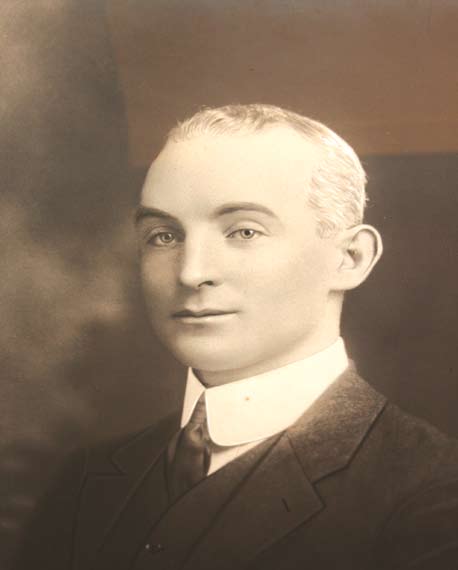
Ted Larkin

“ER Larkin” (Unknown) (Presumed Public Domain via Wikimedia Commons)

Rugby League football we learnt had its origins in northern England when working class clubs, unable to survive under the more affluent south’s “amateur” rule, broke away in 1895 to create the Northern Rugby Football Union. This form of football was established in Australia 1908. It represented, the Griffyns told us, a social movement which united young Australian working class men. It was also, from its start, closely aligned with the Labor party. Prime Minister Billy Hughes, who later earned the labor movement’s ire by attempting to introduce conscription in the Great War, was Glebe Rugby League Club’s patron in 1908. He was just one of several Labor politicians who aligned with the Rugby League movement because of its labor movement origins.

Another of these politicians was Ted Larkin. He was Australian Labor Party member for the NSW State Parliament, from 1913, and the paid secretary of the NSW Rugby League. He died at Anzac Cove on 25 April 1915, and, with his brother who died in the same battle, has no known grave.

You are probably starting to see now the story the Ensemble wove for us as they joined the history of Rugby League football to the progress of the War. It was told through music composed in various styles by Sollis (such as “Heartbeat”, “The Digger’s London Leave”, “Greater Game Rag” and “Conscription”) alongside propaganda songs of the era (such as “What do you think of the Kaiser?” and “Daddy’s in the firing line”) and more recent works like Eric Bogle’s heart-breaking “Green fields of France” and “Working Class Man” (made famous in Australia by Jimmy Barnes). The connections were palpable.

We also heard unfamiliar composers, such as Edouard (or Ede) Poldini, a turn of the century Hungarian composer best known for his miniature piano pieces, like “The Clock”, which featured Kiri Sollis on flute supported by the ensemble. It had a lovely, distinctive tick-tock motif.

“Footy’s my fix” (contemporary footballer)

Interspersed with footage from the Great War, including the Conscription Referendums and the Great Strike of 1917, were interviews with young Gungahlin Bulls footballers and one of their coaches. They talked of mateship, what football means to them, and how they’d feel about going to war should the call happen again. They spoke from their hearts about depression and alcohol, and with humour about the distance between them and those IT guys, the “keyboard warriors”, who are too smart to get themselves beaten up on a football field! Through their comments, and the accompanying footage, Sollis brought working class culture to an arts environment, and as the ensemble belted out “Working Class Man” we saw on the screen those (not really so) simple souls with hearts of gold in our complicated land. It was pretty spine-tingling.

I believe this program will tour nationally. Don’t miss it, if it comes near you. If you’re not moved by the story and impressed by the musicianship of the performers, not to mention challenged to keep up, well, your tastes are very different to mine!

Other (very different) YouTube versions of some of the music:

And you can see sheet music for “The Clock” online, though I couldn’t find a performance.

Team Griffyn: Michael Sollis (Musical Director and Mandolin), Susan Ellis (Soprano), Kiri Sollis (Flute), Chris Stone (Violin), Laura Tanata (Harp) and Holly Downes (Double Bass).
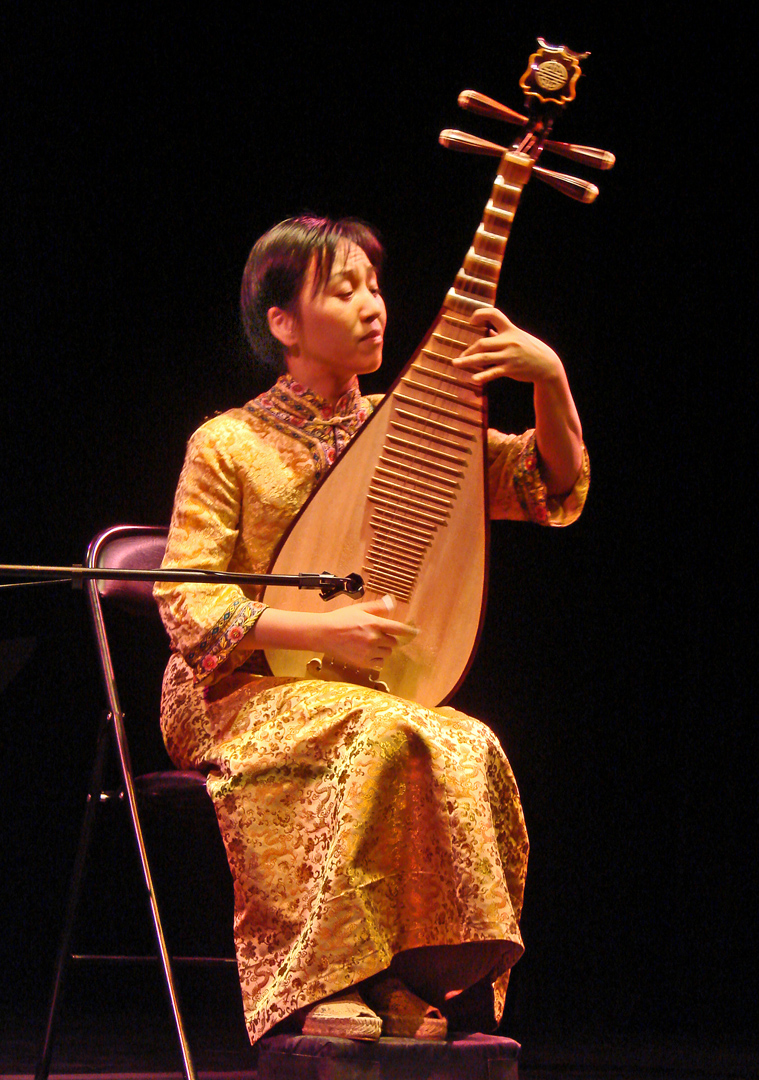
The Griffyns go to China with Gough

… figuratively speaking, of course! The Griffyn Ensemble commenced their 2015 season in fine style, with guest artist, Chinese pipa player, Professor Zhang Hongyan. As always, the concert had a theme, evident from its title, Whitlam in China (and the development of friendly relations between our two countries). It was a tightly performed, well conceived and thoroughly enjoyable concert.

Lingling Yu playing Pipa at Musée Guimet, Paris (Courtesy: Dalbera, CC-BY-2.0, via flickr)

Lingling Yu playing Pipa at Musée Guimet, Paris (Courtesy: Dalbera, CC-BY-2.0, via flickr)

First though, we had the pre-concert entertainment by the string quartet from the China Philharmonic Orchestra. They played three Chinese pieces – all folk-based – in the National Library of Australia’s Lower Ground public space. I don’t remember the names of the first two pieces, but the second one had a gorgeous melancholy to it, and it sounded a little familiar. The first violinist told us that it was about longing and homesickness, and is frequently used for Chinese New Year. I’ve probably heard it somewhere! The third piece was a lovely contrast, “Happy Girl”. Many of us listening couldn’t resist bobbing our heads a little. These folk tunes sounded fine in a Western string quartet configuration.

After this prelude, we all filed into the National Library’s lovely 300-seat theatre, a favourite place of mine and one that I had much to do with professionally, many moons ago. I love visiting it.

Somewhat unusual for the Griffyns, this program’s narrative had a clear chronology, commencing with Gough Whitlam’s election to parliament in 1952 and ending pretty much with the famous dismissal in 1975. The music itself though moved around a bit in time. Here is the program, with links to online versions* (mostly played by other performers) where I have found them:

  • I will build my house on the water. By Horace Keats to a 4th century Chinese poem. Performed by the Griffyn Ensemble (Soprano JaneParkin with Pianist Clemens Leske version)
  • Dragon boat. Traditional. Performed by Hongyan Zhang
  • Moonlit night on the Spring River. Traditional, based on a Chinese poem by Zhang Ruoxu. Performed by  Hongyan Zhang, with the Griffyn Ensemble (China Broadcasting Traditional Orchestra version)
  • In our image, in our likeness. Movements 1, 3, 4. By Leilei Tian. Performed by Kiri Sollis (Recorders), Chris Stone (Violin) (mp3 version)
  • Like spinning plates. By Radiohead. Performed by the Griffyn Ensemble, featuring Susan Ellis (Soprano). (Radiohead’s own version)
  • It’s time. By Paul Jones and Mike Shirley. Performed by the Griffyn Ensemble, featuring Susan Ellis (Soprano). (Original version)
  • Dance music of the Yi People. By Wang Huiran. Performed by Hongyan Zhang. (Chu Yuan version)
  • Big decisions: The Whitlam dismissal. By Robert Davidson. Performed by the Griffyn Ensemble.
  • The song of the pipa player. By Mo Fan to a poem by Bai Juyi. Performed by Hongyan Zhang, with the Griffyn Ensemble (Ding Yi Music Company version)

If you listen to any of these you will realise what a varied – as usual – concert it was.

The concert was narrated by Griffyn musical director Michael Sollis, frequently accompanied by apposite little bars on the double bass (Holly Downes). He had clearly done a lot of reading about Whitlam’s political life, and his narration included quotes from people of the time, such as other politicians and officials, commentators and journalists. While Mr Gums and I, unlike the Griffyns, lived the era, I did learn some things. Gough, after all, was some decades older than I! I learnt, for example, that the first time he mentioned Australia recognising or making overtures to China was in 1954! Sollis described in some detail Whitlam’s history-making visit to China in 1971, when he was still Opposition leader. Whitlam, Sollis reported with a wry look, told Chinese premier Zhou Enlai that

The Australian people have had a bitter experience in going all the way with LBJ. They know America made [Prime Minister Harold Holt] change his policy and they will never again allow the American president to send [Australian] troops to another country.

Sollis also quoted Stephen FitzGerald, who accompanied Whitlam and who later became Australia’s ambassador to China. FitzGerald described the trip as:

an expedition of great bravado and exposure but [also?] great political judgment and luck. It was a journey to the unknown because no one knew what would come of it or who Whitlam would meet. It was personal diplomacy of great political sensitivity.

This section of the narrative was accompanied by a performance of Leilei Tian’s In our image, in our likeness by Kiri Sollis on recorders and Chris Stone on violin to evoke the meeting between Whitlam and Zhou Enlai. I enjoyed listening to the music and thinking about how the two instruments, the two melodies, might reflect the content and tone of the talks. And it was performed with such aplomb and skill by these two musicians who clearly enjoyed what they were doing. One of the many highlights of the night.

Another highlight was the revival-style performance, led by soprano Susan Ellis, of the ALP’s 1972 election song, It’s time. The audience couldn’t resist clapping along.

And finally, while still on the Whitlam theme, I enjoyed Big decisions: the Whitlam dismissal, a piece composed by Australian Robert Davidson for wind quartet with recorded speech. We, of course, had the Griffyns, not a wind quartet, and I presume Sollis had arranged it, as he had the final piece, The song of the pipa player. The recorded speech component of Big decisions comprised excerpts of speeches made at the time – most of which we of a certain age, or students of politics, recognised. The Australian Music Centre says that “The music emphases the inherent melody in recorded voices of Gough Whitlam, Malcolm Fraser, Sir John Kerr and a supporting cast of Paul Keating, Sir Joh Bjelke-Petersen, Sir Charles Court and others”. I loved the way key words and lines from the speeches were repeated with musical accompaniment working around them. Intriguing. Clever.

And then, on top of all this was the pipa, played with such energy and yet delicacy too by Zhang Hongyan. Just check the link I’ve provided under Dragon boat to see what I mean. The concert ended with an ensemble performance of The song of the pipa player composed to a 9th century poem by Bai Juyi. Sollis explained the origin of the piece … here is the beginning of the poet’s foreword to it:

In 815 I was demoted from the Capital to a local Officer of Jiujiang Prefecture. One autumn night of the following year, while seeing off friends on a boat leaving Penpu harbor on the Yangtze River, I suddenly heard a pipa tune being played from the neighboring boat. The music style was clearly from the capital. Being totally surprised, I made an inquiry and learned that the musician was a lady who used to be a famous star in the Capital … Then her glorious years past with the time as her beauty faded. Finally she had to lower herself to marry to a merchant.

Demotion, you see … a fitting conclusion to a wonderful concert in which music and narrative combined perfectly to keep the audience engaged from beginning to end.

Ensemble: Kiri Sollis (flute), Chris Stone (violin), Laura Tanata (harp), Holly Downes (double bass), Susan Ellis (soprano), Michael Sollis (director/composer).

* I tend to provide links where I can because much of the music the Griffyns play is unfamiliar.

The Griffyns end the year on, hmm, a macabre note

Only the Griffyn Ensemble could put together a concert that included Arvo Pärt and Bob Dylan, that started with eerie sounds from a tape and ended with mysterious knockings and bumpings from who knows where to the strains of Silent Night. Intrigued? Then read on …

This year the Griffyns’ theme has been Fairy Stories – loosely defined (and I do love loose definitions). We have wandered though strange maps, worried about what we believe, and thought about our place. In their final concert, “The shearer that could have been”, we were scared witless – well, not really, but they gave it their best shot. It all started with the setting – and a story …

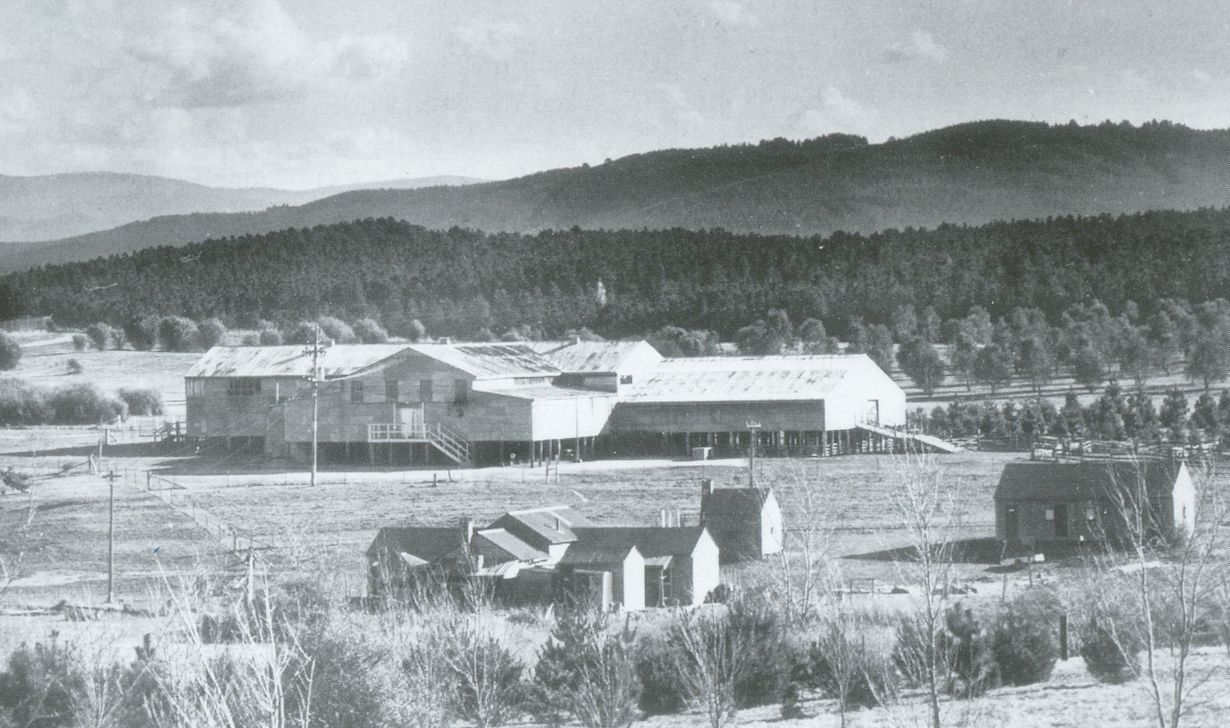
Yarralumla Woolshed, 1925

Yarralumla Woolshed, 1925 (Public Domain, via Wikipedia)

The Griffyn Ensemble like to mix up their venues – partly because they like to choose venues that add to their music, to the stories they want to tell – and so this last concert of the year was in yet another very new venue for them, the old Yarralumla Woolshed. Built in 1904, and still surviving in what is pretty close to the geographic centre of Canberra, the Woolshed has seen many uses over its lifetime – and one of these, in my twenties, was as Canberra’s most popular bush dance venue. It was this history, and its previous history as – of course – a woolshed, that the Griffyns drew on for their performance. And, as they have done all year, they had a collaborator, this time local author Katie Taylor.

Taylor created an appropriately spooky story, about shearers’ tales, mysterious disappearances, loss and hope, about beginnings and endings, and how endings are found in beginnings and vice versa. It was performed expressively by Kate Hosking who told the tale through and between the music performed by the ensemble. We were warned there’d be exaggerations because, as Taylor’s text told us,

exaggerations are what you want from a story-teller.

And so there were – at least we hope they were exaggerations, though you never know!

The eerie tone was set with Juan Pablo Nicoletti’s electroacoustic “Abismo al Abismo” played via tape. Its weird otherworldly impressions of wind and water were enhanced by the sound of Australia’s favourite cockatoos screeching over the woolshed. We were consequently well prepared for Susan Ellis’ unusual rendition of “Have yourself a merry little Christmas … it may be your last”!

From this, and with the story continuing, the ensemble moved on to play two of my favourite Erik Satie pieces (“Gymnopedie No. 3” and “Gnossienne No. 3”), followed by “Swamp Song”, composed by Griffyn violinist Chris Stone, and Shawn Jaegar’s “Pastor Hicks Farewell”. Then, in keeping with the venue, we were invited to take part in a bush dance called by Chris Stone and led by Michael Sollis, as the rest of the band played a “Bush Dance Macabre Suite”. Mr Gums and I aren’t unfamiliar with bush dance moves but “the stab”, “strangle your partner”, and “chop, chop like the guillotine”, were new moves to us! We think playing the spoons was a new move for flautist Kiri Sollis too, but, unlike our dancing, we felt she could easily take up a new bush band career. The suite ended with Susan Ellis singing Bob Dylan’s “Ballad of Hollis Brown” in character, as Ellis always does with aplomb.

We returned after a brief intermission to a dramatic change of pace – from jigs and ballads to Arvo Pärt’s minimalist “Fratres” played by Chris Stone (violin) and Laura Tanata (harp). I’m a bit of an Arvo Pärt fan, so enjoyed their thoughtful rendition. According to Wikipedia, this piece encapsulates Pärt’s “observation that ‘the instant and eternity are struggling within us'”. That fits rather nicely, I think, with the night’s theme of beginnings and endings, of moving forwards and backwards. This piece segued nicely to two very moody pieces: “so she moaned, and as she uttered her moans” composed by Michael Sollis, and featuring the double bass (Holly Downes), mandolin (Michael Sollis), violin (Chris Stone) and flute (Kiri Sollis), and  “Ghost” by Myrto Korkokiou and Apostolos Loufopoulos, with Kiri Sollis on alto flute accompanied by more electroacoustic music. These three pieces showed off the ensemble’s musicianship perfectly.

The concert concluded with Jeff Buckley’s “Dream brother” performed with some lovely singing by the whole ensemble:

Don’t be like the one who made me so old
Don’t be like the one who left behind his name
‘Cause they’re waiting for you like I waited for mine
And nobody ever came

Oh dear … And then, as Ellis moved onto “Stille nacht” (“Silent night”), the rest of the ensemble quietly left the stage, and it wasn’t long before we heard the ghosts of woolsheds past (or were they of our future?) a-knocking and tapping beneath us.

It was a beautifully coherent yet quirky concert that gave its audience a night to remember – and, just so we wouldn’t be left too spooked, they served us lamingtons at the end.

I look forward their Global Chronicles concert series in 2015.

You can hear other versions, online, of some of the music we heard:

The Griffyns are on fire

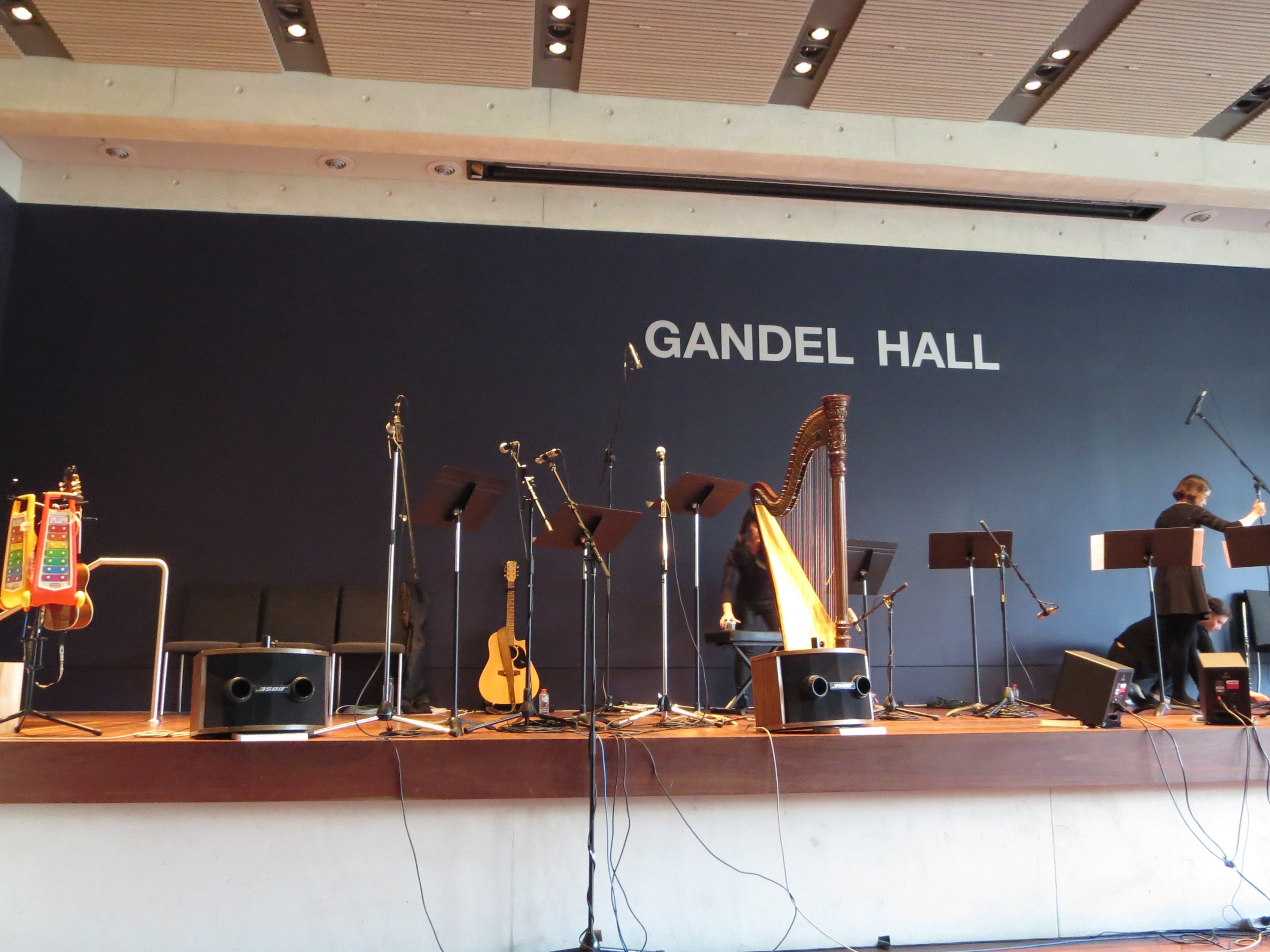
Stage, pre-show

Preshow setting up

And now for something completely different. If Griffyn Ensemble’s last concert, Do you believe? (my review)kept us on our intellectual toes from go to whoa, their third concert* of 2014, House on Fire, had our toes-a-tapping and feet-a-walking in a program that owed more to folk traditions than classical. Collaborating this time with Canberra pop-duo The Cashews (Alison Procter and Pete Lyons), they presented “a new program of original music” composed by them and The Cashews. The programme was  inspired by Arthur Boyd’s imaginative, surreal exploration of “place and identity” and was performed at the National Gallery of Australia’s Gandel Hall to coincide with the Gallery’s Arthur Boyd: Agony and Ecstasy exhibition. Mr Gums and I made a day of it. We visited the exhibition, had lunch overlooking the gorgeous sculpture garden and lake, and then went to the afternoon concert.

When I describe this program as more folk than classical, though, I don’t mean to suggest it was simple. This is the Griffyns after all, and their intent was serious even if the presentation had a lighter – and yes, probably more musically accessible – touch.

The programme opened with an empty stage and the sounds of birds which became more intense as the Griffyns took up their places on the stage and started playing music that sounded like dawn – like birds congregating around a waterhole, as the sun comes up. This segued immediately to the Cashews who performed a beautiful acknowledgement of traditional owners. It was an inspired change from the usual spoken one. “I’ll begin where you began”, they sang, “with connection to this land … I acknowledge you”, concluding with “and pause to acknowledge all that is yours”*. Truly moving.

Pete Lyons then introduced the program, and acted as emcee for the rest of the concert. This was interesting given that it was a Griffyn Ensemble concert, but it spoke beautifully to the fact that this was a real collaboration. Lyons told us that the concert would explore such ideas as belonging and unbelonging, connectedness and unconnectedness, metamorphosis, space, landscape, and silence. All of these made sense to an Australian audience, particularly when also viewed through the prism of Arthur Boyd’s complex depiction of landscape and intense relationship with the environment.

I’d love to describe the whole programme but that would take too long. Unfortunately there was no printed program so I can’t list the pieces. In fact I don’t really know the names of them all, but there were 11 or 12 interspersed with commentary, some brief interviews with Griffyn musicians, and a little walk on the outside! The program ran for nearly 2 hours without an interval, but I don’t think anyone cared.

“Moving to a discordant beat”

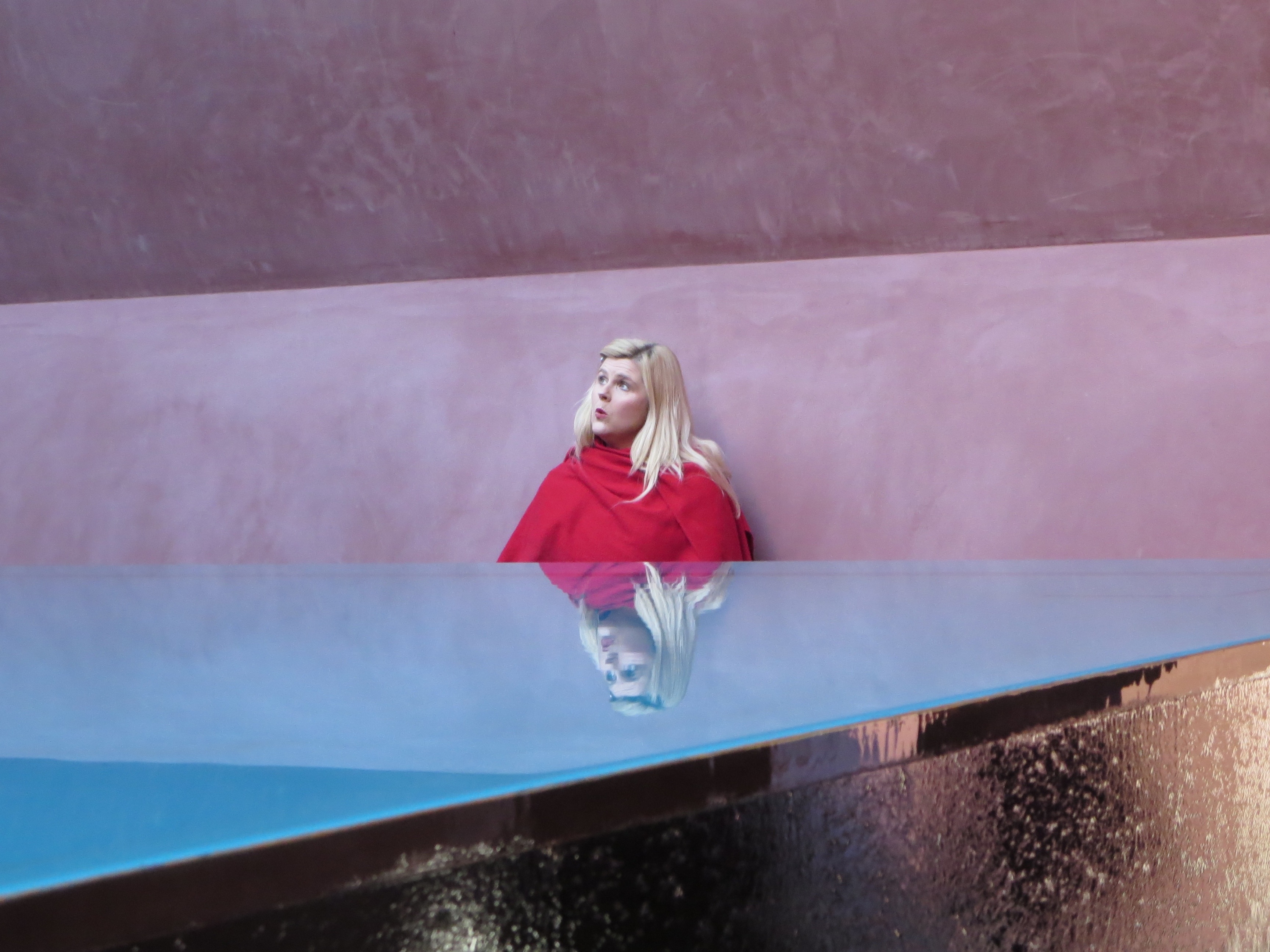
Susan Ellis singing inside "Skyspace"

Susan Ellis singing inside “Skyspace”

I did wonder how well the two sets of performers would meld their very different sounds – one folk-pop and the other contemporary classical. I needn’t have worried. These are all seasoned musicians, flexible in their ability and eclectic in their interests. It was particularly interesting to hear Susan Ellis’ classically trained voice mix with Alison Procter’s lighter one. They had (of course) practised and it worked beautifully, invoking for me the way Arthur Boyd had blended so many competing influences and tensions in his work. In several of the pieces of music, this tension was also conveyed by interspersing lyrical sections with more discordant sounds. Surprising how discordant a harp can sound when it tries – and Laura Tanata certainly tried, to great effect.

I enjoyed Holly Downes’ double bass playing in the last concert, and again in this one. Chris Stone produced some gorgeous mournful tones on his violin. A particularly moving piece was the song that expressed the concert’s theme of House on Fire. It drew on Canberra’s tragic bushfire of 2003 and the fire at Arthur Boyd’s childhood home that destroyed his father and renowned potter Merric Boyd’s kiln. The piece opened with Susan Ellis and Laura Tanata, with the whole ensemble then joining in. It conveyed, in words and music, a sense of “moving to a discordant beat”, but also recognised that there is “strength in adversity”.

The Arthur Boyd “theme” played out in various ways throughout the concert. In another piece, “Metamorphosis”, Susan Ellis, in voice, and Holly Downes’ on double bass, led the ensemble in a piece that explored Boyd’s sense of being “out of kilter”. There was a lovely melancholy in the playing here, too, particularly in the opening double bass.

“Listen … I know exactly what I’m looking at”

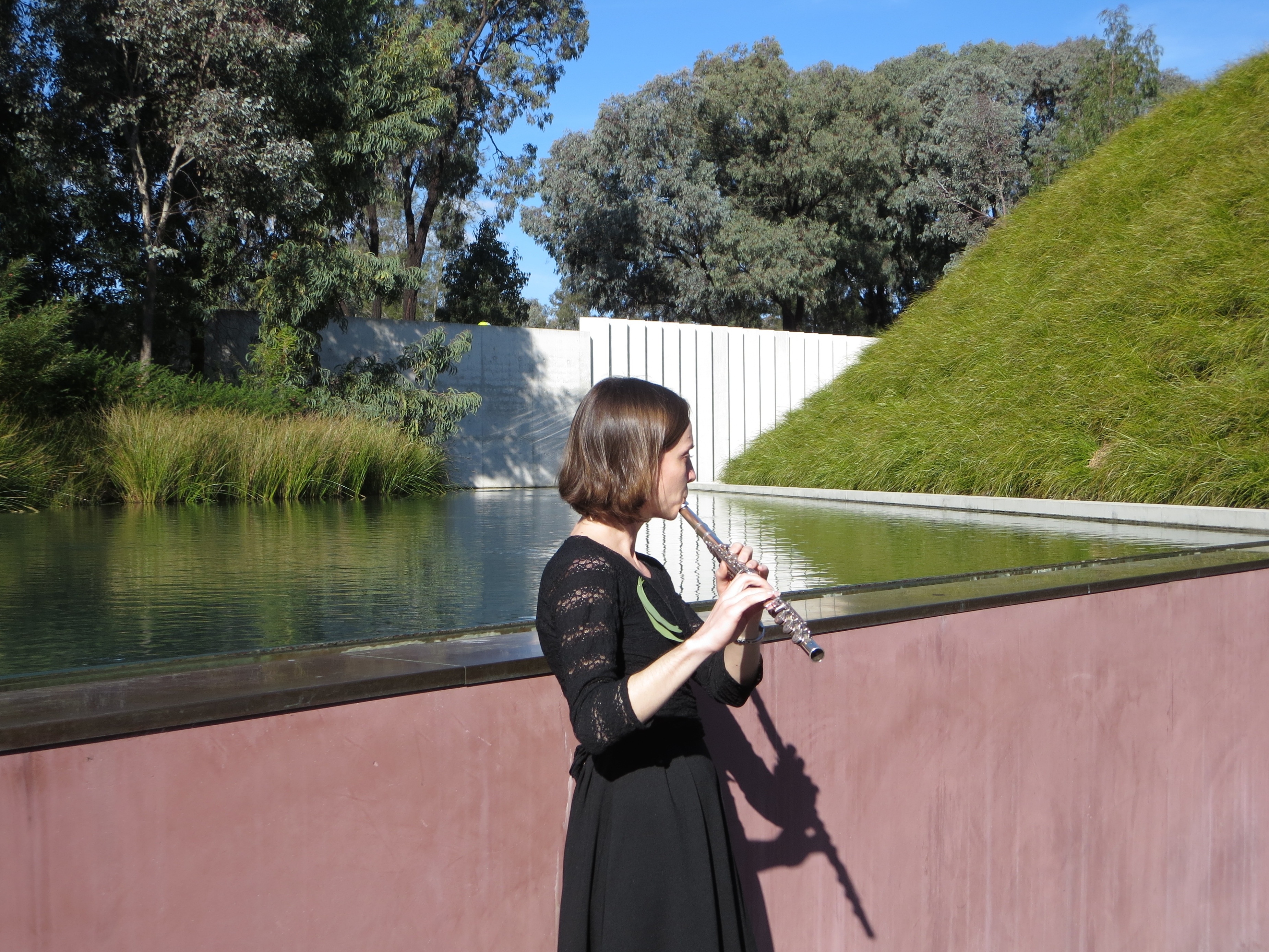
Kiri Sollis outside "Skyspace"

Kiri Sollis outside “Skyspace”

As always, Kiri Sollis shone with her flute, but we were entertained to discover in one of the little “impromptu” interviews that this concert was a departure for her. Classically-trained Sollis is used, she said, to practising lots to get what’s on the page in front of her right. However, in this show, she didn’t have much on the page in front of her and had to draw on her improvisational skills. She mentioned the sense of liberation and the terror of “not having stuff on the page”, reminding us again of Boyd and his terrors! She, like Boyd, needn’t have worried.

We were informed at the beginning that there would be silence and a walk. The silence occurred around the halfway mark, and was introduced by Pete who talked of Boyd’s silence about his work. We can understand why, agreeing with Pete’s comment that Boyd’s imagery and metaphors are complex and not easily unravelled. Best, really, for each person to make of it what they will.

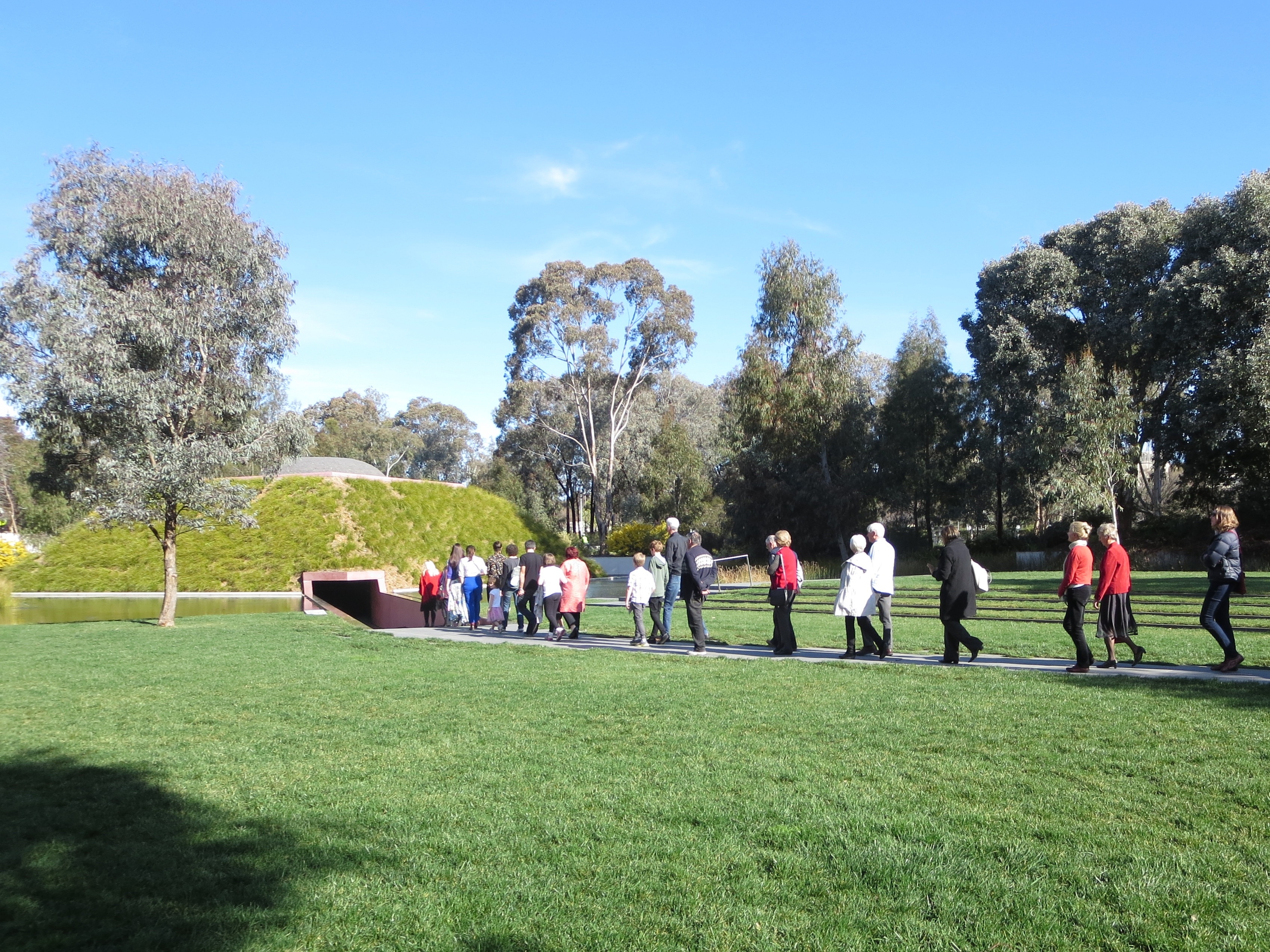
The walk occurred a little later in the concert and involved the audience following Susan Ellis (emulating the Pied Piper in voice) out of the Hall, across the lawn and into James Turrell’s “Skyspace”. Once there, we filed inside the cone in small groups and found three Griffyns sitting on the bench humming/chanting into the space. It was peaceful, harmonious – and reminded Mr Gums and me of some moving “art space” experiences in Japan, particularly from the Setouchi International Art Festival.

“Come walk with me”

Following Susan Ellis

Following Susan Ellis

The concert/show/performance (have you noticed that I don’t quite know what to call these events?) concluded on three pieces of music: “Umbilical Link” composed by Michael Sollis, with words by Alison Procter, “Landscape Escape”, and  “Mountain Song”. “Umbilical Link” was inspired by Sollis’ walking around the suburb in which he grew up, and now lives in again. It’s about belonging, and it also connected to Boyd, to the fact that in the last two decades of his life he found a place he loved, Bundanon. In 1993 he gave Bundanon to the people of Australia because “you can’t own a landscape”.

Being Whispering Gums, I loved this line from “Umbilical Link”:

… big trees whispering moments from my histories.

“Landscape Escape”, a new song by the Cashews, referred specifically to Boyd’s finding Bundanon – “an intricate seduction on a canvas so vast”. The show then closed with an older Cashews’ work (I believe), “Mountain Song”, which neatly tied together the various themes that had been put to us – belonging, disconnection and discordance, respect for indigenous ownership, and a nurturing of the spirit. Australians will get the allusion in Lyons’ words, “the great divide is the great unification”. And with that, a few of the Griffyns picked up stones and sticks and playfully duelled with each other, percussively, before all took their well-deserved bows.

* For the second time this year, the programme was preceded by a support act, this time, appropriately, the local folk/folk-rock/hug pop group, Pocket Fox. We heard the last few songs and were impressed.
** I was trying to capture some lyrics as they were sung, so my quotations may not be exact.

The Griffyns ask Do you believe?

I’ve said it before and I’ll probably say it again, the Griffyns are a tricksy lot. Their second program for 2014 was titled The Three Futurists and was aligned with National Science Week. The theme was “Do you believe” – but we quickly realised that it wasn’t only do you believe in something, though that was certainly part of it, but also do you believe what you are told/what you hear, which is, I think, a more challenging proposition in our media-saturated world.

Pre Show, with scrolls under seats, and double bassist and a dancer doing a last minute practice

Pre Show, with scrolls under seats, and double bassist and a dancer doing a last minute practice

And so, early in the second half of a program that twice had the audience filling out forms, we completed the “Truth assessment” answer sheet from the scrolls under our seats. The sheet had no questions on it; they were read out to us. The questions were about climate change. On finishing our sheets, we were asked to show our hands if we’d answered “a” to a particular question. I was surprised when my seatmates who, I know, “believe” as I do on the issue, raised their hands. Huh? I felt disconcerted – for a moment. And then came: “Do you believe your answer sheet is the same as your neighbour’s”? I looked, and sure enough, Mr Gums’ “a” was the opposite to mine, that is, it was the same as my “b”. Whew, but the point was made, in a very practical way! Don’t take anything for granted!

This year’s theme, as I wrote in my post on the first concert of the year, is Fairy Tales, but they define it broadly to mean “spooky stories and twisted tales”. So far they are keeping their promise. The Three Futurists – aka (Mechanical) Evolution, Prophecy and Armageddon – confronted us with the usual Griffyn challenge. By this I mean, you don’t expect at a Griffyn concert to be transported into a peaceful reverie or to be allowed a simple emotional response; you expect to be intellectually challenged. This is not to say that the music doesn’t move or transport, but that a Griffyn program usually demands an additional level of commitment from the audience. These are artists who like to present ideas, often political ones, through their music. I don’t believe art must be political, but I do like it when artists want to engage politically. Put it down to the 1960s-70s idealist in me!

Anyhow, onto the actual concert. The Griffyns were joined by Liz Lea and four dancers from QL2, Canberra’s youth dance ensemble. An inspired idea, as they added a special dimension to the show. The choreography was expressive, and the dancing – in solos, duets, trios and in ensemble – was lovely and mostly sure. Their representation of mechanical evolution, of robots, was very effective – jerky but with an appealing fluidity that engendered some sympathy for these mechanical life-forms rather than rejection. I also liked Liz Lea’s ancient priestess dance that accompanied the “Song of Seikilos”. According to the program notes, its text comes from around 200BC-100AD:

I am a portrait in stone
I was put here by Seikilos
Where I remain forever,
the symbol of timeless remembrance.

Interesting that this lyrical, graceful reminder of timelessness was bookended by mechanical robots and intimations of Armageddon!

As usual with the Griffyns, the music ranged across genres. It’s one of the things I love about them. In this concert we heard arrangements of older or familiar pieces from popular culture, namely a thoughtful and provocative rendition of Rodgers and Hammerstein’s controversial song “You’ve got to be carefully taught” from soprano Susan Ellis, and Radiohead’s confronting “Fitter Happier”. We also heard the Australian premiere of musical director Michael Sollis’ “Happy Deathday Mister Robot” (listen to a recording made in New York).

Appropriately, much of the music had a strong electronic aspect. I was fascinated by the three pieces by new-to-me Netherlands’ composer Jacob TV (Jacob ter Veldhuis), which use ghettoblaster accompanied by musical instruments such as, in Sollis’ arrangements, flute, harp and/or double bass. Some unusual conjunctions there but they worked in their eerie way. The strangest piece was “Jesus is coming” which includes, among other sounds, some repetitive (and mesmerising) baby talk, but the most confronting was the last piece, “Believer”. In it, Jacob TV incorporates the distorted voice of journalist Bill O’Reilly interviewing George Bush Jr in 2004 about the Iraq War and asking him “So you are indeed a true believer?”. Bush’s response “I believe peace is coming” is what – naive, disturbing, ironic?

I haven’t, I’m afraid, talked much about the musical performances. There was so much going on – the music, sometimes with the ghettoblaster, occasional commentary from the computer (did I mention that before?), live speech, and the dancing – that it’s difficult in retrospect to single out specific performances. So let me just say that the playing was exactly what we’ve come to expect – professional, thoughtful and engaged.

And so what did Mr Gums, our friends and I take away from the concert? Well, primarily that we’d been stimulated to think more upon’t. And that, I think, means it was an excellent afternoon.

You can hear other versions of some of the music on You Tube, such as:

The Griffyns launch 2014 with The Lost Mapmaker

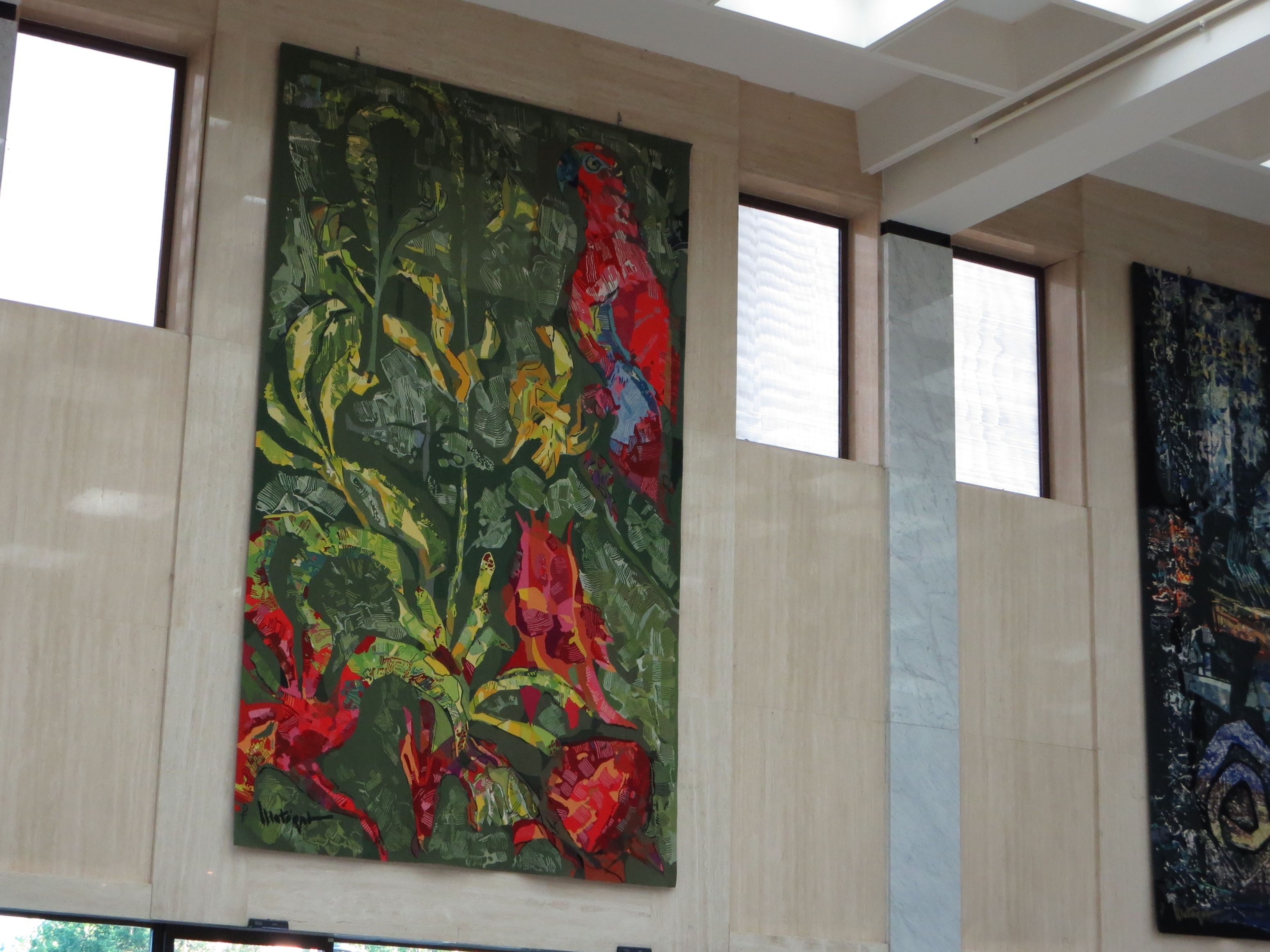
Parrot tapestry, NLA foyer

Parrot tapestry, NLA foyer

You have to be hardy to be a follower (or subscriber) of Canberra’s chamber group the Griffyn Ensemble, about whom I’ve written several times before. Take, for example, the opening concert of their 2014 season. It was held at the National Library of Australia to coincide with the Mapping Our World exhibition. We started in the foyer on the ground floor – sitting on the few scattered seats or on the marble stairs that lead to the mezzanine floor, or standing. We then moved to the conference room on the fourth floor. With only two lifts (elevators) available, the attendants opened the doors to the stairs, which several of us took, not realising where we were heading. Four floors later we emerged, some puffing more than others, to be met by vivacious soprano, Susan Ellis, singing to us as she gave us our programs. We found our seats and settled in for what we hoped would be an entertaining evening. We were not disappointed – but then, have we ever been?

This year’s theme is Fairy Tales but, as before, the theme is broadly defined. The Lost Mapmaker is described in the season booklet as follows:

A mapmaker, trapped outside reality, is trying to draw her way back into the world. Incomplete maps of Australia allow the lost mapmaker, who is only able to communicate through pen and ink, to create an alternative version of reality.

Quartet performing John Gage's A story

Quartet performing John Gage’s A story

Our and the mapmaker’s journey started in the foyer with visual artist Annika Romeyn drawing on an easel while four of the Griffyns sat in a circle, performing the second movement from John Gage’s Living Room Music. The work is a percussion and speech quartet, and the second movement, appropriately title “A story”, involves the players presenting a percussive rhythmic reading of words from Gertrude Stein’s The World is Round: “Once upon a time the world was round and you could go on it around and around.” Words are repeated, round-like, emulating the meaning of the piece. It was an effective, lively opening to the concert, and certainly got us ready to be told a story or two.

Once upstairs the ensemble performed a varied program, ranging from a movingly rendered traditional song by John Dowland, “In darkness let me dwell”, to pieces by popular musicians Brian Wilson of the Beach Boys (“Our prayer”) and Roger Waters and David Gilmour of Pink Floyd (“Comfortably Numb”). It included works by contemporary American composers Lou Harrison (“Song” and “The Clay’s Quintet”), Charles Dodge (“The Waves”) and John Kennedy (“Eagle Poem”). The performance concluded with “Attica” by another American composer, Frederic Rzewski, using words by Sam Melville who was killed in the 1971 Attica Prison Riots. As always, the music challenged us musically and conceptually, but that’s why, I think, most of us love Griffyn Ensemble concerts. We meet new composers or new arrangements of works well-known to us, and we meet them in unusual settings, physical and contextual.

While the ensemble performed, Annika Romeyn drew, using pen, brush and ink on paper that was projected onto a screen. Her drawings took us on a journey through half-made maps, via mythological beings (such as dragons) and gods (such as Aeolus the wind god), a tall ship and a mariner’s compass. It was dynamic, with images being reworked, transformed, as the music moved on. Occasionally, the drawings were replaced by words, devised by author Katie Taylor. “I must name what I see” reminded us of the early explorers and “This country was known before I came” made a pointed reference to “terra nullius”. The Griffyns do not shy from politics.

This year’s ensemble has a new look. Two original members, percussionist Wyana and clarinettist Matthew O’Keeffe, have, sadly, decided that new parenthood and being resident in Melbourne make it too hard for them to continue. We’ll miss them. But, their replacements, double bassist Holly Downes and violinist Christ Stone, both from the folk chamber group, The String Contingent, are looking good. Meriel Owen, the current harpist, was replaced for this concert by the ensemble’s original harpist, Laura Tanata. I still remember a haunting  piece featuring Tanata and flautist Kiri Sollis, some years ago, so was delighted to see Tanata again.

Musical director Michael Sollis is a talented jack-of-all-trades – performer, conductor, composer, arranger, and administrator/entrepreneur. He has an eye for opportunities around town that will work with the ensemble’s ethos and is keen to encourage collaboration with other artists/creators. This shows not only in the venues they perform in, and the variety of music they play, but in associated aspects such as the printed program. Not for them a set format. This program was presented as a scroll, complete with red seal. Visually beautiful, it needed attention to work it out – which I managed when the lights came up during intermission. What did I say about the Griffyns demanding much of their followers!

I haven’t said much about the playing, which is a bit silly given I’m writing about a concert. There was, I think, more whole-ensemble work in this concert and it worked, though the solo and small group pieces have often provided highlights in the past. The new players have slotted in easily, the new instrument mix is possibly more natural than the old, and I do like a double bass! But I will miss Matthew’s clarinet and Wyana’s engaging personality and percussion work. Life, however, moves on – and now we must wait until August for the next concert in the season.

You can hear other versions of some of the music on You Tube:

PS I should mention the concert’s supporting act – a new thing for this season. It was Canberra’s new young group, the Telopea Trio, who gorgeously played pieces by Beethoven, Haydn, Piazzola and Dvorak.

Griffyn Ensemble’s 2013 Elements of Canberra season

The Griffyns ended their 2013 season on a high … literally (in a performance of “Southern Sky”) and figuratively (with beautiful playing under somewhat challenging circumstances … but more on that anon).

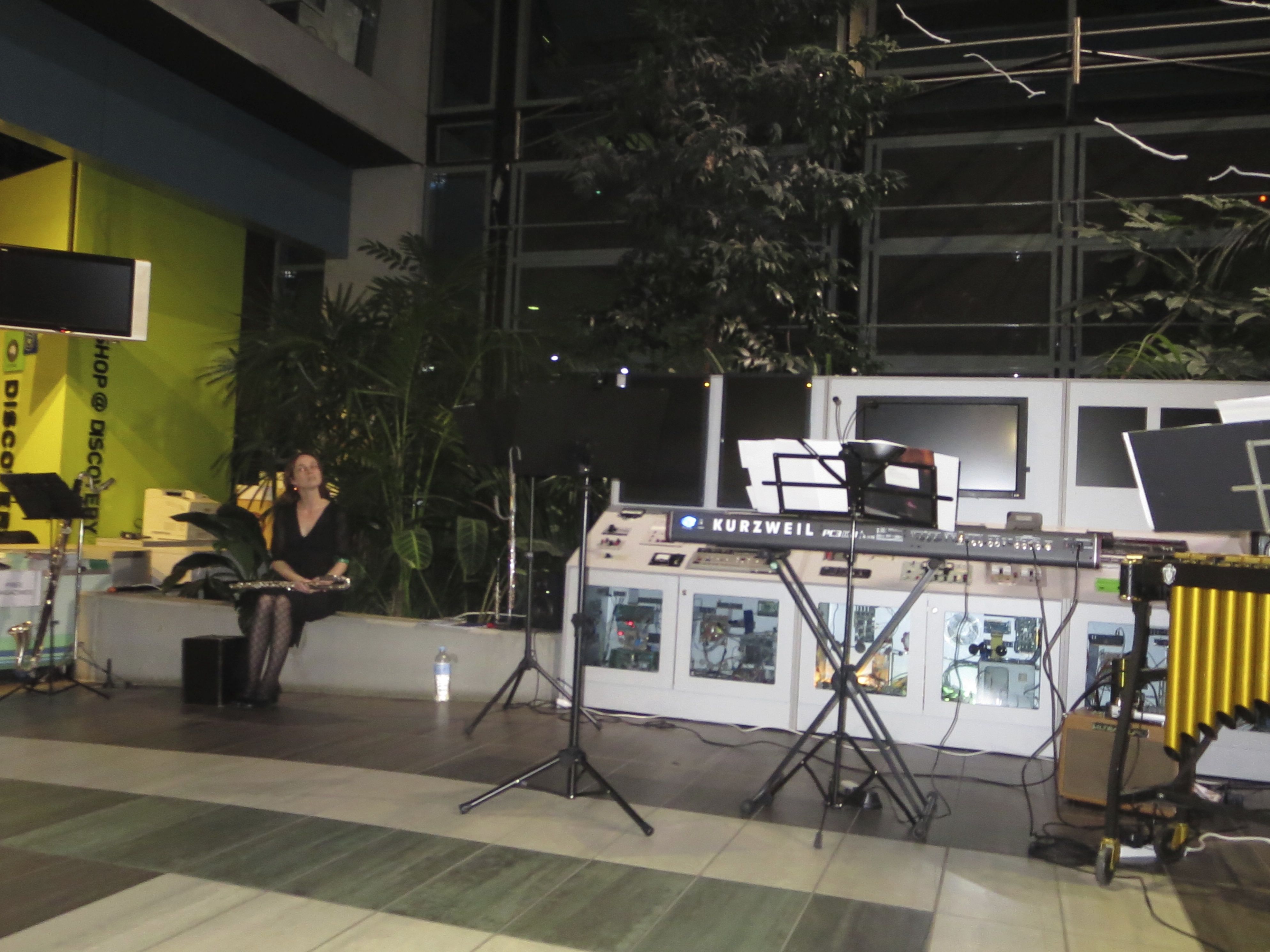
Griffyn Ensemble, CSIRO Discovery Centre

Downstairs, CSIRO Discovery Centre (A bit dark for my digital compact!)

You have to be hardy to be a Griffyn Ensemble follower. You never know where you will have to go to hear their next concert. In this Canberra Centenary year for their “Elements of Canberra” season, we went to the Belconnen Arts Centre ( “Water”) where the lovely Lake Gininderra forms a backdrop, the CSIRO Discovery Centre ( “Earth”), the TAMS Depot industrial hangar (“Air”) and the roofless shell of the ruined telescope on Mt Stromlo (“Stars”). These are not your usual concert venues with plush seats. In fact, a couple required some serious rugging up, but if the musicians are prepared to perform in these atmospheric venues, their loyal followers are clearly prepared to join them.

I haven’t written about the Griffyns this year since the first concert, mainly because we headed off overseas the day after the second concert and had only just returned, with all the concomitant catching up to do, before the third. (Indeed we sandwiched our trip to fit between these two concerts). I don’t plan to review them now. As I’ve said before, I’m not a musician. What I know, technically, about music you could fit on a clarinet reed. But, I do like music that moves, entertains, wows and challenges me – and this is what the Griffyns do for me. So, instead of writing a review, I’m just going to do a little recap of the other three concerts of the season.

It is not necessary to understand music; it is only necessary that one enjoy it (Leopold Stokowski)

The second concert was themed Earth, focusing on Trees and celebrating National Science Week. It took place in the CSIRO Discovery Centre’s atrium, where we were surrounded by trees, and displays and models from nature. It was mid-August and therefore winter in Canberra. Just as well we brought our winter woollies as the Griffyns took us on a musical and physical journey, upstairs and downstairs in this atmospheric, open-plan-glass-walled building. The concert was accompanied by a stylish booklet designed by local artist Annika Romeyn (whose illustrations were on display at the concert). That concert was some time ago now – or at least, I have done much since then including a 2-month overseas trip – so the memory has dimmed. It was, however, a typically eclectic Griffyn concert, as Annika Romeyn describes on her blog. It started with Finnish composer Kaija Saariaho‘s lovely, wistful piece “Fall” which, to me, had at times a rather Japanese sound. It featured the harp (Meriel Owen). And it ended with Michael Sollis’ composition, “City of Trees”, which was commissioned by Robyn Archer for our Centenary. In between were pieces like Martin Wesley-Smith‘s now well-known and fun “Caterpillar”; German-American composer Ursula Mamlock’s “Der Andreasgarten” featuring critters like dragonflies and hummingbirds; an arrangement of Cold Chisel’s “Flame Trees”; and, dear to my heart, Michael Sollis’ “Song of Trees”. It was composed for the opening of the National Arboretum and comprises an extensive list of tree names starting, of course, with gums. It was sung with aplomb by the Ensemble. You can read Clinton White’s review of this concert at CityNews.

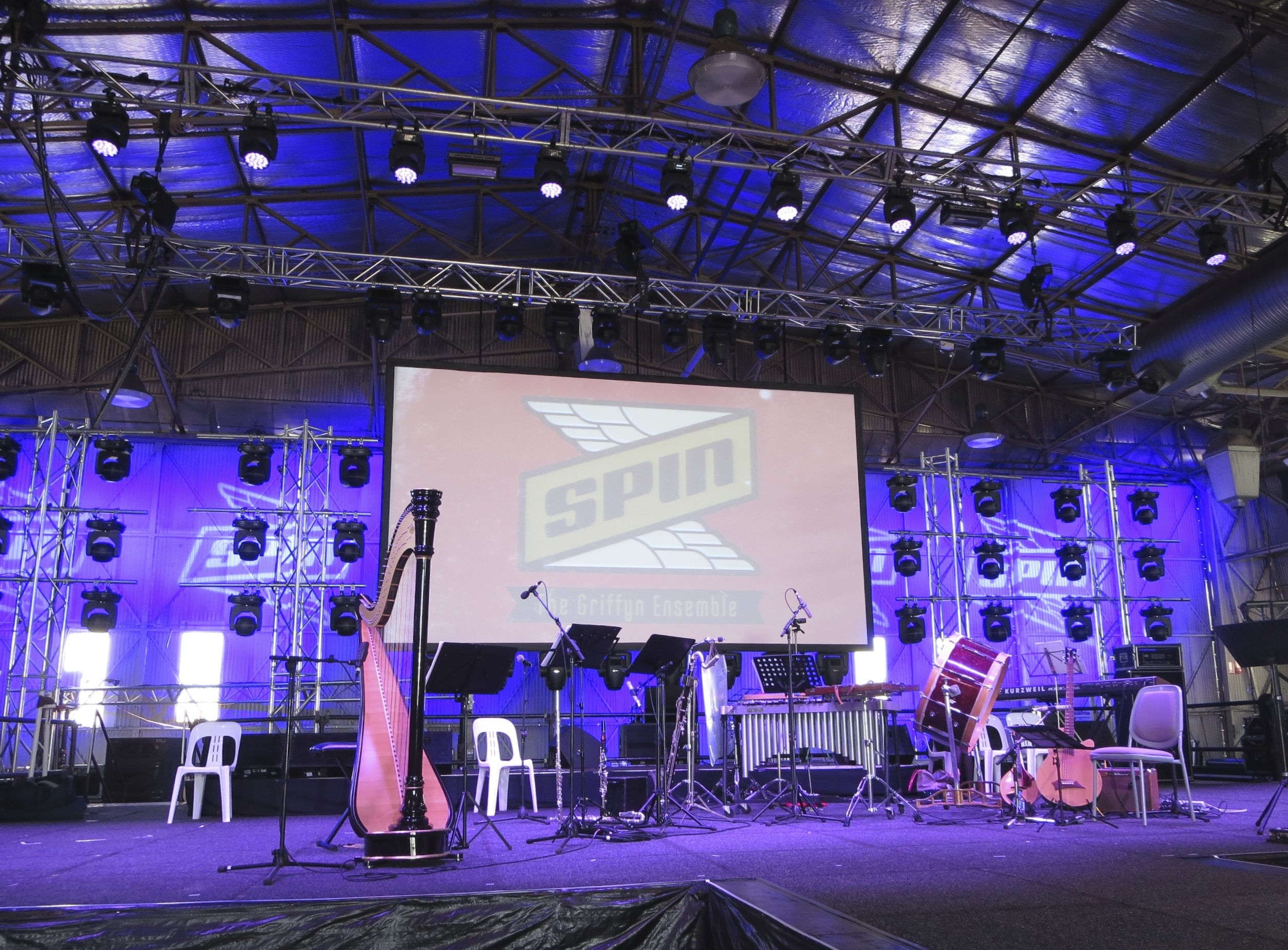
Griffyn Ensemble, TAMS Depot, Kingston

Griffyns in the Tams Depot, Kingston

The next concert, Air, saw us sitting around cable drums in an old hangar on, fortunately, a very pleasant Spring day. We were neither too cold nor too hot. This concert, which coincided with the SPIN Festival, took us travelling by train, bike, plane and even into space. It started on a light note with Luigi Denza’s “Funiculi Funicula”, led by the always-expressive soprano Susan Ellis, and included another ensemble vocal piece led by Ellis, Freddie Mercury’s “Bicycle Race”. As with all their concerts, this one featured some seriously virtuosic playing, particularly from Kiri Sollis (flute) whose “The Great Train Race” (by Ian Clarke) was breathtaking and Matthew O’Keeffe who pushed his clarinet to surely its highest registers in “Someone is learning how to fly” (by Marie Samuelson). The final piece was Brian Eno’s mesmerising, eerie “Music for Airports” (first movement). It’s some 15 minutes or so long and rather repetitive but I could have listened forever. Dare I say I could imagine doing yoga to this, lifting my spirit while contorting my body!

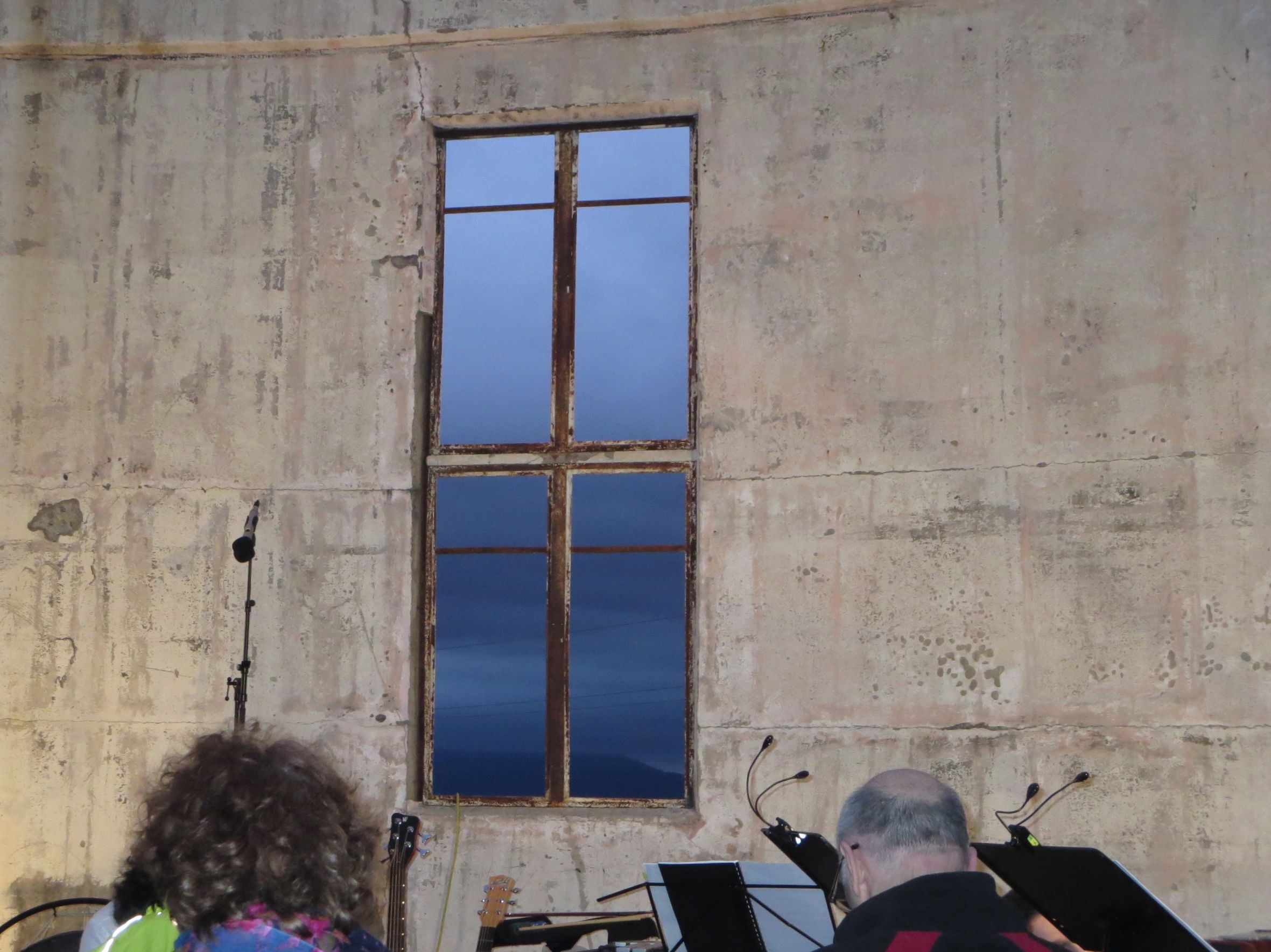
Mt Stromlo burnt out telescope

In the roofless, burnt out telescope on Mt Stromlo

The year ended on something a little different, because, unusually, the whole concert comprised one multi-movement piece called “Southern Sky” by Estonian Urmas Sisask who was inspired by his visit to Australia in the 1990s. You can read an excellent review of the concert on the Canberra Critics Circle blog. I really can’t add anything to what they’ve said. It was cold but, luckily for us (and the musicians), the rain that fell a few kilometres away on my house missed us. The piece, arranged by Michael Sollis, shows off all members of the Ensemble (as the above-mentioned review describes). It was magical, spoilt only by the fact that the cloudy sky meant that astronomer Fred Watson could not actually point out any of the constellations represented in the pieces. I did love seeing Wyana O’Keeffe back in her percussion spot. We’ve missed her this year while she’s been away on baby duties.

And so 2013 ended, a credit to Michael Sollis and his impressive all-round musicianship. What a team they are.

The Griffyns have announced their 2014 season, which is themed “Fairy Tales” and will see them again collaborating, as they like to do, with other creators around town. I can hardly wait.

If you are interested, you can hear examples of some of the music we’ve heard on the links below – but note that many of the pieces will be somewhat different to the versions we’ve heard, as ours were arranged by Michael Sollis for the Ensemble’s particular mix of instruments:

With apologies for this self-indulgent post but, you know, it’s my blog and I’ll write what I want to!

The Griffyn Ensemble explores Water with the Swïne

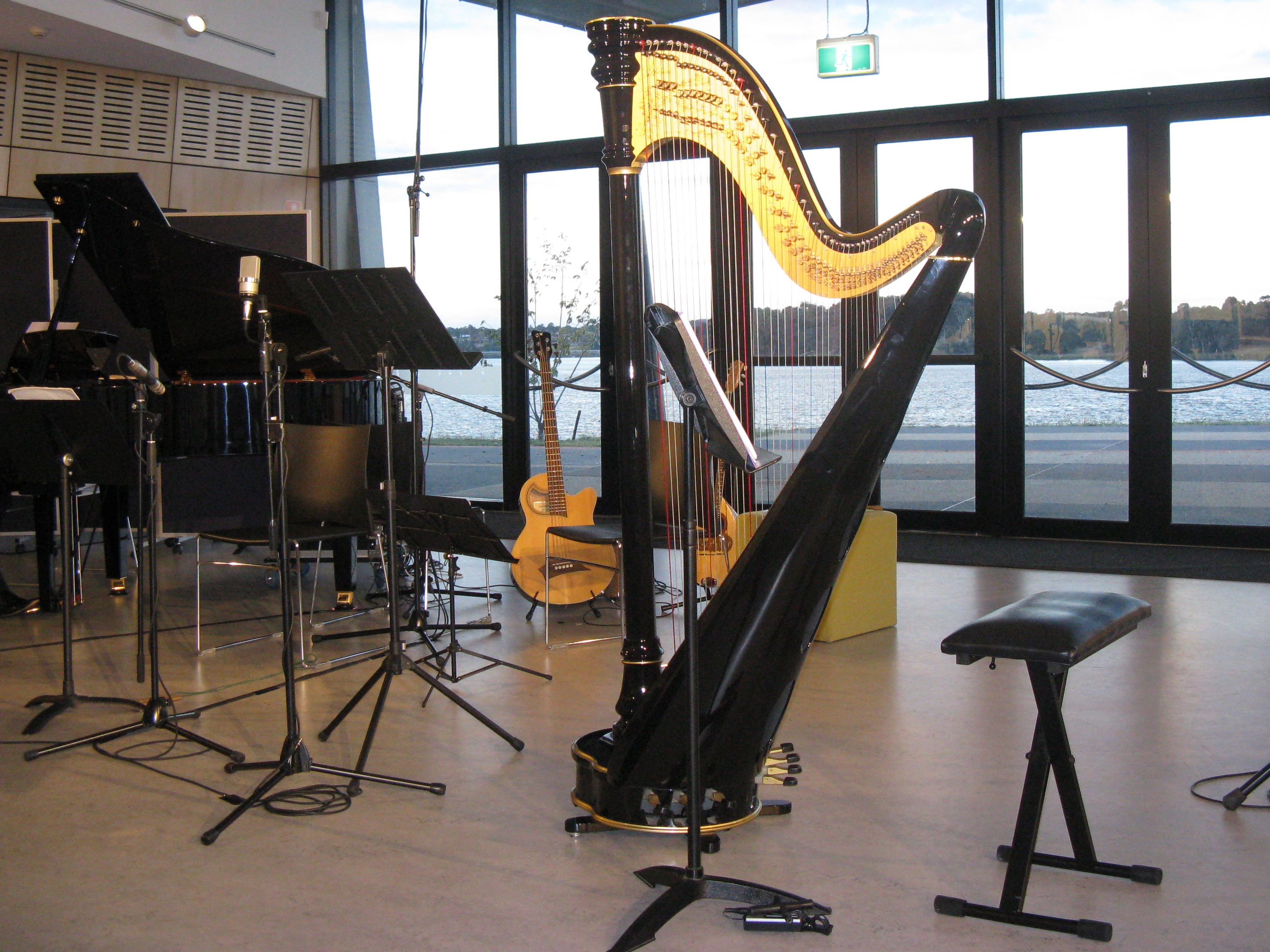
Griffyn Ensemble set up, Belconnen Arts Centre

Before the concert, at the Belconnen Arts Centre

Water, water, everywhere,
And all the boards did shrink
(from The rime of the ancient mariner by Samuel Taylor Coleridge)

I suppose it could be seen as clichéd to hear these words in a concert called “Water” but when the performers are the Griffyn Ensemble, cliché would be the furthest word from your mind.

“Water” was the last performance in the Water into Swine Festival, 28 March to 5 April, which was the result of an “exchange” between Canberra’s Griffyn Ensemble and Sweden’s Peärls Before Swïne Experience. The Swïne (“The Peärls are the music”, they say) specialise in performing new music and are consequently a good match for the Griffyns with their eclectic and open-minded approach to music.

This concert was a little different to previous Griffyn concerts we’ve attended. Firstly, of course, the Griffyn performers were supplemented by four Swedes; and secondly, the concert programming, perhaps because of the exchange, was a little looser. There was a theme – water – but the connections were, let us say, more fluid! And the program was, I think, a little less diverse, a little less eclectic. I love that they dare to program, as they did in Behind Bars, Johnny Cash next to Theodorakis next to Messaien next to new or lesser-known composers.

This is not to say that I didn’t enjoy “Water” – because I certainly did – or that it wasn’t eclectic – because it was. It just felt less so!

One of the things I enjoy about the Griffyn Ensemble that I may not have mentioned before is the balance they strike between formal professionalism and something more informal and intimate. Their performances mimic how I think chamber music was originally performed:

Because of its intimate nature, chamber music has been described as “the music of friends.” For more than 200 years, chamber music was played primarily by amateur musicians in their homes, and even today, when most chamber music performance has migrated from the home to the concert hall, many musicians, amateur and professional, still play chamber music for their own pleasure. Playing chamber music requires special skills, both musical and social, that differ from the skills required for playing solo or symphonic works. (from Wikipedia)

This, a sense of intimacy and joy, is what the Griffyn Ensemble manages to achieve – and it is special to be part of it. So, for example, “Water” incorporated a piece – Sloop John B – which was sung by five young boys led by soprano Susan Ellis and featuring young William (Will) Duff (from Behind Bars) who confidently held a second part against, at times, not only the main part sung by the other boys but other instrumental activity behind him. Also, we were addressed, naturally, conversationally, by Australian sailor Kanga Birtles who has circumnavigated the world solo. He spoke of the perils and joys of sailing, of trade winds and being on the water. His words supported the concert’s loosely defined motif which was to do with the old windjammers sailing from Europe to Australia. This motif was conveyed through Swedish pieces played by the Swïne, and pieces from Madagascar (courtesy Ravel), West Indies, Australia and the United States, played by various combinations of the two groups.

Griffyn Ensemble, Belconnen Arts Centre

Before the concert, Belconnen Arts Centre

The most powerful piece of the first half was Robert Erickson‘s Pacific Sirens performed by the full ensemble (piano, flute, harp, violin, cello, guitar, mandolin, percussion, voice – with recorded sound effects). It was an evocative and eerie piece that confirmed my preference for terra firma! I also enjoyed the world premiere of Australian composer Marián Budoš’ Clepsydra which, apparently, means water-clock. It’s a lovely piece with some jazzy elements to it.

While the first half focused primarily on the sea, the second half looked at water from various angles. One piece was the first movement of New Zealand composer Gareth Farr’s Taheke, which is Maori for waterfall. It was performed gorgeously by Kiri Sollis (flute) and Meriel Owen (harp). Flute and harp is a combination I usually enjoy. This half also featured the world premiere of Griffyn Ensemble director Michael Sollis’ Water into swine. Played by the Swïne (violin, cello, piano, flute), it also included vocalisations representing the dripping of water. As violinist George Kentros suggested, “there’s a hole in the bucket”. Playing their instruments while simultaneously vocalising (except for the flautist of course) looked pretty tricky but the players achieved it with a good deal of aplomb!

The Birtles family reappeared in the second half via a reading, by Susan Ellis, of some excerpts from Kanga’s mother (and Kiri Sollis’ grandmother) Dora Birtles’ journal Northwest by North about the trip she did in 1932 in a cutter from Sydney via New Guinea to Singapore. The reading was illustrated by Michael Sollis’ piece, Scenes from Ballad of a Highlands Man, which was performed surround-sound style with Michael and Kiri Sollis playing a traditional flute-like instrument from behind the audience.

I’ve mentioned only a few pieces played during the evening. We also saw Susan Ellis finger-clickin’ and barefootin’ around the “stage” to Alec Wilder‘s Sea Fugue Mama and heard, interspersed through the concert, the three movements of Swedish composer Klas Torstensson‘s Pocket size Violin Concerto, which challenged us with its mix of discordant and lyrical sounds and which was performed with confidence and enthusiasm by the group for which it was written.

Once again I thoroughly enjoyed the Griffyns. They always manage to put on a concert which appeals to a concert-goer like me, that is, one who is a reader-who-likes-music, who likes to think about what the music means, the stories it is telling, the emotions it is conveying. This concert, with its many watery atmospheres, gave me plenty to think about.

Other versions of some of the pieces:

The Griffyns go Behind Bars

Griffyn Ensemble set up

Before the concert

The Griffyn Ensemble has done it again. They’ve presented a concert that moved, challenged, educated and entertained us. Behind Bars, which was performed last week in Melbourne, Bendigo and Canberra, was the third and final concert of their 2012 season. Like all their concerts it had a theme, this one being, obviously, imprisonment.

This thematic approach is one of the things I greatly enjoy about Griffyn Ensemble. I love the way they marry music with ideas. I guess it appeals to the reader in me. However, while I’ve enjoyed the themes and the music the Griffyns have chosen to represent them, what hasn’t always been clear to me, and I’ve mentioned this before, has been the logic behind the order of the program. Their last concert, which was structured around the four seasons, was clearer, but in Behind Bars the coherence was both logically and philosophically satisfying. Let me describe the program in the order it was presented …

Behind Bars Installation

The concert’s opening introduced us to the main composers and ideas to be further explored in the concert. The performers were spaced around the room, behind, in front of and beside us, and, one by one, provided a spoken and brief musical introduction to one of the concert’s composers. As each new musician performed his/her composer’s snippet, the previous musician/s performed theirs concurrently.  It could have been a mess, but it was lightly and sensitively done and worked well as a concert opener. This section concluded with the ensemble singing Gideon Klein‘s “Poljuŝko, Pole” which was composed in Theresienstadt in 1942.

Abyss of the Birds

Clarinettist Matthew O’Keeffe then performed the clarinet solo movement from Olivier Messiaen‘s Quartet for the End of Time, which was composed in a prisoner-of-war camp in 1941. Messaien apparently said, after this piece was performed in Poland’s Stalag VIII, that “never was I listened to with such rapt attention and comprehension”. This was a lovely piece – though you should know that I’m partial to clarinet. I heard in it strains of jazz and hymns interspersed with the sound of birds. This “birdsong” provided an unexpected sense of hope and freedom amongst the melancholy tones that surrounded it.

Theresienstadt

As you have probably guessed from the heading, the third section of the concert also came from the Second World War and comprised pieces created and/or performed in this Czech concentration camp. The highlight of this section was a performance of the children’s opera, Brundibár, composed by Hans Krasa. WC Fields apparently once said “never work with children or animals” and I must say that guest artist, eight-year-old William Duff, almost stole the show. He sang clearly and sweetly, and his acting was natural and confident. He seemed to have a lovely relationship with his “mother”, the beautifully expressive soprano Susan Ellis. This delightfully entertaining piece was followed by the news that, after performing the work for a Nazi promotional film, the composer, musicians and performers were all sent to Auschwitz and thence the gas chambers. The section closed on the song, “I wander through Theresienstadt”, by poet Ilse Weber (who, with her son, was also transferred to Auschwitz and the gas chambers).

It was in a sombre mood that we went to intermission.

San Quentin

San Quentin was represented by Johnny Cash’s song “San Quentin” composed in 1969 and an earlier piece, “Vocalise”,  by Henry Cowell (imprisoned for “bisexual behaviour”).

March of the Spirit

The concert concluded with an eight-song “folk oratorio” composed by Mikis Theodorakis in 1969 while under arrest at Zoutona during Greece’s military dictatorship of the late 1960s. The piece, March of the Spirit, was set to poems written by Greek poet Angelos Sikelianos during the Greek Civil War in the 1940s. It was described in the program notes as “a collection of eight songs that are a melting post of classical and traditional music elevating the great works of Greek literature and inspiring a new message of democracy and freedom for the Greeks”. Michael Sollis – in a strong, appropriately Greek-sounding voice – and Susan Ellis did the singing, backed, as ever, by the rest of the ensemble on harp, percussion, clarinet and flute. The rousing words – comprising such images as “the earth has been overfertilised with human flesh” interspersed with patriotic calls to freedom – were displayed on a screen for the audience to follow.

What I liked, then, about the concert in terms of its programming coherence is basically this. The opening section provided an effective introduction to the concert’s music and ideas. It was then followed by four sections that were essentially chronological – World War 2 then the 1960s. And, philosophically it ended on a positive note – through a work that expresses the pain of civil unrest but is also a rousing call to freedom and democracy. My only comment, really, is that given the Griffyns are an Australian group performing in Australia, some Australian content might have been appropriate. The toughest issue to tackle would be Aboriginal Deaths in Custody but that would probably be too culturally sensitive for such a group to take on. One day, perhaps, but not quite yet.

I’m aware that I’ve written a lot of words but said little about the music and the musicians. I’ll just say that it was a musically, emotionally and intellectually satisfying concert – and I greatly look forward to the Ensemble’s 2013 season. There are always compensations I find for the years flying by!

Dorothea Mackellar, Elena Kats-Chernin and the Vienna Boys Choir

I’m guessing most of you have heard of the Vienna Boys Choir, but you may not, particularly if you’re not Australian, have heard of Dorothea Mackellar and Elena Kats-Chernin. Mackellar (1885-1968)  was an Australian writer, best known for her poem “My country”. Kats-Chernin (b. 1957) is an Australian composer who was born in Tashkent (in what was then the Soviet Union). She has been in Australia since 1975.

You’ve probably guessed now what this post is about. It’s about Elena Kats-Chernin setting Dorothea McKellar’s “My country” to music for the Vienna Boys Choir to perform (on their 2012 tour to Australia). According to the program, producer Andrew McKinnon, who commissioned the piece, wanted a poem that would both resonate with Australian audiences and “promote the beauty of Australia to international audiences on the choir’s future travels”.

And yet, as I sat down to the Choir’s concert on the weekend and looked at the 25 mostly European-born boys ranging in age from 9 to 14, I wondered what they could make of such a poem. For those of you who don’t know the poem, its most famous verse, the second, goes like this:

I love a sunburnt country
A land of sweeping plains
Of ragged mountain ranges
Of drought and flooding rains
I love her far horizons
I love her jewel-sea
Her beauty and her terror
The wide brown land for me

The program answered my question. After Kats-Chernin had drafted her composition, she went to Austria to workshop it with the boys. What fun that must have been. Kats-Chernin says that while that poem with that choir might seem an odd combination, it also makes sense:

The piece is about a country that’s still really young, but at the same time has been around thousands of years. At the same time they [Vienna Boys Choir] are only young boys, but the tradition they are part of is really old*.

Dorothea Mackellar's My country

Final two verses of Dorothea Mackellar’s My country (Public Domain from the State Library of NSW, via Wikipedia)

And so Kats-Chernin workshopped her ideas with the boys. Here is an excerpt from one of the choristers, Anton (12 yo), as reported in the program:

She read us some of Dorothea Mackellar’s poem. She said Australia is beautiful, and very dangerous. Which key did we think meant danger? Felix suggested B minor, David thought of F sharp. Immediately Ms Kats-Chernin started playing the right chords.

She gave each of us a word to sing, on a sequence of notes, floods, famine, sunburnt country. We were all doing it at the same time, and it was sounding like a fabric of music. That was a total surprise to me, and I could feel myself smiling. It just happened. I think some of this is in the finished piece.

It was a beautiful piece – not schmaltzy or cliched as it so easily could have been. She broke up the words at times, repeated some, left others out (if I remember correctly), all of which gave the poem new power for those of us who know it well. I like Kats-Chernin. She’s able to express a modern sensibility in her music (different or unusual rhythms and harmonic combinations, using my layperson’s language) while retaining lovely melody as well. (Hmm … that statement may imply more about modern music than I really intend, but you know what I mean!). The piece is called “Land of Sweeping Plains” but its most powerful, memorable section focuses on the first line of the 4th and 5th verses, “Core of my heart, my country”. “Core of my heart” was apparently the poem’s first published title. I like that … from “Core of my heart” to “My country” to “Land of Sweeping Plains”. It’s clever – or sensible, at least, I think – to give the piece a more descriptive, less nationalistic/patriotic title, if it is going to become an internationally performed piece. And I hope it does become so.

Meanwhile, if you are interested, you might like to check out this You Tube about Kats-Chernin and the Choir.

* Historians date the choir from 1498!