Carmel Bird, Fair game: A Tasmanian memoir (Review)

Courtesy: Finlay Lloyd

Courtesy: Finlay Lloyd

As I started reading this next fl smalls offering, an essay this time, I was reminded of one of my favourite Australian writers, Elizabeth von Arnim. Von Arnim was a novelist, but she also wrote several pieces of non-fiction, including her delightful non-autobiography, All the dogs of my life. The similarity stems from the fact that both writers play games with the reader regarding their intentions or subject matter – “This not being autobiography, I needn’t go much into what happened next”, writes von Arnim at various points – but this similarity fades pretty quickly because Bird’s piece, despite its similarly light, disarmingly conversational tone, has a dark underbelly.

I thought, given its subtitle, that Fair game was going to be a memoir of Bird’s growing up in Tasmania. But I had jumped too quickly to conclusions. The subtitle “a Tasmanian memoir” means exactly what it says, that is, it’s a memoir of Tasmania. Her interest is Tasmania’s dark history – “the lives of convict slaves, and the genocide of the indigenous peoples”. The title Fair game, you are probably beginning to realise, has a deeply ironic meaning.

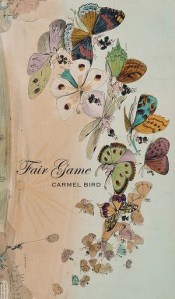
However, getting back to my introduction, Bird does start by leading us on a merry little dance. Her essay commences slyly with a discussion of epigraphs – hers being taken from one of her own books – and the cover illustration. She doesn’t, though, identify the illustration at this point, but simply describes it as “an image of a flock of Georgian women dressed as butterflies, sailing in a glittering cloud high above the ocean”. She then takes us on all sorts of little digressions – about birds, and gardens, and collectors, about her childhood and such – but she constantly pulls up short, returning us to “the story”, or “rural Tasmania”, suggesting that the digressions are “not relevant to this story”. Except they are of course, albeit sometimes tangential, or just subtle, rather than head on. Indeed, she even admits at one stage that:

I have wandered, roving perhaps with the wind, off course from my contemplation of the butterfly women of 1832, they roving also with the wind. It must be clear by now that frequently in this narrative I will waver, will veer off course, but I know also that I do this in the service of the narrative itself. Just a warning.

I love reading this sort of writing – it’s a challenge, a puzzle. Can I follow the author’s mind? One of the easier digressions to follow – and hence a good example to share – is her discussion of a 1943 book published by the Tasmanian government, Insect pests and their control. Need I say more? Bird does, though – quite a bit in fact – and it makes for good reading.

Anyhow, back to the image. A few pages into her essay she tells us more. It’s an 1832 lithograph by Alfred Ducôte, and it is rather strangely titled “E-migration, or a flight of fair game”. On the surface it looks like a pretty picture of women, anthropomorphised as butterflies, flying through the air with colourful wings, pretty dresses and coronets. However, if you look closely, you will see that what they are flying from are women with brooms crying “Varmint”, and what they are flying to are men, one with a butterfly net, calling out “I spies mine”.  Hmm … I did say this was a dark tale, didn’t I? The illustration’s subject, as Bird gradually tells us, is that in 1832, 200 young women were sent from England to Van Diemen’s Land on the Princess Royal. They were the first large group of non-convict women to make the journey, and their role was to become wives and servants in a society where men significantly outnumbered women. As Bird says partway thought the book, “it is not a joyful picture; it is a depiction of a chapter in a tragedy”.

I’d love to know more about Ducôte, and why he produced this work, but this is not Bird’s story. Her focus is the history of Tasmania, and these particular women – who are they, what were they were going to? It appears that Bird has been interested in this story for a long time, since at least 1996 when Lucy Halligan, daughter of Canberra writer Marion Halligan, sent her a postcard with the image. Since then Bird has researched and written about the story. In fact, as she tells us, her research led to the creation of a ballet by TasDance in 2006. They called it Fair Game.

Finally, she gets to the nuts and bolts, and the so-called digressions reduce as she ramps up the story of how these women were chosen, their treatment on the ship, and what happened on their arrival. It is not a pretty story, but represents an important chapter in Australia’s settlement history. I commend it to you – for the story and for the clever, cheeky writing.

awwchallenge2015Carmel Bird
Fair game: A Tasmanian memoir
(fl smalls 7)
Braidwood: Finlay Lloyd, 2015
63pp.
ISBN: 9780987592965

(Review copy courtesy Finlay Lloyd)
Mary Austin, The land (Review)

Regular readers here know that I choose my Library of America offerings for various reasons: for authors I haven’t read before but would like to (such as Edgar Allan Poe and Sherwood Anderson), for authors I love and am always happy to read more of (such as Willa Cather, Kate Chopin and Edith Wharton), or for topics that interest me (like slavery and civil rights). Mary Austin’s “The land” fits into this latter: it’s about the American southwest which is a region I love. I have in fact reviewed another Austin story about that region, “The scavengers”.

In “The scavengers”, Austin described the scavenging animals of the American deserts, the buzzards, vultures, ravens, coyotes and Clark’s crows, and promoted the idea of nature’s balance. In “The land” her focus is the landscape itself, and its hard, unforgiving nature. It’s the first story (essay) in her collection Lost borders, and works partly as an introduction to the collection, in which she sets down, she writes, “what the Borderers thought and felt”.

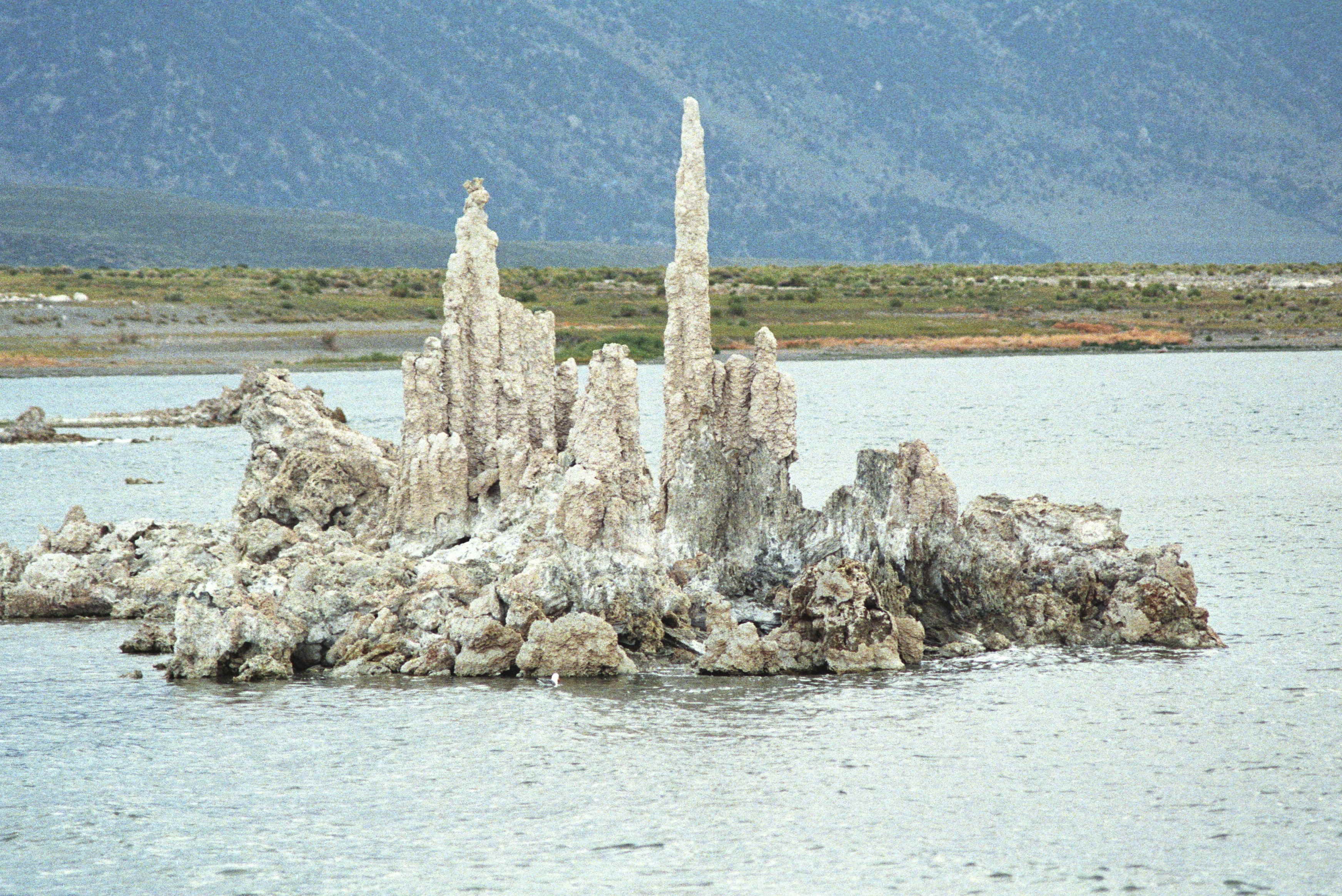
Tufa, Mono Lake

Tufa or “man-deep crystals of pure salt”, Mono Lake

Indeed, LOA’s notes quote scholar Esther F. Lanigan statement that the story introduces “the motley collection of drifters, prospectors, explorers, entrepreneurs, and sheepherders [about whom she will write], most of whom demonstrate an astonishing insensitivity in their dealings with the women closest to them”.

The “lost borders” region she explores in the collection is what I’d call the eastern part of central California*. We are talking country that stretches from the east of the Sierra Nevadas to Death Valley in Nevada. It is remote, hot and very dry. It is country, in other words, that Australians would understand. Driving through this region, as I did in 1983 and a few times in the 1990s, reminded me, in fact, of my road trips in outback Australia – particularly western Queensland and northern South Australia.

“The land” is about story and myth. She writes that “curiously … you can get anybody to believe any sort of a tale that had gold in it”. She’s “sore” that she’s not believed “in some elementary matters, such as that horned toads are not poisonous, and that Indians really have the bowels of compassion”. So, when she is brought a potsherd from Shoshone Land and told she could probably find “a story about it somewhere”, she responds that she’ll “do better than that”, she’ll “make a story”. And so she does, and is amused over time to see her story take on the mantle of truth. She has “a spasm of conscience” on at least one occasion, but doesn’t ‘fess up. Instead, she suggests that there only has to be another similar potsherd found for the tale to be fixed “in the body of desert myths”. Beware, methinks, you oral historians!

“The land” is also about men and women. Austin respects Indian (as she described them back then) knowledge, saying:

Out there, a week’s journey from everywhere, the land was not worth parcelling off, and the boundaries which should logically have been continued until they met the cañon of the Colorado ran out in foolish wastes of sand and inextricable disordered ranges. Here you have the significance of the Indian name for that country— Lost Borders. And you can always trust Indian names to express to you the largest truth about any district in the shortest phrases.

“Largest truth” in “the shortest phrases”. Love that. There’s a lovely, irregular, repetition of “out there” throughout the piece, reinforcing the sense of remoteness and desolation. The unforbidding nature of the land is conveyed in other ways too: by experience, “I have seen things happen that I do not believe myself”, and in description, “the senses are obsessed by the coil of a huge and senseless monotony; straight, white, blinding, alkali flats, forsaken mesas …”.

While Austin respects the Indian inhabitants, she is less impressed by men (and I mean here the male of the species, not mankind). Men are seen as “small”. She describes them as making “law for the comfortable feel of it”. They “pinch themselves with regulations to make sure of being sentient …”. Their “boast of knowledge is likely to prove as hollow as the little yellow gourds called apples of Death Valley”. It is the

men who mostly go into the desert, who love it past all reasonableness, slack their ambitions, cast off old usages, neglect their families because of the pulse and beat of a life laid bare to its thews and sinews. Their women hate with implicitness the life like the land.

Indeed, she concludes this essay with:

If the desert were a woman, I know well what like she would be: deep-breasted, broad in the hips, tawny, with tawny hair, great masses of it lying smooth along her perfect curves, full lipped like a sphinx, but not heavy-lidded like one, eyes sane and steady as the polished jewel of her skies, such a countenance as should make men serve without desiring her, such a largeness to her mind as should make their sins of no account, passionate, but not necessitous, patient—and you could not move her, no, not if you had all the earth to give, so much as one tawny hair’s-breadth beyond her own desires. If you cut very deeply into any soul that has the mark of the land upon it, you find such qualities as these—as I shall presently prove to you.

Austin belongs, I think, to the tradition of nature writers that includes Henry David Thoreau and John Muir (whom I’ve reviewed), but it seems to me that her gender adds quite a different perspective to what she sees.

Mary Austin
“The land”
First published: In Lost borders, 1909.
Available: Online at the Library of America

* This region is at the centre of the California Water Wars (dramatised in the film, China Town)

Virgil Thomson, Taste in music (Review)

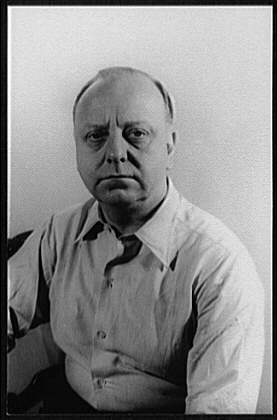
Virgil Thomson portrait, 1947

Virgil Thomson, 1947 (Public Domain, from the Library of Congress via Wikipedia)

There are several reasons why now seemed an opportune time to write my first Library of America (LOA) post for 2015. The first reason is obvious. It’s June and I haven’t featured one yet. The second is because my last post was on music, so writing about an article by American composer Virgil Thomson seemed apposite. The third reason relates to an interesting comment Thomson makes about reviewing, recalling my recent post on the AustLit anthology of criticism.

And then there’s reason why this article, published by LOA back in February, initially attracted my attention. It’s because of Virgil Thomson himself. I first heard of him back in the 1970s as the composer of two beautiful American government sponsored documentaries, The plow that broke the plains (1936) and The river (1938), made by filmmaker Pare Lorents. I won’t reminisce about this now, but I enjoy noting these connections we make over our lives.

In my post on the Austlist anthology of criticism, I quoted the editors as defining criticism as  “interpretation”, something they differentiated from “reviews” which they saw as focusing on “evaluation”. In LOA’s introductory notes to Thomson’s piece, they quote Thomson’s explanation as to why, as music critic and editor for the New York Herald Tribune, he only used composers and performers as reviewers. He said:

It’s a writing job, but the subject is music and you’ve got to know a good deal about the subject in order to be believable. In order to be a reviewer, you have to forget whether you liked it or not and tell your reader what it was like.

Hmmm … a rose by any other name, eh? What Thomson calls “reviewing” is what the anthology editors call “criticism”. Whatever name we give it, I realise that I tend to prefer reviews/criticism that focus on analysing what the work is like, what makes it tick, more than whether the reviewer liked it. “Liking” is such a subjective thing and can depend so much on one’s experiences, preferences, personality even, whereas describing “what it was like” involves knowledge of the art form, the ability to “see” it in context, to understand how it does what it does, and to describe, perhaps, what it “means”. This is not to say that “liking” isn’t important, but that it is not necessarily the most important aspect – for me anyhow.

So, then, Thomson’s “Taste in Music”. He starts by differentiating taste “for” music, which he sees as the ability to enjoy music, pretty much indiscriminately, and taste “in” music, which involves liking certain kinds of music over others. He then discusses admiration versus liking, suggesting that “there are often striking contradictions between what musical people admire and what they like”. Admiration is about “reason” while “liking is an inspiration”. You can’t alter “liking”, he says, “by any act of will”. But “it will frequently alter itself … without warning”. I think we have all experienced that! Loving something, and then suddenly tiring of it, growing out of it perhaps.

Thomson’s main argument is that “development of taste” is not the main objective of music education, that the important thing is “understanding, that whole paraphernalia of analysis and synthesis whereby a piece is broken down into its component details, mastered, restored to integrity, and possessed”. This is true of literature too. How often have you heard people say that studying literature put them off reading, or off the classics. And yet, pulling apart books is the only way you learn to understand them, what makes them tick. Thomson goes on:

Persons unprepared by training to roam the world of music in freedom but who enjoy music and wish to increase that enjoyment are constantly searching for a key, a passport that will hasten their progress. There is none, really, except study.

Oh dear, he’s right, I know he is. And this is why I constantly say that my reports of Griffyn Ensemble concerts do not constitute reviews. They are reports of what I enjoyed, and what I made of the performance. I do not have the skills or training to review music.

Thomson also discusses the familiar versus unfamiliar in music. He writes that “the too old, the too new, the in-any-way strange, we resist simply because we do not know how to take them on”. We enjoy the familiar, he says, and this leads toward “a timid conservatism with regard to unfamiliar music”. He writes that:

The lay public will try anything, but it will be disappointed, on first hearing, in anything it has no method for remembering. We like the idea of being musically progressive, because progress is one of our national ideals; but we do not always know how to conduct a progress.

This is probably true of the new in all of the arts, don’t you think? “To hear music correctly”, he wrote, to “know one’s mind”, we need to be able to “hear patterns in sound”. This is what I feel about all music, but particularly new, unfamiliar work. I might sense patterns but on one hearing, and with almost no musical training, I don’t feel capable of “reviewing” it, of understanding let alone explaining what makes it tick, the same way I can, for example, with a novel. I am experienced at looking for patterns in literature, but not so for music. Thomson suggests that the untrained will “rarely know the difference between their tastes and their opinions”. Hmm … probably true.

His next point is that while professional musicians express “responsible opinions” based on knowledge, it is “lay opinion” which creates the “modes or fashions in consumption that make up the history of taste”.  Interesting. He admits that knowledgeable persons play some role in developing these “fashions” but that they can’t force the public to like what it doesn’t want. He argues that creators cannot behave freely with trendy music. You can’t tinker with what people like. For this reason, he says, unsuccessful or unfashionable music “is sometimes the best music, the freest, the most original”.

What I most enjoyed about Thomson’s essay, though, is that he doesn’t lay down the law. He knows music, like all arts I’d say, is a slippery beast. There “is no rule” that can’t be broken. He writes that:

Those who think themselves most individual in their likings are most easily trapped by the appeal of chic, since chic is no more than the ability to accept trends in fashion with grace, to vary them ever so slightly, to follow a movement under the sincere illusion that one is being oneself.

He then has a dig at intellectuals. “You can always sell to the world of learning” he says, “acquaintance with that which it does not know”!

In other words, the only real answer to understanding and appreciating music, is “labor, much study, and inveterate wariness [because] the pleasures of taste, at best, are transitory”. “Nobody”, he says, “professional or layman, can be sure that what he finds beautiful this year may not be just another piece of music to him next.”

So, having logically argued the meaning of responsible reviewing and the importance of understanding music, Thomson concludes that in the end “the pleasures of taste … are transitory”. The best we can do, he says, is consult our appetite about what we consume and after consuming it “argue about the thing interminably” with all our friends. On that basis, I think, the important thing is to enjoy what we read, hear or see, and when we write about it to be clear about the basis on which we are writing. Our readers can then assess our opinion on the basis of what they understand to be our background, knowledge and prejudices. What do you think?

Virgil Thomson
“Taste in music”
First published: In The musical scene, 1945.
Available: Online at the Library of America

Kate Forsyth, Stories as salvation (Review)

One of the best things about being involved in the Australian Women Writers’ Challenge is hearing of writers whom I may not otherwise have come across, or, if I had, who may not have registered strongly with me. One such writer who regularly pops up in the challenge is novelist Kate Forsyth. The reviews that keep coming in for her books, particularly for The Wild girl and Bitter greens, have intrigued me, but I haven’t yet found an opportunity to read these novels. I did, however, find time to read the short memoir, “Stories as salvation”, Forsyth wrote for the Griffith Review some months ago now.

Forsyth’s story is both common and unusual. It’s common because it is a tale of a young girl who turned to books and stories as solace during a childhood characterised by much ill-health and many hospital stays. How many memoirs have we read that tell this story?

Stories. My only source of sunshine, my only solace. I would read all day and as late into the night as the nurses would let me … Stories were escape. Stories were magic.

But, it is unusual too, because, like most such stories, hers has its unique elements. Her health problems started when she was two years old with a vicious attack by a family dog which, among other things, destroyed one of her tear ducts. She barely survived that attack, and then suffered multiple serious infections requiring hospitalisation, due mostly to this tear duct problem. She subsequently became, she said, at the age of eleven, “the first Australian to have a successful implantation of an artificial tear duct”. She includes in this memoir her poem “Scars” which was first published in Quadrant in 1994 and which evokes the visible and invisible scars of her experience, their power and her power over them.

What I found most interesting in this essay-length memoir was her clear articulation of how her childhood reading had informed the writer she is today. I am always interested in how writers end up writing what they write, and what their intention is (regardless of whether their intention is what I might take away from their writing.) For Forsyth, her introduction to Grimms’ Fairy Tales when she was seven came “to haunt [her] imagination”. She was particularly attracted to Rapunzel who

too was locked away from the world against her will. She too was lonely and afraid. Her tears healed the eyes of the blinded prince, as I so desperately longed to be healed. The uncanny parallels between Rapunzel and my life seemed to have some potent meaning.

And so, later, she started writing. Her first novels, commencing with The Witches of Eileanan in 1997, were firmly in the fantasy genre. In them, she says, “the themes of imprisonment and escape, wounding and redemption, appear again and again”. However, it seems Rapunzel stayed in her mind. She started researching the origins of the story, and realised that she did not want to write it as “an otherworld fantasy”:

I wanted to capture the charge of terror and despair that young girl must have felt. I wanted to remind readers that women have been locked up for centuries against their will in this world.

Our world.

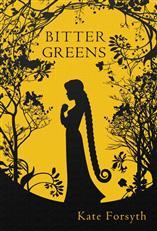
ForsythBitterGreensSo the resultant novel, Bitter greens (2012), is set in a real place at a real time. It could not, therefore, she says, rely on magic to explain all the mysteries in the story. She also explains how this research led her to “undertake a doctorate on the subject, with Bitter greens as the creative component.” It also led her to write The Wild girl about Dortchen Wild who was a neighbour of the Grimm family and who told Wilhelm Grimm “almost one quarter of the eighty-six tales collected” in the brothers’ first edition. (Just to be clear, though … she was one of many from whom the brothers collected.)

Now, I have to say that I am not particularly interested in Forsyth’s fantasy series, but these two books, which tend more to the historical fiction genre, do fascinate me. I will try to get to them one day. Meanwhile, I’m intrigued by what Forsyth loves in a story:

romance, passion, tragedy, struggle, and, finally, triumph.

I do like those things – who doesn’t – but I don’t need “triumph”. I don’t dislike books with this result, but I am happy with stories that are more equivocal, that make me wonder at the end. Life isn’t always, in fact often isn’t, triumphant – and I am more than happy for the arts to reflect that reality. Moreover, I’m not sure what Forsyth thinks, but I think stories can, by their very existence, provide “salvation” without offering “triumph”.  What do you think?

BTW, I was intrigued to read in her Official Biography that Forsyth is a direct descendant of Charlotte Waring, the author of the first book for children published in Australia, A Mother’s Offering to her Children. Waring was the mother of Louisa Atkinson, about whom I have written.

awwchallenge2014Kate Forsyth
“Stories as salvation”
Published in the Griffith Review, Edition 42, 2013
Available: Online at the Griffith Review

John Updike, The lovely troubled daughters of our old crowd (Review)

I have an old-friend-cum-ex-colleague who has been asking me for longer than I can remember to read John Updike. He even, a year or so ago, sent me a link to a Kindle special for Rabbit, Run. I obediently bought it, and I do intend to read it, I do. However, I recently reorganised my Kindle and discovered that I have a TBR pile there of 20 books! How can that be? I hardly ever buy for the Kindle. But, there you are, the Kindle Cloud never lies, so I must have. All this is to say that I realised it could be some time before I got to Updike, so when I saw a story by him appear on the Library of America a year ago, I printed it out! It finally reached the top of the pile and I’ve just read it. My friend is right. I really should read (more) Updike.

The story, “The lovely troubled daughters of our old crowd”, is told from the point of view of a male member of a group of couples who socialised and holidayed together over many years – indeed from the time their daughters were two or three to now, when they are in their mid-twenties. Well, until they were somewhere in their teens anyhow, because the old crowd is no longer together – not only due to “the children, really, growing unenthusiastic and resistant” to group holidays but due to “the divorces as they began to build up”.

He compares happy times of the past – from his perspective – to the less than exciting or fulfilling things all their daughters are doing now – from his perspective. He also compares the daughters to their mothers – and again, of course, it’s from his perspective. This is the important thing about the story – his perspective. We know nothing really of what the girls thought then or think now. We only know what a now middle-aged man thinks. Should we trust his view? What does the fact that Updike included this in a collection, published in 1987, titled (presumably by him) Trust me tell us about his intention?

Late in the story, the narrator also compares the girls to the “daughters of people we hardly knew”. These daughters “are married to stockbrokers or off in Oregon being nurses or in Mexico teaching agronomy” while

our daughters haunt the town as if searching for something they missed, taking classes in macramé or aerobic dancing, living with their mothers, wearing no make-up, walking up beside the rocks with books in their arms like a race of little nuns.

So, here’s the challenge. From his point of view, there’s something wrong with these girls. They are not getting married, they are not in high status or highly admirable jobs or situations. Well, we readers might ask, why should they be, given that their parents have clearly not set good examples of happy marriages? Indeed, our narrator, who’s in “about the last marriage left”, reveals a wandering eye. We wonder, in fact, whether they may have been swinging couples. We might also ask, though, what is wrong with the choices the daughters are making? Why should they wear make-up? To catch a man? What is wrong with walking “beside the rocks with books”? And, do they want to marry a stockbroker?

I love the complexity of this, the fact that Updike has chosen to tell this story through decidedly subjective eyes, and yet has managed to leave the interpretation surprisingly open. It’s a story, I suspect, that can be read very differently depending on each reader’s experience and point of view, despite some givens in the text.

Before I conclude, I want to mention the style. The tone is intimate – as though the narrator is talking to one of his old friends. He refers, for example, to Mary Jo Addison and “that bad spell of anorexia”, implying we know all about Mary Jo’s problems. There’s also some lovely imagery, such as this description of the young girls with “their pale brushed heads like candles burning in the summer sunlight”. Decorative but not very necessary? Is this how they were treated? And, overall, there’s a sense of disconnect between the narrator’s nostalgia and the reality of their lives. I’m not sure he’s unreliable exactly, but he does seem rather deluded about what role he and his friends may have played in who the girls are now.

“The lovely troubled daughters of our old crowd” is such a sly story. It suggests that the daughters are troubled, are somehow wrong, and maybe they are, maybe they’re not, but that is not the real, or the whole, story. And therein lies the lovely irony in the title.

John Updike
“The lovely troubled daughters of our old crowd”
First published: in The New Yorker on April 6, 1981; later republished in his collection Trust me (1987)
Available: Online at the Library of America

J. Sterling Morton, About trees (Review)

One of the first Library of America stories I wrote about here was John Muir’s “A wind-storm in the forests“, so when I saw one titled “About trees” pop up recently, I had to read it. By recently, I mean April – as the Library of America published it to coincide with Arbor Day in the US which occurs at the end of April. J. Sterling Morton is credited as the originator of “this tree-planting festival” – in 1872.

JS Morton, ca 1890s (Presumed Public Domain, via Wikipedia)

JS Morton, ca 1890s (Presumed Public Domain, via Wikipedia)

According to Wikipedia, J. Sterling Morton (1832-1902) was a Nebraska pioneer, newspaper editor and Secretary of Agriculture for President Cleveland. According to LOA’s notes, Morton and his wife moved in the mid-1850s “to a bare, windswept 160-acre homestead in newly incorporated Nebraska City”. This is when, LOA says, his “mania for tree-planting” began. I don’t know much about Nebraska – and what I do know has come from Willa Cather’s novel My Ántonia (my review), which was published in 1918 but set around the 1880s. The landscape Cather describes in that novel rings true to LOA’s description of Morton’s Nebraska. Anyhow, like other successful pioneers, Morton gradually expanded his original small house into something much larger – in his case, a replica of the White House, no less! His estate is now the Arbor Lodge State Historical Park and Arboretum.

Now to the article, “About trees”. It is, LOA tells us, the prefatory chapter in a pamphlet titled Arbor Day Leaves that was compiled in 1893 by the chief of the US Forestry Division, Nathaniel Hillyer Egelston. It was intended as “a complete programme for Arbor Day observance, including readings, recitations, music and general information”. Some pamphlet, eh?

Morton starts by praising trees as:

the perfection in strength, beauty and usefulness of vegetable life. It stands majestic through the sun and storm of centuries. Resting in summer beneath its cooling shade, or sheltering besides its massive trunk from the chilling blast of winter, we are prone to forget the little seed whence it came. Trees are no respecter of persons. They grow as luxuriantly besides the cabin of the pioneer as against the palace of the millionaire.

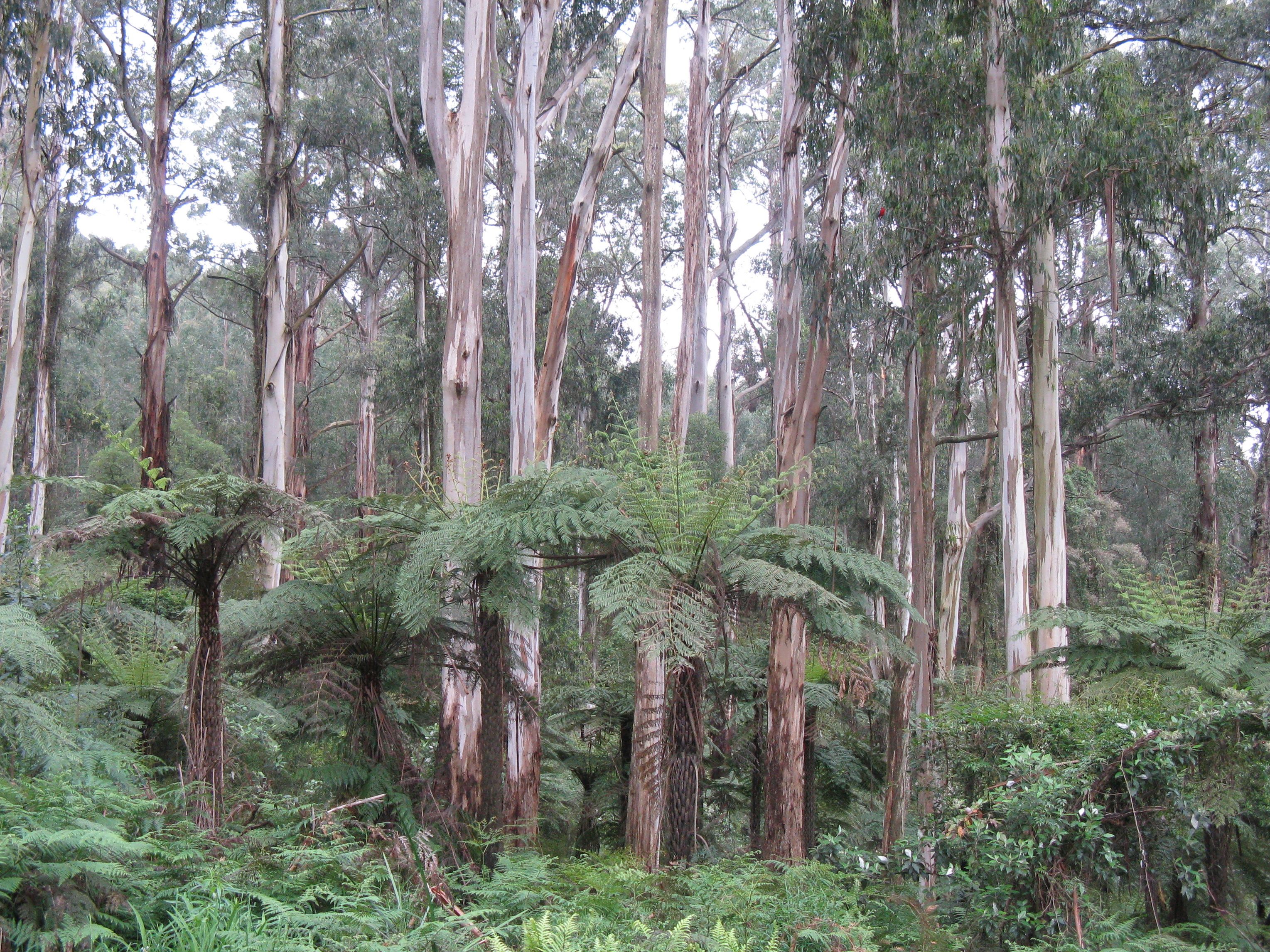
Sherbrooke Forest and Eucalyptus regnans

Sherbrooke Forest (Vic) and Eucalyptus regnans

He says trees are “living materials organised in the laboratory of Nature’s mysteries out of rain, sunlight, dews and earth”, and are the result of a deft metamorphosis. He explains this metamorphosis by telling us more specifically how an oak grows from a planted acorn, and how the earth, through the roots, provides food such as phosphates while:

foliage and twig and trunk are busy in catching sunbeams, air, and thunderstorms, to imprison in the annual increment of solid wood. There is no light coming from your wood, corncob, or coal fire which some vegetable Prometheus did not, in its days of growth, steal from the sun and secrete in the mysteries of a vegetable organism.

I love the John Muir-like romantic prose here! Animal and tree life are, he says, interdependent. Trees are “essential to man’s health and life”. Without vegetable life and growth, animal life would be exterminated:

When the last tree shall have been destroyed there will be no man left to mourn the improvidence and thoughtlessness of the forest-destroying race to which he belonged.

It’s worrying that over a century later, we have Australian Prime Minister Tony Abbott stating that “We have quite enough national parks. We have quite enough locked up forests already. In fact, in an important respect, we have too much locked up forest.” (For one academic’s assessment of the issue, check out forest ecologist Rod Keenan’s* article,  “Abbott’s half right: our national parks are good but not perfect”, at The Conversation.)

Morton argues that “in all civilisations man has cut down and consumed, but rarely restored or replanted, the forests”. In some parts of the world, this has changed, due largely to initiatives like Arbor Day, Earth Hour, not to mention the creation of national parks and reserves. Of course, replanting with (obviously) new trees does change the ecological balance and no matter how carefully managed it is, it is based on knowledge that we know is imperfect. Better then, as much as possible, to preserve forests and let them renew naturally – or so it seems to me!

Anyhow, Morton concludes by reaffirming the importance of planting trees “to avert treelessness, to improve the climatic conditions, for the love of the beautiful and useful combined”.

Arbor Day is, he says

the only anniversary in which humanity looks future ward instead of past ward, in which there is a consensus of thought for those who are to come after us, instead of reflections concerning those who have gone before us. It is a practical anniversary. It is a beautiful anniversary.

When Arbor Day Leaves was published in 1893, forty-four of the USA’s then forty-eight states observed Arbor Day (and by 1920s all states were practising it). What a great legacy.

Later this week, I will post on Australia’s first Arbor Day … watch this space.

J. Sterling Morton
“About trees”
First published: in Arbor Day Leaves (ed. N.H. Egelston), 1893
Available: Online at the Library of America

* I’m no expert, and Rod Keenan is not the darling of all environmentalists, but he offers a reasoned perspective.

Kathy Marks, Channelling Mannalargenna (Review)

A few weeks ago I wrote a Monday Musings about the Walkley Awards, noting some of the winners that particularly interested me. They included two awards for essays in the Griffith Review, one by Melissa Lucashenko, whose essay “Sinking below sight” I subsequently reviewed, and the other by Kathy Marks whose essay, “Channelling Mannalargenna” is the subject of this post. Both essays deal with indigenous topics but while Lucashenko, who won the award for Long Feature, has Aboriginal heritage, Marks, whose award was for Indigenous Affairs, is English. This adds an intriguing layer to her piece which is about the troubled issue of identity in indigenous Tasmania. Marks has, however, been writing about the Asia-Pacific region since 1999.

Like most Australians of my generation, I grew up believing that genocide had resulted in the elimination of indigenous people from Tasmania. Truganini, we were told, was the last “full-blood” Tasmanian Aboriginal person. She died in 1876. In 1978, the documentary, The last Tasmanian, made by filmmaker Tom Haydon and archaeologist Rhys Jones, popularised this idea. It is, however, not quite as simple as we’d been led to believe – and Marks’ essay chronicles the identification legacy left by a history of being discounted. The Walkley judges described the essay as follows:

An elegantly written essay about a community still wrestling daily with the act of colonisation. Adding poignancy is the hovering myth of extinction, Kathy Marks deftly draws the reader into the everyday of establishing Tasmanian Aboriginal identity, teasing out the tensions, but without seeking catharsis.

It’s a brave essay, I think, something that Marks herself recognises when she said on her win that “I was thrilled to receive the award, not least because of the challenging and sensitive nature of the subject matter.” Being brave, though, is surely the hallmark of a good journalist. And so, Marks tackles the thorny issue regarding the definition of indigeneity in Tasmania.

As I read the essay, I was reminded of remarks made by Anita Heiss in Am I black enough for you? on conflict within the indigenous community regarding Aboriginality. Heiss discusses the different ways people come by their Aboriginality and says:

What age and experience  moving around the country has given me is a better understanding of the complexities around individual and collective Aboriginal identity. One shouldn’t be too quick to judge others, especially when some of us have been fortunate to know who we are all our lives, and others haven’t.

And herein lies the rub in Tasmania. Because of the particular history of indigenous Tasmanians, family lines and connections have been broken, and so the way Tasmanians discover their Aboriginal background is highly varied. In her essay, Marks talks to many of the groups and factions existing in contemporary Tasmania, and describes the bitter lines that have been drawn between some of them. Some of these lines are so strongly defended that one group, the Tasmanian Aboriginal Centre (TAC) in particular, has taken legal action against people who have claimed indigenous heritage. Officially, the definition of Aboriginality in Tasmania is the same as that established by the Federal government – the three-pronged factors of ancestry, self-identification and being accepted by the indigenous community. The TAC, however, demands a family tree as part of this. Marks quotes Michael Mansell who argues that to be accepted as indigenous Tasmanian, people need to:

show that…their families, from every generation back to tribal, have always maintained their connection with being Aboriginal. So that excludes people who undoubtedly have Aboriginal descent but who have been brought up as white people… If there’s been a break in the generations, where someone lost contact, the Aboriginal community’s view is…you can’t revive it.

Not all can provide this unbroken connection. For example, indigenous Tasmanian academic, Greg Lehman, told Marks that people were not keen to admit to indigenous forbears in the 194os and 1950s. And then there’s the devastation – dislocation –  that occurred one hundred years earlier through George Arthur’s infamous Black Line and then George Augustus Robinson’s corralling of indigenous people at the so-called “friendly mission” Wybalenna on Flinders Island in the 1830s.

awwchallenge2014Looking from the outside, I find this conflict all very sad. It’s hard enough when indigenous people suffer rejection and discrimination from the white majority culture, but when it also comes from inside the community it must be devastating. Patsy Cameron, an indigenous Tasmanian whose bona-fide is accepted, would like to see a more inclusive approach. Marks quotes Cameron:

‘Even someone who hasn’t been active in their culture or in the politics of the day,’ she says, ‘it doesn’t make them any less Aboriginal. Anyone who can show their lineage, and their extended family acknowledges them as part of that family, we should be embracing them. We should be embracing people who have been lost, rather than chasing them away and doing to them the exact thing that non-Aboriginal people have done to us in the past: denying us our rights, our identity.’

I’ve only touched the surface of Marks’ essay. It’s an excellent read that starts with a brief history of indigenous relations in Tasmania, including some distressing anecdotes regarding discrimination, before exploring in some depth the essay’s central issue regarding Aboriginal identity. Fortunately, the essay is freely available online via the link below. If you have any specific or general interest in the topic I commend it to you.

Kathy Marks
“Channelling Mannalargenna: Surviving, belonging, challenging, enduring”
Published in the Griffith Review, Edition 39, 2013
Available: Online at the Griffith Review

Linda Jaivin, Found in translation: In praise of a plural world (Review)

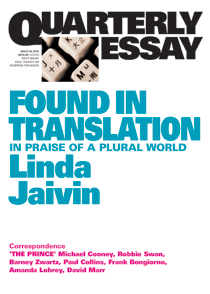
Linda Jaivin, Found in translation Book cover

Courtesy: Black Inc

Reading synchronicity strikes again! In the last couple of months, the issue of language, translation and culture has been crossing my path – in Diego Marani‘s The last of the Vostyachs, in Gabrielle Gouch’s Once, only the swallows were free, and on Lisa’s blog post about the AALITRA Symposium on Translation. I was consequently more than happy to accept a review copy of the latest Quarterly Essay, Linda Jaivin’s Found in translation.

Now, as some of you know, I have mixed feelings about reading books in translation. I want to read them because I want to read not just about but from other cultures. Not being fluent in all the languages of the world, the only way I can do this is to read works in translation, but when I read a translated work I am very conscious that there is a mediator between me and the work. This bothers me. Linda Jaivin, herself a translator, knows exactly what I mean:

… it is absurd to speak of issues of literary style, rhythm – or any aspect of a translated work aside from its structure, characters and plot – without acknowledging that the language of the text is at once a creation of the translator and an interpretation of the author …

And she gives good examples to support her statement. I was pleased to see her acknowledge this, because she knows of what she speaks! But, this little point is only a very small part of Jaivin’s wide-ranging, entertaining but also passionate essay. Jaivin, if you haven’t heard of her, is a multi-skilled woman: she subtitles Chinese film and television and translates Chinese text; she has worked as an interpreter; and she has written novels, stories, plays and essays.

As a reader and lover of words, I enjoyed Jaivin’s discussion of the technical and philosophical challenges faced by translators. She peppers her discussion with an eclectic but fascinating array of examples. And she quotes other translators, such as Edith Grossman who wrote that

a translation is not made with tracing paper. It is an act of critical interpretation … no two languages, with all their accretions of tradition and culture, ever dovetail perfectly.

Take swearing for example. How we swear is highly cultural. Swear words, Jaivin writes, “expose what is forbidden, what is permitted and what is held sacred” in a culture, and consequently “can  throw differences in worldviews into sharp relief”. However, you’ll have to read the essay, if you want to see her examples!

I was intrigued by her argument that translations of classics go out of date! So, this means that the Spanish will always read the same Don Quixote but English speakers are very likely to read a different translation depending on which one is currently in vogue.

“… a culture doesn’t grow just by talking to itself …”

But, the critical point of her essay is not the act of translation. As the title of her essay implies, Jaivin is passionate about pluralism, and more, about cosmopolitanism. By this, she means not just living side by side, not just accepting each other, but “sharing a common vision”.

Australian Women Writers ChallengeFor Jaivin, “translation” is not a narrow concept. Its implications extend far beyond the “simple” translation of words from one language to another, because attached to language are meanings and ideas. When ideas are translated – via words – from one culture to another those ideas change. Jaivin describes how concepts such as Confucianism and yes, even democracy, change when they cross cultures. This can lead, she says, to misunderstanding but it can also provide “room for the kind of creative interpretation that allows cultures and the conversations between them to grow and evolve”.

She argues that, because of Australia’s particular history and geography, and because Mandarin is the most commonly spoken language in Australia after English, “Australia is … in a unique position to translate the shift from the ‘American century’ to the ‘Asian one’ …”.

Building successful international relationships, she believes, requires genuine communication, which includes knowing, recognising and respecting other languages. It

does not require the weak to adopt the language of the strong – as reliance on English threatens to do, given its global and frequently imperial reach.

Jaivin argues that learning a foreign language should be a compulsory part of year 12 and university education, because “we need to have every possible line of communication open to us” if we are to successfully traverse the changes coming.  Not everyone agrees. What do you think?

Linda Jaivin
“Found in translation: In praise of a plural world”
in Quarterly Essay, No. 52
Collingwood: Black Inc, November 2013
103pp.
ISBN: 9781863956307

(Review copy supplied by Black Inc.)

Melissa Lucashenko, Sinking below sight (Review)

In this week’s Monday Musings about the Walkley Awards, I noted that Melissa Lucashenko had won the award for Long Feature Writing for her essay “Sinking below sight: Down and out in Brisbane and Logan” in the Griffith Review. I’ve now read the essay, and thought I’d share it with you. I’ve reviewed Lucashenko before, an essay and a short story. I really must get to one of her novels one day!

With her mixed European and indigenous Australian heritage, Lucashenko is well placed to tackle significant contemporary issues and see them from multiple perspectives. The last essay of hers that I reviewed, “How green is my valley”, dealt with stewardship of the land and the threat imposed by climate change. In “Sinking below sight” her subject is poverty. Lucashenko’s essays make engaging reading. Instead of dry reportage, she starts from the personal, and from that draws conclusions that make sense. And so, while “How green is my valley” drew from her experience on a farm in northern New South Wales, this essay draws from her return, after losing her farm through divorce, to the town of Logan, one of Australia’s ten poorest urban areas.

You’ve probably noticed that her subtitle alludes to Orwell’s autobiographical work Down and out in Paris and London which chronicles his experience of poverty. Similarly, Lucashenko writes that she’s been poor before, so “I had the skill set”. But, this essay is not about her. She starts by setting the scene, describing this “Black Belt” region as one in which

Welfare recipients and the working poor … don’t necessarily realise they are hard up. More accurately, many don’t realise just how poor they are, since everyone in their lives is battling.

She then moves on to the main topic of her essay, which is to find out “How do my Black Belt peers manage? How do single mums, in particular, get by on current levels of welfare? And what dreams are possible for the Brisbane underclass in 2013?” To answer this interviews three women currently living in poverty – Selma (27), Marie (38) and Charmaine (49) – and discusses their situations.

Selma, a Yugoslavian of Serbian and Croatian parents, has four children under ten and a partner who is in and out of jail. Having been a refugee and then involved with an abusive Aboriginal man, Selma has some clear views on her situation:

What I don’t like in society … is the judgments put on Indigenous and refugee and domestic violence people. I was in that situation for nine years. They say you make a choice, but I don’t ever remember choosing to be beaten up! From the age of seventeen ’til about two years ago, domestic violence was part of my everyday life.

She blames poverty for violence, saying that “poverty breeds hate”. Lucashenko suggests that the abuse she experienced “had roots also in the trauma and racism of the refugee experience.”

Marie is also a mother of four, with an “on-again, off-again partner”. She is a member of the “working poor” so not quite as poor as Selma. She grew up in a troubled home, had been sexually molested as a child, and was living independently by the time she was 14 years old. She, like Selma, had a history of “severe emotional and physical abuse from her previous partners, who were all, bar one, Anglo-Australian men”. Lucashenko writes:

Marie spoke to me of feeling enormous rage about the past abuses in her life, rage which sits constantly just beneath the surface.

The third woman is Charmaine, “blond, slim and still able to laugh despite a life that would crush most of us [and] the white Australian mother of four Aboriginal kids”. She too was raped and molested as a child, and ended up in a violent relationship in which she stayed too long.

Australian Women Writers Challenge

While recognising that her examples are more anecdotal than statistical, Lucashenko nonetheless draws some conclusions. They include:

  • Underclass expectations, which see people who grow up with nothing, expecting little
  • The importance of public housing in providing some “minimal prospect of safety”
  • Loneliness and isolation, which drive single mums back to “untenable situations”
  • Violence and mental illness in parents and partners, which entrench poverty for women
  • Childhood molestation and/or rape, which all three women had experienced
  • Women seeking relief in drugs, which of course can initiate new downward trajectories

Her three women, Lucashenko finds, have hopes for the future. Selma and Charmaine are studying, because, as Lucashenko writes

Realising that poverty is a creation of society and its choices, these two women also know that their lives might shift through higher education.

Pragmatic Marie has a saving plan. Their situations though are tenuous. To achieve their goals, they’ll need strength. Better still, though, would be if they got effective financial and other practical support.

Lucashenko opens the essay with the epigraph that “the opposite of poverty isn’t wealth. It’s justice”. Her essay may not be statistically significant from an academic perspective, but anyone who reads contemporary social commentary knows that what she writes rings true – and this, clearly, is why she won the Walkley.

Melissa Lucashenko
“Sinking below sight”
Published in the Griffith Review, Edition 41, 2013
Available: Online at the Griffith Review

Ann Patchett, The bookshop strikes back (Review)

I’m not normally an impulse buyer except, it seems, when I visit the bookshop at the National Library of Australia! I tell myself I’m not interested in little books – you know, the sort bookshops put on their sales counters – but somehow the National Library of Australia regularly manages to break down my resolution. Last year I reviewed Dorothy Porter‘s On passion which I bought from their counter. Today, I’m going to write about Ann Patchett‘s essay “The bookshop strikes back”.

My purchase went like this. I was standing at the counter a few days ago making my purchases when this tiny little 20-page off-white booklet caught my eye. I picked it up, and said to the bookseller, “This looks interesting”. “Oh yes”, she said, “we had them in for National Bookshop Day?” Well, I knew then what I had to do …

I’ve been trying to remember when I first heard that the book was dead, but I think it was back in the 1970s when it was argued that the easy availability of video would spell the end of reading. I wouldn’t be surprised if the same was said when movies appeared, when radio came on the scene, and so on. Surprisingly, though, books seem to survive! Except, it’s not surprising to us readers is it?

Books are facing a new challenge in our digital world – but, so far, the main issue seems to be more about the form of the book (as in print vs digital) than the survival of reading. However, bookshops do seem to be at risk. Ann Patchett suddenly found one day that her town, Nashville, Tennessee, no less, had no bookshops (other than a used bookshop and stores like Target). Apparently the last one to go – an independent that had been bought out by a chain – had been profitable “but not profitable enough”. Patchett’s discovery, albeit on a smaller scale, replicates the situation at my local mall, which is one of my city’s main shopping centres. Fortunately, though, we do have some great bookshops in other parts of the city.

Patchett doesn’t spend a lot of time discussing the whys, though the prevailing view seems to be that the combination of online bookselling giants like Amazon and the rise of e-books are causing the demise of bookshops – both chain stores and the independents. But, Ann Patchett believes things may be changing. She writes:

… all things happen in a cycle, I explained – the little bookstore had succeeded and grown into a bigger bookstore.  Seeing the potential for profit, chains rose up and crushed the independents, then Amazon rose up and crushed the superstore chains. Now that we could order any book at any hour without having to leave the screen in front of us, we realised what we had lost: the community center, the human interaction, the recommendation of a smart reader than a computer algorithm telling us what other shoppers had purchased.

This may be a little simplistic but history does have a habit of repeating itself doesn’t it! So Patchett, who was later “dizzied by the blitheness that stood in place of any business sense”, established, with two other women,  a new independent bookshop in Nashville … and found that on book tours for her most recent book, State of wonder, interviewers were more interested in asking her about her bookshop plans than about her book. She laughs that on the day the bookshop opened in November 2011, the New York Times ran a story with a picture of her on page A1, something that her agent and publisher would never expect to achieve on the basis of her role as a literary novelist.

This is not a highly analytical essay, but it’s a lovely read about the love of books and bookshops. It provides a nice contrast to the fascinating but ultimately sad story of a bookshop I read a few years ago – Annette Freeman’s semi-self-published Tea in the library. Freeman, like many booklovers, dreamed of having a bookshop – one in which readers could come, buy books, stay for a cuppa, and meet authors. She had a lovely vision, but it failed after a couple of years, something she explores openly and honestly in her book.

For Patchett though, so far so good. She’s not sure why they’ve been successful but she says

my luck has made me believe that changing the course of the corporate world is possible.

I hope she’s right – but I guess for her to be so, we need more brave (or blithe) booksellers and more readers who want the personal touch, because, after all, we are in this together.

Ann Patchett
“The bookshop strikes back”
London: Bloomsbury, 2013
20pp
ISBN: 9781408847497
Originally published in Atlantic Monthly, November 2012
To appear in This is the story of a happy marriage (Bloomsbury, later 2013)
Available: Online at Atlantic Monthly