Carson McCullers, The great eaters of Georgia (Review)

Carson McCullers, 1959

Carson McCullers, 1959 (photographed by Carl Van Vechten, Public domain, via Wikimedia Commons

Regular readers of my Library of America (LOA) Story of the Week posts will probably guess why I’ve chosen to write about this story: it’s by an appealing American writer and it’s about food. However, it’s quite different from the other food stories. Firstly, while it’s called “the great eaters” it’s more of a little memoir essay albeit structured around food, and secondly, it was published posthumously in 2005. McCullers was born in 1917 (on Feb 19 in fact, so this month in the centenary of her birth) and died in 1967. “The great eaters of Georgia” was written, LOA’s notes say, in 1954 but was not published, because …

It’s a complex situation, which the Wikipedia article section on her personal life fills in, but the significant thing for us is that she had returned (fled) to the US from Paris in 1953, because her husband had tried to encourage her to commit suicide with him. Soon after her return, he succeeded in taking his life. Now, this is relevant because LOA tells us that McCullers had been offered money by Holiday magazine for a piece on Georgia, but, according to McCullers’ biographer Josyane Savigneau, the magazine rejected the article because they were “looking for a lighter, more descriptive, less personal piece.”

I guess that’s fair enough for a holiday-oriented magazine, but for readers more interested in McCullers than in Georgia – sorry, Georgia – it’s great that the piece didn’t disappear. Like many people, I’ve read and/or seen The heart is a lonely hunter and The member of the wedding – but in my case so long ago that my main memory is not of the plots but of melancholy and loneliness, the sorts of emotions that appealed to my teenage self!

But now, “The great eaters of Georgia”. It’s an intriguing piece that doesn’t perhaps quite cohere – certainly as a piece for a holiday magazine. For example, she mentions visiting various people. First is the controversial writer Lillian Smith, who openly confronted such issues as race and gender equality. McCullers writes:

Lill, like other Southerners, feels passionately about the problems of the Negro. Most Georgians do not agree with her, and often when her name is mentioned there is that strange area of silence.

This may not have been what Holiday was looking for, particularly when she adds that during her visit they “discussed Georgia politics”. Then she visits psychiatrist Dr Hervey Cleckley. She doesn’t share her discussions with him about her husband’s suicide – this I learnt from LOA – but they did talk

of the improvement in the understanding of racial problems and the migration from the rural cotton areas to the cities and towns.

Again perhaps not Holiday content? She says they also talked about Dr Crawford Long, a Georgian who was the first to use ether in an operation. You may wonder why this came up, but it resulted from their discussion of “ether parties”:

These odd-sounding affairs must have been like marijuana parties to the modern teenager but there was no social stigma attached, and my grandmother told me that, as a young lady, she often held ether parties for her young friends after they had ridden home from church and gathered for Sunday dinner.

Fascinating eh? Dr Long apparently noticed the numbing effect of ether (!) and thought it might work in surgery! I found this interesting because I have reviewed Sawako Ariyoshi’s The doctor’s wife, which fictionalises the story of Hanaoka Seishū who is believed to have been the first to use general anaesthesia in surgery – in 1804. Long carried out his first surgery in 1842.

Anyhow, I guess McCullers included this story of Long as an example of Georgian ingenuity? Again it may not have been what Holiday was looking for.

She was probably on firmer ground in her description of eating practices and food, because yes, she does talk about those too as the title suggests! I enjoyed little tidbits such as that in her mother’s day:

a child wore an asafetida bag around his neck to ward off colds and contagious diseases. Asafetida is the foulest-smelling substance. I suppose it makes good medical sense because one was not apt to go very near a person wearing an asafetida bag.

Hmmm, that’s not a food story though asafetida is used in cooking – and, anyhow, it’s adds a touch of humour.

She also talks about what great eaters (hence the title) Georgians are – at every meal:

Georgians eat big meals three times a day. I have never gotten over this orange-juice-and-coffee breakfast they have up North. A respectable Georgia breakfast means fish roe and grits or at least eggs or maybe country sausage.

She remembers chewing sugarcane as a child, and the historic cultivation of chinaberry trees “to counteract miasma”. She mentions the razing of the home she was born in, and sneaks in a comment about the reduction in (though not removal of) poverty in her home-town, before returning to the subject of breakfasts. She talks of the Yankee vulgarity of referring to children as “kids”. And she tells us that fried chicken is probably Georgia’s best-known dish, closely followed by “field peas”. She surprised me by mentioning a dish I have in my recipe folders from my early recipe-gathering days, Country Captain. It’s a sort of curried chicken dish, and I didn’t realise it came from the American south.

She also tells us that “any discussion of Georgian food is incomplete without the mention of watermelon” and provides a loving description of the “special operation and procedure” it demands. Fruitcake, tupelo honey, and the smells of Savannah are also shared with us, before she comes to a little anecdote about a “town character”, a bachelor who prefers to eat alone. This is very “un-Georgian”, and she concludes her piece by saying that

Although we have our share of eccentrics, I know very few Georgians who do not love fellowship, good hunting, food, and laughter—who do not enjoy life.

All in all, it’s a fascinating article – for what it tells us about Georgian life and food but more, for the little insights we glean of her interests and her emotional state. A good read for anyone interested in McCullers.

Pam (Travellin’ Penguin) has also written a response to this story.

Note: My other LOA food stories are by John Duncan (“A Virginia barbecue“), Ana Menéndez (“Celebrations of Thanksgiving: Cuban offerings“), George G. Foster (“The eating-houses“) and George Augustus Sala (“The tyranny of pie“).

Carson McCullers
“The great eaters of Georgia”
First published: Oxford American, Spring 2005
Available: Online at the Library of America
Louisa Atkinson, A voice from the country: January (Review)

Louisa Atkinson, as I wrote in a post a few years ago, was a pioneer Australian writer. She was a significant botanist, our first Australian-born woman novelist, and the first Australian woman to have a long-running column in a major newspaper. It was a natural history series titled A Voice from the Country which ran in The Sydney Morning Herald for 10 years from 1860. I’ve shared here a few natural history articles/essays written by Americans, such as John Muir, but never an Aussie one. That’s going to change here, now – for a couple of reasons. Firstly, because I can, given the articles are findable through Trove, and secondly because the Australian Women’s Writers Challenge plans to focus this year, among other things, on classic Australian women writers. You can’t be a more classic Aussie writer than our Louisa!

But, which of Louisa Atkinson’s many columns should I do? I read a few and decided on one from her first year. In fact, I think it might have been the very first in the series. It’s titled “January”, which makes it particularly appropriate this month. Atkinson was living in Kurrajong, on the lower slopes of the Blue Mountains, in “Fernhurst”, the house built by her mother.

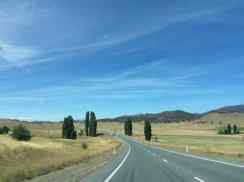
Monaro region, in January

January in the Monaro, 2010s not 1860s

So, the piece is about what it says, January. She describes the birds and plants in particular that you see in January in her region. Here is the opening sentence:

A WARM drowsy month, without the opening promise of Spring or maturing riches of Autumn.

Beautiful don’t you think, and it perfectly catches the middle of the Australian summer, particularly when you read the next couple of sentences:

In dry seasons the grass is scorched and white, the dust flies along the road before the least puff of wind, much to the annoyance of the traveller. The observer of nature finds his field of observation limited, yet not altogether barren.

In other words, it is dry, more yellow I’d say than white, and there’s nothing much happening, nature-wise. “Much” though is the operative word, because it’s “not altogether barren”, as she goes on to show by describing, for example, the activity of various birds such as the “waterwagtail or dishwasher”, laughing jackasses, lowries. Now, here’s another reason I chose this piece – her language. There’s the obvious fact that Atkinson has an engaging way of writing about nature, but what I want to explore here is its unfamiliarity.

By this I mean unfamiliar expressions and names. Regarding the former, I often find in articles I locate through Trove, language that is more erudite than we see in today’s newspapers. It suggests a higher level of literacy in readers. Take, for example, Atkinson’s use of “ferruginous” to describe the colour of a fungus. We might find that word in a novel these days, but not, I expect, in a general interest newspaper column. Of course, it may also suggest that newspapers were geared more to the elite than to the general populace? I don’t know enough about newspaper history to say any more on this. Sometimes, it’s more that word usage has changed. For example, Atkinson writes that some young birds “essay flight”. We rarely see “essay” used in that sense these days. I love that reading these older articles can give us insight into other times beyond the subject matter of the writing.

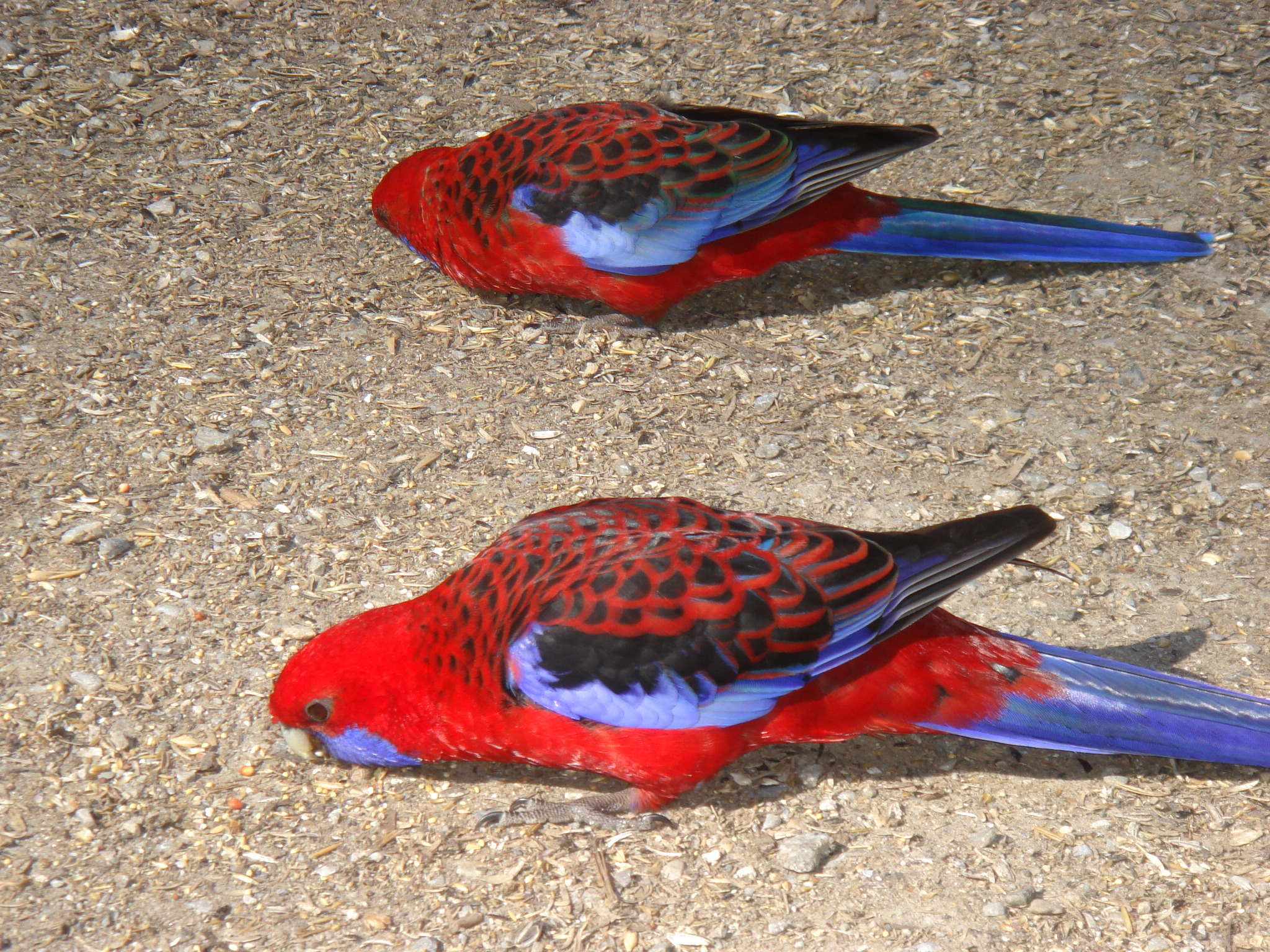
The other unfamiliarity relates to her naming of things. I know what laughing jackasses and lowries are – kookaburras and crimson rosellas*, respectively – but these names aren’t commonly used now. However, I have no idea what a “waterwagtail or dishwasher” is. Is it the willie wagtail and nicknamed dishwasher because its tail swishing back and forth reminded people of a dish mop? So, I did a Google search, and found an article titled “21 Facts about Pied Wagtails” from UK’s Living with Birds website. Facts 6 and 7 are:

6. Few birds have as many country names as the pied wagtail. They range from Polly washdish and dishwasher to the more familiar Penny wagtail, Willy wagtail and water wagtail.

7. The origin of the washer names is a mystery, but it may be because women once washed clothes, as well as pot and pans, by a stream or village pump, the sort of place that pied wagtails also frequent.

So, not the action of their tail perhaps but the places they frequent? I’m not a bird expert, but my understanding is that this White or Pied Wagtail is a “vagrant” in Australia, and that what we call the willie wagtail is from a different family. Which one – if either of these – is Atkinson talking about? Regardless, my point is that reading past writing can trip us up when the writers described plants, animals or objects using terms or names we don’t use now. We have to be careful – particularly those of us not expert in subjects – about drawing wrong conclusions from our reading.

POSTSCRIPT, 31 Jan 2017: Pam (Travellin’ Penguin) checked out “dishwasher” through her bird contacts, and was pointed to the book Austral English, which says that it’s “an old English bird-name for the Water-wagtail; applied in Australia to the Seisura inquieta … the Restless Flycatcher”. It quotes from the 1827 Transactions of the Linnæan Society, that the bird “is very curious in its actions. In alighting on the stump of a tree, it makes several semi-circular motions, spreading out its tail …”.

Crimson Rosellas

Crimson Rosellas by Kevin Tostado, using CC BY 2.0, via Wikimedia Commons

Enough of that, though. Let’s get back to Atkinson and her description of the lowries (i.e. crimson rosellas).  They are common to my garden – and her writing captures them perfectly:

A flock of lowries, young and old, frequent the fields, whence the oaten hay was gathered, nor confine their depredations there, assisting themselves liberally to the ripening peas and beans, which the gardener intended for seed, and even pursuing these favourite morsels into a verandah where they are spread to dry. The flock presents a brilliant appearance ; the full plumaged birds are vivid crimson, blue, partially pied with black, whilst the nestlings are variegated with green.

And now to conclude I’m going to jump five years to a report in the The Sydney Morning Herald in January 1865 of a meeting of the Horticultural Society of Sydney. It reports on various attendees bringing all sorts of plant specimens to the meeting, most of them exotic, and then, towards the end, there’s this:

Miss Atkinson, of the Kurrajong, sent a jar of jam, of the Lisanthe sapida, with the following remarks –

“LISANTHE SAPIDA – A small shrub of the Epacris family, bearing a crimson fruit, enveloping a single stone; good bearer, crop lasts about two months or more, coming in in November. To make jelly—boil the drupes, adding a few spoonfuls of water; when soft strain the juice off, add one pound white sugar to a pint, and boil to jelly. The fruit makes a pleasant tart—the Lisanthe Sapida grows in poor sandstone ranges. If any member of the societv would like to cultivate the shrub, and cannot procure the fruits in their locality, it is to be met with in the Kurrajong.”

A vote of thanks was given to the exhibitors, and more especially to Miss Atkinson, who it was remarked had made herself most remarkable for her endeavours to bring colonial productions into notice.

The lisanthe (or lissanthe) sapida, aka native cranberry, is, as you might have guessed, a plant native to Australia. Lovely to see recognition, by her peers, of a woman, and one who clearly loved and promoted the natural environment in which she lived.

* Mountain lowry is an alternative name for the Crimson rosella but is not, I believe, the most common one, particularly in New South Wales, but readers can correct me if I’m wrong.

aww2017-badgeLouisa Atkinson
“A voice in the country: January”
in: The Sydney Morning Herald, 1 March 1860
Available: Online

George Augustus Sala, The tyranny of pie (Review)

When I decide to write about a Library of America (LOA) Story of the Week it is usually because it’s by a favourite author (like Willa Cather, Kate Chopin, or Edith Wharton), or by an author I want to read but haven’t yet (like John Updike or Washington Irving) or on a topic that interests me (like the environment or race issues or food). You can guess from the post title, then, why I chose the story I’m writing about today!

I’ve covered a few LOA food stories: Scotsman John M. Duncan’s “A Virginia barbecue” (1823), American George G. Foster’s “The eating-houses” (1849), and Cuban-American Ana Menéndez’s “Celebrations of Thanksgiving: Cuban offerings” (2004). Two are about events and one about restaurants, though they all mention food too of course. Englishman George Augustus Sala’s piece, however, starts from the point of view of food – the pie, which, I’ve just realised, is appropriate for this American Thanksgiving weekend. Sala, like Virginia-barbecue-Duncan, was a traveller to America, so wrote his piece from the perspective of an outsider.

George Augustus Sala

Sala c. 1855-65, by Mathew Brady (Public Domain via Wikipedia)

But, who was this Sala? Aussies will be interested to know that it was he who coined the still-used description “Marvellous Melbourne” when he visited Australia in 1885. He was born in 1828, and is described in LOA’s notes as a “prolific and flamboyant journalist”. He “found fame” as an acolyte of Charles Dickens, and was a regular contributor to Dickens’ journal, Household Words (about which I’ve written before). However, LOA continues, it was public praise from William Makepeace Thackeray which really launched his career. Unfortunately, although Sala published much and earned good money from writing for The Daily Telegraph, he was a spendthrift who was also often drunk, and “died virtually penniless”.

Now, the piece. It comes from his second trip to the States. His first trip was in 1863 during the Civil War, and while he was critical of much he did like American humour. He wrote, says LOA, a three-book series of anthologies, Yankee Drolleries (1866–1870), which introduced British readers to established authors like Oliver Wendell Holmes (whom I wrote about recently) and the up-and-coming writer, Mark Twain.

During his second trip, which resulted in his book America revisited, he found an improved America. LOA quotes this:

The truth is, that in New York there is room enough for Everybody, whereas in London, huge as it is, there is not sufficient room for Anybody.

By the late 1870s, we’re told, Manhattan had become a popular travel destination for the European upper class.

Sala, LOA also says “had a lot to say about American food. His comments range from despair and scorn to grudging, if infrequent, admiration”.  He apparently approved of New York, because its food and accommodation were “what Europeans usually consider to be refinement and comfort.” But on leaving New York, “you must expect nothing better than pork and beans and Indian pudding, or hog and hominy if you go South; the whole washed down by rough cider or molasses and water.” His short “The tyranny of pie” piece appears as a digression in his America revisited chapter about a train trip to Baltimore.

I’m sure you all know the phrase “as American as apple pie”. The Huffington Post provides some background to this in an article titled “Why are we ‘As American as Apple Pie’?” The pie was an English tradition, and brought to American by the Pilgrims, but by 1860, well before Sala’s second visit, the phrase was already in use. Novelist Harriet Beecher Stowe wrote, says Huffington’s Kimberly Kohatsu, that “the pie is an English tradition, which, planted on American soil, forthwith ran rampant and burst forth into an untold variety of genera and species.”

It is partly this variety which captures Sala’s eye. He commences, though, by praising signs of “improvement and reform” in America – in

everything except Pie. The national manners have become softened—the men folk chew less, expectorate less, curse less; the newspapers are not half so scurrilous as our own; the Art idea is becoming rapidly developed; culture is made more and more manifest; even “intensity” in æsthetics is beginning to be heard of and Agnosticism and other “isms” too numerous to mention find exponents in “Society,” and the one absorbing and sickening topic of conversation is no longer the Almighty Dollar—but to the tyranny of Pie there is no surcease.

What is all this about we readers wonder? Soon he writes:

The day before we left New York one of the ripest scholars, the most influential journalists (on the Democratic side) the brightest wits and most genial companions in the States lunched with us. He would drink naught but Château Yquem; but he partook twice, and in amazing profusion of Pumpkin Pie.

Ah, I was thinking, he’s like me. He doesn’t like Pumpkin Pie, and wonders about the taste of this Château Yquem drinker … but, I was disappointed because, within a couple of sentences he writes:

The worst of this dreadful pie—be it of apple, of pumpkin, of mulberry, or of cranberry—is that it is so very nice. It is made delusively flat and thin, so that you can cut it into conveniently-sized triangular wedges, which slip down easily.

He then suggests that the pie is “as important a factor in American civilisation as the pot-au-feu does in France” but that England has nothing equivalent. The closest England has to a dish “by which we nationally stand or fall” is “the roast beef of Old England” but it is expensive and

there are hundreds of thousands of labouring English people who never taste roast beef from year’s end to year’s end—save when they happen to get into gaol or into the workhouse at Christmastide.

This is where his little piece ends. I did enjoy its cheeky humour, and this pointed conclusion.

George Augustus Sala
“The tyranny of pie”
First published in: America revisited: from the Bay of New York to the Gulf of Mexico, 1882.
Available: Online at the Library of America
John Muir, Save the redwoods (Review)

Giant Sequoia, Yosemite

Giant Sequoia, in the Sierras

Any fool can destroy trees. They cannot defend themselves or run away. And few destroyers of trees ever plant any; nor can planting avail much toward restoring our grand aboriginal giants. It took more than three thousand years to make some of the oldest of the Sequoias, trees that are still standing in perfect strength and beauty, waving and singing in the mighty forests of the Sierra.

“A wind-storm in the forests” by American naturalist/environmentalist John Muir (1838-1914) was the first Library of America (LOA) story of the week that I ever reviewed here. I was consequently keen to read his short essay “Save the redwoods” when it popped up as an LOA story-of-the-week three weeks ago. It’s an interesting piece, partly because it was found amongst his papers, posthumously, so was not published during his lifetime.

As LOA’s notes say, Muir spent four decades writing articles for the national press which argued for the “protection of such natural wonders as the Petrified Forest, the Grand Canyon, and—above all—Yosemite.” Yosemite was a particular love of his. LOA tells how it was his and Robert Underwood Johnson, associate editor of The Century Magazine, alarm about the “substantial damage caused by lumbering, sheepherding, and tourism” there that eventually resulted in the creation of Yosemite National Park.

It is this issue of lumbering that Muir takes up again in “Save the redwoods”. It was apparently written around 1900 when there were concerns that the Calaveras Grove of Big Trees or Giant Redwoods (Sequoiadendron giganteum) was at risk of being sold and cut down for timber because the owner, James Sperry who had protected them, was old and no longer able to maintain it. A lumberman, Job Whiteside, planned to buy it – but there was a public outcry. This is when Muir apparently wrote his piece, arguing that the various scattered groves of redwoods not included in Sequoia National Park should be protected..

In his piece Muir, as was his style, draws on religious imagery, analogy and personification, amongst other devices, to argue his case. He discusses the destruction of a couple of Big Trees in the grove back in the 1850s:

Forty-seven years ago one of these Calaveras King Sequoias was laboriously cut down, that the stump might be had for a dancing-floor. Another, one of the finest in the grove, more than three hundred feet high, was skinned alive to a height of one hundred and sixteen feet from the ground and the bark sent to London to show how fine and big that Calaveras tree was—as sensible a scheme as skinning our great men would be to prove their greatness. This grand tree is of course dead, a ghastly disfigured ruin, but it still stands erect and holds forth its majestic arms as if alive and saying, “Forgive them; they know not what they do.”

He then comments on the new plans to mill this grove, saying

No doubt these trees would make good lumber after passing through a sawmill, as George Washington after passing through the hands of a French cook would have made good food.

That’s an analogy to get our attention! He argues that if one of these

Sequoia kings [could] come to town in all its god-like majesty so as to be strikingly seen and allowed to plead its own cause, there would never again be any lack of defenders.

He describes the proliferation of sawmills and the ongoing destruction of these big trees, and sets this activity against Mr Sperry’s protection of the sequoias in his Calaveras Grove. Muir notes that when news starts to come through of this Grove being bonded to the lumberman, there is suddenly a “righteous and lively indignation on the part of Californians”. This, he says, seems strange given “the long period of deathlike apathy, in which they have witnessed the destruction of other groves unmoved”. However, he writes, public opinion had been rapidly changing in recent years and there had always been a special interest in the  “Calaveras giants [because] they were the first discovered and are best known”.  Moreover:

  • they have a worldwide reputation;
  • they are visited and admired by “travelers from every country”; and
  • the names of great men have long been associated with them (including Washington, Humboldt, Torrey and Gray, and Sir Joseph Hooker)

He argues that “these kings of the forest, the noblest of a noble race, rightly belong to the world” but, as they are in California, Californians “cannot escape responsibility as their guardians”. Then comes some patriotism and buttering up! He writes:

Fortunately the American people are equal to this trust, or any other that may arise, as soon as they see it and understand it.

It is here that we find the excerpt I opened my post with. It’s followed by his brief description of a bill being put before congress to protect the Calaveras Grove. He argues that not only will the bill protect this particular grove of trees but the resultant/concurrent “quickening interest in forest affairs in general” will result in improved chances for other groves and forests.

The piece feels a little rushed and unfinished, which is probably why he never submitted it for publication, but the work of Muir and others did eventually result in most of the west coast’s major sequoia and coastal redwood groves being “gathered under the jurisdiction of the National Park Service”. I saw many of these trees in the 1980s and again in the 1990s. They are unforgettable.

“Any fool”, Muir wrote, “can destroy trees”. Saving them is much harder. It takes passion, patience and persistence, something Muir exemplified in his life-time. Luckily, a long succession of environmentalists – around the world – continue this tree-saving work today.

John Muir
“Saving the redwoods”
First published (posthumously): In Sierra Club Bulletin, January 1920.
Available: Online at the Library of America

Mark Twain, A presidential candidate (Review)

Mark Twain, by Matthew Brady, 1871 (Public Domain in the US, via Wikipedia)

Mark Twain, by Matthew Brady, 1871 (Public Domain in the US, via Wikipedia)

Towards the end of his life, Mark Twain wrote, the Library of America (LOA) says,

The political and commercial morals of the United States are not merely food for laughter, they are an entire banquet.

I’m not sure the US had/has a monopoly on this. However, let me get to the point. LOA published Twain’s column, “A presidential candidate”, back in 2012 but, given the current political shenanigans in the USA (no offence to my American readers intended), I couldn’t resist sharing it with you today. It’s very, very brief, so my post will be too. In fact, I suggest you ignore my post, and just click on the link below to read it yourself.

Sometimes, I think, we forget – at least I do – how little things have changed really. Just read Twain’s opening:

I have pretty much made up my mind to run for President. What the country wants is a candidate who cannot be injured by investigation of his past history, so that the enemies of the party will be unable to rake up anything against him that nobody ever heard of before. If you know the worst about a candidate, to begin with, every attempt to spring things on him will be checkmated. Now I am going to enter the field with an open record. I am going to own up in advance to all the wickedness I have done …

And he then proceeds to own up to a wide range of rather bizarre “wickedness” as you would expect from Twain, wickedness like running “a rheumatic grandfather” up a tree in the middle of a night because he snored, and burying a dead aunt under a tree to fertilise his vine. He also ran away, he says, at the battle of Gettysburg. His friends try to excuse him, he writes, on the basis that he was trying to emulate George Washington at Valley Forge, but no, he says, the reason is that he was scared. He’d like his country to be saved but would prefer someone else to save it. Indeed, he writes,

My invariable practice in war has been to bring out of every fight two­-thirds more men than when I went in. This seems to me to be Napoleonic in its grandeur.

I like his style! He also discusses his financial views and what he would do with poor people, but you can read those for yourself.

LOA tells us that the piece was written the year before the presidential race between Republican James A. Garfield and Democrat Winfield Scott Hancock. Twain supported Garfield. As American readers would know, Garfield won, but was assassinated before he finished his first year.

But that’s another story. Twain’s “A presidential candidate” is an entertaining piece of political satire in which Twain suggests that all he need do to be a valid candidate is to make known upfront his “wrongdoings”. What sort of man he is, he implies, is far less relevant. Indeed, Twain once wrote that “an honest man in politics shines more there than he would elsewhere”. If Twain is at all representative of his times, it makes me think that not as much has changed in the last hundred or so years regarding our attitudes to politics and politicians as current commentators think.

Mark Twain
“A presidential candidate”
The Library of America
Originally published as Mark Twain as a presidential candidate, 1879
Available: Online

Helen Garner, Everywhere I look (Review)

Helen Garner, Everywhere I lookI was very sad to come to the end of Helen Garner’s latest essay collection, Everywhere I look. It was such a joy – such a joy – to read. Garner ranges across a wide variety of subjects from a kitchen table to Russell Crowe, from some of the darkest things humans do to each other to the beauty of ballet dancers in rehearsal, and she does it in a natural, warm voice that makes you almost feel as if she’s sitting across that kitchen table from you. While it would be cheeky of me to say that I now understand her, this collection provides wonderful insight into the way she thinks, how she goes about the business of living, why she writes the things she does. We come to know her as a human being who muddles through life, making mistakes, questioning herself, confronting challenges, rather than as the literary doyenne she in fact is. In other words, as she always does, she lays herself open.

I call these essays, but some are probably better described as articles or perhaps even columns, and there are a few which read more like collections of jottings or diary entries. Form isn’t the important thing here, it’s the content. The collection comprises 33 pieces, all but three of which have been previously published. Three date back to the 1990s. Many were published in Monthly, and some others in the Age and the Sydney Morning Herald. It’s not always obvious why they were originally written, but in this collection they have been loosely grouped into six broad thematic groupings, starting with “Part One: White paint and calico”, which is all about homes and things domestic, and ending with “Part Six: In the wings”, which I’d describe as comprising reflections about life and self. The cover, designed by the award-winning WH Chong, is just gorgeous, and I found myself looking at it several times as I read, opening it out to look at the whole front-and-back panorama.

But now, that common challenge of writing about a collection: what to discuss, what to leave out. I am going to leave out one thing, and that’s her discussion of writers and writing, because I want to save that for another post. Perhaps I’ll start with some “yes” moments, not that I have to always agree with writers to appreciate them, but affirmation can be nice. There’s her jotting in “When not writing a book” in which she expresses elation over the election of Obama. What an exciting time that was, even for us antipodeans. Her statement – “To think I’m alive when this happened” – is one many of us shared. I remember popping a bottle of bubbly with my patchwork group for the occasion.

There are delightful, often humorous, anecdotes about family life, especially about her grandchildren who now live next door to her, and there are little jewels of description, such as this perfect one of Christmas mornings:

The unnerving silence of Christmas morning. No sound of traffic. Sun lies fresh on everything. Birds sing with unnatural sharpness. The air is still.

And I did love her reference to a criticism of Muriel Spark in “Funk paradise”, another diary style piece:

Apparently her letters make no reference whatsoever to current events. So?

This accusation is also levelled at Jane Austen – for both her novels and letters – the implication being that to be valid you have to be political. I contest that. Austen and Spark write compassionately but incisively about human nature. Let others do politics if they will!

However, the section that grabbed me most was “Part Four: On darkness”. Here she explores the dark sides of human nature through five stories/cases about people who have done terrible things to others. This is subject-matter that many readers shy from, and those who do this tend to make those of us who don’t feel a bit ghoulish. Garner writes in this section about some well-known cases in Australia including the rape-murder of Jill Meagher (“The city at night”) and the murder of Luke Batty by his father (“The singular Rosie”). The fifth and last piece in this section is called “On darkness” and it’s about the Robert Farquharson trial which is the subject of her book, This house of grief (my review). In her opening paragraph she writes:

When the book came out I was struck by the number of interviewers whose opening question was ‘What made you interested in this case?’ It always sounded to me like a coded reproach: was there something weird or peculiar about me, that I would spend seven years thinking about a story like this.

She continues, describing how she would try to come up with “sophisticated explanations” for her curiosity, but eventually tired of being defensive. She outlines the complexity of the case – the ordinary people who behave in ways that even they can’t understand or explain – and asks why this is not worth exploring. She says:

People seem more prepared to contemplate a book about a story as dark as this if the writer comes galloping out with all moral guns blazing. A friend of mine told me that the woman who runs his local bookshop had declared she would, under no circumstances, read my book. Surprised, he asked why. ‘Because’, she replied. ‘I know that nowhere in the book does she say that Robert Farquharson is a monster.’

If he had been a monster, I wouldn’t have been interested in writing about him. The sorts of crimes that interest me are not the ones committed by psychopaths. I’m interested in apparently ordinary people who, under life’s unbearable pressure, burst through the very fine membrane that separates our daylight selves from the secret darkness that lives in every one of us.

This is why I like Garner. She’s generous, openly questioning, tender, but fierce too. And just in case you think she has no “moral guns”, read her piece in the last section, “The insults of age”, in which she describes her reaction to a young teenage girl whom she’d seen intimidating/disrespecting some Asian people. Garner writes:

… I saw the Asian woman look up in fear, and something in me went berserk.

In two strides I was behind the schoolgirl. I reached up, seized her ponytail at the roots and gave it a sharp downward yank. Her head snapped back. In a voice I didn’t recognise I snarled, ‘Give it a rest, darling.’ She twisted to look behind her. Her eyes were bulging, her mouth agape. I let go and she bolted away to join her friends …

This is why I like Garner!

There is so much in this book, lighter stuff too, but I’ll leave those delights for you to discover.

In “My dear lift-rat”, her delightful piece on Elizabeth Jolley, Garner says that she frequently wrote about Jolley’s books “in literary magazines, trying not to go over the top”, and that Jolley would write “formal” thank you letters. “I never knew”, Garner wrote, “whether she really liked them, or if she thought I had missed the point”. If Garner can feel that way about writing reviews (or critiques), then I don’t feel so badly about having the same worries! I sure hope, though, that I haven’t missed her points in this one.

awwchallenge2016Helen Garner
Everywhere I look
Melbourne: Text Publishing, 2016
227pp.
ISBN: 9781925355369

Frederick Law Olmsted, Trees in streets and in parks (Review)

I last came across the American landscape architect, Frederick Law Olmsted, a few years ago when I was doing some freelance research for a Canberra 2013 centenary project. This was because Olmsted, who designed New York’s Central Park with Calvert Vaux, inspired Walter Burley Griffin and Marion Mahoney Griffin, the original designers of Canberra. Now, it just so happens, that my current read is a book by Jane Jose, Places women make, about the contributions women make to the development of cities. In it she talks of Marion Mahoney Griffin, and her role in the design and planning of Canberra, a garden city. So, when a piece by Frederick Law Olmsted titled “Trees in streets and in parks” popped up as last week’s Library of America’s Story of the Week, I decided it was for me.

Frederick Law Olmsted

By James Notman, Boston, 1893, engraving of image later published in Century Magazine (Public domain, via Wikimedia Commons)

It’s a fascinating piece for its insight into nineteenth century thinking about trees, parks and cities. The article was published in a journal called The Sanitarian. He commences by disagreeing with an idea promulgated by French art critic, Charles Blanc, that nature is not beautiful, only design can be so described! Olmsted admits that some trees can be poorly or inappropriately planted or maintained but even those can be – well let him say it

But looking up at the continuous green canopy which these maltreated trunks support, swaying in the light summer breeze against the serene blue beyond—swaying not only with the utmost grace of motion, but with the utmost stately majesty—I say that cheaply, inconsiderately as the planting work was done, if the result is not to be called beautiful, it is only because it has more of sublimity than beauty.

Take that Monsieur Blanc! However, sanitation being his apparent main interest, he moves on to talk about parks and their importance to the “sanitary apparatus of a large town”. Parks are important for providing clean air to city residents. Travellers to London, he writes, had until recently described its myriad parks as ‘“airing grounds,” “breathing places,” “the lungs of London”’. Although times are changing, “the atmospheric theory”of the value of parks still holds strong, he says. For people to benefit from this air, the parks have to be attractive, so trees are planted for their decorative value.

However, it is not for their air-purifying value, nor for a decorative motive, that he plants trees in his parks. His reason doesn’t “interfere with or lessen the value of a park as an airing ground”, but not pursuing decoration as a goal results, he suggests, in a more attractive and less costly park. So, what is his purpose? Well, it has to do with defining “sanitation” more holistically: it’s not just about supporting the body but also encompasses the mind. Yet, he realises,

It is plainly not enough to answer that it is to move the mind recreatively, because that is equally the motive of Punch and Judy, of a flower-garden, of a cabinet of curiosities, of jewelry.

Frederick Olmsted

Portrait of Olmsted, at (the beautiful) Biltmore Estate, 1895, by John Singer Sargent (Public domain, via Wikimedia Commons)

Admitting he’s not a scientific expert, he argues that “the recreative and sanative value of large parks” comes from what he describes as an unconscious process. He distinguishes, in other words, between “conscious, or direct recreation, and unconscious, or indirect recreation”. Designing the placement of trees (and other garden objects) to call people “to a halt, and to utter mental exclamations of surprise or admiration” runs counter to this idea of “unconscious recreation”. A park’s highest value lies, rather, in “elements and qualities of scenery” to which the minds of those experiencing them give “little conscious cogitation” at the time. These elements or qualities “are of too complex, subtle and spiritual a nature to be readily checked off, item by item, like a jeweler’s or a florist’s wares”.

He provides an analogy. It’s the difference he says

between the beauty of a common wildflower seen at home, nearby others of its class, peeping through dead leaves or a bank of mossy turf, and that of a hybrid of the same genus, double, of a rare color, just brought from Japan, now first blooming in America, taken from under glass, and shown us in a bunch of twenty, set in an enameled vase against an artfully-managed back-ground.

In other words, coming across a scene, flower, tree unexpectedly and perhaps without even consciously stopping to comment on it, may have “a more soothing and refreshing sanitary influence”. These are the natural, simple pleasures that “cottagers in peasant villagers” have always been able to enjoy. And here he moves to a more political point. With the growth of cities and the development of the rich, with “the prominence given by the press to the latest matters of interest to the rich and the fashion-setting classes”, the problem is that

the population of our country is being rapidly educated to look for the gratification of taste, to find beauty, and to respect art, in forms not of the simple and natural class; in forms not to be used by the mass domestically, but only as a holiday and costly luxury, and with deference to men standing as a class apart from the mass.

This impoverishes us, dissipates tastes that once brought happiness. It’s a very appealing attitude to parks and park-making, though I must say his language is not the most straightforward to read.

The National Association for Olmsted Parks summarises the legacy of Frederick, his sons and their successors as:

The Olmsteds believed in the restorative value of landscape and that parks can bring social improvement by promoting a greater sense of community and providing recreational opportunities, especially in urban environments.

I think this is what you’ll be hearing about again soon, when I review Places women make!

Frederick Law Olmsted
“Trees in streets and in parks”
First published: In The Sanitarian (September 1882).
Available: Online at the Library of America
Fiona Wright, Small acts of disappearance (Review)

Fiona Wright, Small acts of disappearanceIt would be a rare person these days, from Western cultures anyhow, who didn’t have some brush with an eating disorder, whether through a friend, a family member, or personal experience. And yet it is one of our most misunderstood afflictions, which is where Fiona Wright’s Small acts of disappearance: Essays on hunger comes in. Wright, born in 1983, is a published poet. However, in her mid twenties, in her first hospital day program for her seriously low weight, she had to admit to herself that she was, indeed, one of “those women”, one of those women, that is, whom she’d always thought were “vain and selfish, shallow and somehow stupid”.

Now, many of you know that I am interested in form. Well, Small acts of disappearance is interesting in this regard. On the surface, it is what it says it is, a collection of essays, but it is also, in effect, a memoir of Wright’s experience of one of medicine’s most mystifying conditions, anorexia nervosa. There are ten essays, the title of each commencing with “in” as “In Colombo”, “In Hospital” and “In Hindsight”. This word “in” has a literal meaning, but its repetition also accentuates that she really is “in” something that she cannot, must not, distance herself from. While there is a loose sort of chronological drive to the essays, the first one, “In Colombo”, does not start at the beginning, not that there is, in these things, a clear beginning. She goes to Colombo as a newly graduated journalist in her early twenties, around three years after what she defines as the formal onset of her condition, but years before she commences any dedicated sort of treatment. It is in Colombo, however, when she thinks “things changed” and her “illness grew more complicated”, and so it is from here that she launches her set of essays exploring this “illness”.

There is, then, an idiosyncratic sort of chronology or narrative arc, which provides a structure for what is essentially a set of thematic essays. Linking them are some recurring threads, in addition to the condition itself of course. One of these relates to the paradoxical and perverse nature of the condition, and another to language. I’m going to be perverse and start with the second of these, language. Wright, being a writer, loves language, so as well as writing the book in her own gloriously clear and evocative language, she also shares the “new” language she learns. There’s the language of treatment (“In Increments”), for example, which she describes as “a jargon, that language that speaks only to the initiated, that carries with it its own definition of inclusion”, and the language of group therapy and recovery (“In Group”). She considers the implications of the language, of how it normalises the way the initiates communicate. Group language and behaviours, she explains, mean sufferers can identify each other, like it or not, outside treatment.

In my opening paragraph I suggested that anorexia nervosa is a misunderstood condition. Wright herself had believed that “those women” were vain and stupid. However, through years of treatment she comes to realise that the very opposite is true, that anorectics (her label) tend to be people (men and women) “who think too much and feel too keenly, who give too much to other people”. She says of the women she met in treatment that they were “some of the bravest but also most vulnerable that I had ever met”. The awful thing, the challenge for treatment, is the condition’s perverse and paradoxical nature. No matter which way you look at it, there’s likely to be a contradiction. Sufferers “fear death” and yet let their bodies destroy themselves; their desire for control often triggers the illness, but the illness, the hunger, wrests control from them and takes over; they want anonymity while their emaciated bodies draw attention to themselves; the pain of hunger numbs other pain; and, so on. Hunger, she writes, is addictive, heightening the senses, creating a feeling of “hyper-alertness”. It “feels so good” that “even now” on the road to recovery, she can miss it. Wright’s analysis of the psychology and pathology of eating disorders is clear and authentic.

While much of the book chronicles her personal experiences, Wright supports her impressions/findings with knowledge gleaned from reading and research. This gives the book a gravitas not usually found in the “sick-lit” (sub-)genre, to which this book may or may not belong, depending on the breadth of your definition. She describes the Minnesota Hunger Experiment, which was conducted during World War 2 on conscientious objectors to ascertain the physiological and psychological impacts of extended periods of starvation or malnutrition. She analyses fictional characters who exhibit disordered eating in novels by Christina Stead (For love alone), Tim Winton (Cloudstreet) and Carmel Bird (The Bluebird Cafe).

She also devotes an essay (“In miniature”) to miniatures, which themselves have a contradictory nature. They unsettle our perception, she writes, while also attracting us. So, she interrogates her love of miniatures from childhood, teasing out of this a pathology that desires to be small and that likes clear boundaries. She writes:

To be miniature, then, is to occupy space differently, and especially, pointedly, to have a different occupation of public space. We disturb it with our discrepancy, even as our smallness means that we occupy less of it. I think sometimes that the drive to hunger, the drive towards smallness, is about precisely this: we feel so uncertain, so anxious about our rightful place in the world, that we try to take up as little of it as possible. It is a drive to disappear that can only ever succeed in making us more prominent, more visible, because it makes us as different and offensive on the outside as we so often feel we are at heart.

And then, scarily, she describes how the crafting of miniatures takes “real skill, exceptional care, and time”. Oh dear. Hunger, she says, “narrows the world so minutely and completely” that it brings the world “back under our command”. But, “it is a false and contradictory kind of command … We possess the world, perhaps, but in the process we are dispossessed of our own selves.” It is a long way back, and as she makes clear in her book, she hasn’t yet quite worked out how to live “a full-sized life”.

I’ll close, logically, with her last essay “In Hindsight” which, in another structure, could have been the opening essay because in it she looks back, back, back to origins. In hindsight, she sees aspects of her childhood and adolescence that contained hints of what was to come. All along she’s told us that her disorder had a particular physical trigger when she was 19 years old, but here, in the last essay, she writes:

I’ve resisted telling this other story, I think, because I don’t want to hear it myself.

And then she exposes all those early signs, with such heart-breaking, self-exposing honesty. I’m not surprised Small acts of disappearance has made it to the Stella Prize shortlist. Wright offers us a clear-eyed, analytical but moving insider’s view of a devastating and still mystifying condition. It’s a gift of a book.

awwchallenge2016Fiona Wright
Small acts of disappearance: Essays on hunger
Artarmon: Giramondo, 2015
193pp.
ISBN: 9781922146939

George G. Foster, The eating-houses (Review)

Some of you will know that Mr Gums and I love to eat out. So, when I saw a Library of America (LOA) Story of the Week titled “The eating-houses” by one George G Foster appear in my in-box at the end of last year, I knew I had to read it. I just had to find the time to slip it in. I eventually did, and here I am.

The first thing to say about it is that those of us who thought our era of conspicuous dining-out was a new thing are wrong. Foster writes in the opening paragraph of his article that:

We once undertook to count these establishments in the lower part of the City, but got surfeited on the smell of fried grease before we got half through the first street, and were obliged to go home in a cab. We believe, however, that there can’t be less than a hundred of them within half a mile radius of the Exchange. They are too important a “slice” [see publication details below to understand this reference] of New York to be overlooked …

This reminded me of my return last year to the little suburban shopping centre of my teen years – Wahroonga, in Sydney. I looked across the street, from where I was standing, to the local supermarket on the corner and ran my eyes down from it to the other corner. Just a short distance. And it was wall-to-wall cafes with nary another business in between. That was just that little side of that street. There were a couple of cafes on my side, and around both corners, and across the other street as well. Amazeballs as the young would say! Clearly Mr Gums and I are not alone in our predilection for eating out.

Anyhow, back to Foster. You might have gathered from my excerpt that he was not much in favour of these establishments, and you’d be right. He satirises them, and their denizens, pretty mercilessly. He clearly thinks home-cooked meals are  better – “the fare is generally bad enough — not nearly equal to that which the cook at Home above Bleecker* saves for the beggars”. He ridicules their lack of style and taste:

It is really wonderful how men of refined tastes and pampered habits, who at home are as fastidious as luxury and a delicate appetite can make them, find it in their hearts—or stomachs either—to gorge such disgusting masses of stringy meat and tepid vegetables, and to go about their business again under the fond delusion that they have dined.

He categorises the three main styles of eating-houses – satirically referencing the great Swedish botanist and taxonomist Linnæus – and satirises the diners. He describes a journalist ordering “rosegoose”: “when goose leaps suddenly in front of a poet of the Press, who ordered it probably through a commendable preference for a brother of the quill”.

At the cheap Sweenyorum “sixpenny eating-house” style of place, you only get a spoken menu which, he says, “does away with lying in print, to which bills of fare as well as newspapers are too much addicted”. Still, beware here, he advises, of added extras, or your sixpenny cut will suddenly be “seven shillin'”! Just order “a small plate of roast beef mixed, (this means mashed turnips and potatoes in equal quantities)”, add some bread perhaps, and a glass of free water. Then you will “pay one shilling for the whole, and go about your business like a refreshed and sensible man”.

He briefly mentions the cake and coffee shops which are open all night, and therefore frequented by journalists, firemen, and the like. He reserves special praise for the latter:

They are generally far more moderate than politicians and less noisy than gentlemen. At the first tingle of the fire-bell they leap like crouching greyhounds, and are in an instant darting through the street towards their respective engine-houses—whence they emerge dragging their ponderous machines behind them, ready to work like Titans all night and all day, exposing themselves to every peril of life and limb, and performing incredible feats of daring strength, to save the property of people who know nothing about them, care nothing for them, and perhaps will scarcely take the trouble to thank them.

Oh dear – I do hope their “plate of biscuits with a lump of butter in the belly for three cents, and a cup of coffee for as much more” provided them with enough sustenance! And did you note the reference to politicians?

His final paragraph is reserved for the “expensive and aristocratic restaurant of which Delmonico’s is the only complete specimen in the United States”. I was rather intrigued by this because he argues that, at a place like this, you will get

a dinner which is not merely a quantity of food deposited in the stomach, but is in every sense and to all the senses a great work of art.

“A great work of art” is how many of our top chefs like to see their food today. Paying large sums for food like this seems, in one sense, insensitive. And yet, does art have to last forever, or can it be enjoyed in the moment before we move on? I’m still pondering this.

The interesting thing is, as LOA’s notes tell us, that Foster’s “preference for high-society haunts like Delmonico’s ultimately caused his downfall”. He was imprisoned for forging cheques, and spent 9 months in prison the year before he died. His obituary in the New York Times described him as

a remarkable example of the worthlessness of a brilliant talent unguided by a moral purpose, or a decent regard for the proprieties of civilized society.

Do consider reading this article. It’s short and entertaining – and is a fascinating piece of 19th century social history.

George G. Foster
“The eating-houses”
First published: In New York in slices, by an Experience Carver, 1849.
Available: Online at the Library of America

* A residential area of New York.

Mark Twain, How to cure a cold (Review)

I haven’t reviewed anything by Mark Twain on this blog, though I have posted on an interview with him by Rudyard Kipling, so when his story “How to cure a cold” appeared in December as a Library of America Story of the Week, I figured it was time.

Mark Twain, by Matthew Brady, 1871 (Public Domain in the US, via Wikipedia)

Mark Twain, by Matthew Brady, 1871 (Public Domain in the US, via Wikipedia)

According to LOA’s notes, “How to cure a cold” was written in response to a serious cold followed by bronchitis that Twain suffered through the summer of 1863 – during the American Civil War, in fact, though you wouldn’t really know it from the story. He wrote several letters and reports detailing his experiences to newspaper editors in Virginia City (Nevada) and San Francisco, but didn’t write this dedicated piece until he arrived in San Francisco in September of that year. LOA says that this is one of the few pieces from his early years that he republished, revising and polishing it several times. He included it in his first book, The celebrated jumping frog of Calaveras County (1867), and in a collection of his sketches published in 1875.

As you can probably imagine, given the topic and the Mark Twain factor, the piece – barely 6 pages in my version – is replete with all sorts of weird and wonderful cures. LOA tells us that the editors at the University of California Press,  which publishes Twain’s writings, say that ‘the remedies described by the author, although they seem ludicrous today, “were standard prescriptions of folk medicine …”‘.

I’m not going to write a long post about this piece, because it is short enough that you can read it quickly yourselves – at the link below, if you are interested. But, what I particularly love about this article – besides Twain’s trademark humour, and its careful construction – is that whole plus ça change thing. After taking a page to tell us how he got the cold – a page full of tongue-in-cheek humour – he tells us:

The first time I began to sneeze, a friend told me to go and bathe my feet in hot water and go to bed.

I did so.

Shortly afterward, another friend advised me to get up and take a cold shower-bath.

I did that also.

You can see where this is going can’t you? What follows is a chronicle of remedy after remedy that he tries – “feed a cold and starve a fever”, take the waters, apply a mustard plaster – and so on. He tries them all, to no avail, but the telling is entertaining. Some remedies are pretty harmless, some are rather enjoyable (like gin, and gin and molasses, not to mention whisky), but some are downright unpleasant, such as the warm salted-water one. He writes:

It may be a good enough remedy, but I think it is too severe. If I had another cold in the head, and there was no course left me but to take either an earthquake or a quart of warm salt water, I would cheerfully take my chances on the earthquake.

He did not like the warm salted-water much!

But honestly, nothing has changed has it? As soon we get sick, our family and friends are ready with remedies. All very kindly meant, but the offerings can be confusing, contradictory, and often ineffective. And if it’s not advice from friends and family, we do it to ourselves by finding concoctions over the counter or natural health remedies over the internet. I love the universality of this – the urge to help, the wanting to get better, and the desire to not offend one’s loving advisers. I’m not surprised Twain kept this story, and that LOA chose it as one to share.

I will leave it there, but before I finish I can’t resist sharing a comment on that opening page where he describes a house fire in which “I lost my home, my happiness, my constitution and my trunk”. He discusses the relative import of these, saying of losing his happiness that

I cared nothing for the loss of my happiness, because, not being a poet, it could not be possible that melancholy would abide with me long.

Ya gotta love it (no offence to poets intended). I do recommend this article.

Mark Twain
“How to cure a cold”
First published: In the San Francisco Golden Era, September 20, 1863.
Available: Online at the Library of America
NB I did say that my first review of 2016 would be for a farm novel. I lied! But it will be coming soon …