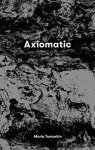
A couple of weeks ago, I posted a guest post by Amanda for Maria Tumarkin’s book of essays, Axiomatic. At the time that post was negotiated, I had no immediate plans to read the book myself, but that changed when Brother Gums and family gave me a copy for Christmas …
Now, if you are a regular reader here, you may remember that Amanda had mixed feelings about the book. She liked the writing, and found the analysis was “at its best in the first three sections when dealing with complex social issues”. But, she found the book “unrelenting”, “not balanced or fair”, and ultimately nihilistic in not offering hope or, to put it simply, ways forward. She concluded by asking what Tumarkin wanted to achieve with the book. Having now read the book, all of these comments make sense to me, but my response is more positive. Perhaps it’s because this Ukrainian-born Australian Tumarkin reminds me of Helen Garner whose bold, clear-eyed writing about tricky subjects I greatly appreciate. Indeed, Garner is quoted on the back of my edition, describing Tumarkin as charging “headlong into the worst and best of us, with an iron refusal to soften or decorate…” That’s Garner, and that’s Tumarkin.
Axiomatic comprises five long essays, each interrogating an axiom:
- time heals all wounds
- those who forget the past are condemned to re–––––
- history repeats itself
- give me a child before the age of seven and I will show you the woman
- you can’t enter the same river twice
As you’ve probably worked out by now, Tumarkin doesn’t unquestionably accept these axioms, showing them instead to be simplistic or misguided, if not, false.
In the first essay, she explores the notion that “Time heals all wounds” through the prism of teenage suicide. At one point she references psychologist Erminia Colucci’s study of “attitudes to suicide and suicidal thoughts among young people in Italy, Australia, India”, and adds, in parentheses:
(There are intellectually rigorous reasons for her choice of countries. There are lovely simple ones too: ‘I am Italian. I love Australia. I am fascinated by India.’)
This description could also be applied to Tumarkin’s rather idiosyncratic approach to her book. There is intellectual rigour – at least to the best of my knowledge and experience – but it also frequently feels personal, subjective, drawing on stories that interest her, that relate to her experiences, and that may not, initially anyhow, seem the most obvious choices. A lot of names – like Colucci’s, for example – are given, but this is not a foot-noted academic book, so you need to use your search engine if you want to check out the authorities she invokes. All this suggests that the book belongs to the creative non-fiction genre, one for which Garner, too, is well recognised. Amanda described Tumarkin’s writing as “a powerful composite of investigative journalism, analytical thinking and literary technique”. I’d agree, and add “personal reflection”.
But, now, how to discuss this complicated, rather slippery book? Discuss each of the essays, teasing out the ideas Tumarkin explores? Choose just one essay, and use it to discuss Tumarkin’s approach? Or, just focus on some specific aspects of the book that stood out for me? I’m opting for the latter.
What most appealed to me is the iconoclastic way Tumarkin thinks, the way she looks behind the assumptions we make, confronting the platitudes, or the way she asks questions from different (but often logical) angles. Regarding adolescent suicide in “Time heals all wounds”, for example, she identifies the nature of adolescence itself:
… one of adolescence’s constants is not knowing what’s happening inside you. And by extension not knowing what you’re capable of.
How do schools, society, handle this inherently unstable nature of adolescence? Then there’s the current “untreated depression” model of suicide causation, an explanation more common, Colucci tells her, in Australia than in Italy and India. What are the implications of this? This is a powerful essay – offering no resolution or answers. Just questions. I’d argue, though, that there’s value in that. Without asking the right questions, there can be no answers?
In “History repeats itself”, Tumarkin applies her pen to the justice system and the way it treats “offenders”, the way it assumes that they’ll re-offend, and then behaves, treats them, accordingly. It’s devastating – and certainly discomforts those of us, including herself she admits, living “cushy middle-class” lives.
Tumarkin discusses how offenders fall through the cracks. For example, she writes:
It’s a real issue, how to keep people real. And not make them into catchphrases for banners, appendixes to principles … Many of those who advocate on behalf of others don’t want a connection with those they are advocating for.
And yet, there are paradoxes, she sees, in connecting. Beware what you start if you can’t see it through. What, for example, does giving up drugs do to a person whose whole life is bound up in that community? What indeed? Do you have an answer?
(An aside: I can’t resist mentioning here that the idea of “connecting” recurs several times in the book, reminding me of EM Forster’s Howards End and its theme, “only connect”.)
Then there’s the notion of “knowing [my emphasis] your life is precious” and the assumption that that is “the default state of the human psyche”. But
How about all those people for whom their life does not feel precious? Why not is often the easy bit to get [and she then catalogues the reasons why not]. A harder question is can the feeling your life’s worth shit be fixed, whether from outside in, or inside out? Can it? All the services offering legal aid, food, counselling, employment (tedious employment), shelter, they cannot get close to this worth-shit feeling … I mean this feeling’s impervious to being messed with, it is too deep and diffused … And when this feeling is there it skews the survival instinct …
“History repeats itself” also provides examples of another feature of the book – its writing. There are perfect (often gut-wrenching) descriptions like this:
Perhaps one way of putting it is that many of Vanda’s [her main “guide” in this essay] clients live their lives on a highway where they are repeatedly hit by passing trucks. As they are bandaging their wounds, cleaning them out with rainwater, putting bones back into sockets, another truck’s coming.
Beyond this, the writing is varied, and rather eccentric, slipping from formal perfection, dialogue and narrative, to, at times, idiosyncratic syntax and punctuation that stop you in your tracks, forcing you to think about what she is saying. Compounding this are digressions and odd juxtapositions which also keep the grey matter exercised.
There is so much more to say about the content, style, thought processes, and inspirations for the book, not to mention the ‘yes’ moments – so many of those – but I’ll close with what I see as a unifying idea running through the five essays – the past. How the past affects us, how we perceive and deal with it. I’m not sure I fully grasped her meaning on one reading – and maybe there is no one meaning. But I sense she’s saying that although the past is significant, although it doesn’t “disappear”, we are not – to quote one of her contacts – “all sum totals of our histories.” That idea is too simplistic – and yet is the way it is too often viewed, which limits us, repeatedly, in our interactions with each other, personally, politically and systemically.
Axiomatic is, for me, a compassionate work. While Amanda sees it as lacking hope, I see it as realistic. True, it doesn’t offer answers. As Vanda says, “there are no fairytale endings.” Why not, Tumarkin asks. “Because,” replies Vanda, “people are people.” And that, I’d say, is the fundamental humanity of this slippery, uncomfortable, provocative book.

Maria Tumarkin
Axiomatic
Brow Books, 2018
201pp.
ISBN: 9781925704051







 Whispering Gums