Jane Austen, Northanger Abbey (Review)

Although I’ve titled this a review, as I do when I write about a book, this post on my latest read, Jane Austen’s Northanger Abbey, is not really going to be a review. Like all her novels, it’s been intensively written about from multiple angles, and in fact there are many themes and ideas I’d love to write about, but for this post I am going to focus on one aspect that particularly struck me this time. This aspect is not exactly new to me, but it came together this read in a particular way – and it is this …

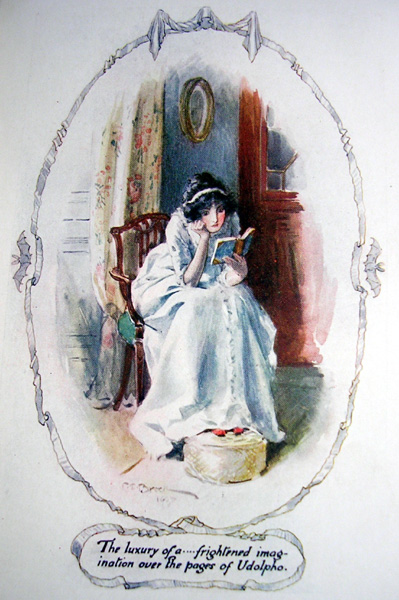
Northerner Abbey illus br Brock

From Chapter 9, illus. by CE Brock (Presumed Public Domain, from solitaryelegance.com)

Northanger Abbey is often seen as a spoof or satire of gothic novels. And it certainly does make fun of these novels, but it does so largely through satirising readers of these novels, particularly (young) suggestible readers. Northanger Abbey is also famous for its defence of the novel, on which I’ve posted before. However, the thing which stood out this read was how much Austen comments on the art or practice of writing novels. The novel opens with:

No one who had ever seen Catherine Morland in her infancy would have supposed her born to be an heroine.

Now this partly sets up the whole Gothic novel thread, the idea that heroines of Gothic novels are certain sorts of people, and that certain sorts of things happen to them, but on this read I was very conscious that there was more going on here between Austen and her reader (in this case, me). Before I explore this a little more, it’s probably worth outlining the novel’s publishing history. Initially called Susan, it was written around 1798–99, when Austen was 23-24 years old. She revised it in 1803, and it was sold to a bookseller, who never published it. In 1816, the year before Austen died, her brother Henry Austen bought it back. Austen revised it a little more, including changing the name of the heroine, and of the novel, to Catherine, but died before putting it out for publication again. In the end Henry organised for it to be published as Northanger Abbey, along with Persuasion, in 1817.

So, it was the first novel she finalised for publication (even though she had previously started on the books that later became Sense and sensibility and Pride and prejudice) but was the last published. The interesting thing about this essentially “first” novel is that the voice, or point-of-view, is a little different from the other five novels which are written more consistently in third-person omniscient voice. In Northanger Abbey however, the author-narrator frequently intrudes into the story to address the reader – sometimes, though not always, using first person – and in so doing tends to draw attention to the making of the fiction.

For example, she introduces the Thorpe family with a brief background, then writes:

This brief account of the family is intended to supersede the necessity of a long and minute detail from Mrs. Thorpe herself, of her past adventures and sufferings, which might otherwise be expected to occupy the three or four following chapters; in which the worthlessness of lords and attornies might be set forth, and conversations, which had passed twenty years before, be minutely repeated.

There is an element here of satirising Gothic novels which tended to be long and detailed and to deal with nobility, but it is also, as I see it, part of Austen’s novelist’s manifesto. She’s telling us that for the purposes of her story we don’t need long digressions into irrelevant, albeit possibly exciting, pasts.

Her frequent references to Catherine and whether or not she is a heroine sets up the reader for a traditional Gothic romance while at the same time teases us to think about what fiction might really be about. We know, from a letter to her niece, that this is, for her, “Three or four families in a country village”. So, on the one hand Austen tells us that Catherine has been “in training for a heroine” and “that if adventures will not befall a young lady in her own village, she must seek them abroad”, and then on the other hand, she returns us to reality with statements like:

she felt more obliged to the two young men for this simple praise [that she was “a pretty girl”] than a true-quality heroine would have been for fifteen sonnets in celebration of her charms.

Austen plays with us like this throughout, comparing the concerns and expectations of a Gothic novel heroine with those of a more “realistic” one.

Towards the end, the two threads – the Gothic and the natural or realistic – come together. Having discovered that all her wild imaginings of murder and mayhem at the Abbey were just that, wild imaginings, Catherine does have to confront a very real crisis when the General suddenly turfs her out of the Abbey, his home, with no explanation:

Yet how different now the source of her inquietude from what it had been then—how mournfully superior in reality and substance! Her anxiety had foundation in fact, her fears in probability; and with a mind so occupied in the contemplation of actual and natural evil, the solitude of her situation, the darkness of her chamber, the antiquity of the building, were felt and considered without the smallest emotion; and though the wind was high, and often produced strange and sudden noises throughout the house, she heard it all as she lay awake, hour after hour, without curiosity or terror.

This is one of the narrator’s third person pronouncements, but Austen, the author, intrudes in first person again at the end, with two statements that refer directly to the making of fiction. One alludes to the final resolution of the romance:

The anxiety, which in this state of their attachment must be the portion of Henry and Catherine, and of all who loved either, as to its final event, can hardly extend, I fear, to the bosom of my readers, who will see in the tell-tale compression of the pages before them, that we are all hastening together to perfect felicity.

The other refers to the introduction of a new character in the last chapter who helps bring about the above “perfect felicity”:

… I have only to add—aware that the rules of composition forbid the introduction of a character not connected with my fable—that this was the very gentleman whose negligent servant left behind him that collection of washing-bills, resulting from a long visit at Northanger, by which my heroine was involved in one of her most alarming adventures.

I love this aspect of Northanger Abbey – that is, I love Austen’s cheeky, inventive voice. She’s not scared to talk to us, to tell us what she’s doing and what she thinks. It’s a fresh, bright novel that beautifully bridges her juvenilia pieces with her more, let’s say, controlled works. We see here the lively intelligence of a young writer who is thinking, perhaps, about imagination and reality, and certainly about what she likes to read and what she wants to write.

This has been pretty brief, and may not have argued my point as coherently as I would have liked, but at least it documents for me the ideas that this reading brought to the fore. I hope it’s given you something to think about too.

Jane Austen
Northanger Abbey
Digireads.com, 2011
ISBN: 9781596251144 (ebook)

Peter Carey, Amnesia (Review)

CareyAmnesiaHamishSomewhere sometime ago I read that serious reviewers should read the book they are reviewing at least twice. I think this is good advice, but I admit that with so many books I want to read I rarely follow it. Peter Carey’s latest novel Amnesia is one that well warrants rereading. It assaults you with ideas and action that aren’t easily assimilated on the first read. However, time marches on, so to write this review I am going (or, to be honest, I’m choosing) to rely on the notes I took, supported by a quick flick through. Please read my review in this light!

Amnesia is a satire, and satires can be pretty tricky to read. They’re slippery. They can be funny, but not necessarily. They tend to be about ideas or issues, so their characters are created to serve that end and may not be fully developed or particularly sympathetic. This can make satires tricky to engage with, particularly if you’re the sort of reader who loves to engage with characters. Amnesia presents the reader with some of these challenges. It’s a romp, a thriller, a drama – but in the end it’s all about activism, cyber security and journalism, about politics and the relationship between Australia and the United States of America. I enjoyed it, though the pace was so cracking at times I found it hard to keep up.

The novel starts with a worm, the Angel Worm, which infects the computer control systems of Australian prisons, releasing their locks. Because Australian prison security was designed by American corporations, the worm also infected nearly 5,000 American prisons. Prisoners of all sorts, including asylum seekers, were freed. The U.S. is not amused. As the story breaks, our protagonist, Australia’s self-described “sole remaining left-wing journalist” Felix Moore, is being tried in court for defamation. He’s “grateful for a story big enough to push me off the front pages”. Unfortunately, in the sort of irony typical of satire, he soon finds himself out of the frying pan and into the fire, because, of course, the parents of one of the Worm’s creators are old university friends, Sando Quinn and his wife Celine.

So here’s the set up. Felix is destitute. His book is to be pulped, and his wife has kicked him out. To his rescue comes another old university friend, Woody Townes, who pays him a lot of money to write a book about worm-creator Gaby. Felix soon learns though that this book is not going to be his book expressing the truth as he discovers it, but a book that says … well, let’s just say that here the adventure, romp, thriller, drama, whatever you want to call it, begins.

What then is being satirised? Let’s start with the four main characters, Felix, Sando, Celine and Woody. They met as students at Monash University and became friends. They were radicals and activists who believed they could change the world. They organised marches and protests, they voted in Whitlam and the Labour Government, and they were affronted and angry by Whitlam’s dismissal in 1975. But, who are they now? One of Carey’s targets is this: what happens when radicals grow up? Woody turns capitalist property developer with hints of something worse; Sando is a politician who tries to keep the faith but discovers the compromises he has (or wants) to make; actor Celine sees herself as Bohemian but becomes seduced by the “finer” things in life and doesn’t want to mix with the working class; and journalist Felix sees himself as the tell-it-all saviour but recognises that in the process he has “become an awful creature”.  It’s not a pretty picture.

Underlying this is a thread exploring Australia’s relationship with the USA. There’s the Battle of Brisbane (a two-day fight and riot between American soldiers and locals during World War 2), discussion of US involvement in Whitlam’s dismissal, and, fictionally, fears of what might happen if the US extradited Gaby. (Julian Assange anyone?) Early in the novel, Felix agrees that Woody has a point regarding the extradition risk:

Everything we knew from life suggested that America would do what it liked and Australia would behave like the client state it always was.

Carey also satirises journalism, particularly the sort that prides itself on exposés in search of the truth. Felix becomes the pawn in a game to produce a story that suits the person who gains control of him – by whatever method they can, by money, say, or by abduction. Woody suggests at one stage that Felix make things up to put Gaby in a positive light, but Felix, who believes there’s “no such thing as objective journalism” argues that this doesn’t equate with making things up! Through the course of the book Felix moves (or, more correctly, is moved through mysterious mechanisms) from a classy high-rise in Melbourne, to a remote primitive shack on the Hawkesbury River, and thence to a motel room in the Blue Mountains. All the while he doggedly listens to tapes of mother, Celine, and daughter, Gaby, talking, talking, talking.

Their story of life in Melbourne, from when Gaby was born, significantly on 11 November 1975, is great reading. Melbourne-born Carey knows the city and captures its life, rhythms, and diversity beautifully. The writing is gorgeously descriptive at times, and often funny, but can also be biting.

I think, too, that there’s an element of Carey sending himself up. I’m not suggesting, despite some obvious similarities between character Felix and creator Carey, that Amnesia is intended in any way to be autobiographical. But, in several of the references to writers and writing, I detect digs at some of the criticisms that have been levelled against him. How about, for example, Felix’s comment at the end that:

For the crime of expressing pleasure that my book would be available to future generations, I was judged not only immoral but vain and preening …

Oh Peter, I thought!

To conclude, though, what is all this satire for? Well, the title says it. There’s a reason Gaby was born on the day of the dismissal, and that she becomes the next generation of activists (or hacktivists) – and the reason is that Carey does not want us to forget. He wants us to “maintain the rage”*, to remain aware and vigilant of what is happening, and of whose fingers are in which pie. It’s not subtle, but then what satire is, and it perhaps tries to pack too much in, but it is both an entertaining and a provocative read. I’d be more than happy to read it again.

Peter Carey
Amnesia
Hamish Hamilton, 2014
367pp.
ISBN: 9781926428604

* I drafted my review and then trawled the net, and what did I find but an interview with Carey in The Australian that says just this. I didn’t steal it, promise!

Aminatta Forna, The hired man (Review)

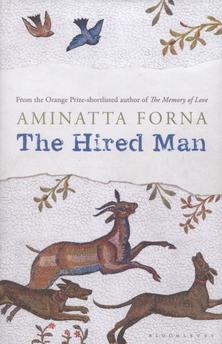
Aminatta Forna, The hired manEarly in Aminatta Forna’s The hired man, the narrator Duro is told by his old, ex-best friend Krešimir, “People have moved on, Duro. Maybe you should too”. At this point we are not sure exactly what they have moved on from but we guess it might have something to do with war – and as the story progresses we discover we are right.

The hired man is Forna’s third novel, but my first to read. All of them, together with her memoir The devil that danced on water, deal with the prelude and aftermath of war. In The hired man it’s the Croatian War of Independence which occurred in the early 1990s. Forna, though, never names the war, and while there is some description of war-time action, she doesn’t provide any real historic details about who, what or where.

The novel is set in the fictional town of Gost, and commences in 2007 with Duro, our first person narrator, telling us that “at the time of writing I am forty-six years old”. Later we realise he is writing for a future reader, after he dies. He writes

… I have to tell this story and I must tell it to somebody, so it may as well be you, come to sort through my belongings.

The trapdoor is opened …

So, what is the story he has to tell – and why is he suddenly compelled to tell it now? Well, towards the end of the novel he says this:

Laura arrived in Gost and opened a trapdoor. Beneath the trapdoor was an infinite tunnel and that tunnel led to the past.

You don’t know who Laura is, though, do you, so it’s time I introduced the plot. The novel spans Duro’s life from his childhood to his mid-forties. He tells of his family, and his boyhood friends, particularly the aforementioned Krešimir and his younger sister Anka, with whom Duro fell in love. He tells how his relationship with Krešimir crumbled as Krešimir’s true, cruel, nature became apparent, and why he left Gost for a few years, returning just before the war started. And he tells us about the “chaos” that ensued during the war, “when men turned to hunting each other”. I don’t want to give too much away here, but let’s just say that by the time the war starts his relationship with Anka had moved, necessarily, from that of lover to good friend.

We jump then sixteen years to 2007 – when Duro is living alone and friendless – though the novel is not told in this linear way. It’s told more organically as the changes resulting from the opening of the “trapdoor” stimulate memories and bring the past back to Duro. This trapdoor is opened because Krešimir sells the “blue” house, the home he’d shared with Anka and their parents, to Laura and her husband who plan to renovate it, sell it, and move on. Duro, we discover, is a handyman, and he becomes Laura’s “hired man” for this renovation, and in the process becomes the family’s friend.

There is an underlying theme here of the British moving into Europe, oblivious of history and inherent dangers:

The way the English saw it, the past was always better. But in this country our love of the past is a great deal less, unless it is a very distant past indeed, the kind nobody alive can remember, a past transformed into a song or a poem. We tolerate the present, but what we love is the future, which is about as far away from the past as it is possible to be.

These English do not understand, for example, that the “fields that used to be ploughed … are now full of wild flowers because nobody dares to walk in them in case they put their foot on a mine and are blown to pieces.”

“I imagine myself with the body of a bird, a raven. Outstretched wings and neck, rigid beak and shining eye, I swoop over the ravine and hover over the town.”

So, here is Duro, standing “guard over the past” like a predatory bird. And here is Laura, reminding him of Anka who, though we don’t know why, is no longer in Gost. And here is “the chill of unfinished business”. The stage is set … but here I’ll leave the plot.

What is beautiful about this novel is that, despite its depiction of brutality and betrayal, and despite a sense of menace, it is restrained – and it’s restrained because Forna’s focus is not violence and revenge, though there are elements of these in the novel. Her interest is how people live with each other after war, and particularly after Civil War when traitors, collaborators, opportunists and victims, depending  on your point of view of course, must all live together. The novel made me think of Olivera Simić’s Surviving peace which I reviewed last year. It’s a memoir, and Simić does not still live in her Serbian home, but she makes very clear that surviving a war, particularly ethnically-driven civil war, is just the beginning.

What is also beautiful about this novel is Forna’s writing – her use of imagery, symbolism, irony and parallels to convey her meaning. Birds and colours have multiple connotations, some positive, natural, others menacing. The “ravine” on the edge of town bears witness to beauty and horror. Hunting suggests violence and predation, but is also a source of sustenance and defence. The title, itself, “the hired man”, has both benign and malignant meaning …

As does the idea of masculinity, “with its undercurrent of aggression”. For Duro, it encompasses loyalty, protectiveness, and reliability alongside strength and control, while for men like Krešimir and Fabjan, the town bully, it means power and competitiveness, and is attended by a sense of menace.

Nothing, in other words, is simple in Forna’s world, and the language conveys this subtly but emphatically.

‘Well this is one of the most beautiful places I’ve ever been. You don’t notice it any more, but you don’t know how lucky you are.’

Laura, new to the town, is oblivious to the irony of her utterance, and so are we as the novel starts – but, we soon learn differently. It is not a pretty town but by the end some rapprochement, uneasy though it still may be, has been achieved. This is a moving but realistic book about just how difficult it is to survive peace.

Aminatta Forna
The hired man
London: Bloomsbury Publishing, 2013
ISBN (Kindle ed): 9781408818770

Biff Ward, In my mother’s hands (Review)

Biff Ward In my mother's hands

Courtesy Allen & Unwin

“Profoundly moving”, “a kind book”, and “harrowing” could be blurb words for Biff Ward’s memoir, In my mother’s hands, but they’re not. They are some of the words used by members of my reading group when we discussed the book this week with – lucky us – the author in attendance.

It’s quite coincidental that I happened to be reading this book right when Annabel Smith asked me to name my favourite memoir for her Friday Faves, which resulted in my follow-up post on memoirs this Monday. However, I’m glad it happened this way, because it’s given me an excuse to continue the discussion a little more. There’s so much to say about Ward’s book, but for this post I’m going to explore just two aspects: the reading experience, and its literary qualities.

On reading In my mother’s hands

So, let’s start with the story. Biff Ward is the daughter of one of Australia’s most influential historians of the mid-twentieth century, Russel Ward. At our meeting, she told us that people expected her to write his biography, but, she said, that was never her interest. Instead, she found herself writing about her mother. In doing this, though, she did in fact write about her father – but in a memoir, not a biography, because this book is about her experience of living in a family with an increasingly delusional, paranoid mother. What that experience was like – and how she eventually unravels the full story – makes compelling reading.

But, there’s more to reading this book than the story, strong as it is. There is how Ward tells it. She evokes the times beautifully – particularly the 1950s and 1960s – showing, in particular, the devastating result of the lack of understanding or awareness of mental illness. And she does this while inhabiting the child she was at the time, that is, she manages to tell those years from her child’s eye view, interspersing this voice with her experienced adult one. Take, for example, her description of when, as a teenager, she’s home when her mother is visited by “top girl” or “the queen bee of the university wives”. Ward believed this visit showed her mother was being talked about publicly, and she felt “shame and embarrassment” as “Top Girl bustled down the hall and out the front door”. That word “bustled” perfectly captures the idea of a “busybody”. Later, though, she sees it differently:

Now I can see that the network of women, connected through the university where their husbands worked, might have cared about my mother. Or might have wanted to care but were not sure how to go about it.

Also contributing to my reading enjoyment was how seamlessly Ward incorporated her research into the story to substantiate her feelings and ideas. She quotes from letters her father wrote to his parents and sister. (How wonderful that these were kept, says this librarian-archivist!) She talks of speaking to friends and family members later about their memories. She shares her research into official records. She refers to her father’s autobiography. And so on. None of this is tedious, but is woven naturally, logically, into the narrative.

Then there’s Ward’s honesty in confronting difficult truths, and her ability and willingness to reflect on her experiences and comprehend their meaning or implications. Here she is, for example, on her response to her father’s overwhelming (and surely unreasonable) request for her to look after her mother for a year:

I didn’t know that somewhere inside me was a plan. My motivation was buried way too deep for me to connect that first touch of an erect penis with the request Dad had made of me.

You can probably guess the outcome.

It would be easy to read this book with anger – to be angry particularly with Russel Ward for his failings – but that would, I think, miss the point. Ward is not angry – and indeed her father did a lot right too. Her tone is more one of sadness, than of anger. She appreciates the culture of the times and she knows that people are flawed. I loved this – the generosity with which she relates what was clearly a traumatic upbringing.

What makes a memoir literary?

This might sound like a snooty question, but literary non-fiction is a recognised genre, and memoirs are making literary award lists. So, what makes one memoir stand out over another in terms of literary qualities? Critic Barbara Lounsberry captures my perspective: “Verifiable subject matter and exhaustive research guarantee the nonfiction side of literary nonfiction; the narrative form and structure disclose the writer’s artistry; and finally, its polished language reveals that the goal all along has been literature.” (from Wikipedia)

So, narrative form, structure and “polished” language. While I wouldn’t call In my mother’s hands particularly innovative or challenging in terms of style and technique, I would call it skilled and polished. Ward’s use of her child’s voice interspersed with her more reflective adult one effectively draws the reader in. Her use of foreshadowing – such as “I missed seeing that I had been provided with a rehearsal of what was to come” and “It’s hard, looking back, to pick the precise moment when a turning point arrives, when your life is about to change” – picks up on a structural device common in fiction. (It also neatly demonstrates the memoirist’s ability to think back).

The jewel in the crown, though, is her language. Ward’s writing is generally direct and to the point, but she has a great eye for metaphor and produces some gorgeous images that can encompass multiple ideas. I loved this description of her mother’s increasing (often self-imposed) alienation within the family:

Even when there weren’t visitors, we hardly spoke to her. As her delusions grew, as she had almost no everyday conversation, we cut off from her, twig by twig. Our family tree grew its gnarled limbs around us and through us, in the imperceptible way trees do, so that we didn’t notice how weirdly shaped we all were.

This obviously distorts the traditional family tree motif but also, I think, subtly suggests the tree of (non) life?

And then there’s the title itself. In my mother’s hands references so many ideas – the fact that children are (rather defencelessly) in their parents’ hands; the idea that as a nurse her mother had had caring, nurturing hands; her mother’s grotesque habit of gouging and hurting her hands (invoking Lady Macbeth, and the mystery at the heart of the book); and her mother’s terrifying attempt to strangle Ward in her bed when she was 12 years old. Literal, symbolic, metaphoric. They’re all there in those four words.

The chapter titles are similarly evocative, usually brief and apt, such as Brittle, Knife, The Cobweb, Running. Language is, in fact, a significant issue in the book because in those awful days when mental illness was not understood, Ward, her father and younger brother had no language to explain to each other, let alone to outsiders, what they were experiencing. Sometimes Ward would lie, she said, because “when there are not adequate words, fiction will suffice”; other times they would use “shorthand” to obscure the reality.

I could write more about the language in this book, because I found it perfectly tuned to the story and to conveying the feelings within, but I’ll leave it here.

At the end of our meeting, I mentioned to Ward her longlisting for the Stella Prize. She smiled a little wryly, and said, in relation to missing out on the shortlist, that she felt in good company being “rejected with Helen Garner and Sonya Hartnett”! She sure is – and on the basis of this book, I’d say she well deserves being mentioned in the same breath as those writers.

awwchallenge2015Biff Ward
In my mother’s hands
Sydney: Allen & Unwin, 2014
268pp.
ISBN: 9781743319116

Fiona McFarlane, The night guest (Review)

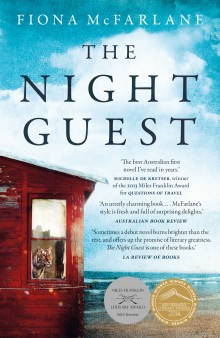
McFarlaneNightGuestPenguinThose of you who followed the literary award season in Australia last year will have seen Fiona McFarlane’s debut novel The night guest pop up several times. The more it popped up, the more I wanted to read it – but also the more I thought it would be good to read with my reading group. So, I bought it, and held onto it until this year, as we did, in fact, schedule it for our end of February meeting.

The first thing to say about this book is that it’s an easy, quick read, a page-turner in fact. But, it is not a simple read. It’s a read that keeps you guessing right to the end, even though you are pretty sure you know what is going on. It’s about Ruth. She’s in her mid-seventies, and recently widowed. She lives in the family’s old holiday house to which she and her husband had retired a few years previously. And, she’s “reached the stage where her sons worried about her”.

Then, along comes Frida, from the government she says, to be Ruth’s carer, because Ruth, as we’d suspected, has dementia, albeit in early stages. She is, she feels, “still self-governing”. Apparently, both of McFarlane’s grandmothers had dementia which helps explain why McFarlane has been able to present Ruth’s state of mind so convincingly. I say “helps explain” because there’s clearly a perceptive and skilled writer at work here too. It’s one thing to experience family members with dementia, but it’s quite another to be able to present it with such authority and authenticity.

How does McFarlane do this? The most important decision a writer has to make I think – and I’ve certainly heard many say this – is the voice. For this book, McFarlane chose third person subjective, that is, it is told third person but almost completely from Ruth’s perspective. A good decision, because we can feel Ruth’s uncertainty as she slides between confidence and uncertainty, between independence and neediness, between reality and a strange world that doesn’t always make sense. Because it’s from her point of view – and not an omniscient author’s – we are kept on our toes, not always sure, as Ruth is not, of where she is on any of those spectrums at any given time. Sometimes it’s patently obvious, but other times it’s not so clear.

Ruth has a few guests during the course of the book – including Frida (of course) and a man called Richard Porter. But there is another one, a tiger! The tiger appears in the opening sentence of the novel:

Ruth woke at four in the morning and her blurry brain said, ‘Tiger’.

She was of course dreaming, except that now she’s awake, she starts to hear noises, “something large … rubbing” against her furniture, and “the panting of a large animal”. These noises are too big to be coming from her cats. The tiger is ongoing “character” in the novel. More on this anon.

The second guest to arrive is the aforementioned Frida. She appears out of the blue one day – “You don’t know me from Adam” she says – to start caring for Frida. The question though is, is she “out of the blue” or is it that Ruth didn’t remember that someone was coming. Questions like this recur throughout the novel, keeping us in a sort of readerly vertigo. One minute we believe we know, and the next we are uncertain again. By the half-way point, though, I suspect most readers are pretty confident of what’s really going on, but even then there are uncertainties about how it will actually play out. All this makes the book an engrossing challenge.

Then there’s the third guest, Richard Porter, who was her first, and unrequited love, when she was a young woman living in Fiji with her missionary parents. Ruth invites him for a visit, hoping that “things could still happen to her”.

It’s hard to know how to write more about the book though because this is one of those stories in which the plot and the meaning are intertwined. However, I can say that it’s broadly about ageing, grief, love and loss. It’s also about trust, honesty and the responsibilities we have for each other.

The tiger

The tiger, as I’ve already indicated, appears on the first page. He’s a complex figure, alluding partly, I’m sure, to Blake’s “The Tyger”. But, and here perhaps I’m drawing a longer bow, he also reminded me of the tiger (aka Richard Parker, which is very close to Richard Porter, but that might be a bridge too far!) in Yann Martel’s Life of Pi. Both tigers reflect a duality: they are both fearsome (and perhaps representative of evil, though I like to avoid that word), but both can also be seen positively. Blake’s tiger was made by the God who also made the lamb, and so by extension can be seen to encompass both forces. Martel’s tiger needs to be kept at bay, but his very presence also gives Pi the strength and focus he needs to survive.

So, too, in The night guest does the tiger play a complex role. He appears when Ruth is at her most uncertain, most fearful, most disoriented, disappearing when she’s calm. In that sense he represents the negative. But, there’s something grand, and perhaps even reassuring about him. In his first appearance, Ruth thinks:

A tiger! Ruth, thrilled by this possibility, forget to be frightened and had to counsel herself back into fear.

A little later, when she is feeling comfortable, the tiger is “safely herbivorous”. But, he comes back, and Ruth is irritated “because there was no point to him now that she had Frida and Richard; the tiger had prepared the way for them and was no longer needed”. I’m tempted to suggest that Frida and Richard could represent the tiger’s duality, but the book isn’t simplistically conceived, so I don’t want to take that line of thinking too far.

Towards the end, when the tiger is fighting for his existence,

Ruth felt for a moment on the verge of understanding exactly what the tiger was saying when he roared. He wasn’t concerned for his safety, but for his dignity …

I’ll leave the tiger there, but I think you can see how McFarlane uses him in the novel.

There are other images and symbols which run through the book, some of them biblical, like lilies (“she was safe behind her lilies”), which makes sense given Ruth’s missionary upbringing. And, of course, Ruth’s name itself is biblical. None of this is heavy-handed though, or suggests a slavish adherence to symbolism. It just adds to the depth with which we can contemplate this book – at least, I think so.

In the end, this is a book about people – and how we treat each other. Several people, besides those I’ve mentioned here, are involved in Ruth’s life, such as her sons and a young mother who’d found her husband as he was dying. The book asks us to consider how far do we – should we – take our duty of care? How do we decide when we should intervene in another’s life and when we should not. I did enjoy this book.

Lisa at ANZLitLovers didn’t enjoy it as much as I did. I agree that it doesn’t really work as a psychological thriller, which is how some of the blurbs on my edition describe it. But, as I was reading it, I wondered whether that’s what McFarlane intended … or just how it’s been promoted?

awwchallenge2015Fiona McFarlane
The night guest
Melbourne: Penguin Books, 2014 (orig. ed 2013)
275pp.
ISBN: 9780143571339

Fyodor Dostoevsky, Crime and punishment (Review, hmm)

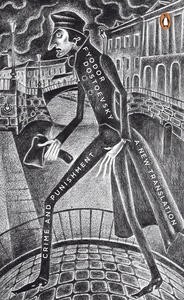
DostoevskyCrimePenguinPart way through my reading of Fyodor Dostoevsky’s Crime and punishment I wrote in my book – because, yes, I am a marginalia writer – “Who does Dostoevsky agree with?” It’s a somewhat naive question, I know, because the author doesn’t have to agree with anyone – and very often doesn’t. You just have to look at Humbert Humbert for example, or Patrick Süskind’s Jean-Baptiste Grenouille. But, in those novels, you can assume the authorial viewpoint. Crime and punishment, however, seems to me to be very different. What is Dostoevsky’s viewpoint? Does he have one?

SOME SPOILERS FOLLOW … THIS IS A CLASSIC, SO FAIR GAME I’D ARGUE.

This brings me to why I read classics. There are two main reasons: one being simply that I’m interested in our literary heritage, and the other is because they still have something to say. I guess this partly answers the question I posed a couple of posts ago doesn’t it? I read for insight into “the human condition”, to understand what makes us tick, and therefore, I suppose, to know myself and others better. Anyhow, back to Crime and punishment and my marginalia comment. The central question in the novel is, really, why did Raskolnikov do it? And his reasons are so ambiguous, so paradoxical, that he slots pretty comfortably into our post-modern world of uncertainty, self-consciousness and fluidity. Of course, he’s not modern (or post-modern). He’s a 19th century creation (and this is a mid-19th century novel with a happy ending). But he’s a creation who is hard to pin down, because he’s the creation of a writer from a society in flux, and of a writer who was perhaps himself in flux. Indeed, Raskolnikov’s name, so the translator of my edition tells me, derives from “raskol” meaning “a split or schism”.

So, Raskolnikov commits his crime. He murders not only the “old hag”, a pawnbroker with whom he’d had several problematic dealings, but her sweet, simple-minded sister Lizaveta, who surprised him in the act. Raskolnikov evinces little or no obvious guilt for his actions, though his physical illness and mental disarray post-murder are surely a psychosomatic response to what he’d done. His behaviour is quite schizoid, at one moment warm and generous, and then suddenly cold and calculating. No wonder those close to him can’t make him out. He’s a slippery beast.

And he’s a slippery beast because it seems – if I understand the various end-notes included in my edition – he’s a vehicle for Dostoevsky’s views on Russian society and intellectual life at the time. So, here I’m answering my opening question: Raskolnikov represents Dostoevsky in that he speaks to Dostoevsky’s concerns about some critical issues, but these concerns are multifarious so cannot be pinned down to one main idea. In some ways Crime and punishment could be seen as Dickensian, in its description of the grime and poverty of St Petersburg, but I don’t see Dostoevsky as a Russian Dickens. His main focus is not social justice, though the idea of “justice” features frequently in the novel, but more intellectual, political and psychological. Raskolnikov’s “motives” range from utilitarian ones (the world will be better off without the “hag”, “a useless, foul, noxious louse”) through philanthropic ones (her money could be used to help others) to megalomaniac and egotistic ones (“I wanted to become a Napoleon”, am I one of the “extraordinary” people “who dares to stoop and grab”, one who “moves the world and leads it towards a goal”?). These motives address many of the debates that were occurring in contemporary Russia, debates about socialism, Westernisation, moral responsibility versus environmental impact on human behaviour, and social Darwinism. Overlaying all this is Dostoevsky’s Christian belief. Sonya, the young girl who takes up prostitution to provide for her step-mother and siblings, is the person to whom Raskolnikov first confesses. While shocked, she listens and refuses to believe, or at least accept, his baser motives. Her solution is a Christian one, to “accept suffering and atone”.

In the end, at his trial, Raskolnikov gives practical reasons for the crime to do with his poverty and desire to use the victim’s money to help his career (except he didn’t touch the money), and admits he turned himself in because of “heartfelt remorse”. He receives a relatively light sentence (only eight years in Siberia) for various reasons, including his sickness before the crime, his generous character, and the fact he did not use the money.

Raskolnikov is one of literature’s great anti-heroes, alongside the likes of Shakespeare’s Macbeth and Camus’ Meursault, to whom he has been compared. I can see why – though he doesn’t have the clear motivation of Macbeth, nor the absence of motivation of Meursault. Like Meursault in particular, Raskolnikov is complex and engenders endless debates that are as affected by the reader’s beliefs, experiences and attitudes, and dare I say by the reader’s times, as they are by the text itself.

The novel’s ending suggests “renewal” and “rebirth”, but what exactly Dostoevsky meant by it all is not completely resolved, at least in my mind. There has been enough ambiguity and paradox throughout – for example, Raskolnikov argues that if he has to question whether he has “a right to power” then he doesn’t because one who does wouldn’t ask – and the trial is covered with such brevity to undermine complete confidence in the resolution. I like this sort of openness. It seems appropriate, therefore, to conclude with Raskolnikov’s loyal friend Razumikhin who says to Razkolnikov’s mother and sister:

Keep fibbing, and you’ll end up with the truth! I’m only human because I lie. No truth’s ever been discovered without fourteen fibs along the way … Name anything you like: science, development, thought, inventions, ideals, desires, liberalism, rationalism, experience, anything at all, anything, anything – and we are all, without exception, still stuck in the first years of preparatory school! We just love making do with other people’s thoughts.

Is Raskolnikov an original, a creative truth-teller, or just another confused human being prattling off ideas he’s heard from others? That is the question.

Fyodor Dostoevsky
Crime and punishment
(Trans. by Oliver Ready)
London: Penguin Books, 2014 (Orig. ed. 1866)
702pp
ISBN: 9780141192802

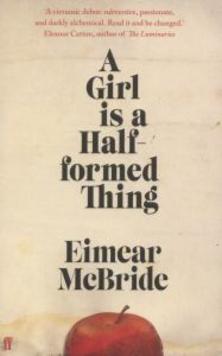
Eimear McBride, A girl is a half-formed thing (Review)

Eimear McBride, A girl is a half-formed thingI try very hard when writing reviews to avoid clichés and superlatives, like, say, “achingly beautiful” or “masterful”. But I think I’m going to use one for Eimear McBride’s multi-award-winning debut novel A girl is a half-formed thing when I describe it as “searing”. I can’t think of a more apposite word. Yet I fear it too has been over-used to the point of meaninglessness. So, let’s try something else …

Once again I’m coming late to the read, and once again this is partly because it was scheduled by my reading group. All I can say is, wow. I’m not sure I’d go so far as Eleanor Catton’s “read it and be changed” commendation on the front of my edition, but I do agree with her  “virtuosic” and “subversive”. It’s a gut-wrenching read.

The plot itself is simple enough. It’s the story of a family – a pious one-could-say-religiously-fanatical mother, a son who survived a serious brain tumour as a toddler, and the younger daughter. The tumour leaves the son somewhat brain-damaged and, of course, it returns. This tumour, the trauma of it, shapes their behaviour and defines their relationships. The story, which spans around 20 years, is told through the daughter and could, in one sense, be seen as coming-of-age. But. This. Tells. You. Nothing. Because …

This is not your typical first-person voice. Instead, we are in the head of the unnamed “girl”. We are there in her conscious unconsciousness (or, is it her semi-consciousness?) in which we hear what she’s experiencing in language that is – here’s another cliché – raw. By this I mean that the language is stripped of the mediation of a formalising narrator’s intellect. Instead it captures the immediate emotional truth of the girl’s experience as she grapples to make sense of her world. This is a book in which the style conveys the meaning as much as the words do.

How does McBride do this you are probably wondering (unless, of course, you’ve already read the book). Well, mostly by breaking, consistently, the rules of grammar and syntax. We are in the girl’s head, a place where, I believe McBride is saying, we rarely think in coherently formed sentences but in what I would call “impressions”. Take, for example, this description, on the first page, of the brother before his diagnosis:

I know. The thing wrong. It’s a. It is called. Nosebleeds, headaches. Where you can’t hold. Fall mugs and dinner plates she says clear up. Ah young he says give the child a break. Fall off swings. Can’t or. Grip well. Slipping in the muck. Bang your. Poor head wrapped up white and the blood come through. She feel the sick of that. Little boy head. Shush.

To orient you, “she” is Mammy, “he” is the father who disappears two pages later, and “you” are the little boy, the girl’s brother. Most of the novel is addressed to him (that is “you”). One of the challenges of reading this book, and it is a challenge to read, is its pronouns. Once you’ve got a handle on them, and once you realise that they are all from the perspective of the girl, you are half way there.

Anyhow, there is easier syntax than the above when life is relatively calm but, when our “girl” is distressed such as when the truth of her brother’s situation can no longer be avoided, it collapses almost completely:

I walk the street. City. Running through my mouth. Running in my teeth the. My eyes are. All the things. The said the done what there what’s all this? That stuff. I could do. My. I walk the street. Who’s him there having a look at me he. Look at my. Tits. Ssss. Fuck word. No don’t. Fuck that. No. Will. Not that. Not. That. But. If I want to then I can do.

This is not the most extreme example – I don’t want to spoil too much – but it should demonstrate what I mean by the language mirroring/enacting/even being her state of mind.

In addition to the idiosyncratic syntax, McBride draws on wide range of literary techniques to keep us focused on, grounded in the emotions of the here and now. The imagery is visceral, returning again and again to  “muck”, “dirt”, “blood”, and “puke”. She alters her rhythms to match the tone, not only through the syntax as evident in the examples above, but through allusions to and repetitions of prayers and hymns, lines from children’s games, literary works and sayings. She makes up new words (“I trup trup off behind her”), mangles existing words (“swoll” for “swollen”), and twists common expressions (“There’s a foul there’s a wind where’s the air”). McBride was inspired by Joyce she says, but her fresh, fearless, urgent language reminded me too at times of Gerard Manley Hopkins.

The novel is clearly set in Ireland and there are odd references to 1980s technology like Game Boys, but overall place and time are unspecified, and none of the characters are named. All this keeps the focus squarely on the emotional core of a family in pain, and the girl in particular. She is abused by her uncle at the age of thirteen and begins a strange love-hate, violent-tender, but sick, relationship with him. Sex becomes for her a weapon, a tool and a punishment. But the book is not about this, that is, it’s not yet another book about abuse. It is about the girl’s inability to handle her emotional pain, and her family’s inability to see her need, it’s about growing up unsupported. She is complicit in her own degradation because for her physical pain is better than the emotional. Like those who self-harm, she seeks out abuse again and again because

… what’s wrong here is me me me. Me the thing but I. Think I know. Is that the reason for what’s happened? Me? The thing. Wrong.

I know this all sounds unremittingly bleak and it largely is, but there are light touches – blackly comic scenes, surprising word plays, and chuckle-inducing descriptions (like her mother’s friends, “they polyester tight-packed womanhood aflower in pink and blue”).

A girl is a half-formed thing is hard to read style-wise and painful to read content-wise. But it is a book that, if you let it, reaches deep into your core and makes you understand the lives of others in a way that only the best literature can. I’m so very glad I read it.

John at Musings of a Literary Dilettante also liked it.

Eimear McBride
A girl is a half-formed thing
London: Faber and Faber, 2014
203pp.
ISBN: 9780571317165

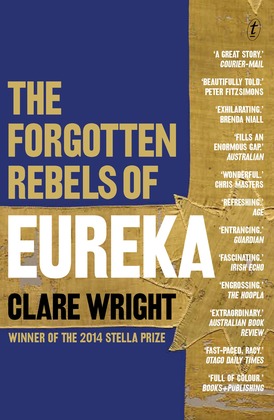
Clare Wright, The forgotten rebels of Eureka (Review)

Book cover, The forgotten rebels of Eureka

Courtesy: Text Publishing

Wah! Once again I delayed reading a much heralded book until my reading group did it*, and so it is only now that I’ve read Clare Wright’s Stella Prize winning history, The forgotten rebels of Eureka. The trouble with coming late to a high-profile book is how to review it freshly. All I can do, really, is what I usually do, and that is write about an aspect or two that particularly interested me. Since other bloggers have already beautifully covered one of these, the history**, I’m going to focus on Wright’s writing and the approach she took to telling her story. I won’t be doing this from the angle of historical theory, as I’m not an historian, but in terms of her intention, and her tone, style, and structure.

If you’re not Australian, you may not have heard of the Eureka Stockade. It was a significant event in colonial Australia’s march to democracy and independence, involving the British army and police attacking a stockade created by miners whose grievances included the payment of a compulsory miner’s licence and the fact that this licence, which they saw as a form of taxation, did not give them the right to vote in the legislature. It has traditionally been framed in masculine terms, but Wright discovered, somewhat by accident while researching another project (as historians do!), a new angle – the role of women in the rebellion. There were, she found, over 5,000 women on the goldfields:

Women were there. They mined for gold and much else of economic value besides. They paid taxes. They fought for their rights. And they were killed in the crossfire of a nascent new order.

Consequently, in her book, Wright draws on extensive primary and secondary sources to explore and expose the lives of these women and the until-now-unheralded role that she believes they played in the goldfields, particularly in the lead up to and aftermath of that fateful day of 3 December 1854.

Wright opens the book with three epigraphs, one of which is particularly illuminating in terms of my subject. It’s by Australian historian Geoffrey Blainey and states that “every history of every country is a mirror of the author’s own interests and therefore selective rather than comprehensive”. Having been interested in historical writing since studying EH Carr’s What is history at university, I like the admission that histories are inherently subjective, regardless of how well researched they are. The historian makes decisions about what s/he will research, what the limits of that research will be, and how s/he will interpret that research. It’s common sense. How can it be otherwise? And so, in this history, Wright’s specific interest in the role of women means that all her research – even research into men’s activities – is viewed through that prism. There’s another implication, too, regarding selectivity: with her focus being specifically the women, we cannot read this book as a comprehensive history of the Eureka Stockade. It complements, or expands, or even jousts with other works.

None of this is meant negatively. I thoroughly enjoyed the read. My point is simply that it’s important, as it always is, to be aware of what we are reading – and I like the fact that Wright recognises this. So, what we have here is, to the best of my knowledge, a thorough but selective history. The text is extensively referenced, with 25 pages of meaningful endnotes and nearly 20 pages of bibliography, and there is a useful index. These are things I look for in a good nonfiction work. The book is logically structured, by theme and chronology, and its (creatively titled) chapters are divided into three main parts: Transitions, Transformations and Transgressions. You can sense a writer’s touch in the alliteration here.

And it’s the writer’s touch I want to turn to now, because Wright has achieved that difficult mix – a well-researched but readable history. It has been written, I’m sure, with an eye on a general, but educated audience. The language is often breezy and even jokey (perhaps a little too much) at times, and yet is replete with classical, Shakespearean, biblical and other literary allusions. She uses metaphor, such as “the cornered lizard bared its frills” to describe the hoisting of the famous Australian flag in the days before the attack. Her descriptions are evocative, and often visceral. You feel you are there in the crowded “tent city” that was Ballarat:

The arrival of the extra troops meant squashing more stinky little fish into an already overpacked tin … From the outside, it seemed like the tightrope was about to snap.

Her stories of the childbirth experiences of Sarah Skinner and Katherine Hancock are devastating to read.

Indeed, I would place this book in the narrative non-fiction tradition. It has a strong narrative drive, with a large cast of characters, some of whom stay with us, some of whom pass through. They include Ellen Young whose poems and letters in the Ballarat Times articulate the mining community’s distress and sense of injustice; hotel-keeper Catherine Bentley who, with her husband, earns the ire of the diggers by consorting with government officials; theatre-owner and actor Sarah Hanmer who donated more to the rebels’ cause than anyone else; and newspaper publisher Clara Seekamp who takes the helm when her husband is arrested for sedition. These women provide significant evidence for Wright’s thesis that women played more than a helpmeet role in the intellectual and political life of Ballarat.

In addition to “developing” these characters, Wright uses other narrative techniques, such as:

  • plot cliff-hangers (much like a screenwriter, which she also is, would do) and pointed aphorisms at the end of chapters
  • foreshadowing to suggest causation: “Even female licence holders expected a modicum of representation for their taxation—as dramatic events would later demonstrate”
  • repetition of ideas and motifs to propel her themes. Take, for example, the Southern Cross. It functions as “a hitching post for existential certainty when all else was in mortal flux” during immigrants’ sea journey from the northern hemisphere to the south (Ch. 3, “Crossing the line”) and is later picked up as a symbol for the rebels’ flag “as the one thing that united each and every resident of Ballarat” (Ch. 11, “Crossing the line (Reprise)”).

As an historian, Wright is confident and fearless, expressing clear opinions, either as direct statements, or indirectly through her choice of language. She calls the Bentleys’ murder trial, for example, a “morality play”. She asks questions; she offers close analysis of her sources, such as noting that the use of the word “demand”, rather than “request” or “humbly pray”, conveys the diggers’ frustration with authority; and she makes considered deductions by testing textual evidence against her understanding of the times and the work of other historians. She discusses discrepancies in reportage, such as the different witness reports of the fire at the Bentleys’ hotel. But she also, as other bloggers and my own reading group have commented, draws a long bow when she suggests the full moon and menstrual synchrony may have been a factor in so many men leaving the stockade on the night of the attack. She provides some evidence for this synchrony as a phenomenon, and offers other reasons for the desertion, but it feels a little out of left field.

At times her nod to the popular and her push for dramatic effect jars, but Wright’s argument that women played an active role at the diggings and in the stockade is convincing. I’m not surprised she won the Stella Prize, because this is engaging reading that is underpinned by extensive scholarship and clear thinking. It’s exciting to see a work that doesn’t just explore the role of women in history but that puts them right in the action.

awwchallenge2014Clare Wright
The forgotten rebels of Eureka
Melbourne: Text Publishing, 2013
539pp.
ISBN: 9781922182548

* I bet you can hardly wait until next month now!
** Do check out historian bloggers, the Resident Judge and Stumbling Through the Past, and litblogger Lisa of ANZLitLovers.

Richard Flanagan: The narrow road to the deep north (Review)

Courtesy: Random House Australia

Courtesy: Random House Australia

I love generosity of spirit, the ability to rise above terrible things to see the humanity that lies beneath. Richard Flanagan’s Booker Prize shortlisted The narrow road to the deep north is, without being sentimental or glossing over the horror, a generous book – and this is why I expect it will be one of those books I’ll remember long into the future.

I know I’m late reading it – but this is because I’ve been saving it until my reading group did it, which was earlier this week. Consequently, I spent the last few days of September engrossed in the life of Dorrigo Evans, war-hero, lover of poetry (and of too many women), and, most significantly, POW from the Thai-Burma Railway. It’s one hell of a tale … and not exactly what I expected.

On the surface, Dorrigo had a successful life. He survived the POW camp for one thing, was highly regarded in his career, became a war-hero celebrity due to a documentary (loved this!), and had a long-lasting marriage with three children. But, this is not the full story. Chapter 2 of Book 1, commences:

A happy man has no past, while an unhappy man has nothing else. Dorrigo Evans never knew if he had read this or made it up. Made up, mixed up and broken down. Relentlessly broken down.

This sounds like it could be PTSD, but it’s not. PTSD is important, of course, but Flanagan is interested in broader issues. In many ways the book feels like a big 19th century novel – it has lots of characters, spans a long time-frame, doesn’t shy from coincidences, and explores big themes – but in style, it’s very contemporary, with frequent shifts in time and place, and multiple third-person subjective points of view. It requires concentration to get all the connections, and would benefit from a second reading. Just the sort of book I enjoy getting my teeth into.

I said in my opening paragraph that the book wasn’t exactly what I expected. That’s because I was expecting more war, and perhaps more anger, than I found. There is war, of course, much of it gruesome, as fits the “truth” of that situation, but the main thread is a love story, accompanied by meditations on ideas like truth, goodness and manhood. I can’t possibly discuss all these or we’ll be here forever, so I’m just going to focus on a couple.

“to somehow be more truthful as a human being” (Nakamura)

One of the novel’s strengths is the balance Flanagan strikes between brutality and humanity. He does this partly by paralleling the life of Dorrigo, the commanding officer of the POWs, with Nakamura, the commanding Japanese officer. Nakamura is the enemy but isn’t vilified as you’d expect. Flanagan shows Nakamura to be brutal towards prisoners but we also get inside his head. We learn that he is not comfortable in his own skin – he is, in fact, addicted to shabu (speed) – and that he needs his superiors’ arguments to convince himself of the right of what he is doing. That he is able to do so – that is, to buy completely into the notion of the “Japanese spirit”, into the Emperor’s goals of “The World Under One Roof” – is believable. What soldiers don’t buy into their nation’s “mythology” (whatever it is based on)?

Flanagan follows Nakamura post-war until his death, as he endeavours to rebuild his life – firstly under a false identity to escape being tried as a war-criminal, and later as himself, married and a father. He struggles to define himself – and is surprised to feel himself transformed into “a good man”. A decade or so after the war, his memory of his brutality fades:

time … allowed his memory instead to nurture stories of goodness and extenuating circumstance.

However, when he is dying, he finds it increasingly difficult to hold onto “his idea of his own goodness”. Comparing this goodness with that of his wife, it comes “close to collapsing altogether”. He searches for the “good things in his life — separate of the Emperor’s will, of orders and authority” but finds they are few when compared with his memory of “skeletal creatures crawling through the mud”. His death poem, concluding with “clear is my heart”, is tinged with irony, but reflects his desire “to conceive of his life’s work as that of a good man”.

By contrast, Dorrigo believes himself not to be a good man, to be “entirely bogus”. He marries a woman he doesn’t love, believing his true love to be dead:

For the rest of his life he would yield to circumstance and expectation, coming to call these strange weights duty. The guiltier he felt about his failure first as a husband and later as a father, the more desperately he tried to do only what was good in his public life. And what was good, what was duty, what was ever that most convenient escape that was conveniently inescapable, was what other people expected.

And yet, he’s a “war hero” and validly so. At one point on the Railway, when they are all starving, he refuses to eat some steak. Rather, he sends it back to the men, having “found himself the leader of a thousand men* who were strangely leading him to be all the many things he was not”. This is not false modesty – the men did bring out his best – and yet this modesty is not completely valid either because Dorrigo did have good in him. He was a man prepared to take action for others, at risk to himself. In his last comatose days, he feels that his life had “only ever been shame and loss”, but his final words are words of action, alluding, self-deprecatingly perhaps, to Don Quixote’s windmill but also reminding us of the last line of the poem that defined him, Tennyson’s “Ulysses” – “to strive, to seek, to find, and not to yield”.

 “a poem is not a law” (Bonox Baker)

Two other notions run through the novel – and I’ve already alluded to them both – the love of literature, particularly poetry, and the workings of memory. One scene in particular brings these ideas together. It concerns the funeral pyre for some cholera victims, who include the artist Rabbit Hendricks. When cholera victims are burnt, their personal belongings must also be burnt, but Bonox Baker wants to save Rabbit’s sketchbook because:

it’s a record … So people in the future would, well, know. Remember, that’s what Rabbit wanted. That people will remember what happened here. To us.

Dorrigo quotes from Kipling’s poem, “Recessional”, arguing that everything is forgotten in the end, that it’s better to just live. Bonox disagrees, telling Dorrigo that

A poem is not a law. It’s not fate Sir.
No, Dorrigo Evans said, though for him, he realised with a shock, it more or less was.

For Dorrigo, for Nakamura and for his commanding officer, Colonel Kota, poetry is essential in some way to their lives. Dorrigo, who lived at a time “when a life could be conceived and lived in the image of poetry” eventually finds himself “living in the shadow of a single poem”, while for Nakamura poetry emulates “the Japanese spirit” by which he tries to justify or explain his actions.

Bonox, though, is interested in something else. He continues to argue with Dorrigo about the sketchbook:

Memory is the true justice, sir.
Or, the creator of new horrors. Memory’s only like justice, Bonox, because it’s another wrong idea that makes people feel right.

And so we come to one of the paradoxes that Flanagan exposes in the book – individual memory versus the memory industry. Dorrigo is outed as a war hero through a documentary, which makes him uncomfortable, and yet “to deny the reverence seemed to insult the memory of those who had died”. The memory industry, however, too often ignores the “truth” of the experience in preference for the facts, as bugle-player Jimmy Bigelow discovers:

His sons corrected his memories more and more. What the hell did they know? Apparently a lot more than him. Historians, journalists, documentary makers, even his own bloody family pointing out errors, inconsistencies, lapses and straight out contradictions in his varying accounts. Who was he meant to be? The Encyclopaedia bloody Britannica? … His words and memories were nothing. Everything was in him. Could they not see that? Could they not just let him be?

Paradoxically, Flanagan is questioning the memory industry while at the same time contributing to it. And it is a powerful contribution. Just goes to show the power of literature!

This is a big messy novel, about the two messiest things humanity confronts – love and war. I love its messiness, its lack of answers, but it sure made it hard to write about. Fortunately, Lisa at ANZLitLovers and John at Musings of a Literary Dilettante have also given it a go.

Richard Flanagan
The narrow road to the deep north
North Sydney: Vintage Books, 2013
ISBN: 9781741666700
466p.

* Aussie readers will recognise Flanagan’s reference here to Weary Dunlop.

Simone de Beauvoir, Memoirs of a dutiful daughter (Review)

Courtesy: HarperCollins Australia

Courtesy: HarperCollins Australia

I have only read one other work by Simone de Beauvoir – and I’m ashamed to say that it wasn’t The second sex (which still sits in my long-in-the-tooth TBR pile). It was, instead, one of her autobiographical novels, She came to stay. I enjoyed it as I recollect, but that was a long time ago. Then this year, my reading group decided to choose one of the books being discussed in ABC Radio National’s European classics series – and we opted for the first of Beauvoir’s autobiographies, Memoirs of a dutiful daughter.

Now, the things is, it’s a pretty dense book that can be looked at from multiple angles, too many to explore in one review. Consequently, my plan is to focus here on a few that interest me, and to later post a Delicious Descriptions containing examples of her gorgeous descriptive writing.

First though, as always, a brief summary of its content. Published in 1958, the book chronicles her youth from her birth in 1908 to when she turned 21 in 1929. It deals at some depth with her childhood, school and university days; her relationship with family and friends; her youthful thoughts about and experience, such as it was, of love; and, most importantly, the foundations of the ideas that drove her adult life. It shows the inner conflict she experienced as an independent thinker growing up in a conservative Catholic bourgeois family. I’d describe it as the autobiographical equivalent of a bildungsroman, which sounds silly since autobiography is intrinsically about the development of self. But this particular autobiography ends at the moment when she formally leaves childhood behind, and, like a bildungsroman, is primarily the story of her “formation”.

Autobiography

WARNING: THERE BE SPOILERS IN THIS SECTION – DOES THAT MATTER IN AN AUTOBIOGRAPHY?

BeauvoirMemoirsHarperPerennialThis leads nicely into the first aspect of the book I’d like to discuss, its form. It is a traditional autobiography in that it starts with her birth and moves in a linear way, with the occasional foreshadowing, to her chosen endpoint which is when she turned 21, finished her schooling and left home. Like an autobiography it contains many characters. (There is a comprehensive index if keeping track becomes difficult, though I didn’t find it that hard).

The book also, though, has some novelistic elements. While at times the style is dry and almost diary-like, at other times it is highly evocative, particularly when she describes her experience of nature. More relevant though to my argument is her use of characters, because while we meet many, there are three that she focuses on – herself, her first cousin and first love, Jacques, and her closest friend Elizabeth “Zaza” Mabille. These two significant people provide coherence to the narrative line and a semblance of a plot. Will she or won’t she marry Jacques? And how will Zaza develop?

Beauvoir doesn’t marry Jacques, but while the book ends when she’s 21 and he’s about 23, she briefly describes what happens to him in the rest of his life, which ends, sadly, when he’s 46. Zaza, on the other hand, could be seen as her alter ego. As we read the book, focussing on Simone as “the dutiful daughter”, we become aware that Zaza is also one. The difference between them is that while Simone is dutiful in an obey-the-parents sense, she is an independent thinker and learns to distance herself intellectually from her parents. Zaza, on the other hand, exemplifies the tragedy that can happen to “dutiful daughters” who don’t achieve this. She, in other words, rounds out the theme implied in Beauvoir’s title.

This sense of Jacques being her potential future and Zaza being her alter ego gives this autobiography some of the sensibility of a novel.

Gender

I couldn’t of course write on this book without discussing gender. But first, it’s important to remember when she was born – 1908 – and the community into which she was born – conservative, Catholic, bourgeois. It was intriguing to see how her ideas developed in this early part of her life.

Early in her childhood she saw that mothers had a life of “servitude”, and were “overburdened with a thousand tiresome tasks”. Her response was to decide not to have children but be a teacher. In her teens, she states that “I believed in the absolute equality of human beings” but doesn’t engage with  the idea of universal suffrage. A few pages later, she is a little fuzzy on this idea of equality when she considers her future husband:

I should be in love the day a man came along whose intelligence, culture, and authority could bring me into subjection.

Why, she says, did she think this? She continues

I never thought of myself as a man’s female companion; we would be two comrades [but, she goes on] My education, my culture, and the present state of society all conspired to convince me that women belong to an inferior caste.

She goes on to explain that the man she loved would be “the model of all I wished to become; he would therefore be superior to me”.

Overall then, her thinking was a little confused. Theoretically she believed in equality and demanded independence for herself, resulting in much conflict with her parents in her later teens, and yet she saw her ideal partner as being “superior”. Part of her belief in equality was an absolute rejection of the double standard. She ascribed to the Christian morality of her times but felt “that men should be subject to the same laws as women […] I saw no reason why my future partner in life should permit himself liberties which I wouldn’t allow myself”.

By the end of the book, that is, by the time she turned 21, her thinking hadn’t developed much beyond this. She believed in equality, she didn’t want to be constrained as she saw married women with children were, but she had not developed the ideas that she presented in The second sex, which she wrote around the age of 40Tellingly, Beauvoir-Sartre biographer Hazel Rowley writes in my edition that it was Sartre who told Beauvoir that if she were to write her memoirs she would need to look into “what it had meant to be a woman”. Beauvoir was apparently dismissive, believing that being a woman had never really affected her but, she decided to do some research. What she discovered was “a revelation” and resulted in her putting her memoirs aside to write The second sex.

Literature and truth

The other issue that spoke strongly to me as I read the book was the importance of literature, of books and reading, to her – and, related to this, her search for truth. Reading was, she writes, “the great passion of my life”. If you are well-versed in French literature, as I am not, you could track her intellectual development through her reading. She discusses the books she read as a young school girl, her reaction as a young teenager to Jo in Little women and Maggie in Mill on the floss (both English books, I know!). She talks of engaging in her late teens with contemporary literature of “the disquiet” through writers like Gide (whom I have reviewed here), and of then moving on from them.

She learns much through reading, not only intellectually and morally, but practically. Books, for example, provided her with much of her sex education, so that when her mother finally decided it was time to tell her the facts she could say “I know all about that” – though what she knew about sex and what she understood about the world were two different things!

She learns that literature and reality are not the same thing, saying at one point that

Literature takes its revenge on reality by making it the slave of fiction.

At times she argues that literature is the truth, while at other times she feels its connections with truth are dubious, but this is all part of a portrait of the writer as a young girl. “Real” truths are not found easily, and she, we see, worked hard for hers.

Finally – and how long we readers had to wait for it – it’s her meeting with Sartre, “the dream-companion I had longed for”, that grounds her, as she reaches the end of her formal childhood. He is, she says, her intellectual superior, and she is, she knows, still naive, but

I no longer asked myself: what shall I do? There was everything to be done, everything I had formerly longed to do: to combat error, to find the truth, to tell it and expound it to the world, perhaps to help to change the world.

And so she did.

Simone de Beauvoir
Memoirs of a dutiful daughter
(Trans. by James Kirkup)
New York: Harper Perennial, 2005
(First pub. 1958; Translated 1959)
364pp.
ISBN: 9780060825195