Charlotte Wood, The natural way of things (Review)

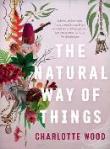
Charlotte Wood, The natural way of thingsWell, I wrote this week’s Monday musings on Australian dystopian fiction as a lead in to my review of Charlotte Wood’s award-winning The natural way of things, but I wasn’t expecting to get the perfect intro for my review! In the post’s comments, author and publisher Anna Blay pointed us to an article by Maria Popova in an online digest called Brain Pickings. The article, titled “The Power of Cautionary Questions: Neil Gaiman on Ray Bradbury’s ‘Fahrenheit 451,’ Why We Read, and How Speculative Storytelling Enlarges Our Humanity”, starts with this:

The important thing,” Ursula K. Le Guin wrote in contemplating the cultural role of speculative fiction and the task of its writer, “is not to offer any specific hope of betterment but, by offering an imagined but persuasive alternative reality, to dislodge my mind, and so the reader’s mind, from the lazy, timorous habit of thinking that the way we live now is the only way people can live.” In doing so, she argued, imaginative storytelling can intercept the inertia of oppressive institutions, perilous social mores, and other stagnations of progress that contract our scope of the possible.

I would agree that the thing is “not to offer any specific hope of betterment” but to jolt the reader into thinking about what is, what might be, if we do nothing. It’s certainly how I’d see most dystopian fiction I’ve read, including Charlotte Wood’s novel, but not being a big reader of speculative fiction I haven’t sat down before and articulated it.

So, what is it that Charlotte Wood wants to jolt our minds about? For those of you – overseas readers at least – who haven’t read or don’t know of it, the plot tells the story of 10 women plucked from their normal lives and transported to a nightmarish place in the middle of nowhere – referencing the mythology of the forbidding Australian outback? – where they are imprisoned behind an electric fence and controlled, labour-camp style, by two boorish men, bruiser Boncer and the preening Teddy. The women pass from disbelief and anger, through resignation, to a sort of acceptance and attempt to make the best of their situation. There are shades of Margaret Atwood’s The handmaid’s tale here and also, perhaps of William Golding’s Lord of the flies, but not derivatively. This is very much its own work.

But now, back to my question. Wood’s target is misogyny, and specifically the way it plays out through the scapegoating of women for their sexuality – whether for assaults that happen to them or for sexual activities they may engage in consensually (think affair with a politician or the flight attendant in a “mile-high” situation) but for which the man is let off while the woman is excoriated. Early in the novel each girl is given a “nickname” which “explains” why they are there such as “army slut”, “cabinet minister’s moll”, “airline girl”, “cruise girl” and “football girl”. You get the picture, I’m sure. The girls are also named. Wood does respect and individualise her characters, beyond just being types. There is one other woman in the picture, and that’s Nancy. She’s on the staff with Boncer and Teddy. She dresses as a rather grotesque nurse who looks after the so-called “hospital” – and represents those enabling women who often feel special but don’t realise that they too are under control.

I came to this book ready to love it. Although I’ve avoided reading reviews, I’ve not been able to help hearing all the accolades, and it sounded like a book and topic that would be right up my alley. It is, and I “enjoyed” reading it, but I’m having trouble defining and articulating my somewhat uncertain response to it. I love the heart, I love the desire to attack an issue that’s absolutely critical, I love the overall narrative concept, I was compelled to keep reading, and I thought the ending was powerful. So, why uncertain? I’ll try to tease it out a bit.

Menace?

There are a lot of characters – the ten captive women, plus Boncer, Teddy and Nancy – though Wood focuses on two young 19-year-olds in particular, Yolanda the “football girl” and Verla “the cabinet minister’s moll”. We get more into their heads. They are analytical about their situations and plan and act in ways to improve their situations. A cautious friendship develops between them. As well as being differentiated in this way from the rest of the group, they are also differentiated from each other by two facts: Yolanda wasn’t tricked like all the others into accepting the agreement that got them to this place, while Verla, who guiltily remembers “gratefully signing the fake legal papers”, believes that her “Andrew”, the cabinet-minister, still loves her. The other women are more problematic. We don’t get to know them well, but what we do see suggests that they have not cottoned on. They focus on finding ways to groom themselves, they reject Yolanda’s feral way of managing the situation, they fall on the fancy handbags at the end and willingly follow the new man who appears. They seem to have learnt little. But, perhaps that’s also the point. They have a right to be the young women they are. See, I’m talking myself into understanding this as I go …

And then there’s the men. They are scary, certainly, and brutal, particularly in the beginning:

So she didn’t see the man’s swift, balletic leap – impossibly pretty and light across the gravel – and a leather covered baton in his hand coming whack over the side of her jaw …

The man Boncer cast an aggrieved look at them, is if they were to blame for the stick in his hand …

But pretty soon we see that they, too, are, in a way, victims of the system. They’ve been fooled it seems into being there, on promises of bonuses, and are ultimately pathetic. I certainly don’t want to excuse them – they’ve made choices. However, as the supporting system seems to fail, they start to rely on the women’s ability to keep the show going. The women realise that these men don’t know what’s happening any more either. There’s an uneasy tension between captors and captives – and with that cracks start to show in the menace, albeit some menace remains.

Natural?

The writing is good. There’s even humour, such as tempeh-loving, yoga-doing but clueless Teddy. The novel is structured by the seasons, starting in Summer, moving through Autumn and ending, appropriately, in Winter. The story is told third person, mostly focusing on Yolanda and Verla. They’re engaging, though they are also pretty slippery to fully grasp. There’s a distance that we never quite penetrate. We “see” Yolanda’s strength and Verla’s self-deception, but we don’t, I think, see “into” them.

Wood uses effective recurrent imagery or motifs, particularly smells, rabbits, horses and birds. The opening line is “So there were kookaburras here”, suggesting some sort of normality. In her interview with Annette Marfording long before this book was written, Wood discusses using kites and kite-flying to suggest “flight and escape”, and then she says “I realise I have a lot of birds”, which I assumed implies that they too suggest “flight and escape”. In The natural way of things, birds also suggest the related idea of “freedom”, but when hawks appear, we see another side, that of predator and prey. All relevant to the book.

Then there’s the irony in the title, “the natural way of things”, because there’s nothing “natural” about what the book describes. The title appears in the text once in a paragraph that occupies its own page. It’s powerful:

What would people in their old lives be saying about these girls? Would they be called missing? Would some documentary program on the ABC that nobody watched , or one of those thin newspapers nobody read, somehow connect the thread to make them a story? The Lost Girls they would be called. Would it be said, they ‘disappeared’, ‘were lost? Would it be said they were abandoned or taken, the way people said a girl was attacked, a woman was raped, this femaleness always at the centre, as if womanhood itself were the cause of all these things? As if the girls somehow, through the natural way of things, did it do themselves. They lured abduction and abandonment to themselves, they marshalled themselves into this prison where they had made their beds, and now, once more, were lying in them.

The “natural” way of things! Referring back to Ursula le Guin, I’d say that Wood has presented here a “persuasive alternative reality”. Indeed, it’s not far removed from Wood’s inspiration: the Hay Institution for Girls to which “problem” teenage girls were sent in the 1960s and 1970s, and treated with great cruelty. But, who or what is the enemy? Looking at Le Guin again, this would be “perilous social mores” (and those who uphold them) – the fact that the scapegoating of women is still “allowed” to happen. There’s (a little) more awareness now, but this behaviour is not stopping, not by a long shot. All of us, I’m sure, recognise the recent inspirations for Wood’s “girls”. Anna Krein’s Night games (my review) makes an interesting companion read.

So, where do we go from here? Dystopian novels don’t have to give answers, indeed they rarely do, they “simply” shine the light. The light Wood has shone is, though, a very complex one indeed. I think I’ll be reading this one again when my reading group does it in July.

Lisa (ANZLitLovers) has also read it and has posted her comments plus links to other reviews.

awwchallenge2016Charlotte Wood
The natural way of things
Crows Nest: Allen & Unwin, 2015
315pp.
ISBN: 9781760111236

Sonya Hartnett, Golden boys (Review)

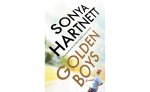
Sonya Hartnett, Golden boysAlthough Sonya Hartnett has written a large number of books, for children, young adults and adults, I’ve never read her, which is something I’ve been wanting to rectify. My opportunity came in May when my reading group scheduled her latest novel, Golden boys, for discussion. It was shortlisted for several awards last year, including the Miles Franklin Award – and has by now, I expect, been reviewed to within an inch of its life, but that’s not going to deter me!

You can tell, with Golden boys, that Hartnett is an experienced writer for young people. The book’s protagonists, the perspectives through whom the story is told, are all pre-teen. The three main voices are 12-year-old Colt, eldest son of the well-to-do Jensons, and almost 13-year-old Freya and 10-year-old Syd, children of the working class Kileys. The set up is that the Jensons have moved into a working class suburb for a reason that starts to become clear as the book progresses.

The novel opens with Colt:

With their father, there’s always a catch: the truth is enough to make Colt take a step back. There’s always some small cruelty, an unpleasant little hoop to be crawled through before what’s good may begin: here is a gift, but first you must guess its colour.

It’s a powerful beginning, and we’re right there. The scene is played out through Colt’s eyes. He’s been through these games before and he doesn’t want to play. He’s starting to realise there’s something darker behind his father’s generosity: “His father spends money not merely on making his sons envied, but on making them – and the word seems to tip the floor – enticing. His father buys bait.”

The second (unnumbered) chapter starts with Freya:

Freya Kiley has started to see things she hasn’t before. Until recently she has lived as every child must: as someone dropped on a strangers’ planet, forced to accept that these are the ways of this world.

But, on the next page we read

Now she’s older and smarter, and she’s starting to see that the world is a castle, and that a child lives in just one room of it. It’s only as you grow up that you realise the castle is vast and has countless false floors and hidden doors and underground tunnels … And as you get older, you’re forced out of the room, whether you want to go or not. Freya wants, with urgency, to go.

This lovely castle motif recurs through the novel. Anyhow, here we have two young people on the cusp of adolescence living in families which are headed (because this is the late 1970s when men still tended to “head” the family) by two problematical fathers – the superficially charming, generous but creepy Rex Jenson, and the detached, sometimes violent Joe Kiley. You have probably guessed what some of the themes are … but they are tied up with the plot, and …

I’m not going to talk about the plot because I have other issues to explore. I’ll just say that it builds slowly, inexorably, as the neighbourhood children gravitate to the well-endowed Jenson home, until we reach the climax . It’s expected – has been cleverly foreshadowed – and yet is surprising in exactly how it plays out. It’s painful, but clever too in resolving little while exposing a lot.

Adult? Young Adult?

Rather, I want to talk about voice and audience. When writers write in the voice of young people, or through the eyes of young people, there’s an immediate assumption, fear even, that the work is for young adults, but this isn’t necessarily so, though it can probably make such books cross more easily between adult and young adult readers. This is where Hartnett’s adult-marketed Golden boys sits. Its subject matter extends beyond a narrow focus on teenage experience, like first romantic relationship, first sexual experience, feelings of alienation or otherness, conflict with parents, and so on, to exploring the experience of awakening awareness to the reality of adult life. Here – this awakening – is the focus of Colt and Freya’s consciousness. How are they going to make sense of the flawed adult world they are now seeing? How are they to move through it? Will they survive their loss of innocence (and we are not talking sexuality here, but that deep shock when your view of the world, your sense of safety, is shaken to the core.) I should reiterate here that there are other youthful perspectives, including that of 10-year-old Syd who provides a neat counterbalance to Colt and Freya. At 10 he still has the self-focus of a child, not yet aware of “adult” life. What he wants for Christmas, whether he can still swim in the Jensens’ pool, and whether being a gangster would be a good career are what occupy his mind!

Hmmm, I’m not sure still that I’ve explained why this is a book that should interest adults – those adults who think, perhaps, “been there, done that”. It’s relatively easy to argue that the book, meaty though it is, would appeal to young adults, but why would a book in which all the perspectives are those of young people appeal to adults? Well, first there’s the subject matter, which addresses pedophilia and domestic violence. Just because we see these events through a young perspective doesn’t mean the exploration is superficial or irrelevant to an adult reader. Indeed, this perspective adds weight, because we see what the children see and the impact on them, how they try to process what they actually see, and how they comprehend the behaviour and responses of the various adults. When traumatic things happen in “real” life, it’s the adults we see and hear – the adults who are interviewed on the radio or television, the adults who write the memoirs or exposés. Hartnett presents the other side, the missing voices of the young – and I found her young people to be psychologically convincing. They are aware, perceptive and curious – but their understanding has limits, such as Freya’s taking the full blame for her parent’s situation because she was the reason they married. Hartnett, though, never sells them short, and neither I think should we.

And then there’s the writing. The imagery fits beautifully. There’s the castle motif for Freya, and a subtle but ominous repetition of the colour “black” from that bike in the opening scene to local bully Garrick’s fringe being described in the last scene as “blown back from his forehead like black grass on a sandy dune”. Descriptions tend to be physical. When Colt is confronted by the boys “the sun becomes an inferno, claws tigerishly at his neck”. On another occasion, one of Freya’s little sisters “skitters off like something twanged from a catapult”. The novel, in other words, is a joy to read – despite the unpleasant subject matter – for the imagery, careful plotting, characterisation, and that ending which manages to surprise despite our basic expectations being met.

Earlier, I quoted Freya as seeing the world or life as a castle. Towards the end, as things become more and more clear, she considers:

If she has spent her life rummaging through a castle of countless rooms, she thinks she must have found the vault at the castle’s core, because inside it there is nothing but her wits.

And that is the lesson, in the end, that both Freya and Colt learn. They will have to make their own decisions, rely on their wits, if they are going to survive this flawed, not always safe, world.

awwchallenge2016Sonya Hartnett
Golden boys
Hamish Hamilton, 2014
238pp.
ISBN: 9781926428611

Chinua Achebe, Things fall apart (Review)

Chinua Achebe, Things fall apart

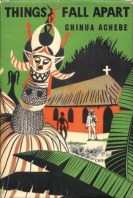
First edition, from Heinemann (via Wikipedia)

At last I’ve read that classic of African literature, China Achebe’s Things fall apart. It all came about because this year ABC RN’s classics book club is doing Africa. As I’ve been wanting to read this book for a long time, and as my reading group has been making a practice of choosing one ABC RN bookclub book a year, I recommended Things fall apart and – woohoo – they agreed. I am so happy! OK, so I’m easily pleased, but …

The funny thing is that as I started it, I did wonder what all the acclaim was about. Yes, I was finding the writing gorgeous, and yes, I found all the detail about life in the little Igbo village of Umuofia fascinating, but were these enough for its huge reputation? Then, I got to Part 2 – this is a classic three-part book – and the arrival of white man and the missionaries in southeastern Nigeria. The plot started to thicken – but, not just the plot. The whole gorgeous structure of the novel, its complexity and its sophisticated analysis of human society and the colonial imperative started to become clear.

Here, though, is my challenge – a challenge faced by all bloggers writing about much-analysed classics – what can I add? I haven’t actually read any of the analysis, except for my edition’s introduction, so I risk either going over the same old ground, or heading off on a completely irrelevant tangent, but I’m going to try. And how I’m going to try is to talk about a few of the aspects of the book that stood out to me, which, as is my wont, will focus more on how it is written than with the story itself.

However, I will start with a brief synopsis of the story, just in case there are others out there who haven’t read it. The plot is fairly simple: it tells the story of Okonkwo. Born to an “ill-fated”, “lazy and improvident” man, he decided early in life that he would not be like his father. He becomes a powerful and respected “warrior” in his community, one known to be hardworking but who could also be cruel to his family or to anyone who showed weakness. He is determined to be a “man”, to never show a “female” side. Male-female dichotomies are, in fact, an underlying thread in the novel. Whenever things go wrong for him, his response is always aggressive: if you aren’t confronting a situation head on, you are a “woman”. This inflexibility, his unwillingness to waver from his tough-minded course, results in his downfall. He could be seen I think as a classic tragic hero, as the man who could have been great but for a tragic flaw, an inability to be flexible, an unwillingness to marry his two sides.

This idea of two parts is fundamental to how the novel is structured and how the themes are developed – and Achebe conveys it through dichotomies and parallels. There’s the male-female one, which Okonkwo battles within himself. “When did you become a shivering old woman” he asks himself regarding the distress he feels after engaging in a violent act. Later, he is surprised to hear of a husband who consulted his wife before doing anything:

 ‘I thought he was a strong man in his youth.’ ‘He was indeed,’ said Ofoedu. Okonkwo shook his head doubtfully.

But there are other dichotomies, and two, in particular, that I found interesting. One is between  Okonkwo and his friend Obierika. Both are respected men in the village, and both adhere to their traditions and conventions, but Okonkwo, who is “not a man of thought but of action” is so fearful of appearing weak he follows the “laws” rigidly. Obierika on the other hand is more thoughtful:

Obierika was a man who thought about things. When the will of the goddess had been done, he sat down in his obi and mourned his friend’s calamity. Why should a man suffer so grievously for an offence he had committed inadvertently? But although he thought for a long time he found no answer. He was merely led into greater complexities. He remembered his wife’s twin children, whom he had thrown away. What crime had they committed?

A similar dichotomy is set up between two missionaries:

Mr Brown’s successor was the Reverend James Smith, and he was a different kind of man. He condemned openly Mr Brown’s policy of compromise and accommodation. He saw things as black and white. And black was evil. He saw the world as a battlefield in which the children of light were locked in mortal conflict with the sons of darkness.

So, we have dichotomies established within the two cultures he’s describing – the African and colonial/missionary – but these two sets of dichotomies also work as parallels for each other, reflecting the differences, the conflicts in fact, that can occur within both (all) cultures.

Now I get to more uncomfortable ideas. Okonkwo’s tragedy could be seen to mirror Africa’s, but this is a tricky thing to consider. Okonkwo’s flaw we know. Did Africa, likewise, have a flaw or weakness? We criticise colonialism – and surely it is a bad thing, the subjugation of one people by another, the taking of one people’s land by another – and yet … Achebe himself benefited from the education brought by the missionaries, and in Things fall apart he tells us that some Igbo villagers saw positives:

The white man had indeed brought a lunatic religion, but he had also built a trading store and for the first time palm-oil and kernel became things of great price, and much money flowed into Umuofia.

Some even saw positives in the religion.

So, Achebe is not uncritical of either side of the colonial equation – the colonisers and the colonised – but his final point in the novel makes clear his attitude to the colonial project. In the last paragraph we learn that District Commissioner plans to write a book. Its title, “The Pacification of the Primitive Tribes of the Lower Niger”, euphemistically describes the colonisers’ mostly violent/aggressive subjugation of African people as “pacification” and demonstrates an arrogant assumption that a society not like their own is “primitive”. For Achebe, then, the overriding point of Things fall apart is not so much to present the positives and negatives within the two opposing cultures, but to expose the disdain with which the colonisers treated African people, and the way they denigrated African culture.

This is such an honest and provocative book, one that would bear multiple re-readings – like all good classics. Have you read it?

Chinua Achebe
Things fall apart
London: Penguin Classics, 2001 (orig. pub. 1958)
ISBN (e-book): 9780141393964

Elizabeth Harrower, In certain circles (Review)

Elizabeth Harrower, In certain circlesThere’s an interesting story behind Elizabeth Harrower’s last novel, In certain circles. It was all set for publication in 1971, following her very successful The watch tower (my review), when Harrower pulled it. Why? I wondered about this as I read it, and I have some ideas, but more on that anon. First, the story.

In certain circles chronicles the lives from youth until their forties of five people – well-to-do brother and sister Russell and Zoe Howard, orphans from an impoverished background Stephen and Anna Quayle, and Lily the teenage sweetheart and then wife of Russell. Part way through the novel, Stephen and Zoe also marry, as does Anna outside the circle. The story starts and ends with Zoe, but the perspective shifts a little along the way between the various characters. It’s a story of idealism and wasted opportunities, of the decisions we make (or don’t make) and their unintended consequences. It’s also about the way the past can drive those decisions. The setting is Sydney, not long after World War 2, though it’s never made explicit. Harrower is not interested in time and place, just people – who they are, why they do what they do, and how it impacts their deepest selves.

Commentators discussing Harrower invariably tell us that Australian literary luminaries Patrick White and Christina Stead praised her writing. You can see why – she writes with their intensity, probing deeply into the psyches of her characters to explore motive, feeling and behaviour. I’d also liken her to the recently deceased Anita Brookner, who, coincidentally, was born the same year as Harrower, 1928, and who also intensely explored the psyches of her characters.

The thing about Harrower’s writing here, though, is that while character is her focus, a strong sense of form underpins her style. The novel is, for example, presented in three clearly delineated parts, which facilitates time-jumps without the need for extensive explanation and gives it the narrative arc of a classic three-act drama.

So, Part 1 is set just after the war. Zoe is a bright, “fearless”, world-at-her-feet young seventeen-year-old, who often doesn’t mean what she says and is not known for her “social conscience”. She is, clearly, ready for a fall. A perfect Act 1 set up in other words. Big brother Russell, on the other hand, has been touched by experience, including being a prisoner-of-war, and has a more realistic perspective of the world. He sees disadvantage and he wants to right it. The opening scene is a tennis party at the Howards, to which Russell has invited the orphans and at which his fiancée Lily is also present. Our five characters are thus properly introduced to us and each other.

Part 2 starts eight years later, when Zoe is 25 years old and has just returned, upon her mother’s death, from a blossoming career in film and photography in Europe. The course of her life changes at this point, and she marries Stephen who is now in business with her brother Russell. She finds herself deeply in love with this man who, when she was 17, had both attracted and repelled her with his judgement of and opposition to her. In this part, the characters have settled into some sort of stable routine, but we readers see the cracks even if the characters themselves don’t. Take Zoe, our main character, for example:

Excessively, even for someone in love, Zoe had found a chameleon-like capacity for fitting herself to Stephen’s moods.

Hmm, we think … and this too:

From riding the crest of a wave, from taming tigers, she had turned into this new thing–a suppliant, but a suppliant with a purpose: all to be well with Stephen.

The conversations between them are chilling – because Zoe submits and submits her self to his views and ideas.

Meanwhile, Lily, for whom family is all (“it was not only a sort of pity Lily felt for anyone unrelated to her, but an involuntary antagonism”) and who has given up her career for her children, is becoming frustrated with Russell’s focus on a wider humanity. And Anna, now widowed, realises where her love truly lies – Russell.

Then comes Part 3, as it inevitably must. Zoe is nearly 40, and not happy. (We could have told her!) After 15 years of self-denial and subsuming her self to Stephen, she is a changed woman, to her detriment, and she knows it. That fall we assumed at the beginning has finally come – and not just for Zoe. The denouement is dramatic, rapid and effective in shaking up the characters’ complacencies and self-destructive compromises, just as you’d rightly expect in a narrative of this sort.

Besides this three-part structure, Harrower also employs form in her character handling. The novel starts with two sets of siblings and one outsider, Lily, but by the middle of part 2, they have re-formed into two couples and a different outsider, Anna. This rearranging of pairs-and-outsider creates parallels and counterpoints that keep the story tight and focused, exposing tensions and differences.

“wasted years”

But form, of course, is used for a purpose, which is to explore themes important to Harrower. In certain circles is not as claustrophobic or as chilling as The watch tower, but they have similar concerns, such as loneliness and a feeling of entrapment. These play out differently in In certain circles, where the focus is on wasted talents, through lack of opportunities, and wasted lives, through difficult pasts or poor decisions, but the result is the same – loneliness, desolation, and entrapment, conscious or otherwise.

Early in the novel, when she’s still 17, Zoe escapes a room of older people, “away from miserable white faces and wasted years”. Ironically, this is exactly how Zoe finds herself twenty odd years later, because Stephen has, “without the least desire to deflate or wound”, dissolved the last of her “ideas and ambitions”, leaving her trapped, demoralised, “detesting the person she had become”.

Zoe is not the only one. The other characters too find themselves having wasted at least some aspect of their lives, some because they can’t let go of (or are damaged by) the past, others because they honour decisions and commitments they’ve made.

There are many roads by which these characters come to the wasteland in their lives, and Harrower presents them with an acuity that is also generous. She doesn’t judge. Even when, at the beginning, Zoe is arrogant and self-involved, Harrower encourages us to like her because she’s lively and good-hearted rather than malicious. Stephen would be even easier for us to dislike, but his pain, his genuine love for his sister, and his obliviousness to “the damage he had done”, enable us to understand rather than hate him.

And now, here I am, way past when I should have finished this post, but having barely touched on the writing – and I should discuss it, because it is delicious. Harrower nails feelings, attitudes and motives with a pithiness that takes your breath away. Watch out for a Delicious Descriptions post!

So, returning to my opening para, why might Harrower have pulled her novel? I understand that she submitted it, pulled it and re-worked it, then submitted it again, and pulled it permanently. I can see why she may have done this: the drama that precipitates the resolution is a little far-fetched though she explains it well enough to make it work; Russell is comparatively shadowy even among the less developed characters; and occasionally the perspective feels a little clumsy or laboured, as if she hasn’t fully resolved how to bring all her personages into the frame as she desires. But, are these serious enough for the book not to have been published? I don’t think so. Neither did Text, and neither, we have to presume, did that original publisher. It is literature’s gain that this book has finally seen the light of day.

Lisa at ANZLitLovers also enjoyed the book.

awwchallenge2016Elizabeth Harrower
In certain circles
Melbourne: Text Publishing, 2014
250pp.
ISBN: 9781922182968

Helen Macdonald, H is for hawk (Review)

Helen Macdonald, H is for hawkMy reading really has been rather odd lately. I’ve read a memoir about horse-racing (Gerald Murnane’s Something for the pain), a novel about hedge-funds and investment banking (Kate Jenning’s Moral hazard), and now a grief memoir focused on falconry (Helen Macdonald’s H is for hawk). None of these are topics I would naturally pick up, but in each case I’ve enjoyed being presented these very different worlds. H is for hawk, this post’s subject, is additionally interesting because it combines three different forms of writing – memoir, biography and nature writing.

T. H. White lecturing on his Arthurian fiction (Courtesy John J. Burns Library, Boston College, via Wikipedia CC BY 2.0).

TH White (Courtesy John J. Burns Library, Boston College, via Wikipedia CC BY 2.0).

As I don’t read reviews before I read books, I really didn’t know what I was getting in for, except that I understood it was about a woman managing her grief through raising a hawk. It is about this, but it is about so much more too, including being a sort of mini-biography of novelist TH White. You probably know White through his most famous works, The once and future king and The sword in the stone, but you may not know that he also wrote a book called Goshawk about the training of his goshawk called Gos. Imaginative name that! Macdonald was far more creative. She named hers Mabel! (She does explain this surprising tame-sounding name).

Many people have written about falconry over the years so why does Macdonald light on TH White? Well, it’s complicated. She had read Goshawk when she was a young girl, and hadn’t much liked it. However, she read it again and

saw more in it than bad falconry … White made it a metaphysical battle. Like Moby-Dick or The old man and the sea, The goshawk was a literary encounter between animal and man that reached back to Puritan traditions of spiritual contest …

White, you see, wrote it after he’d left his teaching post in 1936 to live in a workman’s cottage. He was fleeing a world in which he, a homosexual, didn’t fit, a world in which he had to live “in perpetual disguise”. Macdonald suddenly recognises a fellow-feeling, writing that

I felt, for the first time, that my urge to train a hawk was for reasons that weren’t entirely my own. Partly they were his.

Because MacDonald was training her hawk to escape her grief following the sudden death of her beloved father. She was, she writes, “running” like White. Both, we gradually learn, experience a sort of madness that they need to resolve and recover from.

And so the book progresses in fits and starts, but chronologically so, as Macdonald parallels the awful and sad story of White and Gos with hers and Mabel’s. It makes fascinating reading.

Now, this book has been out for well over a year. It won the Samuel Johnson Prize for Non-fiction (which our very own Anna Funder won for Stasiland) among other awards and shortlistings. It’s been comprehensively reviewed, I believe, so I fear reiterating what others have said before. Consequently, I’m just going to give a broad brush overview of my response to it (and follow up with a Delicious Descriptions post of some of its truly gorgeous nature writing).

To start with, I enjoyed it immensely. It fits into what we call literary or creative non-fiction. That is, it uses some novelistic techniques such as dialogue, poetic imagery and a narrative arc, but it is very definitely non-fiction. It contains a lot of fact about her life, and much research about falconry and TH White. And there are several pages of end-notes identifying sources of quotes, though these notes are not flagged in the text.

I was fascinated by her stories of falconry – her own and from the past – and I am always interested in the lives of writers. Macdonald is an historian by profession, and weaves history through the telling of her own experiences. Although as a child she had agreed with the general censure of White’s training of Gos, as an adult she is more sympathetic, empathising with White’s loneliness and understanding his lack of knowledge and experience. I must say that while I was intellectually interested in the falconry, I would be among those of her friends who find the idea “morally suspect”. It seems a cruel activity to me – and, in fact, cruelty is one of the many threads running through the book. White, who had been physically and emotionally abused as a child, was, apparently, a “sadomasochist”, though Macdonald argues that he consciously worked to keep that part of himself at bay.

This brings me to another aspect of the book I enjoyed – the way she weaves multiple ideas or themes through it. Freedom is one. Macdonald seeks it through her hawk:

The hawk was everything I wanted to be: solitary, self-possessed, free from grief, and numb to the hurts of human life.

Hawks seek it too, sometimes. Macdonald describes “bating”, in which a bird tries to fly from a fist or perch while still attached, as a “wild bid for freedom”. And White definitely seeks freedom. Macdonald frequently refers to his desire for it. She quotes his own writing:

A longing came to my mind, then, that I should be able to do this also. The word ‘feral’ had a kind of magical potency which allied itself with two other words, ‘ferocious’ and ‘free’ … To revert to a feral state I took a farm-labourer’s cottage …

Feral. This word conjures another theme, that of wildness. Both White and Macdonald revert to wildness in their own way – by training wild birds, and by withdrawing from society. Macdonald describes how she becomes, essentially, one with her hawk. She starts to think and see like a hawk, and is taken, she writes, “to the very edge of being human”. Eventually though, sense returns. She comes to understand that falconry is “a balancing act between wild and tame” – and not just for the hawk! She rejects American naturalist John Muir’s “earth hath no sorrows that earth cannot heal”, arguing instead that “the wild is not a panacea for the human soul.” All this makes me think that there’s a fourth form of writing that this book could fit into – the quest story – because it is, fundamentally, a quest for sanity and peace, for both Macdonald and White.

There are other ideas and themes, but I fear that my broad brush is starting to become a fine pen. I will write a little about nature and the environment in my Delicious Descriptions post, so will end my main analysis here.

I read this with my reading group. Some found Macdonald a little too self-obsessed for their liking. Why did the death of her father create such a schism in her soul? Why was she not able to see that her mother’s need, as the bereaved spouse, was surely greater? I wondered a little about this too, though it didn’t affect my appreciation of the book. The answer is, I suppose, that we are all different. For whatever reason – timing, perhaps, the quality of the father-daughter relationship, definitely – Macdonald’s father’s death knocked her for a six. Having accepted that as a given, I found H is for hawk a thoughtful, complex book that engaged me from the start.

This is a long post, I know, but I want to share one more thing. It occurs two-thirds of the way through the book, and, to me at least, shares one of life’s important lessons:

There is a time in life when you expect the world to be always full of new things. And then comes a day when you realise that is not how it will be at all. You see that life will become a thing made of holes. Absences. Losses. Things that were there and are no longer. And you realise, too, that you have to grow around and between the gaps, though you can put your hand out to where things were and feel that tense, shining dullness of the space where the memories are.

Helen Macdonald
H is for hawk
London: Vintage Books, 2014
300 pp.
ISBN: 9780099575450

Steve Toltz, Quicksand (Review)

Steve Toltz, Quicksand, soverAldo Benjamin, the anti-hero of Quicksand, accuses wannabe-writer-friend Liam of having “such little imagination”. You could not, however, accuse the novel’s author, Steve Toltz, of this. Quicksand reads a bit like a 19th century satirical novel transplanted into the 21st century. It is big in size (though not as big as his first, A fraction of the whole), broad in subject matter, and full of colourful characters. It’s wild, imaginative, and darkly funny. It’s the sort of novel that you can tackle from different angles depending on what interests you most. Religion, god and fate? Tick. Life and death? Tick. Love and friendship? Tick. Social commentary? Tick. Art (broadly), artists and the making of art? Tick.

“Bad luck is my pathology” (Aldo)

Before I tell you what interested me, though, a little about the plot. Quicksand is the story of Aldo Benjamin, told partly by his friend, Liam Wilder, and partly by himself. Meeting at high school, Aldo and Liam remain friends until the book closes when they are in their early to mid 40s. Together they reveal the ups and downs – mostly downs – of Aldo’s life as he tries to make his way against what he sees as the tide of fate or bad luck. The novel opens when they are in their early 40s and Aldo, a wheelchair-bound paraplegic, has just been released from prison. We don’t know how long he’s been in the wheelchair or how that came to be, and we don’t know why he’d been in prison. These come out in the course of the novel, which flashes back in chapter 2 to their schooldays and then moves between the past and present to tell the story. We also discover in the opening chapter that Liam is trying to restart his writing career by writing Aldo’s story, much to Aldo’s resigned disgust: “I’m nobody’s muse”, he says. Ironically, though, not only is he Liam’s muse but he’d also been one for his musician wife, Stella, and photographer lover, Mimi.

Aldo, “The King of Unforced Errors” as Liam calls him or a sufferer of “clinical frustration” as Aldo sees it, gets into all sorts of strife. He is regularly bailed out by friends (who cover “the full suite of professional services” such as policeman Liam, Doc Castles, his old school teacher Mr Morrell) and lovers. Nothing much works for him, particularly not his various get-rich-quick business ideas, like the device that was supposed to detect the presence of peanuts in food, or clothing for obese toddlers, or tanning salon taxis, or maternity clothes for goths (“a demographic with an 85% abortion rate”). Moreover, his marriage fails, his child dies, his multiple suicide attempts are unsuccessful, and, to rub salt into his wounds, he ends up in the two places he most fears, prison and hospital. As Liam says in response to Aldo’s question about why write his story:

Because you’ll inspire people. To count their blessings.

I love this sort of writing, this dark humour. It’s full-on to read because lines like this frequently fall over each other, sentence after sentence, leaving you wanting to stop and smell the roses for a minute. Still, I was hooked by page 5 when Aldo presents to Liam a long list of our 21st century insecurities, pretensions and self-deceptions, including

‘You know how people are worried their kid’s going to turn to them and say, What did you do to the biosphere, Daddy?

AND

‘And you know how there’s no replacement cycle too short for today’s consumer?’

AND

‘You know how while we’re enjoying reading dystopian fiction, for half our population this society is dystopia?’

These go on for three pages. Wonderful satire. No matter how superior we might feel about most of the pronouncements, there’s bound to be one or two that get us where it hurts! Toltz looks unblinkingly at our lives and shines them right back at us in the most direct, no-punches-pulled way. It made me laugh – but ruefully, if not guiltily at times – almost every page.

“To troubleshoot the human spirit” (Liam)

The other aspect I enjoyed was the thread about art, artists and art-making. The major focus of this is Liam’s novel about Aldo’s life. After years of failure and giving up, Liam finally decides that Aldo is his “natural subject”. Writing about him, Liam tells Aldo, would be “to troubleshoot the human spirit”. It would, he thinks, throw him “into a head-on collision with the meaning of fate, humanity’s sure, but Aldo’s strange specific one too”. Aldo and Liam discuss Liam’s progress frequently, with Aldo always ready with an astute comment or criticism. “Does my character in your book”, Aldo asks, “need to be more consistent than my character in real life?” “No,” says Liam, though in fact many readers do, I find, prefer it to be so!

Liam is not the only creator in the novel. Aldo’s musician wife Stella plunders Aldo’s life for her songs, and then there’s the art teacher from Liam and Aldo’s school, and the artists in the artists’ residence where Aldo lives for a time. Through all these the novel interrogates why we make art, what art is about. Early on, before he starts his Aldo novel and after years of failure, Liam decides to give up writing. He says

I had settled into a life I had always feared but secretly desired, a life uninterrupted and unencumbered by art.

Chapter 2, though, begins with art teacher Morrell’s statement that:

We make art because being alive is a hostage situation in which our abductors are silent and we cannot even intuit their demands.

Art is not, however, presented as something that is easy or even always right. Toltz’s artists struggle to achieve, are frequently self-obsessed, and unapologetically mine their friends and family for material, all the while, thinks Aldo at least, having a good time. “Their brains are all pleasure centres and no circumference”, he tells the court. They are not, in other words, unilaterally lauded, but this is, of course, ironic, if not subversive, since what we are reading is a novel, a work of art itself. The wheels within wheels in this novel – the ironies, the paradoxes, the self-reflexivity – sometimes make your head spin, but in the end, there is an end, and it’s a surprisingly positive one.

And here, I’ll end! This novel is so full of funny lines, so full of ideas, so full of biting commentary, that it’s hard to know when to stop so, as EM Forster* wishes novelists could do, I think I’ll just end, not because I’m bored which is the reason he gives, but because I might as well.

Lisa at ANZLitLovers also enjoyed it.

Steve Toltz
Quicksand
Hamish Hamilton, 2015
435pp.
ISBN: 9781926428680

* Aspects of the novel, by EM Forster

Neel Mukherjee, The lives of others (Review)

MukherjeeLivesOthersChattoBefore I talk about Neel Mukherjee’s Booker Prize short-listed The lives of others, I want to briefly mention the experience of reading it on the Kindle. I probably haven’t told you my little reading rule of thumb before, which is that I aim to buy Australian books in print, and overseas books electronically. It’s my measured foray into downsizing!

However, I don’t greatly enjoy reading on my Kindle. I like the Kindle itself. It handles pretty much like a book, the e-ink technology is easy on the eye, it’s light and portable, and with this particular author whose vocabulary is impressive, I did find the in-built dictionary to be very useful. But, I don’t find reading books in e-formats particularly pleasurable. It’s not easy to get the measure of a book, to flick through it and see what’s what. Consequently, I didn’t discover the family tree until I’d read the first couple of chapters. Now, if you’ve read this book, you will know that the three generations of the Ghosh family who live in a four-storey house are introduced in one chapter. Their names are unfamiliar to a westerner’s ears making it hard to remember who’s who, so that family tree was a godsend. But, I only found it when a a reading group friend mentioned its existence. The diagram’s small print was, though, very hard to read, and could not be enlarged like e-text can, so I hand-drew a family tree, photographed it, and shared it with my group. Then there were the many specifically Indian words that were not in the dictionary. They were in the glossary at the back, but it’s tedious flipping between glossary and text in an e-book environment, so I didn’t. How hard would it have been to hyper-link those words to the glossary?

“the very quicksands of family” (Suranjan)

Rant over, let’s talk about the book! The lives of others is set in West Bengal from 1966 to 1970, with two epilogues set much later, one in 1986 and the other in 2012. It centres on the aforementioned Ghoshes, a well-to-do family whose wealth comes from paper mills. By the time the novel opens, business is starting to fail, so there is tension in the air, exacerbating the rivalries, envies and secrecies which characterise the family’s relationships. That’s the personal, but this book is also political, because one of the characters, a grandson of the old couple, becomes a revolutionary with the Naxalites, a section of the Communist Party of India (Marxist) (or, CPI-M). In 1967, they commenced radical action to redistribute land to landless farmers and labourers. The book’s chronology mirrors the early years of this movement.

Indeed, the book is chronologically structured, with each chapter labelled by date. The first thirteen of its nineteen chapters comprise two sections – a third person story about the family in the Calcutta house, and a first person epistolary story (presented in a different font – unless your e-book was on an iPad, but that’s another story) by Supratik, the revolutionary grandson who is in the countryside “where the real politics lay”. This first person story finishes in chapter 14, when Supratik returns to Calcutta. The effect of this structure is to parallel manipulative behaviour and power plays in the family with the societal/political power imbalances against which Supratik fights. Just before he leaves the family, Supratik says to his mother, Sandhya:

Are you happy with the inequalities of our family? Of the power-on-top-ruling-people-below kind of hierarchy? Do you think it’s right? Has the thought ever crossed your mind that the family is the primary unit of exploitation?

This structure is just one example of how carefully the book is crafted. There are also allusions – and I’m sure there are many that I didn’t get – to literary classics. Chapter 4’s opening line that “not all family bonds are equal” must surely allude to the opening of Anna Karenina, which is also both about family and land/farm reform. And there’s a scene reminiscent of Sense and sensibility. In it the Ghosh patriarch, Prafullanath, is done out of the inheritance his father wanted him to have by a half-brother, who is spurred on by his wife. This reminded me of Fanny Dashwood talking husband John out of properly helping his stepmother and half-sisters, despite his dying father asking him to do. One of the themes of Sense and sensibility is economic power and inequality, and how families can wield power.

“this unvarying calculus about the worth of one’s own kind measured against the lives of others ” (Supratik)

Mukherjee, however, takes these themes to another level. The lives of others is a powerful and often brutal book. The prologue, which tells of a murder-suicide enacted by a poor sharecropper after consistently receiving no help from his landlord for his starving family, establishes the two main themes – economic inequity, and the inhumane treatment of “others”. These themes are played out in the way various members of the family treat each other, their workers and those with whom they come into contact, and are paralleled in the farm politics which engage Supratik’s passion. While the themes can be simply stated, the story-telling is sophisticated. Complex links and parallels, together with concrete and abstract motifs, evocative images and targeted allusions underpin the novel’s layers to expose human capacity for cruelty, self-preservation and self-deception. In a devastating conclusion, Mukherjee shows what happens when idealism loses sight of the humanity it is trying to protect, when calculation over-rides empathy. He offers no answers, makes no judgements, but simply shows.

The result is tough, and sometimes very uncomfortable, reading, but what drove me on was Mukherjee’s language. It is truly delicious. The imagery is accessible, often referencing the very ordinary, but it is so fresh that it takes its mark perfectly, again and again:

… if you fail an exam, it decreases the chances of getting out of the system that will slowly crush you to a flat piece of cardboard

AND

Two things with the power to scrunch Prafullanath’s plans into a shapeless paper bag had not occurred to his myopic mind.

AND

His voice has the serrations of a knife in it.

Cardboard, paperbags and knives. All so mundane but, in Mukherjee’s hands, so on the money. Here’s one more, describing one of the daughters-in-law:

Haranguing the servants at last gave Purnima a point of convergence for all her diffuse days and energies to focus on, and she took to it like a spindly, undernourished sapling to rich loam.

Mukherjee’s ability to capture people and place with such vividness and clarity is impressive. It’s not a perfect book, being weighed down at times by detail that, interesting though it is, doesn’t always seem essential.

However, Mukherjee’s compassionate but unsentimental understanding of human nature, combined with his clear-eyed analysis of how the personal interacts with the political, reveal uncomfortable truths about our dealings with other, and make him, unlike Supratik, a more trustworthy “defence counsel for humanity”.

Neel Mukherjee
The lives of others
London: Chatto & Windus, 2014
ISBN (e-pub): 9781448192182

Emily Bitto, The strays (Review)

Emily BItto, The strays, book coverLet me start by saying I really enjoyed reading Emily Bitto’s The strays. It was scheduled for my reading group the day after my return from Tasmania, and I suddenly found myself in the last day of my Tasmanian holiday without having started the book. Wah! I read it in two days, helped by several hours in a couple of airports. I haven’t done that for a long time, and what a joy it was to have a real length of time to commit to a book. It helped, of course, that having both a strong plot and an intriguing set of characters, The strays is compelling to read. It reminded me, albeit loosely, of Evelyn Waugh’s Brideshead revisited and Ian McEwan’s Atonement.

This is a debut novel, which also won this year’s Stella Prize. Set primarily in the 1930s, with the last of four parts set in the 1960s, The strays is both historical fiction and a coming-of-age novel. It is also a classic outsider story. Lily, who tells the story first person, is befriended when she is 8 years old by schoolmate Eva, the middle daughter of the Trenthams who, early in the novel invite a number of artist “strays” to form a utopian-bohemian artistic community. The Trenthams are inspired by the Reeds and their Heide group, but The strays is not a Heide story*.  This may be the strength of the novel, but also perhaps its weakness – a strength because it frees Bitto to tell her own story, but a weakness because it removes potential ideas on which to hang her story.

Before I get to that, though, a little more about the story. The first three parts follow the Trenthams for 8 years, from when Lily is 8 to 16. During this time Lily becomes increasingly involved with the Trenthams, in preference to her boring, conservative, middle-class parents, eventually living with them full-time. Some members in my reading group found her parents’ relinquishing of their daughter unbelievable, but this was during the Depression, and Lily’s parents did have some problems of their own to manage. I could suspend my disbelief. From Lily’s point of view, she was in thrall to the excitement of the Bohemian life, telling her parents, “I love you both but I want to be different”.

Her parents, however, should have been concerned, because the Trenthams are rather casual, neglectful parents and the four girls more or less run their own lives, sometimes being fed properly, sometimes not, sometimes, in the case of one in particular, going to school, and sometimes not. The story is as much about them, as about the artists, though we do hear about the artists too. There’s exploration of experimental art and its acceptance or otherwise by society, obscenity charges, mentee supplanting mentor, and so on. There are parties, and other occasions, where artists and children come together. Bitto, through Lily, paints all this beautifully. Indeed, I loved her ability to evoke scenes, people and places with effective, yet tight imagery.

Bitto’s use of Lily as her narrator works nicely. Through most of the novel, we see the story through her child’s point-of-view, but occasionally, with a “later I realised” type of comment, we are reminded that this is an adult telling the story of her childhood:

When was it that I became a voyeur in their midst? I was the perfect witness, an unsuspected anthropologist disguised within the body of a young girl, surrounded by other young girls who were part of the family. Yet I was cuckoo in the nest, an imposter who listened and observed, hoarding and collecting information.

This narrative style keeps the story grounded. We see the dysfunctional dynamics and its effects before Lily, wooed by the excitement, does – though she does have moments of clarity. When the youngest daughter goes missing on one occasion, she writes:

I drew in my breath. These adults were no use in a crisis.

The subtext is that her parents would be.

But, here’s the thing. The book tackles a lot of ideas. There’s the exploration of society’s reaction to experimental art; the idea of coming to terms with the past (for Lily); the utopian artist community and whether it can really work; indulgent or neglectful parenting, creating a dysfunctional family life that comes back to bite; the exploration of girlhood friendships and the whole coming-of-age thread; not to mention those big issues like loyalty and betrayal, envy, sexuality and sensuality. It’s not that these were uninteresting, or even that they weren’t well developed. It’s more that I struggled to find Bitto’s main focus, and I guess I like some sort of central idea on which to hang my understanding of a book.

My reading technique is that when I finish a book I go back and reread the beginning. This usually puts the whole into context, pinpointing what the author was about. However, this technique didn’t work wonderfully with The strays. Bitto’s Prologue starts by discussing the mystery of instant attraction between people, and then moves on to the idea of past life connections and that people’s souls can be twinned from one life to the next. These ideas are used to explain Lily’s relationship with Eva, but I’m not sure that this is fundamental to the book’s meaning. The prologue then discusses the past. Three decades after the main events, Lily receives a letter:

and I become aware of an old compulsive pain I have pressed like a bruise again and again throughout the years.

AND

I feel a tenderness in my chest, and the past rushes in as a deluge I can no longer hold back …

AND

I let my mind turn back once more, to recreate again that distant, still wracked past.

Is it this, the idea of coming to terms with or resolving the past, that binds the book together? It is partly. By the end of the novel, Lily has come uneasily to terms with what happened those three decades ago, and its impact on her life. I say uneasily because – and here we come to the epigraph, by William Pater, which expresses a different idea again to those in the prologue: “To burn always with this hard, gem-like flame, to maintain this ecstasy, is success in life”. Lily’s uneasiness is that she has chosen “conventionality”, but recognises that part of her “is still drawn to the romance of the fully lived life”. Then we have the book’s concluding paragraphs, which are more concerned with mothering and family in Lily’s recognition that it was the Trentham children who paid the debt for their parents’ experiments. See my problem regarding central idea? Or, is it just that I’m being boringly 20th century?!

Whatever it is, they are just niggles. As a read, The strays is up there as one of my most enjoyable for the year – for its lucid writing, for the story and a setting that had such appeal, and, yes, even for that whole raft of ideas that she throws so determinedly at us. Even for that.

Lisa at ANZLitLovers enjoyed the book too.

* Interestingly, a couple of “real” people are mentioned, one being politician and later judge, Herbert Evatt – as a supporter of modern, experimental art.

awwchallenge2015Emily Bitto
The strays
South Melbourne: Affirm Press, 2014
290pp.
ISBN: 9781922213211

Hanif Kureishi, The buddha of suburbia (Review)

Hanif Kureishi, The buddha of suburbiaThe first thing to say about Hanif Kureishi’s 1990 Whitbread award-winning novel The buddha of suburbia is that it’s pretty funny. It’s a comic satire – over-the-top at times, confronting at others. It has its dark moments, but it’s also brash, irreverent and ultimately warm-hearted towards its tangled band of not always admirable but mostly very human characters. I’ve come late to this book, and only read it now because my reading group decided to align one of our books with ABC RN’s bookclub, which this year is featuring novels from the subcontinent. Kureishi’s book was one of the few we hadn’t read, so it got the guernsey.

It’s a coming-of-age novel about Karim, who is seventeen years old at the start and the son of a Pakistani/Muslim father from Bombay and an English mother. He lives in the suburbs south of London, a place populated, in his eyes, by “the miserable undead”. He wants to live “intensely: mysticism, alcohol, sexual promise, clever people and drugs”. The dreams of a young man which, of course, run counter to everything his parents would wish for – except that his parents aren’t watching. His father leaves his mother early in the novel to pursue his own mid-life crisis enlightenment as a “buddha” dispensing wisdom to other suburbanites, while his mother sinks into her misery and her bed. And so the scene is set …

This is a rather raunchy, bawdy read in which characters push the sexual envelope with little concern for consequences. They engage in all sorts of sex for all sorts of reasons that represent a broad spectrum of human experience and behaviour, some loving, some brutal, some exploratory, some exploitative. The novel is set in early to mid 1970s England, before AIDS, at the dawn of punk, and just before Thatcher’s England (1979 to 1990). This could date it, but I don’t think it does, because its concerns remain relevant today: racism, multiculturalism, the stereotyping of “other”, materialism versus the search for meaning, the role of the arts in our lives, and of course, given the title, the urban-suburban divide.

So, what happens? Both a lot, and not much, in that this is a character and ideas-driven novel rather than a plot-driven one. Told first person by Karim, the novel has two parts – “In the suburbs” followed by “In the city”. In the first part Karim talks of his life in the suburbs, of his friends and family, and describes the breakdown of his parents’ marriage as his father moves in with the lively go-get-’em Eva. It’s a life characterised by racism:

The thing was, we were supposed to be English, but to the English we were always wogs and nigs and Pakis and the rest of it.

Aspirations are low, and education is not seen as being useful:

This was the English passion, not for self-improvement or culture or wit, but for DIY, Do It Yourself, for bigger and better houses with more mod cons, the painstaking accumulation of comfort and, with it, status – the concrete display of earned cash.

The city, on the other hand, is a place where you can remake yourself. It seemed, to Karim, like “a house with five thousand rooms, all different”, far from the stultifying dullness of the ‘burbs. But the dichotomy is not as simple as it sounds. Having moved to the city, like his father and Eva, Karim continues to return to the suburbs to see friends and family. He experiences warmth and support there, while the city, where “the piss-heads, bums, derelicts and dealers shouted and looked for fights” can intimidate him.

Nonetheless, once in the city, Karim does start to remake himself – as an actor. But, as elsewhere in the novel, there’s a sting in the tail. The first role Karim is offered is Mowgli in The jungle book. He does well, and his white family and friends praise him, but his honest, feisty childhood friend Jamila sees it differently:

‘And it was disgusting, the accent and the shit you had smeared over you. You were just pandering to prejudices …’.

Karim, who has, earlier and somewhat defensively, described himself as “beige”, moves on to another theatre group where he is chosen because he is “black”:

‘We need someone from your own background,’ he said. ‘Someone black.’
‘Yeah?’ I didn’t know anyone black, though I’d been at school with a Nigerian.

I think you’ve got the drift now. The humour is sharp, with stereotypes being subverted, twisted or just plain skewered. The book is full of witty asides, clever but insightful quips, and some downright absurd situations. There’s tenderness too. I loved the “heart-ambulance”, in the form of a sister and brother-in-law arriving to take Karim’s mother home with them when her heart is broken.

There’s a fascinating subplot involving Jamila and the marriage arranged for her by her father, Anwar. She accedes, but when her husband, the physically disabled hapless but kind-hearted Changez arrives, she lays down the rules for their so-called marriage, and then sets about reinventing herself – in the suburbs – as a strong, independent, liberated woman.

I said at the beginning that this is a coming-of-age novel, but it’s more than that. It’s about transformation and shape-shifting for people of all ages. The only character among the central group, who is unable to accept the challenge of change, is Jamila’s father Anwar, and his ending is not a positive one. By contrast, his friend, Karim’s father, seeks enlightenment. He wants to be something more than a Civil Service clerk who will never be promoted above an Englishman. So, he sets himself up as a “buddha”, a “visionary” who will provide wisdom from the east. I loved the multiple satire here – the joke of suburbanites seeking wisdom from a so-called eastern mystic, and the subversive idea of a Pakistani Muslim setting himself up as that mystic, a buddha.

The novel is about other things too, such as the arts and culture, and the possibility they offer for salvation. While Karim develops a career as an actor, working out how he can or should use his “culture” to further his goals, his friend Charlie reinvents himself as punk star, Charlie Hero. Like Karim, though for different reasons, he discovers it’s not all as straightforward as he thought.

It’s also about love – romantic love, sexual love, parental love, and the love between friends. All the characters seek it, though not all find it. And underpinning all this is the “immigrant condition”, and the idea that, perhaps, “the immigrant is the Everyman of the twentieth century”.

But, in the end, what it’s really about is the desire for a meaningful life and, without giving away details, I think it’s fair to say that most of Kureishi’s characters achieve this, albeit somewhat messily. That said, I can’t help thinking that Karim’s conclusion that “I thought of what a mess everything had been, but that it wouldn’t always be that way” has an ironic edge.

Hanif Kureishi
The buddha of suburbia
London: Faber and Faber, 1990
ISBN: 9780571249398 (epub edition, 2008)

Mark Henshaw, The snow kimono (Review)

Mark Henshaw, The snow kimonoI wasn’t far into Mark Henshaw’s The snow kimono before I started to sense some similarities to Kazuo Ishiguro. I was consequently tickled when, about halfway through, up popped a secondary character named Mr Ishiguro. Coincidental? I can’t help thinking it’s not – but I haven’t investigated whether Henshaw has said anything about this. I’m not at all suggesting, however, that The snow kimono is derivative. It’s certainly not. It’s very much its own book, one that manages to somehow marry an Ishiguro-like “floating” and rather melancholic pace with a page-turning one. On the surface it’s a mystery story, but in reality is something far more complex. Interested? Read on …

Before I discuss the novel, though, I do want to say a little about the author who is not well known. The snow kimono is Henshaw’s second novel. His first, Out of the line of fire, was published in 1988, and was well-received critically, garnering a couple of awards. The snow kimono won this year’s New South Wales Premier’s Literary Award for fiction. Henshaw has worked as a translator, but retired in 2012 as a curator at the National Gallery of Australia in Canberra, which is where I attended the launch of this book late last year. (PS I lied a bit about this being Henshaw’s second novel. He has also written two collaborative crime fiction novels, under the name J M Calder, with another local writer, John Clanchy, whose Six I’ve reviewed here)

And now, back to The snow kimono. It is set in Paris and Japan, with a brief foray to Algeria, and spans the late 1950s to the late 1980s. It concerns the lives of a Frenchman, the retired Inspector Jovert, and two Japanese men, a former Professor of Law, Tadashi Omura, and his old schoolfriend, the writer Katsuo Ikeda. The novel has a complex structure, moving backwards and forwards in time, and between the two main storytellers, Jovert and Omura.

The story commences in Paris, 1989, with the recently retired Jovert receiving a letter from a woman claiming to be a daughter he didn’t know he had (from a relationship in Algeria some thirty years previously). Coincidentally – or is it? – he is confronted by Omura, who has his own tortuous daughter-who-is-not-really-my-daughter story. The novel comprises the stories told by these two men: Omura of his life in Osaka and friendship with the narcissistic Katsuo, and Jovert of his experience in Algeria as a French “interrogator” and of his wife and son. Early on we discover that Omura is the guardian of Katsuo’s daughter because Katsuo is in gaol for an undisclosed (until much later) crime. Complex “truths” about parents and children, and about about who is really whom, underpin the plot’s narrative. There are lies galore …

“the future changes everything”

This novel is a captivating read – for its language, story and ideas – but it demands concentration. There are many characters, and relationships can be obscure or seemingly convoluted. However, as the two men talk, we realise that, while on the surface a plot is slowly being unravelled, Henshaw’s real interests are deeper. How do you live with the lies you have kept, or told yourself? What is memory, and how does it relate to truth? How meaningful is truth at any one time when “the future changes everything”. What does this mean?

Two-thirds though the novel, Jovert reflects

that he had spent most of his life listening to people, sifting through what they said, weighing, assessing. Trying to fit things together. But life, unlike crime, was not something you could solve. What people told you was not always the truth; the truth was what you found out, eventually, by putting all the pieces together. And sometimes not even then.

This is a clue to the paradoxical nature of this novel, and to one of the reasons why it reminds me of Ishiguro. Ishiguro’s books, like Henshaw’s novel, tend to be about memory, its reliability and what it does or doesn’t tell us about who we are. Of course, memory is not an unusual theme for novelists, but it’s the tone, the use of foreshadowing, and the ground-shifting, the pulling of the rug from under us one way and then another, that connected these two authors for me.

So, in The snow kimono, it’s not only Omura and Katsuo who have been living on secrets and lies, but also Jovert. Confronted by the letter and by Omura’s challenge to him that he should meet his daughter, he starts the process of forcing “his memory to surrender what he has spent decades trying to forget”. He had seen memory as a “sanctuary” that can bind people together, but he now sees this is “an illusion”. Memories can in fact “change, be destroyed, be rewritten”, they can be “shuffled, reshuffled”. And so, the man who, during the Algerian War of Independence, had coldly and brutally encouraged others “to recall things they might have otherwise forgotten. Or said they had” now has to confront the “truth”.

The problem is that:

Memory is a savage editor. It cuts time’s throat. It concertinas life’s slow unfolding into time-less event, sifting the significant from the insignificant in a heartless, hurried way. It unlinks the chain. But how did you know what counted unless you let time pass?

Memory is not absolute. It’s mutable, shifting with time, with perspective, with maturity.

I found The snow kimono a deeply satisfying book for this very reason. It suggests that nothing is fixed and that, moreover, as Katsuo cynically says to Omura, there is no “completion”. What does all this say, though, about how we are to live, because surely, this is what the book is about.

The novel’s opening paragraph states that “there is no going back”. This idea is repeated in the narrative: Jovert states after a brutal time in Algeria that “truth can’t be undone”, and Katsuo says after other brutality that “you can’t undo what you’ve done”. However, Jovert does come to believe that “perhaps it was not too late to atone”. What do you think?

There is so much more to this book that I might be driven to write another post …

Mark Henshaw
The snow kimono
Melbourne: Text Publishing, 2014
396pp.
ISBN: 9781922182340