Marion Halligan, Valley of grace

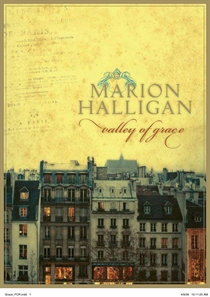
Valley of Grace book cover (Courtesy: Allen & Unwin)

Valley of Grace book cover (Courtesy: Allen & Unwin)

Delicious but sly are the first words that come to mind when I think about Marion Halligan’s latest novel, Valley of Grace. Take this for example:

You know, people think flowers are pretty. Sentimental. Frivolous even. But the fact is, everything begins in the garden. Humans. Society. Civilisation. Evil. Things bud, bloom, weather, age, die. There is as much decay as there is burgeoning. Gardens offer emblems of our passage through the world.

Sly because you know she is alluding to the Garden of Eden here but, without the snakes, apples or trees, the garden symbolism is wider, more encompassing than the simple biblical Fall of Man. Delicious because the language flows so beautifully – and it’s typical of the sure writing that’s found throughout the book. The style is relaxed and flowing, even when it is staccato (if that makes sense). It feels conversational, and yet it is not colloquial. And, it contains Halligan’s hallmarks – wonderful descriptions of food and wine, of home and gardens.

The novel is set in contemporary Paris and chronicles a few years in the life of Fanny and her family and friends. At the beginning of the novel she is 25, single, and working with the gay Luc in his antiquarian bookshop, but very soon she marries builder and restorer of old buildings, Gérard, who is 38. There’s no mystery about this – you can see it coming and it comes. What doesn’t come after that is a baby.

There are no big dramas in this book so if that’s what you like, this is not for you. It is however the book for me, because while I can enjoy a book with drama, that’s not what I read books for. I read them for the very things that I got out of this book: astute observation of humans and how we think and behave, combined with writing that delights, inspires and grabs. Valley of Grace explores all the sorts of things that make up human experience – love and friendship, betrayals, secrets, appearance versus reality, and more besides – but most of all it is about babies and children. The having of them, the not having of them, the healthy and the damaged, the child and the god-child, and the wild child are all covered in this neat little book.

And, in fact, as Halligan told us at our bookgroup meeting tonight (to which we’d invited her and she’d wonderfully accepted), children were a major inspiration for the book. She lived in Paris in 1989 and, from her apartment window, could see the church, Val de Grâce, which was built by Anne of Austria as her part of a bargain with God to give her a child (Louis XIV, no less). This story fed into Haligan’s thinking about fertility (the presence of it and the absence of it) and about how in the past women came to “a bad end” if they didn’t have a baby or had a baby at the wrong time. She said that in the 1960s we thought this would all change but in fact it hasn’t quite turned out that way because women are having babies later and the result is more problems (such as infertility, increased miscarriages, “damaged” babies). This book is, then, her meditation on children – who they are, what they mean to us. And the following will show you just what Halligan thinks they mean:

Taking an angry or maybe anguished baby and changing it from a stiff protesting awkward bundle into a relaxed kitten-like creature seems to Fanny as important a thing as anybody could ever do.

The novel is told in third person but from different perspectives in different chapters – with some wonderful set-pieces, such as the story of Sabine and her arrogant philosopher husband Jean-Marie to whom she delivers “the pavilion girls”. Halligan said that telling the story this way replicates the way life goes – we are the heroes of our own stories, but bit-players in those of others. This makes sense – and certainly works well in the book.

There is a luminous quality to the book, conveyed largely through imagery to do with light and colour (mainly yellows). Mostly it is comforting, but sometimes it is not. Here is Fanny in the Val de Grâce:

She looks up at the immensity of the pale grey stone. Even with all the decoration, the cherubs, the frescos, the marble and gilt columns, it has a bareness, a coldness. It’s the colour of concrete, There’s no stained glass. The light is silvery; when the sun shines, lemony. There is no comfort in it, as there is in her house.

And then in her apartment:

She looks at the graceful space of the apartment. At the light, greenish gold today with summer sun and the fresh leaves on the chestnut trees, their milky white flowers buzzing with bees.

It’s a short book – just under 250 pages – and a rather gentle one. It’s sometimes a little sad, but other times it has a wry humour.  It’s well researched, but the research hangs lightly on it. Its ending is one of the most inspired I’ve read for a long time – but you’ll have to read it yourself to see if you agree.

I have read a few Halligans over the years – Lovers knots, The golden dress, The fog garden and The point – and have enjoyed them all. I’ll close this post with a favourite line from The fog garden because I think it describes this book to a T:

Read a wise book and lay its balm on your soul.

Think twice about questioning an author!

I have to admit that I’m not one of those readers who gets too hung up about accuracy in fiction. After all, fiction is, by definition, a work of imagination, and not of fact. And so, when I read fiction I’m pretty good at suspending my disbelief. I’m more interested in the world created by the author and whether what is written makes sense (is consistent) within that world. I know this is a simple response to a complex question, but it is the rule-of-thumb I go by and has served me well over the years!

This is not so for all readers…as I have discovered over many years of book discussion. I was thus entertained to come across the following exchange in the “Other People’s Letters” section of The ABC Weekly issue of 15 February 1941 which I read today. It concerns a story, by Australian playwright and novelist Max Afford, that had been serialised in the magazine.

Here is the letter:

Why do authors persistently make their characters wear spectacles with “thick” lenses, such as Edward Blaire apparently needs in your serial Owl of Darkness. No spectacle lenses are ever made thick, as thickness has no effect whatever on the lens power, and would only increase their weight. If it were meant to imply that the spectacles had lenses of high power in them, they could be referred to as “strong” but definitely not “thick”. [Name withheld – by me!]

Here is Max Afford’s response:

It is regrettable that your correspondent is not as careful over facts as he is about nonsensical hair-splitting details. The gentleman is entirely wrong! Sydney oculists assure me that, in some cases, spectacle lenses are ground to as much as 1/4 inch [about 6mm for my younger readers here!] thick.

So there you have it! Our poor gentleman loses on both counts: he is hairsplitting and he is wrong anyhow! Personally, I’d rather enjoy the story and find something more useful to write to the editor about.

Barack Obama, Dreams from my father

Dreams from my father, Australian paperback (Cover: Courtesy Text Publishing)

Dreams from my father, Australian paperback (Cover: Courtesy Text Publishing)

I must be about the last person on earth to read Barack Obama’s autobiography, Dreams from my father. However, that’s not going to stop me adding my voice to the accolades heaped on the book! When it was originally published in 1995, it was subtitled “A story of race and inheritance”. This does not appear on the cover or title page of my 2009 reprint of the 2004 edition. Why is that? Maybe they just thought they’d keep it simple?

Anyhow, this aside, there’s a lot that can be said about this book – and in fact a lot has been said. I don’t really want to go over that ground again. Yes, it has a three part structure (Origins, Chicago and Kenya). Yes, it’s beautifully written with some lovely reflective prose. Yes, it contains the germ of his philosophies about race and politics. But, what did I get out of it?

Well the main thing is that it’s one of the most authentic explorations of identity crisis that I have ever read. Here is a man born of a mixed race marriage, who was brought up by the “dominant” race’s family without any real contact with the minority race family but who, by the time he reaches adolescence, finds that those around him identify him with that minority race. Consequently, much of the book is spent on his working out how to live (and grow) as a black man in a white society. He is very honest in chronicling his path from rather wild, disaffected youth to thoughtful more together young man. He starts to make this transition when, in his early 20s, he leaves the high corporate life in New York for the life of a poor community organiser in the Southside of Chicago. And here I must admit I could NOT get that Jim Croce song out of my head:

Well the south side of chicago
Is the baddest part of town…

Some readers, I know, found the Chicago section slow-going, and  I suppose I did too but that doesn’t mean I didn’t find it engrossing because it is in this section that he really explores the many faces of race relations and starts to work through his own views and values. After all, it is here that he gets first-hand experience of what it is like to be poor, powerless and black and it is here that he not only starts to develop his philosophy but also hone his organisational skills. He’s pretty modest about it but it is clear that he is an empathetic person who engenders confidence in people. The other interesting thing about this identity crisis aspect of the book is that while, unlike many of the people he worked with/for he had not “grown up black”, he is one of the rare Americans to actually have direct African roots, something he explores in the third part of the book. All this actually makes him a bit of an insider/outsider in both white and black society. The resolution, when it comes at the end, is emotional and yet rather ordinary. He writes:

I felt the circle finally close. I realised that who I was, what I cared about, was no longer just a matter of intellect or obligation, no longer a construct of words. I saw that my life in America – the black life, the white life, the sense of abandonment I’d felt as a boy, the frustration and hope I’d felt in Chicago – all of it was connected with a small plot of earth an ocean away, connected by more than the accident of a name or the colour of my skin. The pain I felt was my father’s pain. My questions were my brothers’ questions. Their struggle my birthright.

The other thing I got out of it was the exploration – mostly just subtly alongside other discussions – of the concepts of truth and authenticity. An historian he talks to in Nairobi towards the end of the book says, when discussing the historical challenges facing, say, post-colonial Africans, that “truth is usually the best corrective” and elaborates on this by suggesting that possibly “the worse thing that colonialism did was cloud our view of the past”. There’s much to think about in that statement! On a more personal level she says that what she wants for her daughter is less to be “authentically African” and more to be “authentically herself”. I can’t think of a better point on which to finish this little review of mine!

Jim Crace, Being dead

The old “so many books, so little time” mantra means that I very rarely read a book more than once (other than my Jane Austens of course), but I have read Jim Crace’s Being dead twice. I love this book. I know some find the subject matter unappealing but I find it not only fascinating but rather beautiful.

Beach near Bermagui, New South Wales

Beach near Bermagui, New South Wales

For those who haven’t heard of this novella (really), its plot centres on a murder. Joseph and Celice, a middle aged couple (and, significantly, zoologists), are bashed to death on a secluded part of a beach at the book’s beginning and, from this point, the story moves in multiple directions to explore a number of before and after scenarios relating to this event. In fact, one of the things I like about the book is its four-part structure, and its forwards-backwards movement in time as the different strands of the story are played out. Crace moves backward from the moment of their death to the beginning of that day, and alongside this he recounts forward the story of their relationship from the point of their meeting. The third strand concerns their daughter as she reacts to the news of their disappearance, and the final strand, which is the one that turns off some readers, chronicles the decomposition of their bodies as they lie undiscovered in the dunes. It’s not for nothing he makes them zoologists!

Near the end of the book is a clue to why Crace has chosen this structure. He writes that “Earth is not a visionary and can’t be blamed for what’s ahead. It is retrospective … It is the past that shapes the world, the future can’t be found in it”. It seems to me to be a pretty fatalistic – what will be, will be – view of the world, and one I rather like. I don’t think he’s quite saying we can’t change our world but he is saying that what we do, what is now, shapes it and our lives, that there’s no future mystery out there waiting to make something of us. Right near the end is this:

Nothing could be changed or amended, except by the sentiment of those who were not dead. That’s the only Judgement Day there is. The benefits of hindsight. The dead themselves are robbed of hindsight.

So what about the characters who are the focus of all this? Crace has in fact chosen pretty ordinary, fairly unlovable (except to themselves) not-particularly-admirable characters. By doing this he makes the point that we all have our lives, that the only really important thing is love, and that there is dignity in that. As he writes: “Love songs transcend, transport, because there is such a thing as love”.

And it is all told in language that is rhythmic and oddly beautiful despite the horror of the subject matter:

The corpses were surrendered to the weather and the earth, but they were still a man and wife, quietly resting; flesh on flesh; dead, but not departed yet.

Crace is a great stylist, I think, which is why he can tell such a story in four parts but in less than 200 pages. Take the title for example: the use of the present participle “being” is very telling. Present participles imply action, continuation, ongoingness, but death is usually seen as the end. In this book there are several continuations: the world, the natural world in particular, continues, and Joseph and Celice’s love continues. Oh, and they stay dead. Great title.

So, to labour the point, his message is that we and only we make our lives:

There is no remedy for death – or birth – except to hug the spaces in between. Live loud. Live wide. Live tall.

Carpe diem I suppose – but an oh so eloquent evocation of it!

Elizabeth Jolley, My father’s moon

‘No one,’ she says, ‘can write anything till they’ve had experience. Later on perhaps. You will write later on.’ (Elizabeth Jolley, My father’s moon, 1989)

Although fiction demands imagination, it must be based on  some kind of genuine experience. (Elizabeth Jolley, “Only Connect”, essay first published in Toads, 1992)

My father’s moon is the first book in Jolley’s semi-autobiographical trilogy, the others being Cabin fever and The George’s wife. It won The Age Book of the Year Award in 1989.

I am an Elizabeth Jolley fan – and, along with Helen Garner, another Jolley fan, I enjoy the way she repeats and revisits stories and characters from one book or story to another. In this book is the chapter, “Night Runner”, which was published as a short story in Meanjin in December 1983, and again in a short story anthology, Room to move, published in 1985. The narrator of the story – and of the novel – typifies Elizabeth Jolley’s alienated protagonists and their often peculiarly self-centred and self-deluded ways of coping with their loneliness. Clearly Jolley decided that this was a character she wanted to develop further. And clearly she also drew a lot from her own experience to develop this character. Like Vera, Jolley was brought up as a Quaker, her parents sheltered refugees before and during the Second World War, and she trained as a nurse. Like Vera, Jolley probably experienced loneliness and alienation. However, this is fiction and so we need to be careful about how far we take these analogies between Vera and her creator. Much as I can empathise with Vera’s predicament, I must admit that I would hate to think she is Elizabeth Jolley.

It’s an uncomfortable novel. Vera, the first person narrator, is not a highly sympathetic character but neither is she totally disagreeable either. What she is, though, is lonely. The book has a somewhat challenging structure – and I had to concentrate to keep track of where I was. It starts with Vera, a single mother, leaving her parents’ home, with her young daughter, to live and work in a boarding school. Her hopes for a lovely life there among people “who feel and think as I do” are dashed. Such people “are not here as I thought they would be … I am by my own mistakes buried in this green-leafed corruption and I am alone”. In this first chapter are flashbacks to the past, and gradually the book moves into the past, providing us with insights into her character and how she has ended up where she is. Most of this past takes place in the hospital where she trains as a nurse during the war. The book finally returns to the beginning of the novel with Vera resolving to make a step towards alleviating her loneliness. However, we are by no means convinced she will.

Moon, by atomicshark @ flickr, licensed under Creative Commons CC-BY 2.0

Moon, by atomicshark @ flickr, licensed under Creative Commons CC-BY 2.0

The book comprises titled chapters, many if not all of which could be (and some have been) published separately as short stories. This gives it a somewhat disjointed feel – but seems appropriate for the story of a person like Vera. It is full of wonderfully drawn characters, with some very funny (if often dark) scenes and dialogue. Just think nurses and hospitals! There are many references to music – something that is common in Jolley’s works. Music is usually a comforting force for her characters, offering them respite from what is often a cruel world – and this is the case here, with Vera being drawn to characters who love and play music. There is a lot of irony, some of it subtle, some of it less so as in Magda’s comment to Vera who has fantasised about an affair with her husband: ‘You are so innocent and good … Don’t ever change’. Naive perhaps, innocent no!

So, what about the title? Funnily enough(!), it refers to Vera’s relationship with her father, a major stabilising influence in her life. He tells her throughout her childhood that wherever she is she can always look at the same moon he is looking at, ‘And because of this … you must know that I am not far away. You must never feel lonely’. A lovely concept and one to which Vera regularly returns in the book.

My father’s moon is not, I think, the easiest Jolley to read, and there are some things that might become clearer on a second reading. However, its concerns are very representative of her work – loneliness and alienation, homosexuality, parenting, memory, music and religion. While Vera is deeply lonely, while she often behaves selfishly, she can also be kind. She is also no quitter. For that I rather like her.

J.M. Coetzee, Diary of a bad year

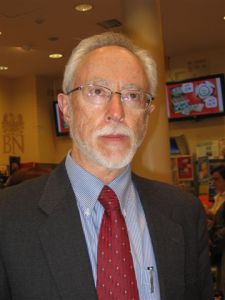
Coetzee, Poland, 2006 (Photo: Mariusz Kubik, from Wikipedia)

Coetzee, Poland, 2006 (Photo: Mariusz Kubik, from Wikipedia)

J.M. Coetzee is one of those rare novelists who pushes the boundaries of what a novel is. The progression from his mid-career novel, the spare but terrifying Disgrace (1999), through Elizabeth Costello (2003) to Diary of a bad year (2007) is so dramatic that there are those who question whether these last two are even novels. It’s actually been a year or so since I read Diary of a bad year but it is currently being discussed by one of my reading groups so now seemed to be a good time to blog about it here.

One of the first things to confront the reader who picks up Diary of a bad year is how to read it. It has three (two to begin with) concurrent strands running across the top, middle and bottom of the page. Some readers try to read the three strands as concurrently as possible while others read the strands sequentially. Following this latter path, though, means you risk missing the way the strands comment on each other. The three strands are:

  • the narrator’s formal voice, basically taking the form of essays he is writing
  • the narrator’s informal voice in which he talks about his life as he is writing the essays
  • the voice of Anya, his “little typist”, and, through her, of her boyfriend, Alan

The three characters represent three modes of viewing the world: the narrator’s is primarily theoretical, while Anya’s is more pragmatic and Alan’s rational. Through these modes, Coetzee teases out the moral conundrums of the early 21st century both in terms of the political (the events confronting us) and the personal (how are we to live).

Towards the end, Coetzee refers to his love of Bach. To some degree the book is a paean to Bach: its three-part structure in which each part counterpoints the others seems to be a textual representation of Bach’s polyphony. The essays running across the top of the page, while a little uneven and dry on their own, are counterpointed by the views of the characters in the other two strands, resulting in our being presented with different ways of viewing the same world.

The characterisation is interesting: Senor C, the writer of the essays, is the logical, moral but somewhat pessimistic thinker; Anya is practical, down to earth, but with a strong moral sense; and Alan is the economic rationalist for whom money is essentially everything. The views of the two men are strongly contrasted, while Anya is caught in the middle. There is a Darwinian sense in Alan of the survival of the fittest, while Senor C spurns competition as a way of life, preferring collaboration. For all his “moral” views, though, Senor C is not presented as a paragon and we are discomforted at times by his attitude towards the beautiful Anya.

The overall theme seems to be how do we live in a world full of paradoxes and contradictions, a world that seems to be pervaded by dishonour and shame (the things Senor C explores in the essays). He talks about ordinary people and how they (we) cope with things they (we) don’t approve of. He wonders why they (we) don’t do something about it, but suggests in the end that they (we) practise “inner emigration”. He says:

The alternatives are not placid servitude on the one hand and revolt against servitude on the other. There is a third way, chosen by thousands and millions of people every day. It is the way of quietism, of willed obscurity, of inner emigration.

I like that concept though it does smack of burying one’s head in the sand. He also talks about collective guilt, and about bearing the dishonour of what’s gone on before. Through choosing a “novel” form like no other, one which blends but in no way harmonises fact and fiction, Coetzee shows in a very concrete way that difficult times need new ways of presenting ideas. He offers no neat conclusions, no easy outs;  he is quite subversive really. Late in the book he ponders the value of writing, and says:

Are these words written on paper truly what I wanted to say?

This then is another step in Coetzee’s path of trying to find the best, perfect perhaps, way of saying what he wants to say. I, for one, will be ready for his next step.

Orhan Pamuk, Snow

One of my rules of reading is that when I have finished a book I go back and read the first chapter (or so) and any epigraphs the author may have included. These can often provide a real clue to meaning. This rule certainly applies to my latest read, Snow, by Nobel Prize winner, Orhan Pamuk.

(WARNING: SOME SPOILERS)

Snow, in fact, has no less than four epigraphs:

  • lines from Robert Browning’s “Bishop Blougram’s Apology” describing the paradoxical nature of things: “the honest thief, the tender murderer,/the superstitious atheist”;
  • a quote from Stendhal’s The charterhouse of Parma which warns about the ugliness of “politics in a literary work”;
  • a quote from Dostoevsky’s Notebooks for the Brothers Karamazov which suggests ideals like the European Enlightenment are “more important than people”; and
  • Joseph Conrad’s statement in Under Western eyes that “The Westerner in me was discomposed”.

These four epigraphs pretty well sum up the concerns of the book. What about the title? The second chapter begins with:

Veiling as it did the dirt, the mud and the darkness, the snow would continue to speak to Ka of purity, but after his first day in Kars, it no long promised innocence.

Here then is the first paradox: snow is pure but not innocent, and it covers dirt, mud and darkness. Already, you can see that this book is going to be ironic. Just how ironic though is a matter for contention but my suspicion is that its very foundation is ironic, as it grapples with what it means to be an artist in a political society, with how one is to live in a conflicted nation. The plot centres on a coup – a coup which is variously called a military coup and a theatrical coup! In fact, it is a coup by a theatrical group that is supported by the military! Art and politics could hardly be more entwined.

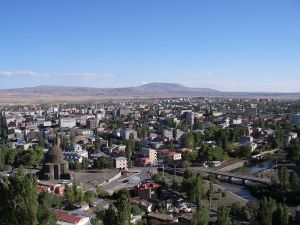
Kars Photo: Jean & Nathalie @ flickr (Creative Commons licence)

Kars Photo: Jean & Nathalie @ flickr (Creative Commons licence)

Snow though is not an easy read. It is my third Pamuk, but only the second one I have completed. I loved his memoir-cum-history Istanbul but could not, hard as I tried, finish My name is red.

What then is it about? The main action covers three days in the life of Ka, a Turkish poet recently returned from 12 years exile in Germany, who comes to Kars (in far east Turkey) ostensibly to write about the suicide epidemic among young women, but whose secondary (or perhaps primary!) reason is to fall in love with an old school-friend, Ipek. Soon after he arrives, however, the coup occurs and Ka is, rather unwillingly, caught up in the intrigue between the competing interests: the secularists, the Islamic fundamentalists, and the Kurdish nationalists. This sets the stage for exploring the art-politics nexus. Ka says to Sunay, the leader of the coup AND of the theatrical troupe that comes into town:

I know that you staged the coup not just for the sake of politics but also as a thing of beauty and in the name of art … you know only too well that a play in which Kadife bares her head for all of Kars to see will be no mere artistic triumph; it will also have profound political consequences.

Here then is one evocation of the second epigraph. The third and fourth epigraphs refer to the running conflict in the book between European/Western values and Turkish/Eastern values. There is very much a sense that the people of Kars feel condescended to by European culture, but as a teen-ager says at one point, “We are not stupid! We’re just poor”. The people of Kars do not understand Western notions of individualism, and they see Western ideas of secularism and atheism as equating with immorality. Ka, as a Westernised Turk, acts as an uncomfortable, to him, bridge between the two worlds.

The core of the book is Ka. He is a sad and highly conflicted individual who, in his youth, had used words to argue that people should act for “the common good” but now finds himself using them to further his own happiness. Once politically active, “he now knew that the greatest happiness in life was to embrace a beautiful, intelligent woman and sit in a corner writing poetry”. The irony is that, for all his attempts to achieve this, he ends up with neither and dies four years after the coup a sad and lonely man.

The novel is interesting, stylistically and structurally. It is essentially a third person story about Ka but is told by a first person narrator, Ka’s friend, the novelist Orhan(!). This metafictional narrative technique, by adding another layer to the “conversation”, rather deepens the “artist in society” and art/politics themes of the book. Much of the story is foreshadowed: we learn of Ka’s death in Chapter 29, though the book has 44 chapters. The tone of the book is imbued with huzun, that very particular Turkish sense of melancholy that Pamuk explores beautifully in his book Istanbul. And, while it is about a coup and has a body count of 29, there are some very funny scenes, one being the political meeting at which the competing rebels prepare a statement about their beliefs for the Western Press. Anyone who has attended a political meeting will feel at home here!

All this said, the book is a challenge to grasp: there are a lot of characters, comings-and-goings, and ideas to track. Just why Ka is the way he is, just what did happen to him in the end, and just what Orhan is saying about art and politics are hard to pin down. I love the way the book is underpinned by paradox and irony – and yet at times the meaning can be a little tricky to discern. What is clear though is that Ka has found living by his political beliefs deeply unsatisfying but, ironically, is unable to bring about a situation in which he can live “happily” any other way.

Kadife, the leader of the headscarf girls, says (fairly early in the book):

…do not assume from this that our religion leaves no room for discussion. I will say that I am not prepared to discuss my faith with an atheist, or even a secularist. I beg your pardon.

Oh dear! Some reviewers call it a brave book. With its fearless exploration of the tensions in modern Turkey, it certainly feels that way. I am very glad that I put in the effort to read it.

Too many books?

Gutenberg, Public Domain image from Wikipedia

Gutenberg, Public Domain image from Wikipedia

No, this is not one of those “too many books too little time” posts. This is way more serious! This is about something I read in the July issue of goodreading (why I read this magazine is beyond me really, but I do). What I read was this, from one Ken Duncan who is apparently an Australian panoramic landscape photographer:

Unfortunately, for our generation, books are a dime a dozen [but] in the old days books used to be something very special, where you had artists create them.

It’s unfortunate that books are commonly available? How awfully elitist this sounds. I know where he is coming from – after all it’s in an article on limited edition books – but he chose an unfortunate way to make his point. Beautiful books are lovely to have and to hold but in the end what really counts is that as many people as possible can access them. Gutenberg and Caxton must be rolling in their graves!

Pramoedya Ananta Toer, This earth of mankind

Nationalism, in today’s western world, is pretty much a dirty word – and yet it is the idea of nationalism which underpins Indonesian writer Pramoedya Ananta Toer‘s Buru Quartet, of which I have just read the first book, This earth of mankind. Toer’s concept of nationalism was formed under colonial rule of his country by the Dutch and then under military rule by Indonesians. His notion of nationalism encompasses ideas of individual freedom and dignity, and the right of individuals and, by extension, the nations which they form, to be self-determining. None of these are well supported under colonial or military regimes.

Toer & a translator. Photo: Michael Scott Moore at radiofreemike.com

Toer & a translator. Photo: Michael Scott Moore at radiofreemike.com

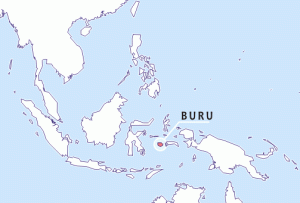
Toer (1925-2006) spent quite a bit of his life as a political prisoner and, in fact, this novel was first told orally to co-inmates in 1973 when he was imprisoned on the Buru Island penal settlement. He was first imprisoned (1947-1949) by the Dutch government after an anti British and Dutch revolution, and then later by the Indonesian government, first in 1963 when he supported Chinese minorities, and then after a military coup in 1965.  On this third occasion, he was imprisoned until 1979, though after that was essentially kept under house arrest until 2002. The first two novels were published in 1979/1980, and were translated into English in 1981 by Australian diplomat in Indonesia, Max Lane, who was recalled to Australia that same year as a result. Clearly, the Indonesian government was not amused. Indeed, the books were banned by that government in 1981.


From Wikipedia, under GNU Free Documentation License

From Wikipedia, under GNU Free Documentation License

This earth of mankind is set in 1898, and provides a fascinating look at colonial life in Indonesia at that time. It tells the story of a Native, the only one to attend an elite school. Being a Native he has no formal name, and so throughout he is called several names – Sinyo or Nyo, Gus, and most commonly Minke. Early in the novel, he is introduced to a succesful concubine Nyai Ontosoroh and her beautiful daughter, Annelies, and is gradually drawn into their lives. The novel follows his – and their – fortunes as the colonial authority does its best to see that a Native does not rise above his station. Life turns out to be a paradoxical one for Minke – on the one hand his education teaches him to think and argue and believe that all things are possible while on the other hand the colonial structure, within which he lives, works to ensure that little is possible.

The novel is peopled with a wide range of characters of various ethnic backgrounds – primarily Dutch, Indo (people with Dutch and Native parentage), and Natives, but also French and Chinese. This ensures that the strictly enforced layer of colonially-decided rights is set against a wide variety of political and personal opinions and provides the reader with an excellent insight into a complex society. This is perhaps also the cause of its main flaw because it is, at heart, an ideological novel. And, like many ideological novels, characters and plots are simplified and exaggerated to make the point. So, in simple terms the story can be seen as poor clever boy meets rich powerful concubine and falls in love with her beautiful but weak daughter only to be crossed by the wicked brother. The story has a melodramatic edge and there’s not a lot of complexity – of greys – to the characters. They are there to serve a purpose.

That said, it is a rivetting read. Told, first person, in Minke’s voice, the novel immediately engages us with him and his situation. He is, in fact, a little more rounded than the others: we get a sense of his uncertainty as he makes his various decisions throughout the book. This is largely because it is also a coming-of-age novel: paralleling the ideological issues underpinning the novel is the story of Minke’s emotional, social and intellectual development. A major thread is that of education and what can (should) be expected of an educated person. Early in the novel his “mentor”, the French artist, Jean Marais, tells him:

You’re educated Minke. An educated person must learn to act justly, beginning first of all with his thoughts, then later in his deeds. That is what it means to be educated.

This advice underpins Minke’s thought and actions from that point on: at each test or decision point he tries to apply his education.  There’s bitter irony here though because it is the source of that education – Europe – that causes his major problems at the end. As Minke is fast learning, you have to be strong to survive.

There’s a lot more that can be teased out in this book – including the role played by language in controlling and enforcing power and status – but rather than ramble on, I will end with the words of Minke’s favourite teacher, Magda Peters. She says:

…without a love of literature, you’ll remain just a lot of clever animals

It is not surprising then that Minke, Toer’s alter ego in this book, becomes a writer!

(Translated by Max Lane)

Steve Toltz, A fraction of the whole

I reckon the voters for the NSW Premier’s Literary Awards inaugural People’s Choice Award got it right when they chose Toltz’s A fraction of the whole as the first winner. Not necessarily because it is the best book of the year, because I’m not sure that it is, but because it is such a life-writ-large book. It is funny – belly-laugh, sometimes, and quiet chuckle, other times – but serious at the same time. Just when you think you have grasped what it is about, it dives off on another tangent and your brain has to start working all over again.

I’m not sure how to describe it. It’s basically a father-son story, told in first person by the son, Jasper. However, Jasper inserts into his story three long sections in his father’s voice: Martin’s life-story (to the age of 22) as he tells it to Jasper in a seventeen hour stint, entries from Martin’s journal describing his relationship with Jasper’s mother, and Martin’s unfinished autobiography. These add some texture to the novel and allow us to know things that Jasper couldn’t know.

Created by Tinette, Wikipedia, under GNU Free Documentation Licence

Created by Tinette for Wikipedia under GNU Free Documentation Licence

The characters are intriguing, with Martin being centre-stage. At my bookgroup’s discussion of the book one of the members wondered whether there could be a bit of yin-yang between Martin and his brother Terry, and she could have a point. Jasper quotes the following from his father’s journal:

No symbolic journey can take place in an apartment. There’s nothing metaphorical about a trip to the kitchen. There’s nothing to ascend! Nothing to descend! No space! No verticality! No cosmicity! … The essential important idea that will shift me from Thinking Man to Doing Man is impossible to apply here. … I am a halfway man …

But, while he tries, Martin never really does move from a Thinking Man, while his brother remains the Doing Man. Jasper seems caught in the middle. Martin’s trouble is that he has “thought himself into a corner”, one where he is so distrustful  of humanity, and so fearful of death, that he can’t trust the ideas that could get him out. As Martin says: “If men are constantly manufacturing meaning in order to deny death, then how can I know I didn’t manufacture that experience myself?”. This corner, this distrust, is to bring tragedy to his life near the end of the novel.

It’s a very funny book, with the comedy being both verbal and situational. It is at different times absurd, ironic or satiric. The satire is aimed at pretty much anything you could imagine – education, politics, media (journalists in particular), philosophy, death and, indeed, humanity. Almost any page you open will provide either a laugh or a description that makes you go “aha” – on many pages you will find both.

So what is it actually about? It is about father-son relationships, and about sons who don’t want to replicate their fathers. It is about Australia (“our demented country”) and Australians – and is not too complimentary about our willingness to put others down, our lack of compassion for those who need our help. It is about the paradoxes that make up our lives and thus humanity and much of the book is expressed in terms of these paradoxes – the good and bad, life and death, pessimism (Martin) versus optimism (Jasper), sanity and insanity, forgiveness and unforgiveness, and so on.

There is so much to write about this book that I think it’s best I end here with, fittingly, a paradoxical statement made by Martin two-thirds through the novel. “Fiction”, he says in his unfinished autobiography, “has a habit of making the real world seem made-up”. Toltz has produced in his novel a world that seems both real and made-up. It is up to us to decide which is which…and act accordingly!