On outdated books

Most readers at some time or other confront the issue of “datedness” in literature. This book is “dated”, we say. The funny thing is that what seems dated to one person is often not so to another. So, what do we mean when we say a book is dated?

The writer Fran Lebowitz is very clear about what she means by it. In a short documentary titled The divine Jane:  Reflections on Jane Austen that was produced last year for The Morgan Library and Museum’s exhibition A woman’s wit: Jane Austen’s life and legacy, she says:

Any artist who has that quality of timelessness has that quality because they tell the truth. Jane Austen’s perceptions don’t date because they are correct, and they will remain that way until human beings improve themselves intrinsically, and this will not happen.

She argues that those works which date do so because “their ideas are wrong” not because the details date. All details date she says. This has got me pondering. How often do we argue that a book is dated because of the “details” – because of their language, or lifestyles, or values?
Old books

Old books (Courtesy: OCAL @ clker.com)

It’s easy with non-fiction to identify datedness: look at this blog with its “hilariously outdated books of the week” posts. With non-fiction it really is mostly a case of the details – in some way – being wrong. The website, Education World, discusses outdated books and reports on one librarian’s “shelf of shame”. This librarian, and others, would rather have no books than outdated books. “Outdated books”, they say, “give children misinformation … we betray children when we put outdated information on our shelves”. “Outdated books keep stereotypes alive”, they say. All this is largely true, but – and here is the rub – they also say:

If you don’t have nice new books that kids want to read, they won’t read. We’re trying to get children to read more.

This feeds into other notions of being outdated, doesn’t it? Today’s children for example may not want to read my old version of The lion, the witch and the wardrobe because it “looks” old, it doesn’t accord with modern book design. They will however read a new edition, one that looks like books of their generation. I wonder if it was always thus? Once upon a time books were so precious, people read whatever version/edition that was available. But, perhaps, these people were readers anyhow, perhaps back then there were many who didn’t read and these are the people today’s librarians are trying to reach?

Enough digression, back to Lebowitz. I think about CJ Dennis’ The moods of Ginger Mick which I recently reviewed. I was initially not very keen to read it because it has, I admit it, always seemed old-fashioned, dated, to me. Its language is certainly dated – in the way that slang quickly becomes so – and the life it chronicles is certainly dated. Some of its values are too – its style of blokiness, its general attitude to race and gender – and yet despite all this it is I think also timeless. It’s timeless because it deals with humanity – with fear and bravery, with our misconceptions about each other based on superficial things (such as class) and our realisation that underneath these superficialities is what really makes a person worth knowing (such as loyalty and “grit”), with, in fact, our discovery of self. As Ginger Mick says in one of the poems:

Sometimes a bloke gits glimpses uv the truth.

Isn’t this why most of us read?

So, what do others think about datedness in literature? Is it enough to “tell the truth” as Lebowitz says – or can a truth-telling book be dated?
Top non-fiction of 2009

Is it cheating to do separate lists for fiction and non-fiction? Some people list their top books regardless of form or genre, while others created separate lists. I’m going to do the latter because – well, because I get to choose more books for a start. Actually, I didn’t read a lot of non-fiction this year so my top non-fiction titles will almost be all the non-fiction I read. As with my top fiction, I am listing them in the order I read them.

I didn’t nominate a top fiction for the year, but I’m going to here – and it is the one I read before I started blogging: Chloe Hooper’s The tall man and so I’ll do a little mini-review of it now.

Chloe Hooper’s The tall man

In a nutshell the book, which is best described as “true crime”,  chronicles the fallout that results from the death in custody on Palm Island of indigenous man Cameron Doomadgee, fallout which includes the autopsy report and ensuing riots, and the homicide trial of policeman Chris Hurley. Hooper explores the awful disconnect between people in the communities involved, between white and black, and within the white and black communities. She shows how women (particularly those on Palm Island) are caught in the middle. They believed the policeman killed Doomadgee but, when the riot occurred, they didn’t want the police gone because “who will protect us from the men”.

Throughout the book, Hooper manages to bring what is a very complex situation into rather clear focus…showing, not surprisingly, that in the end it’s the whites who have the power. For example, she attends a police rally organised to support Hurley and notes how they, the police, were fashioning themselves as victim. She comments that “measured against two hundred years of dispossession and abuse, the idea is fantastic, but no-one in that hall was thinking about historical relativities”! This point regarding “historical relativities” is well-made: this is not simply a case of white devil versus black angel, but we know where the real “victimhood” lies. The book also touches on the notion of power corrupting – or, questions at least how police officers are chosen and trained in the first place.

Hooper manages to walk a fine line. You know where her sympathies lie (particularly as the book progresses and she teases out the evidence) but she takes an analytical approach encouraging her readers to also do so. This begs comparison with Helen Garner who takes a far more heart-on-sleeve approach to her subjects in her books, The first stone and Joe Cinque’s consolation.

Finally, she makes an important point when she describes Hurley’s trial as “a false battleground”. Truth and justice – those universal concerns – do need to come out, but the trial is not going to solve the underlying problems. The tall man is a highly readable book about some significant concerns (for Australia at least)…and, in my mind, well deserves the awards it has won. I have only one quibble with it: I wish it had an index!

POSTSCRIPT: Thea Astley also dealt with troubles on Palm Island in her novel The multiple effects of rainshadow. It deals with the event which occurred on Palm Island in 1930 when the supervisor at the time ran amok and killed his children, something which Hooper refers to in the book when she provides a little rundown of Palm Island’s history.

Chloe Hooper
The tall man: Death and life on Palm Island
Camberwell: Penguin Books, 2008
276pp.
ISBN: 9780241015377

Top 12 fiction of 2009

I think, pedant that I am, I can now post my Top 12 fiction books of the year, since the book I’m currently reading (interesting though it is) won’t be on it, and I won’t be finishing another one before January 1 comes around. I am listing 12 because Tom at A Common Reader said I could! Picking 12 is about as subjective as I’m going to get and so I am going to list them in the order I read them rather than in any further order of quality:

Sleeping Reader

Why I didn't read enough classics (Courtesy: OCAL via clker.com)

There are some interesting (to me, anyhow) observations to make about this list:

  • two are short story collections;
  • six (ie half) are by Australian authors;
  • only 3 are by women authors;
  • three are works in translation by European (that includes Turkish!) authors;
  • two thirds were published this century; and
  • there are no classics (not because none made it to the Top 12 but because for some rather odd reason I didn’t read any this year – well, except for Maria Edgeworth’s delightful little novella, Castle Rackrent, which nearly made this list)

Like most statistics, these only tell part of the truth. They show my increasing interest in short stories (collections and individual), my continued commitment to Australian literature, and my desire to extend beyond anglo-literature. They don’t show, however, my longstanding commitment to reading works by women and my love of “the classics” (however you define that term). Maybe my 2010 resolution – cos I do like, for fun, to make one – will be to redress this imbalance!

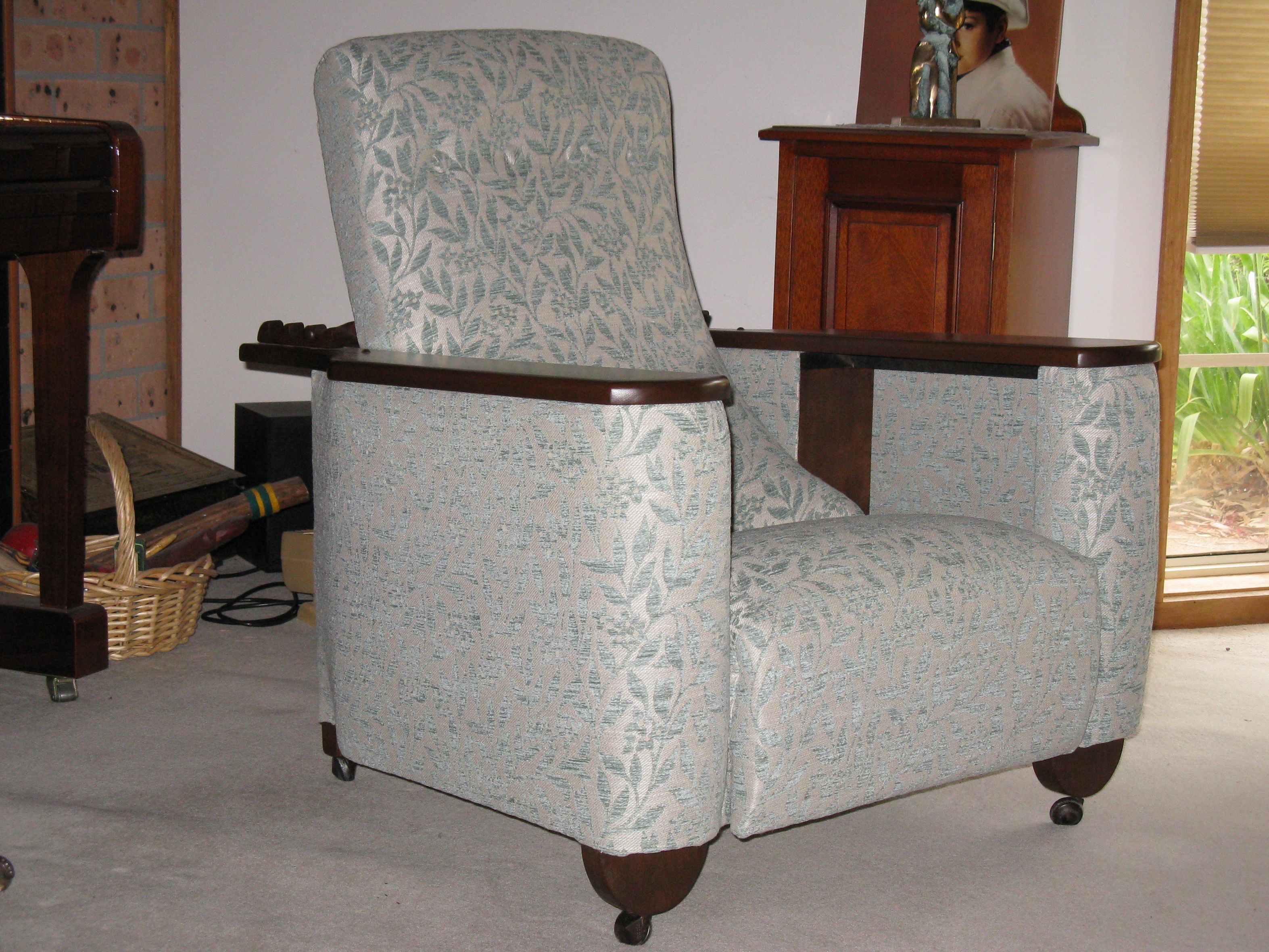
Smoking chair?

Arm chair

Arm chair, c. 1930

…and now for something completely different. Recently I was offered, and gratefully accepted, two chairs which had belonged to my grandparents and which date back to around 1930. They no longer suited my aunt’s needs, and my father, keen to see them stay in the family if they were wanted, offered them to me (with refurbishment thrown in). Not an offer to refuse – particularly when I too had a sentimental attachment to the chairs. After all, I remember them from my grandparents’ home and I do love to have around me things that have some meaning. Readers of this blog know that I love gums and so will not be surprised that the fabric I chose for the new upholstery is called Gumleaf. I am thrilled with it – it’s soft but distinctive – and adds another layer of meaning to the chairs for me!

My father remembers sitting in these chairs and smoking a fat cigar with his dad (some many years after 1930 I hasten to add) – and I think chairs like this were sometimes called smoking chairs. I’m not quite sure what “like this” means other than perhaps that such chairs are very comfortable to sit and relax in. These ones can even be reclined.

You may wonder, though, why I am writing all this? Well, it’s because while some might see them as smoking chairs, I reckon others could very well see them as reading chairs. Not only is this one comfortable, but it has nice wide armrests for that cup of coffee (or whatever takes our fancy) that we like to imbibe while reading. But, more importantly, though you can’t see this easily in the photo, under the armrests are deep open pockets in which it is possible to stow a few books from the TBR pile. They were only delivered last week and, with Christmas around the corner, I have little time to read but, come the new year, I think I will have a new favourite place to read…

My second book for Christmas

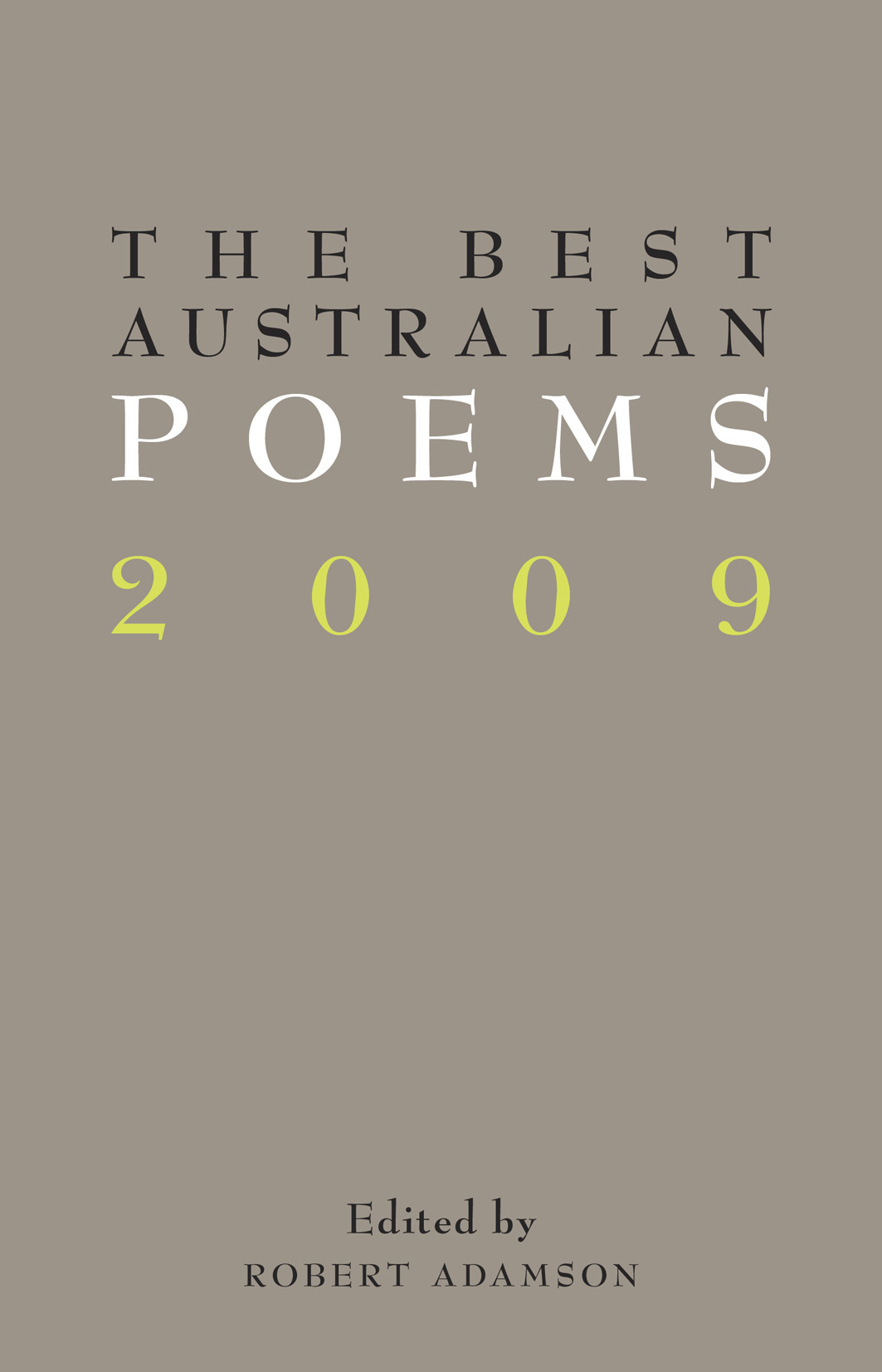
Is this starting to sound like a carol you know? Anyhow, I did say in a comment on my first Christmas book post that I had received another book for Christmas, The best Australian poems 2009 (edited by Robert Adamson). DKS’s comment about the value of this annual series to the cause of poetry made me think that I ought give it its own post.

I wouldn’t call myself a poetry expert, but I have mentioned poetry several times in this blog’s short life because I do enjoy reading it and wish, really, that I spent more time with it. Australian surgeon Mohamad Khadra, in his rivetting memoir, Making the cut, talks about the value of poetry, about how each day on his hospital teaching rounds he would begin by having his students recite a poem that might offer some entrée to understanding their patients’ states of mind. His view is that, as doctors deal daily with humanity, they, and by extension we, can learn from poets who have spent lifetimes making a study of humanity. Each chapter of his memoir commences with a poem.

The Best Australian Poems 2009

Cover image (Courtesy: Black Inc)

But I digress. Robert Adamson mentions three poets in the first paragraph of his introduction – Irish WB Yeats, English Gerard Manley Hopkins (one of my favourites) and Australian Meg Mooney – referring to use in their poems of birds and song. He says that there are many birds and lyrics in the anthology. I’m not quite sure why he singles out these two particular ideas in what is a general anthology – but maybe I’ll know by the time I’ve read all the poems?

To make the selection for this volume he “read all the poetry in the print publications as well as many of the electronic journals and even blogs that feature poems”. Isn’t it great seeing the blog world becoming an integral part of the publishing industry! He says about his selection that he “wanted to create a rhythm for the reader: shorter lyrics and some satirical poems, then hopefully a few love poems, poems of weather, landscape poems and, of course, bird poems.” Ah, the birds again…and then comes the explanation:

People ask me, why are so many bird poems being written and published? I have a theory : we miss having poets among us who can imagine that a soul can ‘clap its hands and sing, and louder sing’ [Yeats], that we need to acknowledge visitations by intense psychological presences, and that birds are the closest things we have, more or less, to angels.

Wow! I’m not quite sure how to respond to that.

The anthology commences with a lovely poem by Martin Harrison titled “Word” written for Dorothy Porter, after her death:

in which briefly suddenly one voice’s glimmer is lost

The anthology also includes a poem by Porter and, indeed, contains for the first time apparently more poems by women than men. The poems are listed alphabetically by poet – saves need of an index not to mention the problem of how to sequence the poems (and all those questions about how one poem’s proximity to another will affect its impact or meaning). He has also included a lot of new poets, more perhaps than in the past, as well as the tried and true. And that is how I like it (just as I like a “classical” music concert to mix it up a bit).

I think that’s about enough on a book I haven’t fully read, so I’ll just finish with some lines from Meg Mooney to whom Adamson referred in his opening paragraph:

The large, brown shapes of the wedgebills
their cheeky crests
disappear as I get closer

like they’re telling me
you can’t just look
and expect to see
in this country

(from “Birdwatching during the Intervention“)

The best Australian poems 2009
Melbourne: Black Inc, 2009
239pp.
ISBN: 9781863954525

My first book for Christmas

I know that Christmas is still over a week away but last night I received my first book of the season…and that, I think, is a litblog-worthy event!

Actually, I tell a bit of a lie, because last week I was sent, by a very kind internet bookgroup friend who knows my likes, the British Library Jane Austen appointment diary for 2010. It is gorgeous, containing Regency era images, silhouette images, and quotes from Jane Austen (from her books and letters). Being an appointment diary it notes standard public holiday dates, but being a Jane Austen appointment diary it also records dates important to Austen’s life – such as the poignant (possibly!):

January 15: I am to flirt my last with Tom Lefroy (from letter to Cassandra)

It is a lovely diary and I shall treasure it way past its expiry date (that is, past December 31, 2010).

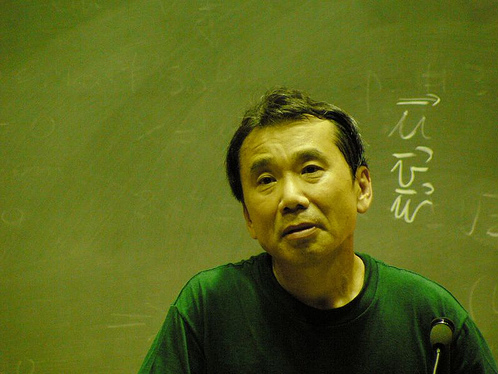
Haruki Murakami (Photo by Wakarimasita, Wikipedia, under Creative Commons Attribution ShareAlike 3.0)

And now to the book I received last night. It is Birthday stories, an anthology of thirteen short stories “selected and introduced by Haruki Murakami“. (The givers knew that I like Murakami.) The book was originally published in Japanese, Murakami having both selected and translated the stories from English, but was later published in English with “a specially written introduction”. The stories all deal with birthdays and are by such luminaries as Raymond CarverDavid Foster WallacePaul Theroux, and William Trevor – as well as by Murakami himself. Each story has a brief – and delightfully personal – introduction by Murakami.

In his introduction to the anthology, Murakami writes that his inspiration for compiling the anthology:

was my consecutive reading of two outstanding stories that happened to be based on the theme of birthday: “Timothy’s birthday” by William Trevor and “The Moor” by Russell Banks. … Both stories left me feeling haunted.

I imagine that there will be various interpretations of “birthday” from the day of one’s birth to those days in which we celebrate our own or the births of others. I rather like themed collections of short stories, and so am looking forward to reading this book – perhaps by dipping into it over time rather than reading it all at once, so you’ll probably hear about it as I go.

Meanwhile, I’m thinking that if these are the sorts of gifts arriving before Christmas, some wonderful delights must be in store for me when the day itself arrives! After all, you can never receive too many books for Christmas – can you?

Haruki Murakami (ed)
Birthday stories
London: Vintage Books, 2004
206pp.
ISBN: 0099481553

Little treasures (that’s novellas to you)

I realised a few years ago that quite a few (though by no means all) of my favourite works of fiction are novellas. I think it’s because I admire succinctness, the ability to convey an idea, feeling, impression in very few words. (By contrast, I love Big Fat Books – which I may post on another day – because you can get down deep and spend time with them like you do with a good friend).

I’m not going to get into arguments about definitions. My definition is simply that a novella is a short book, and that means (ignoring issues of printing styles resulting in different word numbers to a page) one that is under or not much over 200 pages. I’m prepared to be flexible on this! The Wikipedia article I’ve linked to above lists some famous novellas in its opening section. I’ve read several of them – including the Steinbeck, the Conrad and the Orwell – and rather like them, but for some reason they haven’t made it to the list I’ve been compiling over the last few years. And so, here is my list of really special novellas (to date):

The list-maker’s law says that whenever you make a list, the minute you finalise it you will think of more to add to it. I know that – but decided to go ahead anyhow because even though there are others I might wish I’d added, I know that these are ones I’m very glad I remembered. Almost half are by Australian writers, and the majority are relatively recent. I’m not sure whether the latter means that more novellas are written now or that I am reading more of them now? Is it that I appreciate terseness more the older I get? You know, time is running out so why waste words getting to the nub of things? These books, one way or another, get to the nub of things in ways that have managed to capture my imagination and not let it go long after I’ve finished them…and that, after all, is why many of us love to read.

What gives you joy?

I’ve just watched Andrew Denton interviewing Clive James on his Elders program. He asked James what gives him “joy”, and James replied “the Arts”. James said it didn’t have to be anything particular, it could be Marvin Gaye singing “I heard it through the grapevine” or the Adagio from Beethoven’s Ninth Sympathy or a painting by Toulouse Lautrec (whom he apparently adores). What a great answer! Being the eclectic dilettante (to lay it on thick) that I am, I can relate to that … I just hope all those responsible for funding education were watching. The Arts should be absolutely fundamental to any school program. (Now you know one of my soapboxes).

While James didn’t specifically mention books in response to that particular question, the interview did take place in his library. He is said to own 1000s of books. In response to Denton’s question about how we should judge him if we agree with the idea that we “can judge a man (hmm…) by his relationship to his books”, James said:

Intimately involved I should’ve thought. And this is just sort of the outer limit of the books that I own. And that immediately raises the question, not how many of them have you read – cause I really have read most of them, I’ve been alive a long time now – but how many of them will I read again? And if I won’t, why are they here? …[Answering this question he continued] I just like the look of them. I think the civilisation that exists in the book gets into you through osmosis, I like to have them around.

I hope he’s right … about the osmosis I mean! I sure know he’s right about liking to have them around.

Anyhow, anyone like to share what gives them joy?

The trouble with audiobooks (for me)

Headphones

Listening (Courtesy: OCAL on Clker.com)

Once was audiobooks were used primarily by visually impaired people and travellers, but with the rapidly increasing miniaturisation of audioplayers, audiobooks are now being “read” by people going on walks, working out in the gym, doing housework, sitting on public transport, or even working at their computers. In other words, people listen to audiobooks pretty well anywhere that they can. I am not, however, one of them. In fact, I can count on one hand (excluding snippets heard over the years on radio) the number of audiobooks I have “read” (or is that listened to?). Do you “read” an audiobook? How differently do you experience a book when you listen to it versus read it?

For me, the experience is so different that when I am in a listening situation I prefer radio and music to books. And here is why (but please, this is a purely personal thing – it is about how I like to enjoy books and is in no way intended to be prescriptive about how everyone should enjoy books):

  • I like to see the words – know how they are spelt and so on – partly, but not only, because this can be critical to my understanding (particularly with authors who engage in wordplay).
  • I like to stop and think as I read – ponder about a phrase or an idea, and even flip a few pages back sometimes to check a link that I think the author is making.
  • I like to make notes as I go and, if I own the book, I do this in the book – making notes helps me remember what I’m reading, and helps me write a blog or prepare notes for later discussion.
  • I don’t want to miss visual clues – some authors, and particularly post-modern ones, use visual clues and games to add to their text, but there are other more subtle visuals in “normal” books that you miss in an audio version.
  • I don’t particularly like it when a reader acts out the voices in a book – it distracts me from my own understanding of the text. The reader for the audiobook of Ruth Park’s Swords and crowns and rings (link here is to ANZLitLovers review), for example, irritated me intensely with her voices and dramatisation, though as she wore on I got used to her because it is a great story!
  • I like the physicality of the book (though I can probably relinquish this in the same way that I am pretty happily converting from CDs to iTunes for my music).

All this said, I have enjoyed a couple of audiobooks. The outstanding one was Roald Dahl reading his own Charlie and the Chocolate Factory. Authors readings their own works can be a hit-and-miss affair, but Roald Dahl was perfect. I heard snippets of Barack Obama reading his Dreams from my father on the radio and thought he also read his own work beautifully. On another tack, I enjoyed hearing Mary Durack’s memoir Kings in grass castles when we did a long long family trip several years ago.

Audiobooks clearly have their place. They work best for me when they are memoirs or simple plot-driven books rather than literary fiction, and so on the next very long trip we do I’ll probably seek out some memoirs. I also know that I will be very glad of their existence when (or, hopefully, if) my sight fails me. But, otherwise, I will be sticking to reading rather than listening…and this means that the technology that is likely to attract me is the eBook. I can see myself trying them in the not too distant future.

Arnold Zable, Sea of many returns

He leaps through centuries, tears apart myths, and reassembles them in his own way.

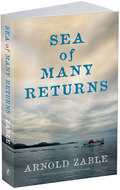
Sea of Many Returns cover

Cover image courtesy Text Publishing

These words that are said of one of the characters in Arnold Zable’s Sea of many returns could just as easily be said of Zable himself – not only of this book, but of his earlier ones such as Cafe Sheherazade. Zable loves telling stories, stories that weave between each other in an attempt to understand the impact of dislocation and exile on the human psyche – well, on his characters’ psyches but it is not hard to universalise this.

Sea of many returns is, essentially, a dual point-of-view novel:

  • the first person narrator, Xanthe, who was born in Melbourne to an Ithacan father and who tells her story; and
  • the third person story of Mentor, her paternal (also Ithacan) grandfather whose journals she is translating.

The story roams, backwards and forwards, from 1895 to present time as Xanthe and Mentor tell of the lives of their family members in Greece and Australia…about all their leavings and returnings, for work or adventure, or more terribly for war or, simply, to find a better life:

The stories I have heard, and am yet to hear, are echoes of one refrain: Is there somewhere on earth where I can find peace and prosper? Once the question is posed, the agony begins, the eternal dilemma: to stay or leave? To retreat behind fortifications, or cast our fate to the winds? (Xanthe, p. 203)

Underpinning this dilemma is the yearning for Ithaca – which translates, really, to the yearning for place, for home. Towards the end of the novel Mentor discusses the notion of “nostalgia” or “the pain of longing for the return”. Put this together with “the Ithacan phobia, the fear that I may never return” and the result is a melancholic – but not depressing – tone, since it is mostly accompanied by, if not always strength of mind, a resilience of spirit.

Not surprisingly, it’s the men who travel, at least in the earlier times of the book. As Xanthe’s aunt says, resignedly, “Let your men roam distant lands. Let them do what they must. What choice do we have? Bend your back to the mountain. Sow and reap”. And so, while Xanthe talks to some of the women in her Greek family, it is the men whose stories she seeks as she tries to understand her father, the angry Manoli, and her grandfather, Mentor. However, the book’s final section, titled “Epilogue: The resident tiller of the soil”, focuses on 90-something year old Irini who, quite paradoxically Xanthe realises, has not left Ithaca since her arrival there 90 years before and yet “is both voyager and teller, Odysseus and Homer”. This is perhaps a little elliptical but it has a certain resonance nonetheless! And Andreas does mutter in the previous section, “To know one place is to know all places”.

While the novel takes on a mythic overtone, it is “history” which provides its backbone and puts flesh on its characters: there are, for example, the way-too-many wars (to which many men go and from which some return), the 1916 anti-Greek riots in Kalgoorlie, the 1953 earthquakes in Ithaca, and the building in Melbourne of Cafe Australia and the Capitol by the Chicago architects, Walter Burley and Marion Mahoney Griffin. This last one seems a bit odd in terms of the overall thrust of the book but is interesting to one who lives in the city they planned!

I have only touched on a little of what this novel contains – there are the references to the Homeric quest and the story of Odysseus, there is the drunk but wise Niko, there is the beauty of the language in its rhythms and descriptions, and there is music – but if I go on, I might, like its storytellers, never stop. As Andreas says to Xanthe near the end

I have told you one version of the story and tomorrow I may tell it with a different slant. Each word I utter is true and false at the same time …

Paradoxical? Yes! But that is the essence of this lyrical and mesmerising but also rather mystifying – or, is that mythifying – book!

Arnold Zable
Sea of many returns
Melbourne: Text Publishing, 2008
307pp.
ISBN: 9781921351532