Barbara Hanrahan, The scent of eucalyptus

Writer-artist Barbara Hanrahan was born half a generation before I was and in the city of Adelaide not a country town in Queensland, but the childhood she depicts in her first novel, The scent of eucalyptus, could almost have been mine. Almost, but not quite, as I was brought up in a standard nuclear family and she by three women – her mother, grandmother, and Aunt Reece (who had Downs Syndrome) – resulting in a somewhat different experience of home-life even if not of wider society.

And there’s another more crucial difference. The half generation time lag accounts for a major change appearing on the horizon – in the education of women. Hanrahan, like my mother who was born nearly half a generation earlier, suffered from the reduced opportunities and low expectations that were women’s lot back then. Both were expected to undertake commercial training at high school – rather than join the academic streams they desired – in order to fulfil “the plan” as Hanrahan calls it:

“( … Our expectations were swallowed by shorthand symbols, hammered by typewriter keys, imprisoned by the columns of a neatly-ruled ledger whose credit column never balances its debit.)

I was part of a school that was a factory, pumping forth each year, from the swollen Commercial class, the girls of fifteen who would go to work as typists and clerks. At eighteen they would be engaged, at twenty, married, at thirty – old. These were the girls I stood with under the lacquered fig trees in the Grade Seven photograph. (They are at their prime at the age of twelve … )

How sad that is. I loved this book from beginning to end. The writing is poetic – not the sort of poetry that is full of allusions and ambiguities in which you have to work hard to locate meaning, but the sort that paints word pictures of both the physical and emotional landscape. An example is her description of a visit to relations in the hills:

“I remember rising while it was still dark to visit them; … watching the sky turn pale and frayed with light; seeing houses jump forward from the darkness; hearing the cold voices of first roosters, the kookaburra’s ruffled peal.”

The writing is rhythmic. There are few wasted words, there is effective use of repetition, there is stream of consciousness, and she uses punctuation precisely to control flow and meaning.

Hanrahan tells her story more or less chronologically, with thematic chapters interspersed at appropriate points and occasional asides foreshadowing her future. The novel spans her life – this is an autobiographical novel – from birth to puberty. It’s not strong on plot, but there is a powerful story here about the development of self. For example, in chapter 2, we see the origins of the artist she was to become: “As a child and ever after, the minute, hidden facets of things intrigued me”.

The first few chapters introduce us to the significant people – the “important” three – in her life. Here she is on her mother:

“My mother was a lark whose tongue was cut; a gull with clipped wings. She learned to expect nothing that she did not strive for … My mother trod a familiar path; hedged by as many briers as Sleeping Beauty’s ever was”.

Such economy of expression that conveys so much. She writes similarly of her grandmother and aunt, and we learn how “the three” love and support each other but also harbour disappointments. These, though, our narrator is barely aware of:

“(I was deceived by familiarity. I didn’t see, couldn’t see, forgot to reason.)”

And so the novel progresses through infancy, kindergarten, and primary school until we reach the point at which I began this post. She paints perfect pictures of school days, of special holidays, of childhood friendships, of fears and hobbies, of a flirtation with religion, and of a sense throughout, but becoming stronger as she grows older, of being “different”:

“And as I grew older I became adept at leaping quicksilver from one of my selves to the other. And as I grew older the split grew deeper, yet I forgot it was there.”

This is a delicious novel – the language is almost mesmeric, capturing a world that has passed and yet is still part of our cultural landscape. I will finish with one final excerpt which delighted me. She, like most Australians, grew up with the image of outback Australia, our “sunburnt country”, firmly entrenched in her mind, but she, also like most Australians, was “a city child” and so she asks:

“But where were the hills of the history book, stitched with the pathways of Burke and Sturt and Leichhardt?- the hills of the sun-burned earth and budgerigar grass, and azure skies and fiery mountains we sang about at school before the flag spangled with all the stars of the Southern Cross I was never sure of seeing? Where were the old dark people I did not link with the lost couples on suitcases at the railway station? Where were the crocodiles and brolgas, the billabongs and snakes? Where were the flowers that wilted in blistered clay, the rusty waves of Spinifex that looped the cliff?

… I looked about me for the sunburned land. In vain.”

This is not the end of the book … but is as fine a place as any to end my review because it, as much as anything, conveys the paradox of her childhood – the knowing one thing but the seeing of/the being something else. This is a book for all Australians to read … and for anyone else who is interested in a thoughtful, lyrical rendition of a childhood.

Barbara Hanrahan
The scent of eucalyptus
St Lucia: University of Queensland Press, 1973
188pp.
ISBN: 0702225169


The gift of words

Xmas Tree

There be words in there

Middle age has come
and all the plans and needs
are chaff not seeds,
blowing down the blue air
to fall flat and trampled
by some window where
a hopeful girl braids
her thick hair and hums.

(“Humble”, by Ginny Jackson)

Better late than … hmm, perhaps not, but I’m going to tell you anyhow.

I’ve noticed in recent years that I don’t receive a lot of books for Christmas – and when I do, they are often not fiction – but a few hardy gift-givers still bravely feed my obsession. And so, I received a small but intriguing bunch this year, which I will list by category:

Fiction:

  • Margaret Atwood‘s The year of the flood. Atwood is one of my favourite writers but I’ve dropped the baton on her a bit in recent years. I hope to pick it up again and run this year with this, her most recent. Thanks, Mum.
  • Helen Simonson’s Major Pettigrew’s last stand. I have already read and reviewed this one – and suggested at the time that there were people I knew who would enjoy it. I didn’t have a copy then so couldn’t lend it to them. I now do … thanks Sandra, from my bookgrouplist swap.

Poetry:

  • Ginny Jackson’s The still deceived. I can always rely on my brother to choose something a little bit different for me, and this year was no exception. My brother lives in Tasmania and this book, published by Ginninderra Press, is by a Tasmanian poet/artist. I have only dipped into it – but if you like the poem opening this post you might like to dip into it too. Thanks, bro!
  • There’s something about a rose. I knew immediately who chose this book – my Dad, the rose lover. It comprises a selection of poems and art celebrating, yes, roses, and was compiled by the Friends of Old Parliament House Rose Gardens. The poems are by Australian poets, some well-known, such as Barbara Blackman, Les Murray and Chris Wallace-Crabbe, and others not so well known (to me at least). I have already dipped into and enjoyed several of the poems…and may share some with you as the year goes on. Thanks, Dad.

Non-fiction:

  • The Canberra gardener. I’ve had previous editions of this gardening bible, but not for some years. Published by the Horticultural Society of Canberra, this one is the 10th edition published in 2010. The previous edition was published in 2004, just as our last serious drought was starting to bite. As a result, this new edition focuses on how to create lovely gardens with less water. Funnily enough, our dams are now suddenly full (last year they were at 50%) but we have all learnt (if we didn’t already know it) that Australia is a dry continent and that we should make water conservation a permanent goal regardless of annual fluctuations in water levels. This book will help me in my endeavour. Thanks, Carmel.
  • Roger McDonald‘s Australia’s wild places. I do like a good coffee table book and this is a good coffee table book. It’s published by the National Library of Australia and comprises landscape photographs of Australia from the Library’s collection. The photos were chosen by award-winning Australian novelist, Roger McDonald, whose books tend to have strong rural themes. The book has an introductory essay, with a strong environment message, by McDonald, followed by gorgeous images by some of our top photographers, including Peter Dombrovskis and Frank Hurley. It is just the book for me to look at now, as we prepare for our annual foray into the Snowy Mountains for a bit of post-Christmas R&R. It was given to me by a friend who spent most of her career working with these images. Thanks, Sylvia.

So, there you have it, six books from six people, each book reflecting a little bit of both the giver and the receiver. What more can one ask of a gift?

And now, if it’s not too late, I’d love to hear if any of you received books this year, and what they were.

Top fiction, et al, from 2010

Award Symbol

No. 1!

Well, 2010 is officially over so I reckon I can now safely present my top fiction of the year! As I listed my top Aussie reads in my last Monday musings post, this post will exclude Aussie writers. Partly for this reason, I’m not going to list the usual 5 or 10 here, but just those that rose to the top. What does it matter after all whether I list 7 or 10 or 13? The world will, in fact, still go round!

My top non-Aussie fiction of the year

In alphabetical order (with the title linked to my review):

  • Jorge Amado‘s Gabriela, clove and cinnamon. I  didn’t read a lot of non-English writers this year but this was one of them. Larger than life, and very colourful, it introduced me to a period of Brazilian history I knew little about and an author I’d like to read more.
  • John Banville‘s The infinities. I like Banville’s writing – this is my second of his. I particularly liked the somewhat tongue-in-cheek tone of this one.
  • MJ Hyland’s This is how. This is cheeky I know as I also listed it in my aforementioned Australian Top Fiction list. She really isn’t Australian, so I reserve the right to list her here too!
  • Hilary Mantel‘s Wolf Hall. One of my first reads of the year – and it got me off to a good start. I look forward to reading more Mantel in future, probably, the way I’m going, the sequel to this one.
  • David Mitchell’s The thousand autumns of Jacob de Zoet. This is probably the most controversial of my top reads for the year but I remain unapologetic about it. It wasn’t perfect but it was a thoroughly engaging read in a style that “mixed it up a bit”.
  • Haruki Murakami‘s Blind willow, sleeping woman. What can I say? I’ve scarcely met a Murakami I haven’t liked and this collection of short stories was no exception.

Some miscellaneous other “tops” of the year

  • The standout film for me this year was Animal Kingdom – but I did also thoroughly enjoy The King’s English which we saw just a couple of days ago.
  • My top short stories (excluding collections) were an older one, Kate Chopin’s Desirée’s baby, and a modern one, Nicole Krauss‘s The young painters.
  • The most intriguing piece of non-fiction writing I read this year was Alan Bennett’s The lady in the van.

So, that’s it. There were other tops of the year but, to take the advice of the immortal Mr Bennet, I have delighted you long enough and will now give you time to tell me your own favourites. But, before we get to that, I wish you all

a very happy 2011, full of brilliant books and delightful discussion (not to mention, of course, health, wealth and happiness!)

I thank you all for popping by my blog this year, and I particularly thank those of you who have taken the time to comment. I treasure every one of you and look forward to more interactions in 2011.

Now, your favourites?

Tracy Chevalier, Remarkable creatures

Bookcover

Cover image courtesy HarperCollins Australia

Most readers experience, I think, periods of reading synchronicity when we read books in close succession that are related in some way. I am experiencing such a period now as Tracy Chevalier‘s Remarkable creatures is the third book I’ve read recently to deal in some way with the first decades of the 19th century. The others are David Mitchell’s The thousand autumns of Jacob de Zoet and Peter Carey’s Parrot and Olivier in America.

Tracy Chevalier would not normally be high priority for me, but this book intrigued me because of its period and setting. You see, it is set in Lyme Regis in the early 1800s, and that rings a special bell for me! Yes, it’s to do with Jane Austen. Not only did she visit Lyme Regis, but she set a significant scene in Persuasion there*. So, my appetite was whetted.

But, I must say, I was somewhat disappointed. It’s not that I expected a lot, really, but I did expect a little more than I got. In other words, I didn’t expect exciting or innovative prose, but I did expect writing that wouldn’t bother me. However, it did, and this was mostly due to a lack of subtlety. The best writing shows, not tells, but there was way too much telling in this book, and it falls into two main types:

  • Giving “facts” that we should know. Here is Elizabeth over-explaining Mary’s calling her “Ma’am”, when she’d previously called her “Miss”:

And she was calling me “ma-am” now. Spinster or not, I had outgrown “miss”. Ladies were called “miss” while they still had a chance of marrying.

  • Describing something, such as a character’s emotions, when it should be (and usually is) apparent. Here is a bit of petulance that sounds rather silly in the first person voice of a supposedly mature Elizabeth:

As angry as I sounded, I was also secretly pleased that Colonel Birch had discovered the value of my fish enough to want one for himself.

(For a humorous review of an unsubtle book, do read Kerry, aka Hungry Like the Wolf, on Ken Follett’s The pillars of the earth.)

There are also a couple of rather gratuitous references to Jane Austen and her novels, gratuitous because the main characters don’t read novels and the reference to Austen adds nothing significant in terms of plot or characterisation. It’s as if Chevalier knew Austen went there and decided to draw on Austen’s current popularity by making the connection:

One of Miss Austen’s books had even featured Lyme Regis, but I did not read fiction and could not be persuaded to try it. Life itself was far messier, and did not end so tidily, with the heroine making the right match. We Philpot sisters were the very embodiment of that frayed life. I did not need novels to remind me of what I had missed.

Enough of all that, however. Let me give a quick rundown of the plot. It tells the story of two women who were fossil hunters in Lyme Regis in the first half of the nineteenth century. They were Mary Anning (1799-1847), a poor working class woman whose fossil finds helped change the course of paleontology, and Elizabeth Philpot (1780-1857), a gentlewoman who befriended Anning and who was particularly interested in fossil fish. Using known facts and novelistic licence, Chevalier has written an engaging story that focuses not only on the fossils and their impact on scientific and religious thinking of the time but also on the difficulties faced by women, particularly those unmarried like Philpot or unmarried and uneducated like Anning. Philpot says early in the novel that

… I had to find a passion: I was twenty-five years old, unlikely ever to marry, and in need of a hobby to fill my days. It is tedious being a lady sometimes.

Chevalier shows the financial precariousness of women, their lack of power, and how easily they can be exploited. Women, for example, were unable to belong to the Geological Society of London, and Mary’s collections (in particular) were written up in scientific journals by men, often with no credit given to her contribution. This is the real story of the novel and Chevalier captures well the circumscribed lives of women, and the challenges they faced in living independently. And yet, she undermines this by fabricating a jealous falling out between Elizabeth and Mary over a man. Did Chevalier really need to do this to make the story exciting?

That said, the characterisation is effective overall. She differentiates the two main characters not only by their very different voices, but also by creating a conceit for each of them. For Elizabeth it is her describing what people “lead with”. The forthright Mary, for example, leads with her eyes, while one of the foppish male characters leads, she says, with his hair. Good one, I thought! Mary’s conceit is being the “lightning girl”. The book begins with her being struck, but not killed, by lightning when she was a young girl. Lightning thereafter becomes a motif in her life for surprising or lucky events and for strong feelings.

Chevalier also writes some lovely descriptions – of people and landscapes:

While I accommodated her absence, a dull ache in my heart remained, like a fracture that, though healed, ever flares up during damp weather.

and

Lyme Regis is a town that has submitted to its geography rather than forced the land to submit to it …It is not planned, like Bath or Cheltenham or Brighton, but wriggles this way and that, as if trying to escape the hills and sea, and failing.

This is an enjoyable book for the glimpse it gives into the lives of two interesting and little known women, but the writing, for me, doesn’t quite do the story justice. For a more positive review, you may like to read Lisa’s at ANZLitLovers.

Tracy Chevalier
Remarkable creatures
London, HarperCollins, 2010
352pp.
ISBN: 9780007178384

*It is also the setting, of course, of John FowlesThe French lieutenant’s woman.

Peter Carey, Parrot and Olivier in America

Alexis de Tocqueville.

Alexis de Tocqueville (Presumed Public Domain, via Wikipedia)

It’s not surprising, really, that after living in America for two decades Peter Carey should turn his pen to it. Having lived in the US twice myself, I well understand the fascination of trying to understand that large and paradoxical country. In Parrot and Olivier in America, then, Carey sets out to explore America through the eyes of two men from early nineteenth century Europe: Olivier Jean-Baptiste de Clarel de Barfleur de Garmont, a French aristocrat whose parents had barely survived the French Revolution, and John ‘Parrot’ Larrit, a poor Englishman who had been brought to France as a boy by another French aristocrat.

Olivier was born in 1805, the same year that French writer and historian Alexis de Tocqueville was born. This is not a coincidence as the novel is Carey’s loose re-imagining of Tocqueville’s trip to America, with a friend, to study American prisons. Like Tocqueville, Olivier undertakes his trip with the support of the July monarchy, but Oliver’s companion is not an equal. Rather it is Parrot, servant-class and twice Olivier’s age. An unlikely pair, really, but perfect for Carey’s purposes …

… which are to pry into, poke at, and peer under that great American experiment, Democracy. Through having two protagonists of such diverse backgrounds and perspectives, Carey is able to explore the issues from different angles, that of master and servant. And through choosing the picaresque as his form (or style), he is able to do so without being ponderous. In other words, the tone is comic, as befits a picaresque novel, and the narrative comprises a series of adventures in which our “heroes”, Parrot and Olivier, meet a range of characters along the way who test them and their ideas. The novel is told in alternating, and well-differentiated, first person voices – starting with Olivier and ending, very even-handedly, with Parrot. It is basically chronological, but there are flashbacks to fill in gaps and frequent overlaps caused by one telling a story followed by the other giving his version.

That’s the nuts and bolts of it, but how does it come across? Well, in a word, exuberantly. That’s not to say it doesn’t have its serious side, but just that it’s rather fun to read. At least, it was for me, though that could be because of my personal history with America. Here, for example, are some of the observations which caught my attention:

On not needing government (Parrot talking with a tradesman):

‘When there is enough for all,’ the nail-maker said, ‘there is no need for government.’
‘But what of the poor.’
‘No man who will work can be poor.’

A little myopic methinks – but an idea that seems to be still entrenched in America?

On the focus on money and trade (Olivier):

No matter how strong their religious sentiments, or their passion about the reform of criminals, the Americans quickly revealed themselves to be obsessed with trade and money … They had got their hands on a mighty continent from which the least of them could, by dint of some effort, extract unlimited wealth. There being so much to be extracted it scarcely mattered how they were governed, because there is no need to argue when there is plenty for all.

For all, that is, if you are able to work, are not black and not indigenous! Even aristocratic Olivier noticed some of these contradictions.

On the ability to be self-made (Peek, the banker, to Olivier):

‘Experiment,’ he cried, laughing too violently for my taste. ‘There is no experiment. We make this transformation every day. It is called rags-to-riches …’

And on the possibility of art and culture in a democracy (Olivier):

… They [paintings in Philadelphia] made me think that the taste for ideal beauty – and the pleasure of seeing it depicted – can never be as intense or widespread among a democratic as an aristocratic people.

Hmm…Peter Carey is on record as expressing concern for the survival of culture. He said in his closing address at this year’s Sydney Writers’ Festival that ‘We have yet to grasp the fact that consuming cultural junk … is completely destructive of democracy’. In other words, Olivier/Carey question whether “high” art and “total” democracy are mutually exclusive? Somewhat related to this is Carey’s ongoing interest (see My life as a fake, and Theft: a love story) in authenticity in art. He explores it here through Olivier’s love of art, and the artistic endeavours of several characters, including Parrot and his mistress.

As for the story itself, there is a lot to enjoy. Olivier and Parrot have a complex relationship that develops from mutual disdain to a cautious friendship as the novel progresses. For all his attempts to be open-minded, Olivier never totally accepts the notion of equality between “men”, but Parrot, from both his early training and a generous nature, manages to tolerate and even accommodate this. Besides these two, there are characters from all strata of society: aristocrats, printers, bankers, land-owners, artists, actors, and so on. And, of course, there are romances, with Olivier’s playing out to a rather ironic conclusion.

One little demur, though. The book did not really engage me emotionally – something I tend to expect in longer novels – and I wonder whether this is partly due to the picaresque genre whose episodic and comic nature can have a distancing effect. Is this a failing? I think not, but it was noticeable, and means that the writing and ideas have to be powerful enough to carry the reader along. And mostly they do here, largely due to the novel’s pacing.

So, what is Carey’s conclusion? Well, it’s pretty even-handed, with both the aristocrat and the servant summing up their experience of America. But, in a twist on Tocqueville, the last words are Parrot’s. As a reader who always looks to see if structure informs the meaning, I wonder if this tells us something. Then again, there could be an element of irony in it. However you read it, there is no real answer to the question in the epigraph:

Can it be believed that the democracy which had overthrown the feudal system and vanquished kings will retreat before tradesmen and capitalists? (Alexis de Tocqueville)

Prophetic words, eh.

Peter Carey
Parrot and Olivier in America
London: Faber and Faber, 2010
578pp
ISBN: 9780571253319

The long and short of it, novelistically speaking

The novella has ambivalence built into its DNA. It’s neither one thing nor the other and tends to make you think even as it lures you down blind alleys and serves up irresolute endings.

(The Daily Beast)

Readers of this blog know that I am partial to short novels, particularly novellas. I always feel a little self-conscious saying this. I worry. Does it make me sound

  • Lazy, as in I can’t be bothered to read a long book? Or,
  • Impatient, as in I want to rack up my book reading stats and long books slow that down?

And to be honest, maybe there is a little bit of truth in these.

Big Fat Book

A long book requires a long commitment. Reading any literature requires attention and if you don’t have the concentrated time to give to a long book, you risk “losing the plot”, figuratively and literally speaking. In other words, if you read it in too many short spurts over too long a period of time, it can be hard keeping it all in your head. In the same time-frame you could very well have read two, three, four  or even six novellas (if, say, you were reading Vikram Seth‘s A suitable boy). You would have experienced a number of different perspectives on the world rather than just one – and you probably would have been challenged multiply by the often elliptical nature of the short novel. And this brings me to why I really like short novels …

I like, as the Daily Beast quote above says, being made to think while being lured down blind alleys and served up irresolute endings. Of course, the modern long novel can do that too … But with a short novel you tend to get tight prose. There are no wasted words. There are no long digressions – or multiple storylines …

What, no digressions? This is where the Big Fat Book comes in. When I wrote my post on novellas nearly a year ago, I said I’d write a post on long novels – and finally I am getting around to it, because, despite my general preference for short novels, I have read and enjoyed long ones*. First, here are some that I’ve read and enjoyed in the last decade:

Not a lot of them, eh, but memorable every one. And the reason is, I think, that you live with long novels. A short novel can engage your emotions, of course, but it is, I think, a more intellectual engagement in which our feelings are continually monitored by our brains: what are we feeling and why? A long novel is different. You become part of its life; the characters become “real” in a way that they rarely do in a short novel and you feel their loss when the book ends. This makes the reading experience very different. The brain is engaged, of course, but the emotions take the upper hand.

In fact, generalising wildly, I see the reading experience as going a bit like this:

  • In the short novel, with its tight prose and often minimal plot, your brain works hard to understand what is happening, where it is going, what it is all about, and then is suddenly confronted with an emotional kick at the end.
  • In the long novel, with its multiple story-lines and often frequent digressions, your emotions become engaged as you live the characters’ lives with them, love, cry, hate, worry with them, and then, when it’s all over, your brain comes in to work out what it was all about.
Detail from photographic portrait of Charles D...
Dickens, who wrote short and long novels (Image: Presumed Public Domain, via Wikipedia)

I say this relatively not absolutely, because of course we engage both emotion and intellect in all our (fiction) reading. However, it seems to encapsulate, for me at least, the mechanics behind my rather different responses to reading a short versus a long novel. Does this make any sense?

Anyhow, I’d better finish here and get back to my current, long and rather engaging, novel, Peter Carey‘s Parrot and Olivier in America. Review coming just as soon as I manage to finish it …

* A NOTE ON DEFINITIONS: Leaving aside those specific terms of “novellas” and “big fat books”, my rule of thumb definition is that short novels are under 300 pages, and long novels over 500 pages. The rest are, well, just novels.

David Mitchell, The thousand autumns of Jacob de Zoet

‘Oh I found ways to live to tell the tale. It’s my chief hobby-hawk is the noble art of survivin’.’

‘Loyalty looks simple,’ Grote tells him, ‘but it isn’t.’

‘…Expensive habit is honesty. Loyalty ain’t a simple matter, Di’nt I warn yer…’

It’s interesting that some of the main themes of David Mitchell‘s The thousand autumns of Jacob de Zoet are conveyed by one of its lesser (in terms of status) and more questionable (in terms of morality) characters, the Dutch cook, Arie Grote. Interesting because such a slippery and relatively minor character expresses some critical themes and because Mitchell’s making this choice provides a clue to the book’s tone and style. It has, in other words, a rather wry undertone.

Dejima model, Nagasaki

Model of Dejima, at Dejima Wharf, Nagasaki

So, what is its plot? Broadly, it is about the Dutch East India Company‘s activities on Dejima, a walled island in Nagasaki harbour, during Japan’s isolationist (or, “Cloistered Empire”) period, with most of the action taking place between 1799 and 1800. It follows Jacob de Zoet, a young man who arrives in 1799 to work as a clerk (and to make his fortune so he can return home to marry his love, Anna). What he finds is a multicultural community comprising Dutch, Japanese, a Prussian, an Irishman and others including Malay slaves, living and working within a complex web of ambitions, animosities and allegiances. He discovers pretty quickly that he’s going to need good survival skills to make it through. The question is: will he make it through, and will he do it with his integrity intact?

There is a love triangle of sorts, involving a young Japanese midwife named Orito. And there’s a drama centred on her “abduction” to a horrifying (invoking, for me, Margaret Atwood‘s The handmaid’s tale) monastery/nunnery called Mt Shiranui, which is overseen by the evil lord/abbot, Enomoto. This sounds, I admit, a bit melodramatic and in a way it is, but it seems to work, largely because of the characterisation.

The novel has a huge cast of characters, as this Character List (source unknown) shows and, over the course of 450+ pages, Mitchell gives us the backstories to many of them. At times I felt there was too much detail – as in “why do I need to know all this?” – but the stories were so interesting that I didn’t really mind. Mitchell is not, I have to say, a taker-outer and so, if you like your stories to move along at a fast clip, this is not for you. Many of the characters, from bottom to top of the hierarchy, are corrupt, as they scheme, bribe and manipulate for money, power and/or prestige, but not all are. Some of the most interesting characters are those who are not corrupt but are not perfect either. They include Jacob; the doctor/scientist, Dr Marinus, who tests Jacob somewhat cruelly; the young interpreter, Ogawa Uzaemon, who overlooks Jacob’s illegal importation of his Christian psalter; and John Penhaligon, the gout-ridden English captain who makes a play for Dejima late in the novel.

Having read and enjoyed Cloud atlas, I must say I kept expecting some, shall we call it, literary “tricksiness” but it never really appeared. This is historical fiction told in a linear fashion, albeit with the odd digression and some shifting perspectives. In fact, while not particularly “tricksy”, the style is not simple. There is a lot of variety in the telling:

  • dialogue (and italicised thoughts of characters, as conversations or action occur);
  • backstories;
  • set-ups that don’t always follow through as you would expect (such as that concerning Jacob’s hidden psalter);
  • scenes in which the main action is interspersed by something else going on (such as Cutlip preparing his boiled egg while Penhaligon negotiates with the slippery Prussian, Fischer);
  • action and adventure; and
  • a good deal of humour (including the scene in which a Japanese translator tries to translate a scientific lecture being given by Dr Marinus).

The language is similarly diverse. Mitchell uses irony, metaphor and symbolism, wordplay, and repetition, to name just a few techniques. Here, for example, is a rather lovely oxymoron:

The creeds of Enomoto’s order shine darkness on all things.

And here is a moving description related to an honourable death (without naming names):

An inch away is a go clamshell stone, perfect and smooth …
… a black butterfly lands on the white stone, and unfolds its wings.

I was impressed by the array of literary devices he used and how it never felt overdone. It was his language and characterisation, more than anything else, that kept me engaged.

The book does suffer a little, though, from the breadth of its concerns. I flicked through the book to jot down its themes and ran out of space on my page! So, I grouped them:

  • Political/historical: commerce, nationalism, colonialism and slavery
  • Philosophical: fate, faith and belief, truth
  • Social: education, oppression of women, science and enlightenment
  • Personal/psychological: loyalty and betrayal, honesty, love and integrity, survival

That’s a pretty broad church and, although some naturally overlap, the effect is to dilute the book’s impact somewhat.

So, how would I encapsulate it? Well, I’d sum it up as being about “imprisonment”, both literal and metaphorical. The Dutch are imprisoned on Dejima, the Japanese are imprisoned within their self-imposed isolationist policy, Orito and her “sisters” are imprisoned at Mt Shiranui. And people are imprisoned by their roles and/or culture. For example, women’s options are restricted, slaves have little control over their lives, and many of the characters, including Jacob, are imprisoned by their lack of economic resources that would enable them to freely choose their lives.

This is one of those rather unwieldy books that is hard to pin down but, despite this, I did rather enjoy watching Jacob and co. going about “the noble art of survivin'” in an intriguing place and time.

Monday musings on Australian literature: Dear Sir, or The cult of ugliness

As I was researching Ruth Park for last week’s Monday musings, I came across some “Letters to the editor” in The Sydney Morning Herald and thought they were worth sharing. (As you read them do note how some of the letter writers sign themselves.) I’ll start with a couple of letters criticising Park’s novels:

Sir, The type of literature exemplified in Ruth Park’s “Harp in the South” and the first two instalments of “Poor man’s orange” fits into a pattern which appears also in modern painting and sculpture, and perhaps in a lesser degree, in much modern music.

This general trend may be described as the “cult of ugliness” …

Why cannot she, with her undoubted talent for portraying people, let us believe there are some normal and pleasant people, whose trials and failures and successes, joys and sorrows, would still present a fruitful field for her literary powers?”

(H.E. Ellen, Cronulla, 13 July 1949, p. 2)

Ruth Park, in her novel about the Darcy family seems to revel in the unpleasantness and beastliness of life…

(K.W., Pymble, 15 July 1949)

… We all know that such conditions exist, but making them a subject for a novel will do nothing towards eliminating them.

It seems a pity that we should feel duty bound to hasten on Sunday morning to keep that part of the “Herald” from falling into the hands of the young.

(M. Blayney, Rozelle, 15 July 1949)

The Surry Hotel, Elizabeth Street, Surry Hills

Surry Hotel, Surry Hills (Courtesy: J Bar via Wikipedia, using CC-BY-SA 3.0)

Fortunately, though, other letter-writers saw value in the “cult of ugliness”, such as:

… Too many of us are cramped and stifled by our small world, so that when Miss Park flings a challenge to our “good” society, we shrink from the “ugliness” her claim contains, not willing to admit that the unpleasant morals of Surry Hills are to be found also in many a far more respectable suburb.

I should encourage my lads, were they old enough, to read these novels, for only by a personal touch with the fortunate and less fortunate, can they be really balanced in their adult outlook.

(Mother of Three, Lindfield, 15 July 1949)

… she has drawn a strong picture of loyalty and devotion in family life as it exists in the hearts of the poor and unfortunate, in spite of the worst possible conditions of living. One may just as well condemn Charles Dickens for exposing the horrors that existed in his day, as to condemn Ruth Park for the same objective …

(Mrs L.R. Fowler, 15 July 1949)

… Hughie Darcy’s loyalty to his friend, Mr Diamond, his understanding of his frailties, is born of a Christ-like love, however distorted it may appear to us …

Instead of writing scornfully about “nasty” novels, we need to “get under the skin” of our fellow Australian citizens and guard against such degradation in the future.

(G.M. Powell, St John’s Rectory, Mudgee, 15 July 1949)

Others distance themselves from the prudes and hypocrites who aren’t interested in facing society’s problems:

… “Poor man’s orange” … shows an understanding almost unrivalled in Australian literature of human psychology and of the problems facing certain sections of our society. I tender my congratulations to Miss Park and the “Herald” for writing and publishing, in spite of prudes and hypocrites, this human and moving story of slum life.

(Humanist, Sydney, 15 July 1949)

But my favourite of the supporters is G.M. Powell (already cited partially above) who praises Ruth Park’s ability to

look behind the dirty facade of human behaviour, and to find that the real personality behind it is really very lovable after all, and frequently very similar to us who walk the paths of rectitude…

Oh dear. Given more recent furores over books and “arts” in general (and I’m sure you all can name some favourite ones) which have engendered rather similar responses, it seems that we readers – including the prudes, hypocrites, and walkers in the paths of rectitude – are as universal as the subjects of the books we read. Funny that!

With thanks to the National Library of Australia for its wonderful newspaper digitisation project which made this post possible.

Ruth Park, Missus

Missus was the last written in Ruth Park‘s Harp in the South trilogy, but is the first in terms of chronology. The first two novels, Harp in the South and Poor man’s orange, were published in 1948 and 1949 respectively, while Missus was not published until 1985.

These first novels, which met with some controversy on publication, are set in early post-war Sydney, the tenements of Surry Hills, and deal with the lives of Mumma and Hughie Darcy and their daughters. Missus is set in the 1920s, in country New South Wales, and relates Mumma and Hughie’s youth and courting days. I have only just read Missus, partly because I read the first two in my teens which was, I have to admit, before Missus appeared on the scene.

You can tell that the writer of Missus is the writer of Swords and crowns and rings (1977). The latter is larger scale – and deals more consciously with its historical time-frame. That is, it more specifically addresses the wars and the Depression, and their impact on the main characters. However, the First World War and the coming Depression do provide the backdrop to Missus. Both books depict rural life and characters with convincing realism.

WARNING: SPOILER, IF YOU’VE NOT READ HARP IN THE SOUTH

Now, the plot. For those who’ve read the first two novels, the interest here is not whether Mumma (Margaret Kilker) and Hughie get together but how they get together and who they are. The first chapter – after a brief introduction to the town of Trafalgar including how the early settlers cruelly despatched the Indigenous inhabitants – introduces us to Hughie and his family. We meet his brother Jer (Jeremiah), who is born with “his feet back to front”, and we learn of the failure of his parents marriage, his mother’s early death and his being turfed out by his father when he was around 14 years old. Jer goes with him, and becomes both millstone and support from then on.

In Chapter 2, we are properly introduced to Margaret (who makes a brief appearance in the first chapter) and her family. Unlike Hughie, she grew up in a large, loving family, though not one without its stresses and losses. Margaret, we learn, has taken a shine to Hughie, much to her mother’s concern, because she sees Hughie for what he is, “a wild goose of a boy … [who’s] got flighty feet”, a “shifty article”. This mother (Rowena) is, in fact, a powerful presence. I love this description of Rowena after she decided to give up on (“on” being the operative word) her first true love:

Her chest ached as if it had a skewer stuck in it, but she tossed her head more often than she hung it.

From here on the story progresses chronologically as Hughie moves around the countryside obtaining and losing or leaving jobs, while Margaret stays at home waiting for Hughie’s occasional visits. The characters of our characters, if you know what I mean, are illuminated by the actions of, or their interactions with, other characters. Margaret’s younger sister, the jealous Josie, provides an interesting foil for Margaret as well as an opportunity for Park to explore women’s lack of rights. Josie marries young – for the wrong reason to the wrong man – and the marriage fails. She’s intelligent and manages to obtain accountant qualifications, but her attempt to set herself up as an accountant in the town fails because no-one will use a woman accountant. Other characters include Alf, Margaret’s long-suffering but sensible aunt who works as a housekeeper for the local priest and who, at different times, provides shelter and monetary support for Josie and Jer; the Biddles (the mustard-gas damaged Joe and his common law wife) who take in Hughie and then Jer at one time in their lives; and the redoubtable Bids Tookey who … but that might give away what little plot there is.

Sunday Creek, near Rutherglen

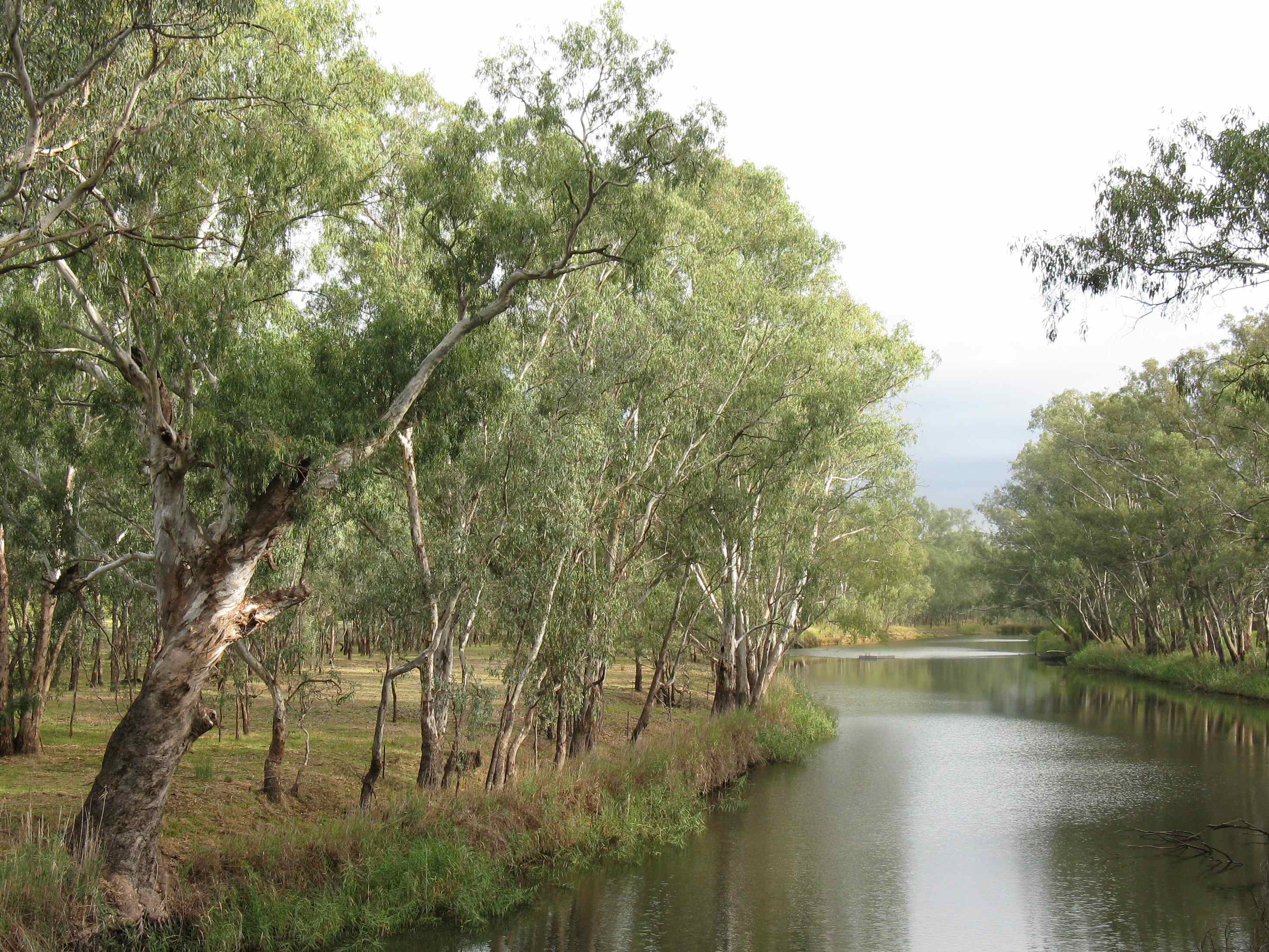
Australian country creek, lined by eucalypts

In just 250 pages Park paints a rich picture of 1920s life in rural Australia while at the same time developing Hughie and Margaret’s characters. Her characters are all flawed, some more than others, but she draws them with a clear-eyed warmth. She sees them for who they are but she respects them nonetheless. There’s no sentimentality here, but neither is it cynical or bitter. Her themes are universal ones: innocence and experience, familial and romantic love, deception and loyalty, most of it overlaid with that pragmatism that is necessary for survival in a hard place in hard times. As I wrote in this week’s Monday Musings, it’s not surprising that these books still resonate.

Finally, the language is lovely – simple, direct and evocative. Read this from the last few pages of the novel:

In the unkempt garden bloomed freesias and grape hyacinths. The eucalypt twig flushed red, the four creeks overflowed, lambs appeared on the hills, white as mushrooms and as sudden.

‘Them two had better wed quick,’ said Eny ominously, ‘or I won’t answer for Margaret’.

Ha! I think I’ll leave it there – pregnant with possibility …

Ruth Park
Missus
Ringwood: Penguin Books, 1985
247pp.
ISBN: 0140089438

Lionel Shriver, So much for that

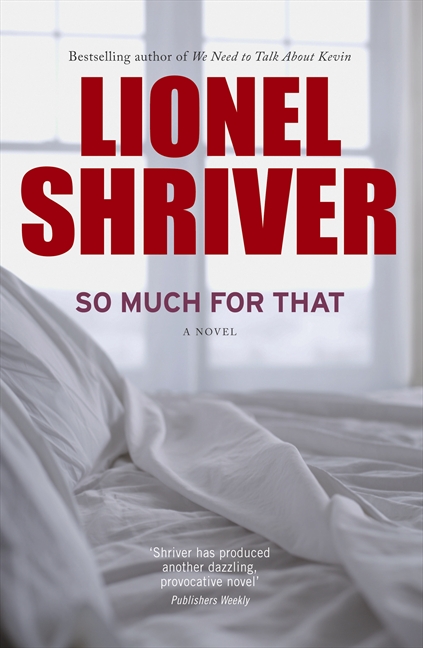
Lionel Shriver, So much for that

Book cover (Courtesy: HarperCollins Australia)

Having had my own rather traumatic experience of the American healthcare system back in the 1980s I was rather keen to read Lionel Shriver‘s latest offering, So much for that. And, I wasn’t disappointed – or, let me rephrase that, I found it an interesting and engaging page-turner though not a top-ten-of-the-year one.

First a quick plot summary. The book starts with 48-year-old nice-guy Shep Knacker planning to escape the American rat-race to his dreamed of, and as it turns out ironically named, AfterLife in Pemba off Zanzibar. Unfortunately, his plans turn sour with his wife’s announcement that she has a rare aggressive cancer called peritoneal mesothelioma and will need him to continue working, for his health insurance. Paralleling Shep and Glynis’ experience of health service and insurance – and told in roughly alternating chapters – is that of their good friends Jackson and Carol whose 16-year-old daughter, Flicka, was born with the degenerative disease, familial dysautonomia.

So, at the start we have a terminal cancer diagnosis and a child with a disease that is not likely to see her making old bones. Through the course of the novel, two more health issues are thrown in to round out the mix – aged care for Shep’s father after he falls and breaks his femur, and elective shall-we-say “vanity” surgery undertaken with disastrous results by Jackson. This all felt a little contrived to me – as did the occasional preachy dialogue that seemed to be there to make sure we got it. (Shriver is not a taker-outer I think!)

But, somehow, Shriver made it all work – right through to the rather surprising and, thus, risky ending. I liked the fact that she balanced the health care polemics with some wider issues such as the psychology and language of illness and the soul-destroying nature of the American (in particular) rat-race. And I liked the way she offset the plot and structural contrivances with a warm but unsentimental regard for her characters. Glynis and Flicka are not “pin-up” patients but “real” people who are angry with their lot and exhibit selfishness and petulance more often than meek forbearance. Glynis, like the character in Helen Garner‘s The spare room, is in denial about her fate pretty much to the end, and Flicka sees little value in living the sort of life she does. Both consequently feel little need to make it easier for those around them.

Most of Shep’s chapters commence with a statement of his net worth, which at the beginning of the novel is around $730K but which decreases with alarming rapidity as the months wear on and his poor insurance cover doesn’t begin to meet the costs of Glynis’ treatment. If you knew nothing before about co-payments, deductibles, co-insurers, out-of-network providers and lifetime payment caps, you’ll know all about them by the time you finish the book. (Apparently the most common cause of personal bankruptcy in the USA is medical debt.) But this is just the background – the polemics if you will – because the more interesting story is that of Shep and Glynis’ complicated but loving relationship, and of how friends and family react to the diagnosis. We feel Shep’s pain as he realises “he couldn’t fix things”. We understand Glynis’ eventual epiphany that “her husband had misguidedly hoarded his pennies, when the only currency they spent that had ever counted was time”. We cringe when we recognise ourselves in the friends who don’t visit often enough, who offer lip-service assistance rather than actual help. And we start to understand the real implications of cancer-speak that encourages an unrealistic belief in positive thinking, that suggests you can win the battle if you fight hard enough:

I know you mean well [says Shep to the oncologist], but after all this military talk she now equates – dying – with dishonor. With failure. With personal failure.

Near the end Shep asks the doctor what the $2 million spent on Glynis’ treatment (to date) had bought:

“Oh, I bet we’ve probably extended her life a good three months.”
“No, I’m sorry, Dr Goldman,” Shep said on the way out. “They were not a good three months”.

… leaving the real question, which Shep had previously asked his father, hanging:

“is there also a limit to how much you should pay to keep any one person alive?”

Lionel Shriver does not specifically answer this question in the novel but – despite the ending – you know exactly what she thinks.

There is more I could say about the novel. The story of Jackson and Carol, for example, offers the book more than a simple confirming parallel. There are some genuinely funny moments, particularly those between Shep and his free-loading sister Beryl, and those when Jackson pronounces yet another long-winded title for the book on “mugs and moochers” that he never will write. And there are some interesting discussions about art and artists, and about parenting in modern USA. But I’ve said enough I think to give a sense of what this book is about.

Shep says at the end that he’d “rather live a good story than read one”. I’ll leave you to ponder the implications of a novelist writing that line … and simply say that while this is not a perfect novel, I don’t begrudge having given up a bit of my good life to read it!

Lionel Shriver
So much for that
Sydney: Fourth Estate, 2010
433pp.
ISBN: 9780732287030