Hate trees! Love bumpy roads!

I was a contrary child. When my family went on long car trips, a few decades ago now, I would, in my sunny way, announce to my parents, “I hate trees, love bumpy roads”. Guess what my parents were talking about prior to this pronouncement from their co-operative first-born? This refrain, as you can imagine, has become one of those enduring family jokes, and particularly so now with my gums-inspired blog.

Anyhow, the thing is, while reading my current book, Andre Gide‘s The immoralist, I came across a description of trees:

Huge olive and carob trees, with cyclamen growing in their shadow; above, woods of chestnut trees, cool air, northern plants; below, lemon trees by the sea. The last are arranged in small terraces because of the slope, like a staircase of gardens, almost all the same, with a narrow path running through the middle from end to end. One enters them silently, like a thief. There one can dream, in the green shadows. The foliage is dense and heavy, no direct light can penetrate. The fragrant lemons hang like thick drops of wax; in the shade they look greenish-white; they are within reach, and taste sweet, sharp and refreshing.

And I realised that I have always loved trees. I did say I was a contrary child, didn’t I?

Pialligo gardenTrees are the stuff of childhood – they evoke adventure, magic, imagination. They are places to climb, to hide or rest in, to swing from or, of course, to read in. I had a climbing tree when I was young – a lovely old spreading custard apple tree. It’s an important part of my childhood memories. Naturally, this got me to thinking about my childhood reading and I realised that trees were always there too. I didn’t “know” many of them in my Australian environment but I loved the sound of them – large spreading oak trees, fragrant magnolias, lush weeping willows, elms, lindens, firs and so on. Trees, in fact, abound in children’s books, so I’m choosing just three that are particularly memorable to me. I’d love to know whether trees conjure up any special feelings from your childhood.

Like many young girls, I fancied myself Jo March (of Louisa May Alcott‘s Little women fame). What better role model could we find but this lively, adventurous young woman who also loved to read:

“No,” said Jo, “that dozy way wouldn’t suit me. I’ve laid in a heap of books, and I’m going to improve my shining hours reading on my perch in the old apple tree…”

Another favourite childhood novel was Johanna Spyri‘s Heidi (of which I was recently reminded by Iris). When Heidi is sent to Frankfurt to keep the sickly Clara company, she misses her home in the Alps:

It was still early, for Heidi was accustomed to get up early and run out at once to see how everything was looking, if the sky was blue and if the sun was already above the mountains, or if the fir trees were waving and the flowers had opened their eyes.

Heidi was one of those books which introduced me – an urban child – to the love of the countryside. (It also made me crave white bread rolls. Those rolls seemed so much better than anything I’d ever seen, and they introduced me to the vicarious enjoyment of food through literature, but that’s another story).

In Australian books, there were of course the gums, the most memorable being the one in Seven little Australians:

There was a tree falling, one of the great, gaunt, naked things that had been ringbarked long ago. All day it had swayed to and fro, rotten through and through; now there came up across the plain a puff of wind, and down it went before it. One wild ringing cry Judy gave, then she leaped across the ground, her arms outstretched to the little lad running with laughing eyes and lips straight to death.

I’ve always been fascinated by the fact that while Louisa May Alcott had the sweet, gentle Beth die, Ethel Turner did the reverse and chose that fate for the “cleverest” of the siblings, the one whose “brilliant inventive powers plunged them all into ceaseless scrapes”.  Interesting eh?

What you call Cult Fiction, I call …

Recently I wrote a post on why I love ABC’s Radio National, giving The Book Show as one of the reasons. Now, I will talk about why I love ABC TV. Or, at least, about The First Tuesday Bookclub and its spin-off Jennifer Byrne Presents. Both programs involve a panel discussing books. The First Tuesday Bookclub is a monthly program (on the first Tuesday of each month, no less)  in which Byrne, two regular panel members and two guests discuss, usually, a current book and an older one. Jennifer Byrne Presents is an occasional program in which Byrne and four guest panel members discuss a particular bookish topic such as bestsellers, crime fiction, travel writing.

One of these occasional programs was broadcast this week, and the topic was cult fiction. The guests were asked to name their favourite cult fiction book, and their choices were:

Fascinating, eh? After each panel member spoke a little to their choice, Byrne asked them …

What makes a cult book?

They tossed around a number of ideas, including that cult fiction should:

  • have some level of zeitgeist
  • have some sense of danger, of being a little off the beaten track, of being daring
  • be loved intensely (to the extent that people might dress up, talk the language such as Elvish, meet to discuss it, and so on)
  • have longevity
  • not be a bestseller

Not all the books nominated by the panel meet all these criteria, particularly the “bestseller” one.

Other questions Byrne asked were:

  • Does cult fiction have to be well-written? (Most panel members said yes)
  • Can you call a cult novel one you only read once? (The panel varied a little on this, though most believed it’s a book you read and read again)
  • Is your relationship with someone affected if you discover they don’t share your particular “cult fiction” love? (Again the panel varied but veered towards “yes”, though perhaps with a little bit of the tongue-firmly-planted-in-cheek)

Is Jane Austen a cult author?

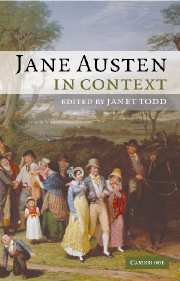
Janet Todd, ed, Jane Austen in context

Courtesy: Cambridge University Press

All this (of course) made me think of Jane Austen, and an essay by Deidre Shauna Lynch on the “Cult of Jane Austen” in Cambridge University Press’s book, Jane Austen in context (edited by Janet Todd). Lynch analyses the range of Jane Austen followers, from the fans to the scholars, and explores some of the implications behind Jane Austen ‘worship’ and the tensions that exist between those who wish to focus on her work and those who seek a more personal relationship with the author. She discusses how the latter group, in particular, have spawned a particular type of Jane Austen tourism that can be likened somewhat to that of pilgrims visiting their saint.

Coincidentally, around the time I read this essay, the Jane Austen House Museum wrote an open letter to the Jane Austen Society banning people from scattering ashes in Chawton‘s grounds. A manager said that while the Museum understood people’s desire to have their ashes scattered at Chawton:

we don’t really feel it’s appropriate. If it enriched the soil we wouldn’t mind so much but the ashes have no nutrients at all.

Oh dear! She does go on to say, however, that Jane Austen had a good sense of humour and that:

she would think it’s hilarious and be thrilled she inspired such devotion.

But, that’s enough of that … otherwise you will start to suspect me of Austen fandom.

Besides, what I really want to know is: How do you define cult fiction? And, do you love any books that you would put in this group?

Marie Munkara, Every secret thing

They all nodded, not knowing what the hell curry* was but getting gist of the story all the same.

Marie Munkara leads us a merry dance with Every secret thing, her first book, which won the David Unaipon Award for an unpublished Aboriginal or Torres Strait Islander writer. What exactly is this “thing” she presents to us? A novel? A short story collection? Well, I think it’s a bit of both. It looks like stand-alone short stories, and can probably be read that way. But, the same characters keep reappearing in the stories and there is a chronological thrust to it with a conclusion of sorts in the final story, so I’d call it connected short stories.

Form, though, is not the only way in which she leads us a merry dance. This is a genuinely funny book – sometimes slapstick or ribald, sometimes more bitter, satiric and/or ironic, but pretty well always funny. However, her subject matter is desperately serious – the destruction of indigenous culture through contact with white culture, specifically in this book through contact with missions and missionaries.

Bathurst Island (Tiwi Islands)
Approaching beautiful Bathurst Island (Tiwi Islands)

Marie Munkara was born in Arnhem Land and spent the first few years of her life on Bathurst Island in the Tiwi Islands. She left there when she was 3 years old, and didn’t return until she was 28. These stories, she says, are drawn from those told to her by friends and family, and are set, I think, in the early to mid twentieth century. She explores a wide range of issues reflective of indigenous-white contact at that time, including education and religion, the stolen generation, sexual abuse, the introduction of alcohol and disease, and anthropological research.

Munkara sees humour in everything (more or less) but her more biting humour is reserved for the “mission mob” because, of course, it is they who wield the power over the “bush mob”. The “bush mob” are shown to be intelligent and resourceful but no match for the power of the muruntawi (white people). Her language draws on a wide range of traditions – including indigenous storytelling, biblical, common clichés – and from these she tells stories that are only too believable. Here she tells us about one of the Brothers:

And so time passed and the natural progression of things came to be and the bullied became the bully, and the bully became the misogynist, and the misogynist became a Brother in a Catholic mission in a remote place in the Northern Territory… (“The sound of music”)

A too familiar story, told in a biblical tone. There is a funny story in which the “bush mob” tries to lead an anthropologist astray by feeding him incorrect information (such as obscene or silly names for ordinary objects), but their victory is Pyrrhic, as the end of the story conveys:

And after all, it was difficult sometimes to tell the difference between the missionaries and the madmen and the mercenaries because their eyes all looked the same and their tongues all spoke the same language of greed. If it wasn’t your soul they wanted, it was something else. Until it became an automatic response whenever a strange muruntani appeared to put out your hand for the specimen bottle to piss into or extend your arm for a blood sample to be taken or for the ungracious thought to pass through their mind that here was yet another who had come to take but as always gave nothing in return. (“Wurruwataka”)

Her stories about the stolen generations are particularly bitter, but again she uses humour. She tells the story of Marigold (née Tapalinga) who’d returned “home” after years away, only to find that she no longer fit, but:

Nor did Mrs Jones want the hussy back as their servant having sprung the little slut underneath Mr Jones in the spare room. The poor man was still traumatised by the ordeal. This wasn’t the first time she’d raped him, he claimed. (“Marigold”)

Only an indigenous writer could write something so patently ridiculous on this topic – and so drive the point home!

Munkara neatly tracks the Bishop’s behaviour and impact on his flock by constantly changing her epithet for him. In the first story, “The Bishop”, he is introduced as “his Most Distinguished” but is then referred to by various names including “his Most Garrulous”, “his Most Impatient” and “his Most Impious”. This changing of names for the Bishop is rather unsubtle humour but it carries a sly comment on the “mission mob’s” disrespect for indigenous culture by insisting on naming indigenous people, completely ignoring the fact that they have their own names. And so, in the first story, we are introduced to Matthew, Mark, Luke and John, to Epiphany, Lazarus, and John the Baptist, to name just a few of the cast of characters populating the book.

Another technique Munkara uses is to pepper her stories with white culture sayings and clichés, such as, “misery loves company alright”, “looking on the bright side”, “but you just can’t please everyone”, and this one:

And so it came to be that for the first time ever, the mission mob found themselves sitting where they’d never sat before – between a rock called ‘you didn’t see that one coming did you’ and a hard place called ‘bush mob’s indifference’. (“The good doctor”)

Overall, this is deceptively simple but clever writing that sets up and undermines its premises every step of the way. First “the mission mob” seems to be winning, and then “the bush mob”. However, while it could be said that “the bush mob” were “clever individuals who had learnt to sit on the wobbly fence of cultural evolution without falling off”, the real truth is that

They didn’t have to die to go to hell because the mission had happily brought that with them when they’d arrived unasked on the fateful shores of the place that was their heaven all those years ago. (“The movies”)

A spoonful of sugar, they say, makes the medicine go down, and that’s certainly true of this book. The sugar is not so strong though that you miss the medicine. Munkara makes sure of that – and the end result is a very funny but also very sobering book. I suspect and hope that Munkara has more … because the missions are only one facet of the history of contact in Australia. There is plenty for her to sink her teeth into.

Musings of a Literary Dilettante and Resident Judge have also reviewed this book.

Marie Munkara
Every secret thing
St Lucia: University of Queensland Press, 2009
181pp.
ISBN: 9780702237195

* Reference to the colloquialism “giving them curry”.

Albert Camus, The plague (orig. La peste)

All I maintain is that on this earth there are pestilences and there are victims, and it’s up to us, so far as possible, not to join forces with the pestilences. (Tarrou)

and

… to state quite simply  what we learn in a time of pestilence: that there are more things to admire in men than to despise. (Dr Rieux)

Albert Camus 1957

Camus 1957 (Public domain from the New York World-Telegram and Sun Newspaper Photograph Collection, via Wikipedia)

I love Albert CamusThe plague. I loved it when I first read it in my teens, and I’ve loved it every time I’ve read it since. Why is this? Well, firstly, I have always loved Tarrou’s quote above. As Tarrou goes on to say, “This may sound simple to the point of childishness; I can’t say if it’s simple, but I know it’s true”. Someone once said to me in our current more cynical century, “Oh, but that means accepting victimhood!”. I don’t see it that way though … and neither I think did Camus.

Tarrou’s, and Rieux’s, statements, then, are one reason I love this book. Another is that it can be read on multiple levels … but first a quick rundown of the plot for those who haven’t read it. It is set in the town of Oran, on the Algerian coast, in the late 1940s. The town is stricken by the plague, and so closes itself off for the duration of the disease. The novel then follows the progress of the disease and how the citizens cope with such a pestilence and its impact on their lives. We see the story through the actions and conversations of several characters including Dr Rieux, Tarrou (a “goodhumoured” but somewhat mysterious visitor to the town), Rambert (a visiting journalist), and more secondary characters including the Priest Paneloux,  Grand (a minor government official), and Cottard (a criminal).

That’s the basis of the literal story … but there are other levels. It can be seen as an allegory of the French occupation in World War 2, but I prefer to see it more broadly as a metaphorical story about how to live in an “absurd” (that is, inherently irrational) world. It might have been inspired by the Nazi occupation and the French Resistance, but I think Camus’ concerns are more universal.

So, how to talk about this book? In the sixty plus years since its publication, it has been under almost constant analysis from every angle you can think of. What can I add? I’m not sure but I’ll give it a go – and talk about what I see as the three critical concepts explored in the novel:

  • pestilences;
  • their impact;
  • how we are to live in a world in which they occur.

Camus sees the world as “absurd”, that is, one in which the irrational can, and will, happen:

Everybody knows that pestilences have a way of recurring in the world; yet somehow we find it hard to believe in ones that crash down on our heads from a blue sky. There have been as many plagues as wars in history; yet always plagues and wars take people equally by surprise.

Camus’ point seems to be that it doesn’t matter where this “irrationality” comes from – man or nature – but that it  does come, and it’s always a surprise. “Pestilences” is his word for the things that come and destablise us; they are the “impossible” things that make normal life not possible.

The impact of these pestilences is, in Camus’ view, very specific – loss of freedom, loss of individuality, loss of planning for the future, and apathy:

They fancied themselves free, and no-one will ever be free as long as there are pestilences.

and

They forced themselves never to think about the problematic day of escape, to cease looking to the future.

and

They maintained saving indifference.

So, how do we react to and live under pestilences? Camus explores three main reactions – rebel, escape and accept – and decides, not surprisingly, that the only real response is to rebel. Rebelling to him, though, doesn’t require a heroic taking to the hustings. It can simply mean not giving in. Here is Rieux:

What’s true of all the evils in the world is true of the plague as well. It helps men to rise above themselves. All the same, when you see the misery it brings, you’d be a mad man, or a coward, or stone-blind to give in tamely to the plague.

And so you do the decent thing, you do what you can to “fight” the plague and help your fellow humans. This is what Rieux, Tarrou and Grand do – and what Rambert eventually decides to do (saying that “this business is everybody’s business”) after spending much of the novel trying to escape. Rieux, Tarrou and Rambert spend a lot of time intellectualising the plague, while Grand gets on with it. Grand could be a laughable character – he devotes his spare time trying to find the right words for the first sentence of his book – but the narrator doesn’t laugh at him. Grand:

was the true embodiment of the quiet courage that inspired the sanitary groups. He had said ‘Yes’ without a moment’s hesitation and with a large-heartedness that was second nature to him.

When Rieux thanks him Grand says in surprise:

Why, that’s not difficult. Plague is here and we’ve got to make a stand, that’s obvious.

Meanwhile, Father Paneloux tries to understand the plague in terms of religion. His first reaction is that traditional one of God visiting his wrath upon a sinful people. But, as the plague sets in and he sees an innocent child die a painful death, he is forced to rethink his religion. He sees two options: to reject God or to totally accept whatever God presents. Since he is not willing to reject God, he decides that he must surrender totally to God’s will. Camus, it’s clear, doesn’t buy it!

Then there’s the criminal Cottard who flourishes under the plague. I won’t labour his story, but just say that one of the issues for him is that he’s safe from the police while the plague exists, and he relishes the fact that suddenly he’s not the only one who is miserable. In fact, as the townspeople become more miserable, the cheerier he becomes. He’s not prepared to join Rieux et al in their fight:

It’s not my job … What’s more, the plague suits me quite well and I see no reason why I should bother about trying to stop it.

The irony is that the person who most cares about Cottard is Grand!

Well, I have gone on about this novel, and could go on more. I’ve barely touched on its literary technique (its narrative style, structure, characterisation and language) but I think I’ve written enough. I will end with Rieux’s assessment of what it all means, because it means as much today as it did when it was written. That makes it a universal work.

None the less, he knew that the tale he had to tell could not be one of a final victory. It could be only the record of what had had to be done, and what assuredly would have to be done again in the never-ending fight against terror and its relentless onslaughts, despite their personal afflictions, by all who, while unable to be saints but refusing to bow down to pestilences, strive their utmost to be healers.

Camus’ worldview here is a moderate form of humanism, one that is realistically rather than idealistically based. It makes a lot of sense to me.

Albert Camus
(Trans. by Stuart Gilbert)
The plague
Middlesex: Penguin Books, 1960 (orig. 1948)
252pp.
ISBN: 0140014721

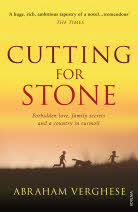
Abraham Verghese, Cutting for stone

Verghese, Cutting for Stone

Bookcover (Used by permission of the Random House Group Ltd)

I  saw a man under the spell of his own tale, a snake charmer whose serpent has become his turban.

I’m not sure how I want to use the above quote, which comes late in the book, but I just liked it and so decided to start this post with it. Bear with me!

Discounting Dinaw Mengestu‘s short story, An honest exit, Abraham Verghese‘s Cutting for stone is the first novel I’ve read that’s set in Ethiopia (mostly). And for that, as much as for anything else, I enjoyed it. Also, in one of those eerily frequent experiences of reading synchronicities, this is the second book that I’ve read this year to deal with a long-standing dictator – and, even more eerie, is the fact that dictators in Africa are falling (sort of) around our ears at present. How do these things happen?

Anyhow, Cutting for stone is about as different from Mario Vargas Llosa‘s The feast of the goat as it could be. In the latter, dictator Trujillo is central to the story. He is the story really. In Cutting for stone Haile Selassie, and later Mengistu, provide the background. The characters are touched and, eventually, significantly affected by coups and unrest, but Selassie and his reign are not the subject of the novel.

So what is its plot? It is mostly set in an Ethiopian hospital, aptly, metaphorically, named Missing (a perversion of its original name, Mission). To this mission hospital come an English surgeon (Thomas Stone) via India and a young Indian nun (Sister Mary Joseph Praise), with rather cataclysmic results. Some time later (I’ll leave you to draw your conclusions) identical conjoined male twins named Shiva and Marion are born. The story follows their lives as they grow up, living through political upheavals while their adoptive parents, Hema and Ghosh, treat the sick and poor of the region, until one of them moves to the United States. Perhaps the best way to describe it is to quote Psychologies from the back cover: “a sweeping saga of family life, love, betrayal and redemption”.  Get the picture?

This is a traditional nineteenth-century-style novel, reminiscent, say, of Rohinton Mistry‘s A fine balance (1995). It’s about social conditions and family. The back cover (again) suggests it has flavours of Dickens and Waugh. Perhaps, but a weak flavour I’d say. While it has some of the intensity of those writers, it lacks their bite. I also found the fundamental crisis – which, not surprisingly given the set-up, has to do with a betrayal between the twins over a woman – to be not quite convincing. Maybe it’s me, but the narrator kept telling us of his love for the girl-then-woman in question, Genet, and I went along with it to a point. But it was never made clear how mutual this was. Marion is the narrator – this is a first person tale – and so we see it all through his eyes, but the whole “love” storyline did feel a little bit like a house of cards. Perhaps that’s the point? Perhaps it’s about his obsession regardless of whether it was realistic or not. It is, after all, partly a coming of age novel.

Verghese, like his main characters, is a doctor and so there is a lot of detail about things medical – about vena cavas and how they relate to the liver, about fistulas in circumcised women, about volvulus, and so on. More detail really than I needed, and yet most of it was interesting. What was even more interesting was the difference between the medical system in Africa and in the United States, and then the difference in the United States between the “Mayflower” hospitals and the “Port Ellis” hospitals. There are social messages here about the construction of medicine in the developed and developing worlds, and between the haves and have-nots. But this wasn’t the only message. According to Wikipedia, Verghese is passionate about “bedside medicine” and there is certainly a strong message here of caring for patients as well as treating them. Early in the novel the young Marion sits with a woman, Tsige, as her son dies. Much later, he is the one who can answer Thomas Stone’s question “What treatment in an emergency is administered by ear?”. The answer? “Words of comfort”.

Marion, then, as a child and a young doctor is well attuned to the feelings of others and yet he was unable to forgive all those who “wronged” him – Genet, his brother, and his birth father. I found that somewhat inconsistent with his character, and it affected my ability to fully buy  into the angst on which the plot turned.

Nonetheless, I liked the characters and so I kept reading, the story was interesting and so I kept reading, the writing was fine and so I kept reading. It doesn’t quite hang together, is a little melodramatic at times, but it’s a lively tale about characters I couldn’t help caring about. Early in the novel, we are told that Hema, who raises the twins, had:

come close to defining the nameless ambition that had pushed her this far: to avoid the sheep life at all costs.

The novel is full of characters who “avoid the sheep life”.

I started the review with Marion’s description of his father telling the painful tale of his life. I’ll end with the advice Marion’s adoptive father gives him:

The key to your happiness is to own your own slippers, own who you are, own how you look, own your own family, own the talents you have, and own the ones you don’t. If you keep saying your slippers aren’t yours, then you’ll die searching, you’ll die bitter, always feeling you were promised more…

Obvious stuff really, but that doesn’t mean that it doesn’t need to be said.

Abraham Verghese
Cutting for stone
London: Vintage, 2010
541pp.
ISBN: 9870099443636

Helene Hanff, 84 Charing Cross Road

Before you all (well, those of you of a certain age at least) gasp and wonder how it could be that I haven’t read this delightful little tome before, I assure you that I have. However, on our drive home today from our week at the coast, we listened to an unabridged audiobook version, and I can’t resist sharing some thoughts from this most recent acquaintance with the book.

For those of you who haven’t read it, 84 Charing Cross Road could I suppose be described as a sort of epistolary memoir. It comprises the correspondence between an American writer and bibliophile, Helene Hanff, and Frank Doel of Marks & Co, a London bookshop specialising in secondhand and antiquarian books. The correspondence starts in 1949 and covers the next two decades. Over time, others in the Marks & Co family join in, but the essential relationship is always that between bookbuyer Helene and bookseller Frank. In a horrible bit of blurb writing, it is described on the back of my (almost antiquarian itself) paperback as “the very simple story of the love affair between …”. Well, that cheapens it because it’s not a love affair in the usual sense. It’s a business relationship that also becomes a friendship. He is married, she is not … and no romance ever ensues.

I am not going to write a full review of the “story”, about how Helene sent “care packages” to the staff of Marks & Co to brighten up their postwar rations-ridden lives, about its humour and humanity. Rather, I thought I’d just share a couple of the comments she, a true bibliophile, makes about books and reading.

One is to do with marginalia. Hanff, like me, likes marginalia. She does it herself, and she likes it in the secondhand books she buys. She says in response to a book received as a gift:

I wish you hadn’t been so over-courteous about putting the inscription on a card instead of on the flyleaf . It’s the bookseller coming out in you all, you were afraid you’d decrease its value. You would have increased it for the present owner. (And possibly for the future owner. I love inscriptions on flyleaves and notes in margins, I like the comradely sense of turning  pages someone else turned, and reading passages some one long gone has called my attention to.) (16 April 1951)

Another year, another book gift, and here is her response:

I do think it’s a very uneven exchange of Christmas presents. You’ll eat yours up in a week and have nothing left to show for it by New Year’s Day. I’ll have mine until the day I die – and die happy in the knowledge that I’m leaving it behind for someone else to love. I shall sprinkle pale pencil marks through it pointing out the best passages to some book-lover yet unborn. (12 December 1952).

Hanff was clearly a slow-reader and liked re-reading, but she was not sentimental about books per se. Here she is on managing her books:

I houseclean my books every spring and throw out those I’m never going to read again like I throw out clothes I’m never going to wear again. It shocks everybody. My friends are peculiar about books. They read all the bestsellers, they get through them as fast as possible, I think they skip a lot. And they NEVER read anything a second time so they don’t remember a word of it a year later. But they are profoundly shocked to see me drop a book in the wastebasket or give it away. The way they look at it, you buy a book, you read it, you put it on your shelf, you never open it again for the rest of your life BUT YOU DON’T THROW IT OUT! NOT IF IT HAS A HARD COVER ON IT! Why not? I personally can’t think of anything less sacrosanct that a bad book or even a mediocre book. (18 Sept 1952)

Ellen of Fat Books and Thin Women would agree I think. Check out her recent post in praise of re-reading, and see for yourselves. Those of you who’ve been reading my blog for a while will know that I too am not averse to a bit of re-reading. There is a special joy in revisiting loved books and learning from them anew, isn’t there?

Finally, (only) because I’m missing my Jane Austen meeting today due to the aforesaid travel, I will share with you her discovery of Jane Austen. Hanff, you see, was not one for “stories”. “It’s just stories. I don’t like stories” she wrote in an undated letter around 1963/64. She preferred history (“i-was-there-books”), essays, poetry and the like. However, in 1952, she discovered Jane Austen “and went out of my mind over Pride & Prejudice …”. I’m sure I would have liked Helene Hanff.

Helene Hanff
84 Charing Cross Road (Audio CD)
Read by Juliet Stevenson and John Nettles
Hachette Audio (orig. pub. 1970)
2 hrs (approx) on 2 compact discs
ISBN: 9781405502559

Freedom, a postscript

In one of those wonderful bits of reading synchronicities, I woke up this morning to read about US District Judge Roger Vinson declaring ObamaCare unconstitutional. Florida Governor Rick Scott (among others) agrees, saying that: “ObamaCare is an unprecedented and unconstitutional infringement on the liberty of the American people”. Those of us in other parts of the world wonder how much America is, in the end, willing to pay for this liberty. I hope it won’t be too much.

Anyhow, I did a little digging around … and came across an undated YouTube interview with Michael Badnarik on the blog of the Foundation for a Free Society. He was asked what Freedom means to him, and this is what he said:

It means not having any government involvement … I don’t need and don’t want the government helping me, making decisions it thinks are in my best interest.

And in the next sentence or two he mentions various apparently un-free things like drivers’ licences. Hmm …

He goes on to mention a wide range of issues, many of which bear good discussion but not, it seems, in his mind. Freedom, I know, is not a simple thing. I value it, but …

… here’s the thing (as I see it) – Jonathan Franzen touches on it but just doesn’t quite nail it – and that is that “no (wo)man is an island”. John Stuart Mill said that:

That the only purpose for which power can be rightfully exercised over any member of a civilised community, against his will, is to prevent harm to others …

and

The only freedom which deserves the name, is that of pursuing our own good in our own way, so long as we do not attempt to deprive others of theirs, or impede their efforts to obtain it.

In other words, Freedom is not an absolute concept … we are human (read “social”) beings and that, to me, involves responsibilities as well as rights. Responsibilities that, by definition, limit our freedom. Don’t they?

Finally, I write this post nervously – it is simple, and the concept is complex. I know that, and have no answer except one. Freedom cannot be absolute and surely must be discussed in that context. Otherwise, isn’t it a little paradoxical for the proponents of freedom to be arguing it absolutely?

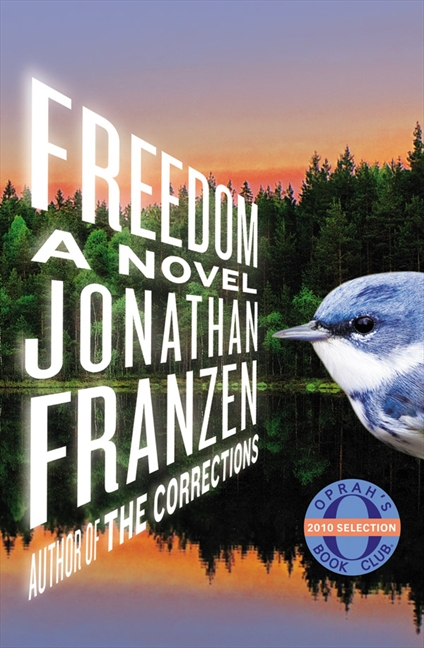
Jonathan Franzen, Freedom

Freedom bookcover, by Jonathan Franzen

Freedom bookcover (Courtesy: HarperCollins Australia)

Hmm … where to start? Half way through this book I was tiring. I wanted to say to Franzen “Enough already” (which, if you’ve read the book, has a certain appositeness). I also started to think of those song lines, so well-known to my generation:

Freedom’s just another word for nothing left to lose.

In fact, I thought of starting this post with that quote, but decided it would be just a little too twee – but somehow it ended up in the first paragraph nonetheless.

In some ways, Jonathan Franzen‘s latest novel, Freedom – which I must be the last blogger to read – is an interesting companion piece to Peter Carey‘s Parrot Olivier in America. They are wildly different in tone, style and historical setting but both explore the foundation upon which America is based, that of freedom of the individual. America tends to parlay this word about a little too, shall I say, freely, a little too unaware at times that freedom is not a simple concept but one that needs to be modified by a few “ifs” and “buts”. It’s these “ifs” and “buts” that confront Franzen’s characters, and that are recognised in those now immortal song lines. In other words, what Franzen’s characters find is that freedom in and of itself is no great shakes. It cannot exist in a vacuum …

But first, the plot. It chronicles the relationship of nice-guy Walter and mixed-up Patty Berglund (and, along the way, their family and friends). The opening paragraph starts around the middle of the chronology, with a rather teasing statement that Walter “had made a mess of his professional life” and then tracks back a few years to the early years of Walter and Patty’s marriage, before tracking back further to their youth and courtship, and then returns to the starting point and on to their future. Through this journey, Walter and Patty, residents of the Twin Cities, grow up, get married, have children, move east, get into a range of “pickles”, and … but that would be telling so I’ll leave the plot there.

It’s a rather complicated structure that owes a lot to postmodernism with its forwards-backwards movement, stories within a story (that is, Patty’s autobiography, told third person, in two distinct parts), a certain intratextuality (such as Patty’s autobiography being read by characters in the novel), the odd font change, and shifting points-of-view. It’s not, however, postmodern in its concerns – and is instead rather earnest, which is part of its problem. I’m not saying that it needs to be postmodern – we don’t need more self-conscious irony and clever playing with the idea of fiction – but it needs something fresh and challenging in characterisation, language and/or tone to carry it right through its 560 pages. Instead, it gets bogged down in too much earnest detail about life in modern America. It’s as though Franzen had a lot of things he wanted to say – about middle-class life, parenting, education, the environment, gentrification, politics, and music – and he was darned sure he was going to say them. We get, therefore, references to 9/11, Cheney and Bush, the war in Iraq, Obama, hints about the GFC, and so on. It’s a bit like Dickens, but without the sustained satire.

That said, there are some funny set pieces, such as the interview Richard (Walter’s friend and rival, and also lately successful rock star) gives to a young fan who wants to use Richard to attract a girl. Richard likens rock music to making chiclets, to being part of not against corporate, capitalist America. And I did love the description of why Walter preferred the aggressive driving of his young assistant, Lalitha, to driving himself:

Walter had come to prefer the anxiety of being her passenger to the judgmental anger that consumed him when he was at the wheel – the seemingly inescapable sense that, of all the drivers on the road, only he was traveling at the right speed, only he … [and on it goes for a page of road-rage inducing complaints].

But, getting back to the main game, what is this “freedom” all about? Most of the characters yearn for and/or experience freedom of one sort or another – they want to live their own lives their way. This can include not working, following one’s own heart regardless of the needs of those around you, having sex with whomever whenever you please, not being responsible for others, not doing the hard yards. And most find that the end result is not a satisfying one.

Walter, whom I presume is Franzen’s main mouthpiece, says:

The reason the system can’t be overthrown in this country … is all about freedom. The reason the free market in Europe is tempered by socialism is that they’re not so hung up on personal liberties … The Europeans are all-round more rational, basically. And the conversations about rights in this country isn’t rational. It’s taking place on the level of emotion, and class resentments, which is why the right is so good at exploiting it ..

This makes sense to me … but, the thing is that there are so many references to freedom that it is hard to locate the main message. This one is political. There are also more personal messages. Here is a description of Walter’s grandfather:

(The personality susceptible to the dream of limitless freedom is a personality also prone to, should the dream ever sour, to misanthropy and rage.)

And of Walter’s father:

He hated the blacks, the Indians, the well-educated, the hoity-toity, and especially, the federal government, and he loved his freedoms (to drink, to smoke, to hole up with his buddies in an ice-fishing hut) the more intensely for their being so modest.

We see parents giving children a “free pass” only to find those children, such as Walter’s brother Mitch, being a “free man” in the sense that he has no home, no secure job, no responsibilities. We see men, like Richard and Joey, thinking the freedom to have sex with anyone anytime will make them happy, but Joey, for example, after an amusing (to the reader!) scene in which he tries to live his fantasy, discovers who he really is:

This wasn’t the person he thought he was, or would have chosen to be if he’d been free to choose, but there was something  comforting about being an actual definite sometime …

And at this point he starts to grow up …

There is a lot to enjoy about this book, despite its bagginess. The characters do engage, flaws and all, and Franzen’s heart is, for me, in the right place. When I got to the end, I smiled and felt that Franzen had achieved something, even if it is simply to show that Freedom is a far more complicated concept than people like to think.

Jonathan Franzen
Freedom
London: Fourth Estate, 2010
562pp.
ISBN: 9780007318520

Mario Vargas Llosa, The feast of the Goat

Mario Vargas Llosa, signing books

Mario Vargas Llosa signing books in 2010 (Courtesty: Daniele Devoti, via Wikipedia, using CC-BY-2.0)

If Nobel Laureate Mario Vargas Llosa‘s The feast of the goat had been a traditional historical novel, chances are it would have started with the assassins concocting their plan and then worked chronologically to its logical conclusion. But, it is not a traditional historical novel, as is reflected in the structure Vargas Llosa has chosen to tell his story.

Before we get to that though, the plot. The central story revolves around the dying (literally) days of the 30-year Trujillo (“the Goat”, “the Benefactor”, “the devil”) regime in the Dominican Republic. This means the main action takes place in 1961. However, overlaying this is the perspective of Urania, the daughter of one of Trujillo’s head honchos. She’d left the country days before the regime ended and cut herself completely off from her father – for thirty-five years, until her sudden return at the novel’s start. The novel is told from these two time perspectives – 1960/61 and 1996 – and from multiple points-of-view*, the main ones being:

  • Urania
  • Trujillo
  • The conspirators/assassins

But this isn’t all there is to this novel’s structure and narrative style. I’m not quite sure how Vargas Llosa gets away with it, but he has written a book that is very accessible (once you get across the intricacies of Latin American names) and yet also rather complex. This complexity is found, primarily, in the structure. The book can, essentially, be divided into two parts. Chapters 1-16 proceed pretty systematically, cycling through, in turn, the stories of Urania, Trujillo (usually with one of his offsiders), and the Conspirators (usually focusing on one of them in particular). By Chapter 16 the two major crises of the book have occurred or been introduced. The last 8 chapters continue to cycle through different points-of-view but not in the same systematic order. In other words, the narrative structure becomes erratic and the rhythm more urgent, as chaos and uncertainty take over.

And yet, there’s more. For example, the novel is told primarily in third person, with the point-of-view changing chapter to chapter. But, every now and then, for just a sentence or two, or maybe a paragraph, the voice lapses into second person. This happens most often with Urania and conveys the sense that there has been some trauma that she hasn’t been able to fully integrate/recover from. We discover the origins of this trauma in Chapter 16, but it is not fully revealed until the last chapter.

… You were still a girl, when being a girl meant being totally innocent about certain things that had to do with desire, instincts, power, and the infinite excesses and bestialities that a combination of those things could mean in a country shaped by Trujillo. She was a bright girl … (Chapter 16)

This little slip into second person in Urania’s story is telling.

Okay, so this is the architecture, the behind-the-scenes technical stuff, but why write it this way? Well, the reasons are intellectual and emotional. Intellectual in that the multiple alternating points-of-view enable us to get a number of “stories” first hand. Through the eyes of the perpetrators and the disaffected, we explore the regime, and how, as happens so often with dictatorships, the early benefits are gradually (but surely) overshadowed by the corruption and violence perpetrated to maintain power, and how this leads to the assassination conspiracy. And emotional in that the constant shifting in perspective, particularly from people we can trust to those we can’t (to the best of our knowledge), and back again, unsettles and discomforts us … just as those who lived through the regime were kept on edge.

It’s impossible, without writing a thesis, to cover all the angles in this book, so I’m just going to look at one more – the characterisation of Trujillo himself. A historical novelist (rather like a biographer) has to choose what to include and what to exclude when describing a person. Vargas Llosa was lucky, really, that Trujillo had some traits that made this choice rather easy, traits that work on both the literal level and the ironic and metaphoric. Fairly early in the novel is this description of Trujillo

…that master manipulator of innocents, fools, and imbeciles, that astute exploiter of men’s vanity, greed and stupidity.

Fairly typical, wouldn’t you say, of a dictator? But, Trujillo was also fastidious about cleanliness and appearance, believing that

Appearance is the mirror of the soul.

If that’s so, then Trujillo’s “soul” is a very superficial thing because his disdain for the rights and feelings of others is palpable. Throughout the novel, Vargas Llosa sets Trujillo’s obsession with personal care (“the man who did not sweat, did not sleep, never had a wrinkle on his uniform, his tuxedo, or his street clothes”) against the coldness of his mind. That his mind is cold is made perfectly clear through his attitude to his offsiders (whom he liked to scare – “it cheered him to imagine the sizzling questions, suppositions, fears, suspicions he put into the head of that asshole who was the Minister of the Armed Forces”) and to women. This regime values machismo above all: it’s brutal to those those less powerful, and has careless disregard for the innocent. Women, of course, bear the brunt:

Again the memory of the girl at Mahogany House crossed his mind. An unpleasant episode. Would it have been better to shoot her on the spot, while she was looking at him with those eyes? Nonsense. He had never fired a gun gratuitously, least of all for things in bed. Only when there was no alternative, when it was absolutely necessary to move this country forward, or to wash away an insult.

Trujillo was nothing if not a master of self-justification.

How it all falls out, what happens after Chapter 16, is both expected and unexpected as those involved do or don’t do what they’d committed to. The end result is a devastating portrayal of how the political becomes the personal! Not a new message, perhaps, but The feast of the Goat is a compelling read that engaged my heart and mind. I recommend it.

Mario Vargas Llosa
(Trans. by Edith Grossman)
The feast of the goat
London: Faber and Faber, 2002
475pp.
ISBN: 9780571207763

* As in most historical fiction, the novel is peopled with historical characters and fictional ones. Most, in fact, are historical but Urania and her father, though based, I understand, on real people, are fictional.

On being a taxonomical reviewer

I was reading a review this morning of a poetry anthology, and the reviewer, one Dr. Martin Duwell I believe, said that the book “encourages the taxonomist in me”. Ah, I thought, a person after my own heart … because I too have a taxonomical bent in my approach to literature. (I am, it has to be said, a librarian/archivist by training/profession, but I suspect the choice of profession followed the bent, rather than vice versa!). Anyhow, back to the topic in hand.

It is natural I think to apply some level of taxonomical* thinking to reviews of anthologies. How have the poems/stories been organised? It’s rarely random. Sometimes it’s simply chronological or alphabetical (as in The best Australian poems 2009 that I mentioned in a recent Monday musings); sometimes there’s a clear thematic grouping, with headings perhaps (as in Dorothy Porter‘s The bee hut); sometimes it’s more subtle, more organic, with the component parts flowing from one to the other, in which cases the reader may or may discern the connection; and sometimes, perhaps, it really is random. The challenge for we taxonomical reviewers of course is to work out whether the last truly is the case – or, have we missed something? It can exercise the brain exceedingly!

Cahill Expressway loop

Cahill Expressway loop - not the painting but this image can be used! (Courtesy: Angus Fraser, via Wikipedia, using CC-BY-2.0)

Having considered the organisation issue, the next thing the taxonomical reviewer thinks about is: are there over-riding themes or styles or [pick your issue]? Sometimes, there is and it’s very clear, such as in those short story collections specifically gathered around a theme. I have a few in my collection, including Sisters compiled by Brigid McConville (in which the writers explore – well – it’s obvious from the title, isn’t it?) and Expressway compiled by Helen Daniel (in which the writers were invited to respond to Jeffrey Smart‘s painting “Cahill expressway”). But sometimes it’s not so obvious, as in, say Nam Le‘s highly-varied-in-voice-and-subject matter collection, The boat. Besides the possibly cop-out but nonetheless valid-enough idea (given the author’s personal history) that it’s about the diversity of human experience, I did glean a theme of survival running through the collection. I may be right, or I may be wrong, but it satisfies my need to comprehend the work as a whole, as well as its component parts.

But, the truly taxonomical reviewer (reader), will also approach a single work like a novel, taxonomically. And I – we, I presume – do this largely by looking at the structure. How has the work been put together, and why. Is it told chronologically in one voice? Is it a multiple point-of-view novel? Is the voice first-person, third person or even, occasionally, second-person? Where, in particular, writers have diverged from the more traditional chronological-one voice structure, why have they done so?  And, more importantly, has it worked? Why did Martin Amis write Time’s arrow in rewind? Why did Jim Crace use his four-part backwards-forwards structure in Being dead? Why did Jane Austen set up her “sense” and “sensibility” (or “pride” and “prejudice”) dichotomy? Why, and I will be discussing this in a coming review, did Mario Vargas Llosa use the rather complex multiple-point-of-view structure in The feast of the goat? The answers to these questions often help me locate the essential meaning of the work. That is, the meaning of the work for me.

I realise that this may all sound rather mechanistic and, if applied rigidly, it could be – but I think that for we taxonomical reviewers this approach is just one of the pens in our pencil-case. Sometimes there is nothing really to categorise/dissect or the categorisation/dissection is straightforward, but sometimes it can help. Sometimes, in a large, complex, unwieldy and/or diverse work, it can help us get to the core. The trick, though, is to be flexible. Elinor and Marianne in Sense and sensibility may, respectively, stand generally for those two character traits, but if we try to bind our analysis too closely to those dichotomies, not only will we tie ourselves in knots, but we’ll miss the fundamental humanity of Austen’s worldview. In other worse, to paraphrase Hamlet, it doesn’t do to think too “precisely on th’ event”. Rather, keep it loose, and meaning just might appear …

* I define “taxonomical” loosely to mean, categorising, ordering, structuring.