On the titling of books

Forget about judging books by their covers, what about titles? How important are they to you? Do you ever decide to read a book based on the title alone? Do you always (never, sometimes) consider the title when thinking about the meaning of a book?

Title Puzzle Clker M

Titles: They're a puzzlement (Courtesy: M, via clker.com)

It seems to be a fraught issue, this book titling business – and it makes me wonder just what import to ascribe to titles. Who decides on the title? Do authors always have the final say in the titling of their books? Well, no, they don’t … so, how much can/should we readers think about the title when discussing or thinking about the books we read. Is it worth wasting our time bothering about it as, for example, readers did with Wolf Hall. Why, many of us wondered, was Hilary Mantel‘s book called Wolf Hall? I had an answer, and so did others, but is it worth even bothering about if we don’t know whether the author created the title? This may be a bad example though. Hilary Mantel was an established author when Wolf Hall was published, so it’s likely she had more clout in the titling of her book than a first time author has. Hmm, then, how am I to know when an author has chosen the title and when he/she hasn’t – and therefore when it might be worth my while considering the title and when not?

And what about books which are published under different titles in different countries? Think Miss Smilla’s feeling for snow versus Smilla’s sense of snow. This is a tricky one though because, like The outsider versus The stranger, it is a translated book, so there’s a double whammy here. Not only has the title been translated, but it’s then been translated differently. Are these difference due to translation decisions or marketing ones? A better example might be Harry Potter and the philosopher’s stone versus Harry Potter and the sorcerer’s stone. What’s that about*? Marketing, of course. (And, I can’t help wondering whether the book might have met with less opposition in the USA if the title had not been changed to “sorcerer”?) Again, where does this title confusion, oops variation, leave we readers, particularly regarding our wish to understand and analyse what we are reading?

For an interesting discussion of book titling, read Caroline Baum’s article “What it takes to title a book” in the Sydney Morning Herald back in 2003. It answers some of the questions I raise above and gives some great examples, but it doesn’t really consider where the reader sits in all this (except as the target for marketing).

What say you on the book title issue?

* Rhetorical question. Reasons abound, some from Rowling herself, on the internet. My concern is the general issue, not this specific case.

All that holding, lifting and turning … the future of the book

Sense and sensibility book covers

Printed and e-Books for Jane Austen's Sense and sensibility

Back in May while I was travelling in Japan, Jennifer Byrne (host of The First Tuesday Bookclub) convened one of her special Jennifer Byrne Presents panel discussions, this one on “The future of the book”. I finally got around to watching it this week. Her panelists were Richard Watson (writer and strategist on the future!), Kate Eltham (writer and Executive Officer of the Queensland Writers Centre) and Richard Flanagan (award-winning novelist). You can read the transcript or watch the show on the ABC website.

I’m not going to analyse it in-depth, but Byrne kicked off the discussion by asking the panel for their response to “the theory that our connectedness with the net is actually impacting on our capacity to read and think deeply”. In exploring this and related questions, the panel talked about:

  • the pros and cons of distractions: do they, for example, encourage creativity or destroy our ability to concentrate?
  • the nature of writing and book production: will the novel (as we now know it!) survive in the new digital, web-based, more interactive environment?
  • the nature of reading: is it a social activity or a private act?
  • writing: will the (apparent) democratisation of writing and publishing make it impossible for writers to make a living out of writing – and if that happens what will happen to the novel (literature)?

But, the most entertaining point came late in the program from Jennifer Byrne:

I’d like to read from the Institute for the Future Of The Book. This is someone who wrote in last month and I think gives us an idea of the problem that does face print ahead. ‘Cause this is a guy… He says he reads almost exclusively on screen, he’s got a kindle, an iPad, an iPhone, a Blackberry, a laptop… ‘But this weekend I did something radical and old-school. I checked a big, thick book out of the library.’ This is the bit I love. ‘The physicality of the book, having to hold it open then lift and turn each page…’ (Laughs) ‘..was a lot more exhausting than I remembered.’ ‘That holding, lifting and turning distracted me from the book.’ What’s happening to modern people?

I’m not sure that we can generalise from this comment to “modern people” but this did make me laugh. And then I thought, hmmm, I do like to read on my Kindle. It is easy to hold (very much like a book), but it is the same (light) weight whether I am reading Ford Madox Ford‘s novella The good soldier or Leo Tolstoy‘s War and peace. I no longer need to have multiple books on the go: the one to read at home because it’s too heavy to lug around, and the smaller, lighter one that I can carry in my bag. Perhaps the comment is not quite as silly as it first sounds?

The program provides no answers. How could it?  And some of the opinions presented are, really, just that, opinions, based more on personal preferences and anecdote than research. But for those of us interested in the future of the book – of the novel, of the experience of reading – it’s yet another interesting discussion to ruminate on.

Hazel Rowley, Franklin and Eleanor: An extraordinary marriage

First Family of the United States

Roosevelt Family, 1919 (Courtesy: Franklin D Roosevelt Presidential Library and Museum, via Wikipedia

I wonder what would make an Australian biographer decide to write about an American couple? And I wonder, having now read Hazel Rowley’s Franklin and Eleanor: An extraordinary marriage, what she would have made of, say, Joseph and Enid Lyons, Australia’s own political power couple. Unfortunately we’ll never know as Rowley died just around the time this, her latest biography, was released. There is, of course, good reason for writing this story: Franklin and Eleanor are an interesting couple, and they did have an impact on the international stage, as well as their national one.

In her acknowledgements at the end of the book, Rowley writes:

I learned quickly that all sources, both primary and secondary, were unreliable. There was so much that could not be said, even in private letters…

Therein lies the rub for the would-be biographer of Franklin and Eleanor Roosevelt. There’s a lot of primary source material available. They wrote copiously to each other and to others, others wrote copiously to them and to others about them. There are diaries written by many in the Roosevelt circle. There’s Eleanor’s newspaper column, My Day, which she wrote for nearly three decades. And there are memoirs, interviews, and sundry other items documenting their private and public lives. Indeed, even though it’s known that some significant letters were destroyed, the biographer of Franklin and Eleanor is challenged by a surfeit of records, unlike those poor biographers of Jane Austen who try to make a lot out of what is a rather small historical record.

And yet, there are still gaps. This is, in the end, what makes fact different from fiction, isn’t it? When you are writing about real people you cannot know everything in their hearts, you cannot be sure of their real motivations, and so whatever biography we read, no matter how thoroughly researched and well written it is, there are things we will never know. With fiction – and maybe I’m being a little ingenuous – the character only exists in the author’s mind and on the page. Whatever the author tells us is all we can know and we must work with that …

Enough intro, let’s get to the book. Franklin and Eleanor: An extraordinary marriage is an extraordinary read. The research Rowley did was clearly comprehensive – as the endnotes demonstrate. Rowley takes, she says, a different tack to the other biographies out there by choosing to focus specifically on the marriage. Her thesis is that it was not simply a patched up compromise (after Franklin’s betrayal with Lucy Mercer) or simply a political marriage, but “a joint endeavour, a partnership that made it possible for the Roosevelts to become the spectacular and influential individuals they became”.

And that’s certainly how she presents it … and, moreover, how the evidence she presents suggests it was, though we’ll never know, really, what interior compromises the couple made in terms of their personal happiness. Eleanor was devastated by Franklin’s love affair with Lucy Mercer in 1918, and divorce was apparently mentioned. Threats of disinheritance and of loss of his political career plus, it seems, his love for Eleanor resulted in reconciliation and the marriage continued. However, it did shift gear, particularly after Franklin’s polio attack in 1922, and began to encompass a variety of “romantic friendships” for both. Eleanor wrote, many years later in her book You learn by living that

You must allow someone else to meet the need, without bitterness or envy, and accept it.

That tells us, I think, that the “new” marriage was not easily come by. But it also tells us that it was come by. And so, in the mid-1920s during Franklin’s “recovery” from polio,

Franklin had Warm Springs [resort bought by FDR]; Eleanor had Val-Kill [cottage]. Franklin had Missy; Eleanor had Nancy and Marion. Both had Louis Howe.

The fascinating thing about the Roosevelts is the loyalty they inspired in the people who worked with them. Many of the long-standing friendships and relationships chronicled in the book are with the secretaries, body guards, campaign managers, journalists who were in their employ or worked alongside them. There are stories galore in the book about how they opened their homes, including the White House, to others, enjoying communal living way before the 1960s.

The book is, as I’ve already mentioned, well-researched. Most of what Rowley tells us appears to be based on primary records (that are well documented in the extensive endnotes at the back of the book), and she occasionally indicates when she thinks the “facts” have been modified with an eye on posterity. But there are also times when she makes assumptions, such as her belief that Franklin and Lucy did not have a real “affair” because they had little opportunity to be alone; because Lucy was Catholic, single and probably a virgin; because they would have feared pregnancy; and so on. All logical enough but the facts aren’t known.

While the book is about their marriage, we don’t learn a lot about their parenting style. However, their political life is told at a general level – FDR’s New Deal, CCC and Lend-Lease programmes, his relationship with Churchill, and Eleanor’s political works including her involvement in the creation of the United Nations. We learn a little of how Eleanor’s more radical ideas were tempered by the supportive but more political Franklin. I loved a government official’s description of Eleanor at the United Nations General Assembly:

Never have I seen naiveté and cunning so gracefully blended.

As a 21st century reader, I was also interested in the behaviour of the press and how the extent of FDR’s handicap was either hidden from the press or, sometimes, hidden by the press from the public:

From today’s perspective, it is astounding that the press stuck to the rules. Even journalists who disliked Roosevelt respected the dignity of a handicapped man.

They weren’t perfect though. Towards the end of his life when he was sick and convalescing in the South, FDR was driven in his car one day in front of the press simply to halt the rumours that had started to fly. He apparently said:

Those newspapermen are a bunch of God-damned ghouls.

Little did he know!

It’s a great read – for its analysis of the “extraordinary marriage” and for its picture of the times. I thought, as I read of Eleanor’s debut early in the book, that her young womanhood was somewhat close in time and place to the women who populate Edith Wharton’s novels, but Eleanor, through either luck or good judgement, escaped the lives and fate of those characters. How lucky, really, for the world that she did.

Hazel Rowley
Franklin and Eleanor: An extraordinary marriage
New York: Farrer, Strauss and Giroux, 2011
345pp.
ISBN: 9780374158576

Willa Cather, When I knew Stephen Crane

American author Stephen Crane in 1899

Stephen Crane, 1899 (Photographer unknown; Presumed public domain, via Wikipedia)

I haven’t reviewed a Library of America offering for a while and so have decided it’s time I dipped again into its offerings. Willa Cather‘s essay/journalistic piece “When I knew Stephen Crane”, which they published last month, appealed to me because of a couple of synchronicities. One is that Lisa of ANZLitLovers reviewed Crane’s The red badge of courage a few days ago, reminding me that I have yet to read Crane. The other is a little more obscure. Colleen of Bookphilia wrote a post earlier this week in which she complained about Anthony Trollope‘s admission that he would, in order to meet a deadline, submit work that he believed was not very good. The synchronicity is that in her essay Cather writes that Crane

gave me to understand that he led a double literary life; writing in the first place the matter that pleased himself, and doing it very well; in the second place, any sort of stuff that would sell. And he remarked that his poor was just as bad as it could possibly be …

Not having read Crane, I don’t know whether he really did present poor stuff, but Colleen, I suspect, would not be impressed with this admission!

“When I knew Stephen Crane” was first published in 1900, two weeks after Crane’s death. It documents 21-year-old Cather’s meeting with 23-year-old Crane in 1895 at the offices of the Nebraska State Journal not long after the journal had published The red badge of courage. The introductory notes state that she changed some facts and suggests she did this “to foretell his tragic fate and to reflect [her] own interest in writing and literature”. I can believe this may be the case as the article is peppered with foreshadowings of his early death. Nonetheless, the notes argue that her report “sounds authentic”.

Certainly, she doesn’t try to present him in a heroic light. She describes him as “thin to emaciation, his face was gaunt and unshaven … His grey clothes were much the worse for wear … He wore a flannel shirt and a slovenly apology for a necktie.” He had, in other words, “a disreputable appearance”. She writes that she had read and helped edit, for the journal, The red badge of courage:

… the grammatical construction of the story was so faulty that the managing editor had several times called on me to edit the copy. In this way I had read it very carefully, and through the careless sentence structure I saw the wonder of that remarkable performance.

She writes eloquently of her moment of revelation from Crane, saying that

The soul has no message for the friends with whom we dine every week. It is silenced by custom and convention … It selects its listeners wilfully, and seemingly delights to waste its best upon the chance wayfarer who meets us in the highway at a fated hour.

Hmm … I think there’s a lot of truth in this, at least in my experience as a giver and receiver of such “messages”. Anyhow, Cather, on a night when “the white, western moonlight threw sharp, blue shadows below us”, felt lucky to have had such a moment with Crane, one in which he talks about his craft, “his slow method of composition”. He tells her that while The red badge of courage had been written in 9 days, he had been unconsciously working on it throughout his boyhood. He also tells her that it would be months after he got an idea for a story before he’d feel able to write it:

‘The detail of a thing has to filter through my blood, and then it comes out like a native product, but it takes forever’, he remarked.

Cather also briefly refutes the criticism by some that Crane is “the reporter in fiction”, arguing that his newspaper account of a shipwreck he’d experienced was “lifeless” but his “literary product” (“The open boat”) was “unsurpassed in its vividness and constructive perfection”.

She concludes the article on a somewhat sentimental note which is not surprising given its publication so soon after his death … but even this sentimentality is expressed in the robust language that we know Cather for:

He drank life to the lees, but at the banquet table where other men took their ease and jested over their wine, he stood a dark and silent figure, sombre as Poe himself, not wishing to be understood …

It is for Cather’s own writing and her insights into character, as much as for what I learnt about Crane, that I enjoyed reading this offering from LOA. I will still, however, read Crane one day.

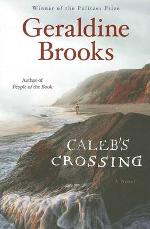
Geraldine Brooks, Caleb’s crossing

Geraldine Brooks, Caleb's Crossing

Caleb’s crossing book cover (Courtesy: HarperCollins Australia)

In the Afterword to her latest novel, Caleb’s crossing, which was inspired by the first Native American to graduate from Harvard College, Geraldine Brooks describes the reactions of members of the Wampanoag Tribe:

Individual tribal members have been encouraging and generous in sharing information and insights and in reading early drafts. Others have been frank in sharing reservations about an undertaking that fictionalises the life of a beloved figure and sets down an imagined version of that life that may be interpreted as factual. This afterword attempts to address those reservations somewhat by distinguishing scant fact from rampant invention.

This concern – “an imagined version … that may be interpreted as factual” – should by now be familiar to readers of Whispering Gums. In fact, this book has several synchronicities with my recent and current reads. There must be something in the water! Firstly, the issue of fictionalising the life of a historical figure is something I have raised a few times, but most recently in my review of Tansley’s A break in the chain. And then there’s Scott’s That deadman dance which explores early contact in Australia between white settlers and indigenous people. Very different stories and yet several similar concerns and issues, such as those regarding land, education, and cultural attitudes to material possession and to hunting. And there’s more! My next review will probably be Leslie Cannold‘s The book of Rachael which is set in biblical times and features a fictional woman who loves learning and rebels against the strictures of her gender.

I love it when my reading interacts closely like this, when books enable me to explore and play off ideas against each other – so I thought, given this and the fact that there are already many reviews out there, that I’d tease these out a little instead of my more usual review. But first a brief outline of the plot, which provides a mostly imagined backstory to the real Caleb Cheeshahteaumauk through the eyes (journals) of the fictional white girl/woman Bethia Mayfield. The book starts in 1660 when Bethia is 15 years old, but it quickly flashes back a few years to when she met Caleb while out clamming and it describes the friendship which developed between them, forged by a mutual interest in learning about each other’s culture. Idyllic really, but of course it doesn’t last. Caleb is noticed as a young man with the potential to achieve in the white world and comes to live with Bethia’s family, so he can be taught by her father. Eventually, Caleb and another indigenous student, Joel Iacoomis, go to school and then Harvard along with Bethia’s not particularly clever brother, Makepeace. By a cruel twist of fate, Bethia goes with them as an indentured servant. She’s not too disappointed about this because she hopes to surreptitiously acquire a bit of learning too. That’s the gist of the story … and if you know the history, you’ll also know roughly how it all ends, but I won’t spoil that here.

And so to the first issue, fictionalising a historical figure. Brooks is upfront in saying hers is “rampant invention” inspired by “scant fact”. Like Grenville in The secret river, Brooks uses a real figure to explore how and why it might have been, though, unlike Grenville, she retains the name of her inspiration. This muddies the water for the unwary reader but it is common to historical fiction. How many novels have been written about, for example, Anne Boleyn? I have no problem with this. She and Grenville, unlike Tansley, are very clear about their fiction and are not afraid to imagine where there are gaps. Her Caleb may not be the Caleb of history but he is a Caleb whose motivations makes sense:

You will pour across the land, and we will be smothered … We must find favor with your God, or die.

And this brings me to the second synchronicity, that concerning early contact between white settlers and indigenous inhabitants. Brooks (a white Australian author based in the USA) and Kim Scott (a Noongar author from Western Australia) explore similar territory but from different points of view: hers is told in the voice of a white woman, and Scott’s has a more complex narrative voice but from an indigenous perspective. Both explore the complexity in motivations. In white society, we see the whole gamut from altruism through attempts to “get along”/cooperate to arrogance, cruelty and greed. And we see an equally complex response from the indigenous people, from Caleb’s “if you can’t beat ’em join ’em” to Tequamuck’s anger and aggression. The end result, as history shows us, is the same … and neither book (nor Grenville’s) is anything other than realistic about it.

Finally, there’s the gender issue. This – like Grenville’s writing about colonial attitudes to indigenous people – is where writers are often criticised for being anachronistic, for putting modern attitudes into the mouths of historical people. It’s a criticism I tend not to share (providing the character is coherent within the text). “New” ideas do not pop out of nowhere. They grow and develop over time, and they grow from exceptional people – not necessarily well-known people, but people who thought ahead of their times – and novelists, almost by definition, tend to explore the “exceptional”. I have no problem believing that a “Bethia” or a “Rachael” lived in their times … just as I have no problem with what some critics have called Thornhill’s “anachronistic sensitivites” in The secret river.

Enough rambling, back to the book! Did I enjoy it? Yes. Did I think it worked? Partly. Geraldine Brooks is a good storyteller and I read this book in quicksmart time. I was interested in the characters and I wanted to know what happened to them. Brooks evokes the era well, using enough vocabulary and phrasing of the period to immerse you in the time and place. Her physical descriptions are beautiful. You know exactly why Bethia would prefer her island home to the streets of Cambridge. The themes – colonial cross-cultural conflict, gender roles, coping with loss – are valid and clear. And her wide cast of characters realistically cover the gamut of attitudes you’d expect.

And yet, I’m not sure she quite pulls it off. My concern is not so much with her vision, with the ideas she puts in the mouths of her characters, but with her mode of telling. She is rather heavy-handed with the foreshadowing. It’s a valid technique given the story is told in retrospect but it feels overused, which somewhat devalues its dramatic impact. I also wonder whether telling Caleb’s story through Bethia’s eyes means we don’t get to know Caleb well enough, resulting in our not being as emotionally engaged with him as we could be. There are hints of sexual tension between Bethia and Caleb but they are never played out. Perhaps doing so would have turned it to melodrama and yet, once hinted, it needed some resolution. I tend to like first person stories and the immediacy they provide, but maybe a different narrative voice (even multiple points of view) would have been better here.

All that said, it’s an enjoyable read. Reasonably early in the book, Bethia writes:

this truth my mother had voiced … that it could not go on, this crossing out of one world and into another.

Near the end she wonders:

If I had turned away from that boy … and ridden back to my own world and left him in peace with his gods and his spirits, would it have been better?

Would it? Now there’s the million dollar question!

Geraldine Brooks
Caleb’s crossing
London: Fourth Estate, 2011
306pp.
ISBN: 9780007367474

How’s this for a description of reading?

I was going to make this post another Delicious Descriptions, but decided it needed a more direct heading. It’s another quote from Kim Scott‘s That deadman dance and has been used by several reviewers of the book. But I think it needs a post of its own:

When Bobby Wabalaginy told the story, perhaps more than his own lifetime later, nearly all of his listeners knew of books and the language in them. But not, as we do, that you can dive deep into a book and not know just how deep until you return gasping to the surface, and are surprised at yourself, your new and so very sensitive skin. As if you’re someone else altogether, some new self trying on new words.

… and new ideas, emotions, ways of being, eh?

What say you to this? Do you you have a favourite description of reading?


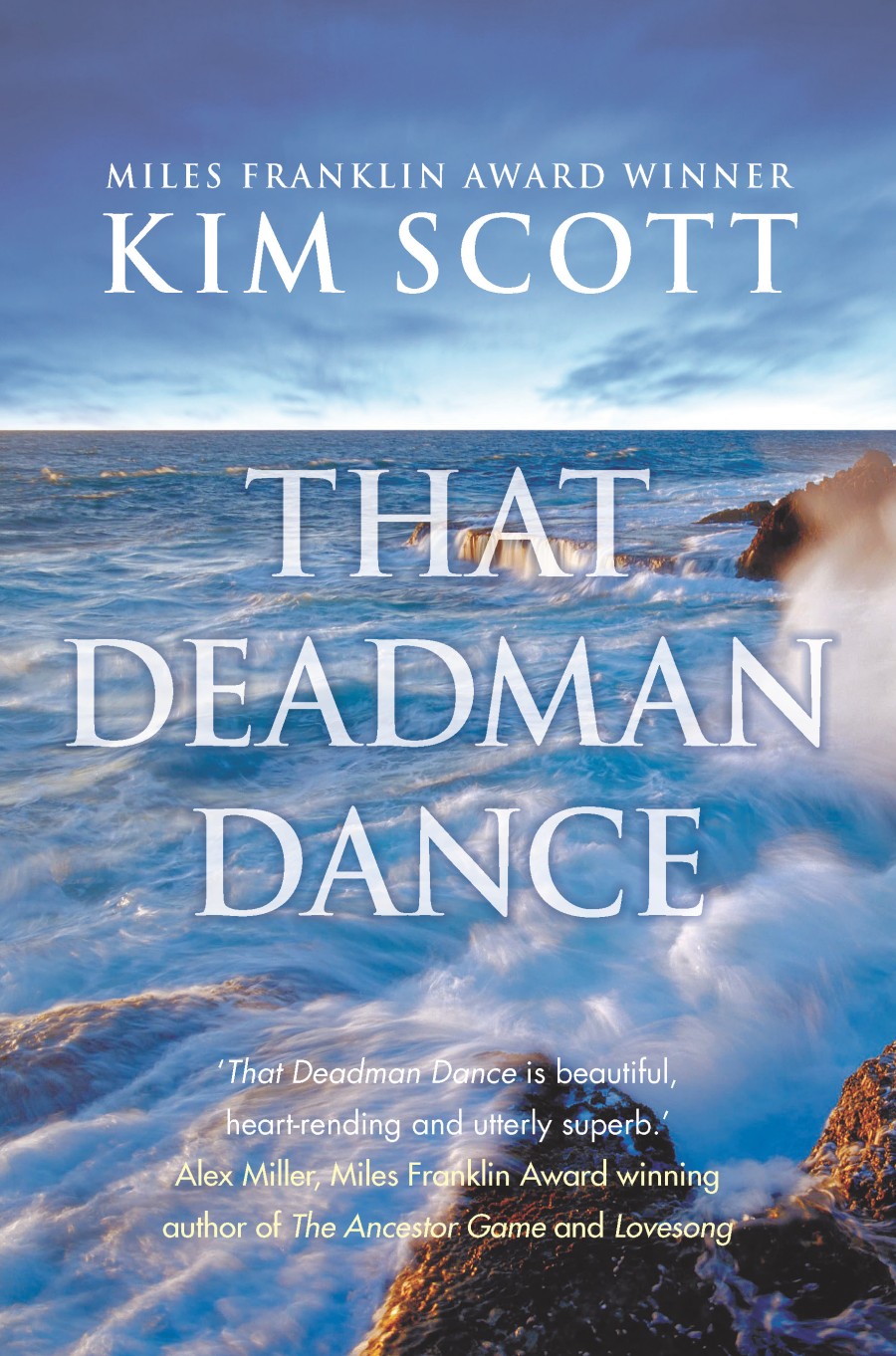
Kim Scott, That deadman dance

Kim Scott That Deadman Dance
(Image courtesy Picador Australia)

About a third of the way into Kim Scott‘s novel That deadman dance is this:

We thought making friends was the best thing, and never knew that when we took your flour and sugar and tea and blankets that we’d lose everything of ours. We learned your words and songs and stories, and never knew you didn’t want to hear ours.

And, it just about says it all. In fact, I could almost finish the post here … but I won’t.

That deadman dance is the first Indigenous Australian novel I’ve read about the first contact between indigenous people and the British settlers. I’ve read non-Indigenous Australian authors on early contact, such as Kate Grenville‘s The secret river, and I’ve read Indigenous authors on other aspects of indigenous experience such as Alexis Wright‘s Carpentaria and Marie Munkara’s Every secret thing. Kim Scott adds another perspective … and does it oh so cleverly.

The plot is pretty straightforward. There are the Noongar, the original inhabitants of southwest Western Australia, and into their home/land/country arrive the British. First, the sensitive and respectful Dr Cross, and then a motley group including the entrepreneurial Chaine and his family, the ex-Sergeant Killam, the soon-to-be-free convict Skelly, the escaped sailor Jak Tar, and Governor Spender and his family. The novel tracks the first years of this little colony, from 1826 to 1844.

That sounds straightforward doesn’t it? And it is, but it’s the telling that is clever. The point of view shifts fluidly from person to person, though there is one main voice, and that is the young Noongar boy (later man), Bobby Wabalanginy. The chronology also shifts somewhat. The novel starts with a prologue (in Bobby’s voice) and then progresses through four parts: Part 1, 1833-1836; Part 2, 1826-1830; Part 3, 1836-1838; and Part 4, 1841-44. And within this not quite straight chronology are some foreshadowings which mix up the chronology just that little bit more. The foreshadowings remind us that this is an historical novel: the ending is not going to be fairytale and the Indigenous people will end up the losers. But they don’t spoil the story because the characters are strong and, while you know (essentially) what will happen, you want to know how the story pans out and why it pans out that way.

What I found really clever – and beautiful – about the book is the language and how Scott plays with words and images to tell a story about land, place and home, and what it means for the various characters. His language clues us immediately into the cross-cultural theme underpinning the book. Take, for example, the words “roze a wail” on the first page:

“Boby Wablngn” wrote “roze a wail”.
But there was no whale. Bobby was remembering …
“Rite wail”.
Bobby already knew what it was to  be up close beside a right whale …

Whoa, I thought, there’s a lot going on here and I think I’m going to enjoy it. Although Bobby’s is not the only perspective we hear in the book, he is our guide. He is lively and intelligent, and crosses the two cultures with relative ease: just right for readers venturing into unfamiliar territory. He’s a great mimic, and creates dances and songs. The Dead Man Dance is the prime example. It’s inspired by the first white people (the “horizon people”) and evokes their regimented drills with rifles and their stiff-legged marching. There’s an irony to this dance of course: its name foretells while the dance itself conveys the willingness of the Noongar to incorporate (and enjoy) new ideas into their culture.

In fact there’s a lot of irony in the novel. Here is ex-Sergeant Killam:

Mr Killam was learning what it was to have someone move in on what you thought was your very own home. He thought that was the last straw. The very last.

And who was taking his land? Not the Noongar of course, but the Governor … and so power, as usual, wins.

The novel reiterates throughout the willingness – a willingness supported, I understand, by historical texts – of the Noongar to cooperate and adapt to new things in their land:

Bobby’s family knew one story of this place, and as deep as it is, it can accept such variations.

But, in the time-old story of colonisation, it was not to be. Even the respectful Dr Cross had his blinkers – “I’ve taken this land, Cross said. My land”. And so as the colony grew, women were taken, men were shot, kangaroos killed, waters fouled, whales whaled out, and so on. You know the story. When the Noongar took something in return such as flour, sheep, sugar, they were chased away, imprisoned, and worse.

I’d love to share some of the gorgeous descriptions in the book but I’ve probably written enough for now. You will, though, see some Delicious Descriptions in coming weeks from this book. I’ll finish with one final example of how Scott shows – without telling – cultural difference. It comes from a scene during an expedition led by Chaine to find land. They come across evidence of a campsite:

You could see where people camped – there was an old fire, diggings, even a faint path. Bobby was glad they’d left; he didn’t want to come across them without signalling their own presence first, but Chaine said, No, if we meet them we’ll deal with them, but no need to attract attention yet.

Need I say more*?

The book has garnered several awards and some excellent reviews, including those from my favourite Aussie bloggers: Lisa (ANZLitLovers), the Resident Judge, the Literary Dilettante, and Matt (A Novel Approach). Our reviews differ in approach – we are students, teachers, historians, and librarian/archivists – but we all agree that this is a book that’s a must to read.

Kim Scott
That deadman dance
Sydney: Picador, 2010
400pp.
ISBN:  9780330404235

* I should add, in case I have misled, that for all the truths this novel conveys about colonisation, it is not without vision and hope. It’s all in the way you read it.

Elizabeth Jolley, Diary of a weekend farmer

Elizabeth Jolley's Diary of a weekend farmer

Bookcover (Image courtesy Fremantle Arts Centre Press)

I took 2 valium and went to bed early (Monday 12th October, 1970)

Elizabeth Jolley’s Diary of a weekend farmer is one quirky memoir (if you can call it that). And yet it is, really, exactly what you might expect from a writer who rarely wrote the expected!

It is a slim volume – illustrated with warm, shimmery paintings by West Australian artist, Evelyn Kotai. The diary entries were written by Jolley at irregular intervals from 1970 to 1974 (probably), and are accompanied by poems by Jolley, plus the occasional contribution from her husband Leonard and daughter Ruth. Some of the entries are reflective

… being on this piece of land makes me feel very much aware of the shortness of life, I mean our human life in comparison with the land and the big old trees. (from Monday 6th [September, 1971] continued)

while others are factual

Ruth and I tried to plant tomatoes ground too dry and hard. (from 10th November 1970)

As you can see, little care (or perhaps a lot of care – how are we to know?) is taken with punctuation.

Jolley’s trademark wry, or even wicked, comments are in evidence

Next door’s place has been well cleared and conquered I think the word should be … (from 11th November 1970)

There is, in fact, a tiny plot running through the book and it has to do with the “neighbour woman”. She appears regularly as a rather ambiguous presence who doesn’t respect Elizabeth and her city-slicking family, and their farming endeavours, but offers some useful advice at times. Much of this “plot” is carried though a poem (“Neighbour Woman on the Fencing Wire”) which continues in sections throughout the book:

I suppose you didn’t notice last Sunday evening
you left your rake and mattock out …
(from “Continuation from the Fencing Wire”)

This woman is a little thorn in Jolley’s side – always pointing our her failings – and yet at the end, Jolley’s underlying compassion becomes evident as she writes of the “neighbour woman’s death” and her husband’s grief:

… and I understood I was face to face with someone who really loved the neighbour woman and that he would never get over something that is brushed aside in the word bereavement. (from No date required)

But, what this little volume particularly shows is her love of the land – along with her recognition of its challenges. Here’s one example:

Is it an alien place resisting or is it retreating from all our human endeavour. And then the doves fly up glowing in the rising sun and the sound from their wings is like a tiny clapping. (from Monday 25th February, 1973).

There is a very Jolley-esque tension here between an almost mystical beauty and a power that is not always benign.

And here is a reference to gums and their widow-making capability:

The wind moves the trees great branches fall
In the wind or in the stillness
A few feet nearer and I should have been crushed
Into the greater stillness.
(from “Great Branches Fall”)

These diary entries were made before her first book, Five acre virgin, and other stories, was published in 1976, though she’d had individual short  stories published from the 1960s on. When I read memoirs by writers, I look (of course) for references to writing. There is not much here, though. Besides the mention of something her husband said as being “a very good 1st sentence”, the main reference to her writing is this:

I finished the story “Pear Tree Dance” for the BBC, an idyllic ending! The newspaper of Claremont Street contains the grim and sinister side of things. (from 19th August 1971)

She’s right about that. Newspaper is one of my favourites of hers but it is rather grim. It was not published until 1981 … and is about a woman who wanted her own piece of land. I think I’ll leave it here – and let you ponder that idea!

Elizabeth Jolley
Diary of a weekend farmer
South Fremantle: Fremantle Arts Centre Press, 1993
ISBN: 1863680438
95pp

Joyce Carol Oates, Beasts

Joyce Carol Oates @ The Belmont Library

Creative Commons licensed image by San Mateo County Library via Flickr

If we wanted to be writers we must examine the world with fresh, sceptical eyes.

Beasts is, I’m ashamed to say, my first Joyce Carol Oates. She’s one of those writers who has kept crossing my path but whom I’ve never quite got to read. I bought Beasts a couple of years ago when I saw it on the remainder table of my favourite independent bookshop – and still it took me some time to get to read it, but I’m glad I finally did. I didn’t really know what to expect – and I’m not quite sure what I got – but I nonetheless found it a compelling read that is staying with me.

Take the opening quote, for example. On the surface it makes perfect sense, and yet when we know who says it we see a whole different layer of meaning to it, a layer that doesn’t necessarily remove the fundamental truth but that certainly shows how such a truth can be twisted or, at least, complicated.

The plot concerns a young college student and her obsession with her poetry writing class teacher, Andre Harrow. The novel (novella, in fact) starts some 25 years after the main events of the novel, when our narrator is at the Louvre in Paris and sees a piece of sculpture that reminds her of the work of Harrow’s wife, Dorcas. The sculpture is an earthy totemic piece that is “primitively human” or, in fact, rather beast-like. In this short three page chapter we are introduced to the notion that something not quite right has happened. “It wasn’t burned after all”, the narrator says, and then soon after mentions the horrible deaths some quarter of a century earlier, of “two people I’d loved”. The final sentence of the chapter is:

This is not a confession. You will see, I have nothing to hide.

As soon as you see a statement like that you can be pretty sure you are in the hands of an unreliable narrator, and this is so here – though she’s cleverly disguised and could be taken to be reliable. It’s all a matter of perspective really! The novel is told first person, in flashback, so we do need to be aware that what she is saying may very well be coloured by her knowledge and experience, that what she says she was feeling at the time, may not be quite right. This adds to the complexity of the book. The structure, though, is pretty straightforward. There’s the first chapter in Paris in 2001, followed by a chapter, set in 1976, describing the night of the house fire (in which the two people died). The third chapter takes place four months before that. From this, the novel works chronologically forward again to the fire.

The novel has a smallish cast of characters – there’s the narrator (Gillian), Andre Harrow and Dorcas, and the girls of the poetry class. Gradually a complex picture is built up of surface friendships with secrecy and jealousy lying just beneath. The reason for this is that pretty well all the girls are obsessed with Andre and each it seems, in turn, have their way with him (or, should I say, vice versa). But here the plot thickens … though perhaps I’ll leave it there for you to discover for yourselves.

Let’s just say that this book is an unsettling exploration of the (sexual) games people play, games in which people can and do get badly hurt. It’s easy to see the young women as the victims – and I must say that to a large degree I think they are. Whenever there is a power imbalance (and this is why I disagree with Helen Garner‘s take in her non-fiction book, The first stone), I see the major wrong as being with those in power. However, that does not mean that the less powerful are not complicit in some way, because often they are, and this seems to be the case with Gillian. She says “I was not predator seeking prey, I was myself the prey. I was the innocent party”. But she has choices, and she makes them, knowing ….

I was in love now. I took strength from my love for Mr Harrow. Though knowing, for I was no fool, that it could never be reciprocated.

And yet, she of course, like the girls before her, lets herself be drawn into a situation that is both thrilling and destructive. Harrow is an aficionado of DH Lawrence – Lawrence was big on campuses in the 1970s as I recollect – and tells his students (with terrible irony) that:

Lawrence is the supreme poet of Eros. No recriminations, no reproaches, no guilt, no ‘morality’. For what’s ‘morality’ but a noose around the neck? A noose? What’s ‘morality’ but what other people want you to do, for their own selfish unstated purposes.

Hmm … this sounds a bit like the Nietzschean conundrum explored in The immoralist doesn’t it, but Oates plays it out in a very different way by exploring its implications across gender, age/experience and power differences to see what falls out.

The novel starts with an epigraph from a DH Lawrence poem:

I love you, rotten
Delicious rottenness

… wonderful are the hellish experiences

Wonderful for whom one may well ask? The ending – or is it the beginning – provides no definite answer but it sure teases out the complexity of “love” running rather amok amongst people who think little about the ramifications of their actions. Damage, as it usually does in such situations, ensues. What price morality, eh?

Joyce Carol Oates
Beasts
London: Orion, 2002
138pp.
ISBN: 0752855921

Lloyd Jones, Hand me down world

I used to find myself saying, I can’t imagine. But, I’ve since found out, you can – it’s just a case of wanting to.

Hand me down world, bookcover

Book cover (Courtesy: Text Publishing)

What this character is talking about is empathy – and empathy, the having or not having it, is for me a major theme of New Zealand writer Lloyd Jones’ latest novel, Hand me down world. The novel is chock-full of characters who vary in their ability to empathise or not with other humans, to behave altruistically or selfishly towards others, to treat others with the dignity that all humans deserve or as nobodies to be ignored (or worse). These are not, in the real world, absolute alternatives but continuums along which we all position ourselves when relating to others. I think this positioning is one of the fundamental challenges of being human, and Lloyd Jones explores it in a novel which got me in from the get-go. In other words, I loved it.

This is a novel with a simple plot but a complex narrative. The plot concerns a young, poor African woman, a hotel worker, who leaves Africa using human-traffickers to find her son in Berlin. Why she does this is a shocking story revealed in the first chapter. The book follows her journey until its inevitable but not totally predictable conclusion.

What is particularly interesting about the book is how Jones has chosen to tell the story. It is divided into five parts:

1. What they said
2. Berlin
3. Defoe
4. Ines
5. Abebi

The first two parts comprise 13 chapters, each named for the narrator telling that part of the story. All but one of the narrators are first person and they chronicle their experience with the woman (whom we come to know as Ines) as she journeys to and finally arrives in Berlin. The third person narrator is “The inspector”. Why he is third person initially mystified me, but it all becomes clear when he reappears in Ines’ part. As I was reading these early chapters, I was reminded of Gabriel Garcia Marquez‘s Chronicle of a death foretold because they sounded like witness statements (and that, in fact, is what we later discover they are). This is not, though, a whodunnit, any more than Marquez’s book is, although a death does occur. Intrigued? You should be.

Anyhow, it is in these early chapters that the “empathy” theme starts to play out as it is in them that we hear how Ines gets from Africa, via Italy, to Berlin. She is “helped” by a number of people including a truck driver, snail collector, an alpine hunter, a chess player and a film researcher. Some of these people help her expecting nothing, some help her only if she gives something in return (and I’m sure you can guess what that might be), some help her but would like something in return, some are unsure whether to help her or not, and so on. It certainly makes you wonder what you would do, how far out of your way you would go.

Suffice it to say, she makes it to Berlin, manages to find a job, and starts searching for her son. But, I won’t talk more on that, so you can discover for yourself how her story plays out. What I will talk about instead are some of the other features of the book that make it such an interesting read.

Several metaphors run through the novel, but they never feel overworked. One that I particularly liked concerns phantoms/ghosts. Lloyd uses them to describe the marginalised or dispossessed. The pastor (who better to talk about ghosts?) speaks of ghosts in a number of contexts, including:

The ghost remains a spectre, no more than a possibility. Something to be afraid of. A manifestation of fear, such as the opposition parties in each and every undemocratic regime in Africa.

The other ghosts – the real ghosts if I may call them that – are simply those whom we choose not to see.

Ines, of course, is one of these – and later, when she considers stealing her son, she talks of teaching him “to turn himself into a ghost”. Another motif that runs through the book is that of versions and lies. Most of the early narrators are not exactly reliable, several people do not go by their own name and there are references to things being transformed (such as snails which can change gender and lungfish which can live in and out of water). When Defoe describes the lungfish (below) we see its reference to the way people change, to how we can transform (for good) or dissemble (for ill, such as the father of Ines’ baby):

Now he arrived at the question that interested him. At which point does it become the one thing and cease to be the other? In becoming that new thing how much does it retain of the other?

One of the little side stories in this multilayered novel concerns the old blind man Ralf in whose household Ines finds work. We learn from Ralf’s ex-wife, Hannah, that after her gentle, kind father-in-law had died they found a photograph that revealed his secret past as a photographer of atrocities during the Nazi regime. Ralf’s inability to come to terms with his father’s contradictory, secret past brings about the breakdown of his marriage. Meanwhile, Ines lies, steals and pretends in order to achieve her goal of developing a relationship with her son:

I had to see him. And that need turned me into someone with no heart or conscience. I didn’t care how the money was earnt.

It is difficult in fact to know who the real Ines is … but she is a wounded soul. Who are we to judge? Throughout the novel, in fact, Jones confronts us with imperfect people and challenges us to consider both them and their circumstances. How far can, should, our empathy extend? Uncomfortable questions but ones we must face.

During Ines’ story she says “I was shown more kindness than abuse” which reminded me of Rieux’s statement at the end of The plague that “there are more things to admire in men to despise”. I like to think they’re right but, with Camus and Jones, I also know that we need books like this to remind us that we still have a way to go …

Lisa at ANZLitlovers also enjoyed this book.

Lloyd Jones
Hand me down world
Melbourne, Text Publishing, 2010
352pp
ISBN: 9781921656682