National Bookshop Day the Third

Today is – though it’s almost over – National Bookshop Day. Last year I wrote a Monday Musings post on Australia’s second National Bookshop Day. It’s good to see that the momentum continues.

In last year’s post I named some of my favourite local bookshops – and nothing has changed in that regard except that Smith’s Alternative Bookshop has reinvented itself as an arts event venue but still with some books and a bookish focus.

So, this year, I thought I’d give a guernsey to my favourite second-hand bookshop. I don’t buy a lot of secondhand books, but when I do (or when I want to sell), I go to Beyond Q in Curtin. It has an extensive range of fiction, including classic Australian fiction, as well as a wonderful collection of old Penguins. Mr Gums likes the shop for its small collection of foreign language books, so we visit there every time he’s finished his latest German book. The collection is eclectic, and includes books originally published in other languages and translated into German – such as books by Agatha Christie and Georges Simenon. These often best suit Mr Gums’ competent but not expert German skills.

But there are other reasons we go to Beyond Q, because it is more than a bookshop. It also has a lovely little cosy cafe and offers live music most Friday evenings, and Saturday and Sunday afternoons (with entry via donation requested). It’s a happening little place in suburban Canberra, and we like it.

So, happy National Bookshop Day to my favourite bookshops … and I just want to let you know that as far as I’m concerned, every day is bookshop day!

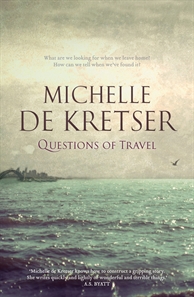
Michelle de Kretser, Questions of travel (Review)

Hardback cover (Courtesy: Allen & Unwin)

Hardback cover (Courtesy: Allen & Unwin)

Every now and then a book comes along that is so sweeping in its conception, that it almost defies review. Such a book is this year’s Miles Franklin Award winner, Questions of travel by Michelle de Kretser. Consequently, I’m going to focus on one aspect that particularly spoke to me – and that is her exploration of place and its meaning/s in contemporary society.

“Soon everyone will be a tourist”

As the title suggests, the novel is about travel – but travel in its widest sense. In fact, without being too corny, it is, really, about the journey of life. As our heroine Laura, thinking about her married lover Paul, ponders:

Perhaps she was an item on the checklist: the wild oats of Europe, the career back home, marriage, mortgage, fatherhood, adultery, the mandatory stopping places on the Ordinary Aussie Grand Tour, with renos*, divorce and a coronary to follow.

That made me splutter in my coffee …

First, though, a brief overview of the plot. The story is told chronologically, alternating between the Australian Laura and Sri Lankan Ravi. Both were born in the 1960s, and the novel chronicles their lives until 2004 when they’d be around 40. Laura, under-appreciated by her family (cruelly described by her father as “the runt of the bunch”) and aimless, travels the world before returning to Sydney in her mid-30s, still rather directionless, but now an experienced freelance travel-writer. Ravi grows up in Sri Lanka, marries and has a son, but a shocking event results in his coming to Australia in 2000 as an asylum-seeker, the same year that Laura returns. You might think at this point that you know where the novel is heading, but you’ll be getting no spoilers from me!

And so we have two significant types of traveller – the tourist (with some business travel thrown in) and the refugee/emigrant. De Kretser explores these comprehensively, and with, I must say, thrilling insight. Thrilling is an unusual word in this context, I suppose, but I can’t think of a better one to describe my reaction to the way de Kretser, point-by-point, unpicks the world of travel, skewering all sorts of assumptions, expectations and pretensions as she goes. I almost got to the point of cancelling my next overseas trip! After all, as Laura discovers, “to be a tourist was always too arrive too late”. How many times have you been told that x place was better in the 80s, only to remember that in the 80s you were told it was better in the 60s!

“Geography is destiny”

So Ravi is told by his teacher Brother Ignatius. This, for all the serious and satirical exploration of travel and tourism, is what the book means most to me. Brother Ignatius tells his students that “History is only a byproduct of geography”. While we could all have fun exploring a chicken-and-the-egg argument, I’d find it hard to deny its fundamental truth.

Laura spends most of the book travelling, or thinking and writing about travel. She’s the quintessential modern person, believing:

What was the modern age if not movement, travel, change?

Living in England she sees the long-standing connections people have to their place, while

Her own people struck Laura, by comparison, as a vigorous, shallow-rooted plant still adapting itself to alien soil.

She returns to Australia, following the death of the gay man she’d loved, hoping for meaning, connection. Geography, place, home had asserted itself … as it usually does. But life doesn’t prove to be much easier. Struggling to find her place, she finds once again that “noone was asking her to stay”.

Meanwhile, Ravi struggles to adjust to his circumstances. Grieving for what he’s lost, he (with his “eyes that had peered into hell”) goes through the motions of living and working. People such as his landlady and her family, and his work colleagues, are kind – enough – but de Kretser shows how skin-deep, how superficial, our practice of diversity and, worse, our humanity is. We do not easily accept people from “other” places. “Otherness”, de Kretser proves, “is readily opaque”. Australians, for example, ask Ravi which detention centre he’d been in because, of course, as an asylum-seeker that’s where he’d been! And, if he hadn’t, was he a “real” refugee. (One of the book’s many other themes, in fact, is “authenticity”.) Ravi, it has to be said, doesn’t help himself. He doesn’t share his history (should he have to?) and, fearing obligations, he resists any help that isn’t essential.

“Place had come undone”

While Laura and Ravi struggle with where they are, they also confront the fact that by the late twentieth century place isn’t only physical. Ravi had discovered, back in Sri Lanka, the world of “disembodied travel”, though his wife Malini had proclaimed “Bodies are always local”. This imagery, seemingly light at the time, carries a heavy weight. Later, finding settling into his new geographical location difficult, Ravi starts to find escape and even solace in virtual places, including visiting people’s homes via real estate sites. De Kretser doesn’t miss any opportunity to explore the ways we “travel” and it never feels forced. It all fits, emulating the way travel fits into our lives.

For Laura, the virtual intrudes mostly through work where she is a commissioning editor for Ramsays, a travel guide company. As the 21st century takes hold, the e-zone division of her company starts to increase in importance. Some of the novel’s best satire is found in the portrayal of corporate culture at Ramsays. It’s laugh-out-loud, sometimes excruciatingly so.

“Time was a magician, it always had something improbable up its sleeve …”

While the novel’s subject matter is travel, in all its guises and in what it says about how we relate to place and each other, the overriding theme is that literal and existential question, What Am I Doing Here? It tackles the big issues that confront us all every day – Time, Truth, Memory, Death and, of course, the most fraught of all, Other People.

Towards the end of the novel, Laura realises that:

… the moment that mattered on each journey resisted explanation … because it addressed only the individual heart.

We could say the same about a great book … and so I apologise for my paltry attempt here to explain de Kretser’s witty, warm and powerful novel. If you have any interest in contemporary literature and its take on modern living, this is the book for you.

For an equally positive perspective, check out Lisa’s (ANZLitLovers) excellent review.

Michelle de Kretser
Questions of travel
Sydney: Allen & Unwin, 2012
517pp
ISBN: 9781743317334

* Aussies commonly abbreviate words with “o” or “ie” endings. “Renos” therefore refers to “renovations”.
Identity … Cusack meets Heiss

A few days ago I reviewed Dymphna Cusack’s A window in the dark, a sort-of memoir of her two decades as a teacher. As seems to happen more often than not, I found synchronicities between it and my previous read, Anita Heiss’s Am I black enough for you? The main one relates to identity.

I shared, in this week’s Monday Musings, Heiss’s statement regarding the functions of Aboriginal literature. One of these is that it:

assists understanding of the diversity of our identities.

Literature, in other words, helps us understand who we are and where we come from – and it does this both for “us” (those who belong) and “other” (those who are outside but are related in some way).

Cusack argues strongly for “relevant” education and is critical of a curriculum that seemed suited only to a university-bound minority. This doesn’t mean, though, that she wanted to promote a purely “practical” or “vocationally-oriented” curriculum. As a student of history and literature, she believed in the importance of the humanities BUT she also believed that they needed to be relevant. For example, she believed that rather than forcing all students to learn ancient languages (like Latin), they needed to be expert in their own language:

But I soon came to realise that English and history teachers have in their hands the tools with which a genuine education is forged. In all the countries in which I have since lived, I have realised the particular and vital importance of teaching the native language. This is not only the vocal instrument by which one learns to express one’s thoughts; it is the key to the thoughts of others …

She believed, in other words, that all students – academic and non-academic – should be inculcated

with a love of literature and the capacity to express themselves clearly – surely the best heritage heirs to all our culture can have …

Because

The more we know about our background, the better we know our identity …

So, there we have it … Cusack, writing in 1976 of her experience in the 1920s-40s, and Heiss, writing nearly 40 years later, both argue that identity (knowing who we are) is intrinsically linked to language, literature and history. This may be self-evident to most of us, but somehow it seems, we need to keep reiterating it … and so here I am, doing my bit …

Dymphna Cusack, A window in the dark (Review)

Dymphna Cusack‘s A window in the dark has been glaring at me from my TBR pile for many years now. Not being able to stand it any longer, I decided to sneak it in before my next reading group book, Michelle de Kretser‘s Questions of travel. Posthumously published by the National Library of Australia, A window in the dark is Cusack’s chronicle of her teaching years, spanning 1922 to 1943.

For those who haven’t heard of her, Dymphna Cusack (1902-1981) is an Australian writer best known for her collaborative novel (with Florence James), Come in spinner (1951), and Caddie, the story of a barmaid (1953), which was made into a successful feature film in 1976. According to Debra Adelaide‘s comprehensive introduction, Cusack was not interested in writing her autobiography but, in the mid-1970s, three decades after she finished teaching, she decided to write about this part of her life. While much has changed since 1975/6 when she wrote it (let alone 1944 where the story ends), A window in the dark – “my job was opening a window in the dark for the minds entrusted me” – is an interesting read. It is not, though, a typical writer’s memoir; its focus really is teaching and education.

The book is well produced with an excellent introduction and explanation of its genesis by Debra Adelaide (though I would have loved an index). It was prepared from the version included with her papers held by the National Library of Australia. This version is probably the final draft, but Adelaide believes that Cusack would have done more work on it, had it found a publisher. Certainly, it does have some rough edges, but not enough to spoil the content nor to prevent our getting some sense of Cusack as a person, as a writer, and of course as a teacher.

Cusack tells the story of her years as a teacher chronologically, starting with university and her decision to accept a bonded Teachers College Scholarship. However, a number of themes run through the book and I’m going to frame the rest of this post through some of them.

Format: Photograph Notes: Dymphna Cusack (1902...“The sum total of my years of teaching in Broken Hill and Goulburn was the conviction that the high school curriculum was insane”

Cusack decided very early in her career that the curriculum she was required to teach was unsuitable for all but the minority who planned to go on to university. She rails, in particular, against the teaching of ancient languages (Latin) and against the focus on British history and English (as in from England) literature (both only to the end of the nineteenth century, what’s more). She criticises educational practice which relied heavily on examinations and argues against dependence on IQ assessment for identifying capable students. She is disgusted by corporal punishment. She does become a bit repetitive, as she moves from school to school, but that simply reinforces her passion for relevant education and humane methods. Being personally interested in local and contemporary history, she’s distressed that students weren’t taught about their own places. Students in Broken Hill were taught nothing about that city’s origins, nor its geology and botany. Students in Parkes learnt nothing about William Farrer and his pioneering work with wheat. And so on … Students learnt, well, I’ll let her tell you:

It was the same in every country town I lived in. An essential part of our history was ignored, whether massacres of whites by blacks or blacks by whites, while we got bogged down in the Hundred Years’ War or the Thirty Years’ War or the Seven Years’ War – all taught with no reference whatever to the basic economic causes underlying them.

She was happiest when, for various reasons, she was given non-examination classes to teach. Then she could teach what she thought was useful. A playwright herself, she was renowned for her drama classes, and the school plays she produced.

“I look so middle-class; it’s my nose”

Despite her ongoing frustrations (not to mention chronic health issues), she had, you can see from this quote, a sense of humour. Cusack belonged to that wonderful cohort of left-leaning writers in early to mid-twentieth century Australia, a cohort which included Miles Franklin (with whom she collaborated on books), Flora Eldershaw and Frank Dalby Davison.  She had a finely honed moral and social conscience, and was acutely aware of injustice. She was not above using her “middle-class” look to get a hearing on issues important to her. She was distressed that Australia, which, by the 1850s was

politically and socially the most advanced country in the world … should by the middle twenties be bogged down into a morass of social and sectarian bigotry and educational conservatism.

Cusack became convinced of the “wickedness of our economic system”, which could not fund milk for children of unemployed parents but could, somehow, find the “money for everything for war”. She abhorred the power those with money had over others. She became unpopular with the Department of Education for her outspokenness on social and economic justice issues, and was particularly critical of the treatment of “that much-maligned creature, the woman teacher”.

“What we want is the warmth, the humanity, the feeling for Newcastle that is inherent in everything you write about …”

So said BHP’s Newcastle manager Keith Butler to Cusack in 1943 as he offered to pay for a novel about Newcastle and the steelworks. Not surprisingly, Cusack would have none of it. She did, however, write her novel, titled Southern steel (1953), and it was, apparently, a positive portrayal. Cusack wrote throughout her teaching career – mostly plays, many of which were performed on the ABC but only some of which have ever been published. She tackled tricky-for-her-times issues such as racism, workers conditions’ and war. Her second novel, Jungfrau (1936), which explored young women, their sexuality and abortion, was runner-up in the Bulletin’s S. H. Prior memorial prize. It was shocking for its time.

“… I found in my teaching life teachers are sublime optimists – why, I never knew.”

And yet, she must have known, for she stuck to teaching through years of ill-health and poor treatment by those in power. She did it, partly of course to support herself, but partly too because she loved her students. She was still receiving thankyou letters from them in her last years. That surely says something.

Australian Women Writers ChallengeWhy, though, read a book written in the mid-1970s about education in the 1920s-40s? It is not, after all, a memoir, so there are gaps in the story of her life – particularly in terms of her significant relationships. And while she mentions some of the plays and novels she wrote during the time, she does this mostly in relation to something happening in her teaching life. Moreover, it’s not particularly interesting in terms of form. That is, she doesn’t play, as some writers do when writing non-fiction, with narrative style or voice or perspective. Yet, there are reasons for reading it. It works as social history and a history of education. It provides insight into the development of her political philosophy and social values. It shows off her skills as a writer, particularly her ability to evoke people and place. And, for all its seriousness, it contains many entertaining anecdotes.

I’m so glad I finally read what turned out to be a fascinating book about (and by) a compassionate, funny and feisty woman whose intelligence is displayed on every page. Would that every child had teachers like this.

Dymphna Cusack
A window in the dark
Canberra: National Library of Australia, 1991
175pp.
ISBN: 9780642105141

Monday musings on Australian literature: Role of Aboriginal literature

Most keen readers have firm views about the value of reading to them. Some, I think, read mainly to escape. Others like to be opened to other ways of being and thinking. Others like the things they learn – yes, even from fiction! And still others love beautiful or interesting language. These aren’t the only reasons, and aren’t mutually exclusive, but are I think among the main reasons …

Last week I reviewed Anita Heiss‘s Am I black enough for you? Heiss has a PhD in Aboriginal literature and publishing, and is active in promoting Aboriginal literature. She has co-edited The Macquarie PEN Anthology of Australian Aboriginal literature, and she was the guiding force behind BlackWords, the topic of last week’s Monday Musings. She is a writer herself (of novels, poetry and non-fiction) and has published two children’s books co-written with students of La Perouse Primary School as the result of workshopping stories with them. She is regularly invited to talk about Aboriginal literature – in Australia and overseas – at conferences and seminars. You won’t be surprised then to know that she has very clear ideas about the role of Aboriginal literature.

Here is what she says in Am I black enough for you?:

Aboriginal literature from Australia serves many purposes: it records our ‘truths’ about history; it functions as a tool for reconciliation, allowing non-Indigenous Australians to engage with us in non-confrontational ways; it provides a means of self-representation in Australian and world literature and assists understanding of the diversity of our identities; finally, it challenges subjective and often negative media stereotypes and interpretations in our lives.

While this feeds into some of the reasons we read, it is a far more political manifesto for literature than we are used to. But then Indigenous Australians are in a very particular, and minority, position.

By some definitions, aspects of this could almost be seen as propaganda – in the sense that she’s essentially talking about promoting a cause – but propaganda, once a neutral term, now has very negative connotations. It contains notions of ‘skewing” facts, and of coercion and control, usually by the state. This of course is not what Heiss is talking about – but she is talking about the role literature can play in reflecting and expressing, to both the self and other, a particular view of things. Whether this is conscious – as Heiss clearly is with her chicklit books (see my review of Paris dreaming) – or subconscious is not really the point. (If it’s too conscious, too manipulative, and/or not believable, readers will stay away). The point for Heiss is that more indigenous writers need to be able to express themselves so that indigenous and non-indigenous people will better understand and know the reality of indigenous Australian life and experience, rather than rely on non-indigenous-written texts and stereotyping. Education, more than persuasion, is what she sees as the goal.

Heiss’s manifesto, as I’m calling it, also made me think of “ideological” novels, that is, those novels which consciously argue a philosophical or political, that is, ideological, line. But this too, I think, is not really what Heiss is saying – though individual indigenous novels could very well fit this specific definition. She is recognising, rather, that all literature functions as part of the prevailing ideology (or culture) within which it is written and therefore can’t help but impact this ideology simply by being, regardless of whether it reinforces or questions or rejects existing norms. The more Aboriginal literature is published, the more it is likely to shift the prevailing ideology, which is a good thing.

Why am I writing this? Just, I guess, because as a reader I like to think about who writes and why they write the things I read, and about the role literature plays in my life (and our collective lives). I appreciated Heiss’s clear manifesto on what she believes and thus on why she does what she does. I wanted to share it – and tease it out a little. I’ve done that, and now I’m happy!

Delicious descriptions from Down under: Hilary Mantel’s Cromwell on books

Portrait of Thomas Cromwell. New York, Frick C...

Thomas Cromwell, by Hans Holbein the Younger. New York, Frick Collection. (Photo: Wikipedia)

There are many delicious descriptions to choose from Hilary Mantel‘s Bring up the bodies, which I reviewed earlier this week, and some have already been posted by bloggers in other posts (such as John at Musings of a Literary Dilettante, Lisa at ANZ LitLovers, and Alex in Leeds). Their excerpts relate more to thematic issues, but I want to share one that just tickled my fancy. Thomas Cromwell is, we know, a reader. He comments, for example, on Machiavelli‘s The Prince, which was published in 1532.

I enjoyed this little description of Cromwell and books early in the novel:

After supper, if there are no messengers pounding at the door, he will often steal an hour to be among his books. He keeps them at all his properties: at Austin Friars, at the Rolls House in Chancery Lane, at Stepney, at Hackney. There are books these days on all sorts of subjects. Books that advise you how to be a good prince,  or a bad one. Poetry books, and books that tell you how to keep accounts, books of phrases for use abroad, dictionaries, books that tell you how to wipe your sins clean and books that tell you how to preserve fish. His friend Andrew Boorde, the physician, is writing a book on beards; he is against them. He thinks of what Gardiner said: you should write a book yourself, that would be something to see.

If he did, it would be The Book Called Henry: how to read him, how to serve him, how best to preserve him. …

I love this for several reasons, not the least of which is the insight it provides into publishing in the 16th century. I hadn’t realised quite how varied the output was. I’d also never heard of Andrew Boorde but he’s clearly well enough known to make it into Wikipedia (see the link on his name above). He’s also the subject of a delightful post I found from a blogger called Early Modern John who, as well as describing Boorde as “randy and carnivorous”, filled me in a little about the book on beards.

As with much of Mantel’s writing, though, this excerpt is enjoyable for other reasons, such as for the humorous reference to Machiavelli’s The prince; the sly reference to Stephen Gardiner whom Cromwell sees as his enemy; and the insight into Cromwell’s character, into his love of books and his focus on and loyalty to Henry (with whom, of course, he believes his own best chance of success lies!).

Hilary Mantel, Bring up the bodies (Review)

Hilary Mantel, Bring up the bodies

Courtesy: HarperCollins Australia

In her author’s note at the end of her second Thomas Cromwell novel, Bring up the bodies, Hilary Mantel writes that:

In this book I try to show how a few crucial weeks might have looked from Thomas Cromwell’s point of view. I am not claiming authority for my version; I am making the reader a proposal, an offer.

And what an offer it is! In my review of the first novel, Wolf Hall, I quote Cromwell’s statement that “…homo homini lupus, man is wolf to man”. This was related to the theme of the book – the machinations behind the scenes that change the world, something that we Australians are more familiar with right now than we’d like to be. (This is, in fact, a very modern book.) Anyhow, Bring up the bodies continues this theme but with a difference …

That difference is Thomas Cromwell’s motivations, but more on that anon. The plot concerns Henry’s desire to replace Anne Boleyn with Jane Seymour as his wife – and we all know where that led! It’s a much tighter plot – and a somewhat shorter book – than Wolf Hall. It takes place over about 9 months, from September 1535 to Summer 1536, and while the political climate is still evident – the continuing struggle to entrench the Church of England over the Roman Catholic Church and attempts at social welfare reform – politics and political change are not so much to the forefront in this second novel. Why? Well, because ….

Mantel wants to propose a motivation for Master Secretary Cromwell’s engineering of Anne’s downfall: revenge. Now, the word “revenge” is not, at least I don’t recollect it, actually used in the novel, though the softer word “grudge” appears a couple of times. But this is the motivation that Mantel proposes. It’s all to do with which men were and weren’t tried for treason (adultery with Anne) and their role in the downfall of Cromwell’s much-loved mentor, Cardinal Wolsey. Why, for example, was Thomas Wyatt never tried despite his professed attraction to Anne, while Henry Norris was? You’ll have to read the book – although you probably already have, given how late I am coming to it – to see Mantel’s proposition.

It is this revenge “take” on Cromwell that unifies Bring up the bodies in the way that the story of the separation of England from Rome and the Acts of Supremacy unified Wolf Hall even though both are ostensibly about the downfall of a queen. However, I don’t want to write a lot more about the plot and subject matter because I’m guessing many of the reviews before me have done that. What I want to write about is her writing. It’s breathtaking – the way she gets us into Cromwell’s head, the way she makes us feel the times, and particularly the way she uses language to drive the plot and themes.

Appealing to the subconscious, being almost subliminal, is common in fiction, I suppose, but Mantel does it with such aplomb. It’s the dropping of words and ideas that you barely notice or first notice and think they mean one thing only to find they are pointing to another. Take Wolsey for example. When he is first mentioned in the novel, it’s logical, it’s part of filling in the backstory that is common in sequels. But, the thing is, he is dead, long dead before this novel starts, and yet his name keeps cropping up. It’s always logical, but it starts to carry some larger weight – which becomes apparent as the denouement draws near. There are other words too – phantoms, spoils, truth, angels – which start to convey more than their literal meaning or which, through repetition, point us to larger meanings or themes. None of this is heavy-handed. You could almost miss it, but it’s there – drip, drip, drip.

If people had one criticism of Wolf Hall, it was Mantel’s use of the third person “he” for Thomas Cromwell. It seems Mantel took this to heart, so in Bring up the bodies she frequently qualifies the pronoun, using “he, Cromwell”. It does the job, though for one who didn’t find Wolf Hall a problem, it did feel a little clumsy to me at times – but I forgave her that. There’s so much to love.

Towards the end, during the process dissolving Henry VIII’s marriage to Anne Boleyn, the Lord Chancellor says

The truth is so rare and precious that sometimes it must be kept under lock and key.

This is deeply cynical (and ironic). The “council” of men has decided to grant the decree annulling the marriage but to keep the reason secret. Why? Because they really couldn’t agree on a valid one – they just knew it had to be done.

Bring up the bodies is a beautifully constructed but chilling novel in which Cromwell’s character becomes murkier and murkier. What’s to admire and what’s not is the question that confronts us every step of the way. Like many, I can’t wait for The mirror and the light, the next instalment of Cromwell’s story – and would love it if Mantel continued with the Tudors after that. What a fascinating time it was – and what a spin Mantel puts on it.

Hilary Mantel
Bring up the bodies
London: Fourth Estate, 2013
462pp.
ISBN: 9780007315109

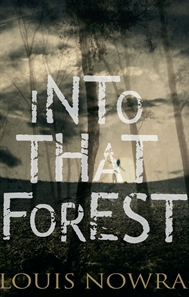
Louis Nowra, Into that forest (Review)

Louis Nowra, Into that forest

Courtesy: Allen & Unwin

Louis Nowra is one versatile and prolific writer, having written novels, non-fiction, plays and screenplays, essays and even libretti. Into that forest is his latest work. It was shortlisted for the Young Adult Novel prize in the 2012 Aurealis awards and the Ethel Turner Young People’s Literature prize in this year’s NSW Premier’s Literary Awards. I read this for my reading group. We don’t often do youth literature but every now and then one pops up that we think might interest us … such as a book by Nowra.

The first thing to say is that the novel is written in a unique voice. Here is its opening:

Me name be Hannah O’Brien and I be seventy-six years old. Me first thing is an apology me language is bad cos I lost it and had to learn it again. But here’s me story and I glad to tell it before I hop the twig.

And what a story it is … this novel feeds into several Australian, and wider, literary traditions. There’s the lost child and the feral child motifs (reminding me of Dog boy). There’s Tasmanian Gothic, and there’s also a bit of the fairy-tale about it. Subject-wise it covers some significant ground: environmental issues (involving both the extinct Tasmanian tiger and the whaling industry) and what we’d now call Post Traumatic Stress Disorder. This might sound rather mechanistic, but there’s no sense of “ticking off”. It’s not didactic, and it’s all logical within the framework of the book.

Set in the late 19th century, it tells the story of two young girls, Hannah (then 6) and Becky (7) who find themselves lost in the bush (oops, forest!) after their boat capsizes in a storm and Hannah’s parents drown. They are taken in by a Tasmanian Tiger pair, and live with them for four years. Meanwhile, Becky’s father, Mr Carsons, is out looking for her. Eventually they are found, but the process of re-integration is not easy. The novel has a small cast of characters, which keeps it tightly focused. Besides Hannah’s parents who die near the beginning, there’s our two young protagonists, Becky’s father, his friend Ernie, the “tiger man”, a few other minor characters – and of course, the tigers, named Dave and Corinna by Hannah.

As in Dog boy, the description of life with the tigers is pretty visceral. At first Becky resists living like a tiger – perhaps because she still has a father whom she hopes will find her – but eventually she too succumbs, if succumb is the word. It is, after all, a matter of survival. And so they shed their clothes, start to move mostly on all fours, and develop keen animal instincts (of sight, hearing and smell). They also develop a taste for raw food and become adept at hunting. The descriptions of killing and eating the prey are not for the squeamish – “I were starving and the taste of blood made me feel even more hungry” and “What were ever in that shiny pink gristle surged through me in waves of ecstasy” – but they are important to our understanding of what their lives had become. Hannah says:

God knows where me sense of survival came from. Maybe it’s natural cos humans are just animals too.

There is a bogey man here – the tiger man or bounty hunter, whom Hannah had met before, through her parents. To the girls he is more brutal than the tigers. He’s “evil”, kills tiger pups, does “stuff to himself that were rude”. But, perhaps, he’s just another survivor, albeit a not very pleasant one?

While Hannah is the narrator, Becky’s character is the more complex one. She struggles more with the change forced upon them:

She didn’t want to forget. Me? I thought it were stupid to try and remember like Becky did. I didn’t see any use for it. Me English started to shrivel up, like an old dry skin a snake gets rid of. It just lies there in the grass rotting away and then vanishes with the wind. I took to talking in grunts, coughs and hoarse barks like the tigers. This annoyed Becky no end. But it were simple – the tigers understood me. Becky warned I were making a mistake. You will forget your language. You will forget your parents. You are becoming an animal, she’d say. Why argue with her? She were right on every level.

Becky initially fights against the brutality of the hunt – there’s a horrific description of the tigers attacking seals – but then surprises Hannah by rather fearlessly exerting some dominance in the pack. She was of course desperately hungry by then, but it shows Hannah that:

she were really stubborn if she wanted something. She were brave, she were stubborn, she were smart, she were tough.

Unfortunately, Becky is not as tough – or as adaptable – as Hannah thought, and consequently precipitates the novel’s rather shocking conclusion.

It’s a pretty bold novel – but less so than, say, Lord of the flies. There’s plenty to discuss, particularly regarding the subjects I suggested at the beginning of the post. The big theme, though, the one common to feral children books, has to do with defining our nature. What separates human from animal? What would you do to survive – and what would that say about the essence of humanity? Good stuff for young adults, and a gripping read too for we older readers.

Louis Nowra
Into that forest
Crow’s Nest: Allen & Unwin, 2012
ISBN: 9781743311646 (Kindle ed.)

Andrew Croome, Midnight empire (Review)

Andrew Croome, Midnight Empire

Courtesy: Allen & Unwin

Andrew Croome’s latest novel Midnight empire is yet another read this year that is outside my usual fare. I read it because of my reading group’s focus this Centenary year on Canberra writers. It wasn’t a big ask, though, because I had read and enjoyed his first novel, Document Z. While both deal with spies, they are very different novels: Document Z is historical fiction, while Midnight empire is a thriller. I wonder what Croome will do next. Romance? Interestingly, Croome, who attended my reading group’s discussion, suggested that Midnight empire is more like a first book. This is because when writing Document Z, he could always go back to the historical record when he stalled, but with Midnight empire he had to rely on his own ideas to keep the story going. Croome told us that the inspiration for the book was drones and, developing that, the idea that with drones people can conduct “war” from their office desk. What does this mean for our psyches, he wonders. And where is the line between who is at war and who isn’t? But more on that later.

First, a little about the plot. The protagonist, Daniel Carter, is a rather naive 26-year-old computer programmer whose company’s encryption algorithm has been bought by the US government for its drone program. Daniel is sent by his Canberra-based company to Creech Airforce Base, outside Las Vegas, to install the software and make sure it runs properly. Suddenly he finds himself at war, albeit sitting at a computer terminal in the American desert, a long way from Afghanistan and Pakistan where the actual war is being waged. Unlike the airforce pilots and CIA agents Daniel is working with, he has not been trained for war.

Parallelling the story of Daniel’s professional life is his personal one. He comes to Las Vegas despite the wishes of his long-term girlfriend Hannah. Their relationship has been foundering and his, to her mind, not well thought through decision to go to Las Vegas is the catalyst for her to break up. Daniel is disappointed, but it leaves him free to meet someone new – and he does, of course. He meets the beautiful Russian, Ania, at the poker table. This is Vegas after all!

As you would expect for the genre, things start to go awry. An agent double-crosses them, pilots start dying mysteriously in Vegas, and the drones are sent in to Peshawar to take out their target. Daniel becomes perturbed about the morality of what he sees and decides to leak some information. Meanwhile, his life with Ania becomes complicated when she tells him her brutal husband has come to Vegas looking for her. Daniel is torn between his work and his personal responsibilities, and starts crossing even more lines from which he may not be able to return. As we read on, we are not sure who to trust or believe. Is or isn’t Ania the traditional spy-tale Femme Fatale? And are the CIA starting to suspect him?

Daniel … in the lion’s den

Croome has, I suspect, chosen Daniel’s name for its allusive – and ironic – value: we can see where Daniel is, but he seems pretty oblivious. Fairly early in their relationship Ania questions Daniel about his work. She’s mystified by the fact that he says he’s fighting a war, even though he didn’t volunteer for it and wasn’t conscripted:

‘Then why are you here?’

‘It is simply that I have a job. I am doing my job.’

You are at war because of your job?’

‘Yes’.

She seemed to find this amusing. ‘But that is not romantic,’ she said. ‘How am I supposed to believe that you are my hero, if it is your job?’

She tries to understand this war in which he says that he won’t be killed. It’s not a war, she believes, if he is not in danger of being killed. Daniel sees it differently:

‘We drop bombs on people … They are trying to harm people and we blow them up. I don’t know what else you’d call it’.

At this point, the war is just like a job to Daniel.  He goes to work on the base, they track targets with the drones, and he goes back to his temporary home in Vegas and lives his life. When he is reminded by his CIA boss Gray that “like it or not, you happen to be at war” his reaction is disingenuous:

if people were dying or endangering one another, it had stuff-all to do with him. Gray could shove it. If the alertness of your encryption operator was your primary concern, you needed your priorities set straight.

He has a point – to an extent – and yet, as his ex-girlfriend had clearly understood, he had agreed to be part of it. Not long after this, they attack their target, completely demolishing a building in which people, including children, had been. It’s remote, cold, clinical … Daniel looks for the children hoping they’ve not been taken out too, but “where were they?” And yet, still, the penny hasn’t fully dropped. Ania, as Hannah had before her, wants Daniel to recognise what he is doing:

I am just saying think, Daniel … I am just saying there are choices – there are decisions to make.

I won’t labour this further; I’m sure you’ve got the main theme by now.

The midnight empire …

How do you critique a novel like this, one that is more plot driven than I’m used to? What should my review focus on? Plot, character, setting are, I’m guessing, the critical things – and I’d give them the thumbs up. The plot is plausible, the character of Daniel believable, and the setting chillingly realistic. The resolution – particularly in terms of who is implicated – is a little more ambiguous than Croome apparently intended but that’s probably the risk you take when you start to play with genre formula. I did find some of the technical details – the encryption technology, and the ins-and-outs of poker playing – somewhat uninteresting at times, but that’s more to do with me and my reading focus I think. Overall, it’s a carefully orchestrated and gripping read that should appeal to a wide readership.

‘Aren’t you interested, though?’ she said. ‘That people would be able to do this – exist somewhere beyond the rest of us, surfacing, emerging at night, a strange midnight empire, you would almost say traceless.’

Ania is talking about the people – and they are real – who live in the storm drains beneath the Strip – but what, we wonder, about the other, infinitely more worrying midnight empires? Croome has made very clear in this novel why we should be intersted in them…

Andrew Croome
Midnight empire
Crows Nest: Allen & Unwin, 2012
238pp
ISBN: 9781743311127

Reading my Kindle Touch

Now, here’s the thing … although I am onto my second Kindle, I still do most of my reading in print form, which might make you wonder why I’m onto my second Kindle!

I upgraded to the Kindle Touch last year for one main reason, the Touch.  Because Touch is quiet whilst my Kindle 3 (aka Kindle Keyboard) would make a clicking sound whenever I turned pages and made notes. This rather disturbed Mr Gums when he was trying to sleep. As part of this upgrade, I also decided to buy the cover with the built-in light. I liked my old Kindle, but I love my new one – it’s quiet and I can read in bed without having a light on. However, I still mostly read printed books. Why?

Well, the main reason is that sense of the physical book and knowing where I am. Yes, the Kindle tells me I am 64% through the book, but as most Kindle readers have discovered I’m sure, that’s a bit fallible because it counts to end of the book which may include a lot of end matter. Frequently I discover I’ve finished the book when I thought I was only 92% through. I find it all very disconcerting not “knowing” where I am. And then there’s that thing that many readers do: you know, we’ll say “I’ll turn the light out/go clean the bathroom (sure!)/do my homework – when I’ve finished this chapter”. It’s easy to flick through a book to see how long the current chapter is, but a far more fiddly thing to do with the Kindle – until now.

Why now? Because, silently, wirelessly, those Kindle folk have updated my Kindle and one of the updates is that the Kindle will assess how fast I am reading and then report at the bottom left of the screen the “time left in chapter”. The percentage read is still there at bottom right. I have no idea when this was done, but I’ve only just noticed it! I love it … there are still aspects of the physical book, of being able to flick through it quickly, that I miss, but this is an excellent upgrade. Not only is it now easy to decide whether to read the next chapter, but I have a new game: Can I finish the chapter faster than it thinks I will!

And now, over to you Kindle owners out there:

Do you prefer your Kindle to print? Or do you still prefer print? What changes to the Kindle would sway you further towards it?