José Jorge Letria, If I were a book (#BookReview)

Book coverIf I were a book is one of those “gift” books you give to readers – and it was in that spirit that it was given to me for my birthday a couple of years ago. It’s a delight of a book, and is somewhat quirkier than these sorts of book-lovers’ gift books often are, which is why I’ve decided, finally, to share it with you. Or, have you seen or read it already?

My edition is a little hardback of 60 plus pages produced in San Francisco in 2014. The original, however, was published in Portugal in 2011, the author being Portuguese. The illustrator, André Letria, happens to be his son. Now I hadn’t heard of José Jorge Letria before, but he was born in the Lisbon District of Cascais, in 1951, and is apparently, says Google’s translation from a Portuguese biography, “a journalist, poet, playwright, fiction writer and author of a vast work for children and young people.” This biography also tells us that he has won many many national and international literary awards, including the Unesco International Prize (France), the Barcelona Classical Poetry Prize, the Plural Prize (Mexico), the Prize of the Paulista Association of Art Critics (São Paulo), and the Gulbenkian Prize. He has won prizes for “the environment in children’s literature” and the Manuel de Arriaga Prize for his contribution to the defense and dissemination of animal rights. He has been on many Portuguese, European and international literary boards, and his books have been translated into “over a dozen” languages. Yet, I hadn’t heard of him, until, that is, I was given this delightful ….

… love-letter to the book and reading. I fell in love with its passion and idealism. The book comprises two-page spreads, each one containing an image and the phrase “If I were a book” followed by a response. So, the first image shows a person looking at a book on a park bench, with the phrase “If I were a book, I’d ask someone in the street to take me home.” (What a nice sign that would make for a street library!) The next shows this same person opening a larger-than-life book, inside which there are stairs descending into unknown depths, with the phrase “If I were a book, I’d share my deepest thoughts with my readers”. And so it continues…

What makes this book so delightful is the personalising of the book (as in “if I were a book”), the ideas expressed in these personalised phrases, and the illustrations. I’m not sure what is allowed by copyright, but I’ve chosen three images to share with you, so you can see what I mean:


This slideshow requires JavaScript.

I’ve chosen these three because the one suggests the way I like to read – slowly, savouring the words and ideas – and because the other two contain aspirations that I’d love books to achieve. You can see how in some images the book is supersized, while in others its size is more “normal”. The images are simple but beautifully whimsical, the colour palette is minimalistic, and the text’s font feels a little worn and loved.

And here, I think I’ll leave it, because what more, really, can I say?

José Jorge Letria
If I were a book
Illustrated by André Letria
Translated by Isabel Terry
San Francisco: Chronicle Books, 2014 (orig. pub. 2011)
[64pp.]
ISBN: 9781452121444

Marilynne Robinson, Gilead (#BookReview)

Marilynne Robinson, GileadOnce again I have reason to start a book post with a discussion of the title, this time Marilynne Robinson’s 2005 Pulitzer Prize winning novel, Gilead. Gilead, in the context of this novel, has a literal and metaphorical meaning, literal because it takes place in the fictional Iowan town of Gilead, and metaphorical because “gilead” may also connote “hill of testimony”. This novel is, in fact, dying minister John Ames’ testimony of his life and values, something he is writing for his 7-year-old son to read when he is older.

Given Gilead was published in 2004,  many of you may already have read it, as well as her next two books, Home and Lila, which form a trilogy and which, I understand, cover the same people but from different perspectives. I read Gilead with my reading group. Responses were mixed, but many of us were interested enough to want to read Lila, at least, to see her perspective.

I was, though, one of those who liked the book unconditionally. I agree that it’s slow to get into, which is not helped by the fact that it has no chapters, excepting one “break” heralding a slight change of pace towards the end. This break occurs when a certain piece of information comes out about John Ames’ namesake, Jack (John Ames Boughton). It is around here that the book picks up in interest significantly because there’s a suggestion that there might even be a plot! However, given I’m a reader who doesn’t seek a strong plot and that I rather like spare writing in a melancholic tone, I was engaged from the beginning. It is melancholic, naturally, because the narrator knows his life is running out, but it’s more resigned than sad.

So, what is this essentially plot-less book about? That depends a bit, I’d say, on each reader’s perspective. For some the book is very much about theology and religion. John Ames speaks a lot about the Bible, about biblical characters and stories, and about death and heaven. Some in my group found his religion old-fashioned. And it is to some extent – partly because of its era. Ames was born in 1880 and the book is set in 1956 when he is 76 years old. John Ames also talks a lot about his family – his father and grandfather, in particular, who were both ministers. Now, Ames’ being born in 1880 means his father, and grandfather, were alive during the Civil War. We learn quite a bit about the history of the abolitionists in Iowa and Kansas. Ames’ grandfather was a John Brown follower, which meant that he was not above using violence to achieve the goal. His father on the other hand, having seen what his father did and thought, was a pacifist. Most of my reading group enjoyed this historical-cultural aspect of the novel.

But, what interested me most about the book was what I saw as one of its main themes, which concerns how to live a good life. In the opening paragraph Ames refers to a conversation with his young son. He writes

I told you that you might have a very different life from mine, and from the life you’ve had with me, and that would be a wonderful thing, there are may ways to live a good life.

Late in the novel, he says something much simpler than this, though. He says

There are a thousand thousand reasons to live this life, every one of them sufficient.

Is he departing from the idea of living a good life, to just living your life? I’m not sure. Pretty much at the novel’s central point he refers a statement by theologian John Calvin that we are actors on a stage with God being the audience. Ames interprets this as suggesting that we are “the artists of our own behaviour”, and, further, that God as audience implies an aesthetic rather than (as well as?) a moral aspect to God’s reaction to us. He explores the implications of this role of God’s a little further but, while it was interesting, it’s not where I want to take this post. I have other ideas to share!

One of the main threads – or themes – in the novel concerns fathers and sons. This is pretty obvious, really, given the whole book is framed as a letter from a father to a son in which Ames discusses his wishes for his son, but it is amplified through his discussion of the relationship between his grandfather and father, and between his father and himself. The relationships are complex, as I’ve already suggested. But, his thoughts on these relationships are intensified by his relationship with and attitudes to his namesake, the aforementioned Jack, to whom he is a “second father”. It is Jack who forces Ames to reassess his values and attitudes, not to mention his understanding of his worth as a Christian minister.

The problem is that Jack has been a bad boy. He became involved with a young girl, and a child ensued – after which he scarpered, leaving his family to work out what to do. Ames struggles with his attitude to Jack – particularly when Jack reappears 20 or more years later, as Ames is writing this letter. He says of Jack’s behaviour:

It was something no honourable man would have done … And here is a prejudice of mine, confirmed by my lights through many years of observation. Sinners are not all dishonourable people. But those who are dishonourable never really repent and never really reform … in my experience, dishonour is recalcitrant.

This is his own view, he admits, because “no such distinction occurs in Scripture”. Again, we are turned to formal theology, but again, I am going to turn away. The point for me is, regardless of what is “scriptural” or not, that Ames struggles with the idea of forgiveness, of acting with grace towards Jack. This forms his inner conflict as he considers father-son relationships, his preaching to his flock, and his relationship with his old friend and Jack’s father, Boughton. It is through this conflict, through finally opening himself to really listen to Jack, that he comes to a deeper more all-encompassing idea of what “grace” and, within that, forgiveness, really mean.

And that’s why I liked this book. It’s quiet but it deals with the essence of what confronts each of us every day in our relationships with each other. It deals with the disquietude that we all confront when people don’t behave in the ways we think they ought. Ames describes it as “that old weight in the chest, telling me there is something I must dwell on, because I know more than I know and must learn it from myself.” You don’t have to be a minister or a Christian to have the same hope that John Ames does, which is “to die with a quiet heart”. Gilead is, to me, a lovely book about what it means to be human and to live with humanity.

Marilynne Robinson
Gilead
London: Virago, 2006
282pp.
ISBN: 9781844081486

Monday musings on Australian literature: Reading marathons

Public reading No Friend but the Mountains

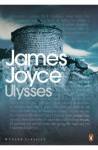
Today’s post was inspired by two comments on yesterday’s post which featured a public reading event I’d taken part in. Lisa (ANZLitLovers) commented that she is taking part in a reading of James Joyce’s Ulysses in a Queenscliff bookshop next Bloomsday, while Karen (Booker Talk) said she wasn’t sure she’d heard of such a grand scale reading event. I had heard of them before, but decided that it was time I got the real gen!

So, I checked Wikipedia (where I found an article on Marathon Reading); I googled; and of course I researched Trove. I discovered a whole world of reading events, which I’ll share here, focussing on Australia, but including some other places too, for context. Wikipedia’s article (accessed 25/3/19) is minimal, basically referencing a few examples of what it calls “marathon reading” but what is more commonly called a “reading marathon”. The first marathon reading Wikipedia describes is a yearly event run by UCLA “where a group of students, faculty, community members, alumni, and often even celebrities read a novel (or two) out loud non-stop for a 24-hour period.”

That description essentially defines what I’m discussing in this post, with a couple of provisos. The time frame for a reading marathon can vary, from several hours to several days; and the readers of course can vary too, from professionals to lay people of all sorts, depending on the event.

Google was useful – to a degree. What I discovered was that Bible reading marathons are BIG. They are big in Australia, and big in the USA, too. Some churches and religious organisations hold them regularly. A bit more on this anon. However, Google also brought up all sorts of reading marathons for various books:

  • the Bible
  • Herman Melville’s Moby Dick
  • James Joyce’s Ulysses
  • George Orwell’s 1984
  • Charlotte Bronte’s Jane Eyre and Jean Rhys’ The wide Sargasso Sea
  • Walt Whitman’s Leaves of grass
  • Harry Potter
  • Jack Kerouac’s On the road
  • Madelaine L’Engle’s A wrinkle in time

The first three popped up frequently, with some organisations running them as regular events. 1984 also popped up more than once.

Most reading marathons seem to have a goal, mostly spiritual (the Bible), or political (eg 1984) or cultural (eg Ulysses). Literacy also pops up frequently as a reason.

The Australian scene

The first references I found to reading marathons in Trove came from the 1920s and 1930s and were all about Bible reading marathons in the USA. It appears that the practice became competitive, with churches vying to do it faster than other churches! An article in World News (30 January 1926) said that “the idea originated in a small western centre some time ago, and had as its object the establishment of a counter-attraction to the then prevalent non-stop dancing Marathons”. The first Bible marathons took 72 hours, but, the article said, a Boston church had done it in 52 hours 18 minutes and 27 seconds. Clergymen were apparently denouncing the contests because “they detract from the reverence in which the Bible should be held, and that the readers gain no instruction or inspiration from their efforts”. There were several articles on the topic, with titles like “Excesses of American churches”.

The first report I found of an Australian reading was of – yes – Ulysses! It was held at the National Library of Australia on June 16, 1993. (I was living in the USA at the time!!) The article starts:

Literary fans walked into the fourth-floor reading room at the National Library yesterday, leaving the cold of a Canberra winter to emerge in Dublin, June 16, 1904, and celebrate Bloomsday slightly late at a marathon eight hour-plus reading of the James Joyce epic, Ulysses.

James Joyce Ulysses

Did they read all of Ulysses in 8 hours? I’d be surprised. Anyhow the report says that the readers, of whom there were over 30, included local politicians, writers and other community figures, and that

there were about half a dozen real Irish accents and an equal number of reasonable facsimiles. Others struggled to overcome Irish names and colloquialisms of varying degrees of technical difficulty and with differing levels of success.

Love it. The article also said that Canberra’s Irish community had held Bloomsday readings before but this was the first at the National Library.

My googling for Australian examples turned up mostly Bible marathons and some Ulysses marathons, both of which continue today (despite those early Bible marathon criticisms!)

George Orwell, 1984

However, there were others. In Melbourne in September 2015, the Wheeler Centre and the Melbourne Festival, organised a “marathon relay reading” of 1984, “Orwell’s prescient novel of power and politics …in a very apt setting—the Legislative Assembly Chamber in Victoria’s Parliament House.” The event was to take over 9 hours, and would involve up to 30 people reading from the Speaker’s chair! Wow! That must have taken some negotiation. The readers included politician Adam Bandt, human rights lawyer Julian Burnside, feminist writer Clementine Ford, ex-Human Rights Commissioner Gillian Triggs, political speech writer Don Watson, and Rosie author Graeme Simsion.

And, just last year, again in Melbourne, the bookshop Readings supported a marathon reading of Emily Watson’s translation of the Odyssey. This was a professional reading organised by The Stork Theatre. A free event, it was to use over 30 performers, and take 12 hours. The promotion said “Come along for your favourite chapter, bring a picnic, stay for the whole 12-hour marathon or come and go as as you please.”

Variations on a theme

My research revealed other events or activities that were tagged reading marathons, but were different from the more common use of the term. These activities comprised two main types:

  • Reading as many books as you can in a given period (a bit like the well-known Ms Readathon): There were a lot of these, one example being the William Stimson Public School, in Wetherill Park NSW, which described its 2017 Book Week as being the “culmination of their reading marathon where the school community read more than 9000 books”. I found these sorts all around the world, from Kenya to the United Arab Emirates, from Latvia to Argentina, as well as in Australia!
  • Nick Bland, The very cranky bearSimultaneous storytime: This is an event where the same story is read at the same time in multiple places. An example occurred in Australia in 2012 when Nick Bland’s The Very Cranky Bear was read aloud “in about 2200 libraries, kindies, schools and homes across Australia” to over 300,000 children in the 12th National Simultaneous Storytime. This event’s aim is partly, at least, to promote literacy.

So, have you attended (or taken part in) a reading marathon? If you have, how did you find it?

Rudyard Kipling, The Janeites (#Commentary)

The topic for my local Jane Austen group’s March meeting was “Jane Austen in the trenches” which, I realise, sounds a bit anachronistic, given she died in 1817, nearly a century before the trenches we’re talking about. But, you see, Jane’s fame didn’t start in 1995 with Colin Firth and that wet shirt. No, her popularity took off around the late 19th century and has continued ever since, albeit with a huge spurt in the late 20th century. As Claire Harman states in Jane’s fame, she is the only writer “who is instantly recognisable by her first name”.

Rudyard Kipling

Kipling (Presumed Public Domain, via Wikipedia)

Anyhow, into the trenches. Our discussion was inspired by Rudyard Kipling’s short story “The Janeites”, first published in 1924. It’s a little tricky to read, being peppered with Cockney voices, but it’s worth the effort – and not just for Janeites. It is set in a London Masonic Lodge in 1920, during a weekly clean-up of the premises. There are three main characters – Brother Anthony, a veteran of army service in the Holy Land during World War I, now a taxi driver; Brother Humberstall, a hairdresser who is a veteran of artillery service in France and who suffers somewhat from shell-shock (now, PTSD); and the first-person narrator, ostensibly Kipling. Humberstall tells the others of his induction, during the war, into a secret society, the Janeites. He explains how he came to join this society, which included members from all ranks, and the tests he had to pass to do so. He tells how this society kept them sane during the war, and how it, in fact, saved him, when, after a terrible attack, he was his group’s only survivor:

… I walked a bit, an’ there was a hospital-train fillin’ up, an’ one of the Sisters—a grey-headed one—ran at me wavin’ ’er red ’ands an’ sayin’ there wasn’t room for a louse in it. I was past carin’. But she went on talkin’ and talkin’ about the war, an’ her pa in Ladbroke Grove, an’ ’ow strange for ’er at ’er time of life to be doin’ this work with a lot o’ men, an’ next war, ’ow the nurses ’ud ’ave to wear khaki breeches on account o’ the mud, like the Land Girls; an’ that reminded ’er, she’d boil me an egg if she could lay ’ands on one, for she’d run a chicken-farm once. You never ’eard anythin’ like it—outside o’ Jane. It set me off laughin’ again. Then a woman with a nose an’ teeth on ’er, marched up. “What’s all this?” she says. “What do you want?” “Nothing,” I says, “only make Miss Bates, there, stop talkin’ or I’ll die.” “Miss Bates?” she says. “What in ’Eaven’s name makes you call ’er that?” “Because she is,” I says. “D’you know what you’re sayin’?” she says, an’ slings her bony arm round me to get me off the ground. “’Course I do,” I says, “an’ if you knew Jane you’d know too.” “That’s enough,” says she. “You’re comin’ on this train if I have to kill a Brigadier for you,” an’ she an’ an ord’ly fair hove me into the train, on to a stretcher close to the cookers. That beef-tea went down well! Then she shook ’ands with me an’ said I’d hit off Sister Molyneux in one, an’ then she pinched me an extra blanket. It was ’er own ’ospital pretty much. I expect she was the Lady Catherine de Bourgh of the area.

Of course, you have to know your Jane Austen to get the Miss Bates reference … !

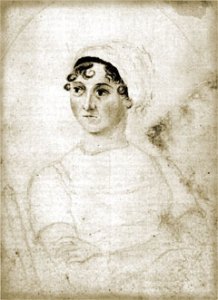
Jane Austen by sister Cassandra

Throughout the story Austen is only ever described as Jane, which bears out Harman’s comment above. There’s an entertaining description of Austen’s subject matter –

’Twasn’t as if there was anythin’ to ’em, either. I know. I had to read ’em. They weren’t adventurous, nor smutty, nor what you’d call even interestin’

– and some amusing references to various Austen characters, particularly Reverend Collins, Lady Catherine de Bugg (de Bourgh), General Tilney and Miss Bates. There’s also a comment that Austen did “leave lawful issue in the shape o’ one son”, and that was Henry James. Fair enough. At one stage, Humberstall chalks their guns with the names of Austen characters. His Janeite superiors approve, though there is some discussion about whether he’d accorded the right name to the right gun. For example:

… they said I was wrong about General Tilney. ’Cordin’ to them, our Navy twelve-inch ought to ’ave been christened Miss Bates …

Of course, much has been written about this story, including its secret society setting, the Masons, and Kipling’s intentions about that – but these other issues are not my focus here.

What is of interest is Humberstall’s statement late in the story:

“… You take it from me, Brethren, there’s no one to touch Jane when you’re in a tight place. …”

It is this that inspired our meeting because, while Kipling’s story is fiction, it is the case that Austen’s novels, among others, were provided to soldiers to read for morale. On the Kipling Society’s website is this:

In 1915, John Buchan and George Mackenzie-Brown, co-directors of Nelson, launched the highly successful Continental Library series, designed to be carried in soldiers’ pockets. Gassart [who wrote an article for the TLS in 2002] quotes the papers of W.B. Henderson, a Glaswegian schoolmaster attached to a Siege Battery in the Royal Garrison Artillery, in arguing that a book’s solace:

was its power to transport the infantryman from a world of “sergeants major and bayonet fighting, and trench digging and lorry cleaning and caterpillar greasing” into the fantasy of the novelist – and none was better at it than Jane Austen.

Her novels were also used during the war as part of therapy with shell-shock victims. Indeed, the above-mentioned Clare Harman says that three of Austen’s novels were “at the top of a graded Fever-Chart”. Academic Claire Lamont (in her paper, “Jane Austen and the nation”) suggests that this was because Austen’s “Englishness expresses itself as the standard of where and how one might live…”. Other critics have other ideas – though many of them are variations on this theme. One member of my group found a report that novels like Austen’s were used to gee-up damaged soldiers to get them back to the front! That shocked us somewhat. Bibliotherapy, it seems, is not a new thing.

Kipling, himself, was, not surprisingly, an Austen fan. As well as his story “The Janeites” (which term was coined by a critic back in the 1870s), he wrote a poem, whose final lines are used as an epigram for “The Janeites”:

Jane lies in Winchester, blessed be her shade!
Praise the Lord for making her, and her for all she made.
And while the stones of Winchester – or Milsom Street – remain,
Glory, Love, and Honour unto England’s Jane!

OK, so it’s a bit sentimental I admit, but he wrote it and that’s my excuse for using it to close today’s little commentary!

Rudyard Kipling
“The Janeites”
First published: Hearst’s International, MacLean’s, and the Story-Teller Magazine, May 1924
Available: Online at UWYO

Anita Heiss (ed.), Growing up Aboriginal in Australia (#BookReview)

Anita Heiss, Growing up Aboriginal in Australia

As many others have said, including my reading group, Anita Heiss’s anthology, Growing up Aboriginal in Australia, should be required reading for all Australians. At the very least, it should be in every Australian secondary and tertiary educational institution. Why? Because it contributes to the truth-telling that is critical to real reconciliation between Indigenous and non-Indigenous Australians. Truth-telling comes in many forms. There are formal processes, as through truth-telling commissions, but there are also the informal processes that we can all engage in while we wait for the government to fiddle-diddle around deciding whether it can front up and do the right thing.

Essentially, truth-telling means all Australians acknowledging and accepting “the shared and often difficult truths of our past, so that we can move forward together”. These truths include the original colonial invasion of the country, the massacres, the Stolen Generations, and the ongoing racism that results in continued inequities and significant gaps in almost every health, educational and occupational measure you can think of. Informal truth-telling encompasses all the things we do to inform ourselves and each other of these truths. Heiss’ anthology, Growing up Aboriginal in Australia, which contains 50 stories by indigenous Australians on their experience of growing up indigenous in this so-called lucky country of ours, contributes to this informal truth-telling. Taken as a whole, the book provides a salutary lesson, for all Australians who care to listen, on the experience of being indigenous in Australia. Taken individually, each story has the potential to break your heart. If you think I’m laying it on a bit thick, then you haven’t read the book!

“a stranger in my own land”

The above line from William Russell’s story, “A story from my life”, brought me up short because it replicates a line I read in Atkinson’s book The last wild west (my review). Atkinson describes his Indigenous friend and co-worker Sno as being “an alien in his own homeland”. There is strength in this replication between books, just as there is strength in the repetition of experiences within Heiss’s book, and the strength is this, that every repetition reinforces the truth of the historical (and continuing) injustice faced by Indigenous Australians. The stronger, the more inescapable the truth becomes, the harder it must surely be to ignore.

So, what are the repeated experiences in Growing up Aboriginal in Australia? Well, there are recurring references to the Stolen Generations, to being questioned about identity (“are you really Aboriginal?”, “you look too white to be Aboriginal”), to feeling disconnected from culture, to being called racist names, to being humiliated in myriad ways too numerous to list, and to being physically attacked. These are the experiences that we’ve all heard of, but Heiss’ contributors enable us to feel them. And that’s important. I’ll share just a few quotes from a few stories:

Thankyou for your acknowledging every 26 January with such grace and humility. Thankyou for your encouragement – and advice to me – to let the past be in the past, to simply ‘get over it’ on the day my people’s land was invaded and dispossessed. (Dom Bemrose’s biting “Dear Australia”)

My father cut to the chase. ‘Olly, you can’t go telling people we’re Aboriginal … It isn’t safe’. (Katie Bryan, “Easter, 1969”)

I would paint and draw and sculpt about being Aboriginal. I would see people twitch uncomfortably and sometimes even let their ignorant thoughts out: ‘But you don’t look it’, ‘From how far back’, ‘Do you get lots of handouts?’ (Shannon Foster, “White bread dreaming”)

In Year 2 I was lined up with Aboriginal classmates to be checked for nits and, as I stood there with fingers being raked through my hair, I felt angry and embarrassed as my non-Indigenous classmates watched. I realised that … for some reason it was only supposed to be us Aboriginal kids that had nits. (Jared Thomas, “Daredevil days”)

None of us kids are allowed to go anywhere outside after dark by ourselves. We can’t ever go to the toilet at night: we gotta go in twos, and Mummy stands at the door and watches. She has a big bundi* ready in case there’s trouble … Terror is outside the door, and we can’t do anything about it. (Kerry Reed-Gilbert, “The little town on the railway track”)

It was hard selecting these quotes – not because they were hard to find but because there were so many options that it was hard to decide which ones. That’s the shame of it. And these stories come from all ages – from teenagers to those in their 70s or 80s –  and from all parts of Australia, from, as Heiss writes in her Introduction, “coastal and desert regions, cities and remote communities.” They come from “Nukuna to Noongar, Wiradjuri to Western Arrernte, Ku Ku Kalinji to Kunibídji, Gunditjamara to Gumbayanggirr and many places in between.”

The contributors include many well-known people – writers like Tony Birch and Tara June Winch, sportspeople like Patrick Johnson and Adam Goodes, performers like Deborah Cheetham and Miranda Tapsell –  but there are also lesser-known but no less significant people, many of whom are actively working for their people and communities.

Despite the devastating picture being painted, the book is not all grim. There are also positive repetitions in the book. They include deep connection to country, the importance and support of family, and particularly, the strength of mums. There’s humour in some stories: you can’t help but laugh, while you are also grimacing, at Miranda Tapsell’s story of her friends expecting her to turn up to a party as Scary Spice, but opting for Baby Spice instead (Miranda Tapsell, “Nobody puts Baby Spice in a corner”).

“two divided worlds”

One of the early stories is particularly sad because its 29-year-old author, Alice Eather, took her life before the book was published. In her person, in her story, in her life, she represents the challenge Indigenous people face in Australia today. Her story “Yúya Karrabúrra” starts with a poem. At the end of the poem she writes:

This poem is about identity, and it was a really hard thing to write in the beginning because identity is such a big issue. It’s a large thing to cover. The poem is about the struggle of being in between black and white.

Now Alice, like many in the book, had an Indigenous parent and a non-Indigenous one, but the struggle she names here is faced by every person in the book, regardless of their family backgrounds, because every one of them must contend with white society and culture, and it’s clearly darned hard.

I’m going to close on this idea of identity, because identity is the well-spring from which everything else comes. The stories are organised alphabetically by author, which I’m sure was an active decision made to not direct the conversation. Coincidentally, though, the last story – Tamika Worrell’s “The Aboriginal equation” – provides the perfect conclusion. It constitutes a strong, unambiguous statement of identity. She says:

I will not sit quietly while my identity is questioned. It doesn’t matter how many times you say you didn’t mean to be offensive, that doesn’t dictate whether or not I’m offended.

Then concludes with a hope that she

will live to see a future that is less ignorant, less racist and at least somewhat decolonised. Until then, I’ll continue to be an angry Koori woman, educating those who don’t understand and those who choose not to.

She’s not asking for the moon here is she? The least we can do is choose to understand – and we can start by reading books like this.

Lisa (ANZLitLovers) has also posted on this book, and there are several reviews for the Australian Women Writers Challenge.

* “bundi” is a Wiradjuri hitting stick I believe.

AWW Challenge 2019 Badge

Anita Heiss (ed.)
Growing up Aboriginal in Australia
Carlton: Black Inc, 2018
311pp.
ISBN: 9781863959810

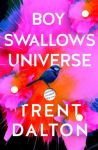
Trent Dalton, Boy swallows universe (#BookReview)

Trent Dalton, Boy swallows universe

Two books came to mind as I was reading Trent Dalton’s debut novel Boy swallows universe. One was Steve Toltz’s out-there book about fathers and sons, A fraction of the whole (my review), and the other was Tim Winton’s Breath (my post), which explores what it is to be a good man, but more on these anon.

I had three reasons for wanting to read the book. Firstly, it was my reading group’s first book of the year, and secondly, it was recommended by two people whose literary tastes often match mine, my brother and an ex-reading group friend. Finally, there was its Brisbane setting. I spent six special years of my childhood in the Sandgate area of Brisbane, where, I’d read, Dalton had also lived while growing up. Fortunately, all these reasons were justified as this novel is an excellent read – engrossing in content and intriguing in style.

Boy swallows universe covers around six years of its protagonist Eli Bell’s life, starting in 1985 when he is 12 years old and living with his mother, Frankie Bell, and stepfather Lyle. He and his mute older brother August are regularly babysat by Slim (based on the real criminal, convicted murderer Arthur Ernest Halliday) while Frankie and Lyle are out dealing drugs. Slim, for all his apparent criminality, turns out to be one of the most important wise people in Eli’s life – and, while he isn’t always around as Eli grows older, it is to Slim that Eli often speaks, consciously or subconsciously, drawing on his ideas and advice, as he faces life’s challenges. Eli’s relationship with Slim is just one of the threads and refrains that hold this big book together.

a genre-bending coming-of-age crime novel with a touch of magic

Terrible things happen in the book – and Eli and August are pushed around, buffeted by the things that happen in the adult world and over which they have little or no control. Part way through the book, having lived most of their lives with Frankie and Lyle in Darra (Brisbane’s southwest), they find themselves dumped with their damaged alcoholic father Robert Bell, whom they don’t know, and who lives in Bracken Ridge (Brisbane’s north in the Sandgate electorate). While Frankie and Lyle, for all their illegal doings, provide a generally stable home-life, the one provided by Robert is erratic, affected by his alcoholic binges. And yet, here too, the two resourceful boys find love – and more, support.

All this probably suggests to you a straightforward book about dysfunctional families, of which there are many these days. But, you would be wrong, because wrapped around the domestic is a story of drug dealing, drug double-dealing and violence, that takes this book into a whole other realm. In fact, the best way to describe it is as a genre-bending coming-of-age crime novel with a touch of magic. You with me?

Now, I’m going to shift gear a bit and return to those two books I mentioned in my opening paragraph. The book’s opening line is “Your end is a dead blue wren”, and we soon discover that these words have been written in air by August, who is sitting on their brown brick fence while Eli is being taught to drive by Slim. There’s a bizarre edge to all this which, in addition to the fact that the book is mostly about men and boys, fathers and sons, made me think of Toltz’s A fraction of the whole. However, while Toltz’s “bizarre” lies more in the absurd area, Dalton’s is more magical. There’s a red telephone in a secret room, for example, that always seems to ring when Eli is around. Who is at the other end? August at one point says it is he, but is it really? It doesn’t really matter, in fact, because the phone seems to be more about deflecting or, perhaps, relocating fear and trauma than about reality. It works because Eli’s voice and the sort of jaunty in-the-moment tone make it work.

More interesting to me, though, is the link with Winton’s Breath. They are very different books. For a start, Breath is more novella, while Boy swallows universe verges on the big, baggy monster. But, both books are fundamentally about what makes a good man – and, in neither case is the answer simple. In fact, it comes more often than not from flawed, if not sometimes bad, men. From early on in Dalton’s novel, Eli asks various men – family, friends, criminals, strangers – “are you a good man?” Many are surprised and know not what to answer. Gradually though Eli puts together his own picture from their answers and bevaviours, until, near the end, he says (addressing Slim in his mind):

This is what a good man does, Slim. Good men are brash and brave and fly by the seat of their pants that are held up by suspenders made of choice. This is my choice, Slim. Do what is right, not what is easy … Do what is human.

Now, before I get onto the writing, a bit about this genre-bending novel’s plot. As I mentioned above, the novel’s plot-line relates to drug double-dealing. This results, at the end, in quite a suspenseful, page-turning adventure that was much enjoyed by many in my reading group. But, not so much by me who finds reading action pretty boring. Indeed, if I have one question about the book, it’s whether it really needs the final chase. I think the point would have been made had the novel concluded just before it – but that final adventure will help the novel adapt well to film, and to a film that many will want to see, so I won’t be too churlish about it.

And, anyhow, it’s a small criticism because I greatly enjoyed the book. It is so well constructed. Little details dropped in one place are picked up in another; little verbal refrains recur adding both poetry and meaning without being heavy-handed. Even the curious, often cryptic, three-word chapter headings, like “Boy writes words”, “Boy steals ocean”, and “Boy masters time”, are explained late in the book when the Courier Mail editor asks Eli to tell his life in three words.

There’s also lovely descriptive, sometimes lightly satirical writing, such as this from the Vietnamese restaurant scene:

There’s two more tanks dedicated to the crayfish and mud crabs who always seem to resigned to the fact they’ll form tonight’s signature dish. They sit beneath their tank rocks and their cheap stone underwater novelty castle decorations, so breezy bayou casual all they’re missing is a harmonica and a piece of straw to chew on. They’re so unaware of their importance, so oblivious to the fact they are the reason people drive from as far away as the Sunshine Coast to come taste their insides baked in salt and pepper and chill paste.

Then, of course there’s the characterisation, and the first person voice. Eli is such a kind and likeable character. His coming-of-age is a tough one, but he’s positive, loving, open-minded and willing to learn. He’s also courageous. It could almost be schmaltzy except that you see the grit and know that he has been tested. More cynical readers might think Eli is too good to be true, but the book’s light tone and touch of magic remind us that this is not social realism. It’s “true” to the heart of what Eli (and I believe Dalton) experienced, but it’s not fact. It’s about surviving trauma. Dalton has, I’d say, found a perfect recipe for conveying dysfunction and accompanying trauma while also showing how it can be mentally and spiritually survived.

A good read, and a meaningful book that got my reading group off to a rip-roaring start for 2019.

Trent Dalton
Boy swallows universe
Sydney: Fourth Estate, 2018
474pp.
ISBN: 9781460753897

Reading highlights for 2018

If you are a regular here you’ll know that my Reading Highlights post, which is my answer to those Top Reads posts that many bloggers do, will not contain an ordered list of the books I considered my “best” of the year. I find that just too hard to do (though I did make a stab at it on Amy’s blog last month.) I prefer to talk about “highlights”, that is, those books and events that made my reading year worthwhile.

Literary highlights

Literary highlights mean literary events, and there were many wonderful ones in Canberra this year. I didn’t get to near as many as I’d wish, but I enjoyed those I did attend:

  • Festival Muse: Muse is a cafe, bookshop and event venue, and a popular haunt for Canberra book people. For the second year running they held, in March, their Muse Festival. It’s a busy time of year and a long weekend, so I only attended the opening session, Turn Me On. The aim was for the five speakers to share “the lightbulb moments and hidden drivers” behind what turned them on (of course). The speakers included old hands, like journalist Michael Brissenden, and the up-and-coming, like feminist writer Zoya Patel. A wonderful event.
  • Sydney Writers Festival live streams some of its sessions to regional locations, and Canberra was one of those in 2018. I attended three sessions: Conflicting narratives, Annabel Crabb’s BooKwiz, and Emily Wilson on Translating the Odyssey. How wonderful modern technology is when it facilitates events like this.
  • Canberra Writers Festival about which I wrote six posts. You can find them by clicking this link and then selecting those posts for the 2018 festival.
  • Author interviews/conversations of which I only attended a few of the many offered, but those I attended were nicely varied: Robyn Cadwallader, Nadia Wheatley, and Elizabeth Kleinhenz.
  • Annual lectures: the NLA’s Seymour Biography Lecture, given by broadcaster Richard Fidler; and Manning Clark House’s Dymphna Clark Lecture given by historian Clare Wright. As last year, we had supper at Muse after both lectures.

Reading highlights

And here, as in previous years, is where I share some observations about my reading this year. These aren’t necessarily my “top” reads, but all were good ones:

  • Strange synchronicities (1): Setting: The universe, as I mentioned in one of the posts, is clearly telling me to make good on my plan to visit the Mallee region because every second book I read this year – well, I’m exaggerating a little – seemed to be set in the Mallee or near it: Jenny Ackland’s Little gods, Charlie Archbold’s Mallee boys, Sofie Laguna’s The choke, Emily O’Grady’s The yellow house, and Sue Williams’ Live and let fry. I’m not sure that these books presented the Mallee in its best light – there were a lot of struggling families – but this flat, hot and dry, somewhat remote, self-contained region made an excellent backdrop for drama.
  • Strange synchronicities (2): Narrator: I read a lot of child narrators/protagonists, most of them from the Mallee! How did that happen? Sue Williams’ Live and let fry is the exception, but to the remaining four Mallee-area novels, I add three others featuring young protagonists: Nick Earls’ LA-set novella, NoHo, Wendy Scarfe’s Adelaide-based novel The day they shot Edward and a book I’ve just finished but won’t post until 2019, Jarrah Dundler’s northern NSW set Hey brother. All but two of these were adult fiction. Writing child narrators for adults, without becoming sentimental or being simplistic, is a challenge, but when done well – like, for example, Sofie Laguna’s The choke – these voices add a depth that can open our eyes to the impact of adult actions and/or enable us to see adult behaviour from a different perspective.
  • Exotic places I may never get to, like Beirut in Rabih Alameddine’s An unnecessary woman, and Tel Aviv in Raphaël Jerusalmy’s Evacuation. These two books were revelations, in very different ways, and I’d highly recommend both.
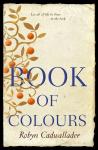
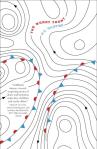
  • Great covers: Covers aren’t ultimately important to me, but I do love gorgeous ones. Two particularly caught my attention this year: Robyn Cadwallader’s Book of colours which conveys a sense of mediaeval lusciousness appropriate to its subject matter while also being modern, clean, fresh; and HC Gildfind’s The worry front which is inspired by the front lines on a weather map. So evocative, so metaphorical.

  • Interesting finds: I read three early twentieth century short stories, two from Trove, “The bridge” (1917) and “Christmas tree” (1919) by Katharine Susannah Prichard, and one sent to my by Pam (Travellin’ Penguin), “The hand” (1924) by ML (Mollie) Skinner. I love reading these writers from the past.
  • Biggest surprise (1): I didn’t plan to read Sarah Krasnostein’s The trauma cleaner because I expected it to be one of those sensationalist stories, but how wrong I was. It’s an intelligently written respectful book about a warm and complex person well worthy of a biographer’s time.
  • Biggest surprise (2): I couldn’t believe that such a dense, contemplative book as WG Sebald’s Austerlitz could be a page-turner, but it was.
  • The odd man: I don’t mean by this that the men themselves were odd but that there weren’t many of them in my reading diet this year. However, I loved reading Rodney Hall again, with his provocative A stolen seasonRichard Flanagan’s First person was an engaging and intriguing read too, and John Clanchy’s novel about women, Sisters, was right up my alley. Then there was the daddy of them all – well, I mean, one of the great writers from the past – EM Forster. Loved re-reading Howard’s end.
  • The ones that got away, or, the books I really wanted to read, but didn’t. There are too many of them, but two that really bother me are Jane Rawson’s From the wreck, and Gerald Murnane’s Border districts.

Michelle Scott Tucker, Elizabeth MacarthurThere were many more great books. Michelle Scott Tucker’s biography of Elizabeth Macarthur was excellent, both informative and engaging, as was Clare Wright’s You daughters of freedom. I read several Australian classics, and was impressed again by works by some of our older, fearless women writers – Carmel Bird, Helen Garner, and the late Elizabeth Jolley.

Some stats …

And here is where there are some surprises (for me, anyhow):

  • 80% of my reading was fiction, short stories and novels (versus 53% in 2017): I said last year that I wanted to rebalance the fiction-nonfiction ratio towards more fiction. I sure did it – and then some!
  • 70% of the authors were women (versus 73% in 2017,  65% in 2016, and 67% in 2015): I like to read women writers and reading them is one of my specific reading interests, but 70% is a little higher than it need be. I’m not unhappy though!
  • 18% were NOT by Australian writers (versus 35% last year and 32% in 2016): Last year, I said that roughly one-third non-Australian, two-thirds Australian felt like a fair ratio. Less than 20%, however, does not feel “balanced” and I’d like to redress it next year.
  • 28% were published before 2000 (similar to last year’s 31%): I’m happy with this.
  • 35% were published in 2018, which seems reasonable.

Last year, I noted that I don’t set reading goals – except a general one of trying, vainly, to reduce the TBR pile – but I did say that I’d like to lift my fiction ratio. I did achieve that. I also increased my TBR reading by 100% – meaning I read 6 books from the TBR pile (defined as books I’ve owned for over a year) compared with 3 in 2017. Woo hoo!

Overall, another good reading year containing some excellent reads. I’m grateful for all of you who read my posts, engage in discussion, recommend more books and, generally, be all-round great people to talk with. Thank you for being here.

I wish you all a wonderful 2019.

What were your reading or literary highlights for the year?

My reading group’s top picks for 2018

Having enjoyed doing our top picks last year, my reading group decided to repeat the exercise this year. I’m assuming that, in the spirit of end-of-year lists, you might be interested to see the results, particularly as you will all know at least some of these books.

I’ll start, though, by listing what we read in the order we read them (with links to my reviews):

We returned to our fiction roots this year. Last year four of our eleven books were non-fiction, but this year only one was (except that for our Helen Garner night there was, not surprisingly, a mix of fiction and non-fiction.) This re-balancing mirrors my own reading this year.

And now, the winners …

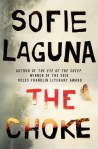
Sofie Laguna, The chokeEleven of our twelve currently active members voted. We had to name our top three picks, which resulted in 31 votes being cast (one member casting just one vote). The results were:

1. The choke, by Sofie Laguna (6 votes)
2. The immortal life of Henrietta Lacks, by Rebecca Skloot (5 votes)
3. The sympathizer, by Viet Thanh Nguyen; The merry-go-round in the sea, by Randolph Stow; and Austerlitz, by WG Sebald (4 votes each)

Highly commended: An unnecessary woman, by Rabih Alameddine (3 votes).

In other words, six of our eleven books received 26 of the 31 votes cast, which is similarly decisive to last year’s figures. It’s interesting, given that most books were liked

Of course, this is not a scientific survey. Votes were all given equal weight, even where people indicated an order of preference, and not everyone read every book, which means different people voted from different “pools”. 

Anyhow, a reasonably varied lot. Of the five which shared the top three positions, we had two Aussies, two Americans (albeit one Vietnamese born), two women, one translated fiction, one classic and one non-fiction. No indigenous writer, though we did read one.

Selected comments (accompanying the votes)
  • The choke: Two of the comments focused on the naive narrator, one saying “rivetting read and clever use of naïve narrator”;  and one referred to its emotional impact, saying “harrowing but brilliant and insightful.”
  • The immortal life of Henrietta Lacks: The doctor in our midst said, simply, “every medico should read it”, while another member was more expansive, saying, “What a marvellous account of a scientific breakthrough, within the real challenges of black lives, and this family in particular. A nuanced account of a continuing ethical dilemma.”
  • The sympathizer: Most of us commented on its offering a different, valuable, perspective on The Vietnam (or American) War. One member elaborated: “The bleak humor and cleverness of the writing showed why it won the Pulitzer, but it was the extraordinary character leading through a war and revolution that really made it something new and challenging.”
  • The merry-go-round-in-the-sea: The two commenters said “Sophisticated, layered autobiographical novel; lovely, involving descriptions of rural Australian life;  beautifully developed complex characters; humour” and “So glad to have read this superb Australian author, whose depiction of landscape, and his torn relationship with Australia and his family was truly beautiful.” Couldn’t have said it better myself.
  • Austerlitz: Both commenters noted the “dense writing” with one adding that it was “a great feat of imagination” and the other referring to its “amazingly sustained mesmeric tone.”

If you are interested in our schedule for next year, I have already posted that in my most recent My Literary Week post.

And a bonus!

A good friend of mine – we met over 40 years ago in library school – has just told me her reading group’s Top Picks for the year. She’s happy for me to share them – so we’ll start with the books her group read this year:

  • The dry, by Jane Harper (novel, Australian author)
  • The good life by Hugh Mackay (non-fiction, Australian author)
  • The rules of backyard cricket, by Jock Serong (novel, Australian author)
  • And the mountains echoed, by Khaled Hasseini (novel, Afghan-born American author)
  • The rip, by Robert Drewe (short story collection, Australian author)
  • Lincoln in the Bardo, by George Saunders (novel, American author)
  • The good people, by Hannah Kent (novel, Australian author)
  • The light between the oceans, by M L Stedman (novel, Australian author)
  • Warlight, by Michael Ondaatje (novel, Sri Lankan-born Canadian writer)
  • The shepherd’s hut, by Tim Winton (novel, Australian author)

It’s amazing isn’t it, how two reading groups comprising women of a similar age living in the same region, end up reading completely different books! So many books, I suppose.

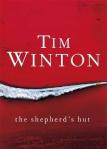
Tim Winton, The shepherd's hutAnyhow, their top picks were:

  1. The shepherd’s hut, by Tim Winton
  2. Warlight, by Michael Ondaatje
  3. The rules of backyard cricket, by Jock Serong

So, all fiction, all male, two Aussies, and none read by my group! But, all worthy books for reading groups, and all books I’d very happily read. Just saying – in case your group is looking around for books to read!

If you are in a reading group – face-to-face or online – would you care to share your 2018 highlights?

My literary week (14), lists and a celebrity

I don’t really need to write a post today having written two in the last two days, but there are a couple of things I’d love to share with you, so here I am for the third day in a row.

Reading group schedule

Trent Dalton, Boy swallows universeFirst up is my reading group schedule for the first half of the next year, which we decided by consensus – with a bit of the usual argy-bargy – a few days ago. Here’s the list in the order we’ll read them:
  • Trent Dalton, Boy swallows universe : strongly recommended by an ex-member (“ex” because she moved away) whose recommendations are usually spot on – and with supporting recommendation by Brother Gums whose taste is also impeccable.
  • Anita Heiss (ed), Growing up Aboriginal in Australia : for obvious reasons, and because if the University of Melbourne believes its staff should read it, then so should we!
  • Marilynne Robinson, Gilead : because many of us have been wanting to “do” Marilynne Robison for some time.
  • Amor Towles, A gentleman in Moscow : because many of us have heard good things about it.
  • Sayaka Murata, Convenience store woman : because we’d like to include more translated fiction in our reading diet and this sounded interesting.
  • Mary McCarthy, The group : our “classic”, which some have never read and others are interested to read again in our current climate.
You will of course hear more about these as 2019 progresses …

Eric Idle in conversation with Alex Sloan

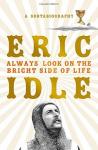
Eric Idle, Always look on the bright side of lifeAs most Aussie readers will know, Monty Python member Eric Idle is currently doing the rounds in Australia promoting his book Always look on the bright side of life: A sortabiography. I’m intrigued by that subtitle given the various discussions we’ve had here recently about memoirs and biography – but I haven’t read it yet so I can’t tell you what angle, if any, Idle has taken on the biography form.

Anyhow, the event I attended was part of the ANU/Canberra Times Meet the Author series, this one a paid event, with the ticket price including a signed copy of the book. I went with friends so didn’t take my usual copious notes. Indeed, I took no notes, so this will be a brief report.

I suspect most of the events ran pretty similarly, with a few variations depending on who “conversed” with Idle. Anne of Cat Politics, who occasionally comments here, went to the Melbourne event where the conversation was conducted by Michael Williams of The Wheeler Centre. She has written about it on her blog. We had a similar discussion, led beautifully by Alex Sloan, about Idle’s life and, career and his friendships with people like George Harrison. We also had a couple of songs, including the “Selfies” one (for which Anne provides a Youtube link.) Our event, like hers, ended up with Idle singing “Always look on the bright side of life”, except we had a small backing group, The Idlers, drawn from the Canberra Choral Society. That was fun – and I think they enjoyed themselves, too.

But, I think we may have had something else unique to us – a discussion about physics. Our event commenced with a YouTube video of Idle doing his “Galaxy Song”, after which ANU Vice-chancellor and Nobel Laureate in Physics, Brian Schmidt, came to the stage to introduce Idle. In doing so shared with us some – let us say – disagreements between Eric Idle and physicist Brian Cox about certain facts in the song. Schmidt suggested that, on one fact at least – to do with the power of the sun – he’s decided to agree with Idle. There was some lovely banter about all this, with Idle, who has performed the Galaxy Song with Cox, telling us that he’d told Cox that the facts were correct when he wrote the song: it was Science that had changed (due to that darned Hubble Telescope). You can Google Brian Cox and Eric Idle to find out more – if you haven’t seen them already.

Kate’s list of lists

As a service to us all, Kate (booksaremyfavouriteandbest) has published a post titled Best Books of 2018 – A List of Lists. In it she has listed the Best of 2018 lists already published by magazines and newspapers around the world – with annotations explaining what they cover. For example, of Esquire’s list she says “excellent mix of 50 fiction and nonfiction titles” and for NPR’s Best Books of 2018 she writes “use the filters to wade through this 300-strong list”.
Kate will be adding to this post as more lists are published. If you love book lists, bookmark her post!

Quote of the week

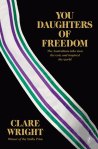
Clare Wright, You daughters of freedomHopefully, by the end of next week I’ll have written my post on Clare Wright’s You daughters of freedom, but I can’t resist sharing just one of many wonderful quotes from the book. This one is not Clare Wright’s own words, but a description of England’s “suffragette agitators” by the UK’s attorney-general at the time. He called them “those unsexed hyenas in petticoats”. Really!? You have to laugh!


Rebecca Skloot, The immortal life of Henrietta Lacks (#BookReview)

Rebecca Skloot, The immortal life of Henrietta LacksIn her extensive acknowledgements at the end of her book, The immortal life of Henrietta Lacks, Rebecca Skloot thanks “Heather at The Book Store, who tracked down every good novel she could find with a disjointed structure, all of which I devoured while trying to figure out the structure of this book.” Interesting that she looked at novels, particularly given our recent discussion regarding non-fiction that reads like fiction, but more on that later …

Many of you will have heard of the book, or, if not, of Henrietta Lacks, or of her HeLa cells? It’s a sort of hybrid biography-cum-science book about an African-American woman named Henrietta Lacks who died in 1951, and the immortal HeLa cell line that was and continues to be cultured from her cervical cancer cells. As Skloot writes, “these cells have transformed modern medicine.” The book was published in the USA in 2010. It won multiple awards, including, says Wikipedia, the National Academies Communication Award for “best creative work that helps the public understanding of topics in science, engineering or medicine”. In addition, the paperback edition was on the New York Times Bestseller List for 75 weeks.

I’ve described the book as hybrid, because the story (or biography) of Henrietta Lacks is just one of its threads. It also interrogates the complex intersection between race, class and ethics in medical research as well as broader ethical ramifications of issues like “informed consent” and the commercialisation of human tissue. Skloot, herself, says early in the book,

The Lackses challenged everything I thought I knew about faith, science, journalism, and race. Ultimately, this book is the result. It’s not only the story of HeLa cells and Henrietta Lacks, but of Henrietta’s family—particularly Deborah—and their lifelong struggle to make peace with the existence of those cells, and the science that made them possible.

If you haven’t guessed it by now, then, this book is another example of those non-fiction books that I like so much in which authors author takes us on their journey of discovery, in this case to understand the people and the science, the ethics and the law, behind this astonishing story. Skloot wasn’t the first so tell it, however – something she makes clear during our journey. Earlier stories include Michael Rogers’ 1976 article in Rolling Stone, and the 1997 BBC documentary, The way of all flesh, which you can watch on YouTube. I’m not going to spend a lot of time on the story of the cells, so if you want to know about them – read the book and/or watch this video.

Skloot explains her own fascination with Henrietta, from being introduced to her cells in high school, through those HeLa cells being “omnipresent” throughout her biology degree, to when she was in graduate school studying writing “and became fixated on the idea of someday telling Henrietta’s story”. It’s not surprising then that this book has been extensively researched – as evidenced by the Notes and Acknowledgements. (These two chapters make great reading in themselves.) It took around 10 years to write, not just because of this extensive research. A major issue which Skloot had to confront was the understandable suspicion and anger of the Lacks’ family, whose help she needed if she were to tell this story properly and with integrity. Their story is bound up in a long invidious history of research carried out on African-Americans, which is also detailed in the book.

“What do you mean, ‘everybody else’?!”

So, the structure. The book is divided into three parts – Life, Death, Immortality. In the first two parts, the story is told in two roughly alternating, chronological threads – one telling the story of Henrietta Lacks, her cells, and her family, from 1920 to 1973; the other tracking the early days of Skloot’s research from 1999 to 2000. In the third part, the two tracks coalesce into one chronological thread, starting from 1973 when the late Henrietta’s daughter-in-law, Bobbette, discovers quite accidentally via a friend’s brother-in-law, that Henrietta’s cells were being used in scientific research and had been since 1951. Until that point, no-one in the family had known that Henrietta’s cells were still “alive” and being used in research all over the world:

“What?!” Bobbette yelled, jumping up from her chair. “What you mean you got her cells in your lab?”

He held his hands up, like Whoa, wait a minute. “I ordered them from a supplier just like everybody else.”

“What do you mean, ‘everybody else’?!” Bobbette snapped. “What supplier? Who’s got cells from my mother-in-law?”

She is, to put it mildly, horrified – and rushes to tell her husband and thence the family.

Here, though, I’m going to return to the issue of writing non-fiction like fiction. There’s the use of narrative structure, of plot lines, to create some sort of tension for the reader – in this case it largely revolves around the lives and reactions of the family, particularly Deborah – while we are also learning drier “stuff” about the history and ethics of cell culture and medical research. The dialogue I’ve just shared is part of the main plot line concerning the family’s discovery of what had been happening to Henrietta’s cells.

Then there’s the use of evocative, descriptive language. Skloot doesn’t overdo this, staying, in the main, direct and focused – but there are enough little flourishes to keep the writing interesting, like “HeLa grew like crabgrass” or “tufts of hair like overgrown cotton sprouted from his head”. The imagery draws from the area in which it is set. And, there’s the use of dialogue. Skloot did carry out a lot of interviews over her decade-long research and often makes clear when she’s quoting from those – but not all dialogue comes from that research. Some is imagined – or what critics call “representative”. No-one, for example, would have recorded Henrietta’s exact words when she visited her gynecologist, but Skloot writes:

“I got a knot on my womb,” she told the receptionist. “The doctor need to have a look”.

How much more interesting that is to read than, say, “Henrietta visited her gynaecologist, telling the receptionist that she had pain in her womb that needed to be investigated.” I know what I’d rather read. Not only is dialogue more engaging, but if the writer gets the voice right it enhances our understanding of the character. One of the delights of this book, in fact, is our getting to “know” members of Henrietta’s family, and the dialogue plays a significant role in this. Not non-fiction readers, however, approve of this approach.

As I’ve already said, I’m not going to write a lot about the content of this book, fascinating though it is. It has been written about extensively; there are interviews with Skloot on the web; and for background there’s that BBC documentary. The book is now nearly a decade old. Cell research has moved on, but the story of the intersection of race and class with science and ethics is still relevant. Moreover, this is a book of history – the history of medicine. Close to home for me, for example, was learning that HeLa cells were involved in identifying the connection between the HPV virus and cervical cancer, and thence the development of the vaccine with which my reading group’s daughters were among the first in the world to be vaccinated.

All this makes the book well worth reading. There were, admittedly, times when the cell science got the better of me (and other non-scientific members of my reading group) but not enough to turn us off. Skloot’s courage, warmth and empathy with people out of her ken, the trust those initially fearful, angry people came to place in her, and her ability to tread the fine line between judgement and analysis when discussing actions of the past make this a special read. No-one in my reading group regretted this choice for our schedule. A fine way to end the year.

Rebecca Skloot
The immortal life of Henrietta Lacks
Sydney: Picador, 2010
ISBN: 9781742626260 (ePub)