Helen Garner, Yellow notebook: Diaries, Volume 1, 1978-1987 (#BookReview)

Book coverThe opening session of last November’s inaugural Broadside Festival featured Helen Garner in conversation with Sarah Krasnostein about her recently published Yellow notebook, the first volume of her edited diaries. It was an excellent, intelligent conversation. Garner came across as the forthright writer she is, one who fearlessly exposes difficult and unpleasant things, alongside joys and triumphs.

The epigraph she chose for her diaries is therefore not surprising:

We are here for this–to make mistakes and to correct ourselves, to stand the blows and hand them out. (Primo Levi, The periodic table)

Certainly, in Yellow notebook, Garner both stands some blows and hands a few out. She admits to many mistakes. She allows herself to be vulnerable. She may have cut a lot, as she told Krasnostein, but she clearly didn’t sanitise. Her aim was to select what others might find interesting. She didn’t rewrite, only changing (or adding) something if it would otherwise have been meaningless. A diary, she said, “has no voiceover, unlike a memoir”. That is, a diary contains what you did/felt at the time without the benefit of later reflection; she had to accept herself – both hurting others and being hurt – as she was at the time of writing. This gave her “fellow-feeling” with others.

She also decided not to identify people. She uses initials, such as M for her daughter, F for her husband at the time. Some of these people are, of course, easily identifiable for anyone who knows her biography, but I think there is still value in taking this approach. In this spirit, I decided not to investigate beyond what I already knew about her life.

The yellow notebook has a lot to offer Garner lovers. For what is quite a short book, its content is wide-ranging. It includes observations from life around her (as you’d expect from a writer), snippets of conversations (both overheard and her own), the occasional news item, stories from her life, thoughts about other writers, and of course reflections on her own writing. We are introduced to her love of music, and her interest in religion. We hear about her marriage break-up and her all-encompassing love of her daughter. All this reveals a messy person – someone who can be wise at times, and immature at others, who can be confident but also excruciatingly insecure, who can be unkind but also warm and generous, a person, in other words, like most of us, except most of us don’t lay the worst of ourselves quite so bare.

I could give examples of all of the above – and I should, because there’s glorious sentence after glorious sentence – but I want to focus on her writing life. For the rest, do read the book yourself.

“thinking voluptuously of the stories I’m going to write”

Part of understanding a writer is knowing who they read and admire. The writer Garner mentions most in this volume is Elizabeth Jolley. While Jolley and Garner are, in some ways, quite different writers, they have a lot in common. Both don’t shy away from some of the darker aspects of human behaviour. Sometimes Garner simply quotes Jolley – as we do when a writer reminds us of something we’re experiencing. Sometimes she shares little anecdotes about Jolley, but other times she comments on Jolley’s writing, even when referring to another writer!

‘Cod seemed a suitable dish for a rejected one and I ate it humbly without any kind of sauce or relish.’ –Barbara Pymm, Excellent women. This is Elizabeth Jolley’s tone and it made me laugh out loud.

Elizabeth Jolley makes me laugh out loud too. Garner also loves Jane Austen. She writes:

Mansfield Park. She never tells you anything about the appearance of her characters. As if they were moral forces. I love it.

You can see why I love Garner. She, Jolley and Austen all get to the heart of humans, incisively – and with wit. Garner writes about being rejected:

My short story was rejected by the Bulletin because it contained four-letter words. A letter from Geoffrey Dutton: ‘It pains me to have to knock this back … it’s you at your best.’ Thanks a lot. I suppose he’s a skilled writer of rejection letters.

Other writers Garner mentions include, randomly, Frank Moorhouse, Janet Malcolm, Joan Didion, Tim Winton, Virginia Woolf, Patrick White, DH Lawrence (who “uses the same word over and over till he makes it mean what he needs it to”), EM Forster, Katherine Mansfield, Henry James, James Joyce, Doris Lessing, Christina Stead (whom, she discovers, is “a visonary”), Randolph Stow, Rosa Capiello, and Les Murray:

The infuriating accuracy and simplicity of his images – birds that ‘trickle down through’ foliage. Of course, I think, this is what they do – why didn’t I know how to say it?

Four of Garner’s own books are published during the ten years covered by these diaries, the novels Moving out (1983) and The children’s Bach (1984) (my review), and short story collections, Honour; and Other people’s children (1980) and Postcards from Surfers (1985) (my review).

She shares many of her struggles and challenges in writing The children’s Bach, in particular:

… each morning I set out for my office weak with fear. I will never be a great writer. The best I can do is write books that are small but oblique enough to stick in people’s gullets.

AND

This flaming book is jammed again. I feel my ignorance and fear like a vast black hole.

AND

I’m scared to go into my office in case I can’t make things up.

AND

Went to work and fiddled around for half an hour, then began to properly feel it come … Delirious I ran downstairs and bought myself a pastie …

She shares her thoughts about writing, such as

About writing: meaning is in the smallest event. It doesn’t have to be put there: only revealed.

This is so Austen, too.

More broadly, she also speaks of critics, awards, and readers. It’s engaging and heart-rending all at once – and probably applicable to many writers.

Finally, she reflects on the value of art and on the creation process. Describing the experience of a painter finishing a portrait, Garner writes:

The miracle of making something that wasn’t there before. Pulling something out of thin air.

It’s that capacity that impresses someone like me. I’m sorry for the pain writers (and other creators) endure, but I’m so glad they are prepared to do it. I look forward to Volume 2, and beyond.
Challenge logoHelen Garner
Yellow notebook: Diaries, Volume 1, 1978-1987
Melbourne: Text Publishing, 2019
253pp.
ISBN: 9781922268143

(Review copy courtesy Text Publishing)

Bill curates: JM Coetzee’s Diary of a bad year

Bill curates is an occasional series where I delve into Sue’s vast archive, stretching back to May 2009, and choose a post for us to revisit.

When Sue wrote this review in July 2009 – yes I am progressing only slowly, but there is so much to choose from!  – Diary of a Bad Year was Coetzee’s most recent work. I read it only a year or so ago and it impressed on me how lucky we are in Australia that Coetzee chose to live here.

_______________________

My original post titled: “JM Coetzee, Diary of a bad year”

Book coverJ.M. Coetzee is one of those rare novelists who pushes the boundaries of what a novel is. The progression from his mid-career novel, the spare but terrifying Disgrace (1999),through Elizabeth Costello (2003) to Diary of a bad year (2007) is so dramatic that there are those who question whether these last two are even novels. It’s actually been a year or so since I read Diary of a bad year but it is currently being discussed by one of my reading groups so now seemed to be a good time to blog about it here.

One of the first things to confront the reader who picks up Diary of a bad year is how to read it. It has three (two to begin with) concurrent strands running across the top, middle and bottom of the page. Some readers try to read the three strands as concurrently as possible while others read the strands sequentially. Following this latter path, though, means you risk missing the way the strands comment on each other. The three strands are:

  • the narrator’s formal voice, basically taking the form of essays he is writing
  • the narrator’s informal voice in which he talks about his life as he is writing the essays
  • the voice of Anya, his “little typist”, and, through her, of her boyfriend, Alan

The three characters represent three modes of viewing the world: the narrator’s is primarily theoretical, while Anya’s is more pragmatic and Alan’s rational. Through these modes, Coetzee teases out the moral conundrums of the early 21st century both in terms of the political (the events confronting us) and the personal (how are we to live).

Towards the end, Coetzee refers to his love of Bach. To some degree the book is a paean to Bach: its three-part structure in which each part counterpoints the others seems to be a textual representation of Bach’s polyphony. The essays running across the top of the page, while a little uneven and dry on their own, are counterpointed by the views of the characters in the other two strands, resulting in our being presented with different ways of viewing the same world.

The characterisation is interesting: Senor C, the writer of the essays, is the logical, moral but somewhat pessimistic thinker; Anya is practical, down to earth, but with a strong moral sense; and Alan is the economic rationalist for whom money is essentially everything. The views of the two men are strongly contrasted, while Anya is caught in the middle. There is a Darwinian sense in Alan of the survival of the fittest, while Senor C spurns competition as a way of life, preferring collaboration. For all his “moral” views, though, Senor C is not presented as a paragon and we are discomforted at times by his attitude towards the beautiful Anya.

The overall theme seems to be how do we live in a world full of paradoxes and contradictions, a world that seems to be pervaded by dishonour and shame (the things Senor C explores in the essays). He talks about ordinary people and how they (we) cope with things they (we) don’t approve of. He wonders why they (we) don’t do something about it, but suggests in the end that they (we) practise “inner emigration”. He says:

The alternatives are not placid servitude on the one hand and revolt against servitude on the other. There is a third way, chosen by thousands and millions of people every day. It is the way of quietism, of willed obscurity, of inner emigration.

I like that concept though it does smack of burying one’s head in the sand. He also talks about collective guilt, and about bearing the dishonour of what’s gone on before. Through choosing a “novel” form like no other, one which blends but in no way harmonises fact and fiction, Coetzee shows in a very concrete way that difficult times need new ways of presenting ideas. He offers no neat conclusions, no easy outs; he is quite subversive really. Late in the book he ponders the value of writing, and says:

Are these words written on paper truly what I wanted to say?

This then is another step in Coetzee’s path of trying to find the best, perfect perhaps, way of saying what he wants to say. I, for one, will be ready for his next step.

JM Coetzee
Diary of a Bad Year
Melbourne: Text Publishing, 2007
178pp.
ISBN: 9781921145636

____________________

I said in this July 2009 post that I was ready for his next step, but in fact other reading got in the way and I have not read any more Coetzee since then. However, like Bill, I’m very glad he chose Australia to be his home. I will try to read more of him in coming years because I enjoy his exploration of the novel-form itself, as well as being interested in his ideas.

Have you read any Coetzee? If so we’d love to hear what you think about his writing.

Bill curates: Orhan Pamuk’s Snow

Bill curates is an occasional series where I delve into Sue’s vast archive, stretching back to May 2009, and choose a post for us to revisit.

Sometimes I think I am well read and sometimes I come upon a post like this and realize just how far I have to go. Pamuk, I discover, is a famous Turkish novelist and the winner of the 2006 Nobel prize.

_______________________

My original post titled: “Orhan Pamuk, Snow”

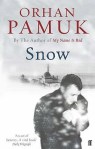
Book coverOne of my rules of reading is that when I have finished a book I go back and read the first chapter (or so) and any epigraphs the author may have included. These can often provide a real clue to meaning. This rule certainly applies to my latest read, Snow, by Nobel Prize winner, Orhan Pamuk.
(WARNING: SOME SPOILERS)

Snow, in fact, has no less than four epigraphs:

  • lines from Robert Browning’s “Bishop Blougram’s Apology” describing the paradoxical nature of things: “the honest thief, the tender murderer,/the superstitious atheist”;
  • a quote from Stendhal’s The charterhouse of Parma which warns about the ugliness of “politics in a literary work”;
  • a quote from Dostoevsky’s Notebooks for the Brothers Karamazov which suggests ideals like the European Enlightenment are “more important than people”; and
  • Joseph Conrad’s statement in Under Western eyes that “The Westerner in me was discomposed”.

These four epigraphs pretty well sum up the concerns of the book. What about the title? The second chapter begins with:

Veiling as it did the dirt, the mud and the darkness, the snow would continue to speak to Ka of purity, but after his first day in Kars, it no long promised innocence.

Here then is the first paradox: snow is pure but not innocent, and it covers dirt, mud and darkness. Already, you can see that this book is going to be ironic. Just how ironic though is a matter for contention but my suspicion is that its very foundation is ironic, as it grapples with what it means to be an artist in a political society, with how one is to live in a conflicted nation. The plot centres on a coup – a coup which is variously called a military coup and a theatrical coup! In fact, it is a coup by a theatrical group that is supported by the military! Art and politics could hardly be more entwined.

Snow though is not an easy read. It is my third Pamuk, but only the second one I have completed. I loved his memoir-cum-history Istanbul but could not, hard as I tried, finish My name is red.

What then is it about? The main action covers three days in the life of Ka, a Turkish poet recently returned from 12 years exile in Germany, who comes to Kars (in far east Turkey) ostensibly to write about the suicide epidemic among young women, but whose secondary (or perhaps primary!) reason is to fall in love with an old school-friend, Ipek. Soon after he arrives, however, the coup occurs and Ka is, rather unwillingly, caught up in the intrigue between the competing interests: the secularists, the Islamic fundamentalists, and the Kurdish nationalists. This sets the stage for exploring the art-politics nexus. Ka says to Sunay, the leader of the coup AND of the theatrical troupe that comes into town:

I know that you staged the coup not just for the sake of politics but also as a thing of beauty and in the name of art … you know only too well that a play in which Kadife bares her head for all of Kars to see will be no mere artistic triumph; it will also have profound political consequences.

Here then is one evocation of the second epigraph. The third and fourth epigraph refer to the running conflict in the book between European/Western values and Turkish/Eastern values. There is very much a sense that the people of Kars feel condescended to by European culture, but as a teen-ager says at one point, “We are not stupid! We’re just poor”. The people of Kars do not understand Western notions of individualism, and they see Western ideas of secularism and atheism as equating with immorality. Ka, as a Westernised Turk, acts as an uncomfortable, to him, bridge between the two worlds.

The core of the book is Ka. He is a sad and highly conflicted individual who, in his youth, had used words to argue that people should act for “the common good” but now finds himself using them to further his own happiness. Once politically active, “he now knew that the greatest happiness in life was to embrace a beautiful, intelligent woman and sit in a corner writing poetry”. The irony is that, for all his attempts to achieve this, he ends up with neither and dies four years after the coup a sad and lonely man.

The novel is interesting, stylistically and structurally. It is essentially a third person story about Ka but is told by a first person narrator, Ka’s friend, the novelist Orhan(!). This metafictional narrative technique, by adding another layer to the “conversation”, rather deepens the “artist in society” and art/politics themes of the book. Much of the story is foreshadowed: we learn of Ka’s death in Chapter 29, though the book has 44 chapters. The tone of the book is imbued with huzun, that very particular Turkish sense of melancholy that Pamuk explores beautifully in his book Istanbul. And, while it is about a coup and has a body count of 29, there are some very funny scenes, one being the political meeting at which the competing rebels prepare a statement about their beliefs for the Western Press. Anyone who has attended a political meeting will feel at home here!

All this said, the book is a challenge to grasp: there are a lot of characters, comings-and-goings, and ideas to track. Just why Ka is the way he is, just what did happen to him in the end, and just what Orhan is saying about art and politics are hard to pin down. I love the way the book is underpinned by paradox and irony – and yet at times the meaning can be a little tricky to discern. What is clear though is that Ka has found living by his political beliefs deeply unsatisfying but, ironically, is unable to bring about a situation in which he can live “happily” any other way.

Kadife, the leader of the headscarf girls, says (fairly early in the book):

…do not assume from this that our religion leaves no room for discussion. I will say that I am not prepared to discuss my faith with an atheist, or even a secularist. I beg your pardon.

Oh dear! Some reviewers call it a brave book. With its fearless exploration of the tensions in modern Turkey, it certainly feels that way. I am very glad that I put in the effort to read it.

Orhan Pamuk
Snow
Translated by Maureen Freely
London: Faber & Faber, 2005 (orig. Turkish ed. 2002)
426pp
ISBN: 0571218318

____________________

I know what Bill means. I too keep stumbling across authors I should know but have never heard of. I would like to read more Pamuk, including The museum of innocence which is on my TBR. Meanwhile, though, my heart really belongs to his mesmerising memoir, Istanbul. I’d love to read it again.

Have any of you read Pamuk? If so we’d love to hear what you think about his writing.

Anne Tyler, Redhead by the side of the road (#BookReview)

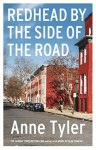
Book coverIn the last couple of months of my Mum’s life I bought her a few novels that I thought would give her pleasure. Although we didn’t know, then, how dire her health was, I did know that she was tired and needed good but not overly demanding or depressing reads. So, for Easter, I gave her Pip Williams’ The dictionary of lost words; for Mothers Day, I gave her Sulari Gentill’s A few right thinking men and Anna Goldsworthy’s Melting moments; and, then, when she went into hospital, I bought her Anne Tyler’s Redhead by the side of the road. Being the lexicographer she was, she loved The dictionary of lost words. She took A few right thinking men into hospital and read two-thirds of it before tiredness defeated her. She was finding the historical background really interesting, but she was keen to get onto Tyler whose books she’d read before. Unfortunately, she never did, but I picked it up as I sat by her bed on the last day of her life. It’s a long time since I’ve read Tyler, but it turned out to be the perfect book for my current state of mind. Even so, it took me two weeks to read it …
Anne Tyler has created some memorable characters and/or situations. I loved The accidental tourist with its travel writer aiming to show American businessmen how to travel without feeing they’d left home – the antithesis of how Mr Gums and I like to travel. I remember the opening of Breathing lessons with the couple squabbling about navigating as they drive to a funeral under pressure. And, her empty-nest-fearing character in The ladder of years who just ups and leaves in the middle of a family holiday is such a wonderful conceit. If she were Australian, we’d probably describe her work as quirky.

What makes Tyler’s novels so enjoyable, then, are her characters and her writing. Her characters are believable but just a little off-centre, and her writing is accessible, but tight and evocative. Her novels are character rather than plot-driven, but they don’t wallow in her characters’ lives. She keeps the story moving.

So, in Redhead by the side of the road, we have 41-year-old Micah Mortimer, “such a narrow and limited man; so closed off.” Routine is his mantra, and you could pretty much set your clock by it. He’s not particularly socially astute, and doesn’t understand the jokes his four older sisters make about him, particularly when he tells them that it looks like his latest girlfriend, Cass, has broken off their relationship. He doesn’t explain that the cause was his inept response to her announcement that she feared she was about to lose her flat – because he hasn’t realised it himself. This is one of the catalysts that forces him to reconsider his life. The other is the sudden appearance on his doorstep of college freshman, Brink, who thinks Micah might be his father.

Now, Brink is the son of his first serious girlfriend Lorna. Micah knows for a fact that Brink is not his son but he accepts this young man into his home and tries, in his own way, to help. While all this is going on, he also keeps an eye out on his apartment building where he “moonlights as a super” and he attends calls for his sole-trader business, Tech Hermit. I must say that, living with my own tech expert, I loved Micah’s interactions with his clients, so many of which I’ve heard Mr Gums have with various friends and family members. “Have you turned it off and then on again?”, for example. The password-finding escapade for a young girl who had inherited her gran’s home and computer is particularly entertaining.

However, that’s not the subject of the novel. What is, is Micah’s slowly growing awareness of life not being as he has seen it, of realising that striving for predicable order does not necessarily make you happy. When Lorna explains why their relationship had ended, our routine-focused Micah, who has never been good at seeing things from other perspectives, has “to adjust to this altered view of the past”. The novel’s title provides a little insight into this:

He slowed to a walk on the last stretch approaching York Road. He momentarily mistook the hydrant for a redhead and gave his usual shake of the shoulders at how repetitious this thought was, how repetitious all his thoughts were, how they ran in a deep rut and now his life ran in a rut, really.

Micah, though, is not the only character muddling along. The thing I like about Tyler is that all her characters muddle along. She forces us to see below the surface, to see that while some may appear more successful than others, may have the trappings of success – like Lorna – all have their insecurities or uncertainties. The novel is full of gentle but no less pointed insights into relationships – Micah’s with his messy, chaotic family, for example, or, Lorna’s with her husband. And it has some sensible down-home philosophies, such as “what’s the point of living if you don’t try to do things better” and “try again, try again, and try again after that … because what else can a person do”.

All this might sound a bit cutesy, but the thing is that beneath Tyler’s apparent cutesiness, is a warm but clear-eyed view of human nature. She sees our foibles, our mis-steps, our little self-delusions, but she wants us to make our lives work. Redhead by the side of the road is no exception, and was just the right read for me for now. I must get back to reading Tyler.

Anne Tyler
Redhead by the side of the road
London: Chatto and Windus, 2020
178pp.
ISBN: 9781784743482

Bill curates: Tim Winton’s Breath

Bill curates is an occasional series where I delve into Sue’s vast archive, stretching back to May 2009, and choose a post for us to revisit.

Tim Winton is not my favourite novelist but as a Western Australian I feel obliged to read those of his books that I come across, and mostly they’re OK though a bit same-ish (boys growing up on WA’s south west coast). It seems Sue initially titled this post Tim Winton versus Thea Astley. Read on and you’ll see why.
_______________________

My original post titled: “Four time winner: Tim Winton wins 2009 Miles Franklin”

Well, it’s finally happened as I knew it must. Someone has equalled Thea Astley’s record number of four Miles Franklin Award wins, as tonight Tim Winton was announced the 2009 winner with Breath. I was seriously considering making Thea Astley my third favourite writers post – I think this means that I will now have to.

Winton has won the award for Shallows (1984), Cloudstreet (1991), Dirt music (2001) and now Breath (2009); and Astley for The well dressed explorer (1962), The slow natives (1965), The acolyte (1972) and Drylands (1999). Both writers are great stylists who use metaphor well, both tend to explore strong connections between character and landscape, and both are indubitably Australian! I think, however, that Astley’s pen ranged wider than Winton’s and she took more risks. That’s not to say that Winton doesn’t deserve his wins but I do think that Astley (she died in 2004) was and continues to be undervalued.

Breath

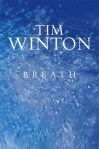
Tim Winton, BreathAnyhow, here is a brief recap of my thoughts on Breath which I read long before I started writing this blog. I’ll start with a quick plot summary just in case there’s someone out there who doesn’t know it! It is a first person, coming of age story told by Bruce “Pikelet” Pike. It starts with his boyhood friendship with Ivan “Loonie” Loon. As young boys, they dare each other to perform dangerous stunts in the local river, and then as teenagers, they take up surfing where they are encouraged into new levels of recklessness by a former professional surfer named Sando. As time passes, Pikelet’s friendship with Sando and Loonie disintegrates and is replaced by a rather equally scary relationship with Sando’s American wife Eva, an injured and therefore ex-skier.
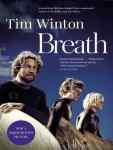
I like the book. I like the way he sustains the “breath” metaphor throughout to represent various facets of life and life-giving (or life-taking) forces. Despite not being a surfer, I love his wonderfully visceral descriptions of surfing. I also like his exploration of the imperative to take risks that is so common in young men and that is often accompanied by a drive to “be someone”.

Book coverRelated, I suppose, to the coming-of-age issue is the theme of learning to accept being ordinary.  After Sando and Loonie leave the first time, Pikelet goes out and surfs Old Smoky: the first time he does it he’s so successful he feels he’s not ordinary, but then in his overconfidence he does it again and nearly does himself in…this is the beginning of his changing point of view. As he says a little later when he reviews his relationship with Eva, “No, Eva was not ordinary. And neither was the form of consolation she preferred. Given my time over I would not do it all again”. In other words, while he had originally equated not being ordinary with doing big risky things, with courting fear, by the end of the novel he realises that life is “a tough gig” and is about more than courting fear and taking big risks. This doesn’t mean that he can’t do and enjoy a job that provides an andrenalin rush (paramedic/ambulance driver) but it does mean that he no longer seeks to be anything other than himself and that he now goes for an adrenaline rush in “safer” more acceptable ways.
Before he gets to this point, though, he has to come to terms with his Eva experience and with the fact that he spent a big part of his life blaming her for his problems. He eventually comes to the conclusion that “people are fools, not monsters”. This closely resembles my own world-view: that is, that mostly(there are obvious exceptions) when people do the wrong thing they do it, at best, from the best of intentions, or, at worst, for reasons of laziness, selfishness or just plain obliviousness.

There’s no neat ending or pat conclusion: Pikelet recognises that he has been damaged by his life experiences and that he needs to manage himself – but he still loves to surf, that is, to do something “pointless and beautiful”. In this sense it is very much a book of its post-modern age: the lesson almost is that there is no lesson, that each of us has to find our own way. Pikelet says to Sando “maybe ordinary’s not so bad”. As one who is rather ordinary herself, I concur!

Tim Winton
Breath
Penguin Australia, 2008
224pp.
ISBN: 9780241015308

____________________

Bill is nothing if not observant! He noticed that the URL for my Breath post was “Tim Winton versus Thea Astley”. Being an early blogger when I wrote this post, I wasn’t completely clued into changing the URL if you change the blog title before you finally post it. The thing is, I was, at the time, really irritated that Astley was never being mentioned – certainly not in the general or popular press – for her Miles Franklin record. Even now, I think, many people do not realise just how significant she is!

Are any of you Winton and/or Astley fans? We’d love to know your favourites if you are. Or, alternatively, we’d love to know why you aren’t!

Bill curates: Christos Tsiolkas’ The slap

Bill curates is an occasional series where I delve into Sue’s vast archive, stretching back to May 2009, and choose a post for us to revisit.

Tsiolkas is an author I admire and enjoy and yet I have not read The Slap. I remember that it caused quite a stir when it came out and if I was the sort of person who went to dinner parties I’m sure I would have joined in the discussions it gave rise to (I smacked my own children, but not other people’s). This is my third and final selection from May 2009. Notice how short it is. I wonder when her reviews began to get longer.
Christos Tsiolkas, The Slap, Allen & Unwin, 2008

_______________________

My original post

You could easily give yourself away when reviewing Christos Tsiolkas’ latest novel, The slap. For example, do you align yourself with the uncompromising, emotional earth mother Rosie or the rational, cool and collected but somewhat more willing to compromise Aisha? Do you rail against the liberal use of expletives, the relaxed attitude to recreational drug use, and the focus on carnal appetites more often in their ugly or elemental than their loving guise? Do you engage in the private versus public school argument? These are the sorts of things that confront Tsiolkas’ readers.

Courtesy: Allen & Unwin

In simple terms, The slap explores the fallout that occurs after a young child is slapped by an unrelated adult at a family-and-friends barbecue. This slap occurs in the first “chapter”, reminding me of Ian McEwan’s books which also tend to start with an event that triggers a set of actions and reactions. However, unlike McEwan, Tsiolkas does not build up a strong sense of suspense about “what will happen next”. In fact, the actual slap storyline is resolved about two-thirds of the way through the novel.

Rather, the book is about its characters and their relationships as spouse, parent, child, sibling, friend. At face level, most are not particularly appealing. They are often intolerant, narrow-minded and/or confrontational. Just as you begin to like, or at least understand, them they do something that changes your mind.  And yet, in all their imperfections, they do engage.

The book has an interesting though not unique structure. Like Elliot Perlman’s Seven types of ambiguity, the story is progressed through a sequence of different, third person, points of view covering three generations. This shifting of perspectives and stories has the effect of moving our focus from the plot to the content.  And the content ranges broadly across the things that confront families and marriages – love and hate, family versus friends, anger, loyalty, compassion and forgiveness. It has moments of real venom, but also of real tenderness.

Not surprisingly, violence features heavily in the book. Tsiolkas shows how pervasive violence is in western middle class society. Through the various characters’ stories we see a wide range of violent behaviour from domestic violence through consensual but aggressive sex to those seemingly casual expressions of violence such as “I wanted to kill her” about a person who annoys. We also see how deeply ingrained prejudice against “other” is, whether that other be racial, religious, cultural, sexual orientation or socioeconomic. In Tsiolkas’ world it feels as though only a thin veneer of civility covers our more primitive selves and the reader is never quite sure when or whether these selves will break through and wreak havoc. It is to the credit of the characters, and by extension us, that they rarely do, but we are left in no illusion that they could.

A critical aspect of the structure is whose perspective starts and ends the novel. Interestingly, again perhaps emphasising the minimal importance of plot, these are neither the slapper nor the “slappee”. In fact, the final voice is given to someone who starts out on the edge of the main action but is gradually drawn in. As an involved outsider, with issues of his own, he is able to resolve (as much as they can be resolved) the secondary plot lines and, as a person on the brink of adulthood, he can offer a sense of hope to what has been a pretty gritty story.

Wallace Stegner, the great American writer, wrote in his book, Angle of repose, that “Civilizations grow by agreements and accommodations and accretions, not by repudiations”.  This, taken at a more personal level, seems to be the point of the novel for as Aisha says in the second last chapter, “This finally was love … Love, at its core, was negotiation, the surrender of two individuals to the messy, banal, domestic realities of sharing a life together. In this way, in love, she could secure a familiar happiness”.

POSTSCRIPT: In 2011 The slap was adapted for television, for the ABC, and closely followed the novel’s narrative style with each episode being viewed through the eyes of a different character. The scriptwriters are, I think, a quality bunch:  Emily Ballou, Alice Bell, Brendan Cowell, Kris Mrksa, Cate Shortland. Interestingly, Tsiolkas is not among them.

_______________________

So, Bill likes Tsiolkas too, but, from his comment on my review of Damascus, it seems that that book’s subject matter doesn’t appeal to him much. Given Bill hasn’t read The slap nor Damascus, I’m guessing he’s read the earlier novels, which I haven’t – and should rectify.

Oh, and re length of reviews. I love that Bill noticed that. I started by wanting to keep my reviews to 800 words, but now my goal (not rigorously adhered to) is 1000-1200.

Anyhow, are any of you Tsiolkas fans and, if so, what is your favourite?

Favel Parrett, There was still love (#BookReview)

Book coverFavel Parrett’s third novel, There was still love, is one of those novels in which not a lot happens but has a lot going on. Just the sort of novel, really, that I tend to like. (It all started with Jane Austen!)

The novel revolves around the lives of two Czech sisters, one who ends up in Melbourne with the other remaining in Prague, but their story is mainly seen through the eyes of their grandchildren. Melbourne-based Malá Liška or “Little Fox” lives with her grandparents Máňa and Bill, while Prague-based Luděk lives with his Babi (grandmother). The novel is set mostly in 1980, and alternates between these two places, with occasional forays into other places and/or times to fill in some backstories. It’s a carefully constructed book, one that benefits from close reading, which is not to say it’s hard reading, because it’s not. It’s one of the fastest reads I’ve had in some time.

Now, if you know your European history, the above description will have suggested to you the book’s framework, and you’d be right. Separated during World War Two, with young Máňa going to England, the women’s lives are further up-ended by the 1968 Czechoslovakian Revolution. Through it all, although physically separated, they stay in touch, via letters and the occasional visits back to Prague by Máňa and Bill:

My grandparents saved their fifty-cent coins to buy aeroplane tickets. They managed to do this every four years, sometimes every three years if they were careful. If they saved very hard.

They bought the cheapest tickets.

They took the longest route.

Such is the call of home, about which more later.

The stories, as mentioned above, are told through the eyes of Malá Liška (in first person) and Luděk (in third person.) I suspect Malá Liška’s is first person because she is modelled on Parrett herself, thus providing a grounding authenticity. Luděk’s story is, the Author’s Note says, drawn from the experiences of her cousin Martin. The Prague scenes, she writes, “would be nothing” without his help. I haven’t visited Prague, but Parrett, through Luděk via Martin, brings it alive:

Luděk loved the mess, the decay. His city wasn’t clean, it wasn’t pretty. And there were wires everywhere in the sky and they crisscrossed like a million black lines. Everything was covered in stinking soot, in pigeon shit, covered in old rusted scaffolding … Prague was his city, the flat his whole world, and he loved it all.

Prague, and his grandmother’s flat, in other words, are his home.

There was still love is about many things, of which love, which survives upheaval and separation, and home, which you can make and remake throughout life while never forgetting your origins, are the two overriding ones. These are big themes, and yet the novel is just over 200 pages. I’m in awe of Parrett’s concision. There were some in my reading group who wanted the whole family saga – which I get – but I loved Parrett’s ability to convey a wealth of meaning and history in a phrase, a sentence or a short scene. Here, for example, is a scene between Luděk and his uncle Bill, in Prague:

‘I think that man is following us,’ he [Bill] said, and his eyes moved up the path towards another bench.

Luděk remembered how his Mama said they were always watching at the airport, watching, taking photos …

Babi told him never to say anything important on the telephone.

The reality of living under surveillance is conveyed quietly, thus, in a couple of pages, but we readers know exactly the fear and brutality that lie just behind these words.

Another example of this concision is a brief scene in a Melbourne shop during which Máňa is called a “stupid wog”. She walks out of the shop with dignity, but Malá Liška notices that “a tear, just a small one, spills down her soft, powdered cheek and she does not wipe it away.” Again, a brief scene, but we know that this is not the only time Máňa has been treated like this. Life, Parrett shows, can be difficult whether you stay or go.

Parrett also achieves concision through a “suitcase” motif. It is introduced in the gorgeous brief poetic prologue called “The suitcase”. Parrett describes suitcases being everywhere, evoking a powerful image of people on the move, of people escaping and of people not getting away. She writes:

You must close up tight, protect your most needed possessions … your heart, your mind, your soul. You must become a little suitcase and try not to think about home.

From here on, suitcases of all sorts are subtly dropped into the narrative to suggest various ideas – a suitcase in a roof space holding an old gymnastics blazer from a past life; “a suitcase with yellow eyes – a suitcase with a mouth like a big black hole” in a Czech Black Light Theatre performance in Melbourne; people arriving at airports, looking “dazed, pushing trolleys loaded up with suitcases”. The most powerful reference, though, comes from The Black Light Theatre Company’s Magician (based on the still living Jiří Srnec):

I put the broken in my suitcase and take them with me until they are ready to go home again.

There is still love.

There it is, home and love again. Luděk’s much missed mother travels with this company, and is tempted to defect to the free West.

Closely related to the idea of love and home is the story of refugees, of migration. In a little section devoted to him, Bill tells of changing his name from Vilém in 1942 England in order to fit in, while Máňa “works on her accent”. He shares the pain of leaving one’s home:

The only way to live now is to keep moving forward and not look back. It is the only way his heart can keep on beating and not break. He must look forward and not behind.

He must never look behind.

A common – and painful – experience for refugees.

Finally, There was still love is also a story about women, and particularly old women who carry on. It is Luděk, loving his grandmother and coming to care for another old women, who voices this:

The city was full of old women left behind, left to keep everything going – to carry the old goddam world by themselves.

My reading group briefly discussed the title, There was still love. What did “still” mean we pondered? “Still” as in ongoing, or as in continuing despite everything? Both, I think. Whatever the meaning, however, There was still love is a moving read that reminds us yet again that the most important things in life are home and love, wherever you find them.

Lisa (ANZLitLovers) also loved this book.

Challenge logo

Favel Parrett
There was still love
Sydney: Hachette Australia, 2019
214pp.
ISBN: 9780733630682

Bill curates: Jane Austen’s letters, 1814-1816

Bill curates is an occasional series where I delve into Sue’s vast archive, stretching back to May 2009, and choose a post for us to revisit.

Book coverI said, when I introduced this series, that Sue began writing Whispering Gums in May 2009. It seems that once begun she could not stop. There are WG posts for May 2,4,5,6,10,14,15,16,19,21,22,27,28,30,31. The May 31 post is titled, prophetically, “When too much Jane Austen is barely enough”, and is in fact the third Jane Austen post for the month. Today I reprise the second. But there will be more.
Diedre Le Faye ed., Jane Austen’s Letters, Oxford University Press, Oxford, 2014

More Jane Austen from Whispering Gums (here)

_______________________

My original post

By 1814, Jane Austen had published Sense and sensibility (1811) and Pride and prejudice (1813).  Mansfield Park (1814) was about to be published, and Northanger Abbey had been written many years previously but was not yet published. She was over half way through her major published oeuvre of 6 books and had less than 4 years to live. Tragedy!

Jane Austen's desk with quill

Austen’s desk, Chawton. (Courtesy: Monster @ flickr.com)

There have been several editions of her letters, the most recent being Jane Austen’s letters, published in 1995 and edited by Jane Austen scholar, Deirdre Le Faye. Of the estimated 3000 letters she wrote, only about 160 survive so it is well to savour them slowly. I have just (re)read the letters from 1814 to 1816, and found much to delight a Janeite. They contain some of her most famous quotes regarding her subject-matter and style, advice to her nieces on novel-writing, criticisms of other writing which provide insight into her own writing, as well as a lot of detail about her daily life.

One of her most famous comments was made to her niece Anna (nèe Austen) Lefroy in September 1814:

You are now collecting your People delightfully, getting them exactly into such a spot as is the delight of my life – 3 or 4 families in a Country Village is the very thing to work on.

Somewhat less well known is her response to James Stanier Clarke, the Prince Regent’s chaplain and librarian, who suggested she write a novel about an English Clergyman. She writes:

The comic part of the character I might be equal to, but not the Good, the Enthusiastic, the Literary. Such a Man’s conversation must at times be on subjects of Science & Philosophy of which I know nothing  […] A Classical Education, or at any rate, a very extensive acquaintance with English Literature, Ancient and Modern, appears to me quite Indispensable for the person who would do any justice to your Clergyman. And I think I may boast myself to be, with all possible Vanity, the most unlearned, & uninformed Female who ever dared to be an Authoress. (December 1815)

False modesty perhaps, but she she knew what she was comfortable writing and this was not it. She makes clear in her letters exactly what she thinks makes good writing and one of those things is to write what you know. She tells Anna that it is fine to let some characters go to Ireland but not to describe their time there “as you know nothing of the Manners there” (August 1814). Interestingly, it would have been around this time that she was writing Emma – some of whose characters go to Ireland but no details are given of their life there. She also tells Anna that fiction must appear to be realistic as well as be realistic when she says:

I have scratched out Sir Tho: from walking with the other Men to the Stables &c the very day after his breaking his arm – for though I find your Papa did walk out immediately after his arm was set, I think it can be so little usual as to appear unnatural in a book. (August 1814)

In other words, truth is allowed to be stranger than fiction!

In the September 1814 letter referred to earlier, she advises Anna to keep her characters consistent, and to be careful about providing too “minute” descriptions.  And in another letter written that same September she warns Anna off “common Novel style” such as creating a character who is “a handsome, amiable, unexceptionable Young Man (such as do not much abound in real Life)” and to not have a character “plunge into a ‘vortex of Dissipation’ … it is such thorough novel slang – and so old, that I dare say Adam met with it in the first novel he opened”!

There is a lot in these letters – about writing and getting published, the weather, fashion, health, and the like. However, in the interests of brevity I will close with something completely different but which, given the current popularity of Christos Tsiolkas’ The slap, seems very apposite. She writes this in 1815 about a young boy of her acquaintance: “we thought him a very fine boy, but in terrible want of Discipline – I hope he gets a wholesome thump, or two, whenever it is necessary”. If Jane thinks it’s a good idea, who are we to argue?

_______________________

When Bill offered this series to help me out, he said he’d start with Eve Langley’s The pea pickers, which he did. I wondered what he would choose next, but I should have guessed that he would have turned to another favourite that we share, Jane Austen.

We’d love all you other Austenites to show yourselves and tell us what you most love about her.

Christos Tsiolkas, Damascus (#BookReview)

Book coverI have reviewed (and enjoyed) two of Christos Tsiolkas’ books since blogging – The slap and Barracuda – so I was of course interested when Allen & Unwin sent me his most recent release, until, that is, I saw its subject matter. Biblical history, or historical fiction set in biblical times, are not really big go-to areas of interest for me. However, it was Tsiolkas so, finally, when its turn came, I dived in.

What did I find? I hadn’t read reviews, but I had heard that it was pretty violent, and it certainly is in places. Indeed, it starts with the stoning of a woman – but it wasn’t gratuitous or dwelt on. The actual stoning was over in a couple of sentences, and, given Tsiolkas is a serious writer, I decided to trust that he was going somewhere interesting.

Damascus – the title referencing Saul’s (Paul’s) epiphany regarding Christ on the road to you know where – uses the story of Saul, his acolytes, and people he knew, to explore the first few generations of Christians and, through them, the foundations of Christianity. The media release which accompanied my copy says that the novel “explores the themes that have obsessed Tsiolkas as a writer: class, religion, masculinity, patriarchy, colonisation, exile.” Class is the first one to raise its head in the book, and is the one that encouraged me to keep going, because the book reminds us of Christ’s teachings about equality. A few refrains run through the novel, but the first one that captured my attention was “The first will be last, and the last will be first”. It is this teaching, this original Christian belief, that most infuriated Christianity’s opponents. That slaves, for example, should be treated as equal, should sit down at the table with others, was an affront. Given Christianity’s problematic history, I loved being reminded of this fundamental point.

The book, for me, explores two main issues. One is this Christian value of equality – accepting all people as worthy of love and attention. It dominates the first part of the book. However, another issue also raises its head fairly early – through another refrain that ends with “Truly, he is returning” – the Christian belief in the Resurrection. This theological concern occupies much of Saul’s thinking and dominates the book’s ending. In Angela Savage’s YVWF conversation with Tsiolkas, he said that he doesn’t believe Christ was resurrected. He doesn’t believe in an eternal kingdom, but that finding how to live a good life has to be worked out here and now. He therefore chose to include the character of Thomas, the doubter from the Gospel of John, to suggest another direction in which the church could have gone. His Thomas appears in the novel as the apocryphal twin of Jesus, thus giving flesh to the dichotomy between these two world views. This dichotomy is also neatly embodied in the love another of the book’s main characters, Timothy, has for both Saul and Thomas.

So, these were the two themes that kept me interested in the book, but what about the actual experience of reading it? Like many Tsiolkas’ novels, it is a multiple (or “roving”) point-of-view novel. It has a complex structure, comprising two chronologies, as you can see in the following list of the book’s parts:

  • Saul I 35 Anno Domini
  • Hope Lydia, Antioch 57 A.D.
  • Saul II 37 Anno Domini
  • Faith Vrasas, Rome 63 A.D.
  • Saul III 45 Anno Domini
  • Love Timothy, Ephesus 87 A.D.
  • Saul IV 57 Anno Domini

One chronology tells the life, thoughts and inner conflict of Saul, while the other explores the impact of Saul on others. Lydia appears in the biblical book of Acts as the first woman Saul brings to the new religion; Vrasas is his jailer in Rome and has a hatred of those he describes as “death-worshippers”; and Timothy, his companion in the Bible, had a pagan Greek father and a Jewish mother and so embodies, Tsiolkas said, “between world-ness”.

All this is rather complex, and if you don’t know your biblical history you need to concentrate hard on who is who, and where they are going, on the various belief systems and their suspicion if not hatred of each other. You also need to go with Tsiolkas’ view of Saul as a flawed man struggling with his own temptations, his lusts, pride and envy. Tsiolkas’ Saul is a man not a paragon, one who struggles even as he tries to bring the new religion to people on his travels. Here he expresses guilt over his love for Timothy:

Saul falls to his knees on the stony ground. He is sin, he is evil. The storm inside him rages and scorns. He will never conquer the serpent that coils around his loins–its poison floods his heart and mind. What arrogance to believe he is loved by the Lord! How vain to think that he has been chosen by the Saviour. (p. 264)

Inner conflicts like this are well-known, I believe, to Christians.

One of the major joys in reading this book is the characterisation. Lydia, whose first baby is abandoned on the mountains because she is an unwanted girl, is a powerful, but moving character who shares her life as a wife in a seemingly typical merchant family before she takes to the mountains herself. Vrasas, on the other hand, is a brutal character. His section is called, ironically, “Faith”. His faith is a brutal one, and his section contains some of the most brutal scenes in the book, starting with a sacrifice. The aforementioned Timothy, who loves both Saul and Thomas, is a particularly engaging character. His section, “Love”, contains another brutal scene, the punishment of a Jesus-follower by a pagan cult. Timothy, in a way, helps resolve the theological conflict between Saul and Thomas. He sees, I think, the essence of what they both believe. He comes to realise that the point is not the second coming, the cataclysm – though he believes it will come – but the love and hope that are conveyed in the Christian message.

Now, as you have probably realised, Tsiolkas, being Tsiolkas, does not hold back in his graphic descriptions of the brutality of the times. This is not a namby-pamby story but a gritty, mucky, one. It will offend some people in its physicality and viscerality, and it will offend others for its perspective on some much-loved biblical characters, but it is also suffused with one of the main metaphors of Christianity, light. When Saul is grappling with his conversion, “he marvels at the solace of light, the joy it brings him”. It’s a hard-won conversion. At one stage, conflicted by what Ananias’ group is saying, he prepares “to condemn the wicked circle” only to feel “that the light has gone.” Gradually, Ananias teaches Saul to see that Yeshua’s “words were a light” and that this light helps his followers shed darkness, hate, bitterness, cruelty. Light metaphors recur throughout the novel, sustaining characters whenever they feel its presence.

Damascus is not a novel for everyone. Its confronting exploration of the early Christians, alongside the complex history of times that many of us are no longer familiar with, make it a challenging read. However, I related to Tsiolkas’ heart, which aligns with Saul’s “misery at what the world is. At what the world can do”. If only we could recover those original Christian values of loving our neighbour, of treating every person we meet with equal respect, so much of that misery would be gone.

Christos Tsiolkas
Damascus
Crows Nest: Allen  & Unwin, 2019
423pp.
ISBN: 9781760875091

Review copy courtesy Allen & Unwin

Bill curates: Eve Langley’s The pea pickers

Back in April, Karen of Booker Talk published a great series of posts on the A2Z of Bookblogging. One of those posts was on Updating Posts or, Breathing new life into old posts. Bill (The Australian Legend), as part of his generous plan to help me keep my blog alive during my time-challenged period, suggested taking up this idea and reposting some of my old blogs. Thus was born … Bill curates! I am so grateful. And now, I pass you over to Bill …
Bill curates will be an occasional series where I delve into Sue’s vast archive, stretching back to May 2009, and choose a post for us to revisit.
Book coverMy first choice is Sue’s review of Eve Langley’s masterpiece The Pea Pickers. One day Australians will overcome their cultural cringe and realise that in Joseph Furphy’s Such is Life and Eve Langley’s mostly unpublished eleven journals and novels we have writing that should be ranked alongside Ulysses and Rembrance of Times Lost. That’s my opinion and not necessarily Sue’s, but I think she still ranks The Pea Pickers pretty highly, and while she says she might now have written this piece a little differently – it was in fact her first review – I think you’ll agree it stands the test of time.
Eve Langley, The Pea Pickers, first pub. 1942. Cover from Angus & Robertson 2nd ed. hardback, 1958
See also Bill’s posts about Langley:
  • Eve Langley Wrote Two Novels (here)
  • Wilde Eve, ed. Lucy Frost (here)
_______________________

My original post

It  is hard to classify Langley’s most famous novel, The pea-pickers, which was first published in 1942. In some ways it fits into the coming-of-age genre but it is different from the more usual offerings in that genre, if only because there is no real sense at the end that the protagonist has come of age! It also has elements of the picaresque. Again, it’s not typical. The two sisters don’t travel far and wide, they don’t have many “big” adventures”, and it’s heavier in tone than the usual picaresque, but it is about two young women who set out to adventure partly to recover some of their lost history.  A modern interpretation of the picaresque perhaps?

The novel is semi-autobiographical, and is told in first-person. Given that there’s not a very strong plot nor a strong sense of character development, it’s interesting that Langley chose the novel form for it rather than autobiography. She wrote it in the early 1940s, but based it on the journals and poetry she wrote during the time period in which the novel is set, the 1920s.

So what exactly is it about?  The plot is pretty thin: two sisters dress as men and take men’s names, Steve and Blue, in order to work as agricultural labourers in Gippsland, the place their mother has told them about throughout their childhood and with which they feel they have a connection.  The book chronicles their life and work over a few seasons, and particularly describes the people they meet along the way, including a couple of “loves” for Steve, the narrator.

Stylistically it is interesting. Her language is very poetic, and there is also a lot of specific poetry in it. It is quietly humorous. It is also quite declamatory – in an old-fashioned poetic sort of way. There are a lot of allusions, particularly to things classical. There is no real plot, no sense of growth for the main characters from the beginning to the end. All this makes it quite odd – a strange mix of old-fashioned (declamatory style, classical allusions, etc) with post-modern (disregard for traditional elements of the novel such as plot and character development).

Two lovely pieces of writing early in the book are:

Down I fell, in love. And what happened? In feeling, incidents pure beyond pens, anguished beyond all telling. In fact, incidents to the point of idiocy.

and

Then the elderly party with the severe yet insane look took the violin from Blue’s hand and stood beside the door with it, looking as though he were meditating on a dry spell that had brought crows flying around the sheep and mortgages flying around the mailbox, and on that violin he played, with an absent-minded hand, such tunes as Ulysses should have retorted to the harpies.

It’s interesting in terms of social history – the cross dressing, the racism (anti Italians in particular), the depiction of agricultural life of the time. It beautifully evokes 1920s rural Victoria, portraying both the characters who populated it and the sort of small-scale agriculture that was going on.

Cross-dressing or women dressing “mannishly” was a bit of a common thread in nineteenth and early twentieth century Australia. Louisa Atkinson, back in the mid to late 1800s, was a botanist, illustrator, writer who wore trousers (particularly when she was out collecting her specimens) and shocked the locals in the Southern Highlands of NSW (Berrima/Bowral area), even though she conformed in terms of religiosity. Marie Bjelke Petersen (late 19th to mid 20th century) was described as mannish in dress when she was young – and I believe she wore pants. In addition, Marie Bjelke Petersen wrote the story “Jewelled Nights” which was turned into a film starring Louise Lovely in 1925. It is about a woman who dressed as a man. The film didn’t do wonderfully well at the box office. And then Edna Walling in Melbourne in the early 20s wore comfortable jodhpurs when she undertook the gardening and landscaping for which she was famous, leading local residents to call her ‘Trousers.”

So it seems that women did find pants more comfortable and wore them mainly for that reason. But, in this book there is also the issue of assuming a man’s guise to help them to find work. They didn’t try to completely hide their womanhood but they didn’t want to advertise it either. They used their male names in their application letter to get a hop-picking job. They also felt safer if they didn’t look obviously female when they were out and about.

In addition to the coming-of-age theme, the book also has other themes, such as love of land and dispossession from it:

Yes, I am from Gippsland, too. My family have been graziers here for many years. I should be the mother of sons who would be the princes of this province, in thought and action … But what am I? Well, you can see, A wandering pea-picker, living in a galvanised iron hut. But my forefathers were the pioneers here. And that is what is really hurting more than anything. I am nothing to Gippsland; I just wander through her, being hurt by her and used by her in menial toil.

The pea-pickers is a challenge. It seems fresh and innovative, thumbing its nose at many traditions of the time, but it also seems to go nowhere and can be self-consciously self-important. It is, nonetheless, an important part of Australia’s literary heritage and deserves wider reading.

_______________________
Do any of you agree with Bill and me about this astonishing book?