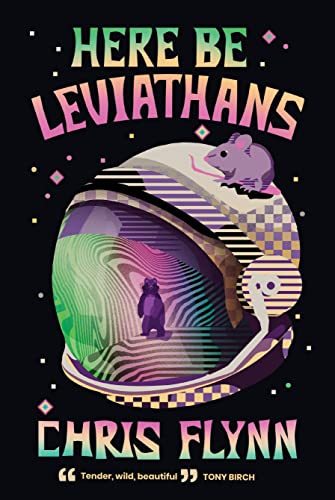
Chris Flynn, Here be Leviathans (#BookReview)

I am not one of those readers who shun weird narrators. Indeed, you’ll find several in this blog, including a skeleton, a dead baby, a foetus and a mammoth fossil. The critical thing for me is not who the narrator is, but whether that narrator is convincing and offers a perspective that engages my mind and heart. Of all the writers I’ve read over the last decade, one that stands out in his ability to surprise and excite me with different voices is Chris Flynn. His short story collection, Here be Leviathans, is astonishing from its first page to its last in its array of narrators.
There are nine stories in this collection, and it is a testament to Flynn that by the second or third one I was fully invested in who would be the narrator this time. I was never disappointed, albeit they ranged from the animate (like the grizzly bear which opens the collection, in “Inheritance”) to the inanimate (such as the airplane seat which narrates the second story, “22F”).

But, before I continue with Flynn’s book, I want to share something he says in his also entertaining “Afterword/Acknowledgements/Blame apportioned” statement. Describing one of his stories as having been inspired by Thea Astley, he refers to his role as one of the judges in Meanjin’s Tournament of Books and shares the exact words of his that I quoted back in my 2013 post on that tournament:

Astley was the progenitor, the chain-smoking, wise-cracking, jazz-loving four times Miles Franklin-winning champion of linguistic manipulation whose style got on Helen Garner’s nerves and who pushed the envelope of Australian literature when no-one else had the cojones to do so.

Flynn’s work is different to Astley’s – time and experimentation having moved on – but he too pushes the envelope of Australian literature, which is why he was one of the writers mentioned the article that inspired my recent Monday Musings on weird Australian fiction. And like Astley, his interests are personal and political. He’s interested in the ways we live in the world, in the injustices we enact, which translates to a concern with issues like colonialism, the environment, and the fallout from an unbridled interest in progress. His touch might feel lighter than Astley’s – he can be laugh-out-loud funny at times – but fundamentally both writers question who we are as human beings. What does what we do say about who we are?

“What a piece of work is man” (Shakespeare via Albert VI)

So, let’s explore Flynn’s brand of weirdness, and why I enjoyed it so much – despite the fact that the opening sentences of the first story, “Inheritance”, were truly shocking:

I ate a kid called Ash Tremblay yesterday. Parts of him, at least. The good bits. The crunchy skull, the brain, a juicy haunch.

What is a reader to think? Fortunately, you don’t have to think very long because very soon our narrator outs himself (it is a “he”) as a bear. He shares a few home truths about humans and our assumptions and behaviours. If you ignore the gruesomeness – after all, a bear has got to eat – the story is pretty funny. Its ostensible subject matter is inherited memory – in this case the bear has inherited Ash’s memory – but it is also a work of ecofiction, which includes exploration of issues like sustainability and colonialism. It is refreshingly bold, asking us to envisage different ways of acting in nature, and, at 30 pages, it is also long. But who cares?

The second, much shorter story, “22F”, is also a work of ecofiction. Its first line seemed ordinary enough, “The first day in a new workplace is always nerve-wracking”. It is, isn’t it? As the story progresses, however, you start to wonder just who this new employee is until the penny drops, it’s seat 22F on a plane. After this story, I thoroughly enjoyed the challenge of working out who was telling each story as I started it. But, back to 22F. In his Afterword, Flynn explains that the story was inspired by the Werner Herzog documentary Wings of Hope about the sole survivor of a 1971 airplane crash. Herzog and that survivor, Juliane Koepcke, return to the site of the crash, and find parts of the plane in the jungle. Flynn writes:

Memory and place. A reminder that we are only passing through and that everything is part of something larger.

Along the way, though, he discusses other issues, like workplace behaviour:

Toilets are inveterate boasters and disgusting perverts. You can’t believe half of what they say.

Eventually 22F’s plane crashes, and while the bodies disintegrate reasonably quickly, 22F is “fashioned from material that does not break down so readily … I will be here for a very long time”.

And so the stories continue, some with multiple voices. “The Strait of Magellan”, for example, is told by the appropriately named super yacht Nemesis, with interspersed commentary by a pandemic virus, HHSV1-ABAD. “Shot down in flames”, on the other hand, is told in sequential voices – by a creek which has been here for sixty-thousand years (that is, that’s how long it’s had its name!), a red fox, a rifle, and finally a bushfire, which wins the day:

I ate the defiant people who stayed.

Such arrogance. Who do they think they are, that they might resist me? I am elemental. I define this paltry world. I decide who stays in their current state and who transforms. I will find you and I will devour you, for I am Alpha and Omega. I was there at the beginning and I will be there at the end. There is no escape.

Many of the stories’ narrators, in fact, identify human stupidity – and arrogance.

In his Afterword, Flynn describes the last story “Kiss tomorrow goodbye” as the “hardest” story to read, but that does it an injustice. It’s the only one narrated by humans, and is inspired by the people who live in the tunnels under Las Vegas. It looks hard because there’s not a punctuation mark in its 30 pages, and its spelling is idiosyncratic to say the least, but in fact the voice and its rhythms are such that it’s not hard to read. It’s a story about survival and makes for a good end to the collection – one that leaves us in no doubt about all the troubling issues that Flynn has explored throughout but that also offers a glimmer of hope in the ingenuity and defiance of its protagonists.

The question of course is do these weird perspectives work or are they just a writerly exercise in “pushing the envelope”? For me they worked. It was fun trying to nut out whose voice it was this time. But there was a point to all this, because these are voices we can’t really argue with. They are not us, but they know us intimately. They speak their truths, like Albert VI, the space monkey (macaque) in “Alas, poor Yorick” who is so hopeful of surviving his space mission but who, like all the Alberts preceding him, is ultimately another pawn in the space race.

Colonial aggression and environmental destruction are recurring themes in the collection, but both are subsumed into an overriding idea which concerns something more paradoxical – mortality and survival. Death or its threat pervades the stories, but there are openings too. Some are small, but they are there.

In his Afterword, Flynn says that “they don’t make them like Astley anymore. She wrote what she wanted and didn’t give a shit”. I disagree. I think they do, and Flynn is one of them. It is great that there are publishers around like UQP who are willing to work with such writers.

Chris Flynn
Here be Leviathans
St Lucia: UQP, 2022
233pp.
ISBN: 9780702262777

Review copy courtesy UQP, via publicist Brendan Fredericks
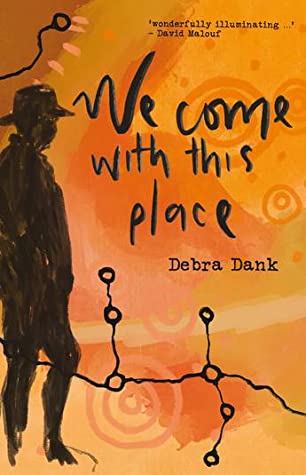
Debra Dank, We come with this place (#BookReview)

First Nations people are advised that this post contains the names of deceased people.

It has been my reading group’s tradition for some years now to read a book by a First Nations writer in July, the month in which NAIDOC Week occurs. Coincidentally, NAIDOC Week’s 2023 theme was “For our elders”, which worked beautifully with our chosen book, Debra Dank’s We come with this place, because a large part of it is about the value and importance of elders and ancestors.

This was not, however, why we chose Dank’s book from the options before us. Its subject matter intrigued us, about which more anon, but we were also influenced by the fact that, at the time we were choosing, it had just won a record number of four awards in the New South Wales Premier’s Literary Awards: the Douglas Stewart Prize for Non-Fiction, the UTS Glenda Adams Award for New Writing, the Indigenous Writers’ prize, and the overall Book of the Year. It was also shortlisted for this year’s Stella Prize, and, after we scheduled it, it won the ALS Gold Medal. These are significant awards and, for most of us, the book lived up to its advance publicity.

I mentioned the subject matter above, but We come with this place is one of those books that is tricky to categorise. It’s a sort of multigenerational memoir that is also a guide to her culture and a community history of her people, before and after colonisation. It grew out of her PhD in Narrative Theory and Semiotics. Dank describes it in her Preface as a:

strange kind of letter written to my place – a recording of events and activities that I and my family have experienced, in order to tell Garranjini that I remember, and I know. It is all based on real events. Some parts have been reimagined, because they happened outside my presence, and several names have been changed. Our relationship with our place, however, is genuine and lives in ways that not easily told in English words or western ways.

She goes on to say that she wanted to show “how story works in my community, and how it has contributed to our living with country for so long”. It also felt imperative, she says, to talk about the “voices, human and non-human, who guided the Gudanji for centuries before anyone else stepped onto this land”. This is a truly generous thing to do, and my group loved that, loved how Dank shared her story, and particularly how she helped us whitefellas “see” how First Nations people understand and relate to Country. I knew much of this from all I’ve read and heard, but this book really grew my understanding.

The other special thing about this book for me is that it is set in an area I know. I spent three formative late-childhood years in Mount Isa, close to Camooweal where Dank’s mother’s family were based. I visited Camooweal several times, and traversed parts of the Barkly Tableland which encompasses her Country. The first First Nations people I heard of were the Kalkadoons, whom Dank mentions in her book. Dank herself, though, is a Gudanji/Wakaja woman, the former through her mother and the latter, her father.

“to see the pain as it lies in the landscape”

We come with this place is a confronting book, from its perfect and defiant title to its chronicling of the atrocities that her people faced. The fear of children being taken away pervades the book. There are stories of massacres, and other appalling brutalities including a rape of her father’s mother. Lucy’s “choices were both dire – a drover’s boy or a special girl. The same, just in different clothes”. There is intergenerational trauma, which Dank exemplifies through her father, Soda. Hardworking and loving, he bears traumas, which she characterises as “newer stories … that pushed and jostled with the older stories” and sometimes “pushed their way out with a violence” that was often directed at her mother, and sometimes herself.

Dank doesn’t hold back; the way she tells it is strong, speaking her truths and segueing between past and present, between brutal history and rejuvenating story, between people and ancestors. Amongst the tough stories are warm-hearted anecdotes about family life. An example is Dank telling of being on country with her grandfather Bimbo and her surprise and joy in learning how to catch fish in arid land. The stories speaking of deep love sit alongside the hard ones, and together convey that the people, their ancestors, and Country are interconnected. This idea is mirrored in the structure.

However, I admit that I did, initially, find the structure a bit confusing, but as I read on, I started to sense an overriding arc similar to that of Bangarra Dance Theatre’s recent offering, Yuldea. Both start with origin stories, then move through colonial history, and conclude with the power of kinship and connection to Country. But it’s not as linear as this sounds. For example, starting the book, and threading through Dank’s narrative are the three Water-women who came from sea in the Gulf of Carpentaria, and travel far to create “the freshwater and hill country” of the Gudanji. They also end the book, giving it an overall cyclical structure which, I think, reflects First Nations’ understanding of life. Other cycles occur within this structure, so there is a continuous sense of moving forwards and back in time, as experiences and stories build on each other to create “Gudanji memory” – for us, and for her people to whom she is writing. This idea of building “memory” from stories, from lines between places and the things that have happened there, is strange to western ways of thinking, but Dank makes it make sense. She shows us how stories are made and passed on through Country.

I’ve been trying to decide how to end this post, and then it came to me that the best way might be with some words from Dr Tyson Yunkaporta’s Introduction to the book. He is a First Nations scholar, founder of the Indigenous Knowledge Systems Lab at Deakin University in Melbourne, and the author of Sand talk. He admits to not being able to face “the through line of history from the savagery of the frontier wars to the interventionist policies of today”. Dank, though, has. He writes:

She hurts us, digs bullets out of old wounds that never healed properly, sucks out the poison and then begins our healing with love and laughter. She does this for everybody, no matter which side of the rifle you’re on.

Dank, in other words, doesn’t pull any punches, but neither does she ram them down your gullet. Her aim is to tell the truth, proud and clear, but to do it in order for healing to take place. Isn’t that what we all want?

Kim (Reading Matters) also loved this book.

Debra Dank
We come with this place
London: Echo, 2022
252pp.
ISBN: 9781760687397

Monday musings on Australian literature: on 1923: 6, A postal controversy

Who would have thought that the cost of postage would generate controversy in the book world? And the sorts of issues that would be raised as a result?

Help Books Clker.com
(Courtesy OCAL, via clker.com)

In my research of Trove for book-related issues in 1923, I came across a letter to the editor opposing some proposed changes in postal rates for books and other printed matter. Of course, I researched it a bit more, and discovered that the issue had started in 1922 (or perhaps even earlier. I didn’t look further, as my aim here is to document some issues that seem interesting rather than use all my reading time on detailed research!)

As far as I can work out, investigating postal rates had started perhaps in 1921, but it was in early 1922 that the Postmaster General promulgated new regulations. They are described in detail in Melbourne’s Age of 25 January, which explains why they were needed:

These regulations are the outcome of prolonged conversations between Postal officers and those interested in the trade, and are designed to put an end to the confusion which has existed for many months past, while removing some anomalies which caused great irritation, and were responsible for considerable loss. Up to the present none has been able to say definitely what constitutes a book from the stand point of the Post Office. The new regulations, while opposed by some who are engaged in the book selling and book buying business, will at least establish uniform practice throughout the Commonwealth. 

The article describes the new regulations in detail, which I won’t repeat here. You can click on the link above if you are interested. I will just share the main contentious issues:

  • the definition of a book for postal purposes: a cookbook, for example, isn’t one, and nor is one containing advertisements.
  • the requirement to register books that are wholly printed in Australia (because they will get a favourable rate). The article tells us that books printed in Australia would cost 1d. per 8oz to post, while those printed outside Australia would cost twice that, at 1d. per 4oz. 

Now, let’s jump forward to 29 January 1923 which is when I first clocked the issue. It was in a letter to the editor in Brisbane’s Telegraph by one E. Colclough who was the Hon. Secretary of the Queensland Authors’ and Artists’ Association. His beef primarily concerned the issue of advertisements preventing a book’s “registration” as a book:

Such a regulation renders it prohibitive for a poor individual to undertake the publishing of his own works because it frequently happens that only by the assistance of the kindly advertiser is he enabled to finance his literary venture.

His association wanted Australian writers to be “encouraged and assisted in every way possible”, and asked for the regulations to be amended.

A few months later, on 13 June 1923, W.T. Pike, President of the Booksellers’ Association, wrote a letter to Melbourne’s The Argus in which he enumerated seven changes the association wanted made to the regulations. Number three was for the book rate to be applied to

all books printed in Australia without regard to subject or where the author lives. At present books printed in Australia are subject to the pernickety whims of officials. For instance, postal officials say a “cookery book is not a book but printed matter.

The Association wanted “a reasonable number of general advertisements to be allowed” and for books to not have to be registered. They argued that this was an “unnecessary time waster” because the printer’s name and address always appear on books, and books are “automatically sent under the Copywright [sic] Act to two public libraries”. They also wanted reciprocity with New Zealand in terms of rates, and suggested the reduction of overseas postage rates from the “absurd” 8d per lb to 4d per lb would be beneficial. “Quite a lot of books would be sent South Africa if postal rates were reduced”, wrote Pike.

The Commonwealth’s proposed rates bill was moved in Parliament in August 1923, and reported in Adelaide’s The Register. It makes for some entertaining reading, with some arguing against the changes because the money could be spent on other things, such as improving the actual post offices. Do read the report, as it’s short and entertaining.

Meanwhile I will end with two things, one being that the bill was passed, and the other being The Register’s report of one MP’s contribution:

Dr. Maloney (V.) supported the measure, but pleaded hard for an increase to pay to officials in allowance post offices. Some of the women, he said, worked for eight hours daily, under great difficulties, and only got 20/ to 25/ a week, or less than messenger boys.

I like this Dr Maloney, who, according to Serle in the ADB, “loved humankind, fought inequality and pressed the rights and needs of the poor”. I’ve moved away from my topic here a bit but, you know, this little series is as much about serendipity as about books!

I hope you like serendipity as much as I do?

Other posts in the series: 1. Bookstall Co (update); 2. Platypus Series; 3 & 4. Austra-Zealand’s best books and Canada (1) and (2); 5. Novels and their subjects

Jack D. Forbes, Only approved Indians can play made in USA (#Review)

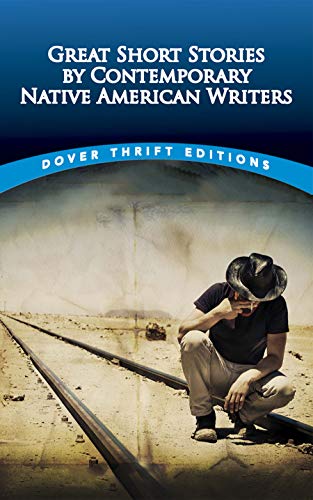
The title of the next story in Great short stories by contemporary Native American writers is almost as long as the story itself. Well, not quite, but, occupying just two pages in the anthology, it is a short short story. It was first published the same year, 1983, as the previous story, “Turtle meat” by Jospeh Bruchac III, but is very different in tone.

(I apologise to those of you who were expecting my next post to be on Chris Flynn’s Here be Leviathans. It is coming, soon, but I had to put it aside for my end-of-July reading group book, and I do want to do it justice.)

Jack D. Forbes

Again, I’m using anthology editor Bob Blaisdell’s intro and, mostly, Wikipedia to introduce the author. Forbes (1934-2011), says Wikipedia, was an historian, writer, scholar and activist who “identified as being of Powhatan-Renapé and Lenape descent”. He is best known for his role in establishing one of the first Native American studies programs at the University of California Davis. He also cofounded D-Q University, “a prominently Native American college in Davis, California”. His activist career started in the early 1960s, when he became involved in the Native American movement, which, Wikipedia explains, “asserted the rights to sovereignty and resisting assimilation into the majority culture”.

Blaisdell introduces his story with this: ‘”Only approved Indians can play made in USA” is almost too sad to be funny, but funny it is’. Or, is it?

“Only approved Indians can play made in USA”

I enjoyed this story because of the way it addresses that issue that can dog First Nations peoples in colonial settings, that of proving indigeneity, which feeds into ideas about identity. It’s an issue I’ve discussed here before, including in First Nations writer Anita Heiss’ Am I black enough for you (my review), and in the essay “Channelling Mannalargenna” (my review) by the non-Indigenous journalist Kathy Marks.

In her book, which is a few years old now, Heiss shares the working definition of an Aboriginal or Torres Strait Islander person used by Australia’s Federal Government:

An Aboriginal or Torres Strait Islander is a person of Aboriginal or Torres Strait Islander descent who identifies as an Aboriginal or Torres Strait Islander and is accepted as such by the community in which he “or she” lives.

I share this purely for background purposes to this story. I am not going to get into the Australian situation because it’s not an issue I have followed recently. It was particularly problematical in Tasmania in recent decades, but I believe that much of that has now been resolved, to the extent that self-identifcation and community recognition are the accepted criteria.

Meanwhile, though, Heiss’s comment is relevant to Forbes’ story which concerns an All-Indian Basketball Tournament, and the two teams that are about to play, one from Tucson and one from the Great Lakes. Many people had come to watch, “mostly Indians” we are told, with many being relatives or friends of the players. There was betting, and “tension was pretty great”. The issue is that the Tucson players are, in general, much darker. Many also have long hair, and some have goatees or moustaches. A rumour starts from the Great Lakes camp that they are Chicanos, not Indians. (If you know your American geography, you will know that Tucson is in southern Arizona, so not far from Mexico, while the Great Lakes are up there near Canada.)

Anyhow, this is a serious point because, as the story goes, the Indian Sports League’s rule is that “all players had to be one-quarter or more Indian blood and that they had to have their BIA [Bureau of Indian Affairs] roll numbers available if challenged”. The Great Lakes players, coming from a big Midwestern city, are all over this:

they all had their BIA identification cards, encased in plastic. This proved that they were all real Indians – even a blonde haired guy. He was really only about one-sixteenth but the BIA rolls had been changed for his tribe so legally he was one-fourth.

You can feel the tongue firmly planted in the cheek – the satirical tone – here can’t you! They challenge the Tucson players, many of whom, as it turns out, can speak their language. None of the urbanised Great Lakes players could, but they claim this proved nothing. Only the BIA card did! The story is short and you can read it at the link below.

“Only approved Indians can play made in USA” is a clever, and oh-so succinct story that draws on recognisable conventions of competitive sport to produce a satire that explores the role of regulation and law in people’s lives, the way power can be wielded, and its potential for destabilising cultural heritage and disrupting solidarity. The ending is particularly biting because after the Great Lakes team has had its way, the last word is given to a white BIA official. That tells you all you need to know about this story.

Jack D. Forbes
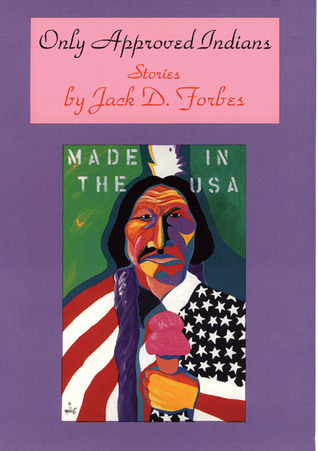
“Only approved Indians can play made in USA” (orig. pub. 1983; also published in Forbes’ collection, Only approved Indians: Stories, 1995)
in Bob Blaisdell (ed.), Great short stories by contemporary Native American writers
Garden City: Dover Publications, 2014
pp. 57-58
ISBN: 9780486490953

Available online at genius.com

Joseph Bruchac III, Turtle meat (#Review)

I’m continuing to work through the stories in Great short stories by contemporary Native American writers. With this post, we jump from 1968 to 1983, which mens we are getting close to contemporary territory. The story is “Turtle meat” by Jospeh Bruchac III.

Joseph Bruchac III

As before, I’m using anthology editor Bob Blaisdell’s intro and Wikipedia to introduce the author, though in this case Blaisdell is extremely brief. Bruchac was born in 1942 and, says Wikipedia, “identifies as being of Abenaki, English, and Slovak ancestry” with his Abenaki heritage coming from his grandfather. He writes poetry, novels and short stories, with “a particular focus on northeastern Native American and Anglo-American lives and folklore”, and is the director of a press which publishes new Native American writers. He is also a performing storyteller and musician.

This post’s short story, “Turtle meat”, was first published, according to Blaisdell, in 1983, in an anthology titled Earth power coming: Short fiction in Native American literature, which was published by the Navajo Community College Press. It was published again in Bruchac’s own collection, Turtle meat and other stories, nearly a decade later in 1992.

“Turtle meat”

Wikipedia’s description of his focusing on “northeastern Native American and Anglo-American lives and folklore” certainly rings true for this story. Blaisdell introduces the story this way, “In this strange great story about an elderly Native American who has been living for years with a debilitated woman, Bruchac writes one of the most extraordinary fishing scenes in literature”. That sure sets up some expectations. It is also a bit misleading because “the debilitated woman” is simply old. She hadn’t always been so.

The story concerns Homer LaWare who, when the story opens, had been Amalia (Mollie) Wind’s hired hand for decades after she had kicked out her husband and come for him. There’s a little sense of “Driving Miss Daisy” here except we are on a farm and life is more earthy than Miss Daisy’s refined life with her Black American chauffeur. To start with, Homer and Mollie have been lovers from the beginning, even though Homer always slept in his cot in the shed – his decision it seems, because “it’s the Indian in me”.

The point at which the story starts, both are showing their age. The story opens with Mollie calling out to him because she needs help getting off the toilet. He comes in from the once-farmed but now overgrown field, and “gently” lifts her, reassuring her that she’s not old, that it “must of was just a cramp. Nothing more than that”. This opening scene tells us a few things – that they are old, of course; that they are comfortable with each other; and that he is sensitively attentive to her physical and emotional needs. We also learn that she has retained ownership of the farm that had originally been her father’s, and that Homer is happy with that: “It’s the Indian in me that don’t want to own no land”. Her grasping husband, Jack Wind, had been sent packing, and her “no-good daughter” had not been seen for years.

The central part of the story describes Homer’s fishing expedition – his catching (and cleaning) several yellow perch, and then an old snapping turtle. It’s a battle – it was easier when he was young “and his chest wasn’t caved in like a broken box” – but he does it. Finally, having been out longer than he’d expected, he returns home, muddy and bloody, to find Amalia missing. Where is Amalia, and why is her daughter – who has “Jack Wind written all over her face” – sitting in Amalia’s rocker?

In one sense, “Turtle meat” is a traditional story of ageing parents and grasping children, but it is imbued with a different sensibility. Homer’s battle with the turtle recalls other literary battles between fishermen and their prey, but in this case it is not only about Homer confronting his age, but is also symbolic of the battle Amalia simultaneously faces. I suspect, too, that the choice of a turtle has specific cultural references for Bruchac, given turtles seem to feature often in his writing.

It’s a great story, as Blaisdell says, but what makes it particularly so is the writing. The characters are more than just types. There’s a natural dignity to them, with an individuality that is conveyed mostly through dialogue – and in Homer’s case, also through his thoughts expressed via italics. The descriptive writing is tight and fresh. And it has a quiet humour. Take, for example, Homer out on his boat:

He looked in the water. He saw his face, the skin lined and brown as an old map. Wattles of flesh hung below his chin like the comb of a rooster.

“Shit, you’re a good-looking man, Homer LaWare,” he said to his reflection. “Easy to see what a woman sees in you.”

How can you not warm to such a character and such writing?

Unfortunately, I don’t think this story is available online so you’ll just have to believe me that it’s another one worth reading from this anthology.

Joseph Bruchac III
“Turtle meat” (orig. pub. 1983)
in Bob Blaisdell (ed.), Great short stories by contemporary Native American writers
Garden City: Dover Publications, 2014
pp. 50-56
ISBN: 9780486490953

Edwina Preston, Bad art mother (#BookReview)

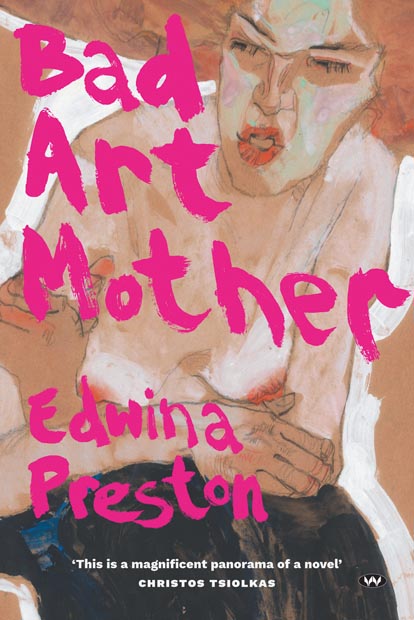
Edwina Preston’s Bad art mother was my reading group’s June book, replacing our previously scheduled book because we’d heard Bad art mother was to be the featured book in the Canberra Writers Festival session, Canberra’s Biggest Book Club. This suited me, as, coincidentally, I’d just started reading it!

Bad art mother has been shortlisted for two awards this year (so far), the Stella Prize, and the Christina Stead Award for Fiction (in the NSW Premier’s Literary Awards). Not a bad achievement for a book that was rejected by publishers over 20 times before being picked up by Wakefield Press.

The novel is mostly set in 1960s Melbourne, which was a time of social change. While feminism was around the corner but not there yet, the city’s life was being influenced by the postwar influx of European migrants. Preston captures this well, said our Melbourne-born members. The story draws its inspiration from various Australian arts practitioners who were active in the mid-twentieth century – the Heide Circle and the artist Mirka Mora and her husband Georges, in Melbourne, and the Tasmanian poet Gwen Harwood. Bad art mother is the third book I’ve read in recent years inspired in some way by the Heide story, the others being Emily Bitto’s novel The strays (my review) and Jane Sinclair’s memoir, Shy love smiles and acid drops (my review). Interestingly, all of them focus to some degree on the damage done to children.

I enjoyed the experience of reading Bad art mother, not only for its expressive language, but also for its intriguing, complex structure. It is told primarily from the point of view of a young boy, Owen, whose mother, Veda Grey, is struggling to make her name as a poet. However, we also get Veda’s point-of-view through letters she writes to her sister. After opening with Veda’s book launch in 1970, the novel is told in six parts, which to-and-fro in time, but it has an overall chronological trajectory, with part one telling of his parents’ meeting and his birth, and the final part being set around 2016 when Veda’s book is about to be republished in an anniversary edition. The central four parts commence with Owen as an adult in the 1980s, before returning to his childhood in the 1960s. It sounds complicated but it works. Lives, after all, are rarely simple and linear. Owen’s certainly wasn’t. Wanting to be just a kid, he had to be the grown-up more often than not.

The other thing to mention is that Owen tells his story first person, but to a specific person, “you”, whom we soon discover is Ornella, his father’s “sister”. That is, she was the daughter of the Italian family that “adopted” his father when he came to work in their restaurant at the age of 19. Throughout his childhood, Owen is passed between his parents, the rich but dysfunctional Parishes (to whom his mother entrusts him in a deal that buys her more time for her art), and Ornella. It is Ornella who saves him when all the others fail. She is the unimaginative one, the stern one, but also the stable, reliable one, the one who picked him up “on time, every time“. Owen knows that he owes his life to her, and now, as she is failing with dementia, he visits her and tells her his story, expressing what she means to him, while also working through his feelings for his mother.

“I will hang my anger out to dry” (Veda)

The book spans Owen’s life from the 1960s to the 2010s, but with its focus being the 1960s, it is, essentially, a work of historical fiction. Why did Preston choose to write about this time? I like my historical fiction to have some relevance to the time in which it is written. Fortunately, Preston’s novel does – and it concerns the challenge creative women face. There are three such women in the story. Rosa, the muralist, works in Owen’s father’s restaurant, and does it her way. She is not a tortured soul, but it takes a long time for her art to be accepted. Mrs Parish is an ikebana artist who quietly finds her own way by removing herself to Japan. And, of course, Veda, the poet – the only one who is a mother. She struggles big-time with her drive to create and her role as a mother. She writes to her sister:

How does one protect them? Sometimes I think I would throw in every hope of my own, every dream of literary prowess or success, to protect him, even for one second, from any hurt that might come to him.

But would I, Tilde? Would I?

If it came to it, I wonder how I would make such a choice. I should hope that if ever given that choice I would make the right one, but I know I would resent it for the rest of my life. I would never be happy. I would be a bloody, injured banshee who ruined everyone around her.

What sort of a mother chooses a book over a child?

Sometimes I am not sure what I am capable of at all.

The point, then, is that it is hard for women to make art and be recognised for it, and it is especially hard when the woman is also a mother. The tension for Veda is palpable through both Owen’s story and her own letters. And this brings me to the issue which triggers the novel’s crisis, anger. When Veda shows her anger at how she and her work had been treated, things go wrong and her life falls apart. Owen’s partner Julia tells him in 2016 when Veda’s poems are being re-released, that she remains relevant because, for all the progress that had been made in the interim, “it’s still hard to be angry, if you’re a woman. It’s still not allowed”. This was a major takeaway from the book for my reading group.

Bad art mother is an intelligent novel that offers no answers to the quandary it presents, but that asks the right questions. Good on Wakefield for taking it on.

Lisa also enjoyed this book.

Edwina Preston
Bad art mother
Mile End: Wakefield Press, 2022
317pp.
ISBN: 9781743059012

Review copy courtesy Wakefield Press

Tuesday Atzinger, The River (#Review)

Back in January I reviewed two stories from Ellen van Neerven and Rafeif Ismail’s anthology Unlimited futures: Speculative, visionary Blak+Black fiction for Bill’s (The Australian Legend) Australian Women Writers Gen 5 Week. The stories I reviewed were the second and third in the anthology because they were the first two by Australians in it. The anthology’s first story, however, is African in origin. Titled “The River”, it is by Tuesday Atzinger, who is described in the book’s Biographical Notes as “a poet and emerging writer … [who] … explores and celebrates Afro-blackness, queerness, disability and feminism. They peddle in discomfort and their primary goal is to fling words together to make you squirm”. Atzinger currently lives in Melbourne “on the unceded lands of the Wurundjeri People of the Kulin Nations”.

“The River” is worth discussing for several reasons, but specifically because it’s the first piece in the anthology, so was, presumably, chosen for a reason. Some of that reason is explained in the anthology’s introduction, which, by the by, takes the form of a conversation between the two editors. One of the topics they discuss is the cover, which was designed by Larrakia woman, Jenna Lee. Ismail describes it as looking at “the interaction of separate cultures in the most respectful and wonderful way”, and also sees it as suggesting “infinity”. It does, doesn’t it. Van Neerven adds that it also reflects “the movements of water” in the anthology. She says:

We were going to begin the anthology with water to allow those kinds of threads of connection and continuation to flow into each other. For me the cover really kind of feels like rivers connecting and the light that is created through water, but it’s also water that we protect and have a relationship and a responsibility to.

Water! Such a complex element in our lives. Most of my friends adore the sea, but for me it’s the rivers that draw me most. They can be young, direct, and fast, or slow, meandering, and somehow wise, or anything inbetween. They can be critical to creation stories, and this role is part of Atzinger’s opening story, making it particularly appropriate as the opening piece.

The first thing to say about “The River” is its form – it is a short story in verse. The River is not named, but we know it’s in Africa, partly because an African word, Ubuntu, is repeated throughout the story: “Ubuntu/Together”. According to the New World EncyclopediaUbuntu pronounced [ùbúntú], is a traditional African concept. The word ubuntu comes from the Zulu and Xhola languages, and can be roughly translated as “humanity towards others”.’ It has been adopted more widely around the world for its humanistic concepts – and is also, would you believe, “used by the Linux computer operating system” to convey the sense of bringing “the spirit of Ubuntu to the software world”. Valid appropriation? I didn’t find much concern about this use on the ‘net.

Anyhow, to the story itself. We are immediately introduced to the River, and a village that lies near it. The word “prosperous” is used, but we are warned that things aren’t so simple:

Shallow water so clear that the stones beneath it glistened brightly
Depths dark and mysterious, hiding all that lay below
The River, ever a source of sustenance
                                                                      And of danger

The story starts with creation: “Eons ago/The River had rippled in welcome as the people first arrived”. It provided refuge and sustenance; it saw “passion, grief, joy and courage”; it saw, in other words, the life of the community, of “the people who slept under the sun”. It had also seen “a lineage of Chiefs/Some wise, some brave, some imperious” until the present one “Mehluli – the Warrior Chief”. He is described in words like “proud”, “arrogant”, “dominating” and “greedy”. He desires a woman, Thandeka, but she already has a “perfect love” with Amandla, a hunter. Amandla fears the River, fears the aformentioned danger, and while she’s away hunting her fears are justified when the Warrior Chief makes his move on Thandeka.

The problem is that you “cannot refuse the chief”. Violence ensues. The River acts in an unusual way, and a dramatic story follows as Thandeka fights back, as does the River, to right the balance that has been disturbed. It is, ultimately, a story with a moral, a story to teach proper behaviour, right values.

The story is told in a beautiful, poetic style. The changing rhythms and strong use of repetition convey elemental and opposing tones – prosperity and togetherness versus power and greed. “The River” is a thoroughly enjoyable read. It is founded in the sorts of lesson-giving stories that are part of most belief systems, but its queer-love narrative brings the story and its traditional message into modern thinking and times. A worthy first story for the anthology, I think.

Tuesday Atzinger
“The river”
in Ellen van Neerven and Rafeif Ismail (ed.), Unlimited futures: Speculative, visionary Blak+Black fiction
North Fremantle: Fremantle Press in association with Djed Press, 2022
pp. 23-41
ISBN: 9781760991463 (eBook)

Leslie Marmon Silko, The man to send rain clouds (#Review)

After a two-month hiatus, I return to my reading from Great short stories by contemporary Native American writers with a three-decade jump from D’Arcy McNickle’s 1936-published “Train time” to Leslie Marmon Silko’s “The man to send rain clouds”, which was published in 1968 .

Leslie Marmon Silko

Again, I’m using anthology editor Bob Blaisdell’s brief intro and Wikipedia’s article to introduce the author. According to Wikipedia, Leslie Marmon Silko (b. 1948) is one of the key figures in “the First Wave of what literary critic Kenneth Lincoln has called the Native American Renaissance“. I don’t know much about the trajectory of Native American writing, within the larger American culture, so this gives me a bit of a guide to how it has gone.

Silko was born in Albuquerque, of Laguna Pueblo ancestry, and grew up on the Laguna Pueblo reservation – which I visited with my family on a memorable road trip through New Mexico in December 1991. (For those of you who haven’t been to New Mexico, I recommend it as a special place to visit – physically, historically and culturally.) Silko, says Wikipedia, was schooled at local Indian schools, before attending the University of New Mexico from which she graduated with a BA in English Literature, in 1969. She then briefly attended law school, before deciding to pursue a literary career full-time, which has included teaching at several universities.

This post’s short story, “The man to send rain clouds”, was published while she was an undergraduate. It earned her a National Endowment for the Humanities Discovery Grant, and continues to be a popular anthology choice, apparently. She has, since then, written several novels, a “poetic memoir”, and many essays. In one of those essays, Wikipedia says, she criticised Louise Erdrich for abandoning “writing about the Native American struggle for sovereignty in exchange for writing “self-referential”, postmodern fiction”. Interesting. I’ve only read two books by Erdrich, and one so long ago I can’t recollect the details, but The bingo palace (1995) does confront the challenge of marrying tradition with contemporary life.

Blaisdell’s introduction includes a statement by Silko on why she writes, which is

to find out what I mean. I know some of the things I mean. I couldn’t tell you the best things I know. And I can’t know the best things I know until I write.

I understand what she means here. I don’t find talking easy. I find it easier through writing to work out what I know and mean.

“The man to send rain clouds”

Wikipedia summarises Silko’s themes as being grounded in a wish “to preserve cultural traditions and understand the impact of the past on contemporary life”. Her career, it says, “has been characterised by making people aware of ingrained racism and white cultural imperialism”. Many of her characters “attempt what some perceive a simple yet uneasy return to balance Native American traditions survivalism with the violence of modern America”. This is all part of a continuing theme in the Southwest regarding “the clash of civilisations” and “the difficult search for balance that the region’s inhabitants encounter”. Much of this is already evident in this early short story of hers.

“The man to send rain clouds” concerns the interaction between Pueblo Indians and Christianity. It reminded me in a small way of Marie Munkara’s Every little thing (my review) except that Munkara’s is a full-length and often laugh-out-loud work versus Silko’s more wry short story. However, both show the power-play between the original people of a land and the churches that came in to save them, and also how the oppressed First Nations people can sometimes, at least, work it to their advantage.

Silko’s story concerns the death of an old man, Teofilo. It opens with his body being found under a “big cottonwood tree” by brothers-in-law Ken and Leon. It describes their going through some traditional death rites, including preparing the old man’s body with face-paint, before bringing him back to the pueblo. It’s here that the title is explained: they say to the old man, after scattering cornmeal, “Send us rain clouds, Grandfather”, which specifically introduces the importance of rain to them and suggests its role in their rites. On their way back into the pueblo, they meet the priest who asks whether they had found Teofilo, but they give a noncommittal reply, telling him that “everything is OK now”. When the priest replies that they “shouldn’t allow him to stay at the sheep camp alone”, they continue with their obfuscation:

“No, he won’t do that any more now”.

I loved Silko’s subtle use of humour in the story. In this brief conversation, Silko sets up exactly how the locals deal with the priest, politely but also determined as much as possible to keep him out of their business. The rest of the story concerns their funeral business, including another delightful encounter with the priest when one of the pueblo’s members feels that some “holy water” wouldn’t go astray.

It’s a quiet story, but a strong one. The tone is measured, the pace unhurried, mirroring the values and attitudes of the pueblo people who are doing their best to preserve their customs while maintaining peace with those who have the power. The same tone is used for the priest’s non-confrontational response, and his own decisionmaking, reflecting, presumably, his need to work with rather than against the people. It’s a story ripe for discussion.

The imagery is beautiful, evoking the snow-capped mountains, the arroyos, mesas, and sandy flats that characterise that part of New Mexico. There is a strong use of colour, which is mostly muted, supporting the tone, with a touch of red to herald something bigger. And of course there’s the rain motif that runs through the story, reflecting its importance to the pueblo’s survival.

A moving story, that I commend to you. It’s a quick read.

Leslie Marmon Silko
“The man to send rain clouds” (orig. pub. 1968 under the name Leslie Chapman)
in Bob Blaisdell (ed.), Great short stories by contemporary Native American writers
Garden City: Dover Publications, 2014
pp. 45-49
ISBN: 9780486490953

Available online via the University of New Mexico.

Bonnie Garmus, Lessons in chemistry (#BookReview)

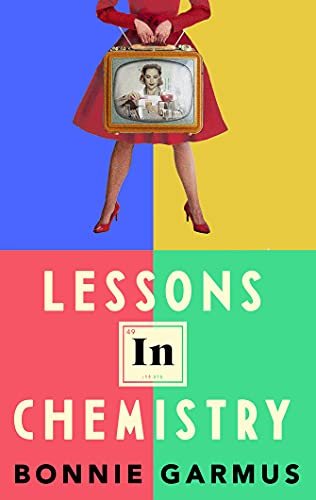
Bonnie Garmus’ debut novel Lessons in chemistry made a splash on best-of-2022 booklists last year, resulting in my reading group scheduling it this year. It is an enjoyable read, but the intriguing thing is that more than one reader I know couldn’t remember what it was about a few months after reading it. Each remembered enjoying it but could not recollect the details. Why is this? Why, in fact, are there some books that we read and enjoy but forget quickly, while others linger long after we’ve turned the last page? I will leave this for you to ponder. Meanwhile, I’ll get onto the book.

Most of you will know the basic story, but I’m going to document it anyhow – because, you know, I might forget it down the track. It is historical fiction set in the 1960s, and tells the story of female scientist, Elizabeth Zott, whose only ambition is to be a research chemist but whose career is constantly derailed by powerful men’s determination to keep women out of the laboratory. She ends up in the most unlikely job, the host of an afternoon cooking show which, despite her best efforts not to fit the female-TV-star mould, becomes a hit.

Everyone in my reading group thoroughly enjoyed the read, despite some reservations, to which I’ll return later. Our overall assessment was that, with its stereotyped, larger-than-life characters who don’t really change, it read like a fairytale, fantasy or, revenge comedy. But, we also recognised that it dealt with some relevant and serious topics, particularly regarding the inequitable treatment of women – in science, and in life. So, here is the question: given my earlier comment regarding readers forgetting its details not long after reading it, how effective is its light, comedic approach to making the message stick? Humour is a tricky thing. We love reading it, but does it move us to take its target seriously?

Like all writing, some humour is more effective than others. Satire, for example, with its characteristic clever, ironic wit engages my brain and, in doing so, can help the message go down. Lessons in chemistry has some of these elements, but it felt more situational and laugh-out-loud than satiric. This is what makes it so enjoyable, but such humour can sometimes bury the message. Time will tell for me!

And now, let’s look at its humour. Some of my favourite scenes came from the cooking show which Elizabeth Zott uses to teach her housewife audience chemistry, but more than that, to empower them. In one show, she describes different chemical bonds, one being the hydrogen bond:

“I call this the ‘love at first sight’ bond because both parties are drawn to each other based solely on visual information: you like his smile, he likes your hair. But then you talk and discover he’s a closet Nazi and thinks women complain too much. Poof. Just like that the delicate bond is broken. That’s the hydrogen bond for you ladies — a chemical reminder that if things are too good to be true, they probably are.”

“See?” a woman in Santa Monica demanded as she turned to her sullen seventeen-year-old daughter, the girl’s eyeliner so thick, it looked as if planes could land there. “What did I tell you? Your bond with that boy is hydrogen only. When are you going to wake up and smell the ions?”

Her poor producer Walter Pine, whose boss is demanding sexy clothes and cocktails with the cooking, tries in vain to rein her in.

Rowing is another topic that recurs through the novel. Obstetrician Dr Mason wants to get single-mother Elizabeth back in the boat when her baby, Mad, is just one year old. He discovers that she has a keen, helpful neighbour, and suggests that she ask this neighbour to help out:

“At four thirty in the morning?”
“This is what is so unsung about rowing,” Dr. Mason said, turning to leave. “It happens at a time when no one’s really that busy.”

That made me splutter my coffee – as did so many other observations throughout the book. It is a chuckle-inducing read, replete with funny one-liners and surprising similes alongside its array of set pieces.

But, as I said, my group did have some reservations, though they varied. One, for example, didn’t like the anthropomorphism involving the dog, Six-Thirty, while others of us appreciated his astute commentary on his human companions. Another felt it read a bit like a catalogue of issues – suicide, rape, domestic abuse, single-parenthood, and plagiarism, among others. And a couple of us found it somewhat anachronistic. I usually give historical fiction authors a lot of leeway in this regard, but the novel felt imbued with a strong 21st century sensibility. For example, Elizabeth Zott’s young daughter responds to minister Wakeley’s question about her age with “I’m not allowed to give out private information.” Most of us remember the 1960s, but we don’t remember this sort of idea being promulgated. It was just “don’t talk to strangers”.

“Chemistry is change” (Elizabeth)

Garmus was 65 when the book was published, making her a late-bloomer in terms of a novelistic career. However, it also means that she has a lot of life experience to share. She – through Elizabeth – believes that science has much to offer human beings. Elizabeth is infuriated that “too many brilliant minds are kept from scientific research thanks to ignorant biases like gender and race”. She believes that science can be empowering – “when women understand chemistry, they understand how things work”. Indeed, for her science encompasses

the real rules that govern the physical world. When women understand these basic concepts, they can begin to see the false limits that have been created for them. 

Beyond this, however, is the over-riding philosophy that life, like chemistry, is all about change. Through the book Elizabeth has to cope with a range of challenges, some of them serious, and some, in fact, tragic. It is her faith in science – plus the support of some decent people, it has to be said – that see her through.

Lessons in chemistry is not a perfect book, but it is great fun to read and it has a big heart. I can forgive it its little failings for these.

Brona (Brona’s books) and kimbofo (Reading Matters) both enjoyed this book too.

Bonnie Garmus
Lessons in chemistry
Transworld, 2022
391pp.
ISBN: 9781473594531

Slow reading: Jane Austen’s Pride and prejudice

Pride and prejudice book covers
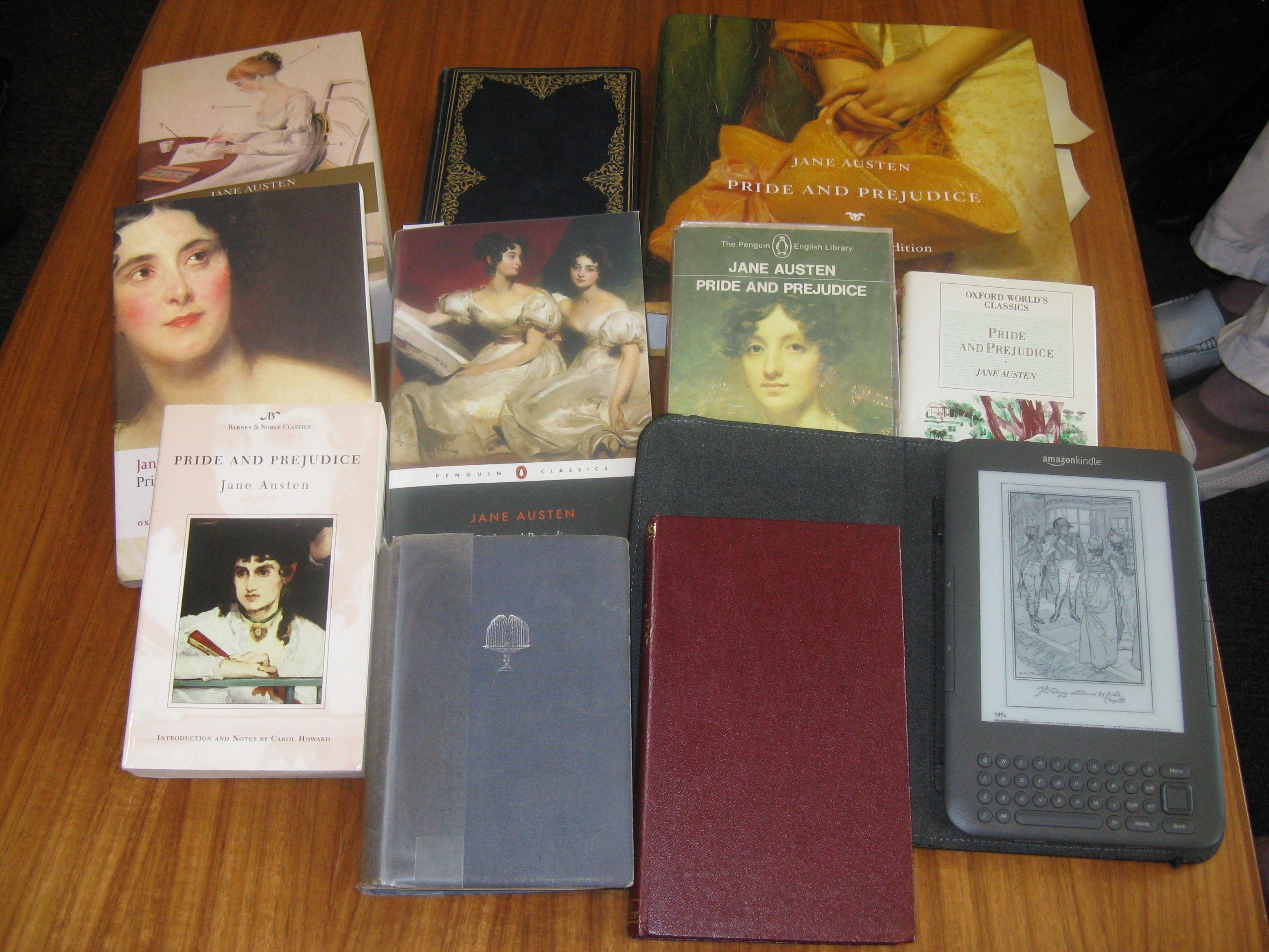
Some of the editions of Pride and Prejudice owned by my JA group

Back in the early to mid-2010s, my local Jane Austen group undertook a program of slow reading Jane Austen’s novels, coinciding with those books’ 200th anniversaries. Given that began around a decade ago, we decided last year that it was time to do another slow read program, and to stick with a chronological approach – that is, chronological in terms of publication. This meant that we did Sense and sensibility last year, and have just completed this year’s book, Pride and prejudice.

It is truly amazing just how much “new” we can find to talk about with books most of us have read not once, not twice, but multiple times, proving I suppose Italian writer Italo Calvino’s definition of a classic. Hmmm, no, not “definition” but “definitions”. He has fourteen of them, but here are the two that are most applicable to my post:

4. A classic is a book which with each rereading offers as much of a sense of discovery as the first reading.

6. A classic is a book which has never exhausted all it has to say to its readers.

These explain why slow reads can be particularly enjoyable with classics: once you know the plot, you are freed to discover how the author did it, to think about why they did it, and to notice more of the things they were telling you that you didn’t notice on the first read in your rush to find out what happens.

So, over the last three months, my group’s discussions have ranged across all of these, including finding some questions that we hadn’t thought to ask before. In Austen there are always those things she doesn’t tell us because they were known to her audience. These are the things we gradually pick up over years of Austen reading and research, such as the entail. But on this read, members raised questions regarding plot events that many of us hadn’t thought to ask before. For example, when Mr Darcy tells Elizabeth, on their meeting accidentally at Pemberley, that his sister “wishes to be known” to her, we wondered what had he told her about Elizabeth? Had he unburdened his heart to this shy young girl? Or, was it just an excuse to encourage Elizabeth to hang around a bit longer? And, when Lady Catherine visits Elizabeth because she fears there’s an engagement (or “an understanding”) between her and Darcy, where had she got this idea from?

We also found – yet again – that we had changed our minds about some of the characters, though sometimes these were diametrically opposed. For example, one remembered that when she first read the book as a schoolgirl, she felt “enormously sorry for ‘poor misunderstood Mrs Bennet’” but now she “would willingly strangle her”. For me, it’s the opposite. I had little sympathy for Mrs Bennet in my first readings, but now, understanding her worries about her daughters’ futures and Mr Bennet’s negligence in providing for them, I feel some sympathy for her – though her behaviour, all the same, is ridiculous. By contrast, in my early readings of Pride and prejudice I was far more sympathetic to Mr Bennet than I am now.

In fact, many of us in fact had little epiphanies regarding different characters that we shared with the group. Sweet Jane Bennet was thought just far too saccharine by one member, but she read some analyses that likened the angelic Jane to the sentimental 18th century heroines. Philosophers David Hume and Adam Smith argued, she told us, that feeling rather than reason provides the grounding for morality – and Jane exemplifies this. She sympathises with everyone, and behaves graciously to all. Our member wondered whether she should temper her view of Jane – though by the end she still felt Jane was just “too nice (to be real)”.

Some of these changes are due to the way slow reading exposes subtle clues that we don’t see on early reads, but some, I’m sure are due to life experiences. Austen is the perfect writer for illuminating (and then informing) our individual experiences of life.

We discussed which characters changed over the course of the novel, and, surprise, surprise, we didn’t all agree. No, let me rephrase that: we all agreed that Elizabeth and Darcy change, but some felt Mr Bennet did too, while others of us felt not – or, perhaps, only for a moment!

And then there’s the writing and the plotting. On each read we find more examples of just how beautifully, and cleverly, Austen writes. As one member said this week, as soon as he starts reading her sentences he’s drawn in – more than with any other writer. And then he shared a funny little quote from the novel that I had picked out too. It’s when Elizabeth first sees Pemberley from the outside, and takes in its beauty and grandness,

and, at that moment she felt that to be mistress of Pemberley might be something!

Book cover

Such an understatement … but of course the novel is full of statements like these, of satire and little ironies, of big and little insights. We also found interesting parallels, such as between those two ridiculous women, Mrs Bennet and Lady Catherine, who, said one member, are silly and illogical in different ways. Which brings me back to sweet Jane. Writing to Elizabeth to tell her about Lydia’s running off with Wickham, she says of her mother’s overwrought behaviour that “Could she exert herself, it would be better; but this is not to be expected.“But this is not to be expected” tells us that Jane knows her mother very well – and more, I’d argue, that Jane, while generous towards people, is not so taken in that she doesn’t see what’s what when it’s there in front of her. She just gives people the benefit of the doubt. I like that.

I fear this has been a self-indulgent ramble that hasn’t said much of substance, but it’s the best I can do right now!

Meanwhile, to those of you who do slow reads, why do you like doing them, and what you most get out of them?